
Podcast
The Beinart Notebook
Hosted by Peter Beinart · EN
A conversation about American foreign policy, Palestinian freedom and the Jewish people.
peterbeinart.substack.com
peterbeinart.substack.com
72episodes
Episodes
Newest firstAll episodes

Progressives Must Not Give Tucker Carlson a Pass
May 1100:16:51Tap to summarizeThis week’s Zoom call will be at our regular time, Friday at 1 PM Eastern. Our guest will be Abdul El-Sayed, a candidate for Senate in Michigan, whose Democratic primary has become the most hotly contested in the nation. El-Sayed has been attacked for saying that both Israel and Hamas have acted in evil ways, for campaigning with Hasan Piker and for calling Benjamin Netanyahu a war criminal. He recently declared that “AIPAC and Israel are not the same as Judaism and the Jewish people” and that “The most dangerous thing they’ve tried to do is extend the definition of antisemitism to include a foreign government.” We’ll talk about US policy towards Israel, about antisemitism, Islamophobia and anti-Palestinian racism, about the mood of voters in Michigan and about the state of the Democratic Party. (If El-Sayed’s opponents want to do an interview as well, they’re welcome to be in touch). This conversation will be co-sponsored by Jewish Currents. Join us.This week I’m also hosting a conversation between Professor Omer Bartov, author of the newly released, Israel: What Went Wrong, and columnist Gideon Levy, who in a recent column criticized an interview about the book that Bartov conducted with Haaretz. Unlike our Friday interviews, that conversation won’t include a live audience. We’ll distribute the video to subscribers this week.After this Friday’s call, we’ll take a week off and resume on Friday, May 29.Cited in Today’s VideoTucker Carlson’s interview with Tyler Oliveira.Naftuli Moster, a long-time activist for reforming the ultra-Orthodox school system, condemns Tyler Oliveira.Things to Read(Maybe this should be obvious, but I link to articles and videos I find provocative and significant, not necessarily ones I entirely agree with).In Jewish Currents (subscribe!), Josh Nathan-Kazis writes about how J Street is responding to the turn in public opinion against Israel.Gilbert Achcar, Professor at the School of Oriental and African Studies at the University of London, analyzes the reasons for America and Israel’s war against Iran.Shaul Magid on the fracturing of American Jewish “peoplehood.”I talked about Being Jewish After the Destruction of Gaza with the Real News Network.AppearancesOn May 11, I’ll be speaking at the New Millennium Church in Little Rock, Arkansas.On May 18, I’ll be speaking to Town Hall Seattle and Third Place Books in Seattle, Washington.Reader CommentDaniel Brumberg, associate professor of government at Georgetown, writes:I only watched ten minutes of your interview with Molly Crabgrass, but I have watched enough similar interviews with Molly Crabapple to appreciate how she has abused and misrepresented the history of the Bund to advance her own ideological project.I say this as the son and grandson of Bundists; my grandfather was co-director of the Bund’s Medem Sanatorium, and my father was a leading scholar of the Bund who spoke fluent Yiddish and Polish, maintained lifelong friendships with Bundists, and never disowned his own Bundism, having grown up in Poland. Both of them would have been deeply offended by the propaganda campaign that Crabapple has launched, which is misplaced, misdirected, and misinformed. She doesn’t grapple in a clear and honest way with the meaning of the Bund before World War II, and after the Holocaust.Instead, she implies that the Bund’s critique of Zionism had the same meaning during both eras. This is nonsense. Apart from decimating the Bund’s leaders and followers, the Holocaust decimated its central premise, even if the warnings of its leaders about the dangers of chauvinism were correct. Many Bundists moved to Israel because they concluded that, after the Holocaust, the basic idea that Jews needed a state of their own seemed compelling. I might add that a lot of folks came to Israel looking for a safe haven, not because of some deep embrace of “Zionism.” Their motive was not unlike the motive of many Muslims who supported the creation of Pakistan--a home of refuge for Muslims.My father was born in Tel Aviv: his parents fled there in 1926 after the Soviet secret police issued a warrant for my grandfather’s arrest. Palestine was the only country on the planet where they could get a visa (that path was closed in 1930). They returned to Warsaw in 1930, and my grandfather began his work at the Medem Sanatorium. They fled Warsaw on September 5, 1939, and were almost killed by Nazi planes. The 350 or so children who remained at the sanatorium were all gassed at Treblinka. My father’s Bundism endured, but he was never “anti-Zionist,” whatever that means. We went to Israel together and met with many Bundists.The world is a complicated place, and when we let our own ideological priorities drive our analyses, we get Crabapple’s ahistorical abuse of a complex story, one that does an injustice to the Bund.Molly Crabapple responds:It is a sad but common phenomenon that descendants are unable to accept the actual views of their ancestors. During his four years in Tel Aviv, the writer’s grandfather Yoysef Brumberg was the Palestine correspondent for the Bund’s newspaper Naye Folkstsaytung. In this capacity, he reported on the brutal Zionist evictions, racism and deliberate impoverishment of Palestinian farmers, writing “where Zionism speaks, socialism is silent.” (see Yoysef Brumberg, Naye folkstsaytung, March 22nd, 1929, translated by Eyshe Beirich). I hope that the writer will read the trailblazing book of Bundist anti-Zionist writings that Beirich and Nathan Tankus are publishing with Haymarket in 2027. It might enlighten him.The writer’s misrepresentation of Yoysef Brumberg’s legacy is sadly in line with other attempts to conceal the Bund’s principled internationalism. Built by socialists who believed in human equality, the Bund was an anti-Zionist organization throughout its entire pre-Holocaust history and maintained this view afterwards. I will quote one of the many articles condemning Zionism written in the Bund’s postwar Bulletin, written in 1948. “What a bitter irony that after the utter destruction brought upon the Jewish people by Fascism, the latter’s methods of terror are now triumphant in Jewish life. . . . It is as if the slaughterer had infected his victims with his germs during the slaughter.”This is by Shloyme Mendelson, a great Bundist pedagogue who was a comrade of the writer’s grandfather.Finally, despite how he addressed me, my name is Molly Crabapple. He should learn it.See you on Friday,PeterVIDEO TRANSCRIPT:I want to talk about a video that Tucker Carlson just put out yesterday because I think in the whole question now about who is Tucker Carlson, and what he believes today, I think it’s a kind of a smoking gun. Now, some people might say, well, why are you talking about Tucker Carlson? You’ve been talking about Tucker Carlson already. You wrote a New York Times column about it.Most of what I tend to focus on in these videos are the human rights abuses committed by the state of Israel, and also the arguments, which I consider unconvincing, to justify those human rights abuses and the war that Israel and the United States are now in in Iran. I do that not only because, you know, not because Israel is, of course, the only country committing terrible human rights abuses in the world, but because I feel special obligation to be in that conversation as a Jew, and also as an American taxpayer whose money goes to fund these crimes.And the reason I’m focusing on Tucker Carlson, the reason I think it’s important, is also because I feel a special obligation to talk about Tucker Carlson in this moment, because he’s enormously influential in the United States, and in the future struggle of whether America will move towards being a multiracial democracy, or move towards being a white Christian supremacist nation, but also especially because I’m on the left, because I’m a progressive. And so, I feel a special obligation to speak out when I see progressives normalizing someone who I believe is trafficking in bigotry, as I believe that Tucker Carlson is.And I think we are at a da...
Transcribe →
They Called Zionism “The Most Evil Enemy of the Jewish Proletariat”
May 1000:10:34Tap to summarizeThis is a free preview of a paid episode. To hear more, visit peterbeinart.substack.comOur guests are Molly Crabapple, author of the newly released, New York Times bestseller, Here Where We Live is Our Country: The Story of the Jewish Bund, and Joshua D. Zimmerman, Professor of History and Chair in Holocaust Studies at Yeshiva University, and author of Poles, Jews, and the Politics of Nationality: The Bund and the Polish Socialist Party in Late Tsarist Russia, 1892–1914. We discuss the history of Jewish socialism in Eastern Europe and its legacy for debates about Zionism, antisemitism, and socialism today.Topics include…What was the Bund? What did it want?Zionism versus Yiddish The Bund versus ZionismThe argument that the Bund’s defeat was a defeat of its idealsThe Bund and Women
Transcribe →
How Should Democrats Think About Iran and Israel?
May 600:09:09Tap to summarizeThis is a free preview of a paid episode. To hear more, visit peterbeinart.substack.comRo Khanna is a U.S. representative from California's 17th congressional district and sits on the House Armed Services Committee. He also served in the Obama administration in the US Department of Commerce.Topics include…Should the US accept defeat in Iran?How scared should Americans be of an Iranian nuke?Should Trump officials be charged for war crimes?Should the US sell weapons to Israel?If ethnonationalism is wrong in India and the US, why is it OK in Israel?
Transcribe →
The Far Right Now Talks About Judaism The Way It Has Long Talked About Islam
May 400:07:44Tap to summarizeThis week’s Zoom call will be at our regular time, Friday at 1 PM Eastern. Our guests will be Molly Crabapple, author of the newly released, New York Times bestseller, Here Where We Live is Our Country: The Story of the Jewish Bund, and Joshua D. Zimmerman, Professor of History and Chair in Holocaust Studies at Yeshiva University, and author of Poles, Jews, and the Politics of Nationality: The Bund and the Polish Socialist Party in Late Tsarist Russia, 1892–1914. We’ll be discussing the history of Jewish socialism in Eastern Europe and its legacy for debates about Zionism, antisemitism, and socialism today. Please join us.Cited in Today’s VideoMy New York Times column arguing that despite Tucker Carlson’s criticisms of Israel and the war against Iran, progressives should not see him as an ally.Things to Read(Maybe this should be obvious, but I link to articles and videos I find provocative and significant, not necessarily ones I entirely agree with.)In Jewish Currents (subscribe!), Josh Nathan-Kazis analyzes the decision by the Jewish Theological Seminary to invite Israeli President Isaac Herzog to deliver its commencement address.Basman Derawi and Michal Rubin, a Gaza-born Palestinian and Israeli-born Jewish poet, co-author a beautiful new book, Your Stories Look Me in the Eyes.AppearancesOn May 6, I’ll be speaking to the Joint Christian Advocacy Summit in Washington, DC.On May 18, I’ll be speaking to Town Hall Seattle and Third Place Books in Seattle, Washington.Take My ClassAs some of you may know, I’m a Professor of Journalism and Political Science at the City University of New York. Every year I teach a seminar at the Newmark School of Journalism that I’m now calling, Arguing with the Enemy.The idea is to have students engage seriously with perspectives with which they strongly disagree. We work through a series of contentious issues—Israel-Palestine, immigration, abortion, climate— and students write profiles of people with whom they disagree. They then write opinion essays expressing their own point of view but reacting in some way to what they’ve learned from listening to the other side. We also host high-profile guests on each side of these contentious issues. Last year, for instance, we heard from The New York Times columnist David French, who is anti-abortion, and Nation columnist Katha Pollitt, who is pro-choice. One of the central questions of the class is how we decide when an opposing view is worth engaging with, and under what circumstances. In other words, I ask students to question the premise of the class itself.The class will meet in person (not online) from September through December of this year, at the Newmark School of Journalism, which is near Times Square in New York, on Thursdays from 9:30 AM-12:20 PM. Every year, 2-3 non-CUNY students, of any age, are welcome to enroll. They must just be approved by me. If you’re interested, there’s more information here.See you on Friday,PeterVIDEO TRANSCRIPT:So, I think we’ve been seeing something really fascinating and disturbing in kind of public discourse over the last year or so, when it comes to the way that Jews are discussed in American public discourse. And the way I would put it is this: that I think we are seeing a kind of discussion about Jews that now resembles the discussion that we’ve been experiencing for decades and decades about Muslims.What do I mean by that? In the wake of September 11th, it started before September 11th—you could probably go back decades before that—certainly since September 11th, the American public discourse has been trying to understand why there are certain Muslim organizations that do things that we don’t like.So, for instance, obviously, Al-Qaeda after September 11th, and later ISIS, and one of the arguments that has been very dominant in American public culture, particularly on the right, is the idea that if there are Islamist organizations that are attacking the United States or committing, you know, human rights atrocities, that reflects something particular in Islam, right?And so, all of us can remember people kind of cherry-picking quotes from the Quran, and basically suggesting that Islam itself is hostile to human rights, or preaches violence, basically an attempt to try to take an identity-based explanation for understanding why ISIS acts the way it does, or Al-Qaeda, or for that matter, the Iranian government, rather than understanding these movements and regimes as part of a world global political structure that’s responding in various different ways.And I think what we’ve seen over the last year are kind of echoes of that on the American right about Israel. You can see it in Tucker Carlson’s commentary. You can see it in Candace Owen’s commentary. You can see it in most extreme form in Nick Fuentes’ commentary. When these people are seeing Israel doing things that they don’t like—and they’re right to be upset about what Israel is doing. Israel has committed a genocide in Gaza. It’s entrenching its apartheid system in the West Bank. It’s now displaced more than a million people’s homes in Lebanon.People should be outraged about this, and they should want the U.S. to stop supporting these terrible abuses of human rights. But what we see on the right, and I wrote about this in a column in the New York Times, what we see often on the right now is that the attempt to make sense of the things that Israel’s doing that these folks don’t like, whether it’s abuses against Palestinians, or abuses against Lebanese people, or kind of trying to bring the United States into wars in the Middle East, that the explanation suggests that the reason Israel is doing this has to do with something about it being Jewish; that there’s a kind of identity-based argument.So, just like you’re trying to explain what Al-Qaeda or ISIS is doing by reference to something about Islam, you try to make an argument that the way to understand what Israel is doing by reference to something about Jewishness or Judaism. And so, now you see people like Candace Owens and Nick Fuentes literally quoting the Talmud to try to explain what Israel is doing as that’s the source of Israel’s violence or Israel’s inhumanity, again, just as people would be quoting the Quran in order to say, you see, this is why Al-Qaeda or ISIS or the Iranian regime is acting the way they’re acting.Now, I don’t want to suggest that Islamophobia and antisemitism in the United States today are equivalent. They’re really not equivalent. They’re both rising. But Islamophobia is much, much more prevalent among people who hold positions of power in American government. We have politicians who speak in a way about Muslims that no American prominent politician speaks about Jews. Donald Trump literally said, Islam hates us, right? It’s still really inconceivable to imagine an American politician saying that Judaism hates us.But what we are seeing rising from prominent figures on the anti-Israel right in the media is a discourse that I think, not surprisingly at all, in some ways recycles the way that people like Carlson have been talking about Muslims for many, many years. They’ve taken this same template, this civilizational template, this idea that the enemies of the United States, by which they really mean the enemies of kind of white Christian Americans and Europeans are motivated by some kind of civilizational difference that you can understand by virtue of their kind of alien religion and ethnicity.And I think this is fundamentally wrong. And it’s really, really important that progressives recognize it’s wrong, and recognize that Israel, in its terrible misdeeds and crimes that it’s committing is not doing so because there’s anything peculiarly Jewish about displacing people from their homes, about attacking other countries, about overseeing a system of apartheid. That Israel is deeply integrated into a world system in which the United States and American imperialism is the most dominant fact. That Israel is acting in ways that are very, very reminiscent of the way that white Western Christian countries have behaved in the United States, in Canada, in Australia, in many different settler colonies.And that it’s always important to have a universal language to describe what Israel is doing, just as it was so important to have a universal language to describe what Islamist terrorist organizations are doing, to see these as part of systems, and to understand that all human beings are capable of terrible crimes. And that the danger in the way that Carlson and Fuentes and Owens talk is that it’s actually a way of trying to let white Christian Western countries off the hook, is to say, you know,...
Transcribe →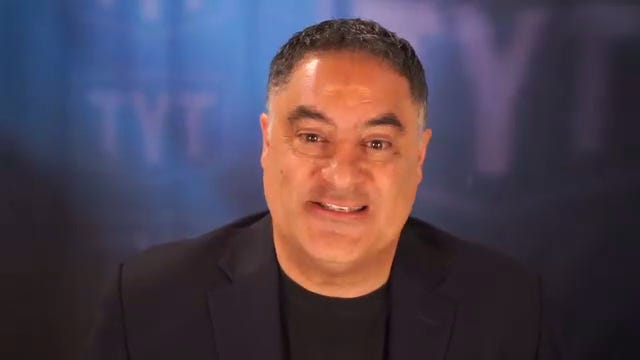
Where Cenk Uygur and I Disagree
May 300:16:14Tap to summarizeThis is a free preview of a paid episode. To hear more, visit peterbeinart.substack.comOur guest is Cenk Uygur, co-creator and host of The Young Turks, a popular progressive political show. Cenk and I largely agree about the war in Iran and US policy towards Israel, but I’ve been uncomfortable with some of his comments about Israel’s role in America's wars. I’m grateful to Cenk for being willing to publicly discuss my concerns—as well as sharing his critiques of me.Topics include…Israel’s influence on American politicsTucker Carlson, enemy or ally?The responsibility of Jews and Jewish leadership in opposing Israel
Transcribe →
Israel is Not Hungary
Apr 2700:08:48Tap to summarizeThis week’s Zoom call will be at our regular time, Friday at 1 PM Eastern. Our guest will be Cenk Uygur, co-creator and host of The Young Turks, a popular progressive political show. A month or so ago, Cenk and I were interviewed together by Piers Morgan and while we agreed about the war in Iran and US policy towards Israel, I was uncomfortable with some of the ways he spoke about Israel’s supporters in the US. Some of his subsequent comments have added to my concern. We spoke privately and then agreed to hold a public conversation. I’m struggling these days to find the right way of speaking to, and about, people who rightly demand a change in US policy toward Israel but sometimes express themselves in ways I find troubling. I’m grateful to Cenk for being willing to publicly discuss my concerns— and, of course, I’m open to hearing his critiques of me. Please join us.Cited in Today’s VideoNaftali Bennett and Yair Lapid join forces to defeat Benjamin Netanyahu, and pledge not to govern with Israel’s Palestinian citizens.Things to Read(Maybe this should be obvious, but I link to articles and videos I find provocative and significant, not necessarily ones I entirely agree with.)In Jewish Currents (subscribe!), 23 Palestinians reflect on the impact of Israel’s genocide on their lives.The disastrous legacy of Trump’s pullout from the Iran nuclear agreement.For the Foundation for Middle East Peace’s Occupied Thoughts podcast, I talked to Bard College Professor Ziad Abu-Rish about the roots of Israel’s aggression against Lebanon.AppearancesOn May 6, I’ll be speaking to the Joint Christian Advocacy Summit in Washington, DC.On May 18, I’ll be speaking to Town Hall Seattle and Third Place Books in Seattle, Washington.See you on Friday,PeterVIDEO TRANSCRIPT:So, there’s been a big development in Israeli politics. Israel has elections that will be later this year, and in the effort to unseat Benjamin Netanyahu, two of his most prominent opponents, Naftali Bennett, the former prime minister, and Yair Lapid, the former Foreign Minister, have teamed up together. If you remember, they were in a short-lived kind of one-year-long government together as a kind of unity government, and they’ve joined up together in the election. And this is explicitly being billed as people coming together across the ideological spectrum to defeat Netanyahu and to save Israeli liberal democracy.So, both Bennett and Lapid have cited what happened in Hungary, where the opposition forces kind of united in a broad tent to defeat Viktor Orban as a kind of model for defeating Netanyahu, and therefore kind of saving Israeli democracy through a coalition of the left and the right. Yair Lapid is conventionally described as a kind of figure of the center left. Bennett is a figure of the center-right, but Lapid described Bennett as, ‘a man of the right, but a man of the liberal, decent, law-abiding right.’And you can see how this framing would apparently seem to make a lot of sense in a comparative perspective, right? There’s been this discourse for many years now about figures like Trump, and Orban, and Modi, and Bolsonaro, and Marine Le Pen in France, and all of these as kind of representing this illiberal ethno-nationalist force around the world. And the question has been: how do people who believe in liberal democracy come together across their different ideological divides, but consolidate the support of people who believe in the principle of liberal democracy? And so, this appears to be that same dynamic happening in Israel, and I suspect there will be a lot of coverage in the American press that looks at it in this way.It’s fundamentally wrong. It fundamentally misunderstands Israeli politics and the nature of the Israeli state. It may be the case that Naftali Bennett and Yair Lapid both want Israel to remain a democracy based on the rule of law for Israeli Jews, and that there is a significant contrast with Netanyahu, in his kind of Trump-like way, basically wants to weaken the checks on the power of the Prime Minister in Israel in a way that would essentially allow him to override the rights of Israeli Jews, and of institutions that protect the rights of Israeli Jews, like the Israeli Supreme Court.But this is fundamentally different than what we’re talking about in Hungary or in the opposition to Trump in the United States, because Naftali Bennett and Yair Lapid are not talking about preserving democracy and the rule of law for the 50% of the people who live under Israeli control who are Palestinian. Not at all, right? To understand Israeli politics, one has to always start with the recognition that there are about 7 million Jews and about 7 million Palestinians between the Jordan and the Mediterranean. All of the Jews have citizenship and the right to vote for the government that controls their lives.Of the 7 million Palestinians, about 3 million live in the West Bank, under military law, without citizenship, without the right to vote for the Israeli government that has life and death power over them, and another 2 million in Gaza, similarly can’t become citizens of the Israeli state. The Israeli state has killed perhaps 100,000 of them, but there’s no voice they have over the Israeli government. And then you have 2 million of those 7 million Palestinians—a minority, less than a third—who are citizens of Israel, right?And so, they could be said to be living within a democracy. But even they are not fully equal members of Israel’s political system. And if anyone had any doubt about how deep the consensus is in Israel that even the minority of Palestinians under Israeli control who hold citizenship, that they are not equal citizens, we only need to look to what Bennett and Lapid just said this week in coming together.Bennett said, we—Yair Lapid and Naftali Bennett—will create an Israeli government which includes only Zionist parties. What does that mean? That is a way of saying we will not allow any of the parties that get their votes primarily from Palestinian citizens of Israel. We will not allow them into our government coalition because they are not Zionist, right? This Zionist line is basically a code for Palestinian, right? Because actually, some of the ultra-Orthodox parties are not technically necessarily Zionists either, but they don’t have a problem with having them in the government.The idea is that basically it has to be a government of Jews, and so even the minority of Palestinians who do have citizenship and the right to vote in Israel, even they cannot be part of this government, right, which is supposedly a government which is designed to protect Israeli democracy, right? But the entire discourse you see here of what democracy means is saturated with the underlying assumption that one is talking about democracy for Jews. It’s never even considered, right, that you might actually be talking about democracy for all people. After all, Naftali Bennett, one of the two figures who’s supposedly coming together to defend Israeli democracy is the former head of the Yesha Council, the former head of the settler movement in the West Bank. And Bennett also said that this new government would not concede one centimeter of land in the West Bank.So, the idea of talking about this as if it’s the same as what happened in Hungary, or the same as a Democratic Party effort to defeat Donald Trump, or an effort to overturn the Hindu nationalism in India, is completely misguided, right? It misunderstands the fact that all of Israeli Jewish politics, essentially, takes place within an ethno-nationalist framework, in which the very language of democracy itself is really, largely confined to the idea of democracy for Jews. Democracy for Palestinians is almost not even a subject of conversation when people like Bennett and Lapid talk about the very idea of democracy because the idea of ethno-nationalism, of Jewish supremacy so saturates the Israeli discourse.To understand Israeli politics, it really makes much more sense to think not about Israel as being similar to the US or Hungary, but to think about Israeli politics as being a bit like politics in the Jim Crow South, in which you could have fierce personal divisions between different political factions, and even different divisions about how they might govern as it related to white Southerners, right? But on the question of whether Black Southerners should have the right to vote, and should be considered part of the political process, that was simply off of the table. Because there was a very broad consensus up until the Civil Rights Movemen...
Transcribe →
"I Lost My Parents on October 7th, But I Won Aziz."
Apr 2600:11:28Tap to summarizeThis is a free preview of a paid episode. To hear more, visit peterbeinart.substack.comOur guests are Aziz Abu Sarah and Maoz Inon, co-authors of the new book, The Future is Peace. Aziz, a Palestinian born in the West Bank, saw his brother die from injuries sustained while held in an Israeli prison. Maoz, a Jewish Israeli born on a kibbutz near Gaza, lost both of his parents on October 7, 2023. Somehow, both men have turned their suffering into activism for justice and peace. We talk about their personal journeys, about the challenges of joint Jewish and Palestinian struggle and about how they maintain their faith in a better future in Palestine and Israel despite the horrors occurring there every day.Topics include…how grieving is different depending on one’s side of the power dynamicthe charge of normalization how to think about hatred as a response to traumathe willingness to speak with those who killed loved onesthe changes that must happen in the US
Transcribe →
How Hasan Piker Sees the World
Apr 2400:07:09Tap to summarizeThis is a free preview of a paid episode. To hear more, visit peterbeinart.substack.comTwitch streamer and political commentator Hasan Piker has been much in the news of late. He first rose to fame as a producer and host for The Young Turks, where he created the popular news series The Breakdown. Today, he’s one of the most-watched creators on Twitch, frequently collaborating with political figures like Alexandria Ocasio-Cortez to engage younger audiences in political activism. We agree on a lot, so I thought it would be better to focus in this chat on some of our disagreements, and thankfully, Hasan was game.Topics include…Defining ImperialismThe fall of the Soviet Union and its impact on the worldSouth African versus Israeli apartheidForms of resistanceusing the term “Nazi”
Transcribe →
It’s Not Just the Presidential Candidates
Apr 2000:09:33Tap to summarizeThis week’s Zoom call will be at our regular time, Friday at 1 PM Eastern. Our guests will be Aziz Abu Sarah and Maoz Inon, co-authors of the new book, The Future is Peace. Aziz, a Palestinian born in the West Bank, saw his brother die from injuries sustained while held in an Israeli prison. Maoz, a Jewish Israeli born on a kibbutz near Gaza, lost both of his parents on October 7, 2023. Somehow, both men have turned their suffering into activism for justice and peace. We’ll talk about their personal journeys, about the challenges of joint Jewish and Palestinian struggle and about how they maintain their faith in a better future in Palestine and Israel despite the horrors occurring there every day.Please join us.Cited in Today’s VideoDan Shapiro’s comments on the Iran WarThings to Read(Maybe this should be obvious, but I link to articles and videos I find provocative and significant, not necessarily ones I entirely agree with.)In Jewish Currents (subscribe!), Tanvi Misra writes about the relationship between the denial of the right of asylum and the rise of authoritarianism.In The Nation, Ahmad Ibsais argues that under international law, Israel may be committing genocide not only in Gaza but in the West Bank as well.Gavin Newsom endorses Donald Trump’s blockade of Cuba.AppearancesOn April 20, I’ll be speaking at Saint Anselm College in Manchester, New Hampshire.On April 23, I’ll be interviewing Mohammed R. Mhawish, the award-winning Palestinian journalist and writer from Gaza City, at CUNY’s Newmark School of Journalism.On April 26, I’ll be speaking at Brown Memorial Park Avenue Presbyterian Church in Baltimore, Maryland.On May 6, I’ll be speaking to the Joint Christian Advocacy Summit in Washington, DC.See you on Friday,PeterVIDEO TRANSCRIPT:There’s been a fair amount of attention recently to the way the Democratic politicians are shifting in their attitudes towards Israel vote on weapons sales in Congress, and also a number of statements by Democratic presidential candidates on the subject of weapon sales.But one of the things that I think doesn’t get as much attention as it deserves is the attitudes of the kinds of people who would be advising the next Democratic president, the foreign policy class that exists inside the Democratic Party, because it’s quite common for politicians to say one thing while they’re campaigning—presidential candidates in particular—and then to do other things in office. And part of the reason is because of the people they surround themselves with.And in the Democratic Party in particular, there’s a history of presidential candidates sounding more dovish when they run but then being more hawkish in office. So, Jimmy Carter, for instance, questioned the whole paradigm of the Cold War, and yet, when he was elected in 1976, he chose as his national security advisor, a kind of Cold War hawk, as a visionary of Brzezinski.Barack Obama, in 2008, was elected in part because he had opposed the Iraq War. That’s one of the reasons he defeated Hillary Clinton in the 2008 Democratic primary. But then Obama turned around and chose Hillary Clinton as his Secretary of State, and she was more hawkish than he was, as were a number of his advisors.So, I think it’s important to look at the kinds of people who would be advising the next Democratic president if we actually want to see a real shift in U.S. policy. And in that regard, I think it’s worth looking at a recent podcast interview done with a guy named Dan Shapiro.Now, I say this not because I want to single out Dan Shapiro as a bad guy or anything like that. I’m sure he’s not a bad guy. I don’t like to kind of attack people in any ad hominem way. I’m sure he’s sincere in his views. But I think what Dan Shapiro says in this podcast interview just illustrates how, for a lot of the kinds of people who would likely go into the next Democratic administration and help to shape policy on Israel, that they have a set of views on Israel policy that actually are radically different from where the Democratic Party base is, and really actually would continue overwhelmingly the same kinds of policies of virtual unconditional support for Israel that I think have been so destructive.And if the Democratic Party doesn’t actually face that and really try to cultivate people with a different view, I think the next Democratic Party president’s policies won’t be very different. Now, Dan Shapiro was on Barack Obama’s National Security Council. Then he was Obama’s ambassador to Israel for quite a number of years. Then Biden appointed him as the kind of special envoy to Israel dealing with the Iran issue.Now, Dan Shapiro did a recent conversation with Mark Dubowitz. Mark, on a podcast that a guy named Dan Senior has called Call Me Back. Mark Dubowitz is probably, like, the most high-profile person who’s been pushing for maximum pressure, and indeed war, from any think tank in Washington in recent years. What’s really remarkable to listen to this guy, Dubowitz, who is kind of like, in some ways, like, perhaps the most prominent hawkish think tanker in Washington.And Dan Shapiro, who’s a Democrat, it’s not about how much they disagree about, but it’s really the extraordinary amount on which they agree. They do disagree about the war—this current war. Shapiro says he thinks that it didn’t have a strategy, and that Trump didn’t explain to the American people, and he didn’t get support from America’s allies. But what’s striking about listening to this conversation between someone, again, who’s on the most hardline, hawkish edge of the Washington debate, you know, someone who would be on the right wing of the Trump administration, and a very prominent Democrat, the kind of person who could get a very prominent job making Israel policy, is that they agree so much more than they disagree, that Shapiro doesn’t question any of the fundamental legal or moral assumptions that underline this war.So, for instance, when Dubowitz and Shapiro talk about this question of Trump’s decision to blockade Iranian ports, that Shapiro says, to do—I’m quoting—to do that properly is a massive naval force project that will take time, right? So, he’s saying, basically, this would be really difficult to do, right? There’s no discussion of whether it’s morally or legally acceptable for the United States to basically impose collective punishment on the entire population of Iran.That Shapiro says that he opposes this war, but he says that he supported the 12-day War against Iran, and he says that there are other times when I think military force by the United States against Iran was and could be appropriate. Indeed, in talking about Israel’s military attacks on Iran, and also against the Palestinians, Shapiro says, Israel has a long-standing practice. It’s sometimes derided, but I think it has some value called mowing the grass. When a threat is present, you can’t necessarily be able to prevent it from periodically reconstituting, but you hit it as you need to hit it.This is a Democrat, someone who was in the Obama and Biden administrations; the kind of person who could have a prominent position in the next Democratic administration, who is speaking about this collective punishment of the entire population, about mowing the grass, the most dehumanizing language that you can use; no conversation whatsoever about the humanitarian cost this imposes on ordinary Iranians, about the horror of what this policy of mowing the grass has meant for people in Lebanon, and Israel has attacked again and again and again over the years, or what it’s meant for people in Gaza, right? Where, again, just to rehearse the obvious, you have the International Association of Genocide Scholars saying that Israel committed genocide.It’s just striking and deeply, deeply worrying to see that there are very prominent people who could likely populate the next Democratic administration whose disagreements with the most hawkish people in Washington is really comparatively at the margins. There are differences of tactics, but there’s no raising of fundamental questions, right? It seems to me the thing that we should be asking of anybody who wants to be involved in U.S. policy towards Iran or Israel in the next democratic administration is, first of all, that you never, ever talk about these military actions without centering the question of the cost to human beings, right? If you think that there is some value to military action, you always have to face it and look straight in the eye, the human lives that will be lost, right, which get no discussion in this conversation.Secondly, that you should never discuss something like U.S. military or Israeli military action against Iran or Lebanon or anyone...
Transcribe →
Mehdi Hasan on Being a Muslim Immigrant in Trump’s America
Apr 1900:10:03Tap to summarizeThis is a free preview of a paid episode. To hear more, visit peterbeinart.substack.comOur guest is Mehdi Hasan, formerly of MSNBC and now founder and editor-in-chief of Zeteo. Mehdi isn’t only one of the most important progressive voices in American media. He’s also a Muslim who cares deeply about his faith, and about reconciling it with his progressive principles. For several years now, we’ve held a running conversation, mostly in private, about what it means to be a progressive Muslim, or a progressive Jew, when many who speak for our faiths scorn the principles of human equality, and when white Christian nationalists run the United States. I’m grateful we had a chance to continue that conversation in public.Other topics include…Mehdi’s upbringingwhy the mainstream media is so dociledrawing the line on who he will or won’t engage withdistinguishing between Zionism and Judaism and confronting those who don’tdistinguishing between real antisemtism and false accusationsMehdi’s influences
Transcribe →