Podcast
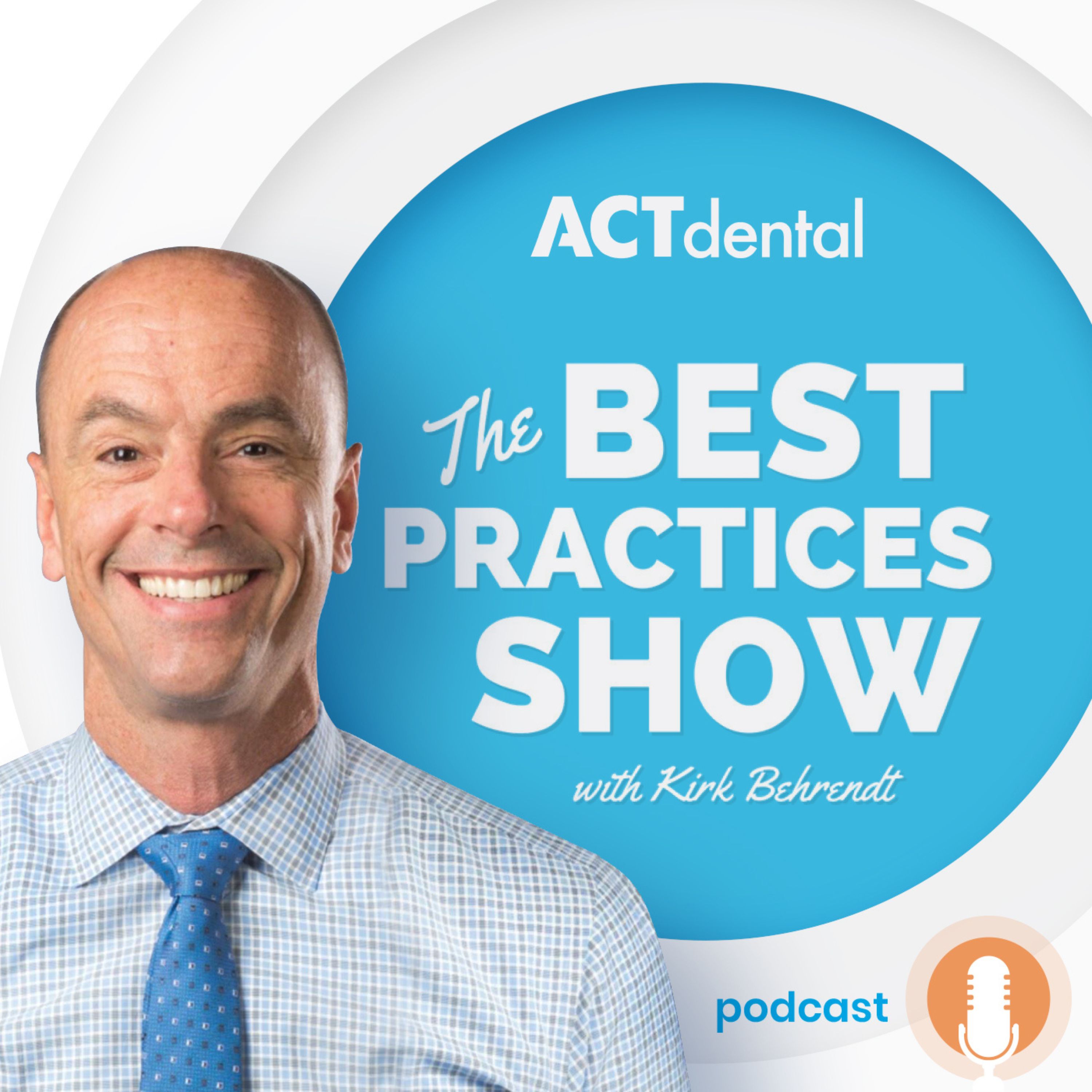
The Best Practices Show with Kirk Behrendt
Hosted by ACT Dental · EN
Welcome to The Best Practices Show, hosted by Kirk Behrendt, founder of ACT Dental (https://www.actdental.com/) and a leader in dental practice coaching. This podcast is your gateway to discovering the hidden gems and tactics used by the most successful dental practices worldwide.
At ACT Dental, we have meticulously curated strategies that have consistently proven effective in elevating dental practices. Our podcast, The Best Practices Show, extends our commitment to sharing this wealth of knowledge. Each episode features interviews with renowned dental professionals and industry leaders who have made significant strides in their practices. They share their experiences, insights, and the challenges they've overcome, offering a unique perspective that you won't find anywhere else.
Why should you listen to The Best Practices Show? Whether you're a seasoned dentist, a new practice owner, or somewhere in between, this podcast is tailored to inspire and educate. Our goal is not just to provide you with information but to transform the way you think about and run your dental practice. We delve into topics ranging from advanced clinical techniques and practice management to leadership skills and personal growth.
Kirk Behrendt, a respected figure in the dental community, brings his vast experience and infectious enthusiasm to each episode, making complex topics both understandable and engaging. As the CEO of ACT Dental, Kirk has helped countless dental practices thrive by focusing on holistic development - professionally, personally, and within their community.
Our commitment to authenticity and practical advice sets The Best Practices Show apart. We don't just talk about theories; we dive into real-life applications you can implement immediately in your practice. Our community-centric approach means we're always listening to our audience and constantly evolving our content to meet your needs.
In addition to the invaluable insights from our guests, we also provide access to exclusive resources available through ACT Dental. These resources complement the podcast topics and give you a more comprehensive understanding and practical tools to apply in your practice.
By subscribing to The Best Practices Show, you're not just gaining access to a podcast; you're joining a community of like-minded professionals committed to excellence in dentistry.
So, are you ready to transform your practice and be the best version of yourself? Join us on this journey, and let's grow together. Hit subscribe and never miss an episode of The Best Practices Show – where we uncover the secrets to the success of the world's best dental practices, one episode at a time.
Subscribe to The Best Practices Show on Apple Podcasts
Join our community and start your journey towards a more innovative, more successful dental practice today!
86episodes
Episodes
Newest firstAll episodes
1084: Metric Mondays: Provider Production: What Each Column Is Really Contributing - Miranda Beeson
Yesterday00:21:01Tap to summarizeProvider production reports can reveal far more than which clinician produced the most. When production numbers are viewed without context around capacity, schedule utilization, experience, and procedure mix, they can create inaccurate comparisons and unproductive conversations. In this episode, Kirk Behrendt and practice coach Miranda Beeson explain how to evaluate production by provider as a management and coaching tool rather than a scorecard. You will learn how to connect production with capacity, identify what is influencing each provider’s results, and use the data to create clearer expectations and better opportunities for your team to succeed. To learn how to get more useful information from your provider production reports, listen to Episode 1084 of The Best Practices Show!Main Takeaways:Provider production reports should be used as decision-making and coaching tools rather than simple scorecards.Production comparisons should account for differences in schedule capacity, clinical responsibilities, experience, and procedure mix.Capacity measures how much of a provider’s available clinical time is actually being utilized with patients in the chair.Production and schedule utilization should be reviewed together to determine whether each provider has an appropriate opportunity to produce.Practice owners should investigate why providers or specific days perform differently instead of assigning blame based on production totals alone.Reviewing successful and unsuccessful days with the team can reveal scheduling, case acceptance, and service-mix opportunities.Clear expectations and collaborative review of production data can support provider development and associate retention.Episode Chapters:00:00 Intro02:19 Why production reports matter04:00 Evaluating associate production with schedule utilization.06:15 Defining provider capacity.07:58 What practices get wrong with production reports.12:42 What healthy practices do differently.15:57 A practical exercise for reviewing production and capacity.18:00 Reviewing successful and unsuccessful days with the team.19:00 Developing providers and supporting associate retention.20:00 Closing thoughts.Guest Bio:Miranda Beeson has over 25 years of clinical dental hygiene, front office, practice administration, and speaking experience. She is enthusiastic about communication and loves helping others find the power that words can bring to their patient interactions and practice dynamics. As a Lead Practice Coach, she is driven to create opportunities to find value in experiences and cultivate new approaches.Miranda graduated from Old Dominion University, and enjoys spending time with her husband, Chuck, and her children, Trent, Mallory, and Cassidy. Family time is the best time, and is often spent on a golf course, a volleyball court, or spending the day boating at the beach.More Helpful Links for a Better Practice & a Better Life:Contact Gina to learn more about ACT: gina@actdental.comThe Best Practices Show: https://www.actdental.com/podcast/Smile Source Community Hub: https://www.actdental.com/community-hubUpcoming Events & Workshops: https://www.actdental.com/events/Smile Source: https://www.smilesource.com/Subscribe on Apple Podcasts: https://podcasts.apple.comSubscribe on Spotify: https://open.spotify.com
Transcribe →1083: Your Practice Is a Reflection of You: What Is It Saying? - Carlie Einarson
4d ago00:42:32Tap to summarizeDoes your dental practice clearly communicate what makes it different, or does it look and sound like every other office in your market? In this episode, Kirk Behrendt talks with Carlie Einarson, dental practice coach, about a four-step process for creating a practice that reflects what you value and attracts the patients you want to serve. You will learn how to differentiate your practice, define your core customer, identify your core competencies, recognize weaknesses, and align your team and patient experience around a clear strategy. To build a practice around what you do best and the patients you want to serve, listen to Episode 1083 of The Best Practices Show!Main Takeaways:Differentiation starts with clearly defining what your practice stands for rather than relying on convenience, insurance participation, technology, or other features competitors can replicate.Practices should identify their core customers by examining the patients who value treatment, respect the team, keep appointments, pay their bills, and refer others.Involving the team in defining the ideal patient creates alignment and can reveal patient characteristics the dentist may overlook.Core competencies should be meaningful strengths that patients value and competitors cannot easily imitate, rather than equipment, general labels, or expected levels of service.Consistently communicating what the dentist and practice care about helps attract patients who share those values.Practices should identify weaknesses such as poor systems, limited team development, weak treatment presentation skills, or gaps in the patient experience and address them strategically.Staying focused on your own strategy, values, patients, and strengths is more useful than trying to compete with another practice's size, technology, hours, or services.Episode Chapters:00:00 Intro02:51 Why branding matters05:35 Differentiation as a strategy for standing out.07:06 Trust as the real product12:00 Identifying the core customer you want to serve.17:19 Defining your ideal patient with your team.23:00 Identifying and communicating your core competencies.28:50 Consistently talking about what your practice cares about.31:00 Identifying weaknesses with self-awareness and team feedback.33:51Clinical development, systems, and treatment presentation weaknesses.38:11Staying true to your core purpose and values.40:00 Staying focused instead of competing with other practices.41:00 The Differentiation Tool and Strategic Marketing Guide.Guest Bio/Guest Resources:Carlie Einarson is a lead practice coach who has a passion for helping others succeed in the dental field. She loves helping to create a stable foundation for practices so both professionals and patients have a great experience every time they walk in the door!Carlie graduated from Utah College of Dental Hygiene. She has ten years of experience in the dental field, including clinical dental hygiene, front office, and leading teams.In her free time, she enjoys spending quality time with loved ones, traveling, skiing, playing volleyball, and golfing.Episode Resources:The Differentiation Tool: https://join.actdental.com/c/resources/differentiation-toolThe Strategic Marketing Guide: https://join.actdental.com/c/resources/strategic-marketingMore Helpful Links for a Better Practice & a Better Life:Contact Gina to learn more about ACT: gina@actdental.comThe Best Practices Show: https://www.actdental.com/podcast/Smile Source Community Hub: https://www.actdental.com/community-hubUpcoming Events & Workshops: https://www.actdental.com/events/Smile Source: https://www.smilesource.com/Subscribe on Apple Podcasts: https://podcasts.apple.comSubscribe on Spotify: https://open.spotify.com
Transcribe →1082: The 4 GAPs Every Dental Practice Needs to Know: Where Your Profit Is Really Going - Courtney Dalton
6d ago00:37:12Tap to summarizeA dental practice can produce millions of dollars and still leave the owner wondering where the profit went. In this episode, Kirk Behrendt speaks with dental practice coach Courtney Dalton about the four financial gaps that determine how production becomes usable cash.You will learn how to identify losses within adjustments, collections, overhead, and cash flow, along with the metrics and systems needed to improve profitability. Understand where your practice’s money is going and how to make informed financial decisions—listen to Episode 1082 of The Best Practices Show!Main Takeaways:The effort gap is the difference between a practice’s full master fees and its net production after insurance and elective adjustments.Practices must enter full fees for every procedure so their production and adjustment data accurately reflect the dentistry performed.The collections gap measures the difference between net production and the money that reaches the practice’s bank account.Financial policies, accounts receivable systems, insurance follow-up, and payment options directly affect collection performance.The overhead gap represents the percentage of collections used for operating expenses across seven expense categories.The cash flow gap explains the difference between profitability shown on a profit-and-loss statement and the cash available after loans, taxes, owner compensation, and other outflows.Measuring and monitoring each gap gives practice owners the information needed to make targeted financial improvements.Episode Chapters:00:00 Why high-producing dental practices can still lack profit.03:00 How production becomes profit within a dental practice.04:24 The effort gap and the impact of adjustments.05:44 Why practices must bill their full master fees.09:26 How the effort gap affects APV, PPD, and PPV.12:09 Why gross production does not determine practice value.14:08 The collections gap and the 99% collection target.16:04 Systems that improve collections and accounts receivable.21:08 The overhead gap and seven expense categories.23:04 Team compensation, staffing, and practice systems.26:22 The cash flow gap between reported profit and available cash.28:43 How loans and taxes affect cash flow.32:49 Why earnings and profitability determine practice value.33:20 The process of measuring, monitoring, and improving financial performance.34:39 How the four financial gaps affect one another.Guest Bio:With an A.S. in Dental Hygiene from Manor College and a B.S. in Exercise Physiology from West Virginia University, Courtney blends her expertise in both healthcare and wellness to drive success.As a member of the Business Development team, she is dedicated to helping doctors and practice owners realize their full potential by understanding the link between ownership, culture, and the health of the business. Courtney is all about building strong, thriving communities at home or in the office!Courtney has been a part of the dental community since 2004 and is as passionate about patient care as she is about those who are providing it. Outside of ACT, Courtney enjoys exercising and spending time with her family.Episode Resources:GAPS Calculator within the Community Hub: https://join.actdental.com/c/announcements-9fc6ae/financial-gaps-calculatorhttps://www.actdental.com/free-resources/Smile Source Transform Membership: https://info.smilesource.com/smile-source-act-dental-transform-membership-1More Helpful Links for a Better Practice & a Better Life:Contact Gina to learn more about ACT: gina@actdental.comThe Best Practices Show: https://www.actdental.com/podcast/Smile Source Community Hub: https://www.actdental.com/community-hubUpcoming Events & Workshops: https://www.actdental.com/events/Smile Source: https://www.smilesource.com/Subscribe on Apple Podcasts: https://podcasts.apple.comSubscribe on Spotify: https://open.spotify.com
Transcribe →1081: Metric Mondays: Production Per Hour: A Clearer View Than Production Per Day - Miranda Beeson
1w ago00:16:54Tap to summarizeA strong production day does not always mean a dental practice used its time efficiently. In this episode, Kirk Behrendt and Miranda Beeson, co-host of The Best Practices Show, explain why production per hour provides a clearer view of provider efficiency than production per day alone. You will learn how schedule design, procedure mix, capacity utilization, delegation, and provider hours influence productivity, as well as how to calculate and evaluate production per hour in your practice. To better understand the efficiency behind your production numbers, listen to Episode 1081 of The Best Practices Show!Main Takeaways:Production per day shows the total outcome, while production per hour reveals how efficiently provider time was used.A high-production day may still be inefficient when it requires extra hours, rushed appointments, fragmented procedures, or working through lunch.Intentional scheduling and an appropriate procedure mix can help practices maintain production while reducing clinical hours.Measuring schedule utilization helps practices identify lost production caused by unfilled provider and hygiene time.Comparing high-performing and low-performing schedules can reveal which procedures, workflows, and provider habits improve hourly productivity.Delegating tasks to trained team members allows dentists to focus on the clinical responsibilities only they can perform.Production per hour should be reviewed with curiosity and used to improve systems rather than punish or compare providers.Episode Chapters:00:00 Why production per hour provides a clearer view than production per day.01:00 Introduction to Metric Mondays and production efficiency.02:17 The difference between daily production and hourly production.03:48 What inefficient production looks like in practice.05:24 Why production per hour is the ultimate measure of efficiency.06:34 Creating leadership time through more strategic scheduling.07:26 What practices do differently when they measure time effectively.09:22 Improving production through schedule and capacity utilization.10:12 The financial impact of open hygiene appointments.11:18 How to calculate production per hour.12:01 Comparing provider schedules and procedure mix.13:18 Delegation as a way to improve provider efficiency.14:41 Asking the team how efficiently time was used.15:17 Using production data to identify practice opportunities.Guest Bio:Miranda Beeson has over 25 years of clinical dental hygiene, front office, practice administration, and speaking experience. She is enthusiastic about communication and loves helping others find the power that words can bring to their patient interactions and practice dynamics. As a Lead Practice Coach, she is driven to create opportunities to find value in experiences and cultivate new approaches.Miranda graduated from Old Dominion University, and enjoys spending time with her husband, Chuck, and her children, Trent, Mallory, and Cassidy. Family time is the best time, and is often spent on a golf course, a volleyball court, or spending the day boating at the beach.Episode Resources:Capacity Tracker: https://www.actdental.com/blog/data-snapshot-capacity-percentageWeekly Production Scorecard: https://www.actdental.com/blog/data-snapshot-production-per-visitMore Helpful Links for a Better Practice & a Better Life:Contact Gina to learn more about ACT: gina@actdental.comThe Best Practices Show: https://www.actdental.com/podcast/Smile Source Community Hub: https://www.actdental.com/community-hubUpcoming Events & Workshops: https://www.actdental.com/events/Smile Source: https://www.smilesource.com/Subscribe on Apple Podcasts: https://podcasts.apple.comSubscribe on Spotify: https://open.spotify.com
Transcribe →1080: 3 Leadership Bottlenecks Holding Your Practice Back - Heather Crockett
2w ago00:29:33Tap to summarizeWhen every question, decision, and critical process depends on the practice owner, growth slows and the team becomes increasingly dependent on one person. In this episode, Kirk Behrendt speaks with Heather Crockett, dental practice coach, about the three leadership bottlenecks that restrict practice performance: information, approval, and knowledge. You will learn how consistent communication rhythms, clearly defined decision-making authority, documented systems, and cross-training can help your team operate with greater ownership and consistency. To identify and remove the leadership bottlenecks holding your practice back, listen to Episode 1080 of The Best Practices Show!Main Takeaways:An information bottleneck occurs when important knowledge and communication flow only through the doctor or practice owner.Daily huddles, weekly team meetings, and leadership meetings create consistent communication rhythms throughout the practice.Leadership teams must align on decisions and quickly cascade the information to the rest of the team.An approval bottleneck develops when the doctor becomes responsible for routine operational decisions that other team members could own.A function and accountability chart clarifies responsibilities and gives team members defined decision-making authority.A knowledge bottleneck exists when a critical system or process is known by only one person.Documented systems, cross-training, delegation, and repeatable onboarding reduce dependence on individual team members.Episode Chapters:00:00 Intro 01:54 The three leadership bottlenecks holding practices back.03:14 Signs of an information bottleneck.04:31 Communication rhythms that improve information flow.11:32 Signs of an approval bottleneck.13:49 Developing leaders and reducing decision fatigue.21:39 Signs of a knowledge bottleneck.22:47 Documenting systems, cross-training, and delegating responsibilities.25:58 Final leadership takeaways and the Leadership Bottlenecks guide.27:28 Leadership training at the To The Top Study Club.29:00 Episode wrap upGuest Bio/Guest Resources:Heather Crockett is a Lead Practice Coach who finds joy in not only improving practices but improving the lives of those she coaches as well. With over 20 years of combined experience in assisting, office management, and clinical dental hygiene, her awareness supports many aspects of the practice setting.Heather received her dental hygiene degree from the Utah College of Dental Hygiene in 2008. Networking in the dental community comes easy to her, and she loves to connect with like-minded colleagues on social media. Heather enjoys both attending and presenting continuing education to expand her knowledge and learn from her friends and colleagues.She enjoys hanging out with her husband, three sons, and their dog, Moki, scrolling through social media, watching football, and traveling.Episode Resources:Leadership Bottlenecks Guide: https://join.actdental.com/c/resources/leadership-bottlenecks Traction by Gino Wickman: https://www.amazon.com/Traction-Get-Grip-Your-Business/dp/1936661837To The Top Study Club: https://www.actdental.com/ttt/More Helpful Links for a Better Practice & a Better Life:Contact Gina to learn more about ACT: gina@actdental.comThe Best Practices Show: https://www.actdental.com/podcast/Smile Source Community Hub: https://www.actdental.com/community-hubUpcoming Events & Workshops: https://www.actdental.com/events/Smile Source: https://www.smilesource.com/Subscribe on Apple Podcasts: https://podcasts.apple.comSubscribe on Spotify: https://open.spotify.com
Transcribe →1079: The Danger of Assumption in Your Dental Practice - Dana Watson
2w ago00:28:04Tap to summarizeMiscommunication in a dental practice often begins when doctors and team members make assumptions instead of clarifying expectations. In this episode, Kirk Behrendt speaks with Dana Watson, a dental practice educator, consultant, and certified Five Voices of Leadership trainer, about how assumptions create inaccurate stories, unresolved conflict, and inconsistent systems. You will learn how to establish clearer expectations, build reliable communication rhythms, prepare for difficult conversations, and improve communication with both team members and patients. To reduce assumptions and create greater clarity in your practice, listen to Episode 1079 of The Best Practices Show!Main Takeaways:Team members create inaccurate stories when important information is missing.Clear expectations help teams understand and consistently perform the behaviors required in the practice.Morning huddles and regular team meetings provide structured opportunities to address communication gaps.Leaders build respect when they acknowledge their own communication mistakes.Clarifying questions such as “Help me understand” can uncover the facts behind frustration or confusion.Important systems, core values, and non-negotiable expectations should be documented in writing.Dentists should not assume that patients understand available services, treatment recommendations, or clinical terminology.Episode Chapters:00:00 The danger of assumptions in dental practice communication.01:06 Dana Watson’s background in education and dentistry.03:05 How missing information causes people to create stories.05:58 Why communication systems require ongoing attention.07:35 Dana’s Everyday Excellence non-negotiables.10:47 Creating intentional opportunities for doctors and teams to reconnect.12:39 Using “Help me understand” as a clarifying question.14:13 Expectations, personality differences, and the Five Voices of Leadership.17:05 Communication rhythms and morning huddles.19:17 The consequences of leaving conflict unresolved.21:19 Reinforcing communication through written systems.23:14 Avoiding assumptions when communicating with patients.24:32 The Exchange and CollaborCon27:15 Closing thoughts.Guest Bio:Dana is an international speaker, author of Married to Dentistry, and a dedicated advocate for excellence in the dental field. After a decade of teaching high school science, she transitioned to dentistry to help her husband run his practice. With over 20 years of experience, Dana has developed a passion for empowering dental teams to achieve their best. Her speaking journey began in 2006 when she shared insights on Bettering Your Best with an international audience.Dana says she did not “choose” to go into dentistry, but found it necessary to join her husband’s practice to help it improve. At first, she felt resentful, but she came to love it, and it ignited a great passion for working in the dental field.Today, Dana inspires teams with her leadership, culture, and systems expertise. Resources:Five Voices of Leadership by Jeremie Kubicek and Steve Cockram:https://www.amazon.com/Voices-Communicate-Effectively-Everyone-Lead/dp/1119111099Communication Code: https://www.amazon.com/Communication-Code-Strategies-Stronger-Relationships/dp/1394150539Dana Watson’s website: https://danaspeaksdental.com/The Exchange: https://smilesource.com/exchangeCollaboriCon: https://www.collabriconcrew.com/More Helpful Links for a Better Practice & a Better Life:Contact Gina to learn more about ACT: gina@actdental.comThe Best Practices Show: https://www.actdental.com/podcast/Smile Source Community Hub: https://www.actdental.com/community-hubUpcoming Events & Workshops: https://www.actdental.com/events/Smile Source: https://www.smilesource.com/Subscribe on Apple Podcasts: https://podcasts.apple.comSubscribe on Spotify: https://open.spotify.com
Transcribe →1078: Metric Mondays: Gross Production vs. Net Production: What's the Real Difference? - Miranda Beeson
2w ago00:20:59Tap to summarizeHow much of your practice’s production can you actually count on as collectible revenue? The gap between gross production and net production can obscure profitability, distort financial decisions, and lead dentists to work harder without improving cash flow. In this episode, Kirk Behrendt and Metric Monday co-host and ACT Dental coach Miranda Beeson explain how gross production reflects clinical activity while net production reflects the financial reality of the practice. You will learn how to calculate your adjustment percentage, identify where production is being reduced, and use accurate data to make better decisions about providers, operatories, insurance participation, and growth—listen to Episode 1078 of The Best Practices Show!Main Takeaways:Gross production reflects the services and clinical activity completed by the team.Net production represents the amount the practice can potentially collect after adjustments.Practices must bill their full fees to accurately measure gross production and adjustment activity.Decisions about adding providers, operatories, patients, or locations should not be based on gross production alone.Adjustment categories should be specific enough to distinguish PPO adjustments, membership plan adjustments, professional courtesies, and other discounts.The adjustment percentage is calculated by dividing total adjustments by gross production.Reviewing gross production, adjustments, and net production together provides a clearer picture of profitability and collectible revenue.Episode Chapters:00:00 Intro02:13 Gross production and net production explained04:07 Why the gap between the two metrics matters.05:45 How gross production can lead to poor growth decisions.08:14 Reframing write-offs as discounts.11:36 How practices use both metrics correctly.14:08 Working smarter vs working harder15:51 How to calculate and evaluate the adjustment percentage.18:57 Improving adjustment tracking and reporting.19:53 Wrap upGuest Bio:Miranda Beeson has over 25 years of clinical dental hygiene, front office, practice administration, and speaking experience. She is enthusiastic about communication and loves helping others find the power that words can bring to their patient interactions and practice dynamics. As a Lead Practice Coach, she is driven to create opportunities to find value in experiences and cultivate new approaches.Miranda graduated from Old Dominion University, and enjoys spending time with her husband, Chuck, and her children, Trent, Mallory, and Cassidy. Family time is the best time, and is often spent on a golf course, a volleyball court, or spending the day boating at the beach.More Helpful Links for a Better Practice & a Better Life:Contact Gina to learn more about ACT: gina@actdental.comThe Best Practices Show: https://www.actdental.com/podcast/Smile Source Community Hub: https://www.actdental.com/community-hubUpcoming Events & Workshops: https://www.actdental.com/events/Smile Source: https://www.smilesource.com/Subscribe on Apple Podcasts: https://podcasts.apple.comSubscribe on Spotify: https://open.spotify.com
Transcribe →1077: Why Do So Many Leaders Avoid Conversations They Know They Need to Have - Miranda Beeson
3w ago00:36:18Tap to summarizeAvoiding a difficult conversation may reduce discomfort in the moment, but it creates confusion, weakens accountability, and allows unresolved issues to grow. In this episode, Kirk Behrendt speaks with Miranda Beeson, coach and director of education, about how leaders can address performance concerns while maintaining trust and supporting their team members. You will learn why accountability is an investment, how unclear expectations damage culture, and how to use the LIFT framework to lead productive accountability conversations. Build a healthier culture through clearer communication—listen to Episode 1077 of The Best Practices Show!Main Takeaways:Avoiding uncomfortable conversations creates confusion, inconsistency, frustration, and larger problems over time.A healthy practice culture requires both support and accountability.Accountability should call people up by showing that leaders believe they are capable of meeting a higher standard.Leaders must clarify whether an expectation gap resulted from unclear leadership or a team member not meeting an established standard.Team members are more likely to accept direct feedback when leaders begin with genuine care and support.Explaining the impact of a missed expectation helps team members understand why their actions matter.Accountability conversations must end with a specific commitment, action, and follow-up plan.Episode Chapters:00:00 Why leaders avoid necessary conversations.03:06 How avoidance damages accountability and culture.06:00 Why unresolved conflict becomes a crisis.07:49 Accountability as an investment in team members.11:58 Why being nice is not always kind.14:20 Introduction to the LIFT feedback framework.15:27 Lead with care.18:10 Identify the expectation gap.21:30 Frame the impact.24:02 Translate the conversation into commitment.26:04 Applying LIFT to a scheduling and patient-flow issue.29:11 Developing leaders who can hold others accountable.32:00 Using accountability to lift people into better performance.34:00 Resources coaching & wrap upGuest Bio:Miranda Beeson has over 25 years of clinical dental hygiene, front office, practice administration, and speaking experience. She is enthusiastic about communication and loves helping others find the power that words can bring to their patient interactions and practice dynamics. As a Lead Practice Coach, she is driven to create opportunities to find value in experiences and cultivate new approaches.Miranda graduated from Old Dominion University, and enjoys spending time with her husband, Chuck, and her children, Trent, Mallory, and Cassidy. Family time is the best time, and is often spent on a golf course, a volleyball court, or spending the day boating at the beach.Resources:To The Top Group Coaching: https://www.actdental.com/ttt/Guide to Giving and Receiving Feedback:https://www.actdental.com/blog/h.a.l.t.-before-giving-feedbackRadical Candor by Kim Scott: https://www.radicalcandor.com/the-bookThanks for the Feedback by Douglas Stone and Sheila Heen: https://www.stoneandheen.com/thanks-feedbackMore Helpful Links for a Better Practice & a Better Life:The Best Practices Show: https://www.actdental.com/podcast/Smile Source Community Hub: https://www.actdental.com/community-hubUpcoming Events & Workshops: https://www.actdental.com/events/Smile Source: https://www.smilesource.com/Subscribe on Apple Podcasts: https://podcasts.apple.comSubscribe on Spotify: https://open.spotify.comContact Gina to learn more about ACT: gina@actdental.com
Transcribe →1076: Why Most Dentists Get Orthodontic Collaboration Wrong–and How to Fix It - Dr. Bill Robbins
3w ago00:26:07Tap to summarizeEffective orthodontic collaboration depends on giving specialists a precise restorative endpoint before treatment begins. In this episode, Kirk Behrendt speaks with Dr. Bill Robbins, a general dentist, educator, and co-author of Global Diagnosis, about why conventional orthodontic referrals often produce teeth that are improved but not positioned correctly for definitive restorative treatment. You will learn how pre-orthodontic and intermediate bonding create a three-dimensional blueprint, why the restorative dentist must be involved before appliances are placed, and how composite and printed restorations can make interdisciplinary treatment more efficient. To improve communication with your orthodontic team, listen to Episode 1076 of The Best Practices Show!Main Takeaways:Traditional two-dimensional orthodontic prescriptions do not provide a precise restorative endpoint.Pre-orthodontic bonding makes worn teeth anatomically correct before the orthodontist moves them into position.Intermediate bonding may be necessary when a patient is already in appliances or when early bonding would create an unaesthetic appearance.The practitioner completing the final restorative treatment should be involved in treatment planning before orthodontic appliances are placed.Anatomically correct teeth improve communication with orthodontists, periodontists, and oral surgeons.General dentists who want to provide higher-level restorative dentistry need strong composite skills.Printed restorations may make pre-orthodontic bonding more efficient than direct composite placement.Episode Chapters:00:00 Intro01:05 Dr. Bill Robbins introduces the evolution of interdisciplinary communication.03:00 Why communication with orthodontists is more complex than communication with periodontists.04:06 The limitations of two-dimensional orthodontic prescriptions.05:53 How pre-orthodontic bonding creates an anatomical blueprint.07:40 Using three-dimensional communication to simplify orthodontic treatment.09:16 When intermediate orthodontic bonding is necessary.11:31 How anatomical correction affects implant placement and crown lengthening.13:26 What general dentists commonly get wrong when referring adult orthodontic cases.14:33 Why composite is an essential skill for restorative dentists.17:54 Digital wax-ups and printed pre-orthodontic restorations.19:21 The future of pre-orthodontic bonding.20:00 Dr. Robbins previews his presentation at The Exchange.20:24 The second edition of Global Diagnosis and its expanded airway component.22:00 How to access Dr. Robbins’s pre-orthodontic bonding article.25:15 Final Thanks and Wrap UpGuest Bio:Dr Bill Robbins is an acclaimed educator and author with decades of experience in restorative and interdisciplinary dentistry. His book Global Diagnosis: A New Vision of Dental Diagnosis and Treatment Planning has become a cornerstone reference for clinicians worldwide.J. William Robbins, D.D.S., M.A., maintains a private practice and is Adjunct Clinical Professor in the Department of Comprehensive Dentistry at the U. T. Health San Antonio Dental School. Dr. Robbins has published over 80 articles, abstracts, and chapters on a wide range of dental subjects and has lectured in the United States, Canada, Mexico, South America, Europe, Middle East, China, and Africa.Resources mentioned in the episode:Dr. Bill Robbins’s website: https://www.robbinsdds.com/Pre-Orthodontic Bonding article: https://www.robbinsdds.com/#articlesGlobal Diagnosis: https://www.quintessence-publishing.com/usa/en/product/global-diagnosisThe Exchange: https://smilesource.com/exchangeMore Helpful Links for a Better Practice & a Better Life:The Best Practices Show: https://www.actdental.com/podcast/Smile Source Community Hub: https://www.actdental.com/community-hubUpcoming Events & Workshops: https://www.actdental.com/events/Smile Source: https://www.smilesource.com/Subscribe on Apple Podcasts: https://podcasts.apple.comSubscribe on Spotify: https://open.spotify.com
Transcribe →1075: Metric Mondays: The Hidden Cost of Underdiagnosed Periodontal Disease - Carlie Einarson
3w ago00:17:22Tap to summarizePeriodontal disease is common, but many dental practices still underdiagnose it, undertreat it, and perform difficult prophies that do not address the patient’s condition. In this episode, Kirk Behrendt speaks with Carlie Einarson, ACT Dental coach and former dental hygienist, about the hidden clinical and financial costs of low periodontal diagnosis, visit, and treatment acceptance percentages. You will learn how to evaluate these metrics, identify gaps in your periodontal process, improve patient communication, and create a consistent protocol across your team. To uncover missed treatment opportunities and help more patients achieve better health, listen to Episode 1075 of The Best Practices Show!Main Takeaways:Perio visit percentage measures how many hygiene patients receive treatment associated with periodontal codes.A low perio diagnostic percentage may indicate that periodontal disease is being missed or inconsistently documented.A low perio visit percentage may indicate that diagnosed treatment opportunities are being left untreated.A low perio acceptance percentage may reflect unclear communication about the condition, recommended therapy, and value of treatment.Every adult patient should receive a consistent periodontal evaluation that includes appropriate radiographs, probing measurements, bleeding documentation, and clinical findings.Hygienists and dentists should help patients co-discover periodontal disease instead of only telling them what treatment they need.Chart audits and a shared periodontal protocol can help providers diagnose, document, and recommend treatment consistently.Episode Chapters:00:00 The hidden cost of underdiagnosed periodontal disease.01:37 The purpose of Metric Mondays.02:30 The three periodontal metrics practices should monitor.04:18 How improving periodontal treatment affects the rest of the practice.06:08 What an underperforming periodontal program looks like.07:37 What low diagnostic, visit, and acceptance percentages reveal.09:00 Why periodontal metrics are leading indicators of practice health.10:11 What practices do differently when they get periodontal care right.11:01 Helping patients understand periodontal disease through co-discovery.12:00 Why “gum infection therapy” communicates more value than “deep cleaning.”13:15 The importance of a consistent periodontal protocol.14:08 How to review periodontal metrics and conduct chart audits.15:44 ACT Dental’s periodontal protocol resources and coaching support.Guest Bio/Guest Resources:Carlie Einarson is a lead practice coach who has a passion for helping others succeed in the dental field. She loves helping to create a stable foundation for practices so both professionals and patients have a great experience every time they walk in the door!Carlie graduated from Utah College of Dental Hygiene. She has ten years of experience in the dental field, including clinical dental hygiene, front office, and leading teams.In her free time, she enjoys spending quality time with loved ones, traveling, skiing, playing volleyball, and golfing.More Helpful Links for a Better Practice & a Better Life:The Best Practices Show: https://www.actdental.com/podcast/Best Practices Association: https://www.actdental.com/bpaUpcoming Events & Workshops: https://www.actdental.com/events/Smile Source: https://www.smilesource.com/Subscribe on Apple Podcasts: https://podcasts.apple.comSubscribe on Spotify: https://open.spotify.com
Transcribe →