← THE Bitcoin Podcast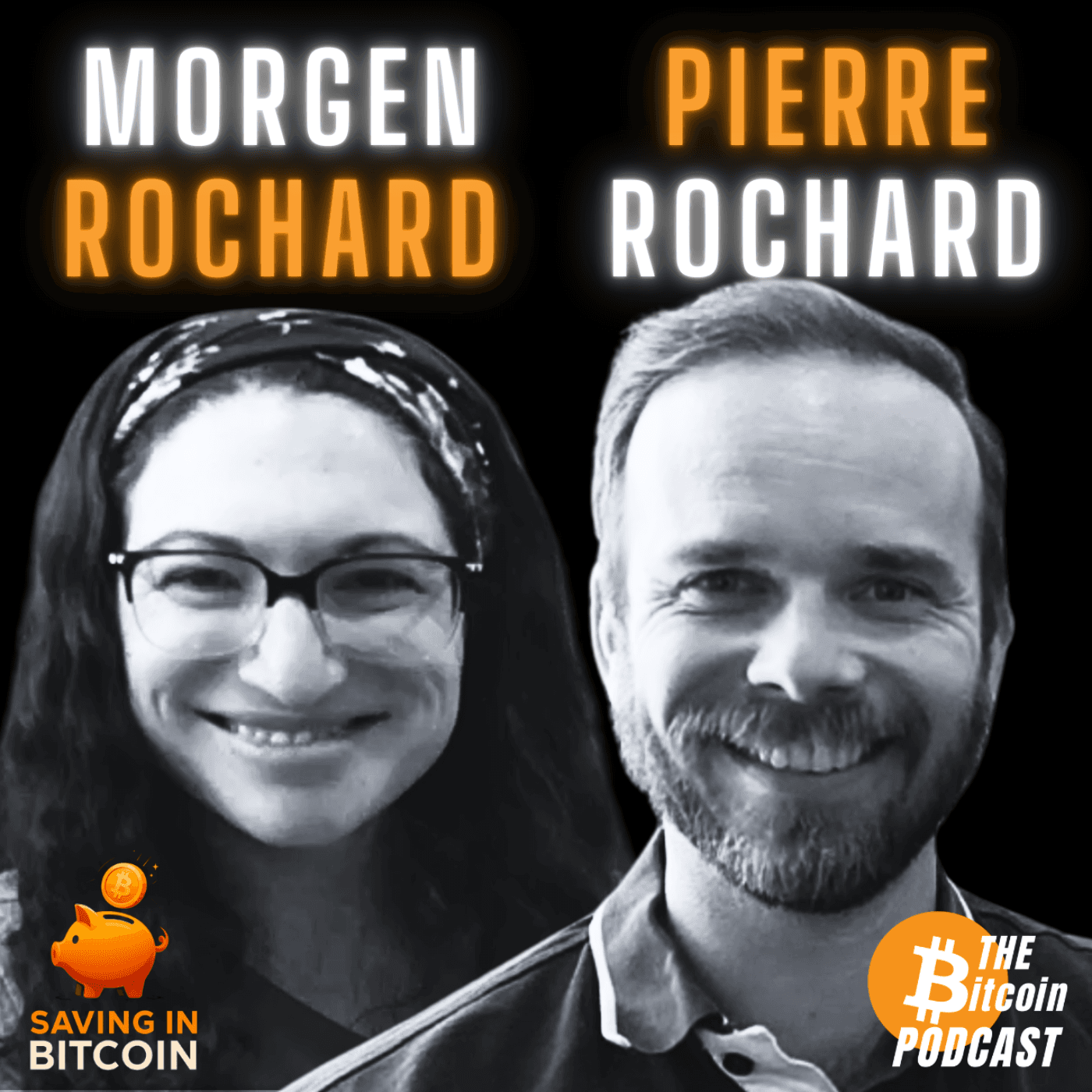
THE Bitcoin Podcast
HOW TO SET YOUR FAMILY UP FOR GENERATIONS WITH BITCOIN | Morgen & Pierre Rochard (Saving in Bitcoin Ep. 2)
01:02:39
Loading summary
Transcript63 lines
- [00:00]
Pierre Rochard
People say, oh, bitcoin's digital gold. And I argue it's actually better than digital gold because with gold, when the gold price goes up, the gold miners, they're incentivized to go find gold deposits and bring up more gold and produce more gold. That's not possible with bitcoin mining.
- [00:17]
Morgan Rochard
Whether or not though there's any other blueprint for financial freedom. No, I mean, I think that there isn't just any second best. I really don't think so. I think why people would hold other assets is going to be really dependent on their plan. Right. And who they are and what their risk tolerance is and what their specific needs as a family are. But for the average person, yeah, if they just want to hold cash in Bitcoin, they're going to be just fine.
- [00:36]
Pierre Rochard
If we look historically at Bitcoin's returns, there's no other assets that have outperformed Bitcoin. Just from that perspective alone, that does raise the question of what else would you put your money in? If you look at it from the software perspective, what other asset could use self custody like this, whatever. What other asset would let you sleep soundly at night knowing that it's the most reliable system? You know, it's open source. That kind of cryptographic technology combined obviously with the monetary policy is unique to Bitcoin.
- [01:13]
Walker
Welcome to Saving in Bitcoin. Your financial freedom blueprint on the Bitcoin podcast powered by Fold. The best place to buy, earn and save in Bitcoin. I'm your host Walker and in this six episode limited series I'm talking to some of the best minds in Bitcoin to walk you through the basics of why our money is broken, how Bitcoin fixes it and how you can use Bitcoin as your personal financial freedom blueprint. Let's get started.
- [01:46]
Pierre Rochard
Foreign.
- [01:53]
Walker
I'd like to welcome Morgan and Pierre Rochard. Morgan is a CFA and financial planner. Pierre is the co founder of the Satoshi Nakamoto Institute. Together they host the Bitcoin for Advisors podcast and they are also married. So Morgan, Pierre, welcome to you both. Thanks for both of you coming back on the show.
- [02:14]
Pierre Rochard
Thanks for having us on, Walker.
- [02:15]
Morgan Rochard
Yeah, thanks for having us.
- [02:17]
Walker
So as I mentioned, you've both been on here before. We've had different sorts of discussions. Longer form, this is going to be a little bit more focused specifically on Bitcoin really as a tool for financial independence, financial freedom and a savings technology, which is something you've both been very vocal about. But before we get into kind of all of these things I've just mentioned, I think it's helpful to start with a little bit of kind of setting the record straight about the fundamentals of bitcoin. We hear a lot of people talk about it as just another speculative investment. It's basically just a tech stock. It's like anything else. Maybe it's a get rich quick ticket. How do you actually break this down? What is bitcoin? How do you describe it simply for people who still are a bit confused about what we're even talking about here?
- [03:10]
Pierre Rochard
Kick it off.
- [03:11]
Morgan Rochard
No, I think you should. You're good for this.
- [03:13]
Pierre Rochard
Okay. All right. So when we think about how we use our money, I think that there's three different buckets that we can use. One is just not spending it, so just holding it. And we call that saving. Another is spending it on consumption. So that is ordering in doordash Thai food and eating that. And then the third is investing. So that is where you hand your money over to somebody else and they promise you that they're going to pay you interest in the future, pay you dividends. Somehow they're going to have some kind of economic activity that they're using that money for to generate a return. So when we think about how bitcoin fits into those three buckets, it's really in the first that when you're holding bitcoin, you're not investing it, you're not consuming it, you're just holding money, which is very foreign to us because over the past decades we have been taught and conditioned to not hold money because money is inflating away. We're used to just thinking about money as fiat currencies like the dollar or euros or yen, and that that is constantly losing its purchasing power. And so the rational thing to do is either go consume right away, live paycheck to paycheck, or immediately put that money to work by putting it, for example, lending it in a money market fund.
- [04:52]
Morgan Rochard
Right.
- [04:52]
Pierre Rochard
Or something like that, so that you're earning a yield that is trying to keep up with inflation. So I'll let Morgan get into the financial planning aspect of short term versus long term money. But that's in a nutshell.
- [05:08]
Morgan Rochard
Yeah, I think that's a great way of describing it. And then also to put into perspective, we don't. People don't really save money. Right. People typically think of savings as what they have in their brokerage account or what they have in their 401k. But unless you're keeping your brokerage account or your 401k in cash, which people simply cannot do. Right. You can put cash into these accounts, but at the very least, the brokerage or the custodian that you're using for this is going to take that money and sweep it into what's called a money market fund. And you're still holding an investment, right, because the money market fund isn't you actually holding cash. And likewise, people think of like, oh, well, I could just buy the S&P 500 in my 401k and therefore I have saved, quote, unquote. But that's not exact. That's not savings. Right. That's investment, like Pierre has mentioned. And so there's this difference between what we need for the long term versus what we need for the short term. And people typically think of both of those as being them saving, but they're definitely two different buckets. The short term is really whatever you need in the immediate in case there's some sort of short term uncertainty that comes up. And for that, actually Fiat's really great for. Because, you know, between now and three months from now, if my dishwasher breaks or my car breaks down or, you know, God forbid somebody gets hurt or injured and needs medical bill, right. And that's not maybe in my budget that I have some sort of short term reserve that's in Fiat cash that I can just go and take it out and go use it. Whereas long term savings would be anything that's beyond any short term need. But it's still uncertain, right? We don't know necessarily. Right. We might have plans for what the future might be, but we don't necessarily know whether or not those plans will come to fruition or what they'll look like or how much money we might need for them. And so we can do our best to plan for the long term, but we want to make sure that we're actually saving for the long term. And you simply can't do that in Fiat. You need to have some sort of alternative, which is why people are using things like the S&P 500 as a savings account. It's because you can't just put, sorry, not Bitcoin. You can't just put Fiat in your mattress and hope that it's going to be there for you in 20 years. And in fact, what people have found when they've saved cash over long periods of time is that if they didn't store it properly, right, it's rotted, it's hard to read the numbers. Right. The paper is very thin. There's all Sorts of issues. Why you wouldn't just stuff cash even in a safe. Not even to mention the fact that maybe if you saved $20,000 in cash 20 years ago, that's basically worthless now, right, Relative to what you could have bought and in the year 2000 with that money. And so there's a lot of factors as to why you can't use fiat as a long term savings, in which case something like bitcoin really does solve that problem.
- [07:35]
Walker
So I think it's a hard thing for people to wrap their minds around that there's a reason that bitcoin's hard to understand. It's because we haven't had anything that allows us to do what bitcoin does, which is actually just save money itself. That's what you're saying, right? Instead of saving, either trying to save in fiat currency, this thing that's losing value and is just not good for saving over anything more than a few months or maybe a year. Or you can do that or you can invest it in one of these various buckets of allocation with various degrees of risk and safety and return, many of which, though the safer ones are probably not even keeping up with the rate that your money is being debased. So you're kind of between a rock and a hard place when it comes to having something for the long term. So is that how you guys think of bitcoin? That is that it's something for the long term, it's for the, you know, it's not for today, it's not for tomorrow, it's not for next week. This is something as you're planning years or decades into the future. This is something as you're looking far ahead. So you say, I know I have this and it will increase in its value relative to everything else. Is that the goal with it?
- [08:48]
Pierre Rochard
So I think that there's that aspect of it of essentially looking at it as a price, a chart and seeing it go up and to the right over the long term, even though obviously in the short term it has been very volatile. And then if we dig deeper, we can ask the question of, well, okay, what is this price downstream of? What does it actually reflect from a fundamental perspective? Because some people argue that, oh, like bitcoin doesn't have any fundamentals, it's just like Beanie Babies or tulips and that it's, it's just, you know, that's what they mean by it just being speculative. And the reality is that bitcoin actually does have fundamentals. If you look at it from a software engineering perspective. So from a software engineering perspective, it's actually designed to be the most reliable monetary system in the history of humanity. And it accomplishes that through decentralization. So that essentially you're able to not only be your own bank, but be your own central bank. Meaning that if you run a bitcoin node, you are a key player in the monetary backbone of verifying every single transaction and the full money supply of this monetary system. That's where we talk about self sovereignty of Bitcoin. And obviously that comes with a lot of responsibility. You gotta keep your own keys and be kind of computer savvy in a way to be able to navigate that. If we contrast that to every other kind of asset that you can hold. So let's take for example, a silly one of Beanie Babies. Why is bitcoin different than Beanie Babies? Why? Well, because the company that manufactures Beanie Babies, anytime the market price of Beanie Babies goes up, they produce more of them. And so if we look at, okay, how's bitcoin different than that? Well, with bitcoin mining, even when the value of bitcoin increases, the bitcoin miners can't create more bitcoin than they're allowed to by the decentralized network of nodes. And so currently that's like 3.125 bitcoin every 10 minutes. And that can't change even if the bitcoin price doubles or triples. In fact, that gets cut in half every four years regardless of what the price does. And so there's actually an opposite mechanism of these halvings. And you can even compare that to gold. Right? People say, oh, bitcoin's digital gold. And I argue it's actually better than digital gold. Because with gold, when the gold price goes up, the gold miners, they're incentivized to go find gold deposits and bring up more gold and produce more gold. That's not possible with bitcoin mining for the same reasons as with Beanie Babies. Right?
- [11:44]
Morgan Rochard
So.
- [11:46]
Pierre Rochard
Where there's kind of a disconnect is in trying to understand, okay, what is the bitcoin price backed by? You look at bonds, for example. People will say, oh, bonds are risk free. Right? You've got the US treasury that's issuing bonds and they can't default on it. Well, why can't they default on it? Oh, because they can print money to pay the bonds. Okay, but now all you've said is that you're shifting the risk from the risk of default to the risk of currency, risk of inflation. And so it really isn't the case that it's risk free. On top of that, interest rates change over time. So you also have duration risk, reinvestment risk. So all of these risks, they don't go away just because a salesperson told you it's risk free. In fact, it's really strange that that's even allowed. People call that the risk free rate. And then with stocks, look, some stocks do really well. People look at Nvidia, they look at Tesla. But we always have to keep in mind that if you look at the history of the stock market, stocks rise and they fall and they rise and they fall based on the efforts of the management team, based on the changes in consumer tastes. So there's lots of other risk factors that are associated with stocks that you really don't have with an open source monetary system like Bitcoin. In particular, with Bitcoin's decentralization, it's not just a decentralization on the supply side that the miners can't just create bitcoin out of thin air. It's also on the demand side that the demand is what is going to drive up the bitcoin price long term. And so you have to wonder, okay, well, what is driving Bitcoin's demand? And it's the fact that you can control your own money, that you can be self sovereign. So I think that when we look at bitcoin versus other assets, we always have to tie it back to what are the fundamentals that are driving it. What's bitcoin backed by? It's backed by software and that software is open source. You can see every line of code. So that level of transparency is far greater than what you can have with stocks or bonds or other assets like that.
- [14:11]
Morgan Rochard
I think just to add to what you said too, I think people often what they're most worried about, right, is that they've made money and that they've even done a good job with it, right? They're a steward of it, where they make money, they spend less than they make and they have that net savings, right? And then what is going to be of my net savings? How can I best protect my net savings so that I have for now and I also have for the future? And often I think when people look at traditional markets, right, just like Pierre was talking about all the different risks that are associated with investing in all of these different types of assets that are available to people, it causes people a lot of anxiety. They have spent so much of their life of their day, every single day going to work to make their paycheck and do the right thing. Right. This is under the best of circumstances, right? There's obviously people where they're, you're, you know, they're not even breaking even and still obviously they want to have some sense of control over their financial picture to alleviate some of that anxiety. And when you look at what's available to you in this financialized system that we live in, we simply don't have any of that. And Bitcoin, actually, I mean, I think this is often overlooked because the volatility is so high in bitcoin currently and that people don't necessarily see it as having all of the value that Pierre just discussed. Right. They haven't maybe necessarily thought about the fact that like you can create more Beanie Babies, right? And then you can't create more bitcoin and the monetary policy is stable and such. But if you do, once you delve under the hood of bitcoin and you see that the monetary policy is predictable, it's unchangeable, right? All of a sudden these things start to make sense to somebody where they're saying, oh, this is something that I can't control it obviously, because I'm not, nobody's in control of bitcoin, but I have something reliable that I can look to that's not going to change. And there's going to be many aspects of my financial situation that will change and will be uncertain and things that I don't necessarily know. But at least I have something stable in, in my, in my life, right? With, with respect to money, where I can rely on that for the future.
- [15:57]
Walker
Stop earning dirty fiat rewards. Stack sats on everyday spending with the 2% bitcoin rewards credit card bifold unlimited Bitcoin back on a platform purpose built for savings. Head to the link in the show notes to get started. Buy bitcoin, earn bitcoin, get paid in bitcoin, make fold your personal finance hub for spending dollars and stacking sats. Well, let me jump on that volatility that you mentioned a little bit because somebody may be listening to this saying, okay, Pierre and Morgan, that's all well and good. You're telling me that these bonds are not really risk free, that stocks also, they go up and they go down and have risk. But wow, from what I've seen, bitcoin really goes up and it goes down and that seems pretty risky to me. I'm looking at the price chart. How are you telling me that this is not Risky. Is there a way to reframe this for people? Is that the wrong way to think about it? How do you guys think about it?
- [16:54]
Pierre Rochard
Well, we can look at what drives that bitcoin volatility, because I think that that's really important. So the reason bitcoin is volatile is because it increases in value too quickly. And so I consider that to be a good problem to have that bitcoin adoption happens in waves. Humans are social animals. We love our neighbors, we try to imitate them, and that means we all try to buy bitcoin at the same time and then we all panic, sell at the same time. So I think it's really driven by human emotions and traders. But if we look at the bitcoin system itself, it's 100% stable. The Bitcoin network operates the exact same way during a bear market than it does on a bull market. It's purely about the human psychology layer on top of it. If you have the resilience and discipline to see through that and to dollar cost average, regardless of what's going on, or to look at your overall financial picture and understand, okay, here's how much I need to have allocated to bitcoin as long term savings, then you're really, you know, the volatility is not a factor that should trouble you. The other reason why there's volatility is because on this very dynamic demand side of humans, on the other side you have supply that's fixed and so the supply does not adjust based on demand. In every other market, the volatility is dampened because supply increases when there's an increase in demand. So for example, iPhones, if an iPhone is very successful, rather than letting the price of iPhones increase in the secondary market, what Tim Cook does is just manufacture more iPhones and ship them over. And so that's really what is causing that volatility, is that intersection between humans being social animals and then the supply of bitcoin being fixed and immutable.
- [19:05]
Morgan Rochard
Yeah, for sure. And just to add to that, I think that what's often lost is the purchasing power volatility that people have that they don't notice. So for instance, if you were to log into your bank account and I didn't come up with this, so I don't remember who exactly said it, but if you were to log into your bank account and your bank account actually were to fluctuate based on a basket of goods that it knew that you had purchased and gave you your own personal inflation rate and actually showed that to you by, like, having your bank account bounce around, I think that people would notice very quickly that inflation is rapidly reducing the amount of value that they have in their bank account, right. Obviously, that's something that would be completely impossible for the bank to do. But I think the other thing to consider, right, is that people's volatility and purchasing power is really going to be relative to what that basket of goods that they're purchasing is. So for some people, right, they're gonna have a much lower inflation rate simply just because of what they're purchasing is not being affected from a demand side of what people are actually, you know, what most people are buying, right? Some people are just sort of off the beaten path or they're making their own food at home or whatever it is that they're doing, right? In which case their inflation rate is lower, right? Whereas if you've got a young family and, you know, they're really interested in organic food and making sure their kids have the right baby products, right, all of a sudden your inflation rate could be, you know, this one person over here who's farming things on their own maybe has an inflation rate of 2 to 3% like the government is saying that they have, but this other family over here is actually looking at 30% because, you know, they had to send their kids to daycare, and all of a sudden that jumped up in price and both parents have to work and they're trying to get the right food and everything else for their families, right? And so there's this volatility of purchasing power that simply happens based on who you are and what you're buying that's not taken into account and certainly not taken into account when people look at Bitcoin and they point at that volatility because that's something that is tangible and visible and able to see. Whereas this stuff is more hidden. And actually, like, I think the secretiveness about it makes it even worse and more insidious because people are more affected by it and don't make actual, like, rational changes as a result of it because they don't see it actually happening to them, them. And so, like, this volatility in and of itself, though, can be mitigated just based on, like, what we call position size in personal finance. So position size is just how much of your net worth or your investable assets are you willing to put in Bitcoin versus other. Other investments or savings that are available to you, right? In which case, for some people, right, they're going to be more willing to take more of their net worth because they don't need it over a short period of time. And they're going to be more willing to withstand that volatility simply because they don't need it. Whereas somebody who maybe they're a little cash tight or they don't necessarily always get a paycheck every other week, right. Their income's a little bit more unstable. There are many reasons why people would want to have more, let's say, fiat available to them to be able to meet all the needs that they have in their day to day life, and less bitcoin as a percentage of their net worth. And this volatility, I think is most dampened by how you allocate, rather than just pointing at the asset and saying, not for me because it's volatile.
- [21:51]
Walker
I think that that's a, a really good point. And honestly, I think that even if the bankers could make your bank account fluctuate based on actual inflation, they wouldn't want to do it. Their bosses at the Federal Reserve would be like, no, come on, guys, no, you can't show that we're going to have a revolution very quickly. Well, so I think that it's a really great framing of the volatility because that's one of the things that I think scares people off a little bit when they're first coming into bitcoin. I think another thing just going back to the human psychology that you guys both touched on is this idea that I'm too late. You know, I see people who are. And maybe it's a friend of theirs, maybe it's a family member who told them to buy Bitcoin 10 years ago when it was, you know, trading. Trading it, you know, hardly. You know, just a, for a. You could buy a bitcoin for two raspberries like the boomers bought their houses for in the 70s. But you know, you could, you could get. Bitcoin was very cheap then. And they look at it now and say, oh, well, you know, it's, it's so many thousands and thousands of dollars. I must have missed the boat. I must be too late. I'm never gonna catch up to where my other friend is or to where these people I see on TV are. So what's even the point of me starting to save in bitcoin? I've missed the boat. What do you say to those people? I mean, are we still early? Is there still hope for anyone at this point? Or have they in fact missed the boat? They should just pack it up, go home, accept their lot in this fiat world.
- [23:18]
Pierre Rochard
So I think that we have to look at it from like a data driven perspective essentially, which is saying, okay, we can look at the survey data that shows that bitcoin has complete name recognition at this point. So everybody in the world has heard the word bitcoin. They might not understand how it works or you know, what a UTXO is and all that, that's fine, but they've heard the word. So there's that brand recognition. But if we look then how many actually own some bitcoin? Well now we've reduced it to really less than 5%. And then if we look at what percentage of global balance sheet is bitcoin. So today bitcoin's market cap, let's say it's $1.7 trillion and we look at total global wealth, that $1.7 trillion is far less than 1% of total global assets. And so just looking at it from that kind of top down perspective, and if we think that bitcoin is going to increase its market share, and personally I think that it's going to really dramatically increase its market share over the Next, let's say 50 years, then we're still very early. So I think that from there we can say, okay, well bitcoin's price today, if it's at $90,000, that might sound expensive, but that's only because of unit bias, that there's only 21 going to be 21 million Bitcoin. Today there's somewhere around 19 million Bitcoin. And that's why I make a point of posting on X screenshots of buying $20 worth of Bitcoin because people don't understand this unit bias and they don't understand that Each Bitcoin has 100 million Satoshis in it. So I think that this is like a big hidden secret within bitcoin is that it's highly divisible, which is interesting because others pick up on the divisibility and they actually think that's a problem because they think it undermines the scarcity. Which, you know, it goes back to the big question of how many pizza slices you know should you cut. But in any case, testament to the educational system. Yeah, boy, we can write a whole.
- [25:53]
Walker
Show on this one, I think, because I didn't know it was still such a contentious issue, divisibility, but apparently it's very difficult to grok who knew it.
- [26:03]
Pierre Rochard
Is the verifiable finite scarcity of bitcoin. So that's where I think we're really early and to anybody who thinks that they're late, I would say, no, not at all. In fact, I would say if you look at the overall context of bitcoin and the ecosystem around it, there's never been a better time to actually get involved. The tools are far better than they were 10 years ago. The risks are actually lower. I think that if you look at it from a risk adjusted expected return, it's never been greater. That's why I think that people shouldn't have this mindset of, oh, we're too late.
- [26:45]
Morgan Rochard
Definitely. I think that the reason why it's over a trillion dollar asset class is because of that, a lot of the early risks have been removed, I think, at least. And it is. It's never been easier for people, and it's never even been easier for people to be educated on the subject. There's so many books now, so many podcasts, so many blog posts. Right? There are so many ways to find good information about bitcoin, which simply wasn't there even five, six years ago.
- [27:09]
Pierre Rochard
There's still not enough podcasts.
- [27:10]
Morgan Rochard
Yeah, it could be more. We need.
- [27:12]
Pierre Rochard
We're so early.
- [27:12]
Walker
Yeah, we need. Until there are more bitcoin podcasts than traditional finance podcasts, I don't think we've reached bitcoin podcast saturation. It's just. Just a fact. The numbers don't lie. There's far too many. I think, trad five podcasts. That's the issue there. But I appreciate that because I think it's one of the things I hear when I talk to people kind of the most, is just, well, I feel like I've missed the boat. And so knowing that, look, in the grand scheme of things, relative to somebody, you're late, but relative to the vast majority of the entire world, you're still very early. And I think that's, like, it's important for people to put that in context. There's. And so I want to switch gears a little bit and talk about just you guys as a family. You're obviously, you're both bitcoiners. You are a married couple. You have children. Morgan, you are a financial planner and financial advisor. You obviously think about these things a lot, about how bitcoin fits into your own personal family financial planning. And so I'd love if you could just. What do you. How do you guys think about this from that family perspective? So we've established this is a way for you to save long term. Is there some other part of your toolkit? Like, is there something. Is there a second best option for people. Is there, you know, is there something else that they have that if they say, I just refuse to get into bitcoin, I'm still gonna be fine, I'm gonna make my way. Or is this just kind of a. Does this need to become a part of everybody's own personal blueprint for how they plan their finances?
- [28:47]
Morgan Rochard
Yeah, I mean, I think at the very least, it's important for people to take any kind of position in bitcoin that they're willing to take. And that, to me means that somebody has accepted that bitcoin is what we were saying, that is that it's money, that it solves a specific problem that they have. Right. So there's. There's some buy in that needs to be associated with it. But once you have that, I think that anyone can take a position in bitcoin, whether it's, you know, buying a thousand satoshis or it's actually moving a huge portion of your net worth into bitcoin, whether or not, like somebody buying a thousand satoshis is actually going to hedge their financial plan against all of these headwinds and risks that I see out there. I think that's, you know, I don't. I don't necessarily think that that is going to help them in that regard. But it's a good start. It is a good start, right? Yes, exactly. Start somewhere, and you're much more likely if you dip your toe in to then go up to your ankles and your knees and so forth until you're swimming in the water. Right. And so I think, like, in the bitcoin community, we often forget about that because we think, okay, if we just preach for 30 minutes about what bitcoin is, or we just do this podcast with Walker, after everyone gets off of listening this, they're going to go move 100% of their net worth into bitcoin. And that's just, you know, I think it's just a little unrealistic. Right, because people need to be exposed to these ideas over and over and over again until it is, like, clicked, right. A switch is flipped, and then things have changed. Whether or not, though, there's any other blueprint for financial freedom. No, I mean, I think that there isn't any second best. I really don't think so. I think why people would hold other assets is going to be really dependent on their plan, right. And who they are and what their risk tolerance is and what, like, their specific needs as a family are. But for the average person, yeah, if they just want to hold cash and bitcoin like they're going to be just fine. I think that that's often not said in the financial communities that I tend to be in because, you know, financial planners, like part of our job is making sure that people allocate their assets to investments, right? And so in some way, right, I'm like putting myself out of a job by saying this. But also like, I think that if I'm really looking at what's best for people, right, if they hold a reasonable amount of cash that helps them cover any kind of short term needs, an emergency fund that might come up, or even let's say they're doing something that's not an emergency, right? Like starting a business or wanting to, you know, fund kids education, that's in the short term horizon, right? There are reasons why you would keep extra cash around and that would be appropriate for somebody's plan. And then thinking about, okay, everything else that's long term, I can hold bitcoin and I'm going to be just fine as long as I really am thinking about this as a long term savings vehicle and a technology that will help me do that rather than a get rich quick scheme, which I think is what people often think of bitcoin when they, when they want to invest in it. And then, you know, from there it's like, okay, if that asset allocation isn't for you for a number of reasons, okay, then let's talk about what percentage is appropriate and why we should still include in the plan. But people who are zero, I mean, I don't think actually that that plan is going to work out. We do have clients that are like that when we're constantly reminding them like, hey, let's at least look at this, let's talk about it. Even if we're not going to allocate to it just because it's important. And it's something that is very different than I think other periods of time in the past, right? There would be events that went on globally or nationally or whatever it is and the market would recover from it because that was the only option that people had. Whereas we're in a time now where you can actually opt out. You don't have to be a part of this system and you can still save for the long term, right? If anything, you could save better for the long term now that bitcoin is available rather than what the other options are. And so I think that that's often lost on people because they've been told over and over again, right, from like The Boglehead books and other things like that, where if you just buy and hold that, you're going to be fine. And I just don't see it that way anymore.
- [32:22]
Walker
Pierre, anything you wanted to add on top of that? That was a lot of fire that was just spit there.
- [32:31]
Pierre Rochard
Well, I mean, yeah, if we look historically at Bitcoin's returns, there's no other assets that have outperformed Bitcoin. So just from that perspective alone, that does raise the question of what else would you put your money in? And then of course also if you look at it from the software perspective, what other asset could use self custody like this? What other asset would let you sleep soundly at night knowing that it's the most reliable system, it's open source. And that kind of cryptographic technology is combined obviously with the monetary policy is unique to Bitcoin. So on top of that, I think that people miss this concept of network effects. And this is really important for a monetary system. And you don't just have the network effects of the payment system, you also have the network effects of the liquidity. And liquidity begets liquidity. That's a very self reinforcing process. And that's where I think that if we look at Bitcoin's long term adoption, it's what gives me the confidence to say that Bitcoin is going to continue to be the number one monetary crypto asset in the world. And it's going to not just stay number one, but the lead it has between number one and number two is going to continue to widen. And this is something we've seen with Ethereum. So if you price Ethereum in terms of Bitcoin, over the past 12 months it has lost 50% of its value. And that really speaks to the fact that with a network effect essentially liquidity is draining from Ethereum to Bitcoin. And that's going to continue to happen even if Ethereum gets flipped by Solana or by Ripple or whatever else can become number two, the gap. And I think it's a lot like people get misled when they look at the rankings, right? They think like, oh, Bitcoin's number one, Ethereum's number two. And they think that it's like the Olympic 100 meter race of you got to look really closely to see who won. But it's actually a giant difference, a 10x difference that's becoming 100x difference of the liquidity of the relative value between these different systems. And I think that trend is going to continue to grow.
- [35:09]
Walker
So needless to say, you would say that people should probably avoid the trap of these alternative crypto coins. That's not something you're advising people to pursue, is that, Morgan?
- [35:22]
Morgan Rochard
Yeah. Well, I would say also that it's very easy to get caught up in what's going on in these other coins because they weave a nice story. They talk about it very rationally. They mention a scam like they're serving you, you know, a steak on a platter, right? Like, they're not saying it in a way that sounds sleazy. Well, some people are, but a lot of people are. Are just coming off as like, oh, this is totally normal. You can just put all of your money into this scam and like, we'll inflate it away and we'll give you yield, but it'll be, you know, it's basically going to be gone. But, you know. But they don't say it like that, right? They say it very nicely and that, like, this is something that you're, you know, you should look into and you're missing out because look at all these people who are making all this money on crypto, quote, unquote. And I just think that if you're. Yeah, exactly. If you are looking at this because you want. You think you missed the boat with bitcoin, like we mentioned, and you want to get rich quick, right? Because I think people all have this sort of fantasy that they're going to buy some coin for 20 cents and that it's going to go to 80,000. Right. Like, because they think when they think of bitcoiners, they think of, like, the original OG holder who bought it when it was a dollar and who's held it all the way. And, you know, the reality is, is that I've talked to a lot of people who have been in from the beginning, and most people haven't held it the whole time or they've lost coins or whatever it is. Right. There are very few people who really did buy at 20 cents and are still holding today. And so, like, I think that people just have this misunderstanding that even if they did do that in one of these altcoins, that they would even be the kind of person that could hold all the way to, you know, whatever the end point is for these coins. And so, like, the allure of, like, the penny stock as it used to be, right. Is now the allure of these cryptos. And I think that we just need to get out of this materialistic trap where we're trying to, you Know, try to game the system and really focus on what's important as a family, which is bringing in some income, making sure that we don't spend more than we make. Right. And having some sort of net savings and then allocating that net savings appropriately according to what our family needs.
- [37:09]
Pierre Rochard
I think people also look at past cycles and they say, okay, well, you know, bitcoin's going to pump, and then that liquidity is going to rotate into altcoins, and so then you'll have an alt season and altcoins will pump. And what we've seen this cycle is that it has become so easy to create a new altcoin. Right. They call them meme coins now, or may. May coins, as I heard one person refer the French to it. Yeah. That the new cryptos are being created faster than you have new adoption. And so they're all diluting each other out. They're diluting each other financially. They're also diluting each other from a narrative perspective. And so the greatest example of this was when President Trump came out with his Trump coin, and then I think it was a day later, his own wife comes out with Melania coin and essentially caused Trump coin to crash. Because it's like, okay, wait a minute. So there's gonna be, like, lots of different meme coins associated with the first family, and they're all diluting each other out. And then you're gonna have Baron coin and you're gonna have Don Jr coin, and then you're gonna. You know, it's like, okay, that is not going to cause sustainable value accrual beyond even what I was talking about with the liquidity network effects, the altcoins are all stepping on each other and dragging each other down. And so I think that people who assume an alt season, really, what we're also finding is that it becomes an increasingly insider's game of, oh, do you have a friend who's involved in launching the meme coin? Then, yeah, you might have an edge. But then they start backstabbing each other and they start rugging each other within the insider group. And there's been lots of stories about this. So I think that it's really a very vicious game, and I don't think that normal people should be involved, and I don't think abnormal, weird people should be involved either.
- [39:31]
Morgan Rochard
Just to add to that, though. Yeah. That people often don't think very critically about these things. Right. I mean, the whole reason why bitcoin exists is because there is a. There's an issue with the money. Right. And bitcoin is aiming to solve, to fix the problem with the money. Right. And then other altcoins have come out basically stating that they have all these problems that they're going to solve. And at some point we have to sort of think critically and say, okay, how many of these coins are solving any problem at all? And is this problem actually a problem that they're aiming to solve? And I think that if people are approaching it like that, rather than, what gambling thing can I do that somebody else is gonna look at that's gonna pump my value and so forth. Right. You have to think so many different things about what other people are thinking, about how they're gonna go into it. I can't. It's like an inception in a movie where you're like, you just keep going, right. In order to make money. It's like, okay, is that really the right way to approach it? Or can we just look at this critically and think, okay, like, what actually would be important for me to have as far as my investment portfolio and savings portfolio is concerned, rather than trying to just solve for, you know, whatever it is that is popular at the moment?
- [40:33]
Walker
Yeah, I think that that's fantastic advice. And these things should be avoided like the plague, because ultimately, I mean, unless you are. Have an appetite for destruction, in which case, I guess have at it. But if you're looking at building something lasting, building something for your family, for, you know, maybe you're. Maybe you're married, maybe you have kids, maybe you'd like to have, you know, have a marriage or have kids. Either way, you want something that's going to last for the long term, that you don't need to be checking on every 5 seconds to see if it got rug pulled or not, you want something that you can plan for your future. And so how should people, or how do you perhaps think about this bitcoin in the context of your family, in the context of setting something up for generations? I mean, do you view this as something, you know, are you. Are you guys going to get rid of all of your bitcoin when, you know, by the time you're, you know, once you kick the kids out of the house later, you know, head off to college kids, by the way, we're selling the bitcoin and we're moving to Puerto Rico or whatever? Is that how you think about it? Or do you think about this in. In longer terms? Is this something that creates a new paradigm for families to actually allow them to plan for generations?
- [41:40]
Morgan Rochard
Yeah. So I think that if you have fundamentally changed how you view both, I guess, earning money and spending money, right, and creating a savings reserve. So for a lot of people that's going to be difficult, in which case if they don't have enough of a savings reserve, right, they're not going to be able to save enough in fiat or bitcoin, right, to be able to create this multi generational plan for their family. But people who are good savers now have just a huge leg up on, on what used to be in the fiat world, right, because in the fiat world you had to save so much money more, right, in order for, not only for you to outpace inflation, right. But also to make a return above inflation. And so for a lot of people, especially in this day and age where inflation is running rampant relative to maybe what it had been in previous years, not including the 80s, right. But where people really need to try very, very hard in order to save and then also invest in just these standard assets and then hope that basically they get a long term 7% return or whatever it is. Which I think is why there's a appeal of all these get rich quick things. Because we're in a society now where it's really, really difficult to get ahead. Whereas if you are, if you're a good saver and you're saving a bitcoin, right, you're leaps and bounds ahead of where other people may be. In which case, like your job at that point is, okay, what is the purpose of this money? How is it going to be meaningful to me and my family today? But also, how is it going to be meaningful to me and my family in the future? And not just even me, right? Maybe just my family in the future because maybe I'm not there anymore when this is even more valuable than it is today. And so I think that, like, when you're thinking about that, you want to really be concentrating on how much of your bitcoin you're actually spending during your lifetime. Because if you do want to create this lasting reserve and legacy within your family to really create meaningful change for many generations to come, then you can't just be thinking about, well, bitcoin has outrageously high returns, in which case those are going to persist and I can take whatever withdrawal rate that I want on it. Because, you know, it doesn't matter how much I have left, right? If I have one satoshi left, right, it's worth more than it would have been when I first started, in which case, right, it's worth trillions of dollars or whatever it is that people typically say about bitcoin, but I don't think that that's the end goal. Right. And I don't think that with the values that I often see with people who are in the bitcoin community, I don't think that that quote, unquote, die with zero that people often think of when they think of in the fiat world. I don't think that that's relevant here because we don't have to die with zero. And we can really make lasting change and live life with a lot of purpose if we do it intentionally.
- [44:06]
Pierre Rochard
Yeah, I agree. Something else that struck me was Josh Mandel mentioned that we often say people buy bitcoin at the price they deserve, meaning that if you were skeptical About Bitcoin at $100 and you, you know, you were very full of yourself and proud that you're too proud to do any research on it, you've already made up your mind. And then you get humbled because, you know, it goes up to $1,000, and then you do your due diligence, and then you buy, or you. You continue to be, you know, very skeptical and jaded. Maybe you're even cynical. And so you wait, and then it goes up to $10,000. So all that meaning that our own hubris gets in the way of us acquiring bitcoin, and thus it's only just that we get punished by having to buy in at a higher price. Well, Josh pointed out that every kid's innocent, and so shouldn't every kid essentially be able to acquire Bitcoin at $0? And that, I thought was the most persuasive argument for bitcoin is intergenerational wealth of you're going to hand something down to your kids for free at $0 because that's the price they deserve. And then if they go and waste it all, you know, they go buy a Lambo and they go wrap it around a tree, God forbid, then they've essentially divested themselves of the bitcoin at the price they deserve. And so I think that that's a really great perspective on it. So I do see it as intergenerational. Maybe as we get older, I'll change my mind. And I'm like, no, I want to spend the bitcoin, not give it to our kids. So I reserve the right to change my mind.
- [45:58]
Morgan Rochard
Yeah, for sure. I think, too, though, to add to that is that if you want to make sure that your kid doesn't buy a Lambo with your bitcoin and then wrap it Around a tree. It doesn't start with giving them money. It starts with teaching them values. And so. Right. It's a lot easier for us to do things for our kids. And I'm guilty of this, so it's not like, you know, I'm doing this all the time, but it's a lot easier for us to just do things for our children rather than to expect things of them. Right? Because obviously, as adults, we're going to be better at doing them than our children are. Right. That's the whole point, is that we are adults and we have lots of experience doing whatever it is that children haven't learned yet, whether it be tying their shoe or setting the table or cooking a meal. Right? But our. The role that we have as parents is to impart this wisdom, these values, right? To the point where it is so ingrained in them as a human being and it's deeply embedded in their soul that they go and take those values and then they get married and have children, and they then share those values with their children and so forth. And so if you are just really good at that. Right? And obviously there are a lot of things that are outside of our control that, you know, at the end of the day, even if you teach your kids values, right, it may just go in one ear, out the other, but at least do your best, right? That's your best hope for making sure that your kids don't squander all your money, rather than, you know, wrapping up money in all sorts of trusts that have, you know, just ridiculous dates on it where your kids are basically dependent on you like they otherwise would be on, let's say, the government or Social Security system. I don't think that that creates a healthy relationship between parent and children. And so the whole point, I think, of all of this is that you are making a difference in the world, whether it be for just your community in general or for your children. Right. And. And showing those values and demonstrating them in a way that actually has a lasting impact.
- [47:34]
Walker
How. How do you. If I can ask, how do you talk to your kids? I'm not sure of their exact ages, but, like, are you having conversations with them about money? Do you have any tips for people about how to talk to their kids about this? You know, especially if they're. They're younger, but you want to start them young. You want to start imbuing these, you know, these kind of. These virtues and these ideas in them about how they should, you know, handle these things. How do you start to have that conversation Especially for people who are not used. You know, they're not financial planners, they're not experts in having these conversations. You know, maybe they never got that talk themselves. How do you recommend that people go about having that conversation with their kids?
- [48:14]
Pierre Rochard
I think that we have to be shameless in it in the sense that, you know, other people, like, they will shamelessly indoctrinate their children into their worldview. And I think bitcoiners should have the same approach. So, you know, for the store and they want to buy a toy and it's like, hey, look, we can't buy this toy because of inflation, okay? The government has printed too much money. This toy is too expensive at this point. And so essentially using that as a scapegoat in a lot of different contexts. Or for example, if you're looking at ingredients for a chocolate bar and you say, oh look, it's got these seed oils in it, it's an inflation ingredient because they've added the seed oils to lower their costs in order to keep the nominal price low. Even though the government has caused this inflation. Really, in any kind of context, you can always tie it back to the money because as bitcoiners, fix the money, fix the world, that's one of our key perspectives. There's that and then also emphasizing with them that dollars are the government's currency. The government controls dollars. Bitcoin is our currency. We control bitcoin. And that's a very simple concept that they can wrap their heads around. And that way you can get the education started early, get them down on the right path, and hopefully you don't have to send them to college and then they get indoctrinated into Keynesianism where you've got these professors who they're pretending that what they're saying is true and doing it shamelessly. So I think that as bitcoiners, we can't have this approach of, oh, well, I'm gonna be like neutral and I'm not going to try to impose my crazy orange pilled ideas on them. I'm going to, you know, like, give them both. No, you gotta have, you gotta stand up for the truth and you know, raise them. Right.
- [50:33]
Morgan Rochard
Yeah, I think all of that. And to add to that, right, you have to teach your kids responsibility and you have to also teach them responsibility with money by letting them do, do it. So I think parents often don't want to do this because they don't want to hand their kids $20 and then their kid just goes and buys something that the parent Thinks is, you know, completely ridiculous. Right? But you need to let your kids do that, because your kids actually come around to the idea that. That what they did is completely ridiculous. So, for instance, with our son, like, he gets an allowance for things, but he also. And he also has a lemonade stand business that we've enabled. Right? So encouraging entrepreneurship and finding a way to earn money rather than. Than just, you know, leeching money off of people, I think is a. Is a. Is a good start, but also allowing them to spend it. Our son decided that he was gonna take his money and buy something for his Brio train set. He was very excited about it. He saved all the money, even down to the penny. We went with a bag of dollars and cents to the store. The woman was just not happy about having to count up the money because she's used to people tapping their own credit card. So, you know, she's like, ugh, count this kid's money. But he went and he bought this toy, and he brought it home, and he was disappointed. Even in the store. He saw the box, and he was like, oh, this box is smaller than I thought it would be, you know, and he takes it out, and he was like, well, it's. I mean, it's a really cool toy, but, like, it's just not what I thought it was gonna be. And actually, still this day, he does play for it, and I think I play with it, and I think that, like, he does value it because he actually did go and buy it with his own money, so it wasn't a total waste, but he definitely learned the lesson of, like, you know, advertisements show things in a way that are different than they are in reality. Right. I spent all this money that I spent weeks and weeks and weeks saving on this one thing that turned out to be a disappointment. Right? Something. Sometimes things that we don't necessarily agree with as parents end up being really good lifelong lessons for children. And so I think that we have to be mindful of that. Of, like, okay, we share our values. We indoctrinate them from a bitcoin perspective of what's right and what's wrong. We teach them the truth, but then we also let them go out and experience the world.
- [52:23]
Pierre Rochard
It's really important for your kids to be disappointed.
- [52:25]
Morgan Rochard
Yeah, yeah, yeah. And struggle, too. I feel like our lives are so easy, right? You hit a button and, like, you know, hats show up at your doorstep, and it's like, you know, kids need to go through some kind of struggle in this day and age because they're not going to actually learn the life skills that they need to deal with the struggles that they're ultimately going to endure later.
- [52:44]
Walker
Amen to that. And I think, yeah, there's probably a lot of adults who could still stand to use that or learn that lesson, but it may be. They may be a little bit too far gone at this point, sadly. I did just want to ask, does your son have a permit for that lemonade stand or does he? No, I'm just kidding.
- [53:00]
Morgan Rochard
Thank God we live in Texas, so we don't need that.
- [53:02]
Walker
Yeah, I was going to say don't try that in Illinois. You'll have cops showing up, being, checking for papers and things. That would be tragic. But no, I appreciate that a lot because as a parent of a young child, these are things that I'm thinking about. I know a lot of bitcoiners and maybe non bitcoiners who hopefully will be soon after more diligent research, are thinking about these things too. And I think they matter. It's like, not only what do you leave for the next generation, but how do you make sure that they're ready when you leave it to them? Because if they're not, it's not really worth that much then, is it? You know, it's. And I think that's kind of the. The key point. Even if it's worth. Worth a heck of a lot, if they don't handle it well. Well, then you've kind of missed half of the. Half of the battle there. I'm curious too, and I want to be. Want to be conscious of. Of both the time here. But I wanted to ask you guys, what do you see as, you know, okay, we're in the year 2025. Bitcoin's been around for a little while now. It's like you said, Pierre, most people at least have heard of bitcoin, even if they don't haven't gone deep in it at all. But it's at least out there, it's a part of the cultural fabric. What do you see as the biggest misconceptions still that are still plaguing bitcoin and the ones I should say specifically that are maybe holding back the individual? Maybe it's something on the climate side, maybe something else. But do you think there are things at the individual side that people just still don't get, and that's what's holding them back?
- [54:36]
Pierre Rochard
I saw somebody recently post a sentiment which I think is pretty common. He said bitcoin is not real. And, you know, it's like this. It's almost like they have this mystical understanding of computers where they think that if it's zeros and ones, that it's not real. And, well, it is real. Electronics, electricity, these are parts of our reality just as much as anything else. And so I think that that's. That's holding back a lot of people who. They aren't even really, like, accustomed to living in a digital world or getting like, okay, you've called it magical Internet money. Like, it kind of literally is magical Internet money for a lot of people. And they need to get it through their skulls that there's no magic about it. It is software engineering. It's electrical engineering. It's, you know, it's real.
- [55:46]
Morgan Rochard
Yeah. I think also, like, just because something isn't something that you can taste, touch, feel. Right. It doesn't make it any less part of the world. Right. Like, there are many aspects of the universe that we don't necessarily understand or know about, but that doesn't mean that we can't live on Earth just because we don't know what dark matter is. You know, like, it doesn't mean that you can't use a car just because, you know, the average person doesn't know how every in and out of the car works. Right. It doesn't mean that you can't use Fiat just because you don't understand how the Fiat universe works. Right. Almost nobody understands how Fiat works, and yet we all seem to do just fine using our dollars every single day. And so I think that there's a misunderstanding because there are people, like, weren't Buffett out there who say, don't invest in things that you don't understand. And so people are like, well, I don't understand Bitcoin, so whatever. And it's like, okay, but you don't need to understand that much to understand enough to be a part of it. And that, I think, is a key misconception for people.
- [56:45]
Walker
Last thing I would ask, how do you balance. And is there such thing as having enough Bitcoin? And how do you balance that with trying to live a life of purpose and not just striving to accumulate ever more wealth in Bitcoin or in anything?
- [57:05]
Morgan Rochard
Yeah. So there's a book that. It's called, like, the Five Wishes. I can't remember the title. It's like the Five Wishes of the Death and the Dying and people. Basically, what they said when they were on their deathbed. And there wasn't a single person that ever said, I wish I took more work meetings I wish that I had more money. I wish that I had fancier cars or a fancier house or a lake house or whatever it is that people want. I think we get really distracted every single day by all of our wants that we have. And we don't necessarily think about what our actual needs are, which for everybody on earth, it's that lasting connection that they have with family, community, friends. It's making an actual impact on, on our day to day lives. Having a place in the world where we matter. Not just because we have a big house or a boat, right. But because we actually matter and what we're doing matters. Being creative in some way or another. For some people, that's work, but that doesn't. Creativity extends far beyond work, right? And so there are many, many ways for you to express yourself in this world. There's, you know, having a relationship with our creator. I think for a lot of people is really, really important. I know that that's really important to our family. Right. All of these things though, money weaves into them, but they aren't the only thing, right? It's not what is purposeful in life. And so I think if we are especially guilty of this in the bitcoin community because we kind of wrap our lives around bitcoin and like, bitcoin is the mission, but bitcoin might be the mission to make sure that all of these other things happen, right? Like, don't let that be lost because. Right. Like bitcoin will help us do all these things, but bitcoin isn't the reason why we're here.
- [58:36]
Pierre Rochard
Well said. Well said. I also think that when you think about life and happiness, a lot of things in life are free, especially the things that make us happy. And that once you start, like if you buy a Lambo and you drive it around for a few days, it's not even new anymore. And so you're on this treadmill of things that are not fulfilling. And so that I think is self limiting. And that's so the problem solving itself.
- [59:14]
Morgan Rochard
Yeah, yeah. Just to add to that, I mean, I don't think that we're here on earth for endless pleasure, right? I think people often think like, oh, my life should be happy and pleasurable all the time and I should always have what I need. I should be comfortable, right? And so it's like, okay, but when you go to the gym, right? If you're comfortable at the gym, do you become better in any way? Right. Do you like get the muscles that you want or have? Like have a Healthier body, like generally. No. Right. If you're like, if we live our life in comfort, we don't actually grow as any as a human being. And so I think that that's really important to recognize that like pleasure is not everything in life. And so if we're just trying to accumulate money to make sure that we're more comfortable and that we're having more great things. Right. That that's not necessarily like purposeful and meaningful for anybody. And so I think balancing that with like what your family actually needs. Right. Versus like what, you know, what they need from you from a perspective of like what you can provide outside of money, I think those two things definitely need to be balanced.
- [60:12]
Walker
Just got me thinking. Maybe it's one of the unforeseen benefits of bitcoin being so quote volatile is that it reminds you of how good the good times are because it's does instill. It gives you a little bit of pain. It's not just all pleasure. It's not just a one way ticket. Straight up. There's a lot of sacrifice and pain and fortitude that is required to hold bitcoin for the long term and to try and use that as a tool to live a better life, not just to accumulate more of it. So I appreciate both of you very much coming on here. It's a pleasure to talk to you both. I just enjoy the heck out of both of you. For people that want to find you, Morgan, you're Morgan Richard. M O R G E N on X. Pierre. Bitcoin Pierre. Pierre is spelled like Pierre. Anywhere else you want to send people where they. If you have anywhere else you want to just direct them to where they can find out more or Morgan, if people are interested in your services for financial planning because they're like, I need some help with all of this.
- [61:14]
Morgan Rochard
Yeah. So we run a podcast called Bitcoin for advisors. It's on all the major platforms. My financial planning firm is or Origin Wealth Advisors. You can find that@originwa.com I also have a bitcoin financial planning or financial consulting practice and that's moneyowners.com you can find me there. If you want us to answer a question live. We do that for our podcast so you can shoot us a note on.
- [61:33]
Pierre Rochard
Twitter and for myself, the Nakamoto Institute, nakamotoinstitute.org and you can go to Slash Donate to help support more bitcoin education in the world. And yeah, go check us out and follow me on Twitter X at Bitcoin Pierre.
- [61:51]
Walker
Thank you both so much for sharing your time. Enjoyed the heck out of this and I think I hope it gives people some perspective and also some actionable tips on how to move forward in this crazy bitcoin world we live in. So thank you both.
- [62:03]
Morgan Rochard
Thanks for having us. This is great.
- [62:11]
Walker
Thank you for watching Saving in Bitcoin, your Financial Freedom Freedom blueprint on the Bitcoin podcast. Bitcoin is a return to savings, real savings built on sound money. Make fold your personal finance hub and take control of your financial freedom. Buy, earn and save in Bitcoin all in one place.