← Clock It with Symone & Eugene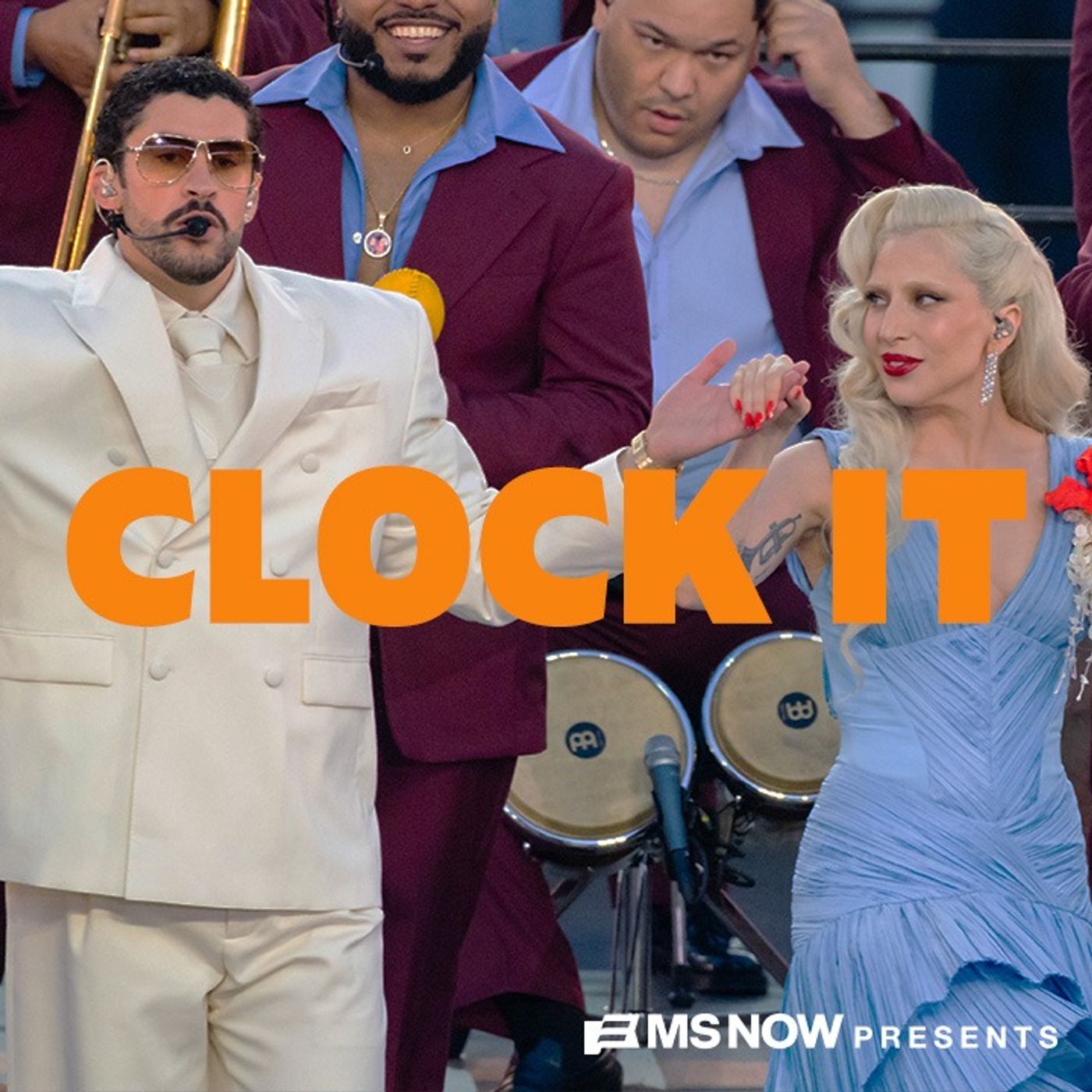
Clock It with Symone & Eugene
Bad Bunny, Texas Dems, and the Artists Making People Nervous
00:46:30
A “scandalous” president and the former star of “MJ the Musical” discuss the duty of an artist in politically turbulent times.
Loading summary
Transcript335 lines
- [00:00]
Thumbtack Advertiser
Avoiding your unfinished home projects because you're not sure where to start. Thumbtack knows homes so you don't have to don't know the difference between matte paint, finish and satin or what that clunking sound from your dryer is. With Thumbtack, you don't have to be a home pro, you just have to hire one. You can hire top rated pros, see price estimates and read reviews all on the app. Download today.
- [00:21]
MSNow Premium Announcer
Subscribe to MSNow Premium on Apple Podcasts for early access, ad free listening and bonus content to all of MSNOW's original podcasts. Exclusive including the chart topping series the Best People with Nicole Wallace. Why is this Happening? Main justice and more. Plus new episodes of all your favorite Ms. Now shows ad free and ad free listening to all of Rachel Maddow's original series, including Rachel Maddow presents Burn Order. Subscribe to Ms. Now Premium on Apple Podcasts.
- [00:54]
Simone Sanders Townsend
Greetings, I'm Simone Sanders Townsend.
- [00:56]
Eugene Daniels
And I'm Eugene Daniels. Welcome to Clock it where we post.
- [01:00]
Simone Sanders Townsend
Up at the intersection of politics.
- [01:02]
Eugene Daniels
Because while most politics talk is focused on the halls of power, the real political games are being played outside. They're on football fields, on the runways, and on TikTok.
- [01:11]
Simone Sanders Townsend
That's right. You have to remember Donald Trump understands better than frankly any other politician that the culture is where the power is.
- [01:19]
Eugene Daniels
And he's been a big part of culture since the 80s, before we were even born. He shows up in music. I'm at the Trump International, ask for me.
- [01:27]
Simone Sanders Townsend
I'm just trying to get rich like Trump in movies.
- [01:30]
Eugene Daniels
What are you working on, Donald?
- [01:32]
MSNow Premium Announcer
Well, I'm working on buying St. Patrick's Cathedral, maybe doing a little rip down job.
- [01:36]
Eugene Daniels
And of course on TV on January.
- [01:39]
MSNow Premium Announcer
8Th, NBC presents the ultimate job, working.
- [01:43]
Eugene Daniels
For the toughest boss. That would be me, Donald Trump introducing the Apprentice.
- [01:49]
Miles Frost
You're fired.
- [01:50]
Simone Sanders Townsend
And he rode that wave of attention all the way to the White House twice.
- [01:54]
Eugene Daniels
So Clock it is where we talk about what we see and hear as the political games bleed into the culture. So you can start to clock it too small. Tell the people what's going on right now.
- [02:03]
Simone Sanders Townsend
Well, today we are talking about Democrats going on a run, even though some of the girls are fighting. We are talking about billionaires cutting costs by decimating our information infrastructure. And we are talking, of course, about the Benitzo movie, about how Bad Bunny made Trump so mad that he actually forgot to watch Kid Rock do the body with a bomb. Bomb, bomb. Whatever it is that he does, he didn't watch that thing.
- [02:27]
Eugene Daniels
It should have been. He told Kid Rock. Plus, we'll be joined by my favorite former president, actor Tony Goldwyn, who you probably know as President Fitzgerald Grant III from Scandal. He will be here along with Miles Frost to talk about what, if anything, people with a stage, a microphone, a presence owe the public when society is under political stress.
- [02:47]
Simone Sanders Townsend
Welcome to Clock It. Let's get into it. I want to start with Texas.
- [02:52]
Tony Goldwyn
Yes.
- [02:52]
Eugene Daniels
Do you know I have a Texas tattoo on my ribs?
- [02:54]
Simone Sanders Townsend
You have a Texas tattoo on your ribs? For real?
- [02:57]
Tony Goldwyn
Yes.
- [02:57]
Eugene Daniels
Cause we live.
- [02:58]
Simone Sanders Townsend
You are from South Carolina, but I.
- [02:59]
Eugene Daniels
Lived in Texas twice as a kid. Cause I was a military brat. And so when I was in college, I had, I went and I was like, I want to get a Texas tattoo. So I have a big state of Texas and a big cross and a heart where I was living at the time.
- [03:12]
Simone Sanders Townsend
I'm not going to discuss the tattoos that I have. But I don't have any states, ladies and gentlemen. It's my only state because you got the Texas statue. So you must be very well aware of the midterms going on. There's a lot of seats, frankly, up in Texas. There's a governor seat, a United States Senate seat, attorney general, lieutenant governor, a lot of state legislators. Very busy, very busy. But we want to focus on what's going on in the Democratic primary child. Because Democrats have been on a run across the country, as we just said, they've put up a little winning streak at the state and federal levels since Trump 2.0 started in 2025. Democrats have consistently shown growing momentum. They have either won or overperformed in these special election races. And I think it is foretelling what's to come at the end of this year.
- [03:57]
Eugene Daniels
It shows you where the excitement is. Right. You can't read too much into some of these special elections, but when you look at who's voting and how they're voting, that tells you if you can get someone come out on a Tuesday in November on a midterm year.
- [04:09]
Simone Sanders Townsend
No state's race, though, I think right about now is more interesting and more, you know, popping up in my group chats than what's going on in Texas in the Democratic primary between Congresswoman Jasmine Crockett.
- [04:19]
Miles Frost
Yes.
- [04:20]
Simone Sanders Townsend
And State Representative James Talarico. James Talarico, the thing that I think.
- [04:24]
Eugene Daniels
Is most interesting about this primary for Democrats is that the split in the party is no longer ideological. Right. The actual split is whether you want to fight or not. And I think these two people show how different groups in the Democratic Party Want to fight, right? Like James Talarico. He's much more, you know, his demeanor's calmer.
- [04:43]
James Talarico
I got into this because of my students. I got into the classroom in the fall of 2011, right after the state legislature cut $5 billion from our schools. I had 45 kids in one classroom. There weren't enough desks for all those kids. So I had. I had students sitting on the air conditioning unit. It's unacceptable. And that's why I ran for the state legislature. It's why I flipped a Trump district that no one thought was winnable.
- [05:07]
Eugene Daniels
And you have someone like Congresswoman Crockett, and she is much more, I think, like a lot of members of Congress that are Democrats, much more in your face.
- [05:17]
Simone Sanders Townsend
They're killing people in the middle of the street. They decided to execute a mother of three in broad daylight. I don't understand how we are sitting here and acting like this is normal.
- [05:27]
Eugene Daniels
Right. She's much more clear and concise. She seems much more ready maybe to fight Donald Trump the way Donald Trump fights.
- [05:33]
Simone Sanders Townsend
Some would call her unconventional. Some reports have called her and her campaign unconventionally. This recently. Recently, okay, there was a controversy that popped off on the Internet. The fact that in 2026, campaigns are being and races are being appended by what happens on threads or TikTok, I don't know if. And TikTok, I don't know if this was a scheme that Todd set up to encourage people to sign up for threads. Todd is busy child. But if you weren't on threads, you were not understanding where this. What happened here. Exactly.
- [06:04]
Eugene Daniels
So this is Texas based Tiktoker Morgan Thompson. She said she met Talarico and this is what she says happened.
- [06:11]
Morgan Thompson
James Talarico told me that he signed up to run against a mediocre black man, not a formidable and intelligent black woman. Colin Allred, the mediocre black man that he's referring to as an attorney, a former professional football player and a former congressman. Up until this comment, the conversation was going well. That's why it threw me off so much to have a white man say this to a black woman who is coming to him with concerns in relation to him for black people, child.
- [06:35]
Simone Sanders Townsend
Now, can I just say a lot of different conversations have sprouted out from this. But as a former comms person, I will say in this new media landscape where folks are making their candidates available to influencers, people, creators, right? People with platforms that have substantial social media followings, particularly in the state or the district, that makes a difference, these are also not Journalists. And this isn't a slight to Morgan. I'm not trying to slight her. But it was a private conversation. The creators don't understand.
- [07:07]
Eugene Daniels
Off the record. No, they do not. So politicians, take a note, baby.
- [07:11]
Simone Sanders Townsend
Okay? If you start talking off the record, they gonna tell. They gonna tell it. And so she told about a private conversation she had. And to be clear, his comments were problematic.
- [07:19]
Eugene Daniels
I will say this. His team, when they sent out the sort of apology, whatever, what he said was, I did call him mediocre.
- [07:27]
Tony Goldwyn
I don't.
- [07:27]
Eugene Daniels
It doesn't sound.
- [07:28]
Simone Sanders Townsend
He said he called his campaign mediocre. And I mean, to be very clear, Colin all did not run a stellar Senate campaign.
- [07:33]
Eugene Daniels
He's no longer running for Senate. So what does that mean?
- [07:35]
Simone Sanders Townsend
Well, because Jasmine Crockett came in and kind of like, to be honest, footed him out of the race, and there were concerns. I mean, if you talk to Democrats in Texas, strategists and whatnot, and people that do campaign work, there was a concern about the kind of campaign Colin Allred ran the last time he ran for Senate. And when he lost. When he lost. And Democrats do believe that this is an opportunity, that this is one of the seats that they can take. Like Chuck Schumer and Kirsten Gillibrand of the Democratic Senatorial Campaign Committee. They are talking about expanding the map. So I just. I just don't think it is ever okay, though. Like, yeah. Was his campaign. Was he running a mediocre campaign? Sure. Should the white man be talking about a. A another elected official and feel comfortable calling him a mediocre black man? No. And trying to pump up a black lady? Hell no.
- [08:21]
Eugene Daniels
It makes no sense. So Colin Allred recently said that he and Talarico had a phone call.
- [08:28]
Simone Sanders Townsend
How'd that go?
- [08:28]
Eugene Daniels
He said that Talarico. He gave Talarico a chance to apologize, and Talarico did not. So.
- [08:34]
Simone Sanders Townsend
Because he's not sorry. He's not sorry because he. Again, again, the campaign was not stellar.
- [08:38]
Eugene Daniels
Right. The question is, do you. And we may never. These are the kinds of things we may never get an answer to. Right?
- [08:43]
Simone Sanders Townsend
We're not gonna get an answer.
- [08:43]
Eugene Daniels
It's like, did he call him a mediocre black man, or did he say he ran a mediocre campaign and she put in the mediocre black. That's the question. And we will never get an answer to that.
- [08:52]
Simone Sanders Townsend
I mean, I think that's a lot of editorializing for her to do. I believe Morgan Justice. Justice for Morgan. That was popping up in my group chat. And so this is gonna be a race to watch. I will say Colin Allred was not going to endorse Jasmine Crockett quiet as his cap. This little Internet controversy kerfuffle ended up pushing him to endorse it in the race. Now, is Colin Allred's endorsement gonna swing the race for Jasmine cr. No. But I do think it is a sign that when I used to work for, particularly the white campaigns, child, we used to always say things like, look, Twitter is not real life. The Internet is not real life. And that is true. You cannot get. Campaigns can't get so caught up in what's happening on the Internet that you ignore what is going on in the real communities with the people you are touching and talking to, the votes you're trying to get. But this is an example of a quote, unquote, Internet controversy that spanned threads. TikTok X coming up, bubbling up in real life to the point where Talarico's being asked about it and the mainstream papers are writing about. The Texas tribunal wrote this up. I think this race is one to watch. And whomever comes out of this primary, Democrats are gonna be full speed ahead, child, in the general election because they do need this Senate seat.
- [10:06]
Tony Goldwyn
Yeah.
- [10:06]
Eugene Daniels
And Ken Paxton, who it could win, right?
- [10:09]
Simone Sanders Townsend
This is crazy. Ken Paxton cheated on his wife, used some taxpayer dollars to do it, gave her a job like I'm giving you. The 40 people edited vers, it all came to light. They were about to essentially impeach him in Texas. He's a current attorney general. His wife, ex wife, now is a state senator. She recused herself from the vote, child, and he survived it.
- [10:31]
Eugene Daniels
And here he is running. So like, between him and John Cornyn, we will see. I think John Cornyn's a harder person to beat for both Talarico and Crockett. But I think Paxton, because of how far right he is, a little bit crazy. Some may say it's very right. Way easy. It might be easier. One thing that was very easy was us enjoying the super bowl halftime show. Come on, baby. I was in the, like, I don't understand a word he was saying, y', all, but I was living.
- [10:55]
Simone Sanders Townsend
He did what needed to be done. I think a lot of people were expecting Bad Bunny to come and, like, protest and put it all on the stage. Just like they always want black and brown people to do. Like, oh, there's an issue where you gonna address it. Right up top. Bad Bunny's time. I do my job correct, I'm gonna tell my story, and y' all are Going to get it. If the girls that get it got.
- [11:11]
Eugene Daniels
It, they got it. And the girls that didn't, didn't. Let's play a little bit for that bunny. Here we go. The marriage.
- [11:29]
Simone Sanders Townsend
Yeah.
- [11:30]
Eugene Daniels
They really got married?
- [11:31]
Simone Sanders Townsend
Yes. They had invited him to their wedding. Apparently.
- [11:38]
Eugene Daniels
Gagarita's a little random, but that's okay.
- [11:40]
Simone Sanders Townsend
I'm gonna tell you why. You didn't hear what he said.
- [11:42]
Eugene Daniels
I heard what he know. I heard. I know what he said.
- [11:44]
Simone Sanders Townsend
Tell me. Tell me. Is this what you want? And then it cuts to a white woman speaking of English.
- [11:48]
Eugene Daniels
That's very good. Come on, Gagarita.
- [11:51]
Simone Sanders Townsend
Hey, Lady Gagita. It's Gakita. Look, you said you didn't know what he was saying.
- [11:58]
Eugene Daniels
No, I have. No, I have. I don't speak any Spanish, y'. All. And that's okay. I should have. I took three years of Spanish in class. I'd have listened to no damn more than people said. But see how I enjoyed it without understanding it, because music is universal.
- [12:10]
Simone Sanders Townsend
A lot of people didn't understand what he was saying. Cause they don't know Spanish. They couldn't catch up with the duolingo at the time. But the part that we played first, where he says, dime, dime, he's saying, tell me, tell me. Is this what you want? And then it cuts to a white woman singing in English, baby, is that.
- [12:25]
Eugene Daniels
What y' all wanted?
- [12:26]
Simone Sanders Townsend
Bonito.
- [12:27]
Eugene Daniels
So this is the thing about Super Bowls performances and halftime shows, especially nowadays, right? Is that.
- [12:33]
Simone Sanders Townsend
Well, to be clear, black people pioneered this, you know, back in the day, back historically, the super bowl halftime show was not a thing until Michael Jackson. But they did that because the year before, they got Michael Jackson to perform at the super bowl halftime show. In Living Color aired a special during halftime at the Super Bowl. And millions of viewers left watching the super bowl, and they went to this. The channel that In Living Color was on, and the NFL and the advertisers took note, and they said, never again, or we're gonna lose the audience. And so the halftime show is actually a ploy to make sure you don't change the channel.
- [13:06]
Eugene Daniels
And it works because we do lock in. I will say, you know, when you look at what Kendrick did last year, what you look at what he did, what you're seeing is that artists understand that people don't want to be beat over the head. And so you have to be a little bit more sneaky in your super bowl performance. Like, he can't walk out arrested by ice. But what he can do is say, is this what you want and have the White Lady.
- [13:26]
Simone Sanders Townsend
We love you, Gaga. Gaga as the White Lady.
- [13:28]
Eugene Daniels
But, you know, but like, it shows you that he fully understands the politics of the moment. And what I found really interesting was there are a couple of different, like right wing influencers that went to the super bowl and then took out their phones and then played the TPUSA halftime show. Now, baby, let me tell you something. She had the wired headphones in. She could fully hear what happened with Bad Bunny. Because the wired headphones that I use do not at all do anything. Let's play a little bit. Because we haven't seen the TPR say no.
- [13:53]
Simone Sanders Townsend
And neither did the President. Because he was watching the Bonito Bowl.
- [13:57]
Eugene Daniels
Correct.
- [13:57]
Simone Sanders Townsend
Because that one was on the screens at Mar a Lago. So let's watch together. Let's listen.
- [14:02]
Eugene Daniels
It's real American. You need to mind your business, man. Watch your mouth. We'll have to knock you loud.
- [14:13]
Miles Frost
I'm tired of talking, man.
- [14:15]
Simone Sanders Townsend
Okay.
- [14:19]
Eugene Daniels
I don't know any of these kids. Okay. Oh, she don't sound that bad. I don't know who she is though. We know this one. He has on jorts. That's crazy. Crazy word.
- [14:33]
Simone Sanders Townsend
Kid Rock on an American flag crazy.
- [14:36]
Eugene Daniels
I mean, he started with this is America, which tells you a lot about what the message that they were trying to send. And I think, you know, going into it, the right wing was like, he's gonna be trying to split us apart. Benito said globe, that's America. At one point. He is in no way, shape or form.
- [14:51]
Simone Sanders Townsend
That was the genius provocation, I think of the. So I.
- [14:55]
Eugene Daniels
Did you enjoy the Carrie Underwood light Lady that was on?
- [14:59]
Simone Sanders Townsend
I like country music. I did not enjoy those particular performances. But you know what? To each their own. Okay.
- [15:06]
Eugene Daniels
We didn't hate on it too much.
- [15:07]
Simone Sanders Townsend
You see, it cannot be for me. But I can still let you have this lesson, child, a lesson.
- [15:13]
Eugene Daniels
Yes, the jean shorts, right?
- [15:14]
Simone Sanders Townsend
Jean shorts are weird choice. To be very clear, jorts are in right now.
- [15:17]
Eugene Daniels
No, they're not.
- [15:18]
Simone Sanders Townsend
Okay, I'mma send you the links. I plan to get some. The girls are actually wearing them right now with boots. You know what? I'm gonna send you some links.
- [15:24]
Eugene Daniels
Please do.
- [15:25]
Simone Sanders Townsend
Don't you get a jort though? Because the way you just talked mess about it. There were a lot of super bowl ads.
- [15:29]
Eugene Daniels
There always are a lot of good ones.
- [15:31]
Simone Sanders Townsend
I am actually very concerned about the ad for the ring camera where you could just. The dogs give the dogs, but it's not gonna be used to find dogs. They trying to ease us into surveillance. That's another story. Mike Tyson did an ad and it was a government ad. Maha, let's play the ad.
- [15:49]
Mike Tyson
My sister's name was Denise. She died of obesity at 25. She had a heart attack. I was so fat and nasty, I would eat anything. I was like £345, a quart of ice cream every hour. I had so much self hate when I was like that, I just wanted to kill myself. We're the most powerful country in the world and we have the most obese, fudgy people. Something has to be done by processed food in this country.
- [16:16]
Simone Sanders Townsend
I just wanna know when Michelle Obama was talking about this, the conservative movement said she didn't want people to have fun.
- [16:23]
Eugene Daniels
Yeah.
- [16:24]
Simone Sanders Townsend
And said just wanted to give them vegetables. And so like they're trying to make fetch happen and take what Mrs. Obama was doing. So like justice for Mrs. Obama.
- [16:31]
Eugene Daniels
The choice of messenger is very confusing.
- [16:33]
Simone Sanders Townsend
Mike Tyson is a convicted rapist.
- [16:35]
Eugene Daniels
And I think at the end of the day, your messenger matters. You know this better than I do. The person that you choose to be in front of your camera to talk about the things you wanna talk about matter with that little fake tear that he had going on, talking about, you know, the sad story about his sister, how he was fat, I guess, and he wanted to kill himself. There was somebody else with that story who doesn't have the history with women that he does. So I think it's very interesting that this administration who says we're on the side of women, we love women, chose him as the.
- [17:02]
Simone Sanders Townsend
You know why they chose him though? Because he's a. They look Pat Black, he's an athlete and he's recognizable.
- [17:08]
Eugene Daniels
And what's that? The culture.
- [17:09]
Simone Sanders Townsend
That's the culture. They look past some of the untoward pieces of his story, much like they look past some of the untoward pieces of the president's story.
- [17:18]
Eugene Daniels
So, you know, okay, one thing that has been in my group test, especially because it affects people that I know, right, is the Washington Post, where they laid off almost half the staff that work there. Now this is a man, Jeff Bezos, who said that he came in and he told everybody that he was on their side, he was gonna do it and that he had their back. They did. The democracy dies in darkness. But then this is the same man who, and I was one of like 20 reporters who were able to go inside for the inauguration of Donald Trump because, you know, went into the rotunda and when I saw him and those other billionaire tech moguls in there, what it told Me was they had better.
- [17:55]
Simone Sanders Townsend
Seats than the senators, than the secretaries.
- [17:57]
Eugene Daniels
And I think at the end of the day, when people show you who they are, believe them the first time. And what he showed is that he is going to do things, it appears, that make Donald Trump more likely to like him. Blue origin, right? His little space rocket situation. They're trying to get a lot of business with the federal government. Donald Trump does not like the Washington Post. And so you have this billionaire who frankly could afford for five years to lose what the Washington Post was losing, which was $100 million a year. He could lose that for years and be completely fine because he has hundreds of billions of dollars.
- [18:32]
Simone Sanders Townsend
But you know why they were losing money? Because the editorial direction looked as though they were bending the knee to the president. And it started with president plan to endorse. They did the interviews and they decided that Atoria board was going to endorse then Vice president Kamala Harris. Jeff Bezos shut the endorsement down and said, you know what? The paper's not gonna do endorsements anymore. That was the start of people taking away their subscriptions. But I think this Washington Post story is bigger than just what has happened. And to be clear, there are excellent journalists at the Washington Post. Really what has happened to the paper is a dereliction of duty, frankly. But it is bigger than just that paper because we are talking about the fourth estate, we're talking about our democracy and the ability for very wealthy people to come in and buy up key cultural entities like newspapers, news stations, social media sites. A group that is backed by the Ellisons now owns TikTok. Y' all remember TikTok was messing up a couple days ago.
- [19:28]
Eugene Daniels
It makes people question, yes, I mean.
- [19:30]
Simone Sanders Townsend
How you are receiving your information and nowadays who owns it. It matters because if you are a Sinclair stat when it comes to election time, they might pull that stunt they pulled the last election where they had everybody from Sinclair stations across the country reading the same dystopian type script. Who owns the information helps create the.
- [19:48]
Eugene Daniels
Reality that people live in.
- [19:50]
Simone Sanders Townsend
And that's what I'm concerned about, that people are not paying attention and aware about. Everybody likes to talk they ish about the Shade Room and who is giving the Shade Room money and the editorial bent or the political bent they believe the Shade Room has. You should take that same scrutiny to some of these other sources and news entities.
- [20:10]
Eugene Daniels
Yeah, be mad at the white men the same way you mad at the black people at the Shade Room.
- [20:13]
Simone Sanders Townsend
Well, exactly.
- [20:14]
Eugene Daniels
You know what? Bezos was very excited about the melania documentary.
- [20:18]
Simone Sanders Townsend
Oh, because they paid for it. Let's just be very clear. They paid Melania 40 or her company $40 million and then spent. Had a budget of 35 million for promotion.
- [20:30]
Eugene Daniels
That's $75 million.
- [20:31]
Simone Sanders Townsend
That's a lot of money.
- [20:32]
Eugene Daniels
How much did it make the first weekend?
- [20:34]
Simone Sanders Townsend
Not a lot of money.
- [20:34]
Eugene Daniels
$8 million. It made 8 million. Now, for documentaries, that's big. People don't go watch documentaries.
- [20:39]
Simone Sanders Townsend
And, you know, I think a lot of that were the journalists that were going to watch it to see what it was. But maybe some people in the community also, you know, they're fans of Melania Trump. No, not mine either.
- [20:48]
Eugene Daniels
Somebody's fans.
- [20:49]
Simone Sanders Townsend
They're fans of Melania Trump and they obviously went to watch it. But there was this whole movement to not watch the Melania documentary and instead watch Michelle Obama's documentary becoming on Netflix. And so lots of.
- [21:04]
Eugene Daniels
Lots of people started by black women on the Internet.
- [21:07]
Simone Sanders Townsend
On the Internet.
- [21:08]
Eugene Daniels
And my mother who shout out to Leah is stay on Facebook. Stay on Facebook. And so. Which is a problem sometimes.
- [21:14]
Simone Sanders Townsend
She's on my Instagram.
- [21:15]
Eugene Daniels
Also on Instagram, she DM's post.
- [21:18]
Simone Sanders Townsend
She Matter of fact, I need to DM your mama after this show.
- [21:21]
Eugene Daniels
Exactly. Tell her hi. She texted me twice. And then she called me and I'm like, mom, what is. In the morning? I said, what's wrong? She said, have you seen the Michelle Obama document? I said, ma', am, I saw it six years ago when it came out originally. But she was. So she's watched it twice because she heard about the Melania thing. She wanted to do it. But then she also found new things about a person that she really liked. So many people watched it. It's on Netflix. It went to the top 10. I rewatched it as well. It went to the top 10 again. Just six years old.
- [21:48]
Simone Sanders Townsend
Yeah.
- [21:49]
Eugene Daniels
So it shows you the power of culture. Right. When it needs to get into the politics of things and what it says. And let's not forget that Melania Trump stole some. Somebody. Somebody stole some words and put them in Melania's speech from Michelle Obama. So it's very interesting. And the way that Republicans have treated Michelle Obama, you talked about the food thing, but also calling her all types of apes and the terrorist fist bump all these years. So it is. It feels very kismet that the thing that they cared about so much, which is this visual. She won the visual battle.
- [22:22]
Simone Sanders Townsend
She won the visual battle.
- [22:24]
Eugene Daniels
Let's take a quick break, because when we come back, Myles Frost and Tony Goldwyn are here you one as Fitzgerald Grant III from little show called Scandal, the other a Tony award winning Michael Jackson. But they are both much more than that. Don't go anywhere.
- [22:47]
Simone Sanders Townsend
If you your parent or spouse served in the military, you could join our family. Our members saved an average of $70 a month on auto insurance when they switched. Tap the banner or visit usaa.com join today to check your eligibility restrictions apply.
- [23:01]
BetterHelp Advertiser
A better help ad February is full of flowers and lots of relationship talk. But whether you're single, married or dating, just remember you're right on time. Sometimes it feels like everyone has it all together in their love lives. But the truth is we're all still figuring it out. Therapy can help get some outside perspective from a professional that can lead to new understanding and a lot less pressure on yourself. And remember, you're right on time. Visit betterhelp.com for 10% off.
- [23:32]
MSNow Premium Announcer
Start your day with the MSNow Daily Newsletter. Each morning, read sharp insights from the voices you trust. Catch standout moments from your favorite shows.
- [23:41]
Simone Sanders Townsend
The second Trump administration has gone to unprecedented lengths to radically transform America.
- [23:47]
MSNow Premium Announcer
Stay up to speed on our latest podcasts and Ms. NOW events and get fresh perspectives from experts shaping the news. It's everything you love about Ms. NOW delivered to your inbox. Sign up at Ms. Now.
- [24:05]
Eugene Daniels
Tony Goldwyn has played a president. He's played the man who turned on Patrick Swayze in Ghost. We're still upset about that. It's the most rented movie of 1991. A network exec on hacks, and most recently, extremely bad guy in one battle after another.
- [24:18]
Simone Sanders Townsend
And Miles Frost is the youngest person to win a Tony for best leading actor in a musical playing Michael Jackson. If you didn't see it, you were crazy. And that was already four years ago. We have asked them to come talk with us today because now they are working together. And right now we're joined by Tony Goldwyn and Myles Frost. Greetings to you both. Greetings.
- [24:36]
Miles Frost
Greetings.
- [24:37]
Eugene Daniels
Thank you all for coming in.
- [24:38]
Simone Sanders Townsend
Yes, we appreciate you. Okay, what are y' all doing together in dc? Because I think people are like, now what? Tony, go with Miles Frost. What's going on?
- [24:47]
Tony Goldwyn
You wanna tell em? Miles, what are we doing?
- [24:49]
Miles Frost
We are doing a beautiful piece of work entitled Shay Joey. I play Joey Evans who is in a jazz club in Chicago in the 1940s. And you know what this story is really about is the struggle to exist as an artist.
- [25:08]
Eugene Daniels
Tony, you're a co director of this.
- [25:11]
Tony Goldwyn
With the great Savion Glover.
- [25:12]
Eugene Daniels
Savion Glover. Yeah.
- [25:13]
Tony Goldwyn
There's Also choreographing and who I saw.
- [25:16]
Simone Sanders Townsend
I guess he's just doing it in real time. Sometimes Savion comes to work and he's like, you know what? I just thought of something. We're gonna learn this right now.
- [25:23]
Tony Goldwyn
What the show is really, is the power of community. And the answer to the vicissitudes of life is the power of community and building community. In this case, a creative community.
- [25:35]
Eugene Daniels
Yeah. The themes you're talking about, they ring true in the 1940s, and they also ring true now. I think there are a lot of people looking for community, a lot of people trying to figure out how to snake through this very strange world that we're living in. So when you think about Tony bringing that to 2026. Right. And the importance of that, why was this story so important to tell in this moment?
- [25:56]
Tony Goldwyn
You know, we've been working on this project for years. I've been working on it for almost 10 years, and about five years ago, started my partnership with Savion. And what's. So there's a kind of metaphysical aspect to creating art. I have found that when something kind of clicks and it finds its moment.
- [26:13]
Eugene Daniels
Yeah.
- [26:14]
Tony Goldwyn
I mean, we mentioned one battle after another. Paul Thomas Anderson has been working on that movie for 20 years.
- [26:18]
Simone Sanders Townsend
But this was the moment.
- [26:19]
Eugene Daniels
This was.
- [26:19]
Tony Goldwyn
I watched that movie, I'm like, whoa, this is happening right now.
- [26:22]
Eugene Daniels
Yeah.
- [26:23]
Tony Goldwyn
And Shay Joey is the same. You know, this idea of, you know, an artist needing community, that. That is the ultimate answer is something that I think we are discovering is really what we need right now.
- [26:36]
Eugene Daniels
When you all look at the responsibility of an artist to reflect the time, speak out about the kinds of things that are happening, what is the responsibility, Tony, I'll start with you. Of artists to speak out or to help reflect what's going on in the country around them.
- [26:51]
Tony Goldwyn
I guess the way that I look at it is I've come to feel that a story is really only worth telling for me, if it's something that really connects with telling the truth about, you know, expressing something that's for real in terms of the problems and struggles and questions that we have as human beings and when. And the more I find myself doing that, the more connected the work seems to be to what's happening in real life, as opposed to something that's not.
- [27:22]
Eugene Daniels
To like the truth.
- [27:23]
BetterHelp Advertiser
That's.
- [27:23]
Tony Goldwyn
It's an artifice that's, you know, that.
- [27:25]
Simone Sanders Townsend
That.
- [27:25]
Tony Goldwyn
That just doesn't interest me sometimes. That's great and entertaining and you truly do want to get away.
- [27:30]
Eugene Daniels
Escape.
- [27:31]
Tony Goldwyn
Yeah, yeah. My. My thing is. What I love about Shea Joey is you come into our club and you'll feel like you're escaping, and yet what's actually happening is you're connecting with these human beings on stage who are in reaction to a world that sometimes is very challenging. And the pain, honestly, we talk about that a lot. In Mazda World, it was that life is. The answer is to celebrate the pain in community, the difficulties, the challenges. What do we do? We sing, we dance, we create, because that's the antidote. So when the Kennedy Center's being shut down, people come to arena stage, you know, and want to go, okay, well, where do I. People crave it. We need it. Yeah.
- [28:10]
Eugene Daniels
Miles, in 2026, where we're seeing attacks on black and brown communities, right? You with the platform, with awards, someone that when they put your name on the marquee, people are coming to see the show.
- [28:21]
Miles Frost
Yes, yes, yes.
- [28:21]
Eugene Daniels
So how do you think about the responsibility of being someone with that platform?
- [28:26]
Miles Frost
That's my job. You know, as someone with a platform, I believe it's my responsibility. I don't want to speak for everybody else, but I feel like it's my responsibility to speak for the people who can speak for themselves and don't have a voice or don't feel like they have a strong enough voice that if they did speak, it would be heard and, you know, taken into account. I just feel that way as a person. You know, if I wasn't a person with a platform, I would still be doing the same, speaking out and doing the best I can to make sure that people are heard and people are understood, because it's also my story. And that's what I love, is that none of these people that we're portraying are real characters that have existed in real life, but at the same time, they are. They are somebody's auntie, they are somebody's cousin, they are somebody's brother. And when you watch it, you can relate to, like, oh, she reminds me of my such and such, My auntie this, you know, my Auntie Carol or whatever, you know, and that's what this is about. That's the point, is to feel that connectivity and remind us that if we lose everything, we still have each other. And as cliche as it sounds, that's really. That's all we got. If we don't have each other, what else do we have?
- [29:32]
Simone Sanders Townsend
I mean, I really feel that right now, this. The part about power and community, I think is real. I mean, you look at all the protests that have been happening all across the country or when I. You know, people pitch us things in the email all the time. Chad. I'm like, please stop sending the pictures to my work email. It's inundated. But I got something the other day about the children's theater in Minneapolis. And the children's theater in Minneapolis is actually five blocks from where Alex Preddy was killed, and it affected their shows. There was the radius around it, the blocks around it. The streets were closed, so the children couldn't go in and perform. But they have been finding ways to still bring the actors and the actresses, these young people, this community together. And then that's been their way of. Of coping. I mean, I think about. We often. Eugene and I were talking a couple weeks ago about how serious things are happening, and then people just have a meme for everything and how the memeification is also the way people cope. Like, we're finding joy in the pain.
- [30:33]
Tony Goldwyn
That's just what I'm saying about celebrating the pain. That's what we do. And art thrives when it comes into friction with politics. That's when artists kind of step up. And this is gonna be an incredibly fertile time for the arts. It really is. No matter how much the powers that be may try to shut it down, that will only make it more powerful, because what outlet do we have? So when you have Alex Preddy's murder, then the children's theater in Minneapolis gets going. I mean, that's an extraordinary thing.
- [31:09]
Miles Frost
I'd be worried if they weren't trying to shut us up and shut us out.
- [31:11]
Tony Goldwyn
Ooh, tell me more.
- [31:13]
Miles Frost
You know, because that just means that we're doing exactly what we're supposed to be doing as far as telling these stor and bringing awareness on all fronts. And, you know, it's making them nervous. It's making them nervous, you know, I don't know.
- [31:30]
Simone Sanders Townsend
I don't know.
- [31:30]
Eugene Daniels
Myles. We are 10 days into black History Month. One of the things I think that is really interesting about art is that sometimes art and artists can fill the gap of what the government is trying to keep from folks. So, right. We have these attacks on black history, attacks on everyone in history who's not, like, a straight white man. Tony. Everyone else's art is thrown to the side. So when you're thinking about the products that you're taking on the kind of work that you want to do, how do you think about, okay, these are helping to fill the gaps in which the federal government doesn't want these folks to have this conversation about race or to Know the history of this country, the real history of this country.
- [32:12]
Miles Frost
You know, somebody that I've always used as a template for the type of actor I wanted to be is Chadwick Boseman. And I'm not gonna lie to you, as I'm continuously discovering myself when stuff like this comes up, I just ask myself, like, what would Chadwick do in a situation like this? We talk a lot about the sound in our show and how important the sound is. Not just what we listen to and what we hear, but the sound and the vibrations that connect us all on the Earth. The sounds that we hear echo to our ancestors that we don't know why we do. Certain things, like you sitting like that right now is because it's ingrained in your body. That's what your mama, your auntie, your grandma did, you know, and it's just things that are in us, and we are reminding ourselves through this show that we are all connected in that way, especially through melanin. And that's. And it's such a beautiful thing to realize that you have access to, and that's something that Savion speaks to. Everything is available to us. We just have to sometimes let go of the things that we've been taught, because it blocks us from going beyond what we think we know. You know, we stay aligned. And a lot of people. It takes some people some time to get, but it's like, do you think a bird knows we call it a bird?
- [33:25]
Morgan Thompson
Come on.
- [33:26]
Miles Frost
Cause a bird's not a bird. To a bird. No, a bird is more than a bird, just like man and woman are more than just man and woman. You know, not.
- [33:33]
Simone Sanders Townsend
Shay Jo. Pushing the envelope.
- [33:36]
Eugene Daniels
Correct?
- [33:37]
Miles Frost
Yeah.
- [33:37]
Eugene Daniels
Is there a political lesson in that? Because it feels, you know, our whole podcast, that these two things, politics and culture, are so linked. And in this question of where we have the president and Stephen Miller, the deputy chief of staff, who are trying to essentially determine, like, just the two of them and a couple of other people who gets to call themselves an American. Right. It feels like those two things are very connected, Tony.
- [34:01]
Tony Goldwyn
Yeah, no, a hundred percent. What's happening now in politics that is anti culture is a kind of a revisionist thing of saying, no, we're going to control the story, which is a very common thing that those in power do. They want to control the narrative to be a certain way and then accuse other people of frankly doing that. So, you know, like this T shirt from the LDF that says, black history is American history. So as a white man, I'm involved in telling this story so that I can expand how I listen to the world, how I. What I'm not hearing, what I'm not understanding, what do I need to, you know, comprehend? So this whole idea of, like, well, no, we need, you know, American history to make us feel good. So this insane, absurd idea, oh, we can't teach school children X, Y or Z because it'll make them feel bad about themselves. I mean, the number of times in my association, you know, in my partnership with Savion, is this constant dialogue of, you know, him challenging me to go, you just said this, Tony. Are you. You thought what you were saying was this. But actually, you need to know how that was heard. And I'm like, whoa, okay.
- [35:18]
Miles Frost
And shout out to Tony, because he's been so receptive to that and understanding, and he puts it in. As soon as he learns it, he puts it into practice. And I really appreciate that about you and respect you as a man. Just based on that tip alone.
- [35:32]
Tony Goldwyn
Without getting too much into the detail, we got into a whole debate earlier this year, Savion and I. And I came into one rehearsal and he showed me a number and I was like, oh, oh, that's amazing. But can we have more of the. Is there a way to work some of the melody into it? And, like, the room went frozen. And he said to me, I hear the melody. You don't hear the melody?
- [35:55]
Eugene Daniels
Nope, nope.
- [35:56]
Tony Goldwyn
And I was like. And I realized I'd stepped in something. And he went. He said, tony, all the black people in this room hear the melody. Like, he went. And we had this big conversation about how white people hear things, but how I was hearing it as, you know, and. And. And I was like, oh, I need to learn how to listen to this. And so it became this very confronting conversation that we had with love and respect, but it was very intense.
- [36:24]
James Talarico
Yeah.
- [36:25]
Tony Goldwyn
And we're like, we need to put this in the show. Yeah, this needs to go in the show. And so that conversation, that debate, that tension is now not only in the show, it's a critically. It's a central aspect of the story that we are telling. That's the thing, man. It's like just being of not getting back to that thing of sanitizing history is like, no, no, we need to be feeling uncomfortable, all of us.
- [36:49]
Eugene Daniels
Yeah, yeah.
- [36:50]
Tony Goldwyn
You know, we need to go. I don't understand. How am I moving through this world?
- [36:55]
Simone Sanders Townsend
We can't be in community if we don't do that.
- [36:57]
Tony Goldwyn
No, that's right.
- [36:58]
Eugene Daniels
Yeah.
- [36:58]
Simone Sanders Townsend
We can't be in community if we don't do that.
- [37:00]
Miles Frost
I don't know anybody. Our growing pains for a reason.
- [37:02]
Eugene Daniels
Exactly, Exactly. Tony, you work with a lot of black people.
- [37:07]
Simone Sanders Townsend
I was just thinking, I'm like, we got a lot of black projects.
- [37:11]
Eugene Daniels
I'm like, when I think about it, especially like over, you know, over the last, like, decade, 15 years, like, you know, obviously, scandal, this project, one battle after another. Right. And issues of race and tension in this country. Why? Why? You know, why. Why do you, as, you know, someone who has been in this business for such a long time, a white man who can probably pick and choose which roles you want to do, what brings you to working with people of color so much? Because other than we're fabulous, but other.
- [37:46]
Tony Goldwyn
Well, there's that for sure. But it is one of the central tensions in our society that I felt I needed to understand better. You know, I, I, you know, we grow up in these kind of silos, and even though my parents were progressive and all of that, I still grew up in a white world. Yeah, for sure. You know, my best friend in elementary school was black, but he was the only black kid in our, in our class. And, and, you know, and I, I felt this curiosity and need to understand. And so I've always been, I don't know, a. Of course, fascinated. But, Philip, it's. When I say responsibility, a personal responsibility. Responsibility as a human being.
- [38:30]
Eugene Daniels
Yeah, yeah, yeah.
- [38:31]
Tony Goldwyn
To keep learning how to listen to not. Savion said to me once, he said, tony, most white people don't want to know. They don't want to know. And I was like, of course. Of course I want to know.
- [38:44]
Simone Sanders Townsend
But I think there's a lesson in that. There's a lesson in that for other people. Because, I mean, I'm from Nebraska. Thank you. I'm from Nebraska, and I grew up often being one of only a handful of black people in some of the spaces. So I do think that particularly, and especially now, it is kind of taboo to ask. People don't want, Nobody wants to say the wrong thing. Nobody wants to be accused of being a racist. Everybody's like, I'm very progressive. Like, what do you mean? I didn't vote for the president. Like, what? I didn't vote for Trump. It's like, okay, baby, that don't mean you can't be corrected.
- [39:17]
Eugene Daniels
Right, Right.
- [39:18]
Simone Sanders Townsend
And I think what we're drawing out in this conversation is the importance of being in community, but being able to have a conversation, and given the challenges that we are currently experiencing in this and have a conversation, I don't know we're gonna be able to.
- [39:32]
Eugene Daniels
We ain't got nothing. That's the.
- [39:33]
Tony Goldwyn
That's the whole. I mean, in fact, with politics, you know, I'd been very trying to be, you know, a real advocate and get engaged in politics, and as a. I.
- [39:42]
Simone Sanders Townsend
Bet Tony talk about states and statesman.
- [39:46]
Tony Goldwyn
That's right. Years ago. And I've been involved in political campaigns and using whatever platform I have to to advocate on those things. But in this new world, since 20, you know, last election cycle, I was like, oh, what is the. Is celebrity activism? Am I helping or am I making a mess? Am I just shouting in my little bubble? And so the conclusion that I've come to for now is it really is about getting people into conversations. I try to have as many conversations as I can with my conservative friends and Republican. You know, I find it extremely difficult to have conversations with people in the MAGA world because. Because it's like we're operating on two different realities. So that is very challenging. But it doesn't mean we can't have the conversations. And in fact, the conversations I'll tend to have get at things that are not political. That is where the antidote lies. I don't know. Right now, that's where I think our intention should be.
- [40:44]
Simone Sanders Townsend
Before we let you guys go, we want to end on a lighter note when we've had a heavy conversation. So we got just a little bit of rapid fire for you. Okay. All right, first off, Cardi B or Nicki Minaj?
- [40:57]
Miles Frost
Well, I'm going Cardi B for obvious reasons.
- [41:02]
Eugene Daniels
Mr. Goldwyn.
- [41:02]
Tony Goldwyn
CARDI B. Yep.
- [41:04]
Simone Sanders Townsend
Good answer. Good answer.
- [41:05]
Eugene Daniels
Kennedy center or arena stage? That's an easy one.
- [41:07]
Tony Goldwyn
Oh, come on now. These are too softball. Go ahead, Miles. What's your choice there?
- [41:13]
Miles Frost
I would choose, obviously, arena stage.
- [41:15]
Tony Goldwyn
You better get down to arena stage if you're listening.
- [41:18]
Miles Frost
Why are you there like, you know.
- [41:21]
Simone Sanders Townsend
Michael Jackson or Beyonce?
- [41:24]
Miles Frost
Michael. Because Beyonce would also say Michael.
- [41:26]
Tony Goldwyn
Yeah. Agreed.
- [41:28]
Eugene Daniels
Last one. Olivia Pope or Olivia Benson?
- [41:31]
Tony Goldwyn
I'm gonna get in trouble. I'm not answering that question. I'm gonna get in trouble on two sides of two badass women.
- [41:39]
Eugene Daniels
So don't look at me.
- [41:43]
Simone Sanders Townsend
I think they are pulling a Ghislaine Maxwell and pleading the fifth, it sounds.
- [41:46]
Tony Goldwyn
That's right.
- [41:47]
Simone Sanders Townsend
Thank you so much. Tony Goldwyn, Miles Frost. This has been an excellent conversation. Thank you for ch. And we look forward to seeing you guys at arena stage.
- [41:55]
Miles Frost
Absolutely.
- [41:57]
Simone Sanders Townsend
After a quick break, we're going to lighten the mood just a little bit more. Stay right there.
- [42:11]
BetterHelp Advertiser
A better help ad February is full of flowers and lots of relationship talk. But whether you're single, married or dating, just remember you're right on time. Sometimes it feels like everyone has it all together in their love lives, but the truth is, we're all still figuring it out. Therapy can help get some outside perspective from a professional that can lead to new understanding and a lot less pressure on yourself. And remember, you're right on time. Visit betterhelp.com for 10% off.
- [42:42]
MSNow Premium Announcer
Subscribe to Ms. Now premium on Apple Podcasts for early access, ad free listening and bonus content to all of any MSNOW's original podcasts, including the chart topping series the Best People with Nicole Wallace. Why is this Happening? Main justice and more. Plus new episodes of all your favorite Ms. Now shows ad free and ad free listening to all of Rachel Maddow's original series, including Rachel Maddow presents Burn order. Subscribe to MSNow Premium on Apple Podcasts.
- [43:16]
Simone Sanders Townsend
We have now reached the side chat.
- [43:18]
Eugene Daniels
Yeah, start off the side chat. Tell me what?
- [43:21]
Simone Sanders Townsend
Well, you know Tony and Miles, we invited them into our group chat and I think that was an excellent conversation we just had. Like, I. I was already gonna go see the play, but now I am. Really?
- [43:33]
Eugene Daniels
We should go see it together.
- [43:34]
Simone Sanders Townsend
Yes. Okay.
- [43:35]
Eugene Daniels
We'll take the husbands.
- [43:36]
Simone Sanders Townsend
It's a date. I don't think my husband. Well, you know what? My husband might wanna go. He likes the arts. Mr. Townsend likes the arts. I'm not gonna speak for him, but I do need to ask if he would like to attend. If not, it'd just be the side chat. You know how usually what Eugene and I do, if we are on the same call or in the same meeting, when we leave the meeting immediately, we have a side conversation child. Or the side chat.
- [44:01]
Eugene Daniels
We'll talk about you.
- [44:02]
Simone Sanders Townsend
We gonna break out of the group chat and talk about you on the side. So that is the side chat. But this side chat is positive.
- [44:08]
Eugene Daniels
It is. I thought Tony and Miles made such really good points. I think you know Tony talking about how, like, it is important for people in the big communities, white people, to be listening. Right. His story about how he was. He couldn't feel the beat. He didn't know what the melody was, but everyone else heard it.
- [44:26]
Simone Sanders Townsend
Like, I think that's a metaphor for these times right now in America.
- [44:30]
Eugene Daniels
And it's about, like, being able to reflect on where you don't know things. And that's okay, right? There are places in which we don't know things. And we check each other also. And other people in our Lives. I thought that was just really good to hear and talk about.
- [44:43]
Simone Sanders Townsend
It's giving something to think about. Going into the weekend. What are you. You know. You do know it's Valentine's Day this weekend, right?
- [44:50]
BetterHelp Advertiser
Do you have plans?
- [44:51]
Eugene Daniels
No. Me and my husband celebrate each other on other times. My birthday.
- [44:55]
Simone Sanders Townsend
Why?
- [44:55]
Eugene Daniels
Because my birthday is also close to Valentine's Day, so I never have been one to care about it that much.
- [45:00]
Simone Sanders Townsend
Really?
- [45:00]
Eugene Daniels
So we.
- [45:01]
Simone Sanders Townsend
No. You don't do birthday on your actual birthday? Valentine's Day on Valentine's Day?
- [45:05]
Eugene Daniels
No, I do my. We do my birthday as, like, the thing.
- [45:07]
Simone Sanders Townsend
So you ain't getting Nate a gift?
- [45:08]
Eugene Daniels
No.
- [45:10]
Simone Sanders Townsend
Okay.
- [45:10]
Eugene Daniels
A gift is my present.
- [45:11]
Simone Sanders Townsend
Oh, wow. Send it. Return to send it, child.
- [45:14]
Eugene Daniels
But we. We like, you know.
- [45:17]
Simone Sanders Townsend
But do you have a reservation?
- [45:18]
Eugene Daniels
Yes.
- [45:19]
Simone Sanders Townsend
Okay.
- [45:19]
Eugene Daniels
I ain't telling you when.
- [45:20]
Simone Sanders Townsend
Okay, but if you didn't.
- [45:21]
Eugene Daniels
I'm just saying if you didn't have.
- [45:22]
Simone Sanders Townsend
A reservation, you wasn't gonna get it nowhere. No, it's too late. Valentine's Day falls on a Saturday. This is a reminder for everybody out there, okay? Valentine's Day is on a Saturday. So if you need to take your mane on Saturday, take your side on Friday if you have it, be clear.
- [45:35]
Eugene Daniels
And if you. You can go to McDonald's. They have the McDonald's cavity situation in law.
- [45:40]
Simone Sanders Townsend
Text me about the McDonald's.
- [45:41]
Eugene Daniels
I need to know.
- [45:41]
Simone Sanders Townsend
First of all, this. The Internet is crazy. They got people. They got folks that otherwise would know nothing about a caviar. Eating caviar on a table.
- [45:51]
Eugene Daniels
It's accessible now.
- [45:52]
Simone Sanders Townsend
This is the Internet. The espresso martinis, the caviar nuggets. The people are being influenced, and I'm not mad at it.
- [45:59]
Eugene Daniels
Are you guys doing a thing for Valentine's Day? I assume yes.
- [46:02]
Simone Sanders Townsend
Well, yes.
- [46:03]
Eugene Daniels
Tell Mr. Townsend whatever bag you don't want, I'll take.
- [46:06]
Simone Sanders Townsend
Well, Mr. Townsend already. He got me some bags last week when he asked me to be his Valentine. I came home, and there were bags.
- [46:11]
Eugene Daniels
I'm robbing her. Just to be very clear, I've told her and Mr. Townsend, we are.
- [46:16]
Simone Sanders Townsend
He's taking me on a trip. Not this weekend, but next weekend. Okay.
- [46:19]
Eugene Daniels
Okay. So she ain't gonna be working is what she's saying.
- [46:21]
Simone Sanders Townsend
Not on Friday.
- [46:23]
Eugene Daniels
Are you doing anything else? Okay. Can I tell you something? I started watching the Pit. Have you seen this?
- [46:28]
Simone Sanders Townsend
Okay, but no. But I'm gonna start the Pit because they done won so many damn awards.
- [46:32]
Eugene Daniels
That's why I started watching it.
- [46:33]
Simone Sanders Townsend
I'm like, maybe it's that good.
- [46:34]
Eugene Daniels
No, I ended up catching up, which I hate. Cause I like to binge things, y'. All. It is so good. I feel like I can give you a tracheotomy right now.
- [46:42]
Simone Sanders Townsend
Some people call it competence porn.
- [46:44]
Eugene Daniels
It's about us. People who really know what they're doing. Like, the show.
- [46:49]
Simone Sanders Townsend
I'm like, oh, like me.
- [46:50]
Eugene Daniels
I'm like, yeah, correct at Grey. The thing with, like, shows at Grey's Anatomy is there's, like, a lot of mistakes in a show like the pit. Correct. But in a show like the pit in the ER, it actually is like there aren't that many mistakes. Right. Like, and so it's really, you know, all of us needing, like, a little. A comfort blanket of people knowing what the hell they're doing in these shows.
- [47:09]
Simone Sanders Townsend
Okay, well, you are encouraging me to.
- [47:11]
Eugene Daniels
Start the pits of it later.
- [47:12]
Simone Sanders Townsend
I did watch Bridgerton. The Bridgerton Store. Only four episodes are out. I'm ready for the next four.
- [47:18]
Eugene Daniels
Wait, why only four?
- [47:19]
Simone Sanders Townsend
Because they split it up. Cause I hate this.
- [47:20]
Eugene Daniels
I hate this.
- [47:20]
Miles Frost
They want y' all to watch.
- [47:21]
Simone Sanders Townsend
I don't like this.
- [47:21]
Eugene Daniels
Either let us binge it or do one a week. This is BS I'm sick of it.
- [47:26]
Simone Sanders Townsend
Ted Sarando said chill. He said, clock that. Okay. Clock it.
- [47:31]
Eugene Daniels
Right, Shonda.
- [47:31]
Simone Sanders Townsend
We're not about to come for Shonda, though. Hold up now.
- [47:33]
Eugene Daniels
No, Shonda. You can do whatever you want.
- [47:34]
Simone Sanders Townsend
Yes, it's for Shonda.
- [47:35]
Eugene Daniels
Rise, please, Shonda.
- [47:37]
Simone Sanders Townsend
He didn't even watch it. Okay, well, so I am behind the season. We appreciate you all for joining us today. Eugene, I think this was a nice first episode.
- [47:44]
Eugene Daniels
I think this is good.
- [47:45]
Simone Sanders Townsend
All right, I'll take it. So we'll do this next next week, same time, same place, maybe.
- [47:48]
Eugene Daniels
We'll see if I can squeeze you in.
- [47:50]
Simone Sanders Townsend
Squeeze me in. All right. I'm the one with the primetime show. Thank you. We'll see you later. Clock it. Okay. Clock that.
- [48:00]
Eugene Daniels
Thanks so much for listening to Clock It. You can subscribe to MSNow Premium on Apple Podcasts to get this and other MSNow podcasts ad free as a subscriber, you'll also get exclusive bonus content. All episodes of Clockett are also available on YouTube. Visit Ms. Now Clockett to watch.
- [48:20]
Simone Sanders Townsend
Clockett is produced by Franny Kelly. Our associate producer is Iggy Monda. Additional production support from Brittany Ruff, Adrianna Thomas, Elayjah Gibbs Jones, and Colette Holcomb.
- [48:30]
Eugene Daniels
Our director is Renee Amro, and Lou Visconti is our control room operator. Our stage manager is Brian Gessner. Our lighting director is John Shurtler. And our Robocam operator is Taylor Hickman. Duriki Rice is our video operator, Michael Kanno is our tech operator, and Paul Driscoll is our tech production operator. Many thanks to Alana Lee. Our audio engineers are Greg Debbins II Hazik Ben Ahmed Fared and Matt Bauer.
- [48:56]
Simone Sanders Townsend
Katie Lau is the senior manager of audio production. Aisha Turner is the executive producer of Ms. Now Audio and Madeline Herringer is senior vice president in charge of audio, digital and long form.
- [49:09]
Eugene Daniels
Our theme music is by Jesse McGinty.
- [49:11]
Simone Sanders Townsend
And we're your hosts, Simone Sanders Townsend and Eugene Daniels. See you next week. See you next week.
- [49:19]
Eugene Daniels
See you next week.
- [49:21]
Simone Sanders Townsend
Oh, I'm gonna go quicker. I'm gonna go quicker. Okay. See you next week. It's so amazing.
- [49:34]
Eugene Daniels
The devil is busy, honey.
- [49:37]
MSNow Premium Announcer
Subscribe to MSNow Premium on Apple Podcasts for early access, ad free listening and bonus content to all of MSNOW's original podcasts, including the chart topping series the Best People with Nicole Wallace, why Is this Happening? Main justice and more. Plus new episodes of all your favorite msnow shows ad free and ad free free listening to all of Rachel Maddow's original series, including Rachel Maddow Presents Burn Order. Subscribe to Ms. Now Premium on Apple podcasts.