
Podcast
The Branding Laboratory
Hosted by Deevo Tindall · EN
Are you a CEO, entrepreneur, or solopreneur with a drive to build a distinctive brand that resonates with your audience? Are you an industry influencer who understands the importance of authenticity and compelling storytelling in shaping your digital footprint? The Business Branding Laboratory is the podcast for you!
Every episode of The Branding Laboratory offers a blend of theory and practice, making complex branding strategies accessible and actionable. We delve into the essence of innovative leadership—unpacking how successful leaders integrate their personal values with their professional objectives to create compelling, authentic brands. Our discussions center around the vital role of creativity in leadership and the transformative power of genuine human connections.
Think you'd be a great guest on the show? Apply at https://thebrandstoryteller.com/podcast-applyhere/
38episodes
Episodes
Newest firstAll episodes

She Controlled the Story for 33 Years. Cancer Changed That
6d ago01:22:34Tap to summarizeFor 33 years, Charlene Wheeless was the person companies called when everything was on fire. She ran global communications for businesses worth up to $40 billion, walked more than a dozen mergers to the other side, and rebuilt brands until the market paid a premium to believe in them. She controlled the story for everyone else. Then she was diagnosed with two different cancers within six months of each other, and her body wrote a story she could not spin. This is episode 100 of The Brand Lab, and it is dedicated to anyone who has been asking the hard questions but has not yet taken the time to listen to the answer. Charlene is a leadership strategist, keynote speaker, bestselling author, and cancer survivor. Her framework, choice not chance, was forged at 12 years old and did not fully take hold until three decades later, in the middle of a cancer treatment that forced her to ask who she actually was underneath a lifetime of performance. What You'll Learn: 1: The moment at 12 years old that Charlene taught people would define her if she did not define herself first, and why that lesson took 40 years to fully learn. 2: Why she believes the emotional death that comes from losing your identity can be more disorienting than the physical death cancer threatens. 3: The difference between being a culture fit and being a culture contributor, and why chasing the former cost her more than she realized. 4: Why she believes some of the most insecure people in the world are sitting at the top of the corporate ladder. 5: The distinction between being a trailblazer and being a rebel, and why the difference matters more than it sounds. 6: What she regrets most about how she showed her daughters strength during treatment, and what she would do differently. About Charlene Wheeless: Charlene Wheeless spent 33 years in corporate communications, running global communications strategy for businesses worth up to $40 billion and guiding more than a dozen mergers through to completion. After surviving two cancers diagnosed within six months of each other, she left corporate to become a leadership strategist, keynote speaker, and bestselling author. Her framework, choice not chance, now guides C-suite leaders and executives who are ready to stop running their lives on default. TIMESTAMPS: 00:00 — Cold open: the epiphany that came with cancer 00:35 — Welcome to The Brand Lab 01:07 — Introducing Charlene Wheeless and episode 100 02:40 — Choice over chance: the system born from crisis 06:01 — Charlene introduces her work: coaching C-suite leaders 07:15 — It is not that you ran out of energy, it is what the energy was spent on 08:02 — The question Charlene asks every client before they climb the next rung 10:32 — Can authenticity coexist with financial greatness? 12:38 — Culture fit vs. culture contributor 12:56 — The epiphany: two cancers in six months 16:09 — I don't have it in me anymore: the nervous breakdown moment 17:03 — The mental aspect of cancer nobody talks about 23:04 — Why does it take pain to wake us up? 24:32 — Age 12: the cheerleading tryout that started everything 26:14 — Her first moment of choice, not chance 30:19 — Charlene today vs. Charlene at her corporate peak 38:33 — Branding yourself after 33 years of building other people's brands 43:24 — Trailblazer vs. rebel: the distinction that matters 44:42 — What it feels like to be the only Black woman in the room 58:11 — Why men are in crisis too: a conversation on masculine and feminine energy 1:11:23 — Hot Seat Round: regrets, billionaire disease, and her 30-year-old self 1:20:39 — Closing thoughts and where to find Charlene Connect with Charlene Wheeless: Linkedin: https://www.linkedin.com/in/charlenewheeless/ Website: https://charlenewheeless.com/ Instagram: https://www.instagram.com/charwheeless/ About The Brand Lab: The Brand Lab is a thinking room for founders and leaders who are building something real. Host Deevo explores the intersection of identity, positioning, and strategy with people who have already done the work and are still doing it. New episodes every week. Subscribe so you never miss a conversation worth having.
Transcribe →
Why Creativity Without Structure Never Makes It to the World
2w ago01:05:18Tap to summarizeA widget is a widget. That is how Latif Hamilton describes the fundamentals of building a business, whether you are selling faux fur coats or bags of chips. But underneath that simple line is a much deeper argument about the tension between creativity and operations, and why most founders eventually lean too hard into one side and wonder why nothing is working. Latif is the founder of Spirithoods, a lifestyle brand he built over 15 years into a company doing more than $50 million in revenue, with appearances on Shark Tank and CNBC along the way. He is now also running The Growth Operative, a consultancy helping other founders navigate the same tension he spent over a decade learning to manage. In this conversation on The Brand Lab, Latif and Deevo go deep on the infinity loop between creativity and structure, the spiritual dimension of entrepreneurship, and the six-year autoimmune journey that forced Latif to unlearn the hustle patterns that had gotten him this far in the first place. What You'll Learn: 1: The infinity loop framework: why too much slack between creativity and operations causes disruption, and too much tension breaks the whole system. 2: Why the fundamentals of building any product-based business are the same, whether you are selling faux fur coats, chairs, or bags of chips. 3: How to build a perpetual feedback loop, both internally between your own creative and operational modes, and externally with your customers. 4: Why saying we instead of I reduces ego and completely changes how you see your own company. 5: The six-year autoimmune condition that forced Latif to unlearn the hammer-to-everything mentality that built his first $50 million. 6: Why entrepreneurship is spiritual work, and what attachment theory has to do with how you run a business. About Latif Hamilton: Latif Hamilton is a creative entrepreneur and the founder of Spirithoods, a lifestyle brand he built over 15 years into a company generating more than $50 million in revenue, with appearances on Shark Tank and CNBC. He is also the founder of The Growth Operative, a consultancy helping brands across fashion, e-commerce, and general consumer categories navigate the balance between creative vision and operational structure. He writes on Substack under his own name, covering the psychology of entrepreneurship and practical business fundamentals. TIMESTAMPS 00:00 — Cold open and pre-show conversation 06:00 — Welcome to The Brand Lab and introducing Latif Hamilton 10:00 — Latif's 30-second elevator pitch: Spirithoods and The Growth Operative 13:00 — A widget is a widget: the inherent qualities of every business build 15:00 — The infinity loop: the tension between creativity and operations 17:00 — Why the least expensive campaigns often perform the best 18:00 — The photography kit analogy: simplification over accumulation 19:00 — Where the balance actually was at Spirithoods: partners, exits, and hard lessons 22:00 — Why you need an opposing perspective, not just a like-minded one 25:00 — Entrepreneurship as a spiritual journey and the necessity of listening 27:00 — Getting in the trenches: festivals, celebrities, and understanding your real customer 31:00 — The perpetual feedback loop: internal and external 36:00 — The creative client who fears systems, and how structure actually protects creativity 40:00 — Aiming your creativity: structure as a compass, not a cage 44:00 — The godmother's wisdom: a human being can get used to anything 45:00 — Identity, attachment theory, and why Latif changed his own name 52:00 — The rollercoaster of entrepreneurship and learning to step off it 55:00 — The six-year autoimmune journey and unlearning the hammer 58:00 — Cycles, seasons, and why the down years are not the enemy 1:01:00 — Alignment, flowing like water, and why business school never teaches this 1:02:00 — De-dollarization, recession signals, and where Latif sees the economy heading 1:04:00 — Market share opportunity: what happens when your biggest competitor goes bankrupt 1:07:00 — Hot Seat Round: results vs. being right, structure vs. creativity, and more 1:09:00 — Closing thoughts and where to find Latif Connect with Latif Hamilton: Linkedin: https://www.linkedin.com/in/latifhamilton/ Website: spirithoods.com About The Brand Lab: The Brand Lab is a thinking room for founders and leaders who are building something real. Host Deevo explores the intersection of identity, positioning, and strategy with people who have already done the work and are still doing it. New episodes every week. Subscribe so you never miss a conversation worth having.
Transcribe →
Why Your Net Worth Is Actually Your Network | Jaclyn Strominger
3w ago00:54:13Tap to summarizeMost people think success comes from working harder. Jaclyn Strominger has spent years working with CEOs and founders who prove otherwise. Success, in her framework, is not the result of grinding through more hours. It is the result of persistent alignment: small, consistent, daily actions pointed at a vision that is actually clear.Jaclyn is the founder of Leap to Your Success, where she works with entrepreneurs and professionals on clarity, leadership, and the practical execution most people skip past on their way to the next strategy session. In this conversation on The Brand Lab, she and Deevo dig into relationship capital, the daily habits that actually move a business forward, why most people lie to themselves about what they are avoiding, and the personal insecurities Jaclyn had to work through before she could build the deep relationships her entire framework now depends on.What You'll Learn:1: Why unstoppable success is never random, and what daily consistent actions focused on a clear direction actually look like in practice.2: The MMA method, measure, monitor, adjust, borrowed directly from direct marketing and applied to personal and business growth.3: Relationship capital: why your net worth can be defined by your network, and how to build relationships that are not transactional.4: The LEAP framework, Leverage, Energy, Action, Performance, and how Jaclyn uses it to help clients find the specific levers that are limiting their growth.5: Why Jaclyn was once terrified to build deep relationships, and the specific, uncomfortable daily practice that got her past it.6: Why people lie to themselves about fear, discomfort, and the actions they are avoiding, and how to actually catch yourself doing it.About Jaclyn Strominger:Jaclyn Strominger is the founder of Leap to Your Success, a certified professional coach and master practitioner in energy leadership. She works with entrepreneurs, CEOs, and professionals on clarity, leadership, and execution, helping them move from stuck and overthinking into focused momentum. Her background spans consumer marketing, magazine publishing, direct sales, and recruiting before she transitioned into coaching. She is based in the United States and is active on LinkedIn.TIMESTAMPS00:00 — Cold open: success is not about working harder01:00 — Welcome to The Brand Lab and introducing Jaclyn Strominger03:00 — Meeting in Tampa: workshops, mastermind rooms, and why smaller rooms build bigger impact09:00 — 30 seconds or less: who Jaclyn is and what she does10:00 — Unstoppable success is not random: daily consistent actions and the 90-day sprint11:00 — The MMA method: measure, monitor, adjust, borrowed from direct marketing12:00 — Success equals persistent alignment: what clients are actually missing14:00 — Jaclyn's journey: magazine publishing, direct sales, recruiting, and becoming a coach17:00 — Why we can't see ourselves clearly, and why everyone needs a coach19:00 — AI, doctors, and adapting to new tools without losing the human element22:00 — Strategy vs. daily habits: which one actually drives growth23:00 — Relationship capital: why your net worth is defined by your network27:00 — Why people lie to themselves about fear and discomfort29:00 — What clarity actually means: the life wheel, top five values, and the vision behind the vision32:00 — Finding your levers: what they are and how to activate them37:00 — The LEAP framework: Leverage, Energy, Action, Performance40:00 — Who Jaclyn is deep down: overcoming insecurities about deep relationships45:00 — The Dale Carnegie course and the daily discomfort practice that changed everything47:00 — Jaclyn's ideal client: the plateau, the hamster wheel, and forgetting your own vision50:00 — What actually changes for clients: altering the trajectory51:00 — Hot Seat Round: results vs. being right, clarity vs. momentum, control vs. trust52:00 — Closing thoughts and where to find JaclynConnect with Jaclyn Strominger:Website: https://leaptoyoursuccess.comLinkedIn: https://www.linkedin.com/in/jstrominger/About The Brand Lab: The Brand Lab is a thinking room for founders and leaders who are building something real. Host Deevo explores the intersection of identity, positioning, and strategy with people who have already done the work and are still doing it.New episodes every week.Subscribe so you never miss a conversation worth having.
Transcribe →
Why Your Best Clients Are the Ones Nobody Else Wants to Train
4w ago00:58:30Tap to summarizeAnthony Moreno built his personal training business around a simple and unflattering label: the undesirables. The aging population. The people with chronic illness, old injuries, and no interest in the gym culture that was built for someone half their age. While every other trainer chased the young, the fit, and the photogenic, Anthony chased the overlooked. And in doing so, he built one of the most loyal, financially stable client bases in his market. In this conversation on The Brand Lab, Anthony and Deevo go deep on the philosophy underneath the business: why personal training is really about buying a friend, why the fitness industry is built around the wrong demographic, what it actually takes to step into entrepreneurship for real, and how Anthony is now transitioning from gym owner to personal brand and consultant for trainers who want to build businesses around people rather than metrics. What You'll Learn: 1: Why Anthony calls his clients the undesirables, and why that demographic has more loyalty, more money, and more longevity than the clients every other trainer is chasing. 2: The friendship theory of personal training: why the emotional and psychological component of fitness is 90% of the work, and what that means for how you run sessions. 3: The get slapped in the mouth test for entrepreneurship, and why Anthony thinks most people want to be an entrepreneur in theory but have never actually tasted the blood. 4: How Anthony went from British Army and Air Force to personal trainer to gym owner, and the specific moment he realized he was making money for everyone but himself. 5: Why find your why is only half the equation, and what comes before it that most people skip entirely. 6: What Anthony is building next: a personal brand and consulting platform that teaches trainers how to build businesses around people, not egos. About Anthony Moreno: Anthony Moreno is the founder of Boutique Personal Training and operator of the Fusion House, a boutique fitness facility in Westchester, New York. He served four years in the British Army Reserve and four years in the US Air Force as a firefighter before building a career in fitness. His clientele skews 50-plus, with a 2000 square foot facility designed for openness, safety, and the kind of culture where everybody knows your name. He is currently transitioning into a personal brand and coaching platform for fitness professionals. He also has a book in progress and businesses in apparel and vending. TIMESTAMPS: 00:00 — Cold open: personal training is really about buying a friend 01:00 — How do you build bigger without losing what made it work 03:30 — Introducing Anthony Moreno and his approach to the undesirables 06:00 — Why Anthony chose the aging and injured population nobody else wanted 08:00 — The business case: who actually has the money, the time, and the longevity 09:00 — Why boutique personal training still says boutique instead of 50-plus 12:00 — What the gym looks like: open floor plan, no intimidation, Cheers culture 15:00 — The inflection point: from gym owner and trainer to owner only 17:00 — Apparel, vending, coaching: Anthony's other businesses 18:00 — British Army, Air Force firefighter, and the two-choice moment coming to the US 20:00 — How Anthony made the leap without going cold turkey 21:00 — Advice to any entrepreneur: get slapped in the mouth first 23:00 — Why instead of find your why, find out what you are willing to keep doing anyway 26:00 — Henry, Julie, and the Christmas party moment that changed everything 30:00 — Why the fitness industry ignores the elderly and what that costs everyone 31:00 — Personal training is buying a friend: the emotional truth behind the business 36:00 — Validation, visibility, and why most aging clients just need to be seen 40:00 — Advice to trainers who are struggling right now 44:00 — What Anthony is building next: from gym to personal brand and consulting 47:00 — What Anthony wants to be known for in two years: author first 49:00 — The market shift: what 50 looks like now vs the Golden Girls era 54:00 — Final thoughts and where to find Anthony Connect with Anthony Moreno: Instagram: https://www.instagram.com/anthonymorenocoaching/ Website: https://www.boutiquepersonaltraining.com/ LinkedIn: https://www.linkedin.com/in/anthony-moreno-707a288b/ About The Brand Lab: The Brand Lab is a thinking room for founders and leaders who are building something real. Host Deevo explores the intersection of identity, positioning, and strategy with people who have already done the work and are still doing it. New episodes every week. Subscribe so you never miss a conversation worth having.
Transcribe →
Your Nervous System Is the Ceiling on Your Business Growth | Doug Bertram
Jun 2400:50:53Tap to summarizeMost founders treat stress as something to endure. Doug Bertram treats it as the primary mechanism through which the body and the business grow. The question is never whether to take on stress. The question is whether you are integrating it in real time or letting it accumulate until something breaks.Doug is the founder of Structural Elements®, a company building a national franchise network of orthopedic wellness centers focused on preventative orthopedics and movement-based therapy. He has been working with the body for 32 years. He attended a Buddhist college, studied Chinese medicine, has run Ironmans and 100-mile races, and is simultaneously working on three books. In this conversation on The Brand Lab, he applies everything he knows about the nervous system to the specific challenges of building a company: the bottleneck problem, the threat versus non-threat misdiagnosis, and why your growth potential is limited by exactly one thing.What You'll Learn:1: Why the body is constantly asking one primary question, and how the answer to that question determines whether you are building capacity or breaking down.2: The difference between calibrated stress and accumulated stress, and what that distinction means for founders who treat grinding as a virtue.3: Somatic literacy: what it is, why most people have never developed it, and how it becomes the foundation for every other performance practice.4: The Extreme Center: Doug's framework for real-time integration as a strategy, and why the middle path is a strategy of avoidance that fails in today's world.5: Why your nervous system is the actual ceiling on your company's growth, and what distributing load looks like in practice before you hit the bottleneck.6: The story of Harvey Sweetland Lewis III, a schoolteacher who ran close to 500 miles straight, and what his body demonstrates about how little we have actually tested our own capacity.About Doug Bertram:Doug Bertram is the founder and CEO of Structural Elements®, a national franchise network of orthopaedic wellness centers built around preventative orthopaedics, movement-based therapy, and nervous system regulation. He has 32 years of hands-on clinical experience, a background in Chinese medicine and Eastern philosophy, and a book project called Living at the Extreme Center currently in development. He is based in the United States and can be reached directly at https://www.linkedin.com/in/douglas-bertram-3bb35312/TIMESTAMPS:00:00 — Cold open: stress is how the body forces adaptation01:30 — Welcome to The Brand Lab and introducing Doug Bertram03:00 — What is Structural Elements and why preventative orthopedics matters05:00 — Somatic literacy: what it is and why most people have never developed it07:00 — The autonomic nervous system: sympathetic vs. parasympathetic explained09:00 — The body's primary question: am I safe?11:00 — How posture and alignment affect nervous system regulation13:00 — Establishing a baseline: Doug's 12-year-old daughter and the alignment test15:00 — Connective tissue, stress, and what happens when you stay in sympathetic too long17:00 — Calibrated stress vs. accumulated stress for entrepreneurs19:00 — Your nervous system is the ceiling on your company growth20:00 — The Extreme Center: real-time integration as a business strategy22:00 — Wu Wei, the middle path, and why avoidance fails in modern life24:00 — The skiing analogy: absorbing force vs. fighting it25:00 — Doug's origin story: broken wrist at 14, physical therapy, 32 years at the table26:00 — What happened when Doug became a CEO: stress accumulated despite the expertise28:00 — Modeling a healthy lifestyle as the face of a wellness brand30:00 — Deevo's daughter and misinterpreting threat: practical tools for triage32:00 — How to stop projecting a story that is not true34:00 — The breath as the always-available intervention35:00 — The Structural Elements franchise model and solving access to quality care39:00 — Undercapitalised and scrappy: what limited capital forces you to learn42:00 — The challenges of building a new model in a traditional industry45:00 — The longevity conversation and why orthopedics belongs at the center of it48:00 — Harvey Sweetland Lewis III: 500 miles straight and what the body is actually capable of50:00 — Closing thoughts: we have not even scratched the surface of our capacityConnect with Doug Bertram:Linkedin: https://www.linkedin.com/in/douglas-bertram-3bb35312/Website: https://structuralelements.com/About The Branding Laboratory:The Branding Laboratory is a thinking room for founders and leaders who are building something real. Host Deevo explores the intersection of identity, positioning, and strategy with people who have already done the work and are still doing it. New episodes every week. Subscribe so you never miss a conversation worth having.
Transcribe →
Why Your Existing Network Is the Fastest Path to Growth
Jun 1700:40:34Tap to summarizeIt is up to 60% more expensive to find a new client than it is to nurture an existing one. Garima Shah has built her entire approach to growth, culture, and leadership around that one number, and in this conversation she explains exactly what that looks like in practice.Garima is the co-founder and president of Biller Genie, a SaaS platform that helps businesses automate accounts receivable and get paid faster. But the real subject of this conversation is what happens inside a company once you decide that relationships, not funnels, are the actual growth engine. From the five core values that run Biller Genie day to day, to why every new hire has to be able to explain their job to a ten-year-old, to the boundary-setting that makes saying no the most empowering word in business, this episode covers a lot of ground without ever losing the thread.What You'll Learn:1: Why activating your existing network costs a fraction of acquiring new clients, and how to actually do it without it feeling transactional.2: Biller Genie's five core values, including Get Shit Done, Catch Up, and Own It, and how a company makes values operational instead of decorative.3: The ten-year-old test: why if you cannot explain your job clearly enough for a kid to repeat it back, you have a messaging problem.4: Why Garima believes no is the most empowering word in business, and how a clear ICP protects both your culture and your growth.5: The romance-and-business analogy, why courting a client is no different from courting a partner, and what that means for how you sell.6: How Garima built a culture of boomerang employees, people who left and came back, and why that is one of the strongest signals of a healthy company.About Garima Shah:Garima Shah is the co-founder and president of Biller Genie, a SaaS platform that automates accounts receivable processes so businesses get paid faster. She leads a team of over 90 employees and has spent years developing a culture built on authenticity, clear core values, and relationship-first growth. She started her career in outside, commission-only sales and has carried the lessons from that experience into everything she has built since.TIMESTAMPS00:00 — Introduction: relationship capital and the cost of cold outreach02:00 — Welcome to The Brand Lab and introducing Garima Shah03:00 — Activating the relationships you already have07:00 — Why no like trust is dead, and why Garima disagrees08:30 — The elevator pitch is dead: explain it to a ten-year-old instead11:00 — The ten-year relationship and the iterative customer journey12:00 — Boomerang employees and building culture internally15:00 — Biller Genie five core values: Get Shit Done, Catch Up, Own It, and more18:00 — Hiring for the right bus, not just the right seat22:00 — Cross-pollination and opening the kimono on every department23:00 — You can never say the wrong thing to the right person26:00 — Boundaries, ICP, and why no is the most empowering word in business29:00 — From advertising school to door-to-door sales: Garima's origin story34:00 — What relationship capital really means: trust first35:00 — Hot Seat Round: relationships vs. strategy, hustle vs. alignment, and more38:00 — Closing thoughts and where to find Biller GenieConnect with Garima Shah:Website: https://billergenie.comLinkedIn: https://www.linkedin.com/in/garimashah/About The Branding Laboratory:The Branding Laboratory is a thinking room for founders and leaders who are building something real. Host Deevo explores the intersection of identity, positioning, and strategy with people who have already done the work and are still doing it. New episodes every week.Subscribe so you never miss a conversation worth having.
Transcribe →
The Self-Limiting Beliefs Quietly Killing Your Leadership (And Your Revenue)
Jun 1000:57:48Tap to summarizeMost leaders hired JM Ryerson to double their revenue. He started by asking them what they did for themselves that morning. The answers told him everything he needed to know about why the revenue problem existed in the first place. JM is the founder of Let's Go Win, a performance and mindset ecosystem that works with growth-oriented companies on leadership alignment, sales execution, and culture. In this conversation on The Brand Lab, he goes deep on the identity work that sits underneath every organizational problem people mislabel as a strategy or messaging issue. If you have ever hired for culture fit and gotten it wrong, lost a client you should have kept, or found yourself making good money while quietly dreading your own life, this episode lands in a specific and useful place. What You'll Learn: 1: The three questions JM uses to dismantle any self-limiting belief, including the money belief that held him back even after his first seven-figure year. 2: Why culture is motor oil and not gasoline, and what that distinction means for how you build a team that doesn't grind itself apart. 3: How to give feedback that people can actually receive, and the one question you must ask before you open your mouth. 4: What JM learned about alignment by almost losing his family while financially succeeding at everything around him. 5: Why leadership development and revenue growth are the same conversation, and why separating them is where most coaching engagements quietly fail. About JM Ryerson: JM Ryerson is a performance coach, author, and founder of Let's Go Win, a holistic performance platform built around leadership alignment, mindset, and culture. His clients' lowest revenue increase on record last year was 47%. He is based in Boca Raton, Florida, and hosts his own podcast. He ran two and a half miles every day in college before he found out his coach was running five. He has been chasing that standard ever since. TIMESTAMPS: 00:00 — Introduction and five years of The Brand Lab 02:00 — What people miss when they Google JM Ryerson 05:30 — Authenticity, the Midwest, and the cost of curation 10:00 — How JM defines leadership and the coach who ran twice as far 14:00 — Diagnosing leadership gaps: how JM assesses an organization 17:00 — Core values, three per company, and why alignment starts there 19:00 — How to give feedback without blowing up the relationship 23:00 — Ego, meditation, and the practice of responding instead of reacting 26:00 — JM's four daily non-negotiables and why they are not optional 31:00 — The identity work behind the revenue: what happens when you're not aligned 38:00 — Rejection, ICP clarity, and learning from the proposals that said no 42:00 — Three questions that break self-limiting beliefs and generational patterns 48:00 — The Win Performance Platform: philanthropy, business, and winning from within 52:00 — How JM decides who he works with and why fixed mindsets are a hard stop 55:00 — Where to find JM and how to connect Connect with JM Ryerson: Linkedin: https://www.linkedin.com/in/jm-ryerson/ Instagram: @letsgowinofficial About The Brand Lab: The Brand Lab is a thinking room for founders and leaders who are building something real. Host Deevo explores the intersection of identity, positioning, and strategy with people who have already done the work and are still doing it. New episodes every week. Subscribe so you never miss a conversation worth having.
Transcribe →
Why Your Fridge Is Full But You Don't Know What to Cook — Jay Lee, Spring House
Jun 300:50:40Tap to summarizeThirty percent of the food you buy this week will end up in the trash. Not because you're careless — because your home is the only place in the entire food supply chain with zero inventory system. Jay Lee, founder of Spring House, is fixing that with an AI-powered food intelligence platform that tracks what you have, reduces waste, and tells you exactly what to cook tonight based on what's already in your fridge. This conversation goes deep on the behavioral design challenge behind building a consumer habit product, how Jay went from a career in defense technology to founding a company in food tech, and what it actually takes to solve a problem that every household on the planet deals with every single day. What You'll Learn: 1: Why 30% of household food gets thrown away — and the behavioral gap Jay identified at the root of the problem 2: How Spring House tracks pantry and fridge inventory through photos, voice, and receipt capture to create a real-time food intelligence layer for your home 3: The difference between static recipes (which create more stress) and adaptive recipes (which cook with what you actually have) 4: Why Jay says building a startup is more about stamina than speed, and how that mindset changed from his first company to his second 5: How culture functions in a startup — and why Jay describes it as the motor oil of a company rather than the gasoline About Jay Lee: Jay Lee is a second-time founder and entrepreneur with a background spanning defense technology and consumer product development. He is the founder of Spring House, an AI-powered food intelligence system designed to help households understand what food they have, reduce waste, and cook smarter. Spring House is currently in development with a beta waitlist open at springhouse.co. TIMESTAMPS: 00:00 — Introduction: Jay Lee and the Spring House concept 03:00 — The behavior Spring House is trying to change: awareness as the foundation 06:20 — The sour cream moment: the eureka origin story 09:00 — Why recipe apps make food waste worse, not better 11:00 — How Spring House tracks inventory: photos, voice, and receipt capture 14:30 — Why Spring House is focused on consumers, not restaurants 17:30 — Stamina over speed: lessons from building two companies 22:00 — Adaptive recipes and the food science taxonomy behind them 26:00 — Where Spring House is right now and how to join the beta waitlist 28:00 — What building companies has taught Jay about himself 33:00 — Culture as motor oil: Jay's philosophy on building great teams 36:00 — Getting the Spring House story aligned: perception vs. intent 40:00 — Technology vs. psychology: what this product is really about 44:00 — What Jay hopes people say about Spring House in three years 47:00 — Building in public and the power of transparent storytelling Connect with Jay Lee:Guest LinkedIn: https://www.linkedin.com/in/jaylee00/ Spring House: https://springhouse.co/ About the Show: The Brand Laboratory is a thinking room, not a traditional interview show. Host Devo explores the intersection of identity, strategy, and psychology behind what founders and entrepreneurs are actually building — and the friction they navigate to build it. Subscribe so you never miss a conversation.
Transcribe →
Why Every Successful Entrepreneur Feels Lonely — And the Community That Actually Fixes It
May 2701:01:44Tap to summarizeWhat happens when you stop going to conferences for the content, and start going for the conversations in the lobby? That question became the foundation for one of the most exclusive entrepreneur networks in the world. Hollis Carter, Founder of Baby in the Bathwater, built a sold-out, decade-old community of seven- and eight-figure founders by scratching his own itch. What You'll Learn: 1: Why curating the room matters more than curating the content — and how Hollis's "current is strong" philosophy keeps the culture intact at scale 2: How to identify the three levels of community participation and why the third level is where the real business breakthroughs happen 3: The hard lesson Hollis learned about "bettering vs. biggering" and how it applies to your business decisions right now 4: Why early entrepreneurial success without the process often leads to self-sabotage — and how to build the experience base that makes success stick 5: How to develop personal core values before your business demands them from you (most founders learn this far too late) 6: The leadership move that transformed Hollis's team meetings: speaking last, and why it creates better outcomes every time About the Guest: Hollis Carter is the founder and CEO of Baby in the Bathwater, a private membership community and event series for founders in the grow-and-scale phase of their business. He began his entrepreneurial journey at 12, growing a lawn business before he had a driver's license, and has since bootstrapped multiple companies to seven figures across industries including publishing, software, and real estate. Baby in the Bathwater has been running for over a decade with a waitlisted, referral-only membership. TIMESTAMPS: 00:00 — Introduction & Welcome to The Branding Laboratory 02:30 — Devo on finding Baby in the Bathwater and why it blew him away 04:00 — Hollis's origin story: from dyslexic kid with a lawnmower to serial entrepreneur 08:00 — The accidental birth of Baby in the Bathwater 10:30 — The lobby theory: why conversations beat content at every conference 13:00 — How Hollis decided to manufacture serendipity 15:30 — Defining the community: who Baby in the Bathwater actually serves 19:00 — New app launch, membership model, and the decade-long journey 21:00 — Attention span vs. passion: why Hollis is in year 10 and still fired up 23:00 — The three levels of community participation and competitive giving 28:00 — What collaborative leadership actually looks like in practice 31:00 — How Hollis defines leadership (and why it's not a canned answer) 36:00 — Hollis's single superpower: curating and connecting 39:00 — Nature vs. nurture: how Baby in the Bathwater built its culture 43:30 — Working on yourself before working on your business (Jim Rohn principles) 47:00 — Personal values as a leadership foundation 53:00 — Core values Hollis lives by: bettering, saying nice things, and doing what you say 58:00 — Final gift: why experience is the only thing that matters Connect with Hollis Carter: https://babybathwater.com/ About The Branding Laboratory: A podcast hosted by Deevo that brings together entrepreneurs, leaders, and brand builders to explore what it takes to break free from uninspiring systems, build a genuine personal brand, and lead with purpose. Visit thebrandstoryteller.com to learn more. Subscribe so you never miss a conversation. New episodes drop regularly.
Transcribe →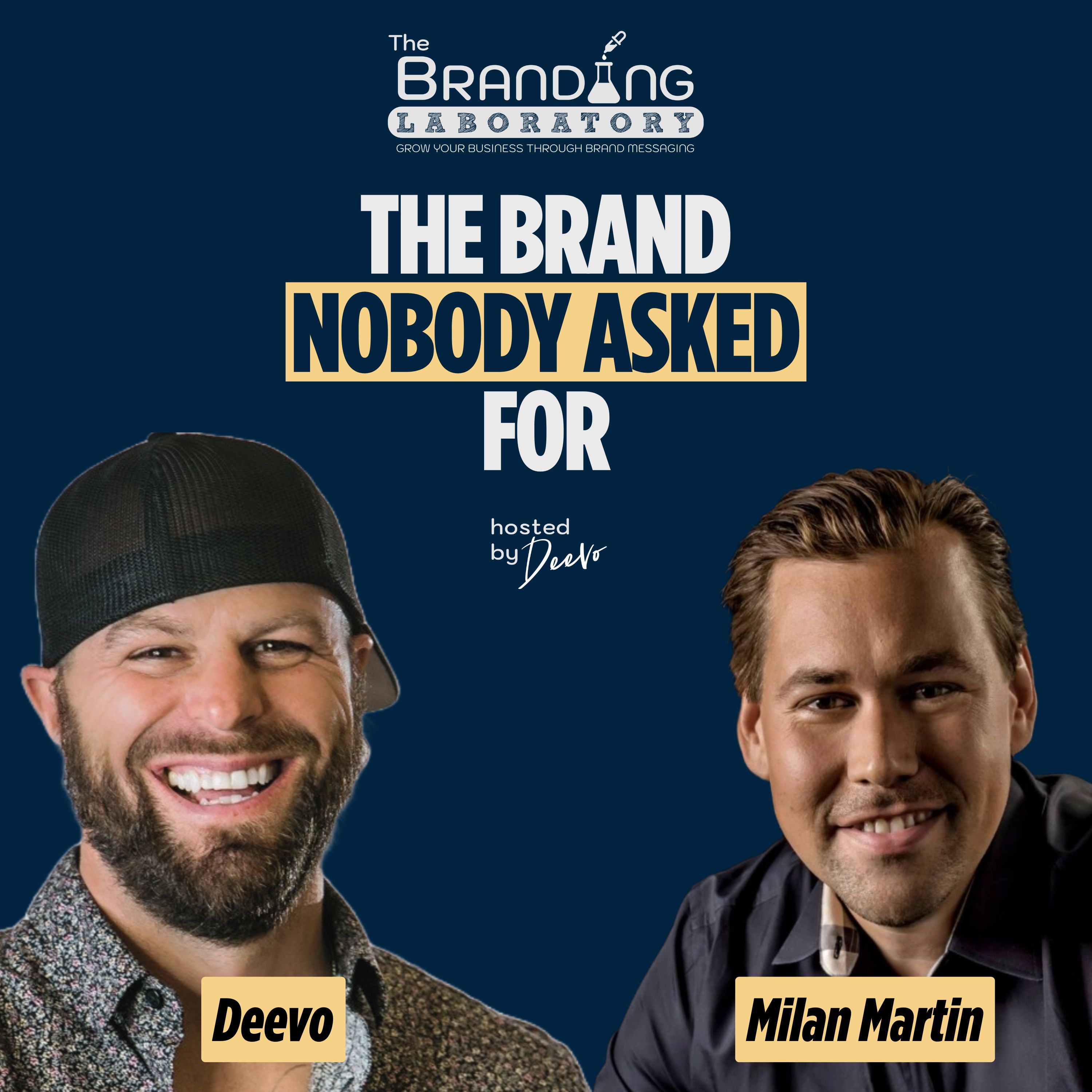
Drink Like You Mean It: Building a Category-Defining Brand with Milan Martin
May 2000:52:26Tap to summarizeWhat does it take to build a brand in a category that barely exists yet? Milan Martin walked away from 20 years in advertising, including work on some of the world's most recognized campaigns, to found Free Spirits, a company making non-alcoholic spirits for people who love cocktails, not people trying to quit drinking.That distinction matters. Free Spirits isn't a sobriety brand, but a choice brand, built for drinkers who want to stay in the room, enjoy the ritual, and skip the regret later on.In this episode, Deevo and Milan dig into what it really takes to introduce something new to a market that doesn't know it wants it yet. Milan shares the brand strategy behind 'Drink Like You Mean It,' how Free Spirits is disrupting a trillion-dollar alcohol industry without wagging a finger at it, and the near-death shipping disaster that almost killed the company in year one.What You'll Learn:Why the biggest misconception about non-alcoholic spirits is who they're actually forHow Milan positions a challenger brand against a deeply entrenched cultural narrative around alcoholThe 'and not or' philosophy that shapes everything from product strategy to marketingWhat actually drives brand loyalty (hint: it's not product, it's community and identity)How baby steps and compounding progress can take you further than a dramatic leap ever couldConnect with Milan: Linkedin: https://www.linkedin.com/in/milanmartin/ Website: https://drinkfreespirits.com/ Instagram: @drinkfreespirits TikTok: @drinkfreespirits
Transcribe →