← The Brett Cooper Show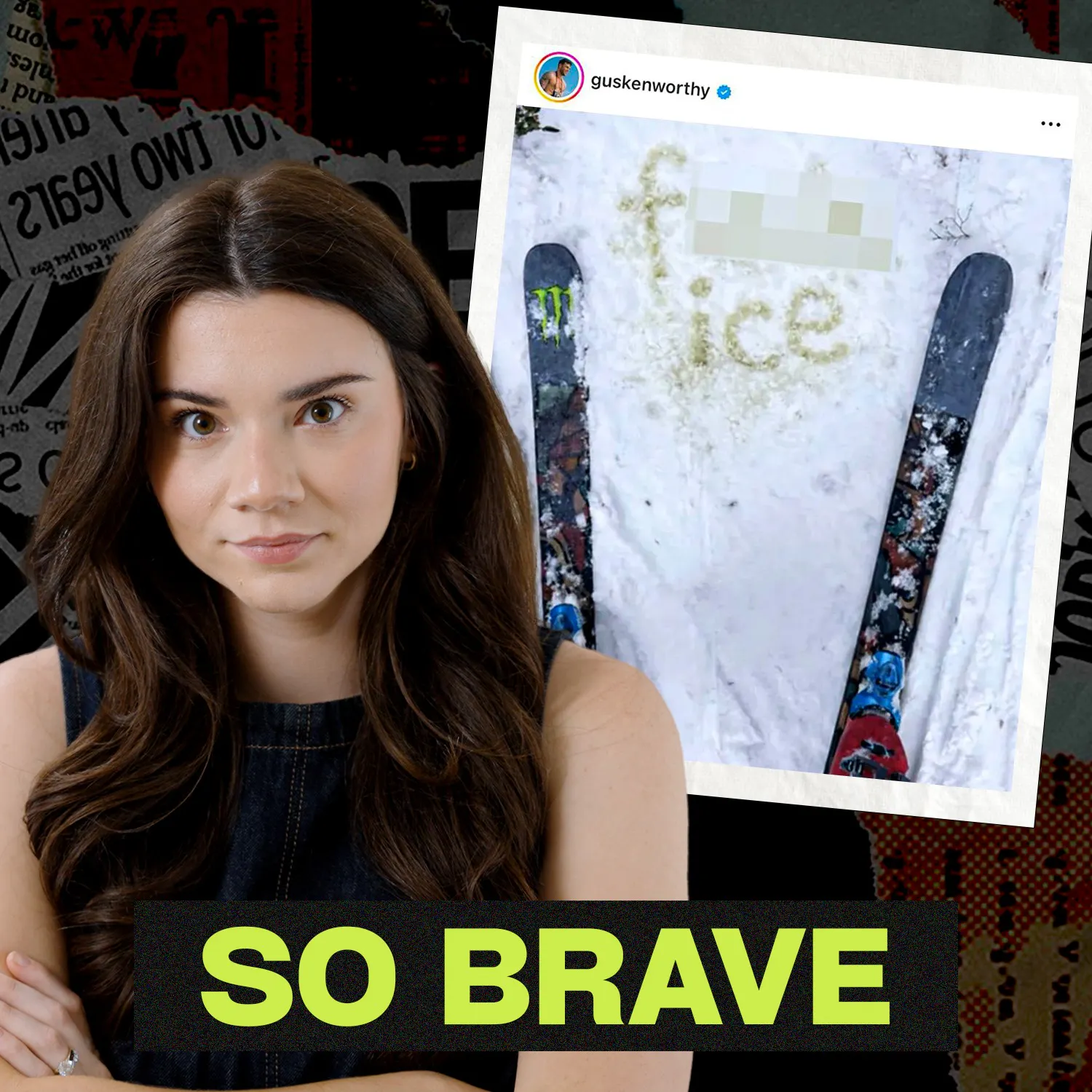
The Brett Cooper Show
Reacting to Team USA Athletes Trashing America at the Olympics | Episode 131
00:23:04
Loading summary
Transcript22 lines
- [00:00]
A
So, guys, if I have to have my feet flooded with idiots from the Winter Olympics, then so do you. Let's get into it now, guys, what you are seeing on your screen right now is F ice written in the snow with what I believe to be urine. This is a skier that literally peed out F ice. And that pretty much sums up all the discourse at the 2026 Winter Olympics that are currently going on in the now. I don't know about you guys, but I love the Olympics. I love the Summer Olympics, but I specifically love the Winter Olympics. And I know I'm like a normal white girl who skis. My family snowboards. I remember being a kid and being so excited to see Shaun White snowboard every year. I love seeing the athletes with so much pride and excitement. I love seeing all of the countries represented. I love the comeback and the underdog stories that you get with sports. Like, it's all just so amazing. And especially these days with social media, we get such an inside look into the Olympics and I feel like we get to know all of these athletes for who they are as individuals, which is really special. And you get to see inside Olympic vill. You know, you get their hauls from Ralph Lauren and their uniforms. It's just so much fun. And I seriously look forward to it every two years. And it feels like this should be a time when people theoretically would be able to put aside their differences and just celebrate excellence. But unfortunately for America, modern day America, it just doesn't seem like that is ever going to happen because clearly there had to be a scandal with that as well. And this time it was the J.D. vance was booed as Team USA walked into the opening ceremonies and the cameras turned to him. For example, the Daily Beast posted this. This was their tweet. They, the International Olympic Committee, had to ask fans not to boo the US Delegation led by JD Vance and Marco Rubio during the opening ceremony. And then somebody else tweeted this text that they received from a friend who was there. And the text reads, holy F. The whole stadium booed J.D. vance and his wife. That was so wild. But here's the thing. People online are not so sure. So I'm gonna play a couple videos for you and I want you guys to let me know in the comments what you hear, because there is a lot of anger and confusion over this. So this is what the Democrats and their new Headquarters X account, their new propaganda arm, their new social media pa, what they shared, this is what they heard. They are saying this was the overwhelming booing as the Cameras turned to J.D. vance. Just listen.
- [02:09]
B
In an individual sport, what an honor for her.
- [02:12]
A
There is the vice president, J.D. vance, and his wife, Usha. Ooh, those are not. Those are a lot of boobs for him. Whistling, jeering, some applause. So the announcers stopped mid announcement. As they're talking about J.D. vance and Usha talking about Team USA, they stop in the middle of their own revelry and excitement of the go. Ooh. Ooh, That's a lot of boos. There's whistling and jeering. Some applause. Just whistling and jeering. Like, even they are part of this. Now, before we get into what you heard or did not hear, I want to show another clip because people immediately started accusing headquarters and NBC and these other accounts of faking all of the boos and the jeering. And they started showing clips from a different broadcast which they said had no booze. So listen to this clip from Nick Sorter that he posted on X.
- [02:58]
B
Here they come. The arrival of Team USA. 232 athletes.
- [03:08]
A
I mean, guys, I'm just letting the clip play because I think everybody looks fabulous. We look badass. Like our Ralph Lauren outfits, Chef's kiss. So classy, so Americana. I could watch it all day long. Like, I have been sitting here all week thinking, like, is there a way that I could get to the 2026 Olympics right now so I could get into those outfits? Because I want them so desperately. Like, I'm waiting for an athlete to, like, post them on ebay and I will be buying them. Cause they look so good. Anyway, that's just an aside because I think everybody looks great. But the point being, I didn't hear anything. Honestly, I didn't hear anything in either of those clips. I'm not even trying to play a political game here. I don't think I could tell you if people were whistling, jeering, booing, cheering, or singing in Italian because we're in Italy. Like, I could not hear. It just sounded like noise because it's thousands of athletes and thousands of people in the sands, plus announcers. It was just chaos. And you know what? Even if there were boos, I can sort of understand that because we are as Team usa, we're in somebody else's country. Like, I doubt everybody at the opening ceremony was American. I would say that most of them are probably Italian because they're in Milan. Like, if Georgia came to Knoxville, came to Neyland Stadium to play Tennessee, they are going to get booed. And that's okay. That's normal. I'm not like clutching my pearls about any of this. And if we're being real. And again, you guys can confirm this in the comments for me, but I feel like most people don't really know what they heard either. And so I feel like this is something that was just made up by people online. Like, made up by people who crave political division. Maybe one of those announcers heard some person boo, but, like, that was not an overwhelming indictment of the United States. But clearly the mainstream media is trying to make it seem like Everybody hates Team USA and everybody hates J.D. vance. And like, are we surprised? No, obviously we are not. But guys, it gets even worse. Now, before we dive into this, if you want to see behind the scenes videos and ad free episodes and farm vlogs and travel vlogs and all of that sort of thing, check out cooper confidential.com. that is my subscription page. We upload new videos every single week. So go check it out. Now. Let's just dive in. Because it is not just the media or other countries that are trying to dunk on the United States. It's our athletes too. And it is becoming increasingly clear that nobody hates the US more than some of our own Team USA because even though they have this opportunity of a lifetime, even though the entire premise of the Olympic Games is to come together, to unify, to represent your country together, they and the journalists who bait them in press conferences are hell bent on tearing it all down for no reason. For no reason other than self importance and virtue signaling. That's all it is. Somebody commented on one of the videos that I'm about to show you and said, imagine being allowed, it's a privilege to represent America in the Olympics. And instead of being grateful that you get to play in the snow for a living, you choose to virtue signal to foreigners who already hate you by shitting on your own country. No honor. I completely agree. Like, there genuinely is not a purpose. This kind of political division, this discourse, it helps no one. And honestly, as an athlete, it just makes you look whiny and annoying. Nobody's talking about the sweatshops in China. Nobody's talking about the revolution in Iran. No, no. Out of all the countries in the world, it's always the United States. We're the worst. We are always the butt of every joke. We are the butt of every journalist's snide comment. And these Olympic Games are no exception. Just take it from our own athletes.
- [06:06]
B
I feel heartbroken about what's happened in the United States when, you know, I'm pretty sure you're referencing ICE and some of the protests and things like that. I think that as a country, we need to focus on respecting everybody's rights and making sure that we're treating our citizens as well as anybody, with love and respect. And I hope that when people look at athletes compete in the Olympics, they realize that that's the America that we're trying to represent. It's a little hard. There's obviously a lot going on that I'm not the biggest fan of, and I think a lot of people aren't. If it aligns with my moral values, I feel like I'm representing it. Just because I'm wearing the flag doesn't mean I represent everything that's going on in the US it isn't the first.
- [06:48]
A
Time that we've had to come together as a community and try and fight for our human rights. I hope I can use my platform and my voice throughout these games to try and encourage people to stay strong in these hard times. I don't want to hear you using your voice as an athlete to be encouraging people to stay strong in these hard political times. I want you to be using your voice to talk about your sport, to encourage people who are athletes, who have big dreams, little girls at home who want to compete in the Winter Olympics, who love skiing, who want to be in the Summer Olympics, whatever it is. That is how you should be empowering people, not empowering people to fear for their life lives under the Trump administration. And I'm sorry, I'm also just going on a rant right here, but I'm just so fed up with this ridiculous discourse about we're fighting for our human rights. What human rights are you fighting for? I have never heard one of these people actually be able to articulate what human right they're talking about. Trump isn't coming after those rights. He's talking about the right to murder your child, the right to mutilate your breasts at 12 years old and undergo gender reassignment surgery, because, no, those are not human rights. So stop trying to emotionally manipulate and lie to people, because that's exactly what you're doing. And I'm done. I am done. Obviously, you can see I am fed. Anyway, watching all of those videos, like, I could literally feel my eyes rolling out of my head. One of my favorite accounts, Peachy Keenan, she commented, and she said, do they ask the UK athletes about the thousands of young girls raped by their grooming gangs? No, of course not. Obviously not. Are they asking the Chinese athletes how they feel about the forced Labor Uyghur sweatshops? No, certainly not. That would be inappropriate. But it is totally fine for the United States to be a journalist's punching bag, which is exactly what we're watching here. And it really does feel like this line of questioning is some kind of, like, threatening humiliation ritual for American athletes. Somebody else commented and said all skier Hunter Hess had to say was, I don't mix politics and sports. I'm happy to represent my nation. Political virtue signaling has taken the fun out of watching sports. Exactly. And before you ask and start commenting, I would also say the same exact thing about a conservative athlete. I don't need a skier flying down the hill at the Olympics waving a Trump flag like that would be distracting. That would be divisive. Just like this is. If you guys remember that story, there was a park ranger who hung up a trans flag on El Capitan in Yosemite. I think I did a segment on it early last year. I thought it was ridiculous and totally inappropriate. And I just want to be on record here. I would also feel the same way if a Republican did that. If you were defacing something in a national park that is supposed to be for all Americans, that is literally supposed to be nonpartisans, it feels like this is common sense. Like, it should not be divisive, just like owning a suppressor shouldn't be divisive, which you can get through Silencer Shop. Now, shooting is great, but shooting suppressed is way better. Now, Alex and I have personally bought a few guns and suppressors through our friends at Silencer Shop, and we use them all the time on the farm. Let me tell you, it is a noticeable difference. With a suppressor, you have more control, less recoil, and a more enjoyable shooting experience. Overall, I love it. You guys need this. But the problem is, for a long time, getting a suppressor felt expensive, confusing, buried in legal paperwork and government regulations. And that is where Silencer Shop comes in. They have made this entire process so simple. And right now, it is easier and more affordable than it's ever been because there is no longer a $200 tax stamp cost, which is one less government tax on your rights. Silencer Shop will walk you through the entire process. You just choose your suppressor on their website, create your profile, sign a couple forms, and they handle all of the heavy lifting. No confusion, just better shooting. In days, Silencer Shop has helped hundreds of thousands of Americans get theirs fast and easy. And the other thing I love is that Silencer Shop just stop there. They are fighting every day for your rights. They are actively suing the federal government to make it easier to own suppressors and short barreled rifles and other regulated items. Because exercising your rights should not come with government overreach and that is a core principle of Silencer Shop. So if you are ready to upgrade your shooting experience and support an amazing company, head on over to silencershop.com cooper to get started again. Silencershop.com because shooting suppressed just makes you better. All right, now back to the story. This was also a great comment. This person said by diving in with the mix of mixed emotions and the heartbroken lines, both Lillis and Hess invited the controversy and distracted from the Olympics itself. Distraction Athletes have a right to personal politics off the clock. But when you are wearing Team USA gear and speaking in an official press conference, the smart move is to stay focused on the slopes. Politely declining to answer the question would have been the high road and avoided alienating a big chunk of the audience who already feels like sports are too politicized. They had the chance to rise above it and instead they stepped right into the soapbox. Obviously. And they did this because people have been taught to fear rising above it in case you're perceived as a nasty conservative or apolitical and privileged. Like silence is violence. We heard that screamed at us for ages in 2020. So no wonder athletes are responding to this. Prioritizing unity and withholding politics for more appropriate moments is a lost art form, especially now because for years stepping onto the soapbox for a lot of these people has come with massive applause and massive amounts of reward. You're part of the resistance and you're applauded for that. Even though the resistance is supported by the entirety of Hollywood and every celebrity and every major corporation and industry. It's hilarious and ironic per usual, but you guys know that. Anyway, moving on with the story, one of those athletes, the girl, Amber Glenn, she chose to take this even further and she posted her quote on her Instagram story and she said this she said When I chose to utilize one of the amazing things about the United States of America, freedom of speech, to convey how I feel as an athlete competing for Team USA in a troubling time for many Americans, I am now receiving a scary amount of hate threats for simply using my voice when asked about how I feel. I did anticipate this, but I'm disappointed by it. I will be limiting my time on social media for my own well being for now, but I will never stop using my voice for what I believe in. Xoxo Amber alright, so here's the thing, I am glad that she brought up freedom of speech because yes, she is correct, we have that right. She is free to use it and thank God we have that right. But having freedom of speech, having the right to criticize your government, doesn't mean that it is always appropriate to crap on our country, especially when you have the privilege and the honor of representing them. Now the other thing that Amber brought up in her Instagram story story was that she was asked about this. She was prompted. This was not something that she just randomly brought up in a press conference. And granted, you know, she did not have to respond in the way that she did. But yes, she was asked, she was baited. Which brings me to my next point because journalists who are at these press conference, they're obviously instigating all of this. Again, it really feels like this threatening humiliation ritual designed by self important journalists who want moral superiority and want a good headline and lots of clicks like that is why they are asking those self important questions. But here's the thing, this is the important point. The athletes, they do not have to take the bait when they are asked these questions. They do not have to respond in the way that they are doing. And actually very recently a lot of athletes chose not to. Somebody commented and said, too bad the Olympic athletes don't have the balls of the US Tennis players at the Australian Open. They weren't having any of it. Exactly. And I'm so glad that I waited to do an episode about this because I was saving all of these clips. I had saved this story from the Australian Open. I was like, I don't know if people will really be interested in it. It kind of feels like short and small. And then boom, the Olympic stuff happened. And I was like, this is a perfect comparison. The Australian Open, it just wrapped up a couple of weeks ago. And there was one specific little reporter there who at every press conference went out of his way to ask the American athletes the same snide and baiting political questions. Now, his name is Owen Lewis. People figured out who he was. And yes, before you ask, he is exclusively on Blue Sky. So do not go looking for him on Elon Musk's platform. He currently works at the Atlantic. And I mean like, how long until we find out that he's the one behind all these questions at the Olympics too? Like, sir, maybe ask them something relevant. Ask them how they're staying so healthy. Which I bet they would respond with balance of nature. Now if you're like me and you don't really know what Phytonutrients are, then you guys are going to love this. Balance of nature supplements make understanding and taking care of your health easy. And it all starts with phytonutrients, the naturally occurring plant nutrients that are found in whole foods that give them their color, taste and smell. And when it comes to your diet, the presence of these three things is a surefire sign that you are getting real phytonutrients. Now, balance of nature takes these whole foods through a tailored vacuum cold process that stabilizes their nutrients. Then they're powdered and packaged with no binders, fillers or flow agents, making sure that you are getting the cleanest nutrients possible. And their whole health system supplements are a value bundle that includes their fruits and veggies and fiber and spice supplements, which gives you 47 whole food ingredients. And all of them contain those naturally occurring phytonutrients. So whether you've been on the fence for a long time or it's the first time you're hearing about balance of nature, I recommend that you go to balanceofnature.com and order the whole health system as a preferred customer today. And speaking of taking care of your health, have you guys reached out to Jevity yet? Because if you are as tired as I am of going to the doctor and having them run like 12 basic tests and telling you that everything looks normal and then they send you home with no sol, then you need Jevoty. Now, my friends over at jevoty test over 100 biomarkers in your body, not 12, 100. And a licensed phlebotomist comes to your house to do the blood work. No more waiting rooms, no more rushed appointments, and actual solutions await you. Because the best part is Jevady doesn't just hand you the data and say good luck. You actually get a full care team that helps you understand what it means and what you can do about it. You get custom supplements and a lifestyle plan based on your blood work, not some generic one size fits all thing. So if you are done accepting normal, when you feel anything but normal, go to gojevity.com BrettCooper and use code Brett at checkout for 2020% off. Again, that is G O G-E-V-I T I.com BrettCooper use code Brett at checkout to take control of your health today. Anyway, guys, my point in bringing up Owen Lewis, that specific journalist, is that you need to look at how these tennis players at the Australian Open responded to his questions. All right, Max, roll the tape.
- [15:43]
B
It's also interesting that you're both second gen immigrants to the U.S. like, in the context of everything that's happening at the moment with Trump and ice, like, what does your heritage mean to you and how important are immigrants to America and American sport today?
- [15:54]
A
Sorry, I don't. I really wanted to talk about that right now, Charlie. Well done, Leonard.
- [16:01]
B
Today in this tournament, I'm asking all the American players this, and there's a lot happening back home in the US and kind of has been for a lot of the last year. And I'm just kind of wondering how you're feeling about all of it. I mean, not sure what we're for looking like, specifically talking about, but there is, there is a lot going on in, in the US And I don't know, I feel like whatever I say here is going to get put in a headline and it's, it's going to get taken out of context. So I, I'd really rather not do.
- [16:42]
A
Something that's going to cause a big.
- [16:43]
B
Distraction for me in the middle of the tournament. I've been asking a lot of the American players just how it feels to play under the American flag right now, and I'm curious how you feel.
- [16:50]
C
Yeah, I mean, I was born in America, so I'm always proud to represent my country. And yeah, a lot of us are doing really well, and it's great to see a lot of, you know, great athletes on the women's side, on the men's side. So, yeah, I feel like we're all doing a great job representing ourselves sort.
- [17:07]
B
Of in the context of the last year, of everything that's been happening in the U.S. does that complicate that feeling at all?
- [17:14]
C
I don't think that's relevant.
- [17:16]
A
My God, it's like every one of these athletes is like, please, I am so done. They're putting their head in their hands. They're like, please don't ask me. Also, for reference, I totally forgot that the first question was asked by a different reporter. But the second reporter, the one who talks like this in the context of the last year, can you please, could you please bend the knee and give me that right there. That one is Owen Lewis. Yes. I should have to say his voice perfectly matches up with his photo. Anyway, moving on from that, my point of bringing all of this up is that that is how it is done. That is how you can respond to this. Nobody is saying that you have to say, I love Trump, I love ice. Yes, let's get rid of all the illegal immigrants. You don't have to be an ice supporting Republican but you also do not have to bend the knee to a partisan journalist hack job who just wants a good headline and some controversy and who wants to make you feel crappy by asking you those self important questions. It is possible to pivot away from the baiting questions and just rise above it. Now one of those players, the girl Amanda who you saw at the end, she even brought this up later on in another press conference and she reaffirmed her stance which I just thought was fantastic. Listen to what she had to say.
- [18:14]
C
Like in my other press conference, the fact that I didn't want to answer a question that was obviously intended for just like a headline and clickbait, that was my my right and it had nothing to do with my political views or anything like that. So the fact that people assume that they know like my stance on certain important topics is just wrong and it's not factual. But yeah, that's, it's tough but I've learned to get used to it. And yeah, I felt like my tweet was just not worth it and like I just didn't want to give my energy.
- [18:49]
A
I mean she laid that out so perfectly and I love that both she and Taylor Fritz directly called out that reporter for baiting them for saying like this is going to be taken out of context. This is going to be used for a headline and I don't want to play that game because at the end of the day it is a game. And those responses are refreshing and they are exactly what we should be hearing from people who are representing our country and who are focusing on some something that is not politics. They are not political in any way, shape or form. Like these are athletes that are competing at the top of their game. They are doing press conferences about their sport. Like the last thing they would want to do if I was in their position. The last thing I would want to talk about is politics. And also the last thing that is relevant is how they feel about Donald Trump and ice. And this is especially true with the Olympics because these athletes are on team usa, not team your personal politics. Like nobody on earth besides your mom and the life sucking journalists care about what you have to say about these issues. And I'm sorry, that is just a fact. Most of us genuinely do not care and we're not watching the press conferences. We see them on social media. We just want to see you win and represent the USA and bring home the gold. That is what we are hoping for. But I am so glad that we live In a country where you are allowed to have stupid opinions, you're allowed to talk about your personal politics without getting thrown off a building, like, thank God for that. But why don't you just put them aside for a month, for a couple of weeks, and just enjoy the experience, be grateful, and represent your country as a cohesive team. Compare those responses to, say, Sydney Sweeney or Jelly Roll, who both in the last week said, this is not the time for you to be talking about politics. People don't wanna hear about it. I don't wanna talk about it. It's not in line with my work. I just wanna make my art and move on. That is how you should handle those situations. It doesn't mean that you should never talk about politics. That's totally fine. But in these moments where you are focusing on your work and your art that are totally disconnected from politics or your sport or what you're competing in, it is totally fine. It is right to say, this is not the time to be talking about politics. And so my message to any of these athletes that wanna trash America on the world stage is that if you don't have have anything nice to say about our country, then don't compete for America. And actually, funnily enough, the skier who peed f ice into the snow that I showed you at the beginning of the episode, he actually did just that. He is a British American skier. I think he actually lives in the US but he's skiing for the uk. And you know what? Good for him. Good riddance. Go ski in accordance with your values. Like, you hate ice. Obviously, you are totally fine with UK opening up their borders to migrants who are attacking and raping citizens on the streets. So at least. At least you were being consistent in your values. But, like, seriously, all jokes aside, you should be proud to be an American, because unlike athletes from China or North Korea or Iran, you are allowed to sit on that stage representing our country, still criticize it, and you will not be publicly executed for sharing those feelings. You will actually still be celebrated. You will still be able to take home the gold, come back, and even if you hate him, you'll probably still be invited to the White House to meet Trump, because that's just how it works in America. You have the freedom to criticize. That freedom was bought with blood. Like, the least you can do is to show some gratitude while you are wearing that flag on your chest. Now, thankfully, to end this episode on a nicer note, one of the greatest Winter Olympians of all time who came out of retirement to compete this year. She seemed to get it. So just listen to what Lindsey Vonn had to say before her final ski run. It's a privilege to represent your country. And the Olympics are the largest stage in the world, the largest sporting event in the world. To walk out into the opening ceremonies with your fellow teammates is such an honor. And I always feel incredibly lucky that I'm even able to compete at that level.
- [21:57]
C
So.
- [21:58]
A
So I definitely don't take it for granted.
- [22:00]
C
And I'm gonna enjoy my last Olympics.
- [22:03]
A
As much as I possibly can. It is literally that simple. It is that easy. It is a privilege to represent my country and you move on. And, guys, for context, again, that is Lindsey Vonn. That is a woman who does not like Trump, who has gone out of her way to criticize him and his administration, but she has done so on her personal time, and she has reveled in the privilege of representing this country on her professional time. And it seems like she genuinely is happy to be there and wear this flag on her chest, even if she doesn't like the person who is currently president. And in my opinion, that is exactly how you should handle yourself. Even if we go back to the origins of the Olympics, like, the whole goal was unity. They were designed to celebrate the Greek gods, yes. But they were also fostering unity throughout all of Greece through something that they called the sacred truce. And obviously that was in regards to all the different Greek city states. But I think that the same should be true, and probably is true for each country that is coming to the modern day Olympics, because it's athletes coming from all different parts of these countries, from all different sports and different races and ages and creed. They're all coming together at the top of their game to represent and compete for our country. And a lot of people apparently have forgotten that.