← The Brett Cooper Show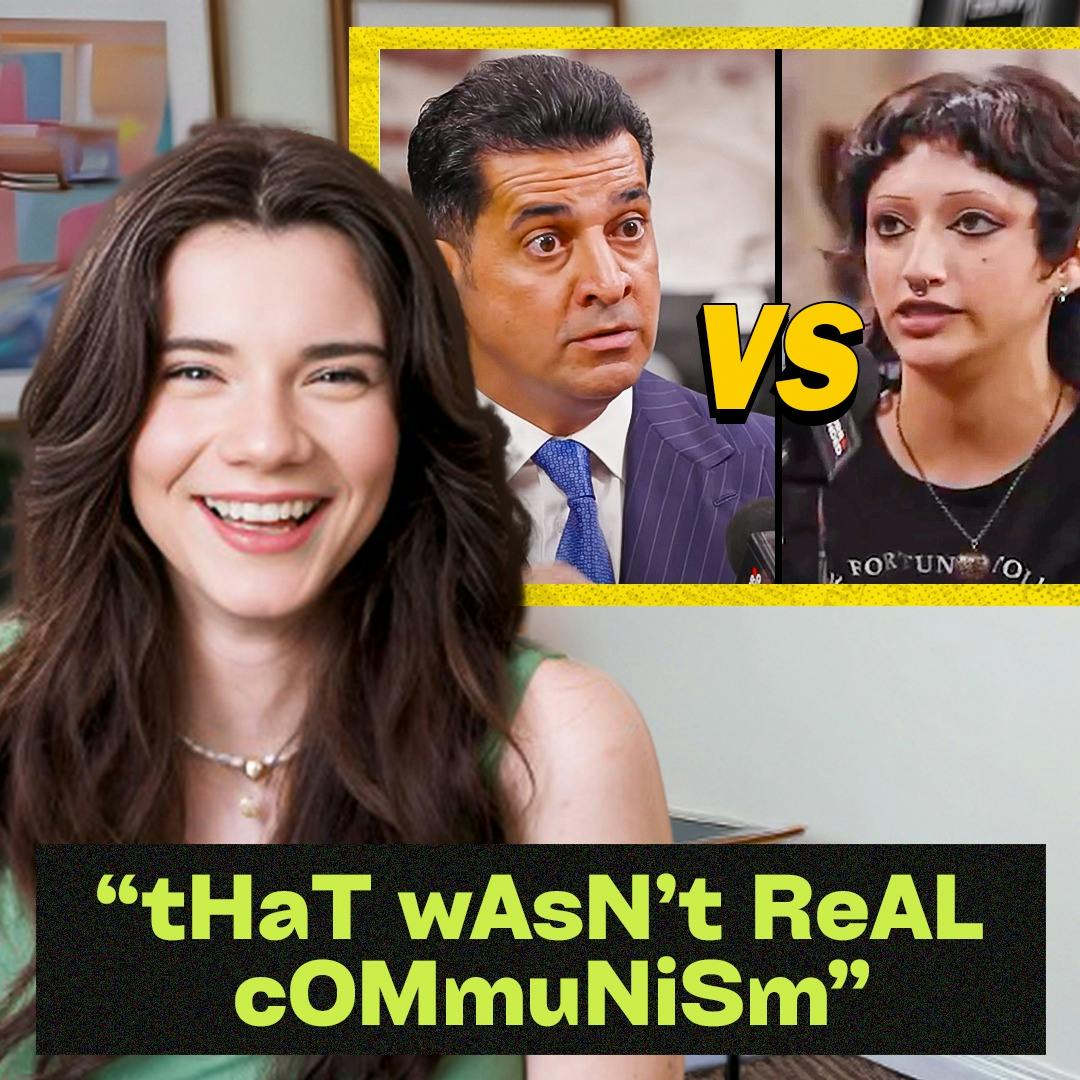
Loading summary
Transcript70 lines
- [00:01]
Cooper
So PPD's debate on Jubilee is going viral. But what I think is interesting is while the entire debate is supposed to be centered around debating the merits of capitalism, that doesn't actually seem to be the root issue. So if you aren't familiar with Jubilee, they are a YouTube channel, a media company. They do a ton of videos that are on different social and cultural and political issues. They do these experiments and debate. And I would say that their most popular format as of late, like what they've been doing for the last year or so, is this 20v1 format where you'll have one person, they sit in the middle at a table, they have a microphone, 20 people who oppose them, surround them. And all of those 20 people come up and debate this one individual. So it might be like one anti feminist versus 20 feminists, or one Christian versus 20 people who are not Christian. A black conservative versus 20, 20 black liberals, whatever it might be. And that is what PBD just did with Jubilee. So his video was one capitalist being him versus 20 anti capitalists or proponents of communism. And like I said at the top of the video, even though that was the basis that was the topic for this issue. As I went through watching all of this, seeing what was being discussed on social media, all the clips that were going viral, what was actually at the root of this entire debate was not a hatred of capitalism or a love of communism or socialism. It was actually just perpetual victimhood. And that is what we need to talk about. Even though I just said that most of the debate did revolve around victimhood, which we will get into. There were two points where they did actually discuss communism and it was so hysterical and it was just so perfect because per usual, their rationale as they were debating PBD was the communism and socialism, because it just hasn't been fried yet. It just hasn't been done properly. And that is why they are anti capitalists and why they love communism. Just listen to this.
- [01:58]
PPD
Statistics are against you. The statistics never worked. There's so many Cubans that move to Miami. The statistic that 5% politics in Russia.
- [02:07]
Communist Supporter
They do you know how much money?
- [02:09]
PPD
Because it didn't work. It killed so many people.
- [02:12]
Communist Supporter
Almost like it wasn't communist.
- [02:13]
PPD
It's almost.
- [02:14]
Communist Supporter
Yes, there was a communistic argument. It's almost like you're not replying to any of your presented to you. I think that's.
- [02:21]
Cooper
The.
- [02:23]
Communist Supporter
Dictators would not be allowed under communism.
- [02:24]
Cooper
Okay, all right. Dictators would not be allowed under communism. And in response to some of the Other things. CBD said. She responded and said it was almost like that just wasn't communism. That's always what they have to say. That wasn't real Communism. That wasn't real socialism. We have to try again. More people have to become impoverished. More people have to die. More dictators have to rise to power. But oh, my gosh, no, I'm so silly. Because actually, under real communism, dictators simply aren't allowed. Like, what delusional world is this girl living in? Like, crack open a history book, for Pete's sake. Like, that's literally the only thing that I can say. Also, what I want to point out is that in the few minutes leading up to this, PPD sat and let her speak. Let her go through all the reasons why she's in support of communism. The response to the prompts that they were given for this part of the debate. He did not say anything. And the moment that he opens his mouth, she's. You didn't talk about my statistics. You're not responding well. Can you let the man speak? This is such a terrible, terrible way to debate. And back to this idea that communism and socialism has never been done properly. Like, I'm sorry, no. It has been tried time and time again, but it never works like the way you hope it would. Like, it never works as it does in theory because you're dealing with human beings, and power and control always corrupts. That is just a part of human nature. We've seen it time and time again in history. That is why, you know, power corrupting is one of the most important tropes in literature. It is one of the first things that you learn about as a child when you are reading fairy tales. Like, all of that is why dictators who do exist spawn under communism. Like, just because when it has been tried before, it has not created. The utopia that you envisioned that you read about in college when you were learning about Marx does not mean that it has not been tried properly or been done correctly. It could just mean, unfortunately, that it doesn't work. And that is just a fact of life. And maybe you need to move on now with another girl. They didn't discuss dictators specifically, but she did argue that none of the famous communist countries were actually communist. So it's kind of in life with what we're talking about here. Take a listen to this.
- [04:36]
PPD
I got an offer for you before we move on. If I were to give you your $2,350, which is the cost to renunciate your citizenship, and I paid you your first class, you know, flight to whatever communist country and $20,000 of spending money. Would you give up your citizenship to go to that country? Whichever communist country you want to go to. Cuba, we can give you Venezuela, we give you North Korea. Any one of those you want to go to. Choose any one of them. I'll give you one way ticket and I'll fund it for you if you want to.
- [05:05]
Cooper
None of them are communist countries. Venezuela, North Korea, Cuba. Famously Cuba. Nope, nope, no, no. None of them are communist countries. So I can't go. Unfortunately. PBD would love to take you up on your offer. So nice paying to, you know, get rid of my U.S. citizenship, a first class flight, $20,000 to, you know, get my bearings, get my feet under me, get my uniforms and my government given job under communism. That's so nice of you, but actually I can't because his communist countries don't exist. Because it's never been tried properly. Okay, like, let's just keep it going. Like I feel like they have to think like this in order to keep the fallacy alive. Like in order to protect the fallacy. The communism works, that socialism works. They have to consistently argue that it has ever been tried, that it's ever been done properly, that none of these communist countries are actually communists. The dictators don't exist. Like they just deflect and ignore consistently and they just continue playing the victim card, which ended up becoming the crux of this video. And deflecting and ignoring is never a good strategy for anything in your life, especially when it comes to your hydration. Which is why I rely on Peak. So if you've been doing everything right for hydration, like drinking water, taking your electrolytes, and yet you still feel like the Sahara desert, you just might need peek like I did. Peak's deep hydration protocol is not just another hydration hack. It is a complete day to night ritual. It's simple, seamless. It's designed to restore your nervous system, strengthen your skin barrier and give you a healthy glow from the inside out. Mornings will start with their BT fountain, which is their beauty electrolyte. This hydrates deeply, it smooths the skin. It fuels lasting energy with clinically proven ceramides, ultra low molecular weight hyaluronic acid and bioavailable minerals that support skin, hair and nails. Your evenings will wind down with my favorite guys. This has become essential to me. It is their RE fountain, the calming electrolyte. It is peaks triple maxed magnesium. It melts away tension and promotes deep Restful sleep without next day grogginess. And the best part is these are the cleanest electrolytes out there. No sugars, fillers, artificial flavors. It is just high quality ingredients like lemon juice, beetroot and monk fruit. Within days. Honestly, within like one night, I noticed a difference in my sleep. But I noticed my energy being better, my skin looking smoother, my sleep was so much better. Like I said, again, this has become a ritual. So start your own 24 hour glow with Peak. Just go to peaklife.com Brett for 20% off for life plus a free gift. Again, that is peaklife.com Brett. All right, so back to the point. Like I was saying, this whole debate, even though it started, you know, being about communism, that is what they should have been talking about. It ended up just being ppd, trying to convince these young people that they were worth something, that they weren't victims, that they could have success in this world, that a capitalist society was, was not the root cause of their issues. Just listen to this. Like this one is just so classic, especially if you know PBD's history. Okay, take a watch.
- [08:02]
PPD
Do you know somebody like you that speak, speaks this eloquently? If somebody gets a hold of you in real estate, insurance, finance, you can learn how to sell and you can make some real good money. Somebody like you that I'm watching, everybody's.
- [08:12]
Cooper
Born with those abilities. You have to be brother. Somebody who's white, tall, six, four, whatever.
- [08:17]
PPD
They're much more eastern. I'm from Iran. Do you realize a lot that goes against me?
- [08:22]
Cooper
Okay, but many people have no choice.
- [08:23]
PPD
But that's an excuse language to be making.
- [08:25]
Cooper
Oh my God. Like this clip might be the greatest clip from this entire video because PBD is trying to say to this young man, you have something to offer. You are not a victim. You can do something in this capitalist society. He's saying you are eloquent, you are articulate. You could go places in real estate, in business, in finance, in sales. And this kid just goes, no, I can't. Because not everybody has my abilities. You know, not everybody was born with these abilities. Like he's completely deflecting the fact that he has something to offer because of this idea of equity, that because he was given something, it's unfair because others weren't. Others don't get to be, you know, white and six four and have, you know, great articulation and the ability to communicate what they think and feel. But it's so ironic because of the man that he is sitting across from ppd, who is a refugee. He was born in Iran. He moved here as a child. He fled Iran, came to America. He served our country in the military. He got out. He got his citizenship. He built his business. He is now extremely successful. He has his show. He's on Jubilee, debating all of these people. He's constantly viral. And he's not a white man who's 6 4, who was born into riches. He is not somebody who was privileged from birth. And yet this kid can't even see beyond his own nose, beyond his own ideology, to see that what PBD accomplished in his life is possible. That he, as a young man, who is articulate, who is smart, well spoken, confident, has the ability to go places like that kind of victimhood that is deeply, deeply rooted. This kid is so entrenched in victimhood that he cannot see. And again, this became the core part of this video. PPD trying to convince these kids that they weren't victims, that they could be something. And like ppd with one guy, he even went so far as to offer a young man a job. This guy had just told the story, lamenting about capitalism, this whole, you know, economical system being against him. He said, I can't get a job. I've applied to 477 different places. Nobody's hiring me. And so PPD says, okay, well, I'll do an interview with you. I will offer you a job. We'll document it. We'll do a whole experiment, literally offering this man a job if you would move to Florida, and he would not budge. And I'm gonna let you guess why.
- [10:47]
PPD
What do you have on your resume skillset? What do you offer?
- [10:50]
Job Seeker
Transportation expertise, logistics expertise.
- [10:53]
PPD
You consider yourself a hard worker?
- [10:55]
Job Seeker
I mean, I feel like 80 hours a week.
- [10:57]
PPD
That's a hard worker.
- [10:58]
Job Seeker
Sure.
- [10:58]
PPD
How about we do this? How about I interview and I give you a job? Would you move to Fort Lauderdale?
- [11:03]
Job Seeker
Ooh, that's Florida. Sure, why not?
- [11:05]
PPD
Would you move to Fort Lauderdale?
- [11:06]
Job Seeker
Why not?
- [11:07]
PPD
How about you and I document this after this? You come, I do an interview with you, and I give you a job, and let's see what you do 90 days later.
- [11:13]
Job Seeker
Okay, let me. And I'll look up your company and all that kind of stuff, and I'll see it.
- [11:17]
PPD
But let's see what just happened regardless. Watch what you just did.
- [11:19]
Cooper
Sure.
- [11:20]
PPD
You just said you applied to 477 companies. Who's not gone back to you?
- [11:25]
Job Seeker
Yeah.
- [11:26]
PPD
A business owner who's hiring aggressively just made an offer to you. You said you're willing to move, then you said, I'll look at it. You became selective.
- [11:35]
Job Seeker
I didn't say I look at it. If you let me finish my sentence.
- [11:37]
PPD
Go ahead. I want to hear it.
- [11:38]
Job Seeker
I would like to look into your company to see exactly what you guys do.
- [11:41]
Cooper
Okay, so later on in this clip, he argues that the reason why he said that is because. Because he said, well, I wanted to know if you would even have a job for me because, you know, you might need credentials or a degree that I don't have. And PPD says, I don't care about that. If I find a job for you, if I train you, if I mentor you, if somebody is going out on a limb saying you have fallen under hard times, you allegedly can't find a job, I am going to go to bat for you and make a job for you. And this guy's still like, nah, I don't. I don't know. I mean, his. The attitude throughout this entire clip. Okay, ma', am, I'll look into it. Dude. Do you actually care then about getting a job, or do you just care about being able to play the victim role, lament about not actually getting a job, but having the choice to be so selective as PBD is saying, oh, I don't want to move to Florida. Oh, I don't actually want to work hard. Yeah, I'm a hard worker. I can work 80 hours a week. But, oh, no, I don't know, I would have to look into your company. Obviously, being offered this opportunity, you know, for growth, for mentorship, for a job, for money goes against this image that he's painted in his head for what he wants his life to look like, for the victim that he is, for what he has to offer the world. There was a comment here that I thought was so great, and this was under that clip on X. It's ironic that under communism, this guy would be assigned a job based on the necessity of the state. Under capitalism, he has a choice, which he clearly seemed to like because he's selective. As PPD said, when people don't contribute to a communist society, the state eliminates them. Yes. This young man with his attitude, with the walls that he has up, he's like, so disinterested. And even engaging in PPD as PPD is genuinely saying, I will help you if you genuinely are up against hard times, loves the fact that he gets the choice to be unemployed. He. He loves the fact that he gets to be this victim, which he is able to do because of capitalism. The thing that he allegedly hates so much that is causing all of his problems. Like, dude, I'm sorry, at this rate, based on what I'm seeing in this video, you have caused the problem yourself. Because at some point, if you have applied to 477jobs, you don't get to be selective anymore. At some point, if you need to put food on the table, if you need to support a family, if you want to be able to go out to dinner and do the things that you want to do to, sometimes you just have to take a job. But of course you still don't have to. You could choose to go without a job. You could choose to be on Social Security, you could choose to go be homeless. And you are able to do that because of capitalism, because of the systems in our government that you allegedly hate so much. Like, there is such massive cognitive dissonance, it is insane. Now, thankfully, I am never a victim, thanks to ExpressVPN. And Express APN makes sure that you guys are the only ones watching me online instead of data brokers. And data brokers track everything we all do, even in incognito mode. They collect browsing history purchases, interactions, and then they sell that data to advertisers, scammers, and sometimes even dangerous individuals. This is invasive. It's creepy. It is constantly happening behind the scenes. And in the world of this right now, online privacy often feels like a thing of the past. But it doesn't have to be. And that is why I use and promote ExpressVPN. ExpressVPN reroutes your Internet traffic through secure encrypted servers so that no one, not your Internet provider, not data brokers, can see what you are doing online. Your passwords, your banking details and private activities stay safe no matter where you are or what you're doing. Plus, it works on up to eight devices at once. Perfect for protecting your entire family. It is fast, it is reliable, doesn't impact your WI fi and your speed. And most importantly, this two super easy to use. You just do one click on their app or their website and you are covered and ready to go. And right now you can get four extra months of ExpressVPN for free. When you use my special link, just scan the QR code on the screen or you can go to expressvpn.com cooper to get four extra months for free. Again, that is expressvpn.com cooper and while they keep your activities safe, GCU can keep your mind safe. Grand Canyon University is a private Christian university in the beautiful Phoenix, Arizona. And GC believes that the American Dream starts with a purpose and they are here to help you find yours. Which is something I would say the PVD is doing to all the kids in this video. But GCU equips you to find your passions and use them in ways to serve others that promote human flourishing and create ripple effects of transpiration for generations to come. And they believe that by honoring your career calling, you are going to impact your family, your friends and your community at large. And whether that pursuit involves a bachelor's, a master's degree, a doctoral degree, GCU's online, on campus and hybrid learning environments are designed to help you achieve your unique academic, personal and professional goals. With over 340 academic programs as of September 2024, GCU truly meets you where you are and provides you a path, a real, tangible path to help you fulfill your dreams. The pursuit to serve others is truly yours thanks to gcu. So let it flourish. Find your purpose today at Grand Canyon University. It is private, it's Christian and it's affordable. Visit gcu. Edu today to learn more. Now back to the story. I saw another comment that was great. This person, it was simple. But this person said he doesn't want a job, he just wants to bitch and blame everything on someone else. Yeah, exactly. He wants to blame it on the fact that he doesn't like PBD and doesn't like what PPD does. He wants to blame it on the fact that PBD's company probably won't require his transportation expertise or whatever he does in his line of work. But also, you don't know that because you didn't even take PPD up on his offer, you immediately cut him off. I'm going to have to look into it. When PPD was saying, regardless of what your expertise is in, I will find you a job. We will make something work. But that would be too empowering. That would be using a leg up and trying to move up in the world to find success, to make something of yourself within this system that gives you the freedom to do so. That gives you endless opportunities if you are willing to take them and look outside side of your victimhood bubble, which is literally what we are seeing in every single one of these videos. Like this guy in particular reminded me of like you know when you see a homeless person on the street and you're going in to grab some food, you're picking up a burger, whatever it might be and you stop and you either bring them the food or you say hey, can I go grab you some food, get you something. And this happened to me just constantly when I lived in LA when I was encountering more homelessness. And I would get these stares with such anger and vitriol, and they'd go, I don't want food. Like, I want you to give me cash. Or I would bring out a burger. I don't want to eat that. And I'm like, I'm sorry. You're sitting on the side of the street, you're begging, and I'm here offering to pay, to give you food, to give you sustenance, to buy you a salad at Whole Foods. And you're upset because I'm not giving you cash to go buy God knows what. Like, I remember one time, I literally think it was like a whole food salad and the guy didn't like the salad dressing, the ranch that I had picked out. I was like, okay, like, I'm sorry for trying to help, but if you want to stay in this situation, then I can't do anything about it. Like, that is literally what we are seeing with these individuals. And this was a common thread throughout this video, like PBD trying to help, trying to empower, and them rejecting him every single time. For example, with another guest, PBD literally offered to pay. Pay this young woman's medical bills. If. If this is the caveat, if she would go see a psychologist that he got her to help with her mental illness. Because she was talking about her illness about she has a genetic tissue disorder, but really what she's dealing with is mental illness. And Sweeped was saying, okay, well, I will help you and we'll actually get help for everything. We'll get you a specialist, but we will also address your mental health. Well, no, she didn't want that either. And I will let you try to decipher why that is.
- [19:23]
PPD
What did you vote for in 2020?
- [19:25]
Disabled Woman
I was actually not able to vote. I was in a hospital.
- [19:30]
PPD
Oh, I'm so sorry.
- [19:30]
Disabled Woman
Yes. Because of results of capitalism.
- [19:33]
PPD
Tell me more.
- [19:33]
Disabled Woman
Yeah, so I didn't have access to proper health care or even access to a proper job that would sustain me as a disabled person.
- [19:40]
PPD
Are you comfortable being specific on what happened? You don't have to if you're not.
- [19:44]
Disabled Woman
I mean, I'm also mentally ill, so that was something I had to deal with. But I'm mainly mentally ill because I am disabled in a capitalist country.
- [19:52]
Cooper
So she is mentally ill because she is disabled in a capitalist country because she doesn't have a job that will sustain her while she is disabled. While she's going through this health crisis, she doesn't have the doctor she needs because she lives under a capitalist society. That was why she was unable to vote. That is the context that you need here. So let's jump ahead to the solution that PBD offers.
- [20:13]
Disabled Woman
I don't have access to even a result or a solution to my disability. As someone. A connective tissue disorder. It's genetic.
- [20:21]
PPD
Have you been able to go to different doctors and get yourself tested?
- [20:24]
Disabled Woman
Yeah.
- [20:24]
PPD
You have?
- [20:25]
Disabled Woman
Yes.
- [20:26]
PPD
In California.
- [20:27]
Disabled Woman
Yes, but not enough. I can't find a specialist.
- [20:30]
PPD
You can't find a specialist?
- [20:31]
Disabled Woman
I can't find a specialist.
- [20:32]
Cooper
Okay, let's just pause right here. So she cannot find a specialist. She's been able to go to the doctor. We're going to let PVD do his offer. She can't find a specialist that she needs. And that is the result of capitalism. Capitalism, the system that breeds innovation, that encourages innovation, that encourages people to go be successful and get jobs and make lots of money and build things to help people and to help themselves because then they're making money. That system, again, that breeds innovation, that has pulled more people out of poverty than any other system because of that. She can't find a specialist. Good for that. We'll just let her continue.
- [21:12]
PPD
Is there anyone in your life that's.
- [21:14]
Disabled Woman
Willing to find anyone find a specialist? Well, they could if. Or they would if they had money, but yeah.
- [21:19]
PPD
Would you be okay if I pay for a specialist for you to go see?
- [21:22]
Disabled Woman
Yeah.
- [21:22]
PPD
Would you take money from a capitalist to help you go see specialist?
- [21:25]
Disabled Woman
I mean, yeah, sure, why not?
- [21:27]
PPD
I'm gonna have you go see two. What do you do? You live in California?
- [21:29]
Disabled Woman
Yeah.
- [21:29]
PPD
I'm gonna have you go see two specialists. But would you also be open to seeing somebody else? I choose as a psychologist that may. No, you're not.
- [21:37]
Disabled Woman
No. You choose as a psychologist, you're choosing who gets to determine what my mental health was. No. No.
- [21:44]
PPD
Okay, then I wish you nothing but the best.
- [21:46]
Cooper
She is absolutely, like, does not want to hear about. She's like f. No. Not interested at all. Now, some people I was reading in the comments on both X and on YouTube, they were upset that he gave any kind of stipulation. They were like, if he was going to offer this, he should have just said that he was going to pay for the specialist, like out of the goodness of his heart. But that really wasn't what PBD was trying to argue here. Because at the beginning of that second clip that I showed you, he was saying that there is an incentive structure, especially in the world of psychologists, mental health, where they make money if you are on medication. They make more money if they're able to diagnose you and then get you treatment. And he was specifically talking about the world of mental health. So what he is trying to do by saying, I will pay for this and I will find you a psychologist is he's saying, I'm gonna find you a psychologist that's going to be productive and try to help you move on with your life and actually fix this thing that you were dealing with, the thing that you keep coming back to in our entire 3 1/2 minute debate that you're saying, you can't survive under this capitalist system because of your mental illness. I am going to find somebody that can actually break you free of these chains while we also address your serious medical issue. But she doesn't want to hear any of it. She's like, absolutely, no, no. He also didn't even get the chance to say how long she would have to go. Is it one appointment? Is it multiple appointments? She just shut down the entire thing. I would rather have no help whatsoever. It's like the guy with the job, he wants to be able to be selective. She wants to be able to be selective. She was fine to receive medical help from him, but if she was going to receive care and help that would help her get off of her medications that I'm sure she's taking for her mental illness to be mentally healthier, to be stronger, which PPD had been talking about, like I said, throughout this entire interaction, she immediately shut that down. Because in my opinion, I'm not saying this is an attack, but in my opinion, it is probably easier and more comfortable for her to be mentally ill, because that is a crutch, because that allows her to live her life as a victim. And again, this was the entire debate. The entire debate was not really PBD debating the merits of capitalism and sparring back and forth about communism. Like, sure, that can came up, as you guys saw in the beginning, but really it was PPD trying to convince an entire cohort of young people that they have agency and that they have opportunities, that they can be empowered and make something of themselves, that they have something to offer this world, that the world is not inherently against them. He was trying to convince them that if they stopped viewing themselves as perpetual victims and that everything around them in the world was oppressive, from the American political system to their race, to their sex, whatever it is, that if they took the mentorship that was offered to them, the opportunities that were out in front of them, the privileges that they have by being born into a country that is fruitful, that gives them opportunities, that they would be able to thrive, that they would not be sitting here debating the merits of this system and arguing for a system that has literally killed and oppressed so, so many millions of people, and yet they rejected him at every turn. And again, I say because it is easier to ignore and deflect, because if they ignore the reality that communism and socialism has never worked, if they ignore the reality that if they were able to get the help they need, the job they need, pull themselves up by their bootstraps, change their attitude about the world, that they would have success, and that they would then see that these systems had never worked. They would be forced to face a harsh reality. I hope that made sense. I had a point that I was going to. With that I heard a dog bark, I had a pregnancy brain fart. And so hopefully I landed the plane the way that I was trying to. But basically that is what I was able to extract from this episode. I think it's really interesting, and I think it goes back to this idea that I have found, especially being a young person going to college, you know, in the 2000s, being around a lot of young people that were in support of communism and socialism. Remember, like, one of my favorite stories from UCLA is the fact that I had a Communist manifesto literally chucked at my head at the party. Like, that is how much these young people, like, cling to the words of Karl Marx. But something that I've observed is that it, at the end of the day, it really isn't about this political system. It isn't about the merits of it or the fact that they really believe in it or think that it's so incredible and all of these things. But it's more about them and the way they view themselves and the way they perceive the world to be out to get them. And that has led them to this political system. It's why people who are independent and empowered and believe that they have agency and they, you know, that they have things to offer this world don't often find themselves loving and supporting communism and socialism. So just some food for thought. That is my take on the PPD debate. Go watch it. Go watch the rest of the video, see the clips, let me know in the comments below what you guys think. All right, I'll see you next time. Bye.