Loading summary
Transcript1 lines
- [00:00]
A
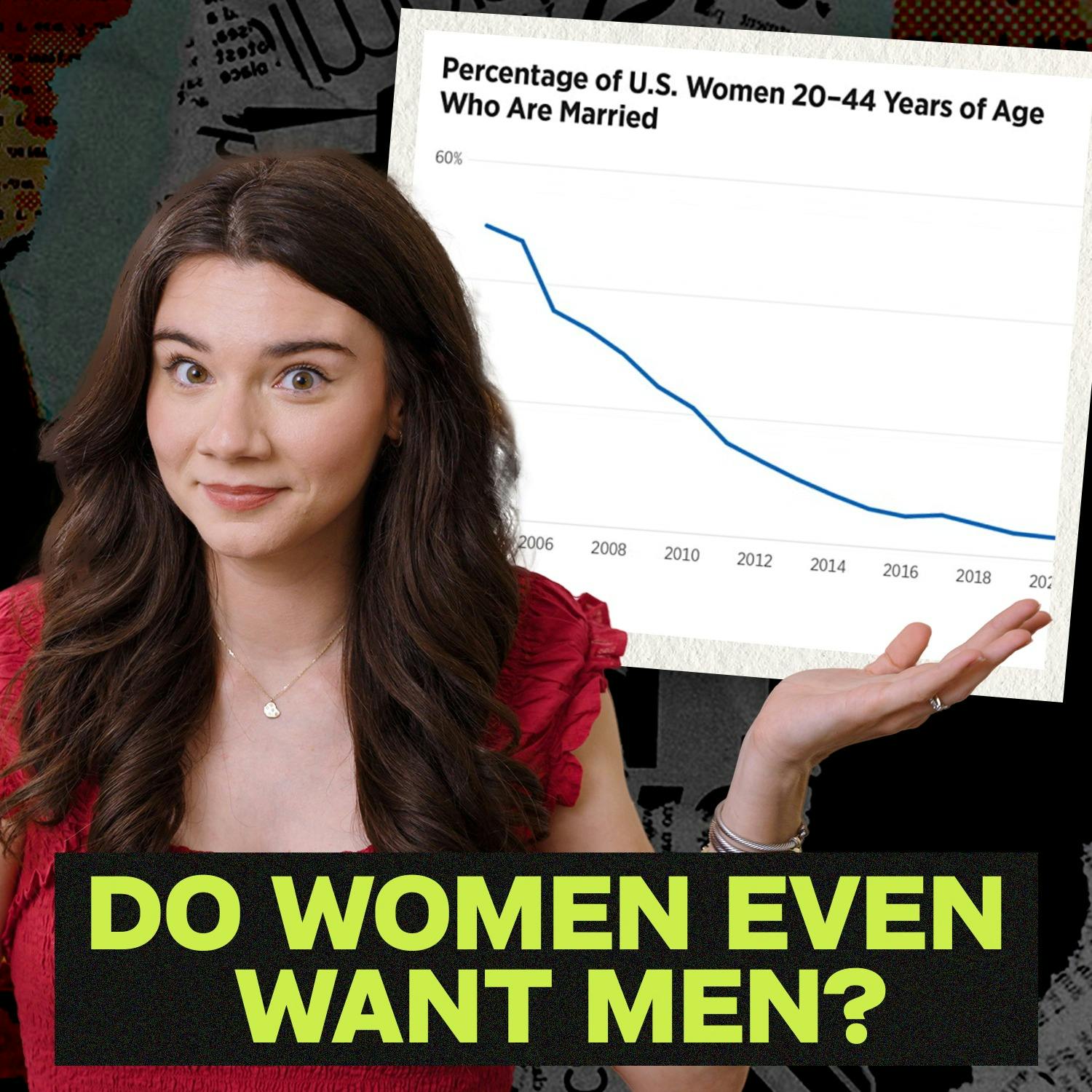
So marriage is not just a lifestyle choice. It is the infrastructure for a family. And that infrastructure is quickly collapsing. And so are the birth rates. Here's why. So if you've been following the news over the last year, if you've watched any of my videos, then you've probably heard about the birth rates falling and how that is such a big issue, not just in America, but around the world. It is something that countries around the globe, from here to Korea, are dealing with on a massive scale. But here is what nobody is actually talking and that is the fact that Americans desire for large families has continued to increase. Take a look at this graph in blue, you'll see that that is three or more children. And while there was a massive decline in the 70s and 80s, that number of people that are wanting three or more children has been steadily increasing since around 2008. 2010 definitely took off around 2015. So based on this graph and based on the statistics, people do still want to have families. They want to have children. And despite this desire for children, fertility rates in the United States have continued to drop. They have dropped from 2.1 to 1.6. So if it's not that people just don't want kids, then what is it? We're gonna talk about that. Before we talk about that though, make sure that you are subscribed to our podcast page and please rate the show if you are enjoying it. And if you wanna be in the know about all live events and upcoming things that we are doing, make sure to check out BrettCooper.com that will be the hub for all of that information. So of course if you pay attention to the culture war, if you are involved in the socio political landscape, all the discourse, then you will probably see people on the left blaming the fertility crisis on climate change or the economy. The right will also blame the economy, but they'll also say that it is about health and the fact that women cannot have children anymore or they're starting too late. And there probably is some truth to all of this, you know, based on individuals and what people's values are like. I'm sure that those are all factors. But today I don't want to talk about that. I've done plenty of episodes on that back on comment section here. We have talked about that ad nauseam. Today I want to turn your attention to what I believe in my opinion is potentially the biggest root cause. I don't think that our society and our country has just a fertility issue. I think that we have a marriage issue that is now leaning into and causing this fertility crisis because it's not wrong. The fertility rates have been dropping for decades. What you know, people like Donald Trump and J.D. vance and Elon Musk are talking about, what they are signaling the alarm bells about. Like that is all real. That is happening. However, the most notable drop was among women between 20 and 24 years old, while it did increase among women between 25 and 29 year olds slightly. But there was a much bigger increase between women 35 to 39 years old. And what is the reason there? Well, women are getting married later. We know that most women are not getting married at 20 years old anymore. They're not like me getting married at 22 or whatever it was. They're now getting married at 28, 29 and 30. And then after that is when they will start having children. And therefore, lawmakers around the world are flailing. They are desperately trying to figure out what they can do to encourage their citizens to have more babies. I mean, we're seeing that in America right now under the Trump presidency. The Trump admin is literally pushing for what they are calling a baby boom with all of these incentives to inspire Americans. To make it easier for Americans to have more children, they have proposed a $5,000 baby bonus. Another proposal is to give every newborn a $1,000 investment account. And contrary to popular belief, it's not just people in more conserv that are concerned about this like in Korea or Hungary. It's not just Republicans in America that are concerned. I mean, Zoran Mamdani in New York is literally running on the idea of free childcare to make things easier for parents. But as I've said time and time again, when we have talked about those proposed incentives, I don't think any of that actually solves the root problem because what we really need to turn the fertility rate around is a marriage boom. We'll dive back in. But first, a quick word from our sponsor. So, like most of you, I thought I knew what I was buying at the grocery store until I learned that over 4 billion pounds of meat were imported into the US last year and were still labeled product of the USA. That is where good ranchers comes in. All of their meat is 100% American, raised on local farms and delivered right to your door through their subscription service. This process is simple, it's hassle free and the quality is incredible. But best of all, you can rest easy knowing that you are buying from real American family farms and that your subscription and purchase helps them stay in business while big companies continue to buy from overseas. So start shopping American meat you can trust and visit goodranchers.com use my code Brett today and you will get 40 doll plus free meat for life. That is code bread, $40 off plus free meat for life when you start a new subscription today. Because here's the thing, guys, in line with what we were talking about at the top of this episode, looking at those graphs, birth rates are far higher among women who are married. 85% of us births still happen within a marriage. So let's just look at some of these marriage statistics. So, for example, in 1960, the median age at a first marriage was estimated to be 20 years old for women and around 22, almost 23 for men. But by 2023, the median age at first marriage had for women by eight years and for men by seven years. And this next chart here is probably the craziest. This is the percentage of US women between the ages of 20 to 44. So this is not just that they're getting Married later, but 20 to 24 years of age who are married. That drop is insane. Like, we talk about birth rates all the time. Oh no, they're crashing. What about this? And I know the conservatives talk about marriage and we encourage marriage, but like, seeing this in a graph is astounding. Like, there has been a profound, huge cultural shift because marriage is no longer the default for young people. However, people do still want kids. Allegedly, they say that they do. They say that they crave families. They say that they crave big families with three or more children. However, they are simply not forming the stable relationships that enable it. And I think that this is an important point to touch on because I think for people, especially on the right, we often talk about how our culture is just so backwards and progressive and, you know, nobody even wants to have a family anymore and everybody's having children out of wedlock. But the truth is the number of people having children outside of wedlock not being married and has not increased. It's just that people are not getting married. So delaying marriage therefore means delaying children. In our culture, I guess we're still a little bit traditional. Good for us. Which ultimately leads to higher infertility risks and fewer total births. That right there is the crux of our fertility decline, the fertility crisis that we are seeing in America. So why is that happening? Now we get to get into all of the really interesting socio cultural stuff that we see on social media, all of the debates, all the discourse between men and women. Now, in another episode, we covered the red pill movement and why men are having a hard time finding women. I'm not sure when we're gonna be releasing that episode because this is prematerity leave, Brett. But in this episode specifically, I wanna get into the Femcels and their side of things. But before we keep going, I wanna thank today's sponsor. All right, guys, here's the deal. Sainthood is not just for the perfect. It is for the faithful. And Hallow's new Saints in Seven Days challenge proves it. Starting on September 15th, you will spend each day diving into the life of a bold, imperfect person who followed God with first. Tosquin. Stefani kicks it off with Esther, a queen who risked everything for her people and trusted God when the odds were stacked against her. Then Michael Isander, AKA David in Amazon's House of David, walks you through the life of the original flawed but faithful king who messed up big but still chased after God's heart. You'll also meet Saint Therese of Lisieux, the quiet powerhouse of trust, and Saint Oscar Romero, a bishop who stood up to evil with courage and truth. This challenge is all about real people and real struggles and real grace through daily guided prayer. In the Hallow app, you'll see how God calls you to be a saint, not in spite of your weaknesses, but through them. And again, this challenge starts on September 15th. Get three months of hallow free@halloween.com cooper now guys, if there is something that all of us can believe in, it is hard work, self reliance, and showing up for the people who count on us. But when you're not sleeping and you're spending all night tossing and turning, all of that gets a lot harder. And I can tell you, I know that from experience from being pregnant for the last nine months. And that is why I have been counting and relying on Beam's Dream Powder to help keep me going. Dream is an absolute game changer and it actually tastes so good. It is like drinking hot cocoa before you go to sleep, but with all of these amazing benefits. And when I implemented it into my nighttime routine, I immediately noticed fewer sleepless nights and less tossing and turning. Plus, I actually woke up energized instead of groggy. Dream is packed with ingredients that your body actually needs to sleep, like reishi, magnesium, L theanine, apigenin, and even melatonin. But melatonin that is dosed intelligently, not like the drugstore garbage that knocks you out and just leaves you groggy in the morning. Now, to top it all off, Beam is a company that was proudly founded in the US and is run by people who share our values of hard work, integrity and delivering results. And right now, Beam is giving my listeners and viewers the ultimate discount of up to 40% off. Just go to shopbeam.com Brett and use code Brett at checkout. Again, that is shop beam B-E-A-M.com Brett and use code Brett for up to 40% off. So back to this femcel phenomenon, aka the women who are either accidentally or intentionally exiting the dating pool. Kind of like the flip side to the incels that we see on the Internet. These are women who are not dating and often they chalk it up to the education and financial gap between the two sexes. And to be fair, a lot has changed in that regard because for centuries women had always married across and up from their status. But what happens when women start outperforming men? What happens when they become more educated than their male counterparts? Because women now in America in 2025 outpace men in terms of college graduation and advanced degrees. And according to a Bank of America report from back in January, women are also outpacing men in both income and in spending growth. And what this inevitably creates is a bottleneck because women are claiming that there aren't enough high status men to go around because they still want to date across or up from their perceived status, which they define through their education and income, which obviously makes sense. But in my opinion, I think that the bigger issue here is not the college degrees or the but it's the fact that these women do not want to get married at all because they require whoever they marry to fit into this box in this life that they have created with no compromises. They are not willing to take any responsibility, to take any kind of accountability. They need you to fit in with them. No bending or anything. Now one author, whose name is Justin Murphy, wrote on X that somewhere in high school or college, these women came to the view that maximizing their independence would be pure upside. No matter what happens, they will enjoy material security, and then once that security is achieved, they'll have the most leverage to get the best possible match. Quote if I never get a match, I'll be fine because I have this career and I'm independent. But also this will probably help me get a great match because a master's degree and a career in a business are all unalloyed goods. This is not a particularly evil mindset, but it is new and it is essentially selfish and it just happens to be based on a tragically false model of the world. Once A woman has financial independence, she is less likely to want any man, while all the best men are less likely to want her. And at the same time, she now feels even more entitled to the best men. And that line right there, I think is the most important thing that he wrote. You'll see a lot of people on social media, specifically on X, doing dissertations on this in the comment section where they say men would rather date a Waffle House waitress. They don't want a woman who is ambitious or successful. That's ridiculous. I really don't think that's the point. I think that a lot of high achieving men, like women who are successful and are intelligent, have degrees, whatever it is, maybe one of them wants to date a Waffle House waitress. I don't really care. But I don't think that that is unilaterally true. And in my opinion, I think that it is less that the best men don't want her because of her success or her ambition, but because of that entitlement that Justin touched on. Because again, what I was saying earlier, these types of women require that a potential partner play second fiddle to her career and her ambition and her success, and that he fits into this perfect life that she has spent years creating rather than being interested in building a life together. I think this is one of the most beautiful parts of getting married young is that you get to create a life with your significant other. And so many people are against that. And they say actually you need to go out and you need to have all of the life experience you needed to get the job that you want and buy your dream house and get the car and do all the vacations that you want, and then you can find a partner to fit into that world. But that's so hard because then you've created this entire life. You're almost like a fully formed human being. And it's much harder to incorporate another human being into that life. And I think so many people, especially on the left, and this was especially popular with millennials, will say, no, no, no, no, don't get married young, don't settle down young. Because you need to accomplish all of these things before you get married and before you sett do the vacations that you want to go on. You need to buy the right cars, you need to get the right job, you need to buy your dream house. And then you can think about settling down and falling in love. But what happens when you've built this entire life by yourself? When you're so hyper independent, it becomes incredibly hard to fit another fully formed human being into that life. And so for a lot of people, I think that they just go, oh, I'm just gonna reject it because nobody's good enough. And in my opinion, I think that a lot of this hyper independence that we see in modern women goes back to that fact. Like, we have seen all of this play out in front of our eyes. I mean, Alex Cooper of Call Her Daddy is a perfect example of this. We actually talked about her also in the Red Pill dating episode because her whole philosophy is, be a man, have sex with whoever you want, build your life, focus on you, punish men for the things that you believe they have done to you or other women, and then you'll get around to getting married or doing the other things later. But right now, girl boss, and treat them like crap. And these types of attitudes have led to an entire generation of women who spent their 20s focused on their careers and rejecting men to the point where now these women have decided that they don't even like men. They don't even want men in the slightest. They do not need them. Take a look at this article published in the New York Times. It reads, the trouble with wanting men. And the subtitle reads, women are so fed up with dating men that the phenomenon even has a heterophatalism. So what do we do with our desire? And yes, guys, we finally have a term for this phenomenon, hetero fatalism. Or as I like to say, women that just don't like men. And because I know that we are all interested in the backstory, this article was written by a woman who, number one, was in an open marriage and then divorced her husband after deciding that she wanted to be with another one of her male partners who never wanted a committed relationship with her. Number two says that men are, quote, what is rotten in this state of straightness? Number three, ridiculed men over dinner at a vegan restaurant with girlfriends, says that the men she wants are, quote, not wanting me badly enough, not communicating with me clearly enough, and not devoting themselves to me. She seems like a peach. And lastly, writes all of this in a magazine rather than a personal diary. And in the end, this writer can't figure out why she's struggling to find men who want to date her, even though she says they are rotten and they are not doing enough things for her. Again, it's that hyper independence where you believe that the world revolves around you and everybody has to fit perfectly into your life rather than just being a good human being and compromising and understanding that relationships are a dance ebbing and flowing, but in this modern world with modern women, that is apparently just not a thing. But back to the article. This author has turned all of this, all of her issues, everything we just read into a problem with men instead of taking any kind of accountability for her own attitudes or her own actions that are 100% pushing away men. Just listen to this. This is an excerpt from her piece, quote, you're flattening the men, a former lover wrote to me after I sent him a partial draft of this essay. They never get to be real. They're used to confirm about disappointment and frustration, her story about disappointment and frustration. And then she says, this man and I met last fall when he was, like me, reeling from romantic rejection. And within a half hour we lunged at each other as though by tact agreement, to be each other's comforting orgasm, giving blankies. For a time we traded obsessive accounts of the failed relationships, cheered each other through the rigors of no contact, watched Albert Brooks movies, belted Weezer songs to karaoke tracks on his couch, and eventually I admitted to him that it had felt more natural to me to default to quote, unquote, wounded female rather than assume responsibility for my desires. He, for his part, described a large, looming ex whose adept use of guilt had left its mark. It was one of those moments of becoming aware, suddenly and fleetingly, of how we play ourselves and cast others to play opposite us in the productions of our internal dramas known as days. I mean, guys, just like in reading that, she's so close. I mean, she just barely touches it. And then immediately the plane takes off again and we go back to her acknowledging default of just playing the female victim. Because of course, blaming men for all of your problems and just opting out of dating entirely is easier than taking responsibility for your life and your situation and working to become a better human being that people would want to date, working to become somebody who is open to relationships that are messy and complicated and involve chaos and involve fallible people who are men and women. All of us are fallible people. And this whole attitude sounds so familiar to me. I mean, just go on X. It sounds like the incels. And this is how you end up with op EDS and situations like this. This was from the New York Times recently. Men, where have you gone? Please come back. So many men have retreated from intimacy, hiding behind firewalls, filters, and curated Personas, dabbling in scrolling. We miss you. I mean, it's so ridiculous. Do you actually miss them? I mean, women, you pushed them away and then the men responded and said, okay, fine, we're out. Many of them responded kind of toxically, in my opinion. And, and now you are doing the same and you somehow think that it's better. I'm telling you guys, there are two sides to this coin. And thankfully people have started to point it out. This is what one writer said in the London Times as a response to that New York Times piece. She said, in blaming all men for women's romantic hopelessness, heterofatalism feels dangerously close to the noxious worldview of the incel. Incels believe that society favors women who can sleep with any guy they like, but who only date the high status. This is a self confirming conspiracy theory that repels all women and as a result scuppers men's romantic hopes. How is heterofatalism, the idea that a straight woman's desire is embarrassing, hopeless and imprisoning, according to the Sexual Health alliance, any better? Hetero fatalism and incel culture are mirror images. In the first, women feel like men are winning. In the second, men feel the opposite. Both simply cannot be true. Mic drop. I mean, that is so perfect. This is not just a man issue. It's not just a woman issue. What we are seeing is complete and utter dysfunction. People moving like ships in the night, completely missing the point. And I love how this author in the Times wrapped up this piece. She said, think pieces are in the business of diagnosing societal ills. But it's sometimes easy to forget that life goes on. People are not evil, and sometimes relationships just don't work. When a man is hurt by one woman and blames them all, his response is rightly seen as juvenile and sexist. But when women blame all men, a new field of sexual studies is born. It should not escape reasonable people that this is hypocrisy. She's precisely right. And that is what feminism has bred in our culture. This idea that any problem women have in their individual lives suddenly becomes this big whole thing that we all then have to answer to and deal with when that simply is not the case. And men have a right to be upset and to point that out and to be angry and women should open their eyes and realize that this is so hypocritical. But continuing to just point fingers, and most disastrously, in my opinion, to blame individuals in your life that you might come across or meet in the dating landscape for these huge societal problems is not the solution. The nice girl that you meet on hinge might not be the issue. So do not take out your huge cultural frustrations on individuals that are just trying to date and just trying to find love. So to bring this all back to the point I was making at the beginning of this episode, it is not a fertility crisis per se, that we are dealing with. I think that there might be a crisis there, but that is not the whole story. It's not just a baby boom that we need. It is a marriage boom. It is a men and women liking each other again boom. And the Trump administration, their heart is in the right place with trying to provide incentives for people, trying to make it easier for people to have children. But I don't think that this is an issue that our government can handle with policy. I mean, we've seen this time and time again in Hungary, in Korea, you might see a little up uptick because you're giving people money to go out on dates or have babies. But it doesn't actually change the problem, which is far more cultural, and it involves this kind of divide between the sexes. Policy alone cannot change our culture, but we can. The way that we date, the way that we treat other people in our lives, the way that we take responsibility for our actions and our well being, that is what matters, and that is how we can change culture.