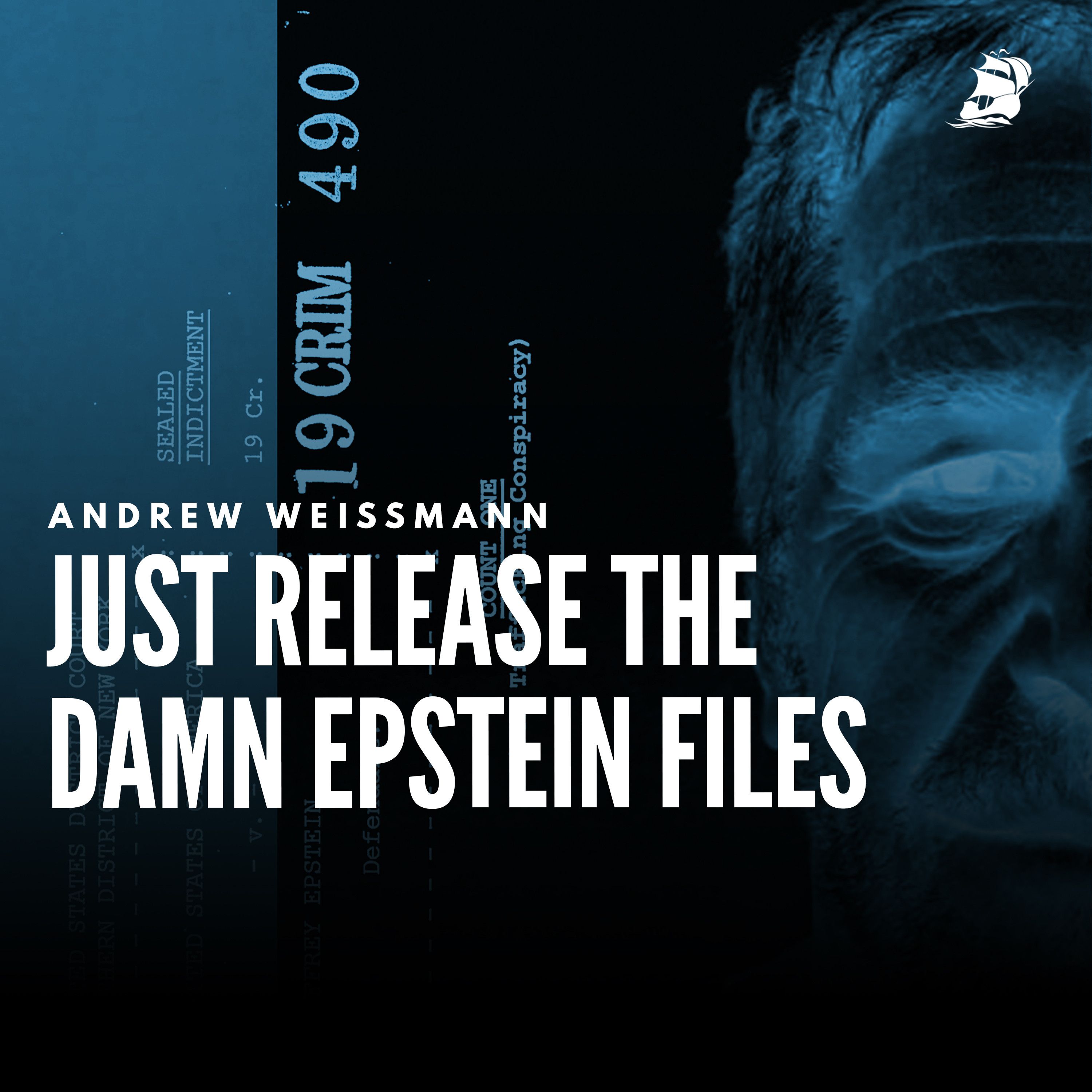
Loading summary
Transcript172 lines
- [00:00]
A
Foreign.
- [00:13]
B
Welcome to the Bulwark Podcast. I'm your host, Tim Miller. Delighted to be here with one of our good friends on the day before Thanksgiving. He's a professor of practice at NYU Law School. He was chief of the fraud section, which no longer exists at the doj, as well as general counsel of the FBI. He's an MSNBC legal analyst. He has a podcast called Main justice with Mary McCord. He's a substack called behind the Headlines. It's Andrew Weissman.
- [00:37]
A
Hi, Tim, how are you?
- [00:39]
B
He's bescarfed. He is in Paris and he is bescarfed. And I look at you and I'm sorry. I'm sorry, but if I'm Kash Patel, I'm looking at you in this photo right now and I'm thinking, are you a suspect in the Candace Owens situation? She says the French are sending assassins her way. You are in France. You're in a scarf. Have you been speaking to any legionnaires?
- [01:01]
A
I was gonna make some French joke, but I'm not going. No, I'm not. But I was very interested that you said that the fraud section doesn't exist anymore. But you didn't say that about the FBI. But I would say having been the general counsel, the FBI. The FBI that I knew doesn't exist anymore either. But yes, all that stuff has gotten dismantled. See, I just jump right into substance.
- [01:23]
B
So I appreciate that. Well, I've got more chit chat for you to substance for starters. I just looked at this. I'm going to be in trouble because you're an Ms. Now legal analyst now.
- [01:32]
A
Ms. Now, Ms. Now. Although, you know, did I tell you I came up with my own sort of way to try and deal with this, which is Ms. Now more than ever.
- [01:44]
B
Now more than ever.
- [01:45]
A
What do you think?
- [01:46]
B
Okay, I'm still working on it. I don't know. I'll let it sit with me for a little bit.
- [01:49]
A
Just so listeners understand the challenge, you can't change Ms. Now, Right? That's what you've got. You gotta work with Ms. Now. So you gotta figure out.
- [01:58]
B
That's why I do it. Ms. Now, Right?
- [02:00]
A
You could do that. But I think Ms. Now more than ever.
- [02:04]
B
I'm gonna sit with it. We'll see what I think. I'll think about it over Thanksgiving dinner.
- [02:08]
A
You know what? I'm gonna sit with it.
- [02:11]
B
That's not a yes. Well, it means that a first blush. I don't like it. Yeah, you're right. First blush. I don't like it. But it could grow on me.
- [02:16]
A
That is a polite.
- [02:17]
B
Well. But sometimes things grow on me, though. Okay. No, if it was a hard pass, I would have said hard pass. I don't think so. But sometimes things grow on me. Yeah. Okay, I'm sorry. We gotta start with something comfortable before we get into the news, and that is that the President of the United States was in the Oval Office. We don't play his voice on this podcast, so I'm going to have to read. It was a couple of days ago. He says he's talking about how he has nothing to do with Jeffrey Epstein. Says on the other hand, they went to his island many times. I never did. Andrew Weissman, I hear all these guys were friends with him. So were you. Were you and Epstein canoodling on the island?
- [02:58]
A
So you're asking me how the island was?
- [03:00]
B
Yeah.
- [03:01]
A
And about Jeff.
- [03:02]
B
Yeah, I'm asking you about Jeff. There's that weird kind of temple. Did he ever make it to the temple?
- [03:07]
A
You know, if he were alive, I'd be like, what the hell? How come I didn't get invited to the temple? But I really don't want to joke about this because this is my answer. Obviously, every single thing about that is false and defamatory. And just to be clear, just so that no one's thinking, oh, did he really deny it? I didn't know him, speak to him, communicate with him. The whole thing's completely false. You can probably tell by the fact that the President said, I hear. Really? Who do you hear that from? But here's the serious part. If anyone has any questions, because now you've got the President saying that and you have me saying it's not true. Well, the President has. Has 300 gigabytes of documents, according to the Department of Justice, on Jeffrey Epstein. If you have any doubt, and he wants to prove that I'm, you know, canoodling with him or in any way palling around, go ahead and release all of that. And by the way, this has nothing to do with Congress. He has the power to do it now. He can, today, as we are talking, release all of this.
- [04:10]
B
Shouldn't you sue him? I think you should sue him.
- [04:14]
A
So that is an interesting question. A lot of people on social media have said that. Let me give you sort of the one. I have time to decide that question, so I don't have to do it right now.
- [04:27]
B
So it's amazing.
- [04:27]
A
I can wait. Well, I'm certainly not going to be.
- [04:29]
B
You're going to sit with it like I was sitting with the. You're going to sit with that question?
- [04:34]
A
Yes. Here's the issue. 1. There would be a lot of litigation over something that he claimed when E. Jean Carroll sued, which is his trying to pretend that he was making statements as part of his official duties. And now that he's got a compliant attorney general, they can weigh in and say, yes, he was, and that would sort of end the case. And so that's sort of one legal aspect that's getting into the nitty gritty of it. The other is sort of more on a sort of personal level, which is, you know what? He should just release the goddamn files and stop playing games and pretending that he can say what's in there and what's not in there. You know what? He wants to make those claims. Go ahead, put your money where your mouth is. Release it. Bringing a lawsuit and having all of this attention a little bit like you. I don't want to be the story. I want to cover the story. I don't want him to steal that from me.
- [05:36]
B
He sued so many people, though. What about the counterargument? Fuck him, sue him. I'll see you in court. There's my counter argument. I hear all of your points, but how about, fuck you, I'm suing you. It's defamatory. How about that?
- [05:47]
A
And let's just say I'm gonna let it sit with me.
- [05:51]
B
Yeah, sit with that counter argument for a little bit.
- [05:53]
A
And by the way, I was trained in Brooklyn, even though I have all these fancy schools, and I went to Columbia and I went to Princeton, and I went to a private school for high school, and all of my training as a prosecutor was in Brooklyn. And just to put it brass tacks, it's like, this is what I learned. Somebody says, fuck you, and the response is, fuck me? No, fuck you.
- [06:19]
B
Yeah. Kind of like the Notorious B.I.G. in a way of legal. Of the legal world.
- [06:24]
A
Yeah. So, I mean, as people who listen to me probably know, I really don't like cursing. But this is what. I totally hear you. I have not made the decision about what to do. It is completely defamatory, and, you know, that I'm confident of. But this is also one where I think time is also on my side, because I know that I'm not in the documents, that there's going to be nothing in there to show that I'm palling around or friends with him or communicated with him in any way, shape or form. So. And it's clear that the President has not been told that or knows that's not True, so. But let's see what happens.
- [07:04]
B
Biggie Weissman. Okay, we'll look at it. I'm on the suing side.
- [07:07]
A
I like that.
- [07:08]
B
I'm on the suing side. Just in case you're wondering.
- [07:10]
A
Seriously, do you think I should sue him?
- [07:12]
B
Yeah. I'm not a lawyer, but is there a more open and shut defamation case than this? I mean, his team has the files. It's a pretty significant smear to say that you were at a child sex trafficking island. And it's not just like he said that he did some other smear about you, about how you're a meanie pants or something or how you're. Whatever, scum.
- [07:31]
A
I have a whole list. There's a lot of adjectives. Scum and a bad guy. I should be investing.
- [07:37]
B
You're not either of those things either. You're a good guy. You're not scum. But I wouldn't sue over that. I would probably sue over him saying that he says directly they went to his island many times. I never did. Andrew Weissman, I hear. Yeah, it's pretty cut and dry.
- [07:50]
A
Yeah. And then we have to just figure, do I pick like, you know, he seems to be bouncing around between the $10 billion and the $1 billion. So I think it's like BBC maybe because the Brits. He feels like he should be a little bit more restrained. I think it's like a 1 billion figure. But York Times and the Wall Street Journal, they seem to have merited the 10 billion. So I'm thinking if he's making all this money from, you know, all his deals with Saudi Arabia and his crypto deals and all that. So maybe it should be more than that. Because, you know, it shouldn't be meaningful. It's supposed to. The whole point is to do something to have him stop.
- [08:28]
B
You should get at least what ABC and CBS paid him. Anyway, if you go forward with it, I'm going to take a 10% vig at this point because I'm pushing.
- [08:36]
A
I think you're also gonna be a character witness.
- [08:39]
B
I will be a character witness. I don't know if that's legal or not. You know, if not, you can just take me out to a nice dinner.
- [08:44]
A
By the way, don't you think we should just take a moment to be like we are sort of kidding around? It is actually not.
- [08:50]
B
I'm doing the thing that I do though, where I'm kidding, but I'm serious. Like, I have a kidding tone. But I do think you should sue him just to be Clear. No, no, no.
- [08:56]
A
But I mean, there are real victims out there. And while this is all lighthearted, there are real victims out there who are calling for the release of these files. There has really been no true full investigation of what's happened. There's been no accountability for them. Many of the things are just outlandish. What's happened to them the way that really sugarcoated what's happened to Glenn Maxwell without any sort of input from victims. I mean, all of this is a real disgrace in terms of justice. So like, while we're joking around, there's real harm to, to real people who've already been victimized.
- [09:35]
B
100% agree to that point. Somebody's asking me, will anybody ever be satisfied, like, by what this release is? That's kind of what I'm asking you about. We have this. Some, some type of release allegedly will happen in mid December. There's been a deadline set now, and for starters, it's just beggars belief. I don't think anyone actually believes that Jeffrey Epstein, Ghislaine Maxwell and Andrew, formerly Prince Andrew, are like the only people involved. Given the scale of the horror and the number of victims, it's just hard to believe.
- [10:08]
A
Well, no, but it's obvious. It's not. I mean, it's just not possible.
- [10:12]
B
Exactly. And so I think just as a minimum ante for like, will anyone ever be satiated by anything? It's like if there is a release of additional information from whatever the DOJ has looked into over the years, that there needs to be some feeling that there will be other people that were involved that are held to account, or maybe they passed away, but at least we'd learn. And to me, that is what I wonder from you. And who the hell knows what this doj, but like redactions and what do you expect as far as what they might do, what they could do, what their ability to redact is, etc.
- [10:51]
A
Let's just take the first thing, which is the argument that, you know, no one's ever going to be satisfied. Well, you know what, That's a terrible argument. We should not release anything because you know what? No matter what, how much we release, no one will be satisfied. Well, you know what, I've done a lot of investigations where you do what you can for victims and you do as much as you can and you do as thorough an investigation as you can. Does that mean you're going to get to the bottom of everything?
- [11:18]
B
No.
- [11:18]
A
But does that mean you don't investigate at all? I mean, that Argument just is. Is laughable. And it's. It's an insult to victims. What the administration can do, they can do a hell of a lot. And I am completely cynical about what they're going to do. Because if the President wanted to right now, he could release everything. I've said that now a million times. But you know what else he could do, Tim? He could say, you know what? I'm not going to deal with other people's privacy rights. I know that those are concerns I can deal with that there may need to be redactions about it. But because I did nothing wrong, I am directing my Attorney General to turn over every single thing in the Epstein files about me. Whether it's communications about me, communications by or to. To me, whether it's images of me, every single thing about me is going to be turned over. He could do that today and give people some satisfaction. And you could say, and I'm going to make sure my Attorney General follows that there's no side deals.
- [12:26]
B
That is.
- [12:26]
A
That is what needs to be done. The fact that that has not happened to me suggests that we are going to get a completely whitewashed partial disclosure of material where we're going to get a lot of filler, but we're not going to get that complete announcement of everything related to him. And that is something he could do now. And the fact that he isn't makes me strongly suspect that that's not going to happen by the congressional deadline, because the congressional deadline is really just a fiction. It has nothing to do with what the President can do right now. So I just don't think people should be hopeful.
- [13:07]
B
If you were still in there, putting even the Trump part of it aside, like, how would you handle like these. There are like a lot of challenging legal questions at this point. Right. Like about redactions. I keep going back to it's. I think that the classified thing is very suspicious, but just because he was not an agent of the government and so why should you have any classified materials in there? He did not have it. A security clearance, as far as I know. So.
- [13:33]
A
And the President, as we know, is happy to declassify things of all sorts of things. So everything. Yes. Could there be classified material? Seems unlikely, but there could be. And could it be something that. That a good faith government would think does not need to, like, shouldn't be declassified? I'm not going to say it's impossible, but again, highly unlikely. But that's not what we're talking about here.
- [13:57]
B
But yeah. Right. But then we should Investigate whoever emailed him the classified information then actually because that person should go to jail because Jeffrey Epstein didn't have security clearance. So then the question comes to the redactions of innocent people's names. And how do you handle all that? How would you think about handling all that?
- [14:13]
A
So one, there is the question of the names of victims there. You can actually go to the victims and ask them if they are alive. Obviously not all of the victims are alive, but you can ask them are they okay with having their names released. A lot of the victims are public and have gone public voluntarily. So you could get consent. If you get consent, game over. That's. That deals with that issue. Second, with respect to people who may have been caught up in this, I think there's sort of two different categories. If it is information that suggests of a criminal nature, there is a DOJ policy about sort of not besmirching people sort of the put up or shut up. And that's sort of one issue.
- [14:59]
B
Yeah.
- [15:00]
A
The thing about were they just communicating with them and you might feel embarrassed or ashamed. Let's just say that Larry Summers is in that category.
- [15:09]
B
Sure.
- [15:10]
A
You know, that's a very different thing. That's not like the government's job is not to like protect from. From that.
- [15:16]
B
Yeah.
- [15:16]
A
Protect your feelings, especially when there's such an important outcry and you have Congress having made a determination about weighing those things. So I think that that gives the Department of Justice a lot more leeway. The other thing you could do, let's say you have an image. Let's, you know, Senator Whitehouse asked the Attorney General about reports that there was an image of Donald Trump with half naked young women and she refused to answer whether she saw it or not. Let's assume, again, hypothetically, let's assume that image exists and let's assume you don't have the consent of those underage now no longer underage women, half naked women with Donald Trump. Again, the question that Senator Whitehouse. But if you don't have their consent, you could always sort of fuzz out and anonymize their faces and still release their that kind of material. So there's really a way forward. If this was an administration that was forward leaning and wanted to release it. And obviously this is an administration that has no problem besmirching people in ways that are outlandish. So ask Mr. Brego Garcia, who the attorney general went on air saying he's a terrorist, he's not accused of that. It's not been charged with terrorism. But he had. She had no problem doing that. So to hide behind that for this administration, administration to say, oh gee, no, now we have a moral fiber. We don't want to accuse people of things that they haven't been charged with is really comes with poor grace when you're talking about this administration which has no problem labeling people without being charged.
- [17:04]
B
All right, there's a lot of uncertainty out there. You know, we got our guest, Andrew Weissman being randomly shanked with lies by the president in the Oval Office. Who could have seen that coming? So in a world of uncertainty, it's important to turn to things that can help give you a little bit of peace of mind. And that's why our sponsor Selectquote is here for you. For over 40 years, Selectquote has been one of the most trusted brokers in insurance, helping More than 2 million Americans secure over $700 billion in coverage. Their mission is simple, to find you the right insurance policy for your unique needs. Unlike other one size fits all life insurance companies, select quotes licensed agents work for you. In as little as 15 minutes they'll compare policies and find you the best fit for your health and your budget. And they work for you for free. No medical exam. No problem. They partner with providers offering same day coverage if you have high blood pressure, diabetes or heart disease. Selectquote has partners with policy designed for many pre existing health conditions, including those so you get the protection you deserve. Head to selectquote.com and a licensed insurance agent will call you right away with the right policy for your life and your budget. Get the right life insurance for you for less and save more than 50%@SelectQuote.com Bulwark save more than 50% on term life insurance@SelectQuote.com Bulwark today to get started. That's SelectQuote.com Bulwark moving on to Maxwell.
- [18:24]
A
The prisoner who's in the camp who's playing with a puppy.
- [18:27]
B
Yeah, she's doing great. Did you see that she got the nice toilet paper?
- [18:32]
A
I didn't see that. I saw that she got the puppy.
- [18:35]
B
Yeah, she got like the triple ply toilet paper. I mean it's really the fanciest. It's better than you're getting in France, I'll tell you that.
- [18:42]
A
You know, there's a joke here which is no shit.
- [18:48]
B
You'Re a psychological laugh.
- [18:51]
A
That got a laugh from you.
- [18:52]
B
That was a laugh. Yeah, of course you did, Andrew. You make me giggle sometimes.
- [18:56]
A
I'm like a serious lawyer. This is not like I'm not That's not high on my like what I'm known for.
- [19:02]
B
It's a holiday week and you're on. This is the podcast where you let your ear down.
- [19:06]
A
Pity.
- [19:06]
B
Laugh, kitty, laugh. That one was good. The sandpaper toilet paper you're dealing with in Europe, though, not Ghislaine. She's doing fine. She's got the nice stuff. One of the people there said to Jamie, you're asking, I'm tired of being her bitch. What do you have with that? You've done some posts about this, about things Congress could or should be doing related to Maxwell. What do you think at this point is the path forward?
- [19:29]
A
Well, first the idea that she gave in a quote unquote interview to the deputy attorney general that was, I mean, it's hard to even call it an interview and then was rewarded by getting moved to a camp is a complete affront to victims. What can happen? You know what she has said that if she's called to Congress, she's going to assert the Fifth Amendment and she's not going to testify in spite of giving two days of answers to the deputy attorney general that her, because you know the deputy attorney general can help her get a pardon, which is obviously her end goal. The Congress can actually deal with her saying, oh, I'm not going to testify based on the Fifth Amendment. They can immunize her and that will force her to testify. So if you immunize somebody that takes away their Fifth Amendment and in exchange their words cannot be used against them to prosecute them other than if they were to lie or obstruct Congress. Now she's already got a 20 year sentence, so you don't need to worry about, do we need to prosecute her some more? She's going to serve 20 years. If you immunize her, she's still, I.
- [20:37]
B
Mean, I think she deserves more, but. Okay.
- [20:39]
A
Yeah, but I mean that's a judge decided should be 20. Great. You know, Judge Miller thinks that it should have been more. But Ali Nathan, very good judge in the Southern District now, 2nd Circuit judge said 20 years. That is what she's going to do absent the president giving her some kind of pardon or commutation. And so they could immunize her and force her to testify before Congress. And then if she lies, she could be prosecuted. If she refuses to testify, that's a separate crime of contempt of court. That's what Steve Bannon was charged with and convicted of. And any time that she would do for that would be consecutive to her crime current time. So Anyway, they have a way to force her to actually have to come to Congress and answer questions and actually confront her with a whole host of things. I am particularly interested in the email exchange which we just learned about where Jeffrey Epstein said the dog that didn't bark is Donald Trump, meaning he has not said anything about us and what I was doing. And she doesn't say, what are you talking about? Like, what are you. I don't know what you're doing. That that he would possibly know about. She doesn't say, why would he possibly know about this? Instead she says, and I'm going to paraphrase it, I was thinking about that, too. So why would you give that answer if this is somebody who you think would have no idea about what Jeffrey Epstein was up to?
- [22:11]
B
Oh, well, obviously. Should we know? Yeah.
- [22:14]
A
Right.
- [22:14]
B
Well, the Republicans aren't going to do that. So your point is, if the Democrats take back control, you would recommend is to immunize her and bring her in front of Congress.
- [22:22]
A
Well, and also the Republicans who just voted to sort of force the president to do this, they could say, we want to hear from Ghislaine Maxwell and they could join with Democrats and do this. And the other is, I think it's worth people talking about it so that there's sort of public pressure for accountability here. And let the Republicans who had taken this step with respect to documents now take a step with respect to a witness. I don't deal with the sort of the political realities of it. That's sort of your area. My point is there is a tool. There is something like, if you're asking what can Congress do, they have the tools in the same way that they had the tools and they voted by quite a lot, meaning unanimously, minus one with respect to the documents, can do the same thing with Ghislaine Maxwell. After all, if the deputy Attorney general thought that she should sit, he should sit down with her for two days and interview her. Shouldn't he be saying, sure, absolutely, bring her to Congress?
- [23:23]
B
There's some reason to suspect not, but we'll see how that shakes out?
- [23:27]
A
Yeah, of course not.
- [23:28]
B
I want to get now to the dismissals. The great news of the week, which I'm excited to have you to discuss. We have District Court Judge Cameron Curry. She dismissed the criminal cases against James Comey and Letitia James, which was a shock to me. I don't know about you, because they seemed really so silly, so serious, and they really took a lot of protocols and that they, you know, really, you know, crossed their t's before when they dropped those prosecutions, she had ruled that Lindsey Halligan was unlawfully appointed. The law only allows one interim U.S. attorney to serve for a temporary 120 day period. Her predecessor Siebert was also a Trump appointed interim. He was one that resigned because he wouldn't take on the case. And so that means that the cases are dismissed. There are a lot of ins and outs and what have yous. But like where, where are you at? Do you think this is obviously the appeal but like do you think this is basically the end or tbd?
- [24:21]
A
So the judge's decision is consistent with all of the other judges who had had to confront this, which is just a sign that Donald Trump keeps on appointing people as US Attorneys who are so unqualified that the Judges after the 120 days, the way the statute works is Trump gets the first 120 days and then after that the judges get to choose. Now in normal circumstances, the judges just go ahead and choose the person who the President chose for the first 120 days because they're not looking at this from a partisan way or a policy decision. They're just saying look, it's the person competent. Can they do the job. And so they almost always do that, but not in this administration. So that's why you have Alina Haba having been ruled. Nope. Illegal and the judges won't appoint her. Same thing would happen I think with Lindsey Halligan. So this is happening around the country. That's sort of just to say there's nothing unusual about this decision. This is totally in keeping with what has happened with this administration trying to avoid a congressional statute, trying to avoid what the Constitution requires, which is that there be Senate approval of U.S. attorneys. What do I think is going to happen? I think that with respect to Letitia James, what they need to do is find a U.S. attorney, somebody who's official enough in new interim, somebody who is willing to do it. Remember that might not be so easy in the sense that Eric Seibert, as you pointed out, said no, apparently all of the career people in the Eastern District of Virginia are not on the cases because they don't want to do them. And so they have to find somebody. And with respect to Letitia James, they probably will find somebody. With James Comey, the issue is even if they find somebody, the statute of limitations, the five year period in which they have to bring charges has run.
- [26:15]
B
Does that mean that it's run or but since they had started it, does it get kind of grandfathered in so.
- [26:21]
A
That is going to be the litigation. If they find somebody to bring this new case, if they find somebody to do it, which I suspect they will, there will be litigation where Comey will say, in addition to all of his other arguments, vindictive and selective prosecution, etc. They will say that the statute ran, you should have brought this within the five year period and you sort of hit the. In the vernacular, will they be able to say, yeah, but we brought the initial one at the right time. And the debate will be, wait a second. If it's a nullity, if this was just void ab initio, if the court's supposed to treat it as if it did not happen, then nothing stopped. The clock, the clock ran out after five years. And now you're bringing this at a time after the five years. So that's Comey's position. And the government has to be able to say, no, I want to sort of resurrect it. I should point out there is.
- [27:19]
B
I will tell you, this happened for me once on a minor in possession of alcohol. Long story, but, yeah, short version is I got a minor in possession of alcohol. I was supposed to do a class and a fine. I paid the fine, did half the class, didn't finish it. Then I was pulled over for like running a stop sign four years later. And they're like, you have a warrant out for not finishing your minor in possession class. That sucked. Went to traffic court. The judge was like, statute of limitations ran out on the minor possession. So lucky you, young man. I got a lucky you, young man from the judge. So, you know, sometimes that happens. Me and James Comey might have that in common.
- [28:00]
A
Yes, he might be lucky. I have to say I, on a big picture level, not from a James Comey level. Because from his perspective, it could be like, I want the case to go away no matter what the reason is. I would like to see the judges rule on the vindictive and selective prosecution argument. That would get rid of the case.
- [28:20]
B
Could that still happen?
- [28:21]
A
It's complicated. This is why lawyers have a bad name. Because you're just like, can't you just give me like a freaking yes or no? And I think that the answer is, is mostly, unless the case is reinstituted, it's not going to get litigated.
- [28:37]
B
So you kind of want them to reinstitute it so that they can then go back at them over the vindictive prosecution.
- [28:44]
A
Well, look, Letitia James case will be, I think will be brought and she will continue making that argument. And she has A very strong argument. I think her argument in many ways is even stronger than James Comey's argument for vindictive prosecution. There is, I just want to mention something on the government side, which is there is a statute that says that if you have brought the case within the statute of limitations and a court later says that there's some defect in the indictment and you need to re indict that you dismiss the indictment because of that. This, this congressional statute 3288 says that the government gets six more months. And so I think we're going to hear a lot about that statute and about whether this is the kind of dismissal that triggers that six month period that would allow James Comey to, to be properly re indicted or whether that statute doesn't apply here.
- [29:48]
B
Can we take this at the bigger picture, which is just about how embarrassing this is for them and just like the degree to which they're bad at their efforts at political retribution. I mean, I was saying this to Sarah earlier. Trump has gone a lot further than many people expected in certain areas. In this area, I was pretty concerned. And I know you were. Everybody was like, I wasn't fleeing the country concerned. But I was like, there's a lot of things the FBI can do before you even get to an indictment. There's a lot of ways that the Department of Justice can hassle people and make their lives miserable. And I didn't think I was at the top of the list. You were ahead of me. I was keeping an eye on you. Mostly I was like, if they come from Weissman, then I'll start to get worried.
- [30:32]
A
I was your canary in the coal mine.
- [30:34]
B
Exactly. But here we are a year out and he had these huge plans for revenge, including arresting Obama. And remember that? And going after Comey and Schiff and James. And now we're about to the next topic, going after these six members of Congress that did this video. Exactly. And it has just been a total incompetent disaster. They're not even good at the authoritarian stuff when it comes to the narrow part of using the justice system to target their foes. Right. And this has been really embarrassing.
- [31:09]
A
Yes. But that is the part of, that's like Trump 1.0, which was malevolence, fortunately married with incompetence. And here there's certainly malevolence. There's, there's this, the transparent weaponization of the department. When you say I want you to open an investigation into the Epstein matter, but only as to Democrats, that is just, it is not the quiet part.
- [31:32]
B
Out loud.
- [31:33]
A
It's the loud part. Out loud. It is just being blatant. And so that is what's going on in terms of incompetence. Just remember, Lindsey Halligan had just swore to a judge that she didn't present the indictment, the second indictment of James Comey to the grand jury. The next day. They filed something saying, no, they made a mistake. She did present it. I mean, it's, it's a clown show. I mean, it's just in terms of.
- [31:59]
B
Incompetence, Keystone Counsel run in circles around these guys and it's like really embarrassing and especially when you consider the other. They're all clowns. Hagsel's a clown, Gnome's a clown. But they're at least kind of relatively achieving some of their malevolent ends, these guys. This is brutal.
- [32:15]
A
So I was a prosecutor for 20 years. When I first went to the grand jury, somebody came with me. The second time I went to the grand jury, someone came with me who was experienced. Lindsey Halligan had never been a criminal prosecutor. She had never been a criminal lawyer. She was an civil insurance lawyer. How is it that she went to the grand jury alone? Now I understand people might say, but wait a second, Andrew, you just said all of the criminal experienced AUSAs in the Eastern District of Virginia didn't want to work on the case. Well, you know what, the Eastern District of Virginia is right near Washington, D.C. where there are thousands of lawyers working for the Department of Justice. How did Todd Blanch, who interviewed Ghislaine Maxwell for two days, the deputy Attorney General, you know what he could do? He could have gone to the grand jury with Lindsey Halligan. Instead, Lindsey Halligan with no criminal experience goes to the grand jury alone. Alone. Nobody is there with her. So I'm sorry, how do you expect there not to be problems in beginning assistant United States Attorney? A beginning federal prosecutor does not go to the grand jury alone.
- [33:25]
B
I mean, Donald Trump got four indictments against him in four different jurisdictions because he did a lot of crimes. I like this effort to just randomly shout and be like, arrest my opponents too. Anyway, it's still scary. It's still malevolent. There's long term damage to the doj. We talked about this with Carol Lennig. But just like in the micro element of just looking at, they have a goal of getting political revenge against their foes because they're mad that Donald Trump did crimes and was held accountable. Like, remarkably bad at it.
- [34:01]
A
Yeah, look, the Letitia James case and the James Comey case, as we're doing this are dismissed.
- [34:09]
B
Right.
- [34:10]
A
Why? Because they couldn't even get a proper, according to the judge, a proper interim youth attorney appointed.
- [34:19]
B
Now we move to the FBI's work. And they're going after, as we're taping this. Apparently they've requested interviews with Senator Kelly and five of the Democrats, Slotkin, Crow, d', Aluzio, Goodlander and Houlihan. They're in that video that I've discussed a couple times where basically they said to US Soldiers that they do not have an obligation to follow an unlawful.
- [34:43]
A
Order, which is the law.
- [34:46]
B
Yeah, it was pretty perfunctory. Trump said that that video was seditious behavior punishable by death. Stephen Miller called it an insurrection. I think trying to be cute.
- [34:56]
A
Both of those are not the law.
- [34:59]
B
Okay, thank you for clearing that up. And now I guess the FBI wants to bring him down to the bureau, have a little chit chat. I'm kind of. I'm Mark Kelly. I'm like, all right, buddy. All right, cash, let's do it. I'm interested in seeing your office, actually. Can we take a look around? See the took of the challenge coins. I'd to have a little meat. Little meat. Cute. Over this. Like what the what, like what is this?
- [35:21]
A
So there's more.
- [35:22]
B
They got.
- [35:23]
A
There's more because the Department of Defense wants to take Kelly and bring him back into service and court martial him. And that is sort of a. To have a chilling effect on anybody who is in public service and also a chilling effect of people who served in the military. And this, if you remember, was a big issue at the end of the first Trump administration with former secretaries of defense and Liz Cheney really calling out this concern about the military and making sure that they do not bend the knee to the political ambitions of then President Trump at the end of his first term. My question is the following, which is not a legal question, is given that this video stated what the law is, why would the FBI and the Department of Defense be doing this? They agree that the law is that members of the military do not have to follow and should not follow illegal orders. People have a First Amendment right to say that, especially since it is true. They would actually have a First Amendment right to say it even if it was not true. And so you have to ask yourself, why are they doing this?
- [36:45]
B
Is that a rhetorical question or can I answer it?
- [36:48]
A
It is a rhetorical question, but like, you know, go ahead.
- [36:51]
B
I'd like to answer with a little bit of specific detail because I've been, I was traveling a lot last week. So I was watching a lot of Fox. Fox loves this story. Fox loves it. They love calling them the seditious six, blah, blah, blah. They're undermining the military, they're undermining the troops. You know, all this hyperbolic rhetoric. And I think that you look around at the political situation right now for the president and he's been taking loss after loss after loss in the off year election with Epstein, with Comey and James, et cetera, and the economy is not looking great. And it's like this is something that we can talk about to try to go after the left and make them seem like they're extremist, anti American, anti military, whatever. And so, you know, Cash watches a lot of Fox, Hegseth is watching a lot of tv and they're like, all right, well, look, I'm going to use my power to try to rattle their cage a little bit and also to try to discourage rank and file people from speaking out. And so I just, I think that's it. But I don't know if that's going to work. I mean, it's like pretty ham handed.
- [37:57]
A
You know, it's interesting. I in many ways hope that you're right, that this is.
- [38:02]
B
Do you think it's scarier than that?
- [38:03]
A
Yes.
- [38:04]
B
I'm glad I answered the rhetorical question.
- [38:06]
A
Then I put it in the context of, I don't know. Did you read Liz Cheney's book? It opens with a real call to the concern about the president and Trump improperly interfering with the military. If you are engaging in a coup, as we know from many international examples, control of the military is everything. And to me, the idea of saying, I don't want you to speak the truth to the military about what they are entitled to do for the same reason, by the way, they got rid of the top lawyers. Yeah, the jags. Right. Why would you do that? Again, you don't, you don't want independent, impartial people steeped in military justice, which I have a huge amount of respect for, to be giving that kind of advice. And so I think if your view is might makes right and you don't believe in principle and you want to control the military, I think that there are very scary things to worry about.
- [39:19]
B
I agree. There are scary things to worry about. I think the question is, and I'm glad we both gave our view because it's worth thinking about and hashing out, neither option is particularly great. The question is, is the Secretary of defense just like a little boy, like play acting secretary of defense with imposter syndrome. Just trying to do a little. You will respect my authoritai game because he's a man child who's totally in over his head. Is that the person in charge of the military? Not a great picture of the person in charge of the military, but that's my view. Or are these guys in charge of the military plotting with Trump for 2027 when who knows what happens? Maybe they might need to ask the military to do unlawful orders.
- [40:06]
A
Well, the thing is, it can be both. In other words, I guess that's true.
- [40:09]
B
I guess that's true. Why choose?
- [40:10]
A
Right? I mean, I think that what you're saying about the description could be a completely accurate description. It also is the case that you ask yourself if you're right, that that is the accurate depiction of who we have there when push comes to shove. Will he be an Esper or a Mark Milley or is he going to be. Exactly. So again, another rhetorical question. Or is he going to be. If he is a man child, maybe it's. Maybe even cut the man part and, you know, will he have the moral fiber and gravitas to understand the impact and import of his decisions for a continuing democracy?
- [41:03]
B
Yeah, I think it's a false choice. I guess my point is in this moment was getting rid of the Jags and calling these guys in and saber rattling in service of like some plan to use the military to undermine the democracy and overturn it as part of Trump's will to power. Like, I don't think so. Right. Like, eventually Trump might decide he wants to use these guys for a will to power. And I think we're in a pretty bad shape if he chooses to do that. But I think currently this is a political action. I guess that's my assessment.
- [41:34]
A
That might be right. They may be thinking short term, but it also may have long term ramific. I mean, you know, we're busy bombing all sorts of boats in the Caribbean where there's significant pushback by lawyers outside of the government in international countries that don't want to give intelligence to the United States because they think it's illegal what our government is doing. And if you get rid of impartial, sophisticated, experienced people, part of it is because you do not want that impartial answer, which is it's against domestic law and international law.
- [42:18]
B
It's an interesting question. It's kind of what leads to a conversation yesterday with Michael Weiss was like the character drama about who's up and who's down in Trump world is not really that important or interesting to me. At some level in the Pentagon, it's kind of interesting you have Hegseth there and this guy Driscoll is more of an advanced guy angling. And the implication of all these questions, at some level, they're not letting Hegseth isn't going to the big boy meetings like Driscoll is right now. And it's like you wonder if maybe Trump likes having Hegseth in there, though, because of the pliability and it is related to all this.
- [42:57]
A
I mean, to me, pliability seems to be the number one criteria. Ceg, Lindsey Halligan, to get back to where we started. I mean, that just seems to be the number one thing that you're looking for because at the very least, I think nobody has been arguing, well, we're picking the very best people for the job.
- [43:18]
B
There's one thing that isn't really for you, but since we're here, I just wanted to bring up, because I was talking to Weiss yesterday. I'm just curious what you think about this. And it's not really in the legal space, or maybe it kind of is. He was explaining that Witkoff and Kushner and maybe Vance a little bit, were kind of freelancing this Russia, Ukraine deal outside of the regular structure. And that Rubio, but notably Ratcliffe at CIA are like against what they are doing and for the more formal process that's going through, the Europeans and Ukrainians, et cetera. And I kind of impishly asked Weiss, I was like, why isn't the CIA spying on Wyckoff then? If Rackoff is against us, shouldn't he be spying on Wyckoff? And then just before we came on, John Hudson over at Bloomberg is reporting on this extremely rare leak of a phone call transcript between Putin's senior foreign policy advisor and Steve Witkoff. Witkoff advises Putin's aide on how to pitch Trump on backing a Gaza style piece plan. So I'm not saying that I was onto something there, really. Who the hell knows what's happening with that? But pretty noteworthy, I guess. I don't know. The transcripts, it feels like that seems like a pretty close hold.
- [44:40]
A
Yes. So just remember, a lot of foreign governments and the United States are sort of constantly spying on each other. We would be doing everything we can to capture communications with Putin.
- [44:58]
B
Right.
- [44:58]
A
And I'm just talking prospectively, I'm not talking about anything I would or would not have known previously. So, you know, that would be something that was in the government's interest, is to find Everything that. That in anyone who is communicating with Putin or senior people around him. So even if you were not targeting Witkoff himself, you might pick this up. Up in that capacity.
- [45:22]
B
Right.
- [45:23]
A
So that's a way of saying that you would get this without actually saying, oh, no, we targeted an American.
- [45:29]
B
Yeah, we were spying, Wyckoff.
- [45:30]
A
Yeah, exactly. The interesting part to me is the leak of that. And, you know, just remember when the plan came out that it was like, oh, Ukraine, here's the quote, unquote, peace plan. And by the way, which is where you give up everything. That's our plan. Which is the aggressor gets to keep the spoils. That's our plan. But by the way, we have 28 points to the plan. But that's the bottom line. And then the President says, and by the way, you have to do it by Thursday, Thanksgiving. That's the plan. And then it comes out, oh, wait, that's not our plan. That's Russia's plan. I mean, again, to your point about they look incompetent, that does suggest that it's not competently put through and that you. That you don't have an administration that is working in a synthesized, coordinated way. Whereas actually, with the Middle east, with Israel and Gaza, whatever you think about sort of the outcome there, I know they built on a lot of stuff that had happened under Biden and under Tony Blinken, but that actually came across as competent. In other words, like, that was actually, you understood that there was a lot of work done and there wasn't a lot of. Of people saying different things at different times and backtracking through that. But here, for whatever reason, not only is the initial proposal just outlandish, but you can't even get your ducks in a row about whose position is this? Is it the United States or is it Russia's? How's that for a basic thing that you would want to know if it's.
- [47:14]
B
Our government that was capturing that call and those comms, it's gotta be a pretty small number. Like, who could even authorize a leak like that would like a call between a Russian diplomat and the US Negotiator. It's a pretty small list, right? Like, Rubio has to approve that, right?
- [47:34]
A
Do you mean who did it? You're really just saying who leaked it?
- [47:38]
B
I mean, I'm saying if it was, the US Government would have had to be like, Rubio would have had to be. And that's a pretty small circle of people that would have the transcript of a phone call between Wyckoff and a Russian diplomat. Well, unless one of them leaked it themselves, I guess it's possible.
- [47:54]
A
Well, I don't know the answer to how many people, but I don't think it's a small. I don't think it, I'm just surmising.
- [48:01]
B
I don't think it's a bigger circle than I think.
- [48:03]
A
Exactly. And I don't think it would, it's fair to say. Well, it would have to be with Rubier's approval. I mean, it could be, but I mean, I'm speculating, but you could also have numerous people. And again, one thing you could look at is, you know, there was a communication that led to the first impeachment, which was a conversation between the president of the United States and the president of Ukraine. And they're actually, yes, it was relatively close hold, but there still were a lot of people who either knew about it directly or indirectly. And so you're right that it's not a huge universe, but you could have that leak, that kind of leak without a senior person having said this should happen. And just remember, when you leak something like this, there can be real costs to what are called methods and means, because in order to do this, you don't want people to think, oh, if they got that conversation, if you're the quote, unquote bad guy, they're going to be trying to reverse engineer. How could they get it?
- [49:06]
B
If I'm Ushakov, I'm throwing my phone in the sea, I think.
- [49:09]
A
Yeah. And you're starting out from scratch and you're double checking every place where you, where did you have that conversation? You know, if I was in my living room and I had it, you're going to be just suddenly searching your living room for all the bugs there.
- [49:22]
B
Time for a new apartment maybe. We went really long on this stuff. I just want the two minute Weissman book on two questions. One is the investigating the investigators. That's happening right now. There's a U.S. attorney in Miami who's running an investigation into all the former officials who ever investigated President Trump. Sort of some broad plot to get him. They are trying to convene a grand jury in Fort Pierce, Florida, which is where Eileen Cannon could possibly oversee that. It seems like a strange place to convene a grand jury for a Washington, D.C. based alleged plot against the president. I wonder what you make of all of that.
- [50:03]
A
Well, the theory is starting with Obama and I presume, ending with Jack Smith. There was this overarching conspiracy. Good luck with that. I mean, there's is so many counterfactual arguments and the argument don't talk.
- [50:18]
B
For starters, as best we could tell, they hate each other. So it's kind of unclear how they could be in on the same plot. But anyway, okay.
- [50:25]
A
Yeah. And then the argument for venue is well, part of the plot included a court approved search that was done in Mar A Lago where even Eileen Cannon when there was a claim that that was sort of improper and vindictive that was made by one of Donald Trump's co defend denied that the hook for venue is the Mar A Lago search. That of course if you don't have this overarching conspiracy, it's really hard to see how that is the appropriate place. It also is such an obvious example of forum and judge shopping because compare it to the claim that Jack Smith was forum shopping where he brought the his Mar A Lago case where in Mar A Lago, like in Fort Pierce, he did not bring it. And Carol Lanig has reported on this about the sort of internal discussions where he was a straight shooter and was like I'm going to bring it where the facts happened. I'm not going to bring it just because I think there might be a better jury or judges in D.C. and so he was a straight shooter, played it as I think he should have right down the middle. But this, if it is the reporting is true, is again a sign of the same weaponization that we've been talking.
- [51:39]
B
About, the incompetent weaponization. I mean it seems hard to imagine that this is and this feels very comey and Jamesish.
- [51:46]
A
Can I just say one more reason? It's it's incompetent.
- [51:49]
B
Yeah, sure.
- [51:50]
A
Donald Trump spent years trying to avoid a trial on these topics. Like, like you want to bring a case on this. I mean like you want to understand what Obama knew about Russian interference and how and the steps he took to actually protect the election from like claims of interference by Obama into the that's what you're going to get. If you want to claim that the Jack Smith case was part of a weaponization and you want to have that be tried, that's going to be the trial with all of the proof that Donald Trump tried successfully to never have go to trial. If you want to argue that the Mar A Lago case involving classified documents was trumped up, no pun intended. I mean look, if you're these people, you're like what are you doing? You're actually going to be giving a forum for exactly what Donald Trump spent years trying to avoid.
- [52:45]
B
Lastly, because this case has been one that I've been particularly interested in. We have James Boasberg, who I guess after Thanksgiving is going to hold hearings onto those flights that took people to El Salvador, then to the seacot prison. All of them are out of seekot now. And so I guess the hearings are looking into inappropriate behavior by the government, or what do you expect to see?
- [53:12]
A
See, so what's at issue here is that James Boberg says that he gave a clear order to have the planes not take off to this prison and if they were in the air, to turn them around. And what he wants to know is who gave the order to have either the planes take off or not turn around. He wants to know what happened and who made those decisions. One of the people he wants to hear from is Mr. Ruveni, who is now a whistleblower, but who was a government lawyer who defended all sorts of Trump policies and has now said who, I think clearly at the time understood exactly what Jamesburg ordered. So he'll be a very good witness for sort of how clear the order was, but he wants to know, the judge does, who made the decision. And so that could be very uncomfortable for people at the Department of Justice and people in the White House as to who did that. Remember that there, Mr. Raveni has said that he was at a meeting where Mr. Bove said that we may have to tell the judges to. And he used an expletive that I, you know, I've done so many expletives like I'm going to now stop. Yeah, he said that we may have to just use that expletive to the judges. And Mr. Beauvais, in his confirmation hearing, he is now a third circuit judge, when he was asked about that specifically said, said, I don't recall, he didn't say. He didn't say it. So now you have one person who said he did and one person who's alleged to have done it, not saying, no, that's not true. Just saying, I don't recall. So if you have to weigh those two, you kind of know what happened. And so Judge Boseberg is going to have the hearing that I think is really, like you, I think is really important, which is there was an order, they were supposed to do it. It really had enormous effects on the due process and the treatment of human beings who are being treated like animals, in my view, and being extracted from this country without due process. And then to add insult to injury, it's not like they were just extracted without due process. They were then sent to a country where they were put in a prison with no prospect of being released. So, I mean, it is, it is horrendous treatment of human beings without any sort of due process of law. And by the way, the Supreme Court has said that due process was violated here. And they said that nine to zero.
- [55:48]
B
All right. Well, come on, Judge Boseberg, good luck to him on getting to the bottom of this. Andrew Weissman, anything we've covered? I don't know. I was going to say we've covered some dark topics, but, yeah, I'm kind of enjoying discussing how incompetent they are and sort of thinking about your lawsuit, what we're going to do with all the money, anything you're thankful for that you want to close us out with on this holiday week.
- [56:07]
A
Yeah, we were joking about MSNBC and its new name, Mississippi Now. But I am, this is going to sound really sappy, but I am really, really thankful for the people on podcasts like this on Ms. Now and many other places, cnn, there are lots of other journalists, ABC journalists who are doing their job and speaking up and not being cowed and intimidated and for the public who listens to them and supports them. And to me, that's, that is, I think it's being thankful for people who are living up to the best of America.
- [56:50]
B
That's wonderful. That is sappy, but it's great. And, you know, the journalists, okay, whatever you guys are doing okay out there, you journalists. But I do appreciate, I'm with you, the listener. I appreciate everybody who's listening tuning in about this stuff. It'd be easy to check out. You know, I feel like if I was a regular, I might have just checked out from all this. I appreciate that folks are out there and wanting to stay engaged. Keep biting his asshole. It's making a difference. You're seeing it weaken in real time. And I think that's wonderful.
- [57:16]
A
Me, too.
- [57:17]
B
Andrew Wiseman, thank you for taking the time with us on this Week From Paris, from gay Paris. Like I said, lawsuit coming soon. Everybody else, I will have a show. I will have a show Friday, but I've already taped it and it was great. So enjoy it and I'll see you all back here after the holiday.
- [57:38]
A
Have a great Thanksgiving.
- [57:39]
B
All right. See you, Andrew. Black cat cross our path on little bone feet they're crow flying beside my.
- [57:50]
A
Window.
- [57:53]
B
We love superstition off the roadside a few cities ago.
- [58:21]
A
Shout memory stopped for tamales last time but now the lights from the town of Faith with the radio.
- [58:57]
B
There'S another song playing. We can hear it in the wind outside. The Bulwark Podcast is produced by Katie Cooper with audio engineering and editing by Jason Brown.