Loading summary
Transcript50 lines
- [00:00]
A
Foreign.
- [00:07]
B
Welcome back to the Bulwark Goes to Hollywood. My name is Sonny Bunch. I am culture editor at the Bulwark and I'm very pleased to be joined today by Brian stelter, who is CNN's chief media analyst. Over, over there. We're going to be talking media stuff. Excited to have Brian on today because there is, there's a big, big, big news, big movement, a thing I think some people kind of saw coming but weren't totally expecting it. NBC Universal is splitting off of Comcast in a deal that will make two separate $60 billion companies basically, which is going to allow them to do some different things. But again, I was a little surprised by this. I wasn't entirely sure what to make of it. I am slightly hopeful. Maybe Brian can throw some cold water on my hope because I don't, you know, hope is not a good thing. But I like the idea of a media company, a big media entertainment company like NBC Univers not being owned as sort of an add on thing to something else. I like the idea of this being a separate thing. Of course, who knows how long it will be a separate thing for which is a secondary issue here. Brian, what's going on with NBC Universal and Comcast?
- [01:17]
A
I did bring some cold water, but I don't think I'm going to throw it on that point. What is going on with NBC and Comcast? Well, it's undoing something that was done 15 years ago. I was at the New York Times back when this merger happened, when Comcast acquired NBCUniversal. This was a gigantic media merger story at the time because it represented what we thought and what Wall street experts thought, what analysts thought was going to be this, this new era of media, right? This marriage of content and distribution. And you know, on a couple of levels you could make the case that it worked, that there are advantages to having your broadband provider also own theme parks and intellectual property and movie studios. I really like the way that my Comcast at home television set works with the voice remote and the way that it's connected to NBC Sports and all that. Like there are some cool gizmos and tools that came out of this. But when we look at this now 15 years later, there's also a very strong argument and I would say now the conventional wisdom is that there's not a lot of synergies. There's not a lot of reasons to have content and distribution together. There's not that many advantages. And maybe the advantages are outweighed by the disadvantages and the baggage and the point you made about the impact of having a media company rolled up inside some giant conglomerate that does lots of other things, which, by the way, is where NBC came from. Right. Because where did. Where did NBC exist before Comcast?
- [02:42]
B
It was owned by ge.
- [02:44]
A
General Electric.
- [02:44]
B
Right.
- [02:45]
A
Ge, so the light bulb company. So, you know, maybe now, for the first time in a very long time, NBC will be more out on its own. And whether that's good or bad, I guess we're going to find out.
- [02:56]
B
I'm kind of fascinated by this idea of distribution companies owning content providers and creating synergies there, because I, like, I totally get it, kind of. But only if you're going to do it exclusively. Right. Like, if you are just serving as pipes for everything and NBC Universal is a part of everything, what's the point of owning NBC Universal?
- [03:22]
A
But then, conversely, as soon as you gatekeep, as soon as you put a walled garden in place, you're gonna run into legal arguments, you're gonna run into possible regulatory review. There's all sorts of impacts that come along from that.
- [03:35]
B
And also, customers don't want that. Customers just want to be able to watch everything on their tv, like, brought in through their Comcast cable.
- [03:42]
A
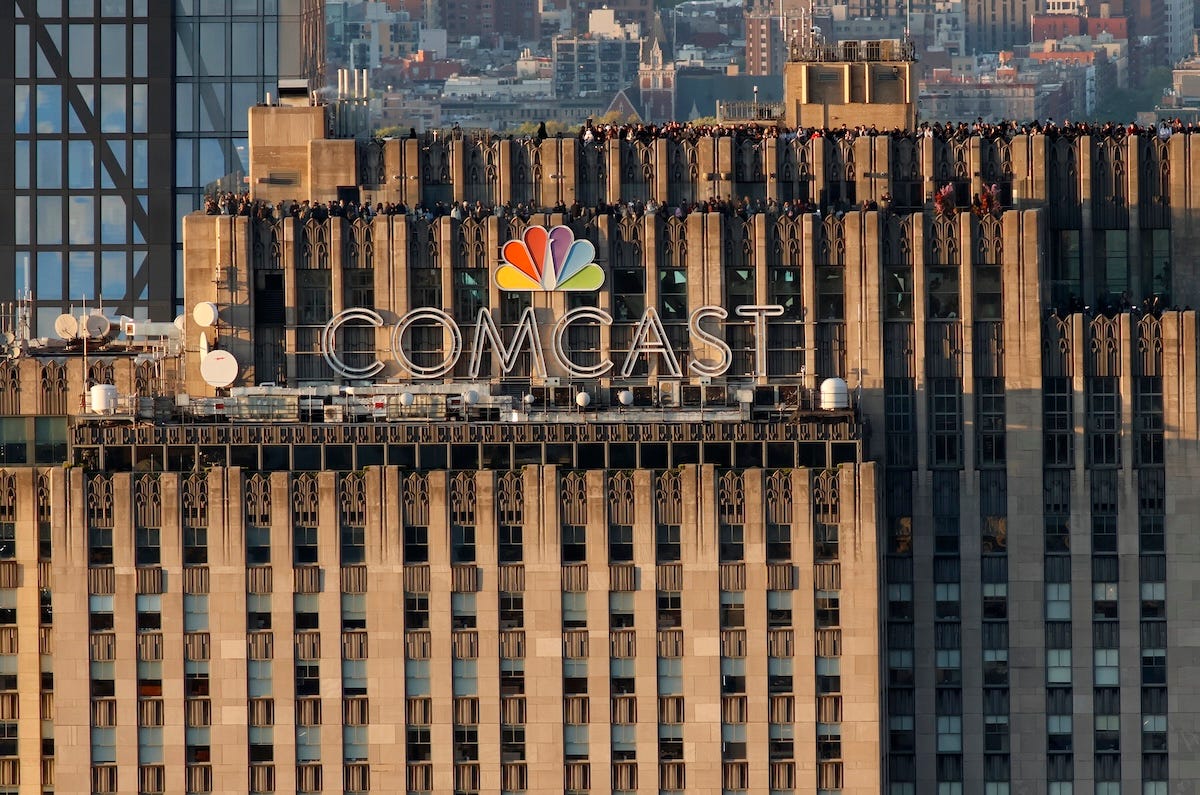
They just want it to be easy. And that's where this promise made 15 years ago of content and distribution together never really came true. So after Comcast and NBC got together, and after Comcast put its giant logo on top of 30 Rock, which was a kind of a big symbolic event, you know, to have 30 Rock, the place that we think of as one of the birthplaces of television, by the way, going back all the way, even to radio, before television. Now it's owned by Comcast. Right. It's almost something that was parodied on 30 Rock on NBC before all this went down. Once that happened, other media companies had to figure out if they needed to make similar plays, you know. So you had Time Warner sold to AT and T. This is when I was at CNN at the time for the first time. And AT and T gobbles up CNN and the rest of what was known as WarnerMedia. You know, you had this effort by other giant distributors try to own media. And we've seen a lot of that get unwound in recent years. I remember thinking, when AT and T owned CNN and the rest of those Warner assets, this should be easier on my AT and T phone. Yeah. You know, meaning I'm an AT and T customer. I have. I have this AT and T wireless account. And yet it still doesn't know Who I am, you know, I'm going to CNN.com and I'm not logged in automatically. I'm going on to hbo. And it doesn't seem to know my identity, even though I'm an AT&T customer paying lots of money. Like so in theory, there are ways where you could bring these tools together, but I don't, I don't know if I've seen that many successful examples of it. I mentioned Xfinity and the Voice remote and the way that during the, you know, the Summer Olympics, you know, the way that NBC streamed the Olympics to Xfinity households was pretty cool. But other than that, I can't point to that and say, I can't point around and say, oh yeah, there were so many great examples of why it's great to have content and distribution owned by the same company.
- [05:26]
B
And it doesn't help that it is the content. The cable companies by themselves, by their nature are kind of limited to regional areas. For instance, I moved from the Washington D.C. area to Dallas in 2020. And when I moved here, I was like, all right, I just want to keep doing Comcast. I just, I just want to keep my Comcast subscription. I'm going to roll it over here. And I called up Comcast. They're like, oh no, we're not there. We're not. I was like, what do you mean you're not here? I thought you were. Nope, we're not here. And that is, that's true of all these companies, which leads to kind of the first big speculation, right? Which is that Comcast is, is going to merge with one of the other big cable companies, Charter or somebody else. Charter is the big name that's been, been floating around there. I, I'm curious what you make of this because this is, it's slightly outside of the purview of media analysis. But the, but it is a big part of this deal. This is a, you know what? One, one of the reasons why the folks at Comcast wanted to get rid of NBC Universal was because people who want to invest, invest in NBC Universal don't really want to invest in Comcast. People who want to invest in Comcast don't want to be in the movie and TV business and theme parks business. So what do we think is going to happen there?
- [06:35]
A
Right? Zooming way out. If you look at Comcast stock, it has not moved for basically the entire duration of this experiment. And in recent years it's been moving in the wrong direction. And I feel for my father in law who has Comcast stock and has always asked what to do about it. What do you do with this stock? Right, with this beleaguered stock? Well, one way to do something with that stock is to break it into two. And that. That is a large explanation for why Comcast is doing this. Try to get some movement out of a stock that has not moved. And that's because of what you said, that investors who know the broadband business don't necessarily know or care about the theme park business and don't want to be in both. So break them apart, See what happens. And of course, when you break them apart, they instantly become more appealing to various buyers. So it leads you all down all sorts of M and A roads. And that's why Comcast and Charter is. Is one of those. It was so interesting that on the morning this Comcast breakup was announced, Charter's stock jumped even higher than Comcast stock for a while. And that was because of an assumption among investors that there's going to be some sort of M and A, some sort of combination. Now, my wife, full disclosure, works at a Charter. She's an anchor On New York 1, one of their local news channels. So I'm interested in Charter and Comcast. I've got Comcast at home, but I want to watch my wife, who's on Charter. So I have one of these Comcast branded boxes that is part of a joint venture with Charter. And so I bring that up to say they're already working together, right? They're already in business together. They have joint ventures. They have tried to figure out ways to use technology to create less of an impediment to watching tv. This always comes back to the simplicity that you and I were talking about in a minute ago. People just want to have easy ways to watch TV and movies. And it's usually not usually. It's oftentimes way too hard. So Comcast, Charter, they want to make it easier. There's been a lot of things sending in their way, but I am, you know, cautiously hopeful. These companies can continue to make it easier. And like I said, when you're on your phone, it should know who you are. You shouldn't have to log back in every month or every week, right. In order to go to watch this stuff. So Comcast and Charter, if you ask 10 analysts, they'll give you 10 different answers on whether they'll. Whether they'll merge, how soon they'll merge, what it'll look like. You know, it's anyone's guess, but it does seem like a very possible Scenario here to roll basically to roll up the two biggest broadband providers in the US which right now, as you said, they're not really rivals because they're in different markets. The counterargument though, by the way, is is there that much synergy? You know, and that's more of a Wall street question, but if you're operating in Dallas and you're operating in New Jersey, where I am, like, is there really that much synergy if you're not in the same place already? We'll see.
- [09:08]
B
Right, right. Well, that is, it will just make the company bigger without. And this then gets into questions of regulatory approval. We'll get, we'll get to that in a second. Because I think those. Little more interesting with the NBC Universal side of things. Let's hop over there. Because I do think the, this, this is the thing I, as a movie person, as a TV person, you know, is what I write about, what I, what I enjoy. I am really interested in what happens to NBC Universal because that is, that is a big company. It's one of the, you know, four big broadcast networks. Universal is one of the oldest and largest movie studios. They have one of the biggest libraries. They have a whole Parks division, the only really competing Parks division with Disney. And they have a streaming service which has been kind of lagging behind everybody else. They're, you know, they still haven't quite figured out what to do with Peacock and how to make that work. What is, what does the next, I don't know, year to five years look like for NBC Universal? Do we think it remains its own thing or is this the first step in getting it merged with a Netflix or, or you know, got Paramount, Warner Brothers. You know, that's been floated out there. It seems much harder from a regulatory standpoint, but, you know, who knows?
- [10:25]
A
Well, again, if you ask 10 so called experts, you're gonna get 10 different theories on what's gonna happen because nobody officially knows anything. But it seems very likely to me that NBC Universal will be an acquisition target. And what's happening now is the kind of game that's always played in the run up to one of those moments. Meaning this split was announced and the official word from Comcast is no, we're not doing this to sell the assets. They're more valuable than ever. We're going to hold these assets and grow them. And you know, the analyst types basically just see through that and assume that that's part of the game being played. It's, isn't it just like high school dating? I mean, I guess for me, college, I wasn't that cool in high school. You know, the more attractive the person is, right, the harder they seem to get, the more you want them. And that's what's going on with these Comcast assets. They are saying they're unavailable in order to look more attractive. You know, positioning themselves in an environment that, frankly, is hard to predict. You know, it's going to take about a year to break up Comcast and NBC Universal. It takes a long time to split these things apart. I'm going through it right now because CNN's own by Warner Bros. Discovery, preparing for an expected takeover by Paramount, but one that has not been approved yet. And so, you know, you get an email every couple weeks, every month or so about the transition progress, the integration progress. You know, it feels to me like you can almost feel the, you know, the, the sound of break, you know, splitting something apart, like kind of separating. It takes a lot of work by a lot of people. So that's going to take about a year at Comcast. What's this environment going to look like in a year? Right? Who's going to be out there wanting to buy or bid for these assets? It's, it's, you know, some of the obvious names are Netflix and Amazon and Apple. And, and we bring those up in part because Amazon bought MGM and because Netflix bid on Warner Brothers. You know, the official word from Netflix, they're not, they're not interested. I think the unofficial word from Netflix would be that, well, number one, they're under a lot of pressure every quarter to keep that stock price up and to keep it growing, to keep the company growing. And number two, they have opened their eyes to acquisitions in a way that they weren't open a year ago.
- [12:33]
B
Right, right, right. The, the NBC, the NBC part of this is interesting because it does, it creates again, a second layer of, you know, bureaucratic hoops you have to jump through. Right. With the fcc. The FCC has a lot of say over who gets control of the public airwaves. Obviously, this has been a whole, this has been a whole thing with CBS and Paramount, but it could very well be a thing with NBC as well, because there is some antagonism between the Trump administration and Brian, who is the owner of, who is, who is the head of NBC Universal, Comcast. I don't, I don't, I don't.
- [13:14]
A
He controls the company. And it's, honestly, it's like a family business. This is not really appreciated the way it is with the Murdochs. Everyone thinks about Fox As a family business controlled by Rupert Murdoch. But Comcast is the same way with Brian Roberts.
- [13:26]
B
You know, I wanted to actually drill into this a little bit because I hear, I like when people talk about this deal, they talk about Brian Roberts a lot. And Brian Roberts is a guy who I frankly just don't know much about. Not like the Murdochs. Again, everybody knows about the Murdochs. Murdochs are famous media conglomerate, family, right? Like, they own lots of things and they, they, they have their fingers in lots of different pies. The. But, but Brian Roberts is, you know, he owned Comcast. He built Comcast up and then acquired NBC Universal is from ge, which kind of puts him into a different category from some of these other people. What is his, what is his real goal here? I mean, I, you know, is as to the. Speculate, please, because I, you know, I assume you don't summer together on the Hamptons or whatever, but the, But I, you know, yeah, I, you, you have a. Probably a better sense of what he is like than I do or most of my listeners do.
- [14:20]
A
I did meet with him once a long time ago, back when I worked at the Times, and I asked him about MSNBC, now known as Ms. Now. This was back when MSNBC's liberal identity was still pretty new. And it was an occasional source of controversy because MSNBC was attached to NBC News. And every so often Keith Olbermann would say something that would upset the journalists at NBC News. And I said to Brian Roberts, how much do you. I don't remember exactly how I worded the question, so I want to claim I remember, but it was something to the effect of how much do you care? Do you care about these controversies? Do you care when, when there's, you know, noise coming out of msnbc? And his essentially his answer was, I just don't want them to embarrass the company. I just don't want it to embarrass the company. They are free to share their point of view and to report the news and to analyze and all that. Just don't be an embarrassment. And he wasn't saying they were at the time. But you get that vibe, right? Like, just don't embarrass us. That to me is like, that sums up a public company CEO so well in so many cases. Like, just don't embarrass the company. Don't create a headache for me. You could imagine the bosses at Disney feeling that way when the FCC comes around trying to intimidate Disney. Like, just don't create a headache for us. So I think that sums up Brian Roberts decently well. He's been a really strong steward of NBC News and these other assets. He has left the news division alone, but he has supported and invested in many ways. So, you know, if you're looking at, if you're looking at NBC, I think you would say they've had a pretty ideal owner for a while. I'm in Philly a lot. My in laws live in Philly. There was a philly magazine headline 10 years ago saying he's the most powerful man in Philadelphia. And that's Brian Roberts. He's not visible, he's not interested in walking red carpets. He doesn't want his name in the press that much. But he is very proud of this family run business that he has that's basically connected half of America. And I think at this point, at this stage in his life, he's thinking about legacy. He's thinking about what's going to become of these assets, who's going to control them. And really noticeably, like, very tellingly this week, he's not identified as the CEO of these two companies. Once they're broken up, he is handing the reins off in a way that's very telling. The company's Comcast says he will remain actively involved and he will because he will still control the most valuable shares of the company. But the lack of a CEO title in the future suggests that he is willing to part with these assets in some various combinations.
- [16:44]
B
How much? Okay, well, to, you know, no pun intended, but how much stock do we put in that? Because I do get the sense that he is still very involved in everything that is going on.
- [16:58]
A
Yes. And the chairman and all of that. And certainly at the end of the day, this was his idea, you know, to make this maneuver. It is intriguing that this happened relatively quickly. It seems like from the reporting we've seen so far from the Wall Street Journal and others, from my own sourcing at Comcast, this is something that came together relatively quickly. This was not something that was planned six months in advance. When the, how do you say? Versant? When the, when the spinoff.
- [17:20]
B
Versant.
- [17:21]
A
Versant. Sorry, yes. It's like conversant. Yes. And I apologize to my friends there, lots of friends there, I always get it wrong. I get nervous whenever I have to say the name. When CNBC and those other assets were spun out, you know, and that again took about a year, was finalized in January, it would have made sense to have thought about a broader spin off at the same time. But the reporting out there this week is that that was not the case, that this bigger spinoff was only conceived in recent weeks. So what does that tell us? I don't know. Does it mean that there were some investors who were agitating some people buying up shares and stakes going to cause a problem for Comcast? We don't know. Was this a situation where a buyer reached out behind the scenes back channeling and Comcast is now preparing the ground for that buyer? You see what I'm getting at? We don't know. We don't know. But if you, the move that was announced this week is exactly what you would do to prepare for an acquirer to come along. And by the way, next week, maybe by the time some people are listening to this, it'll be the annual Sun Valley conference. This is an investor conference. Allen Company puts it on. Sun Valley, Idaho. Bigwigs get invited, basically the CEOs of all the big media companies. And that's exactly the kind of place where future deals get talked about or dreamed up and sometimes born.
- [18:39]
B
Yeah, well, let's, let's talk about Versant for a minute here, because this was, this was the first thing I thought was, okay, why are they doing this now? Why didn't they just spin everything off at the same time? Okay, well, Versant is a slightly different business as a, you know, the, theoretically that, that package of cable companies is in terminal decline. And they don't, it's, but it's still throwing off a lot of revenue. They don't, they, they didn't want to, you know, but the timing to me suggests that they did, that it went pretty smoothly. It went pretty well. And the Versant stock hasn't cratered. It's come down a bit from its initial IPO because there were big funds that had to divest themselves, whatever. There was all this chatter about, well, it's going to come down 10 or 20% anyway.
- [19:27]
A
But it did not crater. People wondered if it was going to crash. And it hasn't crashed. It's held its own.
- [19:32]
B
Yeah, it's been pretty steady in the 36 to 40 range. Right. Over the last six months or so. Which means, which means that it has been basically a success. Like, people look at this and they're like, okay, this has worked. Which suggests to me that the lesson from that was we can do this and it's not going to be a big problem.
- [19:53]
A
Right. I think there's a lot to that. Yes, I think there's a lot to that. There's, you know, so much of this is about Wall street rewarding pure play companies right now. Comcast, Comcast executives recognizing that Wall street is not rewarding the type of company that it is today where it has content distribution together. So, you know, you're, you fish where the fish are. You move in the direction that the market wants you to move. That's what this is, you know, largely about. And I, you know, I don't, I don't want to be fully cynical, but a cynical way to look at this would be to say media companies get put together and they get taken apart and they get put together again, they get taken apart and the winners every time are the bankers and, and the owners and the C Suite and, and the rest of us just along for the ride and the rest of us just hope that great movies get made along the way.
- [20:38]
B
Yeah, that's, this is my eternal bucket. This is the bucket I find myself in all the time just hoping, hoping that good things get made. One thing we have not discussed very much is the park side of things, which is again, it's its own separate empire. Kind of the Universal parks are, are, are, I think, have grown to the point where they are, if not commensurate with Disney, at least reasonably competitive, certainly in Orlando and, and, you know, maybe, maybe a little bit overseas as well. It does feel, it does feel like that is another tricky issue because one of the things that is true about the Universal parks is that they are not built on Universal ip, Right. Like Disney parks based on Disney IP you sell. There's no, you can't possibly sell the Disney parks. Doesn't make sense. You couldn't, you couldn't retrofit it to, to work with non Disney ip. But the, the Universal parks are kind of structured differently anyway. Like the big Harry Potter land. That's a WB property, that's a Warner Brothers property. Right. Like, you know, it is, it's, it's interesting to me because it suggests to me that it would be both harder to sell, but also might be appealing to some of these other companies that already own some of the propert are tied up with the Universal folks.
- [21:57]
A
Yeah, I remember when Comcast opened Epic Universe last year, one of the executives there told me, yeah, David's coming down. Meaning David Zaslav, the head of Warner Brothers Discovery, because of the Harry Potter connection. Right. Because Harry Potter World is a big part of Epic Universe, and that's WBIP and Epic Universe. That reminds me, like when I was down there last fall, there was nothing about me being an Xfinity Mobile customer that helped me at the park.
- [22:22]
B
Right.
- [22:22]
A
It's not like, it's not like having Xfinity broadband at home made a difference. Right. In Super Nintendo World. So that kind of gets to why this is happening. Right. Let's break these apart because there's not that many synergies, to be honest. Although, you know, I think Comcast would say they're really proud of the investments they made. They're really proud of things like Epic Universe that they supported those over the years. So let me just get that out there. I think going forward, there are many players in the media world who know they need a Disney type strategy.
- [22:50]
B
Right.
- [22:50]
A
Disney just keeps cranking out cruise ships, keeps opening new worlds inside the parks. I just spent another three days at Disney World a couple weekends ago. Had to do it, had to get another trip in. When my kids are, you know, what, six and nine like, I feel the pressure to get there as often as I can financially because I want them to experience it. And if you are, gosh, any media company other than Disney, you know, you need that experiential strategy in an environment, in a world of AI, real life experiences are going to be more and more valuable. I think we all feel it in our gut. So that's a huge thing NBC Universal has going for it. They already have those footprints in Orlando and in la, and they just opened like a kids one near you, I think, in Frisco.
- [23:33]
B
Yeah, yeah, the kids, the kids universe.
- [23:36]
A
They're opening Plano. Yeah. Like smaller kind of mini theme parks, like day trip theme parks again, I think that's super smart. Compete with Six Flags, you know, create more experiences where people are with the minions in Minions world. So, you know, just thinking out loud here, right? Once Paramount has its next steps completed, if it does succeed with Warner Bros. Discovery, why is Paramount not looking at NBC Universal? I had one person close to Paramount say to me, you know, when you hear about these deals, you have to assume they're already thinking about the next one, that they're already at least dreaming up, dreaming up the next potential deal. Now, whether they do it, whether they can get the financing, whether they get the approvals are all separate questions. But the dreaming, the daydreaming is definitely happening.
- [24:21]
B
Yeah. I mean, it should be. Again, this is, it's tricky because the, the, the, the real issue here is NBC, which, you know, I don't think anybody's going to allow the same company to own NBC and cbs. I don't think that. I just, I find it, I find that sort of, I find that hard to Believe.
- [24:42]
A
Well, maybe Byron Allen comes up with the money to buy the CBS stations. I'm just thinking out loud.
- [24:47]
B
Right.
- [24:47]
A
He's already got the 11:35 time slot. I just, there, there are lots of ways out of the broadcast station problem. You're right that it's a problem from a regulatory standpoint, but there are ways out of it.
- [24:58]
B
Yeah. The other, the other issue is that it is going to be an expensive company. I mean, again, if you're looking at the, if you look at the. What the market cap of this is going to be after it spins off the number again, I, I've heard tossed around is $60 billion, which is, that's, that would be. It wouldn't be impossible for a Paramount Skydance that's backed by Oracle money to absorb. But it wouldn't be easy. After all, all the, the debt that they're going to be taking on with, with the, the new, the new deal for Warner Brothers. I don't know. That would be, that would be hard. I don't know.
- [25:33]
A
It's an environment where the current deal that is awaiting UK approval. It sounds like UK regulators are going to challenge the Paramount WWBD deal. State AG is likely going to sue over it. But that deal a year ago, I don't think anybody was contemplating the numbers that are involved. Right. And the finance and structure that's involved. So, you know, I guess we got to keep our minds open to the possibilities. And when it comes to NBC. Yeah. I have heard analysts say this week it is very expensive. Right. That limits the pool of buyers. But as I said, Amazon was interested in buying MGM and snapped up mgn. What was that, four years ago? So it's kind of part of a. When people on CNN have asked me this week, what's the bigger picture story here, I've said it is tech money coming in. Right. And biting off pieces of media, biting off parts of the content world. Whether that's tech money, meaning Oracle billionaire Larry Ellison and his son, whether that's Amazon, whether it's Netflix trying to figure out what it might acquire, what it might pursue next. Seems to me it's all of a piece. Right. It's that tech influence now in the media sector.
- [26:38]
B
Yeah. And the other thing we have not discussed very much is Peacock. Just because I like. Again, I look at Peacock and I'm not. I'm. I'm never 100. I subscribe, I have a subscription to Peacock. I've been watching a lot of Telemundo because it's the only way I can stream the soccer games, the world.
- [26:53]
A
Why can't you stream Fox?
- [26:55]
B
I don't want to sign up for Fox 1. I don't want to like sign up for another thing that I'm only going to have for a month. I'm just, I've already got Peacock. You know, I'm so, I'm brushing up on my Spanish. It's been great. But the, but, but the, but the, the Peacock angle here is interesting too because that's again, that's a thing that could be spun off or integrated into Netflix on its own or, you know, integrated into Amazon. Nobody, nobody seems 100% sure what's going on with that. And it does, it's, it's a, it's a big piece of this streaming war that we've been seeing for the last, you know, 10 years here.
- [27:30]
A
Definitely. And somebody emailed me actually while we were talking here saying, you know, it's like the Summer of Peacock. You know, it's not just the World cup on Peacock this month, it's also Love Island. So there are some valuable franchises, valuable assets associated with Peacock. Even though it feels like one of the runner ups, it feels like one of the runner ups, you know, in the streaming wars and may feel like that for a while. And by the way, the a while part of this is interesting to me. We're talking about deals that may or may not happen a year or two from now. You know, the New York Times, Lauren Hirsch pointed out in a piece on Wednesday that the way that this Comcast deal is structured, it's a tax free transaction, quote, a design that may mean a sale of NBC would have to take wait at least two years to preserve the tax benefits. So, and there's a lot to that. And the banker types who structure these deals care, of course, deeply about the tax implications. So you break up your company in 2026, it exists separately in 2027, and then maybe people can go shopping in 2028. And that might sound like a long time to listeners, but that is the timeline that this industry works in. And sometimes to its fault, sometimes to its doom. That, that these deals take a long time, that they gestate for a while, that they're complicated. Meanwhile, like Netflix and TikTok are just eating everybody's lunch. Right? And moving faster. I mean, if, if you were going to write a book about the last 15 years of media while Comcast and NBC Universal were together, it would be about Netflix just moving faster than everyone else.
- [29:03]
B
Yeah, no, it's, it's, it's funny. I was talking to Ben Fritz from the Wall Street Journal last week and I mentioned his book, which is a great book, the Big Picture. But it, you know, it, it, it came out in 20, I think 18 and has thus missed, you know, it just does not, does, it does not comprehend, you know, what is happening right now. But it is a great. I'm going to plug that again because it is a great primer for the, for the lead up to the era that we have right now, if folks want to check that out. But the, but okay, Brian, I always like to close these interviews by asking if there's anything. I should have asked if there's anything you think folks should know about this deal or anything else or, you know, what did we not discuss that we should have.
- [29:47]
A
I think we covered it all. I think Paramount is another example of what you're describing with Comcast, where it's more of a pure play company. It's, it's not trying to own a wireless company. You know, it's trying to be one thing and build up and trying to get more assets. Like I said, we'll see if they prevail with WBD or not. And then basically every other media company is in the same position. But I'm always then curious, who is the contrarian? Is there a counter narrative here? Is there an owner who does believe that this should all still be bundled up together, that this all does belong together? And I don't see an answer to that right now, but I'm interested in looking for that and I'm curious if that happens because like I said, on one level, this history of media is just bundling and unbundling, bundling and unbundling, coming together, breaking apart, coming together again. We know what stage of the cycle we're in right now, but it's not the end of the story.
- [30:47]
B
Yeah, no, that's for sure. Brian, thank you for being on the show today. I really appreciate it.
- [30:51]
A
Great talking to you.
- [30:52]
B
Thanks again. My name is Sonny Bunch. I'm culture editor at the Bulwark. And we will be back next week with another episode of the Bulwark Goes to Hollywood. We'll see you guys then. It.