← The Business of Fashion Podcast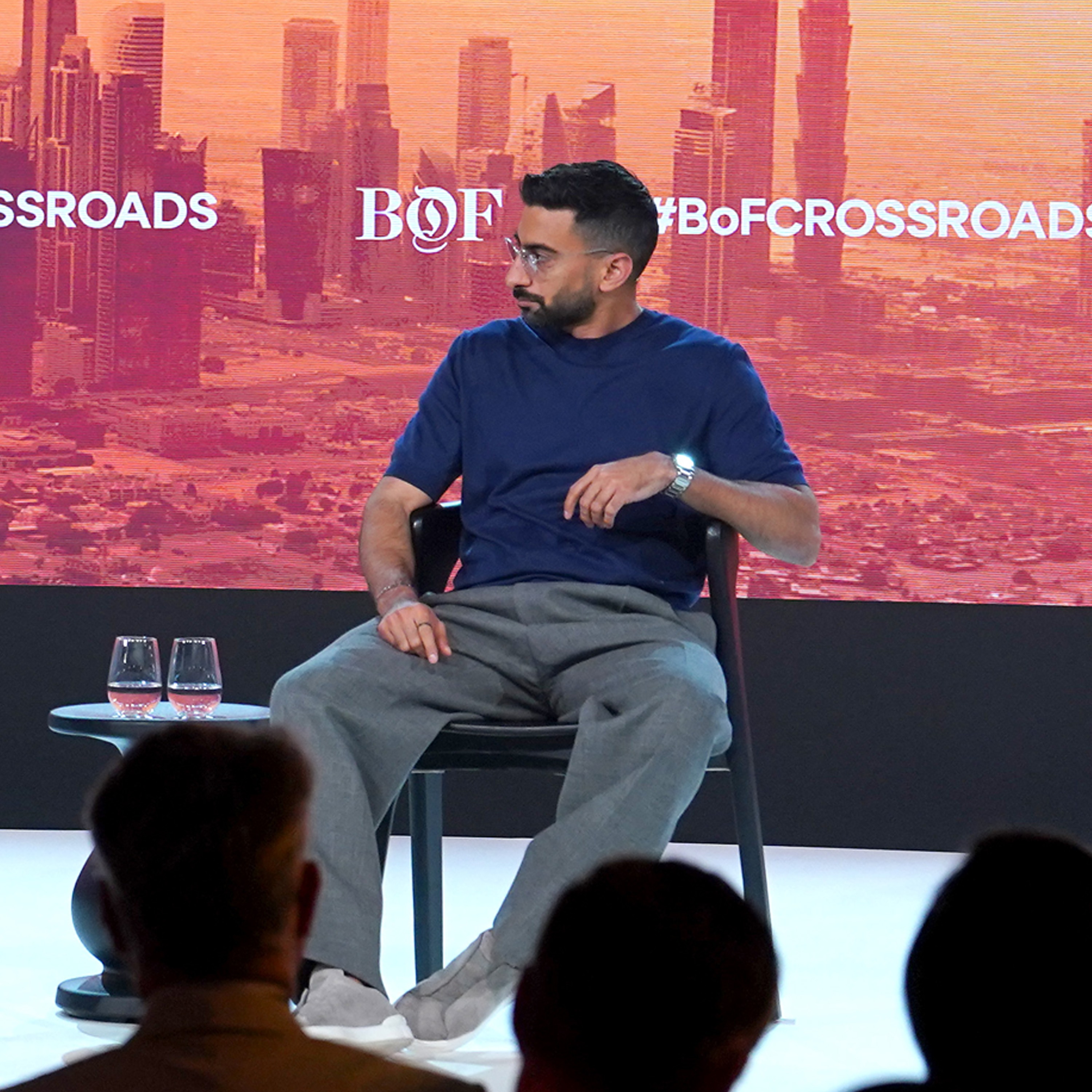
The Business of Fashion Podcast
Anas Bukhash on Harnessing the Dubai’s Potential as a Global Crossroads
00:24:39
Entrepreneur Anas Bukhash joins BoF founder Imran Amed at CROSSROADS 2025 to discuss Dubai’s rise as a global creative hub and its role in empowering innovation and entrepreneurship across the Global South.
Loading summary
Transcript52 lines
- [00:00]
A
Foreign Hi, this is Imran Ahmed, founder and CEO of the Business of Fashion. Welcome to the BoF podcast. It's Friday, April 25th. Over the last few decades, Dubai has rapidly transformed from a humble trading port into a global hub for business, tourism and innovation. With favorable economic policies, a strategic location and an ambitious workforce, Dubai has become a vibrant destination at the intersection intersection of Europe, Asia and Africa. Entrepreneur Anas Bukash has experienced and capitalized on this transformation firsthand. As the host of one of the Middle East's most watched talk shows and founder of influencer marketing agency Bukash Brothers, Anas embodies the entrepreneurial spirit of dubai.
- [00:53]
B
It's a 50 something year old country. It's younger than our fathers and our mothers. So imagine if you come up with an idea and you just move to Dubai, you could be the first one and the then you have that edge of being the pioneer in that field. If you do that in London or you do it in New York, you're probably number 500.
- [01:11]
A
This week on the BoF podcast. I'm delighted to share this conversation with Anas from BoF Crossroads in Dubai to discuss how the city's openness and youthfulness have shaped a thriving innovation driven culture. Here's Anas Bukhash on the BoF podcast. I'm not sure how many of you have watched one of Anas's interviews before, but he always starts with his signature question. And I'm quite lucky today because I get to turn the tables on Anas. So like, how are you really doing, Anas?
- [01:49]
B
Good attempt. It's a good attempt and it's an important question. I'm lucky, you know, I like to remind myself how lucky I am when I start to complain about petty things. I zoom out and think how silly I look compared to so many other places where people are not as fortunate as we are and they just don't have the most basic things such as safety or a next meal. I know it's maybe very cliche to say this, but if you actually just remind yourself without even telling everybody, just do it with yourself, it puts things in perspective. Every time I get ahead of myself and I start to complain, I think it's okay to complain, but you don't linger in the complaint. So I feel lucky and blessed to be in the city, in this country, amongst good people and I get to work with something I love. So I'm quite lucky.
- [02:50]
A
That's the dream. Yeah, the dream for you. I want to go back to where it started. So just to give You a little bit of background. Anas and I met about one year ago. We were seated across from a dinner at the Salone del Mobile in Milan. I didn't know anything about him, but we got into a little conversation. And since then, I've been following your podcast, AB talks, and your work. And what I found so interesting in our conversation that day is I had just come back from Dubai. I don't know if you remember, I had. I had not been in Dubai for nine years.
- [03:27]
B
Okay.
- [03:28]
A
And if I'm honest, I had a bit of, like, misgivings. Not misgivings, but maybe I was a bit judgmental about Dubai. And last year in March, I came here for about a week, and I spent some time with many of the people actually in this room. And I was just blown away by the transformation that this city has gone through. I mean, of course, everyone knows about the architectural transformation and the landscape, and it was a port city. But the thing that really, really for me was the most impactful shift was just the incredible mix of people. And when you think about global cities in the world, like, you can probably count them on two hands, right? But now I would definitely, based on my experience here, you know, the generosity with which so many of you have spent time with me, I really count Dubai now as one of these global cities. Can you just talk to us about the change that you've seen here? I mean, I think you're 42.
- [04:28]
B
43.
- [04:29]
A
43, yeah. I know you spent some time in the US but you spent a lot of your life here watching this transformation happen. Talk to us about the transformation happening in Dubai and what has that meant for the opportunities that people can find here?
- [04:47]
B
It's a good question and a broad, broad question. And the interesting thing is, because I'm an 80s baby, I've seen a lot, you know, I mean, my childhood was back then, it was like the place. Now it's not, but was at the road. And that's where people flirt. And where you flirt is you flirt next to the cafeteria with the shawarma. Like, that's kind of. That was it, you know? And on the weekend, you'd go to the cinema, and there's actually a shawarma in the cinema. Like, that's my background, you know, and you go and buy these cool mixtapes with R and B songs, and that's what you give a girl. And it was such, I think, simplistic and beautiful. And I think we're the last generation to be before social media. Literally anybody who was born and Had a childhood here. That was before social media. We are literally the last generation to have both. And in terms of Dubai, just I'm a very, I'm an entrepreneur at heart and I think of course it's, you know, horses for courses. Dubai doesn't fit everybody. But if you're fast and you actually have a dream, I actually think Dubai is one of the few places in the world where you could be the first and by coincidence a lot of the start. I did six startups. I think most of them were the first. Just because UAE is young, it's a 50 something year old country, it's younger than our fathers and our mothers. So imagine if you come up with an idea and you just move to Dubai, you could be the first one and then you have that edge of being the pioneer in that field. If you do that in London or you do it in New York, you're probably number 500 because so many people before you did it. So I think that's one of the beautiful things. The other point you mentioned I think is gorgeous is the diversity. And it's not only diverse, but people get along. Because you could have a diverse country that people don't like each other, you could have racism, you could have lack of teamwork and all of that. But just in our agency, I think we are around from the 40 people the last time I counted, I think we're between 20 to 26 nationalities. Can you imagine 26 nationalities between 40? And they're all cool and they get along. Like sometimes I just watch them and I see that they go out for walks together and they have fun and I think it's beautiful to see and I think that's very rare. I don't know if it's safe to say that we could be the most diverse city in the world.
- [07:13]
A
Certainly one of the most diverse. I mean, you know, I think of cities like London and New York and Toronto and other places where you have like hundreds of languages spoken. But I think the point that you mentioned is a really important one which is around civil cohesion. You know, even if, you know, I was talking to my friend Bandana about this over dinner last night. You know, we were at the beautiful Indonesian restaurant here in the one and only Hotel Andaliman. And the young man serving us was from Bali and Bandana lives in Bali and you know, he went off to get our order and she said, you know, everyone here, whoever you interact, they just seem happy. You know, you interact with an Uber driver in New York or you, and they're like always stressed out and you interact with an Uber driver in London and they're polite, but they don't really want to talk to you. But everyone here just seems. It feels like a safe place. And no matter kind of which strata of society you might be in, there's something about civil cohesion here that I don't observe in a lot of other places.
- [08:16]
B
Maybe also, if we want to be fair, I think it's an indirect but very direct cause when you have a really safe place and your basic needs are met as a human, you have the luxury of enjoying and feeling good. But if you again, are insecure and the electricity is going off and there is a political issue or war and you have tariffs.
- [08:40]
A
Yeah.
- [08:40]
B
You have no, you go to Europe today. I love Europe, but you go to Europe today. Don't take your watch, don't keep your phone out. And like, that's basic anxiety. So imagine we multiply that. Of course people will be stressed and unhappy, I would say, or no time to be happy or joyous. But on the topic of when you came and judged Dubai, I think a lot of people do that and it's expected. And I think a lot of people come, say, you know, Dubai is fake. And I say, have you really seen all the aspects of Dubai? Because I could show you certain places and then you can make the judgment, fake or not, but I can show you old school Dubai. I can show you the best kebab place. I can show you the best Shawaram place. I'm such a foodie, so I keep talking about food, but there are really nice things. And when I have friends that come here for the first time and I show them that, they're like, oh. I'm like, yeah, there are places other than the typical restaurants and in Difc or anywhere, they're nice, but I wouldn't go there every week. There are places that you can just have a really good meal, like Ravi's or Kababastadi or, you know, there is so much character in Al Fahedi area. And then you can judge.
- [09:57]
A
Okay, well, we kind of set the context of the petri dish within which your entrepreneurship has been nourished. I want to talk to you about AB talks and how all that came up. Because as a, as a fellow kind of entrepreneur whose business started kind of by accident on the Internet. And look at this. You know, this started as a blog. Your business similarly started with conversations. How did you develop the skill for interviewing people? Because you've got. I mean, and I highly encourage Everyone to watch one of Anas's. Because it's a very different. I mean, you're quite intense. You know, like, the. The chairs are kind of like this.
- [10:42]
B
No escape. And there's no table between.
- [10:43]
A
There's no table. I mean. And I saw you recently did an interview with, you know, one of the kind of reputed to be the most cold people in our industry, Anna Wintour, and you tried your tactic with her. Didn't always work.
- [10:58]
B
I'll tell you where the challenge is.
- [10:59]
A
Yeah.
- [11:00]
B
When somebody tells me you only have 20 minutes or 30 minutes, I can't do magic.
- [11:05]
A
Yeah.
- [11:06]
B
I can do my best. And I might get. And you could see, by the way, with Bill Gates and Anna Wintour, rewatch it, watch their body language. The last 10 minutes.
- [11:15]
A
Yeah, it changed.
- [11:15]
B
Bill went like this, and then he was just. He was comfortable at one point, but then they have to finish. So it's. What people don't understand is we're dealing with humans, and in the beginning, they don't know it. And it's the first time they meet me. So they need to trust you. They need to know that you're not sneaky and you're not trying to make them look bad. And just when they warm up, if they have to leave. It's a shame. But we did our best with Anna.
- [11:41]
A
You know, you did. I mean, your signature question, instead of answering kind of how she was, she talked about what she did that day because, like, you know, but it. It's a. It's a good technique. So. But how did you. Because you're really good at it. I mean, I get to see a lot of interviewers. I'm an interviewer myself. I've been interviewed by a lot of different people. But you have this really special way of getting people to open up. How did you develop that?
- [12:08]
B
I'm a mechanical engineer, so it has nothing to do with it, I think. Look, I'll tell you what I think also is interesting. Apparently, some of the best CMOs in the world are engineers by background. And I don't think. It's just. I'm not bragging about engineering. I didn't enjoy it, but I do think unorthodox approach to anything makes you stand out. Maybe because I didn't go to media school or psychology, which I love, but maybe that helped me just to ask questions the way I think I want to ask them. And suddenly you look different. You don't. You don't, you know, like, hey, can I ask you? Like, it's so boring when I Watch these interviews and it's so pretentious. And the person who's asking is not even concerned about the answer. I'm sure you've been there like while you're asking. And sometimes they do this, they're like, hey, how's the event? And I'm like, you just asked me the question. At least stay with me. And it's these little things. I think Imran, it developed the curiosity. So I did TV for a while and I found it so boring and not what I like. It was very surface level questions and short. You can swear. I like to swear and I want people to laugh and I want to go raw. So I realized it's not for me. So then I had the agency, Bukhash Brothers. I'm like, the moment I have a production team, even if it's small, I'm gonna start interviews. This was in, in 2014, I wrote, I have the paper. I wrote the concept of AB talks. I think it was, I think it was like a sit down with AB or some silly name. And then fast forward four years, we're in a storeroom in the agency, put two chairs and I get my first guest who was a footballer. Omar Abd al Rahman, in my opinion, the best we've ever had in the region. And nobody has ever seen him speak at length because it's like after the game. How was the game? It was good, I scored. That's it. But who is this person? So I got him and for me, I don't. The slogan has never changed. It's the human behind the title, Omran, who are you? How are you? Who are you? I don't care how many awards. Good for you, great, but who's this person? And I wasn't a good interviewer in the beginning. A lot of people are like, you're a shitty listener, you're bad, you're not a good listener. And I see the comments and I'm like, okay, if six people don't think I'm a good listener, then I'm not a good listener. And I think that's where sometimes our ego needs to be like, relaxed. If a lot of people tell you that you are hot headed, you're probably hot headed. If six random people told me I'm not a good listener, I have two ways to go about it. Be stubborn. I mean like, yeah, haters or jealous. Or I say, unless you probably are not now, what can you do about it? And then I said, I have to be the best listener I could ever be. And I switched it some of the.
- [15:05]
A
Best feedback I ever had from BoF in the early days was by reading the comments, because I didn't know what it would become. But based on the feedback I get, people would say, can you do more of this, or can you answer this question? And that kind of dialogue with a community of people has become such an important part of media for any, whether you're a brand or a creator or whatever you are. But here you are now sitting in the hot seat of the creator economy too, right? Which the other reputation Dubai has, by the way, is that there's an overwhelming disproportionate number of creators and influencers in this region. And I think the statistics show that people in this region are much higher users of social media than almost anywhere in the world. So why do you believe in the importance of the creator economy that you're a part of? And what do you think creators can bring to industries like fashion, beauty and luxury? And you're doing more and more within these industries. What's the intersection between those two things?
- [16:10]
B
I think having content creators is a blessing and a curse because everybody has a smartphone. Everybody can claim they are a life coach or a media personality or whatnot. And that's where the negative. Because anybody can claim it. Before, you had to go to get certain degrees to become something. Today I can literally change my bio and write, dentist, come to my office and I'll do something. And then suddenly you don't have teeth. So I think there's pros and cons, but the beauty. Now let's go to the positive side. The direct journalism you get out of it, the direct reviews. When you have a really good content creator that has the ethics and the integr live, you see the situation in a certain country, on a certain place or a certain movie, and it's quite a positive aspect. So I would say both of them are important, but on a bigger scale also, I think we really need to chill with our smartphones and not be so addicted to our phones. And I did something funny with my. I was with my family in Italy last week. So at night we wanted to choose a movie. So I chose a movie. I had my two kids, my two brothers and me, and we're watching, and I noticed that one of them is, you know, chatting every literally two minutes, another one is on the phone. And I'm like, my son, Maajid, I'm like, maajid, take all the phones, put them upstairs. He took all the phones, kept them away. Because what happens to all of us, the moment it calms down. If you're in an elevator, just count to three. As soon as the door closes, everybody. Nobody wants awkward silence or boredom. If you're watching a football match or a TV show, suddenly as soon as the energy goes low on the scene and it's the two screen issue, but when you know that mentally it's not at reach, you don't care and you really enjoy the experience. And that's what I, maybe I went a bit off, but with social media and content creation, I think it's important to do it right. But let's not also get too hooked to it because then we don't live and experience things properly in order to give better content. Also, even you need to travel and see and interview people, have dinners and just feel creative. And then you write something that we're like, wow, okay, you know, he has such a different look at things. But if you're just reacting, yeah, so.
- [18:34]
A
We'Re almost out of time. You know, there's lots of people out there that would love to do what you do. So you've just given us one thing, which is like, be a good listener. But like, what advice do you have to entrepreneurs operating in markets that are perhaps sometimes overlooked by the west, that don't have the same ecosystems as Silicon Valley or London or other places? Like, what is your advice to people who are trying to build? You've done six. What's the advice?
- [19:03]
B
It's tricky, Amran. I think my formula is quite simple. If you're good at something and you keep doing it consistently with discipline, you only have one way you will succeed. Like, I don't think there's another option unless you die. So I think that's a very simple formula of success. However, today you have social media, you have friends and family, and you can test things before actually launching a website, before launching a business, before you had to put all this capital in to open a little place in a shopping mall. And if you lose, you can lose big if you just your savings. Today you have a product, you have this. You can literally put it online and say, okay, make a nice iPhone video and test it, promote it with $100. Suddenly people like your glass are like, okay, make plate. I think that's what people are. They're not realizing how easy it is to test. So test and then you'll quickly know.
- [20:03]
A
There's one thing that comes up often in your interviews, which is about your interview subject's relationship with their parents. The other thing that people from these kinds of regions, our kinds of Cultures face is that there's a very specific even now definition of what a successful career looks like in medicine or engineering or some professional, you know, profession.
- [20:27]
B
Yeah.
- [20:28]
A
What advice do you have to give to people who need to convince their parents that you know, a career in media, in the creator economy, in, in creativity is a legitimate career with real value in culture and society.
- [20:41]
B
It's was way less like difficult than when we were young.
- [20:46]
A
Yes.
- [20:47]
B
Like it was unheard of before even I wanted to be a footballer and nobody understood what that is. Like go kick a ball. Like no, you can actually. It was a very difficult thing. But today let's go to the families that are actually against. I think once you zoom out you understand first why. Why is my mom or dad upset with me or saying no? Because that's their definition of what stability is and success. So when we zoom out we realize that the parent all they want is stability for their child before they're gone. Income and happiness, hopefully. So that's what the parent is trying to tell you like. No. Because in my time a lawyer or an engineer or a doctor is what got you the bill, got you a good salary. They still. So once you empathize with that, you're not as resistant to your parents. What you can do is you can tell, listen, these are some examples of people in this field who have made a living out of this. I'm not the first one. Give me a year. If I don't do it, I'll go to whatever degree and push yourself.
- [21:52]
A
Yeah.
- [21:52]
B
And some parents are willing because what happens is then let's say this content creator that left home and went to Mexico and now he's trying and then he suddenly makes money. And that parents like that's my son because now he made money.
- [22:03]
A
You know, that definitely happened to me so.
- [22:06]
B
But that proves that all they wanted was Imran to be successful.
- [22:12]
A
Yeah.
- [22:12]
B
They just didn't see it from the way.
- [22:14]
A
Well they just defined it differently.
- [22:16]
B
Correct.
- [22:16]
A
You know, and it came from a personal lived experience where security and success was defined very differently than the way. I was like very fortunate I was growing up, I grew up privileged. Right. So I could, I could think about other things and than what they were thinking. Okay, last question.
- [22:31]
B
Sure.
- [22:32]
A
You've interviewed some of the most amazing people in the world. Some of the most successful people in the world. Is there something that you see in common across all of them that makes them successful?
- [22:46]
B
Makes them successful?
- [22:47]
A
Yeah. Like makes them successful, happy, fulfilled human beings. Like what does Anna Wintour have in common with Bill Gates, basically workaholics. Workaholics, yeah.
- [22:59]
B
Even I remember Max Verstappen, the F1 driver. You'll notice every question I ask these individuals, they go back to work. Like, that's how their brain is. It's, you know, that's where their value. That's where they, they see them. That's the image they've painted of themselves. It's work obsessed. So you can tell them, what's your horoscope? They're like, yeah, in this article in my magazine, like, they'll go back to work all the time. But maybe to make it a more simple answer, one of the. I'll say one of, One of the ways to be successful is to really have a purpose. I think you really need. And I think if you're just doing a job that doesn't feel true to your core or your being, I find it not sustainable. Or maybe you do a good job, but you will never be great because you're just doing it because the salary is good or it's stable. But if you truly enjoy what you do and it really speaks to you, it's aligned. You are so lucky. And that's where you know you can, because then you don't feel it's work. You're always doing it. You. You travel, you research, you watch YouTube videos, you're listening to a podcast about it. It's your purpose. It's not work anymore. So maybe those that found it are the more successful ones.
- [24:21]
A
Thank you. And thank you for sharing that with us. The BoF podcast is edited and produced by Olivia Davies and Eric Brea.
- [24:42]
C
When you're a forward thinker, the only thing you're afraid of is business as usual. Workday is the AI platform that transforms the way you manage your people and money today so you can transform tomorrow. Workday, moving business forever forward. Hotels.com knows that planning your book club's annual field trip can get chaotic. Ria, the romance reader wants to stay in Prince Charming's castle. Self improvement. Steve needs a hotel gym. Leela and Jeff, the horror fans ghosted the group chat about budget. And you've read enough true crime to know that murdering them isn't a real option. With the Hotels.com app, invite all your friends to collaborate and find the perfect hotel together. Share properties, vote on your favorites, and book all in one place. Find your perfect somewhere with hotels. Com.