← The Business of Fashion Podcast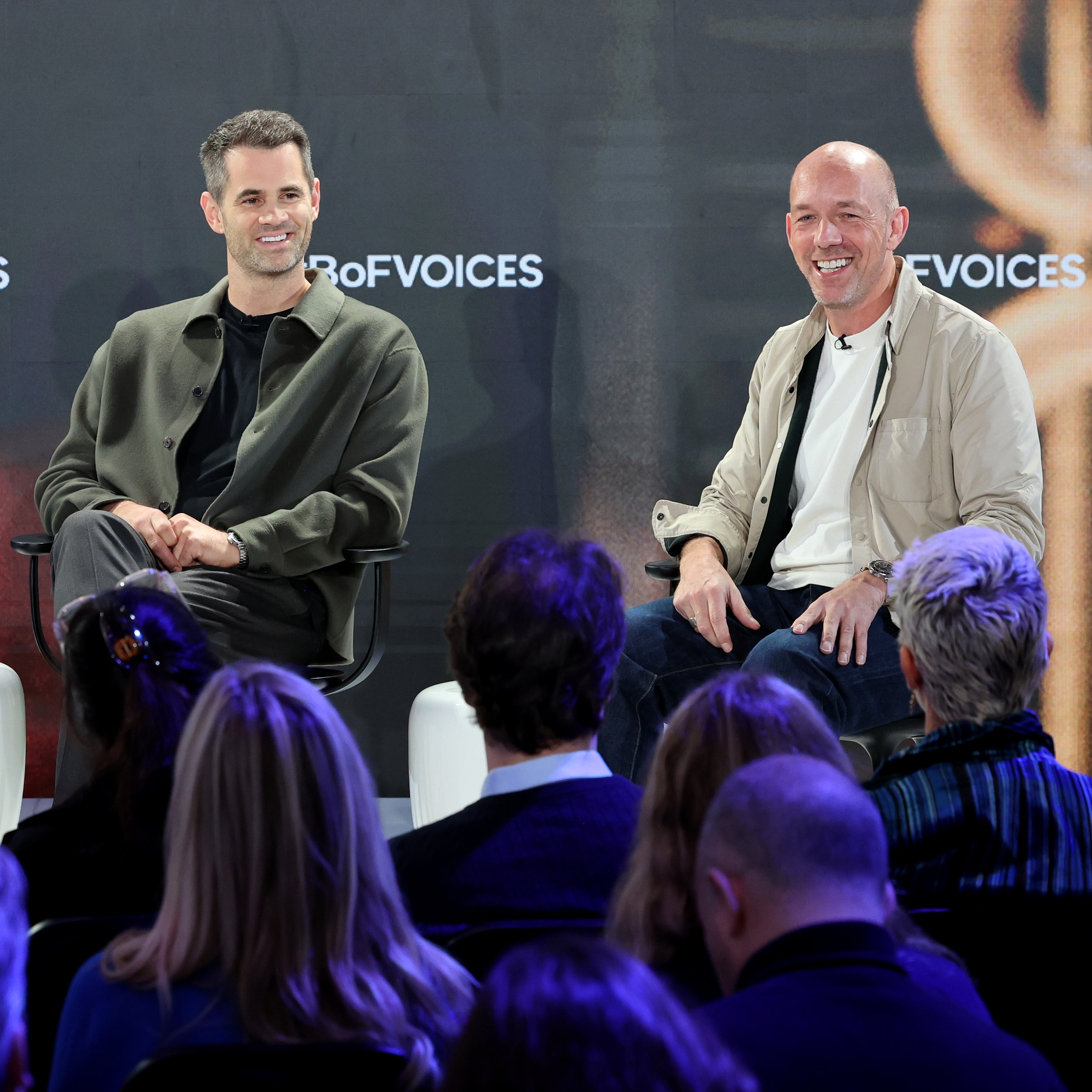
The Business of Fashion Podcast
How Skims and On Create Cultural Relevance
00:25:30
Skims co-founder Jens Grede and On co-founder David Allemann joined BoF founder and CEO Imran Amed at BoF VOICES 2024 to share how they are building culture-shaping brands rooted in product innovation.
Loading summary
Transcript55 lines
- [00:00]
Unknown Speaker
Foreign.
- [00:04]
Imran Ahmed
Hi, this is Imran Ahmed, founder and CEO of the Business of Fashion. Welcome to the BoF podcast. It's Friday, December 6th. Many fashion brands are realizing that operating across multiple cultural sectors is a business necessity. In our social feeds, fashion competes with music, film and sports for our attention. Learning how to tap into other cultural sectors is something that many fashion brands are trying to do. But few have done it better than this week's guests at BoF Voices 2024. I spoke with Jens Gried, co founder and CEO of Kim Kardashian Skims, and David Alleman, co founder and executive co chairman of the Swiss sportswear company on, to learn how they've tapped into the cultural zeitgeist, especially at the growing intersection of sports and fashion.
- [00:57]
Jens Gried
I that athletes have understood that fashion is an accelerator, even a superpower, to build their own brand beyond the sport. And you see examples of that, I would say weekly or daily. And some of our biggest stars in sport, we experience or we live with them or we consume the entertainment that they put out through the fashion that they wear, not necessarily just the sport that they practice. So I would say that fashion has become a superpower for athletes.
- [01:29]
Unknown Speaker
You could say that sports, sports is the new fashion because it's really a moment where innovation becomes more important because it really in our lives, it's an opportunity. Sports, it's the big public moment. And I really love how skims then taps into these moments and kind of creates the momentum, but then it's also in our lives.
- [01:50]
Imran Ahmed
While Jens and David share much in common, how they got here is the result of two very different stories. Here are Jens Gried and David alleman on the BoF podcast.
- [02:10]
David Alleman
This is going to be fun. As I mentioned, you're both operating in a similar intersection, commerce and culture. But how you got here, how you arrived here, is the result of two very different stories. So I wanted to start with the kind of founding stories of these brands, which is always so interesting for me because it really helps you to understand kind of initial spark. Jens, you started from culture. You had an existing relationship with the Klan Kardashian, and you had to convince the world. First, you had to talk to Kim about this product. Like, tell us how you and Kim came to this idea to launch a brand in shapewear, like why you chose this category, why you felt like it was a category that was ripe for disruption, and why you thought the kind of intersection with Kim's incredible following was a good launchpad for it.
- [03:08]
Jens Gried
Yeah, I mean, before brand, there's product and you can't build a great brand without a great product. And I mean, I was a marketeer and in many ways I still identify as a marketeer. I'm an old ad man, David's an old ad man. But I guess we'll get to that later. Before you have an idea about a brand, you need to have an idea about a product. And I always say when people ask me about what is the story of skims or obviously marketing is visible. It's something that it's out there that people are partaking, even if they're not customers of the brand. But really brands is about product and it's number one, it's number two, it's number three, and then comes everything else. So about three years or so before we launched skims, we started developing fabric. And I think of skims.
- [04:00]
David Alleman
Did you already know you wanted to do shapewear? Like when you say developing fabric, I mean part of the innovation of skims is obviously the fabric, but like fabric for what purpose?
- [04:10]
Jens Gried
Well, I think people use the term shapewear. I mean, it's a small portion of what we do. We launch with multiple categories. But you know, what I learned in life is that it's how you come to market tends to be how you are defined. And I think that goes for most brands. So I'll take it. I felt it was just a category where the customer was being really underserved, where there wasn't a lot of innovation. It was a multi pack discount business all over the world and people were paying too much for what they were getting. All my thought process is around innovation, which is an innovation can be two things. Innovation can be a fabric or innovation that just wasn't in the market. I'm so in awe of what David has built and his partners are on. And where would they be without Cloudtech, this iconic branded soul? Where would skims be without fits everybody? Or Seamless sculpt or some of the fabric innovation that we have? Where would Nike be without air? Where would it be without dry fitness? So to me, a brand is really about innovation and fabric first. So that's what we spent years doing. And at some point through that journey of exploration, it was just evident that there was a brand there.
- [05:29]
David Alleman
And how did you know that?
- [05:33]
Jens Gried
I think that Kim had a view of a palette, of a woman, of an ideology even. And I got personally very excited about trying to bring to life. And of course brands grow and we evolve over time, but I think when people think about skims, they think about hopefully, you know, identifiable colors to the eye and identifiable fabric to the touch. That's really the foundation. And then marketing is always built upon that.
- [06:06]
David Alleman
Okay, David, Long before Roger Federer was even part of the on story, you and your co founders identified this opportunity in sportswear, starting with shoes in Switzerland. And I remember early on when I started reading and learning about on, it was like, you have this, like, massive, massive market share in Switzerland, this tiny little country. But, you know, talk a little bit about your starting point in Switzerland. Not necessarily known as a place for starting the kind of brand that you and your partners have built, but, like, what role and how did you build your product around innovation. Before tapping onto the cultural side, I.
- [06:49]
Unknown Speaker
Was fortunate that Caspar and I have a friend, Olivier Bernhard, and he's a duathlon world champion, six time Ironman winner. So he had a lot of time to think about innovation in footwear. And he kind of asked himself, hey, why is it that we haven't seen really strong innovation in the outsoles of shoes? And how can we bring instead of just kind of a better mattress underneath your foot? How can we innovate on the engineering? And so he had cut a garden hose at his home and glued these pieces underneath the sole to prove kind of actually you have an innovation technology that can give you very soft landings, but then compress and give you at the same time very responsive, energized push offs.
- [07:34]
David Alleman
So wait, Cloudtech started by taking a garden hose and cutting bits and then layering it under. I imagine there's like some laboratory and all this stuff involved.
- [07:44]
Unknown Speaker
No, it was actually a carpentry workshop where he did that. So it was super, super scrappy at the beginning, but just to prove the concept and so on is really an innovation brand at heart. And then of course, when you do that in Switzerland and when you have these conversations, it's not just kind of, hey, let's do, but it's kind of going back and forth. Isn't it too crazy to do that out of such a small market? So in that conversation, we also talked about the industry at large and kind of these liberation moments. And I'm almost thinking about 100 years ago, there was a liberation moment in fashion because Coco Chanel decided to do pants for women. And so that had a decisive impact. And when we started on, that was 15 years ago, so that was 2010. And we felt sports is the new liberation moment for fashion, because sports used to be mainly happening on the weekend and was seen, and sportswear was seen as equipment. But now, kind of over the last 15 years, sports got interwoven between life and work and sports. And so it's the new uniform, it's part of our personality. And so because it becomes part of our personality is also elevated to a whole different level. And so in a sense it becomes fashion. And we saw an opportunity in that because of course that means also a whole premiumization of sports in the industry. So we're building the most premium global sports brand. But that's now. So at the beginning it started very, very small.
- [09:22]
David Alleman
And how and why did you get Roger Federer involved?
- [09:27]
Unknown Speaker
Well, that was much later. So at the beginning it was super scrappy because when you do an innovation brand and you have this technology, the advantage is that it's very visual technology. So for a young audience talks about the great Vistec appeal of on. So you discovered a lot. So it was very much grassroots. People saw the outsole. When we kind of were somewhere in a tube in London, we were approached what is that? And so it was discovery. And then kind of runners started friends, their families. And that has been a gradual shift. And this discovery actually happened with Roger as well because Roger posted in on shoes from Roland Garros at the French Open.
- [10:12]
David Alleman
He didn't have a sponsor at the time that required him to wear like.
- [10:16]
Unknown Speaker
He just kind of had quit kind of relationship with his current sponsor. So he was kind of in his own liberation moment. And he started to post on Insta and we, we took that as an invitation to a date. And Switzerland is small. And so we had this dinner date and so we just hit it off in a great way. We talked about fashion and sports and innovation. And he challenged us and said, hey, couldn't you bring cloudtech to tennis shoes? And so we said, hey, visit us two months later, in two months in our lab. And he came, he was excited. He said, how can I get involved? And we said, hey, we're a young brand. We're not so much about big sports endorsements. So why don't instead of us giving you money, why don't you give your money to us and invest it on. And so he became a co entrepreneur.
- [11:12]
David Alleman
Amazing. That is an incredible story. And I did this podcast interview with our live interview during COVID with Roger, which was the story about how you can kind of connect with someone that you don't know because they endorse your shoe, your product before without any obligation because they really enjoy it and see the benefits. So that's interesting. So yesterday morning here at BoF Voices, our trusted sports correspondent Daniel Yoh Miller, together with some of our Other team members hosted a breakfast on this, like, phenomenon of the intersection of sports and fashion, which, as you said, has been kind of gathering momentum now for 10, 15 years. But something in the last, I'd say 12 to 24 months, there's been an explosion. And Jens Skims is also doing stuff with sports. So, like, talk to us about this intersection, this growing synergy between the sports world and the fashion world. Like, why do you think it's happening? Like, what's happened in the last 12 to 24 months that's just made it go?
- [12:18]
Jens Gried
Yeah. We started our relationship first with Team USA and the Olympics. We're an official Olympic sponsor and Team USA sponsor. We're also a partner to the NBA and wnba. And beyond that, continue to find exciting moments in sports, like when we worked with Jude Bellingham just after he won La Liga and the week before the Euros. It's quite simple, I think. We live in a. Well, we do live in a world right where our world are very vertical. We live in our own algorithm. We live in our own echo chambers. We are more divided than we ever been. Probably the only thing in culture today that cuts through the only platform where we meet today as Americans, Europeans tend to be sport. So sport is this great unifying platform where everyone can partake. And I think as a result of it, sport has never been more important to us. And sports stars are now becoming celebrity in their own right. So if you have a brand like Skims and you want to reach a broad demographic, not just be very important to the very few, but you really want to reach a country, sport is the platform to do it.
- [13:40]
David Alleman
Okay, do you think that fashion also has that element to it? Because when I was thinking about this observation, I think that for me, like, one of the interesting things about this intersection is, yes, everyone is connected to sport, but everyone is also, in some way or another, connected to fashion. And you put those two things together, and it's kind of this explosion. I mean, David, is the fashion industry taking over sport, or is sport taking over fashion? Or, like, what is this explosion that's happening?
- [14:15]
Unknown Speaker
You know, I think it's interesting, you could say that sports is the new fashion, because it's really a moment where innovation becomes more important because it really, in our lives, it's an opportunity. Sports, it's the big public moment. And I really love how Skims then taps into these moments and kind of creates the momentum. But then it's also in our lives. How can we decouple more? And we see from especially very young consumers From London to Shanghai, just kind of this decoupling to nature. And that, of course, also means decoupling from your devices and really living in the moment. So you want to have not just craft and provenance and heritage that are very much kind of connected to fashion, but you also want to have the innovation moment. How does my footwear, but also how my sportswear, how my apparel supports me in that activity. Now we're seeing, like, for example, in China, for young women, bouldering is the fastest growing sport because it's that moment where you're completely in the zone. And we heard so much about.
- [15:25]
David Alleman
For those of us who don't know.
- [15:25]
Unknown Speaker
What boulder is, it's a kind of rock climbing. So it's probably the sport that you most have to be in the zone. It's deadly if you're not in the zone. And so sport is an opportunity to decouple from everything that is going on around us.
- [15:40]
Jens Gried
I could add to that, which is, I think that athletes have understood that fashion is an accelerator, even a superpower, to build their own brand beyond the sport. And you see examples of that, I would say, weekly or daily. And some of our biggest stars in sport, we experience or we live with them, or we consume the entertainment that they put out through the fashion that they wear, not necessarily just the sport that they practice. So I would say that fashion has become a superpower for athletes.
- [16:14]
David Alleman
I mean, you can collaborate with other athletes and stuff, but your biggest star is Kim Kardashian. I mean, last I checked, like, roughly 400 million followers on Instagram. You know, the reach and visibility.
- [16:27]
Jens Gried
Many more than me. A few.
- [16:30]
David Alleman
Yeah. The reach is incredible. But how much of the success, like, could you have built skims into what it is without Kim's reach? Like, how much of her reach and her visibility? You said marketing comes second, right? So we got the innovative product, but without that marketing element, would you have been able to build it into what it is?
- [16:50]
Jens Gried
It's a hard thing to decouple one from the other. I think that the starting thesis has to be that the product is so good that eventually it would find its market without marketing. But I could never have built skims without Kim Kardashian because she is a phenomenal creative director, and the brand is a result of her creative vision and her product vision. So the answer to that is absolutely not without our social following. Absolutely not in the speed that we did it, because it allowed us to have near global awareness very early on.
- [17:33]
David Alleman
Yeah, overnight, Almost.
- [17:34]
Jens Gried
Yeah, almost overnight.
- [17:35]
David Alleman
Part of the formula that you and Kim have been using is to not. And it's similar, actually. Story at OND is that you haven't stayed in your own lane. You haven't stuck to just working with Roger. You have been doing stuff with Zendaya and Jens. You and Kim haven't just been focusing on Kim and her reach, you've been doing all these other things in sports and otherwise. Today, there's a special announcement about a new collaboration that we're going to reveal here at BoF Voices.
- [18:05]
Jens Gried
Yes, of course.
- [18:06]
David Alleman
Do you want to tell us a little bit? And can we show the embargoed image on the screen, please? There we go. So tell us about Dolce Gabbana and Skims.
- [18:18]
Jens Gried
So, I mean, this is our second large collaboration with an Italian fashion house. The first one was a few years ago with Fendi. I love what we did with Dolce. As all collaborations, I always say, first it has to be organic. It has to start from a point of friendship or mutual admiration for what one does. But also it has to bring something to the customer that they just haven't had before or to both companies. And for us at Skims, we have a very defined aesthetic lane. Right. So for our team, for our company, for our culture, the ability to go outside of those parameters and experiment creatively and push the brand to an aesthetic, static place where it doesn't normally live is exciting for us. And for Dolce, the ability to reach our 10 million customers and be able to give a Dolce experience at a very different, frankly, price point, but that still retains so much of the quality and integrity, was exciting to them. So I think we're both coming into territory that one would never be in without one another. So that's always the best collaborations. And we're announcing this today, I think, right after this talk, and it's launching on Tuesday next week. And I'm incredibly excited to. And I hope people be excited about it as we are.
- [19:53]
David Alleman
And if I. Because I received zero information about this, I just received an image, if I'm intuiting correctly from the imagery, it's taking some of Skim's innovative fabric silhouettes and shapes and taking the Dolce Gabbana DNA. I see like a leopard print and other things and it's layering it on top of that product.
- [20:15]
Jens Gried
Yeah. So exactly that. This is product we would only do because we're doing it with Dolce. So I have this philosophy in everything I do, which is I and my team and my company is the customer, what we do. So we tend to Pursue ideas, collaborations that we ourselves would like to buy. I just measure everything from Are we as a team excited about what we're doing? We never think about the market. We don't do customer service. We don't try to be clever about this stuff. Am I excited about what I'm doing? Chances are someone else is too. If you're not that excited about what you're doing, chances are no one else is either.
- [20:56]
David Alleman
Okay. One thing that the markets are excited about is a potential IPO of the Skims business. I said in my intro that David has had the experience of taking a company public.
- [21:10]
Jens Gried
I'm calling for advice.
- [21:12]
David Alleman
Exactly. Well, I'm going to ask him for some advice in a minute, but can you comment on the IPO plans? Is that something that's definitely on the roadmap?
- [21:19]
Jens Gried
I've said before that at some point Skims deserves to be a public company. We have institutional shareholders and they deserve that optionality, I think, in the building phase of a company. And Skims is aggressively expanding from a category point of view, our physical retail. We're opening flagship stores all over the United States and soon to be Europe and elsewhere. It's exciting to do that together with your team and away from the public eye. But there will come a time where that will be the case. It's just not right now.
- [21:58]
David Alleman
Not right now, but sometime in the future. David, if you were Jens thinking about taking a company public, what advice would you have to offer?
- [22:09]
Unknown Speaker
You know, probably the advice is take it as a stepping stone. So for US it was 21 when we did this IPO. And it was quite a cultural moment because we were just coming out of COVID and so we were actually running to Wall Street. So we had a group of 200 people, our team that ran together to Wall street and we hadn't seen each for a long time. So it was a cultural moment and a personal moment. It was a personal moment, but it was only a stepping stone for us. It created optionality to kind of also fund the future. Fortunately, we're a very profitable business. So currently we're funding our future ourselves. It was a liquidity event for some of our early investors, but it also gave us, as founder, the voting majority on on. So to make sure that between kind of short term pressures and the long term and the future, we are at the steering wheel because we are, as an innovation brand, we are always about the future. Like doing projects like light spray that we just unveiled in the Olympics that gives you the opportunity to spray a shoe in three minutes. And so this is something really, really hard to do. And we want to be able to continue to do hard stuff.
- [23:24]
David Alleman
Okay, very quickly, because we are, over time, one really important piece of advice from each of you on brands, entrepreneurs, designers who want to leverage culture, sports, film, all these areas that you've both done so successfully. What's your one piece of advice on how to do it right? Yen Zu?
- [23:46]
Jens Gried
First, don't overthink it. I think most founders, most companies I've met overthink it. They spend too much time thinking what is perfect, what is the moment, who aligns most with us? I've always taken the approach that we do, and I try to build a brand that is in the intersection of culture and commerce. And that means that I'm looking for how can I have a little part in this moment in popular culture? And I do. Some will be right, some will be wrong. That's okay. It's more important than do than not do.
- [24:23]
David Alleman
Okay, David.
- [24:25]
Unknown Speaker
So my advice would be to be really, really close to the needs of humans, to the consumers. So it's great to have all the hype, but kind of what's really important for the customer and in our case at on our mission is to ignite the human spirit through movement. We feel if you move in whatever form, something not just happening to your body, but something is happening to your mind as well, and so on. Really tries to be very close to the consumer and be the brand that helps the explorers and the dreamers and probably even the rebels to ignite their spirit. And I think that's what's really, really important right now in this moment.
- [25:05]
Jens Gried
That was a great answer.
- [25:08]
David Alleman
Congratulations to both of you. I'm super honored that we managed to get both of you here and that we made this really big announcement. Thank you both.
- [25:15]
Jens Gried
Thank you so much.
- [25:20]
Imran Ahmed
The BoF podcast is edited and produced by Olivia Davies and Eric BREA.
- [25:33]
David Alleman
More than 125,000 podcasts trust Acast to connect them with their audience. Your brand can speak to your perfect audience, too, by advertising with Acast. We're home to the biggest names in podcasting, reaching millions of engaged listeners who can only be accessed through acast. From true crime to comedy finance to fitness, your next customer's favorite podcast is an Acast show.
- [25:58]
Unknown Speaker
Your audience is already here. Speak to them with Acast.
- [26:02]
David Alleman
Visit go.acast.com ads to get started today.