← The Business of Fashion Podcast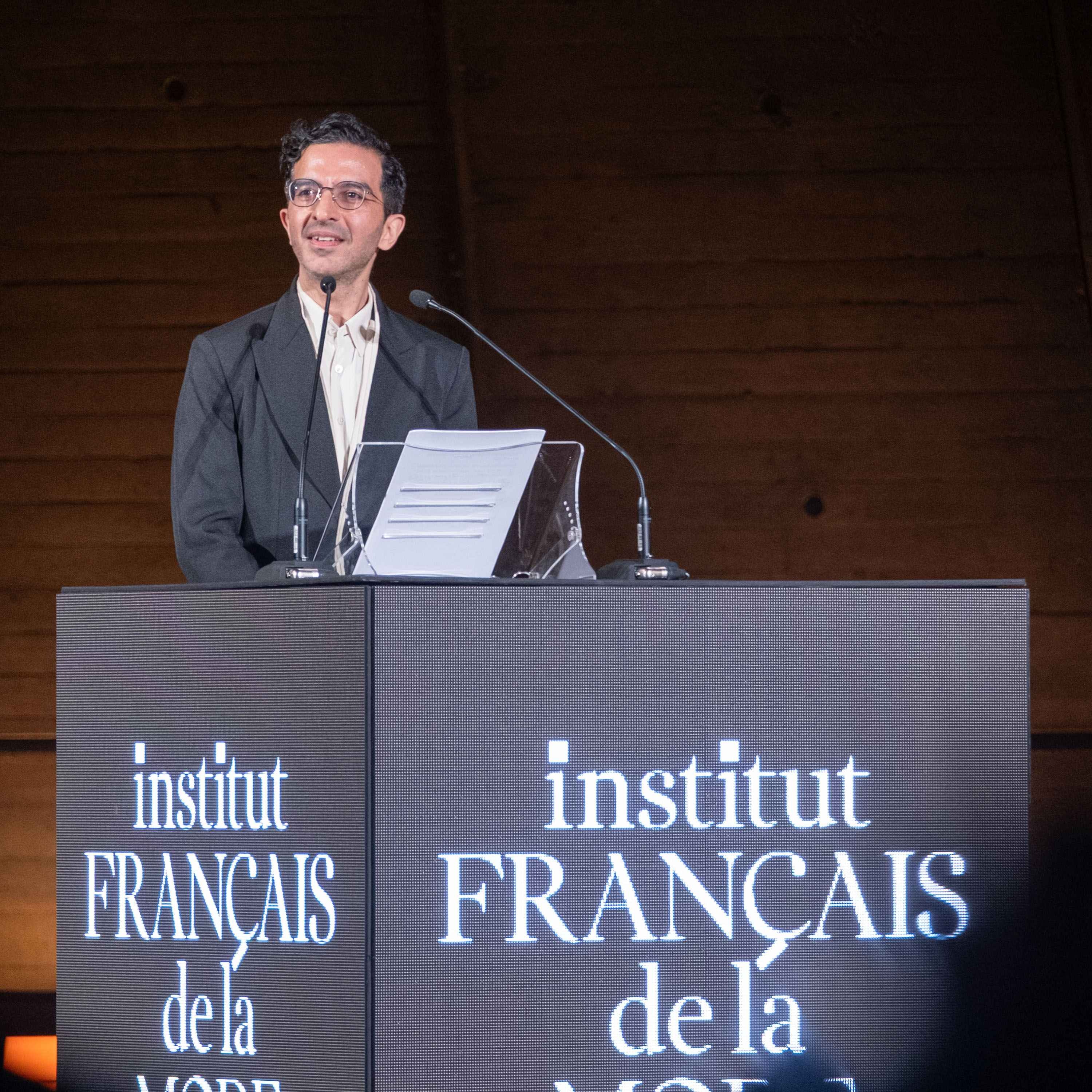
The Business of Fashion Podcast
Lessons on Purpose, Restraint and Responsibility
00:15:20
In a commencement address to the 448 graduates of the Institut Français de la Mode, BoF founder Imran Amed shares key three lessons on navigating a career in fashion at a time of global turmoil and industry transformation.
Loading summary
Transcript11 lines
- [00:00]
Imran Ahmed
Foreign. This is Imran Ahmed, Founder and CEO of the Business of Fashion. Welcome to the BOF podcast. It's Friday, January 23rd. This week's episode is a little different. I'm sharing the commencement address I gave last Friday to the 448 new graduates of the Institut Francais de la Mode in Paris. It was a moment that gave me a chance to pause and reflect on my own journey, and also on where our industry finds itself right now. In this talk, I speak about purpose, how I stumbled into mine, how it evolved, and why it feels increasingly urgent in a time of so much noise and pressure. I also reflect on three key tensions I see shaping fashion today. So whether you're starting your journey in fashion or are many years into your career, I hope this talk offers a few useful reflections for navigating what comes next. Good afternoon everyone to the 448 graduates of EFM, as well as to your families, your friends, your teachers, and to Xavier and cv. Congratulations on achieving this incredible, important milestone and thank you for inviting me to share this moment with all of you. I want to start today with a moment that changed my life. A moment so strange and unexpected that even now I'm not sure how to explain it without sounding a little crazy. But it really woke me up and it led me to be here with you today. So I'm going to share it with you if you promise to bear with me. About 25 years ago, shortly after graduating myself, the global economy was in a recession, the dot com bubble had burst, and my dreams for breaking into the fashion industry were not possible. I wanted everything to happen quickly, but my plans weren't working out the way I had hoped. So I began working as a management consultant, flying around the world and solving problems that didn't feel like mine. Eventually, I was feeling exhausted and burnt out. On the outside, everything looked perfect. On the inside, I felt completely lost. Then one day I was sitting alone in the New Delhi airport when a man in a colorful turban walked up to me and said, I want to talk to you about your life. I didn't really want to talk to anyone, let alone a complete stranger, but he sat down next to me calmly, as if he had been sent to me. He started talking, but eventually he could tell I wasn't really listening. So he took a little scrap of paper, wrote something down, crumpled it up in his hand, and asked me three questions. What is your favorite color? He asked. I said, blue only because McKinsey told me to wear blue shirts so I could fit in. What is your favorite flower? I said, lily, because my cousin had calla lilies in his wedding. Then he wrote down my name and placed numbers above it from 1 to 5. I m r a n 1, 2, 3, 4, 5. Pick a number, he said. I chose the number 3 because it was right in the middle and I like symmetry. Then he said, open your hand. I unwrapped that crumpled piece of paper, and on it were the three words he had written down minutes before. Blue lily. Three. Now will you listen to me? He asked. And in the middle of that loud, crowded airport, his question hit me like a lightning bolt. So I really started to listen. In the end, he gave me one important piece of advice. He said, you need to practice meditation. There is so much noise in your head that you can no longer see clearly. That conversation pushed me to take three months off of work and sign up for a 10 day silent meditation course. It was during that course that I realized I was living a life built to impress others, not to express myself or use my creative talents. Eventually, it pushed me to leave a secure career and build the one that was waiting for me, one full of risk, uncertainty and possibility. So why am I telling you this? That random conversation in New Delhi eventually led me to create the business of fashion and brought me here to be with all of you today. That moment was the beginning of my search for purpose, to build a life and career with meaning in service of something greater than myself. I've learned that this is the most important, important thing of all in life. You won't know exactly what's going to happen in the world around you. There will be disruptions and external forces completely outside your control. But if you are clear about your purpose, that can guide you every day. As the world changes around you, it becomes your North Star. It becomes the compass that helps you to find your way in a world of turmoil and change. And I've learned that it is in our struggles that we find our purpose. Not despite them, but because of them. When I look around this room, I see the future of our industry and frankly, an industry that really needs your energy, your imagination, and your courage more than ever. You are graduating into the world at a moment of reckoning and into an industry in the midst of transformation. Fashion is still operating by old rules, even as the world around us is changing rapidly. As a new graduate, this must feel daunting. But in my experience, it is these moments of disruption that are the greatest moments of opportunity. When I was graduating, there was a brand new technology called the Internet. We had no idea what it would become. And when I began exploring the fashion industry after my meditation course, many of the people I spoke to believed consumers would never buy clothes or handbags online, and they would never use social media to learn about fashion. At the time, I didn't know that this technology would enable me, sitting on a sofa in London, to break into an industry. I had dreamed about watching up Tim Blanks on television in Canada. Through BoF, I've had a front row seat to the most urgent conversations shaping fashion and the wider world. And by using a new technology, I was able to create something red around the world, helping an entire industry navigate two decades of change. This is my purpose. For the last 20 years, I've tried to understand fashion. How it works, how it evolves, and which essential elements must not change. And if the industry is to continue to thrive and survive. Today, fashion is once again at the precipice of great transformation. So I want to share three problems the industry is grappling with right now. And more importantly, where you can have the greatest impact. This is where the greatest opportunities lie. The first problem is growth without meaning. As an industry, we have become obsessed with growth. Over the last decade, fashion has optimized for output. More collections, more drops, more collaborations, more content. Growth has become a proxy for relevance. But the result wasn't abundance, it was dilution. Overproduction has eroded margins and damaged our planet. Excess has weakened trust with consumers. And sustainability has become something we talk about rather than something we design for. When growth becomes the only goal, meaning is the first casualty. So today, the most radical thing you can do in fashion is to practice restraint. As a designer, edit harder and more rigorously. As a marketer, create signals of meaning, not noise. And as an entrepreneur, use new technologies to help us create less but better. Ask yourselves, do we really, really need this? The second problem is values without systems. Fashion has become very good at signaling values, sustainability, inclusion, ethics. Without building the systems that allow those values to exist. The industry has learned to tell stories faster than it has learned how to build structures. Labor abuse is real. Regulation is tightening. Consumers are more informed and more skeptical than ever. The era of storytelling without systems is ending. The next era of fashion belongs to builders, not narrators. This means designing supply chains that reduce waste, using AI to drive efficiency, not mere spectacle, and treating workers rights as a foundation, not an afterthought. Think of these as not inconveniences, but as creative constraints. And ask yourselves, if we were starting from scratch, how should this industry actually work from end to end? The third problem is authority without trust. For decades, fashion power sat in a few places in the headquarters, on the runways, with the gatekeepers. But today, authority is moving to creators, to operators, to communities, to new geographies and new formats. Culture now moves faster than institutions, and legitimacy is earned through trust and hard work, not just because you have an important position. So authority comes from doing hard work consistently with discipline, understanding context from your unique vantage point, and building credibility over time. Indeed, some of the most meaningful change in fashion is coming from people who didn't grow up inside the fashion system at all. So ask yourselves, how can I use my unique talents to change things for the better? I will conclude by saying young people often ask me where they should focus. In an industry with so many problems, this is where your purpose comes in. And to find it, you must really, really know yourself. When I was younger, I spent a lot of my time worrying. Worrying about the future, worrying about my career, worrying about what others thought of me, and worrying about whether my plans would work out. It was only when I redirected that energy towards understanding what really motivated me that my purpose came into focus. If you do this, you can make decisions based on what genuinely interests you, not on what others think of you or expect of you. That's how you know where to start. That's how you know where to focus your energy. And you don't need to fix the whole system. You just need to choose one problem and serve it really, really well. Because the future of fashion won't be decided by those who speak the loudest, but by those who choose to act with care and are guided by a sense of purpose. This isn't something you find once and keep forever. Purpose will evolve just as you evolve. Even now, I'm still finding my way. But when the world feels uncertain, and it will feel uncertain, purpose is what brings me back to myself. I hope that it will do the same for you. Thank you and congratulations. The bof podcast is edited and produced by olivia davies and eric brea.
- [15:16]
Podcast Advertiser
Foreign.
- [15:22]
Imran Ahmed
Hey, it's Raj and Noah.
- [15:24]
Raj
And we're back with a new season of Am I Doing It Wrong? The show that explores the all too human anxieties we have about trying to get our lives right.
- [15:31]
Noah
Because we're still doing a lot of stuff wrong.
- [15:33]
Raj
But who isn't? That's why each week we're talking about the topics that we could all use a little helping hit with. Whether it's making new friends as an adult, managing our emotions, or even dreaming.
- [15:42]
Noah
We'Ll be talking to experts in their fields who are definitely doing things right, so the rest of us can be a bit wiser and a lot better equipped to handle whatever life throws at us.
- [15:51]
Raj
Subscribe now and listen to new episodes of Am I Doing It Wrong? Dropping every Thursday starting January 1st, wherever you get your podcasts.
- [15:58]
Noah
And for the first time ever, we're going to have full video episodes on YouTube. Because as long as there are things to get wrong, we're going to be right here to help you do them better.
- [16:07]
Imran Ahmed
Love y'. All.
- [16:08]
Podcast Advertiser
Influencer marketing isn't what it used to be. We're shifting from reach to resonance, from impressions to impact. It's no longer about how many people see your content, it's how deeply you connect. Connect with them, and nothing creates that connection quite like podcasts. Acast's podcast pulse 2025 report reveals how podcast creators are redefining influence through resonance, multi platform fandoms and their ability to shape culture. So if you're a marketer who's tired of vanity metrics and looking for meaningful results, podcasts are where you need to be. Download the full research free@podcastpulse2025.com.