← The Business of Fashion Podcast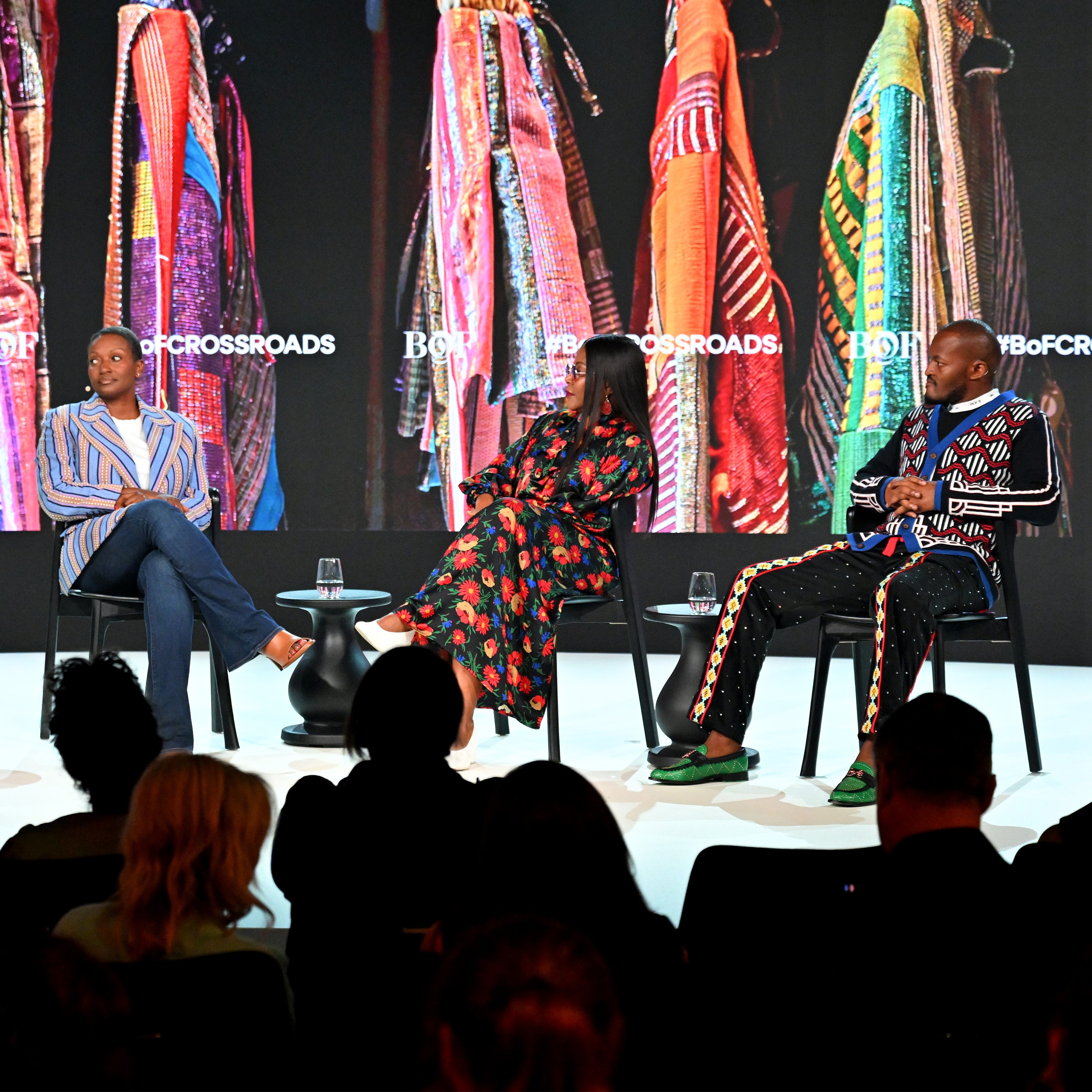
The Business of Fashion Podcast
Redefining "Made in Africa"
00:23:48
Maryse Mbonyumutwa of Pink Mango, Laduma Ngxokolo of MaXhosa Africa, and Reni Folawiyo of Alara join writer Rozan Ahmed at BoF CROSSROADS 2025 to discuss how African brands are bringing global creativity and sustainability to fashion.
Loading summary
Transcript53 lines
- [00:00]
Roseanne Ahmed
Foreign.
- [00:04]
Imran Ahmed
Hi, this is Imran Ahmed, founder and CEO of the Business of Fashion. Welcome to the BoF podcast. It's Friday, May 16th. Africa is experiencing an exciting shift creatively and commercially with growing global attention on its rapidly expanding middle class population. Yet local fashion entrepreneurs must navigate unique operational challenges and and misconceptions about the quality and reputation of made in Africa. Pink Mango's Maryse Bonimutua entered apparel manufacturing in Rwanda to address both economic and social sustainability.
- [00:43]
Maryse Bonimutwa
Africa is here to offer the social sustainability, to make sure that now when we talk about environmental sustainability and social sustainability, they are aligned.
- [00:54]
Imran Ahmed
Laduma Nokolo, founder of the South African luxury knitwear brand Maxosa Africa, drew inspiration from his culture's traditional designs.
- [01:05]
Laduma Nokolo
How do we take local traditional aesthetic and modernize them, but yet at the same time address the big problem that we have in South Africa Africa of unemployment and also considering environmental consciousness?
- [01:24]
Imran Ahmed
And to celebrate African creativity, Renee Folawio founded the concept store Alara in Nigeria.
- [01:31]
Renee Folawio
I started Alara in the front of a very emotional place. I wanted to celebrate African creators both on the continent and in the diaspora. I wanted to elevate their work because I hadn't seen it done anywhere else.
- [01:46]
Imran Ahmed
This week on the BoF podcast, Maryse Laduma and Reni, together with Roseanne Ahmed, discuss Africa's unique contributions to fashion, the opportunities in sustainable manufacturing and how they are redefining what Made in Africa really means. Here's Maryse Bonimutwa, Laduma Nokolo and Rene followio on the BoF podcast.
- [02:14]
Roseanne Ahmed
I have to say it is so refreshing as someone who's worked so hard to shape and champion cci not only in the Middle east, but of course in my mother continent, Africa. It is truly refreshing and truly an honor to have such a Pan African stage of excellence from all corners of the continent. It really is a moment for me and I am so happy you're all here.
- [02:40]
Maryse Bonimutwa
Thank you.
- [02:41]
Roseanne Ahmed
Let's kick off with what is made. As we all know, manufacturing in Africa comes with a special set of post colonial obstacles. And yet of course, despite it all, an immense potential. Maryse, from your innovative experience at Pink Mango, what are some of the biggest challenges you've come across and what opportunities do you feel local production creates? As a designer yourself as well, thank.
- [03:13]
Maryse Bonimutwa
You very much, Rosanne. Thank you Imran for having us here and having Africa represented in this type of event and especially in Crossroads. It's amazing. Things are moving in the right direction. So a quick background maybe to respond to your answer for me. I'M in manufacturing accidentally. My goal was a brand which I started, but I want it to be made in Africa. But very importantly also to leverage on the potential of Africa in the apparel manufacturing and also tourist respond to the development needs the continent have between job creation, export, you name it, and Africa has been announced as the next frontier for apparel sourcing. So six years ago I set up Pink Mango in a joint venture initially to respond to new diversification. And actually today it's never been a better place than to actually also talk about the potential with the tariffs in the U.S. we dreamt it, Trump did it. So Africa, while everybody is looking where we're next to diversify, I wanted to tell potential investors brands here that please consider Africa as the next destination. Things are moving and are moving fast. We've already big retailers starting trial order in East Africa, West Africa coming as.
- [04:47]
Roseanne Ahmed
Well, and the Middle east as a.
- [04:49]
Maryse Bonimutwa
Neighbor with the Middle East. Yes. And when I say accidentally, initially when I started the joint factory, it was with a former Chinese supplier of mine. But when I once emerged in manufacturing myself, I realized actually what it meant really cost per minute and oh, actually when we have to sell to this big retailer in Spain, these outerwear, we are specializing padded jackets and outerwear at this price. This is what it means. Oh, workers will come at this hour and leave at 11. We've got 80% of women, 95% are youth as well. And all of a sudden I realized that after 25 years of being a trader, because I've got a trading company in Belgium, purchasing for global brands, and I've always contented myself with a bsci, a zx, a Rapu, you name it. But I've been into the factory, yes, I've been in audits and stuff, but once you leave, you don't know what's happening. And here I had experts of the industry teaching me actually what it is. And for me there was definitely something to change. And when we talk about sustainability, lots of efforts are being made into environmental sustainability. But when it comes to social sustainability, the norms have not evolved so much. So for me, Africa, then what we had to do is to make sure that it's a canvas, it's an empty template. We are sustainable by nature. The fact that we've not industrialized yet, so how can we. What is going to be our contribution to this sustainability pact? And Africa is here to offer the social sustainability, to make sure that now, when we talk about environmental sustainability and social sustainability, they are aligned. And this is really the innovation that Africa can bring and it's the last frontier because it's the last continent where labor, the workforce is abundant. Labor is still lower cost compared. So if we don't do it now, as it was said yesterday, and if we, the fashion industry, don't do it, nobody else will do it. And this is what we can do in Africa.
- [07:01]
Roseanne Ahmed
Absolutely. I always say there's a lot to learn from Africa when it comes to sustainability because of just a natural means of operating. And the world can learn a lot from the continent when it comes to that. Absolutely. Speaking of learning from the continent, Renny, I have personally witnessed Alara become one of the most celebrated boutiques across Africa. A concept store that encapsulates lifestyle, good food, art and design long before most even understood what it means to be experiential, what drives your brand selection. And considering your own means of shaping shopping, how do you see the role of independent retail evolving in Nigeria and across the continent in general, despite the fact that you clearly have influenced the rest of the world already?
- [07:52]
Renee Folawio
Thank you for that. Thank you, Roseanne. And thank you, Imran, for inviting me to this platform. I'm really happy to be here. I mean, I'll give you a little bit of a background. I started Alara in the front of a very emotional place. I wanted to celebrate African creators both on the continent and in the diaspora. I wanted to elevate their work because I hadn't seen it done anywhere else. I had a lot of sort of, I had seen it within the continent and I was like, how come nobody knows about all these artists and creatives and why is it that they don't have a platform that celebrates them? So it was a self empowerment, self determination moment and I wanted it to be celebratory. So I thought, let's build a shop and then let's take all the aspects of African lifestyle and put it in the space so that people learn about our culture as well as come in and buy some of the beautiful things that I thought we could curate. So that was the essence of how we started. And the most interesting thing about this is that to encapsulate, like you said, a large continent into a shop is actually quite challenging. But I had traveled a lot and I say to people, if I change Alara, I could change Alara every 30 days and it would be extremely different all the time. So it became kind of performative and interesting and a journey of discovery. If you look at the store, these steps are showing you something new.
- [09:23]
Laduma Nokolo
So it was a story.
- [09:24]
Renee Folawio
And in doing that, I didn't know which way it would go. I just tried it, but I found that people got so intrigued and so into what we were doing, the celebratory part, the elevation part. I got a lot of support from creatives. I got a lot of support from everyone wanting to be part of this thing that we had created. So in that sense, I had more than I could deal with. But we found a way to curate the store with objects, with fashion, with art in a way that that discovery journey kept being refreshed all the time, and it kept people's interest and it kept us growing in different directions. So we became a cultural hub where people wanted to learn more about what it is about this African creativity, our traditions. And that way we attracted a lot of people. So we continue to be very curatorial in what we do. But essentially we wanted to say, what is the essence of what you do? What does it bring to the continent? What does it bring to the people of the continent? Who is it empowering? And those are the kind of things we think about when we think about people that we want to platform in Alara. So the idea of elevating but also empowering remains in everything that we do.
- [10:38]
Roseanne Ahmed
Absolutely.
- [10:39]
Renee Folawio
So that's basically, essentially how we choose. And we have different steps as to what that is, but largely we want to empower and we want to celebrate and we want to create objects that people covet.
- [10:52]
Roseanne Ahmed
Right. We've talked about this before, establishing the difference between gaze and benefit.
- [10:58]
Renee Folawio
Yes.
- [10:59]
Roseanne Ahmed
Because Africa certainly is in a moment of gaze, but there are those of us who stay focused on how we benefit from that gaze.
- [11:07]
Renee Folawio
What was the other part of the question?
- [11:11]
Roseanne Ahmed
It was key milestones in taking Alara to the rest of the world.
- [11:16]
Renee Folawio
Yeah, I mean, that has been super interesting. We've been open for 10 years. We've done a lot on the continent. And we, because of the model, which is kind of a model where people are now coming to, which is a model that encompassed a wide range of things. We got a lot of interest from people asking us, how do you do that? What does it look like? How do you manage it? And so we've had people interested asking us, come over. We want to feel what you do, and we want to learn more about how you've managed to do retail on this level, in this way that had been unusual. Taking understanding that retail, not traditionally, it's quite rigid, and people. You wouldn't expect to go into a space where you could come in and it could be art today, it could be a dance performance tomorrow. So people have invited us. We've been to Brooklyn Museum, where we were there for four months. This year we're going to lacma, Los Angeles Community Museum, where we're also going to be there for another one year, where people, they want to learn what we've done and how they can repeat it themselves.
- [12:20]
Roseanne Ahmed
Wonderful. Leduma Max Hosa has built a globally recognized fashion identity rooted in South African vibrance. More than that, you really are a 360example of the African possibility in fashion, encompassing design, retail, and manufacturing under one independent umbrella. Can you describe your creative process for us and what has been the key elements in taking your brand from your homeland, South Africa, to the global stage, as it were? The other global side.
- [13:00]
Laduma Nokolo
Thank you. Greetings to all the delegation, and thank you so much, Rosanne, for making me part of this conversation. And thank you so much to Imran for inviting us here. My design process stemmed from a thesis project that I did at the Nelson Mandela University in South Africa. And that was 15 years ago during the World cup when we had a celebration.
- [13:27]
Roseanne Ahmed
Oh, yeah. Remember.
- [13:29]
Laduma Nokolo
And other cities.
- [13:30]
Roseanne Ahmed
Yes.
- [13:31]
Laduma Nokolo
So my thesis project was merely based on how do we take local traditional aesthetic and modernize them, but yet at the same time address the big problem that we have in South Africa. Slash Africa. Of unemployment. And also considering environmental consciousness, Africa being a sustainable continent from centuries ago, I came up with an idea that how about I look into my own culture and take artifacts, but bring them into the modern, but yet preserve it for the future? In my culture, I'm from a community called the Xhosa people. The Xhosa people are the second biggest population in South Africa. Xhosa people, Wow.
- [14:26]
Roseanne Ahmed
I almost got it.
- [14:27]
Laduma Nokolo
Nelson Mandela and various other figures are from that culture. But it's quite a rich culture that you find in over 200 clans. And as a person that has studied textiles in high school and university, I discovered that I could do a lot from the artifacts that come from my culture. But I stumbled upon an archive of beadwork that my ancestors and various other clans have been practicing in Africa. As you know, during colonization, the Dutch and the English used to bring commodities like beadwork to trade with the locals in exchange of cows or land. And Xhosa people did embrace bidwork, and they came up with extravagant beadwork that you. Most of them, you find them in museums nowadays, you don't find them commonly in the street. So I wanted to take that craft and put it back to the people. And I take motifs and then I modify them, and then I Came up with patterns that were infinite in terms of the design possibilities that I could create. And in my culture, every Xhosa young man that is 18 years old has to go through a circumcision ritual, which is a four year process, a rite of passage, a rite of passage that happens in the forest. And literally before you join that ritual, you have to give away all your belongings. And essentially the whole practice is about taking you as a man, your family is taking you as a man and giving you a form of independence so that you never have to depend on your family again. So they buy you a sweater which is premium quality, shoes that are premium quality, and that's the last purchase that they doing for your family. But then I look back while I was doing my thesis, I wanted to come up with a new attire for that culture, for that practice. And ironically, the clothes that we wear that for the practice are westernized clothes. Your, your Lyle and Scott brand, Pringle whatnot with agal motifs. And I eventually came up with the patterns and then came up with a concept that they could consider as part of alternative things to wear. But I also saw a gap that there isn't much African luxury products out there in the market. So I thought, let me target this concept to close that gap.
- [17:00]
Roseanne Ahmed
Wonderful. I want to end or wrap up rather on thoughts around perception, a concept those of us as ambassadors across the global South. I mean, I don't think this is just applicable to Africa, but across the global south generally, it is a concept that we have to always consider and regularly shatter. More than those of us outside the global South. We've seen how the made in label can generate ideas and associations from country to country. Made in Italy, for example, can have one typically thinking of quality, craftsmanship and prestige, while Made in France carries immediate odes to luxury or croissants. When the world hears Made in South Africa, very quickly, what immediate associations should come to mind?
- [17:57]
Laduma Nokolo
Some of the immediate associations that I could think of is excellence.
- [18:02]
Roseanne Ahmed
Thank you.
- [18:06]
Laduma Nokolo
Black excellence. And of course we have a lot of unlearning to do because as the great writer Ben Okri puts it, that there are three types of Africa is the Africa that we see on the news that with starving, with starvation, and the Africa that we live in that is constantly evolving. And then the Africa that people read about on the news, you know, so we choose to be in the Africa that keeps evolving with possibilities. And made in Africa in general should carry prestige and not cheap. It's not cheap. Yes. There's a bad perception that Anything that is made in Africa should be reasonably priced or cheap. We put in our heart and souls into our work and present it to the world so that it sits next to their level of brands. We have about eight boutiques in all major cities in South Africa and New York. And we intentionally placed our brand next to your Louis Vuitton, Gucci, Zegna, Mont Blanc. Intentionally.
- [19:14]
Roseanne Ahmed
As you should. Yeah. I love what you said about not cheap. Because in Kenya, for example, I mean, I'm Sudanese, but my second home is Kenya. And a lot of my jewelry is made there. And the women tend to make it whilst praying. And so they relieve their energy and they put it into the jewelry. So when I wear, it isn't just, you know, expensive by way of monetary value. It is expensive to me because it really is their heart and soul, their prayers. They're good energy that I put on my body. So I completely agree with you on that, Rennie. Made in Nigeria. What should be the immediate assumptions, immediate ideas to associate? Culture?
- [19:54]
Renee Folawio
Couture.
- [19:55]
Roseanne Ahmed
Couture.
- [19:56]
Renee Folawio
Craftsmanship. Glamour.
- [19:58]
Roseanne Ahmed
Glamour. Couture, naturally. Couture in the blood.
- [20:03]
Renee Folawio
I think it's important to highlight that.
- [20:05]
Roseanne Ahmed
Yes.
- [20:06]
Renee Folawio
Because traditionally we have made to measure clothes. I know everybody looks at the lens of or production, industrialization and stuff like that, but naturally. And traditionally we have made to measure. Literally every week you go to somebody to make your clothes, to go to a wedding. And when you see the women turn out, it's like they're going to the Met Gala. And I really do understand that people don't understand that that's actually our reality.
- [20:28]
Roseanne Ahmed
Yeah.
- [20:28]
Renee Folawio
And it's in the everyday, and it's literally every day. And it's everyone. It's not just people of a certain strata. It's everyone. So everyone has someone who's making something from scratch for an event. And I think that's essentially what we do traditionally. I understand that to grow and stuff like that, you need industrialization, you need to change. But that is our essence. And I think that it's sustainable. We have a lot huge human resources, people working, bidding stuff that you won't even understand or believe. And they do it fast, quick and regularly. And I think that is really our core strength. And I think we can grow a lot from that. Everything else regarding industrialization, I mean, I leave to you because I think collaboration with people like Maurice coming into Nigeria to help with production on that side might be interesting. But our core. Our core is couture. It's glamour, is celebration. And this is what I would say.
- [21:23]
Roseanne Ahmed
And I feel this is very close also to the Middle east because as someone from both, I understand that our couture designers are on speed dialogue for regular, you know, the average event. So I think this is a habit that is shared across regions. Maurice. Made in Rwanda.
- [21:40]
Maryse Bonimutwa
Made in Rwanda. Just to add, I think, and it's fantastic because I think they should cohabit, you know, the brands, African brands, definitely being anchored in that craftsmanship that we do. But then again, when I talk about the possibility of also being able to produce for the world the Made in Rwanda, and I would say ubuntability and on purpose because it's a pan African way, I've used a South African word and our corporate social responsibility, which we are driving now to potentially the first African grown and factory grown social standard because it was drafted by the factory workers themselves. And I've called, the program is called Pink Ubuntu. And I've used the word ubuntu, which comes from South Africa, but which is an African philosophy that you found in Kenya too, in South Africa, in Rwanda, it's Ubumuntu. And it can be summed up as I am because we are. And for me, when you hear Made in Africa in the future, we are now building business models that are anchored in our own culture in Ubuntu. And I've even coined the word ubuntability. And ubuntability should be our personal and collective responsibility in the African philosophy of I am, because we are. And if we are going to move part of the production to Africa, we all have to be ready to respect that, because it's the last frontier where we can really rebalance that. So made in Rwanda, Made in Africa. Ubuntability, lovely.
- [23:13]
Roseanne Ahmed
Love that, love that. I once said in an interview that the global south and Africa included isn't necessarily forging anew, but finally and rapidly remembering who they are. So thank you all very much for the return.
- [23:38]
Imran Ahmed
The BoF podcast is edited and produced by Olivia Davies and Eric Brea.
- [23:52]
Adam Grant
If you're a lineman in charge of keeping the lights on, Grainger understands that you go to great lengths and sometimes heights to ensure the power is always flowing. Which is why you can count on Grainger for professional grade products and next day delivery. So you have everything you need to get the job done. Call 1-800-GRAINGER clickgrainger.com or just stop by Grainger for the ones who get it done. Hi, I'm Adam Grant, host of the podcast Work Life. For over 20 years, Paylocity has been simplifying work with innovative solutions that teams love, like on demand payment, which offers employees access to wages prior to payday, flexible time tracking features which enable staff to clock in and out through their mobile device and numerous other cutting edge solutions that simplify collaboration across hr, finance and it. Learn more about how Paylocity can help streamline work and enhance business outcomes for your organization@paylocity.com Simplified.