← The Carey Nieuwhof Leadership Podcast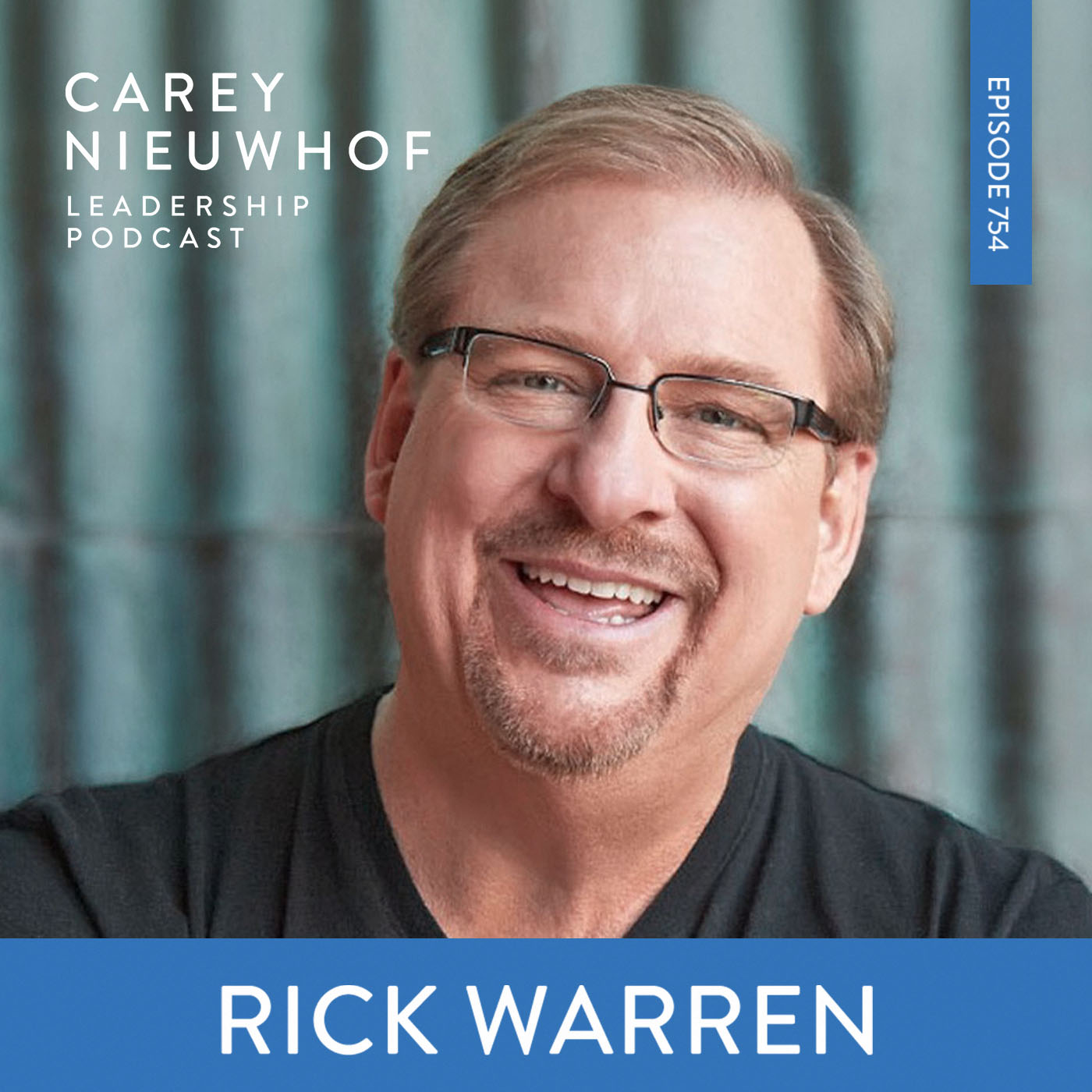
The Carey Nieuwhof Leadership Podcast
CNLP 754 | Rick Warren on What 99% of Churches Don't Do, The Rise of the Global Church, and the Call American Churches Need to Hear
01:16:42
Rick Warren returns to the podcast to explain what 99% of churches don't do. He discusses the extraordinary rise of the global church and how it's outpacing population growth, and he outlines the call from Jesus every American church needs to hear....
Loading summary
Transcript56 lines
- [00:01]
Rick Warren
The Art of Leadership Network. If you don't get anything else, I want you to get this. The whole business of Christianity and church and disciple making is moving people from come and see to come and die. 99% of all the churches in the world have no plan to do that.
- [00:23]
Carrie Newhoff
Welcome to the Carrie Newhoff Leadership Podcast. It's Carrie here. And I hope our time together today helps you thrive in life and leadership. Well, today Rick Warren is back on the podcast. Had him on a couple years ago when he was still the lead pastor of Saddleback. Today you get a rare glimpse of Rick, pretty much Uncut Man. I'll tell you, it's a different kind of interview. And he talks about what 99% of churches don't do, the rise of the global church and the call American churches need to hear. So a little note before we get started. I think you all know who Rick is. I'll give you his bio in just a minute. But today's episode, a little bit longer than usual. But that's because when you sit down with Rick, you don't sound bites. If you really, you know, he's on major media or that kind of thing or social media, you get like short clips and everything like that. When you really get to know Rick, you don't get sound bites. You get a fire hose of wisdom. So you're going to hear fewer questions in this podcast, more Rick Warren, uncut, unfiltered. I wanted to keep the depth of this interview intact, so I think you're really going to appreciate it as we go along. And he's right about what 99% of churches don't do. So a Time magazine cover named Rick Warren the most influential spiritual leader in America and one of the most influential people. Tens of millions of copies of Rick's books have been published in 200 languages. The purpose Driven Life and the Purpose Driven Church were named three times in national surveys of pastors as two of the most helpful books in print. Rick and his wife Kay founded Saddleback Church, the Purpose Driven Network, the Peace Plan and Hope for Mental Health. He is the co founder of Celebrate Recovery. Along with John Baker. He's spoken in 165 nations and also spoken to the United Nations, US Congress, numerous parliaments, World Economic Forum, CAD, Aspen Institute, and lectured at Oxford, Cambridge, Harvard and other universities. He is now the Executive director of Finishing the Task, a global movement of denominations, organizations, churches and individuals working together on the Great Commission goals that ensure that everyone has access to the Bible before 2033. And I'll tell you it's gonna be a really fascinating conversation. Hope you're doing well wherever you are. To all of our new listeners, I wanna say welcome. Really glad that you're here and I would love for you to hit follow wherever you're listening. When you do that, we get to bring you more great guests like Rick Warren and everybody else that we've had and are going to have on this podcast. So when you help the podcast grow, everything gets better. So we choose our partners really carefully, give it a listen, they've got some great opportunities for you, and then we'll dive into my conversation with Rick Warren. This episode is brought to you by Kingdom Advisors. Last year, over 80,000 Christians searched for certified Kingdom Advisors to align their financial decisions with their values. And they're part of a growing movement of people seeking financial guidance rooted in biblical principles. So Kingdom Advisors is the organization leading the way. For over two decades, they've been dedicated to training financial professionals to integrate integrate their faith and their finance. Their Redeeming Money conference is coming up on February 11th to 13th in Orlando and I am so excited to be one of the speakers. So at that conference, more than 3,000 financial professionals, industry leaders and students will gather to connect with like minded community, get practical solutions and grow spiritually. If you're a financial professional, you owe it to the people who put their trust in you to join this community and get the wisdom that redefines true financial success. Visit redeemingmoney.com/that's redeemingmoney.com C A R E Y for more information and to register. This episode is brought to you by Amplify plus from Ministry Brands. One thing you've heard me say a lot of times is time off won't heal you if the problem is how you spend your time on. Well, for so many pastors, our best hours get swallowed up by systems that don't work right. Scattered tools, disconnected processes, constant admin. These hours are the very ones you could be spending on things that matter most. For example, investing in people, shaping vision, or leading your church toward its mission. That's why I want you to see what 55,000 churches nationwide are using. Amplify plus from Ministry Brands. It's a fully connected church management platform that brings your people, communication, events and scheduling all into one place. When your systems work, your time on fuels the heart of Ministry. Visit ministrybrands.com Amplify to learn more. And now to my unfiltered conversation with Rick Warren. Rick, I am so honored and delighted to have you back. And it's just I've enjoyed our conversations over the years immensely.
- [05:18]
Rick Warren
I always enjoy you, my friend. And you know, the secret of an effective life will be determined by the quality of questions you're willing to ask yourself and others. And asking questions is really the secret to great leadership.
- [05:38]
Carrie Newhoff
I'm learning that as I get older. What keeps you curious? What keeps you asking questions? Because you could probably teach for the rest of your life.
- [05:46]
Rick Warren
The bottom line is you can learn from anybody if you know the right questions. Everybody's ignorant, just on different subjects and you know things I don't know and the person besides, both of us know some things neither of us know. And that's why iron sharpens iron. The Bible says, counsel in the heart of man is like a deep well, but a man of understanding will draw it out. Learning to ask questions is actually a sign of wisdom and learning to draw it out and waiting for that answer. I had a friend years ago, 40, 50 years ago, who went and served as an intern and a pastor's church in Texas, well known pastor, and he was there for a year and at the end of the one year intern, he walks in and he says to the pastor, I've enjoyed working here as an Internet. I just wanna know before I leave, what's your secret? And the man goes, what? He goes, yeah, I wanna know your secret. He goes, what? He goes, I've never heard you preach a dud. Every sermon you have is meaty, it's deep, it's passionate, it applies to life, it's full of wisdom. I've never heard you preach a bad sermon. What's your secret? And the guy goes, I don't have a secret. And Billy didn't stop there, he pounded the table. You do too, and I'm not leaving until you tell me your secret. And the guy was quite a humble guy and he hemmed and hawed around, finally said, well, I made a commitment about 30 years ago to read through the New Testament once a week. And I've never missed a week. Billy's done. What do I ask after that? What's the follow up question? And he goes, so what translation do you read it in? And the guy goes, the guy said, well, usually the Greek. So here's a guy who's reading out of the Greek New Testament every week, once a week, the entire New Testament, every week for 30 years. The guy knows the word of God backwards of 40, he's continuing in my word. Then you will be my disciple and you will know the truth. The truth will set you free. But he said, I could have been there for a year and never learned that. You often have to draw it out. And that's what you do on your podcast. You're trying to probe and draw things out. And if people want to talk about it, they'll talk about it. If they want, they'll do something else. But the bottom line is the quality of your life will be determined by the quality of questions that you ask. First of yourself and asking the tough questions of yourself and then. Then asking others. And so I always. The young guys that I. I've helped mentor along, I said, make yourself a list of questions and stick it in your wallet. So then if you forget it, you know, then you can. You can pull them out and. And ask those every time you get around anybody. Interesting.
- [09:02]
Carrie Newhoff
What are the questions you ask yourself?
- [09:05]
Rick Warren
Well, I'm constantly asking myself, what is it like to be on the other side of me? That's a profound question.
- [09:15]
Carrie Newhoff
It is.
- [09:16]
Rick Warren
And what is it like to be on the opposite side of me? Okay. As an employee, as a friend, as a small group, as a fellow pastor. Because we have our perceptions of ourselves, which are usually pretty skewered. You know, you can't see the forest for the trees, but that's a real big one. I have a little acrostic that I made. You know, I'm the king of acrostics because it helps you remember things.
- [09:44]
Carrie Newhoff
Yeah. You sent me a new one this morning.
- [09:47]
Rick Warren
Well, here's one on how to speak to anybody about anything, okay? And I use the word S, P, E, A K. And so if you get sat down next to somebody at a banquet with rubber chicken, and you don't know them and they don't know you, well, how do you speak to that person? And so S stands for story. You say, tell me your story. Now, you're not prescribing where they start. Things start. I was born in a hospital. Or they can start last week, but they get to tell their story. Now. Many times you just ask them that question, and they'll talk for the next 30 minutes, and they'll walk away thinking, you are the most amazing conversationalist. It's true. Because you've given them a chance to tell their story. So tell me your story. The P is what's your passion? What turns your crank on? What gets you up in the morning? What causes you to have reason to get out of bed? Some things bore you to tears, and some things keep you alive. What's your passion? What are you wired to do? So Tell me your story and then what's your passion? Now, once you know those two things, the third thing you could do is actually encourage them based on the two things they just told you. Particularly, one of the greatest things that older adults can do with young adults is give them permission to be what they're shaped to be. And when you hear their story and you hear their passion, sometimes I've just said things like, you know, what you'd be good at. And that sentence has liberated more people because they're waiting for somebody to give them permission to do what they're shaped to do, what they're wired to do. And I mean, I talked to a waitress one time, and when I heard her story and her passion, I said, you know what you'd be good at? A nurse. And she burst into tears. She said, I've always wanted to be a nurse. I've always wanted to be a nurse. And I said, well, why aren't you a nurse? She said, well, I've got a young daughter at home and I can't go to nursing school and take care of her. And I said, can you think of anybody who would love to take care of your daughter so you could go to nursing school? And she thought for a while and she goes, yes, my mom, My mom was a nurse and she knows I'd like to be and she would love to take care of my daughter. I said, well, go ask her. And so she went away and when she came back to pick up the dish, she goes, I'm going to be a nurse. I just gave her permission. Okay, so tell me your story. What's your passion? And then E is you encourage them based on that you know what she'd be good at and you just give em a little encouragement. Then A and K A is you ask them what's your biggest problem or what's tough in your life right now? What's causing you stress? What's keeping you awake at night? You ask a question that and you ask that question all the time in your podcast. And then K the K and speak is the first four questions are for their benefit, but the fifth one is for my benefit and it stands for know K N O W Who do you know that I need to know? What do you know that I need to know? Now, I phrase it like that, but everybody knows something that I could learn about and probably everybody knows someone that I would benefit from knowing. So in my mind I'm going, who do they know that I need to know? What do they know that I need to know. And so the fifth last letter is for my benefit. The other four for their benefit.
- [13:54]
Carrie Newhoff
Fascinating. All right, we're going to get to finishing the task and I want to talk to you about some of the things you're working on.
- [13:59]
Rick Warren
Now.
- [14:00]
Carrie Newhoff
How do you know what it is like to be on the other side of you? How do you determine that? Because that's a very important question.
- [14:08]
Rick Warren
Well, you ask people and you ask people to be honest and you say, don't give me any bs, don't give me any flyboy, just him haw around. Just shoot it to me straight. I'm asking you what's it like to be on the opposite side of me. My goal, particularly when my children were younger, but for really most of my ministry, my goal, my definition of success was having those who know me best respect me the most. That's real success. Having those who know me the best respect me the most. There's a difference between influence and impressing people. You can impress people from a distance, but to influence them you gotta get up close to em. And when you get up close, they see you got warts, they see you warts and all. In fact, most of us up close aren't very impressive, okay? We're not very impressive up close. And that's why a lot of times people and pastors will keep a barrier. It's kind of like the Beatlesong. He's got to be good looking because he's so hard to see, okay? It's easy to impress people from a distance, okay? Just wear the right clothes and sunglasses and look cool. But if you really want to influence people, and that's what I am all about, you got to get up close to them. And if you get up close to them, they're going to see your, your, your failures and your mistakes and your weaknesses and your warts and all. And you got to get over being afraid of that because that's actually how you're going to help people. We always help more people out of our weakness than we do our strengths. In other words, if I were to, if I were to say today, spend the whole day, just talk about all the cool people I've got to meet. Celebrities and world famous people. Well, goody for you. Yeah, goody for you. And they'd be going, who does he think he is? Do you think he's somebody hotshot? He's just bragging. Your strengths don't build bridges. Your strengths always build walls. It creates competition, it creates resentment. But when I talk about a health struggle or an emotional Struggle or a marriage struggle or any kind of normal pattern of life. People go, wow, well, if Rick's going through that and God's working in his life, I guess God could use me. Well, he can. God has only used broken people. If God only used perfect people, nothing would get done because there are no perfect people.
- [16:59]
Carrie Newhoff
What are the unique giftings? Oh, go ahead, keep going.
- [17:02]
Rick Warren
No, that's all. I was just going to say that the. Ask people what's it like to be on the other side of me and then be willing to accept what they say and don't get defensive about it.
- [17:15]
Carrie Newhoff
One of the gifts you have. Andy Wood said that you have the unique gift of being a pastor to kings. And you mentioned people of influence. So you've met with numerous presidents of the United States, to some of the biggest celebrities on the planet, to people of incredible influence when you're there. Because I think we all have a moment, maybe not with a president or a global superstar, but with somebody who has more status or influence than we might. How do you break the ice? What is your approach when you meet someone who is at that global level?
- [17:52]
Rick Warren
What do you lead with? Well, the first thing is don't be in awe of anybody. They're all. They're. They're just men and women. They all put their pants on one foot at a time like we do, and they all, you know, they all are always wondering, what do other people think about me? You know, what's really interesting is when you hear how celebrities meet somebody they've always wanted to meet, and they're. They're as afraid as a little kid. And you go, wait a minute. You. You are a rock star, and the whole world idolizes you, and yet you're going to get the thing with Bob Dylan. And now you're a puddle of nerves, okay? Everybody has their idols that they go, oh, I would get weak in the knees of that person. So realize they're just normal people. You might have a title, a CEO or senior pastor or president of this or that, but you're just a person. And here's the key thing. The two most important confessions in scripture. Carrie. First is Peter's confession, who says, you are the Christ, the son of the living God. That's the most important confession to settle in your mind, who's Jesus? Thou art the Christ, the son of the living God. The second most important confession is Paul's confession when he says, we are but men. And they tried to make him a God, and he did a miracle, and they tried to turn him into a God. We're just men. And so really to last in life and last in ministry is to hold those two not in tension, but in harmony. God is God and I'm not. And if you're going through a stressful period of time and you're starting to freak out and get worried, just Repeat this about 10 times. God is God and I'm not. God is God and I'm not. God is God and I'm not. And the safest place to be is in the center of the sovereignty of God's will. Realizing that even the bad stuff that happens is father filtered. And so knowing who God is and knowing who I am, we are but men. He knows our frame. We are but dust. This is a funny story. You know, I've taught everybody in my teaching team to give sermon outlines because we forget 95% of everything we hear if we don't write it down. So I've never preached without handing out an outline with fill ins. And sometimes the fill ins get a little funky if you're not working at it real clear. And Tom Holliday was preaching on that verse. He said he knows our frame. We are but dust. And the fill in was but dust. We are butt dust. I'm going to go. And the whole congregation just start cracking up. They're all right again. We are butt dust.
- [21:04]
Carrie Newhoff
That's fairly true, actually.
- [21:07]
Rick Warren
Yeah, right.
- [21:09]
Carrie Newhoff
So when you walk, you're behind stage, you're backstage, there's 50,000 people at the concert, and you're in the green room with the celebrity or the musician, or you walk into the Oval Office. What's your opening approach? What do you say? What do you do?
- [21:28]
Rick Warren
Well, I usually will simply express some kind of expression of gratitude or thanks or affirmation. Here's the thing. The little secret is it doesn't matter how famous you are. Everybody is dying for affirmation. I don't think it's possible to give people too much affirmation. We have a, because of our sinfulness, we have a unfillable hole that you could be praised all the time and you still need more affirmation, appreciation. And because of the fear of rejection and stuff like that, this goes back to human nature, back in the Garden of Eden when Adam and Eve sinned. And God comes walking in the garden and he says, adam, where are you? Well, when God asks the question, it's never for his benefit. Okay? He knew where Adam was. He wanted Adam to know where he was. And Adam says, I was afraid and I hid. And human Beings have been hiding and hurling ever since then. He hid. I was afraid and hid. And then he said, the woman you gave me. He didn't just blame Eve, he blames God. God, if you hadn't given me this woman, I would have. You and me, we'd still be close. We'd be like this, we'd be tight. I would have never eaten that fruit. But the woman you gave me. When Adam sins, he takes it like a man. He blames his wife. And I say, I've told saddleback for 50 years. You spell blame, be lame. Every time you blame, you're being lame. And so it is human nature to hide our faults and to hurl at everybody else fault. We hide and we hurl. We, you know, excuse and accuse. We blame others.
- [23:26]
Carrie Newhoff
I see that. You know, I also see that you're very good at that. I don't know if you remember this or not, but the last time I saw you in person, we were at an event and I was not expecting you to be the event. I walked into the green room, you were sitting at a table and you just looked up and then you lit up and you're like, carrie, Tony, hey, how are you? And you made me feel like the most special person that day. It's just, it's such a gift and such a rare and wonderful thing. So I'm just underscoring that for people.
- [23:55]
Rick Warren
Listening, affirmation, you get joy out of the affirming as much as you do receiving it. And so there's joy. You know, you can be negative, you can be positive. You know, I've just decided I might as well be positive now. You know, I'm not a firm believer in positive thinking per se. Positive thinking only works on stuff you can control. But if it's out of your control, all the positive thinking in the world isn't going to change. The weather, okay, isn't going to change history, isn't going to change stuff that you can't change. It only works on stuff you have the ability to change. But positive thinking is certainly better than negative thinking. I mean, you can set yourself up for self fulfilling prophecies, which some theologians think that's what happened with Job because he actually, a couple chapters in, he says, that which I feared the most has happened to me.
- [25:01]
Carrie Newhoff
You're right.
- [25:02]
Rick Warren
Evidently Job had been fearing that he would lose his family and lose his health and lose his wealth. And all that which I feared the most has happened to me. It's self fulfilling prophecy. I'm not saying that that's all that was involved because we know Satan was involved. There's a God test there, stuff like that. But it is true that you can set yourself up with expectations. Worry is simply the opposite of meditation. If you know how to worry, you know how to meditate. When you take a negative idea and you think on it over and over and over and you mull on it over and over and you rehearse it and rehearse it, rehearse it and it keeps getting bigger and bigger. The more you think about it, the worry gets. Pretty soon the whole world is against you. One person criticized you and you keep going over and over. Pretty soon the whole world stinks. Well, when you take a negative idea and think on it over and over and over, we call that worry or anxiety. When you take a positive idea or scripture, a truth of God's word, and think on over and over, it's called meditation. So if you know how to worry, you know how to meditate, you just need to change what you're thinking about the most. It's not rocket science, it's just you.
- [26:19]
Carrie Newhoff
Said your travel schedule and what you've been up to lately, both past and present, after reading it, I need to take a nap. So I did that. And then it's unbelievable. You've been all over the planet. And I want to ask you, as you see the church, what is the state of the church around the world today? Rick, what are you seeing?
- [26:41]
Rick Warren
Well, that's a really good question. First place, most people don't realize how big the church of Jesus Christ really is. It's far bigger than we realize. We have myopic vision. All we can see is our situation. And it's kind of like the guy, the bum who, he's sleeping on the slide of the street and somebody rubbed Limburger cheese on his mustache. And when he woke up and everywhere he went, it smelled bad, he goes, the whole world stinks. Well, it was, it was just smelling what was on him. The, the bottom line is Christianity is growing and it is the largest thing on the planet Earth. Let me put this in perspective. There are 900 million Buddhists in the world. 900 million. There are a billion Hindus. Almost all of them live in India because they're not a self propagating faith. They don't try to win anybody, convert anybody. So almost all the Hindus are in India. There's 1.4 billion Muslims in the world. Muslims are growing by birth rate. Christianity is growing by conversion. We're not having as many kids, but the Muslims are still having five, six, seven kids. There are only 14 million, not billion. Only 14 million Jews in the world. Now there should be 10 times that number. There should be 140 million. But five generations were killed in the Holocaust. And So there's only 14 million Jews in the whole world. About half of them live in Israel and the other half live in New York City and America and a few other places. But there are 2.3, 2.4, and some say 2.5 billion people who claim to be followers of Jesus Christ in the world. Now, they're not all our brand. They're not all anybody else's tribe. They might not say I'm born again. They might not say I'm filled with the Spirit. But if you were to say to these 2.5 billion people, do you believe Jesus Christ is who he said he is, Son of God? Oh, yeah, yeah, I believe that. Do you believe in the Trinity, Father, Son and Holy Spirit? Yeah, I believe in Trinity. You believe Christ died on the cross for our sins? Yeah. You believe he rose again on Easter? Yeah. Do you believe he gave the Great Commission? I have no idea what that is. Do you believe that he ascended back to heaven and he promised to come back one day? Yeah. Do you believe he sent the Holy Spirit to start the church in the day of Pentecost? Yeah. Then we're on the same team. You're not a Muslim. You're not a Buddhist, you're not a Hindu. Now, we disagree on all kinds of different doctrines and things like that, but if you love Jesus, we're on the same team. You're certainly not a Muslim. You're certainly not a Hindu. Now, part of finishing the task is re evangelizing nominal Christians who are cultural Christians. If I go to Italy and say, are you a Christian? The guy says, what do you think I am? I'm Italian, of course I'm a Christian. Specifically, I'm a Catholic Christian. I'm an Italian. And so we're going to have to re evangelize. You know, there are nominal Muslims who were raised in Muslim culture. They don't know what they believe. They're nominal Hindus and nominal Buddhists. Raised in Buddhist or Hindu culture, they don't know what they believe. Now it's a whole lot easier to convert a nominal Christian follower who says, yeah, I already believe Jesus, Son of God, died on the cross for my sin. Coming back someday to get him to go from the head knowledge to heart knowledge. The 18th inch gap. That's a whole lot easier than to convince a Hindu to go from 10,000 gods to one. Yeah, that's a big leap. Okay, that's a big leap. But there. So when I say there are 2.5 billion people who claim to be followers of Christ, they're not following Muhammad, they're not following Buddha, they're not following Sheba. And so what that means is that one out of every three people on planet Earth claims to be a follower of Christ, saying, I believe Jesus, who he said he is. Now, that means the church is bigger than China. The church is bigger than India. People don't realize this. The Christian church, with 2.3, 4 or 5 billion, whichever one you want to pick, is bigger than China and the United States and Europe put together. Wow. We're the biggest thing on the planet. We have no reason to be ashamed. One out of every three people on Earth says, I believe Jesus is who he said he was. He's part of the Trinity. And so we're starting. We're acting like we're, you know, cowering in the corner and that we are. What's happening is. Well, first, let me come back and talk to you about the shifting of the church in a minute, but let me just put this in perspective. Since the year 2000, that's 25 years ago, the world population has been growing 1% a year every year for 25 years. For the last 25 years, world population has grown at 1% a year. But Christians, the Christian faith, that's everybody from Orthodox to Pentecostal to Catholic to Presbyterian and Protestant and evangelical, and everybody, all the different brands, has been growing at 2% a year every year since the year 2000. That's everybody in bind. That means the church is growing 100% faster than the population. You're never gonna hear that in a. In a media, but it's true. And the center for the Study at Gordon Conwell, who studies these stats, will tell you that for 25 years, the world population has been growing at 1% a year. The church, everybody included, has been growing at 2% or 100% faster than the population for the last quarter of a century. Now, there are two tribes in Christianity that for the last 25 years have been growing at 4% a year every year since the year 2000. And these two tribes going four times faster than the world population are, number one, Pentecostals and number two, evangelicals. And a lot of those crossover, a lot of evangelicals are Pentecostal. A lot of Pentecostals say, I'm an evangelical. So they might get counted twice, but they're growing four times as fast as faster than the population. You don't hear that? Now what's happening is what I'm calling the great shifting of the church. And people need to understand this. Not the shrinking of the church, but the shifting of the center of gravity of the church from the Northern Hemisphere to the Southern Hemisphere, which is why I'm spending almost all my time in the Southern Hemisphere.
- [33:56]
Carrie Newhoff
Yeah, you were not going from LA to New York to Chicago to Dallas.
- [34:01]
Rick Warren
I'm not in America hardly at all right now. What I'm trying to say is that because of the shift from the Northern to the Southern hemisphere, a hundred years ago, 95% of all Christians in the world lived in Europe or North America, the U.S. and Canada. 95% of all Christians a hundred years ago lived in North America or Europe. Today, it's the exact opposite. 95% of all the Christians in the world do not live in Europe or North America. They live in the global. South Africa, Latin America, Southeast Asia. And that's the future. That's the future of the church.
- [34:48]
Carrie Newhoff
Today's episode is brought to you by the Preaching Cheat Sheet. So, preachers, I'd love to know if you can relate to this. Okay, it's Thursday night. Sunday's message still isn't coming together. I mean, you can even start early and it's not quite right. Right. The pressure is building. It's hard to decide what to add, what to cut, how to tie everything together. You want some family time. And you know by the time Saturday rolls around, you're just gonna have to call it as it is, even if you're second guessing some of your message. Well, that's where my 10 step preaching cheat Sheet can help. It's your quick check guide to ensure you've got an engaging, clear and memorable sermon right ready for Sunday morning. From your opening line to landing the plane at the end of your sermon, and every step in between, you can use the 10 steps during sermon prep, or even to start or to finish your message, whatever you want to make sure you are ready to deliver an impactful message every single time you preach. And the big news is, I've just released a brand new version of the cheat sheet. So if you've downloaded it before, be sure to get the new version in your hands. We got a lot of feedback. I improved it still. Basically the bones are the same, but it's gonna be even better. Okay, you can download your copy for free by clicking the link in the description of this episode or by visiting preachingcheatsheet.com Again, that's preachingcheatsheet.com to download your copy for free or simply click the link. In the episode of this description. Wherever you're listening, you talk about the difference between pastors who want to preach and pastors who want to be pastors. What's the difference?
- [36:20]
Rick Warren
Well, a lot of people really don't want a pastor. They love people. They love crowds, but they hate people. Okay, they love crowds. And again, they want a crowd of people to preach to, but they like them in the abstract, but they don't like them in the concrete. They don't like them in face to face. And that's why I say when I'm looking at a pastor, I want to go out and watch him on the patio after the service. How is he dealing one on one with people? You know, I developed a ministry of hugging people. I'm in full time professional Christian hugging. And when I hug people, I often think, I wonder how long that hug's got to last that person. I've had some people tell me, you know, Rick, the only physical affection I get every week is at church and where people are more living by themselves and lonely. The epidemic of loneliness. Why do I make a big deal about that? Because in studying the New Testament church, one of the 20 or 30 things that they did that we don't do today is they were radical about hospitality. They didn't have programs, they didn't have tv, they didn't have social media, they didn't. But you know what? They just love people and they were nice to them and they showed hospitality. And you know, we even invented the hospital when people got sick. We brought them together and showed hospitality in the hospital. One of the reasons the church grew the first 350 years is there were two plagues. The Justinian plague, the Cyprian plague, Black plague. And people were fleeing the cities in large numbers because they didn't know about germs. They just thought the cities may get us. Sick. Christians moved into the cities to take care of the sick and the dying. And that's where the phrase see how they love one another came together. They just love people into the kingdom. The greatest apologetic is clearly the greatest apologetic is hospitality. And one of the things we're trying to teach churches to do in finishing task is, is hospitality. So anyway, personal renewal, relational renewal, missional renewal, you're going to grow, then you're going to have to have structural renewal. I once asked Peter Drucker, who was my mentor, one of my nine mentors each of them did something different, taught me something different. Billy Graham taught me how to get along with the whole body of Christ with Catholics and Orthodox and Pentecostals and Lutherans and liberals and everybody. And. But I asked Peter Drucker, how often do you have to change the structure in a rapidly growing organization? He said, I think it's about every 45% growth. Now, just between me and you, nobody else is hearing this. I think he made up the number. And the reason why I think he made it up is because I heard him use two other numbers at different times. Right, right, right. The point is, periodically what worked when you had 100 people doesn't work at 200. Okay? And you have to keep. The shoe must never tell the foot how big it can get. And so there's structure change. Now when you get all these lined up, personal revival, relational revival, missional revival, we're actually doing something, then structural revival, then you get the fifth one, cultural revival. And the church starts impacting the culture, the moral climate of the community, not by protest, not by ballot, but by simply living lives that are so attractive. People, I want to be like that. They're not as stressed out as I am. They've got more margin in their life than I do. Christians have the exact same problems that non Christians do. We just have a different solution. But if Christians look at you and your church and your members and go, the only thing different I see in them is they have more meetings to attend. No, thank you. They're just as stressed as I am. They're just as worn out as I am. They're just as tired and fatigued as I am, caught up in the rat race as I am. When I started Saddleback, the goal was, how do you lower the barrier so that people like to come to Christ without having to cross cultural barriers? In other words, if I have to learn Latin to become a Christian, I'm probably not going to do it.
- [41:06]
Carrie Newhoff
Probably not gonna do it. Yeah.
- [41:07]
Rick Warren
Okay. And so you start with simple stuff like what you wear. You can come to church in your shorts if you want, in your T shirt. Okay? You don't have to put a suit on. You don't have to dress up, and simple stuff like that. But it was, how much can we lower the cultural barriers so that people could come to Christ and not have to say, well, I gotta stop being an Italian to become a Christian? Today, I believe the more counterculture a church is, the more attractive it's gonna be. Because culture is getting thicker and thicker and sicker, and it is gonna actually be the people who are more leaning toward the Amish angle. I'm not saying become Amish, but I'm saying who have a distinct difference, that they're not trying to be cool on social media, they're not trying to be hip. They're just trying to live a life that's not stressed when everybody else is stressed and not lonely when everybody else is lonely and not depressed when everybody else is depressed. Now, this comes to the big thing I wanted to talk about today, and that is the Jesus method of turning people from total unbeliever to believer, to a maturing disciple, to ministering in their shape, to their mission in the world. Everybody needs a ministry in the church and a mission in the world. Now, I studied this, and I'm still studying it 55 years later. And I keep seeing things in the life of Christ that he did that we keep adding in to what I'm teaching churches to do around the world. Now, the very first words of Jesus Christ in his public ministry. Jesus goes out to the. To the Jordan river, and he's baptized by John the Baptist in the Jordan. And we see the Trinity, Father, Son, Holy Spirit. The very next day, Jesus starts his public ministry after his baptism. And he walks back out to the Jordan River. And as he's walking by John, who's baptizing John, says to two of his disciples, to John's disciples, Andrew and John, there goes the Lamb of God. Follow him. Andrew asks Jesus the first question in Christ's public ministry. He says, where are you going, Lord? Okay. And Jesus says three words. Come and see. Come and see. Now, that's about as low a commitment as you can ask. It's saying, be curious. Come and see. And that's the first thing we need to say to people who don't know Christ in our province, in our state, in our cities, in our town. Come and see. Just check us out. You don't have to sing anything. You don't have to sign anything. You don't have to sacrifice anything. You don't have to say anything. You don't have to stand up and tell us your name. We want you to feel welcomed and wanted, but not watched. Just come and see. Just check us out. It's creating curiosity. Now, I don't have time to go into all the ways Jesus created curiosity, but there are ways that we can use in our churches. Now, that's a really low commitment. Just come and see. He starts where people are, but he doesn't leave them where they are. And over the Next three and a half years. And I have studied this for decades. He systematically and sequentially turned up the heat, requiring a little bit more and a little bit more. And about 14 or 15 times in the scripture, he redefines what it means to be a disciple. And each time it's harder. Each time it's harder. Now, he doesn't start with the hard stuff. He starts with come and see. He starts with felt need. Come to me, you who are tired and weary and heavy laden, and I will give you rest. He's not saying, take up your cross. He's saying, come to me and I'll give you rest. He starts where their felt need is. He starts with their pain. How many times did Jesus, when somebody comes and he starts with the question, what do you want me to do for you? He let them start the agenda. So he loves them just where they are, but he loves them too much to let them stay that way. And as my children were growing up, I loved them at every stage of their maturity. I didn't say, now, when you get to this stage, then I'll start loving you. I love them at every stage. And when they would bring me as a three year old scribble like this on a paper with a crayon, I go, that's perfect. Hmm. It's perfect for that age. But it's not perfect if I'm nine years old. It's perfect for that age. But I love them at every stage. When my kids were little, I used to go in and sit by their bed at night and watch them sleep. And I would watch their chest rise and lower, rise and lower, rise and lower. Because I got so much pleasure out of watching my kids breathe. Yeah. Why? Because I am their father and I love them. They didn't have to be doing something spiritual, witnessing, helping an old lady across the street, tithing, you know, having a quiet time. They just be them. I created them and I love them. Just watching them be them, watching them sleep. God smiles watching you sleep. That's my boy. That's my girl. And your first purpose in your life is not to love God, it's to let him love you. That's the first purpose of your life. Let him love you, worship. We love because he first loved us. It's a response to his love. You see, Carrie, when people tell me, rick, I think I know my problem. I think my problem is I don't love God enough, I say, that's not your problem. It's not your problem. Your problem is you don't feel how much he loves you.
- [47:26]
Carrie Newhoff
How do you do that?
- [47:27]
Rick Warren
Because if you felt that love, you can't help but love him. Well, first you have to first stop letting your image of your Father be the image of your heavenly Father. When we pray, our Father who art in heaven, a lot of people say, if God's like my Father, no thanks God. My father was a drunk. My father beat me. My father ran off with a woman. My father did. God is a capable father. He's a competent father. He's a caring father. He's a consistent father. He's everything that a human dad is not. And so we have to get a new image of God and see how much he loves us. You can't make God stop loving you. You will try, but you will fail. Because his love isn't based on who you are. It's based on who he is. It's not based on what you do, but what is done. So we teach about the fundamental is how much God loves you. He on the cross, hands outstretched. I love you this much. I love you so much it hurts. I love you so much. I'd rather die than live without you. And every drop of blood falling to stand. I love you, I love you, I love you. So anyway, he started with simply Jesus loving the disciples. You can't give truth until people have trust. Trust always precedes truth. If you give truth before people trust you, they're just gonna give you the middle finger and say, well, forget you, okay? You have to prove that you love them. And once you prove you love them, then they'll start trusting you. And once they trust you, you can start turning up the heat. Now, I'm summarizing a whole seminar on this. But Jesus, he starts with.
- [49:17]
Carrie Newhoff
So the Jesus method.
- [49:18]
Rick Warren
Yeah, yeah, Jesus method. Come and see. And then a little while after they've learned to trust him and they see this, he really does love us, he turns around to him and says, guys, if you want to follow me, you're going to have to love each other. Oh, really? Now we have a condition. It's not just come and see. We have to learn to love each other. Okay, well, okay. We got to work on loving each other. I don't really love that Simon the Zealot guy, but we're going to have to learn to love each other. Because Jesus said, that's a mark of being a disciple by this shalom and know you're my disciples, that you love one another. And then a little bit later, he turns up the heat again and he says, if you Wanna be my disciple? If you continue in my word, then you are my disciple. And you will know the truth, and the truth will set you free. Now he's given another condition. Oh, we have to continue in the Word to be a disciple. I've gotta study it, I gotta memorize it and read it, I gotta apply it, I gotta practice it. I've gotta fill my life living and doing the Word. That's what a disciple does. Now we've got another condition. Then a little bit later he says, you want to be my disciple? You bear fruit. This is to my Father's glory that you bear more much fruit. And then at one point, Jesus turns around and he says, if you want to be my disciple, you got to love me more than your father and mother. Wow. Okay. We're not in Kansas anymore, Toto. Okay. Is that. Come and see. I have to love Jesus more than I love my mom and my dad. This is a quite a big jump. But he's proven he loved him. He's proven he cares about him. He proven he can be trusted. He can do miracles, all these things. And so he demands greater thing allegiance than any dictator. He deserves it. Cause he created us. Now, at one point, Jesus turns around, and by this time, a huge crowd's following him with the 12. And he turns around, he says, if you want to be my disciple, you got to eat my flesh and drink my blood. That sounds gross. And they had no idea what he's talking about. And the Bible says that many people considered his words too hard. That many people in the crowd no longer followed him. They dropped off because that was just too gross. It was too heavy, it was too hard. They had no idea what eat my flesh and drink my blood meant. So Jesus turns around and he says to Peter and the guys, guys, you going to leave me too? Peter goes, where are we going to go, Lord? You got the words of life. We have no idea what you're talking about. We don't know what. In fact, it sounds pretty gross. But we know you love us. You trust us. We trust you. So you're stuck to this because we've seen you do the miracles. We trust you. We love you. You love us. So we have no idea what this means, but you have the words of life. So they stayed with him, even though they didn't know what it meant. Now Jesus keeps about 14, 15, 16 times turning up the heat on the stove, requiring a little bit more. He's taking through incremental, intentional, deeper and deeper discipleship. Now, we did this at Saddleback with a series of covenants where you sign a membership covenant, then a maturity covenant, then a ministry covenant, then a mission covenant. And it's turning up the heat. And habits at each level require a little bit more. So I was maturing the people from unbeliever. He turned these unbelievers into apostles in three and a half years, okay? Now, right before Jesus goes to the cross, he says this. Guys, if you want to be my disciple, you're going to have to take up your cross and deny yourself and follow me. Now, honestly, Carrie, today we have no understanding of how shocking that statement was, because today the cross is a symbol of hope. Okay? We see it as a. We put it on our cemeteries, we put it on our hospitals. The Red Cross is a symbol of hope. We wear crosses around our deck. Nobody wore a cross in those days because nobody took up a cross unless the Romans were gonna nail it to it. It's a symbol of a terrible, shameful death. You're going to hang naked in front of people for three or four days and writhe in pain. It's not just a death. It's a cruel, criminal's death. And to wear a cross around your neck, nobody would do. It'd be like wearing a gas chamber or an electric chair on a chain. A symbol of capital punishment. So Jesus is saying, guys, we're at the stage now. I'm telling you, you got to come and die. Come and die. Now. Whoever listens to this podcast, if you don't get anything else, I want you to get this. The whole business of Christianity and church and disciple making is moving people from come and see to come and die. 99% of all the churches in the world have no plan to do that. They don't have a process. They've never studied how Jesus did it. And so what we're doing is we're teaching them the Jesus template. I didn't make this up. I just studied it for 40 years and said, he did this, then he did this, then he did this, then he did this. And then we built a series of tools, classes, campaigns, curriculum, what would call it the covenants, cell groups, all these things moving people from come and see to come and die. So let me put this in perspective. At Saddleback, we moved them from non believer, nonbeliever to believer and baptized. In the 43 years that I was pastor, Saddleback Church, I baptized 54,000 new believers. Okay? I don't know any church that's done that in North America. 54,000 new believers. But we didn't just leave them there. We brought them into a membership class, four hour class required. And they signed a membership covenant, certain commitments to do. He said, we become a Christian by giving your life to Christ. You become a church member by giving yourself to other people, other members. Paul says, they first gave themselves to Christ and then to us by the will of God. But then we moved them from member to disciple or from membership to maturity. And we had a class there and we had a covenant there. And that covenant included a daily time with God, a weekly tithe to God, and a committed team for God. Your small group. Then we moved into the third phase, from membership to maturity to ministry. And you commit to studying your shape, how God wired you, and getting a ministry in the body of Christ where you're serving using the gifts and talents that God wired in you and made you. And then we moved them from ministry into mission. And in 2000, by the way, we put over 40,000, I told you, 45,000 in small groups. We put over 30,000 into ministries that were involved in that. And then for mission in 2004, I got up and I said, you know, Jesus says, go make disciples in every nation. I wonder if there's any single church in the history of 2000 years, Christianity, any church that's ever actually done that, gone to every nation. When Jesus told the disciples, go to every nation, it was physically impossible. They couldn't go to Australia, they couldn't go to South America, they couldn't go to North America. There were no ocean bearing vessels in those days. You either walked or rode a donkey. Okay, nobody could afford a horse except the Roman centurions. And so Jesus often asks us to do the impossible. But today, you can go anywhere in the world within 24 hours. If you don't believe that, ask your travel agent. Say, I want to go to the Himalayas. They'll have you at the top of the Himalayas in 24 hours. On top of that, you can sit in your pajamas and talk to people in Burundi and Bujumbura and Belgium all at the same time in your PJs, so you can be a world class Christian and not even leave your home. So anybody can go to the whole world now. But I said, why don't we be the first church to go to every nation and plant a church in every single nation? And our people said, let's do it. Why not? I said, let's do it by the end of the decade, by the end December 2010, that's six years away. So we started Sending people out. We had no idea what we were doing. We made a lot of mistakes. Someday I'll write a book, A Thousand Ways to Not Send People on Mission, because I know them all. But we discovered about a dozen that really, really work. At first we sent out hundreds, then 400, then 500, then 900. We always send them out in small groups, in teams. Jesus never sent out individuals. He always sent them out in teams. And so we would send them out and we went through. I don't have time to go into this, the stage of the Mercury phase and the Gemini phase and the Apollo phase. We're going to the moon, which is every nation now. I didn't even know how many nations there were, so I had to look it up. There are 197 nations in the world. There used to be 196. Sudan split into, into two north and South. There are 195 nations in the United Nations. The only two nations in the world not in the United nations are Serbia for war crimes and Taiwan, because China won't let them in. So I say by the end of this decade, we're gonna send Saddleback members who are gonna pay their own way to go. And we're gonna do the five things Jesus did. P, E, A, C, E. Okay. And the five things that Jesus did in his ministry, we'll do those five things. And so we sent em out by the hundreds, then the thousands, then the ten thousands. And over that six year period, I sent out 26,869 of my members who paid their own way to go to one of the 197 nations. And on November 18, a month before the end of the decade, we went to Nation197. There's a little island in the Caribbean called st. Kitts. Only 35,000 people. And we planted a church and we equipped leaders, we assisted the poor and cared for the sick and alleviated suffering and established new churches. And so we're the only church in church history to literally go to every nation. Now what I'm doing for the rest of my life, all the things that I learned in the Saddleback sandbox, I'm just teaching people how to do it themselves, globally, with finish the task. This is part called finishing the task. And so come and see, the whole business of Christianity is moving people from come and see to come and die. But you have to have a plan. It isn't going to happen automatically. So we can give people the template of here's what Jesus did, here's what he did. Second, here's what he did. Third, here's what he did. Fourth, it's just like physical development. Spiritual maturity is no different than physical maturity. Every one of us grow at different rates and different sizes, but every human being goes through the exact same physical development stages in the exact same order. And nobody ever does them out of order. No baby learns to talk before it learns to eat. Nobody learns to walk before it learns to breathe. No baby learns to do all kinds of chores, but without learning to sleep first. When a baby is born, the very first thing it has to learn is how to breathe. And if it doesn't breathe, the doctor spanks its bottom, it gulps, it starts breathing. Lesson one learned, then it has to learn how to sleep. The third thing, it learns how to suckle, how to nurse. And then no baby learns to talk before it learns to walk. The same is true spiritually. We don't expect people to be a witness before they're walk to talk the talk before they're walking the walk. Walking precedes talking spiritually as well as physically. And so in the same way that every human being goes to physical development, every human being goes. And Jesus obviously, being the Creator, knew how to take people through those stages.
- [62:52]
Carrie Newhoff
Rick, this has been fascinating to hear, the whole blueprint behind what you've been doing at finishing the task, and a couple of quick questions before we wrap up. 2033 is a big date for finishing the task and for a lot of other Christian organizations. Just briefly, what's the significance? I mean, obviously it's 2,000 years since the resurrection, but what is that in the context of FTT finishing the task?
- [63:17]
Rick Warren
Well, that's it. It's good. Leaders understand that a deadline creates urgency. Yep, you move faster if you're going to move into a new house. About 10% of all the move workout gets done in the last week. You know, it's like you have two years to get ready, but still the last week you're pushing to get the drapes right and all that kind of stuff. So if this really is the year 2025, then that means it's 2025 years since the birth of Christ. It's ad that according to this calendar, Jesus was born in year zero. He was one year old in year one. He was two years old in year two. The first Christmas was in year zero. Okay. And so we know the Bible tells us that Jesus began his public ministry, Luke tells us when he was 30 years old. So according to this calendar, Jesus began his ministry in AD 30. Now, we also know that Jesus had a three to a three and a half year ministry. So we know that Jesus died on the cross in 33 AD according to the calendar, Jesus rose. In 33 AD, Jesus gave the great commission. In 33 AD, Jesus ascended back to heaven and said, I'm coming back one day in 33 AD and 50 days later, on Pentecost, he sent the Holy Spirit to start the church in 33 A.D. that means in just eight years, June 5, 2033, will be the 2000th birthday of the body of Christ. The 2000th birthday of Christianity. 2000th anniversary of the death and resurrection, 2000th anniversary of the giving of the Great Commission. Now, I've been working with denominations for about 10 years as people started planning. How are we Gonna celebrate the 2000th birthday of the body of Christ? What do you give a God who's got everything for his birthday? Okay, the 2000th birthday of Christ's body on earth. What do you give Jesus? Well, he's got everything. Well, he doesn't have everything. He doesn't have our love unless we give it. He doesn't have our trust unless we give it. He doesn't have our obedience unless we give it. There's certain things that God has given us. The choice to give or not give. But what Jesus wants more than anything else for his birthday, what matters most to him, you look at why did he go to the cross? Why did he go to the cross? Why did he come to Earth? What Jesus wants more than anything else is he wants his lost children found. And his last words, last instructions must be our first priority. And that is to help lost children find Jesus. Why has Jesus not come back yet? Well, he tells us. Tells us in First Peter, it says, God is not slow concerning his promise. What? The promise of coming back. But he is not willing that any should perish, but that all should come to repentance. What he's waiting on is for the last people who are going to be saved to be saved. God wants a big family in eternity. He wants a big family in eternity. And the Bible says he created the entire universe just to create this galaxy, just to create this planet. Just it's on an axis that one degree this way we'd burn up. One degree this way we'd freeze up. So it's just the right axis to sustain human life, just so he could create the human race, just so he could create you, just so he could love you, so you could accept him and you could live with an eternity that's how important you are. People matter to God. People matter big time. The cross shows how much people matter to God. He came to Earth because he wants his lost children bound. You know, I have three kids. What if I go on Yosemite and they get lost in the wilderness in the forest, and we go out and we send a search team to seek and to save the lost Warren children and we find one of them, we don't say, hey, we found the best one. Don't worry about the other two. No, as long as there's one child out there who's lost, we gotta keep searching. And so the greatest gift we can give. Think about this in the sermon on the mount, Jesus says in Matthew 6, if you will seek first the kingdom of God and his righteousness, all these other things I'll take care of, it's promised. As I said, of provision, not prosperity, provision. You seek the kingdom of God, then the big question is, everybody knows that verse. Nobody knows how to seek first the kingdom of God. How do I do that? How in the heck do I seek first the kingdom of God? Well, you look at Jesus, because Jesus would not say to do something that he didn't do himself. So whatever he did here on earth must be how to seek the kingdom of God. If there was another way to seek the kingdom of God, he would have done it. But whatever Jesus did in that three and a half year ministry, that's the model for seeking first the kingdom of God. Now, Jesus at age 12 already knew his purpose in life. At age 12, he says, I've got to be about my Father's business. And during his ministry, he mentions this task over and over. He says, the very work that I'm doing is to finish the business that I'm now doing. I've come from heaven not to do my will, but to do the will of the Father. My food is to do what sent me and finish his work. That's where you get the term finish the task. Now, right before the night before he goes to the cross, Jesus is in the Garden of Gethsemane. And he says an amazing statement. He says in that prayer after he's reported the five things he did with the disciples, which are worship, fellowship, discipleship, ministry and evangelism. By the way, he says, I brought you glory on earth by finishing the task that you gave me to do. Now, he's not talking about dying on the cross, because he hadn't died on the cross yet. So when people say, what is the finished work of Christ? It depends on whether you're talking about before the cross or after? On the cross Jesus says it is finished. Tetelestai one word, paid in full. In that he's talking about salvation's paid for. You can't add anything to it so that it is finished. He didn't say I'm finished cause he wasn't. He's alive. But he said, it is finished. I paid for salvation. But the night before he says, I finished the work. I finished the task you gave me to do. What was that? It's what he was doing with the disciples for three and a half years. Now when I see that I must be about my Father's business at age 12 and the last day before he goes to the cross, he goes, I did it. I finished the work. That's what I call the bookends of a successful life. That's a purpose driven life. I know what I'm supposed to do and I did it for the glory of God. So when I hear that I must be about my Father's business, I ask the question, what was the business of Jesus and what was his business plan? Most people never asked that question. What was the Father's business that he was doing from age 12 on and what was his business plan? Well, the Bible tells us in three verses in Matthew 9, 35, in Luke 4, and in Mark 3. Now in those three verses, first it says twice in the book of Matthew, Jesus went into every village preaching, teaching and healing. Preaching the good news of the kingdom, that's evangelism. Teaching in the synagogues, that's discipleship and healing every disease, that's ministry or alleviating suffering. So the first three things that Jesus did, preaching, teaching and healing is preaching the good news, evangelism, teaching disciples, discipleship and healing the suffering. Mental, emotional, financial, whatever. Then the other two things Jesus did is he was continually praying. In fact, the bigger his ministry got, the more time he spent in prayer. It was his habit. And he said Jesus often withdrew to a place to pray. My house will be called a house of prayer for all nations. First we make it a house of preaching, a house of music. It's not a house of prayer. And we're certainly not praying for all the nations. We're praying for Bertha's Bunyan. And so Jesus said, prayer is what my house is to be all about. And then he sums it up. I will build my church. So Jesus did. Preaching, teaching, healing, praying and building. Now, the way we help people remember this is this little acrostic called peace. That the five ways you can Remember the five things Jesus did. I just put it in a peace pea is preaching, teaching and healing, in that order. Pass on the good news, equip disciples, alleviate suffering as preaching, teaching, healing, and then continually pray is a C, and the E is establish churches. That's church planting. And so every church needs to be doing these five things. And we have a systematic, sequential way to move people so that they know how to pass on the good news, they know how to equip disciples, they know how to alleviate suffering, they know how to continually pray, and they know how to establish churches. If you can start a small group, you can start a church. I won't go into this now, but we actually, around the world, people who joined in on this, and we're really nearing a very large number. I don't want to say the number because we're trying to keep the news, but a very large number of churches, denominations, organizations, have joined together in what's called the Great Commission Allies. Great Commission Allies is not an organization. It's not a denomination, it's not a congregation, it's not a generation. It's the connection between all those. And we chose the name Allies because World War II is our model. World War II was not won by any single nation. The Canadians fought under the Canadian flag. The Australians fought under the Australian flag. The French fought under the French flag. The Nigerians fought under the Nigerian flag. And somehow, as allies, we beat evil. Yeah, okay. Everybody kept their own identity and everybody kept their own flag in the Great Commission Allies. If you're a Lutheran, you're proudly a Lutheran. If you're a Pentecostal, you're proudly a Pentecostal. If you're a Nazarene or a Baptist or Catholic or Assembly of God or Orthodox, it's the whole church doing the whole body and the whole world. And so it's a connection where nobody loses their. We're not creating any new organization. We don't need anymore. We don't need any denomination. You fly under your flag. If you're Campus Crusade, fly under that flag. If you're ywam, fly under that flag. We literally have thousands and thousands of organizations, denominations that are coming together in the Great Commission Allies to do P, E, A, C, E. And we have a goal for each one. If you're interested in that, you write to me and I'll give you further information.
- [76:02]
Carrie Newhoff
Yeah, I was going to say you've got a lot of leaders listening right now. Some of them may be very interested in partnering with you and the Great Commission Allies. What's the best way for them to figure out how to connect.
- [76:14]
Rick Warren
Best way, simply just send me an email. Send one rickinishingthetask.com and I've got a team. I got a team that will get you stuff we have. For instance, I'll just tell you one thing. For pastors, I had my team go through every message I've taught in leadership in 55 years. Okay, these are messages I taught every week to my staff or once a month to my lay leaders. I did a rally once a month for all the lay leaders in ministry at third base to pastors around the world. Over a million pastors in 165 countries. They found in 55 years, they found over 1,500 leadership lectures. 1,500. So what I did is I went through and I took the top 36 and I'm retaping them audio and video. I've got the first 12 done. We're doing a 36 week master course on the very best lessons I could teach the things that made the biggest difference. Now, that is going to be released probably early fall and it's free. It's totally free. We don't charge anything for any of our resources. Everything's free. There's only one requirement. You have to agree and promise to teach it to somebody else.
- [77:42]
Carrie Newhoff
That's a great deal.
- [77:43]
Rick Warren
I'm not interested in teaching you if you won't teach somebody else. So two Timothy two two, the four generations. The only requirement that you have to do is you have to teach it to your staff, to your church and to other pastors or leaders. And it's yours. You take it and use it. So if you're interested in that, just say, give me information on the master course. We got a lot of other free tools that's available. Nothing. We don't charge for anything. It's all free.
- [78:08]
Carrie Newhoff
So, Rick, at finishingthetask.com it's all in.
- [78:11]
Rick Warren
All the major languages. All of my resources, like some of the books, are in 200 languages. Everything we have are at least the top 20 languages free.
- [78:21]
Carrie Newhoff
Well, Rick, as always, it's been fascinating. I can't believe it. And you're operating on no sleep, which is another story for another day.
- [78:29]
Rick Warren
I'll probably crash after this.
- [78:31]
Carrie Newhoff
Well, you'll have a good nap. All right. All right.
- [78:33]
Rick Warren
I will have a good nap.
- [78:34]
Carrie Newhoff
Well, Rick, I can't thank you enough. I got a bunch of questions. We never even touched. So until next time. Thank you so, so much.
- [78:41]
Rick Warren
Love you guys. Thank you so much.
- [78:42]
Carrie Newhoff
Love you too. Rick, thank you. Told you that was a bit of a different conversation. I hope you really enjoyed it. I look forward to interviewing Rick again. I mean, he's once in a generation kind of leader and so glad to bring him back to you here on the podcast. Hey, next episode, something a little different as well. I'm going to talk to you. I'm going to have my friend Sean Morgan interview me. We actually did this for his podcast and it went in such a surprising way that he just said, you know, why don't you use it for your podcast? So that's what we're going to do. Going to talk about my last year and a half, 29 stress points in 14 months, my health wake up call, and really my hardest year in leadership in two decades. Not so much in leadership, but in life, I guess you could say. So that's coming up next time. Also coming up, Mark Clark, Megan Fate Marshman, Eric Geiger, Dr. Judah Smith and Les Parrott, Shanti Feldon, Dr. James Sells, Bobby Gruenwald, Tim Timberlake, Tom Raynor, and a whole lot more. Thank you so much for listening, everybody. Man. And I love the fact that we get to do this 11 years and running this month.
- [79:47]
Rick Warren
Isn't that nuts?
- [79:48]
Carrie Newhoff
And that's because of you. And so I'm really grateful. Wherever you are, I hope our conversation today helped you identify and break a growth barrier you're facing. Hey, before we go, pastors, I know how hard it can be to keep your sermons fresh and relevant, especially when you are preaching week after week after week after week. So whether you're hitting writer's block or you're in a rush trying to put the finishing touches on your sermon, it can be hard. And so I want to help. I've created a 10 step preaching cheat sheet. Actually, I just totally revised it. After decades of preaching, I've simplified my sermon prep into a series of steps and reminders. Now updated, they're engaging, relevant, memorable, and ready for preaching in Today's culture. It's 10 simple prompts with examples that you can start using as early as today for next Sunday. So start transforming your preaching. Visit preachingcheatsheet.com get your new copy for free. Even if you downloaded this a year ago or so, we've had 40,000 church leaders download it. It's updated. Check it out preachingcheatsheet.com to download your copy absolutely free.