← The Carey Nieuwhof Leadership Podcast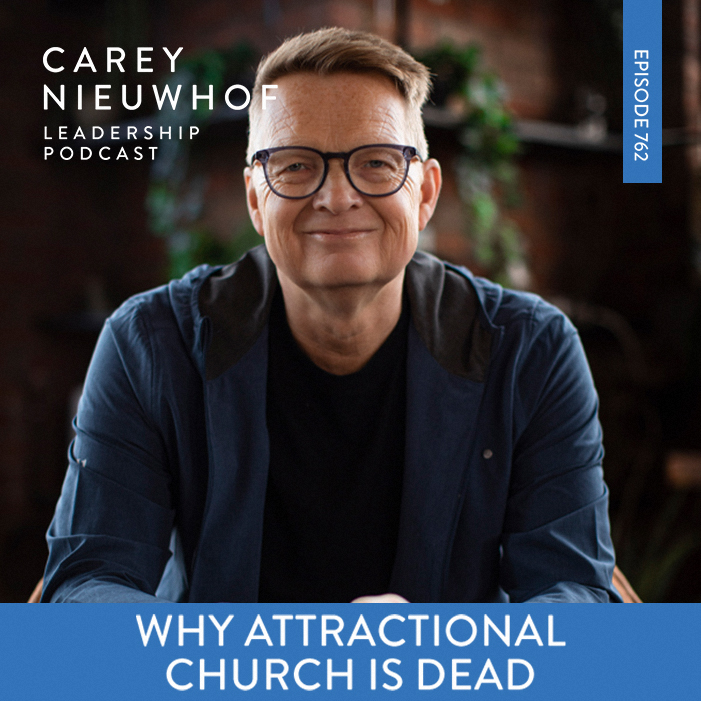
The Carey Nieuwhof Leadership Podcast
CNLP 762 | The Church Model That's Dead: Attractional Church and 3 Shifts Every Leader Must Know
00:18:39
In this episode, Carey explores why the attractional church model no longer works, what's replacing it, the three shifts that made it ineffective, and what you and your church can do now to reach more people. 🔗 📩 🗣️ 🧠 ...
Loading summary
Transcript39 lines
- [00:01]
A
The Art of Leadership Network. Driving motorcycles on stages, sleeping on the church roof with your wife to promote a series on sex or raffling off cars or flat screen TVs at Easter. Yeah, maybe that was a little bit much. Okay, welcome to the Carrie Newhoff Leadership Podcast. Well, if you follow Church World carefully, you know that something is changing in the church. And so what I want to do is I want to kick off this episode with a question. Why isn't the attractional church approach working the way it used to anymore? I mean, for a decade, right, attractional church was how we did it. It's like we got to go out and reach the culture, use the culture to reach the culture. And there have been some major shifts in ministry, really, over the last five years. And in this episode, I want to share why one of the most significant changes is happening, and that is simply this. Why attractional church really doesn't connect. It doesn't work with people anymore. I posted a video on this to YouTube a few months ago. It generated such a big response. I wanted to go deeper on it here in the podcast. So in this episode, I'm going to show you why attractional church actually worked really well for a season. Why a lot of the approach is kind of outdated right now. And finally, I'll share with you perhaps how you should be approaching church instead. Today's episode is brought to you by Spiritual Gifts Plus.
- [01:26]
B
So if you're like most pastors I talk to, you're struggling to find volunteers and you're probably struggling even more to keep them. Well, what if I told you one simple change this year could double your volunteer retention and boost church volunteer satisfaction by 80%.
- [01:42]
C
You want to know what it is, right?
- [01:43]
B
Well, here it is. Stop pitching people where you have a need and start placing them where they're gifted.
- [01:51]
A
So the easiest way to do that.
- [01:52]
B
Is by upgrading your membership track with spiritualgiftsplus.com when someone takes the spiritual gifts test, they're intelligently matched to actual teams inside your church based on their spiritual gifts and their disc personality profile. And as a leader, you see exactly where they fit so you can place them where they'll thrive. Plus, you'll love these features. You can customize the test to your theology, you can customize teams based on your actual ministries, and you can share it via link or QR code. It's super simple to use and it connects to planning center. Paper tests are really in the past when it comes to spiritual gifts. Try spiritualgiftsplus.com free for seven days and experience it for yourself.
- [02:38]
A
Use the code Carrie.20 at checkout for.
- [02:41]
B
20% off any plan. That's C A R E Y 20, that's spiritualgifts.com move people from sitting to.
- [02:49]
A
Serving and now to today's conversation. In every era, ministry is model based. And I know we don't like to talk about that, but the reality is every single church had a model. The early church had a model. They would gather daily in people's homes and they would break bread. The Roman Catholic church for centuries have had a model. Protestant churches had a model 100 years ago. It was very different than it was 300 years ago. Is very different than it was or is today. So I started pastoring in the mid-1990s, around 1995. And the church was ripe for disruption. So what I inherited and those of you who started sort of in my generation was what we called traditional church, right? You had an organ, you had a choir. Our organist was not particularly talented at being an organist. Maybe the choir couldn't really sing. And it was kind of a stuffy church. And that made it ripe for disruption. So what did we do? We came in with bands, we came in with a new approach, we came in with casual dress and we changed the model around that time. That was really the beginning, if not the height of the seeker sensitive movement. And we used to talk about being seeker sensitive, the seeker targeted. And that was around for about a decade. And then that slowly gave way to what became known as the attractional church model. So if you're a young leader, we have a lot of young leaders listening. You missed that. Cause you were a kid or you weren't born. But this is how we got to where we are now. And what happened when attractional church came along, that shift maybe started around the mid 2000s, 2005. Now what else happened in 2005? Well, the answer was social media was born. I still remember some of the early articles. We're in web 2.0, right? It's interactive now. And what social media meant as it rose and it went from static text to video and more and more people jumped on. Social is for a period of the late 2000s to maybe 2017, 2018, that's a very important date in my mind. We all started copying each other. We would copy each other's sermon series. We'd copy songs, right? You had some huge music movements at that time. As people are like, oh, we can do different songs and they can sound differently. We copied series, we copied songs, we copied style, we Copied approach. So for decades, about 20 years, what church leaders, maybe even a little bit longer, tried to do was to make faith appealing, right? We had coffee bars, we had cool bands, we had great speakers. And for a while. And it worked. And by worked, I meant it resonated with the culture. But in the late 2000 and tens, and I dated around 2017, 2018, I started to notice, hey, there's something in the air. Things are changing again. Now, before we talk about what changed, let me say something that not everybody listening or watching is gonna be happy with. It is very popular right now in this moment to critique and even ridicule the attractional church. And for sure, it had its excesses, okay? Driving motorcycles on stages, sleeping on the church roof with your wife to promote a series on sex, or raffling off cars or flat screen TVs at Easter. Yeah, maybe that was a little bit much. Okay? And we actually did the motorcycle in church, built some huge sets, and we did Ed Sheeran covers. Look, I get it, okay? We don't do any of that stuff anymore. But the question was, as people look back and ridicule that era, was it a waste? Did everybody just drink the Kool Aid and do things that were unfaithful? So this is what I'm gonna say that probably not everybody's gonna agree with. No, I actually think it was faithful for the moment. And it's very popular to look back on history and critique everything that was done in the past as though, hey, we've got it nailed down 100%. We got the right model, we are the right people, and everything that happened before me garbage. No, there was something in that era that really resonated attractional church, I think, in a helpful way. Yeah, it had its excesses, okay? What it did was it took evangelism seriously and the church needed evangelism. And we figured out ways to use the culture to reach the culture. And it connected with people. People came to faith, people got baptized. And this is what you'll discover. Yes, there were some deconversions. There will be in every generation. But. But people who were baptized at the height of the attractional movement are still strong Christians today. The vast majority actually are. So it is super easy to look back on things in the past. And we do that centuries ago or a decade ago or to our parents generation, and we're all arrogant and we got it right and they got it wrong. And we say they were so simple minded, they were so misguided. And that just makes us feel smarter than Everybody else. But you know what I think the best of the attractional model was, was we put the message into a form that was easy to understand, grasp, and made it easy to invite friends to. Those are principles that have endured. But around 2017, 2018, back to what I was saying earlier, something began to shift. It wasn't resonating as much as it used to. That same approach of COVID bands and you know, cool series and all that stuff just wasn't getting the same connection to the culture. And then we had Covid right world shuts down. So much shifted. And now here we are, 2025, almost 2026. Churches are exploding and congregations that used to roll coffins out on stage at Easter or play ACDC covers are featuring worship music, worship music and more worship music. And they're doing gospel calls and they're typically a little less topically driven in their sermons than before. And they're doing some more in depth biblical teaching. That is how things have over the last eight or ten years. So what changed? Why is this resonating now and it's not resonating as much before? So three things changed and I want to go through those three shifts. So this is the shift I date back to 2017 to 2018, around that era. What had happened around that time? Well, we had widespread adoption of social media. Social was pivoting to video so we could really watch more sermons, watch what was happening. And a lot of churches, not every church, but a lot of churches had moved online. Most churches had great websites and so on. And so that's shift number one, the foyer moved. So what do I mean by that? Well, the Internet changed everything. The foyer of your church moved from the actual physical foyer to the digital realm. You used to have to travel, right, to actually show up in person to explore the Christian faith or maybe order a book or, or talk to a friend. And Sunday was truly a first time experience up until, well, almost 10 years ago. Right. It still is. Like people show up for the first time on Sunday, every single Sunday, I hope. But chances are, and the data goes back to around 2017, 2018. Every person who visits your church in person has already explored Christianity and your church online. They found you on social media, they found you on your website, they found your messages on YouTube, they discovered your church and they explored. So 15, 20 years ago, people came in cold. It's like, I don't know what to expect today. They come in warmed up and spiritually far more open than in the past. They've made a decision. They've watched your church online even when I was a lead pastor and I stepped out of that role in 2015. We had done a lot of online early work and launched our campus in 2016. I taught regularly at our church until 2020. I am very loathe to remember anybody who came in from 2015 to 2020 who hadn't told me that their first time visit was preceded by weeks, often months of watching us online, discovering us on the Internet, and now going to check it out in real life. So the foyer moved. That's shift number one. Shift number two, people opened up spiritually. So right now people are more spiritually open than a generation ago than in a long time now. It's hard to believe, but 15 years ago Christopher Hitchens, Richard Dawkins and Sam Herons ruled the roost and they were saying the new atheism is here. Well, now the new atheism seems to be dead. Or at least on life support. Today's episode is brought to you by.
- [11:20]
B
The Preaching Cheat Sheet. So preachers, I'd love to know if.
- [11:22]
A
You can relate to this.
- [11:23]
B
Okay, it's Thursday night. Sunday's message still isn't coming together and.
- [11:27]
A
You can even start early.
- [11:27]
B
And it's not quite right.
- [11:29]
A
Right. The pressure's building.
- [11:30]
B
It's hard to decide what to add, what to cut, how to tie everything together. You want some family time. And you know by the time Saturday rolls around, you're just gonna have to.
- [11:39]
A
Call it as it is, even if.
- [11:40]
B
You'Re second guessing some of your message. Well, that's where my ten Step Preaching Cheat Sheet can help. It's your quick check guide to ensure you've got an engaging, clear and memorable sermon ready for Sunday morning, from your opening line to landing the plane at the end of your sermon. In between, you can use the 10 steps during sermon prep, or even to start or to finish your message, whatever you want to make sure you are ready to deliver an impactful message every single time you preach.
- [12:10]
A
And the big news is, I've just.
- [12:11]
B
Released a brand new version of the cheat sheet. So if you've downloaded it before, be sure to get the new version in your hands. We got a lot of feedback. I improved it still.
- [12:21]
A
Basically the bones are the same, but.
- [12:22]
B
It'S going to be even better. Okay, you can download your copy for for free by clicking the link in the description of this episode or by visiting preachingcheatsheet.com Again, that's preachingcheatsheet.com to download your copy for free or simply click the Link in the episode of this.
- [12:38]
A
Description, wherever you're listening, we have Gen Z teens and millennials leading the way. 74% are highly spiritually open. That has shifted massively over the last decade. 74% of Gen Z teens and 64% of Gen Z adults say they are spiritually open. And what this means, and by the way, that's Barna data. What this means is that when they engage with your church, they're open, they're hungry, they're curious, and they're ready to go. The suspicion that the new atheism had 15, 20 years ago, it's not there anymore. They've looked out at the culture and they've said it's bankrupt. And that leads us to the third shift. And that is that people aren't looking for an echo of the culture anymore. They're looking for an alternative to it. So what is really going on with the next generation? Well, you know, 15, 20 years ago, people were like, oh, cool, Ed Sheeran in church, or, you know, whoever it happened to be. But now they're looking for an alternative to the culture, not an echo of it. They've tried New age spirituality, vague spirituality, secularism, atheism, partying, whatever, and they're broken, all right. The alternatives are bankrupt. They move from being desperate to desperation. And you're beginning to see this as tens of thousands of college students fill up stadiums and hundreds or thousands are baptized through the Unite movement. You see revivals and outpourings happening. You see this in the uk, you're starting to see it in France, you're seeing it in Canada, you're seeing it in the US People are hungry, they're open, and they're turning to church and they're turning specifically not just to spirituality, they're turning to Jesus, which is amazing. I mean, I talk all the time to church leaders and we're like, I don't know what's going on, but it's pretty cool. The Holy Spirit is at work. So what does this mean for you? Well, it means that the tide is shifting and you want to make sure that your ministry model is ready for what God is doing in any particular season. And as we talked about before on this podcast, the trends are reversing. We are seeing the seeds of revival. Brand new Barna data shows that the number of U.S. adults who affirm that they've made a personal commitment to Jesus that is still important in their life today has rebounded from an all time low of 54% five years ago to 66% today. That's a huge shift. It's actually a 12 point jump in.
- [15:05]
C
Just a few years.
- [15:06]
A
And Gen Z is now leading the return to church, attending 1.9 times a month more than any any other generation, including more frequently than their generation X and boomer parents. So what does this mean? What this means is that when people show up on a Sunday, you have to do less explaining, less attracting than you used to. People aren't coming in cold, they're coming in hungry. So if the attractional model is fading, then the question becomes, well, what is replacing it? Well, that change means that when people show up at your church, they're ready to go deeper, faster. So here are a few things you want to think about. What about praying with boldness? I mean we see confession really resonating with Gen Z. People don't want a polite God, they want a powerful God and they're ready for an encounter with Him. You want to preach deeper. All right, don't assume they'll be bored. Assume that they're hungry and they really want the word of God. Offer real spiritual practices, worship, fasting, prayer, confession, and I'll talk about this more in the future. But what you want to do is you want to design your weekend experiences from your heart posture to the way you position the message, to the way your worship leaders position the music. Design it for encounter, not for entertainment. That really what you're trying to do is you're trying to facilitate an experience, a possible experience between God and his people. So you want to design your weekend services to facilitate an encounter with, not entertainment. Cut the fluff, maximize the real. I know it sounds like a big reversal. So you know, some of you might be saying, wait, does this mean we're going back to old time church? For the already convinced, let me be clear. I hope not, I hope not. I hope this just isn't insideritis, you know, for the next generation. You see, if church becomes insider focused, we're just done on so many levels. So I think there are some lessons from the attractional church era that we can carry forward to today. Despite everything I've said, I think there are some lessons we don't wanna forget. Think about attractional church, right, which everybody makes fun of. Nobody wants repulsive church, right? You don't really wanna make church so repulsive that people who are curious about God show up and they walk out the door saying, I will never go back. No. What do you wanna do? Well, you don't wanna go down so deep that people who can't swim in the scriptures end up drowning. So here are a few things from the attractional church approach that I think are still very valuable and that everybody is wise to consider. So when it comes to content your message, you know how you're positioning people around the Bible. Assume intelligence, but not background. People may be spiritually hungry, but they might not know basic Christian concepts. So what you want to do is you want to create quick on ramps for any spiritual encounter you've got on the weekend. For prayer, you might say something like, we're gonna pray now. You can simply listen or you can join in silently, or you can pray with me. Right? Just create an on ramp so it doesn't get weird. And then with scripture, you might say, okay, we're turning to Ephesians chapter 5. That's page 1156, and the Bible's under your chair. Or you can use the Bible app. We got a quick link to that. You can tap your phones or use this QR code that'll take you directly to it. So you wanna invite people along with the journey. All right? You want to avoid Christian insider language. Don't use jargon or become a Christian culture club or live by acronym or code. And even when you're doing proper theology, you want to translate terms like sanctification, atonement, or fellowship into everyday language. Another thing I would say is don't ignore felt needs. People still come with real life problems, right? Their marriages are not perfect. They have financial problems. And guess what? The scripture speaks to that, right? So you want to connect with their struggles and take them to deeper spiritual truths than the culture is offering them. The question isn't whether they'll come. The question is whether you're offering them something that will satisfy the spiritual hunger that they have. And then finally, what you want to do when you're introducing the scripture is you want to bring people up to speed quickly. So if you're speaking on David, for example, King David, you might say, hey, we're going to go back about 3,000 years. There was the nation of Israel just being established as a superpower in the world. David is their king. And right now he's contemplating what he's gonna do about, you know, whatever situation you're looking at. So what you've done there is in 15 seconds, you brought everyone on board. You've given them a historic context. And the cool thing is, this works for Christians and non Christians, right? A lot of your believers, they don't know that David was 3,000 years ago. They don't know that he was king of Israel. Or that fits into the timeline. So you're gonna bring everybody onto the same page. So I just want to encourage you to pay attention to the times we're in, to think about what part of the approach, the model of church that we're using right now is still resonating. What parts are not. Well, that's a teaching for today. If you want to go a little bit deeper, we've got show notes for you. You can click the link wherever you're listening or watching and that'll take you to the Art of Leadership Academy. You can create a free account. We got all our show notes and actually we have great discussions about episodes like this inside the Academy. Kind of troll free. I think you're really gonna enjoy that. You can jump in there. We've got over 13,000 leaders who are now part of our academy. So move from the crowd to the core to do that. Coming up on the next episode, Tim Timberlake. We've also got Bobby gruenwald, Andrew Stanley, Dr. Caroline Leaf, J.D. greer, N.T. wright. Oh, my goodness, I just finished N.T. wright. You're gonna love that episode, I'll tell you. And a whole lot more. Thank you so much for listening and if this conversation was helpful, please leave a rating review, maybe share it with a friend. Share when you subscribe Makes a big difference. We get the best guests. We have an incredible 2026 lined up for you. I will be telling you about those guests soon, but I am so excited. My team was telling me who we booked and I'm like, yeah, okay, that's going to be amazing. So make sure you subscribe wherever you are. To all the young leaders listening, thanks for your encouragement and feedback. And hey, we'll catch you next time. I hope our time together today helped you identify and break some growth barriers you're facing. Hey, before we go today, just a quick word.
- [21:30]
C
Let's be honest, at a certain point, hustling harder doesn't help.
- [21:33]
A
You probably hit that wall, right?
- [21:35]
C
I'm not sure about you, but when things aren't going particularly well or growing particularly well and I'm stuck, my gut reaction is just to double down and go harder. But what I've learned over time is, you know what I need? I need an outside perspective. I need other voices to help me figure out what am I not seeing. Is there a better system, better strategy, like, where are my blind spots? And you know what? You only learn from others who have been there. And that's why I created the Art of Leadership Academy. It's an online community of growth minded leaders. It's growing every day and it's a very focused space where you can grow faster and lead more effectively. Now you'll get stuff like show notes for every episode. But even better than that, you get some quarterly free webinars with me.
- [22:17]
A
You get real dialogue with other church leaders.
- [22:20]
C
It's a troll free, I'm gonna say it. Weirdo free environment. Okay? You're not gonna get the kind of stuff you get on social media. We moderate the content very carefully and the community. So if that sounds like something you'd benefit from, real leaders trying to make real progress in real churches, I would love for you to join in.
- [22:35]
A
And you know what's super cool?
- [22:36]
C
You're gonna find people who are a step ahead of you, and you're gonna find people who are a step behind you.
- [22:41]
A
The people that step ahead of you.
- [22:42]
C
Are gonna help you. The people a step behind you, well, you can help them. And I'm in that community on a daily basis. So if that sounds like something you.
- [22:49]
A
Would love, it's totally free.
- [22:51]
C
No gimmicks, no tricks.
- [22:53]
A
Just sign up today.
- [22:54]
C
Visit theartofleadershipacademy.com or click the link in the description of this episode. A few clicks, you're in and I'll.
- [23:00]
A
See you on the inside.