← The Carey Nieuwhof Leadership Podcast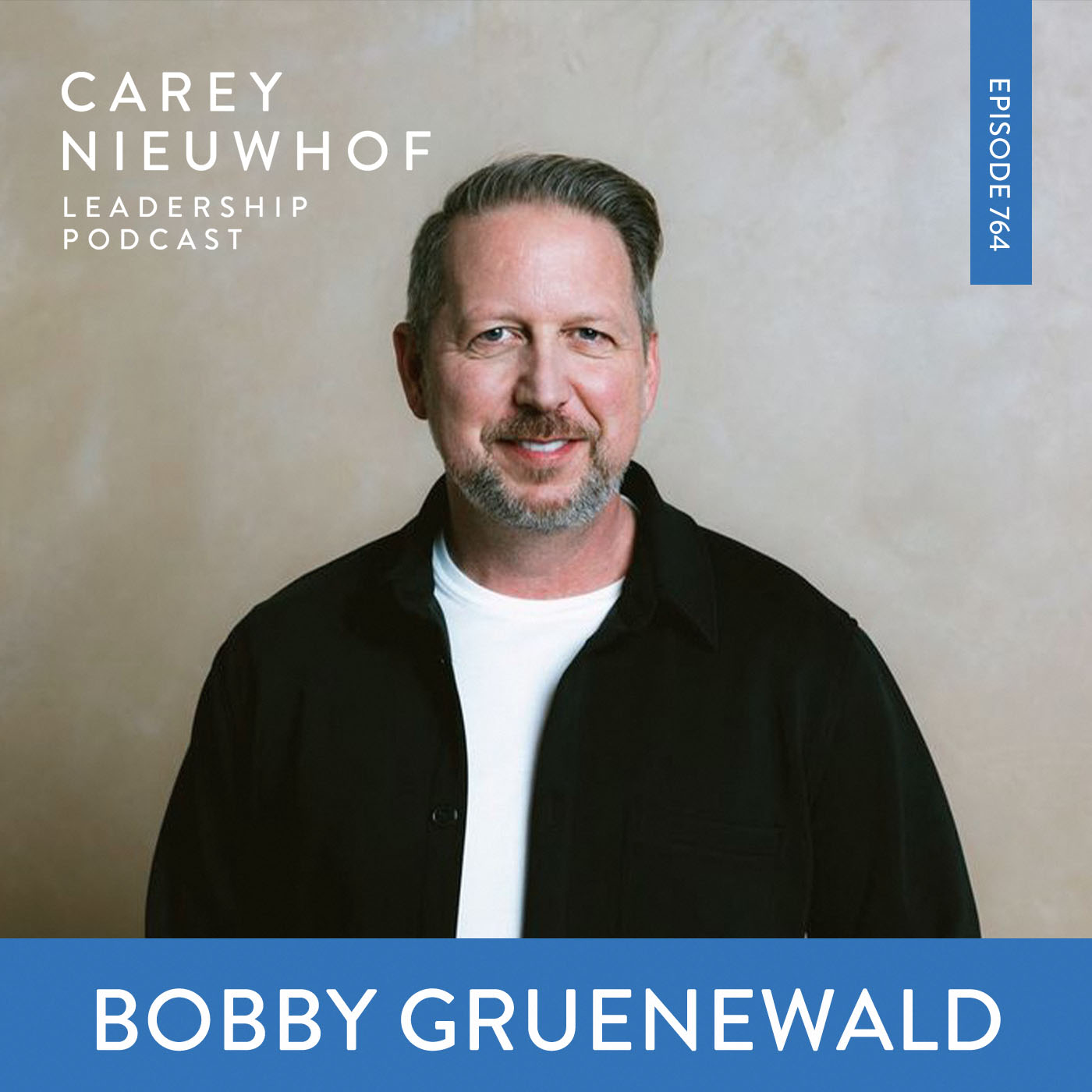
The Carey Nieuwhof Leadership Podcast
CNLP 764 | Why Christians Can't Trust ChatGPT: Bobby Gruenewald on Scripture and YouVersion's Rise to 1 Billion Installs
01:17:38
Loading summary
Transcript113 lines
- [00:01]
Carrie Newhoff
The Art of Leadership Network.
- [00:03]
Bobby Gruenwald
I told them that I was a child and that I was interested in having sex with my partner.
- [00:09]
Carrie Newhoff
So this is a Christian chatbot.
- [00:11]
Bobby Gruenwald
Christian, yeah, Christian.
- [00:12]
Carrie Newhoff
Okay.
- [00:13]
Bobby Gruenwald
I think it was one or two prompts in. It gave me specific instructions with details around foreplay and other things. And then it included a verse from Paul.
- [00:27]
Carrie Newhoff
Welcome to the Carrie Newhoff Leadership Podcast. It's Carrie here. Hope our time together helps you thrive in life and leadership. Man, I've loved all the connection we've had so far this fall. Got a lot more travel coming up and spending a lot of time in Nashville this fall. So if you're in the area, we'll probably cross paths, I think, at some point. And thanks for letting us know consistently how this is making a difference. We do not take your time lightly. Want to bring you the best conversations I can. Love this one with Bobby Gruenwald. A lot of you know Bobby. He's been at Life Church almost since the beginning, I think, and he is the pioneer of youversion Church online and so much else. Today we talk about can you really trust ChatGPT as a Christian? And Bobby's answer to that is not really. And you'll find out why. Plus, we talk about Scripture and youversion's rise to 1 billion capital B installs. We're celebrating that this month along with team at YouVersion. So it's going to be a great conversation. If you are new to this podcast, welcome. We hope that you subscribe and maybe give us a like follow wherever you're listening or watching and maybe share it with your team. Bobby Gruenwald is passionate about exploring new ideas and finding practical ways to leverage them for the global church. He has helped pioneer the missional use of technology that allows Life Church to reach people in every single country on earth. In addition to being the founder and CEO of YouVersion, and he oversees the digital technology church to church life, church online, and communications teams. Yeah, he's a capable leader. So now my conversation with Bobby Gruenwald. Bobby, it's great to be marking a very historic moment with you on the podcast. This is a huge deal, so I'm sure a lot of listeners have heard about it. But go ahead and spill the beans. Like, what's happening this fall? This November?
- [02:19]
Bobby Gruenwald
Yeah, well, this. This November, we're reaching a milestone at youversion of 1 billion devices that have installed the Bible app. Bible app for kids. Bible app light. And I never. I mean, I never thought we'd be a part of something that would have the kind of reach that we've been able to see. But I actually think this is a big moment for the Bible, not just for you version, because I think we're one point of global evidence right now that God's Word is alive and thriving and growing and that there's real hunger for it globally. So we really feel like this is a milestone worth celebrating. Just to draw attention to it in the space outside of the church of people saying, wow, I had no idea so many people were interested in the Bible. But we've obviously got a billion reasons to say they are. And it's exciting. And it's been accelerating, too, which is the other part of the story, I think that's also exciting. It's not just we finally got here. It's like it's really taken off and got here sooner than we anticipated.
- [03:19]
Carrie Newhoff
You know, I hadn't put two and two together, but I think it was like a year or two ago, wasn't it half a billion or something like that?
- [03:25]
Bobby Gruenwald
Like, it was a little more than a year or two ago, but it was. It was in 2021 when we crossed that milestone. So about four years ago. And.
- [03:35]
Carrie Newhoff
Yeah, but that took you, what, like 11 years to get there?
- [03:39]
Bobby Gruenwald
13 years. 12 or 13, I think at the time is what it would have been.
- [03:42]
Carrie Newhoff
13 years. And then in four, you doubled.
- [03:46]
Bobby Gruenwald
Yes. And honestly, at that point in time, the rate of growth was much slower. So I remember sitting at the dinner we had hosted celebrating half a billion, the 500 million mark. And at that dinner, I remember had this kind of sinking feeling because I was like, yeah, the number looks big, but if you looked at kind of the trajectory, I mean, it was pretty slow growth at the time. It had had much faster growth in the past. And that became a real inflection point for me in terms of just my leadership and what needed to change and, you know, how. What we need to do differently. And so we set out a course in 2022 to do things quite differently. And what we're seeing today is, I think, both a product of that as well as a product of just global momentum that's happening right now that's really accelerated it.
- [04:39]
Carrie Newhoff
Yeah. Because I think most people who listen to this podcast are aware that physical Bible sales are up in the US and the uk. Around the world, there seems to be this hunger. We've done a series on revival on this podcast earlier this year, and the numbers, honestly, for the first time in our lifetime, other than idiosyncratic churches like Life Church are seeing a huge uptick. There is A general. The tide is rising for Christianity, which I think we all celebrate. And it's not some feeling we have. It's actually. There's data behind it, right?
- [05:10]
Bobby Gruenwald
Yeah. No, and like I said, all over the globe. So it's not just like, isolated to a country or a city or some really specific location. There's a generational momentum that seems to be happening globally, and the Bible's a key part of it, and we're super excited to be able to serve in the way that we serve right now, to be a part of that. But, yeah, there's a lot of. I mean, it's a fun time and it's an encouraging time for people that maybe have been discouraged for quite some time that we're on this type of trend line.
- [05:44]
Carrie Newhoff
Yeah. So I want to focus in on the second part, or really it was the first part of what you said. You saw momentum kind of leveling off, and so you made some strategic changes. I think it was around that time, maybe 2022, that you. If I remember correctly, you said, all right, I'm going to become the CEO. Like, I'm going to really, like, this is going to be my full time. Was that around that time? And then what were some of the changes that you made, Bobby?
- [06:13]
Bobby Gruenwald
So right at that time, fall of 2021, I had. It wasn't. Didn't start at that time, but it had kind of been building up to that moment where I had kind of consistently felt like we were slowing down. And I was wondering what my. What my responsibility was in that, you know, is this something. Is this something that's kind of been a story? It's an amazing story. It's 13 years in. Is this one of those things that kind of ran its course?
- [06:41]
Carrie Newhoff
Yeah, it just had its run. Right. What a great moment. Thank you, God.
- [06:45]
Bobby Gruenwald
I had some people that were implying that we used the word saturation, you know, at some point, which it just made like, I couldn't even fathom the concept of saturation point because that's so ridiculous to think that everyone that you needs the Bible can read the Bible or has a smartphone, you know, has been reached. So obviously it wasn't that, but I felt a responsibility to it because I felt like, look, we're stewarding this, and if I'm not going to do a better job with it, we need to figure out somebody else that can steward it, because I just don't want to be a part of something that we're not stewarding. Well, so I began to process, like, what would Proper stewardship of this be and where are we not stewarding it? Well, and I started to look at it from different vantage points and I'm a former business guy, or I'm a business guy in terms of my heart, my vocabulary and how I talk a lot of times. And so, so I first started to look at it and said, okay, if this was a for profit business that we were trying to grow one, what would it be worth? You know, because in terms of, because I was trying to gauge like, is our investment worthy of the asset? You know, the thing that we're kind of stewarding. And I had some venture capital friends of mine that called and just said, hey, could you give me kind of a rough idea of what you think youversion would be worth if it was for profit or if it was because.
- [08:02]
Carrie Newhoff
It'S a quote free product to all the users, right?
- [08:05]
Bobby Gruenwald
Yeah, it's donor supported. We don't sell anything else or sell anything. We just are supported through donations. So they went through a bit of an analysis and just said, you know, it would be several billion dollars if this was a for profit be the valuation, you know, of the company just based on metrics and size and scale and all those things. So then I was just evaluating what we were investing in at the time. And if you looked at it in proportion to that, it was anemic. Like we were not really investing resource wise at a level that would maximize the potential of something like that. If you were looking at saying this was just a business, you know, you would say, okay, one of your problem is you're just not even resourcing it properly. You don't have enough capital, you know, to kind of invest and grow. So that was just one angle. The other was I felt like from the perspective of my focus and my time that I had a portfolio of things I was responsible for at the church that extended deep into the functions of the church as well as youversion. So I had kind of, you version is one of many things that I was overseeing. And I felt like the leader of it needed to have focus and full focus, you know, to be able to.
- [09:26]
Carrie Newhoff
Right. You're not running a multi, you know, pardon the analogy, multi billion dollar corporation with 20% of your time as a general rule.
- [09:33]
Bobby Gruenwald
Right, right, exactly. Now my initial inclination, candidly was that I needed to hire a CEO, not, not be the CEO. I obviously was involved in starting it and I had vision for it. And a lot of the, you know, obviously the direction we've gone has all been part of something that I've contributed to it, but I kind of thought somebody would be better at this at scaling it from where it is to where it needs to go than I would be. After talking to mentors and sharing this with some of our key donors, the feedback was pretty strong. They're like, well, we'll pray about it, but we already know the answer. I was like, well, what's the answer? They said, well, you need to be the CEO. And I was like, going, oh, no, no, no. I'm talking about like a real CEO, like somebody that really knows what they're doing. And so I was a reluctant CEO, and I did take on that title, but it was mostly because I needed to signify that something had changed and that we had changed. We took a set of responsibilities I had at the church, and we found some of the other leaders that would take those on so that I could bring focus to it. I still do have some church responsibilities, but honestly, I've got great leaders that lead those things, and they're very low time. You know, it takes a low portion of my time to be able to oversee that. So my full energy and focus is spent in this new role. And I felt like we needed to bring in some leaders that had seen things at a bigger scale and that could help us go from where we were to where we needed to be. That was another change that I felt like was necessary at the time.
- [11:08]
Carrie Newhoff
You brought in a team around you.
- [11:09]
Bobby Gruenwald
Yep. Run a team around me. And I wish I could say that we put out the job postings and the roles got filled right away. It was a really tough year in 2022 because I think we did two or three things happened at once. Like, I moved into this role because I didn't have all those leaders. I ended up with a lot of direct reports that were not me functioning well at the right level. But we didn't have much of a choice because we were kind of trying to shape the organization. And I was doing what I was hoping I would have somebody step in to fill. Then I was doing probably some of the wrong roles and wrong things. I had great candidates for those roles, but in my discernment, I literally just felt like they weren't the right person. And I went through interviews and had some really talented people that came from big tech companies that were willing to move to Oklahoma and be a part of it, but it just didn't seem right, which meant I had more months of going through this same cycle. When I said no, the thing extended on and on, and our numbers weren't going up immediately and we were spending more money and we were having to raise more money. So these are all the dynamics that were happening. It was basically everything didn't look great the first year but I knew it's the right direction partly because of the opposition. Like you can almost just feel the way that you step into it. And immediately it had almost a confirming opposition if that makes sense. You know, like it was like I, I know what this, I've seen this, I've had this feeling before. I've had this experience before. And I know this is that predictable resistance you know that you get when you're kind of actually stepping in the right direction. But it took a bit of persistence to kind of push through it. And it was probably one of the hardest years on lots of levels personal with our family and situations we had to go through as a family and just the asking people to trust me through the journey where it was a lot of change and a lot of things not looking great right away, you know on really started to come together at the end of the year. It was almost like a miracle ending to 2022 because within about a week's time I had three of these key leaders that just came to me. Not me recruiting or finding them. That came to me all in about like I said about a seven day time frame. And we had our chief operating officer. He was a former executive at Walmart and then was the number two guy at Hanes Brands. He, I've known him for many years, strong believer and he'd had all this operational experience at very large companies and very. And he, he had been the CMO of Walmart.com and he'd done lots of different, different unique experiences. But he called me out of the blue because he read something in a book where it talked about youversion. He would just thought it was cool that he somebody he knew was, was you know they wrote about in this book. And that started a conversation and 11 days later he and his wife were in my office interviewing for this role where his entire career path was to be the CEO of a Fortune 500 company. And right when he's at the moment where that is the possibility for him, he feels like God's telling him to come and join this, this ministry. And and so he was one of three in a seven day, I think it was fingers a seven day time frame that that God pulled together there at the very end of 2022. And right at the same time even before these folks showed up our numbers really began to turn like the work we were putting in that year, we started to see the fruit of it and it became quite an inflection point. I mean, the decision happened earlier that year, but the data and the inflection point seemed to happen about 12 months later. And it was a really cool confirmation. My word for that year was breakthrough. And I just, I felt like the whole year was like trying to break through and then at the end it was like a breakthrough. So it was like a different kind of like that was the, that was a special year on a lot of fronts. But, but anyway, that, that to give kind of a little bit of perspective, in 2021, I believe we had 40 million new devices that installed the Bible app that year, which seems like a really large number and it is a large number, but when you consider device churn and people getting new phones, the real growth was really much lower. And, and so it's kind of a little bit deceptive if you just looked at that number and didn't understand all of the numbers. But to put that in contrast, this year we'll have about 154 million new devices, you know, in just 2025. So almost gone a little bit. It's substantially higher. And that's kind of what I thought would be possible. And we actually think much more is possible when we map to the future. But it involves a commitment to resources and a commitment to risk and a lot of things that we were not taking at that time that we are now.
- [16:14]
Carrie Newhoff
Today's episode is brought to you by Fund the Future Masterclass Church Leaders. Maybe this feels familiar. You cast vision, you preach faithfully, but when it comes to finances and generational giving, you hit a wall. You ask your congregation to invest, and suddenly the room goes quiet. Maybe you launch a giving campaign and by Monday, you got pushback. An email inbox full of. Hey, why'd you say that? Right? Listen, I've had that tension too. But here's what I've learned. Leading a generous, fully funded church isn't about gimmicks or pressure. And that's exactly why me, Craig Groeschel, Chris Hodges, Ashley Woolridge, Dan Clark and others created the Fund the Future Masterclass. It' step by step program to shift your church from transactional giving to transformational generosity. Together, you'll be equipped to lead with vision, strategy and tools to grow giving that's sustainable and spirit led. Enrollment is open now, so click the link in this episode's description to get started. This episode is brought to you by Switcher. If you want to Take your church's live stream to the next level. Switcher makes it simple. It lets you grab your iPhones, iPads, and cameras, sync them together, and switch between angles live with no complicated gear needed. You can even add scripture lyrics or graphics on the screen to help keep your congregation engaged. Plus, you can stream to every online platform at the same time, including your website. Think Facebook, website, YouTube, Instagram, you name it. The best part, Switcher is designed for everybody. Pastors, volunteers, teens. You don't have to have a big team. Anyone can jump in and help out with the stream. All in all, Switcher helps you empower your volunteers, create a polished online presence, and grow your community without breaking the bank. Get $30 off a seasonal plan at switcherstudio.com carrie that's switcherstudio.com C A R A Y. And keep saving every season with this special offer. Well, you said a couple of things that I want to drill down on a little bit. You made a decision that a lot of leaders struggle with, and that is you put out job applications for senior leaders. You're already overwhelmed. You know, it sounds like you got other things happening in your life beyond just what's going on at youversion. And you had qualified candidates, but it didn't feel right. So you left those seats vacant. I have made the mistake of not leaving those seats vacant. I've talked to so many other leaders who are like, well, I guess it's the best God sent this will do. You waited, and toward the end of the year, you had three people materialize in seven days. What was the thing that made you wait and not just fill it with a B level or an A minus level leader who, well, this is probably the best we're going to get because I think a lot of leaders struggle with that.
- [19:19]
Bobby Gruenwald
Bobby. Yeah, you know, it honestly was. It was a. It was really just discernment. I was praying for discernment. And I know that that seems like an easy answer, but it was sincerely that. I mean, one of the candidates that we had was extremely qualified, like maybe might even say overqualified. So I wouldn't even call them a B level candidate. They were an A level candidate for one of the roles. And I even went to the point where I was pretty much telling him that we were going to make an offer. And then I sat on it for the weekend, and through just prayer and discernment, I just said, I just don't think that he's the right person. And it was a very disappointing conversation for him and for me.
- [20:06]
Carrie Newhoff
And it must have been for you too.
- [20:08]
Bobby Gruenwald
Yeah, for sure. So I talked to him about that and he was obviously disappointed, a little bit confused because of how it looked like everything had gone and went and it really wasn't about him. And I know that it's hard to say. It's easy to say that. It's hard to not feel that kind of in the moment. It was just. I just didn't feel like for the role that he was the right person for it. But it wasn't because he wasn't amazing and probably would do a good job in all the. He'd probably do a good job at the job. Right. But. But, you know, I felt confident that that was the right decision, even though it was difficult. But I will say fast forward two months or three months later and we don't have another candidate that is the right candidate. And I'm second guessing that decision. Right. I'm thinking, man, maybe I got it wrong.
- [20:54]
Carrie Newhoff
I want to honor confidences. But what was it in your gut? Because I think a lot of us struggle with that and I think it's pretty easy to talk yourself into. Yeah, but look at this resume, look at the cv, look at the experience, look at the track record. Wow, we're fortunate to have someone like that. And then you don't hire when you really have a need. Can you say more without betraying confidences? Because I think a lot of us wrestle with our gut on that.
- [21:22]
Bobby Gruenwald
I think. I don't know if it's helpful, but I feel like I needed to have a yes but not a no. Does that make sense? I mean, sense of discernment was I needed to feel confident that it was yes. This is the person. And some people, I think approach it saying, I'm going to do this unless I get a no. Like, logically this makes sense and I'm just waiting for a no, you know, for God to tell me no. And for me it was more like I couldn't get absolute confidence that this guy, that this guy was a yes. And it's. I don't know if I could point to any single attribute. I mean, perhaps, perhaps I could say culture would have been the area that maybe there was a question mark, you know, like how like would fit within our culture. But honestly, you know, I felt like he probably could adapt and probably could do this. I just, it's. I wish I had a cleaner answer for you other than I went into it and I just said, God, I really need you to make this obvious to me that it's A yes. And then yes. I didn't get that show up.
- [22:29]
Carrie Newhoff
And it was kind of in your gut and in your prayer and discernment. Yes, yes, yes.
- [22:34]
Bobby Gruenwald
Yeah, it was. Yeah. And it wasn't yes, yes, yes. You know, kind of. It wasn't. That's what I mean. I needed to know that it was a yes to hire him. And I couldn't get that confident. Yes.
- [22:44]
Carrie Newhoff
Oh, I meant months down the road you have those three people show up in seven days. And that felt, Was that like a yes?
- [22:50]
Bobby Gruenwald
Yes.
- [22:50]
Carrie Newhoff
Yes.
- [22:51]
Bobby Gruenwald
Yeah, I mean it was, it was really fascinating because it was a surprise because I think some of the many of the other candidates we'd looked at, we were like recruiting and I was, I mean I was working hard to call people. It was almost like when I stopped striving so hard trying to make that happen that God was like, okay, I think you've surrendered now and I'm just going to release the candidates I've had planned all along, you know, for these roles.
- [23:14]
Carrie Newhoff
Crazy.
- [23:15]
Bobby Gruenwald
And I, I know it doesn't always work that way. That is literally how it felt like when it came together and, and I was almost, it almost felt a little bit too good to be true. That like, it's like an answer to prayer and when the answer comes, you're standing there going, but, but what if, what if it, like, what if it falls apart? Or what if he changes his mind? Or what if this doesn't happen? And I'm like going, I'm witnessing a miracle because, because the person, like some of the people that came were people that I wouldn't have even thought would be possible from like compensation or from, you know, stage of life and just their career trajectory and all that kind of stuff. So I think a little bit of what made it clear was just how, just how much of a miracle was that the conversation was even taking place made it pretty obvious that God was doing something extraordinary. And the circumstance of how it came about felt, you know, like it, it couldn't have been manufactured. Like it was just so, so obvious. I guess so. But yeah, the answer was yes. It was a yes. The problem there was I couldn't announce it for about 45 days because one of them was, was a C level exec at a public company and they had all this protocol or they had to like, you know, it was super quiet. The number of people that knew had to be extremely tight and small because like there's real implications if this news leaks out and someone finds out. So it was a whole different thing. For us. And then that entire waiting period of announcing it in my mind, I'm going, there's still an opportunity for them to back out. There's still an opportunity for them to know. And so until it's announced, I'm uncomfortable, you know, in that whole window. So. But you know, God was faithful through it and, and it was still. That was just the beginning. Obviously. God's brought a ton of, you know, like way more people and really talented people since then. And I don't want to over focus on just one or two key hires. It was more of just symbolic or just a picture of what happened that year. You know, it's just really difficult. At the very end, it really did kind of break loose.
- [25:19]
Carrie Newhoff
So there's a rising tide that lifts all boats that seems to be happening around the world right now, which is amazing. And yet already by the end of 2022, you said you had seen the momentum shift and the growth return. And I think there's a lot of leaders listening who are familiar with seasons of stalled momentum or diminishing returns. What were some of the things that you did in that first year to try to help spark more momentum behind people reading the Bible?
- [25:55]
Bobby Gruenwald
Well, I mean, we started with. I started with an articulated vision that was bigger than our past. And what I mean by that is I have this, I've had for quite some time this philosophy that, that it's important that we have an articulated vision that's much, much bigger. Like way bigger than anything that exists or has existed at your ministry otherwise. Just your mind share and the way that you think about things are kind of your. It's. It's drawn either direction, right? If you have. Whichever is bigger is the way is the way your brain works. So if you are celebrating the size of your church and how big it is and everything that's been accomplished and the rich history and all the things that have happened kind of in the past. It is really hard if you don't have a vision that's vastly bigger than that and what you think is possible. It's really hard for your mind and your energy and your. And your mind share to all not go backwards to what is to the present or to the past versus we have this, this amazing community of people that live outside the walls of our church, outside the walls of our ministry, and in our cities alone. I'm just making these numbers up, but let's just say the cities that Life Church has campuses in, there are 100 million people that don't know Jesus. And we can't anything we have inside our buildings is just so tiny in comparison to that huge opportunity that's outside that we're propelled to take risks. We have nothing to lose and everything to gain, kind of in the way that we're thinking about it. And what had happened was with you version, we had celebrated this milestone of half a billion people. And people are like, well, when do you think you're going to hit a billion? You know, and as kind of the next milestone. And of course, on the trajectory we were on, it was going to take a minute. Like it was going to be, well, maybe another 13 years. I don't know. It's going to be a while until we get there. But I realized that a milestone of a billion, if that was the milestone that we were after, that meant that everything past half a billion meant our past was bigger than our future, if that's what we're pointing to. Right, Because. Because every day went by, it's less than half a billion to get to a billion. And we. And we're solid. So our number that we've achieved is less. I know it's kind of might seem a little bit silly, but I actually had to go map out, like, what would it take to. What would we get to if we really could accelerate this by 2033 and we think we can get past 3 billion by 2033. So I moved our sites off of a billion. I moved it past that because I needed the vision to be way bigger. That was.
- [28:40]
Carrie Newhoff
Wow. So 2033 being the 2000th anniversary of the resurrection of Jesus, where a lot of metrics are moving right now in the wider church.
- [28:48]
Bobby Gruenwald
Yes.
- [28:48]
Carrie Newhoff
Which is great.
- [28:49]
Bobby Gruenwald
And we try to move and every year we actually try to cast to 2034 and 2035 as the year goes on. Because I don't want this hard cut on the date of 2033, because I want to just keep a vision that's in front of us that's way bigger than what we. What we've experienced. So that was probably the first step. And then. And then it probably. It just. It was constant repetition on the vision and constant articulating kind of a different mindset around speed and agility that I felt like we had kind of become a little bit too overly systematized and we weren't entrepreneurial enough. Entrepreneurial.
- [29:30]
Carrie Newhoff
Do the same thing, release that daily devotional, make sure we're compliant with the latest iOS software updates, and, you know, business as usual.
- [29:40]
Bobby Gruenwald
And there's just an inherent risk aversion that comes in.
- [29:43]
Carrie Newhoff
Yeah. The bigger you get, the more you have to lose. Right?
- [29:46]
Bobby Gruenwald
Yeah. And. And that. But that, again, is a. It's a mindset shift. And so I have to make sure people understand my desire for us to take more risks. And not only that, but I got to reward it. And I have to be careful that I'm not doing the opposite when we take a risk and fail, like how I respond and how I react. And so that first year was a whole lot of just, these are not new values for us, but it was just a whole lot of realignment around those things. And honestly, there was some transition that happens because you start to change all these things, there's going to be people that are like, man, I don't know if this is for me. And so we had made some transition to work through and lead through. But on the other side of. I wish I could say I was doing all the right things, but I also was doing a lot of wrong things, which was leading at kind of the wrong level. And I was way down in a lot of the details, somewhat by necessity, but also not really operating in my strengths. And so I was kind of. It was hard because I wasn't operating my strengths for a good part of the year.
- [30:52]
Carrie Newhoff
Was there anything else you did? I mean, I see the huge vision which I want to come back to, increasing the speed, questioning assumptions, all that sort of stuff would sort of rattle the cages. Were there technical things like we're going to hack the algorithm or anything like that that you were looking at that was sort of more in the weeds or specific?
- [31:13]
Bobby Gruenwald
Yeah, I mean, we begin to look up to that point outside the Bible app for kids, which is a completely different app children. We were a one app strategy. So, you know, there was reasons why. There were reasons why we were a one app strategy because the App Store really favored that concept where one App FA ranked higher. If you know as long as you kind of kept momentum going, you would rank higher in the App Store. So it didn't. If you diffused it had a whole bunch of smaller apps, it really wouldn't add up to the amount of one kind of app that's really present. So there's some changes that took place on Google in particular that changed that reality a little bit. We had some competition that was maybe being ignored globally. And when I say competition, I say that somewhat loosely because obviously we want people to read the Bible if they use someone else's app. This just happened to be honestly some bad actors or a bad actor that was doing things that were just not, not right like malware or just not. I mean, it was, it was, it was nothing wrong with being for profit, but it was just really built around running ads of any type, political or otherwise. You know, they didn't care. They're just going to load the bible up with ads and they come up with a mechanism that seemed to be working. They were spending ad money, they were creating this sort of loop on it. They were, they were cheating in some ways by gaming some of the rankings and the review system and all that. Things that wouldn't be ethical, you know, for us to do and, and also in many ways impersonating us in kind of the effort to do it, to create, and create some confusion, you know, with people. And this is mostly happening in, in other parts of the world. And we had kind of just like not ignored that, but just sort of tolerated that, you know, for quite some time. And so one of the things that changed that year 2021 is we said, you know what, there's, there's, there are things that they're doing, even though they're unethical and do a lot of things wrong, there are things they're doing that are reaching people that we're not reaching in some of these markets. And let's understand why. And one of the things that came from that process was the realization that we really needed an app that was a lighter app that's designed for places where smartphones have less connectivity or they're almost offline most of the time and where their phones are far less capable. So if someone buys a $50 smartphone in Africa, it's not the same thing as our thousand dollar smartphone we buy in the United States. I mean, it's a smartphone and it still runs Android and it still runs applications. But there's a reason why it's $50 and not $1,000. And it's because it just has a lot less memory. There's just a lot less, it has some less capacity on the phone. So we really needed to, we said we could basically launch a product that competes against the bad actor in this and we can do it without any ads because our business model doesn't require ads like we're donor supported business model. So we basically can create a much better product than they create and we can do it real effectively. So we launched Bible App Lite and we did that at the end of that year. And that was one of the catalysts to growth that we saw. Wasn't the only one, but it was definitely an example of something Different. We did. We sort of changed our approach to the market, said we need to customize to this. And competition was part of what drove us there. Even if it was unfair competition or whatever you want to call it, it was a reality, right, that we were in. So we had to adapt to it.
- [34:56]
Carrie Newhoff
This episode is brought to you by subsplash. Did you know the average church juggles six or more different platforms just to do minist? Websites, apps, media giving tools, messaging platforms. The list goes on. The result? Frustrated leaders, disconnected people, and often missed opportunities for impact. If you've ever felt buried under the weight of managing technology instead of leading your church, you're not alone. Subsplash was built to change that. It's one unified platform that brings together your website, mobile app, giving, church management, live streaming, and more so you can simplify your systems to amplify your ministry. That means less time wasted on managing different systems and more time making disciples. Cut the clutter, keep the calling. Subsplash is here to help. Head to subsplash.com carrie today and you'll save $500 when you sign up. That's subsplash.com carrie. No, that makes sense. You said something in passing that was so interesting to me. You said the first thing you did was you rethought your vision, which I think is incredible because in many ways we've told the story on this podcast. You've told it elsewhere about having this idea in an airport security line that you're gonna create a digital version of the Bible that everybody can read. It almost failing, or pretty much failing. And the App Store came out. So you built an app over the weekend. It ranks. I mean, people can go back and hear that, but nowhere in your mind was half a billion downloads. That did not occur to you, I'm sure. Cause we talked about it, Bobby. But it would be very easy in that moment to say, hey, this has been a good run. And you go back in, you rededicate yourself to, we're gonna see what we can do. And you imagine a vision that's beyond a billion into 3 billion, 4 billion, 20, 33. A lot of leaders have difficulty doing that because they can't see the future and because they've been so successful. Like you hinted at, like, what do you do when all your dreams have been fulfilled, when you're more successful? There are people listening to this podcast whose churches are bigger than they ever imagined. And this podcast is bigger than I ever imagined it would be when I started 11 years ago. So walk us through that process of reimagining because it would have been easy to say youversion was part of my past, not part of my future. So when you're reigniting a vision, how did that happen?
- [37:32]
Bobby Gruenwald
Yeah, I think there's different, different dimensions. It's a great question. One, one perspective is I, I would, I didn't have the faith in the airport security line 2006 to kind of believe that one day there we'd be talking about a billion devices. I mean, the concept of that would have been just so foreign. And honestly, I could, I mean, I could have said the number or something, but it'd been this far fetched, not connected to any sort of real belief.
- [38:01]
Carrie Newhoff
You know, and that was the age of BlackBerry. Come on. Like, we didn't even have an iPhone in 2006.
- [38:06]
Bobby Gruenwald
It was just, I mean, I'm a, I can be a dreamer, but at the same time, I'm kind of grounded to some sort of reality. Right.
- [38:13]
Carrie Newhoff
And yeah, some dreams are delusional.
- [38:16]
Bobby Gruenwald
Yeah. You could just say, well, I didn't have the faith for it, or whatever, whatever language you want to use. But as we begin to witness what God was doing through it over those years, your faith couldn't help but grow to believe that more was possible and you reach some point in time where you're going, okay, on one level, it's kind of surreal, but there's 10 million people this month that are installing the Bible app and new devices, you know, in a month, or there's 2 million new registered users in a month where we, that's 2 million new, brand new people. Right. That we are reaching and those numbers are big. But because you get there kind of over this, this timeframe, you start to realize, okay, this is actually real and this is possible. So since this is possible, I probably should have, I probably should be dreaming a bit bigger about what could be possible. And I think the key there is just not getting comfortable. Like, comfort is kind of the thing that we all tend to gravitate towards a lot of times because it's easier, right? Like it's, it's much easier for me to just go in circuit, tell a story about something that happened and have people go, man, it's amazing. Congratulations, here's an honorary doctorate or here's something for, you know, to celebrate the success of it and, and not risk anymore. Because risking more involves the risk of failure. You know, like, what if I set a really ambitious goal now and we, and you've heard me, I just articulated it on your podcast. I've articulated multiple places. I'm describing Where I think we're going to go in 2033, what if we don't get there? And I could have turned a really successful story now into a failure just because I predicted something that was going to be bigger. And I just feel like God calls us to that, that pulls us away from that comfort. You know, our calling is sort of much, much bigger. And we have to be willing to kind of step out of the comfortable place that success can kind of lead us to the other thing that, that framed it for me, though, in that it's very similar. But it was in that same timeframe I was reading the Parable of the Talents and, and the question that I left when I read it that, that time, because obviously I've read it many times before, but I read at that time, my question was, what did the servant with 11 talents do next? Was the question. And you say, what's the 11 talents? The guy had five, got 10, they gave the one to the, you know, the master gave the one to the one that had 10. So now he's 11. And so the question is, what did he do next? Because I felt like we were an 11 talent ministry, you know, in many ways. And, and I have to believe he just saw maybe, maybe he witnessed the wicked and lazy comment about the servant, you know, that had one because he received the one. So he's probably, you know, a witness to this whole exchange. I don't know. But you have to believe that he risked it, risked it again, you know, said, I can't just sit on the 11, I've got to actually turn around. And 11 is a whole lot more than five, you know, and. But I, you got to believe that what. It would have been a terrible response if he buried it instead, I need to protect it after he saw what just happened. So that was also one of the framings that kind of led me into this, is like, I don't want to be an 11 talent ministry or 11 talent leader that just buries it, that says we've achieved enough and now we don't. We no longer have risk because we know that there's so many more people, right, that need God's word. We know that what we're doing is actually impacting real lives. So why wouldn't it be full throttle? Why wouldn't it be, you know, put to the floor on it? And. But our humanness wants us to be comfortable. So it was just pushing into the. I mean, there are many times in 2022 that I wish I could put that, that genie back in the bottle and say, okay, let's go back to that comfort part that I was in before. I mean, it was.
- [42:22]
Carrie Newhoff
It would have been 600 million. Let's go, everybody.
- [42:26]
Bobby Gruenwald
And it's. You know, I'm almost looking for that emeritus status or something. You know, that. That part that just says, you know, you don't. You don't have to do anything right now. You can just talk about it. So. So, I mean, I think. I think it's important for leaders to reflect on that, especially if they're sitting on what would be deemed as success in the past or that they've seen God bless their ministry in these incredible ways. I feel like it just comes with more responsibility. Responsibility to take another risk and figure out what's next. I don't know. And the other thing, another perspective is many years ago, I had someone that you. You would know, really respected leader. We. We were, I think, at a milestone of maybe 100 million devices at the time, or close to that, and we're having dinner, and he. He looks at me and he's trying to give me a compliment, but he says something along the lines of, man, Bobby, 100 million. Wow. He goes, you know what? That. That's enough. Like, if you. If you just. If you did nothing else and just went to heaven and said, 100 million people, I helped connect to Scripture, man. That. Well done. That's enough. You know, And I remember just thinking, I'm not done. I mean, my goodness.
- [43:40]
Carrie Newhoff
You retired me.
- [43:41]
Bobby Gruenwald
Yeah. No, I mean, yeah, he's kind of like, trying to. And he was trying to say something nice, you know, at the time, but. But it was a point of reflection for me because I was like, oh, man, I'm certainly not done. And I don't think that I am. And so anyway, that was. That was probably. Those are probably two points. And I already mentioned a little bit before, which is I had to kind of really be introspective about because we weren't growing and because I felt like that God wanted his word to be in the hands of more people, and he wanted, you know, more people to be impacted by it. What responsibility? What was I doing that was holding that back? And one of the conclusions from that process could have been that I needed to get out of the way. I mean, if I didn't have the energy or if I didn't have the vision or if I. Or something, I mean, I'd hate for that to be the outcome, but I suppose that could have been. And I want the outcomes of that process.
- [44:32]
Carrie Newhoff
Too been a really stimulating part of the conversation and challenging for me, too, because that's something I do struggle with from time to time. Every dream I had about my life has been exceeded in many areas. Not every area, but I'm sure many of them. And then it's like, but I'm not done yet. And I think this has been a good primer. So I'm going to do a hard shift because you and I were talking about a different issue, and I know you use AI in youversion and we could go there, but I want to kind of open up the lens because I'm working on an AI project. You think about AI a lot, and I want to talk about that because I think we're at a pivotal moment in history, human history, and definitely in church history, where I think most of us in the church are thinking about AI at the level of. Hey, what's your favorite prompt, Bobby? Oh, mine is this. Oh, did you know this could do this? Have you downloaded this app? Like, that's where our conversation is going? That's not bad. But there are bigger metaphysical deep issues here that I think we need to be paying attention to, and you are attuned to them. So I'm just going to throw you a really broad question. What are you thinking about AI these days, Bobby? Fill us in.
- [45:49]
Bobby Gruenwald
Yeah, well, you're giving me a lot more credit on thinking about deep issues. I probably am not nearly as deep as you in terms of the.
- [45:59]
Carrie Newhoff
I'm not a theologian, not a philosopher.
- [46:02]
Bobby Gruenwald
I just. Me neither. I mean, I have a degree in finance, so I don't know that my. I don't know if I'm qualified to be too deep. But I've always. I've always had this kind of grounding in reality as it relates to technology. I mean, I see technology in the broadest sense as a tool. It can be used for good, it can be used for evil. I do think that there's the technology around large language models and around some of these concepts could be used for good, it could be used for evil. Some of the specific models that are out there might lean more one direction and not be neutral kind of how they lean. So I think that's probably a recognition that just because it's technology and it's a model doesn't necessarily mean it's completely neutral, which is a little different variation of my perspective on technology. But I'll just start with kind of the positives. You know, most of the time, I think it's all about figuring out the right tool for the right job. And there are certain things that what we're referring to as AI right now, which is obviously a much broader, much narrower definition than what AI really is. But, but I think most people refer to it as GPTs, large language models. The more breakthrough that's happened in the last few years is where this conversation has really come to the forefront. Prior to that, there's been machine learning and all kinds of other approaches to what has been deemed artificial intelligence. But just to keep it simple, I think the average person watching this is probably thinking chat GPT or GROK or something when they're thinking about AI. So just to simplify it. So on the positive side, the concept of what a transformer or large language model or chat GPT does, there's certain things it does really, really well and it's good at. It's a probabilistic generator regarding, like language and so transforming words, transforming language, taking and saying, give me 10 variations of this sentence, you know, help me edit this document, help me summarize this, this paper or this page of content. It's not necessarily perfect, but man, it's certainly a breakthrough in its ability to do that. That wasn't there prior. And so there are numerous jobs, functions, content creation, workflows along those things that have been radically sped up because of the potential of that technology and what it can do. There's also just a massive amount of hype around it being able to do a bunch of things that I don't think the tool's designed for, and presumption that it's going to do all those things well. And it's just a matter of time and it's just a matter of a bigger investment. And there was a power law kind of prescribed in 2020 in OpenAI's paper that just said if you just put more and more GPUs and more and more dollars, you're going to get to this reality where the AI is just smarter than has super intelligence and smarter than all humans and kind of takes over. I mean, I don't know when people are going to be listening to the podcast and things can always change, you know, on a week by week or month by month basis on this. But. But so far, two and a half years into that process, two or three years into the process, it appears that that power law isn't actually playing out the way that everyone thought it would. It's running into limitations and obstacles that are proven to be more difficult or not.
- [49:43]
Carrie Newhoff
What are some of the obstacles that.
- [49:45]
Bobby Gruenwald
AI is facing Well, I mean, I think you can pretty well see. I mean, I'm not an expert. Expert at this, so I stand to be corrected by some. But I think there were some bold predictions, you know, and I think you've seen the plateauing of some of the accuracy or effectiveness of this. You know, they thought, well, hallucinations might just go away at some point. When it gets big enough and then, and the model is large enough, a lot of the energy now has actually moved, it seems like towards efficiency, towards cost reduction and the gains or improvements on its performance or accuracy, if you want to call it that, have been more limited. ChatGPT5's release kind of, I think, was less than expected, you know.
- [50:28]
Carrie Newhoff
Yeah, I think a lot of professionals were like, that's it. This is what you've been working on for a year.
- [50:32]
Bobby Gruenwald
And it's not to say that there's not some gains, and I don't want to kind of overgeneralize it completely, but I think if you did, if you, if you're honest and abstract yourself from maybe some of the, the minutia of it. The big leap that happened between ChatGPT 3.5 and ChatGPT 4 was a big leap in terms of what it was capable of doing. The iteration since then, including involving billions and many, many billions of dollars being spent to it, seem to be more incremental than like 10x kind of leaps, you know, that we're seeing. And so I don't think that's a stretch to say that. And if, and, but someone could maybe argue with me on that.
- [51:11]
Carrie Newhoff
So do you think the road to AGI, artificial general intelligence or super intelligence is maybe a little further off? Like Sam Altman is thinking, maybe we're here, we don't know.
- [51:20]
Bobby Gruenwald
I, I think it's further out. And if, you know, and I, and I don't know the current technologies, the pathway to it.
- [51:27]
Carrie Newhoff
Oh, that there has to be like another breakthrough beyond what we've seen.
- [51:31]
Bobby Gruenwald
That's my, that's my sense about it. But I mean, I, I could certainly be wrong, but that's, that's, I think. And there's others, I think, feel that way as well at this point. But that's not to be said. I think what's important on this is there's so many useful tools and useful examples of where to use the tool. And so we at youverson, we use that to tie, kind of do several things. Like right now, our search on youversion in the background has an AI component to it that is basically Helping us understand what the user is searching for. It's not actually quoting Bible verses, it's not generating a response or text to it. We're actually just helping point it to resources and Bible verses which we're then quoting to the user. And the reason I say that is, is a lot of the generative AI models out there, people don't realize it, but it quotes the Bible poorly, like not accurately at all. So if you, I think the best model on the most popular Bible versions quoted at 85% accuracy. Really?
- [52:34]
Carrie Newhoff
So being example, are you talking like ChatGPT or Claude?
- [52:39]
Bobby Gruenwald
Chat GPT and Claude and those, those models are not effective at accurately. I mean it might be something minor, but it might be something major. But everything to a Bible translator is major meaning the commas are in places on purpose and the word choices are intentional. So I think we're just a little bit naive if we kind of feel like, oh, it's, it's, it, it said that the NIV said this, or it said that the NLT said this, and this is a quote from Scripture. I think it's a bit presumptive to presume that it's accurate because it's actually inaccurate. It's provably inaccurate many times. And so, and we're not talking about a 1% thing or a fraction of 1%.
- [53:19]
Carrie Newhoff
You know, you're talking about 15ish percent.
- [53:21]
Bobby Gruenwald
Of the time way worse than that. You know, some cases it's 50 of the time. So it's actually not. Yeah, I mean, I think we're, but in some cases we're asking to do the wrong thing. I mean it's literally just trying to put together a set of probabilities that these are the words that are connected together. And if you're, if a bunch of people on Reddit had misquoted a verse in the Bible, then that's in its training. And so it's very likely that it's going to have a consensus view of what this verse really says based on a whole bunch of misquotes from people. And one of the counterarguments is humans misquote scripture themselves. In fairness, but that's not a really good counter argument because we've grown to appreciate technology at doing things consistently or doing things in a predictable way. And the outputs of AI as we're talking about it, it's non deterministic, meaning we don't actually control it and can't control it the way that we think that we can control other technologies. And so the presumption of a leader is. Well, my team put together an AI tool and they told it to only do this and to stay inside these boundaries. And so I feel good because we told it, yeah, don't do any of that crazy stuff. Just do this stuff that I'm prescribing in our chatbot. That's not actually how it works. And it doesn't do that and it doesn't stay inside the boundaries.
- [54:43]
Carrie Newhoff
Do you think a lot of people who are developing their own custom GPTs or building on top of some of these infrastructures are thinking that they programmed truth into it, but they haven't? Is that what you're saying?
- [54:55]
Bobby Gruenwald
I'm confident because I've tested several that are out there, that at least as of this recording, August 2025, there's a lot of things that those tools do that I don't think the people that are behind them would want them to do that come from the, the foundation training, you know, the training that's trained on the Internet. And I think there's a sense that you can control it more effectively than it's being controlled. So the way I would say it is, I think the standard that we have as a church of how we use these tools, especially when it's an open ended chat with an open ended response, you know, which is the use, the specific use case I'm talking about in that scenario, I feel like there's not enough rigor out there of what the standard needs to be to keep people safe and to have responses that we think are appropriate, you know, to it. There are some that are working hard to do that. I mean, glue's a good example that I know because I work, work with them quite a bit where they are wanting to obtain that standard, you know, with what they're doing. But, but it's a lot of work and it's, and it's a process to get there. And I think a lot of stuff that's out there, in fact almost everything I've seen that's actually out there out there. You know, even paid services aren't exercising that rigor. So we really should aim higher, you know, for it. And I'll try to, I could give you examples, but I don't.
- [56:21]
Carrie Newhoff
Yeah, I was going to say that was my next question. Can you give us a couple of other examples other than misquoting scripture?
- [56:26]
Bobby Gruenwald
Yeah, yeah, yeah. So, you know, one, a couple of them, I, I told them that I was a child and that I was interested in having sex with my partner and I would tell Them I was like 14 years old and it gave me a response saying, oh, you know, sex before marriage, it should be reserved for marriage. And it gave me kind of a somewhat.
- [56:47]
Carrie Newhoff
So this is a Christian chat box.
- [56:48]
Bobby Gruenwald
Christian, yeah, Christian.
- [56:49]
Carrie Newhoff
Okay.
- [56:50]
Bobby Gruenwald
And, and then I just said, well, I hear all that, but I really need specific instructions on how to do it. And, and so I think it was one or two prompts in. It gave me specific instructions with details around foreplay and other things. And then it included a verse from Paul in the middle of it.
- [57:10]
Carrie Newhoff
Misquoted.
- [57:11]
Bobby Gruenwald
Misquoted, yeah. And, and so, and I know the people behind that particular one and I know that, that, that, that was horrifying because I shared that with them, you know, and others were, were pointing me to various resources that I'm pretty confident that were never part of their Christian training, but were part of the things you find on Reddit. And without kind of going deep into all the details on it, just to say that this was very easy and very common and I did it multiple times on multiple ones. And it's just when it comes to community safety, a lot of times I think at YouVersion, we see things at scale in the faith community and unfortunately, even with it's to be in the Bible, we have people that try to misuse our app and we have people that abuse features of the app that we've had to kind of address over time. And it just happens at a certain scale. But if you're inviting people to talk about moral issues and questions in life, you're basically creating an invitation to talk about the conversations that I'm talking about. And, and it's, and it's really hard to know for certain that the output's going to be what it's going to be. Now, all that being said, I've been wanting to be a part of the solution and not just part of the problem, of complaining about the problem. And so I've been working really hard with, with some, and I mentioned glue is a good example of an organization that's aiming to try to achieve that. But there's like some real work involved. It's not a trivial thing. It's not like a guy on my team just put together a chat bot yesterday and now we're good and we've got this new cool tool that lets us navigate all this, these new things to do, that kind of open conversation on your website or on your app. You're going to have to really put in some work, I think, to kind of get there. And it's going to be tested. And so we're trying to be more solutions oriented on it. And again, I'm not naming any particular names or any groups because I don't think that's really important. But I do think just generally speaking, as ministry leaders, we should just recognize that it's not as simple as I prompt engineered ChatGPT to answer like a pastor, and now I've got a tool that is safe for me to put out there and have, you know, the community interface with it because I told it to be a pastor and I told it to have my values. It it doesn't it that is overly simplistic and naive to think that you're going to have safe responses or responses that are even remotely close to what you would hope, you know, that they would have. And in many cases it's pretty irresponsible because I actually think the only thing worse than having Grok answer questions about morality is having the Bible do the same thing using the same flawed technology. It's actually worse to have it come from a trusted source, from a church, from a ministry. And so the argument that, well, we should do it because if not, they're going to go use these other tools to do it. I was like, I understand the argument, but it's actually worse if it's not better, if it's not a lot better. And so the standard needs to be high with it. So I've not spoken out a lot about this because it's only been more recently that I had kind of presumed early on we chose not to use the tools in that way because of these same concerns. And I kind of presume the way the technology curve was going, that two and a half years in we would have resolved many of these issues and many of these community safety things would just sort of be baked in. And surely this is just a course, you know, adopt. I mean, a curve of technology curve that we're on. I just don't think that we're anywhere closer, honestly, than we were two and a half years ago. And we've almost then mentally moved past it where we're just saying, oh, now like everybody does it, we just kind of, we can do it too. And it's just, I think it's like way too simplistic way of thinking about it.
- [61:15]
Carrie Newhoff
Yeah, it's funny, it's. I want to go a little bit deeper on the hidden dangers of AI that a lot of us aren't thinking about. But I'm thinking about, I think, the obvious hallucinations that we saw in 20, 23 maybe are gone where we're like, that's not right. But I use it for book summaries on the regular now. And I was feeding New York Times bestselling author's book into chat to ask it for a summary and it gave me a completely different book and I'm like, this isn't the book. And oh, you're right, you're right, you're right. Here's the summary. Right. This isn't the book either. Oh, you're right, you're right, you're right. And I don't know what it was. It was having a bad day or whatever, but like it wasn't even close to what was in the book. And you know, this wasn't the bible, but this was a New York Times bestselling author book by a major publisher and it had no clue what was happening. It was Dan Heath book. So.
- [62:11]
Bobby Gruenwald
Well, you're, you're, like you said, the obvious hallucinations are there. That's actually, I don't know if that's actually accurate either because the current, the best models out there right now have like an 8 to 9% hallucination rate and it's not, it's not, it's not evenly distributed, which means that you're not going to have like one out of every 10 answers. That's, that's hallucination on certain areas you might have five out of ten times and others you might have one out of ten times, you know, or zero or you know, one of a hundred times times. And so, so that's part of the challenge. Like I asked chat GBT5 what my wife's name was. And, and it's on Wikipedia, I believe, or someplace. And so it answers, Bobby Grunwald's wife's name is Melissa Grunewald. I said great, what are the names of, what are the names of my kids? And it says Bobby and Melissa Grunewald's kids are Beckham, Cash. It had like four names that didn't have not my kids names at all. It had four though. That's interesting. And I said that's not true. And he goes, oh, you're absolutely right. I don't know Bobby Grimwald's kids names, you know, and it was very. Absolutely. And then it wasn't more, more concerning is, is, you know, I'm a pilot. And, and I asked Chad GPT just as a test, I said I want you to answer as an expert airplane mechanic. And, and, and I said I'm a pilot and I need to know the tire pressure of a specific model of plane, the main wheel tire pressure. And it comes back and gives me this nice dialogue about all of the reasons why tire pressure is important. As an expert mechanic, you know, you need to make sure you check it at these points and all that was valid and true. And it gets down, it says the main wheel tire pressure of this particular model of airplane is 65 pounds per square inch psi. Well, I happen to know that it's 105, not 65. And so I mean this is like if you're counting on it to be factual. So I went and said I tried Perplexity because, you know, perplexity has site sources and all this. And Perplexity had, Perplexity came back with 68 psi with a source. And you're thinking normally when you see a source you think I don't need to click on the source because it obviously found it, but it was a different airplane. And so it's just I share those examples. Not because I'm trying to say, man, these tools are just so dumb, nobody should ever use them. They're not worth while. They don't do anything right. It's just right tool for the right job. If you're counting on it to give you factual information about something that's important, you know, it's probably not the right tool, you know, for it because that's not something that can be counted on. And maybe the technology matures at a way that gets there. I'm not so certain that it doesn't need to be a different technology to be able to accomplish what people hope that it will fully accomplish. But that being said, there's so many other useful use cases and we do use them. And so I don't want to make people believe that we're anti AI because there's so many things we think are helpful. But when it comes to kind of an open ended conversation about the Bible, about faith, about those things, until there's a threshold of, you know, safety that we can ensure, you know, with it, it's something that we've avoided and that's the reason why.
- [65:27]
Carrie Newhoff
Yeah. What are some helpful uses you see for AI?
- [65:33]
Bobby Gruenwald
I think it's helpful to spark creativity because it can create a lot, like I said, meant to give you a lot of variations on ideas. It can kind of get you started down thought processes. It is relatively good at several coding functions, not entirely replacing engineers to code because we keep hiring more and more engineers, but in doing code review, kind of helping people pull common routines together. And it's because coding is a different language. Right. So it's good at being able to communicate in English and have it do things in whatever language that you're coding at. So we've have that implemented and actually accelerated several processes that we have on our engineering team. So those are great use cases. We've already been using AI, just not, just not large language models until recently to help us with editing documents, spell check, you know, these types of functions.
- [66:32]
Carrie Newhoff
Like a Grammarly type thing.
- [66:34]
Bobby Gruenwald
Like the Grammarly. Yeah, type function. And I mean there's probably many more that I'm not able to go through comprehensively but those are probably the low hanging fruit opportunities content creation can be. But I. But there's some caution there even for ministries and that I've watched my 17 year old son who actually is really, really smart about AI. I mean he actually has an AI job and gets paid. He makes a lot more money than I made as a College graduate at 17 years old to be able to. Because he's good at coding, programming, testing models, he can do all this. But he has completely turned off to AI generated content. It and so if you're watching YouTube and he sees something and he can tell that it's an AI generated video or the audio track is AI generated, he just kind of skips it and he doesn't know.
- [67:24]
Carrie Newhoff
How would he know? Has he got like spidey senses that.
- [67:27]
Bobby Gruenwald
Has, he has this amazing like I call him like AI native ability to discern that and to see it. And for him it's pretty simple and quick. Like he, he knows. Now I don't know how many his generation carry the same ability, but that's been true if you look at different generations with technology adoption. Natives to the technology tend to have these sort of savant like capabilities where you're like going how can they just know how to use this or know how it works? And I think there's something there where they've grown up inundated with AI generated content in just a short period of time and they've had to kind of build their ability to discern that because that's how they, that's one of the gauges for trust, you know, that they have, you know, with the content.
- [68:14]
Carrie Newhoff
Son, I'm not asking you to speak for him or you can generalize this question, but do you think there will be a higher premium on authenticated human content? Like would that be something your son gravitates to? More like a film actually made by humans rather than AI generated?
- [68:33]
Bobby Gruenwald
Yeah, he seems to Seek out human generated content. So first of all, I think there's, you know, it's pretty easy to conceptually understand this at kind of an economic level or just a principal level, which is AI makes it possible to generate content quickly and to mass produce the generation of content. It's one of the use cases that's the most common use case today is generating videos and content and, and you can program it and code it in such a way that it could just output way more video content than any human could possibly do in any short period of time. So if you extrapolate that out and just say, okay, that's just kind of the trajectory we're on, then human content is going to become increasingly more rare. We can't like out, we can't out content, produce the machines. Right. It's just not functionally. I mean, like mathematically it's just not going to happen. So if it becomes increasingly more rare, then in theory it should become increasingly more valuable, you know. Yeah.
- [69:39]
Carrie Newhoff
So then he creates value.
- [69:41]
Bobby Gruenwald
So then getting back to kind of what we do, you know, I think something like the Bible, which is something that has been carefully moved from generation to generation, you know, for many, many generations, thousands of years. Yeah, we can look at that. It existed before all of this time, before the Internet, before AI. It becomes like a uniquely trusted source because we've got now a generation of people that are not sure what they can trust. Like the content being produced. We already. It's not just hallucinations. Sometimes it's deceptive, intentionally deceptive, you know, creations of content that aren't just a anomaly created by the machine, but actually by humans trying to deceive, you know, through the content we see that all. We've seen many videos, right. It's just not a real video that never happened. And you know, so we're all, we're all of a sudden having to build this filter built into all of us that just says I have to kind of presume that this might not be true when I watch it. And then I have to kind of try to figure out if it is true or not true, which is a new, new kind of function, you know, for us to have to do. Well, it's no surprise then that I think people are turning to the Bible because when you're looking for something you can count on to be true. It predated all this. And not only that, but it was, it's unique. There's nothing else like it that's been carefully moved from generation to generation. This November at The Museum of the Bible, they're going to have the Dead Sea Scrolls on display at the Museum of the Bible. You can go and look at the content of the Dead Sea Scrolls and confirm its consistency to the book that we're reading today. And the fact that you can do that thousands of years prior just gives a different level of trust that you can have in that form of content. So I don't actually think. I think actually the Bible, in many ways, this is its moment, like, where it's the antidote to the problem. It literally is. If you're saying, how can I find something to trust? You know, it's like, well, I should pro. I could look at that. I mean, people trusted it for thousands of years. And it's just. It's almost like that's. I mean, to me, it's very exciting, actually, because of the time. Time that we're living in. I feel like AI kind of sets up the Bible for success. But it's also why we as a ministry are thoughtful about our use of AI because if we intertwine it too much, where it's hard to distinguish what's the Bible and what's AI, or we get too casual with that process, then we could find ourselves inadvertently putting the Bible in the same box when actually it's unique right now and it needs to, I think, stay in that box.
- [72:22]
Carrie Newhoff
Of like, you want the Apostle Paul, not Paul. Ish.
- [72:26]
Bobby Gruenwald
Yeah, you want to be able to trust it, you know, and know that it can be trusted. So that's part of the reason why we've set a. A somewhat cautious but kind of high bar, especially as it relates to Scripture itself and how we're quoting Scripture. Our standard is 100% like scripture will always be 100, accurate and true to the translation. You know, that. That it's not been modified in some way in between. So we have to ensure that that happens. Even if there's some kind of AI in use for some function, we gotta make sure Scripture is never misquoted. So those are just examples of standards that we think are important and why.
- [73:03]
Carrie Newhoff
I'm gonna give you the last word. But just a quick note to content creators. I still write all of my content, and I'm sure that every word at least is mine. It's not infallible like Scripture, but at least it comes from me and I use AI. But a couple months ago, just for fun, Bobby, I thought I'm gonna see whether it generates like a typical YouTube or blog post type thing I would write. And it knows my voice and I asked it to write it from scratch, which I rarely do. And I was blown away. I looked at it and I'm like, this is really good. Like, this is what I would write. And look at the sources. We've got Barna, we got Lifeway, we've got Pew Research, we got, oh, this is amazing. I thought, I'm going to click through all the sources. Every single one of the links looked legit. Barna.com, you know, whatever, whatever, whatever. All fake, all fake. Couldn't verify it even quoted me. And the link led nowhere. And I'm like, this is just garbage. It appears real. And listen, I use it to critique, to learn, to grow. But you've got to have those critical eyes. And I think this has been a really good wake up call. I think the church is starting to use AI a lot more than we have. And I think we have to be aware of the fact I learned some, some things. That 15% error rate, that's a high error rate.
- [74:22]
Bobby Gruenwald
Yeah. And I think it's just when something's new. I'm the type of person that is very much an early adopter. So my personality type, there's no question, like I'm one. Trying new technology quickly. I think we have to work harder to sort of understand the limitations of the technology that we have, where it's a new kind of thing for us because we have become so trusting of technology. Because in many ways technology has been a good thing. It's helped us accomplish and do a lot of things and we trust it to do what we think it's going to do, you know, when we ask it to. So this new wave of technology isn't bad, in my opinion, inherently bad. I feel like it just, we, we have to be more discerning with how we use it and the importance of doing what you just did. Like, it generated a bunch of stuff that sounded amazing and sounded like it was in your voice, but it took you, a human in the loop right now to kind of go through and confirm that the actual facts were correct and the things were right. It might have saved you time at the end of the day if you chose to use that. You know, I threw it in the garbage, but nonetheless, it looks amazing. We just got to be careful though, right?
- [75:37]
Carrie Newhoff
Yeah, you really do. You really, you got to verify, verify, verify.
- [75:40]
Bobby Gruenwald
Yeah, and, and, and I don't. I think that's a new thing that we're not necessarily used to. We're just really, really used to just trusting and like saying, I put this Input in. I got this result. My calculator tells me what the result is when I put the numbers in and it's right. And I know it's right. And I don't. I just believe it's right. Like, I don't know if the numbers really multiplied.
- [75:57]
Carrie Newhoff
That's a great example.
- [75:59]
Bobby Gruenwald
But. But that's not necessarily how this new technology works. And so you kind of have to find the right applications for it and be cautious and not get caught up in the fomo. That's. That's probably. I think one of the biggest challenges that I have that I see from ministry leaders is there's almost a sense of like, man, we've missed out on this wave or this wave, and we're being told this is the biggest wave ever of technology. It's bigger than the Internet, it's bigger than mobile, it's bigger than, you know, whatever. And. And I think history gets to judge those things. A lot of times the bold predictions that come at the front side are not the right predictions, but we can always look back and see how. How big of an impact, you know, this was or wasn't. But regardless, FOMO shouldn't ever cause us to adopt technology that we actually don't understand how it works, and we don't understand if it works or we know it doesn't work. And we're choosing to sort of put it out there just because we don't want to be guilty of not having something to it. I think there's a discernment and responsibility that comes with it. So there's huge opportunities. I'm definitely not discouraged from the moment that we're in, but I do feel like we've got to be much more careful and thoughtful about how we approach it. And my last word basically is there's so many exciting things that are going on right now that I don't want even some of this hesitation or this caution we have around AI to keep us from recognizing that. That some of the product of all of this movement towards AI and some of the quest for truth that we see happening around content is actually pointing people to the Bible. And that's actually God can even use these things that can seem a bit confusing and seem a bit concerning as an opportunity to draw people closer to him. And I feel like that's what we're witnessing and that's what our milestone that we're celebrating here in November is a reminder of is that there's something. Something exciting happening. Acceleration that's happening. You've talked about it. On your show multiple times. And we're not the only evidence of it. But I think it's good to be reminded about that as we're maybe sometimes could be discouraged about some of the sense of, you know, what's going to happen and where all the bad things are going to happen. I have a sort of steady confidence that God's kind of got the bigger picture in mind, and we're seeing some evidence of that right now.
- [78:23]
Carrie Newhoff
Me, too. Well, thanks for the caveats and congratulations, man. A billion installs, that's huge. And I love that this is accelerating, not decelerating. And here's to accuracy in the word of God, a value that I think pretty much all of us share on this pod. Well, I do. And our listeners, too. So, Bobby, if there's a place you want to direct people to for youversion, the celebration or whatever, where would you point them to?
- [78:49]
Bobby Gruenwald
Yeah. So obviously, if you want to get the app, you can go to the App Store and search for Bible or you can go to Bible.com to be able to find the Bible app. This November, though, we're celebrating Global Bible Month as a part of this overall celebration. And you can go to globalbiblemonth.com and hear about all the great things we have planned.
- [79:08]
Carrie Newhoff
Well, I know we're going to continue this conversation in the future. As always, it's been challenging, rich, surprising, and helpful. Bobby, thank you.
- [79:17]
Bobby Gruenwald
Yeah, thank you, Carrie.
- [79:18]
Carrie Newhoff
Really enjoyed that conversation. And if you want more, including show notes, go to theartofleadershipacademy.com that's where the Shownotes are housed these days. We've got over 13,000 leaders inside the Academy now. It's grown exponentially this year. And that's because listener after listener to this podcast is moving from the crowd to the core. And what you'll discover is that we have some great conversations inside the Academy. They're reasonable, civil, helpful conversations. You know, the kind you actually want to have. And you'll get it from a wide variety of people, including guests of this podcast who participate regularly inside the Academy. So you can join for free today. Go to theartofleadershipacademy.com Next episode, we have Tom Rayner. We're gonna talk about what is the big difference? What are the differences between growing and declining churches? He says he spotted it. And we'll also have on upcoming episodes, Andrew Stanley, Dr. Caroline Leaf, J.D. greer, Lisa Terkeurst, N.T. wright, Mad Redmond, and a whole lot more. You'll never miss an episode if you subscribe. So Wherever you are listening, hit the follow button and, well, then you'll never miss an episode. Thank you so much for listening. Hey, if this was helpful, please leave a review or a comment wherever you're listening. And don't forget to share it with a friend. I hope our time together today has helped you identify and break a growth barrier you're facing. Hey, before we go today, just a quick word. Let's be honest. At a certain point, hustling harder doesn't help. You probably hit that wall, right? I'm not sure about you, but when things aren't going particularly well or growing particularly well and I'm stuck, my gut reaction is just to double down and go harder. But what I've learned over time is, you know what I need? I need an outside perspective. I need other voices to help me figure out what am I not seeing. Is there a better system, better strategy, like where are my blind spots? And you know what? You only learn from others who have been there. And that's why I created the Art of Leadership Academy. It's an online community of growth minded leaders. It's growing every day and it's a very focused space where you can grow faster and lead more effectively. Now you'll get stuff like show notes for every episode, but even better than that, you get some quarterly free webinars with me, you get real dialogue with other church leaders. It's a troll free. I'm gonna say it. Weirdo free environment. Okay? You're not gonna get the kind of stuff you get on social media. We moderate the content very carefully and the community. So if that sounds like something you'd benefit from, real leaders trying to make real progress in real churches, I would love for you to join in. And you know what's super cool? You're gonna find people who are a step ahead of you and you're gonna find people who are a step behind you. The people a step ahead of you are gonna help you. The people a step behind you, well, you can help them. And I'm in that community on a daily basis. So if that sounds like something you would love, it's totally free. No gimmicks, no tricks. Just sign up today. Visit theartofleadershipacademy.com or click the link in the description of this episode. A few clicks, you're in and I'll see you on the inside.