← The Carey Nieuwhof Leadership Podcast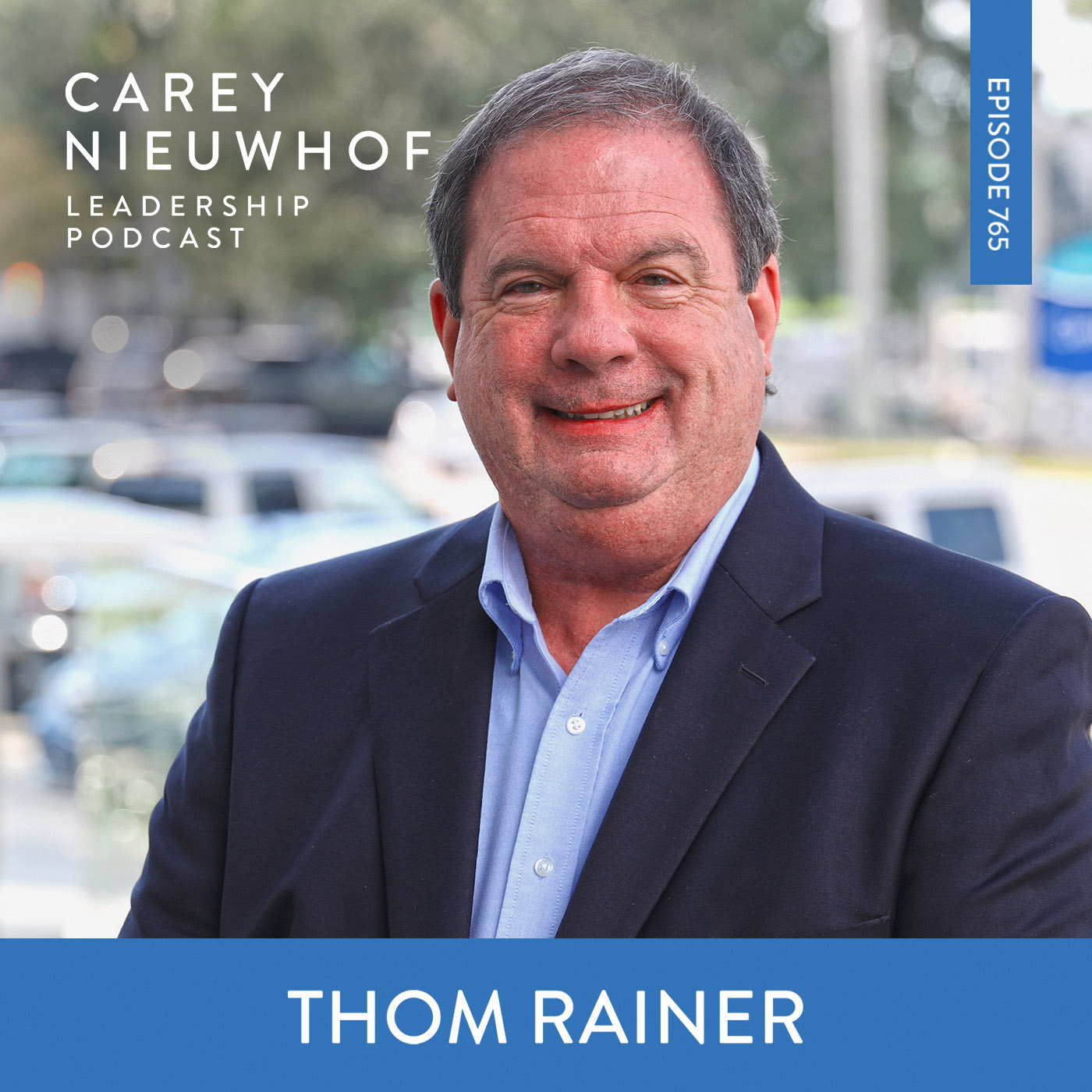
The Carey Nieuwhof Leadership Podcast
CNLP 765 | The Real Difference Between Growing and Declining Churches: Thom Rainer on What Reaches The Anxious Generation
01:03:04
Loading summary
Transcript167 lines
- [00:01]
A
The Art of Leadership Network.
- [00:03]
B
When we begin to look at what is happening in churches, we have discovered a corollary factor. Now, let me be very careful. Corollary factor is not causation. Churches that have at least three outwardly focused events on their calendar in a year are the churches that are growing in region Gen Z. That sounds too slow. Simple.
- [00:30]
A
Welcome to the Carrie Newhof Leadership Podcast. It's Carrie here. I hope our time together today helps you thrive in life and leadership today. What is the real difference between growing and declining? Church's Tom Raynor weighs in. You're new to the podcast. Welcome. If you're a regular here, we're so glad you joined us. And if you haven't subscribed yet, please do so. It makes a big difference. We have great conversations like this. We have an archive now of well over 750of other episodes. And when you subscribe, you never miss a thing. Well, Tom Raynor is my guest today. He is an author, researcher, speaker, former president and CEO of LifeWay Christian Resources. Prior to Lifeway, he served at the Southern Baptist Theological Seminary and was the founding dean of the Billy Graham School of Missions and Evangelism. He is currently the CEO of Church Answers and helps so many churches around the world. We have a fascinating conversation about the difference between growth and decline, what reaches the anxious generation, and a whole lot more. So without further ado, my conversation with Tom Rayner. Tom, it's good to have you back. Welcome.
- [01:36]
B
It's good to be back, Carrie. I don't know how far back we go, but I am grateful for the long relationship we've had and for the time we've had in speaking engagements and podcasts, writing, whatever the case may be. You're one of my heroes out there and.
- [01:50]
A
Well, likewise. I remember meeting at Rocket Town Records back in the day or the Rocket Town venue in Nashville and those great events we used to do. And I'm just so grateful for you and your voice. So thank you.
- [02:03]
B
Thank you, Carrie.
- [02:04]
A
Well, you know, it's pretty cool. You and I have been around for a minute, and for the first time in my memory, we're seeing evidence, statistical evidence, that the historic decline in the church is starting to reverse a little bit.
- [02:18]
B
I did not think I would see this, Carrie.
- [02:21]
A
I didn't either.
- [02:22]
B
If you. I'm shocked. Some of my predictions and projections and you deem that I'm a prophet, you have full privilege to stone me to death. Because I. I got a lot of these wrong. And I thought the trajectory we were on and you know, when you talk about the nuns and those factors as well. But I thought the trajectory we're on was a sustained trajectory. I thought we were headed toward the European model, if you will.
- [02:46]
A
Me, too.
- [02:47]
B
I blink my eye, and things have changed. And I am. To say I'm blown away is an understatement. To say I was wrong is an understatement as well. I am grateful I was wrong, and I'm grateful for what I'm seeing God doing.
- [03:02]
A
Yeah. You know, I'm in the same boat because, you know, in Canada, we had seen a steady decline, and that's what we were seeing in the U.S. so you kind of thought, well, this is just where we're going. And I would have said, yeah, we would end up eventually if it wasn't turned around like Europe. And yet, you know, starting with Asbury, there have been a couple of stirrings, but often, you know, like, for example, I got this question. It's like, aren't millennials all returning to traditional mainline churches because they like liturgy? And I'm sure we all know one millennial who has done that, right?
- [03:37]
B
Yes.
- [03:38]
A
But anecdotes don't trends make. And I've never. Maybe you have the data. I've never been able to find data to show that that is significant.
- [03:48]
B
Burge has that data, and guess what, you're right.
- [03:51]
A
I've seen his stuff on mainline decline just continues. And I was talking to an old seminary Prof. Last night, ran into him at dinner just out of the blue. I'm like, wait a minute. That looks like. And he's like, hey, that looks like it's been 30 years.
- [04:04]
B
Wow.
- [04:04]
A
But he was just talking about declining enrollment at my alma mater and how they're having to pivot and pivot and pivot in the mainline church. But, yeah, you know, it's funny, because often we think if we know somebody, we see a trend. But the cool thing about 2025 is there is actual statistical data that. I was just talking to David Kinnaman today before I talked to you.
- [04:26]
B
Brilliant.
- [04:27]
A
And. Yeah, brilliant. But, like, you know, women are now leaving the church faster than men, and men are attending the church at a greater rate than women. He's like, we have 40 years of data on this at Barna. This has never happened. Never happened. And it's all coming out at once in 2025. So it's interesting. What do you think is going on.
- [04:48]
B
From the male, female perspective? Just the gender issue? My honest answer is, I cannot explain it. I don't have a demographic Sociographic or even a spiritual answer to that. Some of the other things I think we can see, particularly when we start talking about the millennials and where they are, move forward to Gen Z and maybe even Gen Alpha. Generational trends I'm beginning to make some sense of. But Carrie, I'm so surprised at the gender trend, at the trend of men returning and females. Not that I cannot explain it. There's some political corollaries that might match, but I'm not ready to say, because there's this political movement going on over here, that I can match it to the movement within the church. And you know, this is one of those things. I wish I could make up some statistics. Stats used to say Rainer's the greatest at statistics, even if they aren't true. And so I don't have one of those.
- [05:52]
A
We can all make up stats, right? On the 77% of all statistics are made up on the spot. That's one of my favorite stats. But anyway, no, David's doing some more research into that, which I think will be great and I look forward to that coming out. But you know, even the reversal of the decline, that has been documented, you know, the number of people professing a. An active faith in Jesus Christ that still has significance in their life, which is something I think all evangelical Christians can agree on. Right? That's sort of the benchmark.
- [06:24]
B
And then I would put alongside that, without the level of importance, church attendance, returning to church, those factors church attendance does not salvation make. But it is evidence that you are moving into some type of accountability and discipleship mode within a larger body. And you know me, Carrie, you've known me for a long time. I love the local church, warts and all. And this is encouraging to me to see that it's not only a movement of conversion of people coming to Christ, this is a movement of people coming back to church. And I can't write books fast enough to keep up with the movement. I want to say I want to write this one. I want to write this one. I have a book coming out. This is not a plug. I'm just talking about books I've written. But I have a book coming out in 2026 that is basically about how Gen Z is really rejecting a lot of the digital. Not totally, not completely, but they're seeing that there's something else in their lives right now. I'm calling it the Revival of the Analog Church. And even though it's not truly analog, we're seeing these things, particularly in Gen Z and probably more In Gen Z males, they're saying, you know, we've tried a lot of things and we have been shaped by a lot of things, but we're more messed up than we were when we started those things, whatever they were. And we can refer to, you know, we can talk about the smartphone, we can talk about the smartphone with social media. We can talk about polarization and all those issues. The Gen Z has come back and said, this is the Rayner paraphrase. So this is the Rayner standard version, the rsv. It ain't working. It just ain't working. And they're smart and they know it. And so if it's not working in their lives, they're asking the question, what is there? And some of them are returning to the faith, and not just their parents, but the grandparents and their great grandparents. And again, Carrie, I want to be careful. I can get excited about something and then tomorrow it changes. But this does seem like a sustained trend. And I'll continue to watch it. I'll listen to people like you and David Kinnaman and others who keep an eye on these things and Ryan Burge and others, because I want to know what God is doing so I can be a part of it and maybe in some way help and resource it in the midst of it.
- [08:37]
A
Well, God willing. My book on AI will be coming up, AI on the church in 2026. And the thesis is that the church's future is human connection, that as the world becomes more digital, we need to become more human. And there'll be a lot more to say on that down the road. But I couldn't agree with you more. One of the paradoxes, though, and this is one of the reasons we're going to talk about Gen Z and the return to church and all of that, but one of the reasons I always love talking to you is, you know, so many congregations like on the ground, you spend a lot of time consulting, doing work with church leaders on the ground. And I think what we're seeing is an uneven distribution of the statistical reversals that we're watching. Right? So Gen Z is in revival. There are some pastors listening to this who are like, yeah, and we are out of room and they're lining up at the door and we don't know what to do. But there's probably more pastors listening to this who are like, yeah, we haven't seen one in the last 10 years. It's a bit of an unequal distribution. Can you talk about what you're seeing? And particularly I want to know what the similarities are in the churches that perhaps aren't experiencing revival. And I'm going to say yet, because I'm an optimist. Yeah, but they're not seeing it yet. What are the similarities in those churches? Like, what are they doing, not doing that might be a factor in them not seeing this resurgence?
- [10:04]
B
Well, first of all, you're right, it is unevenly distributed. We cannot look at a set of churches and say, of these churches we're going to project, 96% of them will be in some type of revival or addition mode and they will see great numbers in their churches. So you're exactly right there. So that's point number one. Point number two, when we begin to look at what is happening in churches, we have discovered a corollary factor. Now, let me be very careful. Corollary factors, not causation. So when you talk about corollary factors, you have to be very careful because many people say, well, let's go do this, and then this will happen. I am not saying that, but I can say that we have isolated the churches that have gained and isolated the churches that have lost. And there's usually no. There's usually no such thing as a plateau. There's usually one way or the other. So we have two sets of churches. Now, this is not as much large quantitative research as it is significant qualitative. We have a lot of churches, several hundreds, but not tens of thousands. So I want to be careful on both ends. I want to be careful that I'm making a statement that I'm suggesting has some type of causation to it. And I'll be very careful to say that I have a significant enough population to make a point. So is that enough caveats at this point? I mean, have I.
- [11:28]
A
But now I'm sitting on the edge of my seat. What is it?
- [11:30]
B
What is it?
- [11:31]
A
What is it?
- [11:31]
B
Cover myself fully on this. So we began to isolate the factors and started in consultations. It expanded beyond that because in the course of a year, we will do. Oh, in terms of on the ground consultations, we'll probably do 50 or 60. So, you know, that's not a large number. So we started. It's anecdotal, but it's good. Anecdotal.
- [11:52]
A
Yeah.
- [11:53]
B
And so we started expanding it and we started asking denominational and network leaders, will you look at these churches for us and give us some information? So when it was all said and done, we had the two stacks of information, the figurative stacks, not the literal stacks, and we came away and said, look at this. And it's so simple. Churches that have at least three outwardly focused events on their calendar in a year are the churches that are growing and reaching Gen Z. That sounds too simple that just there's some people who will hear that and maybe even Karen Newhoff hears this and said, tom, let's get this a little more exciting. But the reality of it is if there were three outwardly focused things and that thing can be loosely defined, but largely attempt to reach people in your community and bring them into your church, not just a ministry, but attempt to reach people in your community. We, we get very particular on that type of definition when we work with churches. If there were at least three a year, then that church had a high likelihood of not only being in a growth mode, but a Gen Z mode. Now when I say Gen Z mode, I mean a Gen Z growth mode.
- [13:09]
A
Yeah.
- [13:11]
B
What's going on there? Well, this is almost Matthew 9 or Luke 10, depending upon which pericope you want. But it's basically there's a harvest out there. We just need to send workers into the field. So pray to the Lord of the harvest that there will be workers in the field. So what have I done? I've gotten very traditional on the outreach mode. I've gotten biblical. And I'm not doing anything cutting edge right now. I'm just giving the facts of this. So we have this data and we know now, according to other research that we have done, that Gen Z is waiting. They're waiting for the invitation, they're waiting for the connection. They're waiting for someone to come to them. If a church does this very poorly, they're going to be much more likely to see them come if they don't do it at all. And so 3 and if you do 4, oh my goodness. The correlation jumps up almost to 0.9, which is unheard of, but certainly 0.75, 0.8 correlation. When you look at 3 and Carrie, the obvious question is what does that mean? You know, what are those corollary things that you are doing? Well, it could be just this time where you're going to invite a lot of people on a particular day. We used to call them high attendance days or what did Elmer Towns call them back in the day?
- [14:28]
A
More towns. There's a name I haven't heard in a minute. Wow.
- [14:31]
B
Friend days.
- [14:33]
A
Friend days. Yeah. Bring a friend day.
- [14:35]
B
We have Invite your one at church answers. And it's just a day where you get everybody thinking about inviting someone else. So that that would Be one example. Another example is what are we doing to change the culture of the church? Are we sending the church through a culture of prayer and evangelism where they're constantly asking themselves the question. There are ways that you can put that on the calendar. Where you see a church transformed in that methodology. It could be something like sports ministry, like upward and upward. Upward is seeing some of its most significant growth. Wow. Is it because they're a great company? Yeah, they are a very good company. I love those folks. But it's more. It is the fact that they have an intentional ministry to reach the community through sports. And some of it is easy. This sounds like an advertisement for Upwards, so forgive me.
- [15:29]
A
No, we know those guys. They're great. They partner with us on the podcast and that's it. It's not a church league for sports. Right?
- [15:36]
B
Community.
- [15:37]
A
It's a community league.
- [15:38]
B
And they have to be Easy as a 5k where you just have one person in the church organize it and people in the community come and run the 5K. Their big growth engine, by the way, is pickleball. So that's fascinating.
- [15:51]
A
That is a sport that won't go away.
- [15:53]
B
Yes, but that's what's going on. It is plain and simple. When churches attempt to reach people, guess what they do. They reach people. Who are they primarily reaching? Gen Z and maybe to a little bit Gen Alpha, depending upon what the family makeup is. I could go on and on about that. I don't want to overstate it, Gary, but that's what we are seeing in the churches that are growing versus not growing. More than any one thing, Today's episode.
- [16:17]
A
Is brought to you by Fund the Future Masterclass Church leaders. Maybe this feels familiar. You cast vision, you preach faithfully, but when it comes to finances and generational giving, you hit a wall. You ask your congregation to invest and suddenly the room goes quiet. Maybe you launch a giving campaign and by Monday you've got pushback. An email inbox full of. Hey, why'd you say that? Right? Listen, I've had that tension too. But here's what I've learned. Leading a generous, fully funded church isn't about gimmicks or pressure. And that's exactly why me. Craig Groeschel, Chris Hodges, Ashley Woolridge, Dan Clark and others created the Fund the Future Masterclass. It's a step by step program to shift your church from transactional giving to transformational generosity. Together, you'll be equipped to lead with vision, strategy and tools to grow giving that's sustainable and spirit led. Enrollment is open now. So click the link in this episode's description to get started. So three outwardly focused outreaches a year now, just to go a little bit deeper, because I want to spend some time on that. You know, some people would say, well, isn't every Sunday invite a friend Sunday? I mean, that's definitely the culture we try to create. And we are, you know, fortunate to see new people. I remember. You know, it's really interesting. I remember the last Sunday in Connexus church. And it's different incarnations. It's only 18 years old, but you know, 30 years now of ministry in the same place with the same people. Just the name changed and we kind of replanted. But I remember the last Sunday where I looked out, we were in a school auditorium, elementary school. So it was small and I knew everybody in the room. I knew the names of everybody. And there were maybe 150, 200 people present. But I'm like, or maybe it was 300 at the time. I know everybody here. Darn. And I thought, lord, I don't want to teach in front of the same people for the rest of my life. And that was the last Sunday that I, you know, every Sunday, I'm pretty sure consistently now for almost 25 years, we have seen new people every single Sunday. But part of that impetus was, you guys, go do evangelism, invite your friends. We're gonna create a great environment for that. And currently we're in an explosive period of that. Is that enough, like to have a mindset or do you have to have additional events on top of that?
- [18:51]
B
I would say that you would be the outlier. And it's not enough for most churches.
- [18:56]
A
Got it.
- [18:56]
B
We're dealing with 400.
- [18:57]
A
Why? Because it's not really about invite your friends or we don't have any friends, or like, what is that about?
- [19:03]
B
Well, what that means is that your church has created a culture that's sustainable and many churches are not near that point. And so that's fair just to tell them to go out and buy. Now, forgive me with all these correlative factors because they can be boring and they can be wrong. Both end. So here's some more of our non verified facts, but close enough that I feel pretty good about it. If you invite someone to church, if a church member invites someone to church, about 15% will show up within a six month period. That's rough. Okay. We're actually asking people who have 85% strikeout rate. 85% strike, but a 16% you invite 200 and you're going to get what, 16% of 230?
- [19:53]
A
32.
- [19:54]
B
32. And if you're in a church of 150 with a median sized church at 65, you're doing pretty well. So that's one thing. But listen to this one. When someone invites someone to church and asks them to go for coffee or a meal afterwards or before either one, the number jumps up to almost 80%. Wow, the relationship. I didn't know that the relationship has been developed. I only go to church where my sons are pastor. I stopped preaching and the world was so much better for it. I mean to carry it on a scale of one to 10, my preaching ability did not hit zero. I strove for minus two. But I am a terrible preacher. And when I got out of that world and when I was at Lifeway, I was preaching at other churches every week. Not because I was a great preacher, just because they wanted me in my position there. So what I love is every Sunday I'm either at my son Jesse's church in the Nashville area or on rare occasions my son Sam in the Sarasota Bradenton area. So yesterday I just love doing that. That's almost all I do. Yesterday we had a outreach meeting. It was a meeting of those who are in the welcome ministry and related and Jess gave that stat to them. Jess, My pastor, the one that I just shared with you. And there was a audible gasp among the. His church runs about 200. So there was probably 20 people there. And there was this audible gasp about wow, if we just invite them to a meal. Now in that room as an illustration which was kind of neat, there were eight people that Nellie Jo, my wife and I had invited to church and taken to a meal. And I said how many of you came to church after we took you to a meal? So almost half of those who are now in the welcome ministry were affected by that. So that's all anecdotal but it's growing anecdote the relationship to the invite.
- [22:02]
A
So a couple of things we for years we don't do it anymore. Use vacation Bible camp. Would that be an example of something? If you really not to be the church daycare circuit. That's why we ultimately shut it down is we just became Christian daycare for free for Christians. But in the early days it was really effective at outreach. You know our average members were in their 70s, 60s, you know, I was 30, just starting out and it's like there's a lot of young families around here. Let's go reach them. And they showed up and then they stuck around. And some of those kids are still now adults in their 30s and 40s who are part of our ministry today. Would that be an example of an outreach event?
- [22:43]
B
It is. And any kind of outreach event has to have attached to it. Intentionality. It cannot just be an event that the church does and the people sit back and watch because they have to.
- [22:53]
A
Be involved, inviting their friends.
- [22:55]
B
They have to be involved.
- [22:56]
A
And it shouldn't be Christian daycare for the summer, right?
- [22:59]
B
Yeah, absolutely. They're going to be, especially the Baptist. They're going to show up for anything that's free for their kids. But yeah, it needs to be highly intentional to those who are not in church.
- [23:10]
A
Yeah, the other one that's really helping us right now, we ran it 20 years ago and then it was on ice for a while, but now it's back. For the last three or four years it's just been huge in generating the growth we're seeing as Alpha. And it's Christians inviting non Christians.
- [23:25]
B
I've got to do more research on that. I always, for many years saw Alpha as this mainland thing that's kind of transporting to the US through the Anglican world, whatever the case may be. And I'm hearing some of the same things you're talking about Alpha.
- [23:40]
A
Yeah, it's amazing. I mean, I know Nikki. You should get to know Nikki. I can always introduce you guys. But Nikki Gumball pioneered it and I mean, it did come out of the mainline tradition, but it's on fire with the Holy Spirit and thoroughly biblical. And it's probably more effective everywhere in the world than in the US and only because people in the United States don't know it. It hasn't really penetrated non denominational world yet. But we are, you know, we're non denominational. We're seeing huge results with it. But basically it's an introduction to Christianity centered around a meal and you're only allowed to come if you're bringing an unchurched friend. And we have seen just powerful conversion.
- [24:22]
B
Stories, baptisms, and I've got to get more on board with Alpha and find out what they're doing because we do a lot of work with an incipient organization called Global Methodists. They came out of the United Methodist movement, but they're growing rapidly. A lot of the growth is coming from the closure of the Methodist churches to becoming Global Methodist. But I keep on hearing that from a Global Methodist Friends. Yeah. Hey, do you know anything about Alpha? Well, no. I mean, my dominant spiritual gift is stupidity. And I just haven't pursued this, and I really want to pursue it.
- [24:58]
A
Oh, that's great. Well, listen, we'll connect out offline when we're wrapped up, and I'll see if we can make some introductions. Tom, Because I've just seen God use it again and again, and the spirit I see behind the leadership at Alpha just is humbling. If we can have a little bit more of that in the church, I think we're all gonna be a whole lot better. Okay, so you give me an idea. It has to be intentional, has to involve your members. It can't just be, hey, next Sunday's outreach. Sunday, see you then. People have to do something. And, yeah, maybe once in a while, you can create a culture that permeates your church where you've got a sustained invite culture. But you would say that's the minority.
- [25:35]
B
Well, it's a distinct minority. And I would add to the factors you just described. It has to be prayerful. We assume that, but many times the assumption means we don't do it. And these things are not the work of humanity. It's the work of the Holy Spirit. And I know I'm stating the obvious, Carrie, but many times I do too many things where I don't ask God what he wants me to do. I just go ahead and Tom's power, fair, same. And it just fails miserably. So it sounds to me how you're describing Alpha, and what I need to learn is that it has all of those elements together. Intentionality, prayer, unchurched, lost people, studying the word, coming together, meals. It sounds like Alpha was it before. A lot of other things we had. Even though Alpha's been around a long.
- [26:25]
A
Time, it's pretty amazing. I've vetted it on numerous levels, from being part of it to getting to know some of their top leadership. And I'm just totally impressed. Totally impressed. And it's all those things. So because you spend so much time with so many different churches and you really have a heart for the small church, which is really the normal church, I think you normalize that language. I think the median attendance now in the US is something like 65, 50 people on a Sunday. When you're thinking of a church like that. And we do have people who listen to this podcast who don't lead megachurches. Right. There's a lot of people listening who are like, yeah, that's our church, or I'm trying to turn it around, or, I've been there for 20 years and we're not Seeing momentum. How are, and I'm saying this with great affection and love, how are those leaders getting in their own way?
- [27:16]
B
Oh, gosh. I mean, they're getting in the way much like I get on my own way. First of all, they have a sense of despair. Many of them do. In that sense of despair leads to greater despair. And I'm not being disparaging. No pun intended.
- [27:32]
A
Yeah, yeah, yeah.
- [27:33]
B
No, I'm just simply saying they going into leadership with a mindset that it cannot be done. Now, why? They've been beaten up so much, they, Many of them have scars that they can touch and they still hurt, metaphorically. And so they now play defense, and maybe even fearful defense more than they play offense. Secondly, they get so busy doing some things they do not do. The main thing. When we look at the Book of Acts and we know the story of how they gave their attention to prayer and the ministry of the Word. Well, what happened right after that? There was another explosion of outreach because the leaders of the church said, we cannot give our attention to everything. And many of these small church pastors, many pastors, period, I'm not going to just blow it all on the small church, but many pastors, period, they are too busy doing things that don't move the needle whatsoever with the Great Commission. And as a result, the church does not move now.
- [28:38]
A
So what are some examples? Like, I still hear once in a while about committee meetings. And I'm like, seriously? Really? Committees? Like, is it that kind of stuff? What are they doing?
- [28:48]
B
Oh, it's in some. I'm not going to mention the denominations because I have too many friends, but in some denominations, you actually have the prescribed committees that have to meet according to your denominational agreement. And I'm working with the church, or our team is working with the church right now. And they asked the question, what would happen if you didn't do it? And they said, well, we've never done it. We don't know. Is the judgment of God going to follow on you? Is a bishop going to come and tell you that you cannot belong anymore? So, yeah, so many committee meetings. So much pastoral care that can be delegated, equipped to others, not afforded, but delegated and equipped to others. I was looking at some comments on my blog today, and one of the persons was obviously a church member who did not get visited in the hospital. And I can't remember if it's a he or she, doesn't matter. And that person was talking about how we left the church. We're now just watching tv. We're sending all our money to that person. And I almost did this and it would have been so ungodly on me. I almost wrote and said, you are the paradigmatic example of someone who believes church is for me and that's what you pay your money for and if you don't get your way, you're going to leave. I didn't. I'm glad. Maybe they're listening to this podcast.
- [30:14]
A
Good for you. And you know what? I can promise you the TV preacher is going to visit you in hospital next time.
- [30:19]
B
I almost wanted to say that too, because they even named the TV preacher. And I say, oh, my goodness. But that still is taking place. And our data was pretty much following what was taking place with the fact study. And we were Faith Community. I'm not getting my acronym right, but, but, but. Anyway, we were right around 65, and I told Sam, who is now president of the company. I said, sam, I'm seeing anecdotal numbers that the number's going to go down to 50. I'm going to put that in my book. He said, don't do it. He said, because your book will be wrong. He said, it's going to stay 65. Wait till the next batch of numbers come out. I went ahead of his instincts and I put 50. So there's one data point in my latest book, the Ancient Generation Goes to Church. That's wrong. It shouldn't.
- [31:09]
A
He was right. It was 65.
- [31:11]
B
It's still 65, not 50.
- [31:13]
A
Darn.
- [31:14]
B
I was going based upon trend lines. And he said, no, I'm trend line stopping. Then I can take. He said, it's stopping right at 65. He said, I wouldn't be surprised to see that number start edging up in the near future.
- [31:28]
A
This podcast is brought to you by Belay. Well, what if your message could reach further without adding more to your plate? So you were called the ministry to change lives, not to chase algorithms, design graphics, or manage marketing campaigns. Yet too many pastors do that, and way too often the urgent demands of digital outreach pull you away from what matters most, leading your people and sharing the gospel. You shouldn't have to choose between reaching more people and staying true to your calling. That's where Belay's expert marketing assistants come in. They help pastors like you grow your market presence without growing your to do list. If you're not sure how to start, here's what you do. Download beLay's free resource, 15 tasks a pastor Can Delegate to a Marketing assistant. You'll discover exactly what to hand off so you can focus on your calling and not content calendars. How do you do it? Well, text the word carry C A R e y to 55123 that's Carrie to 55123. Let belay help you lead with greater focus and greater impact. Well, because you have this thing where the bigger churches are getting bigger, like multi site is a driver of a lot of growth and then a lot of those smaller churches are just fading away. So it kind of makes sense that the median or average are going to trend up. So I'm glad you mentioned your new book because you first of all write books that are rate faster than most people read them. And you're talking about the anxious generation which is mostly Gen Z and some Gen Alpha. And you were really impacted by Jonathan Haidt's work, right? The Anxious generation. And you've taken his research and applied it to church, which I think is brilliant.
- [33:10]
B
Well, Jonathan Haidt is brilliant and for me to give accolades to someone whose worldview is so different than mine just let you know that he is brilliant. He's an agnostic Jew. So for me to take this information and say this is good for the church is accolades to Jonathan Haidt and the work he did. I was working on a book proposal. It was due. I had a certain schedule that my publisher asked me to stay with and so I was on that schedule and I was about 2/3 of the way through with the book and the Anxious Generation book showed up. I had ordered it, pre ordered it and it showed up and I got my Amazon box out and ripped it open and said I want to take a little break. Well, I took a long break, several hours kept on reading Anxious Generation by Jonathan Haidt 2 or 3am I said I'm going to take a nap. I took a nap. And then whatever hours followed, I finished the book and I walked away absolutely stunned with what I had read. Absolutely stunned. He was telling us why a generation is having such mental emotional problems. He was nailing it with facts, he was nailing it with data. He was nailing it with truth that sometimes hard to take. And he didn't just leave it there. He said okay, here's the problem. Solution on paper is pretty easy. And then I extended that we can talk about that solution. Of course a lot of people know what that is, but I extended that and I said what happens when the anxious generation, primarily Gen Z, some Gen Alpha, what happens when they go to church? And so Sam and I did research that began to trace that and ask those type of subjective questions. What happens when you go to church? And the thesis of the book is this. Christ working through his people in the church is the healthiest thing that can happen to a young person who is struggling, period. And you know how pro church I am too. I'm talking about local church, not just universal church. And so you know, is there observational bias there? I don't think so. Because even Haidt and some like Elon Musk are hinting that they want the church to get stronger because the nation's not going to get stronger, the world's not going to get stronger unless the church.
- [35:51]
A
There's a secular mourning for the loss of church that I've been talking about.
- [35:56]
B
Christian mourning at times.
- [36:00]
A
But they're like, hey, we need the church. Like this is not good. I'm not a Christian, but it's not good that the church has gone away. They need us to be vibrant.
- [36:09]
B
And that's why Elon Musk declared that he was a cultural Christian. Yeah, I'm not so sure the noun is right, Elon, but I understand what you're saying.
- [36:18]
A
One of the threats to Gen Z that you talk about because you know, anxiety fuels a lot of their day to day existence is polarization. So on the one hand it's good to pull that out and highlight it. On the other hand, I don't think we've ever been more polarized as a culture and the church is not exempt from that. I mean you look at what's happening in the church right now as we record this and everything is polarized. I mean it doesn't matter what comes out of Washington, what happens in a municipality, there is a red side and a blue side and the church is actually leading that charge. I'd love your commentary on that, Tom. What are you seeing and what's the danger?
- [37:06]
B
There's great danger. Cause polarization is not the biblical way. To be one in Christ is the beautiful is the way of the Bible. And so it is very dangerous. What Height discovered, and I'll get to your question directly, Carrie. What Height discovered was that polarization was part of the problem that was taking place with Gen Z, with the anxious generation through their smartphones. So on the one hand we have red and blue, we have these national issues going on. We have divided nation, divided countries, divided families. The issues. It's almost like you can say one thing and someone's going to say another one and then we're going to have a fight. And what is really, really disheartening is to See, some people say, well, my pastor didn't mention X issue, this cultural issue in the sermon this week. So I'm leaving because he's not where it should be. Well, what happened to Gen Z? They've got all of this external polarization taking place that you articulated very well. And then you have this fourfold threat that's really foundational with the Internet, just the ability to be anywhere at any time. And then from the Internet comes the smartphone, and you now have the entire Internet in your pocket. And then from that comes social media that was added to it. And social media then starts bringing on this polarization. How? By the algorithms. Look, Carrie, if you went to my YouTube channel, you would find out I'm a political nut. Not necessarily red or blue. It's just I cannot get enough of both sides of finding that. So my YouTube would be filled with politics. And with Alabama football.
- [39:06]
A
Only one will survive into eternity. You know that, right?
- [39:09]
B
I know that. But what was happening with these young people is they were. They're on their phones and the hours and the things that were taking place, and they're being fed one point of view, which is. Which is their confirmation bias. They're being fed through the algorithms, and that is putting them in a group. And that group is opposed to something or someone all the time. So all the things that were happening on social media, on the smartphone, when we see young people are old people like me, and they've got this phone in front of their face for YouTube viewers. I mean, for those who are listening to this, I got a phone in front of my face.
- [39:50]
A
The new iPhone air very, very brand new.
- [39:54]
B
So they are being fed polarization. They're being trained in polarization. Add to that political issues, financial issues, geopolitical issues, all of the things that are taking place now. And we have a divided world, and yes, we have many divided churches. Now, I will say this. Among those divided churches, there are some pretty sharp pastors that I think are listening to the Holy Spirit more than the whims of society and culture. And they are understanding that they have to make certain that they don't bring that polarization into their church. They can have conviction, they can have certainty, they can have biblical certitude, but don't bring that polarization to the church.
- [40:40]
A
I'm going to ask you to name names, and we can cut this out if you're not comfortable. But who are some of the pastors that you think are doing a great job of being biblically clear but resisting the polarization tendencies?
- [40:53]
B
Well, in the large church, I would say J.D. greer. J.D.
- [40:57]
A
He'S coming on the show soon. He's got a new book about transcending the culture wars. I'm like, you had me at the title.
- [41:03]
B
I did not know that. But you can listen to JD and you can pretty much know that he's there. Southeast Christian Kyle Idleman. Yeah, he would be another one that just again, being a larger church now, you want to go to smaller churches. For those of you who never have heard of this, go go to Sam Raynor. And he's at Church Answers. But he's also pastor of a It's not that small, about 800 attendants church in Bradenton, Florida are his younger brother, Jess Raynor. And again, I'm touting the Raynors and there are a lot of others that are out there, but Matt McCraw first at First Baptist, Barto, Florida. Okay. One of the sharpest young pastors I know. And he is. He's got it. And he's one of these pastors, Carrie, that is in Barto, Florida, that is not in the growth corridor. And he's holding it steady. They've had steady growth. But he wants to stay there. He wants to make a difference.
- [42:09]
A
That's amazing. I was saying to you, I'm still where I started 30 years ago. I haven't moved.
- [42:14]
B
That's amazing.
- [42:16]
A
Yeah, yeah, it really is. The three original churches are like a five minute drive from my house.
- [42:20]
B
That's amazing. I love that.
- [42:22]
A
I love it too. There's a part that gets sweeter about that every year. So thank you for those names. I appreciate it. And feel free to mention your kids.
- [42:30]
B
You should.
- [42:32]
A
What is the difference? How do you survive the polarization? How do you make sure that, okay, I'm not just going to hide from the culture. I'm not just going to bury my head and pretend I don't live in this era. But I'm not going to participate in the polarization. That's sort of my first question.
- [42:53]
B
Well, for one thing, they go to cultural issues from scripture, not from sides.
- [43:00]
A
But so the culture war people, they're like, well, the Bible says this on abortion, the Bible says this about voting, the Bible says this.
- [43:07]
B
The Bible says this. But they are already divided. They already are on social media using the Bible as a weapon instead of an apology of the gospel.
- [43:15]
A
Weaponized scripture.
- [43:17]
B
It is. It is so totally scripture. I can go to any of those pastors that I just named and I can tell you, you know, where they stand on biblical cultural issues. But, you know, they're not creating wars with them. Secondly, look at the life of Christ. Yeah. There was times that he got really mad at primarily just the religious people, not. Not the world. And his. His life was one of. One of bringing people together, of joy, of unity, of peace. And I don't want to make this soft and mushy because there. There's all kind of cultural issues that need to be discussed, but you don't have to do it in such a polarized way. A lot of it is just how you articulate it and your demeanor and your disposition in the midst of all of it. So, hey, go to some of those pastors that we mentioned. They all have. You can listen to their sermons online and just follow what they do. Don't repeat their sermons.
- [44:12]
A
Yeah, yeah. But you'll pick up the vibe soon enough.
- [44:15]
B
Exactly. Exactly.
- [44:17]
A
Yeah. So what that means, I guess even as someone with strong Baptist ties, as yourself, is there should be people who vote on both sides of the aisle in your church. Is that right?
- [44:27]
B
Yeah. And again, for me, you would have to tell me. You'd have to ask me what the particular issue is, because if there's a gospel centric issue, and again, people define that a little bit differently, but if there's a gospel centric issue, I would hope. Hope that my people wouldn't. Or people in my church would not be voting on a particular side that was not biblical. But. Yeah.
- [44:51]
A
You're not kicking them out if they do?
- [44:53]
B
No, not kicking them out. Hope I don't even have to know what they're doing and necessarily how they're voting. I hope they would feel comfortable in my church or in my son's church, and I think they do, regardless of their positions. Yeah.
- [45:07]
A
So when you have a non, let's say polarized church where people. We did this event a couple weeks ago in Dallas as we're recording this called the Art of Leadership Live. And I want to be careful what I say because this is part of the secret sauce. But you have people who have different views on today's issues sitting around the same table, getting along, praying for each other, encouraging each other, learning from each other. And it's almost like the storm has stopped for a minute and we just spent three days together, and then we go back out into the storm. And I see that as a hopeful model of church. It's theology on a tether. I don't believe it or not, have a monopoly on truth. I don't know whether you do, Tom, but I do not. And so there's kind of Extremes where it's like, I'm not sure that's Christianity. No, that's definitely not Christianity. But there's, there's a little more play in the system than perhaps we give it credit for. And when you have that kind of environment in your church, what does that do according to your research and study to Generation Z?
- [46:14]
B
Well, Generation Z will want to see that you love them. That sounds trite. That sounds, that sounds simplistic. But if you're focused on hotbed culture, hot button cultural issues, and not on caring for them and loving them, your focus is going to be off. And they will know it. They will know whether or not you care or whether or not you care more about an issue than the person. And Carrie, what you described is precisely it. You had people come together in person and you had people pray for each other. It's amazing what happens when people come together and talk and pray. And it's amazing what Gen Z will do when they see that that is your M.O. and that is how your church moves forward in the power of the Holy Spirit.
- [47:03]
A
So it's almost like they need to know that you love them more than you love what they think.
- [47:11]
B
Boy, you need to go clip that and put it on a board and just save it somewhere. They need to know that you love them more than what you think.
- [47:22]
A
Yeah, I think that's what the cultures. I can only love you if you agree with me. I can only. We can only share a meal, Tom, if you and I are 100% aligned on these issues.
- [47:33]
B
One of the most dynamic Christians I know that gets that is this girl that I married 48 years ago called Nellie Jo. And I have been so amazed. For example, I'll just go in and say this. At the number of friends that she has in the homosexual community and in the Nashville area, in the artist community. And they know exactly her views on sexuality. They know exactly where she is, but they also know that she loves them as a person. They also know that she loves them for who they are as a person created in the image of God. And they accept her and they listen to her and she listens to them. I just, I wish I would follow the example of Nellie Jo a lot more and I would be much better. I mean, 48 years, you'd think I'd get it by now, but.
- [48:24]
A
No, but that would get you kicked out of churches for even saying that, Tom.
- [48:28]
B
Yeah.
- [48:29]
A
And you know that churches in your tribe would kick you out.
- [48:32]
B
Well, again, I'm non denominational, so you can decide what my Tribe is.
- [48:37]
A
No, I know, I know, but I.
- [48:39]
B
Understand what you're saying. Yes, yes. In some of those churches it can. And those are the churches, by the way, that may have bursts of growth based upon issues, but ultimately they're going to decline because they're not reaching their community.
- [48:51]
A
I got some. Your research is always interesting to me and I want to get to a couple of specific findings. But what else did you learn about Gen Z that shocked you?
- [49:03]
B
They are so open to something different than what they're doing now. I knew that that was a possibility. But for us to interview them and for them to have an openness to doing something totally different than the life they've had, and that can be defined in a number of ways and a number of aberrant movements can capture that. But also the church can capture that because if they get connected with a fellow Christian, if they get connected with a fellow Christian in the fellowship of a church, well, that's the thesis of the book, the Anxious Generation Goes to Church. I was absolutely amazed that they had that openness. Here's another thing. They like the church more than the church likes the church, at least from the past.
- [49:54]
A
Okay, I'm glad you raised it. I wanted to get to that. Can you explain that unchurched people actually value the church more than Christians do. I couldn't believe the stats.
- [50:03]
B
Well, it takes a little peeling back of the onion layer. There is something that is there and I'll just do it in my typical simplistic way because I don't have another way. So what we found is this is we found the reverse halo effect. And here's an example. My son, my middle son, Art, when he was a teenager, he's now 42. When he was a teenager, he would tell me, looking back, dad, I thought our home was really messed up. I mean, I thought y' all were strict and backwards and you know, I just, I really thought my home. And then I got outside the home and I found out it wasn't so bad after all. In fact, it may have been good. What happens is the reverse halo effect is church members see their own churches or perhaps their perception of their own church and other churches. And that close up view can cause a negativity more quickly than someone with an open outside view. And where we are right now is we got members who are more critical of the church than those who are on the outside. There's a danger there too. And the danger is you don't think enough of what God is doing in your church to invite people because you are ashamed of your church. That's the extreme. But it does happen again and again. But we call it the reverse halo. You just. You. You. You are within the church, and you see the negative and not the positive. Those on the outside aren't seeing as much negative as you are. Right.
- [51:30]
A
So they may actually be open to attending your church than you would be to inviting.
- [51:35]
B
Boy, get your producer out, Carrie. Just start capturing all these things. Can we scroll it on the bottom of the screen? As you say no.
- [51:46]
A
Your research is fascinating, and it's really got me thinking about that, because I think that's true. Right. And some of that is your parents didn't go to church. If you're 18 or 20, your parents didn't go to church. Your grandparents kind of did, but it was quaint. So you don't have the. I had a terrible church experience that so many millennials and Gen X did when they were growing up, and then they kind of left. But now we're a couple generations down the road, and they're pretty open. Okay, more research. This is just interesting because I'm a nerd on this stuff. A typical church, you say, loses 32 in attendance for every 100 attenders a year. Did I get that right?
- [52:28]
B
Mm, you got that right.
- [52:29]
A
A third of your church just disappears every year without you doing anything. What does that actually mean? Can you explain that?
- [52:37]
B
A third of your church doesn't necessarily disappear. They just stop attending or disappear. One of the two.
- [52:44]
A
Right, right. But they could move out or obviously people die or, you know, somebody gets mad at you and goes and starts watching TV preachers. It's that kind of attrition we're talking about.
- [52:55]
B
Yeah. And it's four factors. One is death, one is moving to another church within your community, and one is moving outside of your community. And then the fourth one is the big one. And that's attendance frequency. If you have a church of 100 people and they attend every Sunday, presuming that's your worship day, your attendance is 100. You take that same group of people, and they attend every other Sunday, your attendance is 50. And you haven't lost a person on the role. If you have a role, but you haven't lost a person that identifies with your church, what has happened is the frequency of attendance is the number one factor in church decline. Sam Raynor began to see this 15 years ago, started telling people about it, and most people weren't listening to him, including me. And finally, everybody's. A lot of folks are beginning to say that's what's happening to our church. We have elders who were here every Sunday and now they're here every other Sunday. And those are some of the most committed members, presumably in the church. So, yeah, you're losing a third of your church. But the biggest number are those who are not there. That's an attendance number. That's not a membership number. So that's where you're losing them in the attendance factor.
- [54:04]
A
So even if they haven't left, they're not there. That's right, yeah. My parents would be a good example. You know, they moved into an assisted living facility. They're very much behind the mission of the church, but they haven't been there in person in, like, the better part of a year, just because of how health challenges, et cetera, et cetera.
- [54:22]
B
And some of the church members are in different rhythms that are less frequent. And you can look at all the factors behind it, but it's a reality.
- [54:31]
A
Well, even the funny thing is, I think it was Mark Batterson who told me, with the high turnover in dc, like about every four years, everybody loses their job and starts over again. And then you've got military and you got all kinds of stuff, stuff in D.C. he will by not even angry people leaving his church. And it's a pretty young church. 20% are gone every year. So if he doesn't grow by 20%, he's at 0% growth now. They've had a really good track record in that area. But if you think about it, there's not a lot of companies that automatically lose 20% right out of the gate on January 1st. But that's the reality for churches, right?
- [55:12]
B
That's the reality at the attendance level. The membership level would be a whole different thing if you count members in your church. But at the attendance level, the median is going to be about one out of three will not be there next.
- [55:24]
A
Year on a typical Sunday.
- [55:26]
B
Wow. Okay.
- [55:28]
A
Other stats. Yeah, yeah, yeah. The number of church members it requires to affect one conversion. So in 1980, and again, tell me if I got this wrong, but I. I was trying to copy it, 41 members in a church would result in one conversion. In 2010, it took 78 church members before you had one conversion. Now it's 93 church members to produce one conversion. I've never seen a stat like that. What does that mean, Tom?
- [56:02]
B
That goes back to 1996 in my research. Now, if I have 1980, I'm using other research, but 1996, I wrote a book called Effective Authority Evangelistic Churches. And I said, how can I determine that? There's just something. I'm really old, Carrie. I am really, really. I wrote a book on evangelism in 1996. But that. That. That book, we said, how can we tell if a church is evangelistic? Well, can we count conversions, however that is baptisms, professions of faith, whatever number we're using. Can. Can we? Yeah, but how effective is it? Well, let's look at it. Relative to members. How many members per baptism are there, or maybe ask it colloquially. How many people in our church does it take to reach one person for Christ in a year? I don't like that number as much as I used to. Well, let me put it this way. I never liked it because it was going up, but I don't use that number as much as I used to, even though it's in the book, because membership is not as a meaningful number as attendance these days. And I'm working more and more on conversions to attendance. But just as an example, it used to take a few decades ago, 40 church members a year, to reach one person for Christ. That's not very good. That means if you're in a church of 80, you'll reach two people, mostly.
- [57:22]
A
Is the undercurrent underneath these stats. And I want you to finish your thought, because most people are just sitting back, relaxing, enjoying the flight, not inviting their friends.
- [57:31]
B
Not inviting friends, and not in being intentional about being unashamed of the gospel. Being unashamed of the gospel does not mean that you're going to get in someone's face, offend them. Except for the gospel itself, it is a lot less threatening to the unchurch, it being the sharing of our faith, than it is to the person who's receiving the sharing of their faith.
- [57:53]
A
Yeah, that's fair. Wow. And so now it takes. Well, more than double. And is that just because we've gotten more lethargic and less evangelical or evangelistic?
- [58:04]
B
Yeah, that's a simple explanation. We are much less evangelistic than we were many years ago. Now, here's another part of it. Many churches have redefined evangelism in a way that doesn't reach people for Christ.
- [58:18]
A
Oh, what does that mean?
- [58:19]
B
Well, let's just look at it. We were working with a church that had an incredible ministry in their community, and it included food, it included clothes, it included a lot of other things than the typical ministry with clothes and food. And we said, well, how many people are y' all reaching for Christ with this? And the answer was none. Well, they were expending Resources, connecting with people. Could they have reached people for Christ? Somewhat there were socioeconomic differences, but somewhat they could have. There was no intentionality there, but they were satisfied that their ministry, which was on a human needs level, was also evangelism, which was on eternal need, but there was no intentionality. Get Christ into the picture. A lot of churches have ministries that they think are evangelistic, but they are not. I'm working with an entire denomination that is trying to reverse that mindset right now.
- [59:22]
A
Right. We did something good in the community. I don't know why people aren't coming to Jesus.
- [59:27]
B
I asked another church a year and a half ago in a consultation. What is your most evangelistic ministry? Well, they had this big community event that included barbecues and just so many things going on. And they had hundreds upon hundreds upon hundreds, and they had zero who came to the church, even came to the church, much less became followers of Christ.
- [59:46]
A
I do get that question a lot from church leaders who will say, yeah, we do this big outreach event, we do something in the park, picnic in the park, or we do a concert, or we do something for the community, a fun fair, you name it. But it results in zero growth. Why is that a pattern? What are they missing?
- [60:07]
B
They're missing intentionality. One of the ways you're going to reach people with gospel is to tell them about the gospel. They're missing prayer. In fact, they're not praying for the lost in those events. They're missing training. They're not telling people what this event should be doing and why they should be doing it. And the sum of all of this is they're trying to have an evangelistic event without evangelism.
- [60:33]
A
That's well said, well said.
- [60:35]
B
But I'm not going to get the scroll going across on that one. It's just not as profound as some of yours.
- [60:41]
A
Like that. Last words, Tom, anything else on Gen Z that we really need to be paying attention to if we want to see the church reach the next generation?
- [60:52]
B
I will give a story and maybe it will communicate the right answer to this. There was a church. Our team was not working in the consultative relationship. I would hear about it. There was a church where the median age was 74 and the average attendance was 28. Median attendance. So small church, old church. They asked the question, can we even keep the doors open? Because we're not reaching people and we're getting older, we're dying off. Let me tell you the rest of the story. One year later, the church had 150 and the median age was in the 20s.
- [61:34]
A
Wow. What happened?
- [61:35]
B
One lady, one lady said, do we really think the power of Christ is not available for us today? How can we reach young people? And so she said, you know what? I went through an ugly divorce 30 years ago and I remember my time as a single parent and how I just needed someone to talk to, to help or even a babysitter. Said, I'm going to put out a Facebook ad or just a Facebook post and I'm going to say, hey, if there are any single moms around and you just want to get together and talk, maybe study the Bible, here's where we're going to meet. I don't remember exactly, so I don't want to say a number, but I think about 30 showed up the first time. Well, it was outside of the church, but the more she got to know him, the more she brought him into the church. What happens when you bring single moms into the church? You have kids and the church just said it really can happen. God can really do this. So my final word, if I could use that phrase for this podcast, Carrie, is God is not done with these churches. Don't think he is. Ask the maybe the trite and simplistic question, what can God really do through me if I'm obedient to him? To reach others with the gospel.
- [62:56]
A
Wow, Tom, this has been a delight. As always, thank you so much for the work you do with so many churches and keeping us all abreast through your books and your podcast and your writings, your blog and everything. The new book is called the Anxious Generation Goes to Church. It's available everywhere. If people want to track more closely with you, where is the best spot to go right now?
- [63:17]
B
Churchanswers.com that's the organization. And then on social media it's always Tom Raynor. T H O M Raynor. So got it.
- [63:26]
A
Tom, thank you so much.
- [63:27]
B
Thank you, Kerry. Always great to be with you, my friend.
- [63:30]
A
Always a privilege. I always find talking with Tom so interesting. And if you want more, we have show notes for you. Where do you get them these days? Well, along with over 13,000 other leaders, you can find them in the Art of Leadership Academy. You opened up a brand new free tier for that. We've had so many of you sign up to move from the crowd to the core. We love that you can join for free today. No credit card required, just go to theartofleadershipacademy.com not only will you get the show notes, you'll get some webinars, you'll get articles, you'll get some fascinating conversation and a chance to jump into a dialogue that really is gonna help you go further in ministry a lot more quickly than you would simply scrolling social media. So it's social media for the good people inside. Theartofleadershipacademy.com just join today if you haven't done that already, join 13,000 other leaders who have made the leap into the core of this community. So next episode we have Andrew Stanley, not Andy, Andrew the comedian. He was on here, oh, years ago and we had him actually perform at a live event that we were hosting in Dallas. It's going to be a lot of fun to hear that interview which we recorded live. Also coming up, Dr. Caroline Leaf, J.D.
- [64:43]
B
Greer.
- [64:43]
A
Love that episode. NT Wright, Lisa Terkeurst, Sharon Hadi Miller, Matt Redmond and a whole lot more. Thanks so much for listening. If the conversation was helpful, leave a review or comment wherever you're listening. Share it with a friend. Maybe a lot of you tell me you share it with your staff and wherever you are. I hope our conversation today today helped you identify and break a growth barrier you're facing. Hey, before we go today, just a quick word. Let's be honest. At a certain point, hustling harder doesn't help. You probably hit that wall, right? I'm not sure about you, but when things aren't going particularly well or growing particularly well and I'm stuck, my gut reaction is just to double down and go harder. But what I've learned over time is you know what I need? I need an outside perspective. I need other voices to help me figure out what am I not seeing. Is there a better system, better strategy? Where are my blind spots? And you know what? You only learn from others who have been there. And that's why I created the Art of Leadership Academy. It's an online community of growth minded leaders. It's growing every day and it's a very focused space where you can grow faster and lead more effectively. Now you'll get stuff like show notes for every episode, but even better than that, you get some quarterly free webinars with me, you get real dialogue with other church leaders. It's a troll free, I'm gonna say it, weirdo free environment. Okay? You're not gonna get the kind of stuff you get on social media. We moderate the content very carefully and the community. So if that sounds like something you'd benefit from, real leaders trying to make real progress in real churches, I would love for you to join in. And you know what's super cool. You're gonna find people who are a step ahead of you, and you're gonna find people who are a step behind you. There's people a step ahead of you are gonna help you.
- [66:27]
B
You.
- [66:27]
A
The people a step behind you. Well, you can help them. And I'm in that community on a daily basis. So if that sounds like something you would love, it's totally free. No gimmicks, no tricks. Just sign up today. Visit theartofleadershipacademy.com or click the link in the description of this episode. A few clicks, you're in, and I'll see you on the inside.