← The Carey Nieuwhof Leadership Podcast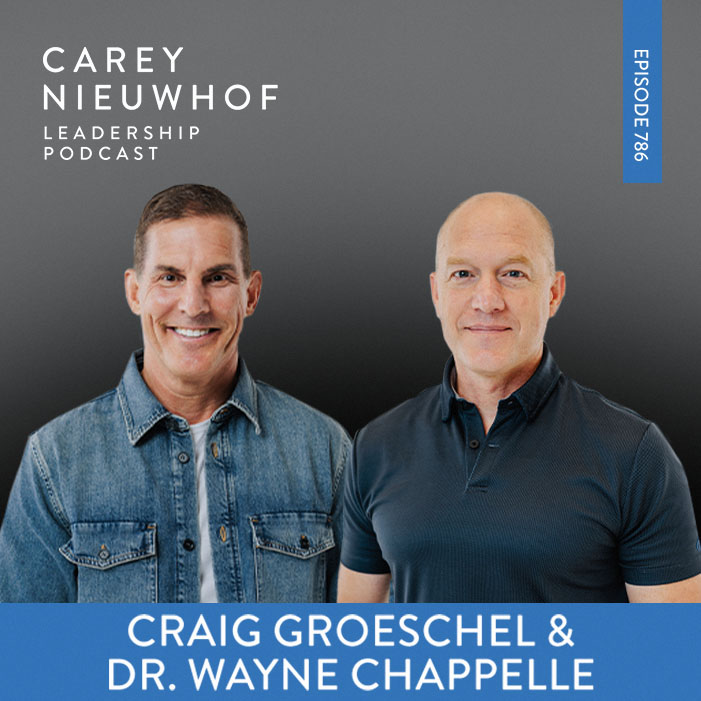
The Carey Nieuwhof Leadership Podcast
CNLP 786 | Craig Groeschel and His Therapist Join the Show: What Happens When a Leader Hits a Breaking Point
01:12:19
Loading summary
Transcript260 lines
- [00:01]
Carrie Newhoff
The Art of Leadership Network.
- [00:03]
Craig Groeschel
I thought, this job will kill me. That's what I thought. Eventually, this. I'm just gonna die doing it. One day it's gonna be too much. I'm gonna drop dead. And they're gonna be like, oh, he was serious.
- [00:15]
Carrie Newhoff
See?
- [00:15]
Dr. Wayne Chappelle
See?
- [00:15]
Carrie Newhoff
I'm dead. Welcome to the Carrie Newhoff Leadership Podcast. I'm so glad you're joining us. You may notice this is not the usual set because we are at Life Church, and I have Craig Groeschel and Dr. Wayne Chapp. Welcome to all of you who are watching, all of you who might be watching or listening for the very first time. We're really, really thrilled that you're here. One of the ways that you can help is give us a follow, like subscribe and leave a comment on this conversation, which I think is going to be pretty amazing. Craig Groeschel, the founding pastor of Life Church. Almost 30 years, right? It'll be 30 years. Actually, it will be by the TIME this airs. Three decades.
- [00:56]
Craig Groeschel
Three decades.
- [00:57]
Carrie Newhoff
Amazing. And Dr. Wayne Chappelle, a new name to a lot of you, but soon, I think a household name.
- [01:03]
Podcast Sponsor/Announcer
We'll see.
- [01:04]
Carrie Newhoff
Has been. What do we call Dr. C?
- [01:07]
Craig Groeschel
He is a. Dr. C is a freak of nature.
- [01:10]
Carrie Newhoff
Okay, there you go. Freak of nature.
- [01:12]
Craig Groeschel
Dr. C, most of the time, a positive freak of nature most of the time.
- [01:17]
Carrie Newhoff
But you hired him back in 2019.
- [01:21]
Podcast Sponsor/Announcer
Ish.
- [01:21]
Craig Groeschel
Correct.
- [01:21]
Carrie Newhoff
Yes. Yeah. To be what, a performance coach?
- [01:24]
Craig Groeschel
Yes. Yes. Yeah. So Dr. C works with kind of top military officials, worked with Olympic athletes. He's currently kind of, in many ways, one of the genius minds behind the Oklahoma City Thunder.
- [01:38]
Carrie Newhoff
Yeah.
- [01:38]
Craig Groeschel
Selecting.
- [01:39]
Carrie Newhoff
You were there last night.
- [01:40]
Craig Groeschel
Yes. And so I say one of them because it's a great team of people that have put together, but what may become one of the greatest teams of all time.
- [01:48]
Carrie Newhoff
They Only won by 50 points last.
- [01:49]
Craig Groeschel
Year pointing that out. So he's one of the geniuses behind that. And I was blessed enough that he agreed to work with me. I was your first pastor, and so in some ways, I was an experiment in your counseling career.
- [02:02]
Dr. Wayne Chappelle
You were.
- [02:03]
Craig Groeschel
You were. For sure. So he was helping me. And I was also saying, but as a pastor, you gotta know this.
- [02:10]
Carrie Newhoff
So military coach, psychologist, also Olympic athletes, elite athletes. You've worked with government officials at the highest level of security. Then you took on Craig, and then Craig said, hey, I got someone. I think this is maybe a year after you started with Dr. C. You're like, you should. He'll see you. The doctor will see you now. And so you've Been also my therapist performance coach for the last five years, six years, which I'm so grateful for. And you just signed with the Oklahoma City Thunder.
- [02:42]
Dr. Wayne Chappelle
I did, yeah. For another five years. That's great.
- [02:47]
Carrie Newhoff
So really hard to put a bio together for a career like that, but this is where we're at, so thank you both for making the time to. And for, you know, the whole Life Church crew and everything. Craig, you've led one of the largest churches, well, the largest church in America now for 30 years. And, you know, you can sit here on the outside looking in and go, everything must be awesome at Life Church. And in many ways it is. I mean, touring the facilities, seeing the production here, it's pretty amazing. We walk through the auditorium, it's beautiful. But on the inside, it doesn't always feel that way. You hit an inflection point maybe six, seven years ago in 2019, what happened?
- [03:30]
Craig Groeschel
Well, in 30 years of leading an organization, it's hard to imagine the variety of things that you will see. You'll see almost everything. And the one thing I had not seen was what I would call kind of like a personal. I'd never hit a wall before and was fairly thankful. And maybe a blind spot was for me, I kind of thought I would not, which was, I'm invincible.
- [03:59]
Carrie Newhoff
Not gonna have a little bit.
- [04:01]
Craig Groeschel
And with reason, meaning I'd set up systems and had the right people around me, and so I had better odds of not doing it. But I had a few blind spots that over time, created a cumulative negative effect. And then one day I just woke up, or say one day over a period of time, I thought, this is getting harder, this is getting more difficult, this is getting more difficult, this is getting more difficult. And I thought, I can muscle through it, muscle through it, muscle through it. But I just continue to take on more and more, and eventually the only way to say it is it just became too much.
- [04:34]
Carrie Newhoff
Yeah. And, you know, I think we would all say, or at least I would say, as someone who's followed you for over 20 years, 25 years, if anybody can power through this, Craig will power through this. What was building up, what was accumulating? What were the things?
- [04:48]
Craig Groeschel
It's hard to say. What's interesting is I almost feel like that was a different person. Like, when I talk to Dr. Chappelle now, I almost wanna apologize for the person that he met, because at the time, it just. I literally. I did think I could power through anything in wood. And then one day, it's almost like whatever power I had humanly Speaking just was not enough. And so it was a little more content, a little. Few more campuses, a few more events and another book, this travel more. And I was able to keep the big things in place. Marriage was strong. Spiritually, I continued to walk faithfully. I was still performing generally well at church. My body and mind and soul was paying a price for it. And I didn't realize how significant that was. Then what happened is I started trying to ask for help, but didn't really have the language. And I was expecting someone to come and help me. And I didn't realize that no one could but me. And so I kept thinking, well, someone will hear this kind of cry, like, hey, I'm really tired. But I didn't have the language to say, I'm in real trouble physically. It's too much. And I didn't know how to ask for help and didn't know how to receive help. And so by talking to Dr. C, it gave me the language and some tools to recognize what had gotten me there and what I needed to change.
- [06:16]
Carrie Newhoff
To get out before we get to Dr. C. Kiss. You gave him an interesting diagnosis. Emotionally, what was going on at that time? Like, what on the inner life that you had, what did it feel like?
- [06:31]
Craig Groeschel
Not much at first. Like, at first it was just, you know, it was more confusion, like, why am I not doing well? I'm not used to not doing well. And then it became a little bit of panic of going, oh, can I keep this up? Like, do I have the ability to keep this up? And I found myself a couple things were helpful is I do the five year journal and there's nothing magic about it. But what's really helpful is you start to see patterns, like, oh, this time last year I was going through the same thing, and this time three years ago I was going through the same thing. So I started seeing patterns in my annual rhythm, like, oh, this is a time that this is the third year in a row where I'm struggling here. And so I was able to ask, like, why and what do I need to do different here? And so I could look at it objectively. But the part that objectively wasn't working was thinking, well, I've always figured it out before and now I can't figure it out on my own. And that scared me a little bit. I didn't know I asked for help to create a system around me that works, but when the demand was too much for the system, I didn't know how to ask or help beyond that.
- [07:37]
Carrie Newhoff
Yeah, I guess one More question, Craig, and feel free to take a pass. But, like, you know, was that sadness? Was it, like, you know, you think about the wheel of emotions. I don't know if you've ever seen that thing. But what were the emotions? What were the emotional signals? You said not much.
- [07:54]
Craig Groeschel
Well, and then eventually the deepest emotion I felt was hopelessness. And what I felt was, here's what happened, and it's crazy. So I'll have a big. Dr. C calls it a work sprint. And so I do a work sprint, and then I get to the end of it. I think, okay, now I can breathe. And then I would look up to see what's coming, and there'd be another sprint in front of me, and I'd be like, oh, there's another one. And there was this cycle of thinking, I can survive this, and then I'll get a break. Then what would happen is I would go and take a vacation or a week off, and it wouldn't be enough for whatever I'd feel like. Well, that didn't work. And there's some reasons it didn't work. One of the reasons was I wasn't doing it right. It wasn't designed in a way that would help refill me. And so I had created patterns that essentially became unsustainable. And then I was looking forward going, I may never get out of this. I'll just. And I began to think in the deepest, darkest parts, which didn't last long, but they were real. I thought, this job will kill me. That's what I thought. This. Eventually, this. I'm just gonna die doing it. One day, it's gonna be too much. I'm gonna drop dead. And they're gonna be like, oh, he was serious.
- [09:02]
Dr. Wayne Chappelle
See?
- [09:03]
Carrie Newhoff
See, I'm dead.
- [09:05]
Craig Groeschel
And I know that sounds crazy, but I thought it has become too much.
- [09:09]
Dr. Wayne Chappelle
Wow.
- [09:11]
Carrie Newhoff
So, okay, that is very clarifying. There's no breaks.
- [09:16]
Craig Groeschel
I was kind of okay with it a little bit, too. Like, that's just what you do. You die. Meaning that's what a good Christian pastor does, is you give it all. And I didn't have the category of permission of things for me that felt selfish or wrong to me.
- [09:31]
Carrie Newhoff
Yeah. And you're barely just past 50 at this point. Around your.
- [09:35]
Craig Groeschel
Back then. Yeah. Now I'm well past 50.
- [09:37]
Carrie Newhoff
Well past 50. But no, I mean, you look at it, hopefully another decade, decade and a half, two decades of life leadership strongly ahead of you.
- [09:46]
Craig Groeschel
And the good news is that in an entirely different place. And so for the person that right now is in that similar spot of panic, there is help and hope on the other side, but it's not going to come generally without some work or an ask.
- [10:00]
Carrie Newhoff
So now, Dr. C. The diagnosis.
- [10:03]
Dr. Wayne Chappelle
Well, I would have to say that there was really no clinical diagnosis you could look at and say, okay, was there a depression or anxiety or some kind of like adjustment related issue? And when you look at what the diagnostic criteria is, and as Craig was describing to me what he was doing, I'm sitting there going, whoa, first of all, what you're doing is extraordinary. You have a lot of things that you're doing. There's a tremendous amount of pressure that you're faced with. You have expectations that are levied on you that are not levied on the ordinary individual. And when I take a look at what it is that you're doing, which is on the outside, extremely successful, you're doing all the things that you need to do. In fact, you're a model for many other people as they're watching you. And yet somehow, some way, the very thing that made you successful, which was your drive, your energy, how much you were taking on, all of a sudden now became a vulnerability. And so I'm looking, I'm going, this, first of all, this is more of an emotional burnout kind of stage. It's not necessarily a clinical diagnosis, but if you keep going the way you are, it will turn into a clinical diagnosis. Now, what made Craig's situation even more complex is when you see the guy, he looks fit. He's one of the most fit guys I've seen for his age. He's extraordinarily fit. He does all the right things in terms of diet and exercise, strength and conditioning. He's got great social relationships, spiritual life was just off the charts successful. And yet here he was taking on more and more. And I have a couple sayings. One is who you are today should be different than who you were a year ago. And who you are a year from now should be different than who you are today. And what was happening is he kept doing the same thing over and over, thinking that somehow it will change or perhaps I can white knuckle it and things will get better. And it was those patterns that he started to recognize. He was going, whoa, this is not working for me. And the crash is like where he could perform at such a high level and then behind the scenes crash and be in bed for a couple of days not being able to get out because he's so exhausted. And then when he gets enough energy to get out of Bed, look at it and go, whoa, that horizon, that's not slowing down. I have to sprint again. How am I gonna keep up with this?
- [12:24]
Carrie Newhoff
Did it hit that way a couple.
- [12:25]
Craig Groeschel
Of days in bed or not really in bed? I don't think I ever did that. But what I did have was a weekend with friends that I was fully present but emotionally barely remembered. That was when it was when we look back and you go, so I did that, but I don't really remember it. And so I think for me, I was more still performing, but not fully and actually getting results, but not able to be. Couldn't remember it. So that was. It wasn't like I stayed in bed depressed, but it was emotionally and mentally. It just wasn't hitting on all cylinders. And it wasn't a long time, but it was enough to go, this is not normal. I need to do something different.
- [13:09]
Dr. Wayne Chappelle
Let me also throw in that. What's interesting is even when you had that crash, when you present yourself in public, you still look great.
- [13:17]
Carrie Newhoff
And so it was very difficult.
- [13:19]
Dr. Wayne Chappelle
So you're kind of waiting for people to say, hey, maybe I could do something to help slow his pace down, or he looks like he might need some help. And you could look out and say, look, I'm really struggling here, and I'm doing so well. But they would look at you and go, oh, my goodness, you look great.
- [13:33]
Carrie Newhoff
You just killed it on the street.
- [13:35]
Craig Groeschel
You preached a sermon, and you. And so I would say that to someone who's listening, there are others out there, high performers, because you probably attract the highest quality of leaders, and there are those that you do know how to perform, even when you're hurting. And that's a strength until it's not. Because other people may not know. And even when you say, hey, I kind of need help, if your performance is still good, they may not believe you.
- [13:59]
Carrie Newhoff
Right. And I'm sure your sermons were still textbook.
- [14:03]
Craig Groeschel
I think I was.
- [14:03]
Carrie Newhoff
Do you think your preaching was taking a hit?
- [14:05]
Craig Groeschel
I don't know. It's hard to judge your own preaching, but I think that sometimes you preach better from an empty place, but that doesn't mean the place doesn't need to be full. So I don't think that impacted my preaching negatively as much as it impacted me negatively.
- [14:23]
Carrie Newhoff
So go ahead.
- [14:24]
Dr. Wayne Chappelle
Yeah, I was gonna say, well, that was actually one of the things I was doing is in order to. For me to get a better idea in terms of what it's like to work with. With pastors, I was watching many of his videos to go, okay, is his performance negatively impacted? Because that's one of the most important diagnostic criteria for a diagnosis. Is is it negatively impacting your occupational performance? And is these, as Craig, as you were describing to me, some of the challenges you were going through, I would watch you on stage and I'm going, oh my gosh, this guy is amazing. He's doing exceptionally well. Which only made it more difficult for people to recognize that you were hurting on the inside.
- [14:59]
Craig Groeschel
Well, same with marriage. I was still very engaged with Amy and marriage still with the kids. And so I was doing everything external that was important, but I was not. I didn't know how to really care for myself and didn't think that's what a good Christian pastor would do. Kind of. It's really odd to even say that out loud.
- [15:17]
Carrie Newhoff
This episode is brought to you by One Accord.
- [15:19]
Podcast Sponsor/Announcer
As pastors and church leaders, our heart's desire is to see every member of our church grow in their relationship with Jesus through the teaching of God's Word. Yet faith for some members, the language barrier can be a real hindrance. It can affect both their understanding of your message and their sense of belonging to your church community. And that's where One Accord comes in. Oneacord is an AI based translation platform designed exclusively for the local church by believers actively serving in their local churches. With over 50 languages available, one accord would love to partner with your church to bridge the language gap. Their subscription plans start from $150 a, so contact them now for a quote at OneAccord AI Carrie where they're offering our listeners a free trial with three hours of translation credit. Join over 200 churches currently using one accord to help translate their services at Oneacord AI Carrie that's O N ecord. AI Carrie. This episode is brought to you by Church Law and Tax. When it comes to legal and tax issues in ministry, most of us don't know what we don't know until it's already a problem, right? I recently heard a story about an 87 year old church treasurer from a small church in Georgia. After decades of service, he put it simply, small churches just can't afford big church lawyers. And what stood out wasn't just his age. It was the wisdom behind that. It actually applies to even the youngest ministry and church planters today. He'd seen small legal issues quietly turn into huge problems. And he found a solution that helped his church stay informed and protected. And the solution? Church Law and Tax. It's a trusted online resource that equips pastors and church leaders with Expert guidance on legal, tax, and other compliance issues churches face every day. For over four decades, they've helped ministries lead with confidence without hiring an attorney or an accountant for every decision. You can start by signing up for their free weekly newsletter at Church Law and Tax. Remember, the law comes before tax. That's church law and tax.
- [17:31]
Carrie Newhoff
Is that like a lifelong thing that you've been really good at? The responsibilities that come with life, but carefully.
- [17:40]
Craig Groeschel
I'm the oldest adult child of an alcoholic, and one of the things that someone that we raised in that type of home does typically becomes overly responsible, often overly loyal. Sometimes a people pleaser tries to keep the peace and that kind of things and those things. And so emotionally and relationally, that's where I am now as a leader. There's kind of like a different category where I get in a different head space, which is you have to do what's right. And then I go home and deal with relational issues, with family, and I become more of a pleaser. And there's almost like two different mind space or head spaces for me. So I go home and be there for Amy, be there for the kids, and then be there for the grandkids. And didn't know how to say, can someone help me fill back up to a place where I can do this sustainably?
- [18:31]
Carrie Newhoff
And you have friends. We were here a couple weeks ago for an event and one of the guys I met goes back to tennis with you in high school. But sometimes it can be really hard and you're well networked with friends as well. And you are a great friend. Like, you've been a great friend to me. Sometimes friends are not enough. Is that true or am I missing something or. It's like I didn't have that layer to those friendships.
- [18:57]
Craig Groeschel
I think the friends are a big, big part of it. So what Dr. C did is he called them wingmen. And what's interesting is so I actually have very, very good friends and feel like I've got everything necessary, all the elements in place to have a God honoring, productive life and ministry. What I didn't have was the language to empowered them to help me. And so Dr. C would meet with my assistant, with the other leaders here, with Amy, with my friends, and say basically what you see that looks like a strength is a strength until it works against Craig. And here's how you can come alongside him and help him. We need to do these three things. And so he gave them language, us, language, me, language. He helped Amy to see that there are times when, yes, you're always available to the kids. But at this point, you might need to create a little boundary to create space for Craig without kids, because that's what he needs. And so it became just more of a team effort that didn't just help me, but helped them, helped us. And that's one of the things I appreciated, was it wasn't Dr. C just counseling me, but he kind of counseled probably the eight or nine people closest to me to create a language that would help us move forward and strategy that's been generally effective. Until 18 months into it, I told Dr. Steve, I think I'm doing pretty good. Am I doing good? Is it okay? Am I allowed to do good? And then I looked back and I go, who was that guy? And how did I even get there?
- [20:38]
Carrie Newhoff
The diagnosis. Okay, so two questions. Dr. C. And I think Craig would have found a virtuous way to get through whatever wall he hit. You were hitting a wall, but if you kept going and it was unsustainable and it almost killed you, there were further consequences down the road. And I think I know you well enough to know you have enough integrity. You wouldn't have taken the usual way out through an affair, that kind of thing. But typically, what happens for people watching, listening right now, who are like, ooh, I resonate with this. If you don't get help now, typically what happens?
- [21:11]
Dr. Wayne Chappelle
Oh, well, if you wait, the situation doesn't magically resolve itself. A lot of people think, if I can just wait it out, things will get better magically. But that's not how things happen. And oftentimes people will think, well, I'll just wait for the environment around me or people around me to change. And you can't do that either, because typically what happens is you'll have a slow fade and it'll lead into some kind of emotional or behavioral issue. In my experiences now of working with pastors, I found that there are seven particular issues that they oftentimes struggle with when they don't get the help. One is bottle or substances, so either go to alcohol or misuse of even over the counter prescription drugs. Second is wallet. Sometimes people cope with spending or mismanagement of money, or they start to get so focused in on money that that becomes their. Their go to zipper, which is sexual misconduct. And interestingly enough, even when working with professional athletes, the highest military generals that are in the world, it doesn't matter how much success that you have in that realm. The attention and the validation that you can get from the opposite sex is very powerful. And where you're feeling low or insecure, you'll oftentimes move in that direction. The next one is temperament, where you let your emotions get the best of you. And sometimes it's an isolated incident or an established pattern of behavior where you let anxiety or depression or anger get the best.
- [22:46]
Carrie Newhoff
And that's where toxic culture comes in.
- [22:48]
Dr. Wayne Chappelle
Exactly. And then there's, like, wolves. And the wolves are people who are a part of your life who are oftentimes in your inner circle, but they look like lambs, but they're taking advantage of you. And when you are so distraught or you don't have the energy to set up those appropriate boundaries, those wolves come in. And then you have jealousy or ego or pride, or you start to try and control things that you have no control over. And as a result, people slowly fade in.
- [23:19]
Craig Groeschel
That.
- [23:20]
Dr. Wayne Chappelle
Now, something that's important, and I wanted to share here, and that is the wingman concept. Nobody ever becomes the best version of themselves by themselves. And a lot of the things that I do in psychology are very different from what traditional psychology is all about. And what's interesting is I took the same approach that I did was working with special operational units across the globe with Craig, because I saw him in a very similar light. High performance, high demand, highly visible. And so how do you help those individuals not just simply survive a normal day with all the pressures, but how do you help them thrive? And what's interesting is our definition in our culture of thriving is I can show up, do a great job under ordinary conditions. That's not thriving. That's just barely surviving. Thriving is, can you show up, do a phenomenal job, and be extraordinary under extraordinarily difficult conditions? And Craig was facing extraordinarily difficult conditions. And so part of meeting with the other one was to help him understand, hey, this is where we're going to go, and you don't have to struggle in order to meet with a psychologist for mental strength and conditioning. But the other piece of this was helping him understand and even define a good wingman. Now, a good wingman, we oftentimes think is somebody who's really nice and says great things and is very supportive. And that's part of the equation. But you need to have a wingman that's willing to punch you in your face. A wingman is saying, look, you're going down a path of destruction, and I need to prevent you from going down that path. And if so, that means I have to tell you the tough things, maybe even share with you things that you don't want to hear, but I have to let you know because if I watch you self destruct and don't say anything about it, then I'm contributing to the problem. So good wingmen are individuals who are not ones that avoid conflict or say nice things, but they're willing to essentially put strong boundaries and be very truthful in a very loving way. Now, sometimes wingman don't say it the best way, a little bit offensive, but you got to have a strong wingman. And that's the other thing I want to throw out there in the sense that when you're a pastor in a position of authority, you have to make sure that you surround yourself not just with yes men, but people who are willing to speak truth into you and not be intimidated by the authority that you have. I'll give you an example. I was working with a four star special operations general and he needed to have. He would go into his meetings, right? And we're planning some very strategic operations across the globe, things that are affecting national security, and some very important things and activities are happening around the world, right? And this guy's going into a room and he'll say, an idea, and he'll say, hey, this is what I'm thinking. And everybody around that room will go, hey, sounds like a great idea, boss. And I'm sitting in there going, wait a minute, you could tell this guy that he's wearing no clothes, or he'd come in completely wearing no clothes and everybody's gonna say everything is great or fine. And he looked over me, he says, can you find me somebody who's willing to be a good wingman who's willing to say no to set boundaries and to challeng? And so I did, I found a three star general. And I says, hey, do you think you could go in to be this guy's wingman and tell this guy, stand up to him, stand up to him. And when we did that, it changed the culture and it made it better.
- [26:59]
Carrie Newhoff
So on that note, I think one of the things every pastor, church Leader, or even CEOs struggle with is, you know, and this is particularly difficult for you, Craig. You have a lot. You have over a thousand people working for you with you. You have your elders, they have some power over you. But there's like always a dual dynamic, right? So to find that wingman, and I'm not asking for names, but I'm wondering, how did you do that? Because I have this conversation every month, sometimes every week with a pastor about finding someone they know in their life. Probably can't be somebody who works for them, because you always have the power to hire and fire. How did you go about finding that wingman or identifying that person in your immediate circle?
- [27:45]
Craig Groeschel
It's a great question. So, first of all, I think you have to create a culture where people not only have permission to push back, but you celebrate it. For example, Stu is in this room, and the last two times we did videos, it meant so much to me. He stopped me and said, hey, you got too much energy. You sound like an announcer. Slow down. And at first, I was a little bit shocked because people typically don't do that. And I said, thank you for that. You really helped me. And he did it again. He stopped me a second time. And then he helped me become better. And so I took him aside. I think I wrote him a note or emailed him or something because it meant so much to me. And then the next time we came in, he did the same thing again. I'm like, I can trust this guy, because in our organization, most people would never do that. So you have to create. Create an organization where they feel safe to do it, and then you celebrate it when they do. You're gonna have a hard time finding three close friends that will do that for you if you don't create a bigger net where that's celebrated. So then I don't know how someone else is gonna find. And what I do know is that I had them already. I had a very strong network of friends. But what I had not done was had someone like Dr. C or didn't have the tools myself to say, here's how you can help me.
- [28:59]
Carrie Newhoff
Here's what I need from you.
- [29:00]
Craig Groeschel
Yes. So I did in other things, like, I need you to keep me from doing too much of this or whatever. But I didn't create an environment to. Whenever you see me doing this, here's what you need to say to me. Or when you see any of these wrong things where there's red lights going on because I'm doing too much, I want you to call me in and call this person, this person, get Amy in and have a come to Jesus meeting with me. And so, thankfully, we have not had to do much of that once creating the team because things sort of got healthier. But there have been a couple times where Jen, my assistant, will say, you told me if you get to this place, you're doing too much. No, you cannot go do that even though you want to. I go, okay, yes. And so she becomes, in some ways, a buffer and a Boss to me, like, on, you know, helps me not do too much.
- [29:52]
Carrie Newhoff
Yeah.
- [29:53]
Craig Groeschel
So one of the things, you have to receive it. I mean, if you don't want it, you know.
- [29:56]
Carrie Newhoff
Right. If you're like, oh, here's why I'm doing it.
- [29:58]
Craig Groeschel
First of all, you have to be honest about where you need the help. You have to do that. That's one big thing that pastors might not do. Second, you have to choose the right people, and they're probably there. Or if not, you're probably in bigger trouble. That's a bigger conversation. You know, and then you want to equip them with the. You know, and celebrate it when they do. Don't push back. You're doing exactly. You know, I didn't want to hear that, but I needed to hear it. Thank you. That goes a long way.
- [30:23]
Podcast Sponsor/Announcer
Yeah.
- [30:25]
Carrie Newhoff
We can cut this if you don't want to talk about it or if it's not helpful. But when you take on a client, I assume you did this for Craig. You did it for me. You run them through this psychological profile called the Neo. And one of the things, it's sort of baseline. It's a circle. So imagine this coffee cup, baseline. This is like, I don't know, you assess 20 or 30 different characteristics, and then it's like high performers. And this is military athletes, top leadership. People have a different spectrum than the general population. And then you plot us against the mean or the average. And I remember my activity was off the charts. And you're like. You are, like, clinically obsessed with activity. You cannot stop. And that has been a constant thing that everybody who's worked with me over the years has said. It's like, I just can't keep up. I can't keep up. I can't keep up. Right. I imagine yours would be similar. Could be something different. What did you. To the level that you're comfortable sharing? Notice that was exceptional or off the charts?
- [31:28]
Dr. Wayne Chappelle
That's a good question. You want me to go ahead and throw that out there?
- [31:32]
Craig Groeschel
Nothing to hide. No, there's nothing I'm embarrassed to share.
- [31:37]
Dr. Wayne Chappelle
So that's the other thing I think I would love for leaders to understand, and that is to be very transparent with their profiles. And this assessment's a little bit different than typical assessments like enneagrams or strength finders, where we like to put people in boxes and we create labels. That's helpful. But labels oftentimes can be very restrictive. And so the last thing I'm going to do is put a label on anybody. What I really want to do is is look at who you are holistically and understand what is your fingerprint? What does your psychological fingerprint look like? Because the very things that make you great in some areas can be the very same things that actually create problems for you.
- [32:15]
Carrie Newhoff
Yeah, my activity's a problem.
- [32:17]
Dr. Wayne Chappelle
Yeah. And so for, like, Craig, one of the things that made him so great was not only his activity level being really high and he can take on a lot, but his expectations of himself were extraordinarily high as well. Those two particular character traits are the things that actually drive success. You can have a brilliant iq, but if you're not willing to work hard and set a high, set standards for yourself, you're not going to achieve. You can have an ordinary iq, but if you have a high level of activity and you have a super high drive, you're likely going to excel. So two things happened. One is, whoa, I got to slow down. The thing that worked for me, the issues that got me here are not gonna be the same things that are gonna keep me here, and that's that sprinting piece. The second thing is how difficult or maybe critical he could be of himself in terms of just overall performance. And you look at him, and I'm looking, watch him going, whoa, this is really good. But afterwards, he might be like, I could have done that better. I could have done this better. So there's this constant drive. Now, what's interesting is movement is a good thing. We want to keep moving. We want to have that drive and a high level of activity. But sometimes we need to slow down. Sometimes we need to actually pause and breathe for a little bit, because sometimes it's in the silence that we hear God's voice. And if we're constantly moving and busy, we will miss that.
- [33:45]
Carrie Newhoff
Today's episode is brought to you by.
- [33:46]
Podcast Sponsor/Announcer
Fund the Future Masterclass.
- [33:48]
Carrie Newhoff
I'd love to share just a quick.
- [33:50]
Podcast Sponsor/Announcer
Word with you about something that Craig Groeschel and I created together. In this episode, Craig and I share that we both walked really hard seasons in leadership walls that felt like they might take us out if we didn't do something different. And one of the biggest challenges I think a lot of leaders face, it's sustainability, right? Vision and momentum. When finances feel stuck and giving doesn't match the mission that you see God calling you toward. That's why Craig and I, along with Ashley Woolridge, Chris Hodges, and others, created the Fund the Future Masterclass. It's a course built to help you beyond transactional conversations about money and into a transformational culture of generosity. It's a step by step framework with practical strategies for casting vision that inspires giving, engaging donors in ways that actually feel healthy, not weird and biblical, and funding your mission for the long haul so you can get actual tools and frameworks, not just ideas. And you'll learn alongside other leaders wrestling with the same challenges. So if you want to grow in a way that lasts and you want to scale this barrier that Craig and I both had to scale at different times, go and check out the link in the description of this episode or just visit Carrie newhoff.com Fund the Future. That's Carrie newhoff.com Fund the future.
- [35:12]
Carrie Newhoff
What did you learn about yourself?
- [35:14]
Craig Groeschel
Well, even hearing that now I know is true and I don't like hearing it. I don't like the words when it comes out of his mouth. We need to slow down the way he said it slowed down. It's irritating.
- [35:24]
Carrie Newhoff
What's underneath that? What's underneath that?
- [35:26]
Craig Groeschel
Well, I don't really want to slow down. Like I genuinely don't enjoy slow at all. I kind of hate it. You know, I don't want nothing to do. And I don't know if that's, we haven't explored that. But maybe that's next.
- [35:43]
Dr. Wayne Chappelle
Take a note.
- [35:43]
Carrie Newhoff
Take a note.
- [35:44]
Craig Groeschel
But I mean, but like Dr. C helped me see, like I would say, well, you know, so and so they're just lazy. And he's like, well, how do you know they're lazy? Maybe they just have different values. Like their values are dumb because I just, I couldn't, I couldn't, I don't understand slow. And so, but he did help me to see that disconnecting is really important, you know, and that was part of his kind of prescription.
- [36:07]
Dr. Wayne Chappelle
Well, also disconnecting from work too.
- [36:09]
Craig Groeschel
Yes.
- [36:10]
Dr. Wayne Chappelle
And what I find interesting is working with professional athletes now entertainers to looking at special operations. I'm looking at pastors and going, oh my goodness, you can get away with things in these other high performing positions in your personal life that you can't get away as a pastor. And so the personal and the professional are much more integrated and combined. And so half the battle was also figuring out, well, how do you disconnect mentally and emotionally enough from what work and have balance and also do it well where you're not only just disconnecting but you also come back better. You're free.
- [36:51]
Craig Groeschel
Yes.
- [36:51]
Dr. Wayne Chappelle
Yeah.
- [36:51]
Podcast Sponsor/Announcer
Yes.
- [36:52]
Carrie Newhoff
Well, this is the problem, right? Because okay, I'm going to take some time off. But your phone's with you, your laptop's with you, your head's moving. Oh, I could do this on Sunday. I could do. Well, you're working 17 weeks ahead, but, you know, I could do this in the summer. And you gave him an interesting prescription or diagnosis and then. Prescription. And I want to talk about that because people who follow you closely, which is a lot of people who are watching or listening all of a sudden are like, oh, that's why he did that. They'll put the two together. But I think the diagnosis was depletion. Is that right? What is depletion?
- [37:27]
Dr. Wayne Chappelle
Well, I would have to say that depletion is essentially where you're running out of energy. You just Emotionally, physically. I'll say just physically and mentally, you just. Your energy's done, and as a result, you can't function at the level that you expect of yourself or should be doing.
- [37:47]
Carrie Newhoff
So you're stepping on the gas, but the power's not there.
- [37:50]
Dr. Wayne Chappelle
That's right. And one of the sayings that we had come up with was, just because you can doesn't mean you should. I've heard that. And when you are wired to constantly be busy and. And to take on lots of things, there's always this desire to say yes to requests for speaking engagements, for doing all these other sort of things that were levied upon him. And I think being a pastor, in his level of visibility, there's no shortage of demand for his attention. And the other piece with disconnecting is because he's so visible, it's hard for him to go out in public without being recognized. And that only can add to.
- [38:26]
Carrie Newhoff
Yeah, you can't go to a restaurant in Oklahoma City without somebody, I'm sure, saying hello.
- [38:30]
Dr. Wayne Chappelle
What people I think don't realize is that's very similar to professional athletes. Shay can't go out in the general public without being recognized in Oklahoma City. Right. And when that happens, people will, you know, come up and.
- [38:42]
Carrie Newhoff
NBA player, for those like me who.
- [38:44]
Dr. Wayne Chappelle
Don'T know, sports MVP of the NBA.
- [38:47]
Carrie Newhoff
Also. Also that. Also that.
- [38:49]
Dr. Wayne Chappelle
Right. So, yeah, it was depletion. And one of the things about Craig before I had met him, was maybe people around me will help control some of the things that are depleting me. And not recognizing that the only thing that if he's going to get better, he has to focus in on what he can control versus what he can't control. And what he can control is him and the decisions that he makes and the way that he thinks.
- [39:20]
Carrie Newhoff
So your prescription was.
- [39:23]
Dr. Wayne Chappelle
Oh, man, we had a lot of prescriptions.
- [39:24]
Craig Groeschel
Well, what he's thinking about. And I've tried to tell this story, but it may not be accurate. You told me to go make a list of. Was it 30, 35. What'd you say? Make a list of 30 things that are daring, high adrenaline. Tell me what you said.
- [39:38]
Dr. Wayne Chappelle
Yeah. So essentially, I want you to take a list and create a list of 30 things that allow you to refuel what I would call the dopamine and the norepinephrine and the serotonin. Because when you get really stressed out over a long period of time time, your cortisol levels go up and all these other sort of reward factors go down. So create a list that allows you to explore things that you would love to do, and that separates you and completely disconnects. But it's got to have freedom. It can't be because you're inside all day. It's got to be somewhere outside because you're very well controlled and composed. It has to be something in which you are allowed to do things that you couldn't do at work and to let some of that freedom. To be essentially aggressive.
- [40:25]
Craig Groeschel
Yes. Yeah, exactly. To be a man, that's so low. But it's like, you know, so much of what we do is pastoral, and it needs to be. And there's. And I always joke around. Long before I was a pastor, I used to be a man. But it's like, it's a joke. But, like, I don't get to go do things that are aggressive, which would be fun. Not, you know, like sports. There's not a group. And so that advice, oddly enough, though, seemed really dumb to me. Like, why would I want to go ride motorcycles? Why would I want to go climb a mountain? Like, I don't have time for that, and it's not productive. And so it seems.
- [41:05]
Carrie Newhoff
So doesn't it dance the mission?
- [41:06]
Craig Groeschel
It doesn't. And, like, I'd never done a guy's trip in my life and don't want to. You want to go play golf? It takes too much time. I'm not going to go play golf. Who has time for that? So there was kind of this almost reverse dangerous pride. Like, I don't do that kind of stupid stuff. And so when he told me that, I kind of pushed back and said, like, that's dumb. And he said something like, fair enough. So here's your options. You can, you know, you can listen to what I'm saying, try it, and possibly get better, or you can fire me, go hire someone else, spend another year with them, and come to the Same place. Or you can stay stuck in your same cycle. And I go, okay, fine, I'll go try something.
- [41:46]
Carrie Newhoff
Do something dumb.
- [41:47]
Craig Groeschel
Yeah. And I think I only came up with two things to try because I couldn't think of five. Maybe I came up with three or four. I don't know what it was, but I tried one and tried the other one. And I surprisingly came back going, oh, I'm alive. And flying in particular, I took up flying, which I had no interest in it before, now becomes one of the most incredible distractions because I'm learning. I mean, I've gone crazy. I got my instrument rating, I got a type rating.
- [42:21]
Carrie Newhoff
Talk about that commercial rating. You can now fly people legally.
- [42:26]
Craig Groeschel
Yeah, I could be paid. I won't ever have a commercial car. But I just wanted to be good at it. And so I. Those two things gave me an outside. It gave me the ability to stop thinking about the church. And oddly enough, when I stopped thinking about it, I got better thinking about it when I came back. And it gave me a whole new growth area to say, okay, I'm 58, but I'm learning. Like, I'm an 18 year old, you know, I can take on new things. And that was really good.
- [42:53]
Carrie Newhoff
The other was, go ahead.
- [42:54]
Dr. Wayne Chappelle
I was gonna throw in. So in your environment that you're in, especially as a high performer, high visibility, your life is very restricted and you had to be very composed. So one of the things that I remember asking you to do is do something that when you're doing it, you can't think about anything else because it'll be harmful to you.
- [43:12]
Craig Groeschel
Yes. Yeah.
- [43:13]
Dr. Wayne Chappelle
That you have to be.
- [43:15]
Craig Groeschel
Same with jiu jitsu. I'm going get. The other one was beat. I'm getting beat up, you know, and you're tangled up by people that weigh 30 pounds less than me. That's, you know, it's humbling and I'm learning something. And so both those things that take tremendous focus, lots of learning, and they get my mind off.
- [43:33]
Dr. Wayne Chappelle
Yeah. So let me put some aside. Here you are. You're depleted, Right. That's kind of like the diagnosis. You're really exhausted. You don't have much energy. And yet the activity that we were prescribing for you was go out and learn how to fight and fly planes. Put yourself in a position in which you're gonna get hurt and you can't think of anything else other than what.
- [43:52]
Craig Groeschel
It is that you're doing. Yeah.
- [43:53]
Carrie Newhoff
Or you're gonna die.
- [43:54]
Craig Groeschel
Right. So you sit there, go, I'm.
- [43:56]
Dr. Wayne Chappelle
I Don't want to take a break to feel alive. And I'm like, all right, let's fix that as soon as you're done, right? When you finish at the end of the day, go fight. Go fight. Somebody Learn how to fight. Learn how to engage in hand to hand combat and be effective at it. Great. Learn how to fly a plane at a jet speed while you're flying down. And I remember you sent me this text message and it was just awesome. I think you were on the flight line. You were probably doing well over 100 miles an hour in an aircraft, a small aircraft, and you guys hit a deer. And that is something that is like, could kill people, right? I mean, and here you are, you're like, whoa, I'm not having to take a break to feel alive. And I'm looking at this.
- [44:46]
Craig Groeschel
So. So I said, we can share anything. That's one thing we haven't shared. But I will say, yeah, I was actually. I flew the first leg to go see a campus, and then my friend flew the second leg and we were coming in for landing, and it was a place that now they have deer protection because so many strikes. Deer ran out in front of us and yeah, so we did clip a deer. I was not flying the plane, but I was right seat and we survived it. And then I forced myself to go up immediately the next day. And it wasn't hard. It was like, you know, there it is. That's what you were afraid of. And, you know, it just happened and we lived through it.
- [45:26]
Carrie Newhoff
So the key, if I'm getting this right, because that's not a prescription for everybody, like, I'm probably not going to go enroll in Jiu Jitsu. I'm not wired the same way you are.
- [45:34]
Craig Groeschel
No, most people should not. Yeah.
- [45:36]
Carrie Newhoff
For you, that was something to be excited about, something difficult.
- [45:41]
Craig Groeschel
And not everyone else needs the adrenaline, so I wouldn't say that. But what everyone does need is a good team of people around them that every high profile, every effective leader needs. A great.
- [45:53]
Carrie Newhoff
I like the idea of something that will take your mind off work, because work is always on my mind.
- [45:58]
Craig Groeschel
I think Dr. C probably told you something similar.
- [46:00]
Carrie Newhoff
Yeah, yeah. And I haven't done as well.
- [46:03]
Craig Groeschel
So on that note, so let's talk about you.
- [46:05]
Carrie Newhoff
Let's talk about you.
- [46:08]
Craig Groeschel
Look at that. Wow.
- [46:09]
Carrie Newhoff
Time flies.
- [46:10]
Craig Groeschel
Well.
- [46:11]
Dr. Wayne Chappelle
But I think what was key there was just the balance, right? Because what you do is so benevolent. You shape the hearts and minds of thousands of people to help them live a life that's better versions of themselves. And because of that, it's easy to give and give and give without looking at oneself and going, what do I need to do to take care of myself?
- [46:32]
Craig Groeschel
And.
- [46:32]
Dr. Wayne Chappelle
And then we get so stuck in that pattern that we forget, man, there's so many things out there that we can be doing and should be doing that allow for us to step outside of the work that we're doing, that become expressions of ourselves and allow us to actually, when we return to work, be better versions of ourselves. God designed you to have very specific interests, and when you let those things go in favor of other sort of things, they'll cause the depression.
- [47:04]
Carrie Newhoff
What I was gonna do, it's funny I said I haven't done it yet, but I remember I bought a brand new road bike this spring and I was getting into peak fitness and then I got sick and landed up in the hospital. And I'm recovered now, but like, I put that one on the shelf, but I'm pulling it back out.
- [47:18]
Craig Groeschel
Good, good.
- [47:19]
Carrie Newhoff
Yeah, yeah. I'm gonna get in the shape of my life over the next year and that's what I'm gonna do. So sometimes life throws you a curveball. Craig, this new book you've written with Dr. C, is it kind of a companion book to Winning the War in your Mind?
- [47:37]
Craig Groeschel
It wasn't meant to be, but in titling it, we actually, we kind of debated should we use the word mind again? Cause we call this one Heal your Hurting Mind and Winning the War in youn Mind. And I actually wanted to do that. The book is entirely different. And it's all about. It's about anger, depression, depletion, burnout and mental health. And so I didn't want to write that book alone because I'm not a clinical psychologist. And so that's why I asked Dr. C to write it with me. But I wanted to bring a pastoral perspective and a scriptural understanding to some of the more common problems facing pastors, leaders and just everybody today. But I wanted to help with it. And so I'd say it's very complimentary, but entirely different.
- [48:22]
Dr. Wayne Chappelle
Yeah.
- [48:23]
Carrie Newhoff
So being an uber high performer.
- [48:29]
Podcast Sponsor/Announcer
You.
- [48:29]
Carrie Newhoff
Have been very candid with, struggling with negative thoughts, negative self talk. Since you wrote Winning the War in youn Mind, what's happened with those negative thoughts?
- [48:40]
Craig Groeschel
Yeah, so Winning the War in youn Mind was both. It was. It was a. It was a journey of kind of self learning. I just got completely obsessed with how does the brain work and God created it and how can I maximize this amazing tool for his glory? And same with like physical things. Like people say, why do you care about being in shape? Like, going, I wanna bring my best self to the work of God every day. And so it's not, you know, I don't post pictures, my shirt off, number one, I'm too old. And that would be gross. But that's not the reason I don't. But it's because holistically, as disciples of Jesus, we should. Our marriage, our relationship with God, our fitness, our mind, our body, our soul, we should do it the best we can to bring the best of that version everywhere. So I got really obsessed with learning about the mind, and I forgot a question.
- [49:30]
Podcast Sponsor/Announcer
Oh, no.
- [49:30]
Carrie Newhoff
What happened to negative thoughts? Since you wrote that book.
- [49:37]
Craig Groeschel
As a high achiever, one of the ways you get there sometimes is you raise the standards for yourself. Well, I was also hard on myself. And so what, someone else might score an eight, I'd be like, no, no, that was a five. I could do better. And so I would use my own high standards to push myself to be better. But negative thinking is negative thinking, period. And it's not. You cannot have a positive impact if you always have a negative thought process. So I literally trained, just like I trained my muscles, I retrained my brain, you know, neural pathways, brain ruts, whatever you want to call it, to think on very specific truths. And so now what happens is anytime I get into a negative thought pattern, I don't have to stay there long. I catch it, capture it, replace it, and I have just statements that I say over and over again, and it's so much easier. Doesn't mean that I never don't have negative thoughts, but it doesn't mean they hit me as hard or as long as. And they don't have the same effect because I can recognize and replace them. And it's a game changer. And this is not just positive thinking. This is renewing your mind according to the truth of God.
- [50:43]
Carrie Newhoff
So that's gotten a lot better.
- [50:45]
Craig Groeschel
A lot better.
- [50:47]
Dr. Wayne Chappelle
It's like reprogramming the way that you think. And sometimes these negative thoughts can occur so automatically, without any effort that you don't recognize them. Half the battle is being able to recognize and just be. Pay attention to your thinking. Because your brain is like a computer program. We program it with specific code to interpret the world around us and ourselves and so on. But you have to then also be mindful of how you're thinking and be able to understand. My emotions are not the result of things that are going on around me. It's the way I'm thinking, and then it's what you replace it with. And you can't replace it with, with a lie. You have to be genuine, it has to be realistic and it has to be to some degree, inspirational. And that's what we came up with, the term grit. Genuine, realistic and inspirational thoughts.
- [51:35]
Carrie Newhoff
Yeah, you've counseled me on that too. I was going through a loop.
- [51:40]
Dr. Wayne Chappelle
It's very similar to what you see with professional athletes who can go out and have a great game, but they get so focused in on things that they might not have done well that all of a sudden they think their game was horrible and you have to go, wait, let's take a step back. Let's really look at this in a more meaningful, genuine and realistic way. And then they're like, oh, you're right. Okay, now I don't necessarily feel great, but I don't have the level of distress I had before Craig.
- [52:10]
Carrie Newhoff
When you look back on all 30 years, would have been some other surprisingly difficult moments for you.
- [52:22]
Craig Groeschel
What's interesting is there are so many, you know, early on, I mean, there's so many. I mean, last night I was up at 11:15 doing pastoral calls because they were necessary and there were two of them. And so the pastoral end of it is always difficult. And I just wanna say, hurts my feelings sometimes. They'll say, but you know, Craig's a really good pastor. Like going, just because you see the other stuff, you don't see the pastoring stuff. That stuff's always there, always there, always there, always.
- [52:54]
Carrie Newhoff
And you are a great pastor.
- [52:55]
Craig Groeschel
No, thank you. But it's like, no, I am a pastor. I'm not a leader first. I'm a pastor first. I'm a pastor who leads, you know, and so that's difficult. I mean, other things.
- [53:05]
Carrie Newhoff
What makes pastoring difficult?
- [53:06]
Craig Groeschel
Well, you're, I mean, Carrie, this week we had a 19 year old murder shot by her boyfriend. You know, I've got another. I've got a staff member with a kid that's suicidal, attempted suicide. I mean, this is yesterday, you know, and so there's just, there's that kind of stuff. Pastoring, the staff alone is. Stu's in this room, flipped his truck five times and thank God he lived. You know, he's in this room. And so I'm involved in those people.
- [53:34]
Carrie Newhoff
And you got a thousand staff.
- [53:35]
Craig Groeschel
And then at the different campuses, you know, I can't reach them all, but when I find out about them, I'll call them, you know, send them a video and whatever. But it is just the pastoral burden is real. The leading in this day is just complicated. If you're out seeing what people say about you online, it can be, you know, at any level. You can have a church of 200 people and, you know, local news does a thing and you read the comments and it'll hit you. So you have to, you have to stay focused on what's. And I'll just be super, super transparent with you because I care. I look back at that season when Dr. Chappelle was working with me. I'm going, who was that guy and how did I get there? And I'm a little embarrassed, but there's a way out. But I'm thankful to be a way out. There's still ebbs and flows. And I look at my journal and December when we're recording. This is a difficult season for me. Historically, based on the load and I think based on kind of the family demands and going into the new year, it's just a harder time. So in this week, I have been. I felt like I lost a little altitude and got knocked off track. So what I have to do is I correct, I add power and I renew my mind. And so I'm focusing on those things. And it doesn't mean like, you're bad and now you're good. No, it's like you're bad and you're getting better. You're good and you had a setback. You're constantly making adjustments, nonstop, nonstop, non stop, tweaking, praying, seeking God. And that's part of the process. And that's actually the beauty of it is when you understand where you're vulnerable and you understand what helps you be successful and what's the difference and what's the tools to get you there. Then you almost counsel yourself, which is kind of what I do a lot. I don't have to. People say, do you still call Dr. C? Only to catch up. We haven't talked serious anything in years. But to see how he's doing, to see how I help him, just talk about the church more, that kind of thing. Because I have the tools and the people and know how to work a plan. It's like God's word. When you know his word and you live his word, it tends to please God. And so you want to get the tools and the people in your life to do it. So I'm not always great, but I always have the tools to realign and regain the altitude and have to do it. Then you have to actually do it. Like you need to get on that bike and.
- [56:00]
Carrie Newhoff
Yeah, I'm gonna get on that bike or something. Throw it on the trainer.
- [56:03]
Craig Groeschel
Yes.
- [56:04]
Carrie Newhoff
So you've said this a few times in our time together where you're like, I look back on that guy and I'm like, who are you? Two things. Number one, what do you notice about him? Number two, what would you say to him sitting where you are now?
- [56:19]
Craig Groeschel
Well, first of all, I'd say, great job. Because, I mean, great work. You did it, you listened, you made change. Like, really good job. I'd say that. And then two is, I'd say, don't get there again, you know? Yeah. And if you gave me going back to him before, I would have said, ask for help and receive help earlier. Not just ask for it, but receive it, you know, and be bolder, be louder.
- [56:47]
Carrie Newhoff
How do you know you're not going back to that ditch? I have some burnout was 20 years ago this year for me, and I have markers along the way I won't get into where I'm like, okay, I know this isn't burnout. I know this isn't burnout. How do you know you're not heading back to the wall where you're like, oh, ministry's going to kill me.
- [57:05]
Craig Groeschel
Yeah. Well, for one thing, I don't like talking a lot about burnout and depression, things like that. It seems to me there's almost. I was hesitant to write a book on those things because if you talk about them too much, you're almost like prophesying them into being like, are you depressed? You know, I didn't think so. Maybe I am. I guess I am. It's almost trendy to have mental health issues. And I don't say that because there are genuine, heartbreaking, very real, very different mental health issues today as to 10 years ago. And so no doubt about that. But what we don't want to do is we don't want to stay in them and give people permission to almost, like, have 10 years of therapy. Like, you really don't want 10 years of therapy. Right. You want to. You want to work on it.
- [57:46]
Carrie Newhoff
You want to get better, you want.
- [57:47]
Craig Groeschel
To get out of it. And again, I forgot your question. I start rolling off.
- [57:51]
Carrie Newhoff
But no, what would you say to him? And then what do you see?
- [57:54]
Craig Groeschel
Yeah, so. Oh, how do you stay out of it is what you're asking.
- [57:57]
Carrie Newhoff
Yeah, how do I stay out of it?
- [57:58]
Craig Groeschel
Yeah. And so I would say, if there's trouble, I'm going to call Dr. C. But right now I'm able to go to Amy, Bobby came into my office yesterday, sat down and said, hey, here's what I'm seeing, here's what we need to do about, we're going. Okay, that's good advice. Same with Jen. She's like going, yeah, you're not gonna do that. And so once the, if the plane starts losing altitude, what I do is we're gonna add the right power to it. And so we're now mad in power. We're gonna self correcting, we're gonna self correct.
- [58:23]
Carrie Newhoff
And your self awareness has probably really grown too.
- [58:25]
Craig Groeschel
Really? Yes. So you recognize it earlier and you know what to do about it, but you just have to do it. And I'm not going back.
- [58:32]
Carrie Newhoff
What do you see in Craig from when you met him to today?
- [58:35]
Dr. Wayne Chappelle
Oh, a lot of changes. You know, on the outside, I think if you weren't aware of all the stuff that was going on, you would, gosh, that guy has been performing exceptionally well for years and it's been amazing. But inwardly he's very different. And I think inwardly he's different because not only are you more self aware, but you're also more open to receiving feedback from the wingmen who are around you. And I think it's also where you recognize that mental health is not just a state of being that you achieve. It is a constant, constant daily condition that you have to be aware of. Nobody ever gets to a point of thriving and they just stay there. No matter how successful they are. There are always going to be ebbs and flows based upon the environment that you're in. And so when we think about like our spiritual life, we got to have prayer, we have to have worship, we have to have meditation, and we do those daily in order to keep ourselves spiritually strong. There are things that, that he's doing now daily that keep him mentally strong as well. And the other thing, and I like what Craig had to say, which is sometimes we can get so focused in on words like depression and burnout or pathology that they become self fulfilling prophecies. And that's all we see and that's all that we interpret. And when I look at Craig, when I look at you, I see, here's a man who is experiencing at times very difficult emotions that are very powerful that have taken. If you don't have the right processes in place, we'll get the best of you. But what you're going through is normal based upon abnormal conditions. And we have to understand that. The other piece is we want to embrace the pain in our life. We want to embrace the problems in our life. Because in my experience, when I work with people, I have never seen people grow and become greater versions of themselves without being on their knees first. And when we live in a culture today that says, man, if you're going through problems or trauma and you have issues, therefore you're a victim or it's bad, no, we want to embrace that because those are the things that actually make us better.
- [60:45]
Carrie Newhoff
Yeah.
- [60:46]
Dr. Wayne Chappelle
Does that make sense?
- [60:47]
Craig Groeschel
Yeah, yeah, yeah. And I want to say, too, like the leaders who are listing here, a big percentage of them would be facing unusual challenges. Meaning if you have 10 employees or 100 employees, if you have 100, you have 10 times the potential challenges and 10 times the opportunities. And so if you do face unusual challenges, you actually want to call it that. And then you have to take an unusually extreme approach at times to deal with it. Give yourself permission to do that with Dr. C. What he told me, I interviewed a couple of guys to work with, and he said, I'm not gonna try to change you. I'm gonna try to help make you better at being you. And that was helpful. A lot of times people think I need to undo who I am and become someone else.
- [61:35]
Carrie Newhoff
Yeah, yeah, yeah.
- [61:36]
Craig Groeschel
You don't need to do that.
- [61:37]
Carrie Newhoff
You're very good at that.
- [61:38]
Craig Groeschel
Extreme qualities make people extremely successful, and it makes them extremely dangerous to themselves. So you wanna take those extremes and you wanna learn how to use them for the good and manage them so they don't hurt you. But don't. Don't lose extremes. Extremes make for extreme good results.
- [61:56]
Carrie Newhoff
You've taught on that. So I want us to think through everybody watching this. And, Craig, you have just so many people who listen to watch your leadership podcast. You probably hear from pastors every day. You're pretty connected in the church space. What advice do you have for leaders who are watching, listening to this, who might say, I want to do this for 30 years, and I want to come out strong? I mean, you and I have joked, when I stepped back after 20 years of leading a church, somebody said to me, and I can't remember who it was, but it's like, congrats on 20 years without a scandal. And I'm like, how did that become a category? It shouldn't be, well, congrats on 30 years, Craig. And I'd say, you're 30 years with your foot in the gas, not on the breaks. If a leader is trying to figure out, what word would you have for them?
- [62:49]
Craig Groeschel
It would be hard to say in a couple of minutes, but I Would say you want to be where you're called. That matters a lot. You want to have faith and humility. You want to have faith to believe for more. But humility, that it's not all about you. You have to invest in what takes. You have to invest in your home, to have anything outside your home matter and be sustainable. And so I would not be here today without my marriage to Amy. And it's such an important part. And if I had all the success out in ministry or business and my kids were a wreck, I would be miserable. And so making your home your first win matters a lot. Having the right people around you is indescribably important. It's like, this place is not great because of me. This place is because they're great God honoring people, period. Hands down. No doubt about it. Being honest about where you're vulnerable. Pastors get in trouble when they're not. You have to be like, I've been really honest about vulnerabilities. And sometimes people say that's a little too honest. But it's like when you are honest, there's nothing to hide behind. And you set the parameters up to keep yourself safe. You have to do that or you'll fail. You have to have people that you listen to. And then you don't go alone. You gotta have a team of people that are with you. And then it's doable. And then along the way, if you can kind of keep enjoying it, it's pretty special because we say we're living in the good old days right now, and we really are.
- [64:20]
Carrie Newhoff
How do you keep it enjoyable? Like ministry. We talked a lot about your life, but let's talk about ministry.
- [64:26]
Craig Groeschel
There are. Sometimes it's not. There's some parts that are just really hard, but you just kind of like, mad Dog's in here today. And. Well, first of all, it's enjoyable when everyone has nicknames. That's just what. Right.
- [64:37]
Carrie Newhoff
It's funny. I've met a lot of your team today.
- [64:39]
Craig Groeschel
They all have their names. To me, it's just a thing. And Mad Dog, we're celebrating his 25 year anniversary today. That's fun, man. Congrats. And there might be physical nudging and high fives and. Because that's just a part of it. So I just, I think doing it with people you love, I've been blessed to have team that have been around for a long time and that just. That is.
- [65:01]
Carrie Newhoff
We were at a breakfast a couple weeks ago and you had your interdirectional leadership team.
- [65:05]
Craig Groeschel
For 27 years.
- [65:06]
Carrie Newhoff
And the chemistry in that room, the honesty in that room was pretty impressive.
- [65:11]
Craig Groeschel
Thanks, special people.
- [65:13]
Carrie Newhoff
Yeah, it really is. I find the longer I'm at it, the more I enjoy working with the people I've known for 20, 25 years.
- [65:21]
Craig Groeschel
Agreed.
- [65:21]
Carrie Newhoff
It's great. Dr. C, what would you say to leaders who are listening, who might be hitting a wall or wondering, how do I finish? Well, what are a couple of practical steps that they could take?
- [65:33]
Dr. Wayne Chappelle
Yeah. So I think being. And when you talk about leaders, I want to make sure I understand this.
- [65:39]
Craig Groeschel
You're talking about.
- [65:40]
Carrie Newhoff
Well, maybe there's a difference between pastors. I don't know that we have too many professional athletes watching.
- [65:44]
Dr. Wayne Chappelle
Yeah, I'm thinking more like, are you business leaders or pastoral leaders?
- [65:47]
Carrie Newhoff
Well, let's start with pastors.
- [65:49]
Dr. Wayne Chappelle
So from a pastoral leadership standpoint, there's a lot of pastors out there that I know are struggling. They're suffering, but they are embarrassed because they oftentimes think, well, I should be better. I'm in a position of moral authority, and I counsel other people in terms of navigating bottle, wallet, zipper, temperament. And now I'm struggling. What's wrong with me? Well, the first thing is, I want to let them know is you're a human being and only one perfect person walked this earth. It's not me and it's not you. And so, as a result, you will struggle. And some of the greatest biblical figures that we look up to that have been phenomenal, struggled. David, who was a man who was described after God's own heart committed adultery and murder. And I look at it over pastors going, are you any better than David? And if you're not, well, guess what, you're struggling with something as well, too. So the first thing is, you got to be honest. You got to be open. The second thing is you got to choose the right people. You have to choose the right people to be able to share your thoughts with, to be transparent with. And then you have to understand that you have to be a journey of self improvement and self reflection continuously. And what you're doing today that might have been effective a year ago or two years ago may not be effective today.
- [67:01]
Carrie Newhoff
You're going to push me on that? Can we just talk specifically as we wrap up about wingman? So you were very fortunate that you had a group around you that you could activate. I'm very fortunate in that I had some people around me I can act.
- [67:15]
Craig Groeschel
Pastors don't.
- [67:16]
Carrie Newhoff
I know. And that's the reason I'm asking The question is because I called you after Craig recommended it, and I'm like, I don't have any, like, burning issue right now. Like, my marriage is in a good place, and I'm happy. I'm doing my dream job, but I just see so many guys 20 years older than me who have flamed out or, you know, had an affair or made a mistake, and I don't want to be that guy. And you're like, it's wingman. Wingman. So what I did was I took that inner circle and I activated them to be more like you. Say in your face and tell me things I don't want to hear.
- [67:52]
Craig Groeschel
Use language that helps you. Like, for some, it would be like an executive board of directors. Like, this is the board, or these are my coaches or whatever language. These are my wingmen. But you need a team of people around you.
- [68:03]
Carrie Newhoff
You do what? What would you say to the pastor who's like, yeah, the only people I know are in my church are people I'm hoping to reach. Where would they find a wingman?
- [68:14]
Dr. Wayne Chappelle
Say that again.
- [68:14]
Carrie Newhoff
Well, if the pastor. Because the thing that I get. And Craig, feel free to weigh in on this. You know, they're like, well, everybody either works for me or I work for them. They're my board. Or it's the pastor across the pastor.
- [68:25]
Craig Groeschel
They're a church member. How do I find a. Yeah.
- [68:27]
Carrie Newhoff
Or, you know, I have an unchurched friend, but I'm not going to unburden on them about all my life problems because I'm trying to lead them to Jesus. So they feel boxed in.
- [68:36]
Dr. Wayne Chappelle
Well, and that's a reality for many pastors. And even though they're surrounded by people all day long, it can be very lonely place to be because you have to have people in your life you can be completely transparent with, and to some degree, even unfiltered. And so finding really good wingman means you have to, at times, step outside of that church circle that you're in and find people who you enjoy and you have a connection with that you have also some level of history and familiarity with, but also who you trust and who are willing to provide you honest, transparent feedback, but also people who will not necessarily shame you or humiliate you if you have struggled and done something that you probably shouldn't be doing. Does that make sense?
- [69:27]
Carrie Newhoff
Yeah. I found it really helpful to have people who understand what I do and people who don't understand what I do. One of my best friends, a medical doctor, another one is somebody who completely understands me. But he lives a thousand miles away and we text every morning. Then I got a couple of other guys locally and I find that triumvirate or. And they all kind of know each other, but you know, that three legged stool or, you know, sometimes there's a fourth really makes a difference. Craig, how about you? Any final words on who to look for for the pastor who's feeling trapped?
- [70:04]
Craig Groeschel
Well, I think for a pastor, I think to have team members that are empowered to speak truth to you matters so much. Like when Andy Stanio said, he said if you don't listen to people around you, he said it better than this. But eventually you'll be surrounded by people who have nothing to say.
- [70:19]
Podcast Sponsor/Announcer
Exactly.
- [70:20]
Craig Groeschel
Yeah. So that matters. And so can you be friends with people on your team? And the answer is, dear God, I hope so. I mean, because you need it like I need it.
- [70:30]
Carrie Newhoff
And so I was talking to a mutual friend. Okay, this is interesting. One more question. We got a couple more minutes. So Nashville, you know who I'm talking about. Okay. And he was saying, we were there. Noah, shout out. I don't think this is a secret. But he's like, I'm going all in on friendships with. And I said, I think that's a great idea. What do you think about friendships with people you work with?
- [70:54]
Craig Groeschel
Well, I think it's essential. It is essential. And then sometime if you do it for 30 years, you might have to let a friend go. And it's horrific.
- [71:04]
Carrie Newhoff
Well, that's what I said. It's better to have your heart broken than to never have gone there, than.
- [71:08]
Craig Groeschel
To never care about people. Yeah. And that's one of the horrific parts about it. Over 30 years of it, I had to let people go that. That loved deeply. And to this day, that's one of the hardest parts of it is me too. And with a thousand staff members, sometimes you turn. Sometimes someone down line might not be as kind in a dismissal. And so you want to treat people well and you don't always get it right and those things wreck you.
- [71:37]
Carrie Newhoff
We've had friends that were part of our church and just broke my heart. It still hurts decades later. But I'm glad we had those relationships. I'm glad we tried. Because otherwise you sit there with a steel shell and die inside.
- [71:51]
Craig Groeschel
Yeah. But I think you have to take the risk. And then the same is true with church members. There's a lot of pastors think you can't be friends with church members. And I do know there are challenges, but I just had dinner last night with a 28 year church member friend and then another one who were friends before the church. And so you can. And is it risky? Yes. And do sometimes you get your feelings hurt? They get their feelings hurt, yes. But that's life, you know, and that's to do ministry. To say we love people and only love them by serving them and not allow them to love and serve you back is not really love. So it's a risk that you have to take. And will it backfire? Sometimes. And yes. And will you regret it? Sometimes, yes. And can you do life without it? No, you cannot.
- [72:39]
Carrie Newhoff
This has been so great. The new book, I think we got a copy here is called Healing youg Hurting Mind. Craig Groeschel and Dr. Wayne Chappelle kind of rhymes. That's the first time I've said it together. That's kind of nice. So it's out now anywhere you get books and having been able to read an early copy, it's fantastic. And Craig, I just want to thank you. I think as the longer you've led, the more vulnerable you become and your vulnerability and your honesty in books like this, in conversations like this, I think is leading the way for longevity in ministry and to help the rest of us realize. Oh, we all struggle with this. Yeah. So thank you, Dr. Chappelle. Huge gift of your life to me and I know to the Groeschel's. So if people want to get. Do you have a website or that kind of thing? And we don't want to blow up your life. So if you want to, like, I'm sure you're going to get a lot of inbound.
- [73:36]
Dr. Wayne Chappelle
Well, there's certainly room in there. But if, if I'm hearing you correctly, it's like, well, how would somebody get a hold of me?
- [73:43]
Carrie Newhoff
Yeah, how would someone get a hold of you?
- [73:44]
Dr. Wayne Chappelle
So I have a website, PsyOptimal.com and it's a couple things.
- [73:48]
Craig Groeschel
You better spell that.
- [73:49]
Carrie Newhoff
Yeah.
- [73:50]
Craig Groeschel
Psyoptimal.
- [73:51]
Dr. Wayne Chappelle
P S Y O P T I M A L. I know I probably should have rethought about that.
- [73:59]
Carrie Newhoff
Gotta change an interview.
- [74:00]
Craig Groeschel
I'm a wingman. That's a bad website. Psyoptical. Come on.
- [74:04]
Dr. Wayne Chappelle
I love it.
- [74:05]
Craig Groeschel
Call it drc.com drc.com, changes.
- [74:08]
Carrie Newhoff
You should buy this before the episode comes out.
- [74:10]
Dr. Wayne Chappelle
Yes, for sure. But you reach out to the website. It's pretty simple. You can even actually Google my name and the website will come up. Just reach out to the website if, if you're interested in me coming out to your organization and speaking because I consult with groups and I speak at churches and I speak at businesses. I do take on a limited number of of business leaders and pastoral leaders each year. And so if you're really interested, you can also contact me through that website as well, too.
- [74:40]
Carrie Newhoff
Psyoptimal. And you have, well, the podcast, I never miss an episode.
- [74:45]
Craig Groeschel
Thank you. Yeah.
- [74:46]
Carrie Newhoff
Craig groeschel leadership podcast craiggroeschel.com I'm doing all your stuff. Anything else you want to direct people.
- [74:52]
Craig Groeschel
To anywhere they want to go. I'm glad they I tell them to go to your content because years ago, before we knew each other, I was reading your stuff and it added value to my life. And I just always tell myself you earned your way to the table with good content.
- [75:07]
Carrie Newhoff
Well, thank you. It's a privilege to be at this table. Thank you both very much. And thanks to the crew mad dog 25 years. All right, well, thanks so much for watching listening to the Carrie Newhof Leadership Podcast. We've got everything in the show notes you can find them, including PsyOptimal and all the links to that at theartofleadershipacademy.com we got a lot of really fascinating episodes coming up. We have Carl Lentz, we have, well, a whole lot more beyond that. But thank you so much for watching and listening. Hope our time together today has helped you identify as break maybe a personal growth barrier that you're facing. And if you enjoyed this show, one of the best things you could do is to share it with your team, maybe share it with a friend and leave us a rating and review. Catch you on the next episode.