← The Carey Nieuwhof Leadership Podcast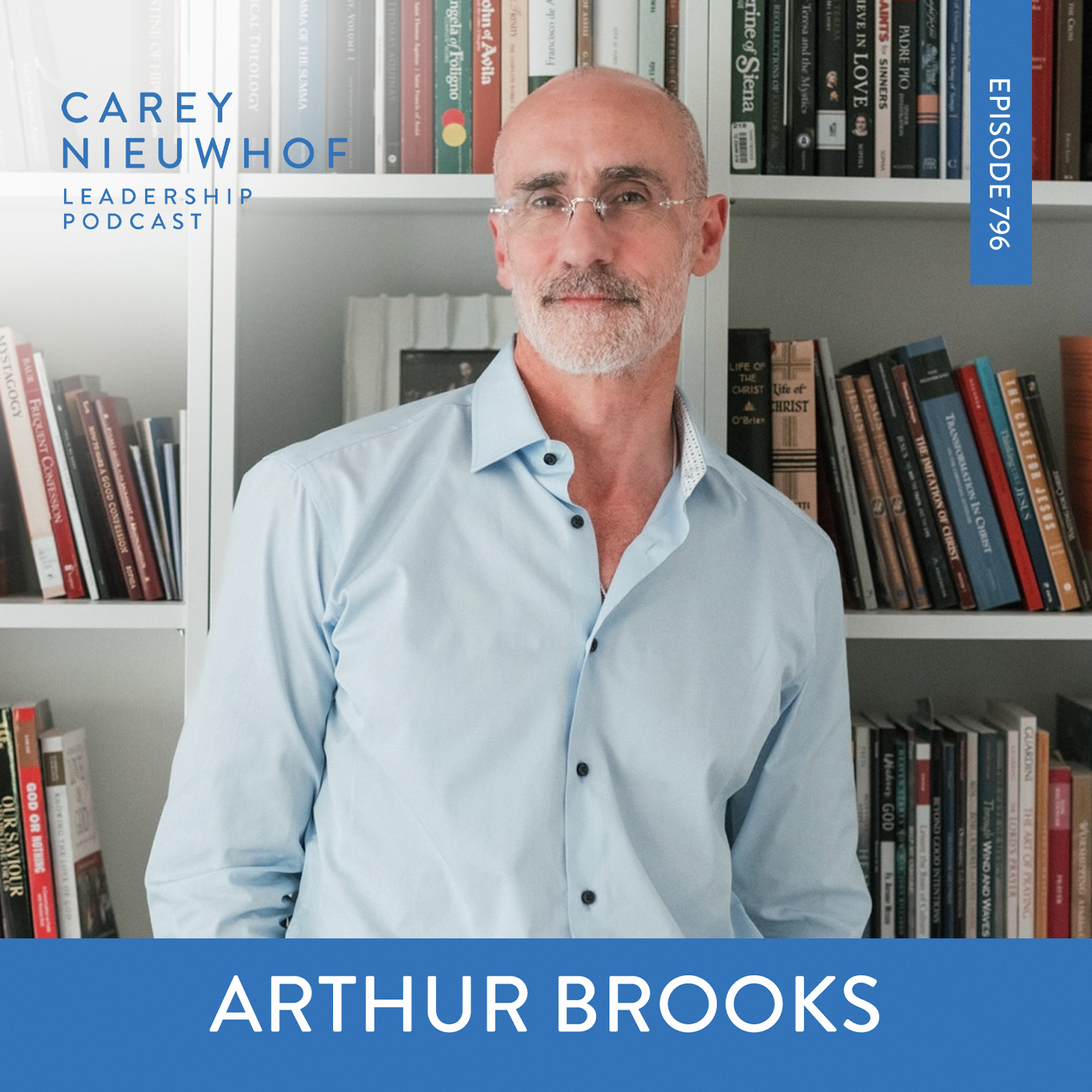
The Carey Nieuwhof Leadership Podcast
CNLP 796 | Best Advice For Preachers: Arthur Brooks on How To Reclaim 20 Hours of Sermon Writing Time + The Meaning of Your Life
01:07:18
Loading summary
Transcript122 lines
- [00:01]
Arthur Brooks
The Art of Leadership Network.
- [00:03]
Carrie Newhoff
Well, before we get to today's regularly scheduled podcast, I've got David Kinnaman with me for our monthly State of the Church update. Man, things are happening, David. Like, we are getting so much data in real time. And one of the questions I think we're all asking you and I were on this podcast a couple months ago saying, is a revival like, yes, but you gotta tap the brakes because there are other issues. So you've got some fresh data just in that kind of answers the question, is there some growth happening in the church or not? What have you got for us?
- [00:33]
David Kinnaman
Well, throughout 2025, we have been seeing all sorts of interesting and unexpected changes in our religious environment. So we've seen rising spiritual openness, especially among Gen Z and millennials, more curiosity and commitment to Jesus, more engagement with scripture. And that led us to a simple question, is what's happening among local churches? Are they seeing, seeing it? So we asked a sample of senior pastors around the country. We actually did this research in January and February of 2026. So brand new, fresh data from, from
- [01:05]
Carrie Newhoff
2026, the ink is not dry.
- [01:07]
David Kinnaman
And we found that, that the, the way people are actually experiencing it is that most pastors say they're seeing increased engagement. Well, I should say almost half of today's pastors are seeing increased engagement among Gen Z. So we simply asked over the last year, did you observe lower, higher, or the same amount of engagement from each of the following descriptions of people. And again, this is senior pastors, Protestant, mainline, the full spectrum of Christian churches. And we found that 45% said they saw higher engagement among Gen Z, 43% said the same amount of engagement. Only 12% said they saw a lower engagement among Gen Z. And then it of tapered down from there. So 42% said they saw higher engagement among millennials, 31% said they saw higher engagement among Gen x, and only 25% of all senior pastors said they saw higher engagement among boomers. Similarly, this is another question that has come up very frequently is whether men or women are more likely to be attending church. And kind of how would you measure it? And again, we saw that 36% of pastors said they saw higher engagement among men compared to only 31% who said they saw higher engagement among women. Most mostly people said they saw about the same level of engagement among women. And then also we saw 40% said they saw higher engagement among men, 18 to 35. That was the highest number by. By a good stretch. So the last little bit I'll, I'll explain here, is that in this data we were able to break down the groups that are experiencing the most likely different differences. So what was fascinating was among people who said they were experiencing renewal or higher engagement among Gen Z, it tended to be non mainline rather than mainline churches and larger churches rather than smaller churches. It also sort of was focused on shorter, shorter tenure in ministry, sort of younger pastors. So some really interesting kind of findings. It tells us that there, you know, some. Sometimes as a researcher, I'm like, okay, how do I know what, what to believe in our data, I mean, or in any set of data. Data is better than our best guesses, but it has its limitations. But what this data tells us is that many, many church leaders, almost half of all Protestant church leaders, a big segment of larger churches, non main churches, younger pastors, are seeing some sort of increase in engagement among younger generations. And it just gives us another independent means of verifying that there is something spiritually afoot today.
- [03:42]
Carrie Newhoff
Yeah, really fascinating. And I mean, we'll probably drill down on this again, but it looks like, you know, when you're saying, are you seeing real movement? If your church is less than 100 people, 26% said, yeah, we're seeing some positive signs. But if your church is 500 or more in attendance, 67%, that sort of suggests that maybe growing churches continue to grow and struggling churches maybe struggle, which is really interesting. Man, there's a lot here, David. There is actually a lot to drill down on. And if you want more, it's easy to get to. And the easiest way to do it is just go to stateofthechurch.com Carrie. That's stateofthechurch.com C A R E Y and see where you are in this story. And now to today's podcast.
- [04:30]
Arthur Brooks
If you use it as an adjunct to the right hemisphere of your brain, you're going to get depressed, anxious, lonely, and you're not going to like your life at all. And that means that if you use AI as your therapist, as your girlfriend, or as your buddy, those are the three things that people do where they substitute for actual human beings.
- [04:52]
Carrie Newhoff
Welcome to the Carrie Newhoff Leadership Podcast. I'm so glad you joined us today because Arthur Brooks is back on the podcast. He's one of my favorite leaders to follow right now. And every once in a while, you know, you know, you interview someone as I did before with Arthur, and you think, okay, we've covered his morning routine, but I went there again, and my goodness, the well is deep, like There are some leaders, you know, they tell you everything they know about a topic in 10 minutes. We can go in so many different directions with Arthur Brooks and we do that today on round two. You're going to learn how to reclaim 20 hours of sermon writing time a week. We're going to talk about his best advice for preachers. He goes to church every single day, has sat through thousands of of sermons, and he gives lectures and talks around the world. So you're going to learn from him. We're going to talk about the meaning of your life as well. So I'm very excited to have Arthur Brooks back. For those of you who are new to the podcast, welcome. We're really delighted that you're here and we hope that if this is interesting to you, you will give us a follow, a subscribe, and that way you'll never miss an episode. And you can go back into the archive and find our first round with Arthur Brooks. Arthur Brooks is a professor at the Harvard Kennedy School and the Harvard Business School where he teaches courses on leadership and happiness. Well subscribed courses. He's also a columnist at the Atlantic and a podcast host. He is the number one New York Times bestselling author of 15 books, including my favorite, From Strength to Strength, which we talk about in this podcast again this time around. So without further ado, my conversation with the one and only Arthur Brooks. Arthur, welcome back to the podcast. I am thrilled to have you.
- [06:22]
Arthur Brooks
Thanks, Carrie. I've been looking forward to it. I loved our last conversation and looking forward to the next one.
- [06:26]
Carrie Newhoff
This one, it was very stimulating. You know what, and I think about why I don't go to mass every day and why I don't work out at 4:30 in the morning, most mornings. So thank you for that.
- [06:35]
Arthur Brooks
I'm delighted. And if I can, if I can get you into mass and into the gym first thing in the morning. Well, I mean, it's not easy, I have to say. And everybody does their own routine differently. My guess is that you're fixing faith and exercise are perfectly on point.
- [06:48]
Carrie Newhoff
Well, definitely. I have my devotional time in the morning, but I have moved my workout to the afternoon because I end up burning jet fuel first thing in the morning. I just this morning turned in the manuscript for my next book and that's one of the questions I have for you, is how many days a year do you travel?
- [07:07]
Arthur Brooks
I'm on the road about 175 days a year. I'm out.
- [07:10]
Carrie Newhoff
You're more than me.
- [07:12]
Arthur Brooks
Yeah, I'm at about 48 weeks a year. I mean, not the whole week. Usually about three nights a week. 48 nights a year. Something like 48 weeks a year, Something like that. And so, and then with a few extra heres and there's. And, you know, a couple week tour in Europe, it all. It adds up to 160, 575 nights a year.
- [07:28]
Carrie Newhoff
Yeah. Plus you teach, right? You carry a full, like a course load. Do you teach one? How many courses do you teach at Harvard?
- [07:34]
Arthur Brooks
Two. I mean. I mean, I teach actually four half courses. So a total of two courses, one and one each semester. But it's two. Two halves in the fall and two halves in the spring.
- [07:44]
Carrie Newhoff
So let's just start there. How do you write books with that kind of schedule? Because that's a very. That's a very selfish question for me right now.
- [07:51]
Arthur Brooks
No, I hear you. And the truth is that those of us that are dedicated to public education, you and me and a lot of people who are watching us right now, the killer of that is the death of your original creative work, trying to recycle your work. You have to have new ideas. That's really important. You be generating new ideas. And the way to generate new ideas is by forcing yourself to do so, by putting yourself under deadline to tell somebody that you're going to do something, right? And your editor is going to say, carrie, this is the old. This is the same book again or something. You're going to hear about it. So for me, there's a couple of things to keep in mind. Number one is what the creative output looks like. And number two is the schedule, the rigid discipline schedule for actually executing on that, on what I'm trying to get out. So the first part is what the product looks like. And for me, books are not the way to stay active. Actually, it's a column. And so I've had a column for a long time, a weekly column, about 1200 words a week for the Atlantic. And it's a science column on the science of happiness, which is my thing. And each week it's a new subject. And I'm usually 10 weeks ahead on the column. So I'm thinking way ahead. I don't have to follow the news cycle, thank God. I mean, so I don't have to, you know.
- [09:05]
Carrie Newhoff
You don't have to do a reaction.
- [09:06]
Arthur Brooks
Yeah, you know, it's like, hey, Trump, set of things, let's all talk about this. And I'll freak out and talk about the thing. No, no, I'm talking about something that I think is important to People's lives. And it's going to be important in 10 weeks, not just right now. And so I'm doing that. And that keeps me really, really fresh. That also beta tests ideas for what people are responding to in a very positive way. And that's how I know what my next book is going to be about when I'm writing about a particular topic. And it lights people up. So. So I'll get, instead of 200,000 readers, I'll get a million readers. Huh? 5x. I can do math, right?
- [09:37]
Carrie Newhoff
You got feedback on it?
- [09:38]
Arthur Brooks
Yeah, exactly, exactly. And so, and if I really want to write about it, and there's some, both supply and demand that I know kind of what I'm going to write a book about, then the second part is the scheduling. I work my column takes me about 10 hours a week to write. I'm usually also writing a book, which I work on for about five hours a week. So I need at least 15 hours of creative time. Now that's if I'm really being productive. 15 hours when I, you know, late in the afternoon is not going to get it done because you know perfectly. And actually the neurobiology of that is very clear as well. When you're late in the afternoon, the dopamine in your prefrontal cortex is spent. People think of dopamine as kind of this anticipation of pleasure neuromodulator that, you know, drives addiction and craving. And that's all true, but also in the prefrontal cortex is what gives you focus and creativity. That's why ADHD drugs, when you give them to your kids, are psychostimulants that vacuum dopamine into the prefrontal cortex. For you and me, not taking psychostimulants. Well, at least not prescription psychostimulants.
- [10:44]
Carrie Newhoff
Not right now, no.
- [10:45]
Arthur Brooks
What we need to do is to optimize our brain chemistry so that on five days a week, three to four hours a day, in my case, you can actually get all your creative work done. And that happens in the morning. That's when you're going to have it the most. A lot of people say I'm a night owl. Probably not. I used to think I was a night owl too. I mean, there are chronotypes, but they're only about 40% genetic. Most people actually have better morning lark activity with respect to their neurochemistry. And that means you got to optimize it in a certain way. The reason I get up at 4:30 and then I work out really hard without taxing My thinking, I'm not listening to neuroscience podcasts, right. I'm listening to nonsense mostly, right, because
- [11:26]
Carrie Newhoff
what are you listening to? Are you listening or like are you listening to music or are you listening to podcasts?
- [11:30]
Arthur Brooks
I often am not listening to anything as a matter of fact, because I actually want to have the same kind of stimulus that I would have by getting in the shower. People have their best ideas in the shower because their earphones are not in there and their phone isn't in there. That's why. So the default mode network in the brain, which is a set of structures that lights up when you're thinking about nothing, turns on and you have good ideas without overtaxing your brain. And so that's really, really important. So it'll be something that's really mundane or something or nothing at all. First thing in the morning for an hour. So 4:45 to 5:45, I'm picking up heavy things and running around. And then as you mentioned at the very beginning of the show, then I go to mass every day. I get cleaned up and my wife and I, we go to 6:30 mass. And that 6:30 to 7 weekday mass is only half an hour long. And that's all before I actually administer psychostimulants to myself, because I want my brain set up. I want body and soul to be ready to use caffeine not as a way to wake up, but as a nootropic drug, which is to say as a way to focus, as a way to get the dopamine into my prefrontal cortex. So then I come back from mass and I take my big bolus of coffee, usually about 380 milligrams of caffeine. That's like a give or take a few. Yeah, that's a venti Starbucks, basically just one. But man, bolus, boom, into the brain that's really waiting for it. It'll cross the blood brain barrier literally in seconds. You're going to start to feel this. That's the reason it says on the Starbucks cup. There's nothing like that first sip feeling, because literally that first sip is going to cross the blood brain barrier, the caffeine in it. And that's when I get my first food, about 60 grams of protein in the way, a little concoction that I make every morning. And bub, oh man, I've got three to four hours of unadulterated focus. That's every day when I'm at home or I'm here in my office, because my office is pretty near My home. I don't take any meetings from 7:30 in the morning till noon. Nobody gets in. I mean, there's no meetings, there's no phone calls, there's no distractions because I can do as much during that time if I have my brain chemistry optimized as I was able to do in the old days. In about two weeks if I was working in the later afternoon and I would be looking at the newspaper and people would be calling me on the telephone and there's only a couple of people in my life that can get to me during that period is the way that that works. So that's a long winded answer. Sorry too.
- [13:56]
Carrie Newhoff
No, this is so helpful. So what you're saying is by. Okay, I've got one question before I go to my next question, which is you're in the middle of your workout, you have a brilliant idea. Do you have a capture system?
- [14:07]
Arthur Brooks
Yeah, for sure. And at that point I'll actually just read it into my phone or write it into a note in my phone if I have a really big idea, and often I do, often something will come to me and I'll say, oh yeah, that thing I wanted to use, that whatever particular ide. And actually the ideas that come to me are really important. I'll do the same thing when I'm in the shower, I'll get out of the shower because I can't afford to lose good ideas. And a lot of people watching us right now, I mean, they're preparing Sunday sermons, for example.
- [14:33]
Carrie Newhoff
Well, I was saying with that 1200 word column, you're basically a preacher. You're in the same rhythm, that's preachers.
- [14:39]
Arthur Brooks
And it's really important. I mean, we're talking. I mean, I'm Catholic, so the homilies are a lot shorter than that. I mean, you guys got your stuff together. So I mean you can't be boring if you're going to be going for 35 or 40 minutes. If it's a nine minute homily. And you know, the Catholic Church sort of says that no souls are saved after about nine minutes. But I mean that it's a different vibe because it's a sacramental vibe. But this is very different than what you guys are doing. And you need original content. You know, Protestant pastors are basically weekly columnists. And that means you need a lead, you need explanation, you need practical tips, you need a kicker. I mean you need all that stuff. And that requires your brain being on point when you're writing that thing.
- [15:24]
Carrie Newhoff
This episode is brought to you by subsplash. So we live in a world that celebrates more. More growth, more programs, more digital presence. And we've been told that to reach more people, we just gotta do more. But there's a heavy truth that every pastor and executive leader feels at the end of the day, the pursuit of more leads to a crisis of complexity. You see it in your inboxes, back to back meetings, the endless to do lists that follow you home. We feel the weight of a thousand tasks that need our attention. So what if there was a way to cut through all of the clutter? Fewer logins, less scattered data, and no distractions for your people to trip up on. By simplifying your technology on one platform, from your website and sermons to small groups and discipleship resources, you can create a clearer and more resilient church. Over 20,000 churches and organizations partner with Subsplash to simplify their tools and multiply their ministry impact. Head to subsplash.com carrytoday Save $500 when you sign up. So to save $500 right now, go to subsplash.com C A R E Y so, okay, so you've got a capture system which is so important and you always think, oh, I'll remember it later. I don't, I don't remember it later. So I got to capture it in the moment. Even, you know, working on this book for the last six, seven months, sometimes three o' clock in the morning, it's like, I better write that down right now. Because it all. What's happening? I mean, you do study brain science. What's happening in the brain? In the shower, during a workout, I came up with the central thesis to my book. I had it, but I didn't have the phrasing. And then the church's future direction is human connection came to me while I was working out one day and I was like, there you go. And I haven't veered from that. That was months ago. What is going on in your brain when you're not working on it, but it's still processing? What's the science behind it?
- [17:20]
Arthur Brooks
Your brain is actually working on it. One of the things that I recommend to people is that you take a key question that you've got and think about it before you go to sleep. Because your brain will work on it while you're asleep. And people can actually elucidate things. They can actually figure out if it was the right question. For example, you will cogitate on it at night. It's not like you can read a whole book and have it memorized first thing in the morning. But a key idea is important now. You have to decide whether or not that gets in the way of your ordinary nighttime routine. And I've actually written a lot about science based protocols for sleeping better and having a better marriage, for example, depending on what you do at night. And I strongly recommend it, having a prayer that you say over and over and over again as you go to sleep. So this might be a little bit at odds with that, but the whole idea of the shower in the gym, for example, is, I just referred to it a second ago in passing. It's called the default mode network. And that is a set of structures in the brain that become active when you're thinking about nothing, when you're not trying to think about anything, when you're really present, as a matter of fact. And we know because there are studies using FMRI machines where you put people, you're looking at their brains and their activities in their brains and you say think about nothing and then you see what part of the brain actually becomes active. And that's what's called the default mode network. That default mode network is the way your brain is supposed to work so that you can come up with why. Really consider why questions. It really disproportionately activates the right hemisphere of the brain, which is the why side, the meaning side, the mystery side. People in prayer, people when they're exercising their friendship with God, they're disproportionately using the right hemisphere of the brain. This is where the mystery actually happens. And by the way, Carrie, this is the reason that people who don't use too much technology and are scrolling and they think that the only questions that matter are the ones that AI can answer. Those are all left brain questions, the questions of the existence and relationship with God. Those are right brain questions. And so if you overuse or misuse technology, you're going to get less religious and that you're going to be interested. Yeah, you're going to become more depressed, more anxious, and have less of a sense of the meaning of your life. And that's one of the reasons you got to put down the devices, get on your knees and pray, for example, or, and I shouldn't say, or, and in the shower and in the gym and while you're driving your car, be thinking about nothing except the things that actually come into your mind, which God will put good stuff in there, but he's going to be using the right hemisphere in the default node network.
- [19:53]
Carrie Newhoff
So yeah, man, this is the thing I love about talking with you is so many new thoughts pop up. So what you're saying is overuse of technology decreases your faith and your spirituality.
- [20:06]
Arthur Brooks
Yeah. So what you find is that people, for example, when people are having intense religious experiences, they're disproportionately using the right hemisphere of the brain. This is work that comes from Ian McGilchrist, the Oxford neuroscientist and psychiatrist who has talked about. He wrote a very important book in 2009 called the Master and His Emissary that talked about this hemispheric lateralization. That's a fancy way of saying the two sides of the brain do different things. The right side is the why side, the left side is the how and what side. On the right side you say, I want to know God better. On the left side you say, okay, let's figure out which church to go to. And the answer is, the Catholic Church. Care. I'm kidding. Anyway, and so you get.
- [20:48]
Carrie Newhoff
You and Patrick Lencioni are in full alignment on that.
- [20:50]
Arthur Brooks
Every time I talk to Pat, I know we're such imperialists, but it's really, really important that we recognize that God created our brain for a reason. And woe be unto us if we don't use it as it's intended to be used. I mean, that's why, like anything else, when we talk about the temple and your body's a temple, I mean, that includes your brain, man. And you're not using your temple appropriately. Spending all day and all night looking at the little screen and technology and Googling around and using AI and all that, that's basically like eating nothing but Twinkies. You're going to pay the price. And actually, it's sinful to do in my view.
- [21:30]
Carrie Newhoff
Okay, so back to your morning routine then. You've got roughly from 7:30 till noon.
- [21:36]
Arthur Brooks
Yeah, I got about 7:30 till noon. There are going to be a couple of distractions in there. I mean, I live with a couple of my grandsons. There's going to be distractions, Right. If I'm working at home and if I'm working at the office, something's going on. You know, somebody's on the phone that I got to take the call, which is unusual, but a couple of things are going to happen, but I'm going to get three plus hours and I'm going to be able to write all of the really creative parts of a column or, you know, a good part of a book when I'm doing that, or lay out some slides or structure a speech or Whatever I'm doing. So I'm doing 150 talks a year outside of Harvard as well. So I have to do that in my creative.
- [22:13]
Carrie Newhoff
So you got to write those as well.
- [22:14]
Arthur Brooks
I don't write them, but what I do is I lay them out, usually in PowerPoint form. And by about the fifth time through, I'm not using any notes at all. So to make it look. And I structure those things rhetorically in the same way. I've studied a lot of great preachers, and what great preachers do without thinking about it is what us mere mortals need to do on purpose. So, for example, the human brain can't stay focused on ideas, on a particular train of ideas for more than about seven or eight minutes. And that means every seven or eight minutes, you need to pause. You need to let the people who are listening to you up off the bike and for. Usually for about 45 to 60 seconds. And that means you tell a joke, you tell a little story. I'll stay by saying, oh, I just saw this study. You guys. You guys got to hear. It's not related to what I'm talking about, but I'm busting. I got to tell you about it. I'm giving you a break, and then I'm going to put you back on the bike and start back up the hill again. And all of this stuff is structured, but it requires thought and creativity and molding and et cetera, et cetera.
- [23:17]
Carrie Newhoff
So, basically, do you have five talks that you just sort of surf off of, like five baseline topics, and you're like, okay, I'm speaking in England. I'll do this one. And then you're customizing it to the audience.
- [23:32]
Arthur Brooks
Yeah. So usually the lead will be customized. I'll often write a joke that's customized for the audience. I've got a. An event for a bunch of orthodontists. And so you want to hear my opening joke for the orthodontist?
- [23:47]
Carrie Newhoff
I want to hear it. I do.
- [23:48]
Arthur Brooks
Okay. Because I know there's no orthodontists who are moonlighting as pastors. So how do you know 18 months before your wife is going to leave you? She gets braces.
- [24:06]
Carrie Newhoff
That's great. That's great.
- [24:07]
Arthur Brooks
I know it's not a good Catholic joke, but anyway, you get my point
- [24:09]
Carrie Newhoff
that I get your point.
- [24:11]
Arthur Brooks
Yeah.
- [24:11]
Carrie Newhoff
So.
- [24:11]
Arthur Brooks
And there will be about five that are in the rotation. Usually there's one or two that everybody wants because there'll be just kind of a bread and butter talk. I'll cycle one or two out and add one or two in. And now I'm coming into a book season. So in March of 2026 is a brand new big book. I've been thinking about it and working on it really hard for the past three years. And I'll be giving the main talk on that, plus about three other talks that are related to it that are specialized in a particular way. And then that stuff will be in the rotation for most of 2026 and a lot of 2027. And if the book is a big success, it'll go on longer than that. I'm still giving talks on From Strength to Strength, which is the book that I gave in 2022.
- [24:55]
Carrie Newhoff
You might be doing that until you die, by the way.
- [24:57]
Arthur Brooks
Yeah, I might. Until I pass from strength to strength, euphemistically. But that's because people call up and say, can you talk, Come talk about that book? And that book is three and a half years old now.
- [25:10]
Carrie Newhoff
No. That's fantastic. And we do have a lot of author pastors and a lot of people who want to write books here. How much do your columns that you're writing? And again, you have the blessing of seeing whether 200,000 people read it or 2 million read it. But how much of that will make its way, obviously transformed into a book, does that become the core of the ideas, some of the expression of the ideas? Or when you sit down to write a book, are you kind of starting from scratch?
- [25:37]
Arthur Brooks
So I'll use paragraphs from columns in books, but I've learned not to use columns. I used to think I had this idea, Carrie, I had this conceit that what I could do is I could talk about something a little bit and sort of get the idea for it. And most pastors and professors, what they have in common is they don't know really what they think until they're talking about it. You know, that's. It's a funny thing. I mean, you as a pastor, you found that you talk about something in front of a congregation and you really get into the regret because you're looking at them, right? And you're getting. Getting a lot of feedback. And so you're writing it. Actually, you should give co authorship credit to the congregation because that's kind of where it's. And that's. And there's a lot of learning literature on this about how this works. And then I thought I would turn it into a column, and then the columns I would just kind of make into a book. And I do every couple of years publish an edited Volume of my most popular columns with the Harvard Business Review Press. That's a. That's not the same thing as my, as my big original books with, with Penguin Random House. But it doesn't work that way for the big original books. It turns out that they're not very good when I do that, that a column is a very different writing process. A column is about 14 paragraphs and I never throw stuff away when I'm writing. I mean, I don't throw away entire sections, but books, each book is written three or four times. I'll get rid of whole chapters. I'll just trash whole sections of these particular things. And what I find is if I try to make a column into a section of a chapter, I'm kind of shoehorning it in. And I've written books like that. They're not my best books, is the way that that works. And so I have to think of a book as really a 75,000 word expression. Something that has to be 75,000 words as opposed to 50 columns. It's not going to be 50 columns. They're just not going to be. They're not going to knit together. It's not going to have coherence and people are going to notice.
- [27:31]
Carrie Newhoff
Yeah. I guess I'm asking this because underneath all of these questions is sort of our attention span, Arthur. Our attention span, our ability to do long form thinking. It's been five years since I wrote my last book, at yout Best. And I know I'm five years older, but just the impact of five more years of short form content, quick videos, scrolling and I mean, I have limits on this phone. And everything really took its toll. And I'm, you know, I've had other things. Our company has really grown. And so my green zone, my morning time, as is yours, was spent less over the last couple years working in that deep thought. And so I made it. I'd love to talk to you about the use of AI in writing books, et cetera. I made it a goal that I consulted AI on like, hey, can you clarify this? Or I'm thinking this, but like, I wrote all mine. My first draft came in at 51,000 words, which I just sent off today to the editor.
- [28:35]
Arthur Brooks
Congratulations, Gary. That's.
- [28:36]
Carrie Newhoff
Thank you.
- [28:37]
Arthur Brooks
It's a great day, isn't it?
- [28:38]
Carrie Newhoff
It is a great day. I was so excited. I don't know what that is, but like, it's like, ah, there it is. It's going to be very different by the time it's published. But like, so there's the first draft?
- [28:50]
Arthur Brooks
Is that the first draft?
- [28:51]
Carrie Newhoff
First draft, yeah.
- [28:51]
Arthur Brooks
Okay, so you're going to get it back and be in the depths of despair. So is everybody watching us? All the creative pastors were also book writers watching us. You remember Elisabeth Kubler Ross, Five stages of death and dying. That's like the five stages of authorship, right? I mean, there's denial, there's rage, there's bargaining, you know, and finally at the end, there's acceptance, you know, and finally at the end. And it's funny because, you know, you turn in the final version, you're like, this has got. Oh man, everybody's gonna hate this. And I can't believe how crummy this is. And then two years later you're like, how come I can't write good books like that?
- [29:29]
Carrie Newhoff
I had that. The editor that I'm using for this book, I hired because he was so good on the last book. It was with Penguin. Penguin had hired him to work on it. And we might self pub this one for a variety of reasons. But anyway, Penguin has an option, so we'll see what they have.
- [29:44]
Arthur Brooks
Penguin is terrific, is the whole thing, but publishing is changing.
- [29:47]
Carrie Newhoff
It is. We want to. Because this is so time bound as an AI book, we're thinking it might be better to self pub and just.
- [29:56]
Arthur Brooks
Your new book is AI.
- [29:57]
Carrie Newhoff
It's AI in the future Church, Arthur, is the idea. And it's not so much. I'll send you a copy as soon as it's reasonable. It's not so much about, oh, here's the best prompt or you should be all in on anthropic, not OpenAI. It's not that it's really all about the impact. Like if there's going to be societal disruptions, if there's going to be the white collar bloodbath we're seeing. How does that change the giving model at churches? You know, what does that do to people's mental health? You know, if we have more and more artificial short form content and sort of the waves that might hit us as a society and then what is the church's response? Like, if you're pastoring a local church, what does that do to your ministry? And the good news is, I think this is one thing seminary did prepare you for. As the world becomes more artificial, we need to become more human, connecting people to God and to each other. So that's sort of the general outline of the book. But it's 51,000. I want to make it short because I'm convinced people's attention Spans have dropped, so I'm hoping to cut 10,000 words, but I'm like, ooh, they're all pretty nice right now, so we'll see.
- [31:10]
Arthur Brooks
That's great. And I think you're right on the money, by the way, because my new book is about the meaning of life, why it's harder and harder to find and what we do need to actually do to find it. And it follows this to a very large extent. I mean, the truth of the matter is that we are being pushed into this left hemispheric world of analysis, efficiency, tasks, technology, all the how to and what. We're kind of going into the engineering universe. We're all getting pushed into the engineering universe. And, and that's true in sort of every area of life. The meaning of life is in the right hemisphere, which is in the why. The mystery and meaning are in. And the love and the happiness, by the way, that we get in life is from the why side, the deep why. And I don't mean the why that you could type into a Google search bar and get a meaningful answer. I'm talking about why am I alive? Why does God love me? Why would I give my life? And you put that into AI and you'll get nothing but sycophantic garbage and nonsense. And that's the key. I mean, if AI will give you something unusable, it's not a right hemispheric question. What Sunday Morning is all about is why questions in the right hemisphere. It's right hemispheric experiences. And if we're consuming those experiences entirely using technology, it's a problem. We actually need to be more human, having a more communal human experience. I might actually go so far as to prohibit devices in church, just like how we prohibit devices in school for exactly that reason.
- [32:42]
Carrie Newhoff
This episode is brought to you by the Art of Leadership Live. If you're leading a church and you know there's more in you and more ahead for your team, I want to personally invite you to something special. September 21st through 23rd, I'm hosting the Art of Leadership Live in Nashville, Tennessee. Now, don't think of this as a conference where you sit in a chair for eight hours, take notes, and hope something sticks. This is super interactive, deeply practical, and intentionally designed to help you make real progress on the leadership challenges you and your team are facing right now. How do we do that? Well, we combine focused teaching, meaningful conversations with other leaders, and built in space to think, process, and actually apply what you're learning so you don't Just leave inspired. You leave with clarity and you leave with next steps. So one important note, the last chance to secure any type of early bird pricing and save on your ticket is almost gone. At the end of April. The ticket prices are at their regular price. So if you've been thinking about applying, now is the time and we keep this event small. I want to interact with you. I want you to interact with other people. The leaders who gathered last year absolutely blew me away. The depth of the conversations, the honesty in the room, there were tears, prayer. The momentum left people in a place where they could really make progress on their ministry. And that's what makes this event so impactful. I can't wait to do it again. And if you haven't been, make sure this year you join us, visit theartofleadershiplive.com to secure the best pricing and secure your tickets before it's too late. Again, that's theartofleadershiplive.com I'd love to see you there. Yeah. You know, I'm curious about where all of this lands and when you think about cognitive atrophy or brain rot, as we talked about, what do you think AI and this short form content is doing to our brains?
- [34:39]
Arthur Brooks
So AI is an ideal adjunct to the left hemisphere of your brain. I did a big summit on AI three weeks ago with Tony Robbins and my part of the summit was AI and happiness, of course. I mean, what is he going to have me talk about? How to write code? I don't think so. My son actually does that for a living.
- [35:02]
Carrie Newhoff
Same here. I got a son who does that for a living.
- [35:04]
Arthur Brooks
That's good. They'll take care of us in our dotage, right, Carrie? Exactly. Because being a pastor and professor is such a high paying profession, right? Exactly. So AI is a great adjunct to the how to and what parts of your brain. I mean, it will do mundane tasks better than you do if you actually learn how to use the skills. And what that will do is that'll free up a bunch of your time. And that's great. That's great. The problem is we tend to waste that time on stupid nonsense like scrolling Instagram and watching YouTube shorts and just frittering away our time. You have to use that time productively for AI to make you happier. So that's important. And that means in communion with other people, in communion with God. So working on faith and family and friendship and working in a way that serves other people, those are the four things to do. Those are the right hemispheric activities that we really need to be paying attention to in the extra time that we have. The second thing that's really important to keep in mind that I pointed out with this thing with Tony, is that if you use it as an adjunct to the right hemisphere of your brain, you're going to get depressed, anxious, lonely, and you're not going to like your life at all. And that means that if you use AI as your therapist, as your girlfriend or as your buddy, those are the three things that people do where they substitute for actual human beings. And they. You might be able to pass the Turing test and say, wow, this is just like a girlfriend who really likes me and pays a lot of attention to me. But your brain knows because your brain, the one thing you can't simulate is the meaning of life. That's what this brand new book that I've got. As we're living man, we're living in a simulation. We're living in the Matrix all day long, zooming work, looking at social media, dating, online video gaming, YouTube, podcasts. This is all the Matrix because it's all a simulated life. And that's desiccating the right hemisphere. It's alienating us from God. It's ruining our relationships. And the result is that entirely explains the explosion of depression and anxiety for people under 35 is entirely the lack of right hemispheric activity.
- [37:15]
Carrie Newhoff
Your classes at Harvard have wait lists. People just really trying to get in and they're not teaching you how to become an investor. You're not giving people the hard skills. You're doing all of the meaning of life philosophical soul work.
- [37:33]
Arthur Brooks
That's right.
- [37:34]
Carrie Newhoff
What are you learning about the hunger?
- [37:36]
Arthur Brooks
The hunger is really clear. What we can do with respect to our efficiency and our economic effectiveness is not a substitute for what we truly crave, what we really want. But that's not a new finding. I mean, Thomas Aquinas said that in 1265 in the Summa Theologia that he said that we want God, but we will accept substitutes because we're venal and fallen. And so we look for things in the world that have these kind of divine characteristics. He said that they're fourfold. It's a very interesting thing. Thomas Aquinas was really the greatest behavioral scientist of his time, maybe of any time. And he said the four idols that we. Because idolatry is when we give our metaphysical love and attention to anything that's not God. And he said that we look at money and power and pleasure and honor. We look at those things as a Substitute for God and chase those things. But all we're really doing is we're falling into this left hemispheric trap. We're in the right hemisphere of the brain. And not to be too neurological about it, but that's kind of geographically how it works. In more theological terms, we're looking for, we're beguiled by the dark ones, idols that are put into our lives, that are inadequate substitutes for what we really, really crave is how this works. And that's a really important thing in a secular sense. That's why people are interested in my classes, because I'm all about love and meaning. My classes are about love and meaning. They're not about success and money and power and fame. That's not what they're about. They're about the love and meaning that people actually crave. And inevitably they want to know a lot more about faith and about the supernatural and transcendental backing for all these things and the Creator and the originator of all these things that we really wanted. Because as we all know, the hunger for something presupposes its object. If you're thirsty, it suggests that water exists. And if you crave ultimate supernatural meaning, it suggests, oh my goodness, that God exists. And that's the conclusion a lot of my students come to.
- [39:43]
Carrie Newhoff
Do you get pushback from your colleagues for teaching subjects like this? I mean, obviously you have a reputation now that's global, but even think back a few years when you started this, did they kind of like, what are you doing? Do you get that or not? Really?
- [39:56]
Arthur Brooks
Never, Never, never, never, never. On the contrary, my colleagues sit in on my classes too. They're really interested in this material because this is what we all want. Now again, this is not woo woo. I don't do this from the autodidact, self taught, self improvement influencer, YouTube expert. Yeah, I know. I suffered through a Ph.D. so my students don't have to. Basically, I mean, it's. I'm a behavioral scientist and I've retrained over the past seven years in neuroscience as well. Because anymore everybody knows in my field that psychology is effectively biology, right? Which again, does not weaken God's hand in this. On the contrary, strengthens God's hand in this because, you know, he's the originator of all these things, including our brains and minds. And so my colleagues are super interested in, and they appreciate the fact that I talk about these things of eternal significance in a very, very scientific way. But weaving in the wisdom, weaving in the theology, weaving in the philosophy, because Those things actually originate the questions. Neuroscience gives us the structures and mechanisms, and psychology and behavioral economics give us the experiments to test out different ways of living and habits to make better ideas come to life in our lives.
- [41:11]
Carrie Newhoff
So this is interesting. You have peers sitting in on your classes. You've got wait lists for the courses that you offer. Meanwhile, most pastors aren't trained in neuroscience and don't have a doctorate, but they have got some education behind them. But there's a lot of churches sitting empty. The majority of churches are on the decline, sadly not the upswing. We are seeing a real resurgence. I'm sure you've heard about it in Gen Z, attending church, their spirituality, Bible app usage, paper Bibles being sold at record levels, et cetera, et cetera. Even Christian music is on the rise, which is amazing. But like, you know, if you think about it, why is there not wait list only at every church? Like, we're sitting on this stuff. So I'd love to know if you were consulting with pastors based on your understanding of the church, and you're there daily in the Catholic context, but I'm sure you've had your share of Protestant churches as well. What would you tell us that we might be missing or not seeing or need to rethink?
- [42:13]
Arthur Brooks
Yeah, I mean, it's incredible hubris on my part to suggest anything like that, but I do actually have a background on both sides. I was raised evangelical and I converted as a teenager. It was my adolescent rebellion. Right. But I was raised in a. In a strong evangelical tradition. Both. I had grandparents on both sides were missionaries. My. My grandfather was the. The Methodist mission school headmaster in the Navajo Nation where my father was born. And then he was the dean of students at Wheaton College. So my, yeah, so he was sort of evangelical royalty. And, and my mother was brought up in the Southern Baptist tradition. So when I, I. When I converted to Catholicism at 16, my parents kind of shrugged and said, I guess it's better than drugs, you know. I guess, yeah. I guess. I mean, marginally better than drugs, you know, but so, you know, I'm really, I'm really familiar with, and I'm really grateful for my evangelical upbringing because, you know, the intense relationship, the deep love of God in a very personal way that evangelicals often have, and the familiarity they have with the scripture where, you know, you're encouraged to really read your Bible very deeply, and they have a tradition, evangelical traditional lectio divina that's really, to this day, has been so important to me in my own life. And so I'm grateful to God for both traditions, actually, and how it's affected me. But the truth of the matter is that it's quality control all across our churches can be a problem. You know, and I say this as a Catholic where a lot of Catholic preaching just isn't very compelling. And what you need, I mean, here's the thing. I mean, you could give me the worst sermons in the world for the rest of my life, and I'm still going every day. But that's because I'm 61 years old. Carrie.
- [44:03]
Carrie Newhoff
I was going to say, why is that true? Because there are people who would do that. We're just going to go till we die. Even if.
- [44:07]
Arthur Brooks
Because I'm like St. Peter, Lord, where else am I going to go? You know, at the end of the Sermon on the Mount, where he starts going off about something that makes people intensely uncomfortable and they wander away, and he says, how about you? You too. And St. Peter's like, I'm in for a penny, in for a pound, Lord. You know, I come back to that
- [44:25]
Carrie Newhoff
over and over again.
- [44:26]
Arthur Brooks
Yeah. And so at this point. But the problem is, you know, and this is one of the things that I tell my students when they're going in for their, for their interviews. People make an impression and decide about you in the first seven seconds. There's a part of your brain that actually in seven seconds decides who you are and what you're all about. You better be good. I mean, you better be at the top of your game rhetorically. I mean, no garbage, music. No, I'm sorry, you can't be boring. You have to be great at what you do. There's really two. And again, this is without hubris. I say this with incredible respect and affection and love for all the people who are actually doing the work and the pulpit. But apostolate, and this is based on a lot of research, the two tools of apostolate that are more effective than anything else. You guys call it mission apostolate. The two tools are friendship and excellence. Friendship and excellence. Why? Because friendship bonds you to each other and excellence magnetizes people to you. We're a hierarchical, kin based species, Homo sapiens. We need kin and we, and we're, we admire excellence. Yeah, that's the hierarchical part. And that. And so the result of it is if you're going to be a leader, and this is an important leadership podcast, you better be a good friend and truly great at what you do. And I give this, this advice a lot when I'm talking to Bishops and priests, it's like, no, no, no, no. No boring homilies. I'm sorry. Because there's somebody out there who's not been to Mass before. There's somebody who hasn't been to Mass in a long time, somebody who got dragged there by their mom who's like, see, See, this is why you do a bad job. And, you know, the lame guitar. And then it's just. I'm sorry. No, you were available.
- [46:13]
Carrie Newhoff
Just not gifted. Yeah, yeah.
- [46:15]
Arthur Brooks
And so that's. And so I have to say that we, you know, God gives us the ability to be excellent at what we do, and woe be unto us if we don't take that opportunity. Because it's not good enough just to say, oh, you know, Holy Spirit will carry this thing. You know, we're involved here. He's involving us for a particular reason. The stakes are super high, in my view.
- [46:37]
Carrie Newhoff
I hear you. So every seven minutes, there has to be some kind of break. You're coming up for air. It's a joke. It's a. Hey, I got really excited about this thing. I read you're giving people a little break for those of us who are listening. Because I think that's a great fear for all of us who communicate, is that we're going to be boring. What other. I would line up and put myself on the wait list for a homiletics course taught by Arthur Brooks. So what other tips would you have based on thousands of hours sitting through messages?
- [47:08]
Arthur Brooks
Well, okay, so you've given a lot more homilies sermons than I have, so I should be sitting at your feet asking this and not vice versa. I'll talk to you about structuring a lecture on how this actually works.
- [47:21]
Carrie Newhoff
Sure.
- [47:22]
Arthur Brooks
And the answer to that is, number one, understanding the neuroscience of message absorption, how people actually understand messages, how fast or slowly you need to talk, for example. And part of that is actually you don't need to know the theory, but you need to study the best speakers and absorb why they're really good. Right. Second is judge yourself. And that means. That means actually taping yourself and listening to your tapes, videotaping yourself in the pulpit or videotaping yourself in the lecture hall and watching your tapes. Old guys like me have done this thousands and thousands and thousands of hours. I mean, this is taking free throws is what it was, really what it's all about. And you can always learn. You can always get better. I'll listen to a lecture of mine, a new lecture that I'm giving. I'll Listen to it over and over and over again and I'll think to myself, what's wrong with this thing? And I'll critique it. So having real high standards on the basis. And again, I used to be a classical musician. So from when I was 19 till I was 31, as a classical professional French horn player in symphony orchestras and, you know, everything I learned, I learned from playing the French horn. And so this is actually one of those ideas. The third point that's really important is murder. Boarding this. When you've got something new that you're thinking and talking about, you better have people in your life that you can actually talk about it with. You're like, that doesn't work, right? Yeah, boarding, you called it murder Boarding. Yeah, that's in the, in the. I used to work at the Rand Corporation, you know, the old think tank in Los Angeles, and I used to go to the Pentagon and they would murder board stuff. And that means that a murder board in the military operations research world is like 20 people sitting there and they're taking potshots at you. Like, that's, that's stupid. That doesn't make sense. I don't believe that whatever it happens to be, that joke wasn't funny. And no matter who you are, and I've been doing that for years. And I murder board stuff and I murder board it. And then, and then getting reps is super important. You know, I mean, if you're a young. If you're a young speaker, a young professor. When I was first, you know, on the lecture circuit, I would never give a speech. I would give it to an empty hall 15 times before I took it out on the road. It was really important to actually get the cadence right. It's et cetera, et cetera, and practice, practice, practice. I mean, this is how you get to Carnegie Hall. This is also how you get to, you know, wherever you're trying to preach. You want a full church. These are the standards. And then thinking about, you know, how the audience is actually going to absorb these messages, that means I'm not going to give you 10 lessons today. I mean, if you've got a 30 minute homily, which is very common for great preachers in Protestant Church, just 30 minutes is terrific. You should be giving three lessons max. And it's important that it be structured in a particular way that the human brain can absorb. Number one is the lead. And the lead is not just. When I was a kid, my mom always told me, no, no, no, no, no, no, no. Once a year, man, Once a year. It has to be a story from history. It has to be a study that matters. It has to be something that's actually really meaningful. It has to be something, not an anecdote, so to speak, especially an anecdote from your childhood. And young pastors and priests always do that. Taught that in seminary. Like make it relatable, too relatable. Anyway, a really great lead. And a lead leads to the lead ends with a question. So it has to end with a real question. And I was left, you say at the end of that, I was left with this burning question and I didn't have the answer such that the homily or the sermon is a. It's a kind of a detective story, right? Yeah.
- [51:01]
Carrie Newhoff
Like, like you've stated a problem that the answer is not obvious.
- [51:05]
Arthur Brooks
That's right. So we're going to go find it right now. Then the second part is, you know, the science for me, you know, Here are these 15 studies about this particular topic and here's all the findings. And it's super interesting. Science, when you're doing, when you're giving a homily, you're giving a sermon, is largely scriptural and it'll be largely based on the readings of the day on the lectionary. And so, you know, what was the letter from St. Paul? What was the psalm that we read? What was the letter from the gospel? What was the reading from the gospel? What were the main points and talking about, you know, the science of that will be what was going on when that was written, what did that, what were that, what was that really? How was that translated from the original Hebrew or Aramaic or probably into the Greek that we got it. You know, something that, you know, something scholarly. I mean, these guys in the, you guys in the pulpit, you guys are scholars, right? I mean, you really are. You really know what's going on. Theoretically, yes, as you're teaching during this time. Right. And so what do we think Jesus meant? What are, you know, what did, what does St. Augustine think that this meant? What did Thomas Aquinas think that this meant? Right. And really a lesson in there. Then from that, say, okay, based on that, now let's talk about how we can use this in our lives. And that leads in a half an hour sermon to three lessons. That's the Feng Shui of this thing, is three lessons. If it's 20 minutes, two lessons. If it's 10 minutes, one lesson, it's one minute. It's one lesson per 10 minutes is the general rule. Right. If you're giving an hour long sermon, well, that means you're going on too long. That doesn't mean six. Exactly.
- [52:39]
Carrie Newhoff
Nobody's quite that interested.
- [52:40]
Arthur Brooks
I know I've heard a lot of sermons that go on for a really long time. And then the end is actually tying it back together again. Going back to the original question and then say, and one more thing, it's a very Steve Jobs kind of thing. And one more thing that you're going to actually leave them with that you want them to remember. And it'll be a leading question like, you will be judged this week on the basis of how you put these ideas into action. And if you do it the right way, you're going to see your life start to change. And then one last thing for them to actually remember. And that's a structure that actually works really well for lectures, really well for speeches, really well for homilies. And we can all use it. And it provides this kind of shape to what we're doing. And not coincidentally and quite conveniently, it follows the way that people learn.
- [53:25]
Carrie Newhoff
So this is what's so powerful. Back to. And this is why you need 20 hours a week. This is why you can't just start at 3 o' clock in the afternoon on a Thursday and hope you're going to get there by Sunday. Back to the disciplines and the rhythm. So back to what you said about the principal use of AI now being relationship therapy, et cetera. But one of the other questions people type in is what is the meaning of life? That's pretty frequent. I think Harvard's top 10 uses of 2025 last year was. That was like maybe in the middle. So people are doing that. This is your topic. Why this topic? Why now?
- [54:06]
Arthur Brooks
So why now is because this is the question that I have been getting since I've been back in academia. I came back to academia in 2019. I'd been gone for over 10 years. I was the president of a big think tank in Washington D.C. for 10 and a half years, right in the middle of my academic career. And I didn't pay attention to academia. But when I left in 2008, academia was happier than the outside world. Right? I mean, people were falling in love and making friends and building their careers and learning interesting and scary new ideas, crazy stuff and, you know, expanding their minds and, you know, campuses were happier than the outside world. I came back in 2019 and it was like a plague had gone through my village. Depression had tripled, anxiety had doubled. 55% of the students on my campus were seeking Therapy were in psychiatric treatment. There was what used to be happiness and love was supplanted by sadness and anger and fear. Cancel culture was in full swing. Professors were afraid of actually talking about controversial topics in class, which is the one place you would always talk about controversial topics.
- [55:20]
Carrie Newhoff
Absolutely. This is the place to disagree. This is the place to test ideas.
- [55:23]
Arthur Brooks
People were being run out of academia on a rail by campus activists who are trading in anger and fear and disgust and all these negative emotions. And I thought, well, I gotta get to the bottom of this. And so I started teaching a happiness class. But I started doing what I ordinarily do, not just quantitatively, but qualitatively. I started doing interviews, and I was interviewing people about their time and their days and their lives, and they kept saying the same thing over and over again. My life feels meaningless. My life feels meaningless. And so then I started looking at the data on that, and it turns out there's this explosion that's exactly contemporaneous with the increases in and anxiety and depression with a percentage of young people under 25 who say, My life feels meaningless. And so based on this, it's very easy to conclude it's pretty unambiguous that we have a meaning crisis. We don't have a happiness crisis. We have a meaning crisis. Happiness includes meaning. Meaning is one of the macronutrients of happiness, the other two being enjoyment and satisfaction. But those things are fine with young people in particular. But with all of us, it's meaning that has been vacated. And so my job over the past seven years, since I've been back in academia, particularly five, since I've been thinking about this new project is why. What is meaning? Why is it actually absent? Where do you go to find it? And then how do you have to live differently so that meaning will actually find you? And that's what this new book is about. It answers those four questions.
- [56:56]
Carrie Newhoff
Why do you think it's so absent? I mean, you've already given part of the answer, I think, in the framing. But, you know, you look at the church we have right now, you know, you've probably seen in 2025, Gen Z is surging back to church. Not entirely. Most are still not going right, but there's been a reversal.
- [57:12]
Arthur Brooks
There's been a little uptick. There's a little uptick at the bottom of that. Yeah, yeah, yeah.
- [57:18]
Carrie Newhoff
Well, you know, the evangelical world, we like to make a lot of a little sometimes, so, you know, you got to give that to us.
- [57:22]
Arthur Brooks
Well, thank God that the Catholics don't exaggerate, you know,
- [57:31]
Carrie Newhoff
So, you know, it's one of those things, Arthur, where we have lived in a secular universe for the better part of a century, at least academically. And is there meaning without God in your view?
- [57:46]
Arthur Brooks
So there is a sense of meaning and then there's the ultimate meaning. They're really two different questions. People have a sense of meaning when they're on the trail of meaning, but they don't have ultimate meaning until they have the originator of all meaning is what it comes down to. So people can get a lot of satisfaction by finding a sense of meaning coming into their lives, by doing what needs to be done to find it. But ultimately our job is to be familiar with and embracing the source of all meaning in our lives. And I think that is God. And as a Christian, I believe that there's a particular way to understand God. That's my belief. Right. So what I will do in my work is, and I think this is missionary work in a nutshell. I mean, again, my grandfather, who, you know, a lifelong missionary, he's a funny guy, he used to say, hey, you know, words never uttered in the English language. And I said, oh, no. What, grandpa? He said, good news, there's missionaries on the porch. That's great. But missionary work I learned from my grandfather and from many other people I love and respect who've been in the mission field is to crack the door, is to get the door cracked, isn't to have the door not stay closed. And the reason is because it's very, very difficult in the door knocking business or the metaphorical door knocking business, to actually get people on their knees and to baptize them. It's a really, really hard thing to do. Right? And as Catholics, you don't get to baptize them anyway. So. But the whole point is that the whole job, the ambition, should be to crack the door. And that means putting them on the path toward ultimate meaning with the faith, because we have to have the faith, either we do or we don't, that the Holy Spirit will do what the Holy Spirit's job is, which is guiding people once there's an open aperture, once the door is cracked. And so I'll have students that I'll talk to and I'll say, you need to open your heart to falling in love. Because I know I've got the data that falling in love, this is as old as Socrates, will actually lead people to seek higher and higher forms of beauty and truth, and that ultimately will lead to metaphysical, supernatural truth. This really works. And so I'll use any of the levers at my disposal. And there's six levers, by the way, that do this, that I found empirically.
- [60:04]
Carrie Newhoff
Okay, go ahead.
- [60:05]
Arthur Brooks
Number one is you induce people to ask the questions that artificial intelligence can't answer, like the big why notions of life. Like, why am I alive? And for what would I give my life? Those are the two biggies, right? Of coherence, why things happen, of purpose, why am I doing what I'm doing? Of significance. Why does my life matter? The 11pm dorm room conversations that are really deep that people don't have now, by the way, because it's zoom, zoom, zoom, zoom, zoom on the phone at 11pm Number two is falling in love is love. Romantic love is an incredibly complex, right, hemispheric thing. And what you find is that when people allow more romantic love in their lives, they become way more disposed toward the metaphysical. And the reason is because they're using their brains the way their brains are supposed to work. Right. The third is actually opening themselves up to what's called transcendence, which is standing in awe of things bigger than themselves. Now, that might be explicit religious activity, but it might be something that's more like, you know, a meditation practice or studying the Stoic philosophers, or giving yourself to other people, transcending yourself in love and service, not looking at yourself in the mirror all the time. These things really, really open you up to experiences that are beyond your ability to explain, which is to say they're in the mysterious, the numinous part of your brain. The next part is looking for. The fourth technique is looking for calling in your work. Not just money in your work or power or prestige, calling in your work, which is finding what you're meant to do. That's meaning, what am I meant to do? And I've got a whole series of techniques for doing that with my students of actually figuring that out. The fifth is actually looking for beauty. Beauty is a numinous experience. And there's three kinds of beauty that will really do this. There's artistic beauty, natural beauty, and moral beauty. In other words, look at something that takes your breath away, or listen to music that takes your breath away, stand in awe of nature, or watch people who are truly doing things of great moral beauty that makes you choke up. It's so beautiful the way they give themselves. That's all the same kind of experience, which is, God is so good, you know, he's got so many ways to get us. And the last but not least, number six is suffering Suffering. Suffering is the teacher of meaning. If we allow it to be, what
- [62:28]
Carrie Newhoff
are we trying to eliminate from our lives?
- [62:29]
Arthur Brooks
Exactly right. Exactly right. Because the therapy industrial complex in this country says that if you're suffering, if you're sad and anxious, it means you're broken and pathological. And we got to get rid of that. And that's really, really dangerous because in so doing, we get rid of the meaning of our lives. Now, again, I'm not in favor of exaggerated dysregulated suffering. It was, you know, psychiatric treatment was the difference between life and death for, you know, immediate members of my family growing up. So I'm. I'm all in favor of medical care. But the idea that psychological pain is evidence, or physical pain, for that matter, is evidence of being a broken human being, I completely reject that. And by the way, here's why I reject it. I worship a man who's suffering.
- [63:13]
Carrie Newhoff
Yeah, 100%. You know, it's interesting you say that, because I was going over some of the chapters again in draft, one of this book, but one of my arguments is that leaning into the suffering part of the gospel narrative is going to be really transformative from the dislocation that potentially is going to happen from AI. And it's something that, particularly in evangelical world, maybe we've avoided a little bit too much. It's just like, your life's going to be great and it becomes a suburban dream. But that ultimately, what does that do if you ignore the suffering of. Well, to our faith. Right. We share faith. So do most people listen to the show? Like, what happens if you're just kind of, I want to get to Sunday. I'm not going to hang out in Good Friday. Like, what happens to you and your happiness if you won't go to suffering?
- [63:58]
Arthur Brooks
You don't learn from the suffering itself, which is the richness and meaning of your life. Nobody, when I asked them, you know, how did you really understand the meaning of your life? They never tell me about, well, I learned it on my beach vacations in Ibiza or something like that. It's not what I get or, you know, it's all those fun trips to Disneyland. No, they talk about when my mother died, when I was a kid, when I lost my business and I thought I wasn't going to be able to feed my kids when I flunked out of college, when I got arrested. People talk about. They always talk about bad things because suffering is your teacher. I mean, this is. Look, we get one go round on Earth and we're trying to find the only true source of lasting satisfaction. Anybody who thinks they're going to get satisfaction that lasts in this earth is a heretic. That's bad religion. I mean, satisfaction. I mean, Mick Jagger said, I can't get no satisfaction. The truth, the problem is that you can't keep no satisfaction because there's only one source of lasting satisfaction and the satisfaction that goes away and the hunger and the craving for something that actually lasts and the suffering that actually goes along with these lessons that we get. That's the point, man. That's the point of being alive. I recommend to a lot of my evangelical friends to really absorb this, that when they're in their holy hour, you know, in their time of prayer each day, and all of us as Christians, we should be in a time of conversation with God every day, no joke. Because, you know, if you have a real friendship, you don't go six months without talking to your buddy. You know, you don't talk to your. And so you need to talk to God. I recommend. You know something, that's an old practice that a lot of Christians have had. Keep a cross on the table in front of you, but at least for half the time, even for my Protestant friends, put a crucifix on the table. Contemplate the suffering of our Savior. I mean, contemplate that, man, because this is solidarity with you. It's not solidarity with you in I got a bonus at work. It's like, I heard a funny joke. No, no, it's solidarity with you in your darkest moments. Because those dark moments are the teachers of what it actually means to make your way through this world to the ultimate paradise that we seek, that we hunger for, that is our, I pray, is our ultimate end.
- [66:18]
Carrie Newhoff
I can't believe our hour has gone by this quickly because the list of questions I have for you is about this long, and I didn't even look at my notes are there. I. I can't thank you enough for your generosity and coming back. We've covered a lot. The new book is called the Meaning of Life. Have I got that right? It's in my notes.
- [66:36]
Arthur Brooks
The meaning of your life. The meaning of your life.
- [66:38]
Carrie Newhoff
The meaning of your life. Even better.
- [66:40]
Arthur Brooks
Even better. It's personalized to the reader, and then the subtitle is Finding Purpose in an Age of Emptiness. And I'm grateful to you, Carrie, for the work that you're doing using modern media to actually spread the cross and gospel of Jesus Christ and making better pastors who understand themselves as those who actually can help get the rest of us into heaven. I appreciate that a lot.
- [67:02]
Carrie Newhoff
Well, you're helping us a lot. I didn't get to the thing, just so you know, before we shut the laptop. The thing that I quote you the most on is real friends versus deal friends. And I know that was something your son said and it's in strength to strength. It's not a major feature. Next time we talk, I really want to go deep on that because I am convinced that that is the crisis of loneliness in leadership. We're surrounded by people that want a little piece of us. You would be. Case in point. I mean, I don't know how many inbound you get, but it's insane.
- [67:33]
Arthur Brooks
A lot of inbound.
- [67:35]
Carrie Newhoff
You get a lot of inbound, my friend. And so do most of the people who listen to the show. But your definition around what a real friend is versus a deal friend, life changing for me.
- [67:45]
Arthur Brooks
Thank you. I appreciate that. I appreciate that. And bringing ideas as you are to a lot of people who they might be the only person in their role in their whole life and even among people that they know, people in rural areas, for example. And so creating a community where we can talk about this and actually have some friendship is really important. Thank you for doing that, Arthur.
- [68:05]
Carrie Newhoff
Thank you. I would encourage everybody. I had a quick glance at the book. It came in just before we recorded. I am ordering copies for me and friends and would encourage you to do the same thing for all things Arthur C. Brooks. Where's the best place for people to find you these days? Where are you most active?
- [68:21]
Arthur Brooks
Arthurrooks.com is my website where everything is going on there. My column comes out every Thursday and I'm doing a lot of stuff in media, but one stop shopping for surveys and ideas and study guides and book club things for churches. It's all there@arthurbrooks.com Arthur, thank you.
- [68:40]
Carrie Newhoff
Well, there was a lot in that hour and I'm sure this won't be the last time we have Arthur Brooks on the podcast. But if you want more information, you can find it in the show notes. And the easiest way to get them is to join my Art of Leadership Academy. We have 20,000 leaders now who are in the academy. Leaders just like you who are trying to do what they're trying to navigate life, they're trying to navigate leadership. And we have meaningful troll free conversations inside the academy on episodes like this. So if you want to go deeper and move from the crowd to the core, all you have to do, sign up for free today@theartofleadershipacademy.com you can get the show notes in there and a lot of other stuff that we do to serve you. We're doing our very best to serve church leaders and leaders who care about the church. Next episode we've got Near Al. Also coming up, John Acuff, Todd Wilson, Preston Sprinkle and a whole lot more. And one of the best things you can do if you enjoyed this episode is to share it with a friend. So maybe take the link, text it to a buddy or email your staff and say hey, we want to discuss this at our next meeting. Would love for you to do that. And remember the show notes will help you do that even more. So check out theartofleadershipacademy.com and if you would be so kind if this was especially meaningful to you, leave us a review or a comment wherever you're listening or watching. And I hope our time together today helped you identify and break a growth barrier you're facing.