Podcast
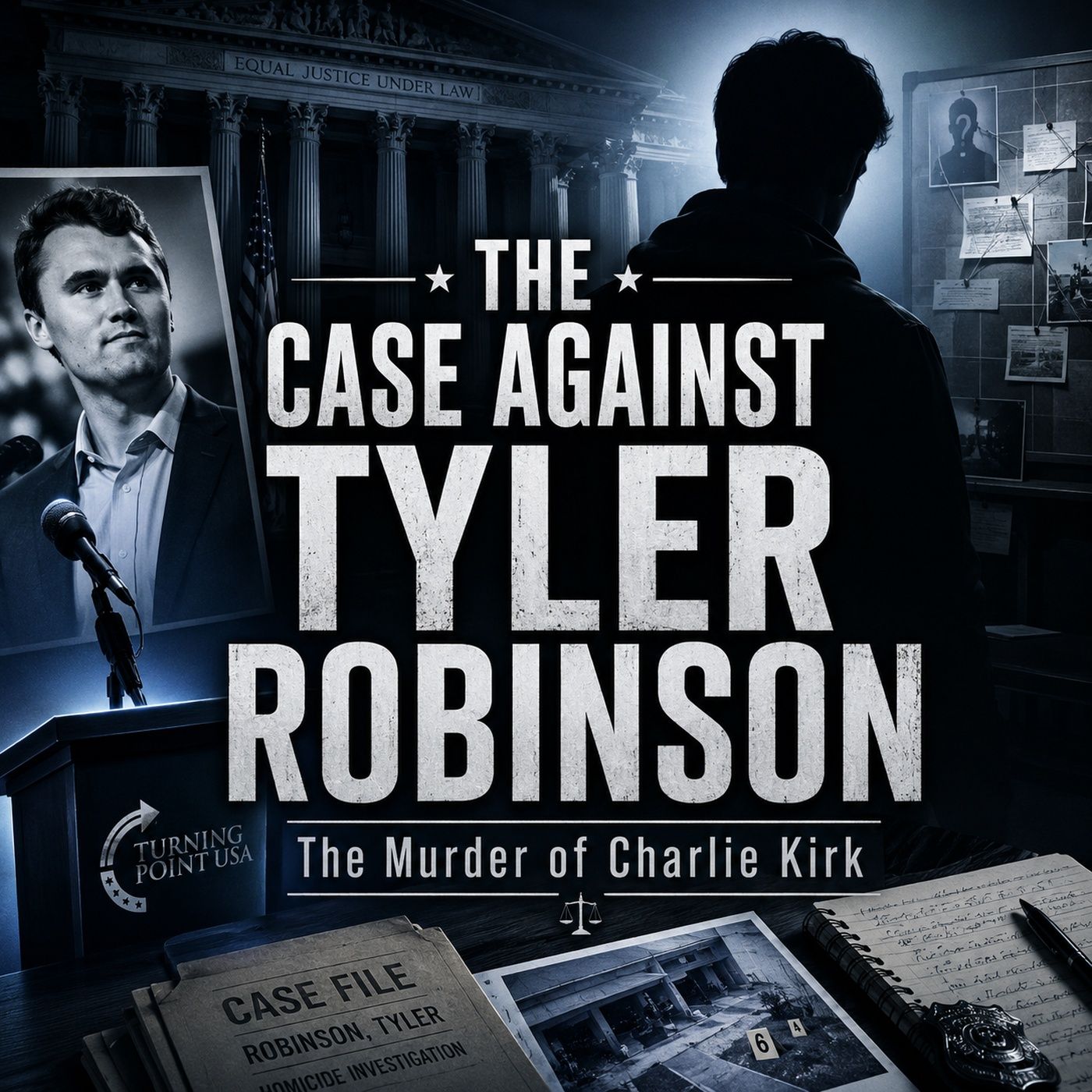
The Case Against Tyler Robinson
Hosted by Bobby Capucci · ENGLISH
The Case Against Tyler Robinson: The Murder of Charlie Kirk is a comprehensive examination of the criminal case surrounding the killing of Charlie Kirk and the prosecution of the man accused of carrying it out. From the earliest stages of the investigation through the pretrial hearings and, ultimately, the courtroom battle itself, this podcast will follow the evidence wherever it leads. Each episode will break down the testimony, forensic findings, surveillance evidence, legal filings, witness accounts, investigative decisions, and defense challenges that shape the case against Tyler Robinson.
This will not be a story told through rumors, internet speculation, or predetermined conclusions. The focus will remain on the record: what prosecutors say they can prove, how the defense attempts to challenge that evidence, and what the court allows the jury to hear. When new evidence emerges, it will be examined carefully. When claims conflict, those contradictions will be explored. When questions remain unanswered, they will not be ignored or filled in with convenient assumptions.
The road to trial is rarely direct, especially in a case of this magnitude. There will be delays, motions, evidentiary disputes, strategic maneuvering, unexpected rulings, and developments that could change the direction of the case entirely. The prosecution will be forced to defend the strength of its evidence, while the defense will search for weaknesses, inconsistencies, procedural failures, and reasonable doubt. Every significant twist and turn will be followed, explained, and placed into the larger context of the case.
Along the way, the podcast will examine the physical and digital evidence, the timeline of events, the alleged movements of the accused, the handling of forensic material, the statements attributed to those involved, and the decisions made by investigators and prosecutors. It will also look closely at the legal strategies being used on both sides, including efforts to suppress evidence, challenge expert testimony, limit what can be presented at trial, and shape how the jury ultimately understands the case.
Most importantly, The Case Against Tyler Robinson will remain grounded in the principle that the evidence must lead the story, not the other way around. The purpose is not to manufacture certainty before the trial has run its course. It is to document the process honestly, scrutinize every major claim, and provide listeners with a clear understanding of what is happening inside and outside the courtroom.
As the case develops, the narrative may change. Evidence may become stronger, weaker, or more complicated than it first appeared. Witnesses may offer new information. Legal rulings may reshape the prosecution’s case or the defense’s response. This podcast will follow those developments in real time, separating established facts from contested claims and courtroom evidence from online speculation.
This will not be a story told through rumors, internet speculation, or predetermined conclusions. The focus will remain on the record: what prosecutors say they can prove, how the defense attempts to challenge that evidence, and what the court allows the jury to hear. When new evidence emerges, it will be examined carefully. When claims conflict, those contradictions will be explored. When questions remain unanswered, they will not be ignored or filled in with convenient assumptions.
The road to trial is rarely direct, especially in a case of this magnitude. There will be delays, motions, evidentiary disputes, strategic maneuvering, unexpected rulings, and developments that could change the direction of the case entirely. The prosecution will be forced to defend the strength of its evidence, while the defense will search for weaknesses, inconsistencies, procedural failures, and reasonable doubt. Every significant twist and turn will be followed, explained, and placed into the larger context of the case.
Along the way, the podcast will examine the physical and digital evidence, the timeline of events, the alleged movements of the accused, the handling of forensic material, the statements attributed to those involved, and the decisions made by investigators and prosecutors. It will also look closely at the legal strategies being used on both sides, including efforts to suppress evidence, challenge expert testimony, limit what can be presented at trial, and shape how the jury ultimately understands the case.
Most importantly, The Case Against Tyler Robinson will remain grounded in the principle that the evidence must lead the story, not the other way around. The purpose is not to manufacture certainty before the trial has run its course. It is to document the process honestly, scrutinize every major claim, and provide listeners with a clear understanding of what is happening inside and outside the courtroom.
As the case develops, the narrative may change. Evidence may become stronger, weaker, or more complicated than it first appeared. Witnesses may offer new information. Legal rulings may reshape the prosecution’s case or the defense’s response. This podcast will follow those developments in real time, separating established facts from contested claims and courtroom evidence from online speculation.
9episodes
Episodes
Newest firstAll episodes
The Tyler Robinson Probable Cause Affidavit (Part 2) (8/9/26)
3d ago00:10:18Tap to summarizeThe probable-cause affidavit alleges that Tyler Robinson carried out the September 10, 2025 shooting of Charlie Kirk during an event at Utah Valley University. Investigators said campus surveillance tracked a dark-clothed suspect carrying a backpack as he moved toward the Losee Center, climbed onto its roof and took a prone position overlooking the courtyard shortly before Kirk was shot in the neck. The suspect then sprinted across the roof, climbed down and fled toward a wooded area, where investigators recovered a scoped Mauser Model 98 .30-06 bolt-action rifle wrapped in a towel. Engraved ammunition was found with the weapon, and a shoe impression near the rooftop escape point was described as consistent with Converse-style shoes worn by the suspect.The affidavit says the investigation shifted toward Robinson after a family member reported that he had confessed or implied responsibility. Police also placed Robinson’s gray Dodge Challenger at the university earlier that morning and said his family confirmed that he had recently discussed Kirk’s visit, criticized his views and become increasingly political. Robinson’s roommate then showed investigators messages attributed to “Tyler” discussing a rifle left at a drop point, the towel wrapped around it, engraved bullets, the weapon’s scope and a change of clothing. Based on the surveillance, recovered rifle, family information and digital messages, the officer concluded there was probable cause to arrest Robinson for aggravated murder, felony discharge of a firearm and obstruction of justice.to contact me:bobbycapucci@protonmail.comsource:23c7187b-5c27-490e-b52d-3f2640f43091.pdf
Transcribe →The Tyler Robinson Probable Cause Affidavit (Part 1) (8/9/26)
3d ago00:13:26Tap to summarizeThe probable-cause affidavit alleges that Tyler Robinson carried out the September 10, 2025 shooting of Charlie Kirk during an event at Utah Valley University. Investigators said campus surveillance tracked a dark-clothed suspect carrying a backpack as he moved toward the Losee Center, climbed onto its roof and took a prone position overlooking the courtyard shortly before Kirk was shot in the neck. The suspect then sprinted across the roof, climbed down and fled toward a wooded area, where investigators recovered a scoped Mauser Model 98 .30-06 bolt-action rifle wrapped in a towel. Engraved ammunition was found with the weapon, and a shoe impression near the rooftop escape point was described as consistent with Converse-style shoes worn by the suspect.The affidavit says the investigation shifted toward Robinson after a family member reported that he had confessed or implied responsibility. Police also placed Robinson’s gray Dodge Challenger at the university earlier that morning and said his family confirmed that he had recently discussed Kirk’s visit, criticized his views and become increasingly political. Robinson’s roommate then showed investigators messages attributed to “Tyler” discussing a rifle left at a drop point, the towel wrapped around it, engraved bullets, the weapon’s scope and a change of clothing. Based on the surveillance, recovered rifle, family information and digital messages, the officer concluded there was probable cause to arrest Robinson for aggravated murder, felony discharge of a firearm and obstruction of justice.to contact me:bobbycapucci@protonmail.comsource:23c7187b-5c27-490e-b52d-3f2640f43091.pdf
Transcribe →The Kohberger Playbook: Is Tyler Robinson Following the Same Path? (Part 2) (7/17/26)
4w ago00:15:09Tap to summarizeThe Tyler Robinson defense is following a familiar capital-case strategy: challenge the evidence, contest deadlines, file repeated motions, preserve every possible appellate issue, and force the prosecution to defend each stage of its case. That approach closely resembles the strategy used by Bryan Kohberger’s attorneys before he ultimately pleaded guilty in exchange for the removal of the death penalty. Although the constant delays and procedural battles are understandably frustrating, particularly for Charlie Kirk’s family and supporters, they are part of the reality of a case in which the government is seeking the ultimate punishment.The Robinson case is unlikely to move quickly or in a straight line. His attorneys are attempting to weaken the prosecution’s evidence, protect his constitutional rights, create leverage for a possible resolution, and save him from execution. Meanwhile, prosecutors must answer each challenge carefully because a major mistake could jeopardize a conviction or sentence years later. Eventually the motions and delays will end, but until then, the slow and repetitive legal grind should not be viewed as separate from the case. In a capital murder prosecution, that grind is the case.to contact me:bobbycapucci@protonmail.com
Transcribe →The Kohberger Playbook: Is Tyler Robinson Following the Same Path? (Part 1) (7/17/26)
4w ago00:15:00Tap to summarizeThe Tyler Robinson defense is following a familiar capital-case strategy: challenge the evidence, contest deadlines, file repeated motions, preserve every possible appellate issue, and force the prosecution to defend each stage of its case. That approach closely resembles the strategy used by Bryan Kohberger’s attorneys before he ultimately pleaded guilty in exchange for the removal of the death penalty. Although the constant delays and procedural battles are understandably frustrating, particularly for Charlie Kirk’s family and supporters, they are part of the reality of a case in which the government is seeking the ultimate punishment.The Robinson case is unlikely to move quickly or in a straight line. His attorneys are attempting to weaken the prosecution’s evidence, protect his constitutional rights, create leverage for a possible resolution, and save him from execution. Meanwhile, prosecutors must answer each challenge carefully because a major mistake could jeopardize a conviction or sentence years later. Eventually the motions and delays will end, but until then, the slow and repetitive legal grind should not be viewed as separate from the case. In a capital murder prosecution, that grind is the case.to contact me:bobbycapucci@protonmail.com
Transcribe →The State vs. Tyler Robinson: Inside the Charlie Kirk Murder Trial (Part 5) (7/16/26)
4w ago00:18:43Tap to summarizeCharlie Kirk was killed in what amounts to a political assassination, and the gravity of that cannot be softened, blurred, or buried under the usual noise. This was not just another violent crime, not just another court case, and not just another headline for people to weaponize for a news cycle. It was the killing of a public political figure in front of the country, followed almost immediately by the rush to explain it, exploit it, minimize it, or turn it into proof of whatever people already believed. Tyler Robinson now stands accused of carrying out that attack, and prosecutors say their case is built around a trail of evidence that includes his movements, the weapon, physical evidence, digital communications, and the timeline that led from the shooting to his arrest. But the fact that someone has been charged does not mean the public gets to skip the hard part. The evidence still has to be examined, the state’s claims still have to be tested, the defense still has the right to challenge the case, and the courts still have to decide what can actually be proven.The larger point is that a case this explosive demands more than outrage, slogans, and prepackaged conclusions. Charlie Kirk’s death instantly became a national pressure point because it touched politics, public violence, institutional trust, media coverage, online speculation, and the way Americans now process tragedy through tribal loyalty instead of disciplined fact-finding. Every official statement matters, every gap in the timeline matters, every piece of evidence matters, and every claim made by prosecutors, investigators, pundits, politicians, and anonymous internet sleuths has to be separated from what is actually in the record. The case is about the killing itself, the man accused, the evidence prosecutors say ties him to the crime, the questions the defense may raise, and the broader consequences of a political assassination unfolding in a country already primed to distrust everything. No one should be allowed to declare the truth simply because their preferred narrative feels right. The only way to handle a case like this is to walk through the record, piece by piece, and force every claim to survive contact with the evidence.to contact me:bobbycapucci@protonmail.com
Transcribe →The State vs. Tyler Robinson: Inside the Charlie Kirk Murder Trial (Part 4) (7/16/26)
4w ago00:12:39Tap to summarizeCharlie Kirk was killed in what amounts to a political assassination, and the gravity of that cannot be softened, blurred, or buried under the usual noise. This was not just another violent crime, not just another court case, and not just another headline for people to weaponize for a news cycle. It was the killing of a public political figure in front of the country, followed almost immediately by the rush to explain it, exploit it, minimize it, or turn it into proof of whatever people already believed. Tyler Robinson now stands accused of carrying out that attack, and prosecutors say their case is built around a trail of evidence that includes his movements, the weapon, physical evidence, digital communications, and the timeline that led from the shooting to his arrest. But the fact that someone has been charged does not mean the public gets to skip the hard part. The evidence still has to be examined, the state’s claims still have to be tested, the defense still has the right to challenge the case, and the courts still have to decide what can actually be proven.The larger point is that a case this explosive demands more than outrage, slogans, and prepackaged conclusions. Charlie Kirk’s death instantly became a national pressure point because it touched politics, public violence, institutional trust, media coverage, online speculation, and the way Americans now process tragedy through tribal loyalty instead of disciplined fact-finding. Every official statement matters, every gap in the timeline matters, every piece of evidence matters, and every claim made by prosecutors, investigators, pundits, politicians, and anonymous internet sleuths has to be separated from what is actually in the record. The case is about the killing itself, the man accused, the evidence prosecutors say ties him to the crime, the questions the defense may raise, and the broader consequences of a political assassination unfolding in a country already primed to distrust everything. No one should be allowed to declare the truth simply because their preferred narrative feels right. The only way to handle a case like this is to walk through the record, piece by piece, and force every claim to survive contact with the evidence.to contact me:bobbycapucci@protonmail.com
Transcribe →The State vs. Tyler Robinson: Inside the Charlie Kirk Murder Trial (Part 3) (7/16/26)
4w ago00:12:27Tap to summarizeCharlie Kirk was killed in what amounts to a political assassination, and the gravity of that cannot be softened, blurred, or buried under the usual noise. This was not just another violent crime, not just another court case, and not just another headline for people to weaponize for a news cycle. It was the killing of a public political figure in front of the country, followed almost immediately by the rush to explain it, exploit it, minimize it, or turn it into proof of whatever people already believed. Tyler Robinson now stands accused of carrying out that attack, and prosecutors say their case is built around a trail of evidence that includes his movements, the weapon, physical evidence, digital communications, and the timeline that led from the shooting to his arrest. But the fact that someone has been charged does not mean the public gets to skip the hard part. The evidence still has to be examined, the state’s claims still have to be tested, the defense still has the right to challenge the case, and the courts still have to decide what can actually be proven.The larger point is that a case this explosive demands more than outrage, slogans, and prepackaged conclusions. Charlie Kirk’s death instantly became a national pressure point because it touched politics, public violence, institutional trust, media coverage, online speculation, and the way Americans now process tragedy through tribal loyalty instead of disciplined fact-finding. Every official statement matters, every gap in the timeline matters, every piece of evidence matters, and every claim made by prosecutors, investigators, pundits, politicians, and anonymous internet sleuths has to be separated from what is actually in the record. The case is about the killing itself, the man accused, the evidence prosecutors say ties him to the crime, the questions the defense may raise, and the broader consequences of a political assassination unfolding in a country already primed to distrust everything. No one should be allowed to declare the truth simply because their preferred narrative feels right. The only way to handle a case like this is to walk through the record, piece by piece, and force every claim to survive contact with the evidence.to contact me:bobbycapucci@protonmail.com
Transcribe →The State vs. Tyler Robinson: Inside the Charlie Kirk Murder Trial (Part 2) (7/16/26)
4w ago00:13:29Tap to summarizeCharlie Kirk was killed in what amounts to a political assassination, and the gravity of that cannot be softened, blurred, or buried under the usual noise. This was not just another violent crime, not just another court case, and not just another headline for people to weaponize for a news cycle. It was the killing of a public political figure in front of the country, followed almost immediately by the rush to explain it, exploit it, minimize it, or turn it into proof of whatever people already believed. Tyler Robinson now stands accused of carrying out that attack, and prosecutors say their case is built around a trail of evidence that includes his movements, the weapon, physical evidence, digital communications, and the timeline that led from the shooting to his arrest. But the fact that someone has been charged does not mean the public gets to skip the hard part. The evidence still has to be examined, the state’s claims still have to be tested, the defense still has the right to challenge the case, and the courts still have to decide what can actually be proven.The larger point is that a case this explosive demands more than outrage, slogans, and prepackaged conclusions. Charlie Kirk’s death instantly became a national pressure point because it touched politics, public violence, institutional trust, media coverage, online speculation, and the way Americans now process tragedy through tribal loyalty instead of disciplined fact-finding. Every official statement matters, every gap in the timeline matters, every piece of evidence matters, and every claim made by prosecutors, investigators, pundits, politicians, and anonymous internet sleuths has to be separated from what is actually in the record. The case is about the killing itself, the man accused, the evidence prosecutors say ties him to the crime, the questions the defense may raise, and the broader consequences of a political assassination unfolding in a country already primed to distrust everything. No one should be allowed to declare the truth simply because their preferred narrative feels right. The only way to handle a case like this is to walk through the record, piece by piece, and force every claim to survive contact with the evidence.to contact me:bobbycapucci@protonmail.com
Transcribe →The State vs. Tyler Robinson: Inside the Charlie Kirk Murder Trial (Part 1) (7/16/26)
4w ago00:16:09Tap to summarizeCharlie Kirk was killed in what amounts to a political assassination, and the gravity of that cannot be softened, blurred, or buried under the usual noise. This was not just another violent crime, not just another court case, and not just another headline for people to weaponize for a news cycle. It was the killing of a public political figure in front of the country, followed almost immediately by the rush to explain it, exploit it, minimize it, or turn it into proof of whatever people already believed. Tyler Robinson now stands accused of carrying out that attack, and prosecutors say their case is built around a trail of evidence that includes his movements, the weapon, physical evidence, digital communications, and the timeline that led from the shooting to his arrest. But the fact that someone has been charged does not mean the public gets to skip the hard part. The evidence still has to be examined, the state’s claims still have to be tested, the defense still has the right to challenge the case, and the courts still have to decide what can actually be proven.The larger point is that a case this explosive demands more than outrage, slogans, and prepackaged conclusions. Charlie Kirk’s death instantly became a national pressure point because it touched politics, public violence, institutional trust, media coverage, online speculation, and the way Americans now process tragedy through tribal loyalty instead of disciplined fact-finding. Every official statement matters, every gap in the timeline matters, every piece of evidence matters, and every claim made by prosecutors, investigators, pundits, politicians, and anonymous internet sleuths has to be separated from what is actually in the record. The case is about the killing itself, the man accused, the evidence prosecutors say ties him to the crime, the questions the defense may raise, and the broader consequences of a political assassination unfolding in a country already primed to distrust everything. No one should be allowed to declare the truth simply because their preferred narrative feels right. The only way to handle a case like this is to walk through the record, piece by piece, and force every claim to survive contact with the evidence.to contact me:bobbycapucci@protonmail.com
Transcribe →