← The Catechism in a Year (with Fr. Mike Schmitz)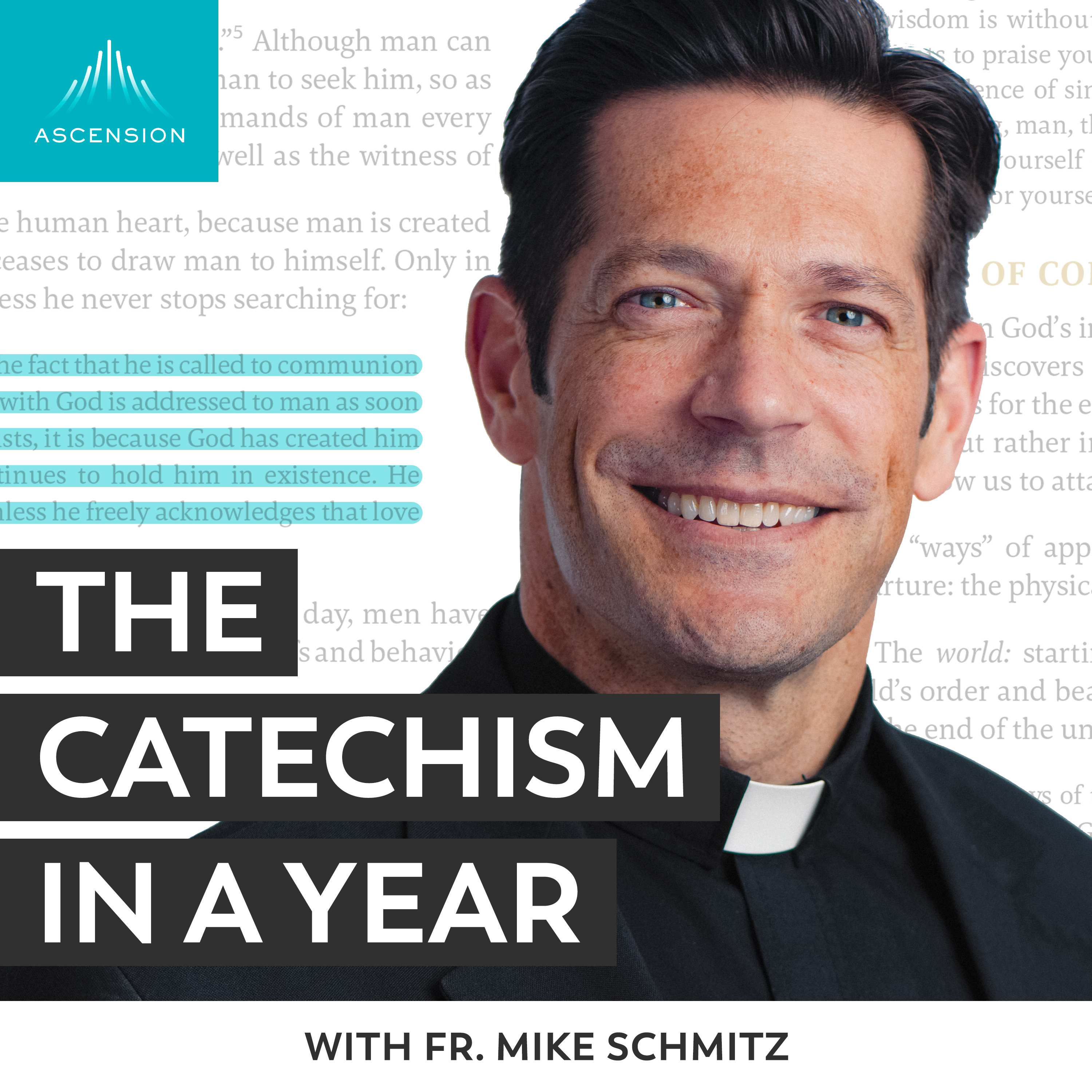
The Catechism in a Year (with Fr. Mike Schmitz)
Day 66: True God and True Man (2025)
00:24:43
We explore the truth that Jesus Christ is fully God and fully man; he is one person with two natures, both Divine and human. Fr. Mike explains that we call Mary the Mother of God because, from the very moment of his conception, Jesus was fully God and fully human. Fr. Mike also goes over heresies in the history of the Church that have denied the humanity of Christ, rejected the divinity of Christ, or confused the fact that Jesus is the Son of God by nature. The Church has always responded by affirming that Jesus Christ is truly the Son of God who became a man and our brother without ceasing to be God and Lord. Today’s readings are Catechism paragraphs 464-469.
Loading summary
Transcript1 lines
- [00:00]
Father Mike Schmitz
Foreign Hi, my name is Father Mike Schmitz, and you're listening to the Catechism in a Year podcast where we encounter God's plan of sheer goodness for us, revealed in scripture and passed down through the tradition of the Catholic faith. The Catechism in a Year is brought to you by ascension. In 365 days, we'll read through the Catechism of the Catholic Church, discovering our identity in God's family as we journey together toward our heavenly home. It is day four 66. We're reading paragraphs 464, 469. As always, I'm using the Ascension edition of the Catechism, which includes the Foundations of Faith approach, but you can follow along with any recent version of the Catechism of the Catholic Church. Also, if you want to download your own Catechism in a Year reading plan, you can visit ascensionpress.com ciy and lastly, you can click follow or subscribe in your podcast app for daily updates and daily notifications. So they come right to your phone or wherever you're listening on this, to this podcast. It'd be great. You can subscribe, you can follow. You know, as I said, is day 66. We're reading paragraph 464 to 469. Yesterday we talked about why. Why did the Son of God became man? Why did the Word become flesh? And we answered that question by saying he came to save us by reconciling us to the Father that remember, that was the first reason. Secondly, that we might know God's love. Third, to be our model of holiness. And fourth, so we could become partakers of the divine nature and just remarkable, right? Well, today we the church, gosh, it's one thing to say. It's one thing to say Jesus Christ is truly God. You know, Jesus Christ is Lord. We talked about that a couple days ago. But then the question comes up, well, what do you mean? What do you mean that Jesus Christ is true God and true man? And so what happens is we're going to look at today the heresies, basically, the challenges to the understanding of who Jesus truly is, right? We know that Jesus is the second person of the Trinity, become flesh. But what does that mean, right? What does it mean to say that Jesus is true God and true man? What does it mean to say he's both divine and human? And so we're going to look at a couple different heresies. We're going to look at the fact that the first heresy, really first, the heresies that popped up were actually more denied Christ's humanity than they denied Christ's divinity. The first thing was actually he only appeared to be human. He didn't really become human. One of the first heresies we also looked at, we're going to look at the Nestorian heresy. And the Nestorian heresy regarded Jesus Christ as a human person joined to the divine person of God's Son. And so we have to clarify that, that no Jesus is. Has one, is a one divine person with a human nature and a divine nature, right? He's one divine person with two natures, human and divine. That's going to be very, very important. That was Council of Ephesus talked about that. We're also going to talk. It was a council of Ephesus that proclaimed that Mary is truly the Theotokos, right? She is truly the mother of God because the person, the being, the one who was conceived in her womb, was truly the Son of God, was from the moment of his conception, had already been. It had eternally been in fact the Son of God who became man at one point in time, right? So he. It's incredible, right? He joined himself, this divine person, joined his divine nature to human nature, which is remarkable, right? So then after that, of course, the Monophysites, they affirmed that when the second Person of the Trinity, you know, the old begotten Son of the Father, joined his divine nature to the human nature, that the human nature had ceased to exist. And so that was why in 451the Council of Chalcedon confessed that. Nope, actually that human nature and that divine nature coexisted, essentially. You want to say it like that. In one divine person, in one. We can say it like this. In one hypostasis. That's the technical term here again, you guys, it's remarkable. But these are some of the heresies that came up in Ask the question, what is it to say that Jesus is Lord? What is it to say that he is the Son of God? You know, it is our misunderstanding of some of these heresies and the church's subsequent clarification of this that I don't know if you ever go online. And typically in our conversations with, not just our conversations with non Christians generically, but there are a number of Muslims, our Muslim friends, who I would say this since we have lacked a degree of clarity in the way we've articulated how Jesus Christ is truly God and truly man, there are a number of Muslim, you might call them apologists who kind of basically, I don't want to say it like this. But kind of twist in some ways the Catholic teaching about who Jesus truly is in order to deny his divinity. Now, for us, we want to understand who Jesus really is so that we can love him, right? So we can know the truth and we can love him in truth, but also so that we can explain it again, not just to our Muslim friends, but to any friend, to be able to say, when they ask us, what do you mean that Jesus Christ is true God and true man? What do you mean that he is both human and divine? To be able to say, at least in some ways, oh, we're not saying this or we're not saying that, but we are saying, you know, this other thing. That's what we're kind of looking at today. And again, it's going to be. There might be some new words that you. I have never heard of before, like Gnosticism or Gnostic Docetism. That's one of the. That's one of the first heresies we're going to talk about a little bit. The name Nestorian comes from a guy named Nestorius. It just happens to be his name. So they named the heresy after the guy. So I guess if you become, you know, influential enough in your heresy, then you get to have a heresy named after you. So, like the Arian heresy named after Arius, but nonetheless, what we're looking for is the ability not only to know who God is so we can love him, but also to be able to explain. So again, not to be confused, there might be some kind of words you might not have heard. Gnostic Docetism, Nestorianism, Homoosius. These, these words. You're going to get the context as we move along. So just invite you not to be distracted or sidetracked by some words that might not be immediately apparently understandable, but know that we're going to give some context ultimately. Okay, so here we go. Let's get started. Let's pray. And then Launch into paragraphs 464 to 469. Father, in heaven, we know that you've given us your only begotten Son. We know that in Jesus Christ, one divine person, there were two natures, human and divine. In so many ways, we don't know how the details. In so many ways, we don't know exactly what that means. Father, we ask you to help us to understand how your eternal, only begotten Son entered into time and entered into our world, into this. In this life, in a unique way, in a unique way, in the Incarnation, help us to understand it just more deeply today so that we can love you and rejoice and give you praise and glory for what you have done in our lives and in the life of every human being. By uniting your divinity to our humanity, you have forever changed our humanity. And we thank you. Help us to live like this, this day and every day. We make this prayer in Jesus name. Amen. In the name of the Father and of the Son and of the Holy Spirit. Amen. Okay, so we're going to dive into that again. It's day 66. We're reading paragraph 464 to 469. Here we go. True God and true man the unique and altogether singular event of the incarnation of the Son of God does not mean that Jesus Christ is part God and part man. Nor does it imply that he is the result of a confused mixture of the divine and the human. He became truly man while remaining truly God. Jesus Christ is true God and true man. During the first centuries, the Church had to defend and clarify this truth of faith against the heresies that falsified it. The first heresies denied not so much Christ's divinity as his true humanity, such as Gnostic Docetism. From apostolic times, the Christian faith has insisted on the true incarnation of God's Son come in the flesh. But already in the third century, the Church, in a council at Antioch, had to affirm against Paul of Samosota that Jesus Christ is Son of God by nature and not by adoption. The First Ecumenical Council of Nicaea in 325 confessed in its creed that the Son of God is begotten, not made consubstantial, I.e. homoousius with the Father and condemned Arius, who had affirmed that the Son of God came to be from things that were not and that he was from another substance than that of the Father. The Nestorian heresy regarded Christ as a human person joined to the divine Person of God's Son. Opposing this heresy, St. Cyril of Alexandria and the Third Ecumenical Council at Ephesus in 431 confessed that the Word uniting to himself in his person, the flesh animated by a rational soul, became man. Christ's humanity has no other subject than the divine person of the Son of God, who assumed it and made it his own from his conception. For this reason, the Council of Ephesus proclaimed in 431 that Mary truly became the Mother of God by the human conception of the Son of God in her womb, stating Mother of God, not that the nature of the Word or his divinity received the beginning of its existence from the Holy Virgin, but that since the Holy Body, animated by a rational soul, which the Word of God united to himself according to the hypostasis, was born from her, the Word is said to be born according to the flesh. The Monophysites affirmed that the human nature had ceased to exist as such in Christ when the Divine Person of God's Son assumed it. Faced with this heresy, the Fourth Ecumenical Council at Chalcedon in 451, following the Holy Fathers, we unanimously teach and confess one and the same Son, our Lord Jesus Christ, the same perfect in divinity and perfect in humanity, the same truly God and truly man, composed of rational soul and body, consubstantial with the Father as to his divinity and consubstantial with us as to his humanity, like us in all things but sin, he was begotten from the Father before all ages as to his divinity. And in these last days for us and for our salvation was born as to his humanity. Of the Virgin Mary, the Mother of God, we confess that one and the same Christ, Lord and only begotten Son, is to be acknowledged in two natures, without confusion, change, division, or separation. The distinction between the natures was never abolished by their union, but rather the character proper to each of the two natures was preserved as they came together in one person or prosopon and one hypostasis. After the Council of Chalcedon, some made of Christ's human nature a kind of personal subject against them. The Fifth Ecumenical Council at Constantinople in 553 confessed that there is but one hypostasis or person, which is our Lord Jesus Christ, one of the Trinity. Thus everything in Christ's human nature is to be attributed to his Divine Person as its proper subject, not only his miracles, but also his sufferings and even his death. He who was crucified in the flesh, Our Lord Jesus Christ is true God, Lord of glory and one of the Holy Trinity. The Church thus confesses that Jesus is inseparably true God and true man. He is truly the Son of God, who without ceasing to be God and Lord, became a man and our Brother. What he was, he remained, and what he was not, he assumed. Sings the Roman Liturgy and The Liturgy of St. John Chrysostom proclaims and sings O only begotten Son and Word of God, immortal being, you who deigned for our salvation to become incarnate of the Holy Mother of God and ever Virgin Mary, you who without change became man and were crucified, O Christ, our God, you who by your Death have crushed death. You who are one of the Holy Trinity, glorified with the Father and the Holy Spirit, save us. Okay, so it's incredible. You know, one of the reasons why, why we have Church councils is because there are challenges, right? There are misunderstandings, there are teachings that are contrary to the faith. And so the Church has to answer and has to say, okay, what is the truth? What is it that we actually believe? What is it that we actually know about Jesus or about any of the mysteries of our faith? And so here we go. From the very, very beginning, we recognize that the first heresies denied not so much Christ's divinity as his true humanity. You know, for Gnostics, it was the material world that was, you know, evil. It was fallen, and it was what we needed to shake off. And so they would say that no, it would be improper to divinity to actually take on humanity, to actually get hungry, to actually digest, to actually sleep like all these things. And not only that, to suffer and to die. That was so abhorrent to them that they deny Christ's divinity or, sorry, they denied his humanity in the first place. And yet from apostolic times, from the very beginning, we have Christian faith, has insisted the true incarnation of Jesus Christ come in the flesh. So that's so important. There's also the other heresy. In the third century, it says here in paragraph 465 in the church council at Antioch had to affirm against this guy named Paul of Samasota that Jesus Christ is son of God by nature and not by adoption. Because Paul of Samosota was saying that he was the Son of God. Oh, but only by adoption. Meaning. Here is the gospel story that talks about how Jesus was baptized in the Jordan River. The Holy Spirit comes upon him, and the Father declares, this is my Son. And so Paul of Samasota would claim that. Well, that's when the Father adopted Jesus. That's when if he had divinity, that's when it came upon him. And the church is like, no, absolutely not. Very, very important to recognize that Jesus is the Son of God by nature, not by adoption. We're sons and daughters of God by adoption. Jesus Christ is unique. He is the Son of God by nature. Always, always the Son of God. Next we have the first ecumenical council in Nicaea. Big ecumenical council. You know what year that was? That was 325. It's one of those years that people just remember Council of Nicaea, year 325. And so put that, put that in the old brain bucket because there was a guy named Arius and the Arian heresy was massively, massively popular. And so the Church had to speak out against the Arian heresy. And what happened? Well, what, the Council of Nicaea in what year? 325. That's right, said that no, the Son of God is begotten, not made consubstantial with the Father. We say that every single Sunday. Consubstantial. That Greek word is homoousios. So of the same substance that, you know, Arius had said that the Son of God came to be from things that were not. There was another. There was a time when the Son of God did not exist. And very, very important in Council of Nicaea that we, that we clarified and affirmed now Jesus Christ is eternally begotten of the Father of the same substance, consubstantial with the Father. So whenever you say that this Sunday coming up, whenever that's coming, realize we say that because there was the heresy that denied the fact that Jesus is true God and true man. Now after this we have the Nestorian heresy. Now I say after this. But you know, all these things, they kind of swirl a little bit too. Sometimes they happen chronologically and sometimes they happen concurrently. The Nestorian heresy regarded Christ as a human person joined to the divine person of God's Son. And so the Council of Ephesus in 431 had to declare that no, Jesus is a divine person with two natures. A nature that is human and a nature that is divine. He has divine nature and human nature, but he's one divine person. Another way to say it here at Council of Ephesus says that the Word uniting to himself in his person, the flesh animated by a rational soul became man. That as 466 paragraph says, Christ's humanity has no other subject than the divine person of the Son of God, who assumed it and made it his own from the moment of his conception. And this is the reason that the Council of Ephesus in 431 proclaimed that Mary truly is the mother of God. The Greek word to say, way to say that is Theotokos or Theotokos, right? She's the Mother of God by the human conception of the Son of God in her womb. So obviously Mary did not exist before the Son of God existed. Who is he is eternal, right? He is the only begotten Son of the Father. He's before all things. He's again, the Word is eternal. Mary was born in time. Mary was, is human being. She's just, just a human being. Yet. Yet here's what the Council of Ephesus said. What year? 431. Got that? Good. Well done. She, Mary, is Mother of God. Not that the nature of the Word or His divinity received the beginning of its existence from the Holy Virgin. Right? Right. So that's she's the Mother of God not because his divinity received the beginning of its existence from her, but that since the Holy Body animated by a rational soul. See that, that is the very important part. We recognize that that's the human nature. The Holy Body, animated by a rational soul, which the Word of God, united to Himself according to the hypostasis, was born from her. The Word is said to be born according to the flesh. So this is so, so important, and I don't want anyone to miss this. We call Mary the Mother of God not because it's not meant to be simply a title of honor to her, although what incredible honor. But it's saying something about Jesus. It is saying that from the very moment of his conception, the eternal Son of God, the second Person of the Trinity, united to himself humanity like human nature. So that the being in Mary's womb is the second Person of the Trinity, right? That one person, one divine person with a human and divine nature. Therefore the child to whom Mary gave birth is actually God. Therefore we can say Mary is the Mother of God. Does that make sense? No. Again, not that she preceded the eternal Son of the Father, but that she truly gave birth to a divine person. Therefore she is the Mother of God when she gave birth to Jesus Christ, a divine person with a human and divine nature. Again, it's not about Mary. What it is about is about here's how fully Jesus has united his divinity to our humanity. And so we have the Monophysite heresy in paragraph 467 that affirmed that the human nature had ceased to exist as such in Christ when the divine Person of God's Son assumed it. So I've heard it described that it was like, yeah, at some point, here's God's divinity, right? The second Person of the Trinity who became one of us. So, yes, there's human nature at the beginning, but then it was kind of like this. Here's my image. It's not my image, it's someone else's image. Like this humanity that Christ assumed gets lost in this sea of divinity. And the example was like Alka Seltzer, right? Here's a tablet of Alka Seltzer. That would be the humanity that gets dropped into this sea of divinity. And it just kind of dissolves Just goes away. And the problem with this, because that would say, yeah, there's the incarnation, God became one of us, but then the humanity part just dissolved away. The problem with that, as others have said, is that it means that Jesus did not act as a human being, that, that his, that his life, his miracles, his suffering, his death, his rising from the dead weren't done as a human being, but simply was done as a divine being. And we recognize that now God did this. Even the whole purpose of the Incarnation, right, is to bring us close, is to bring, come close to us and to bring us close to divinity. And so if he absorbed and essentially obliterated our humanity, then that doesn't come close to us. And so the Fourth Ecumenical Council, Chalcedon in the year 451 confessed this following the Holy Fathers, meaning it goes all the way back. We unanimously teach and confess one and the same Son, our Lord Jesus Christ, the same perfect in divinity and perfect in humanity, the same truly God and truly man, composed of a rational soul and body comparison, consubstantial with the Father as to his divinity and consubstantial with us as to his humanity. Again, this is so important, right, because the humanity of Jesus did not cease to exist, did not get obliterated like Alka Seltzer in water. This is so important. He was begotten from the Father. This is going back to the Council of Chalcedon. He was begotten from the Father before all ages as to his divinity. And in these last days for us and for our salvation was born as to his humanity of the Virgin Mary, the Mother of God. And so goes on. And this is maybe I don't want to say this is the most important part, but for me it kind of brings it hammers at home. And this is this again, paragraph 467 in those in the small script we confess that one and the same Christ, Lord and only begotten Son, is to be acknowledged in two natures without confusion, change, division or separation. I remember those just so, so, so important for all these things without confusion, change, division or separation. The distinction between the natures was never abolished by their union. Meaning, yeah, human nature, divine nature, never abolished by that union, but rather the character proper to each of the two natures was preserved as they came together in one person prose upon and one hypostasis. It's just remarkable. Incredible, man. I think this is not only incredible for us to recognize that Jesus, one divine person, having a divine nature and a human nature is not just technical. It's not just kind of. We like to know the nuts and bolts or how the engine works or whatever you want to say on what's under the hood, but because it actually matters to us. It matters that Jesus is fully God, because if he wasn't fully God, we couldn't be redeemed. It also matters that Jesus is fully human, because if he wasn't fully human, we couldn't be redeemed, right? And so here is Jesus, who in one divine person has a human nature just like ours in all things but sin. He became like us in all things but sin, but also has a divine nature, which is just remarkable and incredible. I love, I love this last prayer. The Roman liturgy says, what he was, he remained, meaning he was God. What he was, he remained. And what he was not. He assumed that he wasn't human, but he became. He assumed humanity, right? What he was, he remained divine. And what he was not, he assumed human. And the liturgy of St. John Chrysostom, who just remarkable, golden, golden tongue, he said, only begotten. We'll close with this because I know it's long, but it's, it's. It's deep, right? Only begotten Son and word of God, immortal being. You who deigned for our salvation to become incarnate of the Holy Mother of God and ever Virgin Mary, you who without change became man and were crucified, O Christ our God. You who by your death have crushed death, you who are one of the Holy Trinity, glorified with the Father and the Holy Spirit, save us. It is incredible. I know this is exceptionally long today, but this is deep. Hopefully, this. Don't be discouraged if you're like, what's. I still don't know who Nestorian is or Nestorius is. I don't know the Arian heresy yet. It's okay. What we need to know is Jesus is one divine person with a human nature and a divine nature again, as it's. As it says very clearly, without confusion, change, division or separation. And that means God has made himself our brother so that we could become sons and daughters of God. It's incredible. Tomorrow we're going to talk about how. How is the Son of God man even more deeply. It's remarkable. It's incredible. It might in some ways be challenging, but at the same time, hang in there, you guys. I'm so sorry this is so long, but hang in there. This is worth it. It is worth doing the work because we need to know who Jesus is. We need to know what, what is. What is the meaning of the incarnation and how does it affect our lives? I am praying for you that made it through today. Keep pressing play tomorrow. Please pray for me. My name is Father Mike. I cannot wait to see you tomorrow. God bless.