Loading summary
Transcript71 lines
- [00:00]
Charlie Kirk
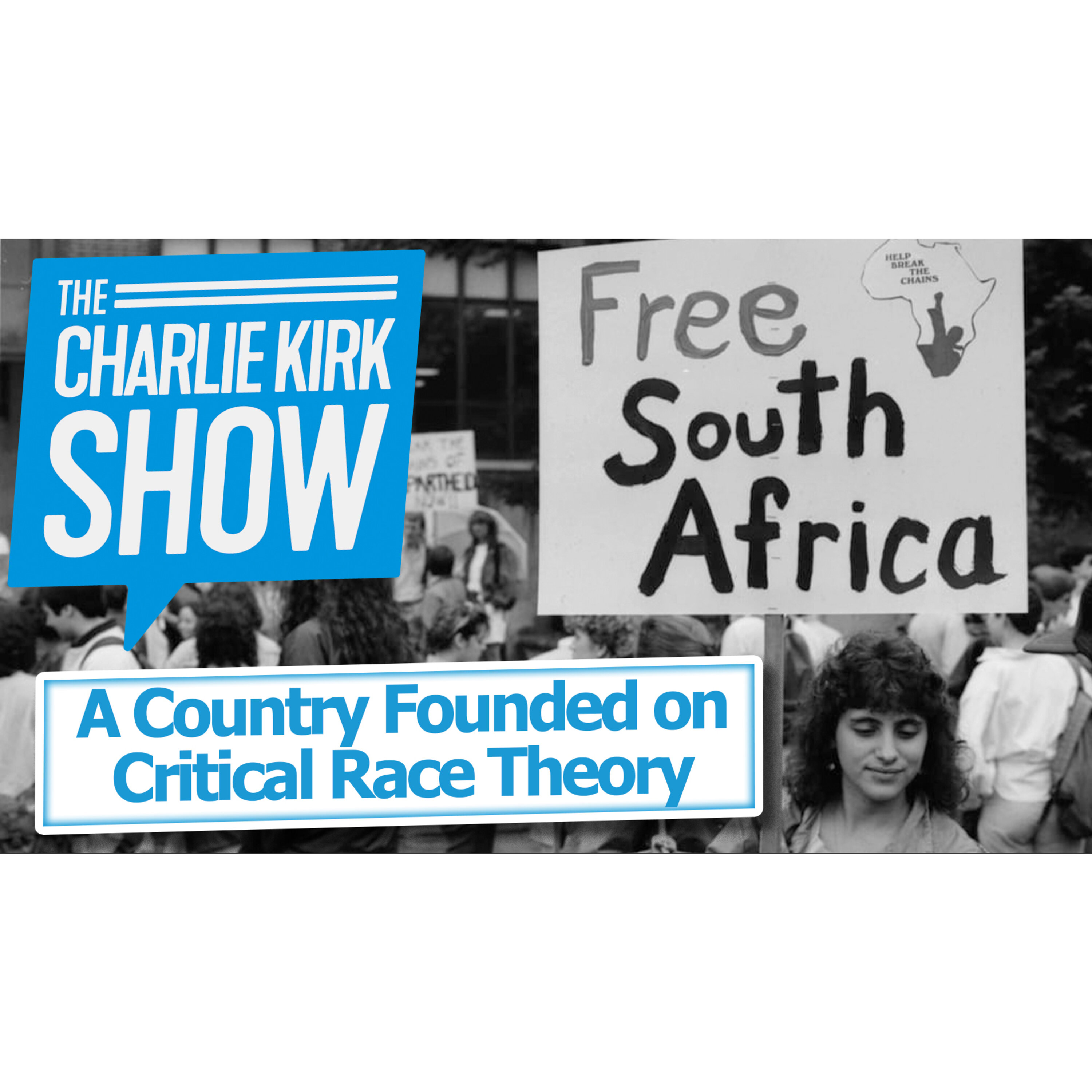
Hey, everybody, what happens if a country was founded on critical race theory? We explore that question with a real life example of a real country that exists, that is falling apart today on the Charlie Kirk Show. If you want to support our program, go to charliekirk.com support. Buckle up, everybody. Here we go. Charlie, what you've done is incredible here.
- [00:20]
Andrew
Maybe Charlie Kirk is on the college campus. I want you to know we are
- [00:23]
Charlie Kirk
lucky to have Charlie Kirk. Charlie Kirk's running the White House, folks. I want to thank Charlie. He's an incredible guy.
- [00:31]
Andrew
His spirit has love of this country.
- [00:33]
Charlie Kirk
He's done an amazing job building one of the most powerful youth organizations ever created, Turning Point usa. We will not embrace the ideas that have destroyed countries, destroyed lives. And we are going to fight for freedom on campuses across the country. That's why we are here. Did you get hit with a big tax bill you weren't expecting, with rates being very low and home equity being high? Perfect time to refinance. Look, we're all about refinancing all this. Here's the long and short of it. You should not be giving business to bad companies. So if you're using Goldman Sachs, bad company, Wells Fargo, bad company, JP Morgan, bad company, all these companies, they love blm, they hate America. And quite honestly, if you're listening to this program, they hate you. And so if you want to take out a loan, here's what I'm going to tell you. What to do. Maybe you're a new family. You're like, I want to buy a house, and it's my dream house, and I want to take out a loan. The good news is that there are partners called Andrew and Todd. Andrew Del Rey and Todd Avakian. Andrewandtod.com Just save that in your notes, by the way. Just save it in the notes of your phone because you might need it. Like, I don't need it. My banker at Goldman Sachs is just fine. Or my banker at bank of America is just fine. Like, okay, then when you go take that loan and you go sign those 95,000 pieces of paper they give you, you know what you're really signing? You're signing contribution forms to BLM Incorporated. That's. That's what you're doing. When you go take out a loan with Chase, when you go take out a loan with Wells Fargo, you might as well go give the money to Joe Biden. So when you go to D.C. next and you go travel maybe with your family, why don't you just get a cashier's check and Drop it off at the White House entrance. That's what you're doing when you bank with these woke losers at Wells Fargo. So take out a loan with the good guys. It's Andrew and Todd. Look, they're just great people. They're Christians. They love the Lord, they love America. And you call them up and just say, I want to speak to Andrew and Todd. That's all you have to say? Charlie Kirk sent me. And their number is 8881172. That's andrewandtod.com andrewandtod.com 88881172 you go to andrewandtod.com, 8881172 and say you should make a vow to yourself. Just make a promise to yourself. I refuse to fund companies that hate America. I refuse to fund companies that hate America. And you have a choice if you want to take out a loan or just explore the idea of refinancing. Andrewandtod.com call 8 8/8 1172 I go out to eat with these guys. They're terrific. They're good people. Andrewandtod.com we are here at the Turning Point USA Student Action Summit, the largest gathering ever of young conservatives. And maybe there was a bigger one at some point in America. I don't think that's true of young conservatives. I highly doubt this is the biggest ever. Really.
- [03:30]
Andrew
It's bigger than last year.
- [03:32]
Charlie Kirk
Oh, man. It's bigger than six months ago when we did it.
- [03:34]
Andrew
I know. I say last year. Actually, technically people don't know that. Some people don't know. We moved this event from December to, to a July time slot.
- [03:43]
Charlie Kirk
And if we, if we were to go to. Well, we are going to Phoenix this December. Absent delta variant lockdowns, we're going to have a lot of people, 10,000, maybe 15,000, maybe 20,000.
- [03:58]
Andrew
We'll see.
- [03:59]
Charlie Kirk
Lot to get to the big number.
- [04:00]
Andrew
Those are big numbers.
- [04:01]
Charlie Kirk
So one of the themes that we have been talking about here at Turning Point USA is critical race theory. What are the implications of critical race theory? Article by a friend of mine was one of the best articles I've read in quite some time and I think it was done by the site itself. In fact, let's have Darren back on the show. He's so smart.
- [04:23]
Andrew
Darren's great.
- [04:24]
Charlie Kirk
It's Revolver News and as soon as I saw the headline I put down my phone and I said, why didn't I think of that? And that's when you know that's a really important. I think it's really important.
- [04:34]
Andrew
I mean, to be fair, you have brought up South Africa a lot just as a preface.
- [04:38]
Charlie Kirk
Oh no, of course. The way this was articulated.
- [04:41]
Andrew
Yeah, no, the way it was constructed. The argument is really, really brilliant.
- [04:44]
Charlie Kirk
Yeah. Here's the article headline. South Africa, the first country built on critical race theory officially implodes. And I thought to myself, that is so perfect. What were to happen if we founded a country and built a country on all of these academic ideas that we see talked about in higher education? What would be, what would happen? What would that look like? Well, the answer is South Africa. South Africa is totally disintegrating again. I'm reading from Revolver News. So what happened is that there was the jailing of this person by the name of Jacob Zuma and the supporters of the former president took to the streets to allegedly protest, but what they really wanted to do was to plunder and steal at will. Sound familiar? The death toll already of all the riots are already into the dozens in South Africa. Do you know there are 57 murders a day in South Africa? That's almost American levels of murders.
- [05:40]
Andrew
Well, it's such a. That's why it's insane per capita, by the way.
- [05:43]
Charlie Kirk
That's what I mean. Yeah, exactly.
- [05:45]
Andrew
I was. Yes.
- [05:46]
Charlie Kirk
Well, I'm just saying that America was probably. Let me guess, America probably has 200 murders a day. That's just an interesting question, isn't it? How many murders does America have a day?
- [05:56]
Andrew
We have 330 million people versus.
- [05:58]
Charlie Kirk
No, totally. I'm just, I'm guessing. I don't.
- [06:00]
Andrew
Ye.
- [06:00]
Charlie Kirk
The point is that the rioters have plundered shops and entire shopping malls. If you have not seen what's been happening in South Africa, then you are living in a media simulation. It's one of the most important stories happening in the world. Now, South Africa, many people listening to this that are under the age of 30, myself included, have no real memory of how South Africa was the old Israel. What do I mean by that? South Africa used to be the trendy celebrity concert filled issue that people would talk about to Virtue Signal for good reason. Largely because South Africa was living under legitimate legal apartheid. Now Andrew, you. Do you remember this because you're a little bit older than I am. Do you remember when South Africa was a really big deal or that?
- [06:49]
Andrew
Oh yeah, when I was in, when I was. I feel like when I was in grade school, I mean, all I heard about was, you know, Nelson Mandela and they were, they were sort of the iconic civil rights leaders of the world at that time. And if you could get a picture with Nelson Mandela, it was like. It was like everybody, like, would travel. They would go on a pilgrimage to South Africa. Lots of stories.
- [07:08]
Charlie Kirk
So South Africa was able to turn the page on apartheid. But instead of founding themselves on American principles, they snuck in these academic theories of critical theory into their laws, and no one really ever said anything about it. So South Africa, I think it was 1994, was their refounding, was the first modern nation to be refounded on specifically anti white principles of critical race theory, and is now reaping the whirlwind of that choice.
- [07:42]
Andrew
So smart.
- [07:43]
Charlie Kirk
What's happened in South Africa and what happened in South Africa is now being implemented in America. So South Africa is the only country in the world that has a similar demographic portfolio as America. It's the only country that has as diverse of a country as America. I'm going to prove it to you. So in South Africa, it's about a 78% Christian country. It's 80% black, 8% kind of other ethnic minority, 7.9% white, and 2.9% Asian. So it's predominant of one racial group with other racial.
- [08:22]
Andrew
That other is probably a mix between black and white.
- [08:24]
Charlie Kirk
That's right. They call that. There's a word for it. I'm not gonna say it.
- [08:27]
Andrew
I'm not gonna say it either.
- [08:28]
Charlie Kirk
But it's considered to be a pejorative.
- [08:30]
Andrew
Yes, very much so.
- [08:31]
Charlie Kirk
I know exactly the term you're thinking of. Not gonna say it.
- [08:33]
Andrew
Yeah, but it's just mixed race.
- [08:35]
Charlie Kirk
That's right.
- [08:35]
Andrew
Black and white.
- [08:36]
Charlie Kirk
And so South Africa was previously a Dutch colony. And so South Africans speak a language called Afrikaans. Right. Which is this kind of mixture, blend of different languages. South Africa just so you know, is natural resource rich. Now, before the Dutch colonized it, the Portuguese explored it, but the Dutch were really. They ran the port right around 1647, where two employees of the Dutch East India Trading Company, they were shipwrecked at Cape Town, South Africa. Now all these guys with these Dutch names of Jean van Reebeck and all these people, they started to found a lot of cities in South Africa. Johannesburg, for example. And you get a lot of these books that are written about South Africa. So Winston Churchill actually fought in the Boer War all the way down in South Africa. And so the Boer republics boarded and overlapped it. And then eventually South Africa gained independence. Now, racial segregation was previously mostly informal, but then it got actually formalized. The Union of South Africa started in May of 1910, and the Natives Land act of 1913 severely restricted land owned land ownership of land by blacks in South Africa. This started decades of different movements and segregation was institutionalized. For example, there would be signs by order of Provincial Secretary these public premises and the amenities thereof have been reserved for the executive use of white persons. The segregation was all throughout South African society. Growing up and growing up if you grew up in South Africa. So what ended up happening is when South Africa was refounded in 94, they did not embrace a form of a constitutional republic like we had. Instead they considered to hyper focus on race even more so the African National Congress Party is incredibly corrupt and ineffective and in fact they are anti white. Now people don't like talking about this, but remember back with the story during Donald Trump that got a lot of controversy how white farmers had to give up their land to blacks based solely on the color of their skin. Now there was some misinformation around that story, but it was true in certain provinces across South Africa. Now you have to understand though that the there's this idea in South Africa to always try and elevate the ethnic minority. For example, there's a thing called the Triple B Double E scorecard, the broad based black empowerment economic employment. And there's nothing broad or based about it. It is simply trying to achieve the equity or communitarian style redistribution that we see in our country. South Africa is something that you all listening to this right now have to become very familiar with. Because when your friends have these coffee shop style debates about critical race theory, you need to point to a real example. Needed to point to the murders and the rioting and the looting and the unraveling of a society that is rich in natural resources, that was once going to be an economic superpower and is now on the verge of a civil war. And that's what critical race theory gets us. Who's your wireless provider at? And T. Verizon, T Mobile. What if I told you peertalk USA uses the exact same network as one of those carriers? Same tower, same exact coverage, but literally costs you half? I know it sounds crazy. When I first heard about Pure Talk, I thought this is too good to be true. Sarah from Abilene, Texas says the service is amazing. Love the price, the speed is quick, the reception is perfect. Eugene from Granbury, Texas. Good service. Haven't any problems in our travels. We move around the state pretty much since giving up at&t. We really don't feel there's any difference in the quality. We're getting ready to put our service on our iPads as well. Switching is so easy. You can keep your phone. They'll just send you a SIM card so you can get the same great service you currently have at half the price. So why is it so much cheaper than AT&T Verizon or T Mobile? Well, the average person is saving $400 a year. Listen to this. Unlimited talk text and 6 gigs of data is just $30 a month. So here's the deal. Unlimited Talk, unlimited text plus 2 gigs of data for just $20 a month. All you need to do is grab your phone and dial £250 and say Charlie Kirk. That's £250. Say keyword Charlie Kirk. And when you do, you'll save 50% off your first month. Keyword Charlie Kirk, £250. What happens when you found a country on Critical Race Theory? And so we've gone through in great detail the ideas and the ideals of the American founding, which is at odds with everything Critical Race Theory believes in. But there are seven truths that are mentioned in the preamble of the Constitution. There are seven aims and objectives of the United States Constitution. Josh Hammer at our Turning Point USA Student Action Summit said this and it was so obvious. So I went back to my hotel room late last night and I reread it. I said, of course there is. And it's, it's, it's beautiful. And I want to read it for you because when you form a government, you're really forming a cooperation. You're coming together with agreed upon purpose. So in this short sentence, I think it's all one sentence. There are seven things that we are trying to accomplish as a people. We the people of the United States. Number one. In order to form a more perfect union. One, establish justice. Two, ensure domestic tranquility. Three, provide for the common defense. Four, promote the general welfare. Five, secure the blessings of liberty to ourselves and posterity. Do ordain this Constitution for the blessings of the United. For the United States of America. Might be six. Actually, maybe I'm. Secure the blessings.
- [14:38]
Andrew
Six and a half. Yeah, six and a half.
- [14:40]
Charlie Kirk
Like six and a half. Yeah, we're ordaining. I'm sorry. Yeah, you're right. You're right. We do ordain. You're right. 7. That's a big deal. That preambles our mission statement as a country. Nikole Hannah Jones and Robin d' Angelo and the Critical Race Theory people. Do you know what they can't find in that preamble? A skin color. We the people, which means the speaking beings. If you're A human being. This applies to you. It is by definition the Greek definition of equality. By definition, the Greek definition. It is by, by its own practice, by its existence, the Greek definition of equality, which means equality under the law, more perfect union. Establish justice, ensure domestic tranquility, provide for the common defense, promote the general welfare, secure the blessings of liberty to ourselves and to our posterity. Do ordain, which means that you only ordain things. By the way, when you believe in a transcendent order, you do not ordain secular things. People who are in the secular world don't believe in ordaining in the truest sense of where that word comes from. So the country that's been built not on those seven truths, not on ordaining or securing or protecting or establishing. Look at these action verbs. Form, establish, ensure, provide, promote, secure, protect and ordain. Ordain and establish. Those are seven verbs.
- [16:06]
Andrew
Great point. Honestly, I'd never thought about the word ordain. And you know, they talk about the founders and they say, oh, they were deists or we don't know if they were Christian. That's all garbage anyways. We've talked about that on the show. But they, regardless of if they were devout themselves, they were also steeped in the language and the thinking, in the rhythm of the, of the, of the Bible that it completely saturates and permeates
- [16:28]
Charlie Kirk
all of our ordination back then was a strictly religious thing. And so this idea of ordaining, which is the second definition of the word as a secular meaning, is a new kind of phenomenon anyway. But you look at a country that doesn't have that, what does it look like? So South Africa is also a racially diverse country. Very few countries are racially diverse. By the way, France has recently become more racially diverse because of immigration. United Kingdom has recently become more diverse.
- [16:55]
Andrew
Well, very few are racially diverse and peaceful.
- [16:57]
Charlie Kirk
Well, that's the point.
- [16:58]
Andrew
Yeah.
- [16:59]
Charlie Kirk
This idea of a kind of multi decade chapter in our country, mostly this 80s and 90s and early 2000s, for 30 years we had plenty of problems and bad decisions made by our elites. But you really can't find, outside of one incident, the Rodney King riots. That's it. You cannot find widespread racial disharmony in America in the 80s, 90s and early 2000s. Right. You can't, I mean, you could find some movements here and there. You can find, you know, Al Sharpton, the con man with a Brawley Laquita. I get the name screwed up. Tyena Brawley. Thank you. Yeah. Was that Andrew Gordon. Yeah, that's a good poll. Andrew Gordon. You could find those things, but for 30 years. Yeah. You are from New York, Mr. Gordon. That's a great poll. Long Island. He's from Long Island. Which is. I think it didn't happen far from there. Yeah. For 30 years, we had this moment past civil rights era, where you saw the black middle class have an opportunity to really grow, and some blacks took advantage of it. You also saw the heavy hand of government from the Great Society. But generally, this idea of race was being de emphasized in American society. Now we're deciding to go back to how we were in the 1960s, to go back to how it was in the 1800s. And quite honestly, you look at South Africa, this is how. This is what this looks like in full implementation. You know, we spend a lot of time in the clouds here, which is a good thing. You should spend time in the clouds, which is ideas and principles and morals and philosophy, which means the love of wisdom. Literally, go back to the Greek word of philosophy. It means love of wisdom. But it's also important to see when are these ideas implemented? What does that society look like? And South Africa is a perfect example. The Washington Post even has a article out. This is South Africa's riots are a warning to the world. Oh, okay. So the Washington Post calls unrest in South Africa riots, but they call unrest in America mostly peaceful protesting. Remember when. What's her name, Kurzweil, who wrote that piece that said the case for looting. We're going to see the normalization of theft. We're already seeing. By the way, did you know looting is legal in San Francisco if you steal less than $900. Oscar Wilde. They will not. I wasn't that far off. They will not charge you with a crime in South Africa if they steal. If you steal less than $900. So South Africa is a perfect example of what happens when the people in charge of America get their way and they implement it. This is where we are headed. So the prime minister of South Africa might as well be Ibram X Kendi. Ibram X Kendi or Robin d' Angelo or Taha Nisi Coates or Nikole Hannah Jones? You notice how weird all these people's names are? There wasn't Tahanesi Coates born with, like a very normal or Ibram X Kendi was like Henry Rogers or something. And he just created this name. Maybe it was his ancestral name. I don't know. Not gonna spend too much time on that. But what does this sound like? South Africa has the BBBEE organization of government. It is called the Economic Freedom Fighting alliance, otherwise known as the broad based economic employment. Now there's nothing based about this. Instead the policies used to try and achieve equity Broad based black economic inequality equality. That sounds like something that was workshopped in blm. Now I'm gonna be very honest with you guys and we have a great relationship together with our audience. I should have talked earlier about South Africa in regards to critical race theory. The triple B double E, which is a racist institution in South Africa is a government agency that relies openly and explicitly on injecting racial preferences throughout the economy. And again I'm reading from Revolver News. Companies who receive a BBB scorecard based on hiring black workers, elevating black management and giving black South Africans a share of ownership. Companies with a high score are given favorable tax treatment. Corporate actors are strongly incentivized to give contracts to to high scorers as well. So what are the results then? What happens when you start organizing society based on black preference? Remember the rolling blackouts that you've seen in South Africa, ESKOM in particular, which is called they are South Africa's public electric utility company. They are one of the most intense adapters of this idea. Gwen Nagadia. Sorry, Nagawannaya described the outcome of this approach where she said why is ESKOM in trouble? Because of its high operating costs and it cannot meet its debt obligations. Why? Well, its ambitious program to build two big power stations has incurred substantial cost overruns and technical faults. Why? In part, it was flawed from the beginning with a small bidding pool. Meaning was not likely, it was likely not cost competitive from the start. Why there was political meddling. Why Chancellor House, why contractors needed to have black partner in order to secure contracts. Why the bee? In order to do business in South Africa you must win over the anti racist division of the government. But there's more going on than just racial discrimination. There's also when you have rampant affirmative action, this is so obvious. It is an invitation to cronyism and corruption. All these racial quota laws to try to hire blacks in South Africa is the heaviest on small businesses where large mega corporations, they have no problem complying to this. Now we talk a lot up in the free market space of which you know, turning point is part of and we spend a lot of time in about burdensome regulation. And remember, we love markets as a means to an end, not as an end to a means. Meaning we're not trying to get to a place of free markets, we're trying to use free markets. When useful to expand human flourishing, protect private property, rebuild the American family. And if we have to insert ourselves into a market when there's not a desirable outcome, like families getting obliterated because of some corporation that did something that we should be happy to do, that we should be reluctant to do it at times, but markets should work for us. We should not work for markets. This puritanical view of free markets is a libertarian idea. That's fine. I agree with libertarians on guns and lockdowns and against mandatory vaccines. I do not agree with them on a quasi religious view of markets. That's a different podcast for a different time. But we talk a lot about regulation. Red tape is what we call it. What about the red tape of racial quotas? Do you want to crush the small business in Tampa, Florida? Do you want to crush the laundromat in Spokane, Washington? Do you want to crush the cobbler in Riverside, California? Then all of a sudden tell them that they have to comply with this top down racial demographic edicts. That's going to raise the cost of doing business. And that is precisely what has happened in South Africa. South Africa's unemployment rate is at a record 32.6%. That is not just a quirk of the Chinese coronavirus. The country's unemployment was at 32.5% in early 2020. Now, as the country has continued to deteriorate, race hate against white people is not stopping, but it's only going to increase the same thing that's happened in America. Now. One of the richest families in South Africa is the Gupta family. They are an Indian immigrants who arrived in 1993 to try and start businesses after the end of apartheid. They had nothing to do with apartheid. Not ancestrally or not directly. So what ended up happening? Well, the Guptas built a relationship with the now jailed Jacob Zuma. Zuma became president and his actions benefited the Guptas to such degree it constituted state capture. The Guptas owned a portfolio of companies that enjoyed lucrative contracts with South African government departments and state owned conglomerates. Public officials responsible for various state bodies say they were directly instructed by the Guptas to, to take decisions. Basically, South Africa is run by a ruling class. But you know who is immune from that? Indians. Because it's inherently anti white legislation and the Indians aren't involved in that loophole. Found a loophole, but then they use that loophole to exploit the rest of the country of South Africa. Now South Africa isn't the only country that has done this. Zimbabwe also in March of 2020, started to give land back to white farmers after they wrecked the economy because Zimbabwe took it from white farmers. In fact, one of our board members at Turning Point usa, when it used to be called Rhodesia, had land stolen from the evil communist funded Mugabe. Mugabe was a Soviet funded. People don't know that dictator. Very few people know that. In fact, people don't even know. People don't know this obviously that the World Council for Soviet Expansion, you know, the last conference they ever held was held in Zimbabwe. The last conference they ever held. And so what does this mean for us in America? This means when you elect a president, a congressman or a senator that talks the way that Ibram X Kendi does or Cory Booker does, you're going to get South Africa, a rather independently and otherwise rich nation. By the way.
- [27:10]
Andrew
It was, it was the standard bearer in all of Africa.
- [27:12]
Charlie Kirk
It's called the crown jewel of Africa. Botswana actually is Zimbabwe. Botswana is considered the crown jewel. But that's all the same region. By the way, just so we're clear, South Africa is on what's called the central plateau. Very, very fertile land. It should be the breadbasket of Africa. You know, people think of Africa, they just think like a bunch of sand. They think of like Aladdin or like Lawrence of Arabia, which is not even in Africa, which is hilarious. Right?
- [27:36]
Andrew
Northern Africa versus Southern.
- [27:37]
Charlie Kirk
Well, Lawrence Arabia is on the Arabian Peninsula. I'm just saying, like that's what people think. Like a bunch of these like never ending.
- [27:42]
Andrew
Or they think like jungles and gorillas. But actually South South Africa is actually. It's more like California.
- [27:47]
Charlie Kirk
Yeah, it's precisely. Yeah. And in fact there's a lot of wines that come from South Africa. And so you have in South Africa Botswana, which is a country that is actually embrace private property and markets more than most. Then you have a country like Zimbabwe, which was formerly Rhodesia, total disaster. And then Namibia out to the west, Mozambique out to the east. And South Africa, by the way, South Africa has like city states within its own country. You want to talk about a divided nation, that's South Africa. Back there was an Alien movie that was done that was playing off of apartheid. What was that movie called? It was called like Section 6 or something. You remember that movie Terror?
- [28:25]
Andrew
Oh yeah, yeah, yeah.
- [28:26]
Charlie Kirk
You know, I'm talking about
- [28:29]
Andrew
they filmed it in South Africa. District 9.
- [28:32]
Charlie Kirk
Exactly right. And so by the way, incredibly successful movie.
- [28:35]
Andrew
But yeah, they filmed it on the cheap in South Africa.
- [28:38]
Charlie Kirk
Super successful. And I liked it a lot. And it goes. I think they were, I don't remember how it was. I don't even remember if it will politically apply today, but it actually did a good job of explaining kind of like this idea of an outsider coming and governing an insider, because literally aliens were governing. Governing humans. Is that a fair way to say it? Yep. And the humans were like on lockdown.
- [28:57]
Andrew
What I think it's interesting in South Africa is it's an example of scapegoating culture.
- [29:02]
Charlie Kirk
Yes.
- [29:03]
Andrew
Like run amok. And what happens is they seem to all end up in the same place. Right. Right. Now it's interesting because we all grew up learning about the Holocaust and all of this, these stories that are tragic and they're sort of ingrained in us. But that was the ultimate scapegoat, right? This was heaping all of your grievances and all of the problems that you think you can. You thought about your. Your culture and your society and your. Your economy onto one people group. Right. And how does that end? In a terrible, terrible way. And I'm not saying that these are equal by any means, but it's the same. It's the same thought process, it's the same ideology. It's a scapegoating.
- [29:38]
Charlie Kirk
And that's what's being implemented now. You read this one article in the Washington Post, says riots in South Africa are a warning to the rest of the world. Thanks, Washington Post. You guys have been right on top of the riots. Or how about Al Jazeera, of all people? South Africa's unrest and ANC's many failings. Now they call South Africa the rainbow nation because they're supposed to all get along. But isn't this the false promise of liberalism? You're going to live in John Lennon's world, when in reality you'll be living in a hellish landscape. Are you saving for retirement or just treading water? Are you depending solely on stocks or mutuals instead of diversifying what you really need? Did you know it's easy to move out of a 401k into precious metals like gold? That's predicted to go up $2,500 an ounce soon. Inflation is here and this could be an answer for you. So call the team at Noble Gold, do it this month and they'll give you a gift of a 22 karat American Eagle coin. Just mention the promo code, Kirk. That's noblegoldinvestments.com. that's noblegold investments.com. okay, cut 14. South Africa's radical political party, black first. Land first. This is what this sounds exactly and identical to the very ideas that are being proposed by the Democrat Party. And I think this is important. I want to complete this point because you are going to hear from people that this has never been tried, that this is just theory. It's so important to use reference points to show that these ideas will destroy civil society. Play cut 14. In order to learn more about why anti white racism is thriving in the country, I spoke to the deputy president of Black First, Land first, one of South Africa's more radical political parties. Last year Andilem Kritama founded the Black First, Land first, which he says aims to put land and the economy back in the hands of black South Africans. BLF is taking. Their entire political party is founded on redistribution. Their entire political party is founded on. On equity. That's where we're going. There will soon be a major tenet in the Democrat Party that just say we need Black First, Land First South Africa should be a warning. It's that it's a playbook. Instead it's a roadmap. Sure. It's actually an awful place to live. You might get shot, your kids might get mugged, your daughters might get kidnapped. The ruling class calls the shots in South Africa. There's no touching the people in charge of South Africa, not going to happen. If you live in Port Elizabeth, East London, Durban, Newcastle, Pretoria and you have money, you won't get shot by a stray bullet. You're in a bulletproof car and your kids will be just fine. Again, it's an awful place to live. You can't walk the streets at night, can't be around your fellow citizens. Kind of sounds almost where America is headed. And the 55 million person experiment of critical race theory is one of the most murderous, chaotic. And now it's on the verge of a legitimate civil war. As South African society falls apart, it's going back now to levels of violence we have not seen since the end of apartheid where some people feared that full blown genocide was imminent. And I have a lot of friends in South Africa, a lot that I've met throughout the years at gun conventions and hunting conventions and they say they have not seen this kind of outrage in a long time. South Africa has one police officer for every 400 people. The police are borderline useless and actually protecting the nation's law abiding citizens who are forced to rely on private security or their own devices to keep themselves safe.
- [33:51]
Andrew
And by the way, that's a lot higher number than in America. One police officer per 400 people, that's a lot higher than America. And you were talking about Just, you know, you're not even able to go out at night. Well, if you've ever been to Africa, you know that a lot. If you're a lot of these white compounds, you know, from expats that are living there, everything's fenced, gated, private security, the whole thing. So we talk about, we. We dream of. Of an America where you don't have to lock your doors. Again, most people in Africa are dreaming about in South Africa specifically, but. But Kenya is the same way. Many places the same way. They're dreaming about a place where they don't need to have private security and fences and gates and barbed wire.
- [34:30]
Charlie Kirk
This goes back to the sociopathic nature of the American ruling class. I don't think our billionaire class actually enjoys people. I think they actually enjoy their people and they want to be away from them. They want to be elevated. They want to be fenced in. And that is a psychological kind of exploration for a different.
- [34:48]
Andrew
That's the next episode.
- [34:49]
Charlie Kirk
Because if you don't love people, then you wouldn't care for their welfare.
- [34:52]
Andrew
They love themselves and they love their own power.
- [34:54]
Charlie Kirk
I think they love power, and I think they love what it gives them. Thanks so much for listening, everybody. Email us your thoughts, freedom charliekirk.com and if you want to support our program, go to charliekirk.com support thanks so much for listening, everybody. God bless you. Speak to you soon. For more on many of these stories and news you can Trust, go to charliekirk.com.