← The Charlie Kirk Show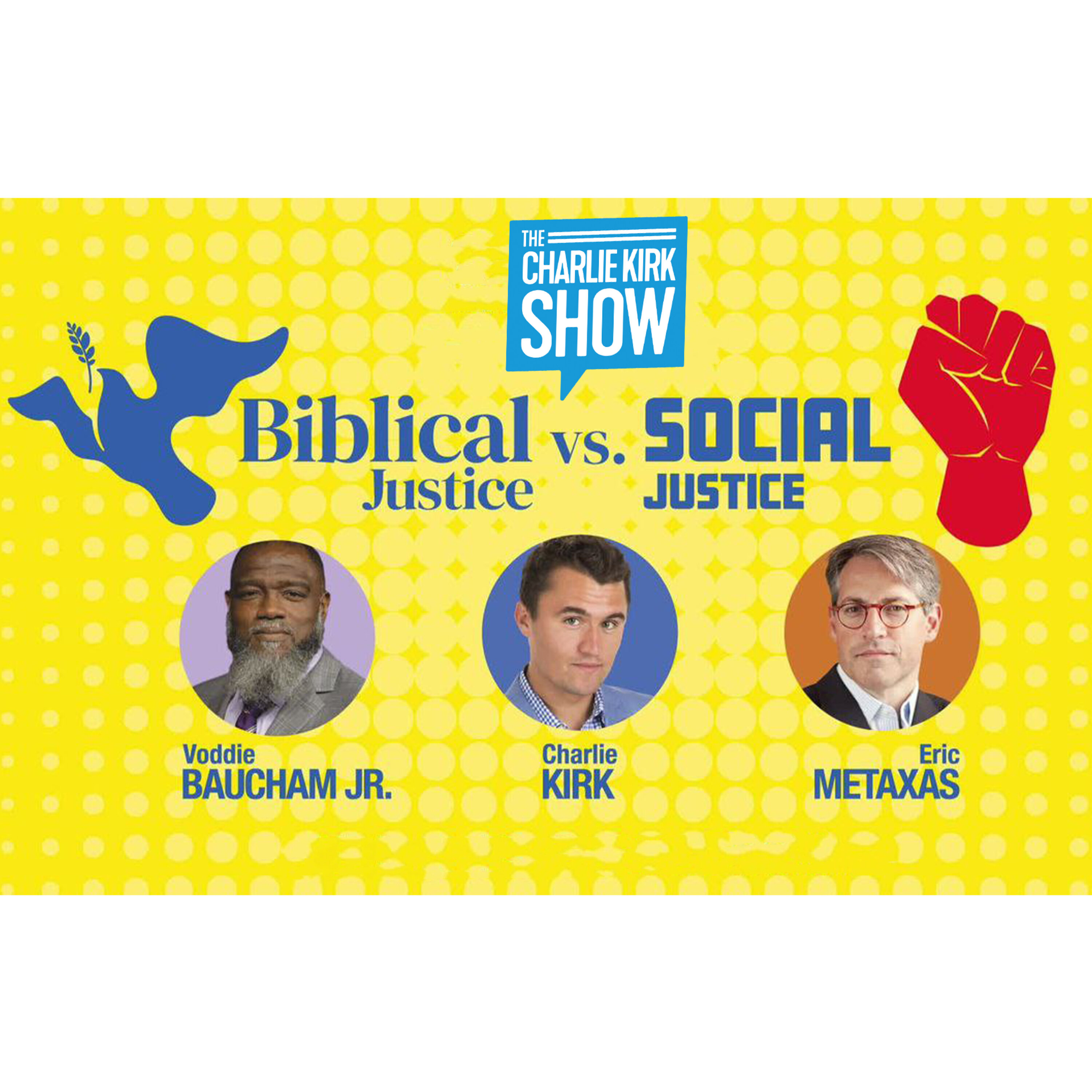
The Charlie Kirk Show
Biblical Justice vs Social Justice with Voddie Baucham and Eric Metaxas
00:47:58
Loading summary
Transcript72 lines
- [00:00]
Charlie Kirk
Hey everybody, Happy Sunday. This is a conversation I had with Vodi Bakkem, Eric Metaxas at a Salem breakfast at a ridiculously early hour. It was like 7:30 in the morning. And this is one of the most fun conversations I've ever had about Black Lives Matter, the Bible, critical race theory and wokeism. And we got such unbelievable response, everybody, that we had to air it as a podcast. Send this to all of your Christian friends this Sunday. There's no advertisers. It's brought to you by all of you that Support us@charliekirk.com support. Maybe you're on your way to church. Maybe you're on your way to some sort of gathering with friends. It's a Sunday and maybe you're just saying, hey, maybe this wokeism stuff has gone too far. And guess what, it's against the teachings of the Bible. So check it out, send it to your friends and please consider supporting us@charliekirk.com support. That's charliekirk.com support. I want to thank Kurt from Heartland, Michigan. Thank you. Kobe from Powderly, Texas. Thank you. Brian from Monterey, California. Thank you. I want to thank Pamela from Oregon.
- [01:11]
Thank you.
- [01:12]
I want to thank Raquel from West Covina, California. Thank you. And I want to thank John from Anvil, Pennsylvania.
- [01:19]
Thank you.
- [01:20]
CharlieKirk.com support. You know what happens when you guys Support us@charliekirk.com Support. We can hire the best research team in the country. I have a research team right now led by producer Connor and Reagan and the amazing team there. You know what they're working on? They're working diving through the VAERS data because no one else dares to do it. When you guys support us, you allow us to go after these stories in a fact first way that no one else will be looking@@charliekirk.com support. Email us your thoughts freedomarliekirk.com if you want to get involved with Turning Point USA, go to tpusa.com we play offense with a sense of urgency to win the American culture war@tpusa.com in fact, I had somebody come up to me yesterday and she said, charlie, I want to get involved with Turning Point USA because you guys are saving the country. And we had the Charlie Kirk show Turning Point usa, two different things, but working in harmony to save Western civilization. Vodi Bauckham, Eric Metaxas and more. Buckle up, here we go.
- [02:21]
Charlie, what you've done is incredible here.
- [02:23]
Eric Metaxas
Maybe Charlie Kirk is on the college campus.
- [02:25]
Voddie Baucham
I want you to know we are lucky to have Charlie Kirk.
- [02:28]
Charlie Kirk
Charlie Kirk's running the White House, folks.
- [02:32]
Unidentified Supporter
I want to thank Charlie. He's an incredible guy. His spirit, his love of this country. He's done an amazing job building one of the most powerful youth organizations ever created, Turning Point usa.
- [02:42]
Charlie Kirk
We will not embrace the ideas that have destroyed countries, destroyed lives, and we are going to fight for freedom on campuses across the country. That's why we are here.
- [02:54]
Moderator/Interviewer
Gentlemen, welcome to the panel. Thank you for being here. And let's dive in. We're talking about biblical justice and social justice. And to kick it off, I want to ask you about your personal engagement with these subjects. But first, Vodi, if you could give us a working definition of each of the distinction between social justice and biblical justice.
- [03:19]
Voddie Baucham
Social justice is distributive justice. It's redistributive justice. It's based on the idea of equity, not equality, but equity, equal outcomes. So social justice is about distributing resources within a given community, culture, whatever, so that the various groups within that culture don't have disparate outcomes. Biblical justice, on the other hand, is about applying the righteous standard of God equally to all people in all circumstances.
- [03:56]
Moderator/Interviewer
Thank you. Thank you. That's very helpful. They use a lot of the same terms, those who promote social justice, and yet there are distinct differences. Charlie, when did you first see these issues cropping up on campuses among younger folks or whoever in the culture, and start to realize we need to make some distinctions here.
- [04:16]
Charlie Kirk
Yeah. Thank you. And honored to be here. And thank you to Salem. We've had a fun couple months working together, and we're gonna have a lot more. So Phil and Dave and the whole Salem team, it's been great. I also want to say, Vodi, you're our secret weapon, man. I'm telling you, we need you in front of millions and millions of more people. We're gonna make sure that happens. It's so important what you're doing.
- [04:39]
Moderator/Interviewer
Super quick.
- [04:39]
Charlie Kirk
I started as soon as I got involved with the campuses. I realized this idea of social justice is the religion of most of secular America. And the most succinct way I think I can describe it is social justice is always changing, and biblical justice never changes. And it's one of the world and one of the word. It's completely different. And social justice will always lead you to a world arc and a bend of totalitarianism because there is no root, there is no anchor there. There is no unchanging truth that guides you. Therefore, it's completely and totally relativistic based on the communicator's passions, the needs, wants and desires of the audience, or even worse, how treacherous or deceitful the people that are using whatever power they have to try to enforce that social justice. This is a tricky subject for a lot of Christians and it's very front and center in the church because they use our desire and our heart and our yearning to help the less fortunate as a way to try and to try and overtake power structures to then actually deconstruct the sort of civilization that we know. And they're using it through kind of the most vulnerable way imaginable, which is Americans inability to understand or communicate about race. And this is where Vodi comes in. So help, you know, in such a helpful way. We've all talked about this and they use the most effective tool imaginable, which is they call you a racist and they think you're going to shut up. And so I'll stop there. But that's kind of where I started encountering.
- [06:13]
Moderator/Interviewer
That's very important that we'll come back to that theme of how the card that is really dropped on the table is that of racist. If you even dare oppose critical race theory wokeness intersectionality. Eric, how did you start to see these issues, these subjects crop up? When did this first catch your attention as a second?
- [06:32]
Eric Metaxas
Well, probably when I was an undergraduate at Yale in the early 1980s. Oh, I know I look young, but I was there. And the fact is that I grew up in a working class home in Danbury, Connecticut. My mom and dad are European immigrants. My mom came from Germany, which became East Germany. So she was under Stalinist communism and was so grieved by it that she escaped East Germany at age 17. My father was in Greece when the communists tried to take over that country following World War II. So my parents, without even trying very hard, raised me to hate communism and understand it is evil. So when I got to Yale, I was astonished suddenly to be around the cultural elites who were basically anti American, anti Christian. And it's when I first began smelling this stuff, but I was too young and naive to really understand how bad it was. And in my book, which was flash on the screen, published by Salem Books because they'll publish anything. I have to say that's only half a joke because a lot of other people won't publish some good stuff. And that's redounds to the benefit of Salem. Praise the Lord. Thank you for your courage in publishing truth when a lot of people are cowards. But I guess I first noticed it then, and it's the same thing. We understand what it is. It's cultural Marxism. And if we want to just really go, even be, be more clear, if we want to distill it, it is an anti biblical, anti God worldview. The social justice is just one excrescence, you know, one blister. It is just another way of expressing the same kind of thing. It's a deep philosophy, as Charlie said. It is a religion. It is evil. And like all things evil, they don't say, hey, we're evil. You know, Hitler didn't say, oh, I'm, I'm Satan's man, follow me. They, they have to borrow from the truth. They have to cannibalize reality, since the devil can't create and they have nothing but the ability to twist the truth. So even the term social justice, let's face it, it's right out of 1984, it's a way to take something that sounds good and there's no way that they can do anything other than that. And it works. And it's our job to make sure that people understand what is happening.
- [09:25]
Moderator/Interviewer
It's really a Marxist vision of seeing people in either the oppressor or oppressed category. Marx, of course, is economic and his focus today, the focus is racial. So if you're, if you have white skin, you're an oppressor. If you don't have white skin or benefit from the system of whiteness, then you're oppressed. And as you alluded to this has been seen in numerous countries over the years. It's not new. Vodi, when did you first start seeing this crop up and start engaging it?
- [09:54]
Voddie Baucham
I started really talking about these things, I guess in 2004, 2005, I, I became aware really of the influence of Gramscian Marxism and the Frankfurt School. And you know, during that time, 040506, you know, people kind of looked at you and crossed their eyes when you mentioned these kinds of things. But then in 2008 during the election, when Obama's pension toward Marxism, you know, became public, people started to pay a little more attention by then. And now this is just more of a progression of the influence of those same ideologies, but just with different manifestations. And I would also say that, you know, this oppressor, oppressed paradigm, it's not just about black and white in America, it's about black and white. But having lived as an expat for the last six years overseas, when you look at this globally, whereas in America, the oppressor is white people, white males, also white male Christians. But globally, the oppressor is America. And so internationally, people, you know, here you say to a white person, you need to check your privilege. Globally and internationally, people say to America, you need to check your privilege. And what's going on at the border has a lot to do with that as well, because this is about these people who need to check their privilege, America lowering their borders so that we can redistribute among people who haven't had the privilege to be here.
- [11:41]
Moderator/Interviewer
That's important. What do you three see as the ultimate vision of social justice? I find it rather fuzzy in a lot of places, and yet I think there is a vision behind all this movement. How would you point us?
- [11:55]
Charlie Kirk
I think there's probably three different ways you can answer that. And they all agree on the problem, the diagnosis and the revolution. This is the question I get all the time, Charlie, what do these people want? And the first category are people that actually think they're going to usher in a utopia. These are the useful idiots. These are your typical college students. They really believe that there's a way to eradicate private property. And this comes, and this is what really has frustrated me with the church is this whole thing centers on who are we as human beings? Are we nothing more than a collection of randomness or cells? Or are we the speaking beings, as Aristotle would say, Are we made in the image of God and are we broken by nature? We need Christ to save us. That's a really important argument. When you try to design a political system. When you try to design a political system and you understand that human beings are naturally likely to sin, then you're going to create a system that hopefully doesn't allow them to collectivize that sin and then destroy the kind of vocal minority, which is what the founding fathers did. They think that any problem in the world is because of the system, not because of human beings. That's a really important point. If you go and ask college student, college class, do you think human beings are naturally good, are naturally bad? They think human beings are naturally good. That's where this whole kind of argument centers. So that's number one, it's the. It's the utopian types. Number two are the folks that quite honestly are nihilists. This is Nietzsche in its fullest, possible and brightest colors. They are driven not by an end result, but instead by the passion and the enjoyment of watching systems burn down to the ground. This is something that is more prevalent than you might ever possibly imagine, especially amongst Young people that are 18, 19 and 20, 20 years old that have been taught that there is no, there is no beauty, there is no truth, there is no goodness, there is no wonder. So all there is is you that can possibly try to bring down the world down around you. This is best personified in a 15 second clip in one of the Batman movies where the Joker says, some people just want to watch the world burn. That's exactly right. That, that is a portion of the activist base. The third part is honestly the most scary. And this is where this is heading, which is the bend towards totalitarianism. What happens when you have these massive movements is eventually they're going to splinter, they're going to fight, there'll be chaos, there'll be disorder, and then a sociopathic narcissist is going to be able to charm them to give all of that collective power to one person or a small group of people. And then we're going to live under that form of totalitarianism or tyranny. This almost always leads to a smaller and smaller group of people controlling more, where the people that thought they were actually going to have the power end up not having the power. And so I think it's not, it's somewhat useful to talk about those three different things, but they won't even be able to agree that amongst themselves. What they can agree though is what currently generally exists is a cancer and a poison. And what they want to do is they want to, they want to put forward a chemotherapy type of shock and awe blitzkrieg on the American Republic and on Christianity. And they don't care the cost, they just want it gone. And what comes next, they'll figure out once we are no longer in power. Because that's all they, that's all they say is true.
- [14:57]
Eric Metaxas
What? I'm sorry, what?
- [15:01]
Charlie Kirk
That make any sense?
- [15:02]
Eric Metaxas
Oh, it made some sense.
- [15:05]
Moderator/Interviewer
Thanks, Eric.
- [15:05]
Eric Metaxas
You know, honestly, I forgot the question. What was the question? The question is whose idea was it to do a 7am breakfast and why is he still among the living?
- [15:18]
Moderator/Interviewer
The.
- [15:19]
Eric Metaxas
The question is, Phil, was it you, Phil, who.
- [15:21]
Moderator/Interviewer
Who has the best blazer up here?
- [15:24]
Eric Metaxas
I think, I think voting. I think there's no question about it. There's no question about it. I'm not kidding. I don't remember the question.
- [15:36]
Moderator/Interviewer
The question is, where is this all headed? What is this?
- [15:42]
Eric Metaxas
Oh, I'm sorry, I do remember the question. You know, it's important for us to understand and this is what we're talking about here. What this is, what this is. You know, we have to kind of cut to the chase. What is this? It is a view utterly antithetical to scripture. And we've seen it since the Garden. And you've seen it in the French Revolution. We saw it at the Tower of Babel. When men try to exalt themselves above God or when they try to reach God in their own strength, it is a satanic project. Buckley always quoted somebody talking about imminentizing the eschaton. I want heaven now. I don't want to go through the cross. That's stupid. I can do it. Let's do is to designed by reality itself, which God created to fail. It cannot succeed. But because we're living in a fallen and broken universe, we are designed to do this in our brokenness. And apart from Jesus, this is what people do, right? People talk about what do sinners do? They sin, that's what they do. And you can't really blame them. Apart from God's grace, that's what we do. And so it's only because God has inserted himself into history that we have the ability at times to, to do other things. And the United States of America is the time when in the history of the universe human beings were able to take a biblical worldview and say, oh yes, we are fallen, so we need as many checks and balances as we can. We don't want power to be centralized at all. And they set that up. And then they said, and yet because we believe that we with God, we are capable of great things, we will have this free market of ideas, economic free market. And if we can keep it, if we can keep the republic, that will, will flourish. But apart from God, it won't flourish. So what we're seeing of course is just another version of the anti God philosophy. But if you look back in my Bonhoeffer book, at one point I talk about a place called Bielefeld, which was really a ministry place where people were ministering to handicapped people and schizophrenics and all kinds of people that the Nazis would say should be terminated. And at the end of the day you get those two views. One says, it's Nietzsche, it is satanic. It says that if you can't produce, if you, you can't do what we need you to do, you're worthless. You have no intrinsic value. Value. God doesn't exist. Therefore you're not sacred, you're not made in his image. And that's basically it. And you see that more and more and, and obviously to the extent that people can, can sell that they will sell it. And there are times in culture when the, the, the Christian faith is strong or when there are other forces that are partaking of the good, the true and the beautiful, that they're strong and you're not able to get away with that. So in America, 10 years ago, 20 years ago, you can only say so much. But as those forces wane, these forces come out of the closet. And just as Hitler was able to say things in 39 and 40 that he wouldn't dare say in 34, you're seeing people say increasingly absurd things. And so when you talk about what is the goal, I think it is really clear that some people, yeah, they're stupid enough to think you could build a utopia. Other people don't care. They want to burn it all down. But the bottom line is we know where it goes. Where it goes ultimately is to the death camps. Those who disagree with the satanic power have to be destroyed. They have no intrinsic value. And so it's really like everybody's taking a ride on the Zeitgeist. And if you're not willing to go wherever that's going to take you, you need to die. You know, you're, you're just using up fuel. And so we do need to understand it really boils down to two views. There's the kingdom of God and there's this stuff. And I think we need to understand that the people who are foolish enough or lost enough to be going along with that, you know, they're destroying themselves. And so I think it's really tempting to think of them as enemies. The enemy is the enemy because this really is a satanic project. And, and, and we have to be very clear that the two views have increasingly become, have become clear.
- [20:17]
Moderator/Interviewer
Thank you. It strikes me in the context of Christianity, the church, that especially among my generation and younger, the phrase neither left nor right has become very popular when it comes to third way. It's become very popular in evangelical circles to describe basically our political philosophy. We're about Jesus, as indeed all three of us are. So that's good in my view. And yet this, oh, we're not of the left and we're not of the right. We just sort of keep our hands clean. There's no mud on our boots in the public square, and there's not supposed to be. Keep them lily white and pristine. And I think that has had a real effect with regard to why it's
- [21:03]
Voddie Baucham
got to be white man. We can't have black boots or brown boots or we gotta have white boots.
- [21:09]
Eric Metaxas
Man. Yeah, yeah.
- [21:11]
Voddie Baucham
Racial man.
- [21:12]
Eric Metaxas
Yeah, what he said.
- [21:15]
Moderator/Interviewer
I was actually mocking them. I was trying to make fun of their white boots, but we are in Texas, so there's lots of boots. This neither left nor right philosophy, though, I think it's deadly. And I think it causes especially younger people to think I, I don't need to even get my hands dirty at all in the public square. What would you men say in response to that kind of lie?
- [21:39]
Voddie Baucham
I think one of the things that drives young people to that is their unwillingness to be confrontational. I've often said, you know, there is an eleventh commandment, and the eleventh commandment is thou shalt be nice. And we don't believe the other two in. And what these people are trying to do is avoid having to confront ideas that oppose them and to avoid debate. I mean, like real debate and, and real disagreement and discussion. We, we don't want that. We recoil from that. And one of the ways that you get around that is to not believe, Believe anything, to not stand for anything, just to be. Just to say, I'm not that and I'm not that. Right. Because if I'm one of those things, then I, I'll have to suffer the, you know, slings and arrows that come from the other side. And I don't want to be about combat. I don't want to be about confrontation, which is one of the reasons that we hate masculinity. There is a witness war on masculinity right now, and all of it, all of it boils down to this same issue of thou shalt be nice. And we don't think masculinity is nice.
- [22:58]
Charlie Kirk
Yeah, the third way in, in the Christian circles, it's, it's really puzzling to me. So obviously I spend most of my time in the political world as a Christian, and I'm starting to do more and more things in the Christian world. Spoken over 70 churches in the last year. I, I'm really shocked at how many young Christians, how weak they are and just they have very little direction or purpose. They don't want to have any sort of confrontational conversations. Says in Isaiah 1, let us reason together. But if you go back to the ancient Hebrew, it's, let us debate together. Let's, let's talk about this stuff. Let's show me your ideas. Why I want the third way. So you're trying to say you don't take stances on moral issues. Is that the new position of the skinny? Jean? Christianity. No offense, Eric, because those are nice. So is it yeah, you'll get me back. I know. I guess. And so Look, Christ was 100% grace and 100% truth. And if all of a sudden we're not going to be clear about what the scriptures tell us on how to govern ourselves and how to live, then it really gets back to the true problem, which is watered down theology. And that is really what's going on here. And I've had the opportunity to dig into this a fair amount. I'm by no means an expert, but when it comes down to a lot of these Christians, if you really get down to it, all of a sudden they'll say, oh, yeah, it's an allegory. Ah, okay, so it's not the word of God, it's a suggestion manual or it's a place of good stories. Now I get where we're coming from here. This is not the authority. It's part of your bibliography of your worldview. It really comes down to what is the Bible? Is the Bible a book that is of comparable moral claim as Aristotle's Ethics or Robin d' Angelo's White Fragility? Or is it the word of God? Is it something, as it says in First Peter, that was given to us divinely that we must pour into and has an imprint on our heart? That's really what's going on here. And if we're, if we're having a political discussion and they say they want the third way, then they're picking and choosing from the Bible like a buffet line that makes them feel good, that actually doesn't say true things about our faith and about what we're supposed to do as Christians.
- [25:19]
Eric Metaxas
Part of the reason that this is happening is because this is always. It goes down to bad theology, right? Mega church pastors or whoever out there over focused on evangelism. Now it's bad to under focus on evangelism, but if you act as though getting people saved is the only thing we're here on earth to do, you're an idiot. You're not reading the Scripture. The fact of the matter is that if you over focus on evangelism or what happens is you make people think. I cannot say anything ever unless it might help lead somebody to faith. And if I say anything controversial or that they might disagree with, that's bad for the witness. And I was hamstrung in that position for years myself. I just thought, I've got to be careful. I don't want to be political because it's all about, you know, getting them safe, getting them safe, getting Them safe. Well, at the end of the day, you have to trust truth. And. And you have to trust that if I speak the truth, I am speaking God. And I think we all have to understand. We've all seen idiots who drive people away from Jesus. And I'm looking at you, Jack Graham. Ha ha. So that's my love language. Now, he knows I love him more than any of you, but we haven't. You. We've all seen that. And so the left and the culture lifts this up as a boogeyman that, oh, you don't want to be that guy who's driving people away. He's the religious fanatic, right? Well, now we have the opposite thing. The guy who's so nice, who he's afraid to talk about truth. And in America, this is a particularly American issue. Bonhoeffer, when he came to America in 1930, was kind of scandalized how everybody at Union Theological Seminary, which was. Woke up 90 years ago, that everybody wanted to get along and get along. And he was like, well, what about truth? Because the Germans, you know, they don't have a problem with that. But America's, we want to be nice. We want to be nice. So every culture is uniquely blessed by God, but every culture has unique issues and possibilities of going wrong. And our problem, America, is this wanting to be nice. And so when you wrap that together with this desire to get everybody saved, you you tell people, don't get into politics. Don't get into this, don't get into that. And it's the same old thing. Look, Wilberforce heard this, okay? Wilberforce said, slavery is an abomination from the pit of hell, and it is my duty as a human being and as a believer to talk about it. And many people said to him, keep your faith private. Okay? So they didn't even like him. But the point is, anytime these truth claims come up, it's divisive. It's this, it's that. But if you are an African slave, what would you want the Christians to talk about? Would you want them to talk that slavery is bad? Yes. You would say, if you're any kind of a Christian, you better talk about that. You better. If you're a Jew in a boxcar going to Treblinka, you're thinking, I hope there's some Christians out there who. Who will be combative and speak out against the Nazi worldview. But there were Germans, Christians in Germany saying, it's only about evangelism. We don't want to bring up that divisive stuff. Romans 13. Hitler is appointed by God, even if he's doing bad stuff, we can't speak against it. There's just a concatenation of confusing ideas all building up into wherever you are in a given culture. But, but we have had plenty warnings before. We've seen it before when Christians say, I don't want to be divisive. And I'm going to tell you, a lot of good German Christians said that. And they said if we talk about this, we talk about that, it'll dampen our witness. Well, my attitude is your witness can go to hell and your fake evangelism to a fake gospel can go to hell. If you are not willing to stick up for the unborn or truth or whatever it is, your Christianity is worthless to the people you claim to want to, to lead. And you're, you're the blind leading the blind. And the church needs to understand it's not a choice between do I want to lead people to Jesus or do I want to talk about truth? If you don't understand those two things are one, you know you're already lost.
- [29:38]
Voddie Baucham
Amen. And you know, I would just say to bring these things together. This is about a poor theology because you have a problem with divisiveness if you believe that unity depends on us. If you believe that we have to do the work of reconciling us to one another. And so one of the things is, we're not holding those two halves of Ephesians two together. That first half where Christ through his death on the cross, right, reconciles us with God, reconciles lost dead sinners to God, but in the second half, he reconciles lost dead sinners to one another. The cross reconciles us vertically, vertically and horizontally. And what many Christians believe is, sure, the cross may reconcile us to God, but it is insufficient to reconcile us to one another. So we have to make sure that we don't mess that up. But when the fact of the matter is you can't, if you believe you can mess up what Christ accomplished on the cross, then you don't believe Christ accomplished it on the cross.
- [30:53]
Moderator/Interviewer
And that's one of the main differences between biblical justice and social justice. You look to the justice of the cross to find divine justice and divine mercy flowing out of that. But there's no such grace, mercy. There's no mercy in social justice. There's no love really in social justice. I want to switch tracks though, here. In your book Fault Lines, my book Christianity Wokeness, we both talk about intersectionality, which is the idea basically that the interests of.
- [31:21]
Voddie Baucham
Is it, by the way, is it, is there a new rule now that the two of us can't be in the same place at the same time after this? Since we've.
- [31:30]
Moderator/Interviewer
Yeah, it's a dangerous proposition. So intersectionality is the idea that the interests of underprivileged groups intersect. So women have been kept down from by men, sexual minorities have been kept down by straight people, disabled people have been deprived by able bodied people, etc.
- [31:54]
Charlie Kirk
And so on.
- [31:54]
Voddie Baucham
Foreigners and foreigners by the native born, foreigners by the native non Christians, by Christians. It's very important for people to understand that in the world of critical social justice, it's not just the white person that's the problem or the white male that's the problem. It's the white male, heterosexual, cisgendered, able bodied, native born. And if you keep going down the list, you get to Christian. And if you read the literature, the critical social justice literature, ultimately you realize that Christianity is seen as an oppressive hegemonic power. So one of those intersections where people, you know, pile up their oppression as if they are not Christian or if they are not orthodox in their Christianity as well.
- [32:42]
Moderator/Interviewer
That's exactly right. So let's go to the. The LGBT project and its advancement just for a minute here, Vodi. We've heard in recent years that sexual minorities need to be elevated and platformed. They've been oppressed even in, even in the Southern Baptist Convention. Now, this isn't exactly the same thing, but we've heard two consecutive presidents of the SBC, J.D. greer and Ed Lytton, say basically that scripture whispers about sexual sin, which I think is tied into this whole embrace and softening around this issue. I'd love to hear you respond to the, to the claim scripture whispers about sexual sin. What would you say to that?
- [33:31]
Voddie Baucham
First of all, that's a lie, but secondly, even if it was true, we need to think about it like I used to think about my mama. I could be out playing with my friends in the streets, and if I thought I heard my mama whisper my name, I'd go home just to make sure. Right? So even if it was true that God whispers about that, listen to the whisper. But that's not what they mean when they say this. What they're trying to say is that God doesn't speak to this at all. Because even if you believe he speaks to it in a whisper, that should be enough.
- [34:18]
Charlie Kirk
Amen. Amen.
- [34:20]
Moderator/Interviewer
Eric and Charlie, I want to switch tracks to our children, the children they're being taught in Public schools and colleges and universities basically to hate America because as Vodi talked about just a minute ago, America is a white supremacist hate heteronormative capitalist public order that is infested with sin. Right. In a structural way. So what we saw with Antifa and BLM last summer, I don't think it was just being locked down in a terrible way. I think it was also lots of people thinking they were doing something righteous in destroying this public order. How should we think about our children and how they're being educated today to basically despise authority, the public order that God has made, and America itself?
- [35:12]
Charlie Kirk
Yeah, I mean, this is sort of in the sweet spot of what we do every day at Turning Point. And so the, to be as blunt as possible, if we don't radically change the way we do higher education in our country, we will not have a Nation in 15 years. Yeah, it's really that simple. And so we have way too many kids going to college. Way too many. Probably 50% too many. We have a generation of young people that are.
- [35:38]
Voddie Baucham
Would you just back that one up? Yeah. Because I think some people like didn't catch what you said and it's incredibly important. Okay, would you.
- [35:48]
Charlie Kirk
Okay, we, we have way too many people going to college in America.
- [35:53]
Eric Metaxas
Explain that.
- [35:54]
Charlie Kirk
So, yeah, we have, we have an entire industry designed to. Towards trying to capture high school seniors putting them through a debt cycle to borrow money that they don't have, obviously because they're borrowing money to study things that don't matter, to find jobs that don't exist, to colleges that would otherwise go under and be financially bankrupt if it wasn't for the subsidy of the federal government. Most of what they're studying, they don't even find jobs in those majors when they graduate by getting them in these environments that is basically the new Sodom and Gomorrah, where sexual degeneracy is platformed and glamorized, where dorm rooms of male and females are next to each other, where bad ideas are incubated and given a platform. They are then exposed to evangelistic nihilism, anti American thought. And we're supposed to believe this is some sort of rite of passage. It's mostly and mainly. And then I'm going to offend most of the people in the room. It's mostly and mainly parents fault because they have, they have this idea that their kid needs to go to college because they don't want to tell their friends that their child's become a plumber. And they don't want their kid to become a carpenter or work construction, because that would be the worst thing, right? They'd rather have their kid become, you know, a nihilistic, screwed up Marxist than actually have to go work H Vac for a living. Right? It's true. And so because of that we have this cycle of, mainly tied together of this population, public pressure, this idea that you have to go to college to succeed. And let me just talk about some of the numbers really quickly. 59% of kids that go to college graduate, 41% of the kids that go to college drop out. 41% of the kids that go to college drop out, 41%. They exit with debt, a damaged self esteem and confidence, very little to no direction. And they make perfect revolutionaries for the future because they're in this kind of financial purgatory. Then the ones that do graduate, we send them to inner cities to go rent, not own. When you don't own anything, you're far less likely to want to conserve anything. And then we tell them, whatever you do, don't get married, don't have kids, go become a cog in the corporate machine. And then they become early 30 something people earning $120,000 a year, not accumulating really any of that capital, by the way, because they're spending it, spending and spending it on short term gratification or rental expenses. And we wonder why all of a sudden they want to uproot the entire system. They have nothing worth, they have nothing they want to conserve. They don't own anything. They're not paying a principal of any mortgage. They don't have kids, they're not married. And all of that originates at this one cultural institution that we have wrongly platformed in America, which is higher education. There are some great colleges out there. Hillsdale is one of them. You know, Eric, you and I have done some work at Liberty. There's some great schools. They're in the one, the vast 1% of 1% in the nation. And so, and by the way, you want to talk about where this is at its worst, go to the seminaries across America. Holy moly. Go to Hope College, go to Wheaton. And you want to see some of the all these ideas being institutionalized to the pastors of tomorrow? It is worse than ever before. Calvin College, just to name a few. And I see their critical race theory manuals. I see what the pastors of tomorrow are being taught. So I'm trying to radically and some sometimes provocatively tell the body of Christ. We have to rethink the way that we pass down our values to the next generation. You don't need a certificate to succeed in America. You don't need to say that you went to some college to be a good person. I care about whether you're saved, whether you have character, and whether you want to do something in your life. Not if you went to Harvard and if you want to do something like that.
- [39:25]
Eric Metaxas
Yeah. What was the question, Owen?
- [39:28]
Moderator/Interviewer
America is a white supremacist order. Our youth are being told, so how do we counter that idea?
- [39:36]
Eric Metaxas
Well, it's kind of funny because there's many ways to counter it. The first thing you have to do is you have to loudly and forcefully say, that's a lie. I think that oftentimes we rely too much on reason, and sometimes you just have to kind of push people back and say, that is a lie and put the onus on them. You could say, that's a lie. That's a pernicious lie. That's a satanic lie. That is evil. Don't say that again. Explain to me how that is true. And explain to me where you get the right even to say such a foul, untrue thing. There are many reasons for this, but I didn't really understand this fully until I wrote a book called if youf Can Keep at the Forgotten Promise of American Liberty. And in it, I. I was forced myself to really see what I had kind of been missing over the decades. And so I got. The best miseducation you could get. I went to Yale University, which is exactly where you would go to learn how the global anti American elites think. So I learned to speak that language. I got those ideas in. Then I became a Christian. But it still took me a long time to get comfortable with what I now know to be true and to understand how dramatically over at least 50 years. I mean, the 60s was the watershed moment when all of these evil ideas kind of bubbled into the public realm. And of course, they've been bubbling. You know, this is trickle down evil, right? This is. This is cultural trickle down. The theory where you see these ideas, you know, they're brought in by Marcuse and Gramsci, and there's certain people talking about them in faculty lounges and stuff, and Derrida, right? And then they trickle down, trickle down, trickle down. So when I bumped in all this stuff in the 80s at Yale, this was not yet out in the public, but I've watched it come out into the public so that now people are even using terms. I mean, one thing for me, that I notice is when people use terms like hegemony or intersectionality or anything, I just feel like saying, hey, shut up. Like, speak English. Because all those words are sophistry. They're designed to skew your thinking a little bit, to knock you off balance. Like, now I got to talk about critical race theory or systematic. And be like, those are called weasel words. You know what weasel words are, right? They're empty words. A weasel, you know, theoretically, they would suck the interior of an egg out, right? So weasel word is like an egg that's hollow. And weasel words are like that. And the left does that. They come up with these terms. So anytime anybody talks about privilege, it's like, that's not a thing. Shut up. Go back, find, like, the real word, and let's talk about it. But these are invented ideas. And so that's kind of. That's part of what has happened. But I bumped into this stuff first at Yale, and it took me decades, really, to perceive that we have been pushing these ideas out, out, out, out, out. So for me, Charlie said, it's the parents to blame. I agree. It is always the leaders. If you look at what happened in 1968 when the students took over the universities, okay, it is just like today. If a city burns down, that's not. To me, that's not on the people doing the burning. That's not on the people doing the burning. That's on the people who. Who are supposed to stop them, not stopping them. It's very simple. If you do not have the guts, if you do not have the ability to say, that is wrong, and we will crush you if you try to disturb private property, try to do anything like that. But the leaders have imbibed these false views going back to the 60s where people said, don't trust anybody over 30. It's a Rousseau in idea. It's utopian, a scheme that says the youth are people pure. The Bible says the youth are hellbound sinners. Those things can't coexist. But in the 60s, you have a situation where these leaders of Columbia University, different places, did not have the ability to stand up to the students and let these arrogant thugs. You know, these are cultural Marxists. These are. These are cultural revolutionaries under Mao. We've seen them through history. They're the same ones that created the bloodbath of the French Revolution. It's always these shock troops. And then there are people who say, like, oh, they've got the truth, and let's let them have their say. You cannot let the devil have his say. You cannot let the devil have a millimeter. If you do, you're a fool. And the fact of the matter is we have allowed this to happen and these anti American ideas to come in and is why today we have an entire population that is not conversant in the basics of what is self government and liberty and why is it beautiful and good and doesn't need to be perfect. It's just way better than anything else. So I tried to answer the question and I failed. Thank you.
- [44:33]
Moderator/Interviewer
No, you did well. Thank you. We're concluding here in just a moment, but we need to say a couple things. We need to say that Uncle Tom 2, the documentary is coming out this fall, fall on Salem now it's featuring Vodi so extensively, I think you had like a crew filming you and all that sort of thing, right? At some years. That must have been cool. Okay, so you want to check for Uncle Tom 2. Uncle Tom 1 has had a major effect and Uncle Tom 2 will as well. Excellent work by Salem. And then we want to say a quick thank you to Tim Peterson, who's the president of Salem Books. If we could have a hand for Tim Peterson. He has, he has acquired a number of of us up here and is really leading the counter revolution in a lot of ways because books do that in a. In a free society. So we're very thankful, many of us, for Tim. And I want to just conclude here, we have literally one minute, but I want each of you to give us 15 seconds on the antidote for what ails us. And we'll start with Eric and finish with voting.
- [45:39]
Eric Metaxas
Speaking of Salem books, I have a book coming out in October called Is Atheism Dead? And I've never been as excited about a book. And it is the answer to this question because the COVID of the book essentially is a snake, you know, eating itself, biting its own tail. Right? That's what false ideology is. If you push it to its logical conclusion, it swallows itself, disappears with a pop, and you'll never see it again. And it is our job to point that out. These things cannot sustain themselves. God is truth. And we just need to, in every way we can, with moral fiber and courage, continue to live out the truth and speak the truth and trust the Lord and be led by the Holy Spirit, because there are a hundred answers to this. But I know that you cannot go wrong speaking the truth and trusting the Lord to use you as you do and having the confidence that you cannot fail. He defeated death on the cross. There is nothing to be to fear, but displeasing the Lord.
- [46:46]
Moderator/Interviewer
Amen. Ten seconds each.
- [46:48]
Charlie Kirk
Yeah, it's going to cost you something. You're going to have to give something up. Social status, a country club membership, some of your Facebook friends. You're going to be called bad names if you're not in the fight. Here's the, here's the way to tell that if you're living a comfortable life and everyone loves you.
- [47:04]
Eric Metaxas
Amen.
- [47:07]
Voddie Baucham
People are looking for things like justice, mercy and reconciliation. The good news is we know the only place they can find that
- [47:18]
Charlie Kirk
the
- [47:19]
Moderator/Interviewer
gospel of Jesus Christ is the answer, something we stand for. Thank you, gentlemen. Would you join me in thanking these gentlemen overall?
- [47:33]
Charlie Kirk
Thanks so much for listening, everybody. Email us your thoughts, freedom charliekirk.com if you want to get involved with Turning Point USA, go to tpusa.com and if you want to support our program, go to charliekirk.com support thanks so much for listening, everybody.
- [47:48]
God bless you. Speak to you soon.
- [47:54]
Eric Metaxas
For more on many of these stories and news you can Trust, go to charliekirk.com.