← The Charlie Kirk Show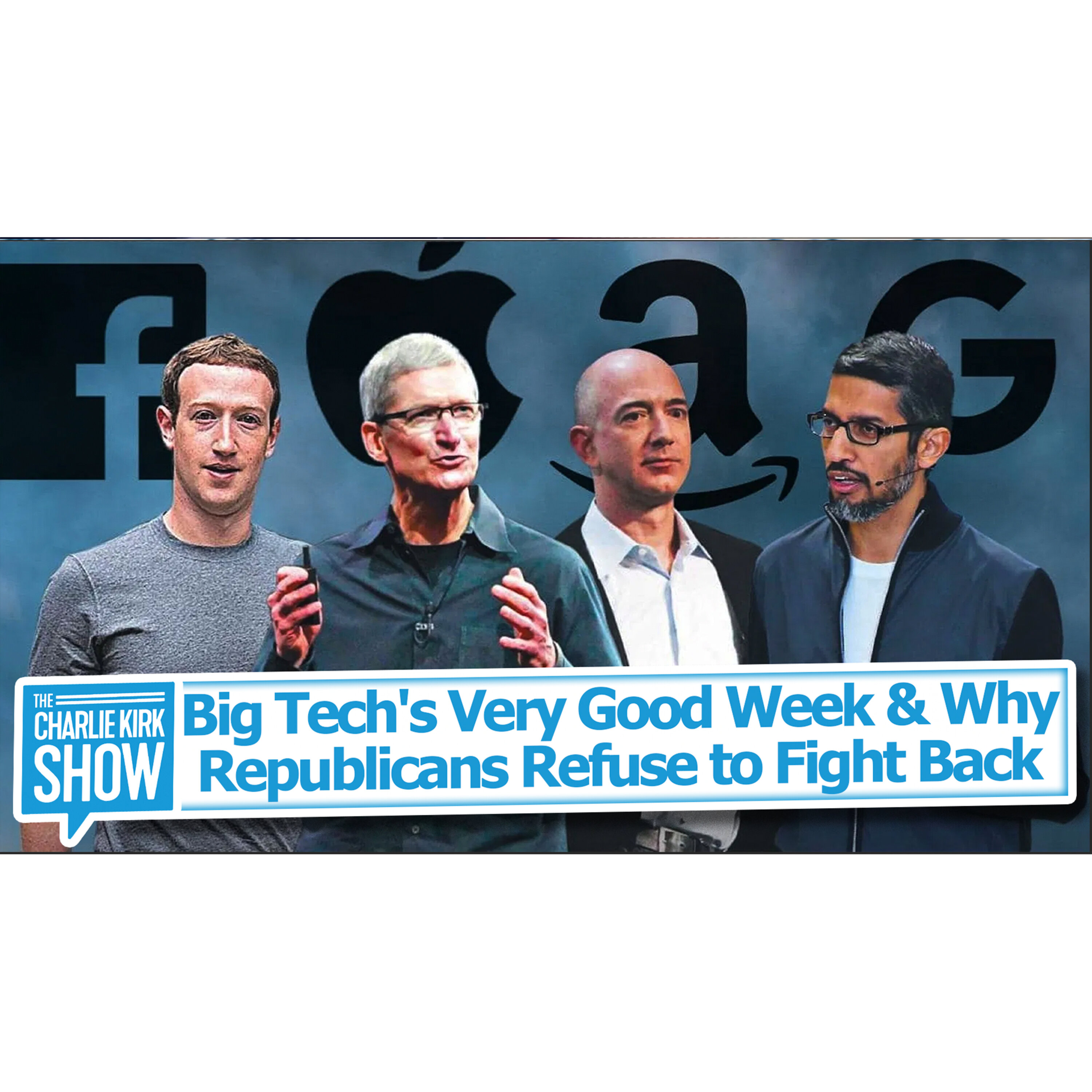
Loading summary
Transcript1 lines
- [00:00]
A
Hey everybody. This episode is brought to you by my friends at ExpressVPN. ExpressVPN.com Charlie Secure your device. Anonymize your online activity. Protect your action online. Expressvpn.com Charlie help our show out by also helping yourself. Protect yourself. ExpressVPN.com Charlie hey everybody. We continue our quest to find the 135,000 missing ballots in New York City. We have a parallel government from Menlo Park, California. Unfortunately, Big Tech had a good week and we explore that. We talk about what we can do about it, why Republicans are, for many different reasons, unwilling to go after Big Tech. Email us your questions freedomarliekirk.com and if you want to support our podcast, go to charliekirk. I want to thank Alex for supporting our podcast. Thank you. I want to thank Cynthia for supporting our podcast. Michael from Glendale, Arizona, thank you. Russ and Kim from Oxnard, thank you again. Ashley from California, thank you for supporting us@charliekirk.com support. Unfortunately, Big Tech had a good week. We talk about New York City and more. Buckle up. Here we go. Go Charlie. What you've done is incredible here. Maybe Charlie Kirk is on the college campus. I want you to know we are lucky to have Charlie Kirk. Charlie Kirk's running the White House, folks. I want to thank Charlie. He's an incredible guy. His spirit, his love of this country. He's done an amazing job building one of the most powerful youth organizations ever created, Turning Point usa. We will not embrace the ideas that have destroyed countries, destroyed lives. And we are going to fight for freedom on campuses across the country. That's why we are here. Did you ever read the fine print that appears when you start browsing in incognito mode? It says that your activity might still be visible to your employer, your school, or your Internet service provider. How can they even call it incognito? To really stop these people from seeing the sites you visit, you need to do what I do and use ExpressVPN. Think about all the times you've used the Wi Fi at a coffee shop, a hotel, or even at your parents home. Without ExpressVPN, every single site you visit could be logged by the admin of that network. And that's still true when you're in incognito mode. What's more, is your home Internet provider, I'm talking about Comcast, AT&T or whatever, can also see and record your browsing data. ExpressVPN is an application. It's an app that encrypts all of your network data and reroutes it through a network of secure servers. So your private online activity says just that. Private ExpressVPN works on all of your devices and it's super easy to use. So stop letting strangers invade your online privacy. Protect yourself at expressvpn.com Charlie use my link at expressvpn.com Charlie that's E X P R-E-S-S VPN.com Charlie to learn more. Back in New York. It looks like New York's got a little bit of life. And I gotta say, looking out the window, it's about one in four people are wearing two masks. And so that's a good day to be alive at 25% ish. Is it going down? That's actually probably less than that. And New York's got some spirit back. I'm cheering for New York. And, you know, we're gonna talk about how New York is leading the world in how to run a third world election. And we're gonna talk about how. See, I have some questions and we're gonna get into this. Why were there 135,000 test ballots used in the New York mayor's race? 135,000 test ballots. Why wouldn't 50 test ballots be sufficient? And so this, this opened up so many questions in the New York City's mayor's race, where Eric Adams went to an early lead and now his lead is ever decreasing. By the way, he is not a Republican, he's not a conservative. He seems like somewhat of a mainstream Dem, mainstream Democrat who kind of wants to clean up the streets and doesn't believe the abolition of the police is a good idea. So I got to thinking, did Arizona or Georgia use any test ballots? Did Michigan or Wisconsin use test ballots? Who is in charge of deciding whether or not test ballots should be used? And if you have not seen the story, in the wonderful city of New York, as we are here on wabc, they had a primary where they decided they couldn't count votes as it is. So they wanted to make it extra confusing. So they implemented this very bizarre way of counting votes called ranked choice voting. Now, I'm a huge critic of ranked choice voting because it panders to the most radical voter. Rank choice voting essentially is you have five options, and your first option, you put number one, and then the person that you like second gets second. And so what happens is the person who gets the least amount of votes gets disqualified. And then they those people's votes then go back to their number two choice. If you're confused, so is the New York Board of Elections. And if you are really confused, so is Bill de Blasio, who basically comes out and says, look, man, after he took a big hit, it's really tough running New York elections. It's not like we're New York City or anything. This is. We're a third world country. And basically, unfortunately, he's somewhat right, but I'm still pulling for New York. Now, the problem with ranked choice voting again is that gives an extra platform to not an extra platform. That's not the right way to word allows the people in last place. So the socialist types to all of a sudden pick the winner instead of allowing a plurality to elect somebody where basically should be they say, you know what? We know that the AOC types, you know the types, whatever, the most radical person that wants to destroy the city, that's who they want to have become mayor. And so they state designed a system where the normal common sense people all of a sudden, they did not want that. They didn't want to give them a bigger platform. So you have a system that works where you choose a winner. They say, let's overly complicate that. And so New York City, we still don't know who's gonna be mayor. It's gonna take em a couple months. You know, we're gonna kind of just be like Senegal and we're gonna find votes in some sort of a warehouse. But again, I do have a question, which is did some of these battleground states, did they have test ballots? In fact, one of the sworn affidavits said that in Georgia they saw some test ballots and so was New York. And what we, what we're witnessing right now in New York and no one really knows what's going on. It's no one knows who's in charge. It's a pure egalitarian experiment here, right? Everyone's blaming each other and there might not be a next mayor. It just might be like the Paris Commune, right? Where everyone's, you can do whatever you want to do. There is no police, but at least there's no more traffic because no one lives here anymore, right? That's kind of the new New York thing. Everyone complains about how New York is right now, except they say, well, the traffic's a lot better. Oh, I wonder why no one's here anymore. I'm half kidding. And the reason is all leadership. And it's a tragedy. I've been coming to New York for the last 10 years of my life. Actually. I first came to New York City at the Occupy Wall street protests, remember down in Zuccotti Park. And that was an overwhelming sensory experience, both visually and also the smell. It knocked you off when you were like a block away. Holy moly. The entire collective Zuccotti park hadn't showered for quite some time. And it was the Occupy Wall street when I first came and I started Turning Point usa and I came to New York City with more regularity. And I loved New York in 2013, 14, 15, 16, and then something happened in 2017. And this is a great lesson. It is a great, it is a piece of wisdom from the phenomenal Alexander Solzhenitsyn in the Gulag Archipelago, which he said that all of the tragedy of the Soviet Union happened thanks to ideology, where you have a group of people that care more to their commitment to an abstraction than what's good for the well being of the citizens around them. Defund the police. Why? Because I read it in the textbook. Well, is that a good idea? I don't know, go ask my NYU professor. And what happened in 17, 18 and 19, and I saw it happen in this beautiful city of New York was all of a sudden the activists, the ideologues, they were, they were given an opportunity to destroy probably the greatest city in the world, the center of the world, as John Lennon used to call it. And so instead of seeing what is happening and seeing what very well could solve the problem, like more police or not letting first degree murderers out on bail, minor details. Instead, it's a commitment to an abstraction. It's a commitment to an idea that sounds good in a lecture hall at Fordham University or Columbia University or NYU or Sarah Lawrence, but it really makes no sense in practice. And the reason why New York City really was able to become the greatest city in the world in the 80s and the 90s is when Rudy Giuliani was mayor in the 1990s and even with Bloomberg in the early 2000s, New York City was an anti abstractionist political environment. Even the Democrats made sense because there was kind of this, there was kind of this attitude, especially of the kind of muscular class in New York City. The taxicab drivers, the garbage, the garbage delivery people, the police officers was like, no, no, but is that good for the city? And especially after 9, 11, there was this attitude of I don't care your political party, I don't care where you come from. Is this gonna make New York safer, stronger and is gonna make more people wanna live here? Now it's the opposite. Now the cost is completely dismissed and you see that in this vote counting bonanza that we're experiencing right now in New York, where it's going to be a couple weeks, if not months, where we figure out what's going to happen. And they might as well just, and I mean this non sarcastically, they might as well do the election over again. At this point. No one is is going to become no one is going to trust who wins this current count. No one is going to trust whatever result that they announce. And so the Democrats screwed up the Iowa caucus vote totals. They screwed up the 2020 election results. They can't cut election results in New York City. But now they want to control our federal elections at HR1. They want to have a complete nationalization of our federal elections despite not being able to count ballots correctly, say, oh, sorry, we were off by 135,000 ballots. With the ever increasing numbers of makes and models like a Fiat or a kia Pacifica or XT5, it's now impossible to stock all the parts you need in a traditional chain storefront. Why endure often pointless or seemingly intimidating questioning and wait while the counterman orders all of the parts on his computer, choosing only the very brand his wearing out his warehouse happens to carry? You have computers with access to RockAuto.com right in your pocket. One reason to repair and maintain your cars is to save money that you can then use for other important things like mortgages or food. Why would you choose to spend 30%, 50% or 100% more on the exact same auto parts as a chain store or the new car dealership? Chain stores have different price tiers for professional mechanics and do it yourselfers. Rockauto.com prices are the same for everybody and they are reliably low. Rockauto.com offers the lowest prices possible rather than changing prices based on what the market will be like what airlines do. Rockauto.com is for everybody and does not require membership or account login. Rockauto.com is a family business and serving auto part customers for over 20 years. Go to rockauto.com and shop auto body part customers from hundreds of manufacturers. Best of all, prices@rockauto.com are always reliably low and and the same for professionals as it is for do it yourselfers. Why spend up to twice as much on the same auto parts? Go to rockauto.com and see all the parts available for your car or truck. Write Charlie Kirk in the how did you hear about us? That's RockAuto.com, amazing selection. Reliably low prices, all the parts your car will ever need. Rockauto.com Scott Hennan emailed me and texted me. He said rank voting is also in Fargo, North Dakota as the leftists got it on the ballot and it passed. The Fargo City Commission already passed mail in balloting. Sadly, it's not just New York City. And you want to know why all of a sudden we are having a hyper polarized political environment, especially in New York City. It's because instead of the coalition builder that is rewarded, it is the more radical voters that are then given a higher platform. So essentially the loser voters end up picking the winner. Only if you wanted to have a revolutionary become mayor would you institute a system like this. We've talked at length about Big Tech. I think the United States Constitution is the greatest political document ever written. The United States Constitution recognizes natural rights given to you by your creator. The United States Constitution has a direct tie to the Declaration of Independence. Not every historian agrees with this, and those historians are just wrong. There is an eternal and there is a divine connection between the truths that are stated in the Declaration of Independence, which we celebrate in just a couple days, and the truths of the United States Constitution. And at the first glance it looks as if the Declaration is nothing more than a separation agreement with King GEORGE and the U.S. constitution is then trying to form an idea of how to govern ourselves. But that is, that is a surface level reading. If you dive deeper into the Declaration of Independence, you will see that the complaints that Thomas Jefferson offers in the Declaration are solved in the actual Constitution written by James Madison and with the help of Alexander Hamilton after the Federalist Papers in September of 1787, finally with the Bill of Rights ratified in 1791. And the Constitution talks explicitly and speaks to this idea, this truth that you as a human being have the right to speak, assemble, associate, that you have private property rights, and that if something tries to get in the way of those rights, that it is government's role to stand up for you. You see, the Constitution was written for the people, which means for individuals, your capacity to speak and to reason, to associate, to communicate. Now, we take this for granted, but when this starts to all of a sudden come into real life encounters, we sometimes seem to say the Constitution doesn't apply there. The current example, and we've talked about this, is this example of Big Tech. Big Tech, best described as a coalition of a couple companies. I'm just looking at the television screen. It's right there. Facebook, Apple, Amazon, Netflix, and then Alphabet. We can remove Netflix. Let's just talk about, for example, Google, Amazon, Facebook and Apple. I believe that they represent a parallel government. They represent a power structure that quite honestly is more powerful than the own federal government that we give our power and pay our taxes to. They have more information, they have more capacity. Do you know what the combined market cap of Google, Amazon, Facebook and Apple is? Well over $5.7 trillion. That's four companies. Four companies that have the combined market capitalization, which means their value in the public exchanges of over $5.7 trillion. That is more than the federal government budget every single year, even with a stimulus package. And they work weekends. And almost every single person that works for Google, Amazon, Facebook and Apple, they are committed ideologues and they are committed to try to remake the American Republic in their image. The question in front of us, and the question here is what is more important your right to speak or four companies with a combined value of over $5.7 trillion to shut you up. This summer is showing welcoming signs of a more normal life ahead. We hope finally you can get back to enjoying life's little pleasures like smiling at your neighbor or seeing a movie and going to the post office. Okay, some parts of normal life aren't so great. But with stamps.com, you can skip trips to the post office and save on postage, mail and ship anytime, anywhere right from your computer. Send letters, ship packages and pay less, a lot less with discounted rates from USPS and UPS. Stamps.com saves businesses thousands of hours and tons of money every year. Stamps.com can bring the same US Postal and UPS shipping service right to your computer. They make it easy for small businesses to mail and ship without needing to take a trip to the post office. Print official US postage and shipping labels 24. 7 without having to leave your desk or buy any fancy equipment. All you need is your computer and a standard printer. They offer deals you can't get Anywhere else, like 40% off USPS and 66% off UPS shipping rates. Stop wasting time going to the post office and go to stamps.com instead. There's no risk and with my promo code Kirk, you get a special offer that includes a four week trial plus free postage and a digital scale. No long term commitment or contracts. At TurningPoint USA we view stamps.com and we love it. So just go to stamps.com and click on the microphone at the top of the homepage and type in Kirk that stamps.com promo code Kirk stamps.com never go to the post office again. Federal judge has come out and blocked Florida's social media law says it's likely violated free speech. What likely violated free speech? You're trying to tell me a law that was trying to be passed to protect free speech violates freedom of speech? Forbes.com is writing. A federal judge on Wednesday blocked a Florida law passed by Governor Ron DeSantis that would have allowed the state to penalize social media companies for banning or labeling posts made by political candidates, dealing a blow to the Republican backed effort to retaliate against the likes of Facebook and Twitter for suspending former President Trump. First of all, this guy that wrote this article sil a tiara is completely wrong. The banning and suspending of President Trump is one component of a broader complaint that those of us that care about freedom of speech have against these tech companies. U.S. district Judge Robert Hinkle, whoever that is, issued a preliminary injunction blocking enforcement of the law a day before it was scheduled to go into effect on the grounds that it likely preempted or violated the First Amendment. Henkel noted that the law was an effort to target social media platforms, obviously too large and too liberal, the judge says, but added that balancing the exchange of ideas among private users was not a legitimate government interest. The judge also pointed out the discriminatory nature of the law as it offers exemptions for companies that operate a theme park in the state, something observers have referred to as the Disney exemption. Florida's Governor Ron DeSantis said he plans to immediately appeal Hinkle's decision. Good. And disagreed, quote, with his determination that the U.S. constitution protects big tech censorship of certain individuals and content over others. Hinkle continues this judge the legislation compels providers to host speech that violates their standards, speech they otherwise would not host, and forbids providers from speaking as they otherwise would. The governor signing statement and numerous remarks of legislators show rather clearly that the legislation is viewpoint based and parts contravene a federal statute. Well, I would love to have this judge oversee the circuit court in New York because if all of a sudden you have any sort of political motivation behind any sort of action, that should throw out the indictment behind Donald Trump in a second. But almost no judge will take the political leanings into consideration unless they are so extreme and so over the top. So this judge is making the argument that the $5.7 trillion companies, four of them, they should be, they should be treated as if they are the local Lebanese restaurant in midtown New York City. So we have seen what big tech has done and what they are doing and just breaking today on Facebook. There is a new disclaimer on Facebook. If you go to Facebook and maybe you like Charlie Kirk's Facebook page or maybe the Turning Point USA page, Facebook now has a pop up. It says, are you concerned that someone you know is becoming an extremist? We care about preventing extremism on Facebook. Just so you guys know. I want to just train our audience. Anytime you hear the word extremism, someone is trying to control you. Anytime you hear the word extremism, it's someone who is trying to use power to manipulate your actions. Others in your situation have received confidential support. How you can help, hear stories and get advice from people who escaped violent extremist groups. And then Facebook says get support. Just so you know, they consider Christians to be extremists. If you believe in the Bible, you're an extremist. If you're a member of the National Rifle association, you're an extremist. Here's an example of the pop up you'll get on Facebook now, Carl. You may have been exposed to harmful extreme extremist content recently. Violent groups try to manipulate your anger and disappointment. You can take your action now to protect yourself and others. Get support from experts. Now we did a whole show on that one word experts on how that word, if you take the two words that are being used to destroy the American republic, that actually I'll put in another two words. Public health experts and extremism. We should have a. We should have a word cloud of the words that are being used to remake America. Extremist, expert. Public health. Public health being more of a phrase. So Facebook has basically come out and they are no different than a Democrat super pac. They are acting with a certain pattern that they have a political viewpoint and they are willing to try to do whatever is necessary to accomplish it. And Ron DeSantis was courageous and heroic to do everything he possibly could to try to at least have a little bit of a check and balance against it. Facebook in this last week also won a lawsuit against the Federal Trade Commission. In a December 2020 lawsuit, the FTC alleged that Facebook improperly maintained its monopoly and personal social networking services. The FTC complaint focused on two sets of practices. Number one, that Facebook protected its monopoly by acquiring emerging rivals Instagram and WhatsApp in 2012 and 2014. And secondly, that Facebook restricted access to application programming interfaces, APIs that allowed apps and services to be interoperable with Facebook's platform. And more specifically, Facebook declined to share API with apps and services that competed with Facebook's core functionability. Or supported rival social networks. So now we have basically a set of judges and the way that the laws are currently written that are saying that Big Tech's right to dominate you is more important than your right to speak. Where is the check and balance against this? A French judge named Montesquieu said that liberty is fragile and temporary if there is not a check on power. So let me ask a couple questions for this federal judge and for anyone out there that says that Big Tech has a right to be a multi trillion dollar cartel. I would like you to ponder on these questions. Can McDonald's not serve Big Macs to Republicans? If McDonald's said that they will not serve Big Macs to Republicans, do you think that is legal, moral, and should hold up in the court of law? Can McDonald's now say that we will not serve hamburgers to 75 million Americans? Can American Airlines kick socialists off their airline and say they can't fly because they want to nationalize the airlines? Can American Airlines now walk the aisle on a flight from Los Angeles to JFK and say, Ladies and gentlemen, welcome aboard Flight 2132, nonstop service from LAX to JFK. Before we get going, we want to see your voting records. And if any of you happen to vote for Donald Trump, we will escort you off this airline. Thank you so much. And make sure you wear your two masks. Is American Airlines allowed to do that? Is American Airlines allowed to have viewpoint discrimination based on who uses their airline? Is AT&T allowed to disconnect phone calls between LGBT groups? Is Verizon Wireless allowed to disconnect phone calls between environmentalists? What if Verizon Wireless all of a sudden had a meeting and they said, we are now going to not allow phone calls to be made amongst extremists because the experts tell us to do it for public health? Extremists. Experts. Public health experts that are always worried about us becoming too extreme because of public health. We must worry about public health because the experts tell us and extremism is on the rise. You know those three things, then you know a lot about how the current masters of the universe are trying to control us. The courts are currently saying that their right to dominate you supersedes the right to speak. Basically what the courts are currently saying is a multi trillion dollar cartel has more rights than the vaccine skeptical mother, that a multitrillion dollar company has more rights than the pastor who dares post about how he's worried about the transgender craze that's coming to a high school near him now, some people say, well, Charlie, they are private companies. So is the highway from South Bend, Indiana to Chicago, Illinois. It's called the Chicago Skyway. Hello to all my friends on AM560. The answer, the Chicago Skyway was built with private funds. It was built for a public purpose. Do you know it's against the law? If the private group that owns the Chicago Skyway came out and they said, you know what? We're not going to allow gay people to drive on the Chicago Skyway. Against the law. You know, if the Chicago Skyway came out and they said, you know, we're not going to allow Democrats to drive on the Chicago Skyway. We're not going to allow conservatives because it's against our community standards. We're not going to allow extremists on our highway. Those are interstate highways. And Facebook and Amazon and Google are information highways. And excuse me while I dismiss myself from the overly theoretical arguments and I get into how I see things as they are. The local Lebanese restaurant that is just right around the corner, or Bill's Burgers right around the corner that we know very well. My wife is right. There is a different circumstance completely than a multi trillion dollar international company. Now, some people say, well, Charlie, the law must apply for the small and for the large. Of course it must. We're simply saying that when you're a multitrillion dollar company with a user base that is the entire North American continent, basically certain accommodations are going to have to be made. And those accommodations are, we're no longer going to pat pander to the corporate board of Facebook that kicked off a duly elected president that kicks off millions of people every single day, and also is engaging in a pattern of monopolistic practices that is bad for you. I met a restaurateur and he said, charlie, this last year has been the worst year we've ever had. I had seven restaurants. Now we have three restaurants and we let off 350 employees. Meanwhile, Facebook went from a $700 billion company to a $1.3 trillion company. If we as conservatives are going to remain true to what we actually believe in, we're going to conserve things that are local, that are beautiful, and that are in the tradition of the preservation of natural rights. And the current shadow parallel government we have in Menlo Park, California, stands in opposition. In fact, they stand to try and crush those things. Why haven't Republicans, more of them done what Desantis has done through to try to put a full court press or pressure on these tech companies? Isn't it obvious. So let me explain to you why Republicans are not prepared for this fight and why it's up to you, the voter, and us, the communicator, to be in unison and demand out of our leaders to use their political power to preserve natural rights. Here's why. You see, in the conservative movement I grew up in, in 20, 12, 13 and 14, there was a book that was referenced and circulated more than any other book and it is a phenomenal piece of literature. It's called Road to serfdom by F.A. hayek. And this book talks about the threat of government tyranny, of central planning, of picking winners and losers, how you can get famine, hunger and misery when you over involve yourself in the economy. I believe all of those things. But the belief behind F.A. hayek's literature is that power, if it is not checked and balanced, is something that will be abused. The issue with overemphasizing that particular interpretation of F.A. hayek's book, Road to Serfdom, results in a seeming indifference to a corporate oligarchy. What if I told you that we could have a road to serfdom that also has corporations dominating us, not government dominating us? You see, the true awakening that needs to happen amongst conservatives is that we have two simultaneous threats to our way of life, one from Washington and one from Menlo Park. If you don't know a Menlo park, it's Silicon Valley. They both have similar objectives and aims. One of them we have some capacity to check and balance and that is in Washington we at least have some authority for subpoena power. If you get an audit notice from the irs, at the end of that order notice, you have a very cop a very commonly noted and copy pasted piece of paper called these are your taxpayer Bill of Rights. Now you can roll your eyes and shrug your shoulders and say I hate the government. And by the way, I'm all for all of those things. But. But at least you have something called due process. There's a process to all of that. But what happens when Google shuts down your email account? What happens when Wells Fargo turns down your banking ability like it did for a Republican candidate for Senate from Delaware last week, Lauren Witzke? What happens when all of a sudden the big companies say we don't think you should exist anymore? What are your rights of redress or grievance? Do you have any? And the problem why conservatives have not signed on to this and why it's still lacking momentum and why there is not the political will is that there is still this muscle memory of the 1970s that, oh, I thought the companies were on our side. No, they're not. The chamber is against you. They care about being the favored companies in a corporatist agenda. Either we are going to use the political power given to us by voters to restrain big tech and restrain the big fourth branch of government, or we're going to be squeezed by both and they'll fight over the spoils. The reason why Republicans have not done this is they're so afraid that if they dare use the political power given to them by voters that that power will be abused. News flash. You're being abused by the people that actually have the power. The only check and balance that remains against Facebook and Google and Amazon and Apple is the process when you go and vote and the power you give to your leaders. You know why this judge ruled the way he did? Because he doesn't feel as if there is an overwhelming political will to try to make him do otherwise. Alexander Hamilton famously predicted that judges are human beings and they will go the way of the public will, almost always, at least in the general direction. We saw that with the gay marriage decision back in 2000, 2011, 2012. It's time for Republicans and Republican leaders, especially your governors and attorney generals, to take bold and public and dramatic action. We are living through the big squeeze of our actual government and a parallel government that want to crush you, the average conservative American. Thanks so much for listening everybody. Email us your thoughts. Freedom charliekirk.com and if you want to join us in Tampa, Florida for the Student Action Summit, go to tpusa.com SAS hope to see you there. God bless you guys. Speak to you soon.