← The Charlie Kirk Show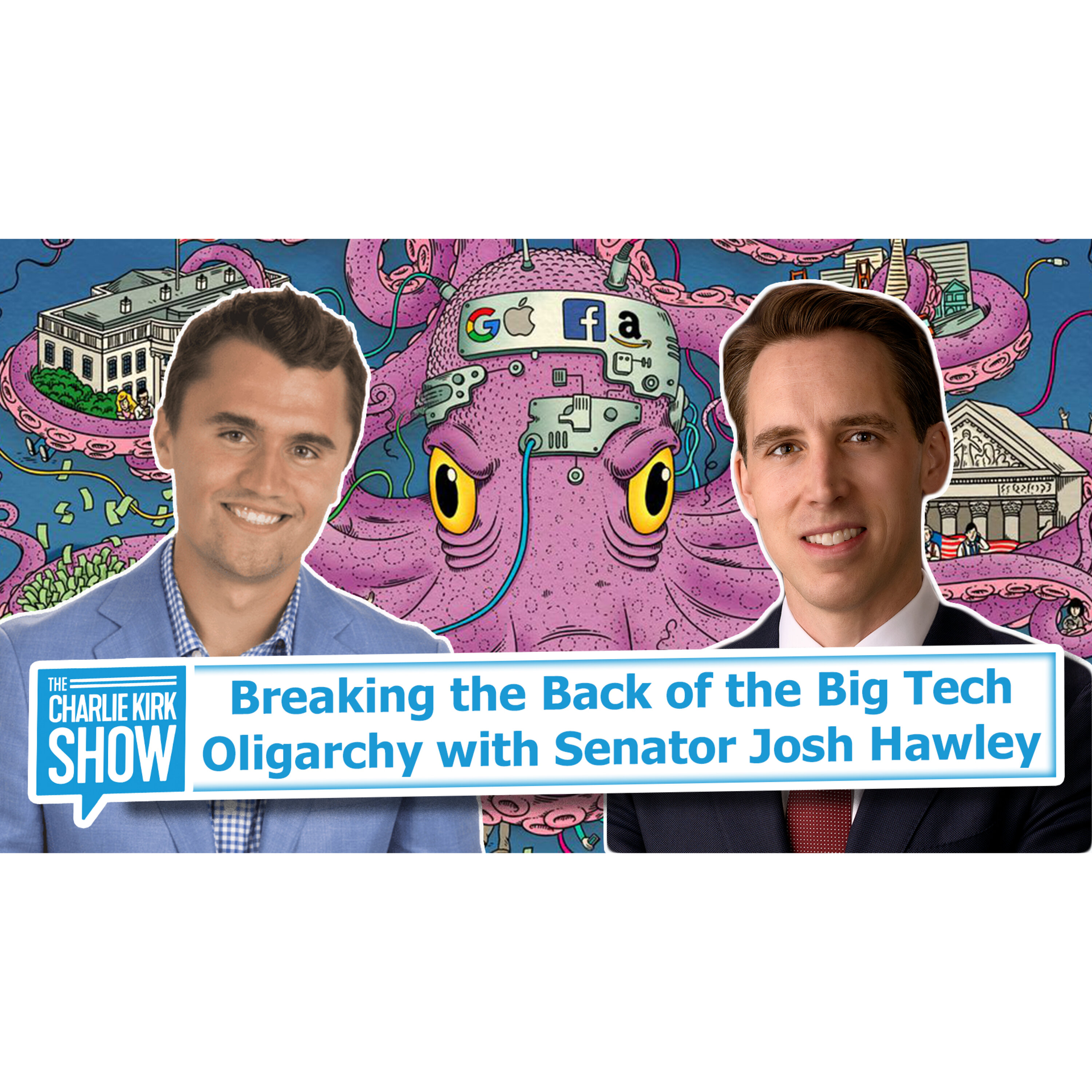
Loading summary
Transcript40 lines
- [00:00]
A
Hey everybody. On this episode of the Charlie Kirk show, my conversation with Senator Josh Hawley. He's a terrific man and we talk about breaking up Big Tech. If you want to support our program, go to charliekirk.com support email us your questions freedomarliekirk.com if you want to get involved with Turning Point USA, go to tpusa.com, buckle up everybody. Here we go. Charlie, what you've done is incredible here.
- [00:23]
B
Maybe Charlie Kirk is on the college campus. I want you to know we are lucky to have Charlie Kirk. Charlie Kirk's running the White House, folks.
- [00:32]
A
I want to thank Charlie. He's an incredible guy. His spirit, his love of this country.
- [00:36]
B
He's done an amazing job building one of the most powerful youth organizations ever
- [00:41]
A
created, Turning Point usa. We will not embrace the ideas that have destroyed countries, destroyed lives. And we are going to fight for freedom on campuses across the country. That's why we are here. Look for many of you that watch our livestream or our radio show, listen to our radio show. You know, I talk about relief factor a lot. And look, truth is I know millions of people are in some kind of pain, maybe from exercise or just getting older that can do it. That's why I'm so impressed with Pete and Seth Talbot. They are on a mission. You rarely seen this kind of focus and commitment. Seriously. They recently shared with me that they are doubling down and want to literally double their number of total happy customers in the next year. And I believe they'll do it. So here's the deal. If you're struggling with back, neck, shoulder, hip or knee pain, we or even general muscle aches and pain, then I'm suggesting you order their three week quick start, still discount only $19.95, about a dollar a day to see if we can get you out of pain. So go to relieffactor.com that's relieffactor.com the Talbots are amazing people. Check it out. Reliefactor.com hey everybody. Welcome to this episode of the Charlie Kirk Show. With us today is one of the few men in Washington D.C. with courage, Senator Josh Hawley, author of the terrific new book the Tyranny of Big Tech. I'm going to plug it throughout our conversation. Senator, thank you for joining us.
- [02:00]
B
Thank you. Thanks for having me.
- [02:02]
A
So Senator, you have been one of the most vocal members of Congress in regards to the issue of big tech. You've been vocal on a lot of different things. I want to talk to you about those as well. But most importantly, big tech Tucker Carlson has a terrific kind of sentence of praise here that I want to read because I just thought it really captured what a lot of us are thinking. Unconstrained by the Constitution, the tech monopolies became more powerful than the federal government. Strangely, this didn't seem to bother anyone in Washington except Josh Hawley. Let's hope his colleagues read this book. Tell us why you wrote this book.
- [02:38]
B
Well, it's because the power of Monopoly Charlie has become so incredible that now these companies are deciding what counts as free speech in America. They're deciding what we can say to each other, what news we should consume. They're deciding how we ought to raise our families. And it's time to put a stop to it. We've got to stand up to these woke monopolies, these big tech monopolies that want to run our lives. And that's what the book is all about, how we can do that and why we should.
- [03:02]
A
So some people will say, for example, Steve Moore wrote a piece last week, you might have saw it or not, saying that you are on the progressive side on this, that the beauty of America is our ability to have massive merger and acquisitions. And because you submitted a piece of legislation, I believe capping M&As at $100 billion if you're worth more than that, which I think is brilliant, it's awesome. But what do you have to say about this kind of doctrine in the conservative movement that quite honestly, I used to espouse quite a lot because I was raised in a conservative movement that was dominated by libertarian literature? What do you have to say to a lot of the naysayers? Because I'm sure you're getting plenty of feedback on this.
- [03:40]
B
Yeah. What I would say is that what we as conservatives believe about the free market is we believe in competition. That's what makes the free market free. We want to have robust competition. What we don't want to see is, is a handful of companies guarding themselves, protecting themselves, insulating themselves from competition from innovation, and then worse, turning around and using their market power to try to control our politics. I mean, that is a deadly scenario for any democracy and absolutely a deadly scenario for ours. So I would just say to my conservative and libertarian friends who believe in the free market, as I do, this is a time to fight for competition. This is a time to say, why should Facebook be able to buy up all of its competitors? Why should Facebook and Twitter, Google, Apple decide that parler a competitor should cease to exist in the space of 48 hours? Why should they have that kind of power? The answer is they shouldn't. And one of the reasons that we're seeing both a suppression of speech, but we're also seeing a slowdown in innovation is because these monopoly companies have too much power. And it's hurting competition, it's hurting the free market. Bottom line, competition and liberty go together. Liberty and monopoly do not.
- [04:48]
A
That is really well said. And I'm going to ask another question there, but I want to read apart from your book because it's really, really. It's really terrific. And so page 82, again, the title, the Tyranny of Big Tech. It's a basic premise of small r Republican thinking, going at least as far back to Aristotle, that citizens in a free state must be able to reason together about their common needs and interests. In other words, to deliberate. This is how citizens guide and control their government, by deliberating about what's good for them in common. James Madison followed this line of reasoning in his design of what became our Constitution, with its distinct branches of government and mandated sharing of power between nation and states. So you say here, in order for us human beings to actually be fully human, we must be able to express different ideas, to be able to communicate with one another. And tech is getting in the way of that. And so are we actually even able to have a republic when we have a small group of companies that are arguably more powerful than our own government?
- [05:49]
B
Yeah, that's. That's my concern right there. Charlie, you just nailed it. I'm worried that the republic itself is in danger. And our founders, by the way, they foresaw this. Our founders said the great enemy of a republic is aristocracy, or oligarchy, if you like, which is just. Oligarchy, of course, is ruled by the wealthy few, aristocracy ruled by the elite, by the few. And our founders were dedicated opponents of aristocracy and oligarchy. And unfortunately, that's what we're seeing now with these tech companies. We're seeing a very few people in a very few companies with outsize economic power, outsize political power. And they want to use that both to shape our economy and also to control our politics. This is what we've got to fight back against. We've got to say that, listen, in this country, power should reside with the individual and families, with ordinary, everyday working people. That's who ought to control our government. That's who ought to control our society. Not a handful of elitists woke elitists in these corporations.
- [06:47]
A
So you were elected in 2018, and you defeated Claire McCaskill in a pretty resounding victory. And that was part of the transfer of government, where the House of Representatives went from Republican to Democrat. In the years before that, Republicans controlled the House and the Senate and the presidency. And the big. Their big accomplishment was a corporate tax cut for the companies that actually hate us. And it seems for years you couldn't get Republicans to even mention this issue of tech. It's almost. It's almost a inarguable fact that these companies are not just against our country, but against the Republican Party. Amongst your colleagues in the Senate, are you seeing some Republicans start to be open around this idea of using political power given to us by the people to go after these companies that act as if they're sovereign nations? Are you seeing an increased appetite for that?
- [07:43]
B
You know, I am. I've seen a definite shift in the short two years I spent the Senate. When I first came to the Senate and I proposed legislation to take on tech, you know, to be honest with you, I couldn't find very many takers on the Republican side. And of course, the Democrats, they've really fallen in love with monopoly power now. They love it. They want techturb to censor even more. They wanna use the power of these companies. Exactly. To do what the First Amendment wouldn't allow government to do. But I think on the Republican side, folks are beginning to wake up, partly because these companies have become so brazen. What they did with Hunter Biden during the last election, where they suppressed that news story for days and weeks on end. What they did in January where they kicked President Trump off of. Off of all of the social media platforms. They deplatformed many other conservatives. Censored conservatives. You've experienced this, Charlie. I mean, they are so brazen about this. I think conservative elected officials are finally waking up to what voters have known for years, which is that these companies are powerful, they are dangerous, and they are no friends to democracy.
- [08:42]
A
Well, and so the founding Fathers were always very concerned, as you said, about aristocracy or too much power in a small group of people. This is a different thing for conservatives, though, and I really want you to dive even deeper in this, because we're almost trained never to criticize private companies. Right. In our upbringing in the conservative movement, when I was 2011, 2012, when I first was getting Turning Point started, you know, there were certain things that you were not allowed to say. Right. The. The think tank people and the pundits would always say, oh, no, no, no, the market will figure it out. We do not touch that, just cut their taxes it was almost part of the muscle memory of the conservative movement. Your whole doctrine, which is phenomenal, and Tucker's been espousing this. And J.D. vance, who's a friend who also endorsed your book, he's also been articulating this is. Hold on a second. We should be against absolute power. We want limited power, regardless if it's in a corporation or, or in the government. Can you talk about how conservatives should be unafraid about. About criticizing private, private companies, which are. They are, aren't even private companies. Because I think that's what's stopping us from actually getting momentous change, if that makes sense. Because we're just so. It's so ingrained in our thinking that we're not allowed to criticize private corporations.
- [09:56]
B
Yeah, absolutely. I would start by going back to the American founders who understood this. You know, there's a reason that the founders, first of all were against monopoly and they actually limited the corporate form back in the day. I mean, you couldn't use the corporate forum in America for the first really century, a little more than a century of our existence as a nation, unless you were a church or an educational institution or maybe for a public works project that the government oversaw. And the reason was they were so concerned that the corporate form would turn into monopoly. They were so concerned about concentration of power in the economy. Our founders understood that anytime you have concentrated power in society, it will always, always convert itself into political power. That's what aristocracies do. You amass wealth, you mass influence. And then they start trying to run our lives and run our government. And that's what these tech companies are doing. They are economic monopolies, but they're trying to project their power into politics. And we're witnessing it. We saw it last fall during the election. We saw it this January, February. We see it now with the sports, mlb, that these other mega corporations trying to force Georgia and other states to back away from election integrity legislation, that is concentrated economic power, trying to leverage it to control our politics. So I think we, as conservatives, we need to recover the founders understanding about monopoly and liberty, which is that they don't go together. And so we got to break up the monopolies and have real competition so that we can protect the people's liberty.
- [11:26]
A
It doesn't matter what your politics are or who you voted for. Everyone should have the right to express themselves freely. Sadly, the big Tech monopoly has instead opted for censorship to fight back against Big Tech's control of the Internet. I'd use ExpressVPN free to access. Tech giants make all of their money by tracking your searches, video history and everything you click on, then selling off your sensitive data. When you use the ExpressVPN app on your computer or phone, you anonymize much of your online presence by hiding your IP address. That makes your activity much more difficult to trace and sell to Advertisers. What's more, ExpressVPN encrypts 100% of your network's data to protect you from cybercriminals. And it just takes one click to protect all your devices. That's why ExpressVPN. That's right, ExpressVPN is rated number one by CNET and Wired revoke Big Tech's right to your data. Visit expressvpn.com Kirk E X P R E S S vpn.com Kirk to get three extra months free. That's expressvpn.com Kirk for three extra months free. Expressvpn.com Kirk and you articulate this wonderfully on page 134 right at the end of part two. The American founders advocated a political economy of republicanism to protect the rule of law of the common man. But this was a political economy of aristocracy, which you're talking about what's happening right now. You're referencing the FTC decision with Google. The tech barons wanted to control the economy, the media, news and politics, all of it remaking the nation in their image. As for the Republic, that grand experiment in self government by the common man and woman that would fade away, recede into the mists of history. Really well written, unobtrusively, quietly, such that no one would really notice, to be replaced once and all by a rule of the corporate elite. Can you talk about that where we are now? It's non representative and it seems that we know where these woke corporations stand. We know that they have a certain viewpoint. But now talk about this in the economics terms, not just so you'll be able to get a lot of conservatives, for example in the House Freedom Caucus to agree with you on censorship, to agree with you even on section 230. But then Senator, when you start to say no, no, no, we gotta break these companies up, all of a sudden then you're some Republicans are saying no, no, we don't do that. We just allow the market to operate. Why is it that we now need to intervene? Why is it we need an interventionist economic doctrine with these companies?
- [13:50]
B
Well first of all, these companies have gotten big and powerful and achieved monopoly status because of government's Intervention. Let's not kid ourselves. This didn't just happen magically. The government gave these companies a special immunity deal, that section 230, whereby they could do what they do, collect all of the data they collect on us, take it without our consent, sell it without our permission, where they could engage in this manipulative advertising, which is their whole business model, and they could do all of that and not be challenged, not be taken to court, not be held accountable. That subsidy has been worth billions and billions to these tech companies, and it's helped them to get gigantic, powerful, and ultimately to achieve monopoly status. So here's what I would say. As Republicans, we have a history as a party of saying that we are pro worker, we are pro free market, and we're pro competition. Those things sit together. What we are not in favor of is monopoly. And we have a history of a party of breaking up monopolies, and we need to recover that. Part of the reason that we are pro capitalism is because we're anti monopoly. Those things go together. What happens with monopolies is that ultimately takes us down the road of corporatism, that ultimately gets us to a place we don't really have a functioning free market anymore. We have a few companies that always make deals with the government. So you get big government, big business, working together, and you no longer have a robust, functioning free market. So to preserve capitalism and the free market, we've got to break up monopolies. That's what I would say to my conservative friends. That's what I believe. And I'm. I'm a pro free market conservative. And above all, I'm a pro liberty conservative, and that's why I'm anti monopoly.
- [15:25]
A
So let's talk about the actual human cost of this. And you talk about this in. In specifics about a Missouri school. I'm trying to find the exact page here. I think it's around 64. But you talk about how they're addicting America to these devices and to their. Their algorithms. Can you walk us through that? Because there's also a human cost to all of this as well.
- [15:46]
B
Tremendous human cost. Their business model, these dominant platforms. And we're talking here about Twitter, we're talking about Facebook, Google, Apple. Their. Their dominant business model is built around addiction. They want to addict us to their product. Why? Because they need to take as much information from us as they can. Our. Our preferences, what websites we visit, what movies we watch, what news we consume, how long we linger over this ad versus that ad. They track all of that. They Build giant dossiers on us individually. And then they use that personal data, that personal information to try and sell us stuff or to try to encourage us to do this or not that, to manipulate us. Essentially. That's the business model. To make it work, they've got to have us spend as much time as possible online. And so this gets to the model of addiction and the costs are huge. I mean, you look at social media use, it is correlated in teenagers, for instance, with higher rates of isolation, higher rates of depression, even higher rates of suicide. You see similar things in adults where increased social media use is correlated, at least with feelings of isolation and depression, also, you know, productivity loss. So there are huge, huge costs to their business model. And that's even before we talk about censorship and political control. So for all of these reasons, we've got to say, listen, we're not just going to let you take our private property, which is our personal data, without telling us, without our consent, without paying us, compensating us in some way. The basic business model, I think, is an affront to conservative principles about private property, about ownership of your control of your own information. And that's another thing we've got to challenge.
- [17:26]
A
So now I want to get into why nothing gets done on this topic. I want to get into a little bit more of a cynical chapter of this conversation, which is how powerful these tech companies are in Washington D.C. how much money they spend on public affairs, how much netpack contributes to Republicans and Democrats. Can you talk about the, the lobbyist infantry that Google employs in Northern Virginia and Washington D.C. how Google learned from the Microsoft failures of the 90s. Remember, Microsoft came under all of this antitrust action and Microsoft said, screw you, we're going to ignore you. And then they kind of had a couple years of difficulty. Bill Gates testifying didn't go well. So Google said, ah, we're going to do it differently. We're going to build a beautiful office. We're going to employ former congressional staffers, we're going to make all the correct contributions. It'll cost us 30 to 40 million a year, but that'll be a rounding error for the federal government staying out of our business. Can you talk about money in politics? How these tech companies are directly involved in the process of legislation and dare I even say, regulation?
- [18:37]
B
Yeah, absolutely. Here's what they've done. They've gone out and they have purchased influence with lobbyists, as you say, Charlie, but also with think tanks, with academics, with the whole sort of chattering class in Washington D.C. and they have entire. The infantry is really a good word. A whole phalanx of folks who are out there willing to say, oh, wait a minute, no, we can't interfere with these companies. No, no, no, you mustn't. You mustn't break them up. No, no, no, no, you mustn't say that they shouldn't censor speech. It's important that they censor speech. They have a whole echo chamber that they have built for themselves, and that includes conservative groups and organizations. Google has been smart. Facebook has been smart. They've contributed to a lot of conservative groups. And so anytime you challenge their power, and I found this personally, when you challenge their power, you introduce a bill, for instance, to break them up, what happens? They go and they turn on their chorus. And the chorus of folks paid by Google start saying, oh my gosh, this is anti free market. Oh my gosh, this is anti capitalism. That's for the right. On the left, they'll say, oh, my goodness, this would empower extremist voices. Whatever the talking point is, that will keep Google in power. That will keep Facebook in power. That's what they amplify. And I tell you, they're powerful. I would say what I've observed on Capitol Hill, I don't think there are any more powerful lobbies in the town of Washington, D.C. than Big Tech.
- [20:03]
A
I totally agree. And so for conservatives, it used to be heretical to say that anything but libertarian economics is the greatest thing ever. On the left, it's heretical to say anything but racial politics is the most important thing. So Google knows this. So they fund the appropriate groups. And therefore, if you dare say that you're not going to put what other tech policy they want on the left, then you're a racist and you're empowering, you know, the worst possible white identitarians on our side, you're Somehow violating the 10 Commandments of Free markets, which in reality, we're actually trying to preserve them. And I also, I don't love utilitarian arguments because they could be used for evil. But just from a pure utilitarian standpoint, we like markets because we like human beings and human flourishing. When we set up a system that doesn't help human beings and human flourishing, we shouldn't feel just indebted to have to. Not indebted's not the right word, but we shouldn't feel obligated. That's the right word to have to defend that sort of system. And I think that a lot of Republicans and conservatives, they either don't understand where their voters are, which I want to talk to you about in a second, or they're being paid by these tech companies or they're just not that interested in this issue. So I want to talk about where our voters are. So, Senator, you're very smart because you actually listen to the people you represent. You listen to the voters of Missouri who are telling you, hey, it's not a good thing that Amazon is coming in and destroying the small businesses and all of a sudden they come in with their distribution center and we're supposed to believe this is economic growth. Amazon, I think, gets treated with kid gloves because a lot of the criticism from our side rightly goes towards Facebook and Google and Twitter. But Amazon is more involved in, I think of this economic decolonization of America where they're just taking out all of the meaningful work and replacing with piles of plastic. Do you include Amazon and a lot of this criticism and can you talk about how that has impacted some of your voters livelihoods or your citizens livelihoods in Missouri?
- [22:02]
B
Yeah, I absolutely do include Amazon in this criticism. Amazon is one of these dominant platforms. And you look at Amazon's attempt to control almost all E commerce in America as you referenced, Charlie, but really then to control more and more of the real economy, to displace family businesses, for instance. Listen, I grew up in a small town of about 4800 people in rural Missouri called Lexington, Missouri. This is a place that subsisted on small local businesses, a farming community as well. So this is for me, I live that kind of a life. Where do you go to to buy your tennis shoes that you need to play sports? Where did I buy my cleats to play football? No, you went to the local store. I mean, because there weren't any other options. But you went there. The local store, we knew who ran it. This was a family business. Amazon's model is to destroy all of that. It's to destroy the local stores, destroy the family businesses, is to replace them with Amazon Incorporated. That's what they want to do. And they want to use their monopoly power to do that. And while they're at it, Charlie, they also want to buy up the cloud, that's Amazon Web Services. And they also want to buy up all the distribution network in America and of course now grocery stores. So Amazon basically wants to run our lives. And I think what you're seeing is these companies, the other tech companies included, they basically want to control the American economy. You know, they want to control our lives, they want to control our speech and they want more and more of the real economy to be tethered to and directed by them by the digital economy. And ultimately this is bad for jobs. This is bad for our through the economic independence of working Americans. And this is something I get into in the book.
- [23:40]
A
So you talk about in part three, what people can do. I actually haven't gotten that far. But what can people do because I have the chapter opened.
- [23:48]
B
What?
- [23:49]
A
Because a lot of people feel helpless outside of voting and buying a pillow on Fox News promo code, Kirk, they feel as if there's nothing that they can do. What can someone do up against the trillion dollar company? Senator, you have these guys that have more power than Alexander the Great could have dreamed of. And just local citizen in Joplin, Missouri or in Des Moines, Iowa, says, I don't even want to try. Is that true?
- [24:16]
B
You know, it shouldn't be true because the choices that we make do have a difference in our lives. And I talk about in that part of the book in my own experience as a husband, as a father and just what we do in our family life. And I think one of the things that my wife and I have found is it's important to live as much as your life away from these digital platforms as you can. In other words, don't allow the digital platforms to colonize your life, to use your phrase, Charlie, it's a good one. Don't allow them to move in and control your family. So how can we do that? Number one, we can limit the amount of time we spend on the platforms. We know their model is addiction. We know they want us on the platforms constantly. So don't do it. Don't give in to that. Say, okay, listen, if I've got to be on Google, I've got to be on Facebook for something. I'm going to do it for this specific reason. I'm going to limit my time. Then I'm turning it off and I'm putting the phone down and I'm going to go do something with a real person. For families, you know, I've got two small boys at home and then a baby daughter for our little boys, we don't allow them to have mobile devices or tablets or mobile platforms at all right now. And they're certainly not on social media. We are trying to make the effort to build the ecosystem of our family, if you like, where it's not dependent on any way on social media or on these devices because we want our kids to actually have the joy of having real interpersonal relationships. Now, every family's got to reach its own stasis there and figure out what's good for them. But what we can all do is say, listen, we're going to be in control of our family time, not big tech. We're going to make choices to raise our own kids, not big tech. And it's really great if you can partner with other people and other families, you know. So with us and our kids, we found other like minded families. Like yeah, we don't want our kids online constantly either. Okay. So then you get them together and they play sports together and they go to the park together and they hang out together and you begin to build this community and it's just old fashioned neighbors with neighbors, you know. And I think the more we do that, the more we take back control from these tech companies. That's number one. Number two, we got to break them up at the political level. Voters have to demand real action, not just talk, not just hearings, but real action to break these companies up.
- [26:20]
A
In 1857, the SS Central, also known as the Gold Ship, sank with 9.1 tons of gold on board valued at $2.1 million. That is the modern day equivalent to hundreds of millions of dollars. The greatest American treasure ever discovered at sea. Today Noble Gold, a California based company with a pristine reputation, has a share of these coins available to their clients. Over 7,000 gold coins, mostly one $5 and $20 gold coins from 1840 to 1857 were recovered from the SS Central America shipwreck. Most of these coins were from the ship of gold were quickly acquired by private collectors when the coins were first brought to the market in 2000. Now Noble Gold's clients can get this unforgettable part of American history at a fair, affordable valuation. Contact Noble Gold and ask about the Kirk shipwreck deal. To receive this unique offer, visit noblegoldinvestments.com and then call a Noble Gold representative to ask about the shipwrecked coins. It's time to tell better stories at your parties by showcasing a one of kind coins from collection destined to rise in value. Noblegold investments.com I totally agree and I'm somewhat of a radical on the device thing. I've been speaking out about it. I think that no one under the age of 18 should get a smartphone. I think they're destructive to our humanity. And when you see that Apple and Google and Facebook has combined thousands of well paid neuroscientists that work for them, that treat your children like lab rats, they bring in three and four year olds and they they have devices of how to make them more chemically addictive. So for example, a pharmaceutical company might try. They, they wonder, okay, is this drug gonna have its desired effect? You know, a, a hot sauce company like Cholula, they might wonder, is this sauce going to taste good? Facebook, they're wondering, is this app going to be addictive to a 5 year old? That is so perverse and wrong that they should have to, they should have to have, they should have to pay for that. The same way that Purdue should have to pay for OxyContin, they should have to pay for that. And so I totally agree. And then let's talk about breaking them up from a state level. So it's my opinion that that's where a lot of the action needs to happen, where these states need to kind of consolidate their support. A coalition of 15 states, outside of the lawsuits, outside of the attorney general stuff. If 10 conservative states like North Dakota, not going to happen there, because that government, that governor is a tech governor, maybe South Dakota, Florida, Oklahoma, Alabama, they said, okay, we are going to fine you 2 million bucks a day if you don't meet this list of demands you're never going to meet. Wouldn't that be an effective way to push back against them? It's time to start using political power. Why are conservatives afraid to use political power?
- [28:59]
B
I think because for a long time we just, we haven't been alert to the problems. And I think we've, we've, we've bought into this idea that anything that currently any company that exists out there must be the product of the free market. When that just isn't true, that just isn't true. And to your point, Charlie, we need to be for liberty above all, right? That's why we love the free market, because it produces liberty, because it gives people control of their government over their lives. That's what we need to be for. And competition is the way to get there. I love that idea about encouraging states to actually use the authority that they have as Attorney general. Missouri, that's the job I did before I ran for the Senate. You know, that's why I launched investigations of Facebook and Google for antitrust violations. We also have really strong consumer protection laws in Missouri. A lot of states do. Those can be used to hold these companies accountable and to go after their practices of like data collection, their practices of addiction, the things that are ruining people's lives. And so I think the more that states do, the better. But we also must not let the federal government off the hook. We've Got to press relentlessly because ultimately at the national level, the only way from an antitrust perspective to make this truly uniform and effective is the federal government will have to act. The federal government will have to break them up. And so we've got to keep that pressure up, especially on elected officials.
- [30:14]
A
So the book again, is the Tyranny of Big Tech. Senator, I want to ask you two more things. Number one, I want to thank you for your vote. I'm going to be one of the few talk show hosts that's going to thank you for this. But thank you for your vote on the Asian bill, the Asian hate crime bill. Because it was so vague, it was so nonspecific, and it was just a virtue signaling vote. It's all that it was. Can you talk about that, please? Because you obviously came under fire. You're actually going to be thanked here, unlike most programs that are going to try to attack. Talk about that, please.
- [30:44]
B
Yeah, to me, that was a free speech vote. I mean, I believe in free speech. I believe in the First Amendment. I was a First Amendment lawyer, you know, so I take that really seriously. That problem with that bill is Section four of that bill gives to the federal government, the Department of Justice, the ability to define what is offensive speech and then to track it and to monitor it and to collect it and to help the states and local governments do the same. I'm against that. You know, hate crimes, that's one thing. But that's not what we're talking about here. We're not talking about a crime. We're talking about speech. The bill calls it hate incidents, and it says the federal government can define what counts as that. I think that is extremely dangerous. We have been down this road before. You know, look at the Patriot act, where we gave the government all kinds of power over speech, over Americans. It was supposed to be temporary, right? It was supposed to sunset. Never did here. We're still dealing with it now. So I just can't in good conscience vote to give the government more power to define what counts as good speech or bad speech.
- [31:40]
A
Yeah, and I was disappointed that more senators didn't vote with you. So, I mean, I call the virus the Chinese Coronavirus. Is that now a hateful incident, according to the Department of Justice?
- [31:50]
B
Might well be, yeah. Might well be. I mean, that's exactly. Charlie, what was in the sights of this bill? I mean, this is why it was initially introduced. Senator Hirono, Democratic Senator. It was her bill, and she explicitly said that using terms like that is racist, and that's the whole point of the bill is to try and ban the use of those terms and you know, again, to give DOJ the power to say, well, this is a hate incident now because you used offensive speech. And we're going to track that and we're going to build a database on that. I just think that is really dangerous.
- [32:19]
A
Well, it'll eventually lead to some form of prosecution of speech. Inevitably. They don't make lists for therapeutic reasons at the Department of Justice. They make lists for action. And that's something that I just want to thank you for because those are the tough votes where you can really see what someone's made out of because it's a pure virtue signaling vote that no one wants to get the criticism. And you actually did the right thing there. So in closing here, the Republican Party is changing and I think it's changing for the better. It's now a multiracial working class party that cares about the concerns of its voters and less about corporate donors. Can you just talk a little bit about how this tech issue is kind of part of a broader challenge of neoliberalism. Right. Which is that maybe we shouldn't bring in 15 million people a year. Maybe our trade policies have been against the people of Missouri and Arkansas and West Virginia. Can you talk about the direction of the party and how you want to play a role in that and where voter, what voters should demand out of their leaders?
- [33:20]
B
Most importantly, you know, I think that the party in the last 30 or 40 years has gotten caught up in what was a bipartisan consensus basically in favor of liberal globalism. That's what neoliberalism is, it's liberal globalism. And what that says is we put the priorities of multinational business first and we don't really worry about working people. And if business wants to ship our jobs overseas, we're supposed to be in favor of that. If they want to open our borders and flood our markets with cheap labor, we're supposed to be in favor of that. If they want to use forced labor and exploited labor overseas to compete with our free labor at home, we're supposed to be in favor of that. Voters have had enough of that. They said, no, no, no, no, no, no, we don't want any of that. We don't believe in any of that. We believe actually in a strong national economy. We want to invest here. We want to see real jobs brought here. We want to see good paying jobs here in this country. The Democrats answer to all this, by the way, because the Democrats are also, of course, big time Globalists, their answer is, let's have a global economy and we'll make up for it with socialism at home. Right? So we won't really have any good jobs here anymore, but the government, that it won't matter. The government. So socialism at home, globalism abroad. Republicans need to say no to both of those things. You know, what we want is a strong America. We want an economy where working people can support themselves by the work of their own hands. To do that, Charlie, you gotta be able to get a good job at a good wage in this country. And I think that's why you see Republicans rethinking some of the economic dogma of the last 30 and 40 years and saying, why should we be in favor of trade policies that sell out our workers, in favor of forced labor in China? Why should we be in favor of that? No, we need policies that make American workers strong, that make American families strong, that make American communities strong.
- [35:08]
A
I'm chuckling because growing up, it was the Democrats that used to actually argue for this. At least some of them, not the neoliberal Democrats, but the Bernie Sanders types. The people that used to ride the bikes in my communities and scream about how we have too many people coming into America and they talked about how our farms are being taken over by Big Ag. They're actually kind of right, kind of. All these whack jobs that used to ride through my neighborhood and scream about all this stuff because there was a global agenda that was setting in. And in some ways, those people are now Republicans and we represent the working class. But anyway, I digress from that. The tyranny of Big Tech. It is the most important issue of our time. If we do not challenge these companies, we will all live in a weird mixture of brave new world in 1984, where we're going to pursue pleasure and not virtue, and there will be no liberty. We must crush these companies for the betterment of humanity. Senator, thank you for your courage and for your time today.
- [35:57]
B
Thanks for having me.
- [36:01]
A
Thanks so much for listening, everybody. Email us your thoughts freedomarliekirk.com and if you want to get involved with Turning Point USA, go to tpusa.com God bless you guys. Speak to you soon. For more on many of these stories
- [36:15]
B
and news you can Trust, go to charliekirk.com.