← The Charlie Kirk Show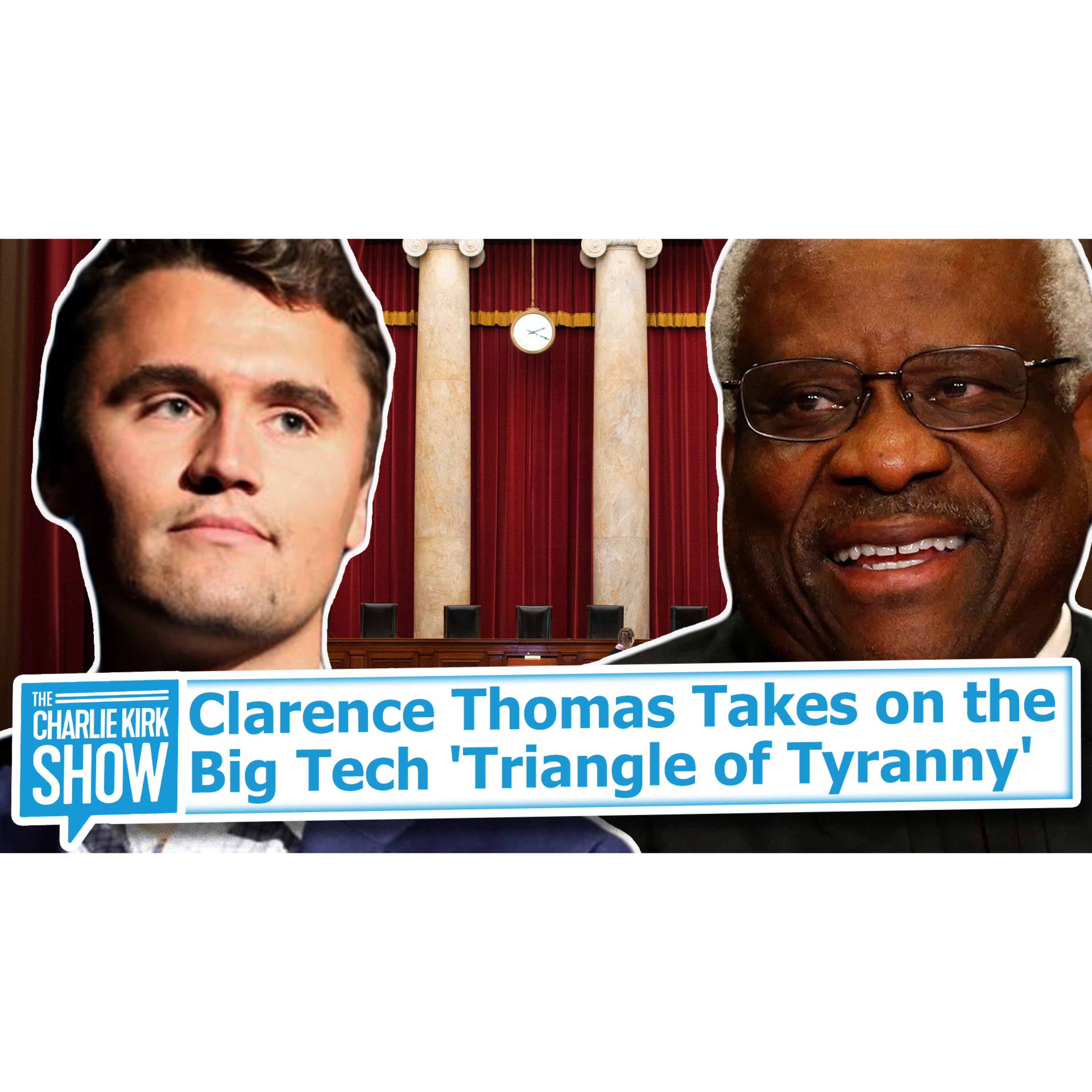
Loading summary
Transcript3 lines
- [00:00]
A
Hey, everybody. This episode is brought to you by my friends at ExpressVPN. ExpressVPN.com Charlie Secure your device. Anonymize your online activity. Protect your action online. Expressvpn.com Charlie help our show out by also helping yourself. Protect yourself. ExpressVPN.com Charlie hey everybody. Today on the Charlie Kirk show, we go through the entire hour. Call Clarence Thomas, who issues a scathing rebuke against the tech companies and offers some hope of how we can challenge them. If you want to support us, go to charliekirk.com support do you want to get involved at Turning Point USA? Go to tpusa.com and email us your questions. As always, freedom. Charliekirk.com Buckle up, everybody. Here we go. Charlie what you've done is incredible here. Maybe Charlie Kirk is on the college campus. I want you to know we are lucky to have Charlie Kirk. Charlie Kirk's running the White House. Folks.
- [00:59]
B
I want to thank, I want to thank Charlie. He's an incredible guy. His spirit, his love of this country. He's done an amazing job building one of the most powerful youth organizations ever created, Turning Point usa.
- [01:10]
A
We will not embrace the ideas that have destroyed countries, destroyed lives, and we are going to fight for freedom on campuses across the country. That's why we are here. I don't know about you, but I feel like I'm always looking at a screen, now more than ever. And whether you're an avid news watcher or in serious need of a distraction, unplugging yourself is easier said than done. One of my favorite ways to rest my eyes and still get the content I'm itching for by putting in my Raycon wireless earbuds and listening to something great. Whether you're catching up on a favorite news podcast, binging an audiobook, or powering through your workout with pumped up playlists, a pair of Raycons in your ears can make all the difference. Raycons are built to perform anywhere or anytime. With water and sweat resistant construction and Bluetooth that pairs quickly and seamlessly. Raycon's offering 15% of all their products for my listeners. And with enough battery life for six hours of playtime, you can unplug for a while. Go to buyraycon.com Kirk that's it. You get 15% off your entire Raycon order, so feel free to grab a pair and a spare. That's 15% off@buyraycon.com Kirk buyraycon.com Kirk Justice Clarence Thomas, who is my favorite Supreme Court justice, he's an originalist, he's a textualist. He believes in the natural rights doctrine. He believes that in God granted rights. He's a believer in liberty. Came out and set the record straight when it comes to big tech and the massive tech oligarchs running our country. I'm reading from the New York Post. Quote, quote, on Monday, Justice Clarence Thomas announced that the Supreme Court soon will have to put an end to big tech tyranny. If the high court fails to act, it could mean the end of free speech in the 21st century and as he puts it, relegating free speech rights to just simple paper rights. Clarence Thomas came out and eloquently and said, quote, one person controls Facebook and just two control Google. Three people, in other words, have the power to disappear any of us from the digital public square. Even a commander in chief. The Supreme Court, Justice Clarence Thomas argues, must rein in this unaccountable tyranny. So before I go any further, I feel like I'm reading from a podcast script, as if Justice Thomas has been listening to what we've been saying. So we've been making this argument for the last couple years, and I'm beyond thrilled to see the United States Supreme Court, at least one person of the nine on the Supreme Court speak this language. This is bigger than I think most people realize because Justice Clarence Thomas is not quick to say that we should use government against a, quote, unquote private company. That's the argument that the big tech companies use when they fund a lot of the libertarian think tanks or these libertarian think tanks then push out their white paper saying we should never touch Google, never touch Facebook, never touch Twitter, because they are allegedly private companies. Now, we've gone through why that's not the case in great detail. If you drive from Gary, Indiana to Chicago, you will probably drive on the Chicago Skyway. And the Chicago Skyway is a private highway. It's a private public partnership. It is against the law for the owners of that private partnership to say, you are not allowed to ride or drive on our highway based on your ideological views. It has to be for everyone, accessible to anyone that has a car. That's an interstate highway. And tech companies are information highways. Since they are information highways, we must understand that the purpose of these tech companies should be to have the most amount of access and speech. So Clarence Thomas coming out is a big deal in the fight against big tech for a variety of reasons. Let me name a couple, number one, other judges and lawyers that want to become judges across the country on the state Local, county and federal level that are in the original list Tradition. Take what Clarence Thomas says very seriously. That's Clarence Thomas comes out less as a judge in this opinion and more as a scholar. It's almost like in political world, when Donald Trump or Tucker Carlson says something, we all listen carefully when they say something new or they are trying to set a trend, that's a big deal for us. You have to understand, in the legal community, looking up to Supreme Court justices for guidance is not just normal, they are taught to do that. So Clarence Thomas is very well known for believing in God granted rights. And again, what I call the Straussian Lockean tradition of natural rights doctrine. What is the natural rights doctrine? Well, the natural rights doctrine was the ideas behind the Declaration and the Constitution. It starts with a moral claim that no person should be dominated by another without their consent. It's a pretty simple rule that no person should be able to be ruled over without that term. That pops itself up all over the Constitution and in the Federalist Papers. Consent of the governed. It comes from a belief of negative rights, not positive rights. What's the difference? Negative rights are that who you are. Naturally, government can't take away from you unless you did something to warrant the sacrificing or the removal of those rights. Your right to speech, your right to consciousness, your right to own property, your right to take risk, your right to travel, your right to express your beliefs, those are inalienable. In the Declaration of Independence, it says very clearly that the social contract or the social compact that we have from the Lockean tradition is one that governments and the role of government exists to protect and secure those rights, not administer them. You asked Jean Jacques Rousseau, who is also a social contract theorist, literally wrote a book on the social contract. Thomas Hobbes was the other social contract theorist who came to the wrong conclusion. But the right observation when it came to human behavior, Rousseau would say that government is the administer of these rights, that government exists to tell you what you can and cannot do. Whereas those of us that are conservatives or Americans, pro American, I should say, we'd say no, no, no. We tell the government what they can and cannot do. They take orders from us that no one has a right to rule another. That is a moral claim that is made repeatedly in our founding documents. That is a moral claim that the founding fathers worked very hard to get their words right on. And generally they really did. So Clarence Thomas is a believer in the natural rights doctrine. Now, natural rights doctrine has fallen out of favor in almost every single academic circle. Across the country. They believe that it's not God that administers your rights, that God is a questionable proposition at best. Instead, they believe that a central ruling authority, the state, is why you're even able to exist in the first place. They would believe in a John Rawls veil of ignorance approach to anything. We would consider rights. So Clarence Thomas comes from that tradition and I could do an entire podcast just on natural rights, where they come from, why it's so important, how we take it for granted. But the tie it back to this news story and we're going to explore this throughout the hour together. Clarence Thomas saying this coming from a position that government must be used sparingly and rarely is a big deal. And it spells trouble for these tech companies. Your credit card company found suspicious charges on your card. That's simple identity theft. It's annoying, but they cover it. The type of fraud you really need to worry about is home title theft, a devastating crime that takes you off your home's title and you're not covered by insurance or most identity theft programs. That's why you need Home Title lock. Here's how easy it is for cybercriminals to get you the title. Documents to our homes are kept online. The thief forges your signature on a quit claim deed stating you sold your home and that he's the new owner. Then he borrows money using your home's equity and leaves you in debt. You won't know until late payment or eviction notices arrive. The instant Home Title Lock detects someone tampering with your home's title, they help shut it down. Let's get you protected. Go to hometitlelock.com and register your address to see if you're already a victim. And enter the code radio for 30 free days of protection. That's promo code radio@hometitlelock.com Someone just emailed us. They said, charlie, what does this mean for platform access for those of us that have been kicked off social media? I'm going to get to that question. It's a great question. I love hearing from you. Freedomarliekirk.com we're continuing with Clarence Thomas's scathing statement against the tech companies. Clarence Thomas rejected the free market absolutist argument about competition limiting big tech tyranny. He pointed to substantial barriers to entry that face newcomers. The fate of parler proves the justice's point. I'm reading from the New York Post. Clarence Thomas coming out and arguing from a natural rights doctrine that we must quote, rein in the tech Companies should be a warning shot to the big tech oligarchs. The oligarchs are deciding to ignore more than half the country and their anxiety around this issue. They instead want to dominate you. They want to addict your children to these devices. And I've said this before, that no young person under the age 18 should be given a smartphone. It's that simple. That parents giving children smartphones spells the end of their humanity and the beginning of their cyborg age and era. I'm more and more convinced that these tech companies act as predators with young people and students across America. So this was an opinion that was issued by Thomas, Clarence Thomas. The great Clarence Thomas, who, by the way, is not in the Black History Museum. Go figure that one out. Clarence Thomas writes, when a person publishes a message on the social media platform Twitter, the platform by default enables others to retweet the message or reply. The user who generates the original message can manually block others from republishing or responding. Donald Trump, the President United States, blocked several users. They sued and the second court held that the comment threads were a public forum. The president violated the First Amendment. You see, Clarence Thomas is so smart here. This is why this is such a big deal. He's using circuit court decisions to affirm the point in the argument that these tech companies must be regulated. It's brilliant. He continues by saying the disparity between Twitter's control and Mr. Trump's control is stark to say the least. Mr. Trump blocked several people from interacting with his messages. Twitter barred Mr. Trump from not only interacting with a few users, but removed him from the entire platform, thus barring all the other users from interacting with his messages. Under its own terms of service, Twitter can remove any person from its platform, including the president, at any time, for any reason. According to Twitter Incorporated user agreement, this is not the first time or the only case used to raise issues about digital platforms. And Clarence Thomas goes and mentions above bunch of them. So the entire argument that Clarence Thomas makes surrounds on the issue. I should say it focuses on the issue of Donald Trump not having access to his Twitter account and how it actually happened. He continues by saying, if part of the problem is a private company concentrated control over online content and platforms available to the public, then part of the solution may be found in doctrines that limit the right of a private company to exclude. Historically, at least two legal doctrines limited a company's right to exclude. And he goes on, he mentions them first, our legal system and its British predecessor have long subjected certain businesses, known as common carriers, to Special regulations. And he goes after 230 with great eloquence and continues by saying, the other one is if the good serves the, quote, public interest. And he says at this point, a company's property is, quote, not its own, but its instrument and the means of rendering the service which has become that of a public interest man. Is this guy smart? And he's of course not in the Black History Museum because he is not sufficiently black, because he's a free thinking, constitutional loving conservative and to the left that deserves no platform whatsoever. And you want to talk about someone that every young black person should know about and aim to become, it's Clarence Thomas on the Supreme Court. A courageous, clear thinking man who grew up in absolute poverty and rose all the way to the United States Supreme Court. Clarence Thomas authored an amazing response to the tech companies saying that it is time to regulate them because of the natural rights doctrine. So I mentioned earlier, this is a big deal and I've made this argument I'm so pleased to see Clarence Thomas make it is that we do not want to break up the tech companies because we lust for government takeovers. We want to regulate them and break them up because we care about natural rights, because we care about free speech, because we care about God granted liberties that are being violated by these despots in Silicon Valley. Continues by saying Internet platforms of course have their own First Amendment interests, but regulations that might affect speech are valid if they would have been permissible at the time of the founding. See United States vs Stevens in 2010. The long history in this country and in England of restricting the exclusion right of common carriers and places of public accommodation may save similar regulations today from triggering heightened scrutiny, especially where a restriction would not prohibit the company from speaking or force the company to endorse the speech. Clarence Thomas continues by saying, in many ways, digital platforms that hold themselves out to be public resemble traditional common carriers, though digital instead of physical. They are at the bottom communication networks and they carry information from one user to the other. Let me just stop here and explain what he's talking about here. Clarence Thomas is basically saying Facebook and Twitter, they don't create any content of their own. They're starting to get into the content creation business. But almost everything on their platform is carrying one piece of information from person A to person B. What a brilliant argument. Quite honestly, I didn't think about this. Clarence Thomas is saying, this is not a media company. This is not a company that is producing new thoughts and new ideas. They're not a company that has massive Investments in production. They're not a company like Fox News or the Charlie Kirk show or Washington Post where they have infrastructure that thinks of what to say and how to say it and guests and perspectives. No, no, no. This is a piping company. That's right. They just get one thing from one place to the other. It's a valuable service. But they're not actually in the content creation business. That's a really important distinction. And when they are, YouTube is just funding other people's shows. And I think that would be the only exception to what I just said. And that's a new development because I think those tech companies are trying to anticipate the response to them. Clarence Thomas continues by saying a traditional telephone company laid physical wires to create a network connecting people. Digital platforms lay information infrastructure that can be controlled in much the same way. And unlike newspapers, Clarence Thomas argues, digital platforms hold themselves out as organizations that focus on distributing the speech of the broader public. Federal law dictates that companies cannot, quote, be treated as the publisher or speaker of information that they merely distribute. And he cites the code in the criminal code. The analogy to common carriers is even clearer for digital platforms that have dominant market share. This is a very detailed piece, by the way. I am going to reinforce for the third or fourth time how big of a deal this is. This is a Supreme Court justice that just takes out his sword and starts waving it and saying, we're coming after you tech companies. And it's thoughtful and it's detailed and it's nuanced and it's philosophically and morally sound. Continues by saying, the Internet of course, is a network, but these digital platforms are networks within that network. The Facebook suite of apps is valuable largely because 3 billion people use it. He's right. Google search, at least 90% of the market share is valuable relative to other search engines because more people use it, creating data that Google's algorithm uses to refine and improve search results. These network effects entrench these companies, ordinarily the astronomical profit margins of these platforms. Last year, Google brought in $182.5 billion total and 40 billion in total net income or profit, which would induce new entrants into the market. These companies have no comparable competitors and highlight that the industries may have a substantial barriers to entry. I mentioned this earlier, but we're getting actually into the supremecourt.gov statement here where Clarence Thomas says very clearly, Google brought in $182.5 billion, which is larger than the GDP of of several Eastern European countries. That's their Revenue. Google and Facebook together says Facebook suite of apps is valuable because of the 3 billion people that use it. Do you see what he's doing here? This is so brilliant. And only someone like Justice Thomas or Antonin Scalia could pull this off. He's making an argument that we would make against limiting government, against limiting private corporations. He's making an argument, without the reader really realizing it, that if you hate tyranny and you believe in the moral claim of the consent of the governed, of which are all claims that are made in the US Constitution and Declaration. People say all the time, charlie, what is the Declaration about? What was the Revolutionary War about? Taxes? No. Was it about tea? No. There's a beautiful quote from a man that fought at Lexington and Concord, and he asked us about taxes. No, T. No. He said, it's about who's telling us what we can do and can't do. The revolution was about consent. The revolution was about who's in charge. The revolution was about, do we have a voice against King George? Well, now we have King Google. And Clarence Thomas is brilliantly and legally challenging their oligopoly, using language that appeals to those of us that love natural rights. Because Clarence Thomas is sending a public memo to other judges across the country and other legal scholars across the country. Wake up and get this right. These are not private companies. That's what Clarence Thomas is doing here. Clarence Thomas is trying to lay down the law to some judge in Montana or Nebraska who read these briefs for fun. And this thing got circulated all throughout legal communities. I could tell you that is a fact. Where they say, did you say what Justice Thomas said here? It's a private company. No, no, no, no. Go read what he had to say. Where his former clerks who've become partners at law firms and his former clerks that have become judges, they're reading this saying, wow, I didn't think about that. You see, what Justice Thomas is doing here is he's moving the Overton window. He's moving the window saying, if you love liberty, you must break up these companies. That argument is not being made enough. Instead, the argument is they're too big, too powerful. We don't like big companies. And I actually sympathize with that more and more. But you're not going to win over most judges that went through rigorous, intense, and detailed constitutional law courses, classes, and clerkships on just an argument on economic monopolization. It's not going to work. So Clarence Thomas is trying to start not just a movement, but some positive progress in the legal Community to say prove me wrong. Clarence Thomas continues by saying, to be sure, much activity on the Internet derives value from network effects, but dominant digital platforms are different. Unlike decentralized digital spheres such as email protocol, control of these networks is highly concentrated. Although both companies are public, one person controls Facebook and just two people control Google. As I mentioned earlier, no small group of people control email. He continues by saying, much like with a communications utility, this concentration gives some digital platforms enormous control over speech. When a user does not already know exactly where to find something on the Internet, and users rarely do, Google is the gatekeeper between that user and the speech of others. 90% of the time. It can suppress content by de indexing or down listing a search result or by steering users away from certain content by manually altering autocomplete results. What is Clarence Thomas saying here? Too much power, too few people. It can be abused. That's the argument we use against despotic government all the time. And why I am cheering Clarence Thomas in this is this is the winning argument. People do not like totalitarian impulses, whether it be in private companies or public companies. Clarence Thomas is not being shy and basically saying to anyone that cares to listen, if you believe in the greatest political document ever written, the United States Constitution, with the first couple words, we the people, and you believe in the consent of the governed, then you better get on the program right now to challenge and break these up. As if he was reading or listening to the Charlie Kirk show and I I don't know, maybe he listens. Who knows? I would be stunned. But it would be kind of fun. Because he says this, it changes nothing that these platforms are not the sole means of distributing speech or information. A person could always avoid the toll bridge or train and instead swim the Charles river or hike the Oregon Trail. But in assessing whether a company exercises substantial market power, what matters is whether the alternatives are comparable. For many of today's digital platforms, nothing is. Now why am I chuckling? I've been making that argument when it comes to information, highways and infrastructure. Highways that of course, there's another way to get your information out. You can go write letters to every single person across the country. Of course you can. It's not comparable. Therefore it violates people's rights to communicate. Remember, we are the speaking beings. There's only two ways to govern people. By force or by speaking and persuasion. When people do not have a right to speak, then it will resort to force, which in and of itself we know does not end well with the ever increasing numbers of makes and models of your car, Fiat, Kia or different models like Pacifica or XT5. It is impossible to stock all the parts you need. You have computers with access to rockauto.com so why allow yourself to be intimidated by the people that run the auto part stores? One reason to repair and maintain your cars is to save money that you can then use for other important things like the mortgage or food. Why would you choose to spend 30, 50 or 100% more on the exact same auto parts at a chain store or new car dealership? Chain stores have different price tiers for professional mechanics and do it yourselfers. Rockauto.com's prices are are the same for everybody and they're reliably low. RockAuto.com always offers the lowest prices possible rather than changing prices based on what the market will bear. Rockauto.com is a family business serving auto parts customers online for 20 years. Go to RockAuto.com to shop for auto and body parts from hundreds of manufacturers. The RockAuto.com catalog is unique and remarkably easy to navigate quickly. See all the parts available for your vehicle and choose the brand, specifications and prices you prefer. Go to RockAuto.com right now and see the parts available for your car or truck. Write Charlie Kirk in there How'd you hear about us? Box so they know we sent you. Amazing selection. Reliably low prices. All the parts your car will ever need. Rockauto.com Justice Thomas continues, if the analogy between common carriers and digital platforms is correct, then an answer may arise for dissatisfied platform users who would appreciate not being blocked laws that restrict the platform's right to exclude. When a platform's unilateral control is reduced, a government official's account begins to better resemble a quote. Government controlled space continues by saying common carry regulations, although they directly restrain private companies, thus may have an indirect effect on subjecting government officials to sweet to suits or lawsuits, basically saying that would otherwise not be cognizable under our public forum jurisprudence. Clarence Thomas continues by saying this analysis may help explain the Circuit Court's intuition that part of Mr. Trump's Twitter account was a public forum. But the intuition has problems. First, if market power is a predicate for common carriers, as some scholars suggest, nothing in the record that's right, nothing in the record evaluates Twitter's market power. Second, and more problematic, neither the Second Circuit nor respondents have identified any regulation that restricts Twitter from removing an account that would otherwise be, quote, government controlled space. Clarence Thomas finishes near the end. Once again, a Doctrine, such as public accommodation that reduces the power of a platform to unilaterally move a government account might strengthen the argument that an account is truly government controlled and creates a public forum. It finishes with this. The question facing the courts below involved only whether a government actor violated the First Amendment by blocking another Twitter user. That issue turns at least to some degree on ownership and the right to exclude. As Twitter made clear, the right to cut off speech lies most powerfully in the hands of private digital platforms. The extent to that which power matters for the purpose of the First Amendment and the extent to which that power could lawfully be modified raise interesting and important questions. And he finishes by saying this particular petition, because he kind of meandered from it, offers no opportunity to confront them. If we do not challenge these tech companies properly through every means that we have at our disposal, there will be no speech as we know it in our country. Clarence Thomas, an originalist and a textualist, is now leading the charge legally against these companies that engage in surveillance capitalism where you are not the user and you are the product. Only addictive drugs and social media companies call the people that use their products users, not customers. Maybe because they're highly addictive, maybe because they're not good for you. When A company controls 92% of all the volume of search results in a country wants to say they will not use that power and abuse that power. We do not accept the premise that a president should be unchecked, that a Supreme Court justice can be unchecked, they can be impeached and removed. Member of Congress is up for election, who checks Google? Where's the consent of the governed when it comes with a small group of people that control all of the speech for all of us? How is that constitutional to try and protect Sergey Brin's $100 billion if you have a really good idea that dares question them? Or if all of a sudden you come out with a story that they don't like, like the New York Post Hunter Biden story and you're not able to spread that story or communicate about that story. How is that not a direct and clear violation of the moral right to hear and receive information? Where we are headed is a Soviet style totalitarianism, a soft totalitarianism that controls the circuits of all the information in our country. And Clarence Thomas is realizing that the threat to speech in our country is not only coming from the federal government, it's coming from once called private companies that are public forums, that are content carriers. They simply connect the dots from one to the other from point A to point B. They don't come up with their own content. They're simply drawing a line from one to the other. So what do we do about it? It's time to play offense. It's time to start new competitors help out. Rumbleumble.com R U M B L E.com the Challenge YouTube There'll be some search engine competitors coming up very soon, so we can stop using Google once and for all. Hopefully Parler will be back online. We have to sue. The States have to sue. We have to follow the great Clarence Thomas lead that if you love liberty, it's time to end our love affair with the tech companies who hate our country. Thanks so much for listening, everybody. If you want to email us, go to freedomarliekirk.com to do so. And again, if you want to support us and our mission to reach millions of young people, go to charliekirk.com support God bless you guys. Talk to you soon. For more on many of these stories and news you can Trust, go to charliekirk.com.