← The Charlie Kirk Show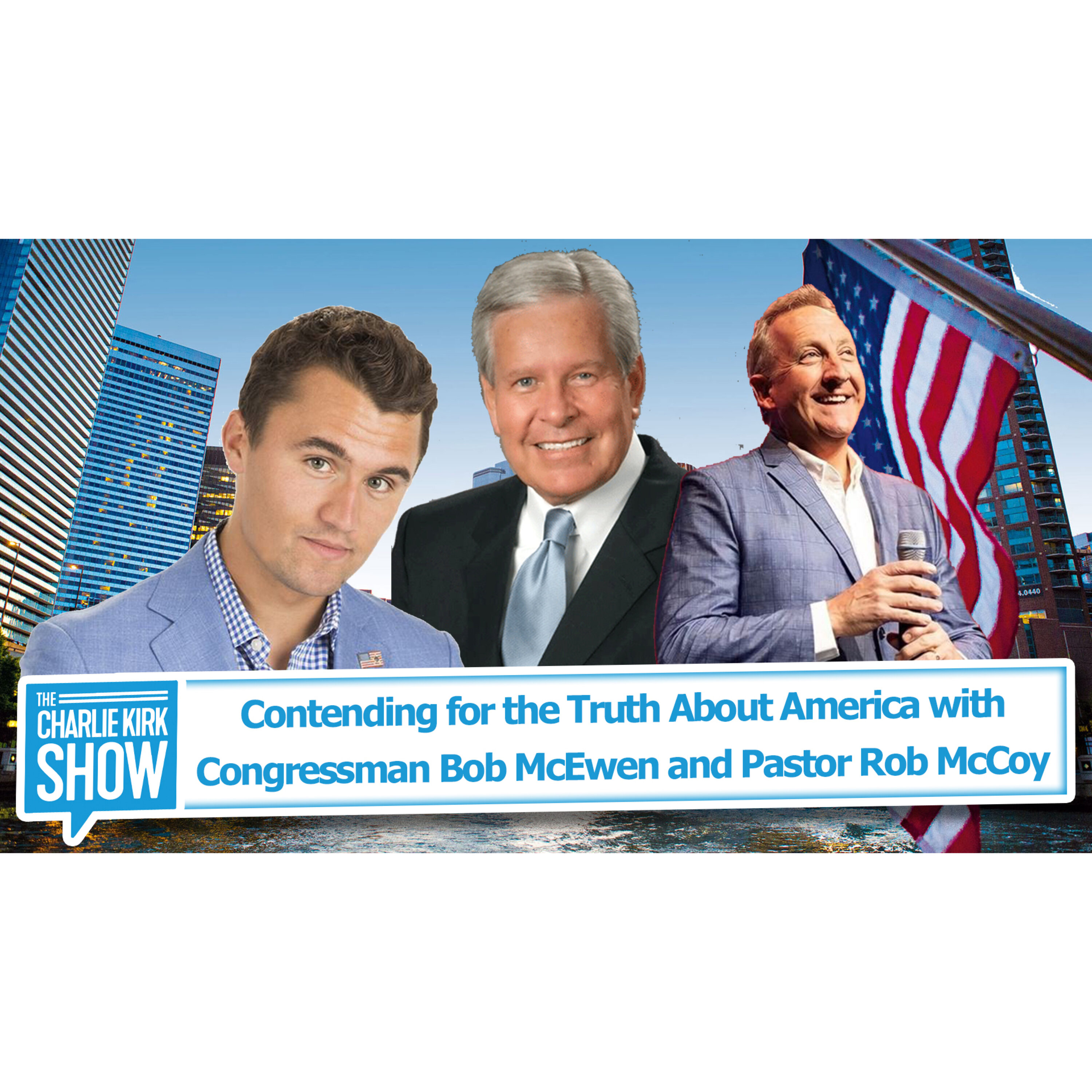
The Charlie Kirk Show
Contending for the Truth About America with Congressman Bob McEwen and Pastor Rob McCoy
01:03:41
Loading summary
Transcript197 lines
- [00:00]
A
Hey everybody. On this special Sunday episode of the Charlie Kirk Show, I sit down with Pastor Rob McCoy and Congressman Bob McEwen. One of the most in depth, important educational conversations around our country, the history of America and the importance to fight for it. You are going to learn a lot during this podcast because I know I learned a lot during this podcast. Type in Charlie Kirk show to your podcast provider. Hit subscribe. Give us a five star review. Please consider becoming a monthly donor of the Charlie Kirk show by going to charliekirk.comsupport. that is charliekirk.comsupport. please consider chipping in some money to help support our program so that we can remain strong and resistant from leftist boycott and divestment campaigns. Really great episode in store. Everybody buckle up. Here we go. Charlie, what you've done is incredible here.
- [00:50]
B
Maybe Charlie Kirk is on the college campus. I want you to know we are lucky to have Charlie Kirk. Charlie Kirk's running the White House fol.
- [00:59]
C
I want to thank Charlie. He's an incredible guy. His spirit, his love of this country. He's done an amazing job building one of the most powerful youth organizations ever created, Turning Point usa.
- [01:09]
A
We will not embrace the ideas that have destroyed countries, destroyed lives. And we are going to fight for freedom on campuses across the country. That's why we are here. Hey everybody. Welcome to this episode of the Charlie Kirk Show. With us today are two incredible men back based on popular demand, Congressman Bob McEwen. Bob McEwen speaking.
- [01:32]
B
Charlie, great to be with you. Great to be back.
- [01:34]
A
And my pastor, Rob McCoy.
- [01:36]
C
Hey, Charlie.
- [01:37]
A
Lot going on in the world and I know there's some things you guys want to touch on. Last time we chatted was many months ago. And I have to say, Bob, you gave one of the best defenses of the founding of America and this kind of rejection of the lie of systemic racism. You did wonderfully. We were chatting over lunch about this idea of corporate wokeism. Let's start there and wherever it leads us.
- [01:59]
B
Well, let's go back to what you just mentioned about the founding of America. The President of the United States, Donald Trump, saw where there was an effort to say things that simply aren't true. When a person comes up to you and says something that's totally bizarre, we tend to just dismiss it. And so when these folks at New York Times came along and said, you know, America was founded under such circumstances and they give a date that's 150 years before George Washington was even born, our natural thought is just, that's absurd. And you move on. But as they were successful in the 1619 project to begin to teach that America was formed, they literally used the word the United States. Of course, the United States didn't exist at all at that time. They began to teach the children. The President Donald Trump created a thing called the 1776 Commission. Why? Because America was born on July 4, 1776. And I was fortunate enough to be appointed as a Commissioner to the 1776 Commission. When a president is sworn in, it's in the Constitution at noon on January 20th and then they have the parade, they have a luncheon, they have a parade and then they have the inaugural ball and then they go in the next day at 9 o' clock and get their picture taken. As the first day of being President of the United States, Joe Biden could not wait until dinner at 5:30 in the afternoon. Just five hours after being sworn in, he abolished the 1776 Commission. One of the most important things to be done was to go back to trying to convince people that America was born 150 years before it was actually born. And it's very sad, but it gets back to what you.
- [03:32]
A
What's their motivation, Bob, why 1619? And is there any truth to this idea that we have colonial roots to the founding of America?
- [03:40]
B
No. People had talked and began to pray as they began to read the scriptures. They began to after the creation of the Geneva Bible. And they saw that God had made man and it's not because of his bloodline or how much tribe that he belonged to or how much land that he owned, but because God made them that he had individual rights. And that began to change. Then you see an explosion thereafter in arts and culture and Bach and Beethoven and Mozart and Shakespeare. And you see all these things then they begin in 1776. You see also the free enterprise system where no longer are you tied to a river or to land, but through the quality of your mind you can create a new product and a good service and wealth begins to explode. The nexus for all of that was the United States of America said we hold these truths and nail them down. That God gave individual those rights. Everything before that is virtually the same. And when it came to slavery, where people just part of a group and you could control people, that slavery was prior to 1776 universal or ubiquitous. After 1776 it was anathema. And that group of men that signed that document are the ones that changed the world for all time. And people still bristle at that.
- [04:55]
A
So what, how should we treat colonial history then? This is something that some I think, well, meaning conservatives ask, they say if the 1619 project is flawed, then should we forget Roger Williams and George Whitfield and Jonathan Edwards?
- [05:09]
B
And those were people that came to start, that came for religious freedom back under the old colonial system. When those people landed, there were Africans that captured other Africans and sold them into slavery. In the 1619 project, it was a black African that sold to a black African purchaser. That was the first transaction in 1619. And of course it had nothing to do with America. But Roger Williams and these other folks came to America for independence with the Mayflower Compact.
- [05:36]
C
Religious freedom.
- [05:38]
B
They came for religious freedom to become what God had made them to be. And of course, each one of the states was founded on that principle. They had to collectively join together, often over slavery, that every time they tried to get rid of slavery prior to America being born, the king had the power to veto it. And that was one of the real motivating factors to put a stop to it.
- [05:59]
C
And many of the founders started Bible societies. They were committed to the scriptures. Though they were all born in a slave culture, they were committed to removing slavery from the face of the earth.
- [06:11]
A
And every state north of Maryland abolished slavery by the time of the founding. Nine states by the ratification of the Constitution, 1787. I guess my question is that if we say that America's founding was absolutely on July 4th, how do we deal with the decades that led up to it? And that's a question that the 1619 people are able to get into schools because they say there was all of this complicated colonial history that kids aren't being learned by being taught. Is there any truth to that?
- [06:42]
C
No. Matter of fact, a good guest to have on your program would be Bill Federer. As you go through even how the. With the Mayflower Compact and how they were blown off course and where they landed outside the King's jurisdiction, they had to establish their own self rule. So this was the first political compact the Mayfield.
- [07:01]
A
I know, but. But that's what they want to teach. Okay, so the point is that if we started in 1776, then should we talk about colonial times? That's the argument of the New York Times, right? Yeah.
- [07:13]
B
Well, Spain controlled Florida and I suppose that's all part of. Part of history. But there was a momentous time that an explosion that took place.
- [07:22]
A
No, I know, but the 1619 Project wants us to talk talk about that.
- [07:26]
C
I have no problem.
- [07:27]
A
What's our problem with the 1619?
- [07:29]
B
Well, they want to say that that's what America was born.
- [07:31]
A
Why not? How wasn't it though? I'm playing devil's advocate because this is school board. People don't know how to respond to this.
- [07:36]
B
Yeah, that's when people came here. But as they studied the word of God, they studied what rights were correct and where rights came from. That's where they banded together and said, we're going to start a new day. So what happened before that? And of course the irony of the whole thing is the 1619 Project says that slavery is so wonderful now. Remember, their people were dedicated to it, fought a war to preserve it and all they said that slavery was so wonderful that because there was slavery 100 years before America was born, that's why this nation, 4% of the population of the world, creates nearly a third of all the goods and services. That slavery is what shot it to the moon. The absurdity of that is just difficult to grasp.
- [08:12]
A
It is a pro slavery economic argument. I just think we have to also be very clear that there was a colonial tradition that actually did not totally embrace slavery the way that the some of the historians said it was a much more mixed. I see what you cultural landscape. Right. Because some of the 1619 push. The way they get it into these schools is they prey on the misunderstanding of colonial history. They say, hey, we need to teach people about the 1680s, 90s and early 17. I don't think we should be afraid of that.
- [08:39]
C
No.
- [08:39]
A
And I just think the biggest problem, the 1619 project, they don't use original source documents. They misunderstand the founders. And the biggest issue is not the year 1619. They. Their big argument, and I've read all their garbage, is they say that 1776 was about a defense of slavery. That's their big argument. It's not about the idea of going back to 1619. Right. Which I actually, I'm cool with talking about the Mayflower Compact. I'm talking, I'm cool about talking about, you know, I think it's like 170 something families. Whatever it is, you would know the number where they kind of just say, hey, we're in the middle of the Atlantic and we have to figure out how to govern ourselves if we survive this thing. The problem I have is all of a sudden they're indicting the American founding and they're saying, no, no, no, no. They're harboring the same evil that happened in 1619. I just want to make that clear that we can't throw out colonial history. I think it's a big part of who we are.
- [09:27]
C
The clarity of very good the clarity of colonial history, if done correctly, not with revisionism like they do, totally would completely support the founding of this nation for the purpose of freedom.
- [09:36]
A
Who is that one guy you mentioned that you did a deep study on? It was either it was John Adams pastor or something.
- [09:41]
C
Oh, Jonathan Mayhew.
- [09:43]
A
Yes. Tell us about him.
- [09:44]
C
Well, so Jonathan Mayhew, he actually died in 1766. And when confronting especially the king who was facilitating slavery in the colonies, even though the colonists didn't want that, it was the pastoral class that started to instruct and educate the founders. And so Jonathan Mayhew folks said, this is sedition. You can't go against the king. And they would cite Romans 13. And so Jonathan Mayhew did a sermon on Romans 13, an exegetical work, where it says that God appoints all positions of authority and they're there for our good and we're to submit to them. And Jonathan Mayhew pointed out that if that authority isn't doing good, they're no longer the authority. It's not unlimited submission. And he coined the term disobedience. To disobedience to tyrants is obedience to God. John Adams said that sermon, and that minister was the inspiration for the War of Independence.
- [10:49]
A
And he died in 1766.
- [10:51]
C
1766, before we had a constitutional republic that now declares the authority in America as we the people. And so when you look at Romans 13, where God appoints all positions of authority in a constitutional republic, that authority is the people, and those who govern govern by our consent. And they're bound by the seven articles of the Constitution. And if they fail to obey the oath of office, our birth certificate says it's our right and our duty to remove them.
- [11:18]
A
Yes, and Nikole Hannah Jones types, the 1619 Project people, they totally whitewash history throughout the 30s, 40s and 50s and the 1700s of this idea of how big of a deal it is to recognize that slavery is wrong from our 2021 eyes, that's a hard thing for us to process. But the fact we made any movement on the topic was something that mankind had never seen before, that this was. That was an evil, that we have to stop it, regardless of any sort of economic stimulus it has, which I'm with you. I think slavery. Thomas Jefferson wrote extensively about, not necessarily that slavery was wrong for the slave. He wrote about that. You know who he said slavery was wrong for the slave owner. He said it creates lazy, selfish, evil and despotic tyrants. He wrote extensively about it. And that's true. I think Slavery is bad for everyone.
- [12:07]
B
Exactly.
- [12:08]
A
And this whole idea of the moment, the 1776 I think was the moment, but the buildup was this multi decades of beautiful rich sermons and courageous truth tellers that culminated in that summer of 1776.
- [12:24]
C
If you look at history and give it an honest assessment, and you see the Protestant Reformation and you see, as Bob pointed out, the Geneva Bible where.
- [12:34]
A
Tell us about the significance of that.
- [12:35]
C
So the Geneva Bible was put together and it was no different than the King James Bible. They still use the original manuscripts. The only difference is in the Geneva Bible, on the side of each page were notes and each of these notes had commentary on civil government. And, and they, they did extensive work on self governance. Wow. And they listed that. And so when you see in that painting in the, in the Capitol rotunda where they're holding out a Bible, it's the Geneva Bible. This is what inspired them for self coming to Switzerland.
- [13:11]
B
Yeah, yeah.
- [13:12]
A
I'm just, I'm curious.
- [13:12]
B
When Bloody Mary came in and she began to reimpose onto the church, who
- [13:17]
A
was Bloody Mary in Scotland?
- [13:17]
B
She was. She took over after Elizabeth.
- [13:20]
A
Okay.
- [13:20]
B
And began to impose. What year was this, the church of? Well, It'd be late 1500s or early 1600s. And she wanted to take over the church. And so when you rebel, as Rob said, when you rebel against the church, that's called, that's called sedition or heresy, treason. And so they kill you to death. And so these Knox and Calvin and all these people left and went down to Geneva. They left Scotland and while they're sitting around the Starbucks in Geneva with nothing to do now, this is where you understand divine intervention. They said, why don't we take the scriptures and put them into modern English and translate them. They said, well good, let's do that. So they started doing it. And Calvin said, why don't we number the verses? So prior to that there was no John 3:16. Until they did it now it was
- [14:10]
A
just all the way.
- [14:10]
B
It was, it was just manuscripts. And so when they got this Bible together and then, as Rabbi Lapin points out is better than anyone is, you can follow where that Bible goes. And that's where you see this again. Explosion in invention and creation and art and literature and all these kinds of things. Then it gets up to poor James, he's jealous because the people recognize we don't have to go to some city on the Caribbean. What we do, we go directly to God. And so that created a reformation of we go directly to God. And James begins, oh, it's Just a matter of time. We're not going to have to go through the kings divine right of kings. They're going to see that too. And so he took the Geneva Bible and got the King James authorized version. So he got rid of the comments.
- [14:56]
A
That was up before he killed Tyndale or after.
- [15:01]
C
Well, it would have been right around the same time. It would have been after because he
- [15:05]
A
killed tyndale in like 1603 or something.
- [15:07]
B
Yeah, well, and he wasn't there that long. But then those people, then they made a covenant that we have no king but Jesus. And that's where.
- [15:15]
C
And then you have Samuel Rutherford wrote a pamphlet called Lex Rex where the king was saying that he's the head of the church. And Samuel Rutherford said no, when the king enters the church, he's subject to Christ like everyone else is. Christ is the head of the church. And that was revolutionary. That was the Scottish Covenanters and that pamphlet, Lex Rex was instrumental. And it was guys like John Knox and these folks that put together self governance by looking at the scriptures and the idea of a constitutional republic. It didn't start in Rome, it didn't start in Greece. It started in the wilderness with the Jews, three to five million slaves. And the republic was when Jethro said to Moses, appoint godly men who are not covetous, who love the law. Over thousands, hundreds, 50s, tens. So you have representative government and then the Constitution, this immovable structure that would guide them, this moral law was the decalogue, the Ten Commandments. And from that came the civil law. And they lived together for 40 years without a police force or a standing army because they were accountable to God and accountable to each other. And so the founders sought to put something like this together, as did these Scottish Covenanters. It was brilliant. And you follow that back and you do an honest assessment of history, you'll see that they're contending with colonialism, they're contending with all these issues.
- [16:39]
A
So Bob, the. And I hope you don't mind us diving into this. I think it's fun. The kids are taught founders love slavery. They embraced it, or they were quietly passively supportive of it at the very least because of the three fifths clause and the Fugitive Slave Act. Why is there more to the story there, three fifths?
- [16:56]
B
Because those that didn't want slavery and just say during that same time is when they were putting the constitution together in 1787, they're operating under, under the, the Articles of Confederation, the Congress and the Articles of Confederation hadn't paid the soldiers and so they created this Northwest Territory, Illinois, Ohio, Wisconsin. But they said that when we give these soldiers, we don't have any money for them, so we're going to give them land grants. But in that Northwest Territory, there can be no slavery. Article six, unanimously, that's Article six. So everybody's thinking there, okay, this is going to be a dilemma. And so how are we going to work our way through this? Because there were people who said, we cannot have this as slavery. And so the south said, well, we want to. Some of those that want to preserve slavery, we want to be able to count our slaves as people. And he said, well, that's fine. That's wonderful. Good. We'll call them citizens and they'll be allowed to vote. Well, no, we're not sure about that. And so. Well, and so they didn't. The south didn't want to give them any recognition at all. And the north said, well, if we want to give them 100% recognition, we want them to be counted as 100% and they can vote. And so the compromise was in the medium was that they wouldn't be able to vote and that they would be counted as three fifths for a while. Now, here's the point. The question was not whether or not there would be slavery in the United States. In the south, the question was whether there will be a United States of America. That was the question. And so the effort that they had to make these compromises to get over the hump, to do something that nobody ever done in all of history, and these marvelous, marvelous compromises were made so that this great nation could then lead the world to freedom.
- [18:25]
A
Well, and also just to add, the south did not want blacks or slaves to be able to vote. They wanted them for a headcount so that they could representation in the population, that white men could vote with a heavier representation, buckets that they could dominate the country.
- [18:40]
B
Correct.
- [18:41]
A
They never actually wanted blacks to vote. That's correct. They were afraid of that.
- [18:44]
B
They wanted zero and the north wanted 100%. And that's where they compromised at three fifths, as they'll be counting towards, so that the south cannot overwhelm the Congress by always having and being able to just bring more people.
- [18:56]
A
Well, the south wanted the count. They didn't want the vote, meaning they wanted the census to count them, but they wanted them not to be disenfranchised
- [19:03]
C
because in the lower house, they wanted a greater representation in the House of Representatives.
- [19:07]
B
That's right.
- [19:08]
A
So that they could make slavery permanent.
- [19:09]
C
They could make slavery Permanent.
- [19:10]
B
And so the three fifths was an effort to make it ultimately so that they got to 100%, which they ultimately did.
- [19:16]
C
Now, keep in mind, the reason why there was a compromise is in 1787, you're contending with the threat of Great Britain, the superpower on the face of the earth that had just defeated the second greatest superpower, France, an imminent war where they're not going to settle with this upstart nation. And they've got to come together. And so they have to figure out how do we unify in order to face a greater threat. Otherwise there won't be a discussion, there won't be freedom. And so it was a three fifths compromise.
- [19:48]
B
And what's marvelous, Charlie, is when people say, you know, when in the Constitution people like me were only counted as three fifths, well, where were you counted as 100% or where did you vote? Well, when the Constitution was passed, women couldn't vote. Where could women vote? The answer is no place ever. So this is the beginning. As we begin to move out of the harbor to get to the place where we are now is they're criticized because we didn't jump that far. But they were the ones, the people that still think that way, they're still thinking the ways of race. They're the ones that never want to move down this path at all.
- [20:18]
C
They're the party of slavery.
- [20:19]
B
They're the party of slavery. They're the party of the kkk. They're the party of Jim Crow. They're the party that says, as mayor of Chicago, I will not talk to white people. I will not take questions from white report. They're the ones that are constantly trying to establish the race. God is so disinterested in all that. God looks at the heart. That's what America always stood for, was for the character. And the opposition to America are people who want to talk to you about skin color and not about character.
- [20:48]
A
And the fracturing really began and was something that we were actually on the path to abolishing slavery. Naturally, it had its own downward trajectory. Vermont did it in 1777. Naturally. Nine states, as I mentioned, by the ratification of the Constitution. First ever anti slavery convention was in 1775 in Philadelphia, overseen by Benjamin Franklin. There was all this movement and Bill of Rights were a timeless, eternal document. And then a man came up with the mixture of a new type of cotton, cotton gin and an insidious ideology. Yeah, well, his name is John C.
- [21:25]
C
Calhoun, who was no Eli Whitney with cotton gin.
- [21:28]
A
That's right. But John C. Calhoun was where everything changed.
- [21:30]
C
He's got. Bob do that insight you have on John C. Calhoun and how Jackson just.
- [21:37]
A
He was the vice president for both Jackson and Quincy Adams. I'm not mistaken.
- [21:40]
B
Maybe that's correct. Yeah, both of them. But the main thing about all of that, I think that needs to be made, is that no one had ever done any of this before. So the idea of criticizing America because it's only halfway to first base, everybody else is back in the day, it's like saying.
- [21:56]
A
It's like, you know those Wright brothers, that plane couldn't fly coast to coast. Awful.
- [22:00]
B
Absolutely. It never went as high as the trees. My goodness. Yeah.
- [22:05]
A
How dare they.
- [22:06]
B
That's perfect. That's exactly right. That's exactly right. People who couldn't make a paper airplane are criticizing these people going around here who have produced absolutely nothing are criticizing these marvelous people who sacrifice. Sacrifice their lives, their fortunes and their sacred honor to have, As I said, 4% of the population of the world creates a third of the world's goods and services.
- [22:25]
C
Since our founders had instilled in the documents themselves the abolition of slavery, how is it that Andrew Jackson and John C. Calhoun revived this nefarious and evil industry? What were the shenanigans?
- [22:44]
B
Well, it was quarantined, first of all. You couldn't bring any more in under the Constitution.
- [22:48]
C
So it was going to die out
- [22:49]
A
on a Sunday, 1807.
- [22:50]
B
Thomas Jefferson signed the moratorium in March of 1807. It could not take effect until January 1st. But rather they wanted it done. They wanted to know the first moment that it could be done in America. Slavery, importation of slaves. So the first nation to abolish the slave trade. So now it's going to atrophy and go away. But then they came in with a compromise. And the great compromiser, which he's known as, and that is to bring in a new slave state and begin to expand it. And the purpose of that was so that you would have senators and you would be able to preserve this horrible institution. The big fight was in 1824. John Quincy Adams won that. But then the folks from west of the Mississippi, west of the Alleghenies, they were fighting for the chance. And the Democrat, the modern Democrat party under Andrew Jackson, began the march. A genuine slave trader. Not any of the founders up until that time, Washington, Adams, Jefferson, Madison, Monroe and John Quincy Adams, they were all anti slavery. John Quincy Adams, or perhaps no one ever in the history of the United States has been more history of the world. That was More anti slavery than John Quincy.
- [23:57]
A
He went back to Congress just for that crusade after he lost one term,
- [24:00]
B
introduced a bill every day to abolish slavery and Congress established the Adams rule. And the Adams rule is you can only introduce a bill once. Once it's there, we got it. You don't need to do it tomorrow. We'll just read the one from yesterday. And so he did it because he hated slavery. And when he collaps on the floor of the House and was carried off to a corner to ultimately die, one of the pallbearers was a congressman from Illinois. Sitting two rows behind him was Abraham Lincoln, who carried on his legacy to the point that finally it had to be abolished. But those people who are today look at skin color. Those people still wanted to preserve it, but they lost.
- [24:34]
A
So if you read Calhoun, which I've done a lot, he was brilliant guy, there's no doubt. I mean, he was a treacherous guy. Was definitely a defender of slavery. Wasn't wrong about everything. He wrote a lot about the family, a lot about order, a lot about custom. But he believed he had a total philosophical difference than the founders. He thought liberty had to be earned. He thought that liberty was something that you were not born with. It's not a right, he says, that you have to check a certain amount of boxes. And therefore we have a skin color hierarchy. And the blacks, because they're owned by us, means they can't get to liberty. And he wrote rather persuasively, you're not allowed to say this nowadays, but I say it just. If you just look at it objectively for the time where he then connected a somewhat persuasive argument for a group of people that was still wrestling with these ideas, with the economic lust that slavery was able to show because of the cotton gin and the new form of cotton that came across. But John C. Calhoun was really the guy that caused the American Civil War more than anything else. He was the guy that just really. He led into a lot of, I think, the Southern entrenchment when it came to slavery. It was a decaying cause. It was not something that. It was a fringe thing by the 1810s. And then you have Jackson, who kind of revived it, but the, the cotton gin and John C. Calhoun in particular. And Calhoun did not see eye to eye with his own president, John Quincy Adams on this. I mean, they hated each other.
- [25:56]
B
Yes, that's great.
- [25:57]
A
And that was the beginning of the fraction of the, of the American republic as we know it.
- [26:01]
B
That's why we love listening to You, Charlie.
- [26:03]
A
Oh, geez.
- [26:05]
B
I. I didn't know all of that about John C. Calhoun. And you stimulate me, and I'm sure others.
- [26:09]
A
Well, he was a historicist, too. He was a historicist before that was even a term. And so the attention of the American experiment is this idea of historicism, which is rooted in Hegel, which is that we are all inevitably going towards some utopia, that everything has a thesis and a synthesis and a thesis, and that we're marching through this thing in time. Those of us that are Christians totally reject this.
- [26:33]
B
Yeah.
- [26:33]
A
Like, hold on a second. We're not going towards some sort of ultimate output here.
- [26:38]
C
Tower of Babel.
- [26:39]
A
No, we totally reject it. And Calhoun is. I mean, I say there are. There are nine words that every school teacher should know. John C. Calhoun, Nathan Bedford Forrest, and Nikole Hannah Jones. Because they're all the same. Yep, exactly. John C. Calhoun was the founder of the skin color movement. Again, I want to make this clear. He was brilliant on some things. I think we throw out the baby with the bathwater and some of this stuff, because some of it's actually really, really good. With that being said, I think he had an evil heart when it came to the ownership of other people. I just want to make that clear because there are some Calhoun defenders out there, and they just trim around the edges. He was evil when it came to slavery. Nathan Bedford Forrest was the founder of the kkk. You know a lot about Nathan Bedford Forrest. Nathan Bedford Forrest screened the first ever movie in the White House of Woodrow Wilson, Birth of a Nation. It's the first ever movie shown Democrat on Democrat. And then Nikola Hannah Jones. Nikola Jones is carrying that tradition forward. Only difference is that it's a different skin color that they think deserves to be punished and put into oblivion.
- [27:39]
B
The two of them wanted to preserve an old order, and the third one wants to do away with the entire nation.
- [27:47]
A
And that is the historicist part of it. She believes that everything before me has been a problem, and we must keep on changing things for changing's sake.
- [27:55]
B
Yeah.
- [27:58]
A
If only young people heard all this history, right?
- [28:01]
B
Well, Winston Churchill, of course, is.
- [28:04]
A
He's my guy.
- [28:04]
B
Well, he was a special man. And a young fellow said to him one time, he said, how do I prepare for government if I wanted to have a life of government service? And he said, study history. Study history, Study history. For in it you will find all of the secrets of statecraft.
- [28:21]
A
That's right.
- [28:22]
B
If you look what's happening at the border at this very moment, if you look at what's Happening to our currency, printing more money in the first four months of the Biden administration than we have for an entire budget for the entire country ever in the history of the country. When you see what's going to happen to our dollar, when you see what's happened to the border, when you see what's happening, it's all there. It's all historic. It's not new. If you've studied history, you can see it happen.
- [28:48]
C
When I was studying history at Fresno State, I'm not the sharpest knife in the drawer, but I enjoyed the topic. It became my major. And one of the things that caused me to really just attach myself to it was when I saw the word where his story and I see this redemptive thread, at least from my worldview of these things that occur. And so, Charlie, when you're bringing up our colonial history and we go all the way back to the Reformation, we go all the way back to, you know, even into the wilderness and further back, you see this redemptive hand of God trying to set man free. And then you see the sin nature of man trying to enslave him. And those are the two contending forces. And for me, looking at history, I'm always looking at those things. Granted, as you point out, you don't throw everything out. It's like eating a whole chicken. You eat the meat, spit out the bones. But there are characters of history that we glean from that allow us to understand exactly what he wants to do and what we're to do going forward.
- [29:58]
B
And one of the most important things I think, to learn is that the United States, in my study of history, never in the history of mankind has a nation become the premier nation on Earth. But what it didn't seek it, it knew what it had to do to get there, and it knew what it had to do to stay there. With the single exception of the United States of America. After World War II, when the entire world was at its feet, it did not ask for leadership, didn't pursue it, and had it thrust upon it, and
- [30:21]
C
in my opinion, and conquered lands that it didn't keep.
- [30:24]
B
Never has a nation pledged blood and sacrifice and treasure for the benefit of another and never asked anything in return.
- [30:35]
C
Well, enough ground to bury our dead,
- [30:37]
B
with the single exception of the United States of America. I was speaking to the Parliament in Seoul, Korea. I was on the Veterans Affairs Committee. And by that World War II passing through now, there are lots of veterans from the Korean War. And I pointed out to them in all of my encounters with Them, of all the things that they bear in their body, lost over 50,000 dead, etc. I have never met a Korean veteran yet who has ever complained about or regretted his sacrifice for their freedom to make that nation that was third from the bottom in wealth to now the 10th richest nation on earth only so that they could be free. No other nation has ever done that other than America. And let me continue on for a moment, if I may, and that is, America has become the standard for righteousness in the world. And so the reason that we send the fleets between Taiwan and China every year is for freedom of passage because we want to guarantee that the world is free. Now, if there is no United States of America, if there is nobody to appeal, then when that tanker belongs to the British and Straits of Hormuz is attacked by Iran, there's no place else to appeal. And so the chaos and collapse that would take place in all the areas of copyrights and inventions and communications and travel and all, all of that would apart if America is not strong. So when we see what's happening to America at this moment from within, it's an effort to allow power, not righteousness, but power to control the Pacific, the control the Straits of Hormuz, et cetera.
- [32:02]
C
When you look at a satellite picture at night of the Korean Peninsula, the North is completely dark and the south is lit up with industry. And here we have veterans that contended and, and obviously they had a peace agreement where they drew the line. But you pointed out that most of the arable land, arable land, 75% of
- [32:22]
B
the arable land is in North.
- [32:23]
C
Describe how, how you have two separate governments and why one is decimated and the other is flourishing.
- [32:29]
B
Well, I majored in economics and, and they explained that the reason some countries are rich and some countries are poor because some are more aggressive and some are have natural resources and others have temperate climates, etc. And so I appreciate east and West Germany, same heritage, culture, climate, language. One has socialism. And when the wall came down, 17 times higher standard of living than under communism. North and South Korea, same heritage, culture, climate, language. North Korea got socialism after World War. After the Korean War, South Korea got freedom 25% of the arable land, mountains and all the refugees and went from third to the bottom to 10 from the top. North Korea, same heritage, culture, climate, language is now over the last decade, 10%, 6 million people, 10% of the population of North Korea in the last decade starved to death. As you know, food, clothing and shelter, the first thing you do is food. Then Clothing, then shelter, but they can't even feed themselves. They eat sticks and leaves to fill up their stomachs. Socialism only fails every time. And the significance of people trying to say about race and the rich and poor, it's freedom that creates the wealth and it's not the skin color or the slavery that took place 250 years ago, or take some poor little six year old boy and he's supposed to be responsible for something that happened. It has none of that. That is evil. And that's what happens when you abandon God. Then you cannibalize each other and you go by tribe. And when you go by tribe, it's whoever the strongest tribe is. And I like to use the example of our daughter went to Rwanda. 80% of the people are Hutu. 20% are Tutsi. 80% voted to kill the 20%. That's what man does without God. The significance of America is that our rights don't come from the land, they don't come from our skin color, they don't come from our tribe. They come from the same God.
- [34:19]
A
You said Joe Biden was struggling to
- [34:20]
B
say that in the press conference. He was trying to explain about America in his meeting with Putin. And he said that our rights didn't come from, from a power, it came from. And then he stumbled around, but he said we were born with them. He didn't say they came from God.
- [34:40]
A
That's almost natural rights. I have to say, he's almost getting back into lock. Calhoun disagreed. Calhoun thought that we are all creatures of the government and the state and your rights are administered to you based on whether or not you deserve them.
- [34:53]
B
Well, Joe Biden just said today that our rights don't come from the state.
- [35:00]
A
I don't know if he meant it or not, but I'll take it regardless of who says it. I don't know if he meant it
- [35:04]
C
or even if he remembered it.
- [35:05]
A
Yeah, that would be a question. You mentioned chaos on the southern border.
- [35:09]
B
Yeah.
- [35:09]
A
So, Rob, isn't it our moral obligation as Christians to let in every single person from Honduras?
- [35:15]
C
No.
- [35:15]
A
Why? I thought we're supposed to love our neighbor.
- [35:19]
C
We do.
- [35:19]
A
Okay.
- [35:20]
B
Yeah.
- [35:21]
C
And open borders and unconditional love are not found in the Bible. When you look at different verses in the scripture and I have a couple of them here. Let me just see if I can. This is one that is continually used by the WOKE church that says that we're to have open borders. It's the Christian thing to do. It's out of Leviticus 10. And if a stranger dwells with you in your land. You shall not mistreat him. The stranger who dwells among you shall be to you as one born among you, and you shall love him as yourself. For you were strangers in the land of Egypt. I am the Lord your God. And then there's other passages where you see the word stranger used. Isaiah 17, your country is desolate, your cities are burned with fire. Strangers devour your land in your presence, and it is desolate as overthrown by strangers. And the idea is there's two words. There's, I think it's zur and ger. And these two words are totally different when interpreting in the Hebrew as what stranger is everywhere in the Scriptures. When you look at the original language, the word stranger is somebody who is willing to assimilate or abide by the laws of the land. In relation to Isaiah 1:7, it's Zer. Excuse me, it's. It's zur. That word means someone who is an enemy, who comes and has no agreement with your compact, with your constitution, with what you have agreed, defines you as a nation. And then people say, well, there's no boundaries. The Book of Acts points out that God made us all of one blood. There's one race, the human race, but he appointed boundaries. So there's different countries and boundaries and ethnicities, but there is one race. And so boundaries are borders, compacts, constitution ideology, contending for freedom. So you wouldn't have an open border any more than you would have an open door at your house. You control who comes in and what happens in your home, as you would what happens in your city, your county, your state and your nation. And then in addition, an open border is the unchristian thing to do because it's enticement. I will get arrested or I will be fined or prosecuted if I leave my back gate open and the three year old neighbor next door wanders in and drowns in, let's say I have a pool. I would be held liable for that because I enticed them. Well, with that enticement, we have sex trafficking, human trafficking, drugs, and there is no controls. And we're thrusting that onto a population that we're supposed to, Based on Romans 13, we're supposed to protect. So no, it's not the Christian thing to do. It's the exact opposite.
- [38:30]
B
I may say that in order to have wealth, if we care about the condition of people, there has to be ordered liberty. And if there's disorder, then there can be no liberty. There can therefore be no wealth. And as rob Just said when you leave your house for two weeks, you lock it. Why? Not to keep out your neighbors. Chances are your neighbors have a key to it. You don't mind them or your family. Who do you want? Not one in your house. You don't want the drug addict coming in there building a bonfire in your living room. Now, that's why you lock your house when you go off and leave it. It's the same way with a border. You have a border there to allow people in that you want to come in. But as I just spent two days on the border. Listen, I spent two days on the border last week and talking to the Border Patrol. And they had over 200 meetings during the transition of the Biden election to the Biden being sworn in. And over 200 of these meetings explained, this is what will happen if you do this. This is what will happen if you do that. And so they took notes in order to do those things immediately. So there's lights along the border. They turned out the lights on January 21st. They haven't been turned on since. They said they told the ice, the Immigration and Custom Enforcement, they told them, you cannot arrest anyone. Well, once you can't arrest them, that's just like when de Blasio becomes mayor of New York and says, you cannot arrest a person for defecating on the sidewalk. And so they urinate on tourists when they come because they know that they're not going to be fined for it the same way for jumping the turnstile. So they gave the orders, and it went out in Facebook that these folks could. These child traffickers and these human traffickers and these drug dealers, that they could form these groups through Facebook, they would come and they would come across. And as they bring these people across, the Border Patrol agents, we got pictures of them talking to the smugglers. They're standing there in the water talking to them as they're bringing them across. And they go back and get another group and do it again, this one opening there. They have processed. They don't arrest them. They process them. They give them papers. And they've processed more people in the last 90 days than they did in the previous year. But they said they only do it for one out of three. Two others out of the three are just disappearing. But those that have the sheet of paper, they go to the airport, they don't have an id, they don't have a COVID test, and they put them on the airplane or the bus, and they send them to the red states all over America. Hundreds of Thousands of a week. City of Dayton, Ohio, every five days, just from those locations. So it's an effort to. And here's another thing that if someone does show up and they're having a struggle, what they'll take is a child and throw them in the water, or a woman and throw her in the water and she'll start to drown, knowing that the Americans will go rescue them so as the drugs can then get on through. So it's beyond evil. It's what happens when you have a disordered liberty and our country is vulnerable.
- [41:23]
C
Along those lines, one of the reasons why I added that open borders and unconditional love are not in the scriptures is we hear this term, unconditional love means without condition. God's love has conditions. For God so loved the world, the condition was he had to give his son. If he's going to be just, the wages of sin is death. So he gave his son. And that had to be the propitiation that had to pay the penalty. So that came with a condition. And then the condition for the receiver he gave a gift must be received and believed. And my point is this. Love is not just, hey, do as you please. The Lord chastens those he loves. If you raise children in that capacity, it's a mess. You're not a parent, you're not setting guardrails for their life. And so it's critical that as a nation, these rules are adhered to because it's for the betterment of those who have agreed, paid their taxes and by consent allowing these folks to govern, who have sworn to defend their sovereignty, and they aren't, and they're not protecting those borders.
- [42:37]
B
These people are coming from over 100 countries. The Chinese are strongly involved, but lots of Venezuelans, though Venezuelans tend to be wealthier. The government is obviously financing them. And they're males primarily between ages 15 and 19, which are Army. And they're infiltrating our country en masse.
- [42:56]
A
And there's no moral obligation for us to open up our country to all people at all times. Both legal and illegal immigration in the history of America, the varying levels of immigration, and we are way out of whack right now. After you eat a big meal, you need time to digest it. And I mean it, both on the legal and the illegal side. And this idea that all immigration at all times is always going to benefit all people, always is an absolute lie. And you know, I talk to some people, they're like, well, we got to bring people in. No. Why? Hold on a second. What if I told you that it's deteriorating the wage conditions of your fellow countrymen? What if we are not even able to service that person, let alone the fellow communities we already have? Now, if it's all about cheap votes and cheap labor, then that's a different conversation. I'm all for allowing certain people to come into the country under certain conditions
- [43:47]
B
who want to become Americans.
- [43:49]
A
That's right.
- [43:49]
C
Well, and I would say one of the beautiful things about America with the regard of refugee, and I'm talking legitimate refugee, where their nation is at war or they're at. They're persecuted people and they come as the Jews did, seeking asylum, seeking asylum, willing to assimilate and adhere to our Constitution. Our arms are open, we're happy to have them. But to support business and get a bigger bottom line for corporate America at the expense of the citizenry. Sorry, I'm just.
- [44:26]
A
I'll give you a great example. Elon Omar. Elon Omar was a refugee. And she's never said a good thing about America.
- [44:32]
C
Never.
- [44:33]
A
And she's a member of Congress.
- [44:34]
B
She hates America.
- [44:35]
A
And that's what we're talking about. She. She should be on her hands and knees saying, you know, that would be
- [44:40]
C
a zur in the scriptures, right?
- [44:42]
A
She might say, you know, I might be a super communist or whatever, but thank goodness this country took me in. Instead, she compares us with Hamas. You think Hamas took in Ilhan Omar and Mogadishu when it was burning?
- [44:51]
B
They were offended. You saw that.
- [44:52]
A
Hamas was offended that. How dare they be compared.
- [44:55]
B
Hamas criticize her for being compared to a Jew or to a free American.
- [44:59]
A
That's a good example, though, of an immigrant type, ungrateful and not willing to assimilate.
- [45:06]
B
And the argument that just drives me up the wall is that is when Kamala Harris and all of these people say they're coming from these terrible countries. Why are those countries terrible? Socialism creates poverty. In downtown Cleveland, downtown Detroit, in south la. Socialism. Socialism creates poverty. And so they're trying to escape socialism. I got it. Now, why do you want to do that to our entire country? And you just want to ask the question. Every time they say they came for, they're trying to escape for a better, better future. Of course. What is their better future? Their better future is freedom and free enterprise. So don't be trying to. You want to sell their economic system here. And you can't have it both ways. You shouldn't have it both ways. If we had a press that would ask the question, they wouldn't.
- [45:51]
A
So socialism is a Massive threat. In addition, though, there might be one even more immediate that you and I chatted about at lunch. Corporate tyranny and corporate wokeism, where the same sort of authoritarian impulse can be exercised by some private corporation that we never elected for. There's no check and balance. So the American system has a couple attributes. You know this, you know this. But just to say for our audience, again, independent judiciary, consent to the governed. Checks and balances spread over space and time. Intentionally deliberate, you know, unquestionable eternal truths, you know, delivered from by God. Corporations seem to be kind of immune to that checklist mostly. What is the check and balance against Coca Cola? What's the independent judiciary against Google? What is the consent to the governed? How are we people that respect private property, that love entrepreneurship, that love free enterprise? How are we supposed to deal with these companies that don't share our values, act like Democrat Super PACs, and seem more and more hostile towards the very ideas that we've been talking about?
- [46:49]
B
Well, that is the dilemma that we face immediately. And just to elaborate, as you said, you couldn't pass a law to say on your corporate board, you must have three people of this skin color and then three people of that skin color, and you must have two people that engage in this sexual activity if you tried to pass those laws to do that. And yet we have BlackRock and we have Morgan Stanley and we have these people are saying, unless you have so many people who engage in this sexual activity on your board, we will not loan you.
- [47:17]
A
That is exactly right.
- [47:19]
B
And that's where we need to be. Everyone needs to be involved. Everyone needs to be aware. And we need to vote the evangelical. The people that are coaching Little league and teaching Sunday school are not voting in the proportions that they should. And our responsibility is that this country, this lighthouse for the gospel, this hope for the world, is hanging by a thread. And there are those who are deliberately striving to steal it out from under us in order to change these. We talked to the people at the border. I said, all right, where are all these? He said, we have to process these through over the next couple of hours because we're going to get another 2000 coming on top of them or where are you sending them? And every state that they mentioned where they were sending them were all red states.
- [47:59]
A
Demographic displacement. And so. But, but Bob, what are we voting for? Because it seems like the Republicans are okay with these companies doing this. Some of them.
- [48:06]
B
Well, political parties and politicians are a representation of the electorate. And, and they, they are the phrase will come to me in a moment, when I think about it, is that they are representations of people that, that are electing them. And it's essential for us to make those demands. They, they will respond to what we tell them to do. And we need to be aware of how our, how our rights are being stolen. They need to help us put a stop to it.
- [48:33]
C
I would also say, too, that as Abraham Lincoln said, what's taught in the classroom in this generation will guide the nation in the next. That's a paraphrase. But we've watched as our educational system has created these CEOs, and the conservative mindset is, oh, they've got this socialist teacher in their college, but once that kid gets out, he'll realize once he gets a job. And if you're not a liberal when you're young, you're heartless. If you're not a conservative when you're older, you're brainless. But the truth is, and that was a conservative position, looking at these kids who are being educated well, they graduated and now they're CEOs of Coca Cola, and they're in the NFL and the NBA and the MLB and, and they're in the halls of Congress and they've been educated this way and they're implementing that. So it's a long game here, Charlie. There needs to be a complete re educating of our children and returning it to the parents where we don't entrust them to, especially in California, the cta, the California Teachers association, it has no interest in educating our children, but indoctrinating them.
- [49:49]
B
That's correct.
- [49:50]
C
So we really have to wake up and we need to be at those school board meetings. We must attend them. This is a government of the people, by the people, and for the people. We should be contending for the lives of these kids. And every church in America should have their congregants contending. This isn't even partisan. I'm not asking you to be a part of a party. I'm asking you to contend for the welfare of your children in your city. What is being put into their heads?
- [50:18]
A
I'm getting to the place where it comes to the corporations that if they're of a certain size or magnitude, they must be. The Bill of Rights must then apply. And they've otherwise been able to skirt and say, we're a private company, we don't have. It's a very provocative idea. It's not a perfect idea because then you're going to be imposing a lot of different oversight. But I'm Talking about a company like American Airlines. I'm talking about a company that American Airlines takes political statements. They are now doing political contributions. And I think to myself, hold on, I got delayed all the time from American. You guys got plenty of problems. God bless you guys for doing what you're doing. We bailed you out last year.
- [50:55]
B
That's correct.
- [50:55]
A
We bailed you out because you said we can't survive without the money. And their stock price is gonna be at a record high soon. Right, because that's the way this works. And then they have the audacity to come out alongside Delta Airlines and say that voter ID is not share our value because of the Georgia voting law, which was not even close to being enough that we don't share. They don't share their values. And so at some point it's either. There has to be a place where there's rules for political engagement. If you take certain types of money from federal government like Amtrak. Amtrak. Amtrak can't speak out. They're super inefficient. Not suggesting that anytime soon, but there's rules that. Amtrak can't just issue a press release saying that we have a stance on the Georgia voting law. No one cares about your Georgia voting law.
- [51:39]
B
Delta.
- [51:39]
A
That's Delta. And the point is that natural rights are worthy of being protected. And the threat to natural rights is happening through two different types of kind of, let's just say, groups. The first group is from our government. It is a leviathan. It's growing, it's creepy. But there is a check and balance against it. We can sue our government, and in certain states, you're more free than not. The second is these private companies and conservatives who are just completely unaware or uninterested in even exploring the ideas of how to hold them accountable. I'm afraid we're going to live in a Russian style corporate oligarchy. And that's a very scary set of circumstances where we're controlled by 10 companies and we really don't have the natural rights we once enjoyed because of the private companies.
- [52:24]
C
So let me see. So if a company is big enough that if it fails, the nation is going to suffer, so the government bails them out. It seems like that would be a prime opportunity to implement what you say.
- [52:41]
A
Like, I mean, so for example, the stimulus money should have been like, hey, if you take more than $100 million in this PPP, you're bound by these. Yeah, you got a political neutrality thing. Congratulations, America. No more contributions and no more statements. You're going to fly Airplanes. That's a pretty simple rule. Right. You're basically a government taxpayer funded entity. Entity. Anyway. You're an NGO at that point. American Airlines is an ngo. And the tech companies are a separate argument. That's just a great example. Another one is Hyatt. Right. So Hyatt took all this PPP money to go give JB Pritzker an extra 2 billion. Who's the governor of Illinois and a total disaster. Hyatt is the most liberal hotel chain you can imagine. Penny Pritzker gets all of her money from there. Who is the head of the Department of Commerce for Obama. Why does Hyatt get all the taxpayer funded money when all the no one was going to hotels and then they could turn around and then fund all these Democrat candidates and tell us how racist we are.
- [53:34]
C
Yeah.
- [53:35]
A
Without the taxpayers, would you have survived Hyatt? I don't know. Maybe not. And so it kind of begins this thought process of if you're going to take taxpayer fund and bailouts, there's got to be a political neutrality to it.
- [53:46]
C
I like it.
- [53:47]
B
I do too.
- [53:47]
A
Especially at a certain scale. And there's other. There's other. The tech companies are a completely separate issue. They. They're acting like tyrannical, authoritarian third world governments. And I think that, I think platform access is a civil right. That's where I'm.
- [53:59]
C
That's right.
- [54:00]
B
And you tell the President of the United States that he can't say something. Who would have ever thought such a day would come?
- [54:05]
A
And they got away with it. Their stock price went up, their users went up.
- [54:09]
B
They still learned.
- [54:10]
A
And so this whole idea of nothing but competitive pressure has not yet played out. I'm a big Rumble fan. R U m b l e.com we put everything on Rumble, but we're dealing with a different type of a company. So Ford Motor Company was very unique. They created the assembly line. We know the story. Henry Ford, a mixed guy, somewhat of a racist, but super great entrepreneur. But Ford existed so that you could get from point A to point B better and quicker. He didn't make the car to addict you to the car. These tech companies, they exist to have you be addicted to their whole. Their whole business model is more screen time. It's a different type of thing. And then you're dealing with.
- [54:53]
C
You're the product.
- [54:54]
A
Precisely. They're selling you. Henry Ford was not selling you. He was selling you a car. And so now we're dealing with different market principles always apply. With that being said, the market principle of these tech companies Is that if the market principles apply, then they're just going to get better at selling us. And that's a whole different. Then all of a sudden, they're using market principles to almost put us in some of an intellectual prison. I'm getting to a place where I think we have to rethink the way we handle these tech companies.
- [55:20]
B
And for politicians to say that the reason we gave them taxpayer money is because they're in a condition through no fault of their own. Well, whose fault was. Was your fault that you told them they couldn't run the restaurant, that they couldn't travel to a hotel? So you're the one. So in this effort to have this socialist revolution, you created the dilemma. Then you came in to fix it by taking other people's money and creating a national debt. And then they own us. So it's. The whole thing's in the mirror. But to get back to what Rob said about schools and things, we've seen this coming, Charlie, and I believe it's now here. And people are waking up left and right. They're beginning to see it. Parents are beginning to see it. People. And I put them on my comments all the time. When we see some school board member or some school doing something terrible, I always put at the top, this is what happens when people don't know who their school board members are. And for the first time ever, and I've been strongly concerned about this for the last couple of years, I see people getting involved in school board races because they hire the superintendent. It's not the teacher. They hire the superintendent. The school board does it. Then they hire the superintendent, who then hires the teacher. You and I hired the school board so that teacher is there because what you and I put on that school board and when we now are getting involved in education and as you said so well, is it's not that these kids are all socialists. They don't know squat about anything. They don't understand free enterprise. They don't understand that all wealth, all wealth is created in a free market. Socialism just redistributes what somebody else made. Socialism doesn't create anything. And that they don't know, but nobody has told them that. So now as people are beginning to become awakened, I'm very optimistic that this is what. This is the day that we have hoped and prayed for for a long time.
- [57:00]
C
Yeah. The silver lining to the lockdown is that there's been an exodus from the public school system in a larger way never before.
- [57:08]
B
And parents beginning to see what their children Were being horribly.
- [57:12]
C
And realizing that they're good teachers and they can actually teach their kids.
- [57:15]
B
Empower them. Empower, right, yeah.
- [57:17]
A
Educational revolution is underway.
- [57:19]
B
Yeah, that's the solution.
- [57:20]
A
What else are you working on, Rob?
- [57:22]
C
Well, mostly working with you, Charlie, on the turning point, faith. And watching churches across America start to realize that we have a responsibility in the ecclesia or the ecclesia, the public square. And awakening to that, that liberty is not man's idea, it's God's idea. And every church that has joined us, Charlie, has experienced exponential growth. I mean, exponential growth. And as Vodi Bachman pointed out this fault line in his book, the woke churches, and those churches that are awakening to liberty and their responsibility to declare it and defend it, those churches are growing and the woke churches are not. And people are wanting leadership in these unprecedented times. And I'm grateful that Bob's here for this reason. And I love this about this man. In some of the most difficult circumstances that I've seen in this country in 56 years. This man is an optimist. He's an optimist because he can see the 40,000 foot view and he never gives up. And this ideal in this dream of America has always inspired me and to realize the combination of his faith and as we've shared on this program, Aristotle, politics being the highest form of community, morality and sociability combining is the hope for this nation. If you don't mind, Charlie, one of the most inspiring stories, especially on leadership. And that's what we're looking for right now in this vacuum that's been created by a president that can't put a sentence together, how overnight something can change. And you shared one time, and I remember being a young boy, Jimmy Carter's president. My parents, I mean, double digit interest rates, they were struggling to make ends meet. My father was part of the military and he had decimated the military. You drive over the Coronado Bay Bridge and the Pacific Fleet was in ruins. It just looked like a mothball fleet. And there wasn't a lot of hope in the country at that point. And Carter comes on and wearing a sweater and tells everyone to turn the thermostats down. You were a congressman back then. Tell the story if you would. And because it's so inspiring about commuting From Ohio to D.C. charlie, you'll love this.
- [59:56]
B
Well, people have tried to destroy free enterprise and, and with the creative capacity, they keep going around it. So now they've begun to learn that one of the best ways to do it is to step on the oxygen hose, if you just shut it down so that they can't have electricity or heat or air conditioning. And so Jimmy came in and did that. He said, we need to learn to live with less. Ride your sweater. Ride your. Your bicycle. Wear your sweater. America's coming to an end next Tuesday a week. There isn't anybody, Anything anybody can do about it. And he shut down all of the logging and all of the drilling. And sure enough, there's a shortage of gasoline. And so people could only go on alternate days and they could only get a certain amount of gasoline. So they didn't have. They could treat you like you're on an airline Nowadays, when Nurse Ratched comes up and down the hall screaming at you for not having your mask on over your nose, it used to be that they were trying to treat you nicely. So. So if you had so much gasoline you worked for, you're only open for three, four, five hours. And, and that's. And when, When Democrats or when liberals do this, when the left does this to something, they. They never take responsibility. They say, this is the way it is. Inflation is going to explode next year. And they're going to say, well, that's just. Biden didn't have anything to do with that. Well, he. It's just the way that it was. So Jimmy did all of these things, just like Biden is doing now. And sure enough, interest rates went. Went to 21%, inflation went to 18%, gasolines were short. And they said, that's what the future is. Ronald Reagan came along and said, nonsense. He said, there's nothing wrong with this country that proper leadership can't cure. And so we had the election. Let me just say that Also during that 1980, because America was as mothballed, only one plane in three was airworthy. Only one ship in three could sail. America was on the ropes. They had a conference of African unity and now called the African Union. And the first conference, the speaker was the president of the Soviet Union, Leonid Brezhnev. And he said, this is 1980, looking to 1989. He said, because of what we, the Soviet Union, are doing, by the end of this decade, we will be able to work our will any place on the planet. The correlation of forces, economic, military and political on the side of socialism and communism. Ronald Reagan comes in and says, nothing wrong with America. Forget this nonsense. And so he took all the regulations. First of all, we all got elected November of 1980. And between November and January, when we took office, Liz and I drove back and forth six Times to Washington from southern Ohio. We knew there was not a single filling station open after 3 o' clock in the afternoon. If we didn't have a full tank of gas, we weren't going to make it home that night. And so Ronald Reagan comes in and he takes all those regulations, he opens up oil, lets you drill, do things, take all those regulations, throw them in the Potomac, kill the fish, free the country. And Liz and I are driving home for Easter and she's asleep on the front seat. I live in a place called Hillsboro, Ohio, on a hill. And as you come up, there's three filling stations in one block off the center of town. And those filling stations were all closed by three or four in the afternoon for over a year under Jimmy Carter. We come at 11 o' clock at night, all three of those filling stations are open. And I wake her up. I say, Lizzie, look said had we not won, that wouldn't have taken place. Well, we elected Donald Trump. Donald Trump said we don't need to send our money to people that hate us and tell us when we can have oil. We got enough here. Number one source of natural gas on the planet. And with a matter of 18 months, America is energy independent. And so now we've elected folks have gone back and now we're dependent again. The leadership is what makes a difference. We don't need to be to fear that the future. We just need to do the right thing and America can and will do it.
- [63:25]
A
Amen. I believe that we could turn it around.
- [63:28]
B
No, it's perfect.
- [63:29]
A
Email us your thoughts everybody.
- [63:31]
B
Freedom.
- [63:31]
A
Charliekirk.com Congressman Bob McEwen awesome. Pastor Rob McCoy thank you guys.
- [63:36]
C
Thanks Charlie.