← The Charlie Kirk Show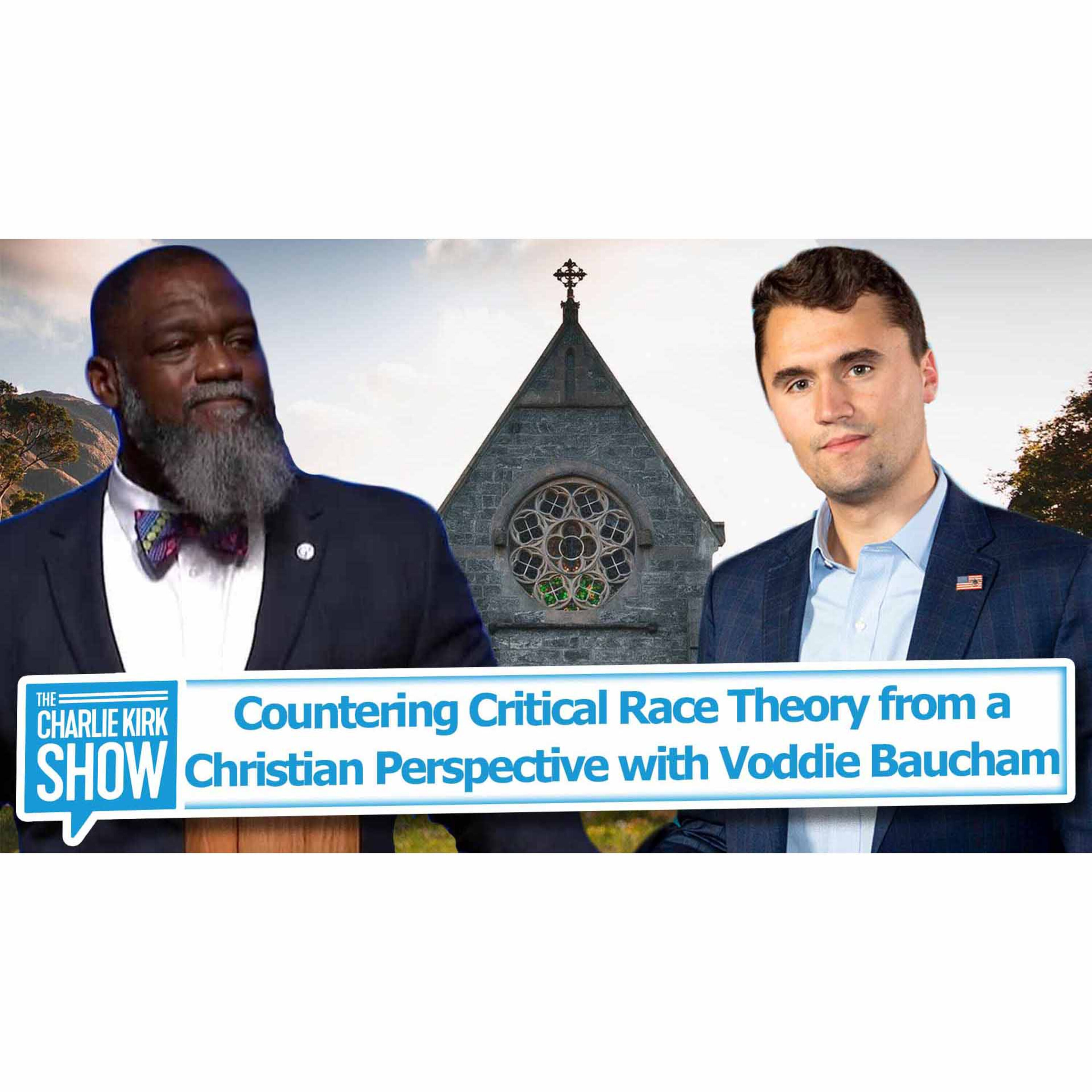
The Charlie Kirk Show
Countering Critical Race Theory from a Christian Perspective with Voddie Baucham
00:35:42
Loading summary
Transcript88 lines
- [00:00]
Charlie Kirk
Hey, everybody.
- [00:01]
Charlie Kirk (Sponsor/Ad Read)
This episode is brought to you by my friends at ExpressVPN. ExpressVPN.com Charlie Secure your device. Anonymize your online activity. Protect your action online. Expressvpn.com Charlie help our show out by also helping yourself. Protect yourself. ExpressVPN.com Charlie
- [00:27]
Charlie Kirk
hey, everybody. Today on the Charlie Kirk Show, Vodi Bauckham, author of Fault Lines. One of the best and most important conversations we've ever had on critical race theory.
- [00:37]
Charlie Kirk (Sponsor/Ad Read)
What is it?
- [00:37]
Charlie Kirk
Where does it come from? Vodi talks about the need to challenge this pernicious and evil ideology, how it's infecting our cultural institutions as well as our churches. Vodi is a black American who understands how important it is to speak out against this issue at this time. Spread this podcast with your friends, especially if you are a person of faith. If any of your friends are engaging or participating in BLM Incorporated or Critical Race Theory, this is the podcast for you. You want to support our program? Go to charliekirk.com support email us your questions. As always, freedom charliekirk.com if you want to get involved with Turning Point USA and join us in Tampa, go to tpusa.com Sas Bodie is here. Buckle up, everybody. Here we go, Charlie.
- [01:31]
Charlie Kirk (Sponsor/Ad Read)
What you've done is incredible here. Maybe Charlie Kirk is on the college campus.
- [01:35]
Voddie Baucham
I want you to know we are lucky to have Charlie Kirk. Charlie Kirk's running the White House, folks.
- [01:41]
Kelly Shackelford
I want to thank Charlie. He's an incredible guy. His spirit, his love of this country. He's done an amazing job building one of the most powerful youth organizations ever created. Created Turning Point usa.
- [01:52]
Charlie Kirk (Sponsor/Ad Read)
We will not embrace the ideas that have destroyed countries, destroyed lives. And we are going to fight for freedom on campuses across the country. That's why we are here. Charlie Kirk here, and I've warned you about home title theft, where cyber thieves remove you from your home's title and you become the owner. I said you better get home title locked because it's coming. Well, if you're on Facebook, that big breach is here. Facebook had 500 million accounts exposed to cyber thieves. And according to a retired FBI cybercrime expert, everything thieves need to take over as the new owner of your home was leaked. Name, address, personal information. It's out there. The thief forges your signature on a quit claim deed stating you sold your home to him. He'll leave you in debt or he'll even have you evicted. Do what I did and protect your home's title. With home title lock, go to hometitlelock.com and register your address to see if you're already a victim. Then Sign up for 30 free days of protection during this high risk breach. Then sign up for 30 free days of production. Again, hometitlelock.com, promo code radio. That's hometitlelock.com promo code radio.
- [02:55]
Interviewer/Host
I am here with a hero, a truth teller, a great guy, and actually, I think I just met you today, this morning, but I've known about you.
- [03:02]
Voddie Baucham
Yeah, it's the first time.
- [03:03]
Interviewer/Host
Cody Bauckham, welcome to the Charlie Kirk Show.
- [03:05]
Voddie Baucham
Thank you very much. I appreciate you having me.
- [03:07]
Interviewer/Host
Author of Fault Lines for all of you watching on Rumble R U M b l e.com the social justice movement and evangelicalism's looming catastrophe. Tell us about the book.
- [03:19]
Voddie Baucham
Yeah, it was a labor of love. A labor of love for the bride. I had been talking about these things for a while and was really concerned with what I was seeing in terms of Christians being duped by and in some cases just embracing and imbibing this critical social justice movement. And there's some books you want to write and other books you have to write. I felt like this was a book
- [03:50]
Interviewer/Host
I had to write and it's done phenomenally well. I've had hundreds of people send me your content. And so I'm so thrilled to be able to sit down with you. And you are a. You get to the point. You're a direct speaker. You don't talk in overly academic prose or dictionary. You get straight to the truth. And so this really hits home for me because so many pastors that I grew up with and grew up watching have all of a sudden decided to kind of mix into their potion of Christianity this heavy dosage of wokeness. Next thing you know, churches I used to drive by, even one here in Highland Park, Texas, has a BLM flag bigger than the American flag. Whether they should have a BLM flag or not is even more of a disturbing question. So you wrote this first and foremost to diagnose this problem. Yeah, and I love the term fault line because you're saying this could, this could really be destructive and disastrous to the church. Let's first talk about what is critical race theory. Why does it present an existential threat.
- [05:00]
Voddie Baucham
Yeah.
- [05:01]
Interviewer/Host
To the church, both domestically and globally?
- [05:04]
Voddie Baucham
Well, critical race theory comes out of critical legal studies. And again, when you hear that word critical, I try to tell people when you hear that word critical, their ears need to perk up. They're telling you something. When they use that term, critical, they're telling you that they're coming from the Frankfurt School of critical theory. They're telling you that they're applying neo Marxism. They're telling you that they're operating from an oppressor, oppressed paradigm. They're telling you that they're trying to problematize whatever it is that they're addressing so that they can bring about a revolutionary political solution to whatever that issue is, which ends in a reversal of this oppressor, oppressed paradigm. So critical race theory is one of the many applications of this sort of Ramsayan, Frankfurt School, neo Marxist ideology to the issue of race in America. It views racism as normal. It views racism as baked in to American culture and ideology. This is why, for example, the 1619 project is so important. America can't be based on those lofty ideals of the Declaration of independence in 1776 or in the Constitution ratified in 1787. It has to be somewhere else. So let's just go to 1619, you know, first slaves, you know, come over, whatever, so that we don't have to deal with those ideals which contradict the idea that America is systemically and irreparably racist. So critical race theory. Critical theory is all about viewing things through that lens. It's a world worldview.
- [06:47]
Interviewer/Host
What I love about your book is that you define your terms before you go into them. You talk about who Antonio Gramsci was.
- [06:54]
Voddie Baucham
Yeah.
- [06:54]
Interviewer/Host
You talk about his letters from prison. You talk about how Marxism went through this evolution that started as an economic theory.
- [07:01]
Voddie Baucham
Yeah.
- [07:01]
Interviewer/Host
And then came into more of a cultural prose. Talk about Herbert Marcuse. Talk about who this man was, what he believed, and then what he started here in the States.
- [07:10]
Voddie Baucham
Yeah. Marcuse and Lukac, these are the individuals that come from Germany. They give us the Frankfurt School. And you have to understand Antonio Gramsci and him in Italy under the fascist, being in prison under the fascists. They're looking at this economic idea. They see the Bolshevik revolution. They believe that Europe's going to fall like dominoes, and it doesn't. So Gramsci begins to think about why this happened. He comes up with the idea of cultural hegemony.
- [07:47]
Interviewer/Host
What does that mean?
- [07:48]
Voddie Baucham
Which is really the idea that there is an oppressive worldview that causes the oppressed to accept their oppression. And so if you want to see this revolution, you've got to deal with this hegemony, with this worldview. And the way that you do that is by controlling the robes of society. And so you control the law, you control education, you control religion. So now this sort of moves things in this cultural Direction. Then the Frankfurt School in Frankfurt, Germany. How do they influence America? Well, Hitler comes to power, World War II happens, and they come over to the United States and they start to influence places like Columbia and places like UCLA and then institutions like Hollywood, you know, and what they're doing is they're applying this Marxist ideology. And I say neo Marxist ideology because it's really Gramsci's ideology about changing the hegemony, about influencing the culture so that you upset things from within. And so Mercusa and the Frankfurt School, these individuals start really plying their trade and really thinking through and getting at the very practical issues of how you transform a culture from within through the application of Gramsci and Neil Marxism.
- [09:27]
Interviewer/Host
And then Marcuse taught Angela Davis.
- [09:30]
Voddie Baucham
Yes.
- [09:30]
Interviewer/Host
Who is actually a communist. That's not pejorative. She's a self described communist.
- [09:36]
Voddie Baucham
Yes. And that's always interesting. Is it? When somebody identifies themselves as a communist and you say they're communist, you always have to explain. No, no, she's not just calling names.
- [09:45]
Interviewer/Host
Well, that's why I said absolutely, absolutely. She calls herself and she's part of the World Communist International League. And so the issue here in our country is that this is growing with serious momentum.
- [10:02]
Voddie Baucham
Yes.
- [10:04]
Interviewer/Host
It's growing in numbers and it's growing in speed.
- [10:06]
Voddie Baucham
That's because it grew deep before it grew wide.
- [10:09]
Interviewer/Host
Explain that.
- [10:10]
Voddie Baucham
So what the Frankfurt School does is they take that long march through the institutions, right?
- [10:15]
Interviewer/Host
Yes.
- [10:16]
Voddie Baucham
So where do the 60s radicals go? They went to the institutions, specifically schools of education and journalism and political science. And then these new areas of study, often referred to as the grievance studies. Right. So queer studies, feminist studies, you know, different ethnic studies and so on and so forth. Things like critical race theory, critical pedagogy. So Paulo Freire. Right. Critical pedagogy, you know, we're using this to teach teachers.
- [10:52]
Interviewer/Host
Yes.
- [10:52]
Voddie Baucham
And so because they went deep into these institutions, they were then able to have influence broadly in the culture through these individuals who were trained and educated without even recognizing. I often say if you got a degree in education, you got a minor in, you know, neo Marxism and you didn't even get credit for it on your diploma.
- [11:15]
Interviewer/Host
That's funny.
- [11:18]
Charlie Kirk (Sponsor/Ad Read)
Hey everybody, Charlie Kirk here. Legacy box is an effortless way to have your outdated media digitally preserved on a modern format. Right now they're offering 40% off so you can ensure your memories are safe for generations. I'm literally sitting right next to a legacy box right here. And it's pretty amazing. It's easy to use, affordable, you could pack it up. All my memories are going in that box and boom. On the cloud forever. Do you want to relive the glory days? Maybe you are a high school quarterback or maybe you were a cheerleader. Maybe you have family memories that you want to preserve. We believe legacies are worthy of preservation. We believe history should not be deleted, but it should be preserved and appreciated and celebrated. And Legacy Box, it's right next to me, right here is easy to use. Get back perfectly. Preserve digital copies on a thumb drive, DVD or the cloud. Ready to watch, share and enjoy. Right now, Legacy box is offering 40% off so your family can celebrate meaningful moments at a fraction of the normal price. Visit legacybox.com Kirk that's legacybox.com Kirk for 40% off legacybox.com Kirk
- [12:20]
Interviewer/Host
I'm going to play devil's advocate and pretend to be a leftist. So they're going to go grab me a vegan smoothie and I'm going to try my best to play a leftist and ask you the toughest questions I possibly can. Bodhi because I agree with everything you're saying, but I'm going to play opposite. Aren't we called as Christians to seek justice, to be vessels for God's will here on earth? What is so wrong with wanting to say that we want to take money from rich people, that we want to displace power from white people? Aren't we all racist?
- [12:53]
Voddie Baucham
Well, actually, the problem with that is that CRT doesn't argue that we're all racist. It argues that some of us are actually incapable of being racist. So when you say we're all racist, I'm agreeing with you 100%. The Bible's agreeing with you 100% because of the pride that's in the heart of every man. But the problem with this ideology is that it says some people are guilty of that sin and other people are incapable of being guilty of that sin. White people are guilty of that sin and they can't get away from being guilty of that sin. And minorities, people of color, are not even capable of being guilty of that sin. Which is why they talk about structural racism and systemic racism. Because if racism is in structures and systems, then you don't need it to be present in people. To your other question, shouldn't we be. Mustn't we be about justice? The answer to that is absolutely. God makes that very clear. But social justice is redistributive justice. Social justice is not the justice that you do or I do. To our fellow man. Social justice is redistributing resources so that various groups have equitable outcomes on all things. Well, that cuts completely against the grain of scripture. I mean, you have a huge problem, for example, with Jesus and the parable of the talents, because, you know, you get the 10, you got the five, you got the one, you've already got a problem because he didn't distribute the talents equitably in the first place. Then he comes back and the person with the one talent didn't do a good job, and he takes it from him and gives it to the one with 10 instead of going the other way around. Social justice would have said, take it from the one who made all that money and give it to the one who was scared to invest. Right. But again, that's not what Jesus talks about in the parable of the talents. And so, yes, we're about justice, but biblical justice is about the righteousness of God and the law of God being applied equally to all individuals because we are all guilty before a holy and just God, and we all need the redemption that can only be found in Christ.
- [15:24]
Interviewer/Host
So some Christians will say, well, then it's our role to recognize how awful our society used to be and then do something to fix with how it is, because someone I was related to did some awful things. Why is that not? Why shouldn't we do that?
- [15:41]
Voddie Baucham
Because all of us are related to people who did awful things, number one. And because number two, you know, Ezekiel 18, I love to take people to Ezekiel 18. Ezekiel 18 makes it very clear that that is not how God deals with us. Right? God doesn't deal with us based on, you know, your parents did this, therefore you're okay with me. Your parents did that, therefore you're not okay with me. That's not how God operates. I don't have to face God based on the sins of my great great great grandparents. I have to face God based on my own sin, the sin in my own heart. And so this is just. It's a misapplication of the truth of scripture. It's also a misapplication of history because people who say that, what they want to do is, they want to say, well, didn't we do that from Japanese internment? Yes, we did. But that was restitution to people who were wronged, not the descendants of people who were wrong. And that's what the Bible calls for, restitution to people who have been wronged, not to the descendants of people who have been wrong, and not by the descendants of the people who did the wrong.
- [17:00]
Interviewer/Host
I can See why the wokesters don't like you, lady. You make way too much sense.
- [17:04]
Voddie Baucham
I will. We do what we can.
- [17:06]
Interviewer/Host
I'm going to read from you page 131. Fault lines where most earthquakes occur are cracks in the earth's surface where tectonic plates meet and slide past each other. Usually they are moving too slowly for us to notice, but when stress builds up, they suddenly slip, causing an earthquake. Is our nation, our civilization, and the American church currently on a fault line?
- [17:29]
Voddie Baucham
Absolutely. Yeah. And, you know, I was born and raised in Los Angeles, so I've experienced my share of earthquakes, which is kind of why this really resonated with me. But I definitely see that, and I see people standing on, you know, different sides of this fault as we wait for it to shift. And I think this is one of those times when we've become aware of this fault line and we're. We're all like, thinking, okay, is this the big one? And I think all of us would hope that it's not, but it could be.
- [18:10]
Interviewer/Host
So the death of George Floyd you attribute as one of the reasons why this has accelerated so much in the last year. Was that. Was that a tremor, an aftershock, or the earthquake? I think, I think I'm using your fault line geologies.
- [18:28]
Voddie Baucham
I think that was an earthquake. I really do. And it's interesting because what that was for a lot of people was a smoking gun. And there was a discussion, debate about the extent to which police were targeting black people, if at all. And there were debates about numbers and which numbers you're using and what research that you're using and what metric are you using in order to make this argument. And there were a number of studies that came out and indicated that there was no evidence of this sort of racial disparity in police shootings and whatnot. And then all of a sudden, the George Floyd case comes and there is this video evidence, and people just kind of went, I told you, right? Here it is. Here's what I've been telling you. And you know what's interesting to me, and I've said this to people, what was interesting to me with the Derek Chauvin trial. I mean, they didn't throw the book at him again. They threw the library at him. You know, but what was interesting is what he wasn't charged with. He wasn't charged with a hate crime because there was zero evidence that he did what he did because. Because of race and because there was no evidence of that. He didn't even face that as his trial. When you talk to people about the George Floyd case, it is the smoking gun that proves the racist killing of black people by police.
- [20:08]
Interviewer/Host
A very sloppy oversimplification of an incredibly important and nuanced topic. And so then all of a sudden, Vodi, I started to see churches have BLM murals and flags. How did this happen? How did we go from a church where I used to be lectured by these pastors, I don't do politics. I don't do politics. I don't do politics. And now all of a sudden, I'm going to go march in a BLM incorporated march. I could say some pastors names. I might by the end of the segment, if I get my blood going, worked up, I think we all know who they are. They're the type of guys that do the rock concert, TED talk type church. You know what I'm talking about? Very tight, skinny jeans. I'm looking at you, Eric Metaxas. So how did this happen? How did the church all of a sudden just become so susceptible to this? It's supposed to be the beacon of truth, the light of the world.
- [20:59]
Voddie Baucham
Yeah.
- [20:59]
Interviewer/Host
And then the church ends up flying these BLM flags.
- [21:01]
Voddie Baucham
Part of it was being taken up with the moment, and the other part of it was, you know, forms of white guilt. The last thing you want to do is be called a racist. You don't even want to be called insensitive. And so I've had conversations with a number of pastors who said things like, well, I didn't necessarily perceive it that way, but there were some of our black brothers and sisters who did perceive it that way, and we wanted to be sensitive to that. That's hugely problematic. If somebody's believing something that's not true, you do them a disservice. If you act like it is true and you're showing not respect for people, but a disrespect and disregard for people. You know, you kind of pat them on the head, you know, like, oh, you sweet little thing. You believe that that's okay. We'll go along with you. Right. Even though we know that's how you treat children, you know, it's not how you treat your brothers and sisters in Christ. So I think there are a number of things that sort of came together and led to that moment. I think it's also sort of a byproduct of some things that have been creeping in slowly for a long time in terms of the way we have embraced, either knowingly or unknowingly, some of these Marxist ideas. So yeah, there were a number of things that sort of led to that moment.
- [22:35]
Interviewer/Host
So some Christians and pastors, especially youth pastors, will say as they go to college that we are systemically racist. We have been racist for quite some time. There is white privilege and it's so hard to even reverse that. Multi years of teaching. And then they come across the wokester pastors and say, hey, in Hosea it says justice is going to roll like a river. The apostles used to share all their food and all their resources. Jesus would want us to be neo Marxists. Don't you understand, Vodi, that if Jesus was here, he would basically be aoc?
- [23:10]
Voddie Baucham
Yeah.
- [23:13]
Interviewer/Host
Why is that wrong?
- [23:15]
Voddie Baucham
You had to pick that one, huh? Yeah, it really is. And it's just a, it's a naive reading of scripture. You know, for example, when, when you see this, this, this death that occurs where there is a lie told about property that was sold, right? And when the lie is told about the property that is sold, the apostles don't come and say, you had an obligation to sell that property. They come and say, hey, before you sold that, it was yours. You didn't have to do that. Right? But the problem is that you came and you lied about what you did. Right? So I think it's a really naive reading of scripture when people look at things like that and say, well, you know, here's what you find. And you know, they were practicing communism, they were practicing Marxism. They actually weren't. There's much in the scriptures about the respect of private property.
- [24:27]
Interviewer/Host
It also falls apart. They don't say the second part. Oh, I forgot, I'm playing the liberal. And so Vodi, but how a lot of white people have this belief in the overemphasis on their skin color. How could I as a white person possibly know the struggles of black people? It's now our opportunity to listen, to empathize, to be an anti racist. Why is Robin Diangelo and Ibram X Kendi and Nikole Hannah Jones, what is so problematic about those three secular gospels coming into the church?
- [25:04]
Voddie Baucham
Yeah, a couple of things. One, that all of those people that you named are coming from a perspective that is antithetical to biblical truth. All of those people that you named are really doing applied critical race theory and applied intersectionality. They're the popularized version of these poisonous ideologies. All of those individuals that you named are operating from a premise that says white people by virtue of their whiteness are guilty, period. Full stop. End of discussion. And that non white people by virtue of their Non whiteness are oppressed, period, Full stop, End of discussion. When from a biblical perspective, what we see is there is one race, God made us from one man Adam does
- [25:57]
Interviewer/Host
that enacts very clearly we are all
- [26:00]
Voddie Baucham
part of that one race. Now if you want to be technical about it, you can have the race of the first Adam and the race of the last Adam, but that's the most you get, right? In terms of race, there are multiple ethnicities, but there is but one race. So from a biblical perspective, we have to repudiate any ideology that would then divide us all and then say that the essence of who we are can be determined by our melanin count, right? Again, nothing can be further from the truth. That's not the way we're taught to think in scripture.
- [26:31]
Interviewer/Host
I think you're getting on to what the actual debate is about what is true? How do you know something that is true? Is it the root of all of this? Even deeper than Gramsci, deeper than Darada and Foucault and Marcuse, all underneath them is this idea that you voting, you can't actually know a straight line from a crooked one. Can you talk about the need to engage in this idea of objective reality, of transcendent order.
- [27:01]
Charlie Kirk (Sponsor/Ad Read)
That's really what we're debating here, isn't it?
- [27:03]
Voddie Baucham
And that's, that's one of the other main premises of critical race theory, the idea that truth is not objective, right? That that knowledge is not objective, that knowledge is a cultural construct which goes back to Gramsci and that, you know, that idea of hegemony. And so because of that, and this is why Christianity is viewed as one of those hegemonic, oppressive powers, right? Because the truth claims that Christianity makes. And so ultimately the question becomes how do we know truth? How do we access truth? And you said something earlier that is important because one of the other principles of critical race theory is that we know truth by elevating the voices of the oppressed, right? That's how we find truth, by listening to those voices, to those narratives and those counter narratives. This is why narrative and story becomes so important and this is why elevating certain voices becomes so important. So you hear a lot about having a conversation about race, but in critical race theory the conversation goes like this. You listen to me talk about my oppression that you can't possibly understand and shut up because you're an oppressor who can only be an oppressor and your only hope is listening to me. So the conversation becomes one sided.
- [28:30]
Interviewer/Host
That's not a conversation no, it sounds almost like I don't even want to say an interrogation. It's the opposite of an interrogation. It's completely one.
- [28:39]
Voddie Baucham
It's a lecture.
- [28:40]
Interviewer/Host
It's a lecture. That's the word I was looking for. That's why you have the PhD. So the book is Fault Lines by Bodhi Baka. Maybe you're riding in the car and you say, who is this super wise person? No, it's true. And you say yes, I know. Don't confuse it with the host. Okay, we'll be back tomorrow. The point is that you got to go buy this book because this is happening in your church. Your youth ministers are being propagandized by this on social media. I saw so many pastors over the last year. I could say some names. We're going to be disciplined here at nrb. Everybody but you probably anyway that are engaging in this at a very dangerous level. And I don't think they quite understand it. But this book will inform them in more ways than one.
- [29:25]
Charlie Kirk (Sponsor/Ad Read)
Hey guys. You guys have heard me talk with my friend Kelly Shackelford before. Kelly Shackelford from First Liberty is a good person. Look, we've talked about court packing. It's the tool of left wing authoritarians. Hugo Chavez packed Venezuela Supreme Court with his socialist cronies and paved the way for his tyrannical regime. But now Joe Biden and American socialist radicals want to pack our Supreme Court with four new liberal justices. Court packing isn't some policy idea to improve our courts.
- [29:52]
Interviewer/Host
It's a coup.
- [29:53]
Charlie Kirk (Sponsor/Ad Read)
A coup to take away your constitutional freedoms and turn America into a socialist country. That's why First Liberty Institute, the largest legal organization in the nation dedicated to defending religious liberty in America, is doing something about it. First Liberty recently launched supremecoup.com that's supremecoup.com to serve as a one stop shop in the fight against court packing and help patriots like you learn the truth about what's happening in the courts. But more importantly, there's a big take action button so you could do something to stop the Supreme Court couple. So do me a favor, support Kelly Shackelford in this and get involved. If you want to defend our God given freedoms and stop the left's court packing scheme, head over to supremecoup.com Kirk that's supremecoup.com Kirk S U P R E M E c o u p.com
- [30:42]
Charlie Kirk
Kirk
- [30:46]
Interviewer/Host
what do we do about this? And you say we must take every thought captive. We must confront the lie and hold to the truth. We must listen with Discernment and we must correct them. What do you mean?
- [30:55]
Voddie Baucham
Yeah, well, in that section, what I do is I take Paul's words in Second Corinthians, chapter 10, and he says that we have to take every thought captive to obey Christ. And we do. And what I want to say to people is none of us would argue that there's no racism. None of us would argue that there's no oppression and no evil or, or any of this stuff. But what we have to do is we have to think biblically and theologically about those issues. One of the reasons we're falling prey to this stuff is that we don't have a well developed theology around them. The other thing that Paul talks about, the first half of that, is destroying arguments and every lofty opinion raised against the knowledge of God. We have to identify these things and call them out. And that's one of the things that people are really uncomfortable with. We really don't like the idea of confrontation. We really don't like the idea of saying to another person, you're wrong. But we have to do that because these ideas are ideas that are raised up to oppose Christ. You know, in Titus 1:9, elders are called upon to have three qualities. Hold firmly to the trustworthy word as taught so that we can secondly, exhort in sound doctrine, and then thirdly, refute those who contradict it. And we do this because we love the gospel, because we do not want falsehood to go unchecked and unchallenged, because we want people to know Christ as he is and as he has revealed himself and not some faulty version of Christ that's created for itching ears by individuals who are trying to lead us astray.
- [32:43]
Interviewer/Host
So if someone listening right now has a church where the pastor has gone woke, or they have a board that is trying to pass CRT or a school that's doing so what do they do?
- [32:53]
Voddie Baucham
Yeah, well, educate yourself. You know, number one, find out what this is. And then secondly, when you educate yourself, engage in meaningful, informed conversation, discussion, and the necessary debate, I'm convinced that a lot of people who are, you know, going down this road don't really understand what's happening or haven't really been confronted about this. And then the other thing that I would say is, don't be afraid to confront this. This is something that needs to be confronted. So don't just immediately run away, right? Educate yourself, inform yourself, engage lovingly, respectfully, but also clearly and unapologetically. And then it may be necessary at times for us to shake the dust off and to move in other directions. You know, when this fault line comes, we don't want to be found on the wrong side of it.
- [33:51]
Interviewer/Host
And there, there is a, there's a belief that this is overwhelming. Can we, can we win this fight?
- [33:59]
Voddie Baucham
We can't not win this fight. Christ will protect his bride. Christ will prevail. The church will overcome. Always, always has, always will. In the end, Christ will bring that justice that we talked about. In the end, Christ will see all of his enemies at his feet. In the end, every sin will be dealt with with the righteousness of God. And in the end, all will be made right. We don't have to worry about that.
- [34:32]
Interviewer/Host
We have no choice but to act.
- [34:34]
Voddie Baucham
Amen.
- [34:35]
Interviewer/Host
And so you're not, you're not here in America for much longer. Going back to Zambia. Yeah, a couple more days and you're doing this whole tour again. It's Fault Lines by Vodi Bachem. For all of you listening on radio, this is just a small taste of the incredible depth that you have gone to in this book. It's not like it's third or fourth printing that right. And it's just continuing. And so my mission, to make sure every single Christian hears about you and reads your book. If they still hold to their woke ideology after reading it, then I got nothing but prayer for you. So I just, I do believe in miracles and divine intervention because my attempts didn't work. But I think that when people actually hear what you have to say, the theological backing of it, it's really beautiful, it truly is. So thank you for being a courageous voice. May have no counter to you in any way whatsoever.
- [35:26]
Charlie Kirk (Sponsor/Ad Read)
Thanks so much for listening everybody. Email us your questions freedomarliekirk.com and again, please consider supporting us@charliekirk.com support. God bless you guys.
- [35:34]
Charlie Kirk
Speak to you soon.
- [35:38]
Kelly Shackelford
For more on many of these stories
- [35:40]
Interviewer/Host
and news you can Trust, go to charliekirk.com.