Loading summary
Transcript47 lines
- [00:00]
A
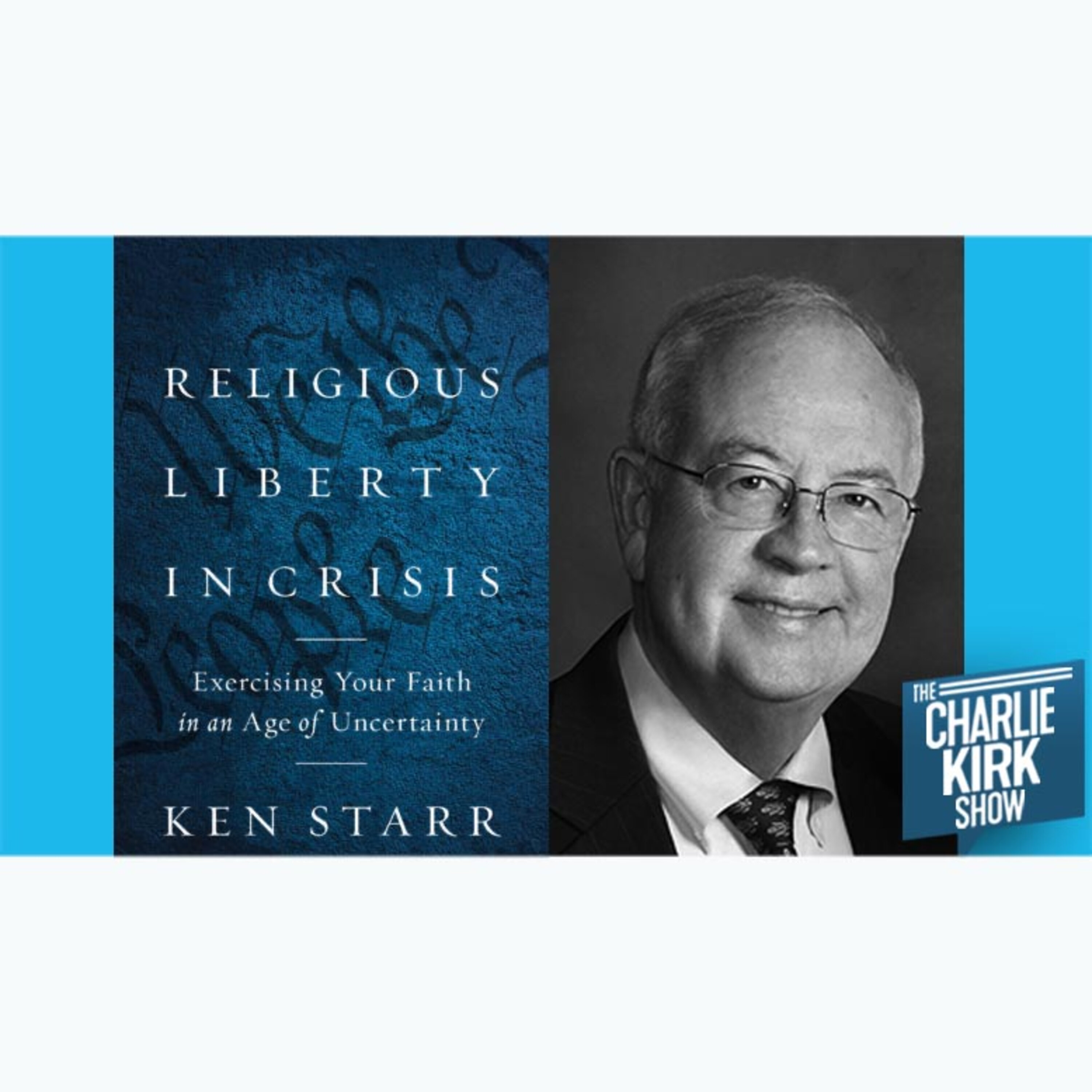
Hey, everybody. Awesome episode in store for you today. My exclusive conversation with Judge Ken Starr, who was the impeachment lead against Bill Clinton, was on the defense team for President Trump, and speaks out against this impeachment charade and circus. Email us your questions that you might have for our guests as we follow impeachment this week. Freedomarliekirk.com if you'd like to support us, go to charliekirk.com Again, that's charliekirk.com support to get behind the work we are doing and Support us@charliekirk.com Support our team of editors, our team of researchers. Please do that. CharlieKirk.com support Judge Ken Starr is here. Everybody buckle up. Here we go.
- [00:48]
B
Charlie, what you've done is incredible here. Maybe Charlie Kirk is on the college campus. I want you to know we are lucky to have Charlie Kirk. Charlie Kirk's running the White House, folks. I want to thank thank Charlie. He's an incredible guy. His spirit, his love of this country. He's done an amazing job building one of the most powerful youth organizations ever created, Turning Point usa.
- [01:09]
A
We will not embrace the ideas that have destroyed countries, destroyed lives, and we are going to fight for freedom on campuses across the country. That's why we are here. I want to talk to you about how MyPillow has literally changed my life. They won't go flat. You can wash and dry them as many times as you want and they maintain their shape. They're made in America. And for a limited time, Mike Lindell is offering his premium MyPillows for his lowest price ever, you can get a Queen size premium MyPillow for $29.98. Regular, it's usually $69.98. That's $40 a savings. Kings are only $5 more. Not only are you getting the lowest price ever, $29.98 for a queen size premium, but Mike is extending a 60 day money back guarantee to March 1, 2021. So go to MyPillow.com right now and click on Radio Listener Square and use the promo code Kirk. That's it. If you want to support Mike and you want to support MyPillow, you will also get deep discounts on all MyPillow products, including the Giza Dream bedsheets and the MyPillow mattress topper and MyPillow towel sets, or call 800-876-0227. Use the promo code Kirk. Mike Lindell fighting for America. Go to MyPillow.com, use the promo code. Kirk when you check out. Hey everybody, welcome to this episode of the Charlie Kirk Show. I am super thrilled to be with us today. Judge Ken Starr, a friend of mine and a board member, honorary board member, Turning Point USA and author of of the new book Religious Liberty in Exercising youg Faith in an Age of Uncertainty. Everyone go pre order it. We're gonna talk about that amongst other things. But Judge, welcome back to the Charlie Kirk Show.
- [02:57]
B
Hey, thank you, Charlie. Good to be with you and thanks for all that you do.
- [03:00]
A
Oh, thank you. It's very kind. So I want to get right into it. This is impeachment week. And did you ever think after you presided over the. Presided is not the right term, but you were involved in the impeachment in the 90s, you helped defend the President over the last impeachment, that we'd have another impeachment a year later? What does this tell us about how impeachment is now being brought up more and more frequently? What was the framers original intent behind impeachment? And do you even think that this impeachment is constitutional?
- [03:34]
B
The answer is the framers used this as, or envisioned this as a tool of last resort, which is the way impeachment was in fact historically used. We went in our country's history for 100 years, almost before the first impeachment of Andrew Johnson. Then we went for a century plus before the beginning of the impeachment against Richard Nixon. I hope come back to that in the conversation. But a new era came in with a law that Congress passed which was a very ill advised law. It was one under which I was appointed as special prosecutor. The name kept changing because I couldn't figure it out. So I was known as an independent counsel at the time. And that law ushered in what I called during President Trump's first impeachment in my presentation, the age of impeachment. Boy, are we in the age of impeachment, which is impeachment is now since that statute was passed in 1978. Impeachment is simply a political tool and that's not what the framers and vision. But specifically with respect to now impeachment, to this approach of what I call eternal impeachment, you can always be impeached. Why don't we just impeach people after they're deceased as well to make a political point? This is patently unconstitutional. I know, Charlie, a lot of people disagree. That's why it really should be resolved by the Supreme Court of the United States. I'm sorry, they're not Getting a shot at it because it's unconstitutional under the text of the Constitution. It's unconstitutional in light of our history. We can talk about that. It's also unconstitutional because of the presiding officer who's going to be United States Senator from the majority party, sort of, kind of quasi majority party. Right. It's 50, 50. But guess what? The tie goes to the runner because they won the White House. So we now have to consider Chuck Schumer as the Senate Majority Leader. Okay, guess what? One of his colleagues who's a partisan Democrat, is going to be apparently presiding at the trial beginning this week. And guess what? Due process, Charlie, as you well know, requires, among other things, a fair and unbiased presiding judge. That's what the Constitution provided for by saying when the President is impeached, and President Trump was the President when he was impeached, but anticipated a trial during his service as President. And thus the Chief justice should preside. He is not presiding. That should be a matter of record. That is, the Chief justice of the United States should receive a formal letter, in my judgment, requesting his attention as his presiding, and he would formally say no. And why would he say no? Because it would be unconstitutional for him to preside. Do you see what I'm saying? It's not just. Well, it's a matter of convenience. Someone has to. No, no, no. These are violations of the constitutional structure at every turn. It's manifestly unconstitutional. Let's talk about a bill of attainder in one of our segments here. Because if this goes forward, and heaven forbid, if there is an actual conviction, we don't anticipate that. It seems very far fetched to even think of it. But we have to play this out to think about the constitutional issues. If he is convicted and if the punishment is any kind of disqualification, then Congress, congratulations, Senate, you will have passed a bill of attainder which is absolutely, expressly forbidden by the text of the Constitution. A bill of attainder is the legislature can't single you out, Charlie, or any individual out. They couldn't single out Rich Richard M. Nixon. And to say we're going to now disqualify you because you abused the powers of office, et cetera, that is another indication that this whole process is unconstitutional.
- [07:43]
A
Can you explain to our audience in more detail what a bill of attainder is and the significance of that? I'd like to build that out a little bit more.
- [07:52]
B
A bill of attainder is when the Congress of the United States, or here one body is asserting the power to impose any form of Punishment on a named individual. Instead of passing a law, it's passing a punishment. That is what Parliament used to do. So, Charlie, when you see the arguments about, well, Parliament did this and Parliament did that, red flags should go up. Part of the reason that we have a separation of power system is that the founders were very aware of the dangers of congressional overreach. We do not have a parliamentary democracy, and the Congress of the United States was forbidden that power, which Parliament used to bully effect. They loved passing bills of attainders against political enemies. That's what we have here. If the president is convicted, the former president is convicted, it will be because his political enemies, even in his own party, have said, we do not want to have him run for any office again. Remember, John Quincy Adams lost the presidency, but he said, I would be very happy as a member of the House of Representatives. So who knows what President Trump, the former president, may decide to do in the future, and he should be able to do that. Welcome to freedom. This is what TPUSA stands for. We live in a limited government, constitutional democracy that's designed to assure freedom. And this prohibition is against a bill of attainder being passed, is just another indicia of the freedoms that we enjoy.
- [09:29]
A
So reading from justthenews.com, you said, and I quote, I would hope that those 10 Republicans, and hopefully even some Democrats would say, as we now look at the timelines, the media, the New York Times, the Washington Post, and all are reporting on, here's exactly it, the facts. You said that they made a huge, colossal blunder. And then you said, so walk back and apologize to the former president, apologize to the American people that I never should have voted in favor of this. Without the benefit of all the facts, I rushed to judgment. What does this say about the age of impeachment? We're at a moment now, Judge, where you can wake up one morning and the President is not impeached. You don't even have articles filed. And then by the end of the day, there is impeachment. That sort of rush to judgment is dangerous beyond even the impeachment process. It almost. It cheapens the justice system that you and I both believe is the greatest in the world.
- [10:27]
B
It's a gross. What happened is a gross violation of procedural fairness. A rush to judgment means what? It's mob rule. Mob rule. So to those 10 Republicans, I would say, take a sober second look. You were swept away. We all get carried away. Sometimes I rush to judgment, but I've been trained, and we all should be trained in life. But especially the lawyers in that crowd of 10 Republicans. Well, do we have all the facts? We know that very bad things happen and we're very emotional, we're very upset. Let's find out what's causation, Right? Scientists want to know causation and so do lawyers and judges. What caused that? And the timelines, of course, suggest that this mob rule, the mob attack, the violence was underway before the President had even finished his remarks.
- [11:27]
A
In our fast paced world, it's tough to make reading a priority. At least it used to be. At Thinker.org, they summarize the key ideas from new and noteworthy nonfiction, giving you access to an entire library of great books in bite sized form. Read or listen to hundreds of titles in a matter of minutes, from old classics like Dale Carnegie's how to Win Friends and Influence People to recent bestsellers like Jordan Peterson's 12 Rules for Life. I love listening to Thinker. I learn something new every single day, which is a challenge that we have posed to you. How do you learn something new every single day? Well, if you want to challenge your preconceptions, expand your horizons and become a better thinker, go to thinker.org that's T-I N K R.org, start a free trial today. Again, that's thinker.org can you talk a little bit about this idea of incitement? Even in the justice system? Do you think the President could be indicted for incitement? What would it take for it actually to be considered his remarks to be considered incitement? And is this even the theater to try to figure out whether or not the President incited the mob?
- [12:30]
B
The answer is I don't think so. Now, the 46 minute speech will be analyzed very closely. Right? And we'll see exactly what the worst case that can be put on looks like. That is the least favorable to the President. But our baseline again in this country is freedom, including free expression. And the idea, and this came out in one of the the submissions by the House managers that the President doesn't enjoy First Amendment rights, I think is just profoundly in error, manifestly wrong, demonstrably wrong. The First Amendment protects all persons, including but not limited to the President. Certainly the President is not excised from the Constitution and the Bill of Rights. It is only so to come back to what is the core issue. Incitement is when you essentially are saying, we want you to go take violent action now. And so now it's important to analyze the text as well as the context, the Text points in favor of the President, especially the exculpatory text about do so peacefully, make your voices known and so forth. And there is thus far no indication, I've seen, Charlie, that the President was in any way advised. By the way, there's some really bad actors in this crowd. We have an intelligence briefing. Did he have an intelligence briefing that morning? That said, by the way, Mr. President, Antifa is here and some very violent right wing organizations are here. Who knows who's here? Mr. President, if he had that briefing, that would be a fact that the decision makers should take into account in terms of incitement or inciting to insurrection. I think it's far fetched. Now the President is of course subject right here and now to indictment in the criminal justice system. I hope that won't happen. But that's part of our equal justice under law. He should not be subject to impeachment and trial. That's a travesty. But he obviously, like any other citizen is subject to the criminal justice process.
- [14:44]
A
Well, or so we would hope. Without the kind of circus that happened in the House with no witnesses, no due process, no representation, just complete and total, you know, just a couple hour process and then you're impeached. Which is extraordinary. We've never seen anything quite like that.
- [15:02]
B
Right. The House is supposed to be deliberative. The speaker of the House cannot sue a sponte. Just unilaterally say we're impeaching the President. She tried to do that impeachment one. Right. She said we're impeaching the President. He will be impeached. So go draw up articles said at the time, abuse of her power. There should have been a vote by the people. And what precedes the vote? Look at history. History is a great guide, especially when we look at presidential impeachments. Each presidential impeachment was preceded by numerous and careful hearings. A sifting of the facts, an assessment of the credibility of witnesses. Not done here. Exactly as you say.
- [15:51]
A
And the Democrats are saying to play devil's advocate, that we don't need the evidence. The evidence came here, but the more information we actually find. It's not that simple. There were groups that were there coming with the intent to try and take federal buildings with militia gear and without any of the remarks of the President. And so it's not that simple. And judge, can you talk about for some of our younger listeners why our system is designed the way it is, why it is supposed to be deliberative, why we're not supposed to be able to convict somebody in 24 hours or less. You have to have time to be able to build a defense, to submit evidence. It feels as if this is almost like the Russian system where they convicted the Alexei Navalny guy in four days or less. I mean, I couldn't believe it. I said, look at the similarities between the two of this kind of rush to judgment. Can you just, from a constitutional perspective, talk about why our system is actually built that way?
- [16:56]
B
It goes back to Magna Carta almost 1,000 years ago, that government, whether it's the king, whether it's Congress, whether it's the president, whether it's the governor, can abuse power. And what we treasure in a constitutional democracy throughout the English speaking world is power has to be limited, and that includes the power of the House of Representatives. One justice of the Supreme Court from yesteryear put it very well. The history of liberty is largely the history of procedure. Process counts. You want to. Let's say you're being accused of something in the university in high school. Right. Don't you want to be heard? No, we don't need to hear from you. And there have been some issues. Right. Under Title nine. I would like to have my lawyer. You don't get a lawyer. Right. And so the term kangaroo, and I love kangaroos, I don't know why it's called kangaroo court. But a kangaroo court is one where you don't have fair process. So always demand process. Right. Think about you're pulled over, driving offense, and the police officers, I find you guilty. So excuse me, I was not violating the law. And who are you? He said, I'm the judge. No, you're not. You're having a hallucination. There's a process here and I get to go to court and so forth. And I'll see you in court, officer. Oh, darn. You're right, sir. Ma', am, you do get a trial. I forgot about that. This is America. It's not Russia, it's not China. Process counts. If we do away with process, which is what the House of Representatives did with respect to impeachment, two then terrible. We complained about process during impeachment. One in comparison, there was a lot of process because there were at least hearings. Right. I don't think it was adequate process and I think the speaker of the House. But we don't need to re litigate that. The point is, the House had hearings and hearings for the Intelligence Committee, they had hearings for the Judiciary Committee of sorts. So they were on a tight time frame. But this is beyond. This is. I'M just going to go ahead and say the House of Representatives should be condemned by fair minded historians of tomorrow as having been carried away, intoxicated with emotion and with power.
- [19:31]
A
And I love your point about how the process counts, because without the process, you really don't have the system that is considered to be the greatest justice system in the world. As William Blackstone said, it is better for 10 guilty people to walk than one innocent person to suffer. The system is supposed to be innocent until proven guilty. And if you don't even have a representative from the side of the accused, especially at the highest level of government, which is the legislative branch, then what does that say for the entire system itself? And the irony, Judge, is that most of the people that were overseeing it were lawyers themselves. Most of the people that were actually doing the House impeachment management, they have law degrees. They know better than this, don't they, Judge?
- [20:18]
B
I'm not gonna get into intent. All I know is they are on notice, they are on constructive notice that they ran a shot over fundamental principles. But here's, you know, let's talk to our students for a second. I realize you have so many listeners, but we're all students. We just. Yes, some of us have students longer than others. So this is for all of my fellow students. The Bill of Rights was so critical. So, yeah, we like the Bill of Rights. Well, you should like the Bill of Rights. You should love the Bill of Rights. The Bill of Rights, of course, was part of the great compromise because a lot of people oppose the Constitution because there was no Bill of rights. And so Mr. Madison, James Madison, the father of the Constitution, rightly dubbed so says, okay, I got it wrong. As a political matter, I got it wrong. We're going to get a Bill of Rights. Now let's read those Bill of rights. There are 10 of them. You can read it in about 10 minutes or less. And what are those? They're freedom rights. I talk about in my book, freedom of religion. We're talking about free speech, right? We're talking about freedom of the press, the right of the people peaceably to assemble, to petition the government, redress. Those are all political rights. The Second Amendment, the right to bear arms. You keep marching the Third Amendment. You don't have to put up the National Guard that may be dragooned into service in the District of Columbia for eternity. At least the mayor can't say, oh, by the way, they're going to stay in your home tonight. Okay, so that's the Third Amendment.
- [21:48]
A
It's the Third Amendment.
- [21:49]
B
Yeah, but you keep marching in. What's the next cluster? Our rights to process. Our rights to process. You can't be subject to unreasonable searches and seizures. You can't have your property or your life or your liberty taken without due process of law. You've got to have the right to counsel. We could give it. You have a right to a jury trial in civil cases. Right. 8th amendment. The government cannot punish you in a cruel and unusual way. And then, of course, the 9th and 10th Amendments are structural amendments to reserve power to. To the people and to the states.
- [22:23]
A
And the thought process behind that entire system is one that the government, if not given specific rules for what the government cannot do, will abuse its citizens. And power can be abused against the people. Look, conservatives are getting kicked off social media and it's not okay. So why exactly are we choosing to give these big tech companies all of our personal data? Now is the time to take a stand. Protect your personal data from big tech with the VPN I trust for my online protection. Express vpn. You see, every device, whether you're on your phone, laptop or tv, has a unique string of numbers called an IP address. When you search for stuff, watch videos, or even click a link, big tech companies can use that IP address to track all your activity and tie it back to you. When I use ExpressVPN, my connection gets rerouted through their secure, encrypted servers, so these companies can't see my IP address at all. My Internet activity becomes anonymized and my network data is all encrypted. And the best part is you don't need to be tech savvy at all to use ExpressVPN. Just download the app on your phone or computer, tap one button, and you're protected. Protect your Internet activity with a VPN I use every day. Visit expressvpn.com Kirk I love ExpressVPN. All my devices have ExpressVPN. You get a three extra months free on a one year package. That's expresvpn.com Kirk to get three extra months free. Expressvpn.com Kirk Judge I want to talk about your book and how you build this out. And I want to reiterate the title. Religious liberty in exercising your faith in an age of uncertainty. And so we saw the lockdowns this last year, which has really put the church through difficult times. My pastor has remained open since May and has been fined and has been ridiculed, investigated by local and state authorities for just opening his church. Whereas other assemblies seem to be deemed appropriate. The church seems to be singled out. Can you talk about how we do have the free expression clause and we have the establishment clause when it comes to religion in our country, about how the church actually does have separate constitutional carve outs to assemble different than if we were just going to a sporting event or to a concert.
- [24:41]
B
I'm so glad you said that. Congress shall make no law respecting an establishment of religion or prohibiting the free exercise thereof. Those are the first 16 words of the First Amendment. And then a semicolon, then they move on the words move on to freedom of speech and the like. In other words, these are the first freedoms. The first of the first. This was so foundational to the architects of the Bill of Rights. And so Congress stay out of the business. You shall not make a law respecting establishment. But now we're in the free exercise territory. I think some of these restrictions were profound violations of the free exercise right. But what does that mean, free exercise? That means you go to church. Does the government have absolutely no power? What if you've got a small sanctuary and 10,000 people are coming in? Ah, you do have the police power to say, okay, wait a second, 10,000 people in that small sanctuary, People are going to get crushed, or whatever. Reasonable regulation. But the reasonable regulation has to be what? It has to be content neutral. You can't say now those 100, those 10,000 people, or however they can go to the casino, they can crowd into the casino. And that's exactly what was happening. Governors were permitting in. The Nevada case, to me was one of the most atrocious. But there were others that you can go to Caesar's palace and it can occupy. The occupancy limit was 50%. Churches were limited, regardless of the size, to 50 persons. You and I have both been to the wonderful church in Palm beach, right? That wonderful chapel, family church.
- [26:26]
A
Yeah, sure.
- [26:27]
B
You can't tell the deacons of that church or the elders of that church, you can only get 50 people in there because it can seat hundreds. And it's a chapel. Think of the mega churches. And one of the things that was made clear in all these cases is the pastors, the deacons, those in charge, the executive directors were all taking the appropriate precautions. And as one case put it, we're a lot safer than Walmart, which is open down the street. We're a lot safer. We have more social distancing and so forth. And so one of the things my book does is identifies the principles of freedom as applied over the years. And the freedom here that's implicated that I spend a chapter on is the freedom from non discriminatory action by the government. The government can't single churches out and say, oh, you're limited to 50 but Walmart or cannabis stores in Colorado, keep it at half capacity, would you? That's discriminatory and that is a constitutional. No. No.
- [27:34]
A
So Judge, why is it that this was such a difficult issue for our legislators and our judges to get right? You cited the Calvary Chapel Las Vegas lawsuit that went up to the U.S. supreme Court. Justice John Roberts sided with the four liberal justices while Ruth Bader Ginsburg was still on the court. And the four dissenting was were Thomas, Thomas, Alito, Kavanaugh and Gorsuch, who believed that no, Caesar's palace should not be given more right to assemble than Calvary Chapel Las Vegas. What was the reasoning behind this? Because it seemed like there was a double standard even when it came to public health statutes. Was this an attack on religion or is it just that they didn't trust pastors to do the right thing? Or it's hard to go after their motives or their intent. I understand that, but what could possibly be the reasoning for that?
- [28:29]
B
Well, let's just stick with, I'm not gonna get into motive, but let's just stick with Chief Justice Roberts. Cuz we were surprised, right? A lot of us were surprised by that. So I'm just going to take him at his word. First of all, on Merritt's case, he's always on the side of religious liberty, always. But this was coming up on an emergency kind of basis. And so I'm going to take him at his word. Look, the local officials know better than I do without the development of a full record. This was a process point, right? We haven't had these issues tried. There have been no witnesses in the courthouse. We haven't had the engine of cross examination, that great engine. True C. So I'm going to give him credit for that. But here's the good news. In December, as you know, this got turned around with a case coming out of New York, the Roman Catholic Diocese in Brooklyn, and lots of opinions, lots of words spilled. And really, once again, Chief Justice Roberts in dissent saying no, I believe that we should be deferring to local officials was really making this process point. But all's well that ends well because by Christmas time, guess what? Churches were back open. Or they could be open. I realized there were some exceptions to that because I don't want your viewers to come in and say, hey, Stuart doesn't know what he's talking about, they had the right to be open. That was so clearly established by the court's decision in the Brooklyn case.
- [29:59]
A
So you talk in your book about the creeping secular age that might erode our freedom. We talk about this a lot on our program. What do you mean by that? And can you talk about the Christian tradition that has always enriched the American experience?
- [30:16]
B
Let me talk about the latter first, and then I'm gonna talk about the Fulton vs City of Philadelphia case that's now pending before the the Supreme Court. I don't know whether he's secular or he's a believer, but Robert Putnam, one of the nation's leading sociologists, co authored a book with Professor Campbell from Notre Dame entitled American Grace. And he talks about how wonderful churches are. They do such good works. And everyone who is involved in any kind of faith community knows, yes, doing good works. That's what we're called upon to do in the Christian tradition, certainly in the Jewish tradition, you are kind to the stranger and so forth. You gleaning in the fields. This is our great tradition from millennia. And so, so much good is done. Think of hospitals and orphanages and so many universities. Harvard, yes, was a good Christian when Bill Buckley, one of my great heroes, William F. Buckley, Jr. So I pay tribute to his memory right now, wrote God and Man at Yale, talking about the secularization of Yale and sort of, where's the place for God? And he wrote this mid 20th century. The president, the then president of Yale said, I don't know. Buckley is complaining about Yale is a Christian university. So this culture has changed very dramatically. And that is now putting pressures, even though so many good works are done. And we see that in the cases coming before the Supreme Court, including Fulton versus City of Philadelphia. Sharon L. Fulton is a very devout Roman Catholic African American woman who has taken Precious Children. Her ministry is taking care of foster children. She's had over 20 in her care and keeping lovingly. So over the years, she performs this individual ministry and social service under the auspices of Catholic Social Services. Catholic Social Services of Philadelphia has been providing this service for the children of Philadelphia for well over a century. But the current administration of Philadelphia said, no more because you will not place Precious Children with LGBTQ families, even though no LGBTQ couple had ever requested such a placement. So it's so unfortunate, it's really tragic because their children, There are approximately 300 children, as I understand the record in the case, who still could use, not could use, could avail themselves of a foster home, of a loving Foster Home CSS Catholic Social Service was so respected. What a tragedy that is. I could go on, if we've got time and use another example.
- [33:03]
A
Please do.
- [33:04]
B
Okay, so Jack Phillips of Masterpiece Cake Shop, this is a case that's already been decided by the court in suburban Denver, Colorado, has this bake shop and he will serve anyone and everyone. There's no status discrimination, but he has principles and he will not depart from those principles in terms of his art. It's not I won't bake a cake, it's I will not perform artistry. And we've all seen cakes. You know, a cake is a cake by any other name. No, no, they're artistic cakes. Right? Just as floral arrangements. Just go get some flowers. No, no, it's a floral arrangement. Artistic taste is brought to bear. Skill is brought to bear. And so he said, I can't do Halloween stuff because that's demonic. Right. This is his set of views and values. And so a recently at that time, married couple, same sex couple, they got married out of state. This is before the case. And they come into to celebrate their nook deals. And he says, and he had served them apparently before, I'll sell you anything in the shop, but I cannot in conscience create this cake for you. That began then his saga, which continues seven years later. But he won in the Supreme Court of the United States on freedom of conscience. And in particular in that case, the. And this makes the point that you flagged earlier hostility to religion. In his opinion for the court, Justice Anthony Kennedy was very sensitive to issues of coercion, freedom of conscience, and so forth. So Jack Phillips prevails in the Supreme Court of the United States in a powerful opinion by Justice Kennedy. And one of the things that I'm trying to say in the book is not the lower courts, but the Supreme Court of the United States has been over these last 20 to 30 years a friend to religious liberty. We have to not take these kinds of onslaughts lying down if we're not taken to court. We being friends of faith of all faiths, or including those of no faith, we're talking about the rights of conscience here for all Americans, which is so fundamental to our constitutional system.
- [35:32]
A
So, Judge, if you could clarify a question. We get quite often here where people say it is illegal to discriminate based on religion and it is illegal to discriminate based on race. What about political viewpoints? A lot of people believe that they are being discriminated against because they're Trump supporter, because they are conservatives. Are there any Protections for them, or is it that you are allowed to discriminate based on political viewpoint?
- [36:01]
B
Yeah. In this land of freedom, the fundamental point is. Yes. Oh, you're a Trump supporter or you're a Biden supporter or you're whatever. I'm not going to do what, Engage in artistry now. This is engaging in artistry now. If you're talking about someone getting kicked out, remember of the Red Hen restaurant, her family and so forth.
- [36:28]
A
Sarah Huckabee Sanders. Yes.
- [36:30]
B
I would immediately go to the public accommodations law of that particular state. It would not be, under present law, a violation of federal law. That's not a protected category. So people said, look, I'm just not going to serve you because you support Black Lives Matter. I'm not supporting. Right. If that were the ground, the answer that's getting into is that racial discrimination and so forth. So it depends on what the category is. But right now, political expression is not clearly a protected category under most laws.
- [37:05]
A
I see it both ways. I don't think it necessarily should be cause what if all of a sudden, Turning Point USA had to allow every socialist into our organization? So it could in some ways, if it was just viewpoint or politics, it could cause some problems down the road if it were to become a political thing.
- [37:26]
B
This is so important, and it's really hard, I think, for younger fellow students to understand this, because we don't like exclusion.
- [37:36]
A
Yes.
- [37:36]
B
We don't like you're not welcome signs, and I understand that we want to be welcoming and so forth. But groups have the right to say, here's who we are. As long as you're not discriminating on certain enumerated terms, especially racial discrimination and so forth. And so just think. And here's the Supreme Court opinion by Justice David Souter, who cannot be characterized fairly as some. What shall I say, very conservative, traditionalist kind of justice. And in a very important opinion involving the Boston St. Patty's Day Parade, the Friendly Sons of St. Patrick and so forth, the people who organized that parade said to an LGBTQ Irish American group, I'm sorry, you are welcome to march in the parade, but you can't march under the banner of your group. That's not what this parade is all about. You have the right to identify what your organization is. And so Turning Point USA has every right to say. It might say, if you're a Marxist coming in, because we want to convince you, but you don't have to allow the Marxist to form a student chapter. Right. Even at a state university, you do not have to allow someone whose views are inimical to the views of freedom articulated so ably by turning Point USA to then say, okay, I'm now your chapter president or I'm going to run for your chapter.
- [39:10]
A
And the same with the Democrat socialists. They don't have to allow a capitalist or a conservative into their groups. And so it.
- [39:17]
B
Precisely. That's the freedom of association. Now you'd say, well, gee, this sounds exclusionary. Guess what? This arose out of the civil rights movement when certain states were trying to intrude into the operations of the naacp, a civil rights organization.
- [39:35]
A
That's a great point.
- [39:35]
B
And the Supreme Court said you can't even get their membership list. Much less. This is going way beyond. Much less. An attempted open infiltration.
- [39:48]
A
That's a phenomenal point. The book again is religious liberty and exercising your faith in an age of uncertainty. Judge Starr, any closing thoughts or things you wanted to touch on that we didn't get to cover?
- [39:59]
B
Stand up for freedom. I know it's a very tough environment out there and it's getting tough all the time, but do so in as charming and winsome away as Charlie Kirk. Stand firm, be firm, be a justice warrior, a freedom warrior, and so forth. And then I hope that Dove's feel moved to purchase my book, pre order the book. And thank you so much for the opportunity. I felt very strongly that this is an important book for now in light of all the tensions and pressures on religious liberty, religious expression. So I hope that will be of use to people. That's what it's designed to do to help us gird our loins for the battle that's already underway, everybody.
- [40:44]
A
Check it out. Judge Starr, thank you so much for joining our program. Hope to have you back on soon.
- [40:48]
B
Thank you, Charlie. All the best. God bless.
- [40:51]
A
Thanks, Judge. Thanks so much for listening, everybody. If you want to get involved with Turning Point usa, which we talked about a couple times in this interview, go to tpusa. Com. That's tpusa. Com. Email us your questions. As always, freedom@charliekirk.com and if you'd like to support us, go to charliekirk.com support. Thanks so much for listening, everybody. God bless.