Loading summary
Transcript182 lines
- [00:00]
Mike Lee
Satan. Sam.
- [01:05]
Ben Shapiro
I remember driving around and as a sophomore and a junior in high school, listening to your radio program in the morning. I wasn't there when you gave the speech at the Lincoln Memorial, is that right? But I saw it. I remember saw it being simulcasted and you said some very, I think, prophetic things there.
- [01:24]
Glenn Beck
I know it. I have been looking for the next George Washington. I can't find him. He may be 8 years old, but this is the moment. Now 18 year old Charlie Kirk is saying enough is enough.
- [01:39]
Ben Shapiro
This is Charlie Kirk reporting from Marquette University. I like ideas. I don't like politicians, I don't like parties. I like principle.
- [01:47]
Glenn Beck
Do not go quietly when truth is on the line.
- [01:50]
Ben Shapiro
I mean democratic socialism, you know, the people social. It's socialism which inherently means the following. It is immoral, it is evil, it is impractical when put in practice.
- [02:00]
Glenn Beck
Do not surrender to the shadows.
- [02:04]
Ben Shapiro
But I'm here for the silent majority that is silent no longer. To give them the courage, confidence and.
- [02:09]
Glenn Beck
Conviction to fight on campuses even when and especially if you think the battle can no longer be won.
- [02:20]
Ben Shapiro
We're not going to allow the ruling class elites, the radical left, to continue to destroy this country from within. And we are a movement here that is growing by leaps and bounds.
- [02:30]
Glenn Beck
Charlie Kirk lived that mandate.
- [02:33]
Ben Shapiro
And I believe that marriage is a beautiful thing. And I believe that having children is a moral good for society.
- [02:38]
Glenn Beck
Biggest blessing.
- [02:39]
Ben Shapiro
Oh, and without a doubt, I don't.
- [02:40]
Glenn Beck
Think you know, know the impact you say, oh, Glenn, you made an impact on my life. Do you realize the impact you're having on the country? Remember when I did the thing in Washington D.C. in restoring honor?
- [02:52]
Ben Shapiro
I do.
- [02:53]
Glenn Beck
And I said, somewhere in this crowd, maybe he's 7, maybe he's 15. Somewhere in this crowd is the next George Washington.
- [03:02]
David Osmond
And 25 years from now he will.
- [03:07]
Glenn Beck
Come not to this stair, but to those stairs.
- [03:11]
Ben Shapiro
We want to overemphasize grace when in reality Christ loves us too much to have us continue to live in sin. He wants us to try to elevate our actions, to glorify God in all that we do.
- [03:27]
Glenn Beck
And he can proclaim, I have a new dream.
- [03:31]
Anna Paulina Luna
I just went to church for the first time in several years. Today we went to church for the.
- [03:37]
Glenn Beck
First time in a really long time.
- [03:39]
Anna Paulina Luna
I've never ever opened the Bible before and something was calling me to my head.
- [03:46]
Glenn Beck
Here's the line for the second service and there's never a line.
- [03:50]
Ben Shapiro
Jesus of Nazareth and the resurrection is the, is the pinpoint of my belief that Jesus did Rise from the grave so that we may live.
- [03:58]
Glenn Beck
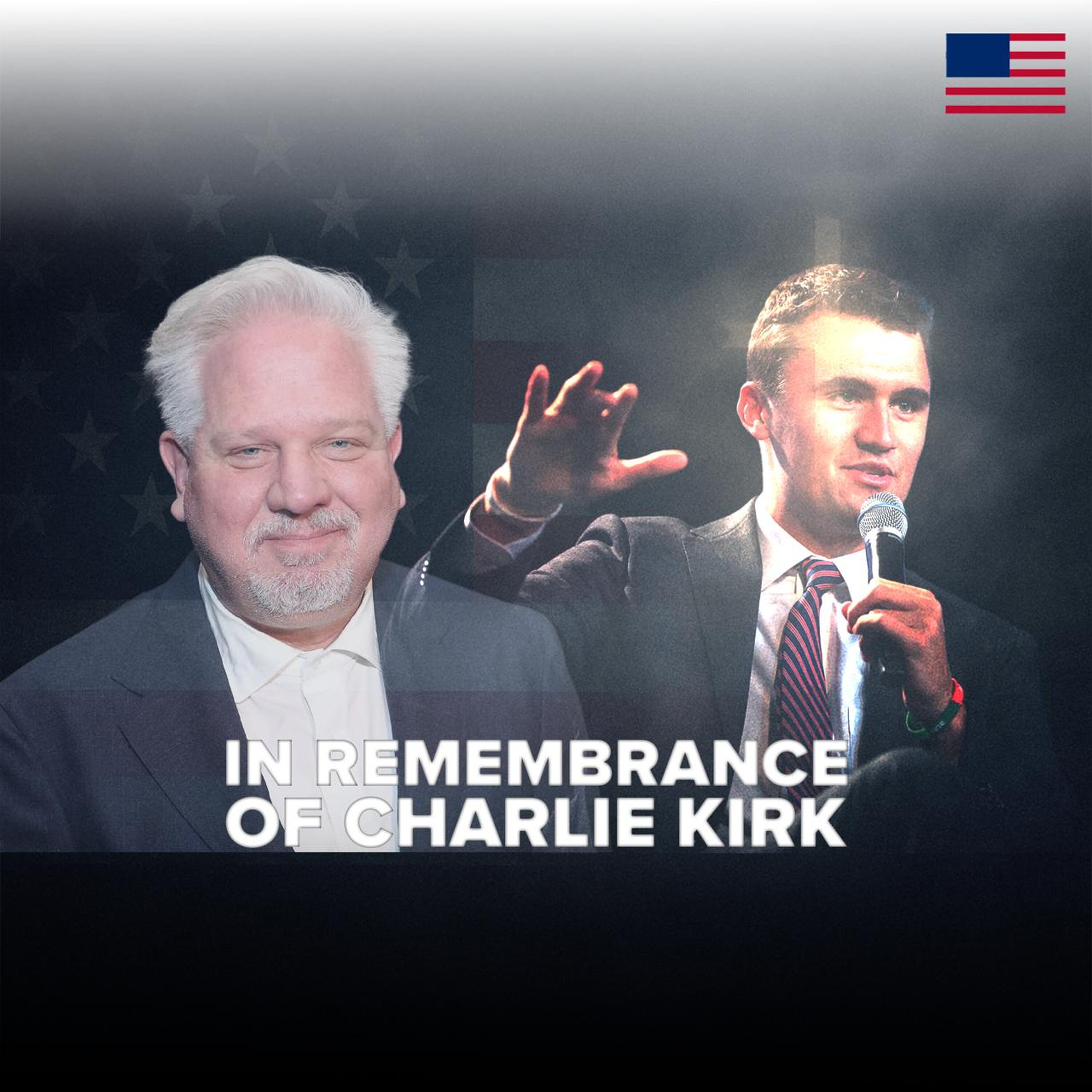
The light is dimming, yes, but it always does before the dawn. Hello, my name is Glenn Beck, and I am a friend of Charlie Kirk's. You may not know who I am, but one thing I am known for is my emotions. And I think we're gonna need a tarp today. This is. I knew this was gonna be difficult, but to sit in the studio right next to his chair is more difficult than I imagined. I want to talk to you a little bit about the future, but I want to talk to you a little bit about my friend as well. I knew Charlie when he was young. I first met him, I think he was 17 years old. He was amazing. He was so well read, so smart, so clear. I thought, this is an amazing man. I remember the first time I met Ben Shapiro. I think he was 13 years old. I interviewed him the first time. He was sitting on his family's washing machine doing an interview with me. And he said he was on a phone that used to have. It was a hard line, so it had the phone wire that he had to pull it all the way around, and he couldn't keep his sister quiet, so he went in and closed it on the phone wire and said, on the washing machine, stop it. I'm going to be on the Glenn Beck Show. And he was impressive. But there was something special about Charlie Kirk. I want to share a story that I've never shared before, and I so regret that we ran out of time. It's a story that I had hoped to tell Charlie myself in the next couple of months. When I first met Charlie, and this is the kind of guy he was, he was so gracious. I first met him, he was young, and I said, so, what do you want to do? What is it you want? What? What do you want to do? So gracious. He said, I want to be you. I want to do what you do. Let me translate. I want to be Rush Limbaugh. He didn't want to be me. He wanted to be Rush Limbaugh. He wanted to be one of the, as Rush said, radio's greatest of all time. And I remember thinking, well, kid, maybe someday, because I think you have it. I brought something with me today that I thought was appropriate while I did the show, that I would sit in front of Charlie's microphone. It was given to me after the death of Rush Limbaugh by his wife. It is Rush's golden microphone. I think it's appropriate that it sits in front of Charlie's microphone. What I would have said to Charlie was, you were thinking too small. I want to be Rush Limbaugh someday. I'm a broadcaster. Rush was a broadcaster, but Charlie was a broadcaster and a narrowcaster. Charlie was a pastor and a priest and listening to the way he could argue and think differently. He was a rabbi as well, and one of the best. He was a political organizer. He was a political think tank himself. He was a compassionate friend. He surpassed Rush Limbaugh by miles. We must stop calling Charlie anything other than a civil rights leader. We need to plant that stake deep. It is time that we point out that what he was doing was not politics. What he was doing was trying to stand up for people's civil rights, to show people how a civilization is not a civilization. Unless you can have a dialogue with people who are diametrically opposed to you, that don't believe anything that you believe in, and yet you can have a civil dialogue. And how important that is. That's our civil right, our right to free speech. And that gunman was trying to take that right away from him and from you and everyone else. Shut up. You will be silenced. You will not say those things. And there has been a force in this country to try to convince people that you don't have a right, that you have a responsibility to silence others. You don't. In this country, one of our main civil rights is we can express ourselves the way we feel we need to express ourselves. And I'm sorry, if you don't like it, you have to just take it and then say, I'd like to have a discussion with you on that. I'd like to know how you got there. I'd like to have the opportunity to argue against that. And you have that right to argue against it. And hopefully, if we are more like Charlie Kirk, we're having those dialogues with each other in a civilized fashion. But make no mistake, Charlie Kirk was a civil rights leader as much as Martin Luther King. Andrew Colette is with us. You were here a week ago. We're a week away. And what, same time?
- [11:37]
Andrew Colette
Yeah, we're probably about two hours or so out from, you know, the exact time of being a week.
- [11:48]
Glenn Beck
How are you doing? How's everybody at Turning Point?
- [11:50]
Andrew Colette
Doing well, after you made everybody bawl their eyes out in your first segment. You're open, Glenn. And, I mean, I just. I have to say thank you for that. I can't even believe I'm seated so close to Russia's golden EIB microphone.
- [12:08]
Glenn Beck
It's crazy.
- [12:09]
Andrew Colette
And Charlie and I, I can't say how many times we said the golden E. E.I.B.
- [12:14]
Glenn Beck
Microphone. Yeah, yeah, yeah.
- [12:16]
Andrew Colette
And it, you, it was beautiful. We were all crying out in the control room. And so I am right now in this moment, very emotional. And I know that you watched his story grow and that tribute about the, the next George Washington and, and how he was. Charlie was so aware of that speech you gave and he wasn't there in person, but he watched. Yeah, he watched it somewhere else live. And I, right now, I don't have many words because of how moving that was.
- [12:49]
Glenn Beck
You know, I said the other day, and I don't mean this, I mean I'm not saying this to self aggrandize at all, but I looked at him almost like a professional son. You know what I mean? I looked at him and because I watched him from a distance and I saw him young and I saw his desires and how he built and everything that he did. And as I was thinking about that, as I packed that microphone up yesterday, I, I was thinking about him and I thought, Charlie would have been president. Charlie would have been president. Rush wasn't president. Rush didn't have a desire to be president. And I don't know if Rush would have made a good. I'd make a horrible president. I don't know. Rush would have been a better president than me. Charlie could have been a great president. He, he surpassed all of us. I don't know if there's another person in history on our side, at least in the last hundred and fifty years that was like Charlie. To replace Charlie, you need maybe six people at the top of their craft to cover everything that he has done.
- [14:13]
Andrew Colette
Yeah. You know, I can't tell you how many times I was with Charlie and people would beg him, you have to run for president. You have to run for president. Charlie would always, you know. Yeah, no, no, no. I'm, I'm happy doing what I'm doing. And I will say Charlie was The existence of J.D. vance gave Charlie a lot of emotional freedom to say that. Next man up is J.D. our job is to support J.D.
- [14:38]
Glenn Beck
Yeah.
- [14:39]
Andrew Colette
And I, you know, we wouldn't necessarily be loud and proud about that on this show because we understand there's dynamics, but you know, Charlie was in so many ways being honed and sharpened and he was. Yeah. For such a job.
- [14:56]
Glenn Beck
And there was a difference in him in 10 years. Yeah, 15 years. Look at the difference in him.
- [15:00]
Andrew Colette
Can you imagine if he had 10 more years? 10 more years sharpening.
- [15:03]
Glenn Beck
Oh my gosh.
- [15:04]
Andrew Colette
I mean, and people need to understand that, yes, Charlie was a brilliant communicator. Yes, he was an autodidact who kept studying the classics and political and philosophy and theology and all of these things. And he was deeply, deeply sincere in his faith. But he was also so skilled at the quiet things, the behind the scenes things. And he would honor people. He was trusted. If you got into a heated discussion in private with Charlie, nobody would ever hear about that if anything happened, because his goal was to keep people together. He understood that there are so many forces in our world and our politics that are ripping everybody apart. And I said this yesterday, but. But it bears repeating. Just a few weeks before his death, he sent me this hierarchy of what the Greeks considered to be the highest virtues and the highest callings. And he said to me, he said, andrew, we are not the actors and the entertainers that are at the bottom. That's how the Greeks put it. He said, we need to strive to be statesmen and philosophers up at the top and theologians. And he said, this is what we're trying to be. Not that anybody could do that. Not everybody can do that. And God, he knew that God had put him in a position that he could keep people together. And so, you know, there would be times where everybody wanted us to go all in on this story or go all in on that. And Charlie saw three steps ahead all the time. He was always thinking, long term, what will that do to the movement? And so he would craft his messaging and his strategy and, you know, who we invited to what, you know, around. How do you. How do you manage this current moment so that everybody is still a part of this thing?
- [16:42]
Glenn Beck
I can't thank you enough for inviting us to be here.
- [16:45]
Andrew Colette
We are enough for coming.
- [16:46]
Glenn Beck
No, I mean, it is an honor. I called Stu yesterday and I said, stu, you should come with me. And he said this, this is history in the making. I mean, it's an honor to be here. Yeah.
- [16:56]
Andrew Colette
Well, you honor us and your beautiful tribute and open to him. And I know we're not done yet, but. No, I. I can't thank you enough.
- [17:03]
Glenn Beck
Thank you. God bless and God bless everybody at TPUSA. Want to get involved? Go to tpusa.com Hamilton and Madison and.
- [17:12]
Ben Shapiro
Jay, who were the, obviously the designers of, and explainers of the U.S. constitution. They wanted spirited tension between the branches. They wanted collision. They wanted the branches to kind of not to be at war with each other, but to have different opinions on how governing should. This idea that the executive branch must bend a knee because Congress has appropriated the money and so look, in addition to that is if we can get. This is where the other thing is that I was pushing for. I don't think it's going to happen is if we can reauthorize the Presidential Reorganization act, which has been authorized in many times, which essentially says if an agency can do the work that is duplicative of another agency.
- [17:51]
Glenn Beck
Yes.
- [17:51]
Ben Shapiro
It no longer needs to exist. So let's just take the department Education, which needs to end. The department Education needs to be shut down. Do you guys agree? And the Department of Education.
- [17:59]
Glenn Beck
So do you believe. Do you believe Linda McMahon? Because she's a great manager.
- [18:04]
Ben Shapiro
She's phenomenal.
- [18:04]
Glenn Beck
Is she a manage to the close? She.
- [18:09]
Ben Shapiro
She shares the President's stated plan to close the department Education. But let's just take three examples of how that can happen before you close it. Student loans that should be under the Department of Treasury. Put that under Treasury. There's no reason to be that.
- [18:21]
Glenn Beck
Wait, wait, wait, wait. Why do we have it? No, that was a problem.
- [18:25]
Ben Shapiro
I agree. That's going to require Congress. Like that's what I'm getting at though is at least you can break apart. Yes, I agree. We should get rid of any subsidized student loans.
- [18:32]
Glenn Beck
Yes.
- [18:33]
Ben Shapiro
I'm just getting at this is the way that you can actually weaken an agency to no longer exist.
- [18:37]
Glenn Beck
Yes.
- [18:37]
Ben Shapiro
Through duplicative type process.
- [18:39]
Glenn Beck
Right.
- [18:39]
Ben Shapiro
School assisted lunch. You can make an argument for it or against it, but school assistant lunch, basically the taxpayers need to, you know, pay for lunch. That could be under department Agriculture. They do food stamps much better done. Then finally they have this whole separate office of the Department of Education that is Senate confirmed tier two position, that is the Office of Civil Rights. Put that under the Department of Justice. They don't need your own civil rights division in the department Education that goes and harasses our Christian schools and goes after conservative kids. So you can completely close that. That's three functions. All of a sudden the Department of Education inherently weakens. And you know this, Glenn. The Department of Education actually never existed. It used to be called hew Health, Education and Welfare.
- [19:17]
Glenn Beck
Yep.
- [19:18]
Ben Shapiro
And in fact we could, we could re merge these together and then we could find duplicative type processes and better, better synergies. That is even before we get more to the fundamental question of which I have and you have. I don't think the department education is constitutional. I do not think that is in the original intent as written that the federal government has any role in the education of our children, period.
- [19:41]
Glenn Beck
What, what progressives do understand but the actual voter that votes usually with Democrats don't understand is I don't have a problem with the way you live in California. You want, you want to live in California and you want to, you know, be as insane as you are. You can do that. Your own community can vote for that. And that's, that's fine. I'm not going to pay for it and don't force me to, to live that way, you know. And that's unfortunately the problem. We have San Francisco value.
- [20:13]
Ben Shapiro
That's right.
- [20:14]
Glenn Beck
In small towns that do not agree with those values at all.
- [20:18]
Ben Shapiro
And it's forced upon them. It's forced upon them because it's federal. The Office of Civil Rights, the Department of Education and even worse, I mean, you guys remember this was not a very covered issue. The Department Education was using school assisted lunch funding to force transgender bathrooms. Do you remember this? It was a lesson. Like they said, we are not going to give money for kids that need assistance for lunch if you don't have radical transgender policy.
- [20:43]
Glenn Beck
Yes.
- [20:43]
Ben Shapiro
So what we've done is we've created this insane leverage that the Department Education should not have over local municipalities and school districts.
- [20:52]
Glenn Beck
Let me describe the scene I got here this morning about 4:30am I do a national radio program starts at 9:00am Eastern Time. So by 6 we were broadcasting and there wasn't anybody here. Everybody is getting some well deserved sleep, it looks like. I mean nobody here has slept for a while. And we got here and there's police that barricade the road right in front and their police all around. And it's an enormous tribute that is on the road sitting in front of tpusa. People have kind of. It reminded me honestly of Princess Diana. I hadn't seen the outpouring like this since Elvis died. And when Princess Diana died, it's just this amazing outpouring of love. During the show, during my national radio broadcast, we, my staff walked in and said, you have to move to another building. There is a bomb threat. And somebody that was here in front apparently put a package down and then gave a bomb threat. Turned out to be just some. I don't know. I don't know. But Satan thinks that he still can win. And the more he pushes the, the brighter the light is going to get. I want to go to Ryan Morrow. I talked to him earlier today because one of the things that we have to do is we have to stop the funding of all of these things that are on the left that we have honestly now started to find out. I mean, I'VE been exposing this stuff on chalkboards for years and years, almost two decades now. And how the George Soros, et cetera, of the world are funding all of the worst of the worst. And Ryan has done his work and has really up with some smoking guns, especially on George Soros. Donald Trump can use as RICO charges. And Ryan is here to lay this all out. What did you find, Ryan?
- [23:05]
Ryan Morrow
Well, we had some amazing findings according to George Soros's own files from his Open Society Foundations. So myself, my colleagues at Capital Research center basically went through as many grants of his, as many funding streams as we could find. And, and here's the smoking guns that we believe that President Trump, if he's informed of it, can use to go after Soros's network of hate in various ways. We traced over $80 million going from the Open Society Foundations to at least 54 groups engaged in crime and domestic terrorism on US soil or that are pro terrorism, endorsing things like the October 7th attacks or are associated with foreign terrorist organizations or explicitly pro terror groups. And this is according to his own file. So it's rock solid and over. Of that amount, over 23 million went to at least seven groups that are doing things that meet the FBI's definition of domestic terrorism. Can you, including rioting and things like that.
- [24:12]
Glenn Beck
Can you be specific? More specific than this?
- [24:16]
Ryan Morrow
Absolutely. I'm happy to. So the center for Third World Organizing, for example, is an organization that has a hub that fused together several really extreme organizations. We found $400,000 going to them, and they openly boast of the fact that they threw down during the uprisings in Minnesota, obviously referring to the rioting and boasting of how many thousands of people they help train. A lot of these groups have created what they'll call like a protest guide or an activism toolkit. And it sounds innocuous. Then you open it up and you'll see support for Hamas in it. But then they'll sometimes slyly say, for more information, go to these hyperlinks. And you go to the hyperlinks and there'll be guides recommending things like property destruction, violence, false IDs, how to obstruct justice, all of these things. And they know darn well what they're doing. They don't put that there by accident. Some of the more careful ones will just direct their readership to anarchist websites with all that material, knowing that they'll see it when it's there. And so, yeah, I mean, it's really stunning. And some of these groups are coalitions so when I say 54 groups, just one of those might have 300 entities in that one. So it's actually. The real number is actually much higher.
- [25:34]
Glenn Beck
Let me play something from October 2010 where I was talking about the RICO act and George Soros. Listen to this. But this is the ABCs of revolution. This is only a copy of it. I only have a copy of it. I don't have the original yet. They talk about urban guerrilla tactics, the incident. Any, any area is occupied by revolutionaries, it must be appropriated forthwith according to two incontestable principles, self defense and free distribution of the goods produced. The best way to avoid isolation is to attack. Thus one must with an eye to the internationalist direction. Remember, workers of the world, unite. Create other nuclei for occupations and appropriations. Strengthen and protect liaison between revolutionary zones. Isolate the enemy and destroy communications. Use commando tactics to harass and rear a guard and avoid encirclement by splitting up his forces. Disorganize the counter revolution by rendering its principal leaders and the best strategist harmless. Do you have that one? Disorganize the counter revolution by rendering its principal leaders and the best strategists harmless. How do they do that? Is the left threatening? Is that something that people who are in that position should worry about their lives? Or is that just render them harmless by. Well, let's just see if I can come up with a crazy example here. Some rich dude takes a million dollars and does everything they can to smear and discredit. By the way, George, have you ever heard of the RICO statute? I just. Anyway, Rico, this is 2010, 15 years ago. I was saying George Soros should be grabbed by the RICO Act. Donald Trump looks like he's now willing to go there. And again we're talking to Ryan Morrow who says he has the goods on this. How long have you been working on this, Ryan?
- [27:48]
Ryan Morrow
Probably about a year.
- [27:50]
Glenn Beck
And what got you started on this?
- [27:52]
Ryan Morrow
Well, I think it started when I released a report breaking down the anti Israel protests that were going on. I saw that that was like manufactured, was like pushing a button. And we identified over 150 pro terrorism groups organizing those protests. There weren't peaceful groups behind it. And so when that report came out, which is very similar to this one, this is almost, almost somewhat of a sequel. One of the radical entities, that's Hamas friendly, had this to say about the research that we released. So the same would be true of the source report that we're about to release at 1 o'.
- [28:25]
Mike Lee
Clock.
- [28:25]
Ryan Morrow
It said that these reports we're doing pose an existential threat that could easily mean a quick death for most of the groups by getting their tax exempt statuses ripped away from them. And so those that survive would suffer mass chaos. So they're saying that we have figured out how to beat them if we just get this into the right hands. And so at one o', clock, this is what we're dropping about George Soros as part of our investigation. And that's what I said on your show earlier. The counter offensive begins today. It begins at one o'.
- [29:00]
Glenn Beck
Clock. You know, it was probably 2010 that George Soros's number two guy met with my number two guy and they had lunch in a public place because that's what we requested when they said we want to have lunch. And I was not part of it. But it was just the second in command, if you will, meeting with each other and sending messages. And it started this lunch started with, you need to tell your boss, your boss, me, is hurting my boss Soros, and it's going to stop. And my guy said, I don't think it is. I mean, if he's getting something wrong, he'd be more than happy to correct it. And he said at the time, your boss needs to understand the ship is already sailed. It's, it's just pulling out of port right now and you're either on that ship or you're not and you want to be on that ship. And he said, my boss is going to say he doesn't want to be on that ship. And at the very end of the conversation he said, I want you to hear me clearly, this is going to stop. We took that as a very large threat. And that is one of the reasons why I did the Puppet Master show on Fox. I did three day special showing everything about George Soros that we could find at the time. You realize who you're getting into war with, don't you?
- [30:35]
Ryan Morrow
I do and I don't care. I know I'm supposed to do this. And so that ship that he was talking about, we're going to sink it. And all the other big billionaire funded organizations are out there that are funding this type of filth that are poisoning American civil society and spreading this type of hate that resulted in what we what happened a week ago. You're on notice if you're doing this by mistake. I will volunteer my time to help you vet the organizations that you finance so you don't fund terrorism and hate. If you're genuine. Well, they're not genuine and you continue doing it.
- [31:15]
Glenn Beck
You're next looking at, you know, looking at your research. There's, there's a handful of grants that are nuts for things like children, that include ideas of hierarchy, supremacy, colonialism. And to the Alinsky Institute in France, which is in honor of Saul Alinsky, if I'm not mistaken. Right?
- [31:35]
Ryan Morrow
That's exactly right. And when you go through the report, you'll see that the organizations that they're funding are so blatantly connected to foreign terrorist organizations, so blatantly extremists. This goes on year after year. So before when there would be reports about this in drips and drabs and I could kind of understand some people saying, well, out thousands of grants, maybe some mistakes are made. This, this is no mistake. We've, we have disproven this. And I keep thinking about how when the Iranian regime allows pro terrorism entities to fundraise on Iranian soil, what do we call that? We call that state sponsorship of terrorism in the United States. When American nonprofits in the nonprofit sector allow pro terror entities to fundraise on American soil, what do we call it? We call it charity. And so that has to come to an end. The IRS code, as we talk about in the report, is being violated. You're not allowed to engage in crime. You're not even allowed to encourage crime. That can't be part of your non profit mission. And so these statuses need to be revoked. And just like that, one extremist group said, if we go down that path, we don't even have to get into the hate speech argument.
- [32:41]
Glenn Beck
Yeah, we can beat them.
- [32:43]
Ryan Morrow
We can beat them rapidly.
- [32:44]
Glenn Beck
Ryan, thank you so much. I really appreciate your conversation with us.
- [32:49]
Ryan Morrow
Thank you.
- [32:50]
Glenn Beck
How many people on earth this last week became a Christian on the killing field? They saw Charlie Kirk and they thought, you know, I wasn't a Christian before. But I think I understand what it means to be a Christian today. Abraham Lincoln said, I'm not a Christian. Little Abraham Lincoln, 6, 7, 8 years old, he would get in trouble and his dad would get drunk and he would take his belt and he would whip him while quoting the scriptures. Well, there's nothing that makes somebody want to be a Christian more than that. And so Abraham Lincoln rejected Christianity. And he said later in life, he said, when I became president, I wasn't really a Christian. When my son died, I wasn't a Christian. I didn't become a Christian until Gettysburg. Gettysburg happened in the summer and we think, oh, then Abraham Lincoln went up there right after, or he went up a couple of months later after they cleared out all the fields and buried all the dead. He comes in November, and they were still stacking bodies up like cordwood. Imagine the scene. Imagine the smell of Gettysburg. He says, that's when I became a Christian. That event brought him to his knees where he begged the Lord and said, what is it you want? I'll do it. Just tell me. We were losing the war like crazy. He issues a proclamation and a request for the nation to go into prayer, fasting and humiliation, meaning asking God for forgiveness for all of our sins. And he basically said, whatever God wants. He's just, this was wrong. We did it. Let's pray, fast, and beg for forgiveness. That's how he won. It was the moment of Gettysburg. This may be the moment of Gettysburg. Gettysburg. In our generation, the number of people who are saying, I'm committing to Christ, I'm going to church, I'm going to change, it's sweeping the nation. It is sweeping the world. This indeed was a turning point. We have something special that we made for Charlie and the staff here at TPUSA coming up in just a minute. I haven't even heard it. My daughter, who is 19 years old, made it with David Osmond last night, and she was there about 10ft away from the tent when Charlie was shot. And we'll tell you a little bit about this next hour.
- [35:09]
Unidentified Interviewer
Glenn, talk to me about the path forward from here, because I think a lot of people right now have that moment where they're so thankful for everything that Charlie had done and appreciated his appreciation approach to everything, this open approach, open debate, and they want to continue that approach. I do think there's also a lot of people who look at it and say, for everything that Charlie tried to do, look at the price he paid. And we can't just do that anymore. We have to go farther. We have to change this. We have to. There's a righteous anger that people want.
- [35:42]
Glenn Beck
To.
- [35:44]
Unidentified Interviewer
Move upon anger.
- [35:47]
Glenn Beck
So the righteous anger, that is righteous and right and natural. I mean, it is one of the phases of grief. And we went through the face first phase, you know, day one, denial. I mean, we saw the video. I did. Unfortunately, I saw the video and I called a surgeon friend of mine right away and I sent him the video and I said, is there any way? And he's like, you know, the. No way. No way. And yet for two hours, I was on the air with Megyn Kelly, and I was saying, well, no, there's a chance. There's a chance. Because I wanted to believe that anger is part of that, and we're going to go through it. But I have been so amazed and so proud of our side. I'm going to tell you next hour of a private conversation that I had with Charlie about assassinations. And so far, everybody is handling it exactly the way he would have hoped. And I know it to be true because I talked to him about it.
- [36:44]
Unidentified Interviewer
Well, certainly not everybody is handling it the right way. It's funny because I was at a conversation with a friend of mine yesterday and we were talking about the reaction to all of this and we kind of said, are you encouraged by what you're seeing or are you despondent?
- [37:00]
Glenn Beck
I'm very encouraged.
- [37:01]
Unidentified Interviewer
It's fascinating. My instant reaction was despondent because, I don't know, maybe I've tortured myself with too much of the negative reaction. Maybe, however, talking it out, I think I've changed my mind on it.
- [37:15]
Glenn Beck
Look how many people have gone to church for the first time. See, this is the difference. Charlie wasn't just a political guy. Charlie was an evangelical preacher in the end. And he was talking about universal things and things that people are starving for. And look at, look at the God movement that is happening. He short circuited a lot of stuff. And now God is moving with his people. And I find that extraordinarily optimistic. I think what we have to be careful of is, you know, I worry I'll start to worry about the people of tpusa. I mean, we've already been praying for you, but I'm going to start worrying about you next week and the week after because I've had enough people in my life die once company goes home, then you're left alone with the reality. And that's when that, that despair or hopelessness can start to play games with you. Don't let it. I mean, there is. I know what Charlie. I'll tell you in a minute. I know what Charlie would have wanted. And what he would have wanted was move forward, keep moving, keep pressing forward, keep staying true to the principles that we have laid out. And that's the only thing I worry about on our side is if anybody gets angry and somebody's going to do something stupid. And I hope that doesn't happen. I pray that doesn't happen. I don't think it will, quite honestly, but I could be wrong. But if we have real discipline and then constitutional discipline, you know, this hate speech debate, Charlie wouldn't have been for that ever, ever, ever, ever, ever, ever.
- [39:00]
Unidentified Interviewer
I know that he tweeted explicitly about it.
- [39:03]
Glenn Beck
Hate speech. There is no such thing as hate speech. There is speech. There's uncomfortable speech, there's evil speech, there's bad speech. There's speech you don't like at all. There's speech you would just want to say to somebody, shut up. But there's no such thing as hate speech. There is no legal position for in this country, the only kind of speech that requires protection is the kind of speech that everybody hates. So there is no place for hate speech. And it bothers me, this Pam Bondi movement of going after people with hate speech. No, we don't do that. You have a right to speak. And I will fight to my dying breath for your right to say what you believe. I don't necessarily agree with you, but it's more important for me to fight for your right of freedom of speech. If I don't agree with you, I don't need to fight for freedom of speech that agrees with me.
- [40:03]
Ben Shapiro
You led the Tea party movement in 2011. Those are my words, not yours. So 2010, 2011, you were a big part of it, and you were a very vocal piece of it. And President Trump, in a lot of different ways, has led the revitalization, has given a lot of Americans hope, that they thought that this. This country could not be turned around.
- [40:25]
Glenn Beck
You know, it's really strange. He has the same thing that Tulsi Gabbard has, and they don't agree on anything, basically anything. You know what I mean? But Tulsi is a. She's so far out of the mainstream, and she is so far left. But at no time do I believe she hates America. I believe she loves America. We just disagree.
- [40:48]
Ben Shapiro
Yes.
- [40:48]
Glenn Beck
And what used to bring us together is that we can disagree, but we have a fundamental understanding that this country is a positive force and you can make it.
- [40:59]
Ben Shapiro
Well, I have a working theory about this. This is why Bernie Sanders has a. Has a group that really appreciates him and follows him, and why even some people on the right will say, oh, I like. I don't like Bernie Sanders. But I think he really believes what he believes. I think the new era of politics and the bipartisan cartel that has ruined this, you know, ruling class essentially, you know, very series of destructive policies that have borrowed too much money and eroded our freedoms and liberties and grew the fourth branch of government. I think the American people would much prefer someone who's authentic, who says why they believe what they believe. Like that conversation you had with the president on trade. Even if you might fundamentally disagree with terrorists, I respected, say, I'll deal with that. Way more than an establishment Republican in a heartbeat.
- [41:41]
Glenn Beck
I made argument after argument and he tried to dismantle and I built. But wait a minute, Mr. President, this. Blah, blah, blah. And in the end he said, I'm just going to shoot straight with you. I love them. I love trade barriers. I love the fact that we can get things from people if we just use our muscle a little bit. I fundamentally disagree, but I hung up the phone going, at least you told me the truth. He was not pandering to me.
- [42:11]
Ben Shapiro
Well, and that's clarity over agreement.
- [42:13]
Glenn Beck
Yes.
- [42:13]
Ben Shapiro
Which and or the false agreement that the bipartisan coalition that has really, like I said, ruined our country in so many ways. Not completely, but I find the American people have this yearning and this interest, especially young people, for authenticity in our candidates. And that's been deteriorating. So I have a question for you. In 10 years, do you think America will be more or less socialist? I ask this question of everybody, by the way.
- [42:46]
Glenn Beck
Can I answer with a caveat? Of course. If we continue the spending and if we continue the erosion of who we are and the truth, we will be much more socialist. If we have this real collapse, an actual depression. People who right now say, I am absolutely against socialism, they will want it to be able to weather that storm.
- [43:19]
Tyler Boyer
That's great.
- [43:21]
Glenn Beck
And I'm afraid that we're on that track. However, I've been really heartened. I mean, Charlie, I don't think, you know the impact you say, oh, Glenn, you made an impact on my life. Do you realize the impact you're having on the country? I mean, your organization didn't exist five years ago. It didn't exist tonight. I'm talking to 5,000 people and I, in. In this place had paid to come across the country. I was on a plane with all kinds of 18 to 24 year olds yesterday. And I realized the people you have. You remember when I did the thing in Washington, D.C. and restoring honor?
- [44:08]
Ben Shapiro
I do.
- [44:09]
Glenn Beck
Right.
- [44:09]
Ben Shapiro
Right on the Washington Monument.
- [44:11]
Glenn Beck
Right. And I said that day, somewhere in this crowd there is maybe he's 7, maybe he's 15.
- [44:20]
Ben Shapiro
I saw that speech.
- [44:21]
Glenn Beck
Yeah. Somewhere in this crowd is the next George Washington that will feel it right now. And I am so overwhelmed with the people that I have met from your organization and the people who are coming. You're raising the next generation. You are you and your organization really responsible for what I think will be the next great generation, but also some real sucky ones are gonna come out of this group, too. You know, I want to tell you something that Charlie and I spoke about, I have been saying for a while now, because I've been tracking this since really 2004, 2005. I've been tracking this slide into Marxism and communism, socialism, radicalism, and I studied revolution all over the world to see how does it happen. And play cut 353. This is May of 2024. Listen to this. You and I both know, and I hate to even address stuff like this, but you and I both know there are those people, and I don't know who they are, and I don't know how many there are, but there are those people that hate Donald Trump so much because they will destroy. Because he will destroy their plans for a new world order. They will. They would at least consider an actual assassination if this doesn't work. And that's terrifying. This is something that I had been saying for a while, that we were going to go into a period of assassination. When I talked about assassinating the president or attempted assassination of the president, I was always very hesitant because I just always want to be very, very careful on what you say about a president or a candidate. But I knew they were coming because that's what happened in the 1960s. And everything had been repeated. And Charlie and I, and one day, maybe 2018 or 2019, I can't remember, he said, what's coming next? And we were on this balcony in Miami, and it was just the two of us, and we had a really amazing conversation about what our responsibilities were and what we had to look out for. And he said, what is coming next? And I said, charlie, assassinations. And he said, how do you see that? And I said, well, Donald Trump is probably the biggest target. But I don't know. I don't know. I mean, last time in the 60s, it was Malcolm X, it was RFK and it was MLK, and there were three of them. And with an exception of RFK, they were just. They were people that were, you know, in the arena, if you will. And so Charlie and I talked about, you know, what do we. What do we do if that starts happening? And that's why I am so happy to see the way people that knew Charlie, love Charlie, worked with Charlie, were part of TP usa, were just fans of Charlie. I think everybody felt like they knew him because he was so personal. But the way everybody is reacting. I wanted to play something that I have not even heard yet myself. This is something that was written by David Osmond, because I knew these times were coming. And probably 2018 is when this song was first written. For these days. And here we are. And last night my daughter Cheyenne, who was about 10ft away from the tent in Utah last week, thank God, she turned her head and turned around because she was hearing people screaming at Charlie. And she thought, what are these idiots saying? And she turned around and that's when she said she heard what she thought was a firecracker. And by the time she turned back to look at Charlie, she was pushed to the ground. So she didn't, thank God, see it firsthand. Last night, she and David Osmond went into the studio to record this in honor of Charlie Kirk.
- [49:28]
David Osmond
I know we don't see everything in the same way But I know we won't be really free if we don't stay united. Cause divided we will fall for anything it's so I have decided I will stand for you and I will I will make you stand I will raise my voice I will hold your hand Cause we are one. I will beat my drum I have made my choice we will overcome Cause we are one. Some say there's no way your way will ever be okay they say the best days are behind so wide and you will find the times when the best men defend every friend, neighbor, countryman but now there's nowhere where you can speak your mind But I will, I will make a stand I will raise my voice I will hold your hand Cause we are one. I will beat my drum I have made my choice we will overcome Cause we are one. Times may change but truth remains we won't be silence Won't be changed Cause injustice anywhere threatens justice everywhere we'll make it stand I will raise my voice I will hold your hand Cause we are worthy I will will beat my drum I have made my choice we will overcome Cuz we are well I will make a stand I will raise my voice I will hold your hand Cuz we are one. I will be my drum I have made my choice we will overcome Cause we are one. We are one.
- [52:53]
Glenn Beck
When that song. I asked David to write that song, I never thought it would be sung by my daughter for Charlie Kirk. It's amazing how the Lord works. That song is so appropriate for Charlie because that's what he was doing. Standing up for your right to speak. Standing up for your right to be you Standing shoulder to shoulder and being united. And I think that's why this is taking America and the world by storm. I think it's why we are uniting with people in South Korea and England and Kentucky and Tennessee and even California and New York. Because there are Some basic principles and some basic truths that Charlie stood for. And the Lord is bringing us back to those today.
- [54:11]
Anna Paulina Luna
I'm going to try to say this without tearing up. I spent my first day in church in many years.
- [54:18]
Glenn Beck
So tomorrow morning is my first time.
- [54:20]
Ben Shapiro
To go to church in many years.
- [54:21]
Glenn Beck
We went to church today. It was the first time in 20.
- [54:26]
Anna Paulina Luna
Years, the first time for our children.
- [54:29]
Glenn Beck
I don't come from any kind of.
- [54:30]
Mike Lee
Money.
- [54:32]
Glenn Beck
And I've never owned a suit before. Daily went to church for the first time in a really long time. And it was so powerful, so many people. It was beautiful, beautiful service. And I think we're gonna keep going. I didn't know Charlie Kirk. Never met that guy before in my life.
- [54:56]
Ryan Morrow
And something else that I've never done before in my life is believing God. I'm gonna wear this suit to church.
- [55:07]
Glenn Beck
I'm gonna go to church. I'm going to try to be better father, husband and leader for my family. But what happened to Charlie Kirk made me angry and sad all at the same time. But at that time, it made me feel like I was missing something that I never realized I was missing.
- [55:36]
Anna Paulina Luna
We are raising three boys that will.
- [55:38]
Glenn Beck
One day be men.
- [55:41]
Anna Paulina Luna
And we want those boys to be as strong in their convictions as Charlie Kirk was.
- [55:47]
Glenn Beck
You don't think it's crazy to get in church? Here's the line for the second service. And there's never a line, by the way. There's never a line.
- [56:02]
Anna Paulina Luna
So if you or someone also that went to church for the first time ever, or for the first time in a very long time, today I am with you. And I'm so proud of you for being bold enough to go do that or to just take a stance and say, this is wrong.
- [56:26]
Glenn Beck
It has been an exhausting day. We got here about 4:30 in the morning to do my national radio program. I have had bomb threats before. We've had death threats before. But I've never actually had to shut down my national radio show and evacuate the studio during a bomb threat that was happened I don't even know two hours ago. We're now filling in for Charlie Kirk and I'm going to see Erica here for the first time. And I don't know, I mean, that might not be good for her to see me because I'm going to be a soppy mess I've had.
- [57:03]
Unidentified Interviewer
You're surely going to embarrass yourself.
- [57:04]
Glenn Beck
I am, but my wife and I. My wife is just obsessed. She can't stop watching the kids and everything and just She. I can't watch it. I can't watch it. I'm having a hard time looking over in this corner because Erica did her speech right there last week. Anyway, Anna Paulina Luna is here. Hello, Anna. How are you?
- [57:30]
Anna Paulina Luna
Hi, Glenn.
- [57:33]
Glenn Beck
You were a dear, dear friend of Charlie Kirk's. How are you holding up?
- [57:41]
Anna Paulina Luna
I don't think anyone can ever anticipate something like this happening, but what I can tell you is Charlie would not want us to throw in the towel. And so I know that right now everyone in the country, for good reason, is still kind of grappling at what happened. But what I am happy to see is the overwhelming support, not just in voter registration, but the amount of young people, especially over 30,000 requests for college campuses.
- [58:08]
Glenn Beck
No, no, no, no, no, no, no, no. Don't diminish that. It's now 56,000 chapters that have been requested to be open, not new members. 56,000 chapters, that's remarkable.
- [58:24]
Anna Paulina Luna
It is. And I know that in the end, no matter what, Charlie really did win, because even half of that number would make an incredible difference on these college campuses. And just a little bit, I guess, Glenn, of how I initially found turning point, this was a little quantum breadcrumb, right? Like everyone, at some point in your life, you're going to see these little kind of God winks that will pop up and let you know that you're on your right path. But I remember being in my finals week when I was getting ready to graduate from college at University of West Florida, and I saw these two girls and they were tabling and they had these pins that said big government sucks. And I remember going into the library and grabbing this pin. I was like, you know, that's pretty cool. I. I didn't even think, you know, that later on fast forward, you know, a year later, that I'd be working with Charlie in that turning point. But what I will tell you is that, you know, a lot of people, there needs to be action outside of the legislative and the federal branch. And, you know, what we're finding is that what Charlie was fighting, this indoctrination that was taking place on college campuses. These weren't just, you know, liberal professors from the 60s that had been radicalized, right? Like this is actually a foreign government funded operation. And a lot of these left wing organizations that have been pushing these violent riots, the targeted campaigns. A lot of the people that have associations with these groups that are calling for assassinations of the president, of conservative commentators, and even of, you know, Charlie's family are tied to these organizations. And I guess what I'd like to share today is so, you know, Glenn, that we were on the show talking about Neville Singham, how he was fighting the party of socialism and liberation Code people, a lot of the stuff comer signed on a letter to the US treasury to freeze all of his assets. And I just met with Judge Jeanine and he's guilty of a far violation. I think the Department of Justice is going to be charging him with that.
- [60:12]
Glenn Beck
So, you know, miracle, Charlie, miracle of miracles. Yeah, I, you know, we were just talking about this new George Soros information that Ryan Morrow has just released, or is it 1 o' clock Eastern yet? And, and it, I mean, you're going to be able to get George Soros on RICO charges, something I've been asking for for 15 years. And it's, it's happening. I think, you know, there's just no better name to name Charlie's movie than Turning Point. I mean, we are truly at a turning point. And I couldn't be happier.
- [60:48]
Anna Paulina Luna
I'm glad that everyone is doing what needs to be done because Charlie ultimately was a freedom fighter and everything that he was doing, you know, the GOP failed to recognize and he was able to transcend politics, but then also to able to share his message. And so, yes, it's been extremely hard. It's been even harder to see some of the commentary coming out of people that I have to walk by every single day up here on the Hill and not knowing him and then continuing this rhetoric. But what I will tell you is a lot of them know the truth and that he was not what they painted him out to be. And I am happy that he has the team in place that's standing with Turning Point because I know that this organization is going to continue not just for voter engagement and for youth engagement, but to really help fight back. And I think that there are a lot of very powerful people now that are listening to what needs to be done. And this is the change that we needed.
- [61:40]
Glenn Beck
Anna Paulina Luna, thank you so much. You know, the one thing that's come to me in prayer several times is these are not enemies of yours, Glenn. These are not enemies of yours. These are enemies of mine. And he will deal with them. We just have to do the next right thing and stand exactly where he asks us to stand. Anna Paulina Luna, thank you so much.
- [62:02]
Anna Paulina Luna
Thanks, Glenn.
- [62:03]
Unidentified Political Strategist
What I think is really promising about the kind of conservative movement is we don't all have to agree. We don't even all have to agree. On tactics. At times, it's almost as if the leftist media is attacking Donald Trump for not having everyone be exactly the same in the room, almost as if that's what they're used to. They're used to looking at a press pool where there's no disagreement whatsoever, which is completely antithetical to what journalism and expression should be. And so I actually applaud the fact that not everyone in the room agrees on every issue or sees eye to eye on even the way to go about advancing those issues. That's something that should be celebrated.
- [62:44]
Glenn Beck
We have Mike Lee, the senator from Utah, on Mike is a dear, dear friend and I know is a dear friend of Charlie's and is one of the strongest constitutionalists in our Senate and a man that I hope someday will be appointed as Supreme Court Justice. Welcome, Mike. How are you?
- [63:07]
Mike Lee
Thank you, Glenn. It's good to be with you, as always.
- [63:10]
Glenn Beck
Can I talk to you just about Utah here for a second? I mean, if this is happening in Utah, this is everywhere. It's shocking to me that it came from Utah, although maybe not so much seeing the response of UVU and the president of uvu. Do you have any comments on that?
- [63:28]
Mike Lee
All of this is shocking. The events of last week are still echoing through our minds. Many of us stunning that it happens, telling that the killer was from Utah. There are things within Utah that don't make sense right now. There are. I think one could say that Utah is fairly mismatched in several respects. Mismatched with its own media institutions which lean overwhelmingly, radically left. It's mismatched with a lot of elements within its educational system, primary and secondary and higher education, where you've got a very conservative populace on the whole. Of course, there are exceptions everywhere. But these institutions in education and in the media stand in stark contrast. It's almost like we've got the media of Mother Jones in a state that's much more in line with National Review or Fox News or something else like that. And so that really is creating some turmoil within the state and some disagreements and cognitive dissonance at times on the part of the left, which still refuses to acknowledge some of the problems that we're facing. And it's deeply concerning.
- [64:49]
Glenn Beck
Mike, let me switch. And one of the reasons why I'm so glad that you are in the Senate and beg you to stay every time election comes up, please, Mike, please run again, is I am afraid that, and I'm already seeing signs of it, that there are those that like big government who are also conservative or say they are conservative, but they're big government. And I'm so afraid of a Patriot act coming out of this. And there was something put up on change. What is it? Change.org and I read through it. It was about a new Smith Mundt Act. And it was honestly, it was terrifying the way it was written and got a lot of likes. A lot of people are saying, yeah, that's what we got to do. And the Smith. Can you explain the Smith Mundt act on what it. What it did? It actually stems back from World War I and World War II, but what it was keeping at bay and then why it was repealed in 2011.
- [65:50]
Mike Lee
It's interesting how this has unfolded during the Cold War era in particular, as you point out. This all started in World War I. I think it grew to much bigger size during World War II and in the aftermath, in the Cold War. But the US Established a fairly sophisticated propaganda system for use overseas, for use in other countries to deliver the messages we wanted consistent with America's interests abroad. The Smith Mundt act, among other things, prohibited the U.S. government from using that same propaganda machine for domestic political propaganda. In other words, fine for us to use this in our foreign adversary nations or direct it to them. Don't use it on our own citizens, because big government already does enough to influence what we do. It tells us what we do, are supposed to do at every turn. We don't also need our government telling us what to think. So that's why Smith Month was adopted.
- [66:52]
Glenn Beck
I think it's a. Hang on. I think. I think it's really important before you move on to the repeal. I think it's really important. That happened in 1946, but it really stems from World War I. The I want you poster was not a Smith. I mean, not a Creel creation. However, the Creel operatives, they were the ones in the government that put that in every post office and every, you know, every theater everywhere. They did all these kinds of things to get Americans hyped into World War I. When World War I ended, they felt betrayed by their own government. They were like, you lied to us about all of this stuff. And they realized propaganda was being used. That's why we were so isolationist up until 1941 when they brought it home to us. And we were very isolationist because we felt our government lied to us because of this propaganda. So as we're turning on propaganda overseas for the Russians and, you know, the Voice of America, the Democrats were the ones who led this, said, you cannot use any of this propaganda on the American people. We signed it in. And then 2011. What happened?
- [68:07]
Mike Lee
Well, as part of the Defense Authorization act during the Obama administration, the Senate, this piece in there didn't get much attention at the time. I voted against it, of course, but undid it. Nobody really offered much of a defense as to why it needed to happen. And they hoped that it would go through largely unseen, largely undiscussed. And it did. And it's time to bring it back. It's time to bring back the prohibition. Look, there's. There's no good reason in a free society like ours for our government to be manipulating its own people. And that's why I've introduced a bill to bring back this prohibition in Smith Month. And in honor of our. Our friend who lost his life a week ago, I'm naming it the Charlie Kirk Act. Charlie was a big fan of limited government, was a deep skeptic of the brooding, omnipresent government that we often face today, and would have been thrilled to be honored by a measure to bring back Smith Mundt bearing his name. And we've got to get this passed.
- [69:23]
Glenn Beck
Yeah, this is so important. I mean, you saw it firsthand. If you were, you know, if you were alive during COVID you know, the propaganda that was. Was done by our government in league with big pharmaceuticals and the media, that was all propaganda. And they could get away with it because the Smith Munk DAC was. Had been repealed. All of the stuff that you have gone through with propaganda, where they are setting up, you know, truth squads where the government will say what's true and what's not, all of that happened because of the repeal of this act in 2011. You want to stop it, you have to put that back in. And he is calling it the Charlie Kirk Act. And when did you introduce. Or when will you introduce this?
- [70:13]
Mike Lee
We introduced it this week. I believe it was yesterday that it was formally introduced. May have been the day before, but it's time for it to happen. Look, I have yet to hear a really good effective defense of the repeal of Smith mundt. Not in 2012 when it was passed as part of the National Defense Authorization act for fiscal year 2013, and not since then. People are actually afraid to defend it, and they're afraid with good reason, because the American people don't take kindly to that. The American people don't take kindly to their overly paternalistic, sort of dark, overlord government trying to tell them what to think. Trying to tell them. Here's the official position of the United States government. We're not actually going to tell you that that's what's doing it. We're just going to use the same techniques that we use overseas to try to get what we want in other countries on American voters. That's wrong because you're taking money from the American people, you're spending it that tell them what to think and therefore how to vote. And that's wrong. And I really don't think there are very many Americans. I suspect this one would pull overwhelmingly in favor of restoring the prohibitions of Smithmont. And that's what we've got to do.
- [71:32]
Glenn Beck
It's amazing because I've been so concerned that we'll go the wrong direction. We'll do another Patriot act, and this one is in the right direction. And it actually handcuffs our government, puts the chains back on the government, which is exactly the opposite of what happened last time, you know, with the Patriot Act. We unleash the government and this is such a good sign that this is coming. How many sponsors do you have for it, Mike?
- [72:00]
Mike Lee
You know, I'm not sure on that. I should know that and I don't. But we're gathering sponsors still. We can use all the sponsors we can get. And so if you're listening today and you're not sure whether your senator supports it, ask him or her to get behind it. And to co sponsor the Charlie Kirk act, heaven knows we need it.
- [72:23]
Glenn Beck
Where do we go from here, Mike? What do you see in the cards.
- [72:27]
Mike Lee
As far as where we go from here with this particular bill? We've just got to continue to send a message that if we learned anything from COVID if we learned anything from who knows how many other incidents, how many other episodes or seasons when the government got too involved in telling us things that turned out to be true, that turned out to be very untrue and turned out to be manipulative, the more we can get that message out and just remind people of the fact that governments are there to do some very simple tasks to protect life, liberty and property. This government in particular is there to provide for our national defense and perform a handful of other tasks identified in Article 1, Section 8 of the Constitution. Happy Constitution Day, by the way. The more we can get people focused on that, the greater our chances are going to be to get this thing done. As far as where we go from here more broadly, I do think this is a great opportunity for Americans to refocus on the fact that our government and what it does could never be something that's big enough, that's A significant enough part of people's lives to where they define themselves and their significance in this life. According to what does. Even to the point where people feel compelled to murder someone who doesn't share their political worldview simply because other people happen to be listening to that person. Part of what was so tragic about this event is it was apparent a week ago Charlie Kirk wasn't taken down because the shooter didn't like, I don't know, his choice of apparel or what he likes to eat. It was based on his political views. That should, by itself be a signal to us that something's gone terribly wrong. This government has gotten way too big. It's gotten way too prominent. We need to bring it back, and it's a good way of wrapping it back into Constitution Day. When we celebrate Constitution Day, we have to remember that the whole point of the Constitution is to restrain government. Laws typically restrain individuals. The Constitution's whole purpose is to restrain government. Every provision in it is there as a restraint on government, and we need to accept it as such.
- [74:45]
Glenn Beck
Senator Mike Lee from the great state of Utah, thank you so much for talking to me, Mike. I appreciate it.
- [74:50]
Mike Lee
Thank you so much.
- [74:52]
Unidentified Political Strategist
On this election, we want to try to lose by less with younger voters. And then we are going to create the most sophisticated, low propensity, get out the vote turnout machine in modern political history for the right. And here was our theory of the case. First on the get out the vote, which is that we believed that there were millions of people that were Trump supporters that were not Trump voters. The people that would say, yay, Trump, and they would be with them, but they weren't putting a ballot in a box. They weren't casting a vote. And we tested the theory of the case when I started to go to Trump rallies and I would ask people, and I take a lot of selfies, people are super nice and they love the country. And one out of 30 people, I'd say, hey, are you registered to vote? And they'd say, oh, yeah, I think so. Yeah. And I'd get this kind of, you know, half answer. And so I went back to my team, I said, guys, I think there's a lot more in this reservoir than we realize. And so we compared it with the data with the Trump campaign, which we were allowed to do thanks to a FEC ruling back in the spring. And we said, guys, let's beat the left at their own game. Let's engage in early voting, even though it's a flawed system in a way that has never been done before because it gives us actually more days to get low likely voters to go vote. If you have 30 days to do it, you can then get someone who is not as easy to persuade to vote because then you can get five or six touches on them. So we hired well over 1,000 full time people. It's the greatest ground force that's ever done. We raised tens of millions of dollars, praise God, from our donors, and we pitched them on this thing. Hey, the road to the White House is going to be going through these states. We know that we're going to need to first register a ton of voters, build relationships in communities and then drive a turnout machine over a 30 day period to get Donald Trump across the finish line. And the states that we primarily focused on was Arizona, Wisconsin. We had some work, of course, in Pennsylvania and Georgia, but really Arizona, Wisconsin and in Wisconsin, I can tell you that if it wasn't for our effort, Donald Trump would have fallen short. We chased in excess of over 70,000 low propensity voters in Wisconsin. Donald Trump won by 28,000 votes. Here in Arizona, as we are speaking, we still have 850,000 votes left to count. We like to take at least 90 days to count our ballots here.
- [77:10]
Mike Lee
It's a joke.
- [77:11]
Unidentified Political Strategist
And Kerry Lake is only down 40. It's really something else.
- [77:15]
Glenn Beck
I know it is. I know it is.
- [77:17]
Unidentified Political Strategist
By St Patrick's Day, we'll find out who won the Senate race. But Carrie Lake is down 44,000 votes here in Arizona and she might fall 10,000 votes short or win by 10,000 votes. But thanks to our effort and the team, we closed an eight point polling gap for Kerry Lake. And so look, basically what we did is we took this movement that Donald Trump created that Donald Trump led and we added machinery to the movement and we were able to successfully turn Trump supporters into Trump voters.
- [77:49]
Glenn Beck
My name is Glenn Back. It has been a true honor to fill in for Charlie today. And we're going to be kind of hanging around for a few days until till Sunday. But the feeling here is godly, very godly. Tyler Boyer's with us. He is the CEO COO of Turning Point Action. We just played a clip of Charlie and I talking right after the election last time. And I've talked to people who said what you guys have planned for the midterms and even looking forward to 2028 is awesome. Going to make it look like child's play. What happened last time. Are you concerned at all.
- [78:34]
Tyler Boyer
Glenn? Thank you for that. Obviously this has been a lot to process. This whole Last week, I'm the CEO because Charlie's the CEO. So losing the head of the household here has been tough, I think, for all of us. But the beautiful part about what we've done and we've been doing is we've been putting our pen to paper this entire time, really focused on what the plan is. Like you mentioned, focused on 2028 and working our way backwards from that. Looking at 2032 and working our way backwards. And when you do it, when you take that process, I mean, that's the way that the left does it. When you take that process, you can actually formulate a plan pretty quickly. And that's what we've done with our Chase the Vote initiative.
- [79:19]
Glenn Beck
You know, the really great thing is Charlie was not a guy you weren't joining because you were a fan of him. I mean, he was teaching principles. So the base is principle based.
- [79:30]
Tyler Boyer
That's right.
- [79:31]
Glenn Beck
And that's really a healthy thing.
- [79:34]
Tyler Boyer
Yeah, I mean, that's at the core of the elections. 2028 in particular, is really focused on the grassroots. Our number one culture point that we have at Turning Point USA and Turning Point Action is what we call grassroots humility. If you focus on the grassroots, then you get candidates that the grassroots wants to work for, and then therefore, it kind of builds the program for you. And that's really the beauty of Turning Point and where we felt like we had to step up really, coming out of the 2022 election when we realized that everybody was not being honest at what I call the Republican establishment. The. The core at the.
- [80:13]
Glenn Beck
You know, I like to call them the evil empire. The.
- [80:15]
Tyler Boyer
The National Republican apparatus. Yeah, the evil empire, whatever you want to call them. But the apparatus itself was kind of lying to people and saying, hey, we've got this handle. We've got this handle. We can do this. We can do this red wave, red wave. And they didn't show up with anybody. And so we knew. And this is the beauty of. Of Charlie. And what we had done was we had seen the culmination of. Of how many people kind of became disciples at Turning Point. And we knew that we could take that, and we had to take that talent and convert it into action. And so that's what really built the C4 plan heading into 2024.
- [80:47]
Unidentified Interviewer
You know, it's really interesting thinking about the coverage leading up to the election. Turning Point, I think, was really put on the line by the coverage, and I think this was intentional. There was a big belief that if Trump lost, if this didn't turn out the right way. There was someone to point blame at and it was you and Charlie. It was Turning Point. That was the big setup beforehand. Oh, well, you're gonna put Charlie Kirk ahead of your turnout operation. I mean, was there a moment where you were like, this is really a moment that's going to make or break not only the country, but also this organization?
- [81:23]
Tyler Boyer
The beautiful part about being right next to Charlie Kirk for as many years as I've been is that it's a pressure cooker unlike anything else, even with the small stuff in the early days is that we live for this pressure. I mean, that's. At the end of the day, that's. You talk about Super Bowls, the Super Bowls. That's what you have to, you know, that's what you want. You want the coverage, you want to invite in all of that. So I think the real beauty in this story from this last election cycle, and I'm so glad everything worked out the way it did, not knowing at the time that it was going to be the last time that we would, you know, run a race together. Right. Like do. Do the work. Because that, that wasn't the plan. That was never the, the anticipated outcome here. But. But looking back, it's now again, it's been really hard thinking about all this last week was this is. I value that. And those, those individual experiences where it was tough, where people did put all that pressure on us. I wouldn't have it any other way. I really would not have it any other way at all because. Excuse me, because had it not been positioned that way, I don't know if the celebration of what we were able to accomplish for this last election would feel the same and what that would lead into for this next election cycle in the future now, what the legacy of Charlie Kirk will be. And so that's what we have to live up to. That's what we have to do.
- [82:53]
Glenn Beck
We are your friends because we're your friends, but we also believe in your mission and we know what you guys are doing. We are here for you at any time, anything you need.
- [83:05]
Tyler Boyer
Thank you very much, Glenn. I appreciate that.
- [83:07]
Ben Shapiro
Means a lot.
- [83:08]
Glenn Beck
And we love everybody at Turning Point. If you want to get involved, go to turningpointusa.com.