Loading summary
Transcript196 lines
- [00:04]
A
My name is Charlie Kirk. I run the largest pro American student organization in the country, fighting for the future of our republic. My call is to fight evil and to proclaim truth. If the most important thing for you is just feeling good, you're gonna end up miserable. But if the most important thing is doing good, you will end up purposeful. College is a scam, everybody. You gotta stop sending your kids to college. You should get married as young as possible and have as many kids as possible. Go start a Turning Point USA College chapter. Go start a Turning Point USA High School chapter. Go find out how your church can get involved. Sign up and become an activist. I gave my life to the Lord in fifth grade. Most important decision I ever made in my life. And I encourage you to do the same. Here I am, Lord.
- [00:47]
B
Use me.
- [00:48]
A
Buckle up, everybody. Here we go. Noble Gold Investments is the official gold sponsor of the Charlie Kirk Show, a company that specializes in gold IRAs and physical delivery of precious metals. Learn how you could protect your wealth with Noble gold investments@noblegold investments.com that is noblegoldinvestments.com.
- [01:17]
B
all right. Welcome to the Charlie Kirk show. It is May 20, 2026. We're here at the Y Refi Studios in Phoenix, Arizona. How we doing, Blake?
- [01:26]
C
We're doing great.
- [01:27]
B
Yeah. What a night. What a night.
- [01:29]
D
It wasn't much of a night. It was over right away.
- [01:31]
B
Well, exactly. Often on election nights or primary, we debate whether we should go live. I'm actually really glad we didn't last night because to Blake's point, it was over so quickly and there was a lot of news made. And now the top line is that President Trump on his endorsements went 37. So he won 37 races that he endorsed in. Those candidates won versus zero losses. Okay, so the breakdown is he went 10 and oh in Pennsylvania, 6 and O in Alabama, 6 and oh in Kentucky, 9 and oh in Georgia, 5 and oh in Idaho, 1 and oh in Oregon. I don't even know the race he endorsed in Oregon, but nevertheless, 37 to 0. Okay, so the top line is that President Trump's endorsement reigns supreme. And that certainly, I think, true on the top line, but when you dive deeper into it, I think it's more complex than that. I think that what really happened last night was that candidates that are with the base, that are with the grassroots, went 37 and oh, right. And there was, by the way, there was more election results from last night than just the races that Trump endorsed in. Yeah, there's the graphic. But if you look at what really happened. Okay, so we got Bert Jones, who was actually the first Trump endorsed or candidate to endorse Trump in 2015 out of Georgia. Now he's governor, really? And he now won. He's gonna be going to a runoff for the next Georgia governor. We have endorsed Bert Jones. He's a great candidate. So get behind Bert Jones. We're gonna get him on the show soon. So that was one example you obviously saw with Mike Collins, who's about as MAGA as it gets. America first as it gets. He won the US Senate primary last night, but he's going to be going to a runoff. By the way, he was spent outspent 15 to 1. But Mike Collins is a guy who's actually got legislation passed as a congressman out of Georgia. He is unabashedly pro Trump. He's pro the grassroots. He works his butt off. We're really, really proud of his accomplishments. Last night he got close to not needing a runoff. So that was impressive for him. But he'll go to the runoff there. I would expect him to win that. And then the other thing that happened in Georgia last night, and I'm hesitant to read too much into it, I think that's fair. But there was actually state Supreme Court races in Georgia. Three of the six seats were decided last night, all for Republicans, which means Republicans will control the state Supreme Court in purple Georgia at least through 2030.
- [04:10]
D
This is really interesting.
- [04:11]
B
So.
- [04:12]
D
So I think a lot of people just had no idea this was going on, which is not surprising because they'll have appointed judges, but then they can go up to the vote for another term. No one has lost reelection to this in over a century. But Democrats, because Georgia is a swing state that has a pretty strict abortion law, this was a big part of their motivation. They decided to put up challengers this
- [04:35]
B
time and put money behind it.
- [04:37]
D
And they put a lot of money behind it. They brought in President Obama to campaign on it. They ran ads, they tried to really pump it up and thankfully they failed. One of their efforts was pretty close. A funny thing you'll notice, by the way, you'll see there's two people they were making a big challenge against and there's actually a pretty big gap in how they fared. And some analysts are. It's a non partisan election technically. So some analysts are saying one of the reasons the Democrat who did better was named Miracle Rankin versus the other was, I think, is it Jen Jordan? So Miracle Rankin versus Jen Jordan. And they said Miracle Rankin sounded more like a name that A Democrat would have. So they think a lot of voters were in the booth trying to think, okay, who's more likely to be the Democrat here? And they were a little bit better at guessing with Miracle Rankin than the other. And so that's why she did way better than the other Democrat.
- [05:31]
B
Interesting. Well, whatever the result is, or whatever the reason behind that is, we now have seen statewide races won by Republicans or conservatives, at least in Georgia, which is a good sign for the general because I want you to remember, even CNN is calling the Ossoff race. He's the incumbent Democrat senator from the state of Georgia, the most vulnerable Senate race for Democrats going into this midterm cycle. So if Mike Collins, our endorsed candidate, who, who came out way on top last night, ends up winning the runoff, which we expect him to do, then that gives us a really good shot. Looking at Georgia now, Georgia is one of those states that I kind of fear the most. Right. It's been a state that we, you know, we had Purdue as a senator, ended up losing that. We ran Herschel Walker ended up losing that. So we've got Warnoff and Ossoff as our senators there. We've got Kemp as governor. He's sort of been a thorn in Trump's side. It's a weird state. I talked to some of the Trump 1.0, Trump 2020 guys about Georgia. They said it's the hardest state for the president to actually crowd build in. So I don't know what's going on in Georgia, but it's a historically red state. Republicans have the registration advantage, but it's plagued us at the federal level. I think this is a real opportunity to take back some ground in Georgia. So we're watching that very closely. And then again, Burt Jones for governor. That would be a massive, massive race there. We've endorsed Bert Jones. So turning our attention also to Kentucky, that's the other big race that everybody was looking at. Kentucky's fourth, which is, of course, Thomas Massie. We talked about it on the show some. We're going to actually bring Scott Jennings, who's a Kentucky native, onto the show in the second half of this hour to get his take. But he lost. He lost by about nine points, which was significant. Now, a lot of people were calling this race 50 50. We had rich Barris on the show. He was even, I think, basically leaning that Massie was, was retaking the edge. But what ended up happening is the older voters here, way out, indexed. They punched way above their weight. They turned out way more than Gen Z And millennials. And they voted in Mass for Thomas or for Ed Galrain, not for Thomas Massie. So it ended up being a huge, huge victory. Obviously, President Trump took a special interest in this race. So did Stephen Miller, so did Pete Hegseth. So Secretary of War even campaigned, which is a very unusual move. But this was a massive, massive victory for the President because he took special, I guess, special interest in it. And that's not a surprise. Now, the, I would call it the sort of dissident wing of the conservative coalition is very upset about this, and I think that's to be expected. Gen Z was very much in Massie's corner. And I wanna show this graphic here. So if you look at this is coming from Chris Brunette. Massie versus gowering support by age demographic. You can see that 18 to 29 year olds supported Massie. 78.5% to 21.5%. 30 to 44 year olds. That millennial demo, 64.9 to 35.1. And then Gen X is about 50, 50. But look at that. 65 plus Blake, 35 for Galrain and 65% or 35% for Massey, 65% for Galrain.
- [09:07]
D
That turns into a landslide because they turn out in a lot greater numbers. And also they're more likely to be Republican generally. But it does show what we discussed. There is a generational divide there. And so for now, it was a big beat down for the President and against Massie. But we can see there's potential shifts on the horizon.
- [09:29]
B
There could be potential shifts on the horizon. Nevertheless, President Trump had a big night and he endorsed Ken Paxton, thank goodness. And so Paxton's got a huge boost in that senatorial GOP primary. All right, so there is a tweet that went pretty viral by one of our very common guests here, great friend of the show, and that is Sean Davis. And he had a very interesting tweet about why he believed Massie lost. Now, a lot of noise has been made about the Massie race because they think that the Israel lobby won it for him. And it turned out to be the most extreme, expensive congressional race in the history of congressional races, which is saying something because typically those. That's like a million primary. And this is a primary. Yeah. So this ended up being, I think, roughly around $40 million on a GOP primary for a congressional seat, which is unheard of.
- [10:27]
D
More than $40 per person in that district.
- [10:30]
B
Yeah. And a lot of finger pointing has been made at AIPAC and stuff like. And they did play a role in this, there's no doubt. But it's also worth saying that only about 5% of Massie's money came in state. All right, so the rest of it came from probably mostly libertarian causes in backers in California, Texas, Florida, et cetera. Okay, so this is what he said. Why did Massie lose? Massie went from principled libertarian during COVID to GOP leadership lapdog under McCarthy to anti Trump Epstein obsessive in 2025 after tweeting about that issue a whopping three times in the decade prior. So that point Sean had made on our show as well, Zepstein point that Massie had only mentioned that three times in a decade. Immediately 2025 comes around, and it's basically the only thing he's talking about. The nail in the coffin for him was voting against the one big beautiful bill in 2025 because according to Massie, it did too much to secure the border. Sean ended up getting challenged on that, and he was proven correct. Massie did make a comment like that. Here's what's interesting about this. And I thought Sean did a great job in this tweet. He said Trump mercilessly trashed Massie in 2020, calling him a disaster for America and Kentucky, saying he should be thrown out of the GOP entirely. But Massie easily swatted that away and won 81. 19. So Trump didn't like Massey in 2020, and yet he won 80 to 20. So in his primary, it's exactly what
- [12:02]
D
he says, which is Massey has. Massey has annoyed Trump for a long time. Trump has wanted him gone a lot longer than he's wanted other Republicans gone. He's one of the few guys who Trump went after in his first term and has stuck around all the way until now.
- [12:18]
B
He served, but I think he served, what, seven terms?
- [12:20]
D
Yeah, and he, he was around even before Trump was in, and he annoyed him in a bunch of ways. But what was actually fatal to him is when he decides to first of all become this character whose Persona is being annoying to Trump and then getting. He got a lot of love from Ro Khanna, from Mother Jones, from left wing outlets, because he's doing this and on top of that, that he decided to become the face of, I'll be frank. An issue that I don't think is. Is core to the MAGA priorities in terms of saving the country and instead just kind of involves smearing the president and his allies. He's saying they're. He just says they're all protecting pedophiles. That is an Insane thing to say.
- [13:03]
B
Yeah, it was an insane thing to say, especially since the Democrats were sitting on the Epstein files for four years and didn't even mention them. Nobody even brought it up. Now, it would be one thing if there was any leadership during those four years to unseal the Epstein files. There wasn't the only people that have actually unsealed anything and you could disagree with the way they did it is the Trump administration. Okay.
- [13:26]
D
He said weirder things. I think he shouldn't get away with what he does. He suggested that Jeffrey Epstein's actually alive and they're covering up, that his death was faked.
- [13:35]
B
He's done that.
- [13:35]
D
He's done that? Yes. He said, we don't know where he is. And then on top of that, he's also called for criminal charges to be brought against people who we like actually categorically know there's like no credible allegations against, where in fact allegations have already been investigated and found to be groundless. And he just says we should, we should prosecute and indict them anyway. Well, he's been hugely reckless with this and they deserve to get owned.
- [13:58]
B
But I think it's something, I think it's something even deeper, actually, sort of, sort of fundamental. And this is actually the main paragraph I wanted to get to from Sean. He said Massie lost because he went from being perceived as a, quote, quirky but lovable nerd who seemed to genuinely believe everything he said, which is definitely the way that I perceived Massie. I believe that, like, listen, I disagreed with him on stuff. I really agreed with him on some stuff, but I believed that he believed it, you know, and he was sticking to his principles. So he went from that to looking like a clout chasing influencer who cared more about getting TV time with Democrats on an issue he clearly never cared about until five minutes ago than he did about representing his voters. And that, I think is a really interesting stuff. And he says, I don't know if it was losing his wife, the tragic death of his spouse. I don't know if it was a desire for notoriety or media claim or lucrative podcasting career. And by the way, that's what everybody's predicting, is that Massie is going to now become a podcaster. We'll see him on the podcast circuit with Dave Smith and probably Candace, like whoever else. Right. So I don't know what's gonna happen in the future, but that's what everybody's predicting. And it does feel like that was ultimately what happened. If you do like a before and after of Thomas Massie, when he was married to his wife and he had like no facial hair, he literally went
- [15:21]
D
from looking like a dork to looking like a Civil War general.
- [15:25]
B
He got a glow up. And that was interesting. And by the way, that happens sometimes when people lose their spouse later in life. They kind of go back to the gym and they kind of. I'm not even mad about any of that stuff. I'm just saying I actually think that was more fundamental because he really had chops and credibility. And then it just felt like he went in a different direction. And I think the voters perceived that. And he says Massie's voters didn't change all that much, but he did.
- [15:52]
D
Massey did, and they noticed. Audience capture is a real thing. And I think Massie, he got.
- [15:59]
B
He felt vexed.
- [16:00]
D
He got caught up in becoming a celebrity, for lack of a better term.
- [16:04]
B
Well, they're already chanting his name for 2028 during his concession speech. So put it this way, we have not seen the last of Thomas Massie. It'll just be a question of what he chooses to do. Certainly the war in Iran is having a devastating effect on the people living there locally. What most people don't realize is it's affecting everyone on the global scale as well. Even if we aren't there physically. Every time a missile is launched or bomb goes off, tiny microplastic particles are being spread into our atmospher, leaching into our soil and water. And guess what? They eventually end up in our body, causing harm. They cross the gut lining, leach into your blood and disrupt everything they've been shown to alter gut bacteria, suppress your immune response and increase your risk for heart attack, stroke, cognitive diseases and cancer. There's now a plastic spoon's worth of microplastics in the average human brain. But your gut can help fight back. Kimchi One from BrightCor Nutrition is a potent ally in this toxic world. It's packed with over 900 probiotic strains unique to kimchi and proven to bind and excrete microplastics, helping you detox from the inside out. Your body was never designed to handle plastic, but your gut was designed to protect you. You must give it the right tools. Today you can get an exclusive offer by visiting brightcore.com Charlie or for an even better deal, call Brightcore for up to 50% off your order and free shipping. Give them a call now at 888-317-9258. So if you call them, you get an even better deal. So again, that's 888-317-9258 or you can visit them and get 25% off@brightcore.com Charlie purchase only directly from Brightcore Nutrition to ensure product integrity and they do not authorize resellers. So again, brightcore.com Charlie for 25% off or call them to get 50% off at 888-317-9258 I want to bring in the great Scott Jennings. Mr. Kentucky, we got lots to talk about. Scott, welcome back to the show, my friend. Good to see you.
- [18:19]
E
Hey, Andrew, good to see you, brother. Thanks for the invite.
- [18:21]
B
Yeah, man, I'm so glad. I know you got your show on next. So everybody check that out. And you made time for it. So I appreciate it. All right. So I saw you on CNN last night. I saw the clip you went off on Mr. Thomas Massie. I'm going to play the clip and I'll get your reaction to it here. So 19 I would have come out
- [18:40]
D
sooner but I had to call my
- [18:42]
B
opponent and concede and it took a
- [18:44]
E
while to find Ed Gal Ryan in Tel Aviv.
- [18:50]
B
I didn't expect that. I didn't expect that from him.
- [18:54]
E
I, look, I live in this district. I vote in this district. I have voted for Thomas Massie many times. That was terrible. And I, I thought that, you know, he is, in my opinion, he has changed somewhat over the years and this dipping into this anti Semitism and sort of making everything about Israel and I just, I don't know, I think as you know where I stand on it, I don't think this is good for our party. I don't think it's good for the conservative movement and, and for him to go up on stage and do that last night was pretty, pretty bad in my opinion. So yeah, I said on CNN I thought it was worth noting and worth calling out and worth condemning. And so I did it.
- [19:40]
B
Yeah, you did it. And I thought you did a great job. Honestly, I kind of with you. Listen, I like Thomas Massie. I have had affection for him. Charlie had affection for him. You know, there was more than a few comments in my mentions yesterday saying you've betrayed Charlie and all this. Here's the thing, Thomas Massey used to vote, have a tremendous voting record actually. And then two years ago something changed and then it wasn't so good. And he got fixated on all the Epstein stuff. He got fixated on the, you know, the GOP is protecting pedophile stuff. And I think we need to have a real conversation about Epstein because nobody wants to do it because I Mean, there's like, Michael Tracy, and he gets widely excoriated for it. But first fact here is that the Democrats didn't release the files. The Republicans have been releasing the files. You may not like the way they did it. Okay, fine. I have some critiques, too. I do. I didn't like the binder thing. I didn't, you know, like, I didn't like. I didn't like Trump's reaction to it. Charlie didn't like Trump's reaction to it. But the truth is, and Blake has been out, I give Blake a ton of credit here. There hasn't been the smoking gun that we wanted or expected or thought was going to materialize. There's been a lot of bad behavior. There's been a lot of gross stuff.
- [21:03]
D
But this, you know, and that's part of it. It's like they say, we're always apparently, one email release away, one file, you know, we'll finally get the smoking gun that's just, oh, here's the. And every single crime this person committed. And also, here's this video attached instead. We have millions of these things, and some of them have been humiliating for incredibly rich and influential people. If Bill Gates is getting humiliated, if Elon Musk is getting humiliated, if Leon Black is getting embarrassed by what comes out of these, if Lawrence Summers is getting embarrassed by what's coming out of these, where's the COVID up here? Because really important and notable people are actually getting dumped on from this stuff.
- [21:39]
B
But the idea that there's, like, you know, there's gonna be this email that gets released, and then, you know, 67 pedophiles that are all billionaires are gonna be thrown in the Gulag or something like that's just. We just haven't seen. I would love to see that. I would love to see a bunch of pedophiles be, you know, Frog march. Yeah, exactly. If it's not there, it's not there. We have to have rules and we have to have laws, and we have to deal with this thing the way a civilized, advanced nation would. Instead, one of my critiques of Massie is that, yeah, you led on this. You were out with Ro Khanna, but you didn't even mention it for a decade, and all of a sudden it became your cause du jour. And listen, I'm with him candidly on the Iran war. Scott, you and I might be a little bit of difference of opinion on that, but, like, you can't be a thorn in your side of your party for years now and not build up some enemies and some ire. So I have no ill will towards him. I'm just. I'm also, like, not that upset today. Okay. And I didn't like the Tel Aviv joke. Okay. Or whatever you want to call that.
- [22:44]
E
Yeah. On the Epstein stuff, you know, Massie spent a lot of time with Ro Khanna, and Ro Khanna was using the issue to hurt Donald Trump. And Thomas Massie started to try to use the issue to hurt Donald Trump. Democrats wanted everybody to believe that Donald Trump had some problem in the Epstein files. They still go out and say that on television almost every day. I hear it every day. There's not a shred of evidence Donald Trump ever did anything wrong. But Thomas Massie was teaming up with people who wanted everybody to believe that that was really unforgivable, in my opinion, regarding the issues. Thomas Massie started voting with Democrats on things like tax cuts. He opposed the president's big, beautiful bill last summer. He voted with them against Donald Trump's border security initiatives like the wall. There's. I mean, look, I don't know much, but I know one thing. There's a couple of issues on which you cannot become an apostate in a Republican primary, and that is taxes and immigration. If you are opposing Donald Trump on cutting taxes and stopping the flow of illegal aliens across the border, you are going to have a problem. As someone who lives here, I watched all the ad traffic. Almost all the advertising was about those issues. And it's like, Trump wants to do this, Massey doesn't. You, you make the choice, and the people in Kentucky have agency. They made the choice. They want a Republican congressman to support the president. I think one of Massey's problems is that he began to think, because I guess, of all of his online activity, that he was somehow bigger in the party or more. He was supposed to be setting the agenda for the party. No, the Republican voters here want Donald Trump to set the agenda, and he had set that agenda. Massey opposed the agenda, and he paid the price in our primary. It's easy to overanalyze these things, but it's really no more complicated than that, in my opinion.
- [24:29]
B
So. One thing that I am aware of, though, Scott, I'm curious, your perspective on it is the generational breakdown. The older voters, the older you are, the more likely you were to vote for Gowrain. The younger you were, the more likely you were to vote for Massie. What do you make of the generational divide? And is it problematic or those are gonna grow up and change their voting habits? I Mean, what do you see here?
- [24:53]
E
Some of it, I think, has to do with communications. I think Massie tends to communicate more on platforms that are used by younger voters. And Gal Ryan, the communications around his campaign were on platforms that were geared towards older voters. I also think Gallerin, you know, look, he supported the president on Iran. He's a veteran, he's a Navy seal. You know, I think that message vector, frankly, was more, you know, kind of wrapping the flag, rapid patriotism, support the commander in chief. That meant more, I think, to the older voters in the 4th congressional district, who I think are more traditional conservatives when it comes to national security stuff. If Donald Trump says we need to go attack somebody, they're going to get in line and they want to do it. And Gal Ryan was certainly. Was certainly right there on that. I worry a little bit about some of the conspiracies and the sort of, what I don't consider to be conservative messaging vectors that Massey was pursuing to try to attract some of the younger voters, you know, but. But, you know, that's the kind of campaign he chose to run. The district, you know, has some younger voters in it, but, you know, it's a Republican primary in a rural area in middle America. There's a lot of older, traditional conservatives in there who just decided, I would rather have a more, you know, loyal Republican in the job to help my president succeed. And, you know, maybe some of the younger voters didn't. Didn't feel that way as much about Gowran, you know, Gowering himself. He wasn't really that much of a part of the campaign. He was endorsed by Trump. The whole thing was a referendum on. Is Massie supporting Trump enough? I mean, that was the whole question. And whether you voted him up or down. I don't think it had as much to do with Gal Ryan's credentials or his views as it did with just, you know, I thought Massey was going to help Trump, and it turns out he's hurting him and people got tired of it.
- [26:39]
B
Yeah. And I want to get to the Andy Barr race, but I just have to show up this before and after this, before and after. Like Thomas Massie, the Thomas Massey that I really was like a huge fan of versus, you know, what he sort of is lately. I mean, barely recognizable between. Between the two. I mean, Thomas Massey is an MIT grad. He's a, you know, what is.
- [27:04]
D
He built his own house.
- [27:04]
B
Built his own house. He's. He like. He like, you know, on raw milk on all this stuff. And then, and then. And Then he's like. He looks like, you said, like a Civil War general or something.
- [27:15]
D
He's suddenly from a Civil War general. And just totally different behavior, too. It's just. You think of this nerd who went to mit, and now he's a guy who, I'll be frank, he's chasing conspiracy theories.
- [27:25]
B
You do sort of expect he's gonna have his podcast next. Go ahead.
- [27:28]
E
He went from, like, lovable, quirky policy nerd that, you know, was always willing to carry the torch on, you know, controlling spending and so on and so forth to some bizarre peddler of conspiracy theories. And I think he. Look, a lot of people make this mistake in their lives, politics or otherwise.
- [27:46]
F
You can.
- [27:46]
E
It's possible to be too online. You know, you get very, very online. You get wrapped up in what's going on online. And. And I think maybe he fell victim to that a little bit, but I guess we'll see what he does in his next career. But, you know, he. A lot of people liked him, and I think. Still want to like him.
- [28:01]
B
Yeah, I still want to like him that way.
- [28:05]
E
Yeah. This wasn't good enough for the Republicans, who, you know.
- [28:09]
B
Yeah, no, listen, I think we could make the mistake of making too much out of this race and taking too much away from it. Let's take our. Let's open the aperture up a little bit. So you've got Andy Barr. I know you got, you know, these guys well. Were you surprised by the result in that Senate race, GOP primary?
- [28:26]
E
No, not at all. Late in the campaign, President Trump came in and endorsed Andy Barr. And not only that, he made a deal to get Nate Morris, who was another candidate out of the race that just left Daniel Cameron. But look, in Kentucky, like in most places, if Donald Trump makes a choice in a primary, it typically makes the difference. This had been a pretty close race, I think, between Barr and Cameron. And when Trump came in and made the choice, everybody flowed to Andy Barr. He's been a good congressman from central Kentucky in the Lexington area. And the Democrats here nominated a very, very progressive radical named Charles Booker. So I don't think Andy Barr will have any trouble holding the seat in November.
- [29:05]
B
Got it. Well, if you could help talk to him. Back channel with him that I have some notes on immigration I'd like to talk to him about. If you could set that up, I'd be very grateful. We were big supporters of Nate Morris. I was a little disappointed to see the way that played out. Nate's been a good sport about it. I think we haven't seen the last of Nate Morris. And anyways, that's, that's that. So Andy Barr is going to probably run away with this and be the next senator from the state of Kentucky. Georgia, you got Mike Collins. We endorsed him at Turning Point Action. He had a big night. Going to go to the runoff. I would expect him. He's probably going to mop up there. I'm also looking at Michigan. Mike Rogers, that's a race to watch. So let's, let's talk. You've got the gutting of the VRA Section 2 by the Supreme Court. You've got fewer and fewer toss up seats. It does feel like there's a bit of a momentum shift. Right? You saw that with the Indiana. We had five guys that voted in the U.S. state Senate there against redistricting. President Trump, Turning Point Action. We had a big night there. You're seeing that there's less meat on the bone. If we're gonna see a wave election, which you often do in the midterms, there's less meat on the bone here. I'm feeling a momentum shift. I'm cautiously optimistic. What are you seeing holding the Senate, holding the House?
- [30:22]
E
I think on redistricting, there's been a clear momentum shift. The Supreme Court in Virginia, throwing out there, you know, that crazy map that they passed, that, that, that changed a lot to go back to 6 to 5 in Virginia. And then you look at some of the changes that have been made in the Southern states. So that alone gives Republicans, you know, a fighting chance. Whereas, you know, a few weeks ago, I think a lot of us were sitting around in the doldrums thinking, well, there's, there's no way, if Democrats do all these things on redistricting and we don't, you know, they're gonna, they're gonna blow us out. So that, that's changed. The other thing going on, I think, is financially, you know, Trump has raised a ton of money. The party's doing well financially. And I think on candidate recruitment, we're doing well. We're nominating people who are basically mainstream conservatives who have broad common sense appeal. On the Democratic side. You brought up Michigan. They, they tend to be looking at people who are so far out of the mainstream that you take a purple state. I mean, all those candidates on the Democratic side running for Senate in Michigan are lunatics, okay? They're radical, progressive lunatics, dangerous people. Look what's going on in Maine. You've got this Platner character. I mean, every single day something comes out about Platner. And you think, where do they find these kinds of people? I think that's also happening in House primaries around the country where the more radical Democrats are winning primaries. But they may not be a match for, you know, more purple constituency Texas. They've nominated a guy for Senate down there who thinks there are six genders and should be no meat. I mean, good luck selling this in Texas. Like I, how do you. I've never met anybody from Texas who believes that except this guy.
- [31:53]
B
I'll call my shot. Yeah, Scott, I'm going to call my shot. I think Paxton's going to win the primary. I think he's going to end up winning the general by 6 to 10 points. That's my prediction.
- [32:04]
E
I think Paxton will win the race in the fall. I think Democrats, as they have in the past, are going to spend a boatload of money in Texas. They spent a bunch of money on Beto. They, you know, they spent a bunch of money, you know, on a couple of Senate races down there and it never pans out for them. Texas is basically a conservative state. And by the way, Ken Paxton's won election statewide before and Talarico, you know, they are going to try to portray him as a middle of the road, normal person. There's nothing normal about this. There's nothing normal or relatable about any of this. You know what's funny? But to the Democrat, they always try to come up with the caricature of what they think. You know, a normal middle America male is like, like this is the caricature of what they think. It's supposed to be like early AI,
- [32:57]
B
it's got like six fingers, you know,
- [33:00]
D
and always, they always end up self destructing a little bit. Because Democrats nationwide are obsessed with Texas. They love the idea of flipping it. And so what they do is they end up spending a ton of money. It's always a ton of out of state money. So these guys come out. Texas, even compared to other states I think is a little, they're a little regional. They don't like it when they sense other people are coming in and changing. They like the idea that they're a very distinct state. And so then, oh, here's, here's someone coming in to transform and flip Texas blue. And Texas Democrats are, are really lib in comparison to some states, really are like they're much more left wing than some other red state Democrats are. They, they hype it up and they blow it all of smithereens. They make it worse for themselves.
- [33:40]
E
They might have Been better off with Jasmine Crockett down there. I'm just, I mean, she, I mean, look, she is a more normal, conservative person than James Tallaric. I'm just telling you right now, her voting record was relatively, you know, more main, more mainstream than anything I've ever heard Talarico say. And the fact that Democrats continue to try to, with a straight face, go on television and say, oh, no, no, no, this is just like your, you know, mild mannered, ordinary, you know, Christian guy from Texas. It is, it is the farthest thing from the truth. And they think people are buying it. Nobody's buying it. Nobody's buying the, the shtick in Maine. This guy's not an oyster farmer. You know, he's like the, he's like a trust fund kid they have constructed to run for the U.S. senate. And they're overlooking the fact that he had a Nazi tattoo that he says he wants to masturbate in public toilets. I mean, it's crazy what they are trying to present to the American people as normal. And it's not going to work.
- [34:34]
B
I'm going to play this Hakeem Jeffries clip because I do think one of the best arguments, and I don't think it's cope, I don't think it's opium, is that Dems do overshoot. They scare the hell out of a lot of people I know, myself included. Sat 10.
- [34:47]
F
I guess part of how we as House Democrats view this moment, either MAGA extremists are going to break the country or we're going to break them. And our goal is to break them. We will defeat them. We have to beat them electorally and then we have to break their spirit because of the extremism that's being unleashed on the American people. That's completely, completely and totally unacceptable.
- [35:11]
B
That was the no Bad Ideas conference, I think that Kamala Harris put together. Final words to you, Scott.
- [35:18]
E
So when you hear Hakeem Jeffries or any other Democrats say MAGA extremist, they just mean anybody who has ever voted Republican in their life. That's the thing. They're not talking about five or 10 people that they don't like. They're talking about 80 million Americans who voted for Donald Trump, who vote Republican, who voted, who just want to go out and support, you know, a common sense conservative. To them, you are a MAGA extremist who needs to be punished, who needs to get some. They need to get revenge on you. They need to break your spirit. Winning at the ballot box will not be enough for These people, they're already promising retribution and revenge on anybody who's ever been within 200ft of Donald Trump. And now they're extending that to anybody who ever cast a ballot for a Republican candidate in any office. That's what I hear in Hakeem Jeffries words.
- [36:07]
B
Well, I mean, I feel for you, Scott, because every night on cnn, I'm pretty sure you're sitting around a table of people who think you're a MAGA extremist and you're pretty like mainstream guy, you know. All right, Scott Jennings, have a good show. We'll see you next time, my friend. Thank you for joining us.
- [36:21]
E
Thank you, Andrew.
- [36:24]
B
Here's what your financial advisor won't tell you. By the time the news tells you to buy gold, it's too late. You're waiting. I get it. Everybody's waiting. Waiting to see if the ceasefire holds, waiting to see if the Strait of Hormuz reopens, waiting to see what happens next. But gold isn't waiting for you. It moves on fear, on instability, on the unknown. And it moves faster than you can react. So while you're waiting for certainty, the rest of the world is planning for what comes next. You can wait or you can get prepared. You can't do both. Remember, the best time to put on a seatbelt is before the accident, not after. If you're ready to act, reach out to my friends at Noble Gold Investments. They help Americans protect their savings with precious with physical gold and silver shipped to your door or held in a tax advantaged IRA. No taxes, no penalties. To roll over a 401k or existing IRA. Give them a call at 877-646-5347. That's 877-646-5347 or visit noblegold investments.com Kirk that's noblegold investments.com Kirk for your free investor kit, five minutes today could protect decades of savings. Noblegold investments.com Kirk
- [37:42]
D
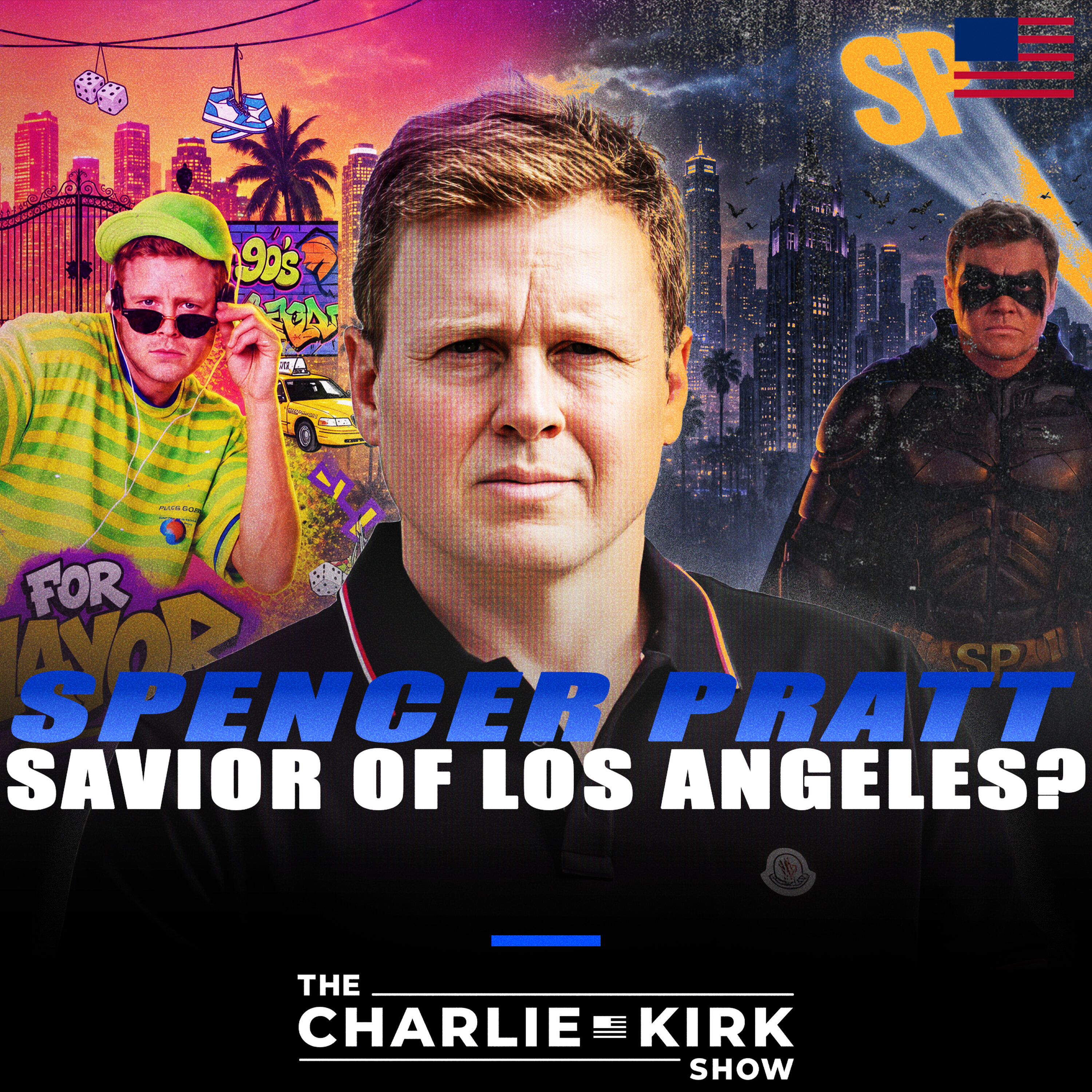
A lot of exciting things are going on in California. In the city of la, we're always getting contacted by people who say, can you guys get more involved in California? Can you help us save California? And usually our answer is there's not. We'll do our best. We should work hard. But we're still having you want to be pragmatic about these things, but big things are happening in Los Angeles where former reality TV star Spencer Pratt has launched an upstart bid for mayor and he's gaining ground by the day. He has great media savvy and peachy. Keenan is one of Our California fans, California experts. And she's joining our show now to talk about his run. Peachy, are you there?
- [38:22]
C
I'm here. How are you guys?
- [38:24]
D
Welcome, welcome. So let's just start with. Let's. How is Spencer shaking things up? What's it like in Los Angeles now that there's hope in this city for the first time in a while, it seems.
- [38:36]
C
Yeah. I just want to let you know that right now, as we speak, my house is filled yet again with the smell of burning forest fires. I live near Altadena and there's like another fire going on up in the mountains today. So having a little PTSD from last January. Yeah. Spencer. Spencer is so great. I have never actually personally met him, but I feel like I know him because he went to Crossroads, which is like a super kind of fancy, private, very progressive high school in Santa Monica where all of my in laws went. I know a ton of people who went to Crossroads who were actually in his class in Crossroads and a lot of my family have been going to his father, who's a dentist for years. So I feel like I know Spencer very well and I'm super excited about his impending victory.
- [39:22]
B
Oh, wow.
- [39:23]
D
Hey, that's confidence.
- [39:24]
B
We had a technical difficulty. I heard the second half of what you said. We've got so many clips and really so peachy. People don't know this, but you have a. Very well, they. Some people know this, but your background in the entertainment industry, you did work with like Star wars on the, you know, I've. I know bits and pieces of your CV here. I mean, I have to say, and I said this on X and it seemed to go around. I think he is the best campaigner of his generation, like, bar none, without a doubt. The question is, will it matter? But let's go in to some of his clips here and his campaign ads because they're really striking a note. They're really resonating with people across the political spectrum, which is very interesting. Which you need to do in la. Literally. I could grab. It's a grab bag. How about the LEGO takeoff of everything is awful? Although it says 3 and there's 2, 3. So we'll play slot 3 and see what we get here.
- [40:25]
D
Everything is awful
- [40:29]
B
Everything is hell when
- [40:30]
G
you're part of the scene Caring back
- [40:35]
D
and burning down our street.
- [40:45]
B
Everything is on and she's killing our dreams like we've never seen this before.
- [40:54]
C
Yeah. And I, you know, a lot of the AI ads that are being made are actually being done by kind of fans. I don't really believe his, his, his main campaign video team is doing those. They're doing all the shots with Spencer and all the drone stuff, but these are just being developed sort of by grassroots creators on social media. And there's just, there's more than one. There's a lot of them and doing so many. And they're, they're really groundbreaking.
- [41:17]
B
Yeah, well, and I would just make the argument that if, even if he's not creating them, it's even more a testament to just how effective his campaign is being. Because when you inspect inspire a legion of like, you know, die hard fans out there that spend their time creating videos on your behalf, it underscores the enthusiasm for your campaign.
- [41:35]
C
Yeah. And a lot of the creators are locals. They live here. And so they are, they have so much stake in this. And anyone who lives in LA or around the cities, you know, around LA City, like Santa Monica, West Hollywood, where I am in Pasadena, we're all affected by what happens in, in LA city. And so they just open their eyes. And for years now, people have been complaining that there's, you know, a tent on fire outside their $3 million Venice home, or they took their kids to the beach and there was needles in the sand. I mean, I've seen all of these things. They've been chased in parking lots. I have had to step over bodies. You know, you drive by scenes that look like Gaza. It's, it's for years, years and years and years since I was a little kid. And so these are creators and filmmakers who are just finally, they finally have someone that is giving them hope and giving them a motivation to like unleash their creativity.
- [42:29]
B
So there's this whole controversy about the fact that he's not actually staying in the Airstream. Okay. On his burned down land. So again, backstory of Spencer Pratt, his house gets burned down and the Palisades fire. I remember peachy having you on with Charlie with. When the fires were raging in East Los Angeles area near your house and you were like on the block giving us a play by play which buildings had just burned down. I mean, it was wild stuff. So this inspires him to get in this race. He says he's living in the Airstream and this is his new home. But turns out he's at the Bel Air Hotel and people are making a big stink about this. But what I love is that he,
- [43:07]
D
how he took advantage of this.
- [43:08]
B
He took advantage of it and he came out with this banger. I love it. Stop. 15.
- [43:16]
G
Now this is a story all about how my life got flipped, turned upside down, and I had to take a minute to run for mayor. I'll tell you how I became the prince of a town called Bel Air in West Los Angeles. Palisades in my backyard is where I spent most of my days meeting hummingbirds, relaxing all cool, avoiding all the bums outside of the school. When a couple politicians were up to no good, start a man making trouble in my neighborhood, I got at one little fire. My mom got scared and said, you're moving in with Harvey Levin in Bel Air. I moved to my kingdom. I was finally there to sit on my throne as a prince of Bel Air.
- [43:52]
B
It's just so good. I mean, it's leaning into it. And, you know, he's got the truth on his side. I think that is the big thing here. It's like whether he lives in an Airstream, cause his house got burned down, or it gets doxed and then he gets death threats, which we can relate to here. And so he has to go live at a hotel. What does it matter? The fact is, his house burned down. I mean, it's an unassailable sort of origin story. What are you gonna do with it, right?
- [44:17]
C
I mean, they want him to be in a tent with his children, like in the ash. And the Pacific Palisades is still ash. It's still. There's being framed. So, yeah, that is his house. And to penalize him for not, like, living in the dirt with no running water, like with his kids, like, to penalize him for that is just. I mean, it's. You know, they have nothing to do with.
- [44:38]
B
By the way, peachy. He said as much. He said, I couldn't even get the sewer line hooked up to my Airstream. I couldn't get power to the Airstream. And not only that, all the trees burned down. And he was like. He told tmz, he's like, I could get sniped. I'm getting death threats. Like, there's nothing obscuring the view to my Airstream. People, if they wanted to hurt me, they could. So, yeah, like, I have to go live at a hotel right now because I have no home. And I was just like, you know, and you could see. You could see tmz, like, the body language go like, oh, that's a pretty good point. And I feel bad for the question about it.
- [45:12]
C
They've got nothing else.
- [45:13]
B
These are just no.
- [45:15]
C
Or Karen's talking points. Yeah, look, looking at this footage, I mean, I grew up on Via Delapaz in, you know, when I was little in the Palisades, and it. That house burned down, obviously, and it's just. It's so sad. I have family who were also burned out, and they live. They moved to Manhattan Beach. They're rebuilding, and obviously it's going to take God knows how long. You know, with Karen Bass in charge of giving out permits. And they. I read that people who did move out of Pacific Palisades are not getting their ballots. Like, they're not considering you a Palisades resident because you had to flee to another.
- [45:52]
B
And that is LA proper. That is LA city. Yes.
- [45:56]
C
Manhattan beach is.
- [45:57]
B
Well, no. Yeah, Palisade. The Palisades is LA proper.
- [46:01]
C
Palisades.
- [46:02]
B
It's not part of Santa Monica. Yeah, that's right. So when you talked to Jake Tapper In 2023, you said that your goal was to end street homelessness in LA by 2026. It's now 2026, and we haven't ended it. We have not ended it, and we're
- [46:19]
E
not close to ending it. How are you so off?
- [46:22]
G
Well, basically, when I said that it was at the beginning of my term, I am very committed to achieving that goal. I didn't anticipate some of the bureaucratic barriers that I would experience, but I am prepared to take those on now.
- [46:39]
B
But you promised that it would go away 100%, and it's only gone down about 17.6%. Right. So why should people trust you that you're going to be able to get to the hundred?
- [46:50]
G
Because let me just tell you, for the first time, we've had a decrease at all.
- [46:56]
B
So Peachy Keenan, L.A. resident, L.A area resident and childhood home in the Pacific Palisades where Spencer Pratt's home burned down. Now, famously, homelessness has taken on a huge issue here. And I want to get back to that voter piece that you just mentioned, because I think it's key. But homelessness, Talk about it. If you're just a normal Angeleno, like, are you really worked up about homelessness?
- [47:19]
C
Yeah, it's the number one issue. And not just in LA city, but even here in Pasadena. It's kind of become a mini skid row. You see people outside any, like, Metro station, they're just loaded up on every bus bench, passed out, unconscious on the street. Sometimes you'll even see them, like, bent over in that, like, fentanyl frozen pose. It's absolutely everywhere. It's even creeping into places like Beverly Hills, which never used to have it. The Palisades was one of these places that didn't have any Homeless. It was like this pristine, like utopia because we're kind of out of the way, it's a little bit hard to get to. And so of course now it's going, you know, now that they, they burned it down for. I wonder why. It's something that affects every single person no matter where you are basically in the, in LA county. And as that report just came out from, from Chris Rufo and Kenneth Schriff, that 70%, 80% are out of state homeless people. And I've known this for years. I've seen videos of people going around skid row interviewing homeless people. Where are you from? Where are you from? They're all from nowhere. No one grew up here. They come here because you can be homeless here very easily. You can get access to drugs, free needles, handouts, food, money, checks, the weather and the weather. Yeah, you can't be homeless as easily in, you know, Montana or Wyoming or even Texas. And it's pleasant here all the time. You can live outdoors year round. And that's why Santa Monica at the beach now is basically an open air drug camp. Ocean Avenue, these beautiful hotels are now overrun. You can't even walk down by the pier really anymore. Yeah. And that's all over.
- [48:52]
B
Apocalyptic. So Spencer Pratt has another campaign ad on the homelessness crisis. Let's play it.
- [48:59]
C
Sat 18, Los Angeles, losing tens of thousands of residents. One of the biggest population drops in the nation.
- [49:07]
E
Man killed near the LA Convention Center.
- [49:09]
B
Billions in homeless funds were poorly tracked.
- [49:11]
G
It's far more sexy to talk about all these billions of dollars that are missing and blah, blah, blah. The system in Los Angeles isn't struggling, it's fundamentally broken. The city failed everyone. The insurance companies failed everyone. Mothers that want to go to the park, that don't want to inhale fentanyl smoke from the 70,000 and drug addicts that the mayor currently lets live on our streets.
- [49:36]
B
If you're not shocked by what you
- [49:38]
C
see, then I don't know what you would be shocked by.
- [49:41]
G
Just giving you needles and pipes on the street and dropping off a sandwich is not helping these people.
- [49:49]
B
So I think he's getting right to the crux of the issue and he's just nailing it every, every which way you can think of. But then the question then becomes peachy, can he win? Can he actually win? President Trump was asked about this and we'll play that clip, but your take, can he actually win Los Angeles?
- [50:09]
C
I mean, when he first announced, everyone was like, well, that'd be great. But obviously LA City went, I think 80% to Kamala, 20% to Trump. So there are a lot of Trump supporters here, but we're so outnumbered. So it's like, how can he win? But Spencer's been doing something really smart. He's playing it totally nonpartisan, and he's making this a local issue. Louisiana issues transcend politics. Like, left and right don't matter, like, at all. It's about quality of life, safety, your family, you know, your ability to just, like, walk down the street. And so that's very smart what he's doing. And so, yes, I think he can win. Nithya Raman fell apart in the debate. We all kind of saw right through her. She's actually. I can't believe I'm saying this. Too progressive for Los Angeles. And then you have this quiet Pratt vote, which you have, like, you know, the. The sort of, like, you know, Louisiana wealthy people, the trophy wives of Brentwood. You know, these are people who love Kamala Harris. They probably voted for Hillary Clinton. They hate Trump, but they. More than that, they hate that they have to see a guy with his pants down, like, taking a crap outside their children's elementary school. So it's possible that these women are like, that ad that they should. They. He did or his friends did. The AI. Like, the yoga mom ad of, like, we're voting for Pratt. Yeah, I think that's absolutely real. And now the question is, are there enough of them to defeat? Karen Bass is like, SEIU thug army of ballad harvesters, which is why she kind of stole it from Rick Caruso.
- [51:43]
D
Do you think there's. You say LA has particular aspects, but do you think there's any lessons we could draw from Spencer's success beyond just the, you know, doesn't, you know, plays it nonpartisan for other cities in the US because there are a lot of blue cities that are very badly run that people are fleeing, but they're Democrat, and we've kind of given up on a lot of them. And it would be good for conservatives if we can have better governance in our big cities, because they're America's big cities.
- [52:12]
C
Yeah, it's so sad. It would be so easy to turn these places around. I mean, you could clean up the homeless here in, like, a few weeks. You just have to have. You just have to literally enforce the law. Just the way Trump suddenly stopped all border crossings. You just have to enforce the law. I think it's about candidates, and Spencer's is, like, the perfect kind of candidate that can kind of transcend, you know, party lines and Be really engaging, great on tv, funny, charisma, personality. It really comes down to finding those kinds of people who don't come across as these like stiff, you know, politician type people who are just people just don't want those right now. They want real people with real lived experience and who aren't these and also don't have a background of corruption and failure and high speed trains to nowhere who are like fresh and who have like been been actually victimized by these, by these crazy urban city policies. And so there are a lot of lessons. It would be so great because we've seen mom dummy and like mom dummy, little mom dummies popping up like nipp popping up. It would be so great to see an army of Spencer Pratt types. Yeah, well, I went to Chicago and New York and all these other cities.
- [53:17]
B
Peachy. So this morning Trump was asked about Spencer Pratt's campaign.
- [53:21]
C
Sod 8 true Spencer Pratt. Do you see yourself in him at all? A former reality TV star.
- [53:27]
F
I'd like to see him do well. He's a character. He's doing well.
- [53:30]
B
I don't know if you have a rigged vote out there.
- [53:33]
F
That's the problem. The votes are rigged.
- [53:35]
B
Well, and he says in between we cut it. But he says, I heard he's maga. I heard he's really maga. You heard he's big spin support Trump supporter is can he win? If that becomes the messaging from the
- [53:45]
C
left, it already is. Like Nithy is already calling him you mega extremist. And he did this like, ooh, like, you know, scary.
- [53:53]
B
Yeah, yeah.
- [53:55]
C
From the, yeah, from the debate. And so I think, you know, it depends. You're never going to get the, like ideological, the crazy ones, the blue hairs. You're never going to, you're never going to get them. You could have a homeless person burned there, like live in their house and burn it down. But I think he absolutely is likely to win.
- [54:10]
B
Whoa, that would be huge. That'd be tectonic. Peachy Canaan, follow her. She's amazing. Thank you Peachy for making the time. God bless you. We'll see you soon.
- [54:19]
C
Thanks, guys.
- [54:22]
B
I want to talk to you about an issue so many Americans face and that's health insurance. There's an organization I really, really appreciate called Christian Healthcare Ministries. CHM is a faith based alternative to health insurance. And this is real stuff. Folks like, you gotta listen in. With chm, you're not paying into a company's profit margin. You're investing in a community with less overhead than the competition. You get reliable Support through the giving and prayer of fellow members. Members contribute every month to help pay for each other's medical bills, allowing believers to afford the care they need. Because they're not insurance. You get access to your preferred doctor or hospital without network restrictions. You heard that right. If you want to see massive savings in your healthcare budget, CHM has four low cost programs for every stage of life, starting at just $115 a month. Plus you can enroll or switch your program at any time. See why so many believers are taking a leap of faith? Start today by visiting chministries.com and use promo code Charlie for a 50% credit towards your first month. That's chministries.org Charlie and use promo code Charlie. All right, we have a special treat for you today. Dr. Hutz Hertzberg runs Turning Point Education. And you are somebody that goes way back with Charlie. And when we were starting our education initiative, you were the first guy he thought of. And you have been leading this charge from the very beginning with us, Turning Point Education. And there's so much news that you guys are making and I wanted our audience to hear about it because we, and I'll be honest, sometimes I take my off the ball on the education front. And we had a couple guests that just really freaked me out about what's going on with these teachers unions, what's going on with the way they spend, and it relit a fire inside of me to refocus on that. And that's why you're here. So just give us the broad strokes. Why does Turning Point Education exist in the first place?
- [56:30]
F
Well, thank you so much, Andrew. Great to be with you. And Blake. Yeah. I will tell you because Charlie, as both you guys in the audience know, was able to see beyond the horizon and he was able to see that, you know, as we all know, Charlie started on the college campuses. His last day on this planet was on a college campus. But Charlie began to see what some of the others of us were beginning to see. And that is the indoctrination of woke ideologies was happening long before students were coming on college campuses. Remember talking with a professional acquaintance, Dr. George, Robert George, at Princeton University a couple years ago. And I was actually, I did some work at Princeton And I said, Dr. George, what have you noticed different in your. Then it was 39 years. It's probably more like 41, 42, 43 years now. So four years ago. And he said, the thing that I noticed that is different with students today than when I first came here is that they're already coming indoctrinated. It used to be they came to Princeton to get indoctrinated. Now they're already getting indoctrinated in high school and junior high. We would say indoctrination starts in grade school and even preschool. So Charlie was seeing that, was seeing that if we're going to get this next generation, we have to go younger. And I was beginning to see the same thing in my own life. I was in Christian higher education. Never anything lower than working with a freshman in high school or a freshman in college. But I realized the same thing, that I needed to go younger. So I made the intentional decision to go younger. And I ended up being president of a K12 school in the northern suburbs of Chicago. And lo and behold, that was the school that Charlie attended third, fourth, and fifth grade. And he was gone by the time I got there. But that's how we connected, and that's how he knew that I existed, and that's how I knew that Charlie existed.
- [58:24]
B
And I love that story. Charlie would often tell it when he was introducing you on stage and things like that. So you've got so many initiatives here, though. You've got. We've got the Educators Summit, we've got Turning Point Education Prep Year. I know we got to talk about this Education Freedom Tax Credit. So take it as you will because they're all super important. And by the way, your speaker list on this. Where did I see this? Right here. Yeah, this you've got. I don't even know how you got George Barna, Al Mohler, John Stonestreet, Megan Basham, Riley Gaines, Congresswoman Mary Miller, Ben Schetler, Ryan Walters. You got yourself Bel Federer, John Amachukwu. I mean, you just got an all star cast. You got so many confirmed speakers to this Educator Summit. When is it? And who in the audience should think about attending?
- [59:17]
F
Yeah, great question. So this is our fifth annual Educator Summit. Already we're just a little over four years old and we're already at our fifth Educator Summit, which is great this year. Suburban Chicago, Lincolnshire, Illinois. Interesting point of trivia here, Blake, that Lincolnshire was the second Turning Point headquarters started in Lamont, and then Lincolnshire was the second before Charlie moved down to Arizona, interestingly. But we're at the Marriott lincolnshire Resort and June 16 to 19.
- [59:50]
B
And this is June 16 to 19 in Lincolnshire, Illinois.
- [59:54]
F
Correct? Absolutely.
- [59:55]
B
So who should consider going?
- [59:56]
F
You know, in the years that we've been doing this, which, again, as I said, this is our fifth year, we have had a great mix of public school Teachers and administrators, maybe about a third, a third Christian school, private school, teachers and administrators, about a third or so, maybe 40% homeschooling parents. And then we have some other folks, we have some pastors, we have some school board members, we have people that are interested in being education advocates. So I would say in answer to your question, is anybody who's interested in making a difference in the field of education and even more specifically making a difference for the lives of these children that you know, are currently being indoctrinated if they're in the public government, school sector and want to make a, be a voice and help make a difference in the world of education.
- [60:44]
B
So I have spoken with a number of these kind of startup schools as well. There's a big, big community of startup schools in the Arizona state of Arizona because of the child tax credit that was passed. We have full school choice in Arizona. It's amazing. If you want to break the back of the teachers union, you break their monopoly on education. By the way, they're fighting that like crazy. And we're going to get it. We're going to do some highlight that of how. So Arizona has this great school choice pass it under Governor Ducey. And now they're trying, they got all these ballot referendums and things like this to crawl like claw back power over students education and it's a total disaster. It's perfect the way it is right now and they need to get their hands out of the cookie jar. They want their money back because there's money per pupil in most states. All right, so that's one thing. Okay, now you've got this prep year, turning point education prep year. Who should be considered? Who needs to hear about this and what is it?
- [61:44]
F
Well, prep year is one of our major initiatives and it's our newest initiative. We have five major things that we're doing, Andrew. One is we're starting schools across the country. The second is the Educator Summit that we've just talked about. And by the way, any of your listeners, viewers today, if they're interested, they can go to our website, turningpointed.com it's all one word, turningpointed.com and if they enter the code turning ck show, they get a 30% discount off of the price.
- [62:15]
B
No kidding. I didn't even know they were doing that. Okay, turningpointed.com Yep. And then what's the code again? It's CK show and they get 30% off a prep year. Wow.
- [62:27]
F
30% off of the educator.
- [62:28]
B
Oh, Educator Summit. Okay. I'm so Sorry.
- [62:30]
F
Yeah.
- [62:30]
B
Okay, great.
- [62:30]
F
Yeah, the prep year, that's. That's a deal in itself. But I just wanted to mention that because.
- [62:34]
B
No, I'm glad you did.
- [62:36]
F
The price is already unbelievably cheap. It's $50, so it's 30% off of $50.
- [62:42]
B
Okay, perfect.
- [62:43]
F
And so that would be a great opportunity to take advantage of all these wonderful speakers that you mentioned. And that includes meals, programming costs, and the hotel rooms are already greatly reduced.
- [62:54]
B
We've got a block.
- [62:55]
F
Yeah. So prep year, though, that is one of our major initiatives. We're excited about it. We launched this past year down in Fort Worth, Texas. Interestingly, from here, I'm literally leaving here and I'm flying down to Fort Worth, Texas for graduation. We've had these students for nine months. It's been a wonderful nine months in this kind of pilot launch. And basically what it is, is post high school prior to going on to the next stage of life. So many students today, unlike when I graduated from high school, everybody went to college. But today, kids are actually asking the question, why should I go to college? Even my own daughter, who's 16, saying, you know, I'm not sure I'm going to go to college. Why should I go to college? I think it's healthy that students are actually asking that question. And of course, Charlie was leading the charge about, you know, college being a ripoff and a scam.
- [63:42]
B
College scam. They got the book back here somewhere.
- [63:44]
F
Right, right. And so I know that his influence was huge with these students, but we thought. And I went to Charlie and I said, charlie, you're always talking about kids not going to college. You know, I understand, we're in agreement on that, but design a program that will prepare them for life irrespective of whether they go on to college or go into the military, the trades, the arts, entrepreneurship, become a homemaker. So we designed a nine month intensive leadership development program where we studied the great book, which of course is the Bible. The great books of Western civilization. Blake, you would appreciate that. The great documents of our country, with great speakers and mentors and experiences that we give these kids. It's an incredible.
- [64:23]
B
And you also say immersive, skill based experience. Experiences too.
- [64:26]
F
Yes, because we want to give them practical skills that are going to serve them the rest of life. So we teach them personal finance, we teach them firearms training, we teach them how to cook. But those are things in the afternoon. Make no mistake, it is a hardcore academic program, but it's also very practically oriented.
- [64:46]
B
Blake, you had a question?
- [64:47]
D
Well, I was thinking, you mentioned great books. Do you have some good examples? Like, what are some of the highlights of that?
- [64:52]
F
Well, you know, the great Western classics that you would study, the philosophers, Aristotle, Plato, Plato's Republic, Descartes, some of those works, and then other great works of literature, some of Shakespeare and others that are regarded as really core Western literature. And of course, we can't do it all. But so many of the kids coming out today, they have no training in biblical worldview. They have no understanding of classical literature at all. They don't get that. They get social studies.
- [65:22]
D
I just as an anecdote. So I have a friend who is still in Hanover, where I went to school at Durban. This is an Ivy League school. And he says, kids, they come in, they're really fried. AI, he says, has made things really bad. So, for example, you at least used to have to think up questions to ask, even if you hadn't read the book. Now they ask AI to generate the questions for them because they can't even handle that level of thought. Tell me what to ask about this in class.
- [65:47]
B
If you want to be humbled. And I'd actually be curious how you do, Blake, because you're probably one of the few I know that would do fairly well. But, like, if you want to be humbled, go check out, like, Oxford, their, their freshman initiation, like, essays, questions from, like, 1900.
- [66:03]
E
Yeah.
- [66:04]
B
And the, the level of understanding of our classical literature, the classical canon of the, of Western civilization was just tremendous. I mean, it blew me away. It would blow me away every time. But we've really lost. We've really lost something. All right, so you got this big print out here. Dr. Hertzberg. Here, Dr. Hutz Hertzberg, turning Point Education, about the Education Freedom Tax Credit. Why. Why are you. Why'd you print this out? What do you want to tell people about it?
- [66:33]
F
Well, let me just say, first of all, there is so much happening in the world of education. I mean, we could talk, if we had time, about the Education Department being closed. I mean, that's big news. That's major, major department of Education that is going away. We could talk about the terrible test scores that we see almost every week with the researchers coming out. But maybe the most exciting thing is something that was a part of President Trump's big, beautiful bill that's called the Education Freedom Tax Credit. You alluded to what's happening in Arizona. Arizona has been a model to other states across the country in terms of education, tax freedom, education, credit freedom, vouchers, esa.
- [67:14]
B
It's amazing.
- [67:14]
E
It is amazing.
- [67:15]
B
Just moved here and I'm telling you, you get, I think it's 7,800, $7,500 per pupil. So your student. And so what a lot of the schools do is they'll say, well it's one to one to send your student to this school. It's $7,500 a year or 8,500. So they supplement massively the cost and you get all these classical schools popping up, these Christian schools popping up and these are business people that decide to start a school and then they bring in all these educators and I'm telling you, it's a really amazing culture that's being cultivated here.
- [67:48]
F
You know, and so many states across the country, you know, look at that and just drool. I mean people in the states, not necessarily the state governors, our state where we're located, which is in Illinois, I mean we don't even have a crumb that is anything close to this at all in our state. But I say all that just to say that in some ways because of the Education Freedom Tax credit, it's going to be somewhat moot, but not completely because this is a great start. It's not the whole enchilada. But we're so thankful that in the big beautiful bill, President Trump included a provision. It's called the Education Freedom Tax Credit and it's a dollar to dollar tax credit. So you can give up to $1,700, designate that to a designated scholarship granting organization. They're called SGOs. And we've already identified one with turning point that we're going to be working with with our schools and parents. And these parents can make a gift through the SGO to directly benefit their child, their school. And it's not just for tuition. It can be for technology, it can be for books, it can be for supplies.
- [68:51]
B
So if I have a student and I want to send my child to a private school, I can go onto turningpoint education website, turningpointed.com and maybe not now, but you'll have an SGO there that you can work with. They'll send the money to your kids school. So that could intend, that could help with tuition.
- [69:13]
F
100%. Okay, 100%. And actually and just to give the name of the SGO is ACE Scholarships out of Denver, Colorado. We're very excited to be working with them.
- [69:22]
B
They share, they're amazing.
- [69:23]
F
We share their values and they totally get what we're doing, we get what they're doing. But here's the tragic part again. Half the states have not opted in. I think there's actually 31 that have opted into this and then there's a few that are waffling. But states like Illinois, and you alluded to this earlier and do the teacher unions hold such sway over these states?
- [69:45]
B
I loathe the teachers unions.
- [69:47]
D
The best sign, by the way, that that education tax credit is amazing is it just drives the teachers unions berserk. They constantly are trying to get rid of this. I know, I know. They're trying to get something on the ballot right now to.
- [69:58]
B
In Arizona, they have two different bills. They're both.
- [70:01]
F
And they're both terrible.
- [70:02]
B
One's less terrible, but they're both terrible.
- [70:04]
F
Yeah, yeah. So again, this, this is now at the national level, like Arizona had been the bellwether, the lead on this. But others in other states now have had to have their own version. About 25, 26 states have some kind of form of tax credit vouchers. Now 31 states as of just a couple days ago have opted into President Trump's Education Tax Freedom Credit. The state has to opt in. But here's the part that people don't understand. Even though we live in Illinois and our governor has not opted in and he says still considering it, the only reason he'll opt in is because he just will get too much pressure. But we can still take advantage of the tax credit. But that money is going to leave the state of Illinois. So you've got hundreds, thousands of families that want to take advantage of this dollar to dollar tax credit. They go through the sgo, but their own school in our state can't benefit from it. In other words, their child's school, our child's school will not be able to benefit. But I can benefit a school in Arizona and whatever other state is participating in the program.
- [71:09]
B
So if you have grandparents watching this right now, they could take advantage of this.
- [71:14]
F
Absolutely.
- [71:15]
B
One of their grandkids in another state.
- [71:17]
F
That's exactly, exactly.
- [71:18]
B
Do we have a list of the states that have opted in? Our website. Can we get something like that?
- [71:21]
F
I'm sure we can get it. It's known as 30 probably states.
- [71:24]
D
Which states have.
- [71:25]
F
Yeah, yeah, yeah.
- [71:27]
B
A Republican governor or not.
- [71:28]
F
Yeah, that's exactly right. Now there is a couple Democratic ones. One that was a little bit surprising is the, the governor of Colorado has opted in.
- [71:35]
B
Paulus.
- [71:36]
F
Yeah. And there's reasons why he's doing that. But we hope eventually that the pressure will be so great that all the states will opt in because again, the governor, the schools are losing money.
- [71:49]
B
Yeah. Well, it's insane. I mean, can you imagine turning down money just because you're so beholden to the teachers unions? I'm telling you, the teachers union. We got to break the back of the teachers unions. They're ruining so much. It's like teachers unions, feminism, mass migration. It's like there's like a top five things that are ruining the country, and it's one of them. Dr. Hutz, thank you so much for coming on.
- [72:10]
F
Thank you.
- [72:11]
B
Great work that you're doing at Turning Point Education. Let's keep going.
- [72:14]
F
Thank you so much. Appreciate it. Thank you.
- [72:21]
B
For more on many of these stories
- [72:22]
G
and news you can Trust, go to charliekirk.com.