Loading summary
Transcript894 lines
- [00:00]
Charlie Kirk
Hey everybody, Charlie Kirk here live from the Bitcoin.com studio on the Charlie Kirk Show. My full annotated commentary on my conversation with Bill Maher. It's a very important conversation. There are some things I wanted to add on top of it. So I think you're going to enjoy this and maybe you have a long road trip. You got a big workout ahead of you. Keep those earbuds in and listen to this annotation I had of my conversation with Bill Maher. As always, you can email me freedomcharliekirk.com, text this to your friends and get involved with the very important turning point USA@tpusa.com, that is tpusa.com Buckle up everybody. Here we go.
- [00:36]
Bill Maher
Charlie, what you've done is incredible here. Maybe Charlie Kirk is on the college campus. I want you to know we are lucky to have Charlie Kirk. Charlie Kirk's running the White House, folks. I want to thank Charlie. He's an incredible guy. His spirit, his love of this country. He's done an amazing job building one of the most powerful youth organizations ever created, Turning Point usa.
- [00:57]
Charlie Kirk
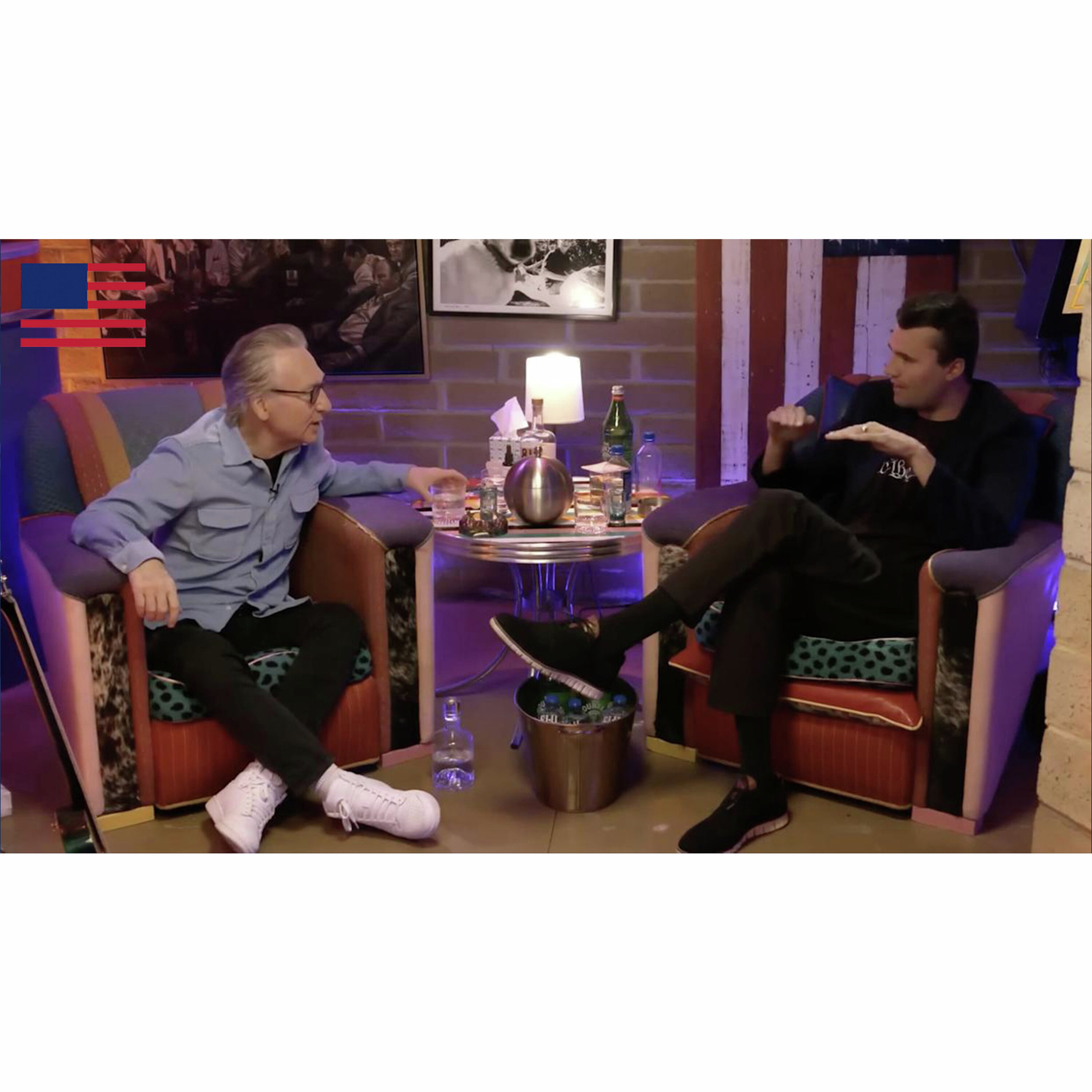
We will not embrace the ideas that have destroyed countries, destroyed lives, and we are going to fight for freedom on campuses across the country. That's why we are here. Noble Gold Investments is the official gold sponsor of the Charlie Kirk Show, a company that specializes in gold IRAs and physical delivery of precious metals. Learn how you could protect your wealth with Noble gold investments@noblegoldinvestments.com that is noblegold investments.com it's where I buy all of my gold. Go to noblegoldinvestments.com okay everybody, this conversation is quite interesting. It is where I sat down with Bill Maher at Club Random on his program. Let me first say, Bill treated me great. It was quite the conversation and he was very pleasant, albeit at times rather crude, but very respectful. I do want to make sure you understand some of the, let's just say, environment around this conversation. Bill is smoking something. So just so you know, I don't like cigarettes, I don't like cigar smoke and I certainly don't like marijuana smoke. But throughout the entire conversation, Bill Maher was smoking weed. Didn't necessarily make it easier for me to be able to have this conversation, but I decided to just kind of roll with the punches. And whether or not I got second hand high is that still is up for debate. I will say though that there's no excuses. Sometimes if you're a football player, you gotta play in the Snow. Sometimes if you're a baseball player, you have to play in the wind and the rain. Sometimes if you're a political commentator fighting for Jesus and fighting for liberty and fighting for America, you gotta play in the weed. And so we talk about a lot of different stuff throughout this conversation. I'm going to break this up and tell you, at certain moments, I feel as if I should have injected myself more. Some points that I wish I would have made, and honestly, some points that I think I did pretty well at. And so throughout this conversation with Bill Maher, I'm going to kind of interject and show you that, ooh, I wish I would have made this point about the resurrection, or I wish I would have said this about President Trump, or I wish I would have said this about Jesus Christ, or I wish I would have said xyz. And you'll see that. So here it is. And just so you also know, there was no really introduction. They didn't even tell me that we were rolling. I was just sitting there on set and Bill Maher appears. And the podcast begins. So here it is, my appearance on Club Random. And this might be the first of many conversations with Bill Maher. Enjoy.
- [03:34]
Bill Maher
So you don't think any people are, like, born, quote, unquote, in the wrong body?
- [03:38]
Unknown
No, I don't agree. No, I think people might think they are Club Random. There's a book of the Bible I think you'd love.
- [03:44]
Bill Maher
What?
- [03:45]
Unknown
Song of Solomon.
- [03:45]
Bill Maher
Song of Solomon. Course we stills in Nash.
- [03:49]
Unknown
Song of Solomon's all about sex.
- [03:54]
Bill Maher
Charlie Kirk.
- [03:55]
Unknown
Here I am here.
- [03:57]
Bill Maher
Kirk. Reporting for duty.
- [03:59]
Unknown
That's what they call me.
- [04:00]
Bill Maher
How are you?
- [04:01]
Unknown
Nice to meet you. Thanks for having us.
- [04:03]
Bill Maher
Us?
- [04:03]
Unknown
Well, me.
- [04:06]
Bill Maher
Is there someone with you? No.
- [04:07]
Unknown
Thanks for having me.
- [04:08]
Bill Maher
You're not expecting trouble, are you? Not quite trouble with security.
- [04:12]
Unknown
Unfortunately.
- [04:13]
Bill Maher
You do?
- [04:14]
Unknown
Yeah.
- [04:15]
Charlie Kirk
Wow.
- [04:16]
Bill Maher
Like, what kind?
- [04:17]
Unknown
You know, security.
- [04:19]
Bill Maher
Like bodyguards.
- [04:20]
Unknown
Yeah.
- [04:21]
Bill Maher
You know, when I went to Europe in 2015, I had like three and two Israeli bodyguards. And my security person. It was right after the. One of the Islamic unfortunate incidents. Was it the Paris. There was two. There was two. Two big things at that time. Paris, right. The. The.
- [04:44]
Unknown
What year was this?
- [04:44]
Bill Maher
2015.
- [04:45]
Unknown
Okay. So that would have been the Charlie Hebdo situation.
- [04:48]
Bill Maher
Certainly was the year for calling. Yes, I think.
- [04:51]
Unknown
And then there was the tolerant Muslim, you know.
- [04:53]
Bill Maher
Yes. And, you know, I've been very.
- [04:56]
Unknown
You've been extraordinary on that.
- [04:57]
Bill Maher
Thank you. So we were, like, extraordinary to you, but we were like, very. And like, I pictured this. There's. I never toured Europe before as A comic, you know, and there are places you can, where they speak English. It was fun, but it also made it a vacation. I took my girl I was with at the time. I pictured this bucolic, beautiful, European springtime vacation. Of course, it was wedged between the two giant Israeli bodyguards the whole way.
- [05:24]
Unknown
If you want security, the Israelis know what they're doing.
- [05:26]
Bill Maher
Exactly. So it was not the vacation I, I, I planned, but. Well, I'm sorry that you have to do that, but that's the price of fame. And boy, you're you, I mean, man, you're everywhere. You. We have the new it boy podcast. No, it's true.
- [05:42]
Unknown
We, we have different jihadis that want to kill me. The purple haired jihadis, the, the, the woke guys.
- [05:46]
Bill Maher
Well, they want, they kill me. They want to kill me just as bad, probably. Oh, they really do.
- [05:51]
Unknown
No, you, you've been very outspoken on the woke stuff, big time. Oh, yes.
- [05:54]
Bill Maher
I mean, and, and they just, the way within a religion, they hate their own apostates more. I would say they hate me more because I'm supposed to like, get on the short bus to crazy town with them and I won't. And yet I'm still a liberal and still like, you know, I mean, we probably could argue all day about Donald Trump and what he's doing, which I'm not down with. But, you know, it's always the people who are closest who think, oh, gosh, you shouldn't have, you're a traitor. Somehow we don't go along with it.
- [06:31]
Unknown
Because they thought you were one of.
- [06:32]
Bill Maher
Them and that I am one of them. They're not one of me. I'm okay. It's the liberals who have.
- [06:37]
Unknown
So they've left you, not you left.
- [06:39]
Bill Maher
Well, I feel like there's liberal and woke are two completely different things. It was a theme of my last standup special that I just did a few months ago. And it's basically, I mean, it wasn't the whole special, of course, but it was a large part of it devoted to that, to proving that case that, you know, what liberals believe woke is something completely different. It's very often the opposite of it. You know, liberalism is let's live in a colorblind society. That's the goal. Woke's goal is we see race everywhere in obsession. Yes. Okay, so that's not liberal. You change. Liberal is. There are two state solution. Woke is river to the sea. Okay, those are. So just don't take my word and say you're that you took this and took it to you. Got off the F train, you fell asleep and you got off the 20 stops too far. And don't blame me for that.
- [07:32]
Charlie Kirk
Okay. And so then we dive into, of course, the topic of weed and alcohol. And I want to reiterate, I was a guest on his show. I did not want to come across as overly aggressive. I honestly wanted to get to know Bill Maher. Thought he's done a great job speaking out against the woke. He's a rare free speech liberal despite our firm disagreements on many things political and spiritual. And so here we have a discussion about marijuana and alcohol. And the point I so badly wanted to make, but I decided not to because in the spirit of being polite, is that his perspective is like, hey, why can't I do weed if it doesn't impact somebody else? The irony is that it kind of was impacting me because I had to smell him doing weed there. But I decided not to make that point in the pursuit of being polite and trying to be magnanimous, albeit, look, there's so much about marijuana that does not get discussed. It could be really, really bad for your brain. It could be increased depression, increase anxiety, a lot of problems with it. But hey, if that's what you want to do, then that's what you want to do. I will say though, it kind of invalidates one's argument if you say it's not impacting somebody else while you're smoking.
- [08:43]
Unknown
Weed basically right next to somebody.
- [08:46]
Bill Maher
Drink?
- [08:46]
Unknown
No, I'm good, thank you.
- [08:47]
Bill Maher
You don't drink?
- [08:48]
Unknown
No.
- [08:49]
Bill Maher
Or smoke pot?
- [08:50]
Unknown
No.
- [08:51]
Bill Maher
And you're married and super Christian. We're going to get along great.
- [08:53]
Unknown
You know, this is going to just be perfect.
- [08:56]
Bill Maher
But can I just ask because I want to find out a lot about you because you're obviously a super bright guy, but you do think that I have the right to live completely opposite than you do.
- [09:07]
Unknown
I think you can get as drunk as you'd like.
- [09:09]
Bill Maher
And you're, you're that kind of an American, right? You're not, you're not forcing your opinions.
- [09:15]
Unknown
As I'm not here to say you can't. What are you? No.
- [09:18]
Bill Maher
Okay, so you think pot should be legal?
- [09:20]
Unknown
That's a, That's a complicated. I have a very unpopular view on pot. You know, can I tell you my case on pot?
- [09:27]
Bill Maher
Please do.
- [09:28]
Unknown
It's not the depression that it might be causing or the fact that might be hurting kids brains.
- [09:33]
Bill Maher
It's.
- [09:34]
Unknown
It's the smell, it's the stench that drives me crazy.
- [09:37]
Bill Maher
Yeah, it's not hurting their brains. I mean, Kids shouldn't do it. Of course kids shouldn't. It definitely hurt. Didn't hurt my brain.
- [09:42]
Unknown
But let me ask, do you think that more, more teenagers are doing pot today or that before legalization or after legalization, do you think usage rates are going up or down? I don't know the answer.
- [09:53]
Bill Maher
Oh, you'll be fascinated by this because, you know, I'm not married, so I go out, so sometimes I'm out with like people who are a great deal younger than me. I don't know how they get in my group, but they do. And so I've been to sometimes parties, like the Hollywood parties, and this is probably not most of America exactly this way, but I wouldn't be surprised if it's that different. And first of all, in this town, it's all run by like the Nepo babies. The Nepo babies, the trust fund kids. There's all these little funny two year.
- [10:23]
Unknown
Old boys, the JB Pritzker types.
- [10:26]
Charlie Kirk
Well, I'm kidding.
- [10:27]
Bill Maher
No, no, I'm sure I know who you mean. The governor of Illinois.
- [10:30]
Charlie Kirk
She inherited the Hyatt.
- [10:31]
Bill Maher
Oh, sure, we invented Nepo baby out here. But yes, it's everywhere now, even on the Lakers.
- [10:40]
Unknown
Hey, that, that's, that's real privilege there, you know, you got some privilege if you can get.
- [10:44]
Bill Maher
Well, okay, I don't want, I want LeBron mad at me like he is at my friend Stephen A. But I mean, that is, I, you know, but the point is that when you go out to these, I've been to these parties where like, it's a bunch of 22 year old kids and none of them are smoking pot. Why, they're on real drugs, pot. So like my generation, it's like I couldn't find pot at one of these parties. I was the only, they were asking me for it. The few kids, they're all, they take.
- [11:16]
Unknown
This, this, they've got psychedelics, mushrooms, lsd.
- [11:19]
Bill Maher
Okay, oh, ketamine, whatever.
- [11:21]
Unknown
Ketamine, that, that has some medicinal property, but not at a party.
- [11:25]
Bill Maher
They're all, it's all ingested before they even leave the house. So that's where the good news, parents, your kids aren't on pot.
- [11:34]
Unknown
Yeah, but they're, they're on way worse. I think they're on a big, big trip. So. But do you think that since we've legalized less teenagers are doing like 13, 14, 15 year olds? Because that was always the argument, right? If we legalize it, less kids would do it?
- [11:47]
Bill Maher
I don't know what 14 year olds are doing.
- [11:49]
Unknown
No, I don't know the answer, I just.
- [11:51]
Bill Maher
That's my story and I'm sticking to it.
- [11:53]
Unknown
But we can agree that kids should totally.
- [11:56]
Bill Maher
But we also should be able to agree that we shouldn't force adults to organize their lives around what kids might get into.
- [12:05]
Unknown
That's a good argument. I mean, do you think that it's.
- [12:07]
Bill Maher
I mean, you're not against porn, are you?
- [12:09]
Unknown
Well, I actually once struggled with porn. Thankfully, I'm free of that.
- [12:13]
Bill Maher
But I mean, how can you struggle with it? I mean, so easy.
- [12:17]
Unknown
Well, you could, you could grow addicted to it. I mean, it can.
- [12:20]
Bill Maher
I was kidding.
- [12:21]
Unknown
No, but I mean, yeah, I don't have that, that issue anymore, thankfully. But I would ask the question though, like, do you think since the legalization of marijuana in la it's made it a better or worse place to live or just. It hasn't changed at all?
- [12:36]
Bill Maher
It certainly hasn't changed my life.
- [12:38]
Unknown
Okay.
- [12:39]
Bill Maher
I grew up right outside here.
- [12:41]
Unknown
Do you think the quality of life has gone up or down?
- [12:44]
Bill Maher
Well, I don't know, but that's not really the relevant question isn't. Even if there is a deleterious effect, there is too many things we do and we would not use that as a reason to prescribe our basic freedoms.
- [12:57]
Unknown
Should people be able to do drugs outside like on the street or.
- [13:02]
Bill Maher
No, definitely not on the street.
- [13:04]
Unknown
Okay, so there are some limits. Of course there are limits.
- [13:07]
Bill Maher
Yes. And maybe of certain drugs or certain drugs should be by prescription as we do with pharmaceutical drugs, you know, but certainly potential is more benign than alcohol. I mean, I could give you the stats on that. We all know that. Is it health food? No, I'm not crazy like some of my hippie friends are complain trying to portray it as something that's actually good for your lungs. But I don't think it's. Well, it's a trade off. When you're an adult, you have the right to make trade offs. Trade offs is the essence of life. I'm going to have this piece of cake tonight and be a little fatter tomorrow or I'm not going to do that and feel better tomorrow. And we all make those choices on a daily basis with everything. Yes. Have I probably cut off some years of my life, maybe with pot? Who knows? I may have increased them because it helped me, it made me, certainly made me richer, made me better at my job, better at writing, better. A lot of things I like to do. So, you know, I might be living in a two bedroom apartment in Van Nuys if it wasn't for pot. And I'm probably going to live longer.
- [14:21]
Unknown
Here or who knows how successful you could have been without it.
- [14:24]
Bill Maher
That's true too. That is true too.
- [14:26]
Unknown
Do you, do you think there's any merit to the argument that the pot is. Has more THC and is more intense than it was 30, 40 years ago?
- [14:33]
Bill Maher
It's so hard.
- [14:34]
Unknown
I don't know. I hear these things and.
- [14:35]
Bill Maher
Oh, I hear those things too. And I'm sure that's true because once it became as commercialized as it has, of course you're going to try to maximize the potency of it. Just because the customer comes back. Just like a restaurant is not interested in your health, they're interested in making the food selling more product, delicious as they can and addictive. Come back to that restaurant. But it's so hard for me to tell you because I've been smoking for 50 years and I'm different. Who knows what I was thinking? I remember when I first smoked, we would just sit in the car and laugh at nothing for an hour. That doesn't happen anymore. So my guess is the pot is stronger, but my resistance is weaker.
- [15:18]
Unknown
Okay.
- [15:20]
Bill Maher
Anyway, it's, you know, people think I'm some sort of giant pothead. I've always been very circumspect about my pot smoking. I mean, I don't smoke every day. The most I smoke is right here, once a week. I like to be in party mode when I'm with someone I'm getting to know. This is one of the joys of my life. And you know, I understand that it doesn't connect with some people or make some people paranoid or something, but other people, it's just, I mean, you know, some people like a scotch and some people like blah, blah, blah. And some people like complete sobriety. If that's your, if that's your thing, that's fine. But to me, the most interesting place I can ever travel is inside my own mind. And drugs do help you get there.
- [16:08]
Unknown
Is there. Do you think all hard drugs should be illegal like heroin?
- [16:14]
Bill Maher
Illegal? No. I mean, well, heroin, is there any uses for it?
- [16:18]
Unknown
I mean, like for what San Francisco did. They pseudo legalized it, right? I mean, they said, hey, we're going to have make it easier for you to do heroin.
- [16:24]
Bill Maher
We shouldn't make it easier. That's crazy.
- [16:26]
Unknown
Where they had drug injection sites, basically. No, I know, but that's, that was a public policy position of Seattle, Portland and San Francisco.
- [16:33]
Bill Maher
That's the low lying fruit for you right now.
- [16:36]
Unknown
No, that's a question no, but, but.
- [16:38]
Bill Maher
Isn'T it I want to create a low lying fruit. Who it's like, sure, it's a right.
- [16:44]
Unknown
And it's a boundary. I want to create a boundary.
- [16:46]
Bill Maher
And you're right, you know, I mean, again, I'm for picking that fruit too. It's silly to help drug addicts be drug addicts and keep them on the street. It's stupid to keep homeless on the street.
- [16:57]
Unknown
Oh, I totally agree.
- [16:58]
Bill Maher
There's another another way. Liberals are different in the world. The liberal thing for forever was for compassion's sake, get them off the street. That's not the woke version. Their version is they're an endangered species. Don't touch them in their natural habitat, living under a river.
- [17:14]
Unknown
Let them defecate, let them do whatever they want.
- [17:16]
Bill Maher
It's their thing. And you know, I mean there should be nothing more basic than a government claiming the streets, the streets are for the citizens. Then it's not to live in. Build a barracks. I mean, why are these things, Maybe you can answer that. Why are these kind of things so difficult that you think such common sense? Build a barracks. I know homeless people say they don't want to live there. You don't have a choice. Oh, we'll get robbed there. Hire security. It's pennies on the dollar. Why is it so difficult? I feel like I with no real knowledge of this field could do it. Could just if I had people who would carry out my, I would say, okay, get me specs. I want to see a place we could build it. I want to see what the barracks looks like. I want to see who works there. Is it really in the toilets? Whatever. And somebody must be Mitt Romney, somebody who did the Olympics, somebody who could.
- [18:10]
Unknown
Come in and we know how to clean up the streets. I mean, Gavin Newsom cleaned up the streets of San Francisco and Gigi Ping showed up. I mean, it's just an act of the will. They don't want to do it.
- [18:17]
Bill Maher
Right. Like when they get the whores off the street, when the mayor is like doing one of those cleanup or like.
- [18:23]
Unknown
When the MLB All Star game goes to Seattle, all of a sudden it's America's cleanest city.
- [18:27]
Bill Maher
Right. So you're saying if we can do it that one day.
- [18:31]
Unknown
I'm saying it's an act of the will. It's all that it is. And look left woke. I won't even say left. It woke philosophy is they believe, they don't really believe in private property. And at its core, why shouldn't someone be able to defecate on the side of the street. Who are you to judge?
- [18:45]
Bill Maher
Well, that's not woke. Yes. Maybe I'm saying woke.
- [18:48]
Unknown
Not even liberal.
- [18:49]
Bill Maher
Right.
- [18:49]
Unknown
I'm making that distinction, which I think is a fair distinction.
- [18:52]
Bill Maher
That's another reason. Another one we can add to the list of woke is not liberal.
- [18:57]
Unknown
And I think left versus liberal or woke versus liberal is an important distinction.
- [19:01]
Bill Maher
Right.
- [19:01]
Unknown
I will say what makes you different is few liberals stand up to the woke, and that is few liberals are willing to stand up to woke.
- [19:08]
Bill Maher
Absolutely. And few conservatives stand up to Trump.
- [19:12]
Unknown
Fair enough. I mean, you can stand up or disagree, but I guess you could say the question, well, is Trump woke is an ideology? Is Trump an ideology? I mean, he's a person. MAGA is an ideology. But, I mean, we can. I disagree with Trump on a lot of stuff. I mean, I don't think we should go to war with Iran. I think that'd be a big mistake.
- [19:30]
Bill Maher
Also, when you get to, we're gonna send homegrown American citizens to foreign prisons.
- [19:37]
Charlie Kirk
Okay. Then we switched our conversation to the Maryland dad. Now, mind you, since I sat down with Bill Maher, a lot has happened regarding Mr. Garcia. We have learned that he has Ms. 13 tattoos on his knuckles. We have learned that he was not too kind to his wife. I believe I mentioned it in this conversation, but it has been even more emphasized in court documents. And so I decided to kind of hear Bill out here. But just to be clear, no US Citizen is being disappeared. This was a return of an illegal occupier and invader back to his country of origin, back to where he came from. And again, we have learned a lot since this episode was recorded. So I just want to emphasize that this individual Garcia, Mr. Garcia, is back in the country where he was born and where he is actually a citizen. We did not take an El Salvadorian and send him to Brazil. We did not take an El Salvadorian and send him to the Congo. We sent him back to his own country. He's not in a foreign prison. In fact, he looked rather healthy to me when the senator sat down with him. So I think Bill was a little bit off here. But in the spirit of allowing the conversation to pick up some momentum, I didn't want to be too disagreeable. I was trying to interject some facts. And again, you have to weigh these things when you're a guest on somebody's program. Do you want to just be overly disagreeable on every single point? You want to try to have the conversation gain some momentum? You Want to try to have some, you want to try to have the conversation. Get, get some flight to get off, get off the tracks a little bit or else you're just going to be disputing every micro point and then there really isn't much, much worth to that type of a conversation.
- [21:19]
Unknown
Oh, so the thing he said, you mean homegrown to Bukele. And if he were to do that, I wouldn't support it.
- [21:25]
Bill Maher
Great.
- [21:26]
Unknown
But I don't. I think that is a one liner that he gave to Bukele. I think that is. You met the man.
- [21:32]
Bill Maher
Yes, I agree.
- [21:33]
Unknown
Do you think he actually believes that, like he would do that.
- [21:36]
Bill Maher
It's worse if he does or would. It's still horrible that an American president would say that. Look me in the eye and tell me if Obama had said that, what your reaction would be?
- [21:48]
Unknown
Wouldn't like it.
- [21:49]
Bill Maher
Wouldn't like it. I think it would be a little more vitriolic than that.
- [21:54]
Unknown
We'd be apoplectic.
- [21:55]
Bill Maher
Okay. I'm just, I'm finding out how honest you are, Charlie, and so far I think you're doing good and I hope I'm doing good with you because if we don't have the honesty, we can't really, you know, look.
- [22:08]
Unknown
But to be, to also, to be fair to the whole, you know, topic in general, the outrage around deportations, as we've seen, you know, this these last couple of, you know, last couple of weeks is like the American people voted for it. It's perfectly legal.
- [22:24]
Bill Maher
Well, they didn't vote for, they did vote for massive people without any. I mean.
- [22:29]
Unknown
You mean that Maryland case is what you're talking about, right?
- [22:32]
Bill Maher
The guy who they're trying, who they Ms. 13 member. Well, there's no evidence that he's. They don't, they did not present evidence. I mean, I don't really want to get into the weeds on this one because I got to do it on my show Friday. But, and, but the Supreme Court, I guess we have to get into the weeds there.
- [22:56]
Unknown
You know, there is, there's, there's even new evidence in the last couple of hours that I don't. You lead the conversation. You tell me how deep you want to go on it.
- [23:06]
Bill Maher
None.
- [23:06]
Unknown
Okay.
- [23:07]
Bill Maher
I mean, but I hope that if it comes to light. Let me button it up this way. I hope that if it does come to light that there really is no evidence that this guy was a gang member, that he got swept up, which is very understandable. That when you do a sweep, when you're doing big things yes. There's. Nothing is going to go perfect. But if it does come to light, I would hope that some Republicans have the spine to say, yeah, that's not right. This guy should not be there. I mean, the Bill of Rights, it's pretty clear that you can't just disappear people without any sort of trial.
- [23:50]
Unknown
Well, but. Sorry to interrupt.
- [23:52]
Bill Maher
And deportation is not the same thing as sending someone to a prison.
- [23:58]
Unknown
But you are allowed to deport under the Alien Enemies Act, Correct? Someone who is part of a recognized terrorist organization, which Ms. 13 is pretty close to. A terrorist organization.
- [24:11]
Bill Maher
Yeah. Okay. I mean, you know, you're bending all these words.
- [24:14]
Unknown
He's not an American citizen. We got to acknowledge that.
- [24:17]
Bill Maher
No, absolutely not.
- [24:17]
Unknown
So that's important.
- [24:18]
Bill Maher
But he wasn't here illegally either, and.
- [24:20]
Unknown
He was illegally the Maryland men. As long as we're not talking about two different cases.
- [24:25]
Bill Maher
Talking about Garcia.
- [24:26]
Unknown
Garcia, yes. He was an illegal immigrant to the country.
- [24:30]
Bill Maher
I thought he was waiting for asylum.
- [24:32]
Unknown
You could be illegal waiting for asylum.
- [24:34]
Bill Maher
I see. So we. Okay, so they could deport him. That's right. Yes, but we never did it. But to a prison.
- [24:39]
Unknown
It's an edge case. I acknowledge it's on the edge.
- [24:42]
Bill Maher
Okay, good.
- [24:43]
Unknown
No, but the edge is. So there's three ways you can deport people. Could be the Alien enemies Act of 1798. It can be expat.
- [24:51]
Bill Maher
Used only three times.
- [24:52]
Unknown
That's fine.
- [24:53]
Bill Maher
But, hey, look, and you quote the.
- [24:55]
Unknown
First Amendment all the time. That's from 1787. Right? So old things are important. I'm just saying, just because that's been used.
- [25:03]
Bill Maher
That's been used more than three times.
- [25:05]
Unknown
Fair enough. But just because things are old doesn't mean. And I'm not saying you're using that talking point, but some people are trying to invalidate it just because it's old. It's also expedited release.
- [25:14]
Bill Maher
They're trying to invalidate it because it doesn't really apply to this. That it's stretching.
- [25:17]
Unknown
I mean, how is ms.13 not a terrorist organization?
- [25:22]
Bill Maher
Yeah, you can.
- [25:23]
Unknown
Yeah, you can make that or trend Aragua. I mean.
- [25:25]
Bill Maher
Well, I mean, organized, because terrorism really is a political movement. It's. It's. It's. It's the. It means terrorizing the civilian population to achieve a political goal. These guys just want to grab your locket. You know, this is a lot more than that. Oh, yeah. A lot more than that. Look, I've said that all this stuff I don't like about Trump, I did it in my piece the other week when I Was talking about the meeting at the White House that. No, he was tweeting about me. I've never liked anything. No, check the tape. There are things I like. And one thing I liked was that the police have their morale back maybe now. And, you know, when you live in a city, it's not a good thing when the police lose their morale because they feel like they've been painted with a broad brush, which they were after 2020, you know, and they're like, okay, you know, and I've been very critical of the cops when I think they did bad things. But do I think this is. It's a racist, you know, attack squad? It's not. There's issues. There's always issues in everything. And you know, when. When you insult the cops, they have a way of kind of brooding about it. And it's just not a good place to be in when you're. When you're a city dweller. And so, you know, I don't want to be killed by a gang member because they do random killings, you know, just to. As gang initiation so they can get the teardrop under their eye. Okay, I want to be someone's teardrop tattoo, you know, rando out to dinner. So I get it. You know, I mean, these are the things that lost the democrats the election.
- [27:12]
Unknown
100%.
- [27:12]
Bill Maher
You know, you got to take care of this.
- [27:15]
Unknown
And there's real Americans that die. I mean, Rachel, Moran, Lake and Riley. There's real. I mean, Jocelyn.
- [27:21]
Bill Maher
Well, probably not at greater rates than are killed by regular Americans.
- [27:26]
Unknown
That's debated. But let's just put that aside. They shouldn't be here. And so none of those murders should happen. Right, Right. And so anyway, back to the core question. Does the president have the ability to remove illegals that have come here under an enemy gang? Of course he does. Yeah. He has the power given to him by that law.
- [27:46]
Charlie Kirk
There's been a national focus on eating only the healthiest of foods. And that's great news for balance of nature. Their method of producing vibrant nutritional supplements is second to none. While so many others use chemicals and additives, Balance in nature is made solely from whole food ingredients. While other methods sacrifice nutritional quality for the sake of profits and volume. Balance of nature advanced vacuum cold process involves freeze drying the fruits and veggies into a fine powder, retaining up to 93% of nutritional value compared to others methods who are lucky to salvage as little as 30%. Balance in nature packs a nutritional punch. And that's the whole reason for taking balance of Nature. Getting the Most nutrition for the sake of your health. Use my discount code Charlie to get a 35% off plus free shipping and their money back guarantee. You must use my discount code Charlie. Call them 800-246-8751 and use discount code Charlie or order online at balanceofnature.com use discount code Charlie to get 35% off plus free shipping.
- [28:48]
Bill Maher
So you're 31. What's your background? I'm going to have to like Larry King. This. You know what? Larry King used to just famously. And I love Larry. I did a show a billion times.
- [29:02]
Unknown
He was a legend.
- [29:03]
Bill Maher
Yeah. And his thing was like, I don't prepare. I'm like the regular guy who just wants to know he's curious about this person. So I don't know. So I asked the questions that this person would ask you. Charlie Kirk, you're 31 years old. You're Jewish, right? No.
- [29:19]
Unknown
Yeah. That's Muslim, actually.
- [29:23]
Bill Maher
You're married.
- [29:24]
Unknown
Yes, sir.
- [29:25]
Bill Maher
How long you been married?
- [29:26]
Unknown
It will be four years in May.
- [29:28]
Bill Maher
Wow. And kids?
- [29:30]
Unknown
Two kids.
- [29:30]
Bill Maher
Yeah, two kids already.
- [29:32]
Unknown
We got to work.
- [29:35]
Bill Maher
Now, Charlie. It shouldn't be work. That's all I'm going to say. I'm kidding. I know.
- [29:39]
Unknown
It's an enjoyable work day.
- [29:40]
Bill Maher
It's okay.
- [29:43]
Unknown
We got to the fun, I should say.
- [29:44]
Bill Maher
And. And you're going to have more.
- [29:47]
Unknown
God willing.
- [29:48]
Bill Maher
God willing. Right, right. And, you know, we don't see eye to eye on the religion thing.
- [29:53]
Unknown
You know, someone told me that I got.
- [29:55]
Bill Maher
I got to tell you, you should see my movie Religion.
- [29:58]
Unknown
I actually saw it.
- [29:59]
Bill Maher
Oh, really?
- [29:59]
Unknown
And to your credit, what you did on Islam was awesome.
- [30:07]
Bill Maher
The other one's not. So what? Correct, buddy.
- [30:10]
Unknown
Secondly. So if you just isolate the Islamic part.
- [30:13]
Bill Maher
But it was fun.
- [30:13]
Unknown
Secondly, Jesus, to your credit, you treated woke like a religion.
- [30:17]
Bill Maher
Yes.
- [30:18]
Unknown
And you criticize them with the same intensity and ferocity you did. And that does. You deserve a lot of credit for that.
- [30:24]
Bill Maher
Thank you.
- [30:24]
Unknown
No, I mean that because you looked at it as. This has catechism. It has religious type undercurrents. It has almost a metaphysical presence to itself. And so you're an equal opportunity critic.
- [30:38]
Bill Maher
Well, I mean, yeah. And it's funny because the director of Religionist, Larry Charles and I had dinner about a year ago and I suggested. And of course it went nowhere. Cause we're both too old to like really act on it. But I said, people keep asking me, and I'm sure him also to do religious too. But they. When they say it, they think we're going to. Oh, now we're going to go to India and make fun of the Hindus. I'm like, I'm not doing it. Okay. I'm not going to India. And the Hindus aren't that funny. Okay, we did it. The movie did great, and we love that. It stands the test of time. And people always keep coming up to me and seeing it. Movies are amazing that way. But I said, somebody gave me a great idea. Why don't we do religionless, too? But the religion is wokeness. And then that's what I was suggested. And I said, yeah, but then you're gonna have to do the right side of it, too, because that's also a religion. Christian nationalism. I. Come on, your boys, some of the people I think you're fond of, they mix religion and politics in a way that I think is not according to the Constitution. But I have to tell you, give you a lot of credit. I saw a video of yours where you were talking about how. Christy, the original documents were. Which is, you know, I mean, my view is that the founding Fathers, we know a number of them were deists, mostly, that was their religion. But you did. And, boy, you have your facts down. I mean, you can spiel when you get on a subject.
- [32:15]
Unknown
I got the shtick down.
- [32:16]
Bill Maher
You really do, and I trust you. I'm going by what you. But they were a little Christier than I thought. And I'm always happy to learn new information. And if it doesn't satisfy people that I don't stay exactly where I am, it satisfies the people who are actually my fans who always want me to do that, to be like, oh, if I take in new information. I mean, that's why, you know, the far left hates me because I went to the White House and said, well, privately, Trump's different.
- [32:44]
Unknown
And good for you for saying that. Yeah.
- [32:46]
Bill Maher
And I didn't give an inch on anything. I believe I confronted him on things that I think, you know, he probably maybe never hears from anybody else, but that's not good enough for them because, you know, they had to. But no, if you take in new information, just tell me. And. And so I do think, after listening to your spiel, that, yes, they were a little more into Jesus than I thought. I mean, I know Jefferson wrote that Bible and took all. He heavily edited it, took all the miracles out. He took all the. The religiosity out of it and just made him a. A moral teacher, a moral philosopher. Now, you have to admit, that's not exactly the act of a Christy person.
- [33:26]
Unknown
No, but at Least he acknowledged that there was something profound there. Got to give him credit for that.
- [33:31]
Bill Maher
I could even acknowledge that.
- [33:32]
Unknown
Okay, that's good. I'm glad to hear.
- [33:34]
Bill Maher
Well, Jesus as a philosopher was a true revolutionary. I mean, when he said, the meek shall inherit the earth, I think the.
- [33:40]
Unknown
Response was, blessed are the peacemakers. Right?
- [33:43]
Bill Maher
Yeah. But the idea that it gets good in the next life was fairly, I think, revolutionary. And the fact that, you know, if you're a good person in this life, there's a much greater. Or this is just the pregame. You want the after party. And the after party is just going to be awesome. You're up there with me and my dad, God, and it's just, you know.
- [34:10]
Charlie Kirk
Okay, so now this is where the conversation about religion started. As you know, I'm a devout Christian. Watching this back, there are a lot of points I wish I would have made. However, I look at the tape and we had a friendly conversation and I didn't want to be overly disagreeable. With that being said, there are definitely some things that I should have inserted. You watch back, you become better and that's how you improve in life. And so one of this is this. And you'll see this. So whether a religion is good or bad for society doesn't necessarily tell you if it is true. It is important, though. That is a very important conversation of whether or not religion improves society or if not, it is a good beginning step to argue about the necessity of believing in God. What I should have said is, okay, then, what is your definition of good and what is your definition of evil? Because he keeps on using those words. I got into that a little bit where I said, well, what book or what standard should we live by? And he kind of says, I don't know, whatever you want. As you can see in the west today, that kind of belief system leads to widespread self harm, to widespread misery, to widespread depression. And the one that I really wish I would have mentioned is the decline in fertility rates and how the west believing in nothing means that the west will believe in anything. Which of course is a confirmation of a G.K. chesterton quote. We then kind of get into this idea of, well, if God, why is there evil? Atheists such as Bill Maher have no way of justifying what is evil because they have no objective standard outside of themselves that all people are obligated to obey. Christians, we Christians explain evil and terrible actions by pointing out that God has given us free will because we need free will to love. I get into that a little bit later. I probably should have been a little bit more precise and a little bit crisper and how I said that. But very simply, no free will, no love. God did not want automatons. The problem is that free will also allows us to do evil. But evil does not disprove God. Evil is actually an argument for God because there would be no evil unless there was an objective standard of good. There would be no objective standard of good unless God existed. I touched on this on the surface, on the edge. I really think at some point I should have just drilled saying. But then it's just preferences and opinions. So God didn't create evil because evil is not a thing. It is a lack in a good thing. Evil is like a cancer. If you take all the cancer out of a good body, you'll have a better body. But what happens if you try to take out all the body out of the cancer? You'll have nothing. Evil is like rust in a car. If you take out all the rust out of a car, you'll have a better car. What happens if you try to take out all the car out of the rust? Well, again, you'll have nothing. In other words, evil is a parasite in good. And good can only exist in an objective sense if God exists. Let me say it again. If you believe in things that are good or evil objectively, if you believe the Holocaust was objectively wrong, you are appealing to a belief in God. So contrary to popular opinion, evil does not disprove God. It may show that there is a devil out there, but it can't disprove God. It instead shows that God indeed does exist.
- [37:28]
Unknown
What do you think would create a better society or better action? People that think that there isn't there is an afterlife based on how you act or people that think there isn't one.
- [37:37]
Bill Maher
That's a great question, because it certainly can turn people either way. It can make you fly planes into a building. I'm not speaking of any specific example.
- [37:45]
Unknown
I can't think of anything.
- [37:46]
Bill Maher
I can't either. But it can make you do that. You'll admit that?
- [37:50]
Unknown
Sure. It could also make you do like blow up Oklahoma City too.
- [37:54]
Bill Maher
Yes. And it can also acknowledge and it all. And I fully acknowledge that it also keeps millions of people in line. Like Mark Wahlberg. I'm guessing without Catholicism, he just looks like a guy who'd be in a lot more trouble. But I think it just has. Has made his life, you know, much more under control. So there's one Mark Wahlberg I think really benefits from Catholicism and But I think there's lots of people like that. They, like, they truly are worried that if they do something out of line, illegal or immoral, that the devil will, in short order, after they die, be poking them in the. With a pitchfork. And so they don't do that. And I gotta give it up. That's a, you know, that is a positive. But then the planes and the buildings thing.
- [38:45]
Unknown
No. And that is on the extremes of, you know, of course I would. Islam has to defend itself. I won't, you know, I won't defend Islam. But are you at all worried that when a nation becomes too secular, it might not know what it believes? There's no cultural cohesion. There's no glue that keeps it together.
- [39:05]
Bill Maher
Yeah, but this isn't that a nation. This isn't secular. This is a bunch of fucking religious reeks.
- [39:09]
Unknown
Increasingly secular, though.
- [39:11]
Bill Maher
Well, thank you. I'm trying.
- [39:13]
Unknown
No, but I appreciate it. You are quite the evangelist.
- [39:16]
Bill Maher
I am.
- [39:17]
Unknown
Cause of no afterlife and no creator.
- [39:19]
Bill Maher
You know what? It creeps up a little. But people. People always are going to want it. People always are going to want to believe a story. It's much better than the truth, which is that things are random. We don't know the big questions. We don't know how we got here. We don't know why we're here. We don't know how the universe started. We're alone in the universe. You know, is there a God? What is the nature of God? Which one is the right God? We just don't. Nobody knows. I mean, that's why they call it faith.
- [39:48]
Unknown
Do you hope you're wrong? That's the most important question.
- [39:52]
Bill Maher
That's a great question.
- [39:55]
Unknown
Well, how do you hope there's a heaven?
- [40:02]
Bill Maher
I hope they figure out how I can live forever. I like it here with you, Charlie. Drinking this and smoking pot. I'm having a great time. I really can't imagine it better. I mean, I can't. And maybe it is. I'm sure it is. I'm sure, you know, people have.
- [40:21]
Unknown
But. But something in you probably hopes that. I don't know.
- [40:24]
Bill Maher
Yes.
- [40:24]
Unknown
Hitler gets ultimate judgment or the most evil things. Right. Something in you wants to see your loved ones.
- [40:31]
Bill Maher
And I don't think about Hitler.
- [40:33]
Unknown
No, but there's got to be a desire somewhere.
- [40:35]
Bill Maher
A lot of people just think about Hitler. I know, but I'm just saying Hitler comes up a lot.
- [40:42]
Unknown
He just.
- [40:42]
Bill Maher
He really.
- [40:43]
Unknown
Fair enough. Let's. That there is a desire that there's some. Something beyond this. Well, that is just.
- [40:52]
Bill Maher
Okay. Yes, I do. But I mean it's very hard to find that justice on earth. Ask an AIDS baby.
- [40:59]
Unknown
Don't Bill. That's why when you say, hey, I'm happy here, there's a lot of suffering on earth too. And that's.
- [41:03]
Bill Maher
It is. And some, and some of the Christian argument and some of it is, is, you know, we, we obviously can see it comes from no bad deed done. You know, child, children with cancer, of course it's.
- [41:15]
Unknown
And it's, it's.
- [41:16]
Bill Maher
And then they say, well that's, you know, God works in mysterious ways, which is sort of a get out of jail card. It's the hardest kind of non thing, admittedly.
- [41:23]
Unknown
It's the hardest. We as Christians have to explain unjust suffering. Atheists have to explain everything else.
- [41:29]
Bill Maher
How do you explain it?
- [41:30]
Unknown
We don't. It's hard. It's a mystery. We can say God works in mysterious ways. We can say original sin. However, we don't have to explain creation or the miracle of life or love.
- [41:41]
Bill Maher
Or justice or we, we don't have to explain it either because it's not explainable because we don't know. We say we don't know. That's honest. You say no, somebody told a story a long time ago and we're going to stick with that.
- [41:57]
Charlie Kirk
As my friend Frank Turek would say, it's impossible to know because of the ripple effect which is this. We believe in Romans 8:28. God will do, will work all things for good for those who love him. But this is the idea that in this world, that every event in this world ripples forward to trillions of other events. Unless you are the all knowing being and have eternal perspective, how do you know that these tragedies that are objectively evil will not work together for good in the end? Perhaps there are many good things that will come out of tragedies in individual lives that we'll never hear about. In fact, good results may even come from generations from now, unbeknownst to those who will never experience them. Maybe a baby getting cancer today, which is awful and just unspeakable, sends forth a trillion ripples. That is partially responsible for bringing forth a great evangelist 500 years from now who saves millions of people. Only God can track all those ripples and only God can weave all those things for good.
- [42:59]
Bill Maher
That to me, I'm not trying to be insulting.
- [43:02]
Unknown
You can't offend me, trust me. I mean that. So you could be as crude or as.
- [43:06]
Bill Maher
I mean that it's not, but I find that intellectually embarrassing.
- [43:10]
Unknown
It's fine.
- [43:10]
Charlie Kirk
So this portion, it gets very technical. And this is all about the dates of the Gospels. Again, I got to give credit to my friend Frank Turek in his book I don't have enough faith to be an atheist, which I'm going to send a signed copy to Bill Maher, which I think would be great. All the Gospels we know were written prior to 70 A.D. they don't mention the Jewish war or the destruction of the city of Jerusalem and the temple in 70 A.D. this would be like writing a history of the Twin Towers and not mentioning they were destroyed on 9 11. And the gospel writers write as if the Temple and areas of Jerusalem are still standing while they are writing. For example, in John 5. 2 says that there is a pool called Bethesda, which wouldn't have been the case after 70 A.D. Dr. Jonathan Bernier authored the most recent complete book on New Testament dating. He concludes that every Gospel is prior to 70 A.D. with Mark being the earliest at 42 to 45 A.D. and every other New Testament book as also prior to 70 AD with only a few shorter books having an estimated range that passed beyond 70 A.D. matthew, who wrote the Gospel, was an apostle. He wrote prior to 70 AD and I thought that was the case when I was sitting down with Bill. But actually I had. I was like, I think he was an apostle. And I didn't say anything, but it turns out he was an apostle. So bill is like 5% right. Paul doesn't quote Jesus very much because he was converted after Jesus ascended to heaven. But here's the truth. The Gospels recorded what Jesus said, so it wasn't necessary. In fact, the restraint of all the Epistle writers in not making up quotes from Jesus, which would have been tempting to do in order to resolve disputes among, like circumcision, which Bill makes fun of tongues, or women in the church shows that they were being true to Jesus. They weren't inventing things he said, although it would have been convenient to do so. This is the critical point, everybody. The dating of all the documents are not as important as the dating of the sources. For example, if you write a book about the events of 9 11, right now, 23 years later, the fact that you are interviewing eyewitnesses from that time is more important than when you're writing it down. The same is true of New Testament events. The sources are much earlier than when they were written down. And so here's an excerpt from Frank Turek's book. I don't have enough faith to be an Atheist Quote Some New Testament books were penned in the 40s and 50s AD with sources from the 30s, very near the death of Jesus. As certain as we are about the date of Luke's records, there is no doubt from anyone, including the most liberal of scholars, that Paul wrote his first letter to the Church of Corinth, which is in modern day Greece, sometime between 55 and 56. In this letter Paul speaks about moral problems in the church and then proceeds to discuss controversies over tongues, prophecies, and the Lord's Supper. This demonstrates that the church in Corinth, with experiencing some kind of miraculous activity, was already observing the lord's supper within 25 years of the resurrection. But the most significant aspect of this letter is that it contains the earliest and most authenticated testimony of the resurrection itself. That is the key the sources themselves, not just what is being written down. In the 15th chapter of First Corinthians, Paul writes down the testimony he received from others and the testimony that was authenticated when Christ appeared to him. For I delivered to you as of first importance what I also received that Christ died for our sins according to the Scriptures, and that he was buried, and that he was raised on the third day according to the Scriptures, and that he appeared to Peter, then to the 12. After that he appeared to more than 500 brethren at one time, most of whom remain until now, but some have fallen asleep. And then he appeared to James, then to all the apostles, and the last of all, as it were to one untimely born, he appeared to me also, 1 Corinthians 15:3 8. So where did Paul get what he received? He probably received it from Peter and James when he visited them in Jerusalem three years later after his conversion, as we know in Galatians 1:18. Why is this important? Because, as the legendary Dr. Gary Habernas points out, even liberal scholars believe that this testimony was part of an early creed that is within one to three years after the resurrection. This is another really important point that must be emphasized. This creed is so widely accepted as being so early that New Testament scholar Richard Bocham writes, all scholars recognize here an early tradition that was formulated even before Paul's own call to be an apostle. Gary habernas cites about 40 additional creeds in the New Testament, which are short, repeatable summaries of historical events or theological doctrines that even illiterate people could remember easily. These include Romans 1, 3, 4, 4, 25, 10 and 91 Corinthians 8, 6, 11, 23, 26 Philippians 2, 6, 11 1. Thessalonians 1, 9, 10, 4, chapter 4, verse 14, 1 Timothy, chapter 3, verse 16, 1 Peter, chapter 3, verse 18, 22, and, etc, and several in Acts. It keeps on going. Since these creeds predate the writings, when you're reading the New Testament documents, you're reading testimony far closer to the events than the dates of the documents themselves. The creed from, for example, First Corinthians 15 goes right back to the time and place of the resurrection. Therefore, it's unlikely to be describing a legend. If there ever was a place that legendary resurrection could not occur, it was Jerusalem. Because the Jews and the Romans were all too eager to squash Christianity and could have easily done so by parading Jesus body around the city. Think about that. Think about how easy it would have been to debunk Christianity. Nope, Christianity is not true. Here's the body of Jesus. Christianity is not true. Here's the body of Jesus. Honestly, think about, like, what just happened in El Salvador. Nope, Actually, Garcia's alive. Here he is. He's sitting with a senator. Oh. All of a sudden, the people that said he was dead, they shut up really fast. But they didn't do that. Why? Moreover, notice that Paul cites 14 eyewitnesses who names are known, the 12 apostles, James and Paul himself, and then references an appearance to more than 500 others at one time. Included in those groups was one skeptic, James, and one outright enemy, Paul himself. By naming so many people who could verify what Paul was saying, Paul was in effect challenging his Corinthian readers to check him out. Bible scholar William Lilly puts it this way. Quote, what gives a special authority to the list as historical evidence is the reference to most of 500 brethren still being alive. St. Paul says, in effect, quote, if you do not believe me, you can ask them, end quote. Such statement in an admittedly genuine letter written within 30 years of the event is almost as strong evidence as one could hope to get for something that happened nearly 2,000 years ago. Let's listen more of my conversation with Bill Maher.
- [50:32]
Unknown
And so is there any part of the Bible you think is true? Well, no, it's an important question. Meaning, like when they were documenting King David, like, was King David a real figure?
- [50:45]
Bill Maher
There are shards of it that are, I'm sure.
- [50:48]
Unknown
So Jesus was a real person?
- [50:49]
Bill Maher
Well, that we don't know. That is not a definitive. Okay, so it really is not. And I'll tell you why. And I'm sure you know this.
- [50:56]
Unknown
The Gospels are written from 70 A.D. to 120.
- [51:01]
Bill Maher
Correct.
- [51:01]
Unknown
So they're about 30 to 40 years after Jesus's life.
- [51:04]
Bill Maher
No, they're from 40 to 70 years after Jesus. The earliest one is Mark, and that's the 170 A.D. it's the destruction of the temple. That's why it's the bleakest one. It's the one that ends with, father, why have thou forsaken me? Okay, so we see that history does involve itself in what's going on. You kind of have to read between the lines. But here's the question I've asked before here. How come the Gospels? We know everything in the New Testament is either the Gospels or St. Paul.
- [51:36]
Unknown
Or the Book of Acts, which is written by Luke. Yeah, right.
- [51:38]
Bill Maher
Okay.
- [51:39]
Unknown
The Book of Acts is the best evidence that Jesus is real. Okay, go ahead.
- [51:42]
Bill Maher
Yeah, but Paul lives in the 50s. He's much closer to Jesus time, and he knows much less about Jesus. He really doesn't even imagine him as a figure that lived on earth. He's more like a God from heaven.
- [51:56]
Unknown
What do you mean by that?
- [51:57]
Bill Maher
I mean, that's in St. Paul.
- [51:59]
Unknown
No, he talks about the literal ministry of Christ.
- [52:03]
Bill Maher
He certainly doesn't. Okay, you'd have to show me that, because my recollection, and this is from a course in college, is that he was not that. We know very little from St. Paul about Jesus and he understands Jesus. Whereas the Gospels written later, they have a lot of information about this guy. And of course, they also penciled in the crucifixion like 300 years later. I mean, the Bible was edited and the Bible itself is an anthology of books. They didn't. There's the Dead Sea Scrolls. There were books that didn't make it into the final cut.
- [52:41]
Unknown
Enoch, Gospel of Thomas, Gospel of Judas. I fully acknowledge it.
- [52:45]
Bill Maher
The director's cut.
- [52:46]
Unknown
Right, so. Well, there is a lot of contradictory stuff. For example, in the Gospel of Thomas, why it wasn't included that, you know, Jesus is in the water, Jesus is in the leaves. But there's other extra biblical accounts, though, that show that Jesus was a real figure outside of the Bible.
- [53:01]
Bill Maher
He could have.
- [53:01]
Unknown
He's mentioned in the Talmud, for example. He's mentioned in Roman historical documents like Herodotus and many others.
- [53:08]
Bill Maher
Excuse me. Herodotus was Greek. Herodotus was 500 years earlier, not Herodotus.
- [53:13]
Unknown
I'm sorry, I'm thinking of a different Suetonius. It's a different Roman.
- [53:16]
Bill Maher
It's Roman.
- [53:17]
Unknown
It's a different Roman historian.
- [53:18]
Bill Maher
But Herodotus was the lying father 100.
- [53:21]
Unknown
Or 200 years later, not Herodotus. Okay, point Being is that there were other historical extra biblical accounts. But okay, let's contend Jesus was real.
- [53:32]
Bill Maher
Yeah, let's contend.
- [53:33]
Unknown
But then. So the resurrect, the resurrection is the pinnacle of the Christian faith.
- [53:38]
Bill Maher
Of course. Cool.
- [53:39]
Unknown
Yes.
- [53:40]
Bill Maher
We're coming up on Easter Sunday because.
- [53:42]
Unknown
If you say if it's probably rational that if Jesus was real, because we know that at least his apostles were real. Right. And they likely wouldn't have died the death they had if it wasn't for Jesus's.
- [53:54]
Bill Maher
How do we know the apostles were real?
- [53:57]
Unknown
Well, not just because of their own first person testimony, but other extra biblical accounts.
- [54:02]
Bill Maher
We know that the Mark, Matthew, Mark, Luke and John of the gospels are not the same people who were his apostles. Right.
- [54:09]
Unknown
Well, Matthew was a tax collector. Right.
- [54:13]
Bill Maher
Matthew who wrote in 70 AD was.
- [54:15]
Unknown
Not the Matthew that's the disciple. Thank you. But Luke was a hired physician.
- [54:19]
Bill Maher
Luke was a physician who was hired.
- [54:21]
Unknown
To write to Theophilus. Basically a rich guy was like, hey, go find out about this Jesus guy. Right. And basically, you know, Theophilus, lover of God, which is in my opinion the most compelling of the two documents. But we do know objectively that like Peter was a real person, right?
- [54:39]
Bill Maher
You do?
- [54:39]
Unknown
Oh yeah, without a doubt.
- [54:41]
Bill Maher
Peter, the guy who upon my rock you shall build my church.
- [54:44]
Unknown
Yeah, St. Peter's Basilica. I mean, like we, we know Paul was real for sure, right?
- [54:48]
Bill Maher
Paul, yes.
- [54:49]
Unknown
Yeah. And Paul talks about Peter. Paul talks about Timothy. Right. He writes to Timothy. So they have dialogues back and forth about Jesus. But I guess let's just, let's just pretend Jesus is real.
- [55:00]
Bill Maher
Yes. Okay.
- [55:01]
Unknown
Why, why fake the resurrection then? What? No, that's a good question.
- [55:08]
Charlie Kirk
If you guys want to help out these campuses indirectly refer someone to why Refi? Why Refi? They've been great supporters of the show. If you go to yrefi.com youm can read testimonials from other people who have been where you are and how they've escaped. Bad credit is accepted. Go to yrefi.com youm can even skip a payment every 6 months up to 12 times without any penalty. Go to yrefi.Com May not be available in all 50 states. Call 888-yrefi34 or log on to yrefi.com that is yrefy.com do you have a co borrower? Yrefi can get them released from the loan. You can give mom or dad a much needed break. Go to yrefi.com 8@8yrefi34 or log on to yrefi.com yrefy.com may not be available in all 50 states. So take a look at it right now. Why refi.com and then we come all the way back to the resurrection. We just can't get away about talking about that Jesus figure. Bill wants to keep talking about it. I was happy to. So this was one point where I thought I asked a really good question, which is, why on earth would you fake the resurrection? What do you have to gain to fake a resurrection? The resurrection fundamentally went against all the Jewish beliefs. The apostles were Jewish who never believed that a man could claim to be God. That would be blasphemy. You'd be stoned to death. And they didn't think one guy would rise from the dead in the middle of time. But that's what they wound up claiming. And they went to the deaths for that claim. Now, they had no motive to make it up. They didn't get sex, they didn't get money, they didn't get power, they didn't get land, they didn't get a legion. They had every motive on the planet to say it wasn't true by saying it was true. They got kicked out of synagogues, they got beaten, they got tortured, they got killed. Hardly a list of perks. Now, I want you to listen. Bill Maher brings up a very common talking point saying, like, look, some people can have mass delusion. So this is Bill Maher bringing up the Hale Bop people. Listen to him mention this and then I respond, well, if you are the.
- [57:07]
Unknown
Follower, no, let's think about this rat, because it is probably the most important event in human history.
- [57:11]
Bill Maher
You didn't have to fake it. I mean, you do realize that there were religions going around the Mediterranean for a thousand years where the gods had the same biography or parts of significant parts of the biography of Jesus. It's in religion, as we put it, gods who were born on December 25th. And I could go into the reason for that. Gods who had disciples, gods who were crucified on some sort of tree that had virgin births.
- [57:39]
Unknown
Had virgin births because they were hearkening back to Old Testament prophecies.
- [57:43]
Bill Maher
But no, these were all sorts of religions around the Mediterranean, not just the Judeo Christian. These are the Persian religions. This was Indian. And that's a very common part of it, is died and came back to life. It's obviously something primitive man would have thought about all over the world. The fact that they put this into this new religion, which something that the people of the time would have been familiar with these Concepts again. That's why they made his birthday Dec. 25, because that was already a huge pagan argument.
- [58:16]
Unknown
No, for sure. And the Christian argument is we redeemed that to become Christmas. But let's just take the resurrection, though. Why would the apostles willingly go and spread what then became their death certificate? Why would they go and do that if it didn't actually happen? Like, take Paul. We both agree Paul was legit and a real person. Paul was a Jew, persecuted Jews and then had his, you know, road to Damascus moment. Why would he do that? Except for the fact that he's crazy or like delusional? What incentive would Paul have to do that? Rich ruling class gave up everything.
- [58:54]
Bill Maher
You know, you're saying to me, is there never a case of human delusion or mass delusion or people can.
- [59:03]
Unknown
Why suicide cults? Of course I acknowledge.
- [59:06]
Bill Maher
I'm going to answer your question. Do you remember the. The Hell Comet cult? Heaven's Gate cult?
- [59:16]
Unknown
No. I mean, I know Jonestown cult.
- [59:18]
Bill Maher
I mean, that's different. Hell, this was like 1997. And they believed. There was these bunch of people in San Diego and they believed that when the Hale Bop Comet passed at a certain place that the spaceship was going to pick them up. But their souls, they had to be dead. And they committed mass suicide. Neatly. They were living normal lives, going to jobs, saying, I'm sorry, you're going to have to change gates for your flight. And then they went home and put on sneakers, purple shrouds and Nikes that.
- [59:59]
Unknown
I do know of. Yes.
- [59:59]
Bill Maher
And mass suicide killed themselves. And you're asking me about could humans believe something that wasn't true? Yes, they could. It doesn't take a hell of a lot. People want to believe. And it's a very enticing thought that this life, which possibly isn't that great, if I just give up this one, which is not that much, I can get this awesome one in the. The capacity, the human capacity to believe what's not true, to believe what you want to believe is infinite. I mean, you are literally the person I'm talking about at the very beginning of the movie Religilous. Because the very first scene, I'm sitting in the car and I'm saying, the movie is not a spiritual quest. I mean, that's what we told them. So they'd signed the release. The movie is me saying, I don't know how it could be that so many intelligent people can wall off a part of their mind and believe in something that part of their mind must know is not true. That's the question I'm going for in religion. And like, you're obviously a super smart guy.
- [61:08]
Unknown
Well, and respectfully, go ahead, sure.
- [61:10]
Bill Maher
And again, I don't want to insult you on that and I appreciate you say no.
- [61:13]
Unknown
I mean, have you seen me go to college campuses?
- [61:16]
Bill Maher
Nothing that you understand my question.
- [61:20]
Unknown
Interestingly, ironically, I have the same struggle. I don't know how somebody as intelligent as you, and I'm not trying to.
- [61:26]
Bill Maher
Offend you, you cannot believe an emergent bird.
- [61:29]
Unknown
Time out. Hold on. All of that takes faith, I acknowledge, but that all of the fine tuning of our universe, if any of those fine tunings were off, a famous, a famous scientist, a famous scientist said to believe that the universe and the earth in its current composition was an act of randomness, would believe that a hurricane would go through a junkyard and assemble a 737 flight ready Boeing.
- [61:54]
Bill Maher
He's wrong.
- [61:55]
Unknown
Okay, that's fine. But there are so many fine tuning aspects to our existence that I think defy the idea that this is all randomness and all chance.
- [62:06]
Bill Maher
Now, you know that's not logical. You're saying because I don't know the answer, I'm going to assume the answer must be that a divine intervention did it. That's not really a scientific way of looking at it.
- [62:19]
Unknown
So the teleological view, not the cosmological view, is that all of these fine tunings, when layered up one after the other, it defies, I think, reason to think that this is just a roll of the dice, that when you see a baby come into the world, when you see how we naturally heal, when you. Even consciousness itself, I think is a pretty miraculous thing to think that's all just a bunch of happy accidents. But I mean, I think it's more rational to think that that's a byproduct of design.
- [62:51]
Bill Maher
You're saying some prime mover made it so these. Correct. Made it so these things happen. I would say if a prime mover could do that, why not skip all the suffering and why don't you just get us to where we're the perfect thing? Why you need things, I don't know. But okay, the perfect being. Right away we're somehow on this journey to being, you know, completely immortal and healthy, I guess, and completely moral and don't each other up and don't have sex with children and all the bad things.
- [63:27]
Unknown
All the evil of our world.
- [63:28]
Bill Maher
Yeah, all the evil and the holocaust. And why go through all that? If you are a prime mover, I assume that means you can do anything and just get us right to the end and then we can just. What? Why just a bunch of us walking around being perfect? I mean, why is that interesting to a God? You know, the whole thing just don't make sense.
- [63:49]
Unknown
So that's a separate question though, of whether or not there is something behind our existence. I mean, so we believe that the universe started with a big bang. Do you agree with that?
- [63:59]
Bill Maher
Yeah, but that's not the beginning of things. That's just the beginning of what the known universe is. The big question is what was before that?
- [64:06]
Unknown
And we believe it's a being, a God. That's always, that's a constant.
- [64:11]
Bill Maher
And look, I mean, you know, the misnomer about atheism is that we say, oh, there's no God. No, we just say we don't know. As Richard Dawkins always says, there's theism, which is belief in gods, and they used to believe in many, and then it got to one and we just believe in one less. So there's just not.
- [64:33]
Unknown
How would you differentiate that from agnosticism?
- [64:36]
Bill Maher
There isn't. That's another thing that's bullied.
- [64:38]
Unknown
No, I'm just asking question.
- [64:41]
Bill Maher
No, I think a lot of atheists think that a lot of people on my team with this, they have that view that, you know, don't split hairs with the atheists and the agnostics. It's like it's. We're on some part of. I don't know and I really. And I'll never know. So I really don't think about it a lot. I don't get up for church. I try to be a good person because I just think intrinsically it's, it's good for society. It's good for me to be a good person as much as I can, and I don't need the threat of the pitchfork in the. To do it.
- [65:14]
Unknown
Can I ask a question? So how. But you even acknowledge though that some people act better if they feel as if they'll be judged eternally?
- [65:24]
Bill Maher
Totally.
- [65:25]
Unknown
Okay. No, that's a big admission, but.
- [65:27]
Bill Maher
Oh yes.
- [65:28]
Unknown
How do you think society best determines what is good?
- [65:33]
Bill Maher
That's a great question. I mean, isn't that what government is always wrestling with, what makes society good?
- [65:40]
Unknown
Do you think, even as an atheist, the Ten Commandments, the right side of the Ten Commandments is a good place to start? Well, because the left side, I think you'd have a big problem, right?
- [65:49]
Bill Maher
I have a problem with, with eight of the 10 because only two of them are laws.
- [65:53]
Unknown
You got a problem with eight of the 10.
- [65:55]
Bill Maher
Two of them are laws. Only two?
- [65:57]
Unknown
What do you mean? Don't kill and don't steal. Okay.
- [65:59]
Bill Maher
And don't steal.
- [66:01]
Unknown
Sure.
- [66:01]
Bill Maher
Like, I mean, this idea that God is. This.
- [66:05]
Unknown
You're good with those two.
- [66:06]
Bill Maher
Like, the first four are just jealous God. It's just like. You know what?
- [66:10]
Unknown
No. Honoring your parents is not jealous God stuff.
- [66:13]
Bill Maher
God's like a pimp who was in the next room. And he said, who you on the phone with there, girl? You know, I mean, I guess I'm testing that.
- [66:22]
Unknown
Hold on. But no, it's. Again, I'm not offendable on this, but I think you could. I know you made fun of it in religious, but there's something beautiful about not working for a day. Oh, you don't mean, like honoring the Sabbath?
- [66:34]
Bill Maher
Oh, a week is even better. But like, well, the Sabbath. No, I mean the Sabbath is slowing.
- [66:40]
Unknown
Down and saying that we're not going to toil for a day.
- [66:43]
Bill Maher
But do you need. Why would you need a religion to get to that? Why would you need a religion to, hey, let's not kill each other and take a day off? Like, again, I don't need a threat or a carrot for that. It's just so intrinsic. It sort of reminds me of the beginning of the Declaration of Independence.
- [67:03]
Unknown
If it's intrinsic, then why is it that a lot of countries that don't have Christianity struggle to come to these realizations that, for example, you know, Communist China, again, no Hitler analogies. Right. Under Mao, which was. Which was resolutely atheist. Right?
- [67:21]
Bill Maher
Resolutely, yeah. I mean, well, no, I did a monologue in religion.
- [67:25]
Unknown
It might have Confucianism underlying it.
- [67:27]
Bill Maher
I did a monologue in religious about that very subject, which is the people who say, oh, Bill, these atheistic societies like North Korea and. No, those kind of societies, they just replaced the leader of the country for a God. They are not atheistic. When you look at what the Korean. The North Korean people believe about Kim Jong Un, it's a deification of the same that he. When he was born, winter turned to spring.
- [67:58]
Unknown
He once, he'll be immortal in the heavens.
- [68:00]
Bill Maher
The first time he played golf, he got 11 holes in one. He invented the hamburger. I'm not making it.
- [68:06]
Unknown
That's more improbable than a virgin birth.
- [68:07]
Bill Maher
It is. It really is. I'm not making this up. But they believe that. So don't tell me North Korea is atheistic. They're not atheistic.
- [68:16]
Unknown
But. But they. There is a in. In China at Least. And of course, in the Soviet Union, there was a anti Christian movement. Very hard, very hardcore.
- [68:27]
Bill Maher
Hardcore as there was in Syria and most of the Islamic countries that, you know, I mean, we hear a lot about.
- [68:36]
Unknown
So I guess, like, what code, and I'm not saying this sarcastically, like, what code? What book do you think is best for humanity to live by? I say the Bible. What would you say? No, it's an important. It's an important philosophical question.
- [68:49]
Bill Maher
I have a book called not the Bible. I'm not kidding.
- [68:52]
Unknown
There's literally not loving your neighbor and not like helping. No, there's a lot of good stuff.
- [68:57]
Bill Maher
Okay.
- [68:57]
Unknown
But again, let me tell you why I'm asking.
- [69:00]
Bill Maher
You're cherry picking. Come on, Charlie.
- [69:03]
Unknown
The story of the Bible is one of love and redemption. There's a lot in the Bible. It is. It's a story of love.
- [69:09]
Bill Maher
This Old Testament.
- [69:11]
Unknown
Well, the entire arc of the Bible is a story of love and a need for humans. Redemption.
- [69:15]
Bill Maher
Well, that's a charitable way of looking at it. And that's in there. There's a lot of things in there because it's a giant anthology over centuries of many different writers.
- [69:24]
Unknown
There is a lot in the Bible. There's.
- [69:25]
Bill Maher
It wasn't written by God. Right.
- [69:27]
Unknown
There's a book of the Bible I think you'd love.
- [69:29]
Bill Maher
What?
- [69:29]
Unknown
Song of Solomon.
- [69:30]
Bill Maher
Song of Solomon, Crossway Souls and Nash.
- [69:34]
Unknown
Song of Solomon's all about sex.
- [69:35]
Bill Maher
I know it is.
- [69:36]
Unknown
Yeah.
- [69:37]
Bill Maher
Quote.
- [69:37]
Unknown
It can't. It's not. It's not appropriate. No.
- [69:40]
Bill Maher
What?
- [69:41]
Unknown
No, it's. It's too dirty for a podcast.
- [69:44]
Bill Maher
There.
- [69:44]
Unknown
It's. It literally is about how a husband and wife can grow intimate to one another. And there's.
- [69:49]
Bill Maher
Oh, can you tell me that? Can you give me the cheat sheet on that one?
- [69:53]
Unknown
Oh, it's. I'm telling you, the Bible has wisdom in ways you might never imagine, Bill. But no, what I'm getting at though, is that human. This is not a gotcha or sarcasm. I mean, this, like. Yeah, humanity will seek to find a book. They'll seek to find a code to live by.
- [70:06]
Bill Maher
Okay.
- [70:07]
Unknown
I think it's incumbent on atheists to tell us what that should be.
- [70:11]
Bill Maher
I agree with the first part of that. Humanity will seek to find.
- [70:15]
Unknown
Seek to know. That's Aristotle's first.
- [70:17]
Bill Maher
Well, seek to find something that mollifies their feelings. That's different than knowing. No, they don't really care about knowing. They care about mollifying their feelings. I feel empty. What will make me feel better? This book that purports to have answers it couldn't possibly have. But it does make me feel better because now I don't have to wonder about things that are very problematic to worry about, like how did I get here? And what does it all mean? And why do kids get cancer when they're two for no reason?
- [70:50]
Unknown
And I don't have an answer.
- [70:52]
Bill Maher
I know. I'm just saying. And I acknowledge this book has the answers to that question. Don't ask. Okay? Don't ask. A and B, God works in mysterious ways. And that's the end of it. Go to your room.
- [71:06]
Unknown
I think it's a little deeper than that, but it is. I mean, it is deeper. Of course. It's that, hey, why are we here? Why were we created? But fair enough. I do want to know, though. But, like, what?
- [71:17]
Bill Maher
I don't got it for you. We don't have it and we don't claim that.
- [71:20]
Unknown
But that's a big problem, though. And let me pause, because the Bible was the document, as you acknowledged, that our founders read and believed that built this beautiful society that you and I both love. And I think it's treading on dangerous if we want to a cut our roots without an alternative. Because if we cut our roots, then we get all this other counterfeit stuff of wokeism and all this postmodernist garbage. So our contention is, let's go back to where we came from.
- [71:53]
Bill Maher
You know who Eugene O'Neill is? No. Eugene O'Neill.
- [71:59]
Unknown
No.
- [71:59]
Bill Maher
Oh, wow. Kids today, giant of American literature theater, A Long Day's Journey into Night. Have you heard of that play? Never heard of Long Day's Journey into Night. You kids. What are they doing with you in school?
- [72:14]
Unknown
I never went to college, Bill. This is the problem.
- [72:16]
Bill Maher
Okay? Anyway, he once said, a life. I find a life with illusions unpardonable and a life without illusions unbearable. And that's the essence of where we are. You choose the second, I choose the first. I find a life with illusions unpardonable. I just can't do it, okay? And you find a life without illusions unbearable. And the fact that we can, I think, come to this moment where we go, okay, that's you type A, I'm type B, and still be friends. To me, this is the future of where this country ends up.
- [72:58]
Unknown
And nothing you have said has offended me in the slightest.
- [73:00]
Charlie Kirk
And I appreciate that.
- [73:02]
Bill Maher
And I appreciate that because again, that was my question in religionless. How can otherwise really super smart people. But this is the answer like, and can I interrupt?
- [73:15]
Unknown
Do you doubt those of us that have had Religious experiences. Do you think it's just, like, neurological phenomenon?
- [73:20]
Bill Maher
What do you. How would you define it?
- [73:22]
Unknown
I would say that Jesus changed my life and he's gone to work within my soul.
- [73:26]
Bill Maher
Okay, but was he, like, getting. Did he jump in the car with you at the drive through?
- [73:31]
Unknown
You know, like.
- [73:32]
Bill Maher
Okay, it's. It's what you said, a religious experience. I have to ask how. How much that is.
- [73:38]
Unknown
There was a moment where I realized that I'm not all that I would ever want to be, that I fall short of the glory of God's wish.
- [73:44]
Bill Maher
And when was this?
- [73:46]
Unknown
When I was in fifth grade, actually.
- [73:47]
Bill Maher
Believe it or fifth grade. Really?
- [73:49]
Unknown
Yeah. That's when I gave my life to the Lord.
- [73:51]
Bill Maher
You were thinking about this in fifth grade.
- [73:53]
Unknown
Amazingly, I went to Christian school, so.
- [73:56]
Bill Maher
So you don't see that as indoctrination?
- [73:59]
Unknown
Well, you know, I actually went to a private school previously, but they didn't force it on us, to their credit.
- [74:04]
Bill Maher
No, but you said you were in a Christian school. Okay, you're 10. You're in a Christian school. There's no connection of, like, maybe at a very early age they put a chip in your brain.
- [74:16]
Unknown
I mean, I still had to make the decision for myself and to the correct. And there's a lot of kids that went to that school that aren't Christians anymore.
- [74:22]
Bill Maher
And so, by the way, I went to Catholic. I was raised Catholic. I went to.
- [74:26]
Unknown
Didn't stick.
- [74:27]
Bill Maher
I had the opposite reaction to catechism, which was the religious training we would go to on Sunday morning where you would learn how to be a good Catholic. And it just really turned me off to the.
- [74:40]
Unknown
Was it too forceful, too legalistic? Like, all of it.
- [74:43]
Bill Maher
It was just giant. I mean, I was used to a room with 20 kids in it at regular school. And then on Sunday, there's like 60 kids, and they're from different schools, and they're just like that, like. And the nuns were, like, mean. Cause you got 60 kids, you don't really know. You have to, like. And of course, they're mean to begin with to, like, get them in order. And they scared you and they yelled at you and they hit you with a ruler on the knuckles. I really. I'm from that era where they still, like, hit you on the.
- [75:12]
Unknown
You know how often I hear the rulers from, like, scorned Catholics. The ruler is, like, a very common thing.
- [75:19]
Bill Maher
It just wasn't a way to get me into the tent. You know what I mean? So, I don't know. You know, maybe on my deathbed, the Catholic will come back. Because I've heard people say, like, once they drill that in to your mind, I mean, to this day, if I walk into a church and I have no reason to, but we did for Religious, there is a certain weird feeling. I mean, you can't be that young and that malleable in the mind and not have some things just resonate forever.
- [75:56]
Unknown
What do you feel?
- [75:57]
Bill Maher
Fear. I just feel fear. When I walked into the church that I went to as a kid to film that scene in Religious with my mother and ask her why she never told me until I was 13 that she was Jewish and that's why she wasn't going to church with us. Um, yeah, I felt fear because it just comes back to you. Like when I was sitting in those pews, like, that's what I felt was fear. Like either the nuns or the priest or my father, somebody was going to be mad at me for something. Because that's how Catholicism is. I mean, that's the. Again, the idea that you keep people in line, it's by fear. That's why you're keeping people in line. And that's a question an atheist, really, I think, is due to ask a religious person. Do you really think fear is the best way for us to grow and become good people? Because if that's how we're doing it, I do have a problem with the methodology. Even if I believed in the religion.
- [77:01]
Unknown
I hear that from a lot of people that were raised Catholic and. No, I do. I'm sorry. It's true.
- [77:10]
Bill Maher
It's so true about the Catholic.
- [77:12]
Unknown
I'm sorry.
- [77:12]
Bill Maher
No, no, you're right.
- [77:13]
Unknown
I didn't mean to. You know, did I do an exorcism or something?
- [77:16]
Bill Maher
You trust me. We have a whole highlight reel of spit takes. It's the. It's the highlight of any show. If the guest doesn't make.
- [77:23]
Unknown
If I can make Bill Maher laugh.
- [77:24]
Bill Maher
If the guest doesn't make me do a spit take. We consider this a failure. But. But you did. So go on. But yes, Catholics, yes, that's exactly who you would hear that from.
- [77:34]
Unknown
It's an under emphasis on grace and grace. Yeah.
- [77:37]
Bill Maher
What is grace? It's such a vague term.
- [77:41]
Unknown
So justice is getting what you deserve. Anyone? Yeah, we believe all humanity deserves damnation and judgment. Tough, tough stuff. And it started in the garden stuff.
- [77:52]
Bill Maher
Oh, you believe in the garden? You believe in the Old Testament?
- [77:55]
Unknown
Oh, yeah, I know. Right to the I'm one of Those.
- [77:58]
Bill Maher
Christians, like 6,000 years old thing.
- [78:00]
Unknown
Not necessarily.
- [78:02]
Bill Maher
Because in religious, I went to See, the.
- [78:04]
Unknown
I'm not necessarily.
- [78:05]
Bill Maher
I went to see the museum. You know, the museum that they have in.
- [78:08]
Unknown
Oh, yeah, yeah. Ken Ham's deal.
- [78:09]
Bill Maher
Ken Ham, yes. And we interviewed Ken. He was not happy.
- [78:12]
Unknown
You gotta. You gotta admit, the ark is pretty impressive. You've seen the ark? They built a whole ark there.
- [78:16]
Bill Maher
We were there for a whole day.
- [78:17]
Unknown
I don't know. I don't. Can't remember if it was before or after the ark.
- [78:20]
Bill Maher
No, no, it was. And Jesus.
- [78:22]
Unknown
That's impressive. Come on.
- [78:23]
Bill Maher
And Jesus riding the dinosaur.
- [78:25]
Unknown
Yeah, I don't know about that.
- [78:26]
Bill Maher
Jesus riding the dinosaur. Do I really need to elaborate, people? Okay, go ahead with your thing.
- [78:33]
Unknown
Judgment is getting what you deserve. Mercy is getting less what you deserve. Grace.
- [78:38]
Bill Maher
Wait, wait. Mercy is getting less than what you.
- [78:41]
Unknown
Yeah, so we believe Jesus gives us grace. So you get a prison sentence, you get judgment, you get mercy, you get less of a prison sentence. Grace would be Jesus serving that prison sentence for you so you could live life eternal.
- [78:53]
Bill Maher
Well, how. How is he serving that? Oh, you mean like in the big picture?
- [78:57]
Unknown
Well, because we believe him living a perfect life and then suffering the death that he did on the cross.
- [79:03]
Bill Maher
Right.
- [79:04]
Unknown
Was him atoning for our sins?
- [79:06]
Bill Maher
Of course.
- [79:06]
Unknown
The sins of humanity.
- [79:07]
Bill Maher
Jesus. Yeah.
- [79:09]
Unknown
Which is a big claim, albeit, and a very compelling one, which we also believe one to be true because it redeems all of humanity of our shortfalling of the glory of God.
- [79:18]
Bill Maher
I gotta say, it's really picking up the check for the whole table, you know? I mean, you gotta give it to your boy for, like, all of our sins. It's a very generous statement, but what.
- [79:30]
Unknown
It does is it is, at its core, a statement of human equality, that we're all sinners, we're all screwed up, we all got problems, we all got vices. And, like, no one, no matter what you do, we all fall short of God's standard and Jesus makes us whole.
- [79:46]
Bill Maher
But how do you think this view of life reflects your politics and how much should it and how much does it? So look at me, big pothead just turned into a real interviewer.
- [80:00]
Unknown
I love it. It's good. So, Larry King, coming full circle here. You and I both agree it's very difficult to have separation of morality and state.
- [80:11]
Bill Maher
Correct.
- [80:12]
Unknown
So my morals come from the Bible.
- [80:15]
Bill Maher
Right.
- [80:15]
Unknown
And that definitely influences my public policy decisions.
- [80:19]
Bill Maher
Mine come from Playboy After Dark. Is that a problem?
- [80:22]
Unknown
It's a little bit different than, let's just say, the book of Deuteronomy.
- [80:29]
Bill Maher
I'm just. Oh, well, that's full of Crazy.
- [80:31]
Unknown
Oh, okay, yeah.
- [80:32]
Bill Maher
The book of Deuteronomy.
- [80:34]
Unknown
Well, there's some.
- [80:34]
Bill Maher
That's the one, but that's the.
- [80:36]
Unknown
I love the Lord your God with all your heart, soul, strength and mind. That's good.
- [80:40]
Bill Maher
Yeah. Also like, no poking in the wrong hole.
- [80:44]
Unknown
You're gonna have to ask gay, a rabbinic Jew about that.
- [80:47]
Bill Maher
Well, there's, it's, I think it's Deuteronomy.
- [80:51]
Unknown
That's Leviticus has the. Do not lie with another man, right? Yeah, that's Leviticus 19.
- [80:57]
Bill Maher
No, and that's not, that is wrong.
- [80:58]
Unknown
Thou shall not lie with.
- [80:59]
Bill Maher
Do not lie to another man because if you lie to a gay man, ooh, you are going to pay for it.
- [81:06]
Unknown
That's rough stuff.
- [81:06]
Bill Maher
But lie with another man, that should be everybody's right, don't you think?
- [81:11]
Unknown
Personally, you have a right to, to do what you would like to do.
- [81:14]
Bill Maher
Personally with another person.
- [81:16]
Unknown
But I as a Christian do not believe that would be holy. I think it would be sinful. Yeah, but that's just, that's a personal theological. I don't want to get too deep in it. That's a personal theological.
- [81:25]
Bill Maher
No, we need to get a little deeper first because it's so important just to understand.
- [81:33]
Charlie Kirk
You've heard me talk about my Patriot supply because I trust them when it comes to my family's well being. And I just got word they're doing something that they've never done before. Right now you can get the best selling mega 3 month emergency food supply for the same price as the standard kit. There's more than $360 of real beef, real chicken, plus farm fresh fruits and vegetables included at no extra charge. Even better. This kit now gives you 2,500 calories a day, more than any other emergency.
- [81:59]
Unknown
Food supply I've seen.
- [82:00]
Charlie Kirk
Let's be honest, when things go sideways, you're going to need more than just survival. You need strength, you need energy, you need real food. This kit will be there when you need it. Stay fresh for up to 25 years and it ships fast and discreetly. If you've been waiting for the right time, this is it. Go to mypatriotsupply.com for the Mega Kit while this offer lasts. Mypatriotsupply.com that's my patriotsupply.com.
- [82:22]
Bill Maher
Well, let me ask you what you, what you believe. I believe that some people, a decided minority, maybe one out of 20, probably for whatever reason, that nature, this perfect nature that you describe as perfect, well.
- [82:39]
Unknown
It was designed perfect. It's all screwed up now, okay. No, I mean, we, we have disease and we have, you know, sorts of stuff. Got down syndrome.
- [82:47]
Bill Maher
Well, then it wasn't designed perfect because it screwed up.
- [82:49]
Unknown
We, we, you know, you know what we believe, though? We believe there was a rebellion and a contamination of nature.
- [82:54]
Bill Maher
Right.
- [82:54]
Unknown
Because that is sin.
- [82:56]
Bill Maher
Right. Okay. If they did hadn't eaten the apple.
- [82:59]
Unknown
We actually don't know it's an apple.
- [83:00]
Bill Maher
But yes, it's whatever. That very.
- [83:02]
Unknown
Could have been a mango. Well, I know. Don't get me started on mangoes.
- [83:07]
Bill Maher
So as they say in West Hollywood, there's nothing like having a mango in your mouth.
- [83:13]
Unknown
It's George Costanza's favorite fruit.
- [83:14]
Bill Maher
But.
- [83:15]
Unknown
Yes, so.
- [83:16]
Bill Maher
But. Oh, damn. What was the point?
- [83:20]
Unknown
Tell me something about Deuteronomy. Homosexuality.
- [83:23]
Bill Maher
Is that you want to say homosexuality.
- [83:24]
Unknown
As we're keeping it on the lighter topics.
- [83:26]
Bill Maher
Thank you. So about 1 out of 20 people, maybe even 1 out of 10, I don't know. And then people will say there's a spectrum. Maybe there's that too. Of course there are. There is. Some people are like, you know, what their kids. Kids call zesty, you know, not gay, but kind of on the waiting list. Okay, but let's say just gay. Like people who are just not attracted to the opposite sex. They're attracted and want to have sex with people of their own sex. Would you agree that that happens in nature?
- [83:58]
Unknown
Yeah, of course it does. Yes. There are instances of species in the animal kingdom that do that.
- [84:03]
Bill Maher
Absolutely.
- [84:03]
Unknown
I acknowledge this.
- [84:05]
Bill Maher
And we are in the animal kingdom. In fact, we're number one with a bullet. Okay, so given that we both agree that that's a phenomenon that exists.
- [84:15]
Unknown
There's other things that happen in nature that aren't so good too. But just. Yes, that's correct.
- [84:19]
Bill Maher
Like on a par with this.
- [84:21]
Unknown
No, I'm just saying just to say that it happens in the species of the animal kingdom doesn't make it necessarily morally okay.
- [84:28]
Bill Maher
But what's immoral about. I don't understand why the. In itself, ipso facto is immoral. It's just an. And the fact that some people want to. In there. I done a million jokes about. I don't get that. I mean, it's where the comes out. I just don't get it. Even if I was gay, I'd find another way. But that's just me. But they do want to do it. Why is there a moral dimension to this?
- [85:00]
Unknown
Again, I believe Scripture as God breathes. It's what the Bible says.
- [85:03]
Bill Maher
Okay. Because the Bible says.
- [85:05]
Unknown
Yeah, I do. You're Correct.
- [85:06]
Bill Maher
But you do know, like the, you know, argument from people like me, that kind of logical argument is that, well, these books were really not written by a God, they were written by men. And it reflected, well, of course they were transcribed, reflected the primitive views of people in that era who would of course have had primitive views. They also didn't understand germs or atoms. So their views on this were primitive. And they believed that there was something wrong with that, that I get it, that it was different than the most of the people in the tribe that, you know, these two guys are going off and doing it, but that we can as, as sentient beings now, logical intellectual beings recognize that this was from a long time ago and now it's just something that happens in nature that some people want to this way and some people want to this way and there's no moral dimension to it and no reason to just call it a sin.
- [86:04]
Unknown
Again, Christianity just disagrees with that. So I mean, it's the only sin that God destroyed a city over. So I mean, and I'm not trying to be legalistic about it, it's just the fact, right, and it's explicitly prohibited in the text, by the way. So is adultery and so is stealing and so is coveting. I'm guilty of coveting and I mean we're all guilty of many sins. I'm not trying to single that one out and try to be pompous.
- [86:28]
Bill Maher
Or I think the phrase you're searching for is save your breath, this is what we believe. And I get it's doctrine. So wait, coveting, what do you mean? Now coveting is one you can't control.
- [86:41]
Unknown
No, that's not true.
- [86:42]
Bill Maher
Oh, stop it. You can control coveting. It's like saying you can control. If I say don't ever think of a pink elephant, you will think of a pink elephant.
- [86:51]
Unknown
It's a little bit more than thinking. We would say in the interpretation of coveting, it's to the place where you become obsessed. Oh, it takes your being.
- [87:00]
Bill Maher
No, oh no, that's coveting. I thought coveting was just wanting something you don't have.
- [87:05]
Unknown
That's of course you can't regulate every.
- [87:06]
Charlie Kirk
Thought that you have.
- [87:07]
Unknown
But coveting gets to the place where it becomes your identity of obsession. And that, let me tell you why. Because it says do not covet a specific thing. You're your neighbor's wife, you know, your donkey. So it's like a very specific thing. So for example, if like, you know, someone says I want to be, I can't Stand Bill Maher. I want to be a comedian as successful as Bill Maher. It becomes their identity. I don't think that's good. I think, I think it ruins your soul. I think you would agree with that too.
- [87:33]
Charlie Kirk
You know, people like that, don't give them any ideas.
- [87:36]
Unknown
Come on.
- [87:36]
Bill Maher
I mean, they're already there.
- [87:38]
Unknown
But people that are consumed, you know, jealousy. That's what we would say. Coveting is not just like, oh, don't think of the elephant. I'm not here to play air traffic control in your thoughts.
- [87:49]
Bill Maher
Right. Because, you know, you're an attractive guy. I'm sure, I'm sure there's lots of maga groupies and I'm sure coveting comes up. You know, how can you not covet?
- [88:00]
Unknown
You know, and praise God that I have a great wife.
- [88:04]
Bill Maher
Right. And you know, she understands about the coveting. Yeah.
- [88:07]
Unknown
And we have a very healthy, loyal, you know, wonderful marriage. And look, but male nature is. That's why there had to be a prohibition on adultery, because it is male nature too.
- [88:18]
Bill Maher
I think it's actually easier to be a female in that way.
- [88:23]
Unknown
I completely agree.
- [88:24]
Bill Maher
Right. I covet being a female.
- [88:26]
Unknown
I wouldn't go that.
- [88:27]
Charlie Kirk
I wouldn't go that far.
- [88:28]
Bill Maher
But how wrong is that?
- [88:29]
Unknown
But no, and again, it's. And again, good on you for being a liberal that acknowledges male, female distinctions. What a concept.
- [88:36]
Bill Maher
Of course. I mean, of all the low lying fruit that the Democrats just like hand the Republicans to win elections, that's the one.
- [88:44]
Unknown
You know, it's so funny. I joked around with my team the other day. I said, are they really going to just let us win every national election on this no men and female sports thing? Like they can't surrender on this one issue.
- [88:54]
Bill Maher
It's so ridiculous.
- [88:54]
Unknown
It's a 9010 issue.
- [88:56]
Bill Maher
Yeah.
- [88:56]
Unknown
There's 890 metal of men winning these competitions.
- [89:00]
Bill Maher
You lost Gavin Newsome on this. Okay, take that as a hint. Right. I mean, you were, I think you were.
- [89:05]
Unknown
I was the one that asked the question.
- [89:07]
Bill Maher
Right, yeah.
- [89:09]
Unknown
Issue of fairness, all that.
- [89:10]
Bill Maher
No, that's what I started to say when you sat down. You're everywhere now. You're. Gavin knew everybody's podcast. And, and you know, look, I always say this. Everybody's a monster till you talk to them. Not to say that there aren't some people who probably are monsters, but like, I mean, I've yet to find the horror show that is you.
- [89:34]
Unknown
So keep looking, Bill.
- [89:37]
Bill Maher
No, I want to.
- [89:40]
Unknown
You gotta keep going.
- [89:41]
Bill Maher
I do, I want it. So tell me. Cut me Some slack. Cause we're friends now, right? We really are.
- [89:47]
Unknown
Absolutely.
- [89:48]
Bill Maher
Okay, so just cut to the chase. What is it that the 10% who hate me. The. The. The ISIS fighters.
- [89:59]
Unknown
Yeah. Oh, yeah.
- [90:00]
Bill Maher
Hate the. The apostates in Islam.
- [90:04]
Unknown
Oh, yeah.
- [90:04]
Bill Maher
More than they do, you know, they hate Shiites more than. Okay, tell me what they are wanting me to press you on now. What is the thing that presses their buttons the most about why you're incorrigible?
- [90:19]
Unknown
I don't even think you would agree with their accusations then.
- [90:21]
Bill Maher
But I just want to know what it is.
- [90:22]
Unknown
They would say I'm hateful. They would say I' bigot. They would say that I'm a xenophobe. They would. That. Those are the contentions based on what.
- [90:30]
Bill Maher
Things that you've said specifically?
- [90:32]
Unknown
I mean, I believe that transgenderism is a mental disorder as it was, you know, diagnosed in the.
- [90:39]
Bill Maher
So you don't think any people are like, born, quote, unquote, in the wrong body?
- [90:43]
Unknown
No, I don't. No. I think people might think they are born in a different body, but I. I believe it to be a mental disorder, as most of clinicians did up until the last five or ten years.
- [90:53]
Bill Maher
Well, you know, this is another one where the woke hates me. I mean, I did a whole thing on how I think. And we do disagree on this, by the way, because I do think there is such a thing as being born in the wrong body. But I said, what's going on in the country is what I would call entrapment. Because entrapment by legal means is when you suggest to people something they really wouldn't have done anyway. And I use the example of the Liberty Seven, the seven African American gentlemen in Miami who were planning to blow up the Sears Tower. They were not. The FBI came in to seven people who were probably had good reason to be discontented with America and said, wouldn't it be great if we blew up those herestyle in Chicago for Allah? And they were like, yeah. And they didn't even have a gun. That's entrapment.
- [91:42]
Unknown
Or the Gretchen Whitmer kidnapping case. Similar. Yeah, no, that's real. No, that's legit.
- [91:46]
Bill Maher
Oh, the kidnapping.
- [91:47]
Unknown
That was entrapment.
- [91:49]
Bill Maher
So she really wasn't.
- [91:50]
Unknown
No, no, that was an FBI entrapment thing. Absolutely.
- [91:52]
Bill Maher
It was.
- [91:53]
Unknown
Oh, yeah. It was like. It was like eight. It was like five feds and two guys.
- [91:56]
Bill Maher
Anyway, for the record, I'm not acknowledging that I agree with that because I just don't know if in the comments.
- [92:02]
Unknown
You guys can agree or disagree.
- [92:03]
Bill Maher
I'm just acknowledging that I respect Charlie Kirk enough to look into whether that is. And it could be true because I say it all the time. I don't believe anybody. Like, I. You. You just lost my trust. All media, right left. Very few people do.
- [92:22]
Unknown
Right there with you.
- [92:23]
Bill Maher
Do I have like, okay, I hear what you're saying. Now I have to go vet it.
- [92:28]
Unknown
Hilariously, more people that I know that are center left now say, I think Trump is not a monster. Because Bill Maher of what he said on anything else.
- [92:37]
Bill Maher
Well, I didn't exactly say that.
- [92:39]
Unknown
Well, no, you said crazy person lives in the White House. That was what you said.
- [92:42]
Bill Maher
Right.
- [92:42]
Unknown
And you said he was respectful.
- [92:43]
Bill Maher
And yes, I said not a crazy, but a person who acts crazy on the public.
- [92:48]
Unknown
Those are two different things, though.
- [92:49]
Bill Maher
I know, but that's what matters. I also said it doesn't matter what it. What he does in a private dinner with a comedian. What matters is who he's on the world stage. What bothers me about the critiques I get is that they don't acknowledge the points I myself made.
- [93:05]
Unknown
Fair enough. Let me ask.
- [93:06]
Bill Maher
No, I don't mean you.
- [93:07]
Unknown
No, no, no, no. But would you prefer him to be crazy in private or crazy in public? Let's just say. I'm not saying he's crazy.
- [93:12]
Bill Maher
I just took it as a positive. And I said this. I took it as a positive that at least there is this other person that I see that is not. Is undeniable. And again, for all the people who. We're losing truth. Yes. I was one of the first to say that we are losing truth. Okay. But I told you the truth. That's all I did. I went there and I told the truth of what happened. Would you have.
- [93:36]
Unknown
Good for you.
- [93:36]
Bill Maher
And they would prefer that I had lied.
- [93:39]
Unknown
Did you sign the Bill Maher Accords? It was like a.
- [93:41]
Bill Maher
Exactly.
- [93:42]
Unknown
It was like the ratification of a treaty.
- [93:43]
Bill Maher
But he signed that piece.
- [93:45]
Unknown
I thought that was hilarious.
- [93:46]
Bill Maher
It is hilarious.
- [93:46]
Unknown
It's like you guys were negotiating.
- [93:48]
Bill Maher
First of all, the thing I did was funny. Give me a little credit for.
- [93:52]
Unknown
Did you sign the thing?
- [93:53]
Bill Maher
No, but the whole piece I did on my show was just.
- [93:56]
Unknown
I thought it was terrific.
- [93:57]
Bill Maher
Yeah, it was funny.
- [93:58]
Unknown
And honestly, good for President Trump for hosting you. And he had the magnanimity to do that and listening.
- [94:04]
Bill Maher
And again, the reason why I was the perfect choice for this was because nobody had been harder so on him. So it was a real Nixon to China thing. And by the way, if you don't know what Nixon to China means you probably shouldn't be commenting on political matters to begin with.
- [94:23]
Unknown
My critical friends, I. What your meeting, I thought was a great window into the whole liberal world that shows the Donald Trump that I know and that I've gotten to know, which is. And I just thought it was hilarious when he was, you know, asking you about Iran. Right. He'll ask anybody about anything. He loves asking people's opinion. He listens more than he talks.
- [94:47]
Bill Maher
Right.
- [94:48]
Unknown
He'll solicit opinions. I know. It blows people's minds when we say this.
- [94:51]
Bill Maher
Well, it also blows our minds because then he doesn't do the right thing.
- [94:55]
Unknown
You know, sometimes he does.
- [94:57]
Bill Maher
Sometimes he does.
- [94:58]
Unknown
The embassy to Jerusalem, I gave that whole list.
- [95:01]
Bill Maher
I also gave the list of things that are horrible. Disappearing people and ignoring judges and gutting the government with glee. This tariff thing that even the conservative press has turned them on, turned off, on. So, yeah, it was just honest down the line on both sides. Do you feel I just told you what I saw and good for you and didn't. And I just told this to Harvey Levitt on his show. I'm proud I looked him in the eye and said, you're scaring people. I'm proud I looked him in the.
- [95:35]
Unknown
Eye and said, how did he react to that?
- [95:39]
Bill Maher
I know, but see, that's the thing. I said that the night I gave it, I said, you're scaring people. Why do you want to scare your own citizens so much? And I know everybody wants to know what he said. And the truth is, I don't remember. But it wasn't.
- [95:55]
Unknown
What kind of drugs were you guys doing that night?
- [95:57]
Bill Maher
But it wasn't. Okay, I'll stop.
- [95:59]
Unknown
Okay. Then you would have remembered that.
- [96:01]
Bill Maher
I would have remembered. So I have no illusions that, you know, my dinner with Donald Trump is going to change the nation. But to the point, to the haters, it's just like. As opposed to what? Not engaging at all.
- [96:15]
Unknown
That's. That is. That is there.
- [96:16]
Bill Maher
It's either me or Gretchen Whitmer with the. With the binders. I mean, I feel like I did it better. I went in there. I didn't give one inch on what I believe or saying to his face what I believe. But, you know, I told the truth about how he's different in private.
- [96:38]
Unknown
Do you think. Why, what do you think about the idea you going. Here's how I would frame it. You going to meet with Trump would be the equivalent of Biden inviting me over for dinner. Meaning, like, is that fair?
- [96:49]
Bill Maher
Absolutely.
- [96:50]
Unknown
Okay. I don't want to put words in your mouth. Why do you think Biden or Obama wouldn't do that? And Trump did.
- [96:54]
Bill Maher
I mentioned that too in the thing. I said, you know what you did. But I said, you know, because, look, this was kind of a guy's dinner. And I. Look, Donald Trump is a man of a certain age, of a certain way of life. I just think he's comfortable with the guys. And I also think he loves his wife more than is let on. But, like, he just likes being with the guys. And it was a guy's dinner. We just had a good guy's time. And so, like, I said it like, I voted for Obama, I voted for Clinton. But the idea that I could talk to them as freely as I felt this conversation was going is emblematic to me of why the Democrats lose the elections, because they just don't feel that this is, like a real person. And I know it's so weird to say that about Donald Trump, who I've said a jillion times is, you know, a whiny little bitch. I mean, I could go through my greatest hits of, like, insults, but this was about getting past that and maybe seeing that if we met in person, we don't hate each other as much. And we don't. And I don't. And I'm sorry. I'm not going to, like, pretend that's a bad thing.
- [98:01]
Unknown
No, it's how you heal.
- [98:02]
Bill Maher
Even though he's doing terrible things.
- [98:05]
Unknown
I would say doing great things, but that's, That's a separate issue.
- [98:08]
Bill Maher
But, I mean, sending American citizens to foreign prisons.
- [98:13]
Unknown
He didn't do that. That was.
- [98:15]
Bill Maher
I know.
- [98:15]
Unknown
One liner.
- [98:16]
Bill Maher
He set a one liner. You're so forgiving.
- [98:20]
Unknown
I am. That's, that's, that's the Christ in me.
- [98:22]
Bill Maher
I know, but that's Jesus.
- [98:24]
Unknown
You need Jesus again. He'll be more forgiving.
- [98:25]
Bill Maher
You wouldn't have been forgiving if Obama said it.
- [98:28]
Unknown
Well, if so, just let's speak. What. So what did Trump. Trump say? That the homegrown ones. You could also argue that if it's an illegal alien homegrown. I don't even want to get too far deep into it. Let's just say you were. I don't think we should ever entertain American citizens going to prisons abroad.
- [98:45]
Bill Maher
Great. Because, I mean, you're a student of American history.
- [98:50]
Unknown
I try.
- [98:51]
Bill Maher
Yeah.
- [98:51]
Unknown
I don't know who Eugene O'Neill is, but.
- [98:54]
Bill Maher
Well, that's not history. That's the arts and that's the 20th century. But, yes, I'm happy to fill the gaps in your knowledge.
- [99:00]
Unknown
Thank you.
- [99:01]
Bill Maher
That's a big one. Eugene O'Neill's big. I would not like.
- [99:04]
Charlie Kirk
No, no, no.
- [99:04]
Unknown
It's like I.
- [99:05]
Bill Maher
He's not, like, just some small guy, but. Okay, so the Iceman cometh. Another big one. But Iceman, you can see it's not recent, but I forget now what we're talking about. It's the pot. I blame the pot, Charlie. It's always the pot. You're right. It's terrible. I'm gonna quit tomorrow. Not really.
- [99:25]
Unknown
It sharpens your memory.
- [99:27]
Bill Maher
What do you think would happen if you smoked pot?
- [99:29]
Unknown
Oh, my goodness.
- [99:30]
Bill Maher
You never did, even as a kid? No, but what seemed just the. This is like, sort of my version of the religion thing. Like, maybe you're missing out on the big picture, the way I am with Christianity. Maybe. Except I've already been exposed to Christianity. And you've never been exposed to Rastafarianism or whatever my religion is.
- [99:51]
Unknown
Only one of those has an afterlife.
- [99:53]
Bill Maher
But you could. I mean, don't you think that it would be a great thing to see corners of your mind that you have never looked into?
- [100:03]
Unknown
Tell me more what happened. What do you mean by that? I'm not. It's not a game I want to like.
- [100:07]
Bill Maher
No, I will tell you. I'm happy to tell you. I'll put it this way. I've mentioned this before with potheads. I think on my show that when I have an important decision to make, I treat my mind the way Congress is designed, a bicameral institution. I will think about it sober and I will think about it stoned. And then if they agree, they can reconcile and present a bill, and I.
- [100:36]
Unknown
Will sign it, and there's a reconciliation process.
- [100:38]
Bill Maher
But they both have to come agree on this, because I just have a different perspective when I'm stoned. And it's very often sharper and more insightful and better. You know, I mean, just editing. I know. Like, just writing in general, but, I mean, I don't do all my writing Stone. But, like, the final edit, it's like, oh, yeah, you're right. That should go. Like, things I did not see sober, I will see stoned. And, you know, you might get stoned and be like, oh, Jesus, what, are we kidding? Back from the dead? No, I'm kidding. This is Sunday. So Sunday's Easter. What are you gonna do? Must be a big day. He is risen.
- [101:29]
Unknown
He is risen indeed. Bill, we're gonna be celebrating the resurrection of one.
- [101:32]
Bill Maher
Why do we say that in the present tense?
- [101:35]
Unknown
Because it is a constant truth in our life.
- [101:38]
Bill Maher
He is risen. I always noticed that. That was interesting to me that it was.
- [101:41]
Unknown
That's a really important question, actually.
- [101:43]
Bill Maher
It is. Tell me.
- [101:45]
Unknown
Well, because the fact that he has risen transcends time. It's not just in the present sense, it's that of all time, that promise is accessible to all of us. And so it's a proclamation to all people. Because if you said he was risen, eh, it's like it's just merely a historical event. It almost underplays the metaphysics of it.
- [102:05]
Bill Maher
I'm just always fascinated the way really, really fine intellectual minds employ themselves for the purpose of arguing things that are so inarguable. It does, because it's almost like it's. It's almost like a challenge. Like I'm so smart that I can make this thing, which is so stupid. It seemed like a real. I'm.
- [102:34]
Unknown
No, no, it's fine.
- [102:35]
Bill Maher
No, but you get where I'm coming from. I'm going to take something that is so anti intellectual, even though I can argue like an intellectual.
- [102:42]
Unknown
However. But you have to acknowledge, even the greatest minds of history have been mesmerized by the scriptures. Isaac Newton, Thomas Aquinas. Well, Isaac Newton wrote more about biblical prophecy than even physics. And so there's something about the scriptures that are intellectual that does push your limits. And that's what I think is so beautiful about our faith is it can be accessible to everyone, but also infinitely nourishing and exploration.
- [103:08]
Bill Maher
So why the. If there's this other truth that's beyond this meta, you know, this metaphysical truth, why so many different versions of it that only seem to cause wars, you know, Protestants and Catholics, Eastern Orthodox, Mormon. Someone asked me recently, like, you know, like, I won't say who, but sometimes people have, you know, don't know history that well and they're like, Bill, like, okay, so Columbus 1492 lands on America and we don't really then have the first colony until 1607, Jamestown. So somebody said to me, what happened in that century? You know what happened in that century? Martin Luther at the beginning of that century said there's an alternative to Catholicism. 95 theses that were not nailed on the door of Wittenberg in 1517. And for the next hundred years they just fucking killed each other all over Europe about who was right about that. And that's why it took a century after Columbus landed to go back, because they were preoccupied with killing each other over whether the Pope in Rome is the devil. And you know, and then. And Then?
- [104:33]
Unknown
Or is the Eucharist the liberal body of Christ?
- [104:36]
Bill Maher
I mean, did his foreskin ascend to heaven with him or was that left here because he was a Jew? I mean there was just a lot of silly questions.
- [104:43]
Unknown
There was a lot of debates.
- [104:44]
Bill Maher
Arianism. Remember that for sure.
- [104:47]
Unknown
Yeah. Or dualism or modalism or. I mean, how do we come to trinitarianism as a whole?
- [104:54]
Bill Maher
I find the first few centuries of Christianity the most fascinating.
- [105:00]
Unknown
Why?
- [105:01]
Bill Maher
Well, because they were deciding on it. I mean Christianity for you non history majors. Christ dies in 33, of course. And then. And it wasn't until three centuries later.
- [105:12]
Unknown
Around Council of Nicaea.
- [105:14]
Bill Maher
Well that's even later. But the 330, I think. Or maybe that was when the Emperor.
- [105:19]
Unknown
Constantine declared he convened the council.
- [105:25]
Charlie Kirk
Hey everybody, Charlie Kirk here. Remember that we vote every day with our dollar. One of the best ways to support America is by buying from local farms and ranches. Good Ranchers makes this easy by delivering 100% American meat to your door. When you shop with good ranchers, you're not just getting the best meat for your family, but you're also supporting American farmers and ranchers instead of buying imported meat. Support American agriculture and our local economy. I've used good ranchers meat for quite some time and they never disappoint. Whatever your choice of protein is, you'll be pleased with Good Ranchers. Use code Kirk for $25 off your order and your choice of free chicken breasts, ground beef, bacon or wild caught salmon for a year. It's time to take a stand. Vote for American meat with good Ranchers. Your purchase helps keep American farms thriving and ensures you get the highest quality meat for your family. Visit goodranchers.com and use promo code Kirk today. That is goodranchers.com promo code Kirk.
- [106:26]
Bill Maher
Right. Okay. So that's when Christianity becomes the official religion of the Roman Empire. So it took 300 years and that's.
- [106:32]
Unknown
When the nice Lycean creed was created.
- [106:34]
Bill Maher
Right, right. And. And in those 300 years there were.
- [106:38]
Unknown
A ton of debates.
- [106:38]
Bill Maher
First it was like, you know, Christianity was just persecuted.
- [106:44]
Unknown
You know, it was surviving the first hundred years.
- [106:46]
Bill Maher
The blood of the martyrs is the seed of the church. Was said by Tertullian in 202. So that's 200 years into it and they were still martyrs. You know, they were fed to the lions. That. And then slowly it catches on. The idea that it gets good and the afterlife was very attractive to an empire that was like a lot of slaves. If you're a slave this is a good deal. And so finally in 330 it becomes the official religion. And then you have the church fathers Ambrose, Augustine. Augustine, right. And Jerome. And Augustine is writing in like 430, I think.
- [107:28]
Unknown
City of God.
- [107:29]
Bill Maher
Yes, he's writing in the, in the.
- [107:31]
Unknown
City of Hippo, which is Libya now.
- [107:33]
Bill Maher
Is in Libya now, Right, correct. And you know, just the way they, the, I don't want to call them exactly. Press agents, but kind of the way they formed the idea of the Church in those early centuries, you know, it was something that needed.
- [107:54]
Unknown
What needed. It needed decisions to be made. Because when you, our answer would be, which I don't think you'll find overly persuasive. See, I was going to do it right. When you were swallowing is that when you have something true, you have a lot of bad forces that try to pervert it. And you got, you have to, you have to be able to, you have to meet, you have to refine it, you have to clarify it. And I mean, the idea of the Trinity was one of the most important. One of those debates again, you had dualism, modalism, Arianism, you had, I mean, you had Gnosticism, which was a huge debate of the early church. And of course the was concluded in Trinitarianism, which I, I, we would, we would argue. Go ahead.
- [108:33]
Bill Maher
It's just so much arguing that's about how many angels are on the head of a pin.
- [108:39]
Unknown
That's, that's just that, that wasn't the, the arguments were much more, well, consequential than even like.
- [108:46]
Bill Maher
Yeah, I guess if you believe eschatology. Yeah. You know, there's an old saying in comedy. Buy the premise, buy the bit. If you believe the premise that he's God and all the, then you care whether the foreskin went with him or not.
- [108:59]
Unknown
The big debate was like, is Christ God? That was the big one. That was the biggest of them all. And it nearly split the church in five different parts. And the idea of the Trinity was eventually decided upon, which we believe to be in religionless.
- [109:13]
Bill Maher
I went to a holy land and they have the Jesus Christ there because they reenact the whole crucifixion. And so I interviewed Jesus and you know, I hit him with that about like, you know, it's supposed to be very proud. They're very proud that they're monotheistic, you know, like the pagan people. They have many gods. These are these heathens, these savages.
- [109:34]
Unknown
The river, the sun.
- [109:35]
Bill Maher
Yes. From shithole crazy people with so many gods. And then you have the Father, the Son, the Holy Ghost, you can pray to the mother. I mean, it's just a lot of people involved.
- [109:47]
Unknown
I won Godhead in three parts. The Trinity's very close.
- [109:50]
Bill Maher
So this is what Jesus said.
- [109:51]
Unknown
Oh, yeah. Tell me what he said.
- [109:52]
Bill Maher
Yeah, he said. He said. And this, like, stopped me in my tracks for a minute because it's the kind of. That makes you go. You know, that makes people go, oh. And to me, it went, oh, no. Okay. So he said, it's like ice.
- [110:06]
Unknown
It's like water. Yeah. It's in three parts. Yeah, Water vapor. Water or ice. See, I'm glad I didn't use that one on you. You wouldn't have liked it.
- [110:13]
Bill Maher
Well, Jesus already tried it.
- [110:14]
Unknown
Did he say it in Aramaic is the real question.
- [110:16]
Bill Maher
But it's a pretty good analogy.
- [110:18]
Unknown
No, but that's what we would say. It's the same thing in three different parts. Right.
- [110:22]
Bill Maher
But, you know, they did add the Holy Ghost, like, three centuries in because the Church needed another.
- [110:27]
Unknown
Well, that's not true.
- [110:28]
Bill Maher
Oh, it is true. There was no Holy Ghost in the beginning.
- [110:31]
Unknown
In Matthew 4, Christ is baptized. And it says, the Spirit came upon him. God filled. The Father says, it's my Son, and I am pleased. And he is the Son. So you have all three parts of the Godhead right there.
- [110:42]
Bill Maher
The Holy Ghost is named there, the Spirit.
- [110:44]
Unknown
It says, the Spirit of the Lord came upon him now judging you.
- [110:47]
Bill Maher
It sounds like the Lord.
- [110:48]
Unknown
Well, then God the Father said, this is my Son in who I am pleased. So three distinct parts of the Godhead. It's the best picture of the Trinity we have. And then in the Book of Acts.
- [110:57]
Bill Maher
So they were all in the same room at the same time?
- [110:59]
Unknown
Well, in the river. Right. I mean, the scene. Right.
- [111:01]
Bill Maher
God the Father was.
- [111:02]
Unknown
God the Father was audible, right?
- [111:05]
Bill Maher
Audible. Oh, so he was on zoom.
- [111:07]
Unknown
Yeah, he was. He was phoning it. Christ was being baptized by John the baptizer and the Spirit of the Lord.
- [111:13]
Bill Maher
Baptizer. John the Baptist.
- [111:15]
Unknown
It's actually. Baptizer. Yeah.
- [111:16]
Bill Maher
That's what they call him now.
- [111:17]
Unknown
Yeah, yeah. Is that Keep up with the time?
- [111:20]
Bill Maher
I mean, is that new?
- [111:22]
Unknown
It's a fun, wonky theological.
- [111:25]
Bill Maher
Why did they change it?
- [111:26]
Unknown
Because it was actually in the. Again, this is like, what's wrong with John the Baptist? It's so insignificant because it actually. In the Old Greek, it was a verb. It was the baptizer. The one. It's completely irrelevant. It doesn't matter.
- [111:37]
Bill Maher
It's like New Coke. Stick with what works. You know what? It was great. John The Baptist. There's nothing wrong with John the Baptist. It's a great title.
- [111:45]
Unknown
And then in Acts it says, the spirit of the Lord came upon the disciples at Pentecost.
- [111:51]
Bill Maher
Wow.
- [111:52]
Unknown
But like, let me ask you, do you. Do you think. Have you ever. What is the best argument for God you've ever heard? What's the one that you think is if you had, like, strong men.
- [112:03]
Charlie Kirk
Deism.
- [112:03]
Bill Maher
It was eight and it was. You're gonna be in eternal pain if you don't believe this.
- [112:11]
Unknown
Since then, nothing has.
- [112:12]
Bill Maher
Well, I mean, I do remember that period in my life when there was the fear. And then as I got older, you know, look, I was still saying there was. I was not a atheist until I was like 40.
- [112:26]
Unknown
Okay?
- [112:27]
Bill Maher
Like, I wasn't religious. I thought that was bull. But I wasn't saying I was an atheist. I just didn't think much about it at all. I do remember, like, like in my 20s, like, you know, you do that thing where you're in some sort of bad shape and you'd be. Please, God, if you just. If I, if you just.
- [112:48]
Unknown
Petitionary prayer don't make me.
- [112:51]
Bill Maher
I feel like this cocaine is going to make me die. If you save me, I promise I'll never do it again.
- [112:56]
Unknown
And your prayer was answered.
- [112:57]
Bill Maher
Answered What?
- [112:58]
Unknown
Your prayer was answered.
- [112:59]
Bill Maher
My prayer wasn't answered. I just didn't do that much cocaine. It felt like I was dying, but I wasn't. There was a logical explanation, Charlie.
- [113:08]
Unknown
It wasn't just saying you're one for one on prayers being answered.
- [113:13]
Bill Maher
I mean, I don't think that was the only time. I know I'm kidding.
- [113:17]
Unknown
Being light hearted.
- [113:17]
Charlie Kirk
All right, you'll see here we now go on to the conversation of Bill Maher standing up against the woke. And Bill does deserve a lot of credit. His criticism, his constant questioning of standing up to the woke mind virus deserves a ton of credit.
- [113:35]
Bill Maher
Well, I can't tell you how much I enjoyed this.
- [113:37]
Unknown
Well, thank you.
- [113:38]
Bill Maher
I mean, again. And I. I'm sure there's something that I'm not asking.
- [113:43]
Unknown
I've been an admire Bill of yours for a while. We, we're on different planets, obviously on the spiritual religious stuff. But when you spoke against the woke, that for me was a proving moment. And I have to say something, and this is 100% true. You had more moral courage than pastors that I know that went along with the crazy train. And you deserve credit for that because it was of high cost. They were intimidating.
- [114:03]
Bill Maher
No, and, and I. And you know, part of the joy of doing that because it's such an easy target and they're so terrible and they have the come. They combine bad ideas with a bad attitude. So when I see somebody, as I've seen so many videos of yours, where you're just taking them down and you do it like Edward R. Murrow, I mean, you just destroy them. If I agree with you on the premise, it is a pure joy to watch that.
- [114:36]
Unknown
Thank you.
- [114:36]
Bill Maher
Yeah, it is. And I know you don't think you're doing a giant service for the Democratic Party, but you are. Because until we get rid of that, they're never gonna win another election.
- [114:50]
Unknown
I agree. They don't. They're not gonna take political advice from me.
- [114:53]
Bill Maher
No, but they might from me. They could not and they should not. The 10%, but that's 10%. I mean, that was the good news about this Trump dinner thing. Like this, the people who hated me before it didn't go up. I looked into it.
- [115:08]
Unknown
It's the same 10%, but they're very loud.
- [115:11]
Bill Maher
They're very loud, but that's it. And as FDR once said, I welcome their hatred because they're just, first of all, they have no integrity. They don't ever present the full argument. They just cherry pick. I mean, everybody does it to everybody. So I'm not saying I'm unique here, but that is part of the problem of our discourse is that everybody just wants to forward their narrative. No one is really interested in the full truth. Just. Just the truth. Just give me the truth. And that's the crowd I'm going for, you know?
- [115:51]
Charlie Kirk
And now in this segment, Bill and I discuss why college students are attracted to conservatism and why they are going right wing. We are seeing a right wing revolution increase amongst our nation's youth. It's promising, it's exciting, it's uplifting, and we discuss it.
- [116:07]
Unknown
And to be honest, when I go to these campuses and we're drawing these huge crowds, in some ways we're benefiting from the ways that the old school comics would benefit on college campuses because we're saying the stuff you're not allowed to say, like we are the rebellion type energy.
- [116:20]
Bill Maher
They must be so thirsty for it.
- [116:22]
Unknown
Of course. And like the kids. Yes.
- [116:25]
Bill Maher
It's like innate that they want to be. Here's something that's not politically correct.
- [116:31]
Unknown
And you think about it, it's like you're a guy on a college campus at any one of these tour stops. We're going to, to right. Boise State University of South Carolina. Ok. You know, Oklahoma State University and they are constantly in this bubble of if I say one wrong word, I could have my entire career ruined. If I say the wrong joke, if I laugh at the wrong thing, if I use the wrong pronoun. They're, they're living in a totalitarian environment, a cultural totalitarian one.
- [116:55]
Bill Maher
Okay, you're gonna have to stay a little more because I want to ask you about this because now you got me on colleges and you know, I've been, that's been one of my big.
- [117:01]
Unknown
No, no, we got to talk.
- [117:02]
Bill Maher
That's been one of my big targets, big time. I mean I've got, was in my book, was in my special. I called them the mouth of the river from which all the nonsense flows.
- [117:13]
Unknown
It is the Wuhan Laboratory.
- [117:15]
Bill Maher
That's was my woke.
- [117:16]
Unknown
Yeah, I probably got it from you.
- [117:18]
Bill Maher
I, I did. I said if ignorance is a disease, Harvard Yard is the Wuhan wet market. That was my joke.
- [117:25]
Unknown
I got, you know, now we could say Wuhan Lab, but. Yeah, that's right.
- [117:27]
Bill Maher
Okay. And Trump's going after the colleges now.
- [117:32]
Unknown
Which I fully support.
- [117:34]
Bill Maher
Yeah. But as always with his. It's like it's not exactly legal the way he's doing it. You know, it's, it's coercive. It's. I get, I am behind the feeling of it. I'm not sure this is the way to do it, but the feeling of it, yes, they, they have become places that. And this is again one of your big bailiwicks. This is one of the places you really got to. I think this has helped you get where you are. They have become places that are two things. Not really interested in teaching, just getting a point of view on the world into the kids heads, which is not the way it was when I went to college at all. And also just very anti Western civilization completely. And this is Western civilization. And you live in Western civilization. You're soaking in it, you're enjoying it.
- [118:38]
Unknown
Yes.
- [118:39]
Bill Maher
All the things that make your life, and especially the life of minorities and oppressed people better come from Western civilization. Rule of law, scientific inquiry, freedom of speech, democracy, all the things, women's rights.
- [119:00]
Unknown
Gay rights, all of it.
- [119:01]
Bill Maher
All of it is Western civilization. And the question is, how do you like extirpate that from universities without, I mean, going after the research money? It has nothing to do with this.
- [119:19]
Unknown
It does and it doesn't. I mean, so first of all, you're right. Let's just start with our agreement. Colleges have become a place where they want everyone to look different, but think the same. Their idea of diversity is like, okay, we look at the yearbook photo, and everyone has, you know, race diversity.
- [119:33]
Bill Maher
Everything has to look like Angelina Jolie's Christmas card.
- [119:38]
Unknown
But they all. They all think as if they're at the Democrat National Committee meeting. There's no diversity of thought. There's no heterodox opinion. They tried to get Western civilization taught at Stanford. You know, this story well over 15 to 20 years ago, and they removed it. They removed it from the core curriculum.
- [119:55]
Bill Maher
Really?
- [119:56]
Unknown
I'm going to be honest. These places have to be basically burned to the ground. Metaphorically.
- [120:03]
Bill Maher
Okay, metaphorically.
- [120:04]
Unknown
Yeah. Well, meaning, like, I mean, look, you have. Take Harvard. So you say the research money, first of all, they take 10 to 15% of that in overhead. Why does Harvard, with a $50 billion endowment, need $2 billion in research money?
- [120:17]
Bill Maher
Just ask Harvey the same question.
- [120:18]
Unknown
That's a hedge fund with a college attached.
- [120:20]
Bill Maher
Right.
- [120:21]
Unknown
That's not. That's not a university.
- [120:22]
Bill Maher
Right, right.
- [120:23]
Unknown
I mean, that's something completely different. Stanford, $40 billion endowment. Yale, $35 billion endowment. And look, some of this research is awesome, and I gotta agree with you, some of it, they should do a case by case basis. But a lot of it, though, is this woke stuff that would, like, take your breath away. I mean, research into transgender mice. I mean, it was just the US Taxpayer dollars refunding that.
- [120:45]
Bill Maher
See, I called that out on my show. That was bull. It wasn't transgender. See, that worries me about you, Charlie. You seem to have swallowed that one whole like a snake does a mouse, without looking into it. It was transgenic.
- [121:01]
Unknown
Oh, I'm sorry.
- [121:02]
Bill Maher
It was not. But it's hugely different. Transgender. That's just going along with what the mob thinks. It wasn't. He got it wrong. And no one was around to tell him that he got it wrong. He just went with it. Transgender. It wasn't transgender. It was transgenic. They were studying mice for health reasons. Serious cancer solving reasons. Nothing to do with transgender.
- [121:29]
Unknown
So I stand corrected on that.
- [121:31]
Bill Maher
Okay, but.
- [121:34]
Unknown
But a lot of these universities have superfluous research departments that are bloated. And then go raise your own money for it. Is my position, if you want to go do this stuff, go raise your money.
- [121:45]
Bill Maher
Absolutely. No, of course. So as Christian as you are, you don't want us to be the Christian United States.
- [121:51]
Unknown
I want to see the body politic become Christian, but I want the Constitution to be our North Star.
- [121:55]
Bill Maher
Not by coercion.
- [121:57]
Unknown
No, because that's not love. That's force.
- [121:59]
Bill Maher
Okay?
- [122:00]
Unknown
We as Christians believe you should voluntarily use your agency, give your life to Christ.
- [122:06]
Bill Maher
And you think that someday we all will get on the train there?
- [122:11]
Unknown
I don't know if I'm optimistic or pessimistic. I don't know. It's tough. The church rates are going down.
- [122:16]
Bill Maher
Right.
- [122:17]
Unknown
I mean, we're seeing a little bit of a plateauing there. Your side's been winning, bill, the last 20 years, you know.
- [122:23]
Bill Maher
You're gonna be tired of all the winning. That's all I'm gonna say.
- [122:26]
Charlie Kirk
And then finally, we talk about the question, would church attendance going up make the world a better place? Of course it would. It's a very simple question. If you're walking down an alley at night and you have a hypothetical, would you rather have five guys come after, come towards you that just got out of the bar, gambling and drinking all night, or five guys coming towards you that just got out of a Bible study? Which five guys would you rather run into?
- [122:51]
Unknown
But, like, as. Are you cheering for those church rates to go down?
- [122:55]
Bill Maher
Yes.
- [122:56]
Unknown
You think would make the world a better place?
- [122:57]
Bill Maher
I do.
- [122:58]
Unknown
Has it made Europe better?
- [122:59]
Bill Maher
The idea that you think we need Christianity as the pillar here to hold up this edifice, that I can't agree with.
- [123:07]
Unknown
But I think you could agree that there's a Christian inheritance that is unique. And that's Tom Holland's argument.
- [123:13]
Bill Maher
Yes.
- [123:13]
Unknown
Who's an atheist.
- [123:14]
Bill Maher
That's true.
- [123:15]
Unknown
And that. That there's something. We've inherited these.
- [123:17]
Bill Maher
Well, there's no. Well, what we do know is that the ideas of the Enlightenment were ideas from people who were Christian. I mean, you know, obviously Rousseau and John Locke and the people here in America.
- [123:31]
Unknown
He was very Christian.
- [123:33]
Bill Maher
Yeah. Christian. I mean, Christianity to varying degrees. Again, Deism, again, You know, Thomas Jefferson taking Jesus out of his miracles, out of the Bible. So there was. But that's the basic tradition. It is a Western tradition that we seem to have to always apologize for. I'm sorry.
- [123:50]
Unknown
No, no, no, I'm not.
- [123:51]
Bill Maher
No, I'm joking.
- [123:52]
Unknown
But no. If America was 81% Christian or 81% Islamic, what's a better country?
- [124:00]
Bill Maher
Yes. According to the ideals I believe in. If you think faith, I know you do, is the most important thing, you might think Islam, but I happen to think freedom is the most important thing. Personal liberty, again, human rights, rule of law, scientific inquiry, democracy, freedom of speech. All these things which are absent much more in those societies than the society I live in.
- [124:31]
Unknown
Totally.
- [124:32]
Bill Maher
All right, Charlie. Okay.
- [124:34]
Charlie Kirk
Deep down, I think Bill Maher, even though he is a liberal wants to do good. My open question to him and for atheists watching this video, what is good? By what definition do you measure it? Because you might be hearkening back to Christian ethics and Christian morality. The final point that I will say if I ever meet Bill Maher again is Bill, I know you want to defend the West. You talk about defending Western civilization, of which I admire. I agree, and we did agree that Christianity gave us Western civilization. So he loves Western civilization, but he hates the thing that gave us Western civilization, which is Christianity. With that, I thank you guys for watching this video. Subscribe Leave us some comments. Again, I had to play as the visitor here on the away team. I decided to make it a friendly, magnanimous conversation. I hope I'm never that close to marijuana or weed again. But with that, thank you guys. God bless you. A lot more that I could say and will say about the proofs of God from the fine tuning from space, time and matter put into existence by a spaceless, timeless and all knowing being which of course is a proof of God or that time had a start or the ontological perspective of God. All I have to say, I just hope all of you give your life to Jesus. Jesus saves. God Bless. Thanks so much for listening everybody. Email us as always, freedomarliekirk.com thanks so much for listening and God Bless.
- [126:00]
Bill Maher
For more on many of these stories and news you can Trust, go to charliekirk.com.