← The Charlie Kirk Show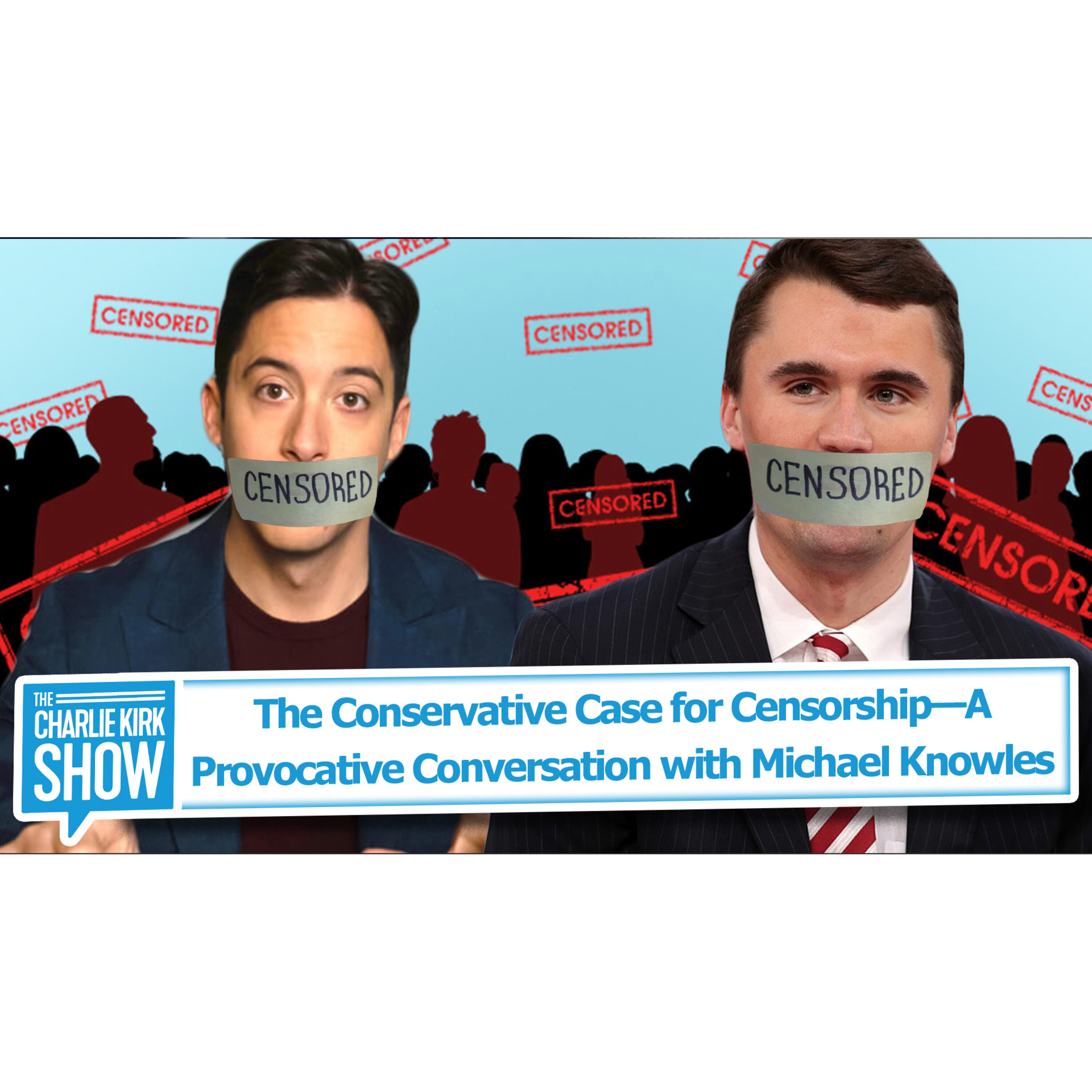
The Charlie Kirk Show
The Conservative Case for Censorship—A Provocative Conversation with Michael Knowles
00:43:43
Loading summary
Transcript71 lines
- [00:00]
A
Hey, everybody. Today my exclusive conversation with Michael Knowles. It's provocative. It is going to make you think deeply about what's happening in our country. And when it comes to the regulation of speech, should we become the censors? Michael Knowles says yes. I play along and ask some fun and lighthearted questions and actually has triggered some thoughts in the episode since where I want to have him come back and dive into this deeper as I was listening to what he was saying and then I thought about it more. But it definitely, in my opinion, is one of the most important conversations I've had recently, which is, should there be limitations on speech? Should we shut down Drag Queen story hour, for example? A very important conversation brought to you advertiser free. If you want to support our program, go to charliekirk.comsupport that's Charlie Kirk.comsupport. email us your thoughts. Freedom charliekirk.com and if you want to come to our Turning Point USA Summit in Tampa, Florida, go to tpusa.comsas tpusa.comsas Michael Knowles is here. Buckle up. Here we go. Charlie, what you've done is incredible here.
- [01:14]
B
Maybe Charlie Kirk is on the college campus. I want you to know we are lucky to have Charlie Kirk. Charlie Kirk's running the White House, folks.
- [01:23]
A
I want to thank Charlie. He's an incredible guy. His spirit, his love of this country. He's done an amazing job building one of the most powerful youth organizations ever created, Turning Point usa. We will not embrace the ideas that have destroyed countries, destroyed lives, and we are going to fight for freedom on campuses across the country. That's why we are here. Hey, everybody. Welcome to this episode of the Charlie Kirk show. With us today is a national treasure. I believe it so firmly, I wrote it on the back of his book. Michael knows his excellency, your majesty, the wizard of Nashville. His excellency, your majesty, a friend of mine, the wizard of Nashville, Michael Knowles. Michael, welcome back to the Charlie Kirk show.
- [02:05]
B
Thank you, Charlie, but I was hoping for a more flattering introduction. I mean, thank you. It's nice to be here, but come on, can't you give me a compliment or two?
- [02:13]
A
Yeah, you know, I seek to underwhelm. That is the ethos of the Charlie Kirk show program. You have a new book of which I am obligated to plug many times because it's a good book and you wrote it. And also I wrote a blurb for it called speechless, and it's very interesting and very important. I want to make sure I get the byline right. Controlling words And Controlling Minds by Michael Knowles. You guys can all get a copy and it's very important. I'm just going to read a little bit of a blurb, then I'm going to let you take it from there. The culture war is over and the culture is lost, writes Michael Knowles. The left's assault on liberty, virtue, decency, the republic of the founders and Western civilization. Has success succeeded? You can no longer keep your social media account or your job and acknowledge truths such as Washington, Jefferson and Columbus were great men. Schools and libraries not coach children in sexual deviance. Men don't have uteruses. Are truths you cannot say. How do we get this point? Michael Knowles navigates us through that. Is the culture war really over, Michael?
- [03:13]
B
I think, Charlie, the first step on the road to recovery is admitting that you've got a problem. And the problem is we've lost. We've lost everything. We've conserved nothing. We have not even conserved the ladies bathroom. Okay, I hate to bring you down like this, but I think that's the first step.
- [03:33]
A
You're a motivational speaker. I know it, Michael.
- [03:36]
B
So, yes, a demotivational speaker.
- [03:38]
A
That's exactly right.
- [03:40]
B
The issue here, we've known about political correctness. Now we call it wokism or cancel culture. It's all the same thing, right? Part of the phenomenon is they change all the words. So that's what it goes by now. We've known about it for about 30 years. It actually goes back further. It's about 100 years old. I explore the history of that at some length in this book. But there's this problem, which is we have been fighting against PC for a long time, for basically our entire lives. We have been winning a fair number of elections during that period of time. And yet, would you say the country today is more conservative than it was 30 years ago? Do you think that we have won the cultural or political battles or no, I think not.
- [04:23]
A
No. But I have to play devil's advocate because it's more fun. There's a couple things that we've done okay with in certain states. They've relaxed their firearm laws. We are winning lawsuits in that direction. The country's becoming more pro life. We're seeing students and parents show up to school board meetings. Is that all just kind of small little victories in the kind of massive hurricane of the left?
- [04:49]
B
Yes, they are small victories in the massive hurricane, but they actually do give us quite a glimmer of hope. In particular those parents who are showing up to the school board meetings. To me, that is the great hope and actually one of the Mac daddies of political correctness going Back to the 1920s, an Italian communist who you.
- [05:07]
A
Antonio Gramsci.
- [05:08]
B
Gramsci, yes. Gramsci is sort of the architect, though there were many architects of political correctness. And Gramsci said that a revolution cannot succeed if the radicals do not have some hold on the common sense. He kept going back to this idea of the common sense. You know, the Marxists and the Marxist ideological heirs wanted to totally remake society and free the oppressed masses. But the problem they kept running into is that the oppressed masses didn't like them very much. The oppressed masses actually liked their own countries and their own communities and their own way of life. So what Gramsci said was we need to have a war of position. Not just a war of maneuver where you go back and forth and advance and retreat, but a war of position where you take influential places in the established institutions and then you exercise that power. And one of the things that we're noticing right now with the parents showing up to the school boards to complain about CRT is you're seeing an alienation between regular, ordinary Americans and the mediocrities who have styled themselves our ruling elite. And they're sneering at these parents and they're saying, you don't know what critical race theory is. You're a deplorable, irredeemable, bitter clinger. Right. And that's further separating what I think is the bulk of common sense American people from these elites. That's a very good thing. And your other point, Charlie, on pro life is an important example here, because the one issue, basically the only major political issue where we've really held our ground or maybe made some advancements has been uncoincidentally, I think the one issue where conservatives are making actual moral arguments. They're not making arguments from convenience. They're not making arguments from efficiency, like for tax cuts. Yes. No, they're not making utilitarian arguments. They're making arguments from justice. It is simply wrong to kill babies in the womb. And you know, what we hear from the squishes in the Republican Party is that we've got to stop making those arguments that alienates people and we need to have a big tent and win the moderates or whatever. Not true at all. The only arguments that people really are stirred up by are cultural and moral arguments. And I think we need to expand that. Not just, you know, not just keep it at the level in the issue of abortion, but bring that out throughout all of the political arguments we're making, we need to set a standard and enforce that standard, something that conservatives have not done for decades. Letters From Prison is some of the
- [07:45]
A
most important writings I encourage every conservative to read. Antonio Gramsci, who, who basically articulated cultural Marxism and said, we need more than an economic revolution, we need a cultural one as well. So, Michael, you just said something very interesting in force. The debate happening right now in the conservative movement is a debate around political power. And this is the one, and we diagnose it on our program, and so do you, and there's robust disagreement about this, of what are you willing to do to change the trajectory now? We as conservatives don't like political power. Usually we don't really know what to do with it. But what you're saying right now is that we should have a renewed enthusiasm for using political power. Is that what you're saying?
- [08:28]
B
I am absolutely saying that. I am really upset at how over the past 15 or 20 years, conservatives have decided that it is somehow illegitimate or unjust to use the political power that the people give us on the happy occasions that we win elections. There's nothing wrong with that. That's what politics is. And furthermore, I think this is the trap that political correctness lays. It's a subtle trap, it's a clever trap. So I have great sympathy for the conservatives who have fallen for it. But it creates a trap whereby either way you react to political correctness, you will actually end up advancing the left's agenda in political correctness. What I mean by that is, on the one hand, you got the squishes. They're obviously going to advance the left's agenda because they just give in to the new politically correct standard, right? They just. They call Bruce Jenner a she and they pretend that babies aren't babies or whatever. You know, they just. They just kind of go along with it. But then there's this other group, they're the more stalwart conservatives. They're the ones. They might say, I'm a free speech absolutist. I'm not going along with your censorship. I'm not going along with your new crazy standard leftists. But here is the trap. By declaring themselves in opposition to political correctness on the basis that we should have no censorship, you should be able to say whatever you want, do whatever you want, look at whatever you want, behave however you want. What these stalwart conservatives are doing is abandoning standards altogether. And the problem here is that the entire point of political correctness is to destroy the traditional standards Karl Marx famously called for the ruthless criticism of all that exists. You get the critical theorists in the 30s, you get critical race theory. Now you get the debunking and the deconstructing and this entire very simple theory, which is just to criticize everything until you have no society or standards left. So either way, you do it either by giving in or by abandoning standards entirely. You are giving the left what it wants, which is namely the destruction of the traditional standards.
- [10:29]
A
So this is an important question I'm about to ask. I'm going to preface it slightly. Your book is called Speechless, which is about controlling words and controlling minds. You just criticize the free speech absolutists. And one of the arguments you make is that shutting people up is not a good thing. That's a surface argument. What you're really. That's not really what you're saying, though. What you're saying is that we should shut certain people up if they're.
- [10:56]
B
I most certainly am.
- [10:57]
A
Yeah. So this is. If this is a new thing, and I'm mostly in agreement, but it takes a lot of nuance and time. So you could do it uninterrupted. And you can go however you want. Because this is a really important point, is that. Let's use this example that you have in your. In your kind of teaser of your book, which is, should we cancel Drag Queen story hour? Should we use political force to say that, you know, someone who's mentally disturbed should not be able to be able to read books to children? That would be. Is that. Cancel culture, Michael? Is that us being the censors? Should we embrace our censorship?
- [11:38]
B
We most certainly should. I know that this is a radical statement. I make it explicitly in the conclusion of my book. In order to save free speech, conservatives must embrace just and prudent censorship. This is not a break from the American free speech tradition. This is actually a recovery of the American free speech tradition. From the very beginning of our country, whole swaths of speech have been off limits. Fraud, obviously, direct threats, fighting words, sedition, obscenity. We still have many obscenity laws on the books. In the 1990s, the Republican House and the Democrat Senate, with a Democrat president, passed two major obscenity laws. The Communications Decency act, which is now at the center of a lot of fights over big tech, because that includes the famous section 230. Also the child Online Protection act, both of which were aimed to censor obscenity on the Internet. About a dozen years ago, we put a pornographer in prison, in federal prison Just for obscenity. It's not like he had kiddie porn. It's not like he was raping people just for putting out prurient, disgusting content. He went to prison. And this has been true throughout the history of the United States. What has changed, and I'm so glad you called it a shallow argument to say that the debate is just about whether or not we should shut people up. I totally agree with you. I think that the big mistake that we have made is that we believe that political correctness and wokeness is a battle between free speech on the one hand and censorship on the other. It's not. It's a battle between competing sets of standards. The traditional standards that we all like and the anti standard, the withering criticism of the left. In the 1950s, we had cancel culture. We canceled communists. It was awesome. I strongly recommend it. I wish we would do it again. In the 50s, if you were a communist, you'd get canceled. Today, if you're an anti communist, you get canceled. All societies have standards. All societies have taboos. The United States has had many, many taboos. And the left, in order to destroy them in the 1960s, pretended that it was the great defender of free speech absolutism. Well, what happened then? What did they do? They installed a new radical standard in its place and we got played. That's the simplest way to put it.
- [13:58]
A
So what would you say then, Michael, to Nikole Hannah Jones that writes speechless, controlling words and controlling minds? How far right wingers have shut down people that are trying to espouse a different opinion? What I'm getting at, Michael, is this book could be written by the other side or was written by the other side when they weren't in the cultural majority. Do they have a moral right to that argument? Or are you saying that our framework and our laws should have some sort of agreed upon principle of what is the good, what is beautiful, what is wondrous, what is true, and what is virtuous? Are you making an argument, Michael, that our government should reflect objective standards?
- [14:37]
B
You know, Charlie, I think that was a little bit of a leading question, but as a matter of fact, I
- [14:41]
A
think you're into we're not in a courtroom. I pray
- [14:47]
B
your intuition is absolutely right. And actually, I think the Nicole Hannah Jones example is good, and I talk about her quite a lot in the book. But the simpler one is really this issue of Drag Queen Story Hour because it's just so outrageous that we have perverts twerking for little children in the public library and in the schools. And you have some putative conservatives who will go out and say verbatim that Drag Queen Story Hour is one of the blessings of liberty. If you can't hear that, that's James Madison rolling over in his grave at that very thought. But I want to give that group of moderate or liberal Republicans their due. What they're saying is that if we ban Drag Queen Story Hour, why, then the left might tell us that we can't go to church on Sunday.
- [15:33]
A
Yeah, they've never done that.
- [15:35]
B
They've never done that, like, for an entire year or something. In some places, they're still doing it. So, yes, as you point out, the practical side, it's ridiculous to begin with. But furthermore, getting back to the good, the true and the beautiful, if you really believe, as these radical centrists do, or I don't know what to call, I just call them the Squishes. If you really believe that we cannot make a distinction between Drag Queen Story Hour and Church on Sunday, that's fine. If you don't think you're capable of making that moral judgment, that's fine. But then you need to admit that self government is not possible because self government is predicated on the idea that we have faculties of reason, we can interpret reality with some reliability, and we have a moral conscience that can discern with relative accuracy between right and wrong, good and bad. That's what the process of making laws is in a democratic republic such as ours. If we can't do that, if we're just throwing our hands up in the air, that's fine. But then we have to admit that we're abandoning the project of self government altogether. And I'm not willing to do that just yet.
- [16:42]
A
So the progressive Republicans or the progressive conservatives, they are trying to defend a liberal order, small L liberal order, where we can have a marketplace of ideas. More speech is always better. We must embrace any ideas at all times, and the way that we're going to get rid of them is to have a counter demonstration. Why is this wrong, Michael? Or why is this a little bit flawed or overly simplistic? Why is the quote, unquote, marketplace of ideas why, for example, when David French and Sohrab were having that debate, why, instead of having Drag Queen Story Hour, we can allow that to happen, but then we'll also rent out the room next to it to have extracisms? Isn't that the solution, Michael? Isn't more speech the solution? And why are you acting like a fascist?
- [17:28]
B
Well, I know. What are they gonna call Me, they're gonna call me a theocratic fascist, illiberal, authoritarian. It's funny, by the way, in my book Speechless, I quote John Locke, the father of liberalism, and John Milton, one of the most famous defenders of speech utilitarianism in the English language. Yes, well, you know, Milton had a very interesting intellectual pedigree, but he's, you know, he was a strong defender of free speech. He wrote Areopagiticus and which is this great defense of it. And yet both of those guys pointed out that we needed to censor some people because they would undermine the entire order. So if I'm illiberal, I am still far more liberal than the father of liberalism. I just want to point that out for my detractors. The reason that the marketplace of ideas, rhetoric falls a little flat in certain instances is because one someone sets the rules of the marketplace. Marketplaces are finite entities, and not every institution is a marketplace of ideas. This is something that conservatives used to understand. You know, it's really depressing for me to see conservatives defending the idea of academic freedom now, which does not mean what people think it means, but they defend this canard, this hoax. William F. Buckley, Jr. Launched the post war conservative movement. This is the founder of National Review. This is as mainstream a conservative as ever there was. He launched it with a book called God and Man at Yale. The subtitle was the Superstitions of Academic Freedom. In that book, he called it a hoax. He pointed out the Yale Sociology department would never hire a neo Nazi to come lecture on the superiority of the Aryan peoples. Nor should Yale do that. Yale has a mission. The educational enterprise is one of indoctrination, Right? Education and indoctrination mean the same thing. If you teach a student that two plus two equals four, you are necessarily going to tell that student that two plus two does not equal five. You're going to punish that student if the student writes 2 plus 2 equals 5 on his paper. And so you are going to have to discern between truth and falsehood, goodness and wickedness. And the notion that this is an open marketplace of ideas only ever seems to cut in one direction. This is never used to say, permit the teaching of the Bible in schools. The Supreme Court told us you're not allowed to study the most important book ever written in schools, without which, by the way, none of the Western tradition makes any sense. You're not allowed to teach that, but you are in many cases today mandated to teach. Robin DiAngelo, White Fragility, Ta Nehisi Coates, any of These radical leftists.
- [20:06]
A
So do you think that conservatives embrace of small l liberalism the utopian belief of the exchange of these ideas? Do you think the totalitarians use that as a tactic to actually be able to have us be indifferent to their degeneracy while they remake our culture? Do you think we've been played?
- [20:26]
B
I most certainly do think we've been played. And the colorful way you put it, Charlie, is absolutely right. But I think it's worth a little caveat here. I mean. Cause I agree with everything you've said.
- [20:38]
A
I'm just asking questions here, Michael, by the way.
- [20:41]
B
Yeah, so I'm sorry, I agree with the questions you're asking, but the caveat is this. What the squishes refer to as liberalism today or classical liberalism, I think would be unrecognizable to many of the classical liberals, to use a popular phrase. John Locke was way more based than anyone is giving him credit for. In the letter concerning toleration, John Locke says that we need to shut up atheists. Okay? And by the way, in Milton's area of Pagitica, Milton says that we need to censor Catholics. I'm glad that we have since gotten rid of that particular censorship. But you know, I say this even as a mackerel snapping Papist. The reason Milton pointed this out is because of the religious wars that had ripped his country apart. Because he saw the threat to the political order if the people could not agree on at least some basic things and to bring it back to the present day. That's what you're seeing here. I am not advocating that we throw people in the gulags for mentioning unpopular ideas. What I am saying though, is that every culture must have standards. We must agree on a few basic things, at least in the rules of engagement, at least in the language that we're speaking. And today the left has so confused things and upended the order that we no longer know how to refer to a man or a woman. Do we say he, she, they, them, zer. I mean, even the most basic elements of our language we are not able to agree upon. And in a self governing republic, speech is politics, Politics is speech. We persuade one another and we make laws.
- [22:16]
A
We are speaking beings.
- [22:17]
B
Yes, to use Aristotle's observation, this is what makes us human is our speech. So when the left muzzles us, whether through the physical muzzling that we've actually all had for the past year thanks to Dr. Fauci, or through the subtler ideological muzzling, through the upending of our language, when they do that. They are really cutting at the heart of what it means to be human, what it means to live in a political society. And unfortunately, they're so clever at it, we haven't even noticed that they've been doing it.
- [22:48]
A
So, I mean, I totally agree. And if only our leaders actually understood the canon that created our civilization, which is this unified belief that there are certain things that are good and those things are worthy of protection. So I had a conversation with a very unimpressive person recently. I'm not going to say that person's name who said, how dare you? It was a private conversation, or how do I know what's best for you? I know it's best for me, and for me it's Christianity and going to church and all that. But for you, it might be social degeneracy. Are you trying to impose a certain viewpoint? Are you trying to use force, Michael? Because don't. We, as conservatives, don't like force. We are scared of force. So are you trying to say that you can run government better?
- [23:41]
B
Charlie, are you accusing me of attempting to legislate morality?
- [23:45]
A
I am absolutely asking the question of whether or not you're trying to legislate morality.
- [23:52]
B
Are you fascist? Well, I will. I will then absolutely answer in the affirmative. Not on the fascism part, though. I talk about fascism in this book.
- [23:59]
A
Bundle of Sticks is what it means. But anyway, that's a different. It really does.
- [24:03]
B
I will answer in the affirmative. Yes. Not only am I advocating that we legislate morality, I'm actually just making the simple observation that all laws legislate morality. That line about you can't legislate morality, I think that may be one of the stupidest lines in our entire discourse. It doesn't mean anything. All laws, whether you are talking about abortion or the death penalty or whether you're talking about parking tickets, all laws are referring to the moral law. When we pass laws, we make moral arguments as to why we need certain laws. A law against murder is obviously referring to the moral prohibition on committing murder. And this is true throughout our law. So, yes, we have to do it. The left knows this. The left knows that this is inevitable. And the right used to know this until very, very recently. And then the right, particularly the ones on the right, who like to lose with dignity. You know, those types, they don't ever seem to have very much dignity, but they always talk about how we need to lose in this wonderful manner. You know, I think that they're afraid of winning. I think they're afraid of the moral risk. Of actually having to govern. I think that they are cowardly and craven and I think that they don't recognize not only is courage a virtue, but it is the prerequisite for all of the other virtues. If you don't have courage, you're not really going to have any.
- [25:30]
A
That's your Aristotle again. Let me think about this. Aristotle Ethics, Book three, I think that is courage is the ninth chapter before friendship, happiness and contemplation. So. And I learned that by not going to college.
- [25:46]
B
Note cards. Hold on. How are you pulling up all these Aristotle quotes? That's very impressive.
- [25:51]
A
Power shows the man. Aristotle said Politics, Book two. So let me ask you a question here. Conservatives are going to be a little bit uneasy with some of the things you're saying. And I want to walk through this because I used to be there too. I know exactly where you're coming from. And you're also being intentionally provocative, which is delicious and awesome. And actually the way you move the Overton window. No, it's great cause I know you well enough, I get the whole thing. It's really good. But let me walk through this and then I want you to respond. Conservatives are afraid of tyranny. It's programmed in our DNA. We don't like tyranny, nor should we. We think tyranny is evil. Autocracy is evil. Our whole Constitution is written as a document to be slow and deliberate and protecting of natural rights in the state of nature. Therefore, when you start talking about using power, immediately, a fire alarm will go off in many conservatives head saying what if that power will be used against me? Walk us through that, because that is going to be your stopping point that you're going to hear say no, no, no, no. Those people are going to be used then as shock troops. If you shut up Robin d', Angelo, they're gonna shut up me. Walk us, help us wrestle through that.
- [27:06]
B
Michael Well, I think you have to begin before that hypothetical, which is what if this power is used against me? And I think you need to ask the simple question, wait a second, is this power currently being used against me? And of course it is. And of course there are many kinds of tyranny. The conservative movement of the 1950s through the late 1980s was very laser focused on the evils of big government. And there are many evils of big. I'm a strong opponent of an unbounded unlimited government. And this is in particular because of the threat posed by the Soviet Union. But there are many kinds of tyranny. Mitch McConnell made this point the other day when he was talking about the woke corporations, he said that today, woke corporations are working in many ways as a sort of parallel government. And Republicans have aided them along. They have for at least a couple of decades now, shilled for usually multinational corporations that hate our guts. And we have given them so much political power that is in many ways less accountable to the American people than government power. I mean, I believe that these corporations crossed the Rubicon on January 7th and January 8th of this year when about three oligarchs in Silicon Valley, hipster Rasputin among them, Jack Dorsey, censored the duly elected sitting President of the United States. No matter what you think happened in the 2020 election, on January 7th, that man was the duly elected sitting president. And a handful of billionaires who have never appeared on a ballot, who were totally unaccountable to the people, kicked him out of our public square. And they do control the flow of information around the Internet. The Internet is the public square. They are effectively controlling our politics. I don't think there is anything conservative about allowing them to do that. And I don't think that we are defending against tyranny when we refuse to bring those woke oligarchs into line.
- [29:01]
A
So. But do you understand the argument you're going to get, which is this bridge that conservatives are afraid to cross, which is we can't use power. We can't use power. We can't use power. Mao, Stalin, Mussolini, bad things happen when we use power. And their gut instinct is not totally wrong. But what assurances can you give? What sort of path is there to say that political power and policy can actually create an incentive structure that will protect freedom and prevent tyranny. Can you help explain that?
- [29:40]
B
Yes, I think that one of the aspects of this fear that if conservatives ever use political power, and this is, by the way, this is a relatively recent phenomenon, that we've been cowardly and afraid to use the legitimate and just power to that the people give us. But I think it comes from that problem of argumentation where we say, you know, Adolf Hitler drank a glass of water, as did my political opponent. Therefore, my political opponent is like Hitler, you know. Yes. Hitler and Mao and Stalin used political power. Washington, Adams and Jefferson also used political power. Millard Fillmore used political power, for goodness sakes. That's just the description of the job.
- [30:14]
A
Millard Fillmore installed indoor plumbing in the White House. It's an unknown fact about Millard Fillmore.
- [30:20]
B
It is a very important use of political power. You've got to fix the Plumbing in your house and in our country, in our political system. And so that's what I'm advocating here. You know, here's one way, I suppose I can make people feel better about it, because I think what a lot of people mistakenly believe is that being able to say and do whatever you want is somehow the American free speech tradition. That is not. It's not true. That's only been true for the past, say, 20 or 30 years. But do you really believe that right now you have less freedom to say whatever you want to say than you did in, say, the Adams administration in the 1790s? I don't think so. I think in some ways you are less free to say certain things, but in many ways, you're more free to say certain things. You're more free to say things today than you were 20 years ago. On television, for instance, George Carlin famously had the seven words you can't say on TV today. You basically can't turn on a TV without hearing all seven of those words.
- [31:20]
A
Right?
- [31:20]
B
In many ways, we're free to say vulgar things, profane things, licentious things. But true liberty is what I think has been abrogated. And this is the distinction here. The real difference, I think, is that talking about conservatives taking the bait, our founding fathers were very clear that liberty is extraordinarily important. It's instrumental, by the way. It's not an end in and of itself. Justice is the end of government. According to Madison, the Constitution is put forward to secure the blessings of liberty. So liberty is an instrument. They love liberty, ordered liberty, but liberty should not be abused. To licentiousness. And I guess the difference is this licentiousness is the freedom of the heroin addict, who. Isn't he the freest guy in the world? You know, he's just shooting up all day long. As long as he's got a couple bucks in his pocket, he's free. Right? And that's why we need to legalize drugs, so he can be more free. No, no. I think we all know that the heroin addict is a slave. He's the least free person on earth. Now, true liberty, of course, is not the freedom to do whatever you want, whenever you want to do it. True liberty is the right to do what you ought to do. This is why we have liberal education to tamp down our base passions, tamp down our vices, cultivate our virtues, which are habits, and have what John Adams told us was the prerequisite of constitutional government. A moral and religious people. Now, my modest suggestion that maybe when we craft our politics, we think about the difference between true and false and right and wrong. If I'm an authoritarian, if I'm illiberal or fascistic for suggesting that, my goodness, what would they say about John Adams? What would they say about Washington or even Jefferson? Surely those guys are to the right of Mussolini.
- [33:00]
A
So what you're getting at here is very important and I will only make one adjustment. We have to stop saying that doing drugs is any form of freedom. Capacity or the ability is not freedom. Liberty is the pursuit of virtue. So if you have the capacity to do something, it's not the liberty to do it. And you're right, it's about what you ought to do. I said this at a speech at our Turning Point USA Young Women's Leadership Summit about marijuana and the whole world lost its mind because I said something that is a very conventional argument, that if you do marijuana, you're gonna be a slave to marijuana. I quickly corrected it for Media Matters. Literally I said, okay, media Matters. I don't mean slave, I mean you're going to be bonded to that thing and everyone lost their mind. And that's the argument that you're making. Can you reinforce something though, which is this new kind of secular humanistic force in the conservative movement where when I grew up in a movement in 12, 13, 14, 15, 16, there was an abundance of literature that I read and consumed and almost no literature that was presented to me. Framing liberty as being able to do whatever you wanna do, whenever you wanna do it, however you wanna do it, as long as it doesn't harm someone else. The self sovereignty, liberty. If I wanna do drugs, I do drugs. If I wanna drink, I can drink. Don't get in my wallet and don't get in my bedroom. Don't get in my syringe and don't get in my blunt. Is that liberty, Michael?
- [34:30]
B
That is most certainly not liberty, Charlie. And I think your comments on the sin spinach are very apt. You know, the old devil's lettuce, the old Peruvian parsley. I think it's not the height of liberty. Of course not. Now why is it your observation is totally right about the conservative movement in the early 2000 teens for the 2000s? Yes, you had this creeping idea. Sometimes we call it libertarianism, sometimes we call it neoconservatism. I think frankly, neither of those terms really does justice to what it to how stupid these arguments were because basically what we were told was that you should be able to just do whatever you want to your body, abuse yourself in any way. You should be able to sexually, obviously do whatever you want. You should be able to mutilate yourself. That's what they're telling us now with the transgender movement. So there's that argument on the personal domestic aspect. And then the flip side of that was we just also need to bomb the Middle East. That that is a core tenet of conservatism. Edmund Burke famously said, the age of chivalry is gone and we need to go back to bombing the Middle East. No, I don't think he ever said that.
- [35:36]
A
No, that was not. In the Reflections on the French Revolution, Burke and Pitt wrote no such things.
- [35:41]
B
No such thing. It was a very incoherent kind of conservatism. And by the way, I have some sympathy here. The Buckley coalition, the Frank Meyer coalition, sometimes called fusionism during the Cold War, it's come under fire because it didn't achieve every single wonderful thing conservatives have ever wanted, but it did achieve quite a lot, actually. I mean, it did lead to the end of the social Soviet Union. It did give us some victories on some important matters. And crucially, what it did was it brought together disparate factions of the right. The traditional conservatives, the libertarians, the war hawk Democrats. Now you might add, later on, you would add onto the neoconservatives, you would add onto them the populists. Now, all sorts of factions always fighting together. And this worked out relatively well for the Cold War. After the fall of the Berlin Wall, what joins us together, you know, Russell
- [36:35]
A
Kirk predicted this whole thing.
- [36:37]
B
He did. Russell Kirk, one of the great.
- [36:39]
A
The conservative mind. Yeah. From Burke to Elliot. I love Russell Kirk. Yeah. A little biased because he has a great last name. I'm sorry, I interrupted you.
- [36:45]
B
Go ahead. That's true. I forgot. Yes. Your long lost relative, Russell. Yes, very. Kirks have done wonderful things for this country.
- [36:52]
A
Thank you.
- [36:55]
B
I would encourage people to rediscover writers like Russell Kirk to rediscover writers like James Burnham, to rediscover writers like Whitaker Chambers, you know, and T.S. eliot and many, many, many others. Because we have been given a very shallow and ridiculous point of view for the last 20 years. That is, that is. I think it's very silly and incoherent, but just as a practical political matter, it has led to the absolute obliteration of our culture and the conservative movement. It has led conservatives not to stand for anything. You know, we want a big tent in the sense that we want more people to vote for us. But you know, just like countries, political movements need to have boundaries. Otherwise they are not a political movement at all. And a lot of people are seeing this now with transgenderism or critical race theory, where we say, hey, if we don't stand up against transing the kids, for goodness sakes, we're really not going to stand up for anything. I've also noticed, I think there's a generational divide here. I find that the mistake. Another. Another mistake, conservatives, is that boomer conservatives often believe that the way to reach the youths is to peddle licentiousness, to say, hey, we'll let you smoke pot. Hey, we'll let you sleep with whoever you want. Hey, we'll let you mutilate your body. Hey, this, that and the other thing. I just think it's B.S. it's not true. I know a lot of older conservatives, and I speak to, as you do, a ton of younger conservatives. Younger conservatives are not waking up in a cold sweat thinking about marginal tax cuts and occupational licensing reform. They are waking thinking about our culture, things that actually matter. What is human nature? What are we conserving? And I think any conservative movement that will be successful needs to speak to that.
- [38:41]
A
So since we only have a couple minutes remaining, I'll go over time if you can, Michael, but you're very important, and you have a very important book.
- [38:47]
B
Very, very Big Guy.
- [38:48]
A
Yeah. So this is the biggest topic of all. Here's what your whole book is really about. And here I'm telling you a book I haven't read. But I did review you. I reviewed you, not the book. So that's a very important thing. So is this. Your whole book is centered on. We must know the good, we must identify it, and we must preserve it. So, Michael, what is the good? Is it objective or subjective? How do people get to know that something is true or false or right or wrong? Those are your words. How does one discover those things and then properly govern themselves after that?
- [39:29]
B
Okay, I've got. This is probably going to be the most controversial statement that I'm going to make on the entire. On the entire book tour, because you've got the radical squishes who are saying we can never know what's good or true or anything, and we've just got to trans the kids. Then you've got people who are quite in the opposite direction who are saying we need basically a firm establishment of the church in this country, you know, with very specific ecclesiology and. And the like. I am taking, I think, the most radical approach of all. The way that we can know some idea of the Good and the true and the beautiful in politics is through prudence.
- [40:10]
A
Ah, that's another Aristotelian word. Ah, it is.
- [40:13]
B
And something that Edmund Burke talked at great length about. You're not allowed to talk about prudence these days because everybody is some kooky ideologue who wants to fit their entire political program on a five point plan, on a napkin or something. But prudence is actually a really good thing. My argument here for recovering some semblance of the American free speech tradition is not that we need to spell it all out right now. And I need to give you my entire grand theory of everything. I'm not doing that. I'm saying one place to begin is not in the abstract pie in the sky, but to look at the actual free speech tradition as it has really existed in, in America. And I know we're not allowed to do this either. Learn from the past and learn from our forebears who gave us this country and see where things may have gone a little wrong and try to fix them modestly, but courageously and confidently and with a real purpose. Because you and I have a purpose. Our country has a purpose. There is a purpose to things because there is reason to the universe. We can know it. And I think in order to preserve our country, we need to get our heads out of the clouds and really dig into this real place. Because America is a real place with a real tradition, not an abstraction.
- [41:27]
A
And it is not something in the clouds. Got to get into what we see empirically and govern ourselves appropriately. Prudence, otherwise known as practical judgment, is how we should govern ourselves. Russell Kirk wrote extensively about that. And the three tied knot we must preserve. Right, Michael? What came before us and what is here and what is yet to come. As Edmund Burke famously wrote, the three tied knot is what is most important. This book is called Speechless by Michael Knowles. It is terrific. And I suppose I have one more question as we just wrap this all up together. Are you optimistic or pessimistic that we can shut up the other side?
- [42:06]
B
You know, Charlie, pessimism and optimism, as my friend Father George Rutler points out, they're two sides of the same coin. The conservative pessimist says things can't get any worse. The conservative optimist says, oh, yes, they can. But I have real hope. Hope is a fact. It's a theological virtue. Obviously this has a religious foundation. I have hope in that my redeemer lives. I know the way the story ends. But I also have hope in the American people. Our continued grasp, to some degree on common sense and our ability to stop these leftists and chase them out of town on a rail if we can only summon the courage to do it.
- [42:39]
A
At every turn I hear a conservative when they are encountering critical race theory at their school board. The school board says I thought you stood for free speech and they don't know how to handle it. And if they don't know, if they don't know the tradition of virtue and what is good, then all of a sudden they will get blown over by them holding our own book of rules against us. Liberty is pursuing virtue. It's not being able to do whatever you want to do whenever you want to do it. Speechless by Michael Knowles I thought this was just going to be a general indictment of cancel culture, but no, instead Michael Knowles wants to do the canceling and oh boy, is that going to get some clicks. Buy the book if you agree or disagree and send us your thoughts. Freedomarliekirk.com Michael thanks so much.
- [43:26]
B
Thank you Charlie.
- [43:30]
A
Thanks so much for listening everybody. Email us your thoughts as always. Freedomarliekirk.com and if you want to join us in Tampa, Florida, go to tpusa.comsas God bless you guys. Speak to you soon.