Loading summary
Transcript99 lines
- [00:00]
A
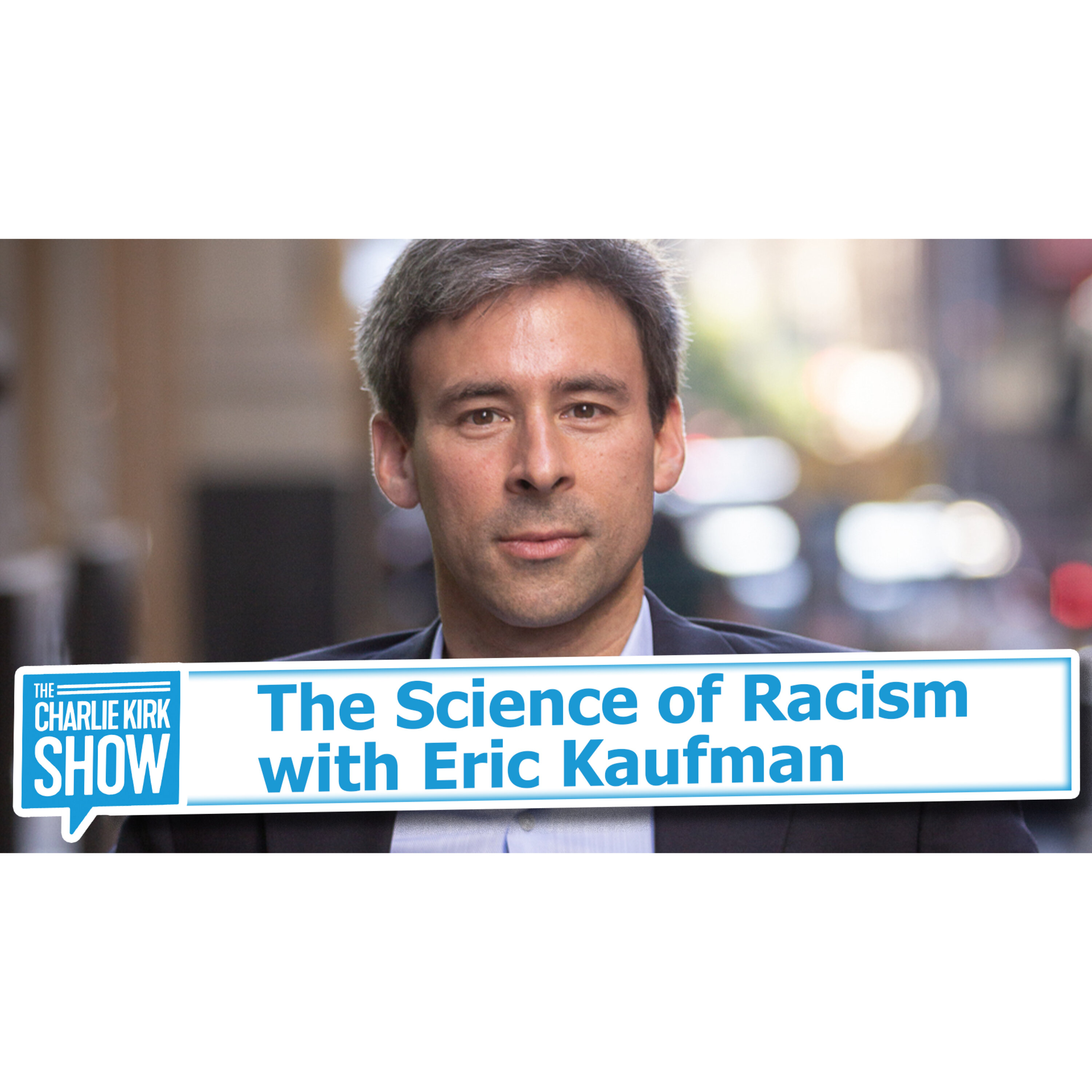
Hey everybody. This episode is brought to you by my friends at ExpressVPN. ExpressVPN.com Charlie Secure your device. Anonymize your online activity. Protect your action online. Expressvpn.com Charlie help our show out by also helping yourself. Protect yourself. Expressvpn.com Charlie hey everybody, what's the science behind racism? This is a super interesting conversation with Eric Kaufman from the Manhattan Institute. Email us your thoughts freedomarliekirk.com and if you want to support truth telling episodes like this, go to charliekirk.com support charliekirk.com support if you want to get involved with Turning Point USA, start a high school or college chapter, go to tpusa.com, buckle up, everybody. Here we go. Charlie, what you've done is incredible here. Maybe Charlie Kirk is on the college campus.
- [00:54]
B
I want you to know we are
- [00:56]
A
lucky to have Charlie Kirk.
- [00:58]
B
Kirk's running the White House, folks. I want to thank Charlie. He's an incredible guy. His spirit, his love of this country. He's done an amazing job building one of the most powerful youth organizations ever created, Turning Point usa.
- [01:11]
A
We will not embrace the ideas that have destroyed countries, destroyed lives, and we are going to fight for freedom on campuses across the country. That's why we are here. Hey, everybody. Welcome to this episode of the Charlie Kirk Show. With us today is Eric Kaufman. I'm so excited for this episode. First of all, Eric, welcome to the Charlie Kirk Show.
- [01:32]
B
Charlie, it's great to be here.
- [01:34]
A
You do phenomenal work. You have a new report out that is sending shockwaves throughout the country. Tell us about the report. It's about race and racism, the things you're not supposed to talk about in our country. Walk us through it.
- [01:47]
B
Well, really what this report is about is how racism is not just something that comes from people's lived experience, experiences, but that is very much shaped by perception. So something, maybe an encounter may be perceived as racist or it may be seen as just innocuous. A lot of that depends on things like your exposure to social media and the media, your ideology, and also whether you're depressed or anxious, your psychological health. All of those things actually, I would argue, are more important than your personal experience in explaining not just your perception of racism in society, but also your personal experience of racism as well. And so really, this report goes through a lot of data and survey data to show this.
- [02:35]
A
No, sorry, go ahead. I didn't mean to cut you off. I'm just saying in your report you conclude that ideology, partisanship and Social media influence the way that we perceive racism. So I have to call a timeout here. How do you define racism? Because the way I grew up learning about racism, it's one person being discriminatory or prejudiced against another person based on their skin color. Now racism is portrayed as a power struggle. How do you describe it in this piece?
- [03:04]
C
Well, I mean, you're actually putting your finger on one of the things that sort of moves and expands and contracts depending on ideology. So part of this is it's defined in terms of subjective survey questions, one of which might just be a broad. Have you experienced racism in the past month or week or whatever. One of which might be, have you experienced racial discrimination? Some of them are more concrete questions like people acted like I wasn't smart or I was stopped and searched. So some of them are a bit more concrete and some of them are a bit more define it yourself. One of the points here is that depending on your ideology, you will define this term more broadly or more narrowly. And that's partly what accounts for greater reporting racism. So there isn't a single definition I'm using. I'm allowing to some degree survey respondents to self define, which accounts for some of the differences that we see.
- [03:58]
B
And in fact, racism's been defined, arguably defined down or debased as a currency, so that it means more and more things if you are of a particular ideological stripe.
- [04:09]
A
Absolutely. And there's one part here I want to focus on that really caught my attention because I really, I have a strong distaste for this person. It's Taha Nisi Coates, and he's a black pessimist, which bothers me. I do not like pessimism as a worldview, as a way to approach life. I don't like it. And I think that your study confirms everything I've been saying about Tahanisi Coates for years, where that he actually makes people less likely to believe that they can succeed in our country. Can you talk about that? Because I was so moved by the data backing of what I believed instinctually to be true.
- [04:48]
B
Yeah, basically, if you. What we did or what I did was I had a survey of African American respondents. I did it in 2018. I repeated it in 2020. I showed half of half the people. Just one paragraph from Ta Nehisi Coase's work where he talks about this very sort of exaggerated portrait of how dangerous it is to be black in America, how everyone's system's out to get you and they're never going to let you Live a normal life. People who read that paragraph were much were about 15 points less likely to say they could make their life plans work out. Generally this is a measure psychologists use of people's sense of self control which is linked to their mental well being and other measures of success. And so what we actually see is that exposure to this critical race theory inspired passage, just one paragraph really was enough to draw people's sense of self empowerment by a substantial level. So instead of 83% of African Americans who didn't read this passage from TA Nehisi Coates saying they could make their life plans work out, only 68%, 15 points lower, said they could make their life plans work out after reading just one paragraph. So you can imagine being exposed to this narrative.
- [06:04]
A
That's extraordinary.
- [06:06]
B
Yeah. Yes. And so it's a, you know, in a way it's doing the opposite of what it is supposed to do. It's supposed to make the lives of African Americans better and it's actually having a negative effect on their ability, their belief in themselves.
- [06:21]
A
I don't know if I agree with that. I'm not sure if Tahanese Coates actually wants. That's a different conversation. Intentions are hard to conclude, but it's hard to believe based on his literature that he actually, I think he's much more concerned on the external than the improvement of the internal. But intentions are tough and we're not going to spend time on that. But that's tbd. I want to get to this one, which is really interesting and I want to just compliment you again. These studies are not easy to do because you're pursuing truth. And in popular culture people don't actually want the truth. They want narrative and they want a narrative that will confirm their power grab. You say here liberal blacks with a college degree are nearly 30 points more likely to find a statement by a white person such as quote, I don't notice people's race or quote, America is a colorblind society, end quote. Offensive than blacks without degrees who identify as conservative. Talk a little bit about that. That's fascinating. That's a major disparity.
- [07:23]
B
Well, yeah, I mean what we see is that even independent of ideology, of being liberal or conservative, having a degree or not having a degree, if you have a degree, if you're African American, that makes you more likely to believe that the so called microaggressions such as I don't notice race are offensive than if you don't have a degree. So in a way the experience or the status of having A university education seems to be an independent force multiplier for this perception of racism, for this sort of expanded definition, if you like, of racism. And yeah, so this is part of, again, all of these factors, ideology, education, social media exposure, are actually leading people to frame things as racist, which are arguably not racist. And that's contributing to the perception in a way that of this as a rising problem because all the indicators of interracial marriage, police shootings of African Americans have dropped 60 to 80% since the late 60s. All of the behavioral attitudinal indicators are moving in the right direction. And yet, if you ask people, is racism an increasing problem, that number has been remarkably high. And in fact, the number of people saying that relations between the races are bad has increased, not decreased in the last sort of five, six years. After being stable, by the way, for about 20 years, suddenly they've taken a nosedive since 2014 when the Ferguson riots.
- [08:54]
A
I have that chart. I want to get to that because it's really interesting and it's by Gallup, it's one of the most interesting pieces of data. But I want to just follow up with one point here. Is it fair to say then those that are college educated tend to be more sensitive to the. I don't notice people's race or America's a colorblind society, that some of this analysis is taught rather than experiential. Is that a conclusion that you found repeatedly through your inquiry?
- [09:25]
C
Yes. Essentially, people are taught the framing. They're taught how to read these words, see them as microaggressions, see them as racist, where maybe before they wouldn't see them as racist. So it's that sensitization, if you like, of people through universities, but also through social media and other media formats that actually has expanded people's perception. So people are seeing more racism when actually there's less of it by any traditional figure.
- [10:01]
A
Look, by now you've all heard me talk about MyPillow and how Mike has done it again, but by introducing his My slippers. Mike Lindell, he's got a lot of ambition. He's a patriot. He loves his country. A lot of people like Mike Lindell. In fact, I get emails from people, they say, charlie, how can I help you? How can I help Mike Lindell? How can I help the country? Well, if you go to mypillow.com and buy anything with the promo code, Kirk, it helps both of us. That's right. Maybe you want to go buy the MyPillow slippers. They're beautiful slippers. Maybe you want to buy the MyPillow. MyPillow. MyPIllow slippers are so comfortable that you want to get some for the whole family. So go to mypillow.com and click on the Radio Listener Square and use promo code Kirk. You'll also get deep discounts on MyPillow products, including the Giza Dream bed sheets, the MyPillow mattress toppers, and MyPillow towel sets. Or call 800-875-0425 and use promo code Kirk. So this is a really important point because I don't think that a BLM Incorporated activist would disagree. They'd say, of course, if you go to college because we're awakening you, that's why they call themselves woke. So they would say, yeah, of course, because they've been informed and they've been enlightened more. Where my argument would be, no, no, no, no. If it was really as oppressive as you say it is, you don't have to go to college to figure it out. For example, in the 1930s, it was really crummy to be a black person in the American South. It was rather self evident. Can you help build that out a little bit more about how the perceptions on race, the disparity, or the conclusion you could find is mostly it's either something that is externally transferred for the people that then communicate it. Does that make sense? Is that an underlying principle of your study?
- [11:48]
B
Yeah, that essentially there has been this construction of racism, this social construction by the media. And this is very ideological. I mean, if you look, for example, the mention of the term racist or racism in major news media such as the New York Times, the Washington Post, there was a huge explosion post about 2014, which is something that Matthew Iglesias, formerly of Vox, called the Great Awokening. So you see this sudden increase in the. And that was quite a deliberate editorial strategy. It was partly about getting readers, partly about becoming more partisan. That actually happens within the mainstream media outlets. And then you get, as a result of that, the survey evidence, more and more people saying racism is a bigger problem in the country. And I think what we see there is a media construction and a sensitization, which is also something we see in the universities, which then produces this perception, not the reality, but it produces a perception of a growing problem that is actually a shrinking problem.
- [12:50]
A
A postmodernist would say, though, that perception very well is the truth. They'd say that these charts and graphs don't mean anything because you don't understand. You're not as educated as I am.
- [13:01]
C
Well, look, I mean, you can say, you know, I use the example of
- [13:05]
B
would we say that the United States
- [13:08]
C
is a poor country or Switzerland is a poor country. That's a phenomenon you can always compare to a utopian state of perfection and say, well, we're not there yet and therefore we are poor or racist or whatever.
- [13:22]
B
I don't think it becomes quite meaningless when we get into that territory. But I think this follows a bit on what Coleman Hughes was saying that, you know, racism is a quantity that is conserved, so even if it declines, you have to expand the definition so that it takes up the same amount of. Same amount of room. And I think that's pretty much what's been going on. Incidentally, I would say that there have been various experiments where, for example, people are asked to identify threatening faces and the experimenters start to remove the threatening faces from the pack people are looking at. And then people have a tendency to define these bland faces as threatening just to conserve the quantity of threatening faces. And I think that's kind of the same principle to what we're seeing with racism, that racism is simply being defined more and more broadly to include saying, I don't notice race, for example, or some other, maybe some discrepancy in educational attainment or something is defined as racism. Just to sort of fill that quotient, if you like.
- [14:21]
A
I want to compliment you again, the more I look into these charts. You did such a good job. We're going to have this whole thing linked on charliekirk.com I love this one. From 1960 to now, there has been. If this was a growth stock, I thought this was Amazon stock. But it's the mentions of racism in American books. Walk us through that.
- [14:40]
B
Well, yeah, so it's quite interesting. There are. Matthew Iglesias says there's this new thing called the Great Awokening since 2015 and we have all the no platformings and cancelings. I argue that actually there have been three great awokenings of this ideology, which I call left modernism, which is sort of the cultural left post 1960s. The first is in the late 1960s. We get a big surge in the number in the use of the term racist and racism in American books. You then get a second wave with the late 1980s, early 90s when we hear about political correctness and Afrocentrism. We then get to the third big wave, which is post2014. Post Ferguson, you get another surge. And we're living through that right now. This great Awokening that Iglesias talks about. And that's actually the spur. The ideological enthusiasm behind that really then underlies a lot of the new activism around race that we see just in the last, say, five, six years.
- [15:41]
A
And so there's a couple different ways to look at that. I want to get to that in a second. But I think a really good objective metric that we are becoming less racist, and you have this as your biggest chart, I think, in the entire study is white opposition to a close relative marrying a black person. That's a pretty agreeable statistic, right? I mean, that's. That's a life partnership, right? That's not buying a muffin. That is a covenant in a lot of our biblical religious views. Can you talk about this why you included it? Because I think that's a pretty objective metric. We're actually getting less racist, right?
- [16:18]
B
I mean, this is about, you know, if we're going to compare apples to apples, we need to have the same data series over time. Opposition. White opposition to interracial marriage was 95% in 1958. It had dropped to about 50% as recently as the mid-1990s. So from the mid-1990s, we go from 50% opposition to interracial marriage to 10% today. So we've seen an enormous amount of progress on that statistic. And along with that, by the way, 17% of new births are interracial. So we've seen an enormous, huge surge in actual interracial marriages. And so by any yardstick, that would be seen as huge progress, big decline of racism. So we should have been shifting our attention from this problem to other problems. Instead, what we've seen, particularly in the last five, six years, is in fact the reverse. This has been taking up more and more oxygen in the news. So that in itself, I think, bears an explanation, which is what I try and do, that it's this social construction that's occurred through media, education, ideology.
- [17:27]
A
Yes. And I want to get to the social media part of it because it's fascinating. Now, just so everyone listening and watching knows this is how a leftist would. I don't want to say leftist. It's too political, but you know what I mean? This is how someone who believes in this nonsense would say. They'd say, well, no, no, they're just as racist. But here's two things. They're afraid to answer it truthfully because they'll get outed as a racist or because they're actually not for it. They're just less. They have to be in the shadows or this is not even a true metric. Real racism is in police statistics, brutality. Can you help reinforce why this is actually a good metric to use? Cuz I could already hear their counter argument if I were to say something like this on campus.
- [18:06]
C
Well, the first thing to say is that even if you were to believe, which I don't, that people are simply lying more, the fact they feel the pressure to lie more is in itself telling you something.
- [18:17]
A
I totally agree.
- [18:21]
C
But if we leave that aside, again, what belies that is that even leaving aside the interracial marriage laws being repealed,
- [18:29]
B
the actual behavior of people in terms of interracial marriages and interracial births and so on has shown the exact same trend. So people are actually voting with their feet.
- [18:40]
A
I totally agree.
- [18:42]
B
So it's pretty hard to massage that.
- [18:45]
A
Well, their new argument though is that the interracial marriage is whites owning blacks. That's their new thing, right? Is that. No, that's true. It's a new piece of literature out of the mountain of trash called the academy. And they say that interracial marriage is a redux of colonialist, let's say, domination of black bodies.
- [19:07]
B
Right. So the narrative has to remain that of white domination of people of color. And to maintain that narrative, you simply have to inflate the definition of racism to include things which wouldn't have been considered racist in the past. Now, I'm happy to have the debate about what should or shouldn't be called racist, but the people who are making these arguments, the critical race theory arguments, are typically not scientifically oriented. So in a scientific argument, you have to have an argument that is potentially falsifiable, that I can measure something and test your argument. You have to be able to refute counter arguments with evidence. None of this is happening. It's all based on smoke and mirrors and sleight of hand definition. So yeah, I think it's not really worth engaging that too heavily.
- [19:52]
A
And they want to dismiss science. They don't consider it to be an acceptable way to make decisions or analyze reality. They prefer much more narratives and feelings, emotions. This is why Jordan Peterson, drawing a line in the sand when he did in Canada years ago was so important, saying that if we don't fight now, they're going to come. And people thought he was nuts. I didn't. And it turns out his prophecy came true way quicker than we realized. Where in a lot of these social science disciplines, they've become anything but science. They've become narrative driven, which is what's so refreshing about your study. Do you have a comment on that?
- [20:32]
C
Yeah, I mean, I think that, you know, we should be able to have the maturity to be able to say, well look, we've discovered a small amount of racism here, roughing up suspects. There's a discrepancy between black and white that cannot be explained by prior sentencing and various other things which would explain it that are not racial. So we should be able to have the maturity to point to places where there still is a bit of racism,
- [20:57]
B
while not Instead there's this need to
- [21:00]
C
back up this narrative of systemic, totalizing white supremacist society, these superlatives claims. That's the narrative part of it. And what that means is it's impossible
- [21:11]
B
to contest any part of the narrative without committing blasphemy.
- [21:15]
C
It's kind of what John McWhorter calls a religion of anti racism. Which means then that you can't start to pick this apart and test little bits of it and make incremental changes. It's got to be sweeping and revolutionary. Yeah, I think this is a very negative trend. It's not all of academia, really. It's concentrated in certain sections of the academy which are anti scientific, anti empirical.
- [21:41]
A
With the ever increasing numbers of makes, fiat Kia and models, it is now impossible to stock all the parts you need on a traditional chain storefront. Why endure often pointless or seemingly intimidating questioning and wait while the counterman orders the parts on his computer, choosing the only brand his warehouse happens to carry? You have computers with access to Rockauto.com at home and in your pocket. Chain stores have different price tiers for professional mechanics and do it yourselfers. Rockauto.com's prices are the same for everybody and are reliably low. Rockauto.com always offers the lowest prices possible, rather than changing prices based on what the market will bear like airlines do. Rockauto.com is for everybody and does not require membership or account login. Rockauto.com is a family business serving auto parts customers online for 20 years. Go to rockauto.com they shop for auto and body parts from hundreds of manufacturers. They have everything from engine control modules and brake parts to tail lamps, motor oil and even new carpet. Whether it's for your classic or daily driver. Get everything you need in a few easy clicks delivered directly to your door. The RockAuto.com catalog is unique and remarkably easy to navigate quickly. See all the parts available for your vehicle and choose the brand, specifications and prices you prefer. Go to RockAuto.com right now to see all the parts Available for your car or truck. Write Charlie Kirk in there. How'd you hear about us Section? Amazing selection. Reliably low prices. All the parts your car will ever need. Rockauto.com so you have a chart here that shows, and it's by Gallup, the percentage of Americans who cited race or racism as the most important problem facing the United States. A fascinating trend. I've never seen it until now. And in 1965, it was at its highest level, right near the Civil Rights act, right near the death of Martin Luther King, if I'm not mistaken. Might have been a little after that, 52%. And the next highest threshold was in 1969, 35%. And then it went down with a couple bumps, but it was 3% in 1978. 3%. Now, help me explain this. Why did it suddenly escalate? Was it the Rodney King riots? 15% in the early 90s?
- [23:51]
B
15 beatings was. Yeah, it jumps to 15 then. Yeah.
- [23:56]
A
So that was the Rodney King riots and what followed. Then it went down again. So that kind of is a little bit of a predictable trend then, is what we're seeing is that there's an incident like George Floyd that gets widely publicized, that motivates people to change perceptions, but then it kind of normalizes. But what we see here in your chart is that, and I'm saying this for our audio podcast, I'm sure you have the chart memorized. 2016, it goes to 13%, where in 2012 it was 2%. Now, again, I'm reading numbers of Americans who cited race or racism as the most important problem facing the United States. It goes up in what looks to be 2018 to be. No, it's 2016, almost 17% down. And then 2020, 19%. Now, weirdly enough, these are all election years. I'm not gonna get into that. That's Candace Owens point, not mine. But help us walk through what you learned in this chart.
- [24:51]
C
Well, the key point to take away there, Charlie, is that media is driving this sentiment. Events are driving this sentiment, not knowledge of statistics. Right. About the number of police shootings per capita. So this is narrative driven. It's Ferguson, for example.
- [25:09]
B
It's Donald Trump's election. It's George Floyd, so on. So these events are what are driving perceptions of what are important issues. Now, that's well known in political science. We know media drives the political agenda. But it's just to point out then that media framing, and I won't say manufacturing, but these issues are seemingly being driven by vivid imagery rather than people's sort of knowledge of how likely it is to be shot by police. And so we then get on top of that, the likes of Ta, Nehisi Coates and others almost suggesting that if you are black and you're a young person, you are at high risk of being shot, which is just nonsense. But that then gets perpetuated as a myth that seems to perpetrate throughout the society. And that's only. That sort of goes to my point about a lot of this being socially constructed by ideology and media. And what that does is it distorts people's perceptions. And I don't know whether we'll come to this chart about, you know, when I ask people about is it more likely a young black man is going to be shot by the police or killed in a car accident? You know, it's about 10 times more. They're about 10 times more likely to be killed in a car accident. That's just a fact. Okay, this is not about interpretation.
- [26:26]
C
This is just a fact.
- [26:27]
B
What is a greater cause of death for a young black man? A car is a much more dangerous object than a police bullet by 10 times. And yet, if you were to ask, so, for example, Black Biden voters, 81% think it's police shooting.
- [26:43]
A
Unbelievable.
- [26:44]
B
White liberals who think that, quote, unquote, all Republicans are racist, who agree with that statement, which is about 60, 65% of white liberals agree with that statement. Well, amongst them, 70% think that young black men are more likely to be killed by police than in a car accident. So it's actually distorting people's perceptions in a provable way, in the sense that they're getting the answer to this question wrong. And it's a factual question. It's not one we can argue with.
- [27:10]
A
And that number is even more telling because the people that are killed by police, studies show, are almost always in the act of committing a crime or they are in the process of an inquiry of a crime. Whereas the car accidents, that's not always the case. And so there's a human action involved in one where you're almost like the innocent bystander effect in the other. So the number's even more telling because the narrative is if, like, there's a black person walking the street and you get a bullet in the head by a police officer, like, no, actually, if you even look at the statistics, most of them are actively involved in committing a crime.
- [27:49]
B
Right, Right. Well, yeah, exactly. And so this, this is really a hugely dishonest and hugely damaging perception for young black men. To be walking around with. And it's not their fault. It's what society is teaching them, that somehow their life is in danger from the police. This means they're less trustful of the police. This causes all sorts of negative impacts of. On young black men. And so it would just be more responsible if somehow we don't seem to hold people responsible for perpetuating these myths. We somehow think it's virtuous when it's actually very negative.
- [28:22]
A
Yeah. They get to buy many homes, as Patrisse Cullors does. So I want to get to some other charts here, and you're making such a good point. This one I love because I am a vocal critic of social media. I think it's destroying our humanity. So you. I have to ask, is this your study or this? No, this is not your study. This was done by racial.
- [28:42]
B
That's a Pew study. Yeah.
- [28:45]
A
Okay. And it's helpful. So if you. You polled blacks that are on social media, not you. I'm sorry? Pew polled blacks that are on social media, not on social media. And so, for example, Pew asked the problem, do you think the issue. Do you think it's harder to succeed? Basically, the issue is this, is that every single one of the predominant narratives. Are you discriminated against? Are people acting suspicious of you? Are you. People acted like you weren't smart, harder to succeed, hiring, paid promotion, unfair police. Stop. Every single one was remarkably lower. To believe that if you were not on social media. Is that correct?
- [29:23]
B
Correct. Yes. Yeah. This effect that, you know. So on some of those questions, people acting suspicious of you, people acting like you're not smart, the gap was sort of 20 points. So if you weren't on social media, about 30% of African Americans responded that they'd experienced this. If they were on social media, it was around 50% or just over 50%. So this is an enormous difference. That difference holds even when we control for people's education, their age, and even their ideology and party identity. So social media is having that independent effect of just placing those images, circulating those images in people's mind, reinforcing a narrative which is not based on statistical reality. So people are inhabiting a different reality.
- [30:10]
A
This is amazing what you just said. I'm looking at this. Finally, I'm a visual person. 95% of black voters who think that white Republicans are racist think that young black men are more likely to be shot to death by police than die in a car accident. 95% believe a pathological lie, right?
- [30:30]
B
Yeah, that's correct. In the sense that this is not about whether racism exists, which we can argue about the definition, but if we're talking about being shot by the police or killed by a car, those are hard facts. And so we can see then that this perception is being distorted enormously. And by the way, in that survey, I gave people the option of saying neither. Well, I don't know if it's car accidents or whether it is police bullets, but they didn't choose that option. They chose no, it's police. And by the way, 70% of white whites who also believe that most white republic, that white Republicans are racist also agreed with that. So it isn't a racist.
- [31:09]
A
Even black Trump voters.
- [31:11]
B
What's that?
- [31:12]
C
Yeah, it's not an education thing either.
- [31:16]
B
There's no difference between college educated, non college educated. So that's not what's driving it. It is this. It's the ideology which is really at the heart of this.
- [31:24]
A
No, it's actually the opposite. White Trump voters are on average to be less college educated and 15% of them don't believe the lie. So it actually goes to show that the less degrees you have, the more likely you are to believe this particular truth. At least in my rough overgeneralization of this.
- [31:44]
C
Right.
- [31:45]
B
Yeah, well, yeah, white Trump voters, from white to white, got the question right at the highest level. So they were least likely to have a distorted picture. Yeah.
- [31:54]
A
So let's get to it. These are just fascinating. So help us walk through this one. Blacks who experienced racism at least monthly.
- [32:03]
B
Yeah, well, so the question here asks people about, you know, how often they experience racism and looks at their ideology. And once again, you can see that blacks who say that all white Republicans are racists are much more likely to report experiences of a whole series of different racist incidents, such as people acting suspicious of you and so on.
- [32:29]
A
And so they, the blacks who say they personally experienced racism at least monthly if they voted for Trump, they say it's the same during Trump and same during Obama. Right. But if they voted for Biden, it somehow went shot up during the Trump era, which is interesting. That goes to show that it's purely political perception, not actual reality.
- [32:55]
C
Well, it's not purely political perception, but what it shows is, for example, if, let's say racism went up during the Trump era, why would a black Trump
- [33:06]
B
voter be be reporting a lower rate,
- [33:09]
C
say 30% versus a Black Biden supporter at 40%.
- [33:14]
B
And those Black Biden voters report that
- [33:17]
C
only 20% of them said they experienced racism in the Obama era against 40% Trump era. The point Here is, if someone's gonna be racist to a black person, what is the likelihood they can identify them as a Biden supporting black person or a Trump supporting black person? Just doesn't make any sense. Again, goes to show that that partisanship is skewing one's perceptions of even personal experiences of racism.
- [33:41]
A
It's fascinating. Another question here is, is political correctness demeaning to black people or necessary to protect blacks? And 62% of white conservatives think that political correctness is demeaning to black people or necessary to protect blacks. Where out of the black voters, 54% of black conservative voters. Before you answer this, can you just give it us an idea of how big the sample sizes were here? Just some of the inputs that you used for this?
- [34:14]
B
Yeah, absolutely.
- [34:14]
C
We had essentially two surveys of African Americans. The second one was 800. The first one was about, I think, 900 or thereabouts. And the survey of whites was, I think, something like 1000 or thereabouts. So these are large samples. And, you know, there was some variation because they were asked at slightly different time periods. But in both cases, a majority, a slight majority of African Americans said political correctness was demeaning rather than necessary to protect blacks. And white liberals were more likely to than black liberals to say political correctness was necessary to protect blacks.
- [34:56]
B
So in a way, white liberals have
- [34:57]
C
this more protective attitude, whereas black liberals have more of an emphasis on. No, political correctness is demeaning, more of
- [35:05]
B
an emphasis on, I think, resilience rather
- [35:07]
C
than the need for protection, which I think is quite interesting. So it suggests that political correctness doesn't
- [35:15]
B
have the level of support within the
- [35:19]
C
black population that one might surmise.
- [35:21]
A
I'm curious, as I look at this chart of Taha Nisi Coates, has he responded to this or even acknowledged it, that he's making black people less optimistic?
- [35:30]
B
No, no. I mean, you know, I'm not sure
- [35:32]
C
he would deign to respond. I mean, there are some people who are, you know, trying to claim that, oh, well, this effect will, you know, you can produce it with a short paragraph, but it quickly fades away. It's not gonna last.
- [35:45]
B
You know, other kinds of methodological critiques which are fair.
- [35:47]
C
Fair enough. You can make such critiques. I just don't think that given the amount of messaging of that type that is around, that this is really a
- [35:55]
A
convincing counter, especially the disparity. It's rather telling. So you also have one here, personal experience of racism and discrimination by level of sadness and anxiety. Walk us through that one.
- [36:12]
B
Yeah. So again, in addition to your partisanship and ideology and how much exposure you have to social media, you also are more likely to report experiencing discrimination and racism if you're generally sad or anxious. So, for example, if we. People who say they are sad or anxious at least half the time are twice as likely to as people who say they're never sad or anxious to say they've experienced, you know, discrimination and racism. And that holds, by the way, for white and black people. So whites who are sad or anxious half the time or more are twice as likely to say they experience discrimination and racism as whites who never experience or who say they are never sad or anxious. The point here being that your underlying psychological state, again, is going to predispose you to answer. Yes, I experienced that as discrimination or racism. It makes you more sensitive to these issues. And so a lot of this comes down to, again, perception and framing are at the heart of this problem. It's not a matter of lived experience alone. I mean, lived experience matters. I don't want to devalue that for real racist incidents. But a lot of this is sort of governed by social construction caused by psychology, ideology, exposure to media and so forth. And that's just not being recognized. It's seen as something that's just real, that bubbles up out of people's experience. Whereas I think we need to be more skeptical and say, yes, it could be, but there's also a lot going on in terms of perception to frame these issues.
- [37:52]
A
I think that's very wise. So to summarize it all together, we'll post this study on CharlieKirk.com, also the Manhattan Institute. There's a direct, I don't want to say direct correlation, but there's an argument to be made that one of the major contributing factors to people's view on race and racism in America is media, social media, and even political views. And that, I guess I have one last question is back in the 1960s, were people, do you have this data? Were people's racial attitudes a view of race as different? Were there disparities based on political viewpoints in the black community?
- [38:36]
B
I don't have that data with me. The differences within the black community, first of all, are smaller based on ideology than within the white community. Yes, those differences within the whites have increased over time with partisanship and polarization. So I would say those differences would have been pretty small among African Americans in the 60s compared to now. But just, yeah, just overall, I mean, I think what this gets to is, you know, we racist incidents and even police shootings are never going to be zero, just like crime is never going to be zero and poverty is never going to be zero. And the question is, are we going to have a moral panic and an emotional response? Not a rational, contextualized, proportional response, but an emotional response and a moral panic whenever one of these incidents is circulated on social media? Because social media allows you to circulate powerful images, we've got to become more scientific, more skeptical about contextualizing just how important and how representative these stories and images are. And not to overreact because that has very negative consequences for the very people that we are trying to help.
- [39:51]
A
I think that's very well said. Well, Eric, thank you so much for joining our program. Anything in particular you want to plug a book or a website?
- [39:59]
B
Well, I mean, you can always check me out on social media or on Twitter, P kaufm. And My website is www.sneps. that's s n e p s dot net.
- [40:12]
C
Thanks again.
- [40:14]
A
Awesome. Thanks so much, Eric. Talk to you soon. Thanks so much for listening, everybody. Email us your thoughts freedomarliekirk.com and if you want to support us, go to charliekirk.com support thanks so much for listening, everybody. God bless.