← The Charlie Kirk Show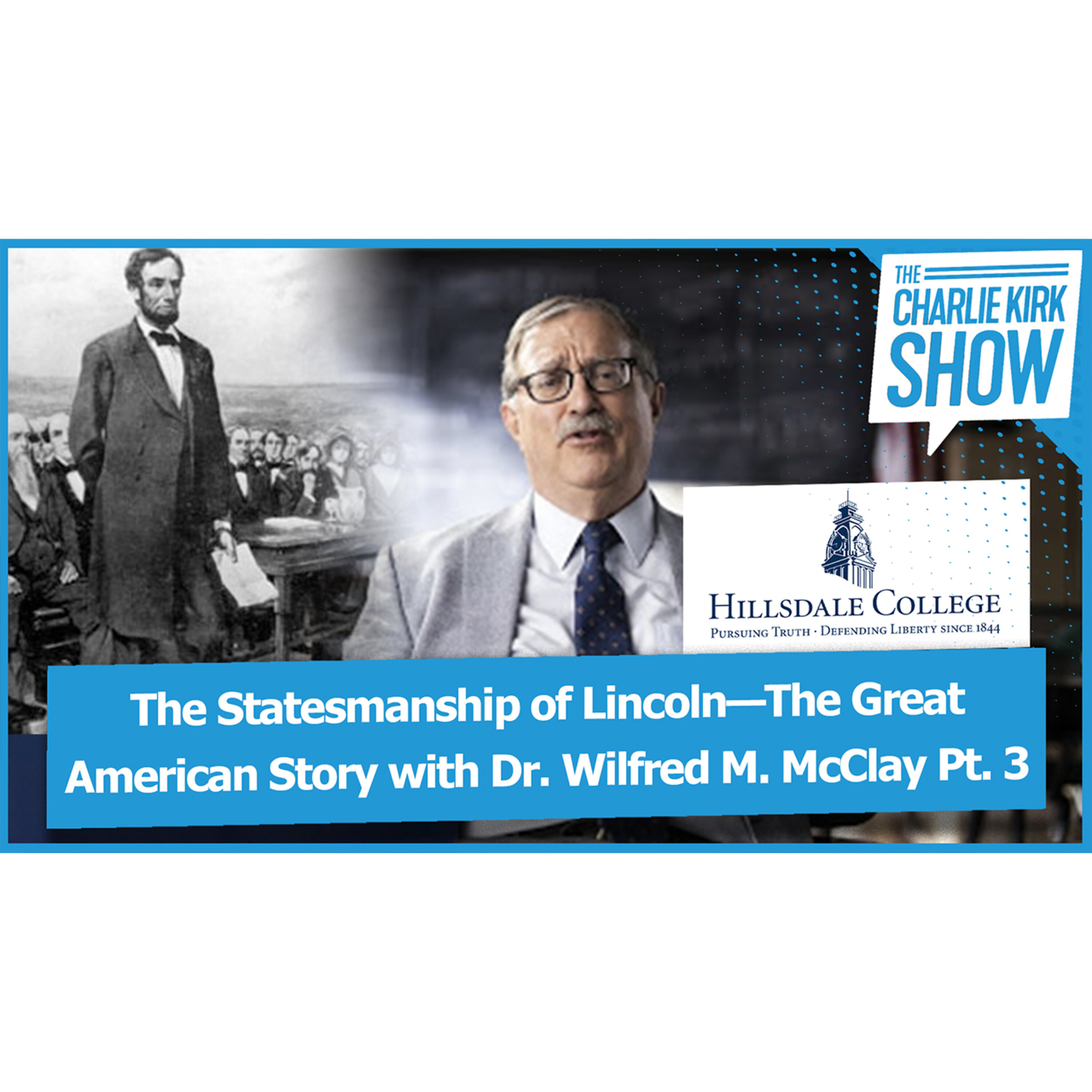
The Charlie Kirk Show
The Statesmanship of Lincoln—The Great American Story with Dr. Wilfred M. McClay (Part 3)
00:37:46
Loading summary
Transcript42 lines
- [00:00]
A
Hey, everybody. Happy Saturday. Another conversation about what some people would say is our greatest president with Dr. Maclay. Dr. McClay from Hillsdale College, the beacon of the north, part of our partnership with Hillsdale College. Look, you guys got to start taking these online courses. They're phenomenal. They're easy to use. So check it out@charlieforhillsdale.com that's charlieforhillsdale.com check it out right now. Take the Aristotle course, the Intro to the Constitution course. If you want to learn about your nation and dive deep into our ideas as a parent, you should be doing this. And people say I don't have time to homeschool. I totally understand. Well, then take one hour a week to teach your children what you learned from a Hillsdale online course. That's my challenge to every parent listening. Take an hour. Call it the hour of truth. No phones, no iPads, no distract, no distractions. You're going to take one hour a week to sit down with your children. Then go through charlieforhillsdale.com and teach them what you learn and then ask them questions about it, about our history, about our culture and tradition. So I would bless us if you go to charlieforhillsdale.com Register free of charge. Dr. McClay, an in depth conversation about Abraham Lincoln. Also, it's brought to you advertiser free. You want to Support us@charliekirk.com Support. Email us your thoughts. Freedom@charliekirk.comble up, everybody. Here we. Charlie, what you've done is incredible.
- [01:20]
B
Here maybe Charlie Kirk is on the college campus. I want you to know we are lucky to have Charlie Kirk. Charlie Kirk's running the White House, folks. I want to thank Charlie.
- [01:30]
A
He's an incredible guy.
- [01:31]
B
His spirit, his love of this country.
- [01:33]
A
He's done an amazing job building one
- [01:36]
B
of the most powerful youth organizations ever created, Turning Point usa.
- [01:40]
A
We will not embrace the ideas that have destroyed countries, destroyed lives. And we are going to fight for freedom on campuses across the country. That's why we are here. Hey, everybody. Welcome back to the Charlie Kirk Show. With us again by popular demand, is Dr. Maclay from Hillsdale College. Dr. McClay, I was just in Oklahoma singing your praises, thinking that you still had something to do with Oklahoma. And they said, no, no, they went to the beat. He went. He's now in the beacon of the north in Hillsdale College. So that's where you belong. We're here to talk about Lincoln today in the great American story, Land of Hope, which you've done a phenomenal job of putting together Tell us about Lincoln. Why should every American know the story of Lincoln?
- [02:26]
B
Well, because there's so many reasons, but one of them is that he is with him. He was the common man who rose to the highest office in the land and was arguably our greatest president. He was a person who, with almost no, well, really no formal schooling, ended up becoming a master of oratory in the English language. He was a brilliant legal mind, brilliant constitutional mind. And he saw and expressed, I think, what is the essential character of our nation better than anybody else. That's a good starter as to why we should know about Lincoln. The only thing that we don't know about Lincoln, never will, is what would have happened if he had been assassinated at the moment he was. Could the whole settlement of the Civil War have been done better, less acrimony? Would we be looking at the problems that we have today if he had remained in charge? It's very hard to know, but I wish we had had that opportunity.
- [03:44]
A
Yeah, that's a really important point that isn't always talked about is that we talked about how he was probably America's greatest president, his ability to keep the Union together. But it was an incomplete presidency because his successor, they were much more aggressive towards the south than even Lincoln wanted to be. He had a much longer term picture of trying to heal the nation. So I want to kind of go back to Abraham Lincoln's upbringing. He was a lawyer for the railroad companies. He studied Euclid, Shakespeare and the Bible. That's what he always said. And one of his earliest speeches I want to talk to you about, Dr. Maclay, is the Lyceum address, because you can kind of see a little bit of a foreshadowing of the leader to come tell us about a young Abraham Lincoln and how we know him today.
- [04:34]
B
Well, he was born in Kentucky and to very, very, very humble origins. When he was asked once about his origins, he said that he referred to Thomas Gray's poem, which we call Gray's Elegy, and has a line in it about the short and simple annals of the poem. He said, that's enough to describe his upbringing. And so we, and we actually don't know a whole lot. We know that he had this experience of being a farmhand. He knew firsthand how laborious and difficult farm labor was, especially in that era before we had mechanization of any kind. He saw slavery in Kentucky, and in his trip to New Orleans, he actually saw a slave market. Every piece of evidence points to his having found slavery to be a repulsive, vicious and Unacceptable un American institution. From very early on, he probably in part got from his father, who did not figure in his life heavily. But he was Baptist. His father was a very serious Baptist, okay. But moving ahead, he had the work ethic par excellence. He worked very hard. And when he came to New Salem, Illinois, just a raw kid. He got himself a job at the post office, established himself, ran for office, educated himself, used every spare minute his law partners called him this little engine of ambition that never stopped. But he was a perfect example of the American ethic. You work hard and you can get ahead. So he comes from this frontier background. He understood the frontier experience of expanding America and he understood the opportunities that were available to him. So he got into politics, he ran for office. He educated himself in the law and became, as you said, a very good lawyer. He had a great legal mind, which he mainly got from reading Blackstone and other classic legal sources. But this, it isn't just reading them, it's he incorporated that. He assimilated them, he made them his own. So that now to jump ahead to the Lyceum address, 1838. This was a period of great unrest, not unlike the present moment in American society, particularly in this sense, maybe more like last summer, a time of racial tensions, tensions over abolitionism and anti abolitionism. There was a murder of a prominent abolitionist. There was mob justice here and there in the country. The rule of law in many places seemed to be breaking down. And the Lyceum address, and this is a very young Lincoln, he's 28 years old when he gave speech which is still worth reading today, is still a very fine speech. He says, look, the revolution was a great thing, the American Revolution, but the people who made that revolution are dying off. By 1838, there's really nobody left. George Washington's been dead for almost 40 years. Adams and Jefferson died on the same day, July 4, 1826. So 50 years after the Declaration, so. So it's a new generation. And he's saying, in effect, we don't have the revolution to unify us. We don't have the revolution as a goal that causes us to set aside our petty difference. Now we have petty differences that are dividing. And what we need to do is look to something else. We need to look to the rule of law. We need to, as he says it in the speech, to make the law, the love of the law, reverence for the law, the political religion of the land, and make it something that is inculcated in every step of the way. Now, just pulling back for A minute. There's some other great things. There's a great line in there about how the pillars, the men of the great men of the revolution who had upheld the Republic, are gone through the silent artillery of time. Just the passage of times he showed already he had an immense gift for fresh and compelling metaphors. But he ends up coming on the side of the law and reason kind of reasonableness coming out of the idea of the veneration of the rule of law. And I have to tell you, just to make a present day comment, side comment. If there's anything I think that's missing from our political discourse, particularly coming from the left side of the aisle, it is this idea that the law, the rule of law is a preeminent value. That, and this is something Lincoln again and again stressed, is that if we don't, paraphrasing, if we don't preserve the Constitution, we don't preserve the framework of laws that undergird our institutions, we are going to have a liberty worth having, that the first prerequisite of liberty is order. He didn't say that. Russell Kirk said that, but it's true. So that's the thrust of the speech, is that the rule of law has to be observed, even an unjust law. In some ways, this kind of conflicts with the idea of Martin Luther King's notion, derived from his reading of Aquinas, that we have no obligation to obey an unjust law. And Lincoln would not necessarily agree with that. He thought we have an obligation to try to change an unjust law, but we should obey it. And I think that this is a lost insight right now. I think someone needs to write a book maybe about constitutionalism or about the central importance of the rule of law to get this across to young people, young and old people in America, that righteousness for a cause is one thing, but civil society can't subsist if we don't have the rule of law. So Lincoln, and let me jump ahead a little bit, if I may, Charlie, that when the Civil War is going full blast and Lincoln, a lot of Republicans wanted to abolish slavery, Lincoln's position was, I can't do that. Unlike Barack Obama, he didn't decide, well, maybe I can do it, yes, but no, he said, I cannot do that. And what he finally did, as you all know, is the Emancipation Proclamation, which did not, if you've ever read it, it's not exactly scintillating reading. It's not like reading the Declaration of Independence. It's simply a legal document freeing slaves who are in those areas that are in a state of rebellion against the Union. So it doesn't include, for example, Kentucky, which was a slave state, but they never joined the Confederacy. It doesn't include the areas of Tennessee that were occupied by the Union army. Tennessee was a Confederate state, but it was, by the time of the magistrate proclamation was being restored to the Union. So it's a very. And the reason he justified is that I have powers. Alan Gelso has written the book on this. I have powers as commander in chief for things that relate to military tactics. So this is a strictly military move and justified, therefore, under my constitutional powers as planted. But to abolish the institution of slavery, that I can't do. That has to be done by constitutional amendment, the 13th amendment, which, as we know from Steven Spielberg's actually quite good movie about Lincoln, he fought like heck for in his last days. So he was a legalist and a constitutionalist all the way down the line. The way this sort of talk you hear today, by any means necessary, which is a reprise of a slogan of the Black panthers in the 60s, he would not have gone for that. By any means necessary. No, by the right means, by the correct means, by the legally sanctioned means. That's another reason we need to remember Lincoln. We lionize him. But what did he do? He was a guy who went by the book for the most part. Now, you'll get Southerners who say bad. He suspended writs of habeas corpus and that kind of thing, we can have a discussion about that. But whether that's also a wartime power of the president. But for the most part, he tried to do things constitutionally because he felt if you didn't preserve the Constitution, if you just threw the Constitution away, there'd be no getting it back. There'd be no. You'd have to go through all sorts of hell to try, probably unsuccessfully, to reestablish those institutions. But because we included in the Constitution, the power to amend was amendable. It was correctable to be brought in line with what he believed was the founding inside of the Declaration of Independence. That's something else that people argue about a lot, and I won't take it up here, but it's consistent with his thinking. And one other thing, and then I'll let you get a word in edgewise. Charlie, you're a very kind interviewer. He managed to convince Frederick Douglass, the great black abolitionist, really powerful, arguably the. One of the most powerful speakers, maybe some people say the most powerful speaker today, who, when he. He was. He Emancipated himself, really taught himself to read, became a quite learned man. Great orator. He originally was with the faction of abolitionists that thought the Constitution was a packed with the devil and was not, had no moral authority. Lincoln, among others, turned him around on that. And he ended up, in fact, in a speech that has the provocative title what to the slave is your fourth of July. And it's full of really coruscating, devastating indictments, moral indictments of an America that tolerated slavery. But in the end, he endorses the Constitution in the most. He calls it glorious, a glorious document. So that's a biggie for me. You know, if Frederick Douglass comes aboard, that's an authority I'm bound to respect on the subject. And Lincoln, I think, persuaded they had a fractious relationship. Douglass often didn't think Lincoln was going fast enough.
- [16:54]
A
That's right.
- [16:55]
B
Yeah.
- [16:56]
A
There's, there's a great story of Frederick Douglass who comes to the White House to go visit with Abraham Lincoln. And no one could believe a black man would be waiting in line to go to the White House. And they, they, they alert President Lincoln that Frederick Douglass is there. And almost immediately he calls for Douglas to come. And at every turn, even in the White House, people were trying to stop him to go see Lincoln because they couldn't believe that a black man would be invited. And as soon as Abraham Lincoln saw Frederick Douglass, he said, ah, Frederick, my friend, come on in. It just made everybody silent. It's a great story. I want to ask you about one part of Lincoln's life that was rediscovered by the great Harry Jaffa, which is the Lincoln Douglas debates. And I want everyone to understand this, that Harry Jaffa was learning under Leo Strauss in New York City. And Harry Jaffa went to a used bookstore and kind of stumbled upon the original transcripts of the Lincoln Douglas debates. And no one had ever really done scholarship, meaningful scholarship of this moment of history until Harry Jaffa. There'd be some people that wrote about it. But what Jaffa realized, and he discovered was that this was really the ancient debate of what is justice? And Abraham Lincoln was very concerned about that sort of question of what is a human being? What is the correct way we should build a government. You talk about how Abraham Lincoln, either willingly or knowingly or unknowingly, was participating in really a new founding of the United States. You can make an argument he refounded our country.
- [18:26]
B
Yes. And that argument has been made by people both favorable and unfavorable to Lincoln.
- [18:34]
A
Well, and that's the thing that's the one thing that the Calhounites and Jaffa can agree on is that Lincoln changed the country.
- [18:41]
B
Yes. And Gary Wills is another who sort of picked up that. The argument from his ticker Douglas Adair. And yeah, no, it's. I think, yeah. I'm not going to go into what my position is on that unless you absolutely want me to. But I'm no Jaffa now. Jaffa was. And, you know, I'm not as well acquainted with Jeff. I actually knew Strauss slightly.
- [19:09]
A
Wow.
- [19:10]
B
Well, I was a student at St. John's College when he was scholar in residence there. And I had the honor of chauffeuring him a couple of times because a campus buddy had that campus job. And he. A couple of times he slipped away to see his girlfriend and asked if I'd fill in for it. So now the truth can be told. And so I got to. I got to chat with Strauss, who was a very funny, actually very funny guy. But I don't know that Jaffa has his own sort of take on Strauss's teaching, which I think in many ways, if I could just be very oversimplified, very much more favorable to the American liberal, and I mean liberal in the older.
- [19:56]
A
Yes.
- [19:58]
B
Experiment, then a lot of Straussians who looked on it somewhat less favorably. It's sort of the best that could be had under conditions of modernity, but not really compatible with the Republic of virtue and dafa. I mean, with the Lincoln Douglas discussion. I think one of the things a lot of scholars look at that, and this is true today too, that debate and sort of say, well, you know, neither one of these guys is affirming American principles of circa 21st century of equality, absolute equality. Even Lincoln draws back from affirming racial equality and in ways that I think, you know, particularly young people who aren't used to the idea of giving a kind of concession to what prevailing values were at the time are shocked by. I'm not because partly because there's such a tone in Lincoln's language, we could talk about that in a different time maybe. But it's clear that he is in part paying his respects to public opinion. Look, the fact of the matter is you can't, as politicians say, absolutely everything you think and get elected. You have to be aware of the context in which you're operating. This is not a great moral sin, particularly in a representative form of government. But what he does do, he's constantly pushing the envelope. He's pushing towards a recognition of the specific ill evil of slavery to be opposed to Slavery and to be committed to racial equality are not the same thing. They're not the same thing. And the difference would be more obvious to people in the 19th century than to us now. But for him, the idea that there could be a property in man, that you could actually have property in human flesh, was abhorrent, repugnant, simply incompatible with the fundamental principles of the Declaration of Independence and the foundational values and the Constitution. Constitution itself, even though the Constitution contains provisions that protect slavery. So the debate. To me, the interesting part of this may or may not reflect. Jeff. I think it does. But the most interesting part comes over the debate about popular sovereignty. And if I may back up for a minute, you know, one of the things that happened with. I mentioned, I think, in passing, in one of our earlier conversations, that it was really the Mexican War that made a Civil War not inevitable, but very likely because it inevitably reopened the slavery question, which had been settled after a matter of speaking with the Missouri Compromise. Because what were you going to do with all this land? The country more or less doubled in size. What were you going to do with all this land, all these slaveholders who brought their slaves with them to Missouri and Kansas and Nebraska, when those territories became states, would they be slave states or free states? The question had to be debated again and again. I won't lead you through the whole mess of the Kansas Nebraska act and the other things, except that what ended up happening is that even the settlement of the Missouri Compromise failed and was ruled unconstitutional. That was part of the Dred Scott decision. So. The issue was out there in the time of the Senate, the Lincoln Douglas debate. They were both running for the Senate from Illinois. Lincoln had been out of politics for a long time and had been a very successful law. He made a lot of money and. But he was goaded back into politics because of this controversy, because he felt as if with the Kansas Nebraska act, the country was just being wrecked and he felt called to get back in the fray. So he ran for Senate, lost to Douglas. But Douglas was one of the most prominent Democrats in the country. So he ran a good campaign, kept it close, and was instantly the front runner for the Republican nomination in 1860. So that was the context of these debates. This was like a prelude to the presidential race two years later. So the issue of what to do about slavery in the territories comes up, and Douglas has this great idea, which actually is so superficially kind of appealing. A popular sovereign. Let the people decide. Of course, what that meant is in states where slaveholders really wanted to prevail they all piled in with their slaves. And to try to bring the population up to a level where when, when there was a territorial election, they would win. And similarly on the other side, and you had Kansas break into violent conflict, bloody Kansas, over this. It was again another place like the 1838 Lyceum address moment, when the country seemed to be kind of, at least in that place, falling apart. And so Douglass just thought, let the people decide. That sounds good, doesn't it? Sounds very American. But what Lincoln ends up evoking is the idea that you can't. There are certain kinds of fundamental values that even the people acting in the sovereign capacity can't overrule. And one of them is the fundamental dignity of human life. So slavery, the wrongness of slavery and the wrongness of allowing it to expand beyond where it already was was to him a fundamental principle. Both of those things he was willing to accept. And this is another thing that troubles people about it. He was willing to accept slavery where it existed. He ran for president on that platform. The south did not believe it. Maybe they were right not to believe him, I don't know. But they, they, even after he was elected, he and some others tried to pass a constitutional amendment called the Corwin Amendment that would have protected slavery forever in the Constitution. They were willing to do that to keep the country from falling apart again, presuming that at some later time sensibilities, moral sensibilities would come around and slavery could be abolished. Now, look, I don't. That's a. We can have a debate about that decision. But in any event, it failed because as I said, the south simply was. Was willing to go its own way, goaded by South Carolina and led along by others. So that issue of popular sovereignty being not enough, that there was some constitutional principle that you couldn't just vote, vote to treat some people as property and others as not. There was no ballot that that could be on. That was Lincoln's, I think, the ultimate thrust of his position. And it's a very important position. Again, going back to my very beginning thinking constitutional. We think constitutionally, we think there are certain things that are outside the scope of government. You can't just decide, for example, just to pick a random example, that landlords can't evict tenants who don't pay them for six months and decide this from Washington. It's a fundamental violation of the laws relating to private property. You can't do that. And the Constitution is there to provide, to put up a fence against the passing passion of majorities or even powerful minorities during particular times of crisis. That's why we have a Constitution. Not for the good times, it's for the hard times to tell us, you know, when we're tempted to transgress that we shouldn't. And Lincoln, he has his detractors on. I take them seriously. But in the end, I think he was a profound defender of the Constitution and of the idea of constitutionalism, of the rule of law, and we're very fortunate to have him. It's interesting, if I could make an upside observation. George Washington would be the main competition with Lincoln for greatest president. And both of them had to make decisions that I think come out not out of a sort of political science playbook, but out of philosophy, out of fundamentally. So what is. What is man's purpose? What are the sorts of things that we need to have for society to flourish? They're statesmen. And statesmanship is something that comes out of the human soul. I think it's this sort of prudential wisdom of looking at all the facts, sizing them up, and then making a choice that is not predetermined. You know, there's no playbook. And both of them, we were. We've been so blessed to have leaders like that. We could. You know, I'll stop right there, but you know what I'm going to say next?
- [31:15]
A
Oh, yeah, I know exactly where you're going. And so I want to close with this Dr. Maclay, which is the enduring legacy of Lincoln. Everyone gets something different out of Lincoln. And, yeah, there are the Lincoln detractors. I don't like the Lincoln detractors because I think that the correct way we should view history, as you do in your wonderful book, is in the time and the manner of the place of which they live, which is what was at their disposal. And you made a great point that Lincoln was very prudent in the way he went about doing things. He was careful not to obliterate the entire constitutional order, even though there was a war on his hands. That being said, Lincoln was very creative and was willing to look at new strategies to be able to try and win the war and also pursue an ultimate good. What do you think is the enduring legacy for Lincoln in today's time? The biggest takeaways you touched on some of them. His statesmanship, his honesty, his integrity, his wisdom. But he really, truly is, next to George Washington, one of the greatest leaders this country's ever produced. What do you think that enduring legacy is?
- [32:20]
B
Well, it's a legacy of combining prudence with Principle. I mean, a lot of times we remember back in the Reagan administration, there were the ideologues and the pragmatists, the stupid categories, the press and vents. I would say that part of Reagan's greatness was that he was a very principled man and he was a very pragmatic man. Or prudential. I like that word better.
- [32:47]
A
I like. I don't like pragmatic. I like prudential. That's an Aristotelian word.
- [32:50]
B
So it is exactly. Exactly. Pragmatic as a William James word.
- [32:54]
A
Yes, exactly.
- [32:57]
B
And Lincoln, I think, had the same kind of combination of fixed principle, but prudential flexibility. The historian John Lukacs that principles are like a mounted gun, that they're fixed, but you can turn them this way, you can turn them that way, depending on what the target is. And I really like that metaphor. So Lincoln had certain principles he would not violate, but he was also. The Spielberg movie is very. What a wheeler dealer he could be.
- [33:38]
A
Oh, yeah.
- [33:39]
B
When. When he was a good politician and, you know, he. He had a. That kind of feel. And where he got it from, I don't know, because he. He was, you know, his. His Harvard was the backwoods. His Kennedy School of Government was the Mississippi River. You know, it was. He was born with a kind of genius that, thank God we provided our country at that time provided scope for men like that. And may we recover that instead of insisting that everybody that serves in high office go to the Kennedy School and become a Kennedy School clone. But I think these qualities of character in him. And by the way, I think the fact that he loved Shakespeare is not a small thing. This is something Jaffa's very big on. The fact that Macbeth was his favorite play, which I'm always surprised it's not
- [34:51]
A
Julius Caesar, but still, unfortunately, it ended too similarly.
- [34:57]
B
Yes, right. Yes. But he had an appreciation for what we would today call the humanity.
- [35:03]
A
Yes.
- [35:03]
B
And remember George Washington and his love of Addison's play about Cato? And there's a way in which great literature can call us to higher things, but also impart a kind of wisdom. And I see this in Shakespeare. Shakespeare is great at teaching us the limitations of human nature. And the Follies, which. I mean, Macbeth is a fool who's led by the nose, by his ambition and his ambitious wife to make a wreck of everything.
- [35:40]
A
Well, and that's a great segue. Dr. Maclay to the Hillsdale online course on Shakespeare, Hamlet and the Tempest. That's a phenomenal segue. It's charliefourhilsdale.com Sorry, Dr. Maclay, we have a hard stop today, but I really enjoyed this conversation on LinkedIn and I think next week.
- [35:59]
B
Can you just hold up for your.
- [36:00]
A
Oh, yes, you can.
- [36:02]
B
The letters may be backward, but this is my book that we've been talking about and I just happen to have a copy. And let me say one last thing about really quick. It's in my book, so you'll have to buy it to get the right quote. But at the last meeting that Lincoln had, cabinet meeting before he was assassinated, same day, earlier that day, he gave a speech in which he said, I don't want to see any. The war's over, Appomattox has happened. He said, I don't want to see any revenge, any bloodletting, any mistreatment of the South. There's been enough of that stuff already. Let's not have any more of that hatred. And that's the worst thing that came out of his assassination. The hatred just boiled and didn't stop boiling for a long time, if it ever had.
- [37:00]
A
I agree.
- [37:01]
B
What a shame. What a shame that his spirit of reconciliation couldn't have prevailed. Thank you for letting me get that.
- [37:07]
A
No, that's perfect. In the next episode, Dr. Maclay will touch a little on reconstruction, and then we'll enter the 20th century. I know there's plenty to go through, so I can't wait for that land of Hope. Charlieforhillsdale.com Check it out. Just your email to sign up for the online courses is terrific. Thank you so much, Dr. Maclay.
- [37:26]
B
Talk to you soon.
- [37:27]
A
Thanks. Thanks so much for listening, everybody. If you want to get involved with turningpoint USA, you could do that@tpusa.com email us your thoughts freedomarliekirk.com God bless you guys. Speak to you soon.
- [37:41]
B
For more on many of these stories and news you can Trust, go to charliekirk.com.