← The Charlie Kirk Show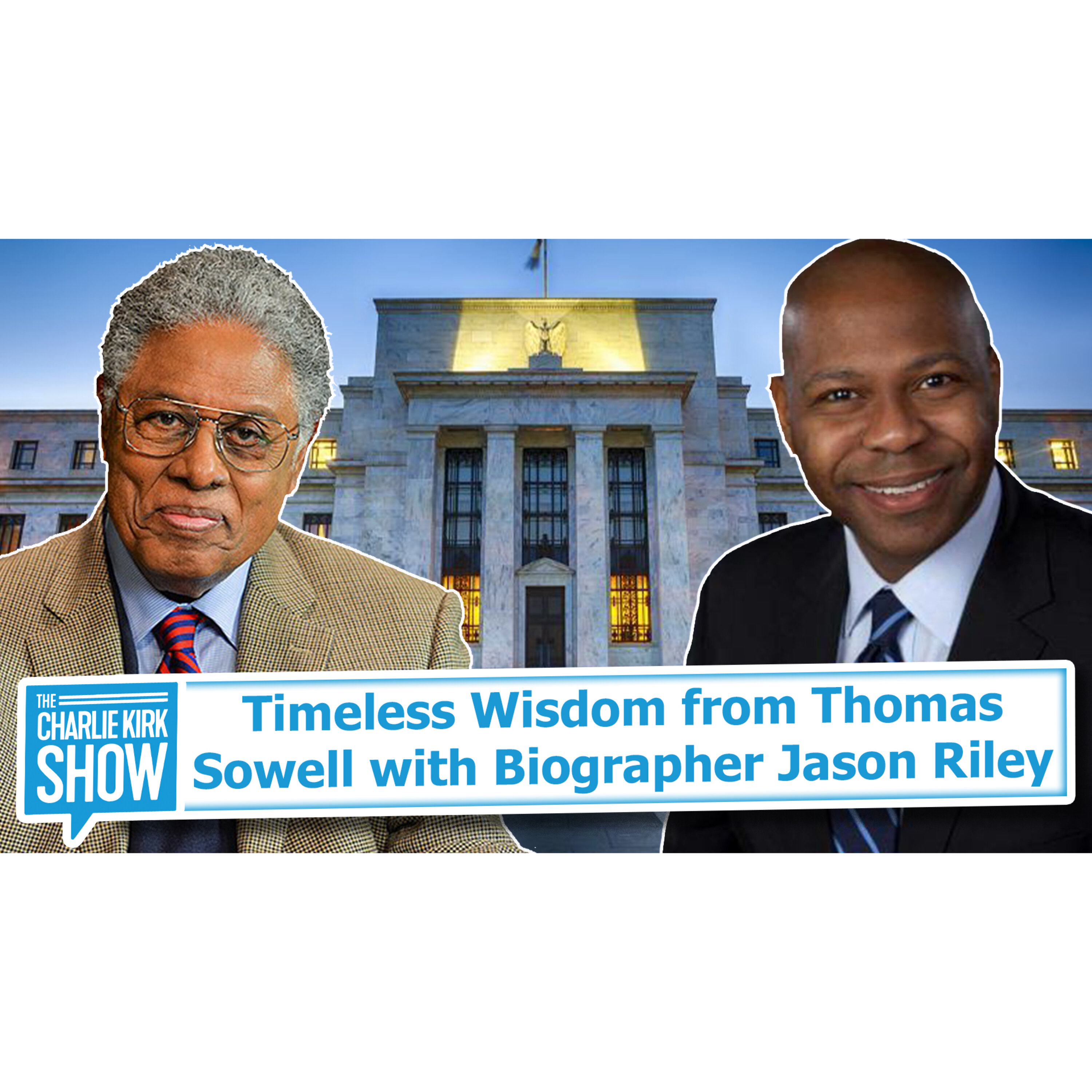
Loading summary
Transcript47 lines
- [00:00]
A
Hey everybody. A great conversation with a terrific Jason Riley. If every young person in the country knew about Thomas Sowell, the world would be a better place. If you are a parent, tell your kids about Thomas Soul. If you're a student, learn about Thomas Soul. In fact, I am so inspired by this conversation I had an idea that Turning Point USA should start the Thomas Sowell Project just running advertisements and awareness of Thomas Soul stuff to give people the knowledge that they need around Thomas Soul. A gift to our country. Email us your thoughts freedomarliekirk.com if you want to support us, go to charliekirk.com support buckle up everybody. Here we go. Charlie, what you've done is incredible here.
- [00:38]
B
Maybe Charlie Kirk is on the college campus. I want you to know we are lucky to have Charlie Kirk. Charlie Kirk's running the White House folks.
- [00:47]
C
I want to thank Charlie. He's an incredible guy. His spirit, his love of this country. He's done an amazing job building one of the most powerful youth organizations ever created, Turning Point usa.
- [00:58]
A
We will not embrace the ideas that have destroyed countries, destroyed lives and we are going to fight for freedom on campuses across the country. That's why we are here.
- [01:10]
D
Did you know that 80% of the grass fed beef sold in the United States is imported from overseas? It's staggering. That's why I get my meat from goodranchers.com because their product is 100% American. When you buy your steak and chicken from Good Ranchers, not only are you getting amazing meat, but you're also supporting American farms. My friends at Good Ranchers have traveled to the United States and met with the actual farmers that raise the livestock to ensure the product they are sending to your table is the very best. All the product is individually wrapped which eliminates waste. GoodRanchers.com safely delivers America's craft beef better than organic chicken right to your door. Buy one time or better yet, subscribe. Check out the Family Fest bundle. If you subscribe, you will save 20% off each purchase. Subscribing brings down the cost per meal to just $2.38 per meal. That includes steaks, chicken and more. Stop trying to play the grocery store guessing game. Know where your meat comes from with goodranchers.com support American farmers. Support American farmers. Again, support our country. Go to goodranchers.com Charlie to get $20 off and free express shipping. It's a 100% American. Beef and chicken steaks are always USDA choice and prime chicken is 100% all natural and no antibiotics ever, no hormones ever Added it's safe and convenient way to shop. Go to goodranchers.com Charlie Goodranchers with an S.com Charlie
- [02:28]
A
hey, everybody. Welcome to this episode of the Charlie Kirk Show. With us today is Jason Riley. I'm a big fan of his, and he has a new book coming out which I think is going to be one of the most important books written of this year and quite honestly, of the last decade, because about someone that I just think is an American hero. First of all, Jason, welcome to the Charlie Kirk Show.
- [02:48]
B
Thank you for having me.
- [02:50]
A
So your new book is called Maverick, and it's about someone who, quite honestly, got me to look at the world differently, and I would say correctly. And that is a book about Thomas Soul. Tell us about the book and why you decided to write it.
- [03:05]
B
Well, I share your praise of Soul, obviously. That's the main reason I wrote the book. It's the first biography of Sowell. He's written a memoir and put out a book of correspondence that he had had with people going all the way back to the 1960s, where he talks a lot about his personal life, but he didn't have a biographer. And I thought that was incredible. And I thought that he should have someone to chronicle his life. And so started sort of getting on his case to let me write the book. I don't know, six, seven, eight years ago, actually. And he's going to be 91 years old this year, so maybe I just wore him down and he finally, finally gave me the green light. But Sol is someone I discovered way back when I was in college in the early 1990s, and I was working on the school paper and having a conversation with some of my colleagues about affirmative action. And someone said, jason, you sound like Tom Sowell. And I said, who's that? And the person wrote down the name of a book on a sheet of paper. And I went to the school library that evening and checked it out and read it in one sitting and went back the next day and checked out my school's whole collection of Thomas Sowell works. And I've been hooked ever since. He's someone who's had a huge influence on my own intellectual development, on my journalism, on my writing. And so I've been a fan for a very, very long time.
- [04:37]
A
Well, and you deserve great praise, too. I really enjoy your commentary. It's always fair, it's reasonable, especially in this moment of insanity we're living through right now, where everything's about racial identity politics. You've been terrific.
- [04:49]
B
Thank you. Thank you.
- [04:50]
A
And So I want to get into more about Thomas Sowell, because one of the reasons I really was looking forward to this conversation, we have a lot of younger listeners and viewers, and they've never been exposed to Thomas Sowell. They hear it every so often on our program. I just did a whole segment on Thomas Sowell today, actually kind of teasing our conversation around my favorite work of his, discrimination and disparities. I think it's. It's, especially today, super applicable. But tell us about why Thomas Soul matters. What, what is different about this man, because his story is rather remarkable. And I only know very. I know the broad part. Growing up in poverty in Harlem and getting a PhD under the great Milton Friedman. What makes his story so compelling?
- [05:32]
B
Well, it's more than his biography. I think it's the way he's carried himself as a scholar and as an intellectual and the way he's distinguished himself. Charlie. It's really. It's unfortunate that this is how he's done it, but it's basically by being an honest intellectual, a straight shooter. And that is so rare today among our intellectuals and among our scholars that that alone makes Sowell stand out. He's someone who follows the facts where they lead. He is not concerned with whether they lead to inconvenient conclusions, unpopular conclusions, politically incorrect conclusions. He thinks his role as a scholar is simply to tell the truth. And simply telling the truth these days and being more worried about truth than popularity makes you a standout among our intellectual elites today. And that is really how Sowell has distinguished himself. And of course, where he's gotten into trouble, and you mentioned discrimination and disparities. One of his books is when he's talked about racial controversies, and he's brought the same empirical thinking to those issues that he's brought to writing about economic history and some of the other topics that he's tackled over the years. And again, it's about following the facts. And so when it comes to writing about discrimination, writing about racial preferences, writing about the priorities of the civil rights movement, he said some very politically incorrect things over the years, and they've got him in trouble. And that's frankly one of the reasons why so many young people haven't heard about Thomas Sowell yet. They do know who, who Ibram Kendi is or who Nicole Hannah Jones is or who Ta Nehisi Coates is or Cornel west and so forth, but they don't know Thomas Sowell. Thomas Sowell was sort of canceled before. It was cool. He was someone that the left went after a Very long time ago for saying politically incorrect things. And it's one reason he's not as well known as he should be. But I will say that that seems to be starting to change. Soul has a fan account on Twitter. It has more than 700,000 followers. Charlie, that's remarkable for someone who's not on social media himself. He has videos of him on YouTube that have millions of views. I did a documentary film about Soul for public television that came out earlier this year, and we were able. And it was available on YouTube and on Amazon as well, and we were able to look at some of the demographic data who was watching it, and we were very glad to see that it skewed.
- [08:10]
A
Younger.
- [08:11]
B
Younger people were watching it. So, yes, a lot of young people don't know about Soul, but maybe that's starting to change.
- [08:19]
A
I think it is starting to change. So my first exposure of Thomas Soul was different, but in some ways similar to yours. So when I was a senior in high school, I was a conservative, but I didn't quite know how to articulate why I believe what I believe. So I stumbled across a man that someone said, hey, you should go check out Milton Friedman. I said, who's that? Of course, they never taught Milton Friedman in my AP Economics class. Right. That would be a thought crime. So I found Milton Friedman on YouTube. And this was in the wild west of YouTube before all their censorship and all of that. And then the next video recommendation was Thomas Sowell. And I assumed, and I was young, that Thomas Sowell was going to be a liberal because I had never heard of a black intellectual that was a conservative. That was the world I was raised in. I started listening to him, and he started talking about the negatives of minimum wage, and he started talking about affirmative action. And I'll. You probably remember this debate, it has 20 million views. Probably now it's him and Milton Friedman sitting next to each other debating a socialist and kind of a collectivist. And it's kind of this one, two punch. And there is kind of this dark web momentum behind Thomas Sowell, the likes of which that very few intellectuals ever get to enjoy. Maybe Jordan Peterson's the closest that I've seen in the modern era. And I've always said Thomas Sowell has been canceled before Cancel Culture even exists. Can you talk about how he got himself in trouble and how he navigated that, especially kind of before the Internet age?
- [09:51]
B
Well, I think the clip you're referring to, it comes from a program that Milton Friedman did called Free to Choose back in the early 1980s and Sol was a guest on that show. And they would come on and debate, intellectuals would come on and debate each other in forums. And Friedman set that up and it was a huge hit. And you're right, on YouTube, a lot of people have been reintroduced to Friedman and Sowell that way. It's also fitting that after you looked up Friedman, the algorithm took you to Seoul. I mean, it gives me some faith in algorithms because it should have, it should have done exactly that. Friedman taught Sowell, mentored Sowell at the University of Chicago, Sowell studied economics. That's where he earned his PhD under Friedman at the University of Chicago. And Sowell sort of modeled himself as a public intellectual on Friedman's public intellectualism. After Friedman left teaching, he did things like that Free to Choose program. He spoke on college campuses, he wrote popular books. He felt the need to explain economics to non experts. And Sewell took that to heart. And Sewell's most popular book, his best selling book, is just called Basic Economics. And all it is is, is an economics textbook with no graphs and charts and jargon. And he's very proud of that book because like Friedman, he believed that the role of a scholar was not just to sit around and talk to other scholars, but to explain your discipline to people who have no background in it. And so Sowell has gone to great lengths to write book after book after book in plain English for general interest readers. And that, that's another one of his legacies in the way, one of the ways he has distinguished himself. And he's accessible. He's very, very accessible. And he thinks that's very important.
- [11:48]
A
And he, and I think Milton Freeman was the trailblazer here. But I think Thomas Sowell perfected it, had a very matter of fact way of speaking. He was almost a little bit of a critic of Buckleyism who just used long words for the sake of using them. Right. And you're kind of like, I can't listen to Buckley without a dictionary.
- [12:09]
B
Yeah, yeah, he makes it. Soule is. His scholarship is wide ranging but also very rigorous in its depth. And yet he can write in a way that is extremely, extremely accessible, but nevertheless shows that he has full command of his subject in all cases. And it's a skill. It's a skill that I wish more economists in particular had because I think economics is such an important subject that more people should understand. But few economists can write like Thomas Sowell.
- [12:43]
D
You guys have heard me talk about
- [12:44]
A
MyPillow before, MyPillow.com, promo code Kirk. You guys know Michael and Dell, and if you want to support Michael and Dell and get a beautiful pillow, very
- [12:52]
D
comfy, and you know they won't go flat.
- [12:53]
A
You can wash and dry them many times. And you got to go to mypillow.com they're made in America for a limited time. And Mike is offering his premium MyPillows for his lowest price ever. You can get a Queen size premium MyPillow for 29.98 for regularly $69.98. That's $40 savings. All MyPillow products come with a 10 year warranty and a 60 day money back guarantee. So you go to MyPillow.com and click on the radio listeners tab and use promo code Kirk. You can get deep discounts on MyPillow products, including the Giza dream bedsheets, the MyPillow mattress topper. So go to MyPillow.com, promo code Kirk. MyPillow.com, promo code Kirk. So Thomas Sowell has a unique biography. I'd like to get into this, and I don't know it very well, but born in 1930, if I'm not mistaken. He. He came of age in a time where World War II was raging, obviously, and then obviously went down when he was, you know, 12, 14, 15 years old. But he was educated during a time where schools were largely segregated and that he kind of saw the Civil Rights act come up. So can you talk a little about his biography? He grew up in poverty, obviously a very smart man, but he would talk a lot about the schools he went to. Did he go to Stuyvesant or something? Maybe I'm wrong, but he was born
- [14:09]
B
in rural North Carolina in 1930. So this is during the Great Depression. And he was orphaned at a very young age. His father died before he was born and his mother died giving birth to a younger sibling. So Seoul was taken in by a great aunt and raised by her and her two adult daughters, one of whom was married. And the four of them moved to Harlem when Sowell was around 8 or 9 years old, part of that big black migration from rural areas to urban areas and from the south to the north that took place in the 1930s and 40s. They were part of that. They settled in Harlem, and that's where he was raised. So before reaching New York, he had attended segregated schools. And he gets to New York and realizes how far he's behind. Even back then, Southern education of youngsters was behind Northern education. And when the Kids would move from one place to another. That became very apparent. And so he had some catching up to do right away. But he was very bright from the start. He was bright, as you mentioned, he was accepted to Stuyvesant University, which your viewers should know and your listeners should know, is one of the most selective schools in New York City, and was even back then you had to take a test to get in and so forth. One of the ironies of Stuyvesant is we have these debates in New York City every year because you still have to take a test to get into the school. And these days the black percentage of people accepted is quite small. I mean, you know, 3, 4, 5, 6% is very, very low. More whites are accepted, and then the group that has the most representation are Asians. When Sowell was attending Stuyvesant, there were a higher percentage of blacks attending Stuyvesant than today, which is quite remarkable given that the black population of New York was smaller back then relative to the white population. And of course there was much more discrimination. And all the things that are cited today as the reason for the racial disparity existed much more extensively back then. Yet it was a smaller racial disparity. It's one of these examples and Sowell is expert at pointing this out, how people who cite racism and discrimination as an all purpose explanation for disparate outcomes don't know their history, frankly. So in any case, Sowell attends Stuyvesant, but he has a very tumultuous home life and ends up dropping out. Before graduating, he was a high school dropout and then he left home. He moved out of the house when he was 17 years old, lived in a homeless shelter for a period of time. Eventually he was drafted into the Marines during the Korean War and got some discipline there. Obviously spent a couple years in the Marines, and then he comes out of the Marines after two years and enrolls at Howard University, the historically Black College in D.C. where he takes night courses. He has the GI Bill money. This is enabling him to go to college. And then he transfers from there to Harvard, where he finally gets his undergraduate degree at the age of 28 years old. And when you think about how many books he's written and all the rest, it's amazing what a late start he got at doing this. He didn't write his first book till he was 40. Think of what might have been if he had had the traditional trajectory of a college student and a scholar. So that was where he got the start. He then goes from Harvard to Columbia to get a master's in economics, and then he goes on to the University of Chicago, where he studies under Milton Friedman to get his PhD and then he spends the 1960s teaching. He taught at Howard University, where he had attended. He taught at corporate Cornell in the 60s. In the 70s, he teaches at Amherst, at Brandeis, and then finally winds up at ucla, where he gets tenure and teaches there through the end of the 1970s. And then he joins the Hoover Institution at Stanford University in 1980 as a senior fellow. So his days of teaching were over then. And that's where he's been ever since. Since 1980, he's been at Hoover, at
- [18:29]
A
the Stanford Institute, Stanford University, and Hoover does a phenomenal job. What I always loved about Thomas Sowell is he was able to weave economic truth and data through his biography. That's why I remembered Stuyvesant. Now, what. What was. How did. What did he attribute that to? The fact that blacks had a higher percentage when he went there. Verse. Now, what would his explanation be or what would he point to as the prerequisites that caused that, that disparate outcome?
- [18:57]
B
Well, I think Tom would point to a number of factors, but they would be mainly cultural factors. And this is one of the things he's written about, that even if you're a group in society that a minority ethnic group or minority racial group that is discriminated against by the larger society, if you have the human capital, and that by that he means the right cultural habits and behaviors and attitudes and skills, you can overcome that discrimination. And so you have example after example of groups the world over that have done this, from the ethnic Chinese in Malaysia to Jews in Eastern Europe. Any number of examples he could cite of hated groups that nevertheless rose economically in these societies, that they were hated and not only rose, but. But what rose to exceed the very groups that had oppressed them, out earned them, outperform them academically and so forth. And so I think what Sowell would say is that back in the 1930s and 40s and 50s, when he was growing up, blacks had very different attitudes towards things like education, the rule of law, policing, and so forth. And their focus was on the development of that human capital. There was obviously a lot of discrimination, a lot of racism, but the focus of the civil rights movement was also on developing blacks culturally to be able to take advantage of the opportunities in society once equality under the law had been reached. And that was the focus of the civil rights movement starting in the 1950s. That's what Martin Luther King was talking about as well. That changed in the 1960s. The focus became less on equal opportunity and more on equal outcomes. The focus also became on getting political clout, electing more black officials. The thinking being, if we just get more of our own in office, the rest will take care of itself. And so there was a shift away from an emphasis on that development of human capital and more of an emphasis on electing black officials and so forth, particularly after the Voting Rights act of 1965 was passed. And I think Sowell would say that along with the Great Society welfare expansions of the 1960s were quite hard on the black family, the black nuclear family in particular. And so what you see today is not so much a legacy of slavery and a legacy of Jim Crow, when you're looking at economic disparities and so forth, so much as a legacy of the Great Society programs of the 1960s and what they did and the damage that they did in terms of, you know, if you look at marriage rates among blacks or single parenting, violent crime rates and so forth, you look at what was happening in the black community in the first half of the 20th century, everything is moving in the right direction. Post 60s things either stall or begin to reverse course, actually. And then that's what you're seeing the legacy of today.
- [22:27]
A
And Thomas Sowell, he was so. He was unapologetic at taking this position. And the way he wrote, he wasn't trying to win.
- [22:35]
B
He wasn't only unapologetic. He predicted that this would be the outcome. He saw this shift in emphasis in the civil rights leadership from equal opportunity to equal outcomes, and focusing almost exclusively on the shortcomings of white society, which of course is what groups like Black Lives Matter do today. They're operating on the assumption that all black problems are caused by whites and can be solved by whites getting their own act together. And Sowell was saying way back in the 1960s, the problems of black people today run far deeper than what whites are doing to them. And he saw that coming a long time. And you look at today, I mean, I'll give you a quick example. You've. In Chicago in 2019, there were 492 homicides. Three of them involved police. Black Lives Matter looks at that statistic and says, chicago has a policing problem. We need to talk about policing. Obviously any rational person who looked at that statistic would say, the problem there is not police or police shootings. The problem is non police shootings. Nor are there white supremacist groups riding around Chicago shooting up black neighborhoods. So Soul said, and even if you go back to people like Martin Luther King who saw this too, he said, yes, there are problems in the white world, but there are problems in the black world too, and we need to get our own act together. We can't keep on blaming things on white society. And yet that is what prevails today when it comes to the focus of the civil rights leadership. But Sowell saw this going sideways 40, 50 years ago.
- [24:27]
D
I've been talking about ExpressVPN on my show for months. Why haven't you gotten a VPN yet? I use ExpressVPN all the time. Maybe it's because you think it's too expensive or you don't really understand what it is, you just say, okay. Charlie says these three words, VPN might as well be AIC or AOC or whatever. No. A VPN means that your phone is protected. That's why I and thousands of my patriotic listeners choose to secure our data online using ExpressVPN. When I wake up every single morning, I make sure that I have those three words in a square next to either my WI FI connection or my 5G connection VPN. I know that my data is anonymized. My IP address is routed through their secure servers. Are you confused about how it works? Well, ExpressVPN is an app for computers and smartphones that encrypts your network data and reroutes it through a secure server. I started using ExpressVPN before May came to us to partner with our program, before we even had a show on the Charlie Kirk show podcast. So I'm not telling you anything that I personally had not figured out on my own when some friends of mine actually in the intelligence community said, Charlie, you need ExpressVPN. I trust ExpressVPN to protect my online data because they're rated number one by CNET and Wired and they stand for my values. Now it's time for you to take a stand. Take back your privacy@expressvpn.com Charlie and get three extra months free on a one year package. Again, that's E X P-R-E-S-S V P N.com Charlie to get three extra months free. Visit expressvpn.com Charlie right now.
- [26:01]
A
So there is a deliberate campaign, and you mentioned this earlier, to not just cancel Thomas Sowell, but people like Thomas Sowell, and I don't like that word, cancel. It's almost to stick them down a memory hole. To use an Orwellian term, they never existed. Delete their Books and don't ever mention them. But it's not just them. It's people like Frederick Douglass and Clarence Thomas. And I would put Thomas Sowell in the category of those people as the impact that they made on the American story and how important their contributions are to our nation. Part of your project is to try to have more people aware of Thomas Sowell and kind of his writings and most importantly his beliefs. That's probably what you had to use to win him over. Said, listen, enough about you. I want your ideas to get out there.
- [26:50]
B
And that's what he wants. He wants his ideas to get out there. And he's not particularly interested in who gets credit for the spread of these ideas. He's more interested in that the right ideas are widespread. And I agree, he's been right for a very, very long time. And you know, one of the interesting things I came across when I was researching the book are a number of interviews he did with people who would start by saying, tom, how does it feel to be sort of so out of step with other blacks? And Tom would always correct the premise of the question. He'd say, you know, you don't mean I'm out of step with other blacks, you mean I'm out of step with other black elites. And he would say, black elites are no more representative of black people than white elites are of white people. And you can't conflate the two here. And that's what we have going on today in the so called cancel culture. You know, I talked about the emphasis on policing. You know, this idea that black people want to defund the police or that black people have a problem with voter ID or that black people think that there should be racial preferences in college admissions. Those are not the views of black people, those are the views of black elites. And the media too often does not make a distinction. And so what these black elites have been able to do over the decades is to convince the media at large and much of the public that people who don't think like them, black people who don't think like these black elites, aren't really black and aren't really representative of black people. And of course, that's exactly backwards. They are the ones who are out of step with most black people and their views are out of step with, with, with most blacks. As, as the polling shows on things like policing and voter ID and affirmative action and so forth. So had to make this point over and over again over the decades and it still needs to be made today.
- [28:55]
A
Yeah, and the more People that are exposed to Thomas Sowell's idea, you know, ideas I find even conservatives at times and I send them some Thomas Sowell clips or Thomas Sowell book. They said, I can't believe how incredible his, his ability to articulate what's happening and how human nature operates and the different inputs. It's just like it opens people's eyes in such a powerful way. And so in a couple minutes we have remaining talk more about the book. It's called Maverick. I encourage everyone to check it out and other things we didn't touch on that you hope to accomplish in your book and the broader impact you're looking to make.
- [29:33]
B
Well, I also want to think that Sowell deserves appreciation for or more recognition for his writings that have nothing to do with race and culture and ethnicity. He was a, a first tier and is a first tier social theorist. You mentioned Hayek earlier. He's written on social theory, he's written on political philosophy, and he's written books on education. And these two I think have sort of been forgotten because of the way that black elites have succeeded in and sort of not giving him the recognition that he deserves. So I get into a lot of Sowell scholarship on non racial issues as well, some of which he's most proud of. I mean, Sowell would have been had a distinguished career even if he had never written a single word about affirmative action. It's something he only started to do reluctantly, mostly in the 1970s. And he said it was because he saw things going in the wrong direction, particularly with what the civil rights leadership was focused on. And he knew that a lot of people would be reluctant to speak up truthfully about what was going on. He said someone's gotta do it. It's the right thing to do. And so I'm gonna do it. And he's paid a price professionally for going down this road. I mean, I'm certainly thankful that he has. I'm glad we have this body of work out there to push back at what's going on with the social justice warriors and so forth today. So I thank heaven he did it. But he has certainly certainly paid a price. But the book is a really comprehensive view of his scholarship going all the way back to the 1960s.
- [31:19]
A
Yeah, he talked about so many different issues. One of my favorite essays, it might have been an essay or chapter. I have it somewhere, is his repulsion for meetings. Are you familiar with this writing of his?
- [31:32]
B
I remember I can barely recall some quip he's made about. It was something about the type of people who like meetings.
- [31:40]
A
That's exactly. Yeah. And like if you're trying to run a successful endeavor or a business, meetings are the worst thing you could possibly have. And it was just kind of like a. It was kind of a tangent of kind of a little of a window into his. The way that he viewed the world. Like just couldn't stand bureaucracy and the changing of ideas. That action just for the purpose of having it.
- [32:00]
D
I.
- [32:01]
A
That one always just kind of sticks out to me. And then another thing, if people, if you want to see Thomas Sowell at his best and around legends and this didn't get. This doesn't have as many views on YouTube. It was a debate of the New York public sector teacher unions against Bill Buckley, Milton Friedman and Thomas Sowell in front of a big auditorium. And it's three on three and they just wipe the floor with him. And he just talks about education, not about race. It's just education.
- [32:27]
B
Yeah, it is incredible. And one of the things, Charlie, that really drives me up a wall is that Soul is not mentioned when people talk about these great black intellectuals that we have.
- [32:40]
A
I totally agree.
- [32:41]
B
The idea that a Cornel west or Henry Louis Gates or Nicole Hannah Jones or Ibram Kendi or Ta Nehisi Coates. Tom's scholarship is not only far more far ranging than their scholarship. The rigor and depth of his scholarship is incomparable to what they've done. He has written circles around them. I mean, and the idea that they are better known and better respected than Soul is another reason I wanted to write the book and introduce him to more people.
- [33:20]
A
Yeah, I just love it. Well, I know our time is running short. It's called Maverick in 30 seconds. Why'd you pick that title?
- [33:27]
B
He is. He's just. Because he has this tell it like it is attitude. And again, it's not something that should distinguish you as an intellectual or a scholar. You would think these are people in the truth telling business. They just follow the facts. But it's a rare quality. And I thought that Maverick is a way that captured it, captured that attitude.
- [33:51]
A
And he has courage. He has never been afraid to tell the truth. And I think I believe this. If every American or the age of 18 got properly exposed to Thomas Sowell like they did Ibram X Kendi, that charlatan, America's problems would be largely fixed almost that easily. That's how big of a deal his scholarship is. So it's Maverick. Jason, you do a wonderful job. Thank you so much for joining us. I really enjoyed this.
- [34:16]
B
Thank you for doing this. Take care.
- [34:19]
A
Thanks so much for listening everybody. Email us your thoughts freedom@charliekirk.com and if you want to support us, go to charliekirk.com Support God bless you guys. Speak to you soon.
- [34:30]
B
For more on many of these stories and news you can Trust, go to charliekirk.com.