Loading summary
Transcript226 lines
- [00:00]
A
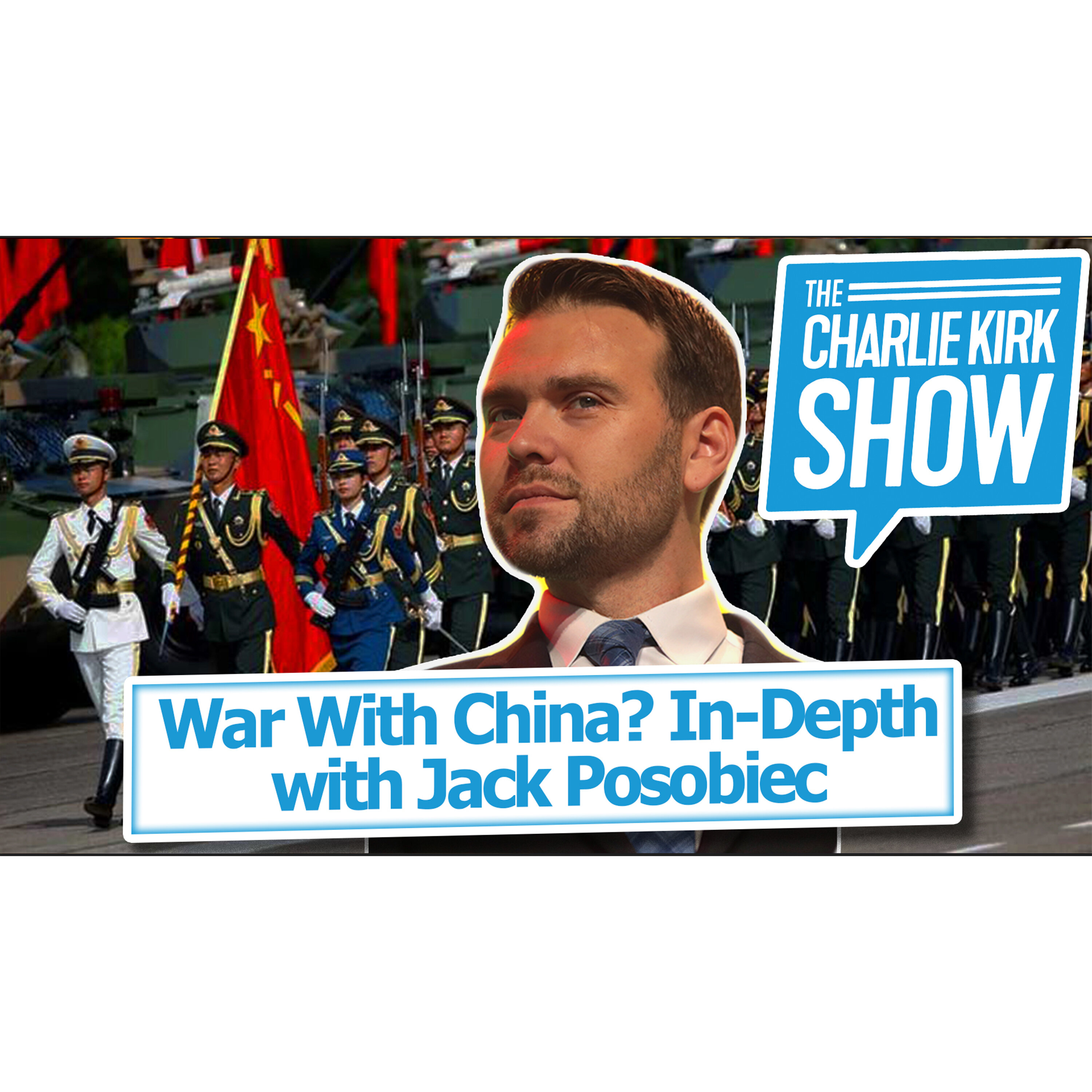
Hey, everybody. Are we headed to war with China? It's a very serious question. I dive deep into that with Jack Posebic from human events. At humanevents.com we talk about that and so much more. If you want to support our program, go to charliekirk.comsupport if you like what we're doing and you want to get behind our vision to reach millions of young people every single month, maybe you want to be like Joey from Denver, who's a very generous supporter. Thank you. Or Mikayla from Chicago, another very generous supporter. Thank you. Or like Carolyn from Brooklyn, Missouri. Thank you. Or Ira from Henderson, Nevada. Very generous Support. Thank you. CharlieKirk.com support is your place to become a partner in our mission and our goal to reach millions of young people every single month with the truth. The truth about our country existence and what you can do about it. If you want to email me directly, I look at every email. I don't respond to them all. It's freedomarliekirk.com if you want to get involved with Turning Point USA, go to tpusa.com Buckle up, everybody. Here we go. Charlie, what you've done is incredible here.
- [01:20]
B
Maybe Charlie Kirk is on the college campus. I want you to know we are
- [01:24]
A
lucky to have Charlie Kirk.
- [01:26]
B
Charlie Kirk's running the White House, folks. I want to thank Charlie.
- [01:30]
A
He's an incredible guy.
- [01:31]
B
His spirit, his love of this country. He's done an amazing job building one of the most powerful youth organizations ever created, Turning Point usa.
- [01:40]
A
We will not embrace the ideas that have destroyed countries, destroyed lives. And we are going to fight for freedom on campuses across the country. That's why we, we are here. Are you saving for retirement or just treading water? Are you depending solely on stocks or mutuals instead of diversifying what you really need? Did you know it's easy to move out of a 401k into precious metals like gold that's predicted to go up $2,500 an ounce soon. Inflation is here and this could be an answer for you. So call the team at Noble Gold, do it this month and they'll give you a gift of a 22 karat American Eagle coin. Just mention the promo code. Kirk. That's noblegoldinvestments.com. that's noblegoldinvestments dot com hey, Jack. Welcome back to the Charlie Kirk Show.
- [02:22]
B
Charlie Kirk. Here we are. I think this is the first time we've actually done one of these.
- [02:25]
A
I think that's right. Usually it's remote and you're like you're in some bunker somewhere.
- [02:28]
B
You're in the. I'm in the bunker. You're out, like in the field somewhere.
- [02:32]
A
You're avoiding Antifa. Trying to.
- [02:35]
B
Well, they're constantly trying to find me. Right, right. And then, you know, and then they're like, oh, I think he's over here. These are there. So what we were doing was. And when we would hold events in dc, many of these times is we would send out like, disinformation addresses.
- [02:48]
A
Are you a disinformation artist, Jack?
- [02:50]
B
Well, I am when it comes to protecting my people. I am when it comes to protecting
- [02:53]
A
my people at events, really.
- [02:55]
B
So we will put out, we'll say like, oh, yeah, we're going to do this event over here. And then Antifa all runs over there and it's like two states over. And then immediately we go to our actual verified list of. Of attendees and say, hey, no, actually the events here, that was just a big job.
- [03:07]
A
I can't wait for the Meanwhile to publish.
- [03:08]
B
Meanwhile, I'm Twitter, I'm like I said, this public. They won't touch this. Then meanwhile, I'm on Twitter, like, how dare you go to our event space? This is terrible. Don't go all the way over to Maryland. That would be awful for us. And meanwhile, we're like, in the heart of dc.
- [03:19]
A
I love that you're with Human Events now. Congratulations.
- [03:22]
B
Thank you. It's been, it's definitely been a whirlwind. And Human Events is great because I think they really punch above their weight class right now. There's only a few people that are really working there behind the scenes. But in terms of the analysis that we're putting out on the op ed side, it's. It's second to none because what they do there in terms of their editing process, it's so be. It's, it's. It's. It's not like 500 angry words on a blog that someone's just firing.
- [03:46]
A
Very thoughtful.
- [03:46]
B
And I have nothing against that as a former angry blogger myself.
- [03:49]
A
Yes.
- [03:50]
B
But it. What they do and the editing process is. It's so professionalized and it's like if there's something you're. That's a claim you're making. Okay, back it up. Where you're works cited, where's your bibliography? But they do it in a cool way. So I'm. You just link to it in line in the text. So it actually creates something that's sort of like an. What I call an interactive op ed. So you're reading something And I'm making a claim, you know, China surpassed the US in exports in this category to this region, right? Boom. Here's a study that explains all that. If you want to learn more. If I'm referencing a study on something, boom, here's the full study. You can check it out. And we try as much as possible to link back to other human events articles on the news side so that you're really kind of staying within our ecosystem. And it's actually kind of like what Wikipedia used to be before the left completely took over it. So if you want to go down the rabbit hole through one of these op eds, you actually can. And it's pretty fun. And it's definitely a standard that it's interesting because some of the people contributing that have submitted things, they say, wow, you guys have this like long process and it's kind of annoying. I'm used to just like firing something off and it, you know, it goes up. But we don't need to name any other sites. But I said, look, you know, I think that's something that eventually will set human events apart. Because, you know, when you're getting an op ed from us, it is something that's gone through a very rigorous examination check. You're backing up your sources and it's all right there. Compiled for you.
- [05:12]
A
Human Events.com, which of course comes from the first words of the Declaration of Independence. One of the course of human events. One of the greatest, if not the greatest documents ever written, especially in the last couple hundred years by a 33 year old Thomas Jefferson. Good anti federalist. Even though I disagreed with him. I don't lie. Thomas Jefferson was a hothead. It was really fun to watch him and James Madison write back and forth.
- [05:33]
B
Oh yeah. I mean this was a guy where, you know, and then you go. And when you. I always go to Jefferson. I'm like, ah, you know, I love all this stuff. And then he goes to the, to France and we support this revolution too. I'm like, well, I don't know about that.
- [05:44]
A
Well, both him and Thomas Paine and Eman Burke was the kind of the, the cold water on the, on the fire of the French Revolution. I love it. Because the only reason we got the Constitutional Convention was because Thomas Jefferson was in France during the Constitutional Convention. Right, Exactly. The only reason. And we didn't have email or text. They couldn't Skype them in. No, it was like, you know, you know what, Thomas, I think Paris needs you. And Paris was like, you know, the best city on the planet for a while. Not anymore. And he's like, all right, I'll go. You know, he was ambassador to France or something. Maybe. No, that was Ben Franklin.
- [06:15]
B
Well, he was sort of like, yeah, so Franklin was chief diplomat, and he was like the chief envoy because France. Keep in mind that at that point in our history, France was our greatest military patron. They were one of our biggest allies. We needed France just extremely. Because, you know, and then, of course, in the way that people look at it, it's France is peeling the US away off from Britain in. As part of their 100 Years War. And they're all the conflicts between France and Britain because at this point, and people always kind of forget this about when it comes to European history, that France was kind of seen as the rising power through the late 1700s, early 1800s. This is before. And then you, of course, you get Napoleon, his wars of expansion. And this is all prior to the way we kind of look at it now. We always think of Germany and sort of their wars of when they were the advancing power, but really prior to it was France.
- [07:04]
A
Yes. And so the only reason we got it approved is because of Thomas Jefferson. So one of the course of human events becomes necessary for one people to dissolve ties with another. So, Jack, I want to ask you about something. You are a former military intelligence officer. Is that fair?
- [07:17]
B
That's right. That's right. People always say that. That's an oxymoron, Right. The military doesn't have intelligence, right? Well, at one point, they did. And that's when I was serving.
- [07:24]
A
At one point they did. So is it true that our military is teaching or instructing or mandating critical race theory?
- [07:34]
B
What they're doing in our military now is creating and pushing social programs and social agendas as opposed to sitting there and explaining to us how to fight militaries, how to beat them. I was in the Navy, so when it comes to the Navy, our job should be how do we find the enemy ships and how do we blow them out of the water and send them to the bottom of the ocean. Right. That's the job of the Navy. That's. That's. That's our sole purpose, actually. And when it comes to it, that's not what we spend our time doing. We spend our time doing trainings, talking about diversity, equality, inclusion, the die entire spectrum. And then when I've talked to now. So that's when I was in. That was. I got out in 2017. What I hear people, my friends that have stayed in and when I talk to active duty folks. Now, it's far beyond anything that was going on in the Trump administration. They hit the accelerator on this thing to the floor. I've got people telling me, they say, jack, they go through these. These extremist hearings, and they're only focused on one group of people, and they are trying to divide us, they're trying to separate us. And when it comes to the Navy specifically, or when you look at the army, when you got. When you're fielding soldiers out there, race goes away, right? That stuff all goes away because you're out there. You're in the fight. You're in the foxhole. You're on a ship. Nobody is coming to save you. There's no fire department you can call. There's no police department. You are out there. It's you and your shipmates. It's you and teammates, and you have to watch each other's back. What they are trying to do is sow division and dissension in the ranks. They are destroying. And there's a phrase that we have, it's called a spirit of core.
- [09:09]
A
Right.
- [09:09]
B
So a spirit of core, is that the spirit of the body? Right. So we are all one body. We're all together. It's actually kind of a Christian notion, if you think about it. Right. You know, and so they are dividing that. And I got to tell you, the entire time I was in the military, eight and a half years, and I really challenge people to go and to ask the same question. I couldn't tell you a single actual racist incident that I saw. I never saw something like that. Did I see hazing? Sure. Did I see things that at times. Would it be considered sexual harassment? Sure. I was part of inquiries where I was made to be a witness in time and times like that. And I would tell what I saw.
- [09:49]
A
Right.
- [09:49]
B
But when it comes to actual instances of racism, it never happened. It's just not part of our military. It really isn't.
- [09:56]
A
So you said what they're trying to do. So help. Help me understand this. Are you trying. Are you saying that the people in charge want to try to weaken our military?
- [10:07]
B
What I think they're doing is an ideological purge. I think they are trying to push people out, whether through attrition, through resignation, or from even not joining in the first place. They do not want people who are conservatives. They don't want people who have that strong religious core. They don't want people who believe in all the things that we just outlined, who actually believe in this country, because they view it as a Force. That is not, I mean, look at it, right? The oath of service is an oath. Not to any one politician. It's an oath to the Constitution. Right, we were just talking about that. So you swear an oath to the Constitution. There's actually a joke. They said, well, congratulations, you just signed up to defend a 200 year old piece of paper. Right. But that's, it's more than that, obviously. It's the ideals of the Constitution. What they are teaching is in direct contrivance to the actual oath of service. And they are trying to make you not allegiant to the Constitution. They want you to have allegiance to the government. And now this overarching ideology of our government. Right. Our, our theory of the state, which has increasingly become this, this wokeism or totalitarianism, whatever you want to call it. Right. This is not our founding ideals and it is not the thing that we actually signed up to serve for.
- [11:27]
A
No, I, of course I'm trying to understand. I have very little understanding of how military protocol happens. So I can under. I get the corporate thing, I get the college thing. I don't really understand the military thing. How is this even remotely possible, Jack? Because for someone like me, like a civilian.
- [11:46]
B
Yeah.
- [11:47]
A
It doesn't make any sense.
- [11:48]
B
So. And this, and I don't want to, you know, it is kind of cliche to say this, but under Obama, what they did was they focused on the military war colleges. And the war college system is. So you have to have a degree to come an officer. Right. But the war colleges are different. Each service branch has one of these institutions and they're within the military. So it's only for military officers. And basically what they are is if you want to become a flag officer, a general or an admiral, depending on your service, you know, you go through one of these colleges, you go through their courses. But what they started using them for was to kind of find the people who were either part of the program.
- [12:24]
A
You're talking about like West Point, Navy, Air Force Academy.
- [12:27]
B
Okay, not the academy. So this is something that you would go through sort of as you're already at that commander level or even the 06 level, your Colonel level.
- [12:35]
A
What does 06 mean?
- [12:36]
B
So you're, that's your full bird colonel. So that's the last rank you would be before you get to that, that leadership officer status. Well, you're still an officer, but before you get to that what's called general officer or flag officer standard. So before you get your star, right. Before you get your, your first star, as, hey, this is, this is a root and tune General. This is a no, you know, a no craft Admiral, that you, you better be saluting when he comes on the ship. So those are not just leaders of the unit, their leaders broadly seen of the force, right. And so they targeted these because they knew that if they went to the deck plates, if they went to the peak of the guys on the ground, they went to the grunts, right, the boots, this would all be rejected immediately. But they knew if they could get the leadership track, the management track, and they got all of this, by the way, from academia and from the corporate world. It's the exact same thing. They say if we can just get the management track and peel them off and then we can find the people through this war college system who are either with the program or the people who aren't on it. And you can see this, by the way, in terms of who got promoted under Obama and then this still continues today, that if you are somebody who's like, you know, views yourself in the mode of one of the World War II leaders of a Patton or a MacArthur or a Halsey or a Nimitz, you know, in the Navy, you, your career will be off ramped, you will be passed over, you will not get that star. You will be stuck at one of the lower levels. You will not become a leader of the force. And this is what they do.
- [14:05]
A
Let's talk about one of my favorite sponsors, Thinker. In our fast paced world, it's tough to make reading a priority, at least it used to be. @thinker.org, t h I n k r.org they summarize the key ideas from new and noteworthy nonfiction, giving you access to an entire library of great books in bite sized form. Read or listen to hundreds of titles in a matter of minutes. From old classics like Dale Carnegie's how to Win Friends and Influence People to brand new bestsellers like Jordan Peterson's Beyond Order. Even better when they go out of their way to carry titles the left is trying to ban, like Ryan T. Anderson's When Harry Became Sally or A Rational Response to the Transgender Movement. Whatever your background or interests, you'll find compelling content on Thinker. I'm telling you right now, thinker.org t h I n k r.org is terrific. If you want to challenge your preconceptions and expand your horizons and become a better thinker, go to thinker.org Charlie that's T H I N K R.org Charlie. Start a free trial and download the app today. Again, that's Thinker.org T H I N K R.org T-I N K R.org Charlie so how many, how many war colleges are there?
- [15:12]
B
So there's a war college for every branch.
- [15:14]
A
Are these, these are government institutions?
- [15:16]
B
Yeah, they're military run, military run institutions.
- [15:18]
A
So where would the armies be?
- [15:20]
B
The armies is in Pennsylvania. It's in Carlisle, Pennsylvania.
- [15:23]
A
So this is called the Army War College.
- [15:25]
B
Yeah.
- [15:26]
A
Okay.
- [15:26]
B
And then so the Navy's is in Newport, Rhode Island. So it's the Newport Navy and Air Forces.
- [15:31]
A
California.
- [15:32]
B
Yeah, Colorado. I think it's Colorado.
- [15:35]
A
I have to actually Colorad Springs is the Air Force Academy.
- [15:37]
B
Yes, the academy is there.
- [15:38]
A
So this is not, this is not, this is the officer training program. So if you went to West Point, you also have to go, you don't have to go to the war program then you would, you have to go to both.
- [15:47]
B
Yeah.
- [15:47]
A
To get to that next level is what?
- [15:49]
B
To get to that highest level. Got it.
- [15:51]
A
Okay. So this is not just to become, this is not just to become an officer. This is that star. This is to get the star to
- [15:57]
B
be a leader of the force.
- [15:58]
A
So is that required then?
- [16:00]
B
It's, it's not necessarily required. Like I don't think you'd see it written anywhere. But that being said, you kind of know that if you want to get there, you've got to go.
- [16:09]
A
This is a brilliant strategy. I've never heard it explained like this. So basically I get the West Point thing. I wanted to go to West Point, didn't get in. I get the Navy, Coast Guard and Air Force infrastructure. But you're saying that they'll get there eventually. What they've basically done is they've co opted and hijacked the bottleneck to get to the very top level.
- [16:27]
B
Precisely.
- [16:28]
A
So you have this sociopath Mark Milley.
- [16:32]
B
Right.
- [16:32]
A
Who's just like a total disaster.
- [16:33]
B
Yeah. Mark Milley is the great example of
- [16:35]
A
this, by the way.
- [16:36]
B
Mark Milley, he's not a West Point guy, he's a Princeton guy. Right. So we know that, that this program started in, in the Ivy Leagues. They, they're now pushing, they're now starting to push it throughout the actual service academy.
- [16:49]
A
Did he go to the Army War College?
- [16:51]
B
I'd have to double check that, but I know he definitely went to Princeton and.
- [16:54]
A
Which speaks for itself.
- [16:55]
B
It speaks for itself. Woodrow Wilson's, you know he's coming from Wilson's. Yeah. The only time we've ever had of a couple a college professor, or so I should say the first Time we had a college professor as president though.
- [17:05]
A
Obama, not only that, he was the head of the college too.
- [17:07]
B
Precisely. And so when you have Millie up there, when he's espousing this stuff, I, I honestly think he believes it. Right. He's just a guy who's become such a creature of the system that he, he doesn't see any difference in terms of what he's saying because that's what he's been told on every step of the way. And these guys, they learn that if you want to get ahead, if you want more stars, if you become obsessed with rank and status and achievement, you don't lead your men into victory the way that we would kind of, you know, this sort of the layman's view of the military. No, you have to find what the military is interested in, what everybody else wants you to be, and then repeat it and regurgitate it again and again and again on your way up. You don't ruffle any feathers so that as you get there, right. You are the person who's always been able to compromise. Been able to compromise. So whoever compromises the most is able to do the, to achieve the highest.
- [18:00]
A
So the, the 1, 2 and 3 star generals, almost all of them have to go through this war college system.
- [18:06]
B
Yeah.
- [18:07]
A
And the war college system is taxpayer funded, run by the Department of Defense.
- [18:13]
B
Yes.
- [18:13]
A
And basically the Obama people said, ah, well, why don't we remake these war colleges in the ways of an Ivy League school?
- [18:21]
B
Right. Because remember, they have total control over the system. These aren't even, it's purely authoritarian, it's directly government controlled. They said, well, we can, we do this. Sure, of course we can.
- [18:31]
A
So why wouldn't Trump just burn those kind of war colleges to the ground?
- [18:34]
B
Some of us wish he did. But no, I, I think it's something where, you know, and I, I, I understand that when Trump came in, like he's from that generation where he viewed, you know, he was born right after
- [18:46]
A
World War II, he went to a prep right before, like a soft West Point.
- [18:51]
B
So he viewed, you know, those generals and those admirals and everybody coming from the military, he still had the favorite, like rosy colored glasses where when he saw them, he's thinking of the World War II era. He talks about Patton all the time. He references almost every speech. Right. Because that's his view of what a military general is. And because he hasn't been involved in the military, I don't think that he understood just how subversive the system had become under Obama.
- [19:18]
A
So now that this indoctrination center exists. Or at the very least I think
- [19:25]
B
you're arguing, by the way, that's where it started. Right now it's beyond the work on.
- [19:30]
A
No, I know, but it's important to pinpoint where it really is originating from for a lot of different reasons. Like where did the virus come from? Came from a lab. It's helpful to kind of know where this started. But it makes a lot of sense now that it just kind of clicked. So I said, how do they implement all this stuff? Because I mean, you look at these like a regular two or three star general. They don't seem like a social, social revolutionary to me. Most of them just kind of seem right. You know, they want the status, they want the crisp salutes, you know, they want to serve their country. But they don't seem overly interested in Robin d'. Angelo. It's not right.
- [20:04]
B
And so this is where, this is where it comes. And then when you, you've seen there's a few videos where these guys will get challenged on actual quotes from Robin Diangelo or some of these other CRT
- [20:13]
A
writers or Ibram X Kendi or Taha Nisi Coates.
- [20:15]
B
And then you, they say, well, you know, I would Emily say it's important to learn about communism. It's important to learn these things.
- [20:23]
A
That doesn't make me a communist.
- [20:24]
B
That doesn't make me a communist. And it's like. And it actually, you know, believe it or not, Reagan actually had the great quote on that, right? It was, you know, how do you know someone who's a communist? They've read Marx and Engels. How do you know someone who's an anti communist? They've understood.
- [20:37]
A
That's precisely right. And so now, so the War College thing makes sense. That's not going to get fixed until we got a new administration.
- [20:46]
B
I mean this isn't going to get fixed either unless you see major pushback from within the military. But the problem with that is because they used that bottleneck to create the higher ranks in the military. Then all of the people now setting the curricula for these sites are the ones who went through it.
- [21:03]
A
This, this War College thing is so brilliant. I so understand. It makes perfect sense with how these apparatus work. So now it's all throughout the military though, because then you have it properly instructed towards the Millies and the Mattis's and all these other Mattis was a huge letdown. I think you were enthusiastic for Mattis at first, weren't you?
- [21:22]
B
I was one of the People who, I said, you know, this, this was a guy who, you know, you, you hear the stories from when he was in the field. You hear the stories about he was leading the men and you thought, wow, this guy is going to be great. He's a great leader, he's a great soldier, he's a great general. Everyone I talk to in the Marines, you know, maybe, maybe that's my fault for trusting Marines in the first place.
- [21:40]
A
We love Marines.
- [21:42]
B
No, no, that's a little, little inner service rivalry there. And there, there are, of course, they are the Navy sister division and
- [21:51]
A
we got two Marines here. They're going to get really angry, okay,
- [21:54]
B
just throw some crayons at them. They say something to eat. And yes, they know. And what it, what it really comes down to it though is when he got in, he, when he got to D.C. he became a politician. And it's the same thing that happens to all of these generals, all of these four stars, all of these three stars. And correct me if I'm wrong, Marines, these guys come, politicians, they become again, obsessed with status. They get obsessed with influence. They just want that power. And they, I think they actually kind of forget what it's like to be out there in the field and you know, you're being told that you have to go, you know, charge the hill. But before you do that, oh, you've got to sit down and listen to why. Because of the fault of how you were born and your immutable physical characteristics. By the way, you're responsible for the oppression of this and the colonization of that. And you know, I've got a three year old and he's responsible for all that? No, I don't think so.
- [22:44]
A
So it's now all the way down into the enlisted ranks. This kind of crt. Woke ideology, is that fair to say?
- [22:53]
B
Well, I wouldn't say that the enlisted ranks are necessarily espousing it as much. Definitely, definitely. When it comes to Marines enlisted, they're like, we're not on board with this crap.
- [23:03]
A
God bless them.
- [23:04]
B
Yeah, yeah. And God bless the Marines for that. Because they're just like, does this help us defeat the enemy? No. Then why are we learning it? Right. I think you would see it more in the Navy, quite frankly. I think the Navy is, the Marines
- [23:16]
A
are a division of the.
- [23:18]
B
They are, they are all their paychecks. They depart from the Navy on them.
- [23:22]
A
But you think, you say there really is a separation.
- [23:24]
B
Oh, there's a huge, culturally a huge cultural separation. Yeah, 100. That's right. Real. And so you I think you would see more of it, more agreement or embracing of this in the Navy at the enlisted rank. Because there's so many people, and I say this as having been in the Navy, they just view it as a job program, right? This is just a government jobs program, really. I can join and I get health care, I get education. They'll pay for my college, and I just go out and I get my paycheck and I do my job. It for probably a third to maybe 40. 40% or so of the force just view it as a jobs program.
- [23:58]
A
So they're not necessarily adopting it. But, Jack, the fact they've been able to even have some success in the military, this could have cataclysmic consequences.
- [24:09]
B
So, you know, it's kind of like the Hemingway quote, right? You know, how does a country collapse gradually, then suddenly. And so when you look at the rot in our military, right, the basic question is, are we prepared? And actually, Pacific Command, 7th Fleet, where I used to serve, so Asia Pacific, I was a China guy in the military. Obviously, everybody knows that our motto was ready to fight tonight. And I've basically been saying lately, I've laid down the marker. I said this on Tim Pool the other night. I do not believe, as currently constituted, that the US Navy would succeed in a conflict over the island of Taiwan. I think the US Would fail in a defense of Taiwan right now.
- [24:48]
A
Why. Why do you say that?
- [24:49]
B
I. For a variety of reasons, I don't. For. Number one, I don't think the will to fight is there from the leadership core. Number two, I don't think that the basic she. If you look at the problems that Seventh Fleet has been having in terms of.
- [25:01]
A
What do you mean by Seventh Fleet?
- [25:02]
B
So Seventh Fleet is our. Our fleet that operates in the Asia Pacific.
- [25:05]
A
So South China Sea.
- [25:06]
B
So South China Sea, all of that. We've lost basic seamanship standards, right? We are crashing ships into freighters or crashing ships into each other. That's. That's not.
- [25:15]
A
But they say that's normal. That happens all the time. No war games, okay?
- [25:18]
B
No way. This. You. They lost seven sailors in one of these things. And that was just basic incompetence. You had people who should never have been on the bridge in the first place that are making these decisions that don't understand the. The basic math of how your trajectories work, how bearing works, how if you're. If you know, if you're sailing, information that if I'm. If another ship is going here and I'm going here, we're going to hit eventually. And then at the end of it, China does not have a force like that. China has a force that is completely based on meritocracy. They are completely based on who can succeed, who is the best, who is the most ruthless in many cases when it comes to their. Their general officer corps. And so they would. Now do I believe China has the power projection to take anything, you know, beyond out into the great, you know, Hawaii? No, I don't think so. But Taiwan being as it's only about 90 miles off the coast, I think if they wanted it, they would take it.
- [26:10]
A
So let's talk about that. In particular, the Chinese government hates the three T's. Tiananmen Square, you don't mention that. Tibet, they hate that. And they don't want you to talk about Taiwan.
- [26:19]
B
Well, Tiananmen Square. What do you mean nothing ever happened.
- [26:21]
A
That's exactly. There's nothing to see here.
- [26:23]
B
Nothing ever happened there on June 4th.
- [26:25]
A
Yeah, exactly. Just. We'll take your head off. The. Taiwan is an island nation. It's its own sovereign nation, despite what the Maoists say. Capital's Taipei. They have their own ethnicity, think that their own language too, if not mistaken. Is that right?
- [26:39]
B
Well, so there is, there is a native language from Taiwan, but there's also, when the. The Republic of China government fled in the 40s to the island, they brought a lot more mainland Chinese. So now you do have like, kind
- [26:53]
A
of a mixed bag. Yeah. So what we have here is the. Is the same thing we have in Crimea, which is kind of a lot of ethnic Russians living in a certain region. And the government wants it back. And so the Chinese government, it's priority number one to get Taiwan back. And you see that even in a small little instance of how John Cena mentioned Taiwan and had to apologize profusely.
- [27:13]
B
Well, and this, this has to do with. And I've, I've briefed actually some pretty senior leaders of our government on this, that Xi Jinping's rise to power. And he's a guy, by the way, I had the opportunity to meet when he, when I was in Shanghai. He was the Shanghai city party secretary on, when he was on his way up. So back 2007.
- [27:30]
A
Wow.
- [27:31]
B
I actually got to meet him once there. And you know, even back then, you knew this was like, it was like he was like the Tony Soprano of Shanghai. Right. He was like on the way up, the huge entourage, you know, overcoat over the shoulder kind of thing. He was the guy everybody knew. Right. And he has ridden this, this ultra Nationalist wave to power, Right? He is, he's gin that up. And you see it in the 100th anniversary. I don't even need to make the argument right. He dresses like Chairman Mao. He says we are I am the Chinese people.
- [28:01]
A
Right.
- [28:01]
B
He doesn't even say I am the party, says I am China. Right. So it's all resting on his shoulders. But at some point that bill is going to come due because the people that he has as his most ardent supporters are going to say, what have you delivered for us? We want Taiwan. Are you going to give us Taiwan? And if he feels threatened by other factions within the party, if he gets backlash from his many, many purges that he's conducted throughout the party system and the military, by the way, then people are going to come and say this guy's weak. He hasn't been able to make due on his promises and that is going to lead him into a very dangerous position when it comes to Taiwan.
- [28:38]
A
So I've heard mixed opinions on this and I agree with our military preparedness. I think that there's just kind of been a dulling of the sword. I'm not yet convinced the Chinese are as sophisticated as they say they are. Is that true? Are they really as advanced as they say they are?
- [28:55]
B
Militarily, interestingly enough, it's, they kind of don't need to be when it comes to a Taiwan situation. So we do, we have the most sophisticated technology? Yes, absolutely. But China understands that technology is both our greatest advantage, but it's also our greatest weakness. So all of their functions and all of their counterattack methods are about disrupting and destroying our technological advances. They want to break down. The first thing they're going to do is go after our gps and that's what the anti satellite missiles are all about. Imagine if China took down GPS not just for, not just for the Asia Pacific, but for the entire United States. You go to your phone, you're trying to get somewhere, boom, no gps, Uber down, everything down, right? That massive, monumental secondary tertiary consequences from that, that's number one, all of our navigation systems. The Navy, for the most part, the primary is gps, right? You lose that, you are out, right? So they've, they've now started to reintroduce, you know, maybe we should look at star charts and basic navigation again just, just in case. We shouldn't be relying on this because they weren't teaching it. They completely stopped teaching. So why should we teach it? We have GPS now. Second is communication.
- [30:01]
A
So interesting.
- [30:02]
B
So our communication system, we use various systems that are, that are encrypted, they're classified. That's the first thing they've targeted. They know they want to get into our systems. And even if they can't get into them, they want to block them. That part of the radio spectrum that they're on or if it's over the horizon, our ability to be able to piggyback messages from some targeter or some, one of our drones that's operating somewhere forward to be able to get target information back to one of our missile destroyers. Right, they want to break down that complete system. And then third, third they look at our carrier defense posture and our carrier defense system. So carriers are these huge, big lumbering, floating airflow, you know, airports, right. Basically, that's, that's the point. They have no real way to defend themselves. And that's why they're surrounded by submarines and cruisers and destroyers and everything else. And that's, that's protect the package, right? Protect the football. So China knows that it's going to be very hard to be able to get through there. So they say, fine, we don't need smart power, we need dumb power. They're going to fire as many rockets and missiles and just cheap ordnance, whatever they can to fire at these things because they know it's a percentage based numbers game. If we can block 30%, that means we're not blocking 70%.
- [31:14]
A
So Jack, I'm just make sure I'm understanding this correctly. Is that so? There's, I want to walk this specific time. Taiwan, I don't know how much time we have because I'm always getting yanked in five different directions. But you're talking about is a war.
- [31:27]
B
So what I'm talking about, and by the way, I actually am not one of these people who thinks that we are. I still think that the most likely scenario is that China continues along their slow path of just kind of absorbing Taiwan into their system through soft power, through economic ties, through financial ties, family ties. I think that's what the cultural ties, I think that's what they want. I think they would prefer to be on that sort of, you know, Taiwan's like a 50 year plan, like 100 year plan. But what I'm saying is if they were led down that path, if there were a financial crisis and a leadership crisis that they were going to pin on Xi Jinping, and then he felt that his leadership and that his role was threatened. Remember when Mao felt that his role was threatened after the Great Leap Forward, what did he do? He launched the Chinese Cultural Revolution, Red Guard down the country. Ginned up the Red Guards 10 years, everything shut down. If Xi Jinping feels threatened, it's Taiwan. It's definitely going to be Taiwan.
- [32:24]
A
But that's the test of this current administration, right? It's 2am Joe Biden gets woke up and they say the ships are. I mean, the planes are on their way. They're going to Taipei. What do we do? Is that basically what we're saying? I mean, it's gonna be that quick? It's gonna be 2am we have to make a call. Are we gonna shoot down Chinese ships in the air? Chinese planes in the air?
- [32:48]
B
Chinese planes have been breaching Taiwanese airspace since the day Joe Biden was inaugurated.
- [32:54]
A
So.
- [32:55]
B
And, and, but you know what I mean. No, I'm just. Those sorties are getting bigger, right? So they're doing it now.
- [33:01]
A
Right? So once that Rubicon officially gets pat, right, and they say, okay, they're now sending amphibious ground troops, like, we know what this is, right? We're gonna have to make a decision.
- [33:10]
B
You're gonna have mines in the Taiwan Strait. You're gonna have their.
- [33:13]
A
And so have we not been. Have we not been guarding the strait between Taiwan, mainland China? Is that right?
- [33:20]
B
Well, and this is something you go back even Bill Clinton, right, when Taiwan had their first presidential election, even Bill Clinton sent naval ships and naval vessels to defend the Taiwan Strait in a show of force because Taiwan or China didn't want Taiwan to hold those elections. Even Bill, this was a bipartisan thing, right? This was something that Democrats and Republicans broadly agreed on and said, you are not going to get Taiwan. We do have a treaty with them. We do have the defense signatory with them. China tries to say that we have this letter, but, you know, not when it comes down to it. We still send them missiles. We still send them weapons. We have that obligation to the defense of Taiwan. The question then becomes, is Biden going to abide by that? Is he going to stand up? And when you look at Cuba, China, Russia and Iran all released a statement saying that the United States should not fear, interfere in Cuba. Excuse me, that's an island in our backyard.
- [34:10]
A
We are the United States, Russia saying
- [34:12]
B
that we are the great power.
- [34:13]
A
They are the interference with Cuba.
- [34:15]
B
We are the great power. We are the great power.
- [34:20]
A
Look, we are all equal. We don't have equal talents. We don't have equal desires. We don't have equal outcomes, but we're all equal. We all need to eat. What are you eating? Maybe it's Chinese meat. Maybe it's grocery Store stuff you can't define. When is the last time you think you had American meat? Chances are it's been very long. Did you know that over 80% of grass fed beef sold in the United States is imported from overseas? My friends, the Good Ranchers crew have traveled the country on a mission to help the American family. How? By working together with local farms and ranches and shipping straight to your door. GoodRanchers.com is a safe and convenient way to order your meat. They save your family money and help the American farmer. What's for dinner tonight? I'll tell you what, I'm having a t bone from goodranchers.com we got this box of meat and Connor sprung into action as soon as the box arrived. It was unbelievable. The box arrived and you know, you could say it was like a child at Christmas. You could say all sorts of things. It was beyond that because it was American meat. In fact, some people working at our office, they twirled around in their chair and they just stared at the box of meat. And in fact, one of them said, do we get any of that meat? And producer Connor said, no way do you want to have a box of meat delivered to your door with that kind of a reaction. GoodRanchers.com saves you the trip down the meat aisle and brings steakhouse quality meat. So go to goodranchers.com Charlie right now. Better than organic chicken, means no hormones, no antibiotics. Goodranchers.com Charlie Get 20% off and free express shipping. Goodranchers.com charlie so Jack, the question is, should we get involved then? If the Chinese government says we want to take back Taiwan and we have to make that snap decision, should we, should we interfere?
- [36:35]
B
Well, the question becomes basically, does the US live up to its word? And this is essentially the bind that we're in, right? Is it a situation where the US has made it their decision? Right. Let's look at Afghanistan, for example. Right? Take the Afghan example. So in Afghanistan, it was very much our decision. Okay, we're done here, right? This is, this is done, it's over. That was something that Trump made throughout four years while he was in office, something he campaigned on and then eventually even Biden had. And it's very interesting that Biden doesn't even say it publicly, but he's like, he kind of just acquiesces and says, yeah, we were wrong throughout the entire Obama administration and you were right and we're just going to do it. But we haven't had that on Taiwan. We haven't had that entire system of going through and explaining why we're going to renege on our obligations. And this is a problem for us. It's a problem for us, number one, as the guarantor of freedom around the world. That's, that's what the, the raison debt of the US Is. And it's also a problem because we do have those obligations, long standing when it comes to Taiwan. This isn't a situation where, you know, we've, we essentially invaded to take out the Taliban, et cetera, et cetera and so forth.
- [37:42]
A
Right.
- [37:42]
B
We have that situation in place and we've promised them that we will defend them.
- [37:47]
A
I think a general principle is I'm not a neoconservative. I think a lot of these endless wars are a project of the war industry.
- [37:55]
B
We shouldn't want, by the way, I
- [37:57]
A
also think that we shouldn't seek to be an empire or imperialist at the same time. Any other country tries to be an empire or imperialist must be stopped short immediately. And so that's a balance that we always have to be able to strike. So the Chinese Communist Party wants this to start taking over islands. Like that's not going to work.
- [38:15]
B
So, and here's the thing too, that, like, and I would say this to folks who are looking at the situation, think of the repercussions on the world stage of the US Losing a major military conflict like that. It would be catastrophic.
- [38:32]
A
Well, and so let's talk about what that conflict looks like.
- [38:34]
B
World reserve currency gone. Right. Balance of trade. We've already lost the balance of trade in the world. Now people would look at us as a joke.
- [38:41]
A
So let's talk. Taiwan is an island.
- [38:44]
B
Yep.
- [38:45]
A
And it's no bigger than Puerto Rico. Is that fair to say?
- [38:47]
B
Give or take.
- [38:48]
A
Okay.
- [38:49]
B
It also has several outlying islands in the, in the Strait that it has sovereignty over so that it would deploy military forces there as well.
- [38:57]
A
And also responsible for almost all the microchip industries in the world.
- [39:02]
B
And that's what it's all about.
- [39:03]
A
That's really. That is the gateway for all of your smartphones.
- [39:06]
B
They're the Silicon Valley of microchips.
- [39:08]
A
And that includes cars, too, by the way, just so we're clear. So Joe Biden gets that call or whatever, knock on the door at 2am
- [39:18]
B
and by the way, I wish that all of that was in the United States.
- [39:21]
A
It should be.
- [39:21]
B
I wish it was in like it's in.
- [39:23]
A
It's unacceptable that it isn't. But our leaders quite honestly didn't care about the country when you And I were kids and so Jack, what's the likelihood? Let's just go through probability, which I know is kind of a frustrating thing for some people to do. What's the likelihood that the CCP makes an aggressive military maneuver to retake Taiwan in the next couple years?
- [39:44]
B
I would say right now it's a 50. 50. I really would. Because again, prior to Xi Jinping's rise, I probably would have put it much lower. But with Xi Jinping being such an X factor because he is now going so beyond 2022. So 2022 is when Xi Jinping was supposed to step down. That was the end of his 10 year term as the General Secretary of the party. They call him, didn't even say president, by the way in Chinese they say Chairman Xi. And so that is what he essentially changed in their system. He said, I'm going to be president for life. I'm going to be the leader for life in 2022. If he is faced with, faced with a rival, if he is faced with a serious, what they would call loss of face or loss, lack of leadership, crisis of leadership, I think Taiwan would be his number one priority to say. And it wouldn't take much. Right? It would be, it would probably start off with like a fishing dispute or one boat hits another boat, Gulf of
- [40:42]
A
Tonkin type stuff or.
- [40:44]
B
Right. Something where. So China fields what they call, call the little blue men. And it's essentially these militias that are signed up to be subservient to the People's Liberation Army Navy, the plan, the Chinese Navy. And they're not uniformed, but they are trained and they operate as a kind of quasi paramilitary force for China. So you get those guys into one of those things and they can, they will then have plausible deniability to say, oh, we didn't order this, we didn't want this to, to happen. But now that it has happened, then China will say this Taiwanese aggression, the aggression of the rogue province must be ended. They will not disrespect the Chinese people the way they have. We must bring them to heel. We must bring these dissidents to heel. They have robbed China of their birthright. For this is, you know, so you
- [41:33]
A
think there's going to be a build up.
- [41:35]
B
So there'll be a build up to that and then that will spill over very quickly again. If you're in that dynamic where Xi Jinping is already feeling threatened and that
- [41:44]
A
that could result in the largest geopolitical conflict Since World War II, if the
- [41:51]
B
United States were to take it to that Level of all out war with China, it would be far beyond World War II. Far beyond.
- [41:59]
A
And do you think we're prepared for that?
- [42:00]
B
No, we're not prepared psychologically as a nation and we're certainly not prepared militarily to take anything to that level. And by the way, Xi Jinping and, and his generals, they know it. They absolutely know it. And that's what they're going to be telling him. They're going to say go ahead and take Taiwan because the US is not ready to fight. And they won't fight that.
- [42:19]
A
We'll just let it happen.
- [42:21]
B
They'll put up, you know, it's like the South China Sea, right. So when I was a navy officer, you know, and I'm looking at the South China Sea and I would write my report and say, hey, they're building islands. Hey, the islands are getting bigger. Hey, they're putting military stuff on the islands. Hey, they've got an aircraft carrier and they're using the islands to, you know, conduct aircraft trials. Right. When it comes to the, the, the aircraft carrier. Right. And, and then we would just make note of it and then you might put out some dispatch or some release or oh, there's going to be a very strongly worded United nations letter about the whole thing. But at the end of the day, we give and we give and we give to China on all of these fronts. Meanwhile, what are they doing with one belt, one road? They're building, they're building infrastructure through Xinjiang. So Xinjiang, the Uyghurs, all of that, that's it. It's about them, but it's not about them. It's about what it's about Afghanistan, Pakistan and access to the Persian Gulf and access to the oil there. Right. They want Iranian oil flowing through pipelines that go up through Pakistan and then look at the map right through that area of Xinjiang when the Uyghurs just happen to be in the west, right. So forget about them. I guess we got to get rid of you. So that's why you have a million in concentration camps now. That's one side. The other side, Thailand, Burma. What's right in the middle? India. So India is now being encircled and you mentioned Tibet. So Tibet, Xinjiang, that's right across the border from India. India understands this and China understands that their greatest rival in terms of population, in terms of economy and in terms of military able to filled a land military on the continent of Asia is India. And so that is why when you look at one belt, one road, they
- [43:56]
A
are encircling India India's not. India's a very.
- [44:04]
B
So my point in all of that is they, they're looking at what we would do and they're planning backwards from there.
- [44:11]
A
Yeah, India can throw a wrench into their plans. What's China's greatest weakness?
- [44:16]
B
China's greatest weakness is its over reliance on the party and its under reliance on actually just believing in their own people and allowing their people to rise on their own and have that ability to sort of just have this. I mean it's, it's, it's cliched. But to have the same ability as people in a free nation would have to really grow their structure. So there are pro, there are protests in China every single day, every single week. They're out in the provinces. People don't hear about it. It gets blocked on Chinese social media, WeChat, etc, you don't hear about it. Unemployment goes up in the US A couple of points. We say, okay, fine, we'll, you know, we'll spend some more money, we'll extend unemployment benefits, everyone will be fine. Unemployment goes up in China. Now you're talking just percentages. That's millions and millions of people without work. They already have a floating population of internal migrants. Right. This is all goes back to the Hukou system. We don't have time to get into all that. But people who are essentially illegally working in cities where they haven't been given permission to work, this is millions and millions of people that have been checked out of the Chinese system that aren't allowed access to capital, they're not allowed access to work, they're not allowed meaningful access into that middle class. And so that lower class, the worker class, the Lao Baixing. So Lao Baisheng is like, it's called the old hundred names. It's sort of like the regular guy. If you can separate that from the leadership of the party, what I call the 1% of China, because if you look at it 90 million versus is 1.4 billion, it's about 1%. If you can separate that and get them to understand that this party is not working in your interests. Right. This is why, by the way, when the pandemic first started, that was a very dangerous moment for Xi Jinping because they understand what's, what happens in China. They believe in some, in a cyclical version of history and dynastic decline, dynastic cycles. Right. Every dynasty in China has fallen at some point. And if you look at it through this lens, the Communist Party is just the new dynasty. It's a modern dynasty. And so what are one of the things that heralds the beginning of that decline cycle? It's economic downturn, military defeat, famine and pestilence and disease. So a widespread disease breaking out. Xi Jinping knew. They know their history. Believe me, they know their history. That's why he described it as a demon from hell. He used extreme language.
- [46:35]
A
They believe in hell. I didn't know that.
- [46:36]
B
So they believe in a, a version of Hell.
- [46:39]
A
They believe the Confucian style of hell.
- [46:41]
B
It's a very different, yeah, very different from the Western, Judeo, Christian version, but it is a version. It's definitely a version. And the reason they framed it that way was to say. Whoa, whoa, whoa. This, this does not say that we've lost the Mandate of Heaven. No, no, no. This, this.
- [46:56]
A
They believe in Heaven too.
- [46:57]
B
They believe in the Mandate of Heaven. They believe in the Mandate of Heaven. So we do. We of course have the divine right, but. Because we are the dynasty. But this, this is not coming as a. As a threat to us. This is something that we will defeat. And so there was a moment, a very real moment where the CCP's legitimacy writ large was threatened by the coronavirus.
- [47:17]
A
Do you think it was released intentionally?
- [47:18]
B
I don't. I don't think it was released intentionally. I think a bioweapon released intentionally. Number one, it wouldn't make sense for them to do that in their own population. And number two, it just. From the bioweapons that I've studied from my time in the IC and from microbiologists I've spoken to in the wake of this, it just wouldn't look like.
- [47:36]
A
So it was released accidentally, but then covered up intentionally.
- [47:39]
B
That's basically what I, way I look at it is. But I also would really ask questions about why. Why were those planes allowed to leave Beijing? Why were those planes allowed to leave Shanghai?
- [47:50]
A
Oh, they infected the world for sure.
- [47:52]
B
They blocked travel internally and enhanced travel externally.
- [47:57]
A
They wanted to infect the world.
- [47:58]
B
Go back to the Chinese ambassador to India's statements, or, excuse me, Italy statements, very early on, when Italy was talking about shutting down, he called them racist. He called them your. Your fear mongering. How dare you. How dare you say these things to China. How dare you say that we should shut down travel with China? They knew what was going on, and I believe that they made a strategic decision that if there's going to be a pandemic, why should we be the only ones who suffer?
- [48:26]
A
And I don't know if the world is ready to hold them accountable.
- [48:29]
B
It's Very interesting. Right? Because even the who at this point, who was the strongest defender of China early on, even Dr. Tedros, who has done everything he could to help this cover up, has come out now finally. We're almost two years into this thing, and even finally now he's come out and said, you know, I have worked in a lab and accidents do happen. I said, really? Really? So go back 18 months when I'm sitting there, January 2020, and the Trump administration's coming out, shutting this down. And we said we were worried about what's going on in that lab. And you were shutting us down, you were banning our accounts, you were going after our followers, and you were calling us every name under the sun instead of saying, you know, accidents do happen,
- [49:12]
A
and the COVID up was one of the great crimes ever done, but the
- [49:15]
B
COVID up was more importantly, not just done on the CCP side. And it's because it was done to cover up the fact that the United States had a hand in that lab.
- [49:26]
A
Oh, of course, absolutely. How significant?
- [49:31]
B
So that's what we don't know because we haven't seen the data. But when it comes. And they won't let us see the data. But when it comes down to it, Dr. Fauci knew what he funded in that lab. We have his emails now. We have Peter Daschak's emails now. These people were in the meetings early on. They could have stepped up directly and said, you know what, by the way, we've been studying coronaviruses in Wuhan. We've been doing these gain of function tests. This is very similar to X, Y and Z experiments that we did. And we think that we can use some of these strains to create a treatment that's going to, you know, that was the point, right? They told us again and again that was the point for conducting these. But that's not what they did, is it? They. They lied about it. They covered it up. They never once told us that they were actually funding these types of enhancement. And that's what's. That's what's actually bigger. And I worry that what they're doing now is they're appealing back one layer of the onion and saying, okay, there was a leak, fine, but it was just an accident. No, no, no, no, no. You were doing something in that lab to create enhanced viruses. And look, I go back to those early briefings, the task force briefings, where I was paying attention, and Dr. Fauci's up there and what is he talking about? Spike proteins, ACE2 receptors. Spike proteins, ACE2 receptors, right. I can read a report, I can hear those functions. And then I look at the studies that they were working.
- [50:46]
A
Then he stopped talking about it and
- [50:48]
B
they completely stopped talking about it. And you look at the studies, they said, well, we inserted the spike protein into the bat coronavirus. And then we use something which they call transgenic mice. And transgenic mice means they injected ACE2 receptors into mice so that they would have the same type of functionality as human lungs to see if those, those newly enhanced viruses would then infect the humanized mice. These are chimeras. So they were essentially doing again, spike proteins, ACE2 receptors. So that's the extent of my scientific knowledge. But that is very alarming to me and I would like to know whether or not that played any role whatsoever. And we're not going to know that until we can get into the Wuhan lab.
- [51:32]
A
I agree. Jack, thank you for joining us. How could people follow you and stay in touch with you?
- [51:37]
B
Best way to follow me is human events.com people can always go there and find the latest scoops. And very, very soon there might be something called, I don't forget, it's Turning Point. Oh, Turning Point live.
- [51:48]
A
We're going to do that September 13th, Turning Point USA Live.
- [51:51]
B
A little way to follow me on there.
- [51:52]
A
We're excited about that. Thanks, Jack.
- [51:54]
B
Thanks, Charlie.
- [51:57]
A
Thanks so much for listening, everybody. Email us your thoughts, freedom charliekirk.com and if you want to support our program, go to charliekirk.com support thanks so much for listening, everybody. God bless. Speak to you soon.
- [52:12]
B
For more on many of these stories and news you can Trust, go to charliekirk.com.