← The Charlie Kirk Show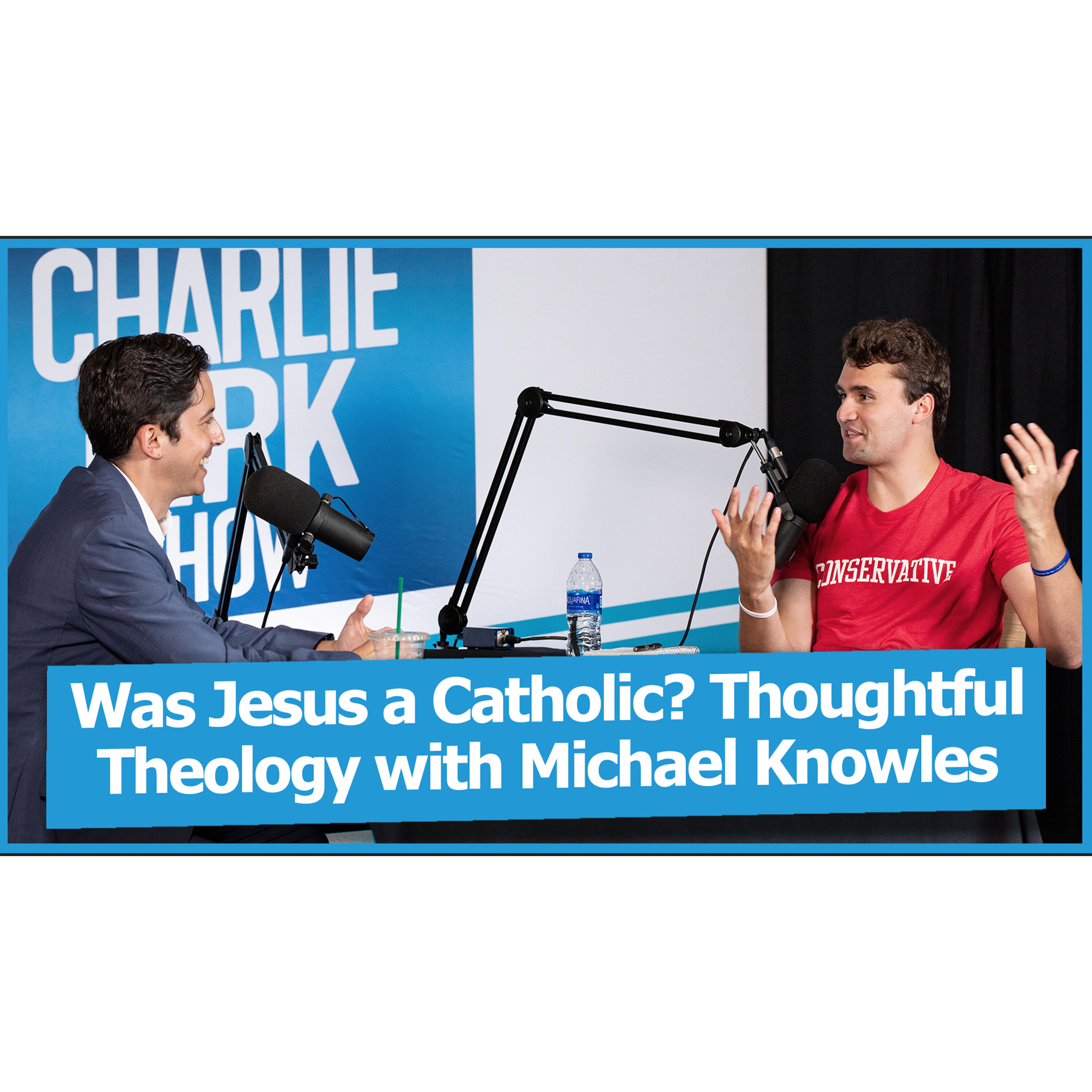
Loading summary
Transcript352 lines
- [00:00]
A
Happy Sunday everybody. This episode is brought to you advertiser free by all of you that Support us@charliekirk.com support. Please consider becoming a supporter and get behind the work we are doing. I want to thank Denise from Victorville, CA for your monthly support. I want to thank Emily from Pixley, California for your monthly support. I want to thank Dexter from Reno, Nevada for your support. And Rebecca from Rancho Cucamonga, California for supporting us at charliekirk.com/support. Was Jesus a Catholic? A fun, light hearted conversation with Michael Knowles, who is a devout Catholic about Christianity, about the Bible, about Catholicism. Now, I do have a soft spot for Catholicism. There's a lot about Catholicism I like. I am not Catholic. I am of the Protestant evangelical tradition. And I press Michael on some of the concerns I have. And I think this conversation will broaden your horizons. It is not a debate. Let me be very clear. This is a conversation amongst two really good friends about things that matter in a lighthearted, spirited way. Text this episode to your friends and it's brought to you. No advertisers, the whole episode. No interruption. Thanks to all of you that have stepped up and supported us@charliekirk.com support. So God bless you for that. Was Jesus a Catholic? Buckle up, here we go. Charlie, what you've done is incredible here.
- [01:27]
B
Maybe Charlie Kirk is on the college campus. I want you to know we are lucky to have Charlie Kirk. Charlie Kirk's running the White House, folks.
- [01:36]
A
I want to thank Charlie. He's an incredible guy. His spirit, his love of this country. He's done an amazing job building one of the most powerful youth organizations ever created, Turning Point usa. We will not embrace the ideas that have destroyed countries, destroyed lives. And we are going to fight for freedom on campuses across the country. That's why we are here. Michael. Welcome back to the Charlie Kirk Show.
- [02:00]
B
It is great as always to be.
- [02:02]
A
We were just having a very candid conversation and maybe one day we'll get big enough where we can actually air these private conversations where it's like, you know what? We're not afraid of cancellation or any of that.
- [02:11]
B
We need a little more cancel insulation first, I think.
- [02:13]
A
Yeah, I think so. I mean, the level of discourse there was rather provocative.
- [02:18]
B
It was racy, it was absolutely outrageous.
- [02:22]
A
Somewhat like saucy. Yeah. Like somewhat authoritarian nature.
- [02:26]
B
More than somewhat. No.
- [02:28]
A
I mean. And we're not going to talk about what we're talking about. We're going to have to guess. No. So your book is basically about making cancel culture great again.
- [02:35]
B
I would I think that's a basically fair assessment.
- [02:38]
A
Is that right? Non sarcastically.
- [02:39]
B
No, I'm serious.
- [02:40]
A
Straight down the strike zone.
- [02:41]
B
Yeah.
- [02:42]
A
And I actually wanted to play devil's advocate more, but it's really hard when you're remote because you don't want to interrupt your guest. Yeah. The book is called Speechless. Yes. It's done very well. A lot of people been talking about it.
- [02:52]
B
Well, I want to. I want to clear, clarify. It's done very well. On the actual bestseller list, it had number one. But on the New York Times, quote, unquote, bestseller list, what number you get? They wouldn't put it on the list. I sold in order of magnitude more. So the first week I sold, it was like 18,000 or something.
- [03:08]
A
Oh, you should be on the list.
- [03:09]
B
So I was 40% more than their number one. But as you know, the book is a little bit controversial.
- [03:16]
A
We did. We got third, right, Andrew? We actually got second on New York Times. Right?
- [03:21]
B
They put you on the list.
- [03:21]
A
Yeah, we got second or third on New York Times, but they never give you. Amazon is legit, though, because it's pure volume.
- [03:27]
B
Yeah, we hit number one on Amazon overall.
- [03:29]
A
Yeah.
- [03:30]
B
Yeah.
- [03:30]
A
Of all categories. Yeah, Big deal.
- [03:32]
B
You know, it's funny, though. Before we hit number one on all categories, before we hit number one on all categories, they put me in number one in civil rights. I beat Ibram Kendi. I beat Robin d'. Angelo. So I just, I want to point
- [03:42]
A
out you're a civil rights icon.
- [03:43]
B
I'm the preeminent civil rights leader in this country. All right? And I demand respect.
- [03:47]
A
Yeah, you're. And the civil right you're trying to push forward is the ability to silence people harshly, quickly and without apology.
- [03:53]
B
Yes. Yeah. I think that, you know, it's funny because we're kind of joking about it, but.
- [03:57]
A
No, no, I'm actually being very serious.
- [03:58]
B
But I'm serious in that what I'm saying is not even that we need to censor or silence people. I'm just saying that I'm making the descriptive statement, the observation that all societies have standards and taboos. This is true everywhere. It's always been true in the United States. And the father of liberalism, John Locke, called for very stringent standards, actually, and censorship. John Milton, same thing. And so when people, I think call me, they ignorantly would say you're an authoritarian or you're an illiberal. I do like to point out I'm. I'm apparently more liberal than the father of liberalism. So I don't think it's too Far.
- [04:34]
A
So this idea of cancel culture. I hate the term. I always have. And I knew this was going to come back towards us eventually because of kind of our moral kind of campaign we've been on like that all cancellation is bad. Yeah, yeah. And I was like, well, the cancellation we're experiencing is bad because you're canceling people for, like, saying the Pledge of Allegiance.
- [04:54]
B
I know. Do you know that other phrase they'll. They always parrot? They'll say, I may vigorously disagree with what you say, but I'll defend your death, your right.
- [05:01]
A
If I hear that one more time by Voltaire.
- [05:03]
B
I mean, any. If. If you hear anything by Voltaire, just
- [05:06]
A
assume that's not totally true.
- [05:07]
B
The opposite is true. That's.
- [05:08]
A
He had some good, did he?
- [05:10]
B
I don't know. I'll keep looking. Maybe I'm not well read enough. I don't know.
- [05:13]
A
I think you're better read than I am. So I guess the question is, then, when do we censor and how? And then I want to play devil's advocate with part of this, because when I was thinking back to our conversation, it challenged a lot of things that I've said publicly. So let's just start with you. When do we challenge? When do we censor? And how. You use. You say prudence, you say, we need to have practical judgment. We know it when we see it. But where is that line? Would you say?
- [05:40]
B
Well, I think that what we need to be is to quote Antonin Scalia on actually a separate issue, very careful. We need to decide very carefully. So we do need prudence here. And I think that there are two polls that people keep vacillating between. There's the one poll which says we should never censor anything. We should have no standards at all. If you want to walk into a preschool and start screaming racial epithets, that's totally fine because we defend free speech. Okay, that's obviously preposterous. Nobody really believes. And then on the other end, they'll say, look, weak. I can tell you with absolute, perfect precision exactly what the standard should be at all times, because I, King of the Universe, am going to proclaim it to you. That's also preposterous. So what I would do if I were trying to figure out how to shape the American free speech regime, I would look to our past. I would look to what we have done before, what has led to flourishing in the United States when we have suppressed obscenity, for instance, in the past, what the effect of that was. I think it was pretty good. Effect when we have stopped enforcing of sanity laws. The effect of that, I think it's been pretty bad. We would all agree. So then I would say, okay, well, maybe we should suppress these sorts of things. There was an effort, bipartisan in the 1990s to limit the spread of pornography on the Internet, and it was struck down by radicals on the Supreme Court. And so I would. I would try to amend that because I think the majority of the American people, in the American tradition, realize you should do that, you can do that and you should do that. So I would begin seriously, very carefully.
- [07:08]
A
Yeah, I don't even know what people believe on that issue anymore after the last 48 hours I've had. I used to think that was the case, but now I'm kind of like,
- [07:14]
B
that's right, you were criticized because there was a porn star at an event and then you were criticized because then there wasn't a porn star at the event.
- [07:21]
A
It's all taped so we can talk about this and edit it as we see fit. Right, Andrew? So it makes for good art is the ability to fail. So, yeah, I mean, I kind of am like, speaking and doing things. Then someone comes up to me and they're like, oh, yeah, by the way, there was a porn star here and we kicked her out. I was like, good. And yeah, I didn't think it was that controversial. Right. Remember, Andrew? And I was like, so what's the problem?
- [07:45]
B
But the thing is, the porn star is completely separate. There is always going to be some tempest in a teapot at any event that you do. Seriously, because it's a very big event. There's thousands of people. People are always trying to.
- [07:54]
A
I just want to reemphasize.
- [07:55]
B
Children are very, you know, young people. Obviously 14 year olds are here. Yeah, we have like 8 year olds here. But you'll be criticized either way. You'll be criticized for kicking off. No, of course.
- [08:03]
A
No, I don't mind the criticism. I mind bad criticism.
- [08:06]
B
Yeah. Yeah. Well, I mean, this is a pretty good example because I think whenever you hear that we need standards in society, all of a sudden people say, you're Hitler, you're Mussolini, you're limited. And you say, hold on. I'm just saying maybe we limit the spread of porn everywhere. Or hey, maybe we don't let transvestites twerk for kids in the libraries. And like, maybe we can know that that's bad and we can agree to use William F. Buckley's phrase, we can be epistemological optimists by which he Meant we could just know things and agree on at least a few things. Maybe we can agree that a man is not a woman. And we can.
- [08:40]
A
No, we've lost that.
- [08:41]
B
But we can't. We don't agree on anything because we no longer enforce a standard. So no standards are left.
- [08:46]
A
But let me ask you a question though. Is that this cult of progress under the guise of non interventionist domestic policy, meaning I'm not.
- [08:55]
B
Right, good phrase.
- [08:56]
A
Like I'm not going to intervene in social issues, does it all of a sudden render this liberty unsustainable? Like is this project by definition going to end in whomever is willing to use the sword?
- [09:08]
B
Well, the first definition you have to establish is liberty. Because if you go with the modern liberal definition that liberty is just doing whatever you want and the ability to do whatever you want, then you have to conclude that there should be no limits. Forget on speech, there should be no limits even on ourselves.
- [09:22]
A
This is the Ron Paul version of liberty. Right. Which was like, do whatever you want, however you want to do it. Legalize all the drugs. I love Ron Paul.
- [09:28]
B
Yes.
- [09:28]
A
I mean he was definitely more sympathetic towards idealist libertarian.
- [09:32]
B
Yeah, but I think it's a bad ideal. I mean, I totally agree. The true definition of liberty is not the ability to do whatever you want, it's the freedom to do what you ought to do. And this is when Christ says, the man who sins is a slave to sin. That's what he means. When Aristotle describes. When Aristotle and other ancient Greek dead old guys describe freedom, this is what they're describing. The tamping down of the vices and the base passions and bringing those appetites into accord with the rational will. And we just don't do that anymore. But that was the purpose of liberal education. And it's funny now because when people go to get a quote unquote liberal education in college. Yeah. They just, they sleep around and drive.
- [10:09]
A
They get a life licentiousness education.
- [10:10]
B
They do, yeah. And everyone does it, or almost everyone these days. But it's why the quality of the education, both on the book learning and the behavior learning has suffered so much.
- [10:21]
A
Well, I think what you just said though, is the debate and the question around what is liberty, what is freedom? Is basically the beginning and the end of what's happening in the conservative movement right now.
- [10:30]
B
It does. Because if liberty means the erasure of all limits, then I guess, yeah, we can't have any standards or anything like that.
- [10:36]
A
But that's kind of what's dominated the conservative movement.
- [10:38]
B
It has for at least 10 or 15 years.
- [10:40]
A
10 years since all the libertarians took over the conservative movement right after Obama.
- [10:44]
B
Yeah. And it's funny, I don't even. I hate to even call them libertarians because they're like, they're. Have you ever heard the phrase a Lolbertarian? Like, it's even like a desiccated.
- [10:54]
A
It's too much Internet culture.
- [10:55]
B
It's so internety. But it's.
- [10:56]
A
It sounds like a Reddit thing.
- [10:57]
B
Yes, but it's. These are not people who have read the classical liberal tradition or who have
- [11:02]
A
read Hayek or Mises or. Yeah, they like, saw Sebastiand Meme. Like, that's what I believe.
- [11:07]
B
Yes. Yeah.
- [11:08]
A
No man shall ever tell me to live. And I'll never tell you another. I live for them or for my own sake, by the way.
- [11:12]
B
Yes.
- [11:13]
A
Yeah.
- [11:13]
B
Yeah. This is the John Golt thing. Yeah.
- [11:15]
A
Well, I mean, it's like, again, the Atlas Shrugged has some utility, but. Yes, the quote's ridiculous.
- [11:19]
B
It's a ridiculous quote. And, you know, the reason I think it's hard to describe them as libertarians is I don't think it comes necessarily from a place of real principle. I think often what it comes from is a place of political cowardice because they don't want to be the bad guys who tell you what to do, and they don't want to have to exercise political power and they don't have to do the thing that the Constitution tells you to do.
- [11:43]
A
Yeah. I mean, but here's my question, though, is that. Do they just throw up kind of the card that says I'm libertarian. I'm like the cool kid in the room? Is that kind of it?
- [11:53]
B
Yeah, it just means I'm a conservative, but I'm not that kind of conservative.
- [11:55]
A
Don't know. I'm a cool guy, you know, and you could take this wherever you want. Some of your colleagues at the Daily Wire seem to really agree with you. Some of them disagree with you, and they all call themselves conservative generally.
- [12:04]
B
Yeah.
- [12:05]
A
Right.
- [12:05]
B
Well, Ben, I think, says he's a little more libertarian, by the way. I think Ben is from a more serious libertarian tradition than the.
- [12:11]
A
No, of course. People in the last 10 years. So Ben, though, would disagree with a lot of this, what we're talking about.
- [12:16]
B
Yeah, fair bit. I mean, there's a joke, you know, Ben has a new book coming out called the Authoritarian Moment, which I jokingly said is going to be my campaign slogan in 2028. Knowles 2020. The authoritarian moment, you know, so.
- [12:26]
A
But the. How does, like, walk us through that Tension point. Because I think that's really interesting of two smart people that just don't see this the same way.
- [12:35]
B
Yeah. I mean, I don't want to speak for Ben, obviously, on it, but I think he has greater sympathy for the libertarian side of things. Drew Clavin, I think, has greater sympathy for the kind of classical liberal tradition. Matt Walsh is more in your camp, especially these days, is a little more in my camp. Jeremy has the most unique politics of anyone you'll ever meet, you know, and so you really can't guess where he's going to land on things. So, you know, that tension, though, is one that Russell Kirk described, too, because he cautioned against the conservative movement getting too libertarian. He said this was not going to work out very well, and he was much more from the traditionalist camp of politics. And it's hard to say that his predictions weren't true.
- [13:15]
A
No, I guess. Yeah. I just. Bennett the question. I can't possibly believe that this idea of us becoming authoritarian is really a legitimate pressure we have to put on
- [13:30]
B
ourselves, because we're not doing anything now. Right.
- [13:32]
A
We're so far from somebody.
- [13:34]
B
I know.
- [13:34]
A
We've just done, like, 30 interviews in the last two days. Yeah. I said what. It's actually the exact opposite that's happened. I think it was so rab. I said this with. He was so smart. Yeah. And Josh Hammer, I said so in a stunning turn of events, when I grew up, I was told that, right, you know, the right wingers are going to control your body and tell you what to do, and that the liberals are gonna, like, allow you to do whatever you wanna do. And now in 2021, it's right wingers that are, like, super, like, no, I'm never gonna tell you what to do. And liberals that are telling you what to do with your body. Well, because how did that happen?
- [14:05]
B
Because in the 1960s, the left, as a tool, as an instrument, as a tactic, they adopted this laissez faire attitude. And it's because they were living in a predominantly conservative culture. So by adopting the attitude that, hey, we should all do whatever we want in upend standards, they were giving themselves a tactical advantage. Now, that was not the end of the story. They were then going to reinstitute very rigid standards on grounds more advantageous.
- [14:28]
A
So you think that they had that totalitarian impulse all along?
- [14:31]
B
Well, they. They just. I don't even want to use that harsh language. They had a political vision and they pretended to be laissez faire for some period of time. And now they're instituting their vision and we bought all of their stupid slogans. So now we're still using this really shallow sort of laissez faire slogan and we don't have our own political vision.
- [14:48]
A
Yeah, but. So here's the issue though, Michael, is that I agree with you, Walsh agrees with us. You know, Tucker, it's kind of this coalition.
- [14:57]
B
Rob Adrian.
- [14:58]
A
Yeah, and it's just. But the lawmakers are in still, in the chamber of commerce view of things, that more plastic from China is a good thing. Like the vaccine is somehow going to save us from ourselves, which is insane.
- [15:10]
B
Even though it doesn't work. So you got to wear the mask in L. A. Well, you're going to that. I don't. That's very confusing because I thought the thing.
- [15:15]
A
Or the Texas Democrats, they all get the vaccine and like eight of them get infected. Is that right? They left with Budweiser, came back with Corona.
- [15:21]
B
Like only Delta variant airlines.
- [15:23]
A
Yeah, Delta. Exactly, precisely. If you just look at memes all day long, you get so many good one liners. I tell people that are gonna speak just go look at memes all day long. You can follow Benny Johnson or Donald Trump Jr. For that. So now, speaking of not very controversial topics. So why should everyone become Catholic?
- [15:39]
B
So Charlie, we're beginning with you. I think this is the real. You're gonna.
- [15:43]
A
I mean, but it's like every time I think that there's something nice about it, it's like, oh, that's awful.
- [15:49]
B
You know, I've read you the Hillaire Belloc quote.
- [15:52]
A
Which one? That true evangelicals become Catholics. The.
- [15:56]
B
No, that's a good quote. No, it's actually a quote that makes this point though. I wish Hillary. I'm going to start quoting that to Hilaire Belloc. The line is that I am bound by my faith to believe that the Catholic church is divinely instituted, but for non believers and evidence of its divine institution is that no other organization conducted with such knavish imbecility would have lasted a fortnight. And we're seeing that play out right now in the episcopacy. And so I think.
- [16:19]
A
So your argument is very similar to Dennis Prager's argument in the Old Testament. This must be true because the Jews write such awful things about themselves.
- [16:26]
B
Yes, yes.
- [16:28]
A
Basically no divine text would ever describe the protagonist in such a horrible light unless it actually happened.
- [16:34]
B
Unless it were true. No, that's a very good point.
- [16:37]
A
So your argument is sustainability of the corrupt.
- [16:40]
B
The other. Well, the. I mean, even. Look, we're all corrupt.
- [16:43]
A
No, I'm actually not bashing it.
- [16:46]
B
I'm just making sure. My argument for those who are considering the Catholic faith, I mean, there are many good arguments for the church, but I'd make a political argument too. My theological argument is that mankind needs sacrament. Mankind needs the regular interaction of the metaphysical and the physical, which you get in its fullest expression in the Catholic Church. And in some Protestant denominations, you get some simulacra of that. And then in a lot of Protestant denominations, they're totally similar. I agree with that. But in the political argument, the argument I would make is that the Catholic Church formed our civilization. And just as the play Hamlet is about the cracking of objective truth with Martin Luther.
- [17:28]
A
O Horatio. Yes, the first line of Hamlet.
- [17:32]
B
Well, oh, by the way, in Hamlet's Feigning Madness, do you remember what he's asked? What are you reading, my lord? And he responds, words, words, words. Which is this joke, Feigning madness. That is, by the way, a current academic understanding of the meaning of texts. It's just words, words, words.
- [17:50]
A
So I'm going to stop you. I'm just interested. I'm not disagreeing. Do you attribute any of Western success to the Protestant Reformation? Do you think that was a good thing for civilization?
- [18:03]
B
No, I'm Catholic, so I certainly don't think it was a good thing for. If I thought it were a good thing for civilization, I'd become Protestant.
- [18:09]
A
Well, so, okay, let's explore that. I mean, like the Gutenberg press, massive literacy rates.
- [18:14]
B
Well, you, I think you would have got.
- [18:15]
A
Like, the first pilgrims weren't Catholic.
- [18:17]
B
No, but you, you had. I know some of my ancestors who were probably rolling in their graves at my Catholicism. But I mean, you know, the printing press is not a consequence of Protestantism. It's actually the cause of Protestantism in many ways. So you would have gotten the printing press.
- [18:29]
A
The printing press, well, it's fair. But the printing press allowed the Bible to be widespread. And the only reason the Bible was widespread was because it wasn't being gatekept by priests.
- [18:37]
B
No, but if you. I mean, you had the printing press before Protestantism, so I think you would
- [18:42]
A
never have touched a Bible without the hierarchy of. Oh, that's of course true.
- [18:46]
B
No, the reason. Very often you'll hear people say that the Bible was under lock and key under the Catholic Church. And that's true in some places because
- [18:53]
A
it was largely true in mainland Scotland. In England, there's like no literacy race.
- [18:57]
B
No, but the reason for that, of course, is the Bible was Super expensive to produce. So they were under lock and key because they were very, very valuable, expensive things with the printing press, the cost of that.
- [19:06]
A
So you're trying to. Dramatic. I'm just interested. I'm not disagreeing that under Catholic what, You know, dominance.
- [19:13]
B
Yeah.
- [19:14]
A
Civilization. That all of a sudden they'd be tossing out Bibles like Frisbees to peasants in, like, the Highlands.
- [19:18]
B
I think you would have had a much greater spread of the Bible. You know, you got to remember it. So the Catholic Church banned certain books, but the Protestants banned other books as well. I mean, I think those differences.
- [19:26]
A
No, I'm not defending everything Luther ever
- [19:28]
B
did, but I'm defending banning books. So I, you know, I'm actually sort of defending that aspect, I guess.
- [19:32]
A
Yeah. So I guess the question. So a lot of people, myself included, would point to the Protestant Reformation and Luther as kind of this correction course towards this idea of natural rights and self governance. And you would say, no, the Catholic Church would have figured it out. And there would have been Catholic Pilgrims.
- [19:51]
B
I don't know. There wouldn't have been. Well, you got to remember the Pilgrims got booted from Protestant England because they were so nuts. And I say this as the descendant of so obedience. They were obedient to the Lord. To the Lord, but not to the king. Well, you know, but Thomas, the true king. But Thomas more, you know, St. Thomas More says, obedient to the king.
- [20:07]
A
I'm the king is a bad example of a Protestant.
- [20:11]
B
He's the founder of English Protestantism.
- [20:14]
A
I'm nowhere near Anglicanism. Okay, let's just be very clear, like the Episcopal Church and I are on different planets.
- [20:21]
B
Well, especially these days, because it's been watered down into things. Of course. And this is the problem, though, that I've noticed with a lot of the Protestant denominations is, you know, it reminds me of o' Sullivan's First Law. Any organization that is not explicitly conservative will become leftist over time.
- [20:36]
A
Oh, I totally agree with that. And the best thing the Catholics have going for you is you're, you know, they're trying to screw up, obviously.
- [20:43]
B
Yeah.
- [20:43]
A
Which is outwardly socially conservative. We'll get into that in a second. We're outwardly socially conservative.
- [20:49]
B
Right.
- [20:50]
A
We have uncompromising beliefs. We're gonna be ritualistic, and we're going to abide by certain truths and just
- [20:57]
B
the inertia of history, too. I mean, this is why even when you get radicals in the bishop seats or even in the papacy, they can't change all that much because they do not have the No, I actually think that's admirable.
- [21:09]
A
I do. Well, it's just very helpful. Yeah, yeah. But I just. Western society in my. I just. Again, you don't know what would have happened. It's pure speculation, but the trajectory prior to Luther was not all of a sudden going to create just kind of out of nowhere, ex nihilio, create a civilization. And the banks of Massachusetts, if a bunch of priests showed up.
- [21:30]
B
I mean, the Americas were discovered by a devout Catholic.
- [21:34]
A
Not discovered, founded and formed. It was settled by like Protestant and Catholic.
- [21:39]
B
I mean, you know, there are other places. No, no, Spaniards.
- [21:41]
A
Robert Williams was Protestant. Yeah, no, the George Whitfield, Jonathan Edwards First Great Awakening was all Protestant.
- [21:47]
B
The English settlers obviously were Protestant, but the Spaniard and Portuguese settlers were Catholic.
- [21:51]
A
And we speak English for a reason because they didn't found anything meaningful in the Western hemisphere except slave trade.
- [21:55]
B
I don't know about that. I think Latin America has some contributions to society. Do you? Do you not?
- [22:01]
A
Well, I think you and I would both agree the American experiment has been mildly more successful.
- [22:05]
B
No, of course. I mean, look, I think that the Anglosphere broadly is obviously much more successful. I agree. Yeah.
- [22:09]
A
I'm not like diminished again, I'm not diminishing. But you know, the Spanish contribution, the
- [22:14]
B
Spanish crown was pretty, pretty successful for quite a time, as was the Portuguese.
- [22:17]
A
But do you think there's something to this kind of WASPy pattern of behavior?
- [22:21]
B
It's like Protestant work ethic kind of thing.
- [22:23]
A
Yeah, like, kind of like we're going to solve big problems, go to the new land as pilgrims found new Israel. Right.
- [22:29]
B
I mean, we shall build Jerusalem.
- [22:32]
A
Well, but like, to be honest though, Michael, and this is an interesting. You love the American founding. I do too. There was maybe one or two Catholics amongst the bunch.
- [22:39]
B
Yeah, No, I mean there was because
- [22:41]
A
it's just not in the Catholic DNA to all of a sudden like uproot found, revolt and start new.
- [22:47]
B
Yeah. And there is some issue. I mean, you know, Edmund Berkeley famously defended the American Revolution. Not everybody is. And he condemned the French Revolution. The French Revolution, because there were different sorts of revolutions. And the idea one was a separation.
- [22:58]
A
I think American was more of a separation. Right.
- [23:00]
B
And it was a sort of. He would call it a conservative revolution, you know, asserting the rights of the Brits. But revolutions are something that, look, Thomas Aquinas defends political revolutions, but only as a sort of last resort. Yeah. And so I just think all of these things that are sometimes considered to be, you know, the invention of the Protestants. I think you Know, you'd be denying a thousand years of Western history to say that it came out of nowhere.
- [23:23]
A
I don't think that's fair because it's like saying it's an invention of the Jews. It's like the Protestants just continued the best parts of Catholicism and kind of threw out the most corrupt ones.
- [23:32]
B
Right, well that's not like Protestant line.
- [23:34]
A
But it's not like the Catholics came up with communion.
- [23:37]
B
Right. Well I do think the Catholics actually came up with the. Yeah, of course.
- [23:41]
A
I mean, they came up with communion.
- [23:42]
B
Yeah. Who else did?
- [23:43]
A
Jesus. Right.
- [23:45]
B
The first Catholic. Right. The guy who instituted the Catholic Church.
- [23:47]
A
So when did Jesus go to Rome?
- [23:49]
B
He. Well, he sent Peter and Paul to die in Rome, but he didn't go to Rome, but his apostles who founded his church did on that rocky church.
- [23:55]
A
So let's talk about it. What's the word Church?
- [23:58]
B
Ecclesia.
- [23:58]
A
What does it mean?
- [23:59]
B
Well, the word, I mean it literally just means church today.
- [24:02]
A
Because what does it mean in Greek?
- [24:03]
B
You know, the called out ones, the people gathered together.
- [24:06]
A
So what was an ecclesia in ancient Greece? It was the church a political gathering.
- [24:10]
B
It was. Well, sorry, it's political in that it's public.
- [24:12]
A
It was non hierarchical.
- [24:14]
B
Well, no, there were bishops. There were bishops. Ancient Greece and deacons.
- [24:17]
A
They had bishops in pagan Greece?
- [24:19]
B
No, not in pagan, in Christian Greece.
- [24:21]
A
What I'm saying is when they use the word in 70 AD.
- [24:23]
B
Oh sure, yes. I mean these are bodies of people. And you know, when we say political, that's synonymous with public. So it's people gathering in a public form of worship and community.
- [24:33]
A
Right, but it's never was that. That word church is a purely Western word. Word like ecclesia means spontaneous gathering of people locally for a communal purpose under the word Eleutherian isonomia in Greece.
- [24:45]
B
But words are colored. Words are colored over time by what they. So for instance, you know, political refers to the polis in ancient Greece. But then over time it comes to
- [24:51]
A
refer to all public matters.
- [24:52]
B
Right.
- [24:52]
A
The whole idea of the Catholic Church. Right. Which I don't agree with, is Jesus pointing to Peter saying on this, you know, the gates of hell will not prevail at the mouth of the Jordan River. He says, accessory of Philippi on this rock, build my ecclesia. Right. And so he points to Peter. So the argument.
- [25:11]
B
Well, he names him the rock. Right? That's the pun.
- [25:14]
A
Well, right. And his name was literally Simon Peter.
- [25:17]
B
Well, his name was Simon and then he becomes Peter, which means Christ names him Peter.
- [25:19]
A
Right, which means Rock and roll.
- [25:20]
B
Unrelated.
- [25:21]
A
Right. Or the foundation. And so the idea of the Catholic Church is that only through that, that calling out of Peter, is that the correct tradition?
- [25:30]
B
Well, that basically Peter is the first pope, that he's the spokesman of the apostles and he has a unique role in the ch.
- [25:35]
A
So then. So then how do you deal with Thomas, who basically went all the way to.
- [25:40]
B
To India.
- [25:41]
A
Yeah. Was he doing that heretically?
- [25:43]
B
No, no.
- [25:44]
A
I mean, he wasn't under Peter's direction.
- [25:46]
B
Well, Peter had this unique role as the spokesman of the Church. But when we talk about the role of the Pope, we're not saying that no one else matters. I mean, the Church is governed by course.
- [25:55]
A
I know, but I'm talking about the Church in general.
- [25:57]
B
Right, but the church is governed by pastors and bishops and archbishops and cardinals and the pope. So the pope has a unique role, but he's not. He's far from the only person who's covered.
- [26:06]
A
I understand all.
- [26:07]
B
So Thomas has perfectly.
- [26:09]
A
Within this early church was anything but organized. And it was spontaneous. It was entrepreneurial.
- [26:16]
B
Well, it was.
- [26:17]
A
And it took Paul to kind of sort that out.
- [26:19]
B
Yeah, but there was unity. Of course, they weren't like texting one another from when nobody was on seclude.
- [26:24]
A
But like, for example, like in Corinth or Thessalonica. Yeah, Like, Paul had to straighten that out. Yeah, but Paul's.
- [26:31]
B
You still have to today.
- [26:32]
A
Yeah, of course. But Paul's solution was never yield to Rome. I'm gonna kind of. We're gonna figure this out through a hierarchy.
- [26:38]
B
I mean, Paul literally went to the Council of Jerusalem, right?
- [26:42]
A
Well, yeah, he was killed in Rome eventually.
- [26:44]
B
Yeah. As was Peter. And so what you see happen is a development because this, you know, unlike. I know there's a very modern kind of tendency to take things out of time or say that these are. These are the eternal ways of politics. This is why we now talk about our democracies, if it's the only political formation of all time. But what has happened from the institution of the Church by Christ through the development of the early church through the various councils, is you're seeing a gradual development. Even, by the way, when you look at the church in Alexandria, you look at the church in Athens, when there were disputes among the early churches, there was a kind of early, strange role for the bishop of Rome to help to resolve them. So that would not look exactly like the modern papacy. Far from it. But it shows the development of that role coming from Peter, the difference.
- [27:30]
A
One of the main things that just can't get me over the hill on Catholicism, probably never will. Is you keep on referring to as like Jesus founding the church. Yeah. And like that.
- [27:39]
B
Jesus founding. Founding a body that was.
- [27:41]
A
Yeah, again, I'm not. I don't think he was here to build infrastructure, but he's here to save souls.
- [27:46]
B
The church is not just cathedrals.
- [27:47]
A
Church has cathedrals. I totally agree.
- [27:48]
B
Church is the body of Christ, and bodies have limits.
- [27:51]
A
I agree with all that. It's just if you believe Jesus is the Son of God, independent of all that hierarchy, process.
- [27:59]
B
But Christ says to Peter, go feed my sheep. I mean, this involves a pastoral role. He says, here is the Bible.
- [28:05]
A
Who do I say that I am? John the Baptist.
- [28:07]
B
Right, right, right.
- [28:08]
A
Who do you say that I am? Right, right. He was talking to the group, not just Peter. He was talking to all 12 disciples.
- [28:15]
B
Even if that were the case, that's fine. What he says to the disciples is, you have the power to forgive sins. Whose sins you forgive are forgiven and whose sins you retain are retained, which means they have a special role. And this is the institution of the confession of the sacrament of reconciliation. Because, by the way, which I actually
- [28:31]
A
think has very good psychological.
- [28:34]
B
But it cannot just be. Sometimes I think people want to etherealize, to invent a word. They want to say that. Well, really what Christ is saying, when he founds the church, when he gives the keys to the kingdom of heaven to Peter, he's really just giving the gospel and it's available to everybody. But that doesn't make sense. If the apostles have the power to
- [28:53]
A
forgive and retain sins, it's not just them. Because at Pentecost, what happened?
- [28:58]
B
Well, the tongues of fire come down and convert.
- [29:01]
A
Every single one of the gifts was spread to anyone who believes.
- [29:05]
B
From healing the Holy Spirit comes.
- [29:08]
A
So it wasn't limited to just that.
- [29:09]
B
But you cannot have the power to bind and forgive the power of confession, if everybody has it. Because if everyone just has that power, then I can say, hey, Charlie, do you forgive me my sins? And you'll say, sure. And then I'll say, hey, Andrew, do you forgive me my sins? He says, no, I retain your sins. If there's no coherence to that. And if there. By the way, if there's no group of. What became the bishops and then what became the Inquisition and then the congregation for the.
- [29:39]
A
No, I'm laughing. It's just like usually the Inquisition's not where people go to first.
- [29:41]
B
Right. But the Inquisition is terribly misunderstood because they conflate the Church Inquisition with the Spanish Inquisition. The Spanish Inquisition was Spanish because it wasn't the Church Inquisition. And the Inquisition still exists today. It's called the Congregation for the Doctrine of the Faith. And so if you don't have people who can clarify matters of doctrine which. Which occurs at various councils and has occurred at synods, then you. You have absolute chaos because everyone will define their own religion.
- [30:04]
A
What if the Catholic interpretation is wrong?
- [30:10]
B
Well, then we are most to be pitied, I suppose, to quote St. Paul.
- [30:14]
A
But wouldn't it be more likely that it was a small d. Democratic gospel for all people of all nations?
- [30:19]
B
I don't think the kingdom of heaven is a democracy.
- [30:22]
A
No small d. Democratic in the mean, accessible to all. But I did not come here.
- [30:26]
B
Democratic involves self rule and I don't think that the church is egalitarian.
- [30:30]
A
So you don't believe that obviously where we'll differ. And it's just. I'd rather have clarity than agreement. As Prager would say that someone just reading the Bible can't come to the truth of the gospel through the experience of the text.
- [30:44]
B
Of course they can. But I think that Christ loves us so much that he impels us to do more and to follow his word and to. To follow the shepherds that he has appointed who he asks to feed his sheep and to regularly eat the body of the Lord and to drink his blood, because those who don't have no life in them.
- [31:00]
A
Which is obviously a defense of the Eucharist, which again I support. I just don't believe in.
- [31:04]
B
But I just think.
- [31:04]
A
I don't believe in transubstantiation.
- [31:06]
B
That's okay. But I'm a firm supporter of people reading their Bibles. I think that's great. But when you read your Bible, that actually.
- [31:12]
A
All 66 books, right, Michael?
- [31:14]
B
Even a few more than that, actually. But once you read your Bible, that impels you to do more. I think. I think that faith. Faith without works is dead, to quote James. And that is correct. And you know, Jesus is half brother.
- [31:27]
A
Yeah. So theological. I was most interested in the Western civilization question because I actually was surprised by your answer because I've heard Catholics go either way.
- [31:37]
B
I also, by the way, before we move on, I do. I'm gonna let the half brother thing slide.
- [31:40]
A
It's totally true.
- [31:41]
B
I'm gonna let. I'm gonna let it slide in the. In the interest of ecumenism.
- [31:44]
A
Why? Why is that not true?
- [31:45]
B
Because Mary was perpetually Virginia. That's a topic for another. Another podcast.
- [31:49]
A
So was James not Jesus's half brother?
- [31:52]
B
The phrase brothers, brothers And Sisters of
- [31:55]
A
the Lord, I could probably yield that point.
- [31:57]
B
Yeah.
- [31:57]
A
I just. Theologians I really trust say that James was Jesus.
- [32:02]
B
I know. And if I find them at a synod doubting the perpetual virginity of Mary, I'll smack them like St. Nicholas smacked
- [32:08]
A
Arius as an intercessor to Christ or whatever.
- [32:11]
B
No, but it's co. Mediatrix, Right? Yeah.
- [32:15]
A
That's another thing I'm not quite bought in on. Is this quasi polytheism of, like.
- [32:20]
B
No, it's not polytheistic, you know, to
- [32:23]
A
venerate a human being.
- [32:24]
B
No, we venerate lots of people. I venerate Donald Trump. We venerate.
- [32:28]
A
I wouldn't recommend that.
- [32:29]
B
We know. I don't. I don't pray to him. I don't worship him. I don't even adore him.
- [32:32]
A
Is he an intercessor to, like, nationalism or, like.
- [32:35]
B
No.
- [32:36]
A
I mean.
- [32:36]
B
But if I asked you, if I said, hey, Charlie, you know, I'm having some trouble, can you pray for me? I guess I am using you as an intercessor. I'm praying to you for intercessor.
- [32:45]
A
I've heard that argument limitless.
- [32:47]
B
So, you know, I get. But I'm not saying you're. I mean, you very well might be a saint.
- [32:50]
A
I think that people in the evangelical world underappreciate Mary.
- [32:55]
B
Yes. Yeah. I think that's fair.
- [32:57]
A
And I think I will give you that 100%. No, I just think it's interesting because basically you're saying Protestants were the rebels when they, you know, put the 95 theses and bygone. It. They've never created, like, they're the. No.
- [33:10]
B
Well, Christ turns all sorts of bad things for good. So he does. I mean. And I actually.
- [33:14]
A
I really mean.
- [33:14]
B
I actually mean this in a very direct way. There's an excellent book by Elizabeth Lev called How Catholic Art Saved the Faith, because there was plenty of corruption. There was rampant corruption before the Protestant revolution. There's plenty of corruption.
- [33:25]
A
Revelation.
- [33:26]
B
Yeah. Cause it was. It wasn't a reformation in that it kind of. It created a new thing.
- [33:30]
A
How much do you know about Tyndale?
- [33:31]
B
You know, enough to know we should have burned that guy when we had the chance. Yeah, we should have burned him earlier.
- [33:36]
A
Oh, really?
- [33:38]
B
No, I mean, I just think that getting onto this point of this book, there was a sort of atrophying of the faith, and there were a lot of problems being created. And so much of today, what we consider to be some of the great glories of Catholic civilization were from the Counter Reformation. They wouldn't have existed actually without the Reformation.
- [33:56]
A
So maybe it made Catholic tradition healthier.
- [33:59]
B
It may have, yeah. I mean, I have full faith in Providence. I mean, I have no doubt that things happen the way Tyndale translated the
- [34:06]
A
Bible because Catholic priests were administering it in Latin, which was not spoken by the peasantry in England. So he went back to the original Konya Greek, brought it to English.
- [34:16]
B
Yeah.
- [34:16]
A
I mean, democratized the Bible.
- [34:18]
B
I'm all for having cheat sheets. So you can. You can read the Bible like John Vulgar.
- [34:22]
A
Yeah. You know, Proverbs.
- [34:23]
B
But I do prefer the Latin Mass for the unity of the Church.
- [34:26]
A
I think there is something, and I'll say this about the Catholic tradition, which drives you nuts when I say it to the beauty and the reverence and the uncompromising belief in that some things must be kept sacred. I think there's. I think it's really beautiful.
- [34:45]
B
Yeah, yeah, yeah, of course. I mean, it's. It's even like, for instance, when I recognize that some people have actual theological problems with Mary's role and things, and they, you know, lots of questions. Yes, to some degree. And people who have even more problems. And I just go back to this idea of if you're really anti Mary, if you're just like, super anti Mary.
- [35:03]
A
And I'm not.
- [35:04]
B
And you're not. I know, but I know some people that are. And I think, you know, even if it weren't the mother of your Lord and Savior, even if it were just like your buddy's mother, wouldn't you be kind of nice to her? Aren't you nice to your buddy's mom? And, you know, that reverence, I think, is very important. It actually creates a problem, even when, like, for instance, the Pope says and does things that are difficult to see, that one has to still have a spirit of obedience and reverence. And, you know, we always do this thing where we'll say, you know, you know, far be it for me to criticize the Holy Father, but I wonder, as a poor, miserable sinner, if maybe he shouldn't have quite said that thing, you know, and frankly, that tone, I think, is. Is helpful to us.
- [35:40]
A
You've been saying that a lot lately.
- [35:41]
B
I've been saying that a lot lately.
- [35:42]
A
These discussions have actually gotten more nuanced. When we first started, we've done this, like, three or four times, and it's really fun. There's some things you're just not going to get me on, which is the Protestant Reformation was a legitimately and objectively good thing for humanity.
- [35:55]
B
We'll get that on that next episode, Prove me wrong. Well, I'll get you that. It'll be Steven Crider. Change my mind.
- [35:59]
A
Yeah, exactly.
- [35:59]
B
Reformation.
- [36:00]
A
Speechless. Get it?
- [36:02]
B
Yes, get it. That's very.
- [36:03]
A
This is why I like is the subtext why we should have killed Tyndale earlier.
- [36:06]
B
This, that's going to be my sequel. This book, Speechless. I will say, one great benefit of the Protestants, you know, making the minor
- [36:14]
A
contribution to Western civilization was that we
- [36:16]
B
got to print the book and sell a bunch of copies even though the New York Times won't acknowledge it.
- [36:19]
A
Yeah. You mean thanks to the Gutenberg. Yeah, yeah, that's, you know, Protestants gave us Adam Smith, John Locke.
- [36:25]
B
I know. Don't remind me.
- [36:26]
A
George Washington.
- [36:27]
B
Yeah, I like that.
- [36:28]
A
Alexander Hamilton.
- [36:29]
B
I like him, too. He was pretty monarchical.
- [36:32]
A
You know, minor details. Donald Trump.
- [36:34]
B
Yes.
- [36:34]
A
From the Protestant tradition.
- [36:35]
B
Yes.
- [36:36]
A
Ronald Reagan. Dwight D. Eisenhower. Yeah. And Howard.
- [36:42]
B
Here we go.
- [36:42]
A
Yeah. Joe Biden and John F. Kennedy.
- [36:44]
B
That's rough. That's a low plot.
- [36:45]
A
You will bear a tree by the fruit it produces.
- [36:50]
B
Are you going to make me run for president, Ryan? I'm still too young. I'm a little.
- [36:53]
A
Everybody, thank you so much. Michael Knowles, God bless you.
- [36:56]
B
Great to be here.
- [36:57]
A
I'll pray for your soul.
- [36:58]
B
Yes, I will pray. Intercessory prayers for Charlie.
- [37:02]
A
Thanks.
- [37:04]
B
That's great. That's great, dude.
- [37:09]
A
Thanks so much for listening, everybody. Email us your thoughts freedomarliekirk.com and if you want to support our program, go to charliekirk.com support. Thanks so much for listening, everybody. God bless. Speak to you soon.
- [37:24]
B
For more on many of these stories and news you can Trust, go to charliekirk.com.