Podcast
The Cogitating Ceviché Podcast
Hosted by Conrad T Hannon · EN
45episodes
Episodes
Newest firstAll episodes

Cogitating Ceviché’s Week in Review (26-30)
4d ago00:22:34Tap to summarizeCogitating Ceviché’s Week in Review (26-30)July 27–August 1, 2026Discussion via NotebookLMThree pieces this week circle the same suspicion, that the smoother path leaves the work undone. Calista Freiheit finds in the mended object a refusal to let the break have the final word, then marks the point where that reverence turns cruel and starts excusing the landlord. Conrad Hannon locates the worth of artificial intelligence not in the answer it supplies but in the objection it raises, and finds the labor it removes returning as the labor of judging what it said. In his second piece he watches a room touch every item and handle none, the real question filed as an update and sent to the parking lot. Repair, doubt, and a live question all cost more than the alternative. That is most of why they lose.This WeekThe Holiness of the Repaired Thing Calista F. Freiheit | July 27, 2026Freiheit argues that a repaired object refuses to let the break have the final word, and reads that refusal against the Christian account of a God who redeems damaged creation instead of abandoning it, with Irenaeus and the retained wounds of the risen Christ carrying the weight. She then sets a limit on her own analogy: repair is easily romanticized by those who can afford replacement, and the burden of maintaining broken systems usually falls on the people least able to change them.The Second Opinion Machine Conrad T. Hannon | July 28, 2026Hannon argues that the useful machine is not the oracle that answers but the colleague that disagrees, and cites the research finding that human and machine working as a pair often perform worse than whichever of the two is stronger alone. The value lives in the shape and timing of the disagreement, arriving late enough not to anchor the professional’s own read, which leaves the adjudication, and the signature, with the person.The Man Who Mistook the Agenda for the Meeting Conrad T. Hannon | July 31, 2026Hannon argues that the agenda begins as a tool that disciplines attention and ends as the meeting’s moral authority, at which point a room can move through every item, touch each one, and handle none. The power belongs to whoever drafts the document, since filing an issue as an update, a dependency, or a matter for future consideration settles it before anyone in the room speaks. The case he builds runs eleven years to a single retirement, then an emergency that receives the full afternoon, the necessary people, and no agenda at all.Quote of the week“You do not have to win an argument you can decline to hold.”Conrad T. Hannon, The Man Who Mistook the Agenda for the MeetingAlso this week from The Elephant Island ChroniclesThe Sea Raiders, H. G. Wells, presented by Gio Marron with a foreword and an audiobook narration.The Magic Shop, H. G. Wells, presented by Gio Marron.One questionName the problem at your work that everyone agrees is important and nobody has scheduled. What is it costing you to keep calling it ongoing?PodcastThe week’s discussion episode is up at The Cogitating Ceviché Podcast.Call to actionIf something here was worth your time, send it to one person who will argue with it.Thank you for your time today. Until next time, stay gruntled, curious, and God Bless.Thank you for your time today. Until next time, stay gruntled, curious, and God Bless.Do you like what you read but aren’t yet ready or able to get a paid subscription? Then consider a one-time tip at:https://www.venmo.com/u/TheCogitatingCevicheKo-fi.com/thecogitatingceviche This is a public episode. If you'd like to discuss this with other subscribers or get access to bonus episodes, visit thecogitatingceviche.substack.com/subscribe
Transcribe →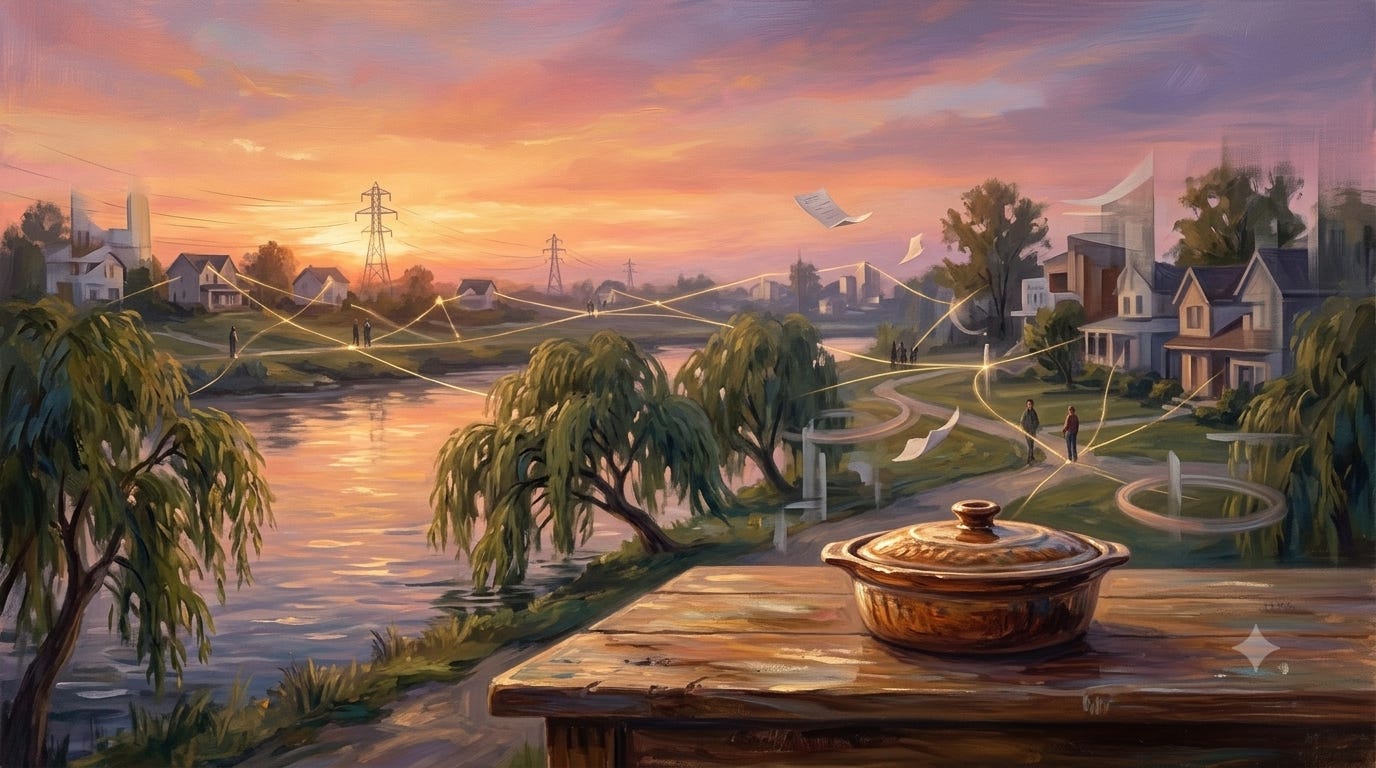
Cogitating Ceviché’s Week in Review (26-29)
2w ago00:22:12Tap to summarizeThe Cogitating Ceviché Week in Review 26-29Discussion via NotebookLMEditorial SummaryThis week considers the structures—visible and hidden—that govern how people care, work, decide, calculate, and endure. Calista F. Freiheit begins beneath an ordinary casserole dish, where a handwritten name becomes evidence of mercy made practical. Conrad T. Hannon looks upward and outward, first asking whether the electric grid might support national scientific computation and later watching an institution search everywhere except within itself for the courage to decide. Mauve Sanger examines the college degree as a form of employer protection, retained even after its official requirement disappears. Gio Marron turns to two classics in which danger takes very different forms: the alien presence moving through Algernon Blackwood’s willows and the disciplined strategy of Miyamoto Musashi. Across the week, the same question returns: What happens when a tool, credential, system, or habit stops serving its stated purpose—and what might restore it?ArticlesThe Name on the Casserole DishJuly 20, 2026 | Calista F. FreiheitA name written beneath a borrowed dish opens into a reflection on hospitality, stewardship, and the quiet networks that carry people through illness, grief, birth, exhaustion, and loss. Calista argues that mercy becomes useful through attention: the right meal, the manageable delivery, the respected boundary, and the organized community that notices those informal circles overlook.Could the Electric Grid Become a National Scientific Computer?July 21, 2026 | Conrad T. HannonConrad offers engineers, economists, regulators, and researchers a proposal meant to be tested rather than admired. Could the scale, reach, sensing capacity, and coordinated machinery of the electric grid support a new form of national scientific computation? The question invites technical criticism as seriously as construction.The Degree as an Insurance PolicyJuly 22, 2026 | Mauve SangerEmployers increasingly announce that a college degree is no longer required, yet the credential often continues to shape who receives an interview or offer. Mauve examines the degree as a risk-management device: a familiar signal that allows institutions to claim openness while preserving old hiring habits.The WillowsJuly 22, 2026 | Gio MarronBy Algernon BlackwoodTwo travelers enter a lonely stretch of the Danube where the natural world seems to possess an intelligence both immense and indifferent. Blackwood’s tale turns wind, water, sand, and willow into agents of unease, making the landscape itself more frightening than any visible monster.The Committee That Went Looking for a SpineJuly 24, 2026 | Conrad T. HannonA decision enters an institution and emerges as a working group, a consultation process, a preliminary report, and perhaps a file bearing someone’s name. Conrad examines the language and procedures through which responsibility is distributed so widely that no one need carry it.The Book of Five RingsJuly 24, 2026 | Gio MarronBy Miyamoto MusashiMusashi’s study of strategy moves beyond swordsmanship into questions of timing, perception, preparation, adaptability, and disciplined action. Its enduring challenge is not merely to defeat an opponent, but to see conditions clearly enough to act without waste or hesitation.Quote of the Week“Care must become particular to become kind.”—Calista F. Freiheit, “The Name on the Casserole Dish”Questions for Reflection and DiscussionThe Name on the Casserole Dish* When does an offer of help reduce another person’s burden, and when can it quietly add to it?* Who is most likely to remain unseen when a community relies only on spontaneous generosity?Could the Electric Grid Become a National Scientific Computer?* Which existing parts of the grid might support useful computation without weakening its primary duty to provide reliable electricity?* Who should control access, priorities, costs, security standards, and the results of publicly supported computing capacity?The Degree as an Insurance Policy* What risks do employers believe a college degree protects them against?* Can a hiring process honestly be called skills-based when recruiters and managers continue to favor degree holders?The Willows* Why can an indifferent natural environment feel more frightening than a creature with recognizable motives?* How does Blackwood make uncertainty itself carry the story’s fear?The Committee That Went Looking for a Spine* When does consultation improve a decision, and when does it become protection from responsibility?* Which forms of institutional language turn a person’s lived problem into a manageable administrative object?The Book of Five Rings* How does preparation differ from rigid planning?* What does Musashi’s attention to timing suggest about decisions made too early, too late, or merely to appear active?Additional Resources* Acts 6: The Need for Assistants — The early church confronts unequal distribution by assigning trusted people to the practical work of correction.* Grid Modernization Initiative — The Department of Energy’s work on measuring, analyzing, predicting, protecting, and controlling the changing electric grid.* Degree Inflation Hurting U.S. Firms and Closing Economic Opportunity — Harvard Business School’s introduction to research on unnecessary degree requirements and their effects on employers and workers.* The Willows at Project Gutenberg — A free public-domain edition of Algernon Blackwood’s novella.* Administrative Burden: Policymaking by Other Means — Pamela Herd and Donald Moynihan’s study of the learning, compliance, and psychological costs imposed by institutional processes.Calls to ActionFor readers of Calista F. Freiheit: Look beneath the ordinary objects in your home and consider which one could be placed into useful service this week.For readers of Conrad T. Hannon: Test the grid proposal and the committee satire with equal seriousness. Identify where the system needs stronger engineering—and where it simply needs someone willing to decide.For readers of Mauve Sanger: Find a job posting that requires a degree and ask whether the credential is essential to the work or merely familiar to the employer.For readers of Gio Marron: Read fear beside strategy: Blackwood on forces that cannot be understood and Musashi on the discipline required when conditions must be understood quickly.For everyone: Read, comment, share the pieces that stayed with you, and invite someone else into the week’s discussion.Thank you for your time today. Until next time, stay gruntled, curious, and God Bless.Do you like what you read but aren’t yet ready or able to get a paid subscription? Then consider a one-time tip at:https://www.venmo.com/u/TheCogitatingCevicheKo-fi.com/thecogitatingceviche This is a public episode. If you'd like to discuss this with other subscribers or get access to bonus episodes, visit thecogitatingceviche.substack.com/subscribe
Transcribe →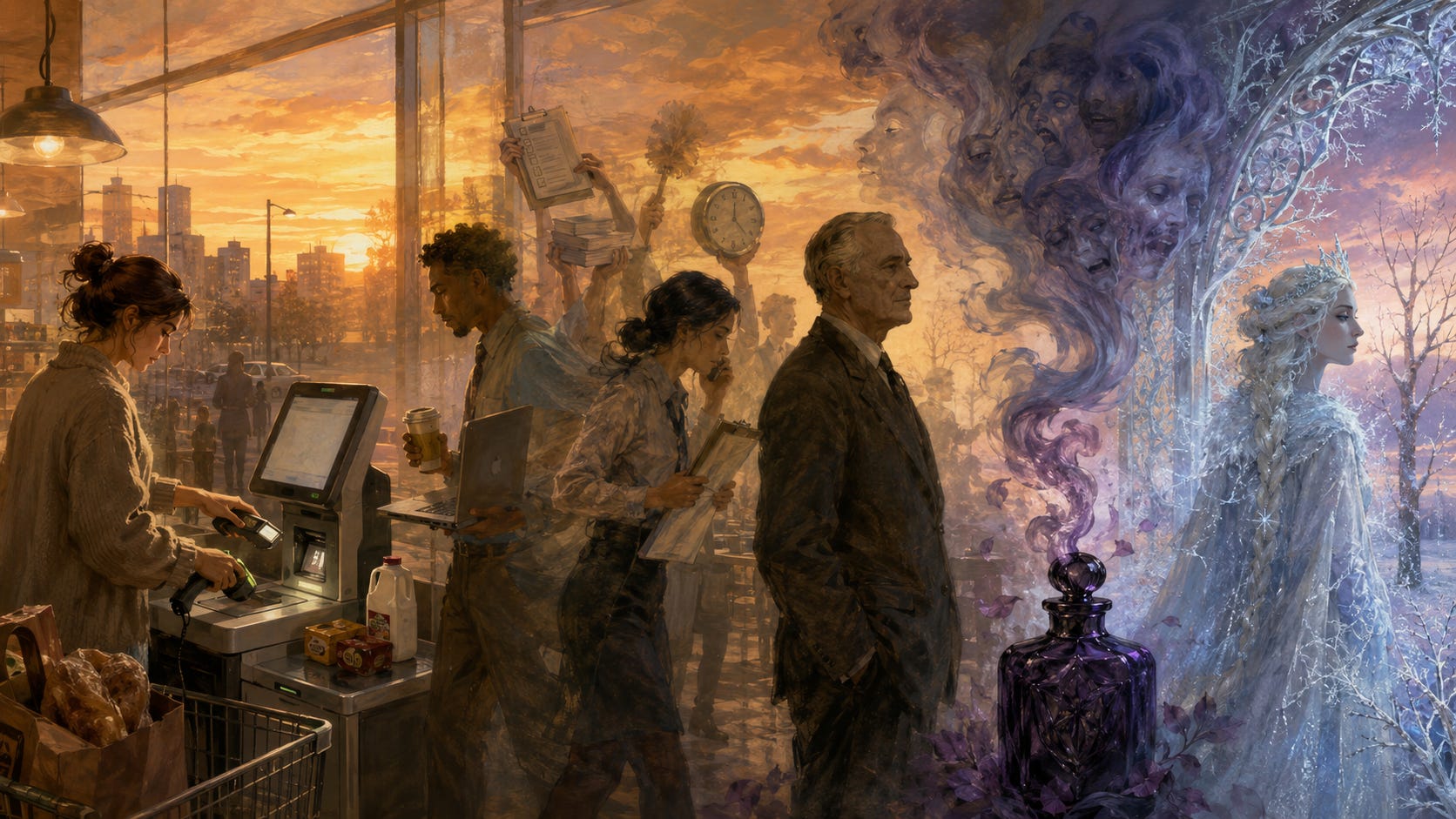
Cogitating Ceviché’s Week in Review (26-28)
3w ago00:20:30Tap to summarizeThe Cogitating Ceviché (26-28)Discussion via NotebookLMEditorial SummaryThis week’s writing examines the quiet exchanges by which power changes hands. Mauve Sanger finds the customer standing behind the register, performing work that vanished from the payroll but not from the world. Conrad T Hannon follows authority through three very different settings: software that performs remorse, George Marshall’s refusal to perform greatness, and workplaces that turn commands into supposedly optional requests. Gio Marron carries the week into darker country, presenting MysticPriestess’s tale of obsession and death before returning to Jane G. Austin’s enchanted winter, where beauty, danger, and longing gather on a pane of glass. Across essays, history, technology, and fiction, the same question waits beneath the surface: who is acting freely, and who has merely been taught to call obedience a choice?Articles and StoriesThe Unpaid ShiftJuly 13, 2026 | Mauve SangerThe grocery store did not eliminate the cashier’s work. It handed the scanner to the shopper. Mauve Sanger examines self-checkout, online forms, airport kiosks, furniture assembly, and other systems that present transferred labor as personal convenience. The essay also asks who pays the highest price when supposedly frictionless systems are designed around the young, able-bodied, digitally comfortable customer.The Machines That ApologizeJuly 14, 2026 | Conrad T HannonSoftware now says “sorry” with remarkable fluency. It apologizes for deleted work, failed logins, unexplained charges, outages, bad answers, and cancellation screens that refuse to let the customer leave. Conrad Hannon argues that these phrases preserve the social form of remorse while removing responsibility, cost, and any promise of changed behavior. The machine performs contrition; the user supplies the forgiveness.George Marshall: Authority Without MythologyJuly 15, 2026 | Conrad T HannonThe second entry in The Second-Best Man series considers George C. Marshall, a man whose influence was immense but difficult to turn into legend. Marshall built armies, selected commanders, advised presidents, and helped shape Europe’s recovery, yet he rarely made himself the center of the story. The essay presents administration, judgment, and restraint as forms of authority that history often overlooks precisely because they work.The Final ScentJuly 15, 2026 | Gio Marron, presenting a horror story by MysticPriestessDeath, obsession, and psychological distress gather around one of the most intimate senses. The Final Scent uses fragrance as a path toward memory, fixation, and dread, asking what happens when something beautiful refuses to remain harmless. This is a story for readers who prefer their horror close, personal, and difficult to wash away.The Tyranny of the OptionalJuly 17, 2026 | Conrad T HannonThe modern workplace has learned that a request can extract more than an order, particularly when everyone understands that refusal will be remembered. This essay examines the language of optional meetings, voluntary participation, flexible availability, team enthusiasm, and unspoken expectations. The command has not disappeared. It has simply learned to smile while waiting for compliance.The Frost-MaidenJuly 18, 2026 | Gio Marron, presenting Jane G. AustinYoung Claude grows enchanted by the pictures frost draws across his bedroom window. Among forests, castles, and frozen landscapes, he discovers a distant palace and the image of a maiden who seems to call directly to him. Jane G. Austin’s 1859 fairy story follows his lifelong pursuit of that winter vision into the far north, where wonder and danger become difficult to separate.Quote of the Week“The machines are not sorry. That was never the point.”— Conrad T Hannon, The Machines That ApologizeQuestions for ReflectionThe Unpaid Shift* When does self-service provide real freedom, and when does it merely transfer a company’s labor costs to its customers?* Should customers receive lower prices when they perform work once done by paid employees?The Machines That Apologize* Can an apology have moral value when the speaker cannot feel regret or accept responsibility?* Does polite language make software failure easier to tolerate, or does it discourage demands for repair?George Marshall: Authority Without Mythology* Why does public memory favor visible acts of leadership over planning, judgment, and administration?* Can leaders remain personally modest without allowing their work to be misunderstood or forgotten?The Final Scent* Why can scent call up memory and fear more sharply than an image or sound?* At what point does devotion to beauty become possession, fixation, or self-destruction?The Tyranny of the Optional* Can a workplace request be considered voluntary when declining it carries an unstated professional cost?* Why might an employer prefer social pressure and ambiguity to a clear command?The Frost-Maiden* Is Claude pursuing a genuine calling, an illusion, or something that cannot be cleanly separated into either category?* What does the story suggest about beauty that can be reached only through sacrifice and danger?Additional ResourcesHow Computer Automation Affects Occupations: Technology, Jobs, and SkillsJames Bessen’s research offers useful context for the distinction between automating work and changing who performs it. His discussion of bank tellers and ATMs complicates simple claims that every machine directly eliminates a job.Error-Message GuidelinesThe Nielsen Norman Group explains how useful error messages should identify the problem, respect the user’s effort, and offer a practical route to recovery rather than relying on charm or vague regret.AI Apology: A Critical Review of Apology in AI SystemsThis research review examines how apologies are used in human–AI interactions and raises questions about trust repair, responsibility, and the limits of machine contrition.The Marshall Plan, 1948The U.S. State Department’s historical overview provides the political and economic background of the European Recovery Program and Marshall’s 1947 call for coordinated reconstruction.Fairy Dreams; or, Wanderings in Elf-LandProject Gutenberg offers Jane G. Austin’s complete 1859 collection, including The Frost-Maiden, free to read in several formats.Calls to ActionFor readers of Mauve Sanger: Tell us where self-service stops feeling convenient and begins to feel like unpaid work.For readers of Conrad T Hannon: Consider the week’s three forms of concealed authority—the apology without responsibility, the leader without mythology, and the command disguised as a choice.For readers of Gio Marron: Read one story by daylight and one after dark, then tell us which image remained after the page was closed.For everyone: Subscribe, share the piece that challenged you most, and join the discussion. A week of writing becomes a conversation only when readers answer back.Thank you for your time today. Until next time, stay gruntled, curious, and God Bless.Do you like what you read but aren’t yet ready or able to get a paid subscription? Then consider a one-time tip at:https://www.venmo.com/u/TheCogitatingCevicheKo-fi.com/thecogitatingceviche This is a public episode. If you'd like to discuss this with other subscribers or get access to bonus episodes, visit thecogitatingceviche.substack.com/subscribe
Transcribe →
Cogitating Ceviche’s Week in Review (26-27)
4w ago00:18:53Tap to summarizeThe Cogitating Ceviché Week in Review (26-27)Discussion via NotebookLMThis week moved through heat, labor, memory, mercy, rest, and appetite. Calista Freiheit opened with a meditation on welcome and danger in The Heat of the Day. Conrad Hannon followed the week’s machinery into its human cost in The Last Humans in the Loop, then turned toward the fragile record of spiritual life in Oswald Chambers: A Life Left in Notes. Gio Marron brought Ryunosuke Akutagawa into the week with two sharp fables, The Spider’s Thread and The Wine Worm. Conrad closed the sequence with The Audit of Idleness, a study of rest under judgment.ArticlesThe Heat of the DayCalista Freiheit — July 6, 2026On the danger we have edited out of welcomeA reflection on hospitality, caution, and the moral cost of making welcome too smooth, too safe, and too empty of risk.The Last Humans in the LoopConrad Hannon — July 7, 2026Automation’s ghost story was always a labor story.An essay on automation, work, and the hidden human hands still left inside supposedly self-running systems.Oswald Chambers: A Life Left in NotesConrad Hannon — July 8, 2026Voices That Refused to Scale, #5A portrait of Oswald Chambers as a life preserved not through spectacle, but through fragments, devotion, and the strange power of notes left behind.The Spider’s ThreadGio Marron — July 8, 2026By Ryunosuke AkutagawaAkutagawa’s brief moral tale returns with its image of rescue, selfishness, and the thin thread between grace and ruin.The Audit of IdlenessConrad Hannon — July 10, 2026On Rest That Must Justify ItselfA study of rest in an age that demands receipts for stillness, asking what happens when even idleness must prove its use.The Wine WormGio Marron — July 11, 2026By Ryunosuke AkutagawaAnother Akutagawa selection, strange and compact, where desire, appetite, and consequence move with the force of a fable.Quote of the Week“Automation’s ghost story was always a labor story.”— The Last Humans in the Loop, Conrad HannonQuestions for ReflectionThe Heat of the Day* What kind of danger has modern welcome tried to remove?* Can hospitality survive if it is stripped of risk?* When does safety become a way of refusing the stranger?The Last Humans in the Loop* Who remains inside the machine after automation claims the work is gone?* Why do we prefer the story of replacement to the story of hidden labor?* What does “the human in the loop” reveal about responsibility?Oswald Chambers: A Life Left in Notes* What kinds of lives are best preserved in fragments?* Why do notes, journals, and unfinished records sometimes outlast polished works?* What does it mean for a voice to refuse scale?The Spider’s Thread* Is rescue still grace when the rescued person tries to possess it?* What does the thread reveal about selfishness under pressure?* Why do brief fables often carry such lasting moral force?The Audit of Idleness* Why has rest become something that must defend itself?* What is lost when idleness must be productive?* Can rest be protected from measurement?The Wine Worm* What does appetite reveal that reason tries to hide?* How does Akutagawa turn strange premises into moral pressure?* What makes a fable feel both ancient and modern?Additional Resources* Ryunosuke Akutagawa, “The Spider’s Thread” — for readers interested in moral fables, mercy, and the danger of selfishness.* Ryunosuke Akutagawa, selected short fiction — for more of Akutagawa’s sharp, compressed storytelling.* Oswald Chambers, My Utmost for His Highest — for readers following the “Voices That Refused to Scale” series.* Essays on Sabbath, rest, and idleness — a companion path for The Audit of Idleness.* Writing on automation and labor — useful context for The Last Humans in the Loop and its concern with hidden work.Calls to ActionFor Calista Freiheit readers: Reconsider welcome this week. Not as a slogan, but as a discipline with cost, caution, and moral weight.For Conrad Hannon readers: Look for the human residue inside the systems that claim to have removed the human.For Gio Marron readers: Sit with Akutagawa’s fables and ask why the shortest stories often leave the longest shadows.For all readers: Read across the week as one question: what remains human when comfort, labor, faith, rest, and desire are each put on trial?Thank you for your time today. Until next time, stay gruntled, curious, and God Bless.Do you like what you read but aren’t yet ready or able to get a paid subscription? Then consider a one-time tip at:https://www.venmo.com/u/TheCogitatingCevicheKo-fi.com/thecogitatingceviche This is a public episode. If you'd like to discuss this with other subscribers or get access to bonus episodes, visit thecogitatingceviche.substack.com/subscribe
Transcribe →
The Cogitating Ceviché’s Week in Review (26-26)
Jul 500:15:50Tap to summarizeThe Cogitating Ceviché Week in Review (26026)Discussion via NotebookLMEditorial SummaryAnother week at The Cogitating Ceviché explored the quiet systems that shape modern life. Calista Freiheit examined the hidden costs behind acts of institutional mercy, while Conrad Hannon turned his attention to artificial intelligence, cybernetic history, and the growing habit of mourning things that have not yet disappeared. Gio Marron continued his literary series with two American classics that remain surprisingly relevant. Together, this week’s essays asked readers to think carefully about rules, technology, memory, citizenship, and the stories societies choose to preserve.ArticlesThe Mercy of Ordinary RulesJune 29, 2026By Calista FreiheitEvery act of mercy carries a cost, even when that cost remains invisible. This essay examines how institutions balance compassion with fairness and asks who ultimately bears the burden when exceptions become policy.The Intern Now Has API KeysJune 30, 2026By Conrad HannonShadow AI no longer simply stores information—it acts. This satirical essay explores what happens when organizations quietly hand decision-making authority to systems they barely understand.Norbert Wiener: When Control Became UnderstandingJuly 1, 2026By Conrad HannonPart five of Anti-Heroes of Progress revisits Norbert Wiener and the birth of cybernetics, showing how feedback became a new way of understanding machines, people, and society.Little WomenJuly 1, 2026By Gio MarronLouisa May Alcott’s beloved novel follows the March sisters through family, ambition, sacrifice, and maturity, reminding readers why this American classic continues to resonate.The Eulogy EconomyJuly 3, 2026By Conrad HannonWhy do we grieve institutions, technologies, and careers before they disappear? This essay explores the growing culture of anticipatory nostalgia and what it reveals about modern society.The Man Without a CountryJuly 4, 2026By Gio MarronEdward Everett Hale’s enduring story of exile and patriotism asks timeless questions about citizenship, belonging, and the responsibilities that come with loving one’s country.Quote of the Week“Every mercy is paid for by someone. We do not often ask by whom.”— The Mercy of Ordinary Rules, Calista FreiheitQuestions for ReflectionThe Mercy of Ordinary Rules* What distinguishes justice from mercy?* Who pays the unseen costs of compassionate policies?* Can institutions remain fair while making exceptions?The Intern Now Has API Keys* Where does convenience become complacency?* How should organizations govern autonomous AI tools?* What responsibilities remain uniquely human?Norbert Wiener: When Control Became Understanding* How has cybernetics shaped modern computing?* Does feedback increase understanding or simply efficiency?* Which of Wiener’s warnings remain relevant today?Little Women* Which March sister best reflects modern ambitions?* What sacrifices define adulthood?* Why has this novel remained influential across generations?The Eulogy Economy* Why do societies mourn institutions before they disappear?* Are we preserving history or romanticizing it?* What deserves genuine remembrance?The Man Without a Country* What creates a sense of national belonging?* Can citizenship exist without shared responsibility?* What obligations accompany patriotism?Additional Resources* The Human Use of Human Beings — Norbert Wiener* The Abolition of Man — C. S. Lewis* Democracy in America — Alexis de Tocqueville* The Federalist Papers (selected essays)* The Death of Expertise — Tom NicholsCalls to ActionFor Calista Freiheit readers:How should societies balance compassion with equal treatment under the law? Join the discussion.For Conrad Hannon readers:Artificial intelligence, cybernetics, and technological culture continue to reshape everyday life. Share your perspective in the comments.For Gio Marron readers:Great literature rewards careful reading. Tell us which classic you’d like to revisit next.For Everyone:If this week’s essays challenged your thinking, share this edition with a friend and subscribe for next week’s collection of essays, commentary, and classic literature.Thank you for your time today. Until next time, stay gruntled, curious, and God Bless.Do you like what you read but aren’t yet ready or able to get a paid subscription? Then consider a one-time tip at:https://www.venmo.com/u/TheCogitatingCevicheKo-fi.com/thecogitatingceviche This is a public episode. If you'd like to discuss this with other subscribers or get access to bonus episodes, visit thecogitatingceviche.substack.com/subscribe
Transcribe →
Cogitating Ceviche’s Week in Review (26-25)
Jun 2800:19:48Tap to summarizeThe Cogitating Ceviché (26-25)Discussion via NotebookLMEditorial SummaryThis week moved through mercy, labels, memory, restraint, and ruin. Calista Freiheit opened with a sober warning about compassion that forgets the person before it claims to help him. Conrad Hannon then tracked the rituals of technological obedience, the custody of historical meaning, and civilization’s sudden rediscovery of the off switch. Gio Marron brought literary counterpoint through Selma Lagerlöf and Alphonse Daudet, reminding us that old stories still know how to expose greed, illusion, loyalty, and loss.ArticlesWhen Compassion Becomes ControlCalista Freiheit — June 22, 2026Mercy that stops seeing the person has already begun to rule him. Calista examines how care, when detached from moral limits and human dignity, can become another form of command.The Compliance WatermarkConrad Hannon — June 23, 2026When “AI-generated” becomes a ritual label, the label itself may matter more than the truth it claims to guard. Conrad studies the strange ceremonies of disclosure, trust, and public obedience.Bede: Gathering England into HistoryConrad Hannon — June 24, 2026In the fifth entry of Custodians of Meaning, Conrad turns to Bede as a figure who helped gather a people into memory, faith, and historical form.The Silver MineGio Marron — June 24, 2026Selma Lagerlöf’s tale enters the week as a moral fable of wealth, desire, and the hidden costs of what men dig from the earth and from one another.The Confiscation Basket RepublicConrad Hannon — June 26, 2026Civilization rediscovers the off switch. Conrad uses the image of the confiscation basket to ask what happens when public order depends on removing the little machines we can no longer govern ourselves.The Siege of BerlinGio Marron — June 27, 2026Alphonse Daudet’s story closes the week with war, memory, and illusion, showing how private grief and national disaster can become nearly impossible to separate.Quote of the Week“Mercy that stops seeing the person has already begun to rule him.”— When Compassion Becomes Control, Calista FreiheitQuestions for ReflectionWhen Compassion Becomes Control* When does help stop being mercy and become management?* Can compassion remain moral if it refuses to recognize personal responsibility?* What safeguards keep charity from becoming rule by experts?The Compliance Watermark* Does labeling AI content increase trust, or does it create another empty ritual?* Who benefits most from mandatory disclosure: readers, regulators, platforms, or institutions?* Can a label tell us anything meaningful about truth, authorship, or judgment?Bede: Gathering England into History* Why do nations need historians as much as rulers?* What makes a chronicler a custodian of meaning rather than a mere recorder of events?* How does faith shape the way a people remembers itself?The Silver Mine* What does the search for wealth reveal about character?* Why do old moral tales still feel sharp in modern times?* Is treasure ever neutral, or does it always test the soul of the one who seeks it?The Confiscation Basket Republic* What does phone confiscation reveal about self-control in public life?* Can civilization survive when restraint must be outsourced to rules and baskets?* Is the off switch a symbol of freedom, discipline, or defeat?The Siege of Berlin* What happens when loyalty to a nation becomes tangled with personal grief?* Can illusion ever be an act of mercy?* How does war distort truth inside the home as well as on the battlefield?Additional Resources* C.S. Lewis, “The Humanitarian Theory of Punishment” — A strong companion to Calista’s warning about mercy without moral limits.* George Orwell, “Politics and the English Language” — Useful beside Conrad’s piece on labels, public speech, and ritual compliance.* Bede, Ecclesiastical History of the English People — The central source behind the week’s reflection on memory, faith, and historical identity.* Selma Lagerlöf, selected short stories — A fitting path into moral fiction where folklore, faith, and human weakness meet.* Alphonse Daudet, Monday’s Tales — A broader setting for “The Siege of Berlin” and its treatment of war, memory, and national feeling.Calls to ActionFor Calista Freiheit readers: Consider where compassion in public life still honors the person, and where it quietly begins to replace him.For Conrad Hannon readers: Watch the rituals. Labels, baskets, disclosures, and histories all tell us who is trusted to judge.For Gio Marron readers: Return to the old stories. They have not lost their teeth.General call: Read the week, share the pieces that sharpened your thinking, and ask where mercy, memory, and restraint still have room to breathe.Thank you for your time today. Until next time, stay gruntled, curious, and God Bless.Do you like what you read but aren’t yet ready or able to get a paid subscription? Then consider a one-time tip at:https://www.venmo.com/u/TheCogitatingCevicheKo-fi.com/thecogitatingceviche This is a public episode. If you'd like to discuss this with other subscribers or get access to bonus episodes, visit thecogitatingceviche.substack.com/subscribe
Transcribe →
Cogitating Ceviche’s Week in Review (26-24)
Jun 2100:17:04Tap to summarizeThe Cogitating Ceviché (26-24)Discussion via NotebookLMEditorial SummaryThis week moves between the private strength that keeps households, communities, and souls intact, and the public systems that modern life quietly depends on. Calista Freiheit opens with a defense of feminine steadiness in an age that mistakes restraint for weakness. Conrad Hannon then turns from county commissions and power grids to Emily Dickinson’s inward genius, before skewering the internet’s new appetite for industrialized cultural waste. Gio Marron offers two literary pieces, “Old Wolf Putnam” and “The Adventurer,” grounding the week in story, memory, and motion.ArticlesThe Feminine Strength Modern Culture Misnames as FragilityCalista Freiheit — June 15, 2026Why the strength that holds life together is often the kind least rewarded by the age of applause.The County Commission Owns the CloudConrad Hannon — June 16, 2026AI meets zoning, water rights, and voltage stability, where grand digital ambition runs headlong into local government.Emily Dickinson: A Voice Folded InwardConrad Hannon — June 17, 2026The fourth entry in Voices That Refused to Scale considers a poet whose small rooms contained vast weather.Old Wolf PutnamGio Marron — June 17, 2026Caroline Clifford Newton’s tale brings an older literary voice into the week’s conversation about courage, age, and character.Slop as a ServiceConrad Hannon — June 19, 2026The internet discovers its final business model: more content, less meaning, and a glossy invoice for the mess.The AdventurerGio Marron — June 20, 2026A. A. Milne’s story closes the week with motion, curiosity, and the old charm of stepping past the familiar.Quote of the Week“Why the strength that holds life together is the kind an age of applause has forgotten how to see.”— The Feminine Strength Modern Culture Misnames as Fragility, Calista FreiheitQuestions for ReflectionThe Feminine Strength Modern Culture Misnames as Fragility* What kinds of strength does modern culture reward most loudly?* What forms of sacrifice or steadiness are easy to overlook because they are quiet?The County Commission Owns the Cloud* Why do local decisions about land, water, and power matter to the future of AI?* Does technological progress depend more on invention or on infrastructure?Emily Dickinson: A Voice Folded Inward* What does Dickinson’s life suggest about the difference between influence and scale?* Can a private voice speak more clearly than a public one?Old Wolf Putnam* What makes an older character compelling rather than merely nostalgic?* How does the story use age, memory, or reputation to shape its moral force?Slop as a Service* What happens when attention becomes the main measure of value?* Can the internet recover standards after rewarding speed and volume for so long?The Adventurer* What separates adventure from mere restlessness?* Why do stories of departure and discovery still carry such lasting appeal?Additional Resources* Emily Dickinson at the Poetry Foundation — a strong overview for readers coming to Dickinson through this week’s essay. (The Poetry Foundation)* Emily Dickinson at the Academy of American Poets — another useful entry point into her life, work, and literary setting. (Home)* EIA: Data center server energy use projections — useful background for the power demands behind AI infrastructure. (U.S. Energy Information Administration)* EIA: Virginia electricity sales and data centers — a concrete example of how data center growth affects regional electricity demand. (U.S. Energy Information Administration)* NREL: County land-use regulations and energy siting — helpful context for the local-government side of energy development. (NREL)Calls to ActionFor Calista Freiheit readers: Share the essay with someone whose strength is quiet, steady, and too often unnamed.For Conrad Hannon readers: Watch the next county commission meeting as if the cloud were applying for a building permit.For Gio Marron readers: Revisit the older stories. They often know more about courage than the new ones admit.General call: Read the week as a whole, then ask which matters more in your own life: scale, spectacle, or faithful attention.Thank you for your time today. Until next time, stay gruntled, curious, and God Bless.Do you like what you read but aren’t yet ready or able to get a paid subscription? Then consider a one-time tip at:https://www.venmo.com/u/TheCogitatingCevicheKo-fi.com/thecogitatingceviche This is a public episode. If you'd like to discuss this with other subscribers or get access to bonus episodes, visit thecogitatingceviche.substack.com/subscribe
Transcribe →
Cogitating Ceviché’s Week in Review (26-23)
Jun 1400:19:25Tap to summarizeThe Cogitating Ceviché Week in Review (26-23)Discussion via NotebookLMEditorial SummaryThis week turned a cold eye on public performance, private judgment, and the old human weakness for mistaking noise for truth. Calista Freiheit opened with a call to resist spectacle dressed as authority. Conrad Hannon followed with satire on tokenized finance, social hypocrisy, and the modern cult of managed competence. Gio Marron then widened the stage with two classic stories: Bret Harte’s frontier wit in “Chu Chu” and Bram Stoker’s gothic unease in “The Judge’s House.” Together, the week asked a plain question: what happens when appearances win the room before judgment enters it?Articles and StoriesThe Duty to Be UnimpressedJune 8, 2026Calista FreiheitSpectacle is not authority, and applause is not evidence. Calista Freiheit argues for moral steadiness in an age trained to confuse volume, polish, and public approval with wisdom.Tokenized Everything and the Bureaucratization of Magic BeansJune 9, 2026Conrad HannonThe internet of value files its paperwork. Conrad Hannon treats tokenization as both a technological promise and a bureaucratic comedy, where every magic bean needs a compliance form.Richard Brinsley Sheridan: Scandal, Wit, and the Theater of Social HypocrisyJune 9, 2026Conrad Hannon#95 in Honoring the Satirists and Thinkers Who Altered Our Perspectives. Sheridan’s world of manners, gossip, and reputation gives Conrad room to examine how social hypocrisy survives every century by changing its costume.Chu ChuJune 10, 2026Gio MarronBy Francis Bret Harte. This selection brings readers into Harte’s sharp, lively frontier voice, where character, comedy, and animal willpower meet on dusty ground.The Age of Performative CompetenceJune 12, 2026Conrad HannonEveryone has a dashboard, nobody knows where the water shutoff valve is. Conrad Hannon skewers a culture rich in metrics and poor in practical judgment.The Judge’s HouseJune 13, 2026Gio MarronBy Bram Stoker. A gothic story of isolation, fear, and creeping dread closes the week with a reminder that some houses keep their own counsel.Quote of the Week“Spectacle is not authority, and applause is not evidence.”—Calista Freiheit, The Duty to Be UnimpressedQuestions for ReflectionThe Duty to Be Unimpressed* Why is spectacle so often mistaken for authority?* What habits help a person resist crowd approval when it replaces evidence?Tokenized Everything and the Bureaucratization of Magic Beans* When does financial innovation become administrative theater?* Can tokenization create real value, or does it often rename old promises in digital form?Richard Brinsley Sheridan: Scandal, Wit, and the Theater of Social Hypocrisy* Why does social hypocrisy remain such a durable subject for satire?* What would Sheridan recognize in today’s reputation economy?Chu Chu* How does Harte use humor to reveal character?* What role does the animal figure play in exposing human vanity or weakness?The Age of Performative Competence* Why do dashboards and metrics so often create the appearance of control?* What practical skills are lost when institutions reward presentation over competence?The Judge’s House* How does Stoker build fear through setting rather than action?* Why do isolated places remain so effective in gothic fiction?Additional Resources* Richard Brinsley Sheridan’s The School for Scandal, available through Project Gutenberg, offers the classic comedy of manners behind this week’s Sheridan discussion. (Project Gutenberg)* Project Gutenberg’s Selected Stories of Bret Harte includes “Chu Chu” and other examples of Harte’s frontier fiction. (Project Gutenberg)* Bram Stoker’s Dracula’s Guest collection includes “The Judge’s House,” one of his compact studies in gothic dread. (Project Gutenberg)* The Bank for International Settlements’ 2025 discussion of tokenized money and unified ledgers gives useful background for the week’s tokenization theme. (Bank for International Settlements)* The BIS 2023 blueprint on a future monetary system explains how tokenized money and assets might operate on a common programmable platform. (Bank for International Settlements)Calls to ActionFor Calista Freiheit readers: Practice the discipline of being unimpressed before being persuaded.For Conrad Hannon readers: Keep one eye on the machine and the other on the paperwork it pretends not to need.For Gio Marron readers: Revisit the classics not as museum pieces, but as living tests of fear, wit, and human folly.General call: Read the week, share the pieces that sharpened your judgment, and leave a comment on the question that stayed with you.Confidence note: High for titles, authors, links, and dates based on your provided list. Medium for descriptions and discussion questions, since they are based on titles and subtitles rather than the full article text.Thank you for your time today. Until next time, stay gruntled, curious, and God Bless.Do you like what you read but aren’t yet ready or able to get a paid subscription? Then consider a one-time tip at:https://www.venmo.com/u/TheCogitatingCevicheKo-fi.com/thecogitatingceviche This is a public episode. If you'd like to discuss this with other subscribers or get access to bonus episodes, visit thecogitatingceviche.substack.com/subscribe
Transcribe →
Cogitating Ceviche’s Week in Review (26-22)
Jun 700:19:39Tap to summarizeThe Cogitating Ceviché Week In Review (26-22)Discussion via NotebookLMEditorial SummaryThis week asks what it means to preserve what is human when systems, customs, technologies, and desires try to rename it. Calista Freiheit begins with the moral grammar of receiving children rather than curating them. Conrad Hannon follows the hidden wires of ideology through infrastructure, sacred text, and digital age gates, showing how power often arrives dressed as procedure. Gio Marron closes the week by returning readers to older imaginative worlds: the Roman bath as civic memory, and H.G. Wells’s falling star as cosmic warning.ArticlesChildren Are Not Lifestyle AccessoriesDate: June 1, 2026Author: Calista FreiheitA reflection on the difference between welcoming a child as a gift and treating a child as an extension of adult preference, identity, or self-design.Infrastructure Is the New IdeologyDate: June 2, 2026Author: Conrad HannonConrad examines the quiet rule of systems: roads, platforms, policies, defaults, and tools that shape public life before anyone admits a doctrine is involved.The Masoretes: Precision as DevotionDate: June 3, 2026Author: Conrad HannonThe fourth entry in Custodians of Meaning turns to the Masoretes, whose disciplined care for letters, vowels, and transmission treated accuracy as an act of reverence.The Roman BathDate: June 3, 2026Author: Gio MarronGio presents John T. Wheelwright’s meditation on the Roman bath: a place where architecture, empire, leisure, hygiene, and civic life meet in stone and steam.The Age Gate and the Panopticon NurseryDate: June 5, 2026Author: Conrad HannonA sharp look at online child protection schemes that may protect minors by turning every user into a subject of verification.The StarDate: June 6, 2026Author: Gio MarronGio revisits H.G. Wells’s apocalyptic short story, where the heavens do not merely inspire wonder; they expose the limits of human certainty.Quote of the Week“Ideologies used to be courteous enough to introduce themselves.”— Infrastructure Is the New Ideology, Conrad HannonQuestions for ReflectionChildren Are Not Lifestyle Accessories* What is the difference between receiving a child and designing a family around adult preference?* Where does modern culture confuse love with possession?* What duties come before personal expression in parenthood?Infrastructure Is the New Ideology* Which systems in daily life shape behavior before debate begins?* When does convenience become quiet coercion?* Can a tool remain neutral once it governs access, speech, or memory?The Masoretes: Precision as Devotion* What does careful preservation reveal about love for a text?* Why might precision be a spiritual discipline rather than a technical habit?* What is lost when a culture stops honoring transmission?The Roman Bath* What did shared public spaces do for ancient civic identity?* How does architecture teach people what a society values?* What modern spaces still join leisure, status, ritual, and public life?The Age Gate and the Panopticon Nursery* Can online child safety be pursued without placing everyone under suspicion?* What privacy costs are easy to excuse when the cause sounds urgent?* Who gains power when identity checks become normal?The Star* Why do people dismiss danger until it becomes impossible to ignore?* What does cosmic disaster reveal about human pride?* How does Wells use scale to humble political, scientific, and social confidence?Additional Resources* Langdon Winner, “Do Artifacts Have Politics?” — a classic essay on how technical systems can carry forms of power and authority. (PhilPapers)* Encyclopaedia Britannica, “Masoretic Text” — background on the Masoretes’ work preserving pronunciation, notation, and textual accuracy. (Encyclopedia Britannica)* Project Gutenberg, “The Star” by H.G. Wells — the public-domain text of Wells’s cosmic disaster story. (Project Gutenberg)* The Roman Baths, Bath — historical material on one of Britain’s best-known Roman bathing complexes and its archaeological collection. (Roman Baths)* FTC, “Children’s Online Privacy Protection Rule” — the federal rule governing many online services directed to children under 13. (Federal Trade Commission)* Electronic Frontier Foundation, “Age Verification and Age Gating” — a digital-rights critique of age-verification mandates and their privacy risks. (Electronic Frontier Foundation)Calls to ActionFor Calista Freiheit readers:Read Calista’s essay and consider what duties adults owe children before any cultural debate begins.For Conrad Hannon readers:Follow Conrad’s work this week for a tour through systems that govern quietly: infrastructure, textual custody, and age verification.For Gio Marron readers:Join Gio in the archive, where Roman civic life and Wellsian catastrophe still speak with unsettling clarity.General call:Subscribe, share the week’s essays, and send them to a reader who still believes words, children, institutions, and inherited texts deserve careful keeping.Thank you for your time today. Until next time, stay gruntled, curious, and God Bless.Do you like what you read but aren’t yet ready or able to get a paid subscription? Then consider a one-time tip at:https://www.venmo.com/u/TheCogitatingCevicheKo-fi.com/thecogitatingceviche This is a public episode. If you'd like to discuss this with other subscribers or get access to bonus episodes, visit thecogitatingceviche.substack.com/subscribe
Transcribe →
Cogitating Ceviché’s Week in Review (26-21)
May 3100:18:55Tap to summarizeThe Cogitating Ceviché Week in Review (26-21)Discussion via NotebookLMEditorial SummaryThis week circled the locked door, the glowing furnace, the failed institution, and the private room where speech can still breathe. Calista Freiheit opened with a defense of holy unreachability, while Conrad Hannon followed heat, genius, and privacy through systems that demand more than slogans. Gio Marron brought fiction into the frame with Ian Moreno’s “The Brick” and H. G. Wells’ The War of the Worlds, turning the week toward burden, invasion, and the strange weight of what civilization carries.ArticlesThe False Gospel of Constant AccessMay 25, 2026Calista FreiheitA defense of sacred distance in an age that treats availability as virtue. Freiheit argues that refusal, silence, and closed doors can be moral acts, not failures of charity.The Heat Must Go SomewhereMay 26, 2026Conrad HannonA meditation on closed loops, greenhouses, and the hard fact that every system keeps accounts. Hannon presses for legibility over absolution: not purity, but honest reckoning.Nikola Tesla: When Vision Could Not Become InstitutionMay 27, 2026Conrad HannonThe third entry in Brilliant, But Not Enough considers Tesla as a warning about invention without durable structure. Genius may spark the future, but institutions decide whether the light stays on.The BrickMay 27, 2026Gio MarronBy Ian MorenoA fiction entry with a stark, compact title and a sense of weight before the first line is even read. The piece adds a grounded counterpoint to the week’s larger concerns about burden, pressure, and what people are made to carry.The Return of the SalonMay 29, 2026Conrad HannonPrivacy returns not as retreat, but as culture. Hannon frames the salon as a counterweight to the public feed: intimate, selective, and quietly rebellious.The War of the WorldsMay 30, 2026Gio MarronBy H. G. WellsWells’ invasion story returns with its old force intact: fear, collapse, empire, and the shock of discovering that mankind is not the final measure of power.Quote of the Week“On holy unreachability and the courage to close the door.”— The False Gospel of Constant Access, Calista FreiheitQuestionsThe False Gospel of Constant Access* When does availability become servitude rather than generosity?* What kinds of boundaries deserve moral respect?* Can silence be an act of faith rather than avoidance?The Heat Must Go Somewhere* What systems in daily life hide their true costs?* Why is legibility more useful than innocence?* What happens when a society mistakes displacement for repair?Nikola Tesla: When Vision Could Not Become Institution* Why does brilliance often fail without structure?* What separates invention from lasting change?* Was Tesla undone more by the world’s limits or by his own?The Brick* What can a single object reveal about burden, labor, or memory?* Why do small, concrete images often carry more force than abstract claims?* What might a “brick” represent: foundation, weapon, wall, or weight?The Return of the Salon* What makes private conversation different from public performance?* Could selective spaces become a cure for digital exhaustion?* What would a modern salon protect that social media cannot?The War of the Worlds* Why does Wells’ invasion story still disturb modern readers?* What does the novel say about empire when power changes hands?* How fragile is civilization when its confidence is broken?Additional Resources* Neil Postman, Technopoly — for readers thinking about tools, culture, and surrender.* Jacques Ellul, The Technological Society — a useful companion to this week’s concerns about systems and human agency.* Sherry Turkle, Reclaiming Conversation — for the privacy, salons, and attention threads.* H. G. Wells, The War of the Worlds — the full classic behind Gio Marron’s May 30 selection.* Lewis Mumford, The Myth of the Machine — for the question of genius, systems, and institutions.Calls to ActionFor Calista Freiheit readers: Close one door this week without apology. Then ask what that boundary protects.For Conrad Hannon readers: Follow the heat. Find one hidden cost in a system you rely on.For Gio Marron readers: Read the fiction as pressure made visible: the brick, the machine, the invader, the world under strain.General call: Share the essay or story that unsettled you most this week—and tell someone why.Thank you for your time today. Until next time, stay gruntled, curious, and God Bless.Do you like what you read but aren’t yet ready or able to get a paid subscription? Then consider a one-time tip at:https://www.venmo.com/u/TheCogitatingCevicheKo-fi.com/thecogitatingceviche This is a public episode. If you'd like to discuss this with other subscribers or get access to bonus episodes, visit thecogitatingceviche.substack.com/subscribe
Transcribe →