Podcast
The Cogitating Ceviché Podcast
Hosted by Conrad T Hannon · EN
46episodes
Episodes
Newest firstAll episodes

Cogitating Ceviche’s Week in Review (26-1)
Jan 1100:12:18Tap to summarizeCogitating Ceviche’s Week in Review (January 5–10, 2026)Discussion via NotebookLMEditorial SummaryThis week’s offerings spiral across epochs and genres—echoing laughter in sanctuaries, automation in our palms, Rome through the pen of Cassiodorus, and freedom from within. Conrad Hannon revisits the gentleman dissenter and diagnoses automation’s iron grip; Calista F. Freiheit pens a theological meditation on humor as spiritual resistance. Gio Marron gives us a noir entrée and a Komroff classic, while history looms large with a defense-less but not senseless Cassiodorus. The week ends where it began—in search of freedom, mystery, and meaning.Articles* The Christian Sense of Humor: Laughter as ResistanceCalista F. Freiheit | January 5, 2026An exploration of sacred wit—how laughter, rightly tuned, becomes a theological and political act.* The Automation Trap: When Tools Make You WorseConrad Hannon | January 6, 2026A critique of the seductive erosion of skill under the guise of productivity, from spellcheck to steering wheels.* How Does It Feel To Be Free?Gio Marron (Manuel Komroff) | January 7, 2026A republication of Komroff’s meditation on interior liberty—fierce, lyrical, and unblinking.* Cassiodorus: Saving Rome Without Defending ItConrad T Hannon | January 7, 2026First in the “Custodians of Meaning” series, this piece considers how one man preserved Rome by giving up its sword.* The Gentleman Dissenter Is ExtinctConrad Hannon | January 9, 2026A polemic on the vanishing breed of principled dissenters—and what’s replaced them.* The NorwegianGio Marron | January 10, 2026The first part of a new Mimi Delboise mystery, tinged with fog, suspicion, and linguistic codes.Quote of the Week“To laugh in a time of collapse is to bear witness to resurrection.”— Calista F. Freiheit, “The Christian Sense of Humor: Laughter as Resistance”QuestionsThe Christian Sense of Humor* Can laughter serve as a form of nonviolent resistance in secular contexts?* What are the limits of theological humor?The Automation Trap* Have our tools replaced our instincts—or just dulled them?* Is “ease” always the enemy of excellence?How Does It Feel To Be Free?* Is freedom a condition or an orientation?* How does Komroff’s idea of inner liberty clash with modern definitions?Cassiodorus: Saving Rome Without Defending It* Can culture preserve what politics fails to protect?* What modern analogs exist for Cassiodorus’ role?The Gentleman Dissenter Is Extinct* What happens to dissent when civility disappears?* Can new forms of dissent still carry moral weight?The Norwegian* What defines Mimi Delboise as a detective in a digital age?* How does ambiguity serve suspense in serialized storytelling?Additional Resources* “Amusing Ourselves to Death” by Neil Postman — A foundational critique of media and meaning.* “The World Beyond Your Head” by Matthew Crawford — On attention, automation, and the loss of embodied skill.* “From Dawn to Decadence” by Jacques Barzun — On cultural transmission and preservation.* “The Abolition of Man” by C.S. Lewis — Dissent, civility, and eternal standards.* “Thinking in Systems” by Donella Meadows — For reading behind the tools and structures we create.Calls to Action* Calista: Reflect on where humor has disarmed bitterness in your life.* Conrad: Audit a digital tool you use daily—has it made you better?* Gio: Follow Mimi into mystery—what do you suspect in Part II?* General: Join the discussion in the comments—Who’s your Cassiodorus?Would you like this exported in a specific format—Markdown, PDF, or embedded into a layout?Thank you for your time today. Until next time, stay gruntled, curious, and God Bless. This is a public episode. If you'd like to discuss this with other subscribers or get access to bonus episodes, visit thecogitatingceviche.substack.com/subscribe
Transcribe →
Cogitating Ceviche’s Week in Review (25-52)
Jan 400:09:42Tap to summarize🐟 Cogitating Ceviche’s Week in Review (Dec 29–Jan 3)Discussion via NotebookLM📝 Editorial SummaryThis week, we explored the uneasy friction between permanence and disposability, the secret life of your kitchen appliances, and the ghostly hands shaping modern thought. Calista F. Freiheit called Christians to resist throwaway culture. Conrad T. Hannon unearthed the intellectual legacies behind the “average man” and the modern pamphleteer. And Gio Marron returned to Tolstoy’s moral minimalism. A week of quietly sharp ideas.📚 This Week’s ArticlesThe Virtue of PermanenceCalista F. Freiheit – December 29, 2025A meditation on Christian faith, the beauty of stability, and why building for eternity matters in a world obsessed with the new.Why Your Smart Fridge Is Plotting Against YouConrad Hannon – December 30, 2025A short sermon on optimization and betrayal. A smart home, Hannon warns, may still be a dumb idea.A Lost OpportunityGio Marron – December 31, 2025Tolstoy’s brief fable of hesitation and loss. What we fail to do may echo longer than our actions.Adolphe Quetelet: Inventing the Average ManConrad T. Hannon – December 31, 2025The first in a new series—The Architects of the Invisible. Who decides what “normal” means? It may start with Quetelet.Pamphleteers, Substacks, and the Long War Over AttentionConrad Hannon – January 2, 2026Newsletters are older than you think. Hannon tracks the lineage from 18th-century coffeehouses to your inbox.The CandleGio Marron – January 3, 2026Another Tolstoy tale—this time about the small light of moral courage, and the ease with which it’s snuffed out.🗣️ Quote of the Week“The modern home has been optimized for everything but truth.”— Conrad Hannon, Why Your Smart Fridge Is Plotting Against You❓ Questions to ConsiderThe Virtue of Permanence* What does permanence demand of us?* Can faith thrive in a culture designed to discard?Why Your Smart Fridge Is Plotting Against You* Are our devices optimizing us in return?* When does convenience become complicity?A Lost Opportunity* Is passivity a moral failing?* What actions have you avoided that still haunt you?Adolphe Quetelet: Inventing the Average Man* Can we think statistically without becoming inhuman?* Who benefits when “the average” defines the norm?Pamphleteers, Substacks, and the Long War Over Attention* Is independent publishing a revival—or a rebranding?* Has the attention economy always existed?The Candle* What small acts keep your integrity alive?* Have you ever looked away when you should have acted?📎 Additional Reading* Amusing Ourselves to Death – Neil Postman* Technopoly – Neil Postman* The Technological Society – Jacques Ellul* The Gospel in a Pluralist Society – Lesslie Newbigin* The Invisible Gorilla – Christopher Chabris & Daniel Simons* The Ethics of Authenticity – Charles Taylor📣 Calls to ActionCalista F. Freiheit: Consider what in your life you treat as temporary that may deserve permanence.Conrad Hannon: Turn off one smart device for a week and note the difference.Gio Marron: Read a Tolstoy story out loud. His prose carries different weight aloud.Everyone: Share one article with someone who wouldn’t normally read it.Thank you for your time today. Until next time, stay gruntled, curious, and God Bless. This is a public episode. If you'd like to discuss this with other subscribers or get access to bonus episodes, visit thecogitatingceviche.substack.com/subscribe
Transcribe →
Cogitating Ceviché’s Week in Review (25-51)
Dec 2800:11:24Tap to summarizeCogitating Ceviché’s Week in Review (December 22–26)Discussion via NotebookLMExcerpt (Substack preview):From faith and formation to spreadsheets and satire, this week’s essays examined how modern systems—technical, cultural, and spiritual—shape the ways we think, work, and believe. Featuring Calista Freiheit on Christian storytelling, Conrad Hannon on digital liturgies, and Gio Marron on letters and gifts that outlast algorithms.Tags: philosophy, culture, faith, literature, satire, technology, theology, Conrad Hannon, Calista Freiheit, Gio MarronEditorial SummaryThis week’s writing returned to a shared concern across genres and voices: how modern systems—technical, bureaucratic, and cultural—shape formation, meaning, and moral attention.Calista Freiheit examined how algorithmic life weakens Christian formation by replacing shared narrative with optimization. Conrad Hannon approached modernity through satire and philosophy, treating the spreadsheet as liturgy and revisiting Plato’s Cave under streaming conditions. Gio Marron grounded the week with literary clarity, presenting letters and short fiction that resist speed and abstraction in favor of human cost and gift.Across essays, satire, and fiction, the week asked a single question: what forms us when efficiency replaces story?This Week’s ArticlesWhy Christians Need Stories, Not Algorithms — Formation Happens Through Narrative, Not NotificationCalista Freiheit — December 22, 2025A careful critique of digital formation, arguing that Christian moral life depends on shared stories rather than personalized feeds.The Spreadsheet as Sacred Text — On the Liturgy of the Modern OfficeConrad Hannon — December 23, 2025A satirical meditation on bureaucracy, treating metrics, dashboards, and KPIs as devotional objects of late modern work life.The Letters — by Lucy Maud MontgomeryGio Marron — December 23, 2025A literary presentation foregrounding intimacy, memory, and the slow discipline of correspondence.Joachim Ringelnatz (1883–1934): German Poet, Humorist, and the Art of Earnest Absurdity — Entry #93: Honoring the Satirists and Thinkers Who Altered Our PerspectivesConrad T. Hannon — December 24, 2025A reflective portrait of a satirist who used humor not to escape seriousness, but to expose it.Plato’s Cave with Wi-Fi — Philosophy in the Age of StreamingConrad Hannon — December 25, 2025A contemporary reading of Plato’s Cave, reframed through algorithmic curation, passive spectatorship, and digital comfort.The Gift of the Magi — by O. HenryGio Marron — December 26, 2025A seasonal return to sacrifice, love, and irony—reminding readers that value is rarely measurable.Quote of the Week“Formation requires a shared story, not a personalized feed.”— Calista Freiheit, Why Christians Need Stories, Not AlgorithmsQuestions for ReflectionWhy Christians Need Stories, Not Algorithms* What once formed belief that digital habits now displace?* Can formation survive personalization?* What is lost when formation becomes efficient?The Spreadsheet as Sacred Text* What rituals govern modern work life?* When does measurement replace judgment?* What does satire reveal that critique alone cannot?The Letters* What disciplines does letter-writing require?* How does delay shape meaning?* What forms of attention disappear with speed?Joachim Ringelnatz* Why does satire endure under pressure?* What makes absurdity truthful?* How does humor function as resistance?Plato’s Cave with Wi-Fi* How does streaming alter perception?* What replaces truth when comfort dominates?* Is escape still possible?The Gift of the Magi* Why is sacrifice often misunderstood?* What cannot be optimized?* What makes a gift meaningful?Additional Reading* Plato, Republic (Book VII)* Neil Postman, Amusing Ourselves to Death* Wendell Berry, The Unsettling of America* Jacques Ellul, The Technological Society* O. Henry, Selected Short StoriesCalls to Action* Calista Freiheit: Reclaim shared practices that resist personalization.* Conrad Hannon: Read satire slowly; it sharpens judgment.* Gio Marron: Return to letters, stories, and forms that require patience.* General: Share one piece this week with someone who values thought over speed.Thank you for your time today. Until next time, stay gruntled, curious, and God Bless. This is a public episode. If you'd like to discuss this with other subscribers or get access to bonus episodes, visit thecogitatingceviche.substack.com/subscribe
Transcribe →
The Revolutionary LARPing of the TDS Brigade
Feb 27, 2025Tap to summarizeThe Cogitating CevichePresentsThe Revolutionary LARPing of the TDS BrigadeBy Conrad T. HannonNarration by Amazon PollyThere is a particular brand of political enthusiast in modern America who imagines themselves draped in the aesthetic of resistance. Not a real, flesh-and-blood resistance, mind you, where there are costs, sacrifices, and the kind of stark, grim reality that history has reserved for actual freedom fighters. No, this is the domain of a peculiar, self-indulgent fantasy: the belief that they are the last line of defense against a rising authoritarian dictatorship that exists largely in their fevered imaginations.We see it in social media declarations about "fighting fascism" and "standing against tyranny," complete with dramatic readings of Hannah Arendt and Orwell, usually from an iPhone assembled under conditions that would make the worst sweatshops of the Industrial Revolution blush. But, of course, these warriors of democracy don’t put themselves at risk in any meaningful way—no clandestine meetings, no genuine dissidence, no threat to life and limb. Instead, they favor the performative grandstanding of hashtags and resistance-themed coffee mugs, their bravado only extending as far as their next pithy social media post.At the heart of this phenomenon is a fetishization of authoritarian collapse scenarios—one that grants its participants a starring role in a grand struggle against evil. They envision themselves as the intellectual offspring of the White Rose, the Warsaw Uprising, and the French Resistance. Instead of sabotage and espionage, their weapons of choice are tweets and overused WWII analogies. Instead of risking imprisonment or death, their greatest hardship is being called out by someone with a blue checkmark. Their biggest suffering amounts to a bruised ego and a momentary social media scuffle before they retreat back to the comfort of their curated online echo chambers.Nowhere is this phenomenon more rampant than among those afflicted with Trump Derangement Syndrome (TDS), a condition wherein every single action by the 45th/47th president—down to his choice of steak temperature—is evidence of a looming Fourth Reich. The same individuals who once scoffed at conservatives for alleged paranoia about creeping socialism now see themselves as the last bastion of democracy, standing courageously against...mean tweets and bad policy decisions. They claim to be at the vanguard of an existential struggle, yet their revolution largely consists of buying "resistance" merchandise and posting reaction videos to press conferences.Their fixation with the image of a fascist takeover is so extreme that they practically salivate over the prospect of Trump becoming a dictator to finally validate their self-image as underground revolutionaries. The wishful thinking inherent in this is staggering: they don’t just fear tyranny; they long for it because without it, they are just angry suburbanites with too much time and an Amazon Prime account. There’s a perverse yearning for catastrophe, a desperate need for their worst fears to be realized so they can bask in the glory of being “right all along.”This fixation culminates in the viral checklist of how Hitler "seized power," a list conveniently tailored to fit a modern-day political narrative. As if the United States, with its two-and-a-half centuries of institutions, legal frameworks, and deeply ingrained political resistance mechanisms, is on the verge of being toppled by a septuagenarian in a golf shirt. The argument collapses under even the lightest scrutiny, but the people pushing it aren't interested in scrutiny—they're interested in the aesthetics of resistance, not the reality of it. In their minds, history is a theatrical production in which they are the starring protagonists, bravely opposing an evil empire that is, in reality, little more than the outcome of elections they dislike.The true irony is that their endless, shrill cries of fascism serve to cheapen the term. Real authoritarianism, with its mass graves and disappeared dissidents, is reduced to "some guy I don’t like won an election." The genuine suffering of those under actual dictatorships is trivialized by people who equate "threats to democracy" with "Supreme Court rulings that didn’t go my way." They exhibit a remarkable ignorance of history while lecturing others about its supposed lessons.For all their talk of vigilance, the self-declared defenders of democracy have a rather shallow grasp of history. Real resistance movements—those who fought against Franco, the Stasi, and the Khmer Rouge—had no exit ramps and no chance to return to comfortable lives after a few years of tweeting indignantly. Their fates were sealed the moment they opposed power. Meanwhile, the modern pseudo-resistor gets to enjoy a soy latte between insufferable rants about "fascism" on TikTok. Unlike the dissidents of totalitarian regimes, whose existence was defined by genuine oppression, these self-anointed warriors endure the horror of having to mute certain words on Twitter.At the end of the day, this entire political cosplay is nothing more than an elaborate form of self-aggrandizement. It offers the thrill of rebellion without the consequences and the satisfaction of moral superiority without the need for sacrifice. If these people were truly interested in preventing authoritarianism, they’d be far more skeptical of actual government overreach—regardless of which party is in power. However, skepticism requires intellectual consistency, and consistency is the enemy of those who derive their identity from selective outrage.But that would require something more than aesthetic posturing. It would require an honest assessment of reality, an understanding of history beyond the pop-culture version, and, perhaps most devastatingly for them, the ability to put away their moralistic costume for a moment and recognize that the world is not a Netflix dystopia in which they are the main characters. Reality is far less dramatic, and the struggles they fantasize about do not exist in the way they wish they did. There is no heroic arc, no climactic moment of redemption—just the mundane political process of a constitutional republic.Until then, they will remain what they are: hobbyists in the great game of imaginary oppression, more eager for the fantasy of tyranny than the hard work of preserving liberty. They will continue to play-act their role in an imagined drama, where they are the noble heroes facing down a monstrous dictatorship that, inconveniently, fails to materialize outside their self-referential Twitter threads and breathless Op-Eds. And the rest of us will watch, amused, as they march onward in their self-inflicted pageantry, forever fighting phantoms of their own design, clutching their Resistance-themed throw pillows as they wait for a dystopia that refuses to arrive.Thank you for your time today. Until next time, stay gruntled. Get full access to The Cogitating Ceviché at thecogitatingceviche.substack.com/subscribe
Transcribe →
José Joaquín Fernández de Lizardi (1776–1827): The Satirical Voice of an Emerging Nation
Feb 21, 202500:16:14Tap to summarizeThe Cogitating Ceviche PresentsJosé Joaquín Fernández de Lizardi (1776–1827): The Satirical Voice of an Emerging NationHonoring the Satirists and Thinkers Who Altered Our Perspectives #65By Conrad HannonPrefaceJosé Joaquín Fernández de Lizardi was a pioneering Mexican writer and satirist whose sharp critiques of colonial society, corruption, and injustice helped shape Latin American literature. His most famous work, El Periquillo Sarniento (The Mangy Parrot), is widely regarded as the first Latin American novel and remains a foundational text in the region's literary canon. Despite censorship and persecution, Lizardi’s fearless engagement with political and social issues established him as a champion of free expression and an early advocate for Mexico’s independence. His legacy endures not only in literature but also in the broader struggle for justice and national identity.Early Life and InfluencesBorn on November 15, 1776, in Mexico City (then part of the Viceroyalty of New Spain), José Joaquín Fernández de Lizardi grew up in a society deeply entrenched in colonial rule, rigid social hierarchies, and systemic oppression. His physician father provided an education that exposed him to classical European traditions and the tumultuous realities of life under Spanish colonialism. This early exposure to the stark inequalities of colonial life would shape his later critiques of the establishment.Lizardi studied at the Colegio de San Ildefonso, one of the most prestigious educational institutions in New Spain. He initially pursued theology but soon shifted his focus to literature and journalism, recognizing the power of the written word to illuminate injustice and advocate for reform. His studies introduced him to Enlightenment philosophy, particularly the works of Voltaire, Rousseau, and Montesquieu, which emphasized reason, liberty, and individual rights. These ideas had a profound effect on him, reinforcing his growing dissatisfaction with colonial oppression and the arbitrary rule of the Spanish elite.His formative years coincided with a period of intense upheaval in New Spain. Economic inequality, racial discrimination, and the monopolization of power by the Spanish elite fueled widespread discontent among the indigenous and mestizo populations, as well as among Creoles seeking greater autonomy. These grievances, combined with the broader influence of the American and French Revolutions, created a climate of rebellion and reform. Lizardi’s keen observations of colonial society and firsthand experiences as a journalist, editor, and, later, political prisoner sharpened the satirical edge that would define his literary career. He became acutely aware of the challenges faced by the lower classes, witnessing firsthand the abuses of power by corrupt officials and the clergy, and this awareness became a driving force behind his writing.Major Works and ThemesLizardi’s literary and journalistic endeavors were driven by a desire to expose the flaws of colonial society and push for reform. His works frequently tackled themes of hypocrisy, corruption, and social injustice, often using satire to highlight these issues in humorous and subversive ways.El Periquillo Sarniento: The First Latin American NovelPublished in 1816, El Periquillo Sarniento (The Mangy Parrot) is considered Lizardi’s magnum opus. It is not only one of the first novels written in Latin America but also a scathing critique of colonial society, disguised as a picaresque tale. The novel follows the life of Pedro Sarmiento, nicknamed “Periquillo” (Little Parrot), a rogue who navigates the various layers of New Spanish society, encountering a cast of corrupt officials, incompetent professionals, and self-serving religious figures.What makes El Periquillo Sarniento particularly unique is its ability to seamlessly blend elements of realism, satire, and didacticism. The novel is structured as an autobiography, with Periquillo narrating his life’s misadventures in a way that simultaneously entertains and educates the reader. Through his experiences—ranging from his time as a student, his work as a failed doctor, his stint in prison, and even his encounters with bandits—Lizardi crafts a panoramic depiction of colonial society in all its dysfunction.Additionally, the novel functions as a critique of Spain’s rigid class structure, which kept power in the hands of a corrupt aristocracy while leaving the lower classes struggling for survival. Lizardi explores themes of economic disparity and the limited social mobility available to common people. While Periquillo is a deeply flawed character, his journey serves as an allegory for the need for personal growth and enlightenment—values heavily influenced by Enlightenment philosophy.Another important aspect of the novel is its linguistic style. Unlike many of the literary works of its time, which were written in highly formal and academic Spanish, Lizardi opts for a conversational and often humorous tone that reflects the speech patterns of everyday people. This decision not only made the novel more accessible to a wider audience but also reinforced its role as a tool for social critique.Moreover, El Periquillo Sarniento is notable for its direct engagement with contemporary issues of law, governance, and morality. Lizardi weaves in discussions on education, politics, and the responsibilities of leadership, often using Periquillo’s blunders to illustrate larger societal failings. The novel remains a fascinating and influential work, not just for its historical importance but also for the way it pioneered the role of literature as a vehicle for social change in Latin America.Critique of Society and PowerLizardi employs Periquillo’s misadventures to expose the deep-seated problems of the colonial system. The protagonist, though morally flawed himself, is a lens through which the reader witnesses the absurdity and injustices of a rigid class system, an inefficient bureaucracy, and the failure of colonial institutions. The novel effectively paints a vivid picture of a society trapped by its own outdated customs, where privilege dictates power rather than competence or virtue. Through humor and irony, Lizardi condemns:* The hypocrisy of the clergy: Many religious figures in the novel are portrayed as greedy, lazy, or corrupt, more concerned with personal gain than spiritual guidance. Lizardi uses satire to highlight how religious institutions often fail in their moral duties, exploiting the faithful rather than uplifting them. His depictions serve as a scathing critique of clerical corruption, illustrating how piety is often weaponized for material benefit.* The incompetence of public officials: Government authorities are depicted as self-serving bureaucrats who hinder progress rather than facilitate justice. Lizardi portrays them as figures who thrive on bribery and favoritism, obstructing genuine reform while perpetuating a system that serves only the elite. These officials, rather than being agents of order and fairness, act as barriers to societal advancement, often stifling the common people’s aspirations.* The shortcomings of education: Lizardi critiques an educational system that prioritizes rote learning over critical thinking, leading to ignorance rather than enlightenment. He emphasizes how the rigid, dogmatic nature of education in colonial society discourages independent thought and innovation, producing individuals who are trained to obey rather than question. The novel suggests that true education should empower individuals, promoting curiosity and rational discourse rather than blind acceptance of authority.* The exploitation of the lower classes: Lizardi underscores how colonial society systematically oppresses the working poor and indigenous populations, keeping them in a state of perpetual subjugation. Periquillo’s encounters with various laborers and servants reveal a broader picture of inequality, where hard work rarely leads to upward mobility. By exposing the plight of these communities, Lizardi adds another layer of social critique to his novel.* The rigidity of social hierarchy: The novel critiques how social mobility is stifled by outdated customs, trapping people in the roles assigned to them by birth rather than merit. Lizardi portrays a world in which individuals are unable to break free from societal expectations, leading to frustration and stagnation. Through Periquillo’s adventures, the reader sees firsthand the absurdity of a system that prioritizes inherited privilege over personal ability.While El Periquillo Sarniento is entertaining, it also functions as a call for reform. Lizardi subtly encourages the reader to reject outdated traditions and embrace reason, meritocracy, and individual responsibility. His work acts as both a mirror reflecting colonial society’s flaws and a roadmap toward a more just and enlightened future. By weaving social critique into a humorous and engaging narrative, Lizardi ensures that his message resonates deeply with readers, making his novel a powerful vehicle for change.Defense of Justice and ValuesDespite its cynicism, the novel is not purely nihilistic. Periquillo, through his misfortunes, gradually learns the value of honesty, hard work, and moral integrity. Lizardi suggests that while society is deeply flawed, individual redemption and progress are possible through self-reflection and education. The novel ultimately endorses the ideals of the Enlightenment, particularly the belief in reason as a tool for per...
Transcribe →
The Art and Appropriation of Drag:
Feb 20, 202500:10:28Tap to summarizeThe Cogitating CevichePresentsThe Art and Appropriation of Drag: Satire, Subversion, and the Boundaries of InnocenceBy Conrad T. HannonNarration by Amazon PollyAt its best, Drag is a satirical tour de force—a high-wire act of exaggeration, irony, and theatrical artistry. For centuries, it has served as a vehicle for skewering societal norms, gender roles, and cultural hypocrisies. From Shakespearean stages to the underground cabarets of Weimar Berlin, from vaudeville to RuPaul’s global empire, drag has evolved while retaining its satirical essence.Yet, like all powerful forms of art, drag is not immune to misuse and appropriation, especially by those who wield its cultural legitimacy as a shield for more dubious purposes. Recent controversies over all-ages drag events highlight a critical distinction: when does satire remain satire, and when does it become a cover for something more insidious?Drag as a Weapon of SatireSatire thrives on exaggeration and inversion. It takes societal expectations, inflates them to the point of absurdity, and holds them up for scrutiny. Drag achieves this through larger-than-life performances, deliberate overstatements of gender norms, and a keen awareness of artifice. The best drag queens do not merely “dress as women”; they perform gender in a way that underscores its constructed nature, laying bare the absurdity of rigid gender roles and expectations.In this way, drag follows in the tradition of court jesters, commedia dell’arte, and even political cartoons—art forms that use humor to unmask power structures and cultural contradictions. It mirrors and mocks society’s rules about masculinity and femininity, using parody and exaggeration to highlight how contrived these norms can be. This is what gives drag its edge: it is not simply costume and makeup but a critique, a wink, a jab at convention.Throughout history, drag has been a powerful commentary on class, gender, and authority. It often emerged in times of social upheaval as a rebellious act against conformity. From the drag balls of Harlem in the 1920s to the politically charged performances of contemporary drag artists, the art form has served as both entertainment and resistance. It thrives in the space between celebration and subversion, allowing performers to say things that might be too dangerous or impolite to say outright.The problem arises when the artistic integrity of drag is eroded by opportunism—when those with ulterior motives exploit the art form to push boundaries that should remain intact, particularly where children are concerned. Without careful distinction between satire and explicit content, drag risks being co-opted by those more interested in provocation than in the art form’s long-standing tradition of cultural critique.The Subversion of Drag by the SubversiveDrag can be provocative, but it does not have to be prurient in all settings. Just as stand-up comedy ranges from family-friendly to explicit, drag has a place in public storytelling and late-night cabarets. The trouble comes when certain performers or organizers disregard these natural divisions and push overtly sexual content into spaces where it does not belong.Recent viral videos have exposed situations in which children were present at performances that included striptease elements, simulated sexual acts, and tipping of performers in lingerie—scenarios that have rightly raised alarm. This is not the satire of drag in its traditional sense. This is the appropriation of drag’s artistic legitimacy as a smokescreen for boundary-pushing that, in any other context, would be plainly inappropriate.Such incidents raise broader questions about how cultural movements and artistic expressions can be exploited by bad actors. Drag, much like other subversive art forms, thrives when it remains within the realm of social critique and theatrical performance rather than devolving into an unchecked platform for personal excess. In the same way that stand-up comedy is policed by club owners and film ratings prevent young audiences from exposure to explicit content, there must be an acknowledgment that drag—when performed in public spaces or for all-ages events—requires a level of responsibility from both performers and organizers.To call out this subversion is not to attack drag but rather to defend it from those who would use it as a pretext for dismantling age-appropriate boundaries. Just as we would not condone burlesque performances in elementary schools or erotic dance routines in public libraries, we should recognize that some venues and audiences require clearer distinctions and responsible curation. Those who claim any criticism of inappropriate performances is an attack on drag itself do a disservice to the art form. It is possible, and indeed necessary, to uphold artistic freedom while demanding ethical responsibility in its practice.Artistic Freedom vs. Protective BoundariesFor those who see all criticism of drag as an attack on LGBTQ+ culture, this conversation may feel fraught. But this is not about drag as an art form—it is about common-sense boundaries that apply to all performance art.Would we permit a stand-up comic to launch into explicit jokes in front of a group of second graders? Would a community theater troupe bring a risqué cabaret show to a school assembly? No. The standard should be clear: drag is not the issue; inappropriate content in all-ages spaces is.A libertarian ethos suggests that the best solutions arise not from heavy-handed government intervention but from self-regulation within the community. If drag as a cultural institution values its standing, then performers, venues, and event organizers must do their part to ensure that children’s exposure to drag remains within appropriate bounds—whether through clear performance guidelines, venue policies, or simply applying basic common sense.Self-regulation requires a commitment from within the artistic community to maintain credibility and ethical integrity. This means establishing clear content guidelines for all-ages performances and distinguishing between family-friendly drag that highlights storytelling and theatricality and performances meant for adult audiences.Furthermore, venue responsibility plays a crucial role. Public spaces, libraries, and community centers hosting drag performances should ensure they adhere to the same standards as other performing arts. Just as a school would not invite a burlesque performer or an R-rated stand-up comedian to entertain children, the same scrutiny should apply to drag performances.The notion that setting appropriate boundaries is equivalent to censorship or discrimination is a false equivalence. Protecting children from inappropriate content is not about suppressing an art form—it is about applying reasonable community standards that ensure that every performance is suited to its intended audience.By prioritizing transparency, accountability, and ethical performance standards, drag can continue to flourish as a respected art form while maintaining the trust and confidence of the broader public.The Future of Drag: Preserving Satire, Protecting InnocenceDrag will and should continue to thrive. It remains a vital, vibrant art form that challenges conventions and entertains audiences. But if its satirical edge is to remain sharp, it cannot become a Trojan horse for those seeking to erode the necessary distinctions between adult and child-appropriate content.In defending drag, we must also defend the innocence of children—not because drag is inherently harmful but because those who seek to misuse it should not be granted artistic cover. True satire does not require an audience too young to understand it, nor does it depend on shock value in spaces where boundaries should be respected.Drag belongs on the stage, in clubs, cabarets, history, and the realm of biting social commentary. However, it must be vigilant against those who would exploit its cultural capital for reasons that have nothing to do with art and everything to do with subverting boundaries that should remain firm.A key component in preserving drag's artistic integrity is ensuring that performance contexts are clearly defined and respected. Just as different styles of music, film, and theater adhere to industry standards regarding age-appropriateness, drag should establish self-regulated guidelines to delineate family-friendly performances from adult-oriented content.This differentiation is not an attack on the art form; rather, it is a recognition that art flourishes when it is presented in the proper context. A performer engaging in sharp political satire at a nightclub is fundamentally different from one leading a storytelling hour for children at a public library. Both expressions of drag can and should coexist, but conflating them invites controversy that harms the credibility of the art form as a whole.Ultimately, drag has survived and thrived because of its ability to adapt and remain culturally relevant. If it is to continue evolving while maintaining public trust, the community must take an active role in preserving its legitimacy by ensuring that its performance spaces remain appropriate for their intended audiences. Responsible artistry is the key to ensuring that drag’s legacy remains one of satire, celebration, and cultural commentary—not one of reckless provocation that alienates potential supporters.Thank you for your time today. Until next time, stay gruntled. Get full access to The Cogitating Ceviché at thecogitatingc...
Transcribe →
Stranger Than Fiction:
Feb 19, 202500:16:15Tap to summarizeDiscussion courtesy of NotebookLM"Stranger Than Fiction" (2006) defies easy genre classification. It is a film that blends fantasy, drama, and comedy into an inventive and deeply affecting narrative. At its core, the film is an exploration of the delicate balance between fate and free will, the power of narrative, and the existential questions that lie at the heart of everyday life. In this extensive analysis, we will examine the film’s narrative innovation, richly layered characters, cinematic techniques that set it apart, and enduring cultural impact. The analysis leans toward admiration and appreciation for a film that remains as intellectually stimulating as it is emotionally resonant.Narrative Innovation and Thematic DepthOne of the most striking aspects of "Stranger Than Fiction" is its meta-narrative approach. The film immediately establishes a world where the boundary between fiction and reality is porous. Harold Crick, an unassuming IRS auditor, begins to hear a voice narrating his every move. This unusual premise is the launching point for a narrative that continually challenges our assumptions about control, destiny, and creativity. Rather than adhering to a conventional linear structure, the film opts for a multi-layered narrative that simultaneously unfolds Harold’s existential crisis and the creative dilemma of the unseen author, Karen Eiffel.The film’s narrative structure is daring in its subversion of traditional storytelling. At first glance, Harold appears to be the protagonist, caught in the mundane routines of a life governed by bureaucratic precision. However, as the voice of narration—belonging to Karen Eiffel—intertwines with his daily existence, the story expands into a meditation on authorship and the influence of narrative on reality. Harold’s growing awareness that his life is being written for him raises profound questions: Do we have agency in our lives, or are we simply characters in a predetermined script? The film posits that even within the confines of an orchestrated narrative, moments of genuine spontaneity and emotion can disrupt fate’s design.This exploration of meta-narrative is underscored by the film’s clever use of voice-over narration. The narration is not simply an external commentary but acts as a character in its own right—one that exerts power over the lives of those it describes. In this way, "Stranger Than Fiction" functions as both a story and a commentary on storytelling itself. The self-referential narrative invites viewers to question the relationship between creator and creation, emphasizing that the act of storytelling is as unpredictable and nuanced as life itself.Furthermore, the film’s themes extend to a broader philosophical debate: the tension between determinism and free will. Harold’s initial passivity gives way to a gradual realization that his actions matter—even if they occur within a narrative framework. His transformation from a cog in a bureaucratic machine to a man who actively seeks meaning in his existence is a powerful testament to the human capacity for change. This journey is not only a personal awakening for Harold but also a commentary on the creative process, where the boundaries between fate and choice are continually negotiated.In addition to its narrative ingenuity, Stranger Than Fiction impressively engages with existential questions. It uses humor, irony, and heartfelt drama to examine what it means to live authentically. The film suggests that life’s unpredictability and inherent chaos can give way to moments of clarity and beauty when one is willing to embrace uncertainty. This delicate interplay between structure and serendipity is one of the film’s most compelling features, offering viewers a refreshing departure from formulaic storytelling.The layered narrative structure and thematic depth ensure that "Stranger Than Fiction" remains a subject of discussion among cinephiles and scholars alike. It compels us to reconsider the role of the storyteller—not just as an author who dictates events but as a participant in the creation of meaning. By highlighting the tension between predetermined destiny and the possibility of change, the film becomes an ode to the unpredictable nature of human existence.(en.wikipedia.org)Character Analysis: The Heart of the NarrativeHarold Crick: The Reluctant Protagonist Turned Self-ActualizerHarold Crick, portrayed with quiet dignity by Will Ferrell, is the film’s ostensibly unremarkable hero. At the beginning of the movie, Harold is the epitome of routine—meticulously organized, predictably logical, and entirely absorbed in the minutiae of daily life. His existence, marked by repetition and monotony, is disrupted by the uncanny intrusion of a narrative voice that announces his every move. Initially, Harold’s reaction is confusion and disorientation. However, as the implications of the narration become increasingly apparent, he embarks on an inward journey of self-discovery.What makes Harold such a compelling character is the evolution from passivity to agency. His gradual awakening is portrayed with an authenticity that speaks to the universal desire for meaning. Harold’s internal struggle is not just about avoiding a foretold demise; it is about embracing the fullness of life despite—or perhaps because of—the uncertainties it entails. His transformation is both subtle and profound, marking the transition from a life defined by routine to one enriched by the awareness of choice and possibility.Ferrell’s performance is central to this transformation. Known primarily for his comedic roles, Ferrell brings a nuanced depth to Harold, revealing the character’s latent complexity. The understated humor in his portrayal is tempered by moments of vulnerability, making Harold a relatable figure for anyone who has ever questioned the nature of existence or felt constrained by the predictability of everyday life.Karen Eiffel: The Unwitting Architect of FateWhile Harold’s journey is the most visible, Karen Eiffel—portrayed brilliantly by Emma Thompson—stands as the narrative’s moral and creative fulcrum. As the author who controls Harold’s fate, Karen is burdened with the weight of creative responsibility. Initially depicted as a detached and somewhat ruthless storyteller, her role as a narrator takes on unexpected dimensions as she grapples with the realization that her writing has real consequences.Karen’s character embodies the conflict between artistic detachment and emotional engagement. Her professional commitment to her craft is challenged by the ethical dilemma of writing a life into oblivion. The letters from Professor Jules Hilbert and the subsequent discussions they spark serve as the inciting moment for her transformation. In confronting the implications of her narrative decisions, Karen embarks on her own journey of self-reflection, evolving from an abstract architect of fate to a compassionate individual who recognizes the sanctity of life—even if it is fictional.The interplay between Karen and Harold enriches the film’s narrative. Their relationship is layered with irony, tenderness, and moral complexity. Karen’s eventual decision to rewrite Harold’s fate represents not just an act of creative intervention but a profound statement about the power of empathy and human connection. Her transformation is emblematic of the film’s larger theme: the recognition that even those who shape our narratives must contend with the ethical responsibilities that come with that power.Professor Hilbert and the Supporting CastDustin Hoffman’s portrayal of Professor Jules Hilbert is equally critical to the film’s thematic exploration. Hilbert is the intellectual guide who helps Harold—and, by extension, the audience—grasp the abstract interplay between life and narrative. With a blend of academic rigor and personal warmth, Hilbert explains the nature of stories, fate, and the inherent unpredictability of existence. His insights offer a philosophical counterpoint to the deterministic narrative that initially governs Harold’s life, underscoring the film’s belief in the transformative power of knowledge and introspection.Queen Latifah’s Penny Escher and Maggie Gyllenhaal’s Ana Pascal, though supporting characters, contribute significantly to the emotional texture of the film. Penny, with her streetwise wisdom, and Ana, with her gentle kindness, provide anchors of genuine human connection that contrast sharply with the cold, mechanical precision of Harold’s former life. Their roles emphasize that life’s richness lies in its interpersonal relationships and the unexpected moments of joy that disrupt our routines.Together, the characters of "Stranger Than Fiction" form a microcosm of human experience. Each character, from the hesitant Harold to the conflicted Karen and the sagacious Professor Hilbert, embodies different facets of the film’s central themes. Their journeys, interwoven in a narrative that blurs the lines between creator and creation, underscore the film’s assertion that life—regardless of how it is written—is a tapestry of choices, emotions, and unforeseen connections.(rottentomatoes.com)(newcityfilm.com)Cinematic Techniques and DirectionMarc Forster’s direction in "Stranger Than Fiction" is as integral to its success as the screenplay itself. Forster employs a visual style that complements the film’s thematic ambitions, creating a cinematic experience that is as thought-provoking as it is visually engaging.Visual Storytelling and CinematographyThe film’s visual language plays a critical role in reinforcing its nar...
Transcribe →
Srinivasa Ramanujan: The Infinite Mind in the Age of AI
Feb 18, 202500:10:05Tap to summarizeThe Cogitating Ceviche PresentsSrinivasa Ramanujan: The Infinite Mind in the Age of AIPast Forward: Historical Icons in the Digital Frontier #48By Conrad HannonNarration b y Amazon PollyPrefaceSrinivasa Ramanujan’s name is synonymous with mathematical genius. A self-taught prodigy from India, he left an indelible mark on number theory, mathematical analysis, and infinite series. His notebooks, filled with thousands of theorems, continue to puzzle and inspire mathematicians today. But what if Ramanujan found himself in the 21st century, where artificial intelligence and advanced computing are redefining mathematical discovery? How would he react to AI-assisted proofs, machine learning-driven conjectures, and the power of quantum computing?Join us as we imagine Ramanujan stepping into the modern world, where mathematics is no longer limited to pen and paper but extends into the boundless realms of computation, automation, and artificial intelligence.Arrival in a New Mathematical WorldRamanujan stands before a towering university building, its name—"Institute for Computational Mathematics"—etched in steel. He clutches a notebook, its pages filled with formulas and ideas that had once amazed even the greatest minds at Cambridge. But the world around him is unlike anything he remembers. Instead of blackboards and dusty libraries, he sees researchers hunched over glowing computer screens, typing code into machines that hum with an intelligence of their own.He watches as a mathematician feeds a conjecture into a program, and moments later, a proof flashes onto the screen. The researcher nods, satisfied. Ramanujan's heart races. Mathematics, his lifelong passion, has become something he barely recognizes.Curiosity outweighs his shock, and he steps into this new world of mathematical discovery.Ramanujan's Legacy and Its Modern EchoesBorn in 1887 in Erode, India, Ramanujan’s rise to prominence was nothing short of extraordinary. Without formal training in advanced mathematics, he filled his notebooks with groundbreaking theorems. His deep intuition led him to formulas that were often correct but without proof—his famous notebooks contained results that would take decades for others to verify.His collaboration with G.H. Hardy at Cambridge refined his genius, introducing rigorous proofs to his intuitive discoveries. Among his many contributions, Ramanujan's work on partition functions, modular forms, and infinite series remains foundational. Even today, "Ramanujan-style" intuition is a rare and revered trait among mathematicians.Yet now, as he watches machines generate mathematical insights in seconds, he wonders: Has intuition been replaced? Does human insight still hold value in an age dominated by artificial intelligence?Discovering AI and Automated Theorem ProvingRamanujan is introduced to modern mathematical research, where AI-driven algorithms have become essential tools. A researcher explains how AI theorem provers like Lean, Coq, and Isabelle assist in formal verification. These systems translate mathematical statements into logic that computers can manipulate, allowing them to check proofs with absolute precision."This program," the researcher says, gesturing at the screen, "can generate, check, and sometimes even suggest new theorems."Ramanujan studies the equations appearing on the monitor. Some resemble the theorems he once worked on. Others are completely foreign. He recognizes the power of AI, yet he feels a pang of discomfort—where does human intuition fit into this?He is shown DeepMind’s AlphaMath, an experimental AI system that extends the logic of AlphaZero, the chess-playing AI, to mathematical problem-solving. The system, trained on vast mathematical datasets, can suggest new conjectures, explore numerical patterns, and even predict missing theorems in Ramanujan’s own work.As he examines the system, he feels a spark of recognition. The AI does not reason like Hardy or other formalists—rather, it seems to "guess" patterns, making leaps that resemble his own intuitive approach. Could it be that artificial intelligence, in some way, mimics his unique way of thinking?The Role of Intuition in a Machine-Driven AgeRamanujan sits in a quiet room with a researcher, a chalkboard before them. The conversation turns philosophical."Mathematics is built on rigorous proofs," the researcher says. "Yet intuition has always guided great discoveries. You, Ramanujan, worked without formal proofs, yet your results often turned out to be correct. What do you think of AI? It lacks human intuition, but it arrives at results much like you did—through pattern recognition and approximation."Ramanujan contemplates. He had once credited his discoveries to the Hindu goddess Namagiri, who he believed revealed insights to him in dreams. What if AI functions as a modern oracle, uncovering mathematical truths beyond human reach?"But can it understand?" he asks. "Or does it merely calculate?"The researcher nods. "That is the question. AI can generate patterns and verify proofs, but it doesn't 'understand' in the way you or I do. It lacks intuition in the human sense. It doesn’t feel the beauty of a formula or the elegance of a proof."Ramanujan smiles. "Then the human mind is still needed."He proposes a test—he will generate a series of mathematical insights in his traditional style, and AI will attempt to prove or disprove them.The Test: Man vs. Machine in Mathematical DiscoveryIn a small conference room, Ramanujan fills pages with new conjectures. Some extend his original work on modular forms and infinite series, while others explore areas that have since evolved far beyond his time. Researchers input his conjectures into theorem-proving AI systems.The results are fascinating. Some of Ramanujan’s formulas, unproven in his time, are instantly validated. Others, however, require new techniques—ones that neither Ramanujan nor Hardy could have imagined. And a few remain unresolved, even for modern AI.One result astonishes the researchers. Ramanujan writes down an infinite sum related to partition theory. The AI verifies it and suggests an even deeper generalization, something no human had previously considered.Ramanujan's eyes widen. "It thinks beyond me," he whispers.Yet, another of his conjectures remains unproven. The AI cannot determine its validity—it is beyond its current capabilities. The researchers now have a new problem to solve, thanks to Ramanujan’s insights.A partnership is forming: Ramanujan’s intuition, guided by divine inspiration, and AI’s computational power, revealing patterns hidden in the depths of mathematical infinity.Ethics and the Future of Mathematical DiscoveryAs Ramanujan grows accustomed to AI’s role in mathematics, he begins to question its implications. If AI can prove or generate theorems, will future mathematicians rely too heavily on machines? What happens when human understanding is no longer necessary?A physicist introduces him to quantum computing, explaining how it will soon solve problems that classical mathematics cannot. Ramanujan listens, fascinated but wary. The idea of infinite possibilities excites him, yet he wonders if the soul of mathematics—the joy of discovery—will be lost.He watches young students working with AI, marveling at how they use it as a partner, not a replacement. He sees the joy in their eyes when they uncover a pattern AI did not predict, and he realizes that the pursuit of knowledge is still deeply human.Perhaps, he thinks, AI is not replacing mathematicians, but elevating them.Conclusion: The Infinite Mind in an Infinite AgeRamanujan stands beneath a digital display, watching an animated visualization of prime number distributions—patterns he once glimpsed in his mind now unfolding in luminous color. He understands now that his legacy is not just in the theorems he wrote, but in the way he thought.AI, powerful as it is, does not feel the elegance of numbers or the thrill of intuition. But in collaboration with humans, it opens doors to realms that even his infinite mind had not foreseen.Before departing, he writes a final equation on the board, a challenge for future mathematicians and AI alike."The universe writes in numbers," he muses, stepping away. "But only the human mind can hear the melody."As Ramanujan disappears, the researchers gaze at the equation, already feeding it into their AI. But some pause, wondering: Will it take a human mind to see what AI cannot?Thank you for your time today. Until next time, stay gruntled. Get full access to The Cogitating Ceviché at thecogitatingceviche.substack.com/subscribe
Transcribe →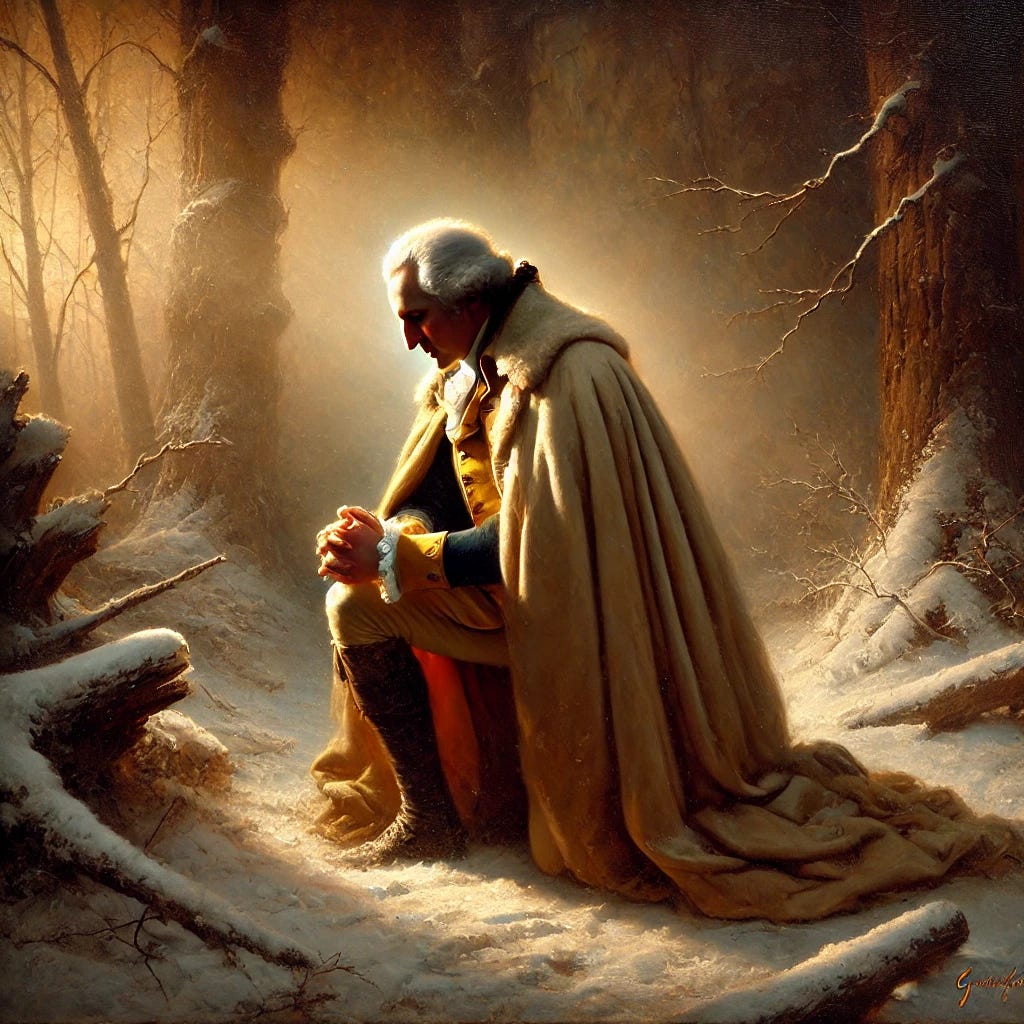
George Washington:
Feb 17, 202500:07:36Tap to summarizeBeautiful FreedomPresentsGeorge Washington: Flawed Yet GodlyBy Calista FreiheitNarration by Amazon Polly George Washington, the Father of our Nation, was a man of immense character, leadership, and faith. Yet, he was also a man with flaws, a reality that does not diminish his greatness but rather magnifies it. In an era that demands moral perfection from its historical figures, Washington stands as a testament to the biblical truth that God uses imperfect men to achieve His perfect will. His legacy is not one of untainted virtue but rather one of struggle, perseverance, and a continual striving toward righteousness, a quality that makes his example all the more powerful for those who seek to serve their nation and their God.A Man of Principle and ConvictionWashington was a man of deep faith, evidenced by his writings, public actions, and the moral compass that guided his leadership. He believed in divine providence and saw the hand of God at work in the founding of the United States. His personal letters and speeches are filled with references to the Almighty, and he frequently called upon the nation to seek divine guidance. The famous Thanksgiving Proclamation of 1789, in which he urged Americans to express gratitude to God, remains one of the clearest demonstrations of his belief that faith and government should not be separate but intertwined.Beyond public proclamations, Washington's personal devotion was unwavering. He was known for rising early in the morning for private prayer and scripture reading. Despite being a reserved and often taciturn man, he spoke passionately about the necessity of virtue in public life. For Washington, faith was not merely a personal solace but the bedrock upon which the nation should be built. He firmly believed that a republic would crumble without morality, as liberty untethered from righteousness leads to corruption and decay.Moral Failings and RedemptionYet, Washington was not without moral failings. He was a slave owner, a fact that understandably casts a shadow over his legacy. However, unlike many of his contemporaries, he grappled with the morality of slavery and took concrete steps to address it. By the end of his life, Washington freed the enslaved individuals under his direct control through his will—an action rare among Virginia planters of his time. His evolving view on slavery is evidence of a man seeking righteousness, an example of sanctification in progress. God does not demand perfection from His followers but calls them to pursue justice.Washington’s attitude toward slavery evolved over the years, mirroring the broader national struggle with the institution. He expressed concern for the future of the country if it remained divided over the issue, and his correspondence reveals a man increasingly troubled by the contradiction between the ideals of liberty and the practice of slavery. Though he did not take the radical steps that later abolitionists would, his private reflections and eventual manumission of his enslaved workers suggest a man seeking to align his actions with his moral convictions.Humble Leadership and Reliance on GodWashington’s greatest strength was his humility. Unlike many leaders who clung to power, he relinquished it—twice. After two terms, he declined to be king and voluntarily stepped down from the presidency, setting a precedent for democratic governance. This act of self-denial reflects a biblical understanding of servant leadership, where true leaders place the good of others above themselves. Washington did not seek personal glory but rather the survival and prosperity of the new nation. His farewell address is a masterclass in humility and moral guidance, warning against the dangers of political partisanship, moral decline, and foreign entanglements.His humility was not a mere political posture but a deeply ingrained aspect of his character. Washington’s reluctance to assume the presidency in the first place stemmed from his desire to serve rather than rule. He frequently expressed doubt about his abilities and asked for divine guidance to lead the young nation. Unlike the kings and emperors of old, he saw his role as a temporary steward rather than a ruler appointed for life. This selfless approach to leadership ensured that the United States would remain a republic rather than descend into the kind of autocracy that had long plagued Europe.Faith and the Formation of AmericaWashington’s faith was not performative but deeply personal. He attended church regularly, prayed fervently, and led his troops in acts of devotion during the Revolutionary War. He believed that the success of America was tied to its moral foundation, urging his fellow citizens to uphold virtue and piety. The idea that liberty is inseparable from faith was a cornerstone of his philosophy, which remains relevant today.During the harsh winter at Valley Forge, Washington was seen kneeling in prayer, seeking divine intervention for his weary troops. This moment, immortalized in paintings and historical accounts, captures the essence of his leadership—a general who relied not only on military strategy but also on divine strength. The war's outcome, against overwhelming odds, only reinforced his belief that the United States had been given a unique destiny that required its people to uphold moral and religious principles.God Uses Imperfect MenThe Bible is filled with examples of flawed men whom God used for His purposes—David, a man after God’s own heart, yet guilty of grave sins; Paul, a persecutor of Christians before becoming one of Christ’s greatest apostles. Despite their imperfections, Washington belongs to this lineage of men who sought righteousness and led with moral courage. His legacy is not one of unblemished virtue but of striving toward godliness, proving that our faults do not disqualify us from being used by God.In an age that often discards its heroes for their imperfections, Washington reminds us that virtue is found not in moral flawlessness but in the pursuit of righteousness. His life exemplifies the biblical truth that God does not require us to be perfect—only willing to follow His call. America would do well to remember that true leadership is not about the absence of flaws but about the presence of faith, humility, and a commitment to moral principles. George Washington embodied all these things, and for that, he remains one of the greatest leaders in history. His legacy challenges us today: to pursue righteousness even when we fall short, to lead with humility rather than pride, and to anchor our nation in faith and virtue so that it might continue to prosper under God's guidance. Thank you for your time today. Until next time, God Bless. Get full access to The Cogitating Ceviché at thecogitatingceviche.substack.com/subscribe
Transcribe →
Cogitating Ceviche's Week in Review (25-06)
Feb 16, 202500:17:51Tap to summarizeThe Cogitating Ceviche and Elephant Island Week in reviewEditor's NoteThis week’s articles and stories from The Cogitating Ceviche and The Elephant Island Chronicles traverse a broad intellectual and creative landscape, ranging from the moral responsibilities of parenting to AI ethics, speculative fiction’s role in technological discourse, and historical satire. We also explore personal narratives of loss and discovery and cinema’s enduring storytelling power. Whether through philosophical inquiry, political analysis, or artistic reflection, each piece invites readers to grapple with the pressing issues of our time.Articles of the Week* Raising Children in a World of Relativism: Instilling Moral Foundations[February 10, 2025]By: Calista F. FreiheitThis is a conservative take on parenting in an age where moral relativism dominates public discourse. Calista examines how Christian values can serve as a moral anchor, offering parents guidance on raising children with strong ethical foundations in a world that often blurs the lines between right and wrong.* Al-Farabi in the Age of AI: The Second Teacher Explores Ethics, Modern Philosophy, and the Future of Education[February 11, 2025]By: Conrad HannonConrad delves into Al-Farabi's philosophical insights, comparing his views on education and ethics with contemporary concerns about AI. This article challenges readers to consider whether AI can serve as a "Second Teacher" in an age when moral and intellectual authority are increasingly mediated by technology.* VP JD Vance on the Future of Artificial Intelligence[February 12, 2025]By: Conrad HannonA deep dive into JD Vance’s perspectives on AI regulation, national security, and the broader implications of automation. Conrad presents an analysis of Vance’s policy positions and their potential impact on technological innovation, workforce displacement, and global competition.* Finding Marigold[February 12, 2025]By: SibyllaThis narrative-rich exploration of memory, grief, and self-discovery takes readers on a journey through personal loss. Sibylla weaves a reflective tale that invites contemplation on the ways we seek and find meaning in the remnants of the past.* From the Giant’s Drink to AI-Driven Gaming: The Enduring Legacy of Orson Scott Card’s Vision[February 13, 2025]By: Conrad HannonOrson Scott Card’s exploration of AI in Ender’s Game and The Giant’s Drink has proven prescient in today’s world of algorithm-driven gaming. This article connects his vision to contemporary discussions on AI-driven narratives, player autonomy, and the ethics of gaming technology.* Giovanni Boccaccio: Satire, Survival, and the Stories That Defined an Era[February 14, 2025]By: Conrad HannonThis is a historical and satirical examination of Boccaccio’s Decameron. It analyzes how his stories of wit and survival resonate in an era of global crises and shifting cultural landscapes. Conrad contextualizes Boccaccio’s work within today’s media-driven world, where storytelling remains a tool for both escape and critique.* Her Private Affair (1929)[February 15, 2025]By: John BrownA cinematic retrospective on Paul L. Stein’s Her Private Affair, exploring its themes of scandal, secrecy, and female agency in early Hollywood. John Brown dissects how the film’s narrative structure and aesthetic choices influenced later noir and melodrama traditions.Quote of the Week"A society without fixed points of reference cannot expect to navigate its own future." – Unknown SourceThought-Provoking Questions for the Week in Review* Raising Children in a World of Relativism:* How can parents reconcile traditional moral teachings with a world that increasingly rejects absolutes?* Should children be shielded from moral relativism, or is it better to expose them to it and guide their reasoning?* Al-Farabi in the Age of AI:* Can AI ever truly replace human teachers in shaping ethical and intellectual discourse?* How does Al-Farabi’s vision of education compare to modern theories of learning in a digital age?* VP JD Vance on the Future of Artificial Intelligence:* What role should the government play in ensuring AI develops ethically?* How can the U.S. compete in AI without overregulating innovation?* Finding Marigold:* How do personal narratives help us process grief and loss?* Can memory be a form of storytelling that reshapes reality?* From the Giant’s Drink to AI-Driven Gaming:* Should AI have creative control over storytelling in video games?* What ethical concerns arise from AI-driven interactive experiences?* Giovanni Boccaccio: Satire, Survival, and the Stories That Defined an Era:* What lessons can modern writers learn from Boccaccio’s use of satire?* How do stories of survival and humor help societies cope with crises?* Her Private Affair (1929):* How did early Hollywood shape modern narratives of scandal and secrecy?* Does Her Private Affair still resonate with contemporary audiences?Additional Resources* The Moral Landscape: How Science Can Determine Human Values* AI and the Future of Education: A Philosophical Inquiry* The Evolution of Satire: From Boccaccio to the Digital Age* The Silent Era of Hollywood and its Influence on Modern FilmmakingFinal ReflectionsThis week’s pieces remind us that history, technology, philosophy, and personal experience are interwoven. Whether examining the moral challenges of parenting, the evolution of AI, or the storytelling traditions of the past, each article encourages us to engage in meaningful reflection. What will shape the ethical and cultural future of our world? What role do we play in preserving, challenging, or transforming the narratives we inherit?Author's Calls to Action* Calista F. Freiheit: Take a moment to reflect on how you communicate moral values to those around you.* Conrad Hannon: Join the discussion on AI ethics and the lessons we can learn from history.* Sibylla: Share your thoughts on how personal stories help us process grief.* John Brown: Revisit classic films and consider their relevance today.* All Authors: And they all encourage you to share and subscribe.Thank you for your time today. Until next time, stay gruntled and God Bless. Get full access to The Cogitating Ceviché at thecogitatingceviche.substack.com/subscribe
Transcribe →