← The Colion Noir Podcast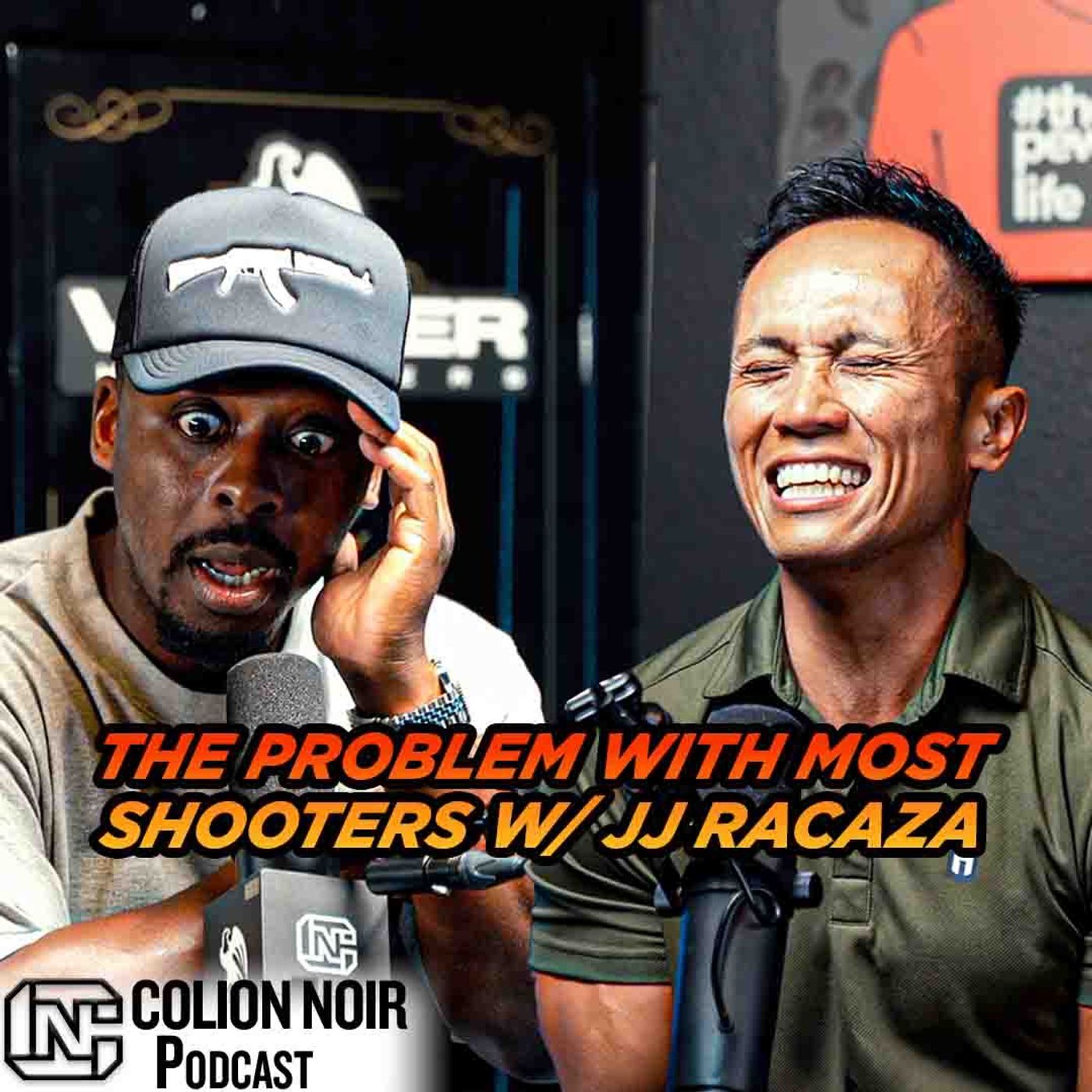
The Colion Noir Podcast
The Problem With Most Shooters w/ JJ Racaza
00:47:34
In this episode, we sit down with JJ Racaza to talk about what it really takes to stay sharp, physically and mentally, as you get older. From competition shooting and heart-rate management under pressure to fitness, injuries, and discipline, this conversation goes deeper than just guns. We also get into mindset, emotional control, training philosophies, and even detour into cars, lifestyle, and why performance in one area of life often reflects in others. It’s a raw, unfiltered conversation packed with insights for anyone looking to level up.
Loading summary
Transcript468 lines
- [00:00]
A
And I'm like, I'm sitting here, but pressure and adrenaline is dumping, right? And so I was like, let me do my breath technique box. 4. Four breath and in, out, and hold and all this stuff. And I got down to, like, 100. I'm like, goodness gracious, this is higher than what I'm training at. And I'm trying to monitor everything that I'm doing. I get to the line, and, like, I look down, it's 127. I'm going. I walked here. I can't run. Right? And that's when I realized I gotta be in better shape.
- [00:26]
B
This episode of the Cole on Noir podcast is brought to you by Vetter Holsters. All right, welcome to another episode of the Coleon Noir podcast. And joining me is my good friend, longtime friend, J.J. ricardo.
- [00:38]
A
Thanks for having me.
- [00:38]
B
What's going on? Yes. Yeah. Always a pleasure. Always a pleasure, man. What you. What have you been up to?
- [00:43]
A
Teaching, Competing.
- [00:44]
B
Yeah.
- [00:44]
A
Trying to stay in shape. Trying to live a good life.
- [00:46]
B
We always do that. I. I will say, at least from my perspective, I've seen you're always in shape. You're always in shape. I'm the one that's like, I feel like I just. Yo. Yo. All over the damn place. And then. And I'm just like, all right, I'm gonna do it. Peter has to hear. Deal with me talking about this all the time. Like, I'm gonna. I'm gonna cut. And I've been on cut for, like, three years.
- [01:06]
A
Different lifestyle. Right.
- [01:07]
B
No, that's. That's the. That's the weird thing about it. Right? It's kind of like. It's definitely hard. Like, the traveling a lot. And I'm making excuses, but nonetheless, for sure. Yeah, the traveling makes it harder. Like, if I. When I get into a routine, I start, like, I start dropping.
- [01:23]
A
I've seen you.
- [01:23]
B
Yeah. Yeah.
- [01:24]
A
I was like, you. You do well quick when you're in a routine.
- [01:28]
B
Yes.
- [01:28]
A
Yeah.
- [01:29]
B
Your body responds, and then. Yes, if I. If I'm consistent. Consistent for a short. Even just short periods of time, body responds really well. Problem is, then traveling hits. Right. Or the drinking. Right. So it's not that I'm a drunkard and I get drunk every night, but the drinking starts affecting, like, even just two drinks, Calories sleeping, you know, metabolic fat burning with all that scientific bullshit that they talk about that alcohol stops doing and stuff like that. Or, you know, just bloat.
- [01:58]
A
Yes.
- [01:58]
B
You know, stuff like that. Yeah. And. Which is crazy because it's like I. I weigh myself Every morning. Yeah. You already know what I'm about to get into. Yeah, dude. It is a mind of epic proportions. Dude, it's, it's like, it's like, it's like, oh, oh, oh, oh, down. I'm down. And then it's like, what the.
- [02:20]
A
I wish this is what my stock market looks like the opposite.
- [02:25]
B
And then like sometimes then it's like, I'm like, okay, all right, let's. Let's get it together. And then all of a sudden, down five pounds out of nowhere. And so it's like, you know, get the whoosh effect and all the other crap. Right? What did you do, Peter? All right, anyway, we're back because Peter's up. But yeah, so, you know, the whole, you, you get it from a weight standpoint dealing with all that stuff. And I'm pretty sure. And the funny thing is I always looked at competitors of competition shooters who train also and then also have a social media presence. Y' all are kind of almost like fitness influencers too, in a sense. In terms of you have to keep up your ability clearly to your ability to shoot. You may have all the knowledge set. Right. But the way things are now, like, if you can't actually demonstrate it and do it, people gonna be like, I don't really know if I'm gonna take much information from this person. Even though you've been shooting your whole life and doing this your whole life, and you could probably shoot better than in, you know, just from your pinky than most people on the planet. Right. So. And just like when you're a fitness person, you can't ever. You can't relax there. There is no. Kind of like, oh, I'm just gonna put on a couple pounds. Exactly. Right. All right. So I've got to give a quick shout out to Vetter Holsters. They're now sponsoring the podcast. I've been using their light tuck Kydex inside the waistband holster. And what I really like is how adjustable it is. You can tweak the ride height and can't to get it exactly how you want. Plus they've got holsters for over 450 gun models in 75 different colors. So you can pretty find whatever you need. But here's the thing that really sets them apart. Their customer service. I've heard so many stories about how they've gone above and beyond to make sure you're happy with your holster. And with a lifetime Warranty and a 30 day money back guarantee, it's clear they stand behind their products. If you're in the market for a great holster, check them out@betterholsters.com. so that's kind of how I always kind of looked at you guys in a lot of ways.
- [04:14]
A
Yeah, there is. I think the fitness thing for me was more like I got to stay tip top shape because I can't relax too much. The good thing about me in terms of fitness is that I don't drink. I can't drink. I'm allergic to alcohol.
- [04:26]
B
Oh, yeah.
- [04:27]
A
If I drink one, it's all of a sudden my heart rate starts going up. I got hives. I can't breathe really. It's really hard. Yeah. It's like, I can handle it, but it's like. It's like, never mind. It's just not a good thing for me. So that's a good thing for me. I don't soda.
- [04:38]
B
Wish I was like that.
- [04:39]
A
I don't like a lot of sugar. Right. I don't like chocolate or anything like that. So I just eat. I'm unhealthy, healthy. I eat really bad in terms of my diet, in terms of fat and all that macros and all that stuff. But I. But it was fine. And like you said, we can outrun it when we were 40 and under. But now that I'm a little bit into my poor. I had to get a nutritionist and like, line it up and understand how macros work, how my body responds to certain food and inflammation. Understanding what that looks like. Right. Traveling is big because then now I have to go shopping, which I don't like. I just want to Ubereats everything.
- [05:10]
B
That's what I still do now, as you can probably see. Yeah. I can tell Uber Eats is awesome. Uber Eats like a. And then what's.
- [05:21]
A
What's higher than a platinum, like, whatever.
- [05:23]
B
Yeah, no, I'm like, you're diamond status. I'm like, diamond stuff. Now. The good thing is, as a recent, you know, now I've just kind of gravitated towards, like, bowls on Uber Eats. So, like. Yeah, so it's like chicken rice. Yeah. Now you got all the seed oils possibly in that and stuff like that. And more recently, I've been doing more kind of like snap kitchen stuff. So I've been doing that. I've been going. That's what I did back in the day when I was like, at my leanest.
- [05:48]
A
Yeah.
- [05:49]
B
So I just kind of went back, started go back.
- [05:50]
A
You had something to go off of.
- [05:52]
B
Yeah.
- [05:52]
A
You kind of had like a black whiteboard that you're like, all right, this is what I can go back. And this is what happened to me when I did it.
- [05:56]
B
Oh yeah, for sure.
- [05:57]
A
Yeah, for sure.
- [05:57]
B
Yeah. I was a unit, what, 2018.
- [06:01]
A
That was the time. Yeah. I was like, what are you eating at this point? Yeah, just yoked veins everywhere.
- [06:07]
B
And I was laying.
- [06:08]
A
Yeah.
- [06:09]
B
I was like, yeah, I like this.
- [06:10]
A
And you know you played basketball a lot too at that time. You still play basketball?
- [06:13]
B
No, no. Cuz then that's how I knew I was getting older because I messed my knee up. I messed my knee up. I was doing something. I was driving to the basket, did some weird movement and then it just. And I think I kind of. I'm sure I up my meniscus or something like that, which I kind of, in a lot of ways am glad kind of happened because it put me in path towards, you know, knees over.
- [06:35]
A
I see.
- [06:36]
B
Yes.
- [06:36]
A
Oh, he's.
- [06:37]
B
That's.
- [06:37]
A
That saved my knees as well. Yeah, yeah, 100%.
- [06:40]
B
Yeah. My knees actually have probably never been better.
- [06:42]
A
I can tell. I have three tears in my right knee.
- [06:44]
B
Oh, shit.
- [06:44]
A
Three times. Mild to severe. My pcl, mcl and ACL are torn up. But I don't need surgery because none of them are loose. They're holding on to each other. Right. So I have some meniscus left over. The surgery would happen only if I really wrecked it. The doctor was like, hey, you need to get your squat and tibia and calves. Strengthen strength stronger. So I was like, okay, I don't know what to do with that. So I started researching and the knees over toe, guys. And I was like, all right, I'm going to start doing whatever he's doing. Walking and tremor backwards. Right. And constantly working on quads, like my quads. And I. I do more squats and deadlifts now than I ever have. I do more tibby work and stuff like that. Right. And kneecap calves races and all this. And goodness gracious, I can tell you my knee pain is gone. I can feel like I can explode again and not be afraid that something's gonna give away. But a lot of his muscular tension, like supporting my knee before, I didn't have that.
- [07:27]
B
Gotcha.
- [07:28]
A
So because I tore my calf. You tore my calf. That's close to tearing your Achilles. Good thing it was your calf because you can recover from it.
- [07:34]
B
Yeah, I tore it doing plyometrics.
- [07:38]
A
What? Jump boxes.
- [07:39]
B
I was bounding.
- [07:39]
A
Yeah.
- [07:39]
B
Oh, yeah, I was bounding and then I think I was actually skipping. No, I. I was skipping and I tore it initially.
- [07:45]
A
You felt it?
- [07:46]
B
I felt it. It Was kind of minor and I should have backed off.
- [07:49]
A
Yeah.
- [07:49]
B
But I had that. And you probably have it too. It's that mentality. So I push through. Yeah, Right. And then I kind of rested a little bit and then I started doing, I think I was doing some like side to side hops. And then the second one I was like.
- [08:01]
A
Oh, that's when you, yeah, you don't. Yeah, that's when you're like regret. Yeah, yeah.
- [08:06]
B
Like to the point where like my calf doesn't look the same anymore.
- [08:08]
A
Oh, yeah. Some atroph or just changed everything muscular.
- [08:11]
B
I don't, I didn't have to get surgery or anything like that, but I, I, I saw the difference in my, like my calf visually looks different now, but I, I kind of, I did the knees over toe stuff, but then I also kind of did some rehabbing for the calf and stuff like that and so, and I kind of stayed off of it. So I've lost some of my explosion because during that period I was scared to do anything explosive. Right.
- [08:31]
A
Yeah.
- [08:32]
B
So I'm slowly starting to trying to get that back. I think it's healed back stronger now.
- [08:35]
A
Yeah.
- [08:36]
B
Because of the, what is it they call it?
- [08:39]
A
Scar tissue.
- [08:40]
B
Yeah, exactly. Right. So at this point I'm pretty good. And then on top of that with my knee. So I do, I do knees over toe stuff almost every day now.
- [08:48]
A
Yeah, Right.
- [08:49]
B
As and when I first started doing it, it was a little weird. Not weird, but I was doing it kind of. I was doing it like I was training for Hydra. Like hypertrophy. Yeah. Yeah. So I was like going to like absolute failure on all this stuff. And it's like, no, this just like your ligaments. That's a different type of training. Exactly. Right. So I started kind of like, hips were super strong, but then I noticed when I tried to sprint, like, it felt like. Yeah. So like, so I backed it off now. And so now I'm understanding like the different styles of training for different reasons. And so now when I'm on the range and we're filming stuff and I like take off and run now I don't have to wait for my tips to kind of loosen up. Exactly.
- [09:29]
A
You know, it's crazy because back in the days it was always taught like, hey, do legs. And then to give it a couple days break.
- [09:33]
B
It's.
- [09:34]
A
Nowadays I'm the opposite. Like, I want to do legs almost every day and I wish I did this and knew this earlier in, in my career because then I could be a lot more explic. A lot more balanced, a lot more stable in a lot of things that I do.
- [09:43]
B
Yeah.
- [09:43]
A
But like, just learning how to do heavy weight and then like, some sort of recovery, but active recovery, like by cycling light squats, whatever it is. Right. Or like wall balls. Right. Those things just keep it moving to flush out all the little. What is that called? The lactic acid?
- [09:57]
B
Acid. Yep.
- [09:58]
A
Yeah. And so I wish I did. And I'm a lot stronger now. I would like to say I'm a lot fitter than I was when I was 33. I thought that was the best.
- [10:05]
B
I think it's like. It's a density almost.
- [10:07]
A
Yes.
- [10:07]
B
It's like you just become a little more dense. Yeah. Yeah. And so that's. That's what. At least that's what I've noticed with myself in that regard. But. But yeah, I'm the same way. I'm kind of slightly changing things up. Like, cardio is becoming more of a thing.
- [10:18]
A
Yeah.
- [10:18]
B
Right. But I'm, like, mixing that up. So I'm doing, like, zone two. Some zone. Zone two. On some days.
- [10:23]
A
You're really getting into it.
- [10:24]
B
Yeah. Yeah. One thing is, I've never been. My issue has never been working out. No, no. My coach. My coach. Yeah. My coach is like, me and my coach was always like. He's like, your issue is never working out. Yeah, he's just like, you eat like. He's like, you just eat like. Because it's like, I'll work out every day if you. If. If that's what it takes.
- [10:40]
A
But for a guy like you, a high performer guy, like, you're. Your brain's going a thousand miles an hour. How the hell do you stay on zone two? How do you do it?
- [10:47]
B
That. Honestly, in terms of all the workouts I do, that's the hardest one.
- [10:50]
A
I was going to say, because the stain zone to your heart rate's got to be a certain level, whatever it is. And it's monotonous.
- [10:54]
B
Yes.
- [10:55]
A
You cannot get excited and finish a workout.
- [10:57]
B
Like, when I think I'm getting tired, it's not. I'm just bored.
- [11:01]
A
Yes.
- [11:01]
B
Right. So I'm like. And the funny thing is, there was a period. I don't know, people listening. It's like, I thought this was a gun podcast. You'll be all right. Like, I'll be on. I remember there was a period where I was doing an hour of steady state. Like, I'll either do it on the elliptical or, like, sometimes I'll do it on treadmill, like an incline walk, something like that. And I'll do that for an hour straight. Or I was doing sled. Sled sprints. So I would do it for, like. Well, actually, it wasn't even constant moving. It was. No. So. Well, the sled sprints, not so much. I would find, like, there was a turf at my gym.
- [11:38]
A
Yeah.
- [11:39]
B
And I was. I think it was about 40. About 40, 50 yards. I'm like, about 40 yards. No, it's like 25, 30.
- [11:46]
A
Okay.
- [11:47]
B
And basically, I'd sprint, push, sled, and then I kind of monitor everything on my apple watch, let my heart rate go up, let it come down, do it again. And I keep doing that till I burn about 600 active calories. So by the time. That's usually about an hour and 30 minutes doing that shit. And then I started realizing that recovery probably needs to be more incorporated into what I'm doing, because eventually I kind of broke down and I was like, okay, all right, now let's find a balance here in terms of that. So, like, I do some, like, lifting for that hypertrophy, some, like, functional stuff. So, like, now I'm trying to get pull ups and chin ups.
- [12:22]
A
Yeah.
- [12:22]
B
Where they need to be. And then, of course, like, cardio stuff, too. Just because, you know, like I said, we're getting older, so I try to make sure that, you know, heart rates. My sitting heart rate stays at a certain point.
- [12:32]
A
Yeah.
- [12:33]
B
So that's. That's. And the thing is, people think this does anything to do with guns, but it does.
- [12:37]
A
It does.
- [12:37]
B
Because when we're out there, me and Peter filming, we're out there for hours. When JJ's out there shooting, he's moving. He's got to be. He's got to be able to be mobile and all that stuff. The agility. So if you don't think it has anything to do with it. It has a lot to do with it.
- [12:51]
A
Hey, I. I can tell you this. I have to maintain a certain heart rate, and I have to be able to function a certain heart rate, because when pressure comes in, I'll never forget having a heart rate monitor.
- [12:59]
B
Yeah.
- [13:00]
A
One time, I remember just pract. I practiced. I was doing well, about 80 to 90 beats per minute. Did well. I was at the match. I'm like, I'm gonna shoot around 80, 90 beats per minute. My resting heart rate when I'm sleeping is like, 45.
- [13:11]
B
Yeah.
- [13:11]
A
But when I'm going, it's about 60, 50. Right. So I remember sitting there in a match, I was getting called on deck. Hey, Jay, you're up next. Okay, cool. Sounds good. I remember just feeling my heart pumping. I'm like, I wonder what my heart rate is. I looked down, it was at 110. And I'm like, I'm sitting here, but pressure and adrenaline is dumping. Right? And so I was like, let me do my breath technique. Box four. Four breath and in, out, all this stuff. And I got down to like 100. I'm like, goodness gracious, this is higher than what I'm training at. And I'm trying to monitor everything that I'm doing. I get to the line and, like, I look down, it's 127. I'm going. I walked here. I didn't run right. And that's when I realized I gotta be in better shape. I gotta be able to monitor and be able to function at a higher heart rate. I started doing those. I went crazy at one point, like I was gonna. I started working out with Real World, Tony, everyone, like throwing this dumbbell and trying to pick up the gun and shoot when everything's blacking out. That was completely different. When adrenaline versus just. What is that called? Just temporarily raising your heart rate. Yeah, totally different. Right.
- [14:10]
B
So that's funny you say that because I recently, and I just did a solo podcast talking about this. I just haven't released it yet.
- [14:16]
A
Okay.
- [14:16]
B
So last time me and Peter were out filming without. What I try to do from a training standpoint is like after we film. Because I shoot a lot, but it's. It's shooting to be on film. Sure. Versus training, kind of shooting for, like to train my self defense. Drawing from consuming all that stuff. Right. And one of the things I did. So what I'll do sometimes I'll try to incorporate all that. So I'll incorporate training and conditioning. So what I was doing, I was. I like, I was doing sprints. So I would sprint like 60, 70 yards and then be at a target. Well, initially, what I'll do it. I'll sprint laterally, 60, 70 yards and then. And then set, and then hit the timer, have it on random. Then when the timer goes off, I draw as fast as I can. Take a shot at a silhouette about 80 yards away.
- [14:58]
A
Okay. I saw some of these videos that you were just showing off. See, here's the thing.
- [15:04]
B
See, I wasn't. But I haven't. I hadn't done any condition. I wasn't running. That was just me standing.
- [15:08]
A
Okay.
- [15:08]
B
Okay. But this was like. And then when I was doing this, it was from concealed.
- [15:12]
A
Okay.
- [15:13]
B
So. And I'm not saying this because I'm like, oh, I was hitting the target and I was missing like crazy.
- [15:17]
A
Okay.
- [15:18]
B
Right. But I was trying to see where my limits were in terms of my distance. So then after that I brought it in closer. So I would sprint 60, 70 yards then. And now I'm spreading towards the target and then stopping at about 20 yards. And let's set. Set the timer. Let it go off randomly.
- [15:32]
A
Yeah.
- [15:32]
B
Then draw and shoot. Yeah. I was still missing. Right. Because I'm like, I hadn't been. I'm not exactly. Right. So I'm not used to the to heart, the shooting at that heart rate level. Right. Because at that point while I'm beginning my watch. Barbara call. At that point after that sprint, I'm somewhere like 50. Yeah, exactly.
- [15:49]
A
Yeah.
- [15:49]
B
Right. And so your body does some interesting things.
- [15:52]
A
Sure. 100 division starts doing different things. Yeah.
- [15:54]
B
Yep. And so for me, I totally understand what you mean. Now I'm trying to mimic adrenaline. Adrenal dump.
- [16:01]
A
Yes.
- [16:02]
B
But it's hard because that's a whole different. Because I know what adrenal dump feels like in a moment when you're like terrified.
- [16:07]
A
If you've been there. Yeah. 100. Like you don't. You lose feelings and extremities.
- [16:11]
B
Yep.
- [16:11]
A
Yeah. Your breath and all that.
- [16:13]
B
Everything kind of slows down. Not in a good way.
- [16:16]
A
Your body doesn't want to move.
- [16:17]
B
Right.
- [16:18]
A
Yeah.
- [16:18]
B
100. Yep. Yeah. So for me, that was something that like, I'm like. But I guess I figured getting my heart rate up is better than nothing.
- [16:25]
A
Yes.
- [16:26]
B
Right.
- [16:26]
A
For sure. Because getting exposed to that.
- [16:28]
B
Yeah.
- [16:28]
A
And understanding some of the biomechanics that happens within you, your eyes, vision, and how to control it. Right. Breath is like our savior a lot of times. Right. Learning how to reset. We call it. In my competition, I have this, like this. It's. It's a little bit long. But if you have like pure system. Right. Planning, initiation and execution and then reset. Reset's a big thing because a lot of times when we're running, we only have one opportunity to do things right or wrong. And we're competing for the best and the best, whatever. But if there's something that goes wrong in that stage. Not always everything goes right. So something goes wrong. It's who can fix and reset themselves back to the present moment as opposed to judging, resentment, and like trying to think about this. Right. Versus moving on to the next shot. Who can bring themselves back to present quickly. And the reset is one of their most important things. And breath is one of those things. It's like a quick inhale and then exhale. And it allows you to be right back to present.
- [17:14]
B
So one of the things I. One of the reasons why I think I won't be. That I wouldn't be that great at competition shooting is because I don't do well with the time period in between stages.
- [17:25]
A
I see.
- [17:26]
B
Yes. I'm somebody that needs to be constantly readjust. I need to be able to see the mistake immediately, be able to try again, to read, to fix it.
- [17:35]
A
Yeah.
- [17:35]
B
Because if you give me time in between, I'll start doing what you're. What you were talking about.
- [17:39]
A
Yes.
- [17:39]
B
And so the pro. And then it's like I got to start from cold.
- [17:42]
A
Yeah.
- [17:42]
B
Right.
- [17:42]
A
Yeah.
- [17:42]
B
And so that's the hard thing for me now if I can keep going, which is why I kind of lean towards, you know, sports like basketball. Right. You can take a shot, you come around the corner again, take another shot. It's not a big deal. Right. Whereas competition shooting.
- [17:54]
A
Yeah.
- [17:54]
B
You run a stage. You up.
- [17:56]
A
Yeah.
- [17:56]
B
You got like 15 minutes to think about everything you did wrong. Oh, you're right.
- [18:00]
A
Yeah. Sometimes.
- [18:02]
B
So like what do you do? So. So how do you kind of. How do you deal with this? That's something that's just kind of natural.
- [18:07]
A
No. So there's, there's. It's got to be trained. Well, most people think it's just physical things. Right. Mindset, Got to be trained. A lot of it. And it's also emotional management. My emotional state, like how excited or how upset do I get in a bad run? So I have to start that in training, leading up to the match, I have to start being very matter of fact about things. I messed up because I did this. This is how I'm going to fix it. Cool. No emotions, no added to the event or no subtracting to the event. Just. It is what it is. Right. However, when I'm trying to develop leading up months before a big competition, there's a lot of judgment, there's a lot of cussing, there's a lot of yelling, there's a lot of anger. Right. Because emotions, I'm letting it go because I'm pushing. But when I'm in that state of just trying to be sharper as a shooter and I'm working on my mindse how to think correctly, how to manage emotions correctly. And then the biggest thing is really just not getting excited or not not getting excited when I get, when I do well and not also not getting upset when I do bad. I'm just correcting it and approaching it as a Very process, like, focus. Right? My dad just texts me. He's like, hey, what'd you do here? I did this, did this and this. How come that didn't work? Because I missed this part right here. Okay, cool. Let's do that again. But we're gonna initiate that plan, initiate that process and make sure that's the focus. Okay, sounds good. And we're gonna do that. And so it carries on to the match. And when you get to the match, people get. You can see people yelling, yes, let's go. Whatever. You'll see those guys crash and burn quite a bit. Because emotional regulations, immature is what we call it. Guys that are look like they're bored. Those are the guys that are doing really good because they're just sharp, they're doing their own thing and they're focused.
- [19:28]
B
So basically they don't get too excited with the good and don't get too
- [19:31]
A
down with the bad, and they're just like this the whole time. Yeah. Those are guys that separate the men from the boys, really out there in the competition. There's like the 1 percenters, let's say the top 3 percenters, and then there's like the rest of the field. The top 3 percenters is like maybe 8 or 10, and then the rest of them could win, but they just don't have the maturity to be able to do that emotionally. Their skill sets there, they're just not mentally or emotionally. They're just not quite there to hold it for 18 scenarios.
- [19:53]
B
So I have to. I've never. I don't know why I've never asked you this question before, but whenever you're forced to shoot regular ass guns, are you kind of just like, disgusted and, like, grossed out?
- [20:06]
A
No. First of all, let's define regular ass
- [20:10]
B
guns meaning like, like, because, like, if you, like, like running guns that would, like, have a tune, trigger, sure. Things like that. So really what we're talking about is a trigger. Yeah, right.
- [20:21]
A
Yeah.
- [20:21]
B
It's like, how much, like, does. Is that something that ever crosses your mind or you're just able to kind of like. Like Lewis Hamilton goes in and just drives a regular car. He understands this is just regular car. So I'm not judging it from the same perspective.
- [20:33]
A
Yeah, it's totally different outlook. Right. And if someone's telling me to perform on a different gun that's different, then I go, all right, I expect that I'm gonna be 5, 10 slower because of this and this and this. The challenges on this would be my trigger. I'm not gonna be Able to slap it. I'm gonna have to rely on more grip. Right. Manipulate the trigger. Slight range of what I call my speed range is not much shorter. Right. With a tuned gun, tuned trigger, I can extend my range to shooting as fast as I can slapping my trigger and get center mass hits all the way to like 18, 20 yards. If you give me a standard gun, I can't quite slap my trigger that far. I might go down to like 12 yards. And I'm gonna rely more on grip because now I'm gonna be hammering this heavier trigger, essentially.
- [21:07]
B
So for just people who are listening don't understand when you talk, when you say slapping your trigger, like, explain that.
- [21:11]
A
So I'm slapping the trigger where I'm not even caring about manipulating a trigger correctly. Like smoothly pressing a trigger to hit center mass. When I'm talking center mass, it's like the alpha.
- [21:19]
B
Yeah.
- [21:19]
A
Right. Which is kind of like just wide.
- [21:21]
B
Yeah.
- [21:21]
A
12 inches or whatever. Right. I can hit that all the way. 20, 18 to 20 yards. Being slappy with a tune gun, I can just slap it and be triggered without okay sights just moving around. But my grip instructor is solid. That's. That's what allows me to be able to do that. With a tuned gun, lighter trigger and all this stuff. Anything under two pounds, you give me another gun like a standard trigger. Four pound, three pound trigger to not tune, recoil the slide and all that stuff, that goes down significantly from like 18 to 20, down to like 10 to 12. Makes sense. Right? And now there that I can still run faster than most.
- [21:51]
B
And we're talking about. You're running fast.
- [21:53]
A
As fast as I can. Yeah.
- [21:54]
B
Like, let's say you're thinking you're like, oh, yeah, 10, 20 yards, I can just go bing, bing, bing.
- [21:58]
A
No, I'm talking. I'm gonna run six rounds in under 10, under two seconds from the drop from the draw. Right. Like, I'm trying to run that and trying to hit alphas.
- [22:05]
B
Did you hear this?
- [22:08]
A
But that's a build drill. That's. That's.
- [22:10]
B
I know what it is.
- [22:14]
A
That's a standard drill.
- [22:15]
B
Right. I'm talking about the time period and the fact that you can hit the A zone. I mean, that's. That's impressive. You may not think it's impressive, but you got to understand I don't shoot like that typically. So that's impressive to me. Right, Right.
- [22:27]
A
But that's a good perspective to most folks out there. When I say fast, it's like, yeah,
- [22:30]
B
that's how fast you should run.
- [22:31]
A
Like a plate rack at 12 yards. I want to run it in 2.2, 2.1 seconds. With a stock gun. Right. With a tune gun, I can run it under two seconds. Gotcha.
- [22:38]
B
Okay.
- [22:39]
A
That's how it's kind of like what it is. 20 yards or 15 yards. I can probably. Or let's say 18 yards. I can probably run it in 2, 2 stock gun. It has to be around 10, 12 yards because of the. The sight system, the trigger and all that stuff.
- [22:50]
B
Yeah, Gotcha. So what. What is your preferred sighting system?
- [22:53]
A
Preferred sighting system right now is. I'm actually an iron sights guy, man.
- [22:57]
B
Yes. Really?
- [22:58]
A
I love iron sights. Okay.
- [22:59]
B
Why?
- [23:00]
A
Career has always pushed me to the red dot. Iron sights gives me. I'm old school. I started in 1989, so there was no red dots at the time. I did first start shooting a red dot behind. Behind a red dot. 1992. I have a picture on my phone, actually, that my dad sent me behind a red dot. 1992. So that's been a long time behind the red dot. The career just took me there because that's where the competition always led. The technology got better. Everyone wants to compete out there. So the best of the best always goes to the red dot. But I do do really, really well. Iron sights. My preferred red dot. In terms of red dot. There's so many red dots out there now it's The C. More RTS3. It's just bigger window. Solid, durable gun. I could shoot over 10,000 rounds even now, just in zero. It's pretty decent. Right. Like all of them break. This is the one that kind of has a solid, but it's more expensive than most. So that's why most people don't, like. They kind of frown upon it because they're not a $306, $700.
- [23:48]
B
Yeah.
- [23:48]
A
Right. But yeah, I do enjoy red dot because it's faster. But I'm very. I would say I'm very good with iron sights. So in my carry, I still just run iron sights with flashlight. Yeah.
- [24:01]
B
I'm going to say this. I'm kind of the same.
- [24:04]
A
No way. You're iron sights as well.
- [24:06]
B
So my thing is if you. If you're like, all right, 10 yards, you got to get shots on target as fast as possible. Give me irons 100%. Right.
- [24:16]
A
I'm with you.
- [24:16]
B
Yeah. You put me out to 20 yards.
- [24:21]
A
Different engagement.
- [24:22]
B
Yeah.
- [24:22]
A
Yeah.
- [24:22]
B
Because now. And really what it is, it's finding the dot. Right. I still. Even though I can find it relatively fast compared to most people, I Still find myself hunting.
- [24:31]
A
Sure.
- [24:32]
B
Right. And part of it's probably because I shoot so many different guns. Yeah. Right. Because I'm reviewing.
- [24:36]
A
Yeah.
- [24:36]
B
Different angles and stuff like that. So I'm constantly always having to readjust.
- [24:40]
A
Sure.
- [24:40]
B
You know, things of that nature. But yes. For me, my most natural point of setting, like you give me a gun, it's gonna be irons.
- [24:48]
A
Yeah.
- [24:48]
B
Right. But I understand technically dots are faster.
- [24:53]
A
Yeah.
- [24:54]
B
Right.
- [24:54]
A
But at one point I. This is called Think smoke and Hope. I beat my race gun with the red dot with my iron sights. Just because everything was close I was able to shoot faster. And I broke that world record at that time with my iron sight. Obviously that's been broken since I was able to. I was. I shot it. I had. I held the record with the red dot. I came in there a year later with iron sights and it broke my red dot record with my iron sight. Just because everything was closer point index and all that stuff. I looked over the gun as opposed to looking through a window and stuff like that. So yeah. There was something to it.
- [25:25]
B
So for me also too is I even sometimes with distance. Because I like shooting. I like shooting handguns that fart really hard.
- [25:32]
A
I see. I've seen you.
- [25:34]
B
It's a useless skill. But I like doing it.
- [25:37]
A
It's a really good skill that you love me when that you have that control to do.
- [25:41]
B
So from a self defense standpoint, it's kind of unnecessary.
- [25:44]
A
Sure. Yeah.
- [25:45]
B
But I've noticed too, I'm affected by movement. It. It causes me to question my. Like with iron sights kind of camouflages. It does movement of the gun.
- [25:55]
A
100.
- [25:56]
B
Right. So I can. So when I'm shooting at like 200 yards.
- [26:00]
A
Yeah.
- [26:00]
B
a little target. As long as I can get an idea where they give me a couple shots to find my hold.
- [26:05]
A
Yeah.
- [26:06]
B
I'm usually kind of right on.
- [26:07]
A
Yeah.
- [26:07]
B
But sometimes with the red dot I
- [26:09]
A
can kind of see that in all the micro movements.
- [26:11]
B
Yes.
- [26:11]
A
Yes.
- [26:12]
B
Yeah.
- [26:12]
A
And the problem with those micro movement our eyes captures what Color contrast movement. So anything that's moving, your eyes immediately lock in. So we over. Correct. Because we're staring at it and it gets worse and you're. What am I doing?
- [26:21]
B
Yep. You just said something I didn't even know. I didn't know that. But I didn't know that. Like our eyes are just tracking to whatever move. So that. See color contrast move.
- [26:28]
A
That's the first thing that captures our eyes. It locks in. So there's some of the tricks that I do like shooting iron Sights. Right. Like, one of the things, there's a plate. If I smothered that, my plate halfway Right. Because that's how we used to aim traditionally. That plate looks smaller.
- [26:40]
B
Yeah.
- [26:40]
A
So what? The way I did it when I broke the world record or at least started shooting iron sight, and I still do it to this day, was I did on six o' clock zero. So I aim a little bit lower. Six. But I have a big target. So now in perceptually and visually, yeah, it looks like a bigger target as opposed to a smaller target. So I don't have to aim as hard. I just put the gun underneath the plate, and I can run the gun much faster with a lot. With a lot less confirmation on it. Of course, I'll still line up my sights, and I know how to hold the gun when it's a smaller target and all that stuff. Understanding that my gun does shoot a little bit higher. It's the same concept I do with red dot. So red dot. If I'm looking at something specific on target, I don't want to smother what I'm looking at. Like a. Especially if it's a tape, I don't want to smother that. What I'm looking at with the red dot, because the second my red dot goes on there, it's moving around. My eyes immediately will transition to that red dot. And now as I'm shooting it fast, I overcompensate and I over transition into the eyes focus the wrong place. I literally, purposely will put it underneath just so to keep my eyes locked into the target. And I just super inlay. Not necessarily a lot, but I'm showing.
- [27:36]
B
So are you kind of running it so that the dot is just out within your peripheral?
- [27:41]
A
Yeah, yeah.
- [27:41]
B
And so your target focus.
- [27:43]
A
Yeah.
- [27:43]
B
And so, you know your gun's a little high.
- [27:45]
A
Yep.
- [27:46]
B
But so it's just audio proof. So you're not too focused on the movement.
- [27:49]
A
Yes. Yeah. So it's not like I'm inches away. Like, if I'm looking at this spot right here, this is an inch circle. My dots is just underneath that.
- [27:56]
B
Okay.
- [27:56]
A
Right. And then I'm hitting pretty much general here. But I'm shooting a target this big, so I'm gonna hit it. Right. It's not gonna be big. And if I'm hitting something tighter, I will line up everything else correctly how I need it.
- [28:06]
B
Right.
- [28:06]
A
And that's just. That's like some of the tricks that I did. Some of the things, some of the drills that I do, I used to Write letters on the target. Like simple words like cat, dog, and all that stuff. As I'm shooting, red dot, I want to make sure I'm reading the word. And that means my target is focused, not my red dot. So if I. If I can see the letters clearly as I'm shooting, that means I was looking at the target, not the red dot. That's so some of the tricks I've
- [28:26]
B
been doing it kind of wrong because I thought it was. Since you had the dot, it was almost like you. Red dot, focus. Which actually makes no sense because the whole point of the red dot is so that you didn't have to focus on the sights like you did when you were shooting irons.
- [28:37]
A
Yeah.
- [28:38]
B
So I'm stupid. So
- [28:41]
A
you're right about that.
- [28:42]
B
Shut up, Peter.
- [28:44]
A
So the best way was ever explained to me was that the red dot is basically on your gun, is like your rear sight.
- [28:49]
B
Yeah.
- [28:49]
A
And the target is your front sight. So in terms of iron sight, since you and I shoot iron sight, that's kind of how I look at it. I want the target as clear as possible. Yeah, right. And even when I'm shooting iron sights, I'm looking morally at the target. I'm just kind of superimposing the sights on it.
- [29:03]
B
See? You're a great. You're a great instructor, man. Look at that.
- [29:06]
A
Oh, no. I mean, I would love to have you in one of my classes next time in Dallas.
- [29:10]
B
Let me know. I will come just for the hell of it. Because I'm not shooting. No competition, decisions.
- [29:13]
A
No, no. But it would be great. Like, this class would have been great right now. Because it's performance shooting. Not necessarily.
- [29:17]
B
Where are you training?
- [29:18]
A
I'm training. I'm shooting at Mission 160.
- [29:20]
B
Mission 160.
- [29:21]
A
It's white, right? Texas.
- [29:22]
B
How did I not know? Are you familiar with that one?
- [29:23]
A
Dude, it's amazing.
- [29:23]
B
I did not know about.
- [29:25]
A
It's amazing. You gotta realize that it was outdoors. I thought it was an indoor. Oh, it's outdoors with this huge central building. It's a huge base. They have all the targets, all the walls that you need, steel, whatever you need. Matt and Kevin, how far is it? For me, it's a. I don't know how far the. 40 minutes, maybe.
- [29:40]
B
Really?
- [29:40]
A
Yeah. 30 minutes. White, right? Yeah. Yeah. You know what that is?
- [29:44]
B
We might have to go check it out.
- [29:45]
A
Yeah. Yes. Not black. Right? But white is.
- [29:48]
B
Right.
- [29:51]
A
He might not go there. I don't know. I don't know.
- [29:56]
B
I mean, now with my Tesla truck, I'll go anywhere.
- [29:58]
A
Oh, that's true. You fit in, right? People body. You do. They lay the red carpet when you pull into valet. And they got it. They have to. No. First they see the Tesla and they're
- [30:07]
B
like, who is this gay?
- [30:10]
A
And they see that. They're like, what are you doing? They give us so much.
- [30:15]
B
Here's the funny thing. I used to hate electric cars. I hated them. I. I used to. I was the guy. I literally was like, I don't want a electric car. I want my cars to destroy the planet. That's what I wanted and that. And, man, I love my fucking cybertruck like no other.
- [30:33]
A
So I'm the same with you. I like combustion car. I love the sound. I thought. I've always thought electric cars had no soul. It's just a dead car. My dad got an electric car. It's one of those, like, Cadillac lyrics. Is like. Like, luxury vehicle. Yeah. Holy hell. It's one of my favorite cars to drive. And I'm like, guilty pleasure throttling it. There's no sound. It just goes. It whispers and it's gone.
- [30:53]
B
I had. I had an initial experience before my coming out of the closet, so. So I went. I was at. How's that? No, this was before that. This was. I never even told you this. I was at Ferrari Plano. Oh, here. Yeah. And they had a Taycan, Porsche Tycon
- [31:16]
A
Turbo S. It was actually.
- [31:18]
B
It was. And so I was like. I was like. Because they would give me cars sometimes.
- [31:22]
A
Yeah.
- [31:23]
B
To do videos on, and I just wanted to take this one out and see what it was like. So I got in it, and I'm like. Like, this electric car is weird. But I was like, if there's gonna be electric car that I'm gonna be into, it might be a Taycan. But I'm like, I'm probably not gonna like this anyway.
- [31:34]
A
Yeah.
- [31:35]
B
I drove the thing. I was like. And I couldn't. I couldn't rectify with myself. I kept lying to myself. I'm like, I don't really like this. It's just because it's kind of different.
- [31:43]
A
Yeah. Yeah.
- [31:43]
B
I was like, why is this so fun to drive? Like, I really enjoy driving.
- [31:46]
A
Yeah.
- [31:47]
B
And I was like. And I just kind of pushed it off in the back of my brain, and I just never entertained it again. And then I ended up. We ended up doing a shooter shoot in Simi Valley with. At Terrence Place. Yeah. And then we did this shoot where we shot the cyber truck. This guy, he.
- [32:02]
A
I saw that video.
- [32:03]
B
Yeah, exactly. Yeah. Yeah. And so that at that. So the lead designer of Tesla was there, and I was just. I kind of talked him off on the side. I was just kind of like. I was like, you know, I've actually shot a Tesla before I ever drove one. So I was like, I've never driven a Tesla before. I've never driven a cybertruck before. And he was like, well, you're gonna drive one today. He's like, you're gonna drive mine. So I was like, I mean, how. I mean, how many. How often do you get a chance to drive, right? Lead designer of Tesla's own cybertruck. Right? So I said, cool. I was like, I'll drive it. And I'm like, man, I'm like, it's gonna suck if I would tell them I don't like this thing. So we get in it. It took, what was it, Peter? Three minutes before I was like, oh, this is kind of awesome because I never gave it a chance. Chance. I never. I was like everybody else, I was like, I never dream. I don't want to drive up here. Looks funny. It's an ugly ass truck. I don't want anything to do with that. And then I get in there and I'm driving. I'm like, this is kind of cool. And this is before I even realized self driving. And then he was like, oh, let's let me show you. Self driving is like. Because I was more like enamored by how fast it was quick. Because.
- [33:08]
A
Yeah, yeah, yeah.
- [33:09]
B
Top end is not very 100.
- [33:10]
A
Yeah. 0, 60.
- [33:11]
B
Yeah, yeah. But yeah, otherwise it tops out. Don't let them fool you. Everybody was like, oh, touch was fine. Tesla quick, quick. It's not fast.
- [33:18]
A
Yeah.
- [33:21]
B
And then we did the self driving.
- [33:22]
A
Yeah. Fsds.
- [33:24]
B
I was like, no, no, no, no, no, no, no. This is. This should not be possible. Yeah, because I thought, you know, I just thought it was like active cruise control, like maybe on steroids. No, this is like Jetson's next level. We live in a different reality type.
- [33:37]
A
And did you put it in aggressive mode?
- [33:39]
B
Yeah. Oh, you mean Mad Max.
- [33:40]
A
Yes.
- [33:40]
B
Oh, yes. That's all I drive. All I do is that. That's all I do.
- [33:44]
A
Of course that's what you're saying.
- [33:45]
B
Mad Max will get you in trouble. It.
- [33:49]
A
I'm like, this is worse than what I would do. It drives. No, it does.
- [33:53]
B
It cuts people off.
- [33:54]
A
Yes.
- [33:55]
B
Like, it doesn't care about cops.
- [33:56]
A
No.
- [33:57]
B
It will speed right by a cop. And you're. Because you're just sitting there, you're like, oh. And you're like, no, no, Chill Mo. Chill Mo. Yes. Elon, do something about that. You gotta put. They gotta do a little thing where
- [34:13]
A
radar, laser, if it's.
- [34:15]
B
It does not fucking care. It just. And then it'll just. Like, sometimes we'll be sitting in traffic and all of a sudden it'll just. It's like, it literally. I can literally hear it go, this.
- [34:28]
A
You're like, no, no. Gotta exit here. And here it is trying to sneak in because it reads exactly five cards deep.
- [34:34]
B
Yep.
- [34:34]
A
That's how cool it is.
- [34:35]
B
But around all the way, dude, I had it. I had a loner because he gave me a demo version while I was out in la. And. And you know, they. You know you can split lanes if you're on a bike. So I'm just sitting there. All of a sudden, it just. I'm like, what are you doing? And there's a bike. And I'm like, holy. I'm like, this is. It's catching stuff I don't even see. And I'm like. And I know in my brain I'm supposed to be like, you're trusting your life to this tech, but then there's a part of my brain that's like, I don't care. I like this.
- [35:07]
A
I agree.
- [35:07]
B
Weird.
- [35:08]
A
I don't know if it's like, more like, I like this, but it's like I know that the computer is doing so much more than I.
- [35:13]
B
Which is true.
- [35:14]
A
Right. Four or five cars deep. I can't do that.
- [35:16]
B
I can't eat. Exactly.
- [35:17]
A
This is reacting to all of that. Doing calculations. Maybe it's not. It's not perfect. For sure, it's man made things break, but it's. Gosh, damn.
- [35:24]
B
I've watched this thing maneuver in the lane to get around a tire that's on the road.
- [35:29]
A
Yes.
- [35:29]
B
And it didn't just go swerve to the right all the way. It maneuvered within the lane. Correct. To the best of its ability.
- [35:35]
A
Yeah. To not hit anything else.
- [35:36]
B
Exactly.
- [35:37]
A
Yeah.
- [35:37]
B
And then I'm like, yeah. I'm like, yo, this thing is amazing. So, like, when I'm doing these road trips that I frequently do now.
- [35:44]
A
You're not exhausted?
- [35:45]
B
No, I'm not. Not only am I. No, I am exhausted. You want? But in the best way.
- [35:48]
A
Productive.
- [35:49]
B
Exactly. Yes, exactly. I can do.
- [35:51]
A
Yes.
- [35:52]
B
I guess you're technically not supposed to do this.
- [35:54]
A
That's not encouraged.
- [35:55]
B
But I do. But, I mean, I do it safely. It's not like I'm sleeping in that well. For some reason, my, like, Okay, I will say this. It actually will make you a better driver when you're in a regular car. And here's why I'm. Because it's constantly beeping at you when you pick up your phone.
- [36:14]
A
Yes.
- [36:15]
B
Now, when I'm in a regular car, I don't even think to get to pick up my phone.
- [36:19]
A
Yeah.
- [36:20]
B
And then when I do, it feels almost like I broke out of jail. It's like, wait, what's going on here? So it almost trains you to not
- [36:26]
A
be on your phone. Yeah.
- [36:27]
B
Right. I'm sure there are better ways to do it. Sure. Just don't be on your phone. I can tell. I love that thing. Is it ugly? Yes. But if you wrap it satin black like I did. Oh, well, technically, I didn't wrap it. I bought it used like that. It makes it look a lot better.
- [36:43]
A
100.
- [36:43]
B
A lot better. Yeah.
- [36:45]
A
Yes. I, I, I think wrapping it is the way to go.
- [36:47]
B
It has, it has to be. If you leave it stainless steel, your truck's ugly. Yeah. Now, here's the funny thing I actually saw the other day. I saw another toaster driver, he, in the back, his license plate. His license plate literally said, it's a ugly.
- [37:03]
A
You know, there's a huge percentage of the people that buy that Tesla or that Cybertruck, not for the looks of it, but for this function. Like, its ability to do all these other things. Right. And then the fun, the funness that you get behind it, you get the exhilarating throttle, that two GS of pulling you straight back. Oh, there's nothing like that.
- [37:19]
B
And then when I really think about it, because I've been meaning. I've been talking to Pete about possibly doing a video on this, and I'm like, so if you're watching the podcast, see the benefit of watching the podcast. You get it early, quick. Like, truth be told, from my perspective as a gun guy, there is no other vehicle that makes more sense. It really isn't. You could argue the electric aspect of it, but if I'm dealing with hauling guns all the time, like, that's immensely harder to break into the Cybertruck than it is any other truck out on the market.
- [37:46]
A
Yeah, Right.
- [37:47]
B
I had a TRX that could get stolen in 10 seconds, and I had every gadget and security feature you could put on that. So you have that the truck is bullet resistant from the factory.
- [37:58]
A
Yeah.
- [37:58]
B
Like, I'm the gun guy. Like, it makes sense. Right. And then on top of that, I, I get to be more productive. You know how many scripts I'VE written in the cybertruck on the way to the range.
- [38:13]
A
I love this.
- [38:15]
B
Well, I mean, because I can. Well. Oh, yeah. Because. Damn. I just kind of. Oof. Because it's like, how do you write if it. Okay, all right, so technically, should I. Should I tell them to set up Peter? No. Or am I incriminating myself?
- [38:27]
A
Usually?
- [38:29]
B
Yeah. So when I'm at the. When I'm at the. The parking lot. Yeah, the parking. I'm charging.
- [38:35]
A
Yes. Yes.
- [38:35]
B
When I'm charging, I have. I have a mouse and a keyboard in the vehicle. So when I'm in there waiting, being fried by all the EMFs, I. I have my phone up there, and then I can just type away and work on.
- [38:50]
A
Well, now a mini iPad mini.
- [38:52]
B
What?
- [38:53]
A
Gets better and better.
- [38:55]
B
Oh, I needed something bigger. Yeah, I just needed to see something a little bit bigger. Part charger. Yeah. Not when I'm driving. When I'm driving, it's just. I just had the phone up there and then, you know.
- [39:09]
A
But, dude, there's no arguing that, man.
- [39:10]
B
It's. It's. It's amazing. I freaking love it. And every friend of mine who was skeptical about it, they get in it. Everybody does the same thing at first.
- [39:18]
A
Yeah.
- [39:19]
B
They're like, whoa, whoa, whoa, whoa. You're not driving. Like, it's gonna stop. It's gonna stop. Because within 10, 15 minutes, even the most hardcore. My business partner hates anything electric. And he's an electrical engineer. He hates anything electric even. He's kind of like, okay, I can kind of see where. Where. He's not there yet all the way. But he went from, like, absolutely hell no to okay, maybe, you know. Yeah, it's. I'm sorry. I. I, I want. It's so easy to hate. It's so easy to hate. But sure, I. I love it.
- [39:51]
A
Yeah. Company vehicle. It's a company.
- [39:55]
B
I should have took advantage of the time when he dropped the price on it for 10 days. And then. Yeah, I was like, oh. I was like.
- [40:01]
A
Because they did go down quite a bit. The one point or 180. You couldn't buy anything now.
- [40:06]
B
That's crazy.
- [40:07]
A
That's nuts.
- [40:08]
B
Now would I still buy it? What you've done, it's been such an added value to my life. It's like, I know I'm gonna lose value on. I don't care. Like, it's. The added value is insane. To the point where I'm like. And he's joking about it, but I literally considered it. I'm like, maybe we should get additional one Because Peter. Peter has to drive the same distance I do when we go to the gun range. Right. And we. We could. We're filming all day. I'm shooting all day. He's carrying the gimbal, and all day. So it. Like, it's just. Man, it's. It's. Yeah, yeah, yeah. So if driving a cybertruck makes me gay,
- [40:45]
A
then what?
- [40:47]
B
I didn't really see that sound bite. I didn't really think that through before. I thought it would just come to me. By the time I got to the end of the statement and I realized I had nowhere to go. There's no way to end this where I don't look terrible. Not saying gay people are terrible, but what, me being gay would be terrible.
- [41:03]
A
Life choices. Yeah. You can be anything you want to be, is what I was told. Some people just chose differently.
- [41:18]
B
All I'm gonna say is, you don't know. You won't like the cyber truck. Damn, that sounds gay too.
- [41:30]
A
Keep going.
- [41:31]
B
I like my cybertruck. That's all I'm gonna say. I love my cyber truck. And I. And the thing is, I truly, genuinely understand why people don't. So when I'm in it, I understand 70 of people are like, this guy's an. And then. But the thing is, kids love it.
- [41:47]
A
Yeah.
- [41:48]
B
Every time I see a kid, they're pointing like. And then I can see the parents go, you know. But I love the thing. I'm sorry. I love it.
- [41:55]
A
Guess what? It's the same thing. When you drive a fancy car, people also think you're an, guess what? Guess what? Give your freaking life.
- [42:01]
B
That is true.
- [42:02]
A
I'm in it. I'm being productive. So what?
- [42:04]
B
That is very true. You don't know the half. You don't know the half. I'm not even gonna get into that because. Yeah. Starting at starting a car channel was very interesting. Yeah. Because I. I admittedly, like, traditionally douchebag cars.
- [42:26]
A
I wouldn't say douchebag cars.
- [42:28]
B
Well, I'm. Even now, I'm compensating by saying that. I'm saying that. You get what I'm saying. Like, I'm saying that. But I genuinely, genuinely love the type. Like, I mean, I'm an exotic car guy. I love exotics. Yeah. And everybody's all like, oh, it's cool. Old schools are cool. I. I can appreciate older cars.
- [42:45]
A
Yeah.
- [42:46]
B
Like, I was recently looking at a G body Porsche.
- [42:50]
A
Oh, no.
- [42:51]
B
I was considering getting one of those. Yeah.
- [42:53]
A
What, those we don't make.
- [42:55]
B
Yeah. Well, see, until I saw. Yeah, see, I was going to do, like, G body turbo on the old. The 930 turbos.
- [43:02]
A
Yeah, 930.
- [43:03]
B
Until I see where those prices are at.
- [43:05]
A
Yeah.
- [43:05]
B
And I was like, I like them. Not that much. It's nuts.
- [43:08]
A
It's crazy.
- [43:09]
B
It's like I'm paying for car. This car is built in the 80s.
- [43:12]
A
I want.
- [43:12]
B
And it's like 200,000.
- [43:14]
A
Yeah, yeah, yeah.
- [43:14]
B
I'm like, no, we ain't doing that.
- [43:16]
A
Yeah. You can get a nice F455 with that.
- [43:20]
B
I love.
- [43:21]
A
With the.
- [43:21]
B
With the. With the manual.
- [43:22]
A
Yeah.
- [43:23]
B
Manual, yeah.
- [43:24]
A
A430.
- [43:26]
B
I. I love, I love.
- [43:28]
A
Did you know you can get a 430 right now? As long as it's, well, good service records and all that stuff. Automatic, you can get it for like 130, 140, 150. But if you change it to manual, convert it. 60,000. Yeah, right. Whatever it is. 40, 50, 60,000. Depending on the conversions, it goes up in value. It goes up to like, 256. 300,000.
- [43:48]
B
I keep, like, unreal every time. Like, people have this perception. It's a very kind of dated, antiquated perception about cars like this, about, like, exotics. When you start playing in that world of cars, they're not a waste of money. They are.
- [44:03]
A
You're right. You.
- [44:04]
B
If you know what you're doing and you don't even have to be a genius, you just kind of. You're buying an appreciable asset that you can actually use. It's kind of like watches too, right?
- [44:14]
A
Exactly.
- [44:14]
B
It's like you can. You can either have a savings account or you can wear it on your wrist and enjoy it. And then you need to get rid of it and do other stuff like that. Right. And so that world is kind of fun to play in.
- [44:24]
A
Yeah.
- [44:24]
B
Because it's like, wait. Because I grew up, my mind, Tyler was always like, cars are a waste of money, but I love them. I had a passion for them, so I didn't care. But you started playing, dealing with certain cars. You're like, wait a minute, I can drive this car for a year, two years. And I basically drove it for free.
- [44:39]
A
Yeah.
- [44:39]
B
And then in many other cases, I can drive this car for a year and make money. Yes.
- [44:46]
A
Or move up to a higher class because it made money. Yes.
- [44:49]
B
I'm not gonna say what car it is, but I currently have a car right now. I've owned it for maybe six months. And I thought about selling it because. And I got a quote, and they quoted me 25 grand more than I paid for it. I said, hell, no, I'm not selling this.
- [45:05]
A
Yeah, because you know where it's going.
- [45:06]
B
Exactly.
- [45:07]
A
Yeah.
- [45:07]
B
So there's that, folks. There goes the dude's back conversation for the evening.
- [45:14]
A
Some guys can appreciate, though. Some guys can definitely appreciate what we're talking about.
- [45:18]
B
Real talk, man. But no, man, it's always a pleasure, man. Like, hey, anytime. No, next time you're going to be in town, I would definitely give me a little heads up.
- [45:24]
A
I will.
- [45:24]
B
And I will. I would definitely come and try. I'll go to one of your training.
- [45:27]
A
Yeah, that'll be amazing.
- [45:28]
B
It's long overdue, dude.
- [45:29]
A
Yeah. Mission 162, you'll be. You'll be able to see that range. Oh, man, this is actually a really cool range. And everything's outdoor, but it gets long. Whatever. But you don't have to stay there all day. But it'll be fantastic to have, dude.
- [45:38]
B
We used to shoot at the tire range. We. We know all about there.
- [45:42]
A
There's no wasp when I'm training.
- [45:43]
B
See that? Now you have. Now. Now you have my attention. Now, real quick, before we end, you have to understand why I'm so terrified of wasp. Peter, shut up. Sorry. I'm terrified of wasp. Not because I'm worried about being. I'm not being. I've been stung by a lot of things. I don't. I've never been stung by a wasp, so I don't know if I'm allergic. Oh. That's what I'm worried about. And I don't want to find out while we're out there at the gun range. And then I'm like, anybody got an EpiPen? Like, it's like, no. Like.
- [46:11]
A
Yeah.
- [46:11]
B
So that's the only reason why I run from them like crazy. And I kind of have ptsd. Because when I was younger, I don't know why. Maybe because I'm black. Anytime I was riding my bike, I would always, at some point, get chased by a wasp. Yeah. I don't know me being black has anything to do with it. But do you mean police off.
- [46:34]
A
Police? So let me ask you this, though, man. You're Tesla. Can you go in there if you get stung? Hey, Tesla, can you drive me into the closest hospital?
- [46:40]
B
Yep, you could be. Well, okay, maybe not, because.
- [46:45]
A
Yes.
- [46:45]
B
You're still supervised. Yeah. So as long as I can keep your eyes open.
- [46:49]
A
Yeah.
- [46:49]
B
Then I should be good.
- [46:50]
A
Okay.
- [46:52]
B
I've. I've tried,
- [46:55]
A
dude.
- [46:56]
B
You'd be surprised I've researched that. That's to death, and I cannot.
- [46:59]
A
All right, May Elon's pretty smart.
- [47:01]
B
Yeah, yeah, yeah. He's. He's made that quite difficult. Yeah.
- [47:04]
A
Can't just black jail it or jailbreak it.
- [47:06]
B
Whatever it is.
- [47:07]
A
Not black jail. Oh, my God. We're done. We're done. We got to go.
- [47:14]
B
Peter's rubbing off on you. Peter's definitely rub it off on you.
- [47:17]
A
Jailbreak. That's what I mean. Go. Darn it.
- [47:19]
B
It's that. But no, man, I really appreciate you, man.
- [47:29]
A
Conversation.
- [47:29]
B
Oh, yeah, no, no. Hey, anytime. Any time we got, we come back on the podcast and. Yeah, let's do it.