← The Colion Noir Podcast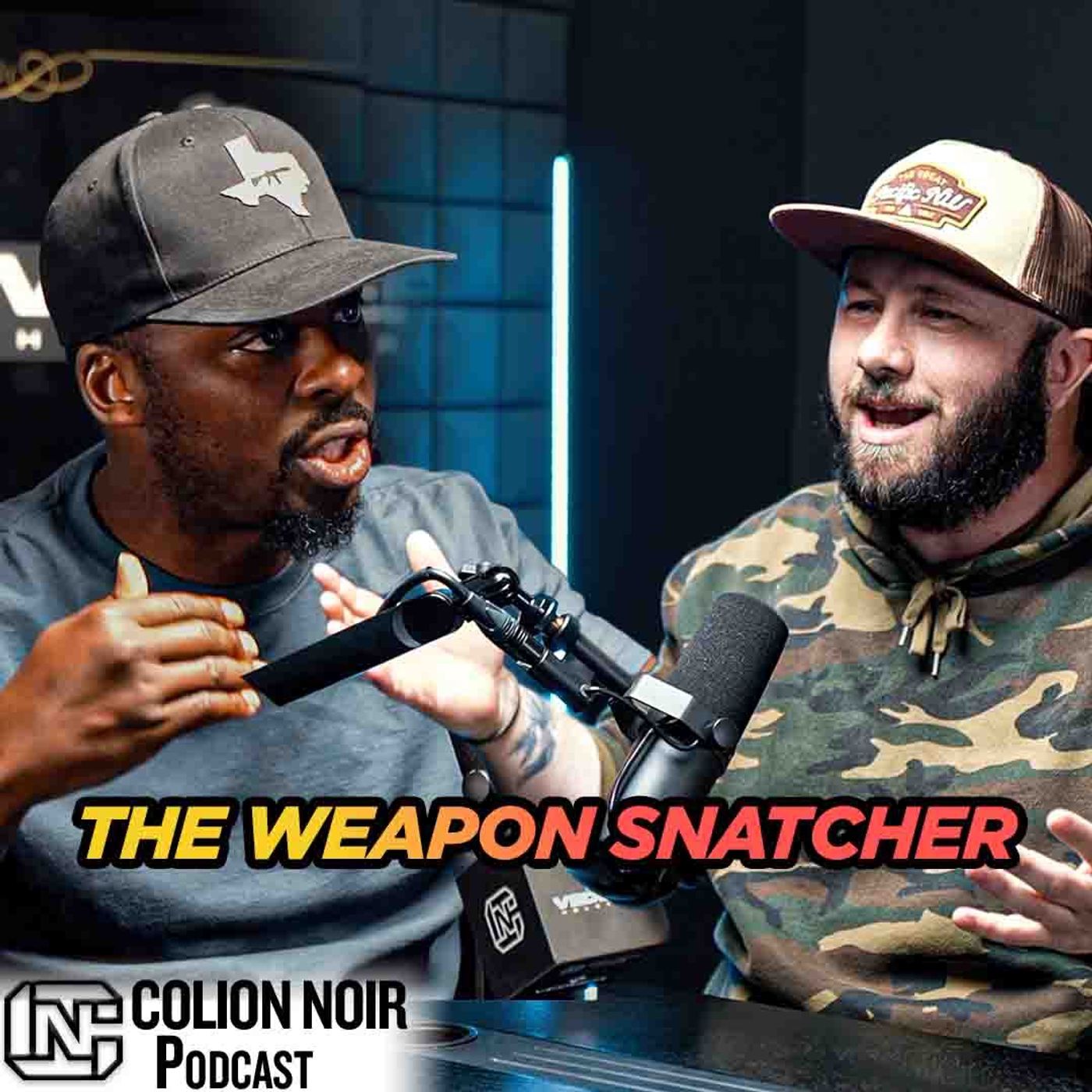
The Colion Noir Podcast
The Weapon Snatcher
00:37:43
Colion sits down with John "Shooter Rughi" Carughi, the firearms instructor/private security officer that gained national media attention for disarming rioters in Seattle, Washington during the 2020 protests. They talk about then and what he's up to now.
Loading summary
Transcript251 lines
- [00:00]
A
You've pointed a gun at many people, but you. But you haven't pulled the trigger.
- [00:03]
B
I've never. Yeah, yeah. Like, we press triggers, man. We press triggers. We don't pull triggers. I mean, you're a much smarter individual than I'm. Touche. Yeah. I've had my gun on quite a few people. I've never pressed trigger on them. I've always found a better way out. And it's also come down to, ultimately their decision. I presented them with options. Choose my option.
- [00:29]
A
That's an interesting way. This episode of the Colon Noir Podcast is brought to you by Vetter Holsters. All right, folks, welcome to another episode of the Colon Noir podcast. And joining me is the guy who likes taking guns from people for no reason whatsoever. Dude, what's your problem?
- [00:46]
B
Honestly, I just kind of, like, saw the ATF and wanted emulate them, but I like dogs, so I kind of have to struggle with it.
- [00:54]
A
No, man. For real, though, what's going on, man?
- [00:57]
B
Not much. Dude, I appreciate you for having me on.
- [00:59]
A
No, always. Always, man. So let's just jump right into it, because I, I, I know how I came about you. I know how a lot of other people came about you. But just kind of briefly, for those who don't know how you kind of. I don't want to call it stardom, because I feel like you're a guy who's always just been who he was. Yeah, right. And. And it just so happened that people discovered you through that incident.
- [01:20]
B
I was just doing what I normally would have been doing anyway.
- [01:23]
A
Yeah.
- [01:23]
B
And it turns out it was in a situation where there were a lot of cameras. Yeah, 20. 20 people call it Summer of Love. I think it was retardation. But I was working in executive protection for a news crew in Seattle, Washington, and that gets confused a lot. A lot of people are like, oh, Portland, no.
- [01:41]
A
Oh, I'll be in Portland pretty soon. So I grew up just.
- [01:44]
B
Just north of Portland, and it is. It's a different place.
- [01:46]
A
It's a different. Yes, it's a different world within the world. Within the world.
- [01:49]
B
Yeah. Two or three of those you probably don't want to be in, but, yeah. So I was working security and during riots for. For the. George Floyd. George Floyd. Rights. Excuse me. And I recovered, took, snatched two AR15s that were stolen from police vehicles, and I returned them to the police. And just so happens that the second one got caught on video, went viral.
- [02:15]
A
So it was two.
- [02:16]
B
Yeah. The first one was caught on a Facebook Live, which I have a recording of but it. You can hear it.
- [02:23]
A
Yeah.
- [02:23]
B
You can't necessarily see it. Like, you can hear me screaming at the dude. You can hear me dropping the mag. Everything but the second one. So it looks like I have a gun of my own.
- [02:31]
A
Yeah. Oh, God, that's crazy. Okay. Makes perfect sense now. Yeah. I didn't even know that.
- [02:36]
B
Yeah. Like, if I have a pistol out and a rifle, I would go with the rifle.
- [02:40]
A
Rifle.
- [02:40]
B
Yeah.
- [02:41]
A
Yeah, yeah. Okay. So my. My thought process goes. Because I watched when I. The video I watched, and what I saw there wasn't like, you explain it and you think, bravado, right? You. You think, oh, this guy was just trying to be that guy. I. I think anybody who watches the video and actually sees it for what it is, you don't get any of that. There was a kind of. It was just a matter of factness about it where it was kind of like you saw something that was wrong and you're like, I'm gonna write this. This is not gonna happen. Right.
- [03:09]
B
Well, I mean, it looks. At what lens? What lens do you want to look at it?
- [03:12]
A
True.
- [03:12]
B
Because through my lens, I did what my duty demanded based on who I am, but I technically failed my job.
- [03:20]
A
Okay.
- [03:22]
B
I had to figure this out in the coming weeks because, like, all right, I was working ep, I left my protecting. I shoved them in a corner. I was like, you stay. Now, being a Marine infantryman, I'm like, technically speaking, that rifle can engage within the 500 meters, right? That wasn't really in my head, but I know that, right? I'm like, that's a police rifle that they just stole. I don't see anyone else around here going to do anything. I'm going to do something, and I'm going to try to do best by my protecty as I can. And so that's what I did twice. I mean, that's. And it took me, like I said, a few weeks to separate that duty from my job. Now, a lot of times, especially guys doing these jobs, those are in alignment. This is one of those where. Okay, now they're Right. Now they're separate.
- [04:07]
A
How so, though? Because I look at it differently. I look at it as you preempt. Preempting a potential situation.
- [04:13]
B
Now, I completely agree.
- [04:14]
A
Okay?
- [04:15]
B
But there's a lot in the executive protection world, okay. Even if they're doing that, you don't leave your. Your detail. So it's like, I understand that. Also a lot of those people were like, well, in Afghanistan and Iraq, never. Blah, blah, blah, like, okay, we're not in Afghanistan.
- [04:28]
A
Right.
- [04:28]
B
So that's in a u. S. City.
- [04:30]
A
Exactly.
- [04:30]
B
Near my hometown. With Americans, it's completely different.
- [04:34]
A
So let's go into that a little bit. Let's talk about. And a lot of this honestly is my fascination. Right.
- [04:38]
B
No, that's fine. I've always been curious, you being who you are, what you thought about it.
- [04:43]
A
So my whole thing is, is the closest I've gotten to being in a dynamic like that. Like the earrings. Like we've dealt with the rioting up and down the street right here. Right. It just so happened we locked up. When I say we, me meaning me, I locked up in that the police kind of used my street as a staging ground.
- [04:59]
B
Okay.
- [05:00]
A
Yeah. But the street over pure chaos.
- [05:02]
B
Oh yeah.
- [05:02]
A
Right.
- [05:03]
B
It's like a hurricane.
- [05:03]
A
Yeah. Literally. So luckily for me, I wasn't really forced out of my house to kind of have to deal with it in the sense of I'm out in this. Right. Even though I did get kind of caught in a couple of protests driving back from places. Yeah. But nonetheless, I looked at that situation and like I said before, there was a matter of factness about it that it was like, I don't like there was thinking involved in it. From your standpoint, from what I gathered. But it wasn't I'm gonna do this to show or prove something. It was just kind of like, what
- [05:34]
B
do I have to show?
- [05:35]
A
Stop this stupid.
- [05:36]
B
Yeah. Like I, I. I had many thoughts going into that day that had started the day prior. I had many considerations I tried to make. And I mean, I've said it a bunch, but one of the things is this is a U. S city. These are Americans. I am not in some foreign country. I am all for taking life if I have to have no problem with it. I squared that many years ago. But this is a different situation. So how can I go into this? What in history can I reference for this? And the one that came to mind is Musashi. He grew up his whole life slaying dudes. Gets to an age, he's like, ah, the right way is to end the fight before it begins. It's like, all right, that's an executive protective detail. All that kind of stuff. That is quintessentially what it should be about. So that's what I aim to do. If I can solve this problem without shooting, that's what I'm going to do first. So when I saw that problem happen both times, I was like, all right, that's what I'm going to do. So my Finger never touched the trigger that day. Other people's did. And I solved the problems before it ended. And that was the thought that went into my mind. So as I was drawing the pistol, I was like, all right, I'm probably going to get fired, but I'm kid. Like, I can live with myself.
- [06:46]
A
Yeah.
- [06:48]
B
And there's tacky psyche. Right. You got a bunch of things running through your head at the. When everything's going on. And yeah, there was the thought in my head, like, this is crazy. Like all that day, I was like, I've seen this in the division. This is the division. Like straight up. The only thing that isn't is just dead bodies. Yeah, right. But the scaffolding, busted buildings, looting, rioting.
- [07:12]
A
Yeah, this is. I played this scenario before, right.
- [07:15]
B
Here I am Assassin's Creed, putting my jacket, throwing them at. Like I've. Yeah, absolutely. Like playing video games. But there's so much going on in there and so many different thoughts. Like usually you want cover and concealment. I recognize in that moment, like if I have anything blocking me from viewing other people, it's a problem right now because people aren't shooting. If people were shooting, a different story. Different story. So I went into the middle of the street very deliberately because now I can see all around me and my head is just like, you know, bobbleheading back and forth to see everything. And that's one of the things that always stuck with me is like, this is complete opposite what I've always been taught.
- [07:52]
A
Yeah. So what would explain to me kind of what was the dynamic that you. From your perspective, what was the dynamic in terms of people seeing other people with guns in that situation? Because it's. It's all over the place, I would assume. Right. It's like, there's good guys with guns, there's bad guys with guns. Right.
- [08:08]
B
And in the. In that day.
- [08:10]
A
Yeah.
- [08:10]
B
So I saw. I. I don't know if I want to call them riders or protesters because they weren't doing. They're just walking around. I saw dudes walking around who were clearly a part of the goings on that were carrying AR15s. Yeah, I didn't worry about that.
- [08:25]
A
Yeah.
- [08:25]
B
I mean, I was watching them. But guess what? Seeing a rifle come up is really easy. I was carrying concealed off body in a bag, because packed in so tight a handful of times, I felt people feeling around my waist walking through. Now I had a. I had mad carrier on me. But being a boy with a little extra fluff, it was a little more difficult now. So I carried in my bag. But the, there is a spectrum obviously of your cops. And all the cops are actually ordered to not have their firearms, especially in their vehicles. But I really, honestly, I didn't worry too much about firearms. I saw that. And seeing a police vehicle, like I clocked it. There's definitely a firearm there.
- [09:04]
A
Yeah.
- [09:04]
B
So watch out for it.
- [09:06]
A
So from that perspective, let's say for instance, like, so right now you, you're currently, you do a lot of training, right. So for me, just kind of a civilian standpoint, what are you seeing? What are you seeing where a lot of civilians kind of lack.
- [09:19]
B
Okay, it's you don't need a red dot class. You don't need an active shooter class. You don't need, don't need, don't need. You need to learn how to make decisions and take the information around you to make a better decision. So I was thinking about this the other day. How could I explain this to other people? Sitting in a car, you're locked in, you have no firearm. You have no nothing. You have nothing to do with your life. You have no routes out. You have no way to make a decision.
- [09:43]
A
So I've got to give a quick shout out to Vetter Holsters. They're now sponsoring the podcast. I've been using their light tuck Kydex inside the waistband holster. And what I really like is how adjustable it is. You can tweak the ride height and can't to get it exactly how you want. Plus they've got holsters for over 450 gun models in 75 different colors. So you can pretty much find whatever you need. But here's the thing that really sets them apart. Their customer service. I've heard so many stories about how they've gone above and beyond to make sure you're happy with your holster. And with a lifetime Warranty and a 30 day money back guarantee, it's clear they stand behind their products. If you're in the market for a great holster, check them out@better holsters.com.
- [10:21]
B
you're trapped.
- [10:22]
A
Yeah.
- [10:22]
B
If you have one option, okay, I can make a decision. But then what are the following consequences? So people need to learn how to make decisions based off of information that they are either provided or they can discern. And one way to do that is like be knowledgeable, read, get, learn things. Even if it's fiction. Dude, I'm a huge Lord of the Rings Marvel star. Would you want to go into it? Sure. They give you references for information on how to make better decisions. You want to Press this shot right now in this wind, or do you want to wait a little bit because it's gusting decisions? That's all it comes down to, in my opinion. And a lot of people lack the faculties to make proper decisions.
- [11:04]
A
So how do you think we should? Because my, my whole standpoint, I have the mindset and it's very idealistic. Right. I have the idealistic mindset of like a citizenry that is majority trained.
- [11:16]
B
Right.
- [11:16]
A
Know how. Yeah, right. The thing is, the thing in the question becomes is how did, how do you en masse make that happen? And I don't mean just necessarily. Okay, go ahead.
- [11:25]
B
Consequence. So you look at the history of the United States pushing out west and expanding, you run. I can swear, right?
- [11:31]
A
Yeah.
- [11:31]
B
You run your mouth at me, you call me a liar, I'm gonna. I have the right to kill you. That's a consequence.
- [11:38]
A
Yeah.
- [11:39]
B
So people live now without consequences. We got first Amendment, second amendment. They are not individual. They are complementary. That's how I view it. Right. So you can say whatever you want, but there's also a consequence. You can carry whatever you want, but there may be a consequence as well. Now, people being safe all the time, people like say, not being punched in the mouth, that leads them to be, be believing they can say and do whatever they want. So you don't learn consequences. I love going to Africa because the consequences are of my choosing. So take the history of the United States. Look at, we've been through these lessons, but we have short term memory, which
- [12:21]
A
is tough, so to say the least.
- [12:22]
B
Dude, I've been watching Ted Lasso be a goldfish. Like totally, absolutely. But also in the long term. Yeah, no, like you have to know where we come from.
- [12:31]
A
Gotcha, gotcha.
- [12:32]
B
That's my view.
- [12:33]
A
No, it did. It absolutely did. Well, I think it answered my question from the theoretical standpoint.
- [12:39]
B
Put yourself in positions. Put yourself in, whether it be a competition, it be a job, whatever. Put yourself in positions where you have to make a choice that is difficult. The concept in my opinion of live life with no regrets is then you never had a tough decision. Yeah, I have decisions I absolutely regret because I could definitely see, look, that was a, a fracture in the direction of my life. I could have gone this way or that way. Yeah, that's okay. As long as you can recognize that. So do you know your own? A lot of people don't know their own mind like we see in politicians now. 20 years ago they said one thing, now they're saying the complete opposite. Just because it's against someone they don't like. Yeah, come on, man.
- [13:17]
A
Yeah, I mean. I mean, the political side of it, a little more Machiavellian. Right? So it's. It's kind of like. And justify the means, but. Oh, no.
- [13:26]
B
But individually, idealistically, the ends do not justify the means because say, I want to take over this nation back in the Crusades. We kill everyone nowadays. That. Okay, that's an idea.
- [13:41]
A
Well, why do you want to take over the nation?
- [13:43]
B
Because they have my holy land. I did. Merchants to crusades.
- [13:50]
A
No, theoretically turns to somebody who's. Whose ultimate goal is to say, take over the slant. Right. Because you were like the end zone. I don't know if you said they don't always justify the means.
- [14:01]
B
They don't always.
- [14:01]
A
Gotcha. Okay.
- [14:02]
B
Yes. I mean, morality comes into play, but then context comes into play with that. I mean, you looking at a survival situation, morals are much different.
- [14:11]
A
Yes. Oh, for damn sure.
- [14:13]
B
Yeah.
- [14:13]
A
Right. And you said something off camera that I thought was. Was very intriguing was. You said. You said something about you've. You've pointed a gun at many people, but you. But you haven't pulled the trigger.
- [14:27]
B
I've never. Yeah, yeah, like press triggers, man. We press triggers. We don't pull triggers. I mean, you're much smarter individual than I'm. Yeah, I've had my gun on quite a people. I've never pressed trigger on them. I've always found a better way out. And it's also come down to ultimately their decision. I presented them with options. Choose my option.
- [14:53]
A
That's an interesting way to put it.
- [14:58]
B
Like, hey, drop the gun or give me the gun. Yeah, you didn't. So I took it, but the muzzle never came up on me. That was always been a defining thing. I heard something a while back. It's like boys who grow up learning risk, they fall, get hurt, they skateboard. Like, I used to lay down on a skateboard and go down a hill with barbed wire. And then you couldn't see the left turn. And so there's car coming. So there's risk. Like, you learn to consult and consort with risk. That muzzle coming up on me has always been like, all right, this is what I'm consorting with. Hasn't happened yet.
- [15:30]
A
So how do you see that situation happen? How do you see yourself dealing with that situation? Let's say, for instance, we were talking about a handgun. What changes?
- [15:37]
B
One of the things has. One of the instances has been hanging. And again, the same thing. His muzzle didn't come up on me. He put his hand in his pocket and he had like, I don't know what kind of pistol, but he had a very small, like, silver plated pistol and he had it at his side. I have my gun on him. I'm presenting him with options.
- [15:58]
A
Yeah.
- [15:58]
B
And he takes his hand, puts it in his pocket. Now obviously, we've all seen movies we've all thought about. That's a dangerous thing.
- [16:02]
A
Yeah.
- [16:03]
B
But the dude's wearing very loose pants. And I see his pants go wide and weight drop. Okay. He just dropped a gun in his pants.
- [16:09]
A
Gotcha.
- [16:09]
B
And then he pulled his hand out slowly. All right, cool. Now we got more options.
- [16:13]
A
But I think that's. I think that's a level of. Of perception that I think you've probably acquired by way of training.
- [16:20]
B
So I get asked this all the time, like, you know, why should I train?
- [16:22]
A
Blah, blah, blah. Yeah.
- [16:23]
B
My number one answer has always been, we train so that everything we do with our, Our kit, our gun, our whatever, we're using our kestrel atmosphere.
- [16:30]
A
Yeah.
- [16:30]
B
So we don't have to think about it.
- [16:32]
A
Yeah.
- [16:32]
B
We open up our bandwidth. So now I can see everything else going on. And it is the. We do it in driving.
- [16:38]
A
That's true.
- [16:38]
B
I don't remember 95% of the drive here.
- [16:42]
A
It's actually weird as hell when you actually start consciously driving. Oh, it's the weirdest thing in the world. You're like.
- [16:49]
B
It's like, what am I doing?
- [16:50]
A
Go back, go back, go back to the weird. Yeah.
- [16:54]
B
So it's. It's simply so we have the bandwidth to do what we're doing. So that's one thing. Like growing up playing poker in my house. It's very slow. First time, went to a casino. Like, holy, this is fast. Right. It's the same thing. Training, shooting, being on your own with your buddies. Then you jump into a competition. Everything is compressed. Faster decision making. That's what it comes down to. So all these little things just connect.
- [17:16]
A
How much of that do you think you can train out, though? So, for instance, like, I do think people naturally have a predisposition to being in chaos. Right. So, yeah, like, I kind of, like, my brain's always so in chaos. A lot of times I'm kind of. It's almost, Almost comforting. As long as there's a certain level of rhythm to it. Right. And soon as I get past the initial fear part, if that makes.
- [17:38]
B
Don't have that initial fear part. Like, I get asked time during Seattle day, did I have fear? I was like, no, I was busy. Like I was in. I was mentally engaged in what I was doing. I don't remember fear at all.
- [17:47]
A
How much of that do you think played a part in the fact that you were actually doing a job though?
- [17:54]
B
It's a good question. I haven't thought about that specifically. When I think about it, what pops in my head is like, I saw what was going on and I knew what I needed to do.
- [18:02]
A
Yeah.
- [18:03]
B
So like I. Because I've made those decisions before. Yeah, but so the. How many people like say predispose. Pre. Disposition.
- [18:15]
A
Predispose. Sure.
- [18:18]
B
I get my degree in like three weeks. You already have.
- [18:22]
A
I am the guy that said pulled though.
- [18:24]
B
Yeah. I think that there's prey and predators. Right. I don't know how much you've gone into this, but the last few months I've been completely obsessed with the Pleistocene and hunter gatherer groups because in the way I see it from my very modern 21st century point of view is that was a very natural way of living. As far as does this decision lead me to living and reproducing or does it lead to dying?
- [18:49]
A
Okay.
- [18:50]
B
All right, so there's clarity there. So now you look at ultra marathon runners, they find that clarity. Mountain climbers, they find that clarity. Combat, you find that clarity. All those different things. So I do think there are people naturally predisob that word or they are so much exposed to it. That is the way that their lives. So you got nature and nurture.
- [19:10]
A
Which part of. I think, yeah, I think, yeah, there's no black and white technically. Between.
- [19:14]
B
Yeah, I mean, I'm not talking colors,
- [19:15]
A
but sure, yeah, I am. I can do that. I have a car.
- [19:17]
B
Well, you brought it up.
- [19:18]
A
Yeah. I have a card,
- [19:23]
B
but yeah. So I think that there's. And there's a lot to it. Like I actually posted the other day there was a school shooting and I very much as like marketing, like, hey, you want training? Go to my site. And then people are like, hey, that's awful. You shouldn't do that. Like, what do you offer that can do? That's like, well, it's decision making. That's what it comes down to.
- [19:40]
A
Yeah.
- [19:41]
B
Most people know fight and flight, but there's two others freeze or faint. Yeah, yeah. So like, what are you going to choose to do? How are you going to make your decision right if you're protecting your wife? Oh, I saw one, this dude carrying his baby draws his pistol and goes after something to stop it. Like, I get that you have a freaking baby on your chest. That is a human shield. Even Though that's not what you mean. That's a decision like, turn around.
- [20:06]
A
Yeah, yeah. It's. It's an interesting dynamic to kind of just when you start talking about those type of situations, you know, life or death, preservation themselves, you know, what decisions you make, especially when you're talking about possibly involving someone who's completely defenseless, like a baby, but then you have this internal instinct to kind of go towards the. Yeah, right. And it begs the question. It's kind of like. Like I've always said, in my mind, I'm caring all the time, generally speaking. So I ask some questions, and I think it's a question I think I have. I have to settle with myself. However, a lot of it is going to be very situational dependent. Right. But say there's a situation where there is an act of shooting. Right? And I'm, I, I'm prime. I have context. I know what's going on. I could be in a position to go in and possibly stop that. To what degree do I make the decision to say, all right, let's go do this? Yeah, right. And then, of course, you can start adding all types of variable context and things like that that can make you say, well, probably not the smartest idea, or get in there, do you think?
- [21:06]
B
Yeah. Right. So there's like the machismo behind it, too. Like when you said you're always carrying, I wanted to ask, what's in your pants? But there's also so many different layers of decision making. All right, look at it legally. Can you legally verbalize why you made the decision to do this in this situation? And on and on. And that's what a lot of people lack, that gets them into trouble. In the eyes of man, you might have been right.
- [21:30]
A
Yeah.
- [21:30]
B
In the eyes of the law, two
- [21:32]
A
different things, which I think for me was a part of me. Like, I remember the one time where I was actually. I was actually being chased. Right. Like, people were, like, hawking me down, chasing me in a car. Right. And I knew what they were trying to do.
- [21:47]
B
Did they know who you were? No.
- [21:50]
A
But I remember at certain points in that situation, I literally started thinking about the legal. The legal component. Right. And it was almost kind of like there's too much information in my head. Right. So my, My, my assessment now, I won't say to the point of paralysis by analysis, but nonetheless, there were still things I was considering, because when I would tell the story to people, people were like, well, why didn't you just do this? And I'm like, well, technically, Speaking. They didn't do anything to warrant a justified action on my part that would require lethal force. Even though I knew and anybody else in this situation would know what was probably going down. Yeah. And in a perfect world, I'd be able to just hop out the car. Present. Present. Present. What's the name of the goddamn gun? Present. The rattler. And go to work. Right.
- [22:37]
B
Like present arms.
- [22:40]
A
Right. Because it's kind of. It's preemptive. Yeah. It's like, I already know what you're trying to do. You're trying to do bad. Exactly.
- [22:45]
B
I've been. I got followed a handful of times after Seattle, like within the first few months. Yeah. And one of them actually, it was people in the comment section like, oh, that probably would have been a good idea. One of them followed me and I like. So I quickly got off on an exit and he slammed the brace and took off and followed me. And I was like, I'm going to this gas station over here because I'm gonna fucking confront this guy. So I had my gun on my lap. It stays on my door. I have my gun in my lap. And he pulls off to my right. And I mean, I could have. I did the drill afterwards. He's like, I wonder how fast I could just come up and shoot sub 1 second, in case you're wondering. But he. I don't even understand it because I am not in with the. I guess the. The city vernaculars. He's like, you trying to swerve on me? I don't know what this means. What are you talking about? Because this guy started following and going like, gotcha. And I was like, I don't know what the you're talking about.
- [23:37]
A
Yeah.
- [23:38]
B
And he just took off afterwards. Like, all right, I don't get that. But. And I did a video about that encounter because in my head, not once did it come into my mind what some of the comments is like, hey, why don't you just drive to a police station?
- [23:52]
A
You know what's funny about that?
- [23:53]
B
Makes sense. But also.
- [23:55]
A
So the funny thing is I did. I did a. In my situation. I did an analysis there too. Cuz I called. I called dispatch. I was on the phone with.
- [24:02]
B
I didn't even think about it, dude. I was like, what is this guy doing? Here's my gun. I'm going to see what happens now.
- [24:06]
A
Now, just in a moment of like, full disclosure for me, I always do run the scenario that I am a public figure. Right. Yeah. And so.
- [24:15]
B
And that's afterwards when I was being followed I had to consider that it was a new thing.
- [24:19]
A
Yeah, exactly. So in like my thought process, it wasn't call the police because I'm being followed. I'm like, call the police because I'm running all of these red lights and I know there are flock cameras everywhere and so they're there. So it's like going on the war races downtown streets. And I'm like, no, no, someone's following me.
- [24:40]
B
Yeah.
- [24:41]
A
You know, I'm on the phone with dispatch and I remember she's telling me, she's like, I can route you to a police station. Now part of the reason I didn't go is because I don't remember how to get to the police station. Just troopy, right. And mindset and I gotta break the
- [24:53]
B
law just to put it in my phone.
- [24:57]
A
So I'm thinking to myself, I'm like. But I'm like, okay, go to police station. And then what? Right. Once they see where I'm going. Yes. Will they break contact, so to speak? Sure. But then he probably just hang back and wait. What am I going to have a police court escort me home? And then if they do escort me home, guess what? They know now where you live.
- [25:16]
B
Exactly.
- [25:17]
A
So it's like, it's, it's those type of things. And I think I'd rather have too much information, honestly to think about more so than less. Well, I say that now, right. Because I live in a, in this environment. I think it'd be a little bit different say if I was down range. Right. Or would you disagree with that?
- [25:39]
B
You always want to know as much as you can. Now say you have 100 of the information. You might only need 30, right?
- [25:47]
A
Yeah.
- [25:47]
B
But that hundred, that 70% left might help you after. Might help you after. After.
- [25:52]
A
Yeah.
- [25:53]
B
Right. So like I mentioned degree I'm about to get a. My bachelor's in international relations in global security. And the thing that has been really fascinating is like okay, now I actually listen and watch the news. I didn't give a before but it's because now I understand the web. Not necessarily understand there's a lot now I'm seeing what is going on with the web. I don't need that information. But when I'm going through my day to day life now I'm filling in holes that were there before. I had no idea and how they affect me.
- [26:20]
A
And you would learn what swerving on people was. Right.
- [26:22]
B
I just listen to you like I had no idea. But then. So you always want as much information. For example, let's look at Intelligence analysts versus operators. Intelligence analysts, they need all the information and they have to fight their own confirmation bias when they're presenting it. They may know, hey, that's the door and that's where they are, blah, blah, blah. The operator, he knows that he needs to go in here and that's what he needs to get. He doesn't necessarily need to know what's going on after where that intelligence is coming from. Right. So it's however you want to dice it up. Yeah, I guess. Pertains differently to everybody, but I mean, I'd rather know as much as I possibly can.
- [27:00]
A
Yeah.
- [27:01]
B
Do I want to know the time of my own death? Probably not.
- [27:03]
A
Yeah, right.
- [27:04]
B
Yeah. Surprise me. Or like I want to choose it. Like, yeah, I'm gonna tussle with that bear. So there's a, there's always decisions that need to be made.
- [27:16]
A
Yeah. So now let's talk, let's talk some, some, some gear.
- [27:20]
B
Oh man.
- [27:24]
A
So within your training, right, what do you, what are you noticing that people are gravitating towards from a rifle setup, handgun setup that, that are. Either people need to get more training on or they, they, they, you think they over. They overstate how much utility it actually brings them?
- [27:42]
B
I think that. Well, I mean there's so many different facets and I never get to nerd out about this one. It does come down to like amateur versus professional. Right. You can give ten thousand dollar rifle to an amateur, they won't perform budget rifle to a professional. All right, there's that aspect. But also teaching across the country, someone a buddy of mine asked me a question, he's like, hey, you know, where's your favorite place to teach? What are your favorite type of people to teach them? Like, dude, I get, you go to South Carolina, you get some weirdos, you go to Washington State, I get all the tech guys. Right. You go to different parts of the country, you draw. I teach here in Texas. You're like, yeah, I want to defend myself. And also I live on the border. Right. So they're getting different things. A lot of people, they want to be able to. I ask this in every class. I have six questions. But one of them is what is your reason for training? Almost 95%. Throwing arbitrary percentages out there is like self defense. And if something goes wrong. Yeah, right. 16 inch rifles, some form of LPVO. Now reticle design or BDC. Mill minute, whatever that is, really comes down to what they themselves know and understand. So they come to me and they hopefully get that understanding mill by the Way so. And then when it comes to pistol, it's they want. Usually it's Glocks. Most people are coming out with Glocks or if they're like a gun guy, they got something like off Glock that wanted to kill Glock but never actually did.
- [29:17]
A
That would be me.
- [29:17]
B
Yeah, right. Like my brother loves cz.
- [29:21]
A
Yeah.
- [29:21]
B
I think ZZ are. They're beautiful. They function well. I can't grip the slide. It slips right off.
- [29:26]
A
I had a, I had a, A descriptor for CZ slides back in the day that I got away with saying I don't know if I can away with Tang now. Now when I really think about Holy. I was really on edge then.
- [29:37]
B
Yeah. Yeah.
- [29:38]
A
I think it something along the lines of a little people spectrum slide.
- [29:45]
B
A little people spectrum slide. See, I don't know if we're talking about midgets. I can go on. I don't know how far I should but. Yeah, I'm with you.
- [29:54]
A
Yeah.
- [29:56]
B
So gear wise and a lot of dudes are they want to go from concealed. But then you have a very fair amount that's like. No, I want the whole setup. Like I just saw a dude at the gas station down the road with a full duty belt. He wasn't doing security. He's just walking around. All the things I'm looking, I'm like, I kind of want to get a photo because this is funny. But also like Dallas was different.
- [30:16]
A
Yeah, it is.
- [30:18]
B
But I did a, I did a video a couple years ago. I was like, what would America's rifle be coming from A Marine Corps inf.
- [30:24]
A
Yeah.
- [30:25]
B
Were issued what would be issued to America and make sense and through all the research I did 16 inch LPVO 556. Whatever your accoutrements are. Yeah, it's whatever you want. But that's.
- [30:40]
A
You are limited there accoutrements. You said lp, lvp, lvpo.
- [30:43]
B
That's, that's not an accoutrement. Yeah, that's a site. It's organic.
- [30:47]
A
No, because if I want to go flip up and with a red dot, that's the accrual one I want to go with.
- [30:51]
B
Yeah. But say you're getting issued this rifle by America.
- [30:54]
A
Fair enough. Okay.
- [30:55]
B
And you live in Nebraska Asking.
- [30:59]
A
I guess. I mean that is, that is safe to say, I think especially if we're especially living in the 2 to 3, 5 5, 6 world across the United States.
- [31:07]
B
Chicago to Texas to Los Angeles.
- [31:10]
A
16 is. It's. It's just, it's. It's not so Long. You can't do close work stuff with long enough that if you're out in the plains or some, you can kind of do what you get. LPO gives you the.
- [31:20]
B
My choice would be an LPVO, either 1 to 6, 6 to 1 to 10 based off of the gas length, but then go 13, 7 on the shorter side or 4 to 14, 5 somewhere in there.
- [31:30]
A
Yeah.
- [31:31]
B
Now you're indoors vehicles easily. I've hit a thousand yards with it. But guess what? It has the. You need the one thing most people don't want to take the time to do. Learn. Figure it out. Learn what's going on. Learn ballistics. Learn what the environment is going to do to your shot.
- [31:47]
A
Yeah. All right, so let's say planes, how much time we got? All right, all right, so let's say we're out in the open plains, right? And you're stuck with.
- [31:59]
B
In America.
- [32:00]
A
In America. In America. And you're stuck with. And you're stuck with one rifle in terms of length setup. What you going? What are you. What are you doing?
- [32:07]
B
You're asking me how long I am there. But in the open planes, like what? There's so many good things. Because now I want to contradict what I just said. I know if I'm in the open plains, I'm probably going to pick something that's ballistically superior in the wind because.
- [32:24]
A
Because there's nothing.
- [32:25]
B
There's so much. It's open, flat land. So I want a high magnification. I'm probably going to need something to move faster from place to place. So it's probably going to be a vehicle. So I'll probably just take what I took to Africa. A 6.5 Creed 22 inch barrel on a collapsible stock and a 3.6 to 18 Leupold. And it was in the classical stock was a JTAC Owl chassis, 10 round mags. Because again, distant. Well, I didn't say this before, so delete again. But distance is time. So I'm going to open planes. I can see farther. I have time to make decisions. So that's why, like my point of view, unless you're doing some kind of security work, something the most applicable engagement you're going to have as a civilian is going to be intermediate decision distances, not necessarily far. Because if you have the distance to make a better decision, then decisions probably
- [33:14]
A
be like, all right, let's get the out of here. Yeah, yeah.
- [33:18]
B
So that's probably what would pop into my head. But I mean if I'm like a rancher or something. I probably would take a 14, 5,556lb
- [33:25]
A
because my mind, I don't have. I don't have a lot of trigger time on it. And I'm starting to get into it. Six millimeter arc. And I'm wondering that. That I think can close the gap between, notwithstanding ammo availability, all that crap. Right.
- [33:40]
B
Semi or both?
- [33:41]
A
Semi.
- [33:42]
B
So I've ran them in semi and ballistically, they're obviously far better than a 556. Yeah, logistically they're not okay. But they also cycle slower. So if you're trying to do fast double taps at whatever distance. Dude, I'm waiting for that bolt to get there before I take my next shot. So if that's a consideration, if you're at that level, to make that consideration.
- [34:03]
A
Yeah, yeah, exactly. And I know me, I. I have. I'm in tune enough to pick up on that. And that would drive me crazy.
- [34:10]
B
Oh, it does. So what I did, I was waiting to send my follow shot. Now my split time's bigger if I want to engage multiple targets at different distances with double taps, because 5, 5, 6, at 600 yards, I want to hit it twice.
- [34:21]
A
Yeah.
- [34:22]
B
Ballistically with a 6 arc, you'll have to worry about that as much. But I'm waiting for that to happen. Which. What does that mean? That means my target has more reaction time.
- [34:30]
A
Now, I'll say this real quick before we go, because you mentioned something about double tapping with 2 to 3556. How satisfying is it to double tap at about 500, 600 meters with 5, 5, 6, 2, 2, 3?
- [34:45]
B
Not as satisfying as how many octaves your voice just dropped saying that. That's because I got a. Dude, I love it.
- [34:51]
A
It is, it's.
- [34:52]
B
It is. It's obviously an engagement technique.
- [34:55]
A
Yeah.
- [34:55]
B
But it's a training method because if you have that down, if you have it locked in, you're not only doing it so fast, you're not catching that second side picture. It's a hammer pair at that point. It is a. It's a culmination of what you've put forth into the skill. Now you take that from prone, you start trying to do it on other like tripod by tables and all. It's increasingly difficult.
- [35:18]
A
Really fast, real fast.
- [35:20]
B
It is so satisfying.
- [35:21]
A
I did, I did, I did some training with that, with that a buck buck Doyle out in Utah. And I like, I nowhere near the ability to do it confidently consistently, but when I would kind of hit my flow state when we're out there and I'd hit it. I'm like, oh, this is too satisfying. It's.
- [35:40]
B
I know we're short on time. I had it. But on that point, I had a student that was going, slow. Be like, pop, pop. And he's hitting. I'm like, speed up. He's like, but I'll miss. Who the cares? You're out here to train, you're here to miss. Like, speed up.
- [35:52]
A
He goes.
- [35:53]
B
Pop, pop, ding, ding. Never would have done that. I actually bought a class for luck, Doyle, five years ago, wasn't able to go.
- [36:02]
A
That's a mistake. That's a mistake. Let me tell you. Like, I. At this point, I go for. For literally vacation. Like, it's not.
- [36:07]
B
At this point, I love. Like, right now, I'm at a point. I love spotting my shooters more than my own shoes.
- [36:13]
A
Really?
- [36:13]
B
Yeah. I'm bored with my own shooting. But spotting, I have, say, 10 shooters. I have 100 lessons going on in front of me to learn instead of just the one from myself.
- [36:23]
A
That's fair. I'm still in that. I'm still in that. That only child baby stage where all I want to do is pull, pull the trigger.
- [36:30]
B
So annoying. I hate it. I hate it. It's so annoying. I'm going to go home. Just
- [36:39]
A
going to see a video. This said pull the trigger three times.
- [36:42]
B
Cancel him. Cancel him.
- [36:45]
A
But no, man, I really appreciate you coming out, man. This was fun. This was fun. We got to do. We got to do it again. Yeah, yeah, cuz there's a lot. Yeah, we can definitely take this so many goddamn different ways, it's not even funny.
- [36:54]
B
But no, we really appreciate it.
- [36:56]
A
Thank you, sir.
- [36:56]
B
Oh, wait, hold up. Black multicam. Man, I brought a bang bag just for you.
- [37:01]
A
Hell yeah.
- [37:02]
B
You can attach it. What's that quick detach point on your rifle? They're built as rear bags, but you got loops. If you have just a modern hunting or a classic hunting rifle you can strap. But yeah, I know we're in a world of big bags, but until you
- [37:16]
A
start shooting at longer distances, start to fall in love with, like, this.
- [37:22]
B
I've used it as a knee pad. I've used it as a pillow on planes. I've used it as rear back support on long drives. Like, dude, yeah, these.
- [37:29]
A
Oh, man, I love my bags, man. Appreciate that. Of course, yes. Perfect color and everything too.
- [37:35]
B
I've. I had an assumption.
- [37:37]
A
Yeah, really. We'll give it away.
- [37:41]
B
Thanks for having me.
- [37:41]
A
Yes, sir.