← The Colion Noir Podcast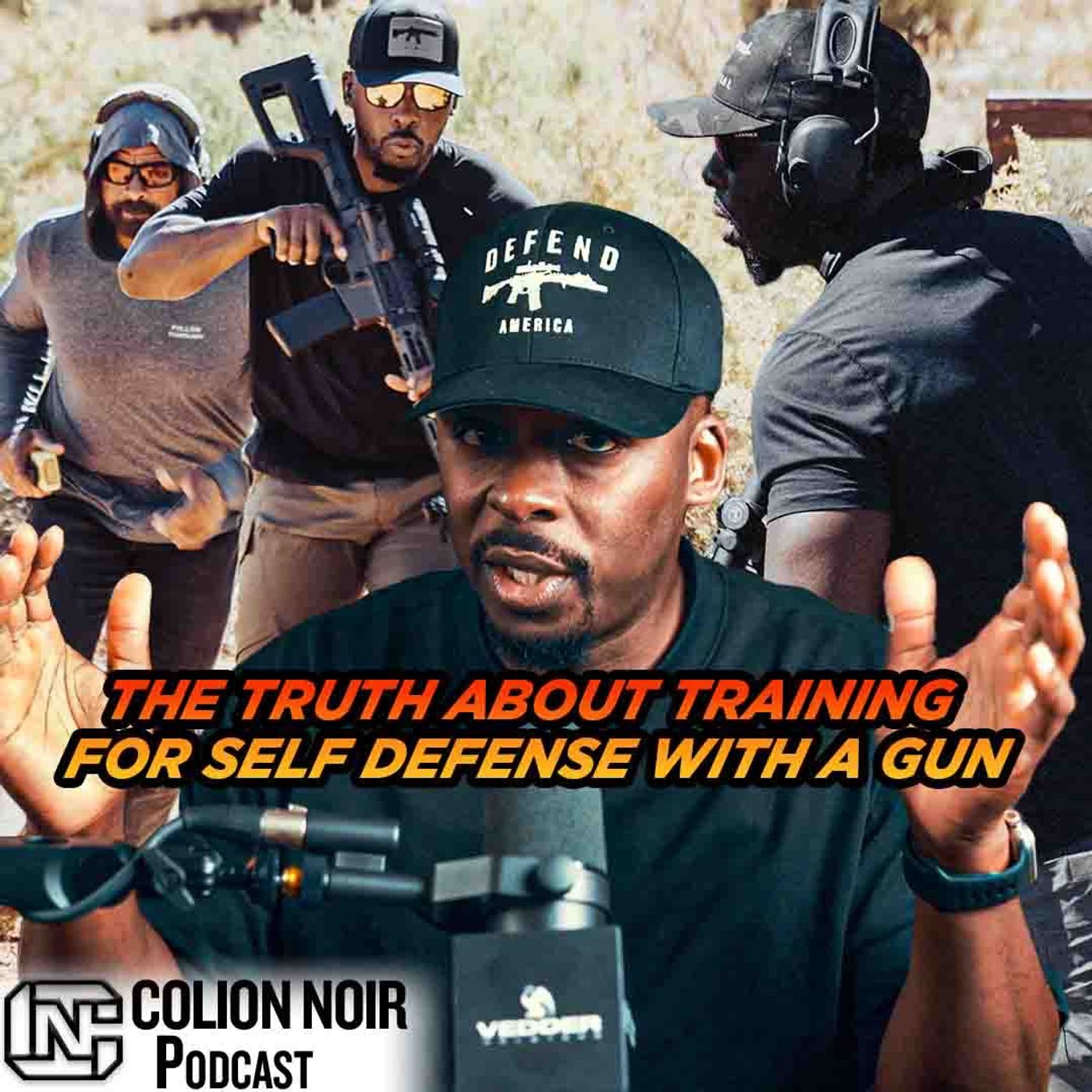
The Colion Noir Podcast
Truth About Training For Self Defense With A Gun
00:43:41
Colion breaks down his thoughts about how to train for a possible self defense situation with your firearm. Things that you might not have thought about.
Loading summary
Transcript1 lines
- [00:00]
A
A lot of the drills that you see people doing on the Internet are designed to look good. And I like them. I watch them all, do them all day long. But there's this thing that people like to do. It's like, like they kind of stand at already and they think like not being ready or like presenting this idea that you're acting like you're in a real world situation to kind of have your hands by your side and then like you kind of have to kind of have this blank stare and you're just like ready and then, and then you're kind of going on from here and it's like, not really. This episode of the Cole on the War podcast is brought to you by Vedder Holsters. Welcome to a brand new episode of the Cole on the War podcast. I am Cole on Noir and this is the Colleon Noir podcast. I think I already said that. Very redundant. Neither here nor there. All right, so let's jump right into it today. Today I want to talk about something that kind of crossed my mind and started as kind of a catalyst of this podcast, which is how I train the kind of realities of training for self defense situation. Now keep in mind, let me make sure I have this phone on to not disturb because everybody likes to disturb me when I don't want to be disturbed. All right, so story time. Me and Peter were out filming a video review and I was. So usually I am always kind of voice. I'm always pretty much filming, you know, film. I release a video almost like every day. And so I shoot a lot, but I don't shoot a lot. And what I mean by that is I don't get to train shooting as much as I would like versus actually shooting. Now whenever I'm shooting a gun review video, I'm still utilizing the fundamentals, the mechanics that I've learned in terms of shooting, trigger press, all of those things. Like I'm aiming to hit targets. I'm still thinking about those things, but it's still not the same as just that isolated training. Right. So what I tend to like to do is after training, I like to. Then after. Not after training, after filming, I like to do some training. And I try to mix. I try to kind of like be as efficient as possible with things that I do in my life, because I do. There's so much going on that I kind of always need to kind of find a way to fit things in. So I'm currently going through a cut, I'm trying to drop weight. I'm about five Nine. Right now I'm last weigh in, you know, depending on the fluctuation, water, glucose, cortisol, stress, all that bullshit. So right Now I'm about 213 to 14. I'm trying to cut down till about to, I'd say 190 and I want to get down to 190 and then float between, float back and forth between 200 and 190 or 190 and 200. Contrary to popular belief, I was pretty athletic when I was growing up. I played all. I did everything I did football, basketball, cross country, track. Oh, that's not everything, but that those four things are what I did. Of all those things, I was exceptionally good at football. For me, football, it was kind of my natural athletic tendency. The only problem is I hated football. I hated football. I hated playing football. I was really good at it. Like, if I honestly continued, if I had the love for football the way I had the love for basketball, and I put forth the effort into football the way I put forth the effort into basketball, I probably would have played football in college. I'm built like Barry Sanders. Like, I'm very leggy. So I have big, naturally big thighs, big calves that. And I've always been very quick, been very. I've always been very quick. I've been pretty fast and I've always just been kind of athletic. My body likes to move, so what I try to do is incorporate. So right now, as I'm going through this cut, I like to be in that 190 to 200 because that's where I feel is the perfect balance between the being light on my feet, being able to be athletic while still having power. And so I'm trying to cut down to that weight. So the way that I do that is of course I still lift and then I still do. But also I'm really big on cardio and not like long form cardio where I'm like on the treadmill for hours. I mean, I'll do it, but like I'll do some zone 2 stuff as much as I can. And that's just me getting older and making sure that, you know, my heart health is up there where it needs to be and all that stuff. But I've always been very like quick bursts of intense power and speed. That is where my body likes to be. Even weightlifting, I like to go short, super intense, where I'm going to absolute failure. And I'm like, by the time I'm done, my nerve, my central nervous system is fucking cooked. But I Love that. That's how I am. I don't like long two and a half hours at the gym and you're doing like a million sets. I'm just, just. That's not me now. It's probably not the smartest thing for me to do the high intense stuff just because I don't, I don't take anything. I'm complete, I'm. I'm boringly natural. Like I don't, I don't, I don't even take creatine and I barely take protein supplements, which probably to my detriment, I probably should take those things. But I just don't, I don't like taking stuff so I'm don't take anything. So I basically just make it even harder for myself. And then of course, you know, I like to drink and I eat out a lot. So you know, all that, all that comes into play now. I say all that to say this. What I like to do is I combine sometimes the cardio with or the cardio conditioning with my firearm training. So this last time me and Peter went out and we filmed afterwards he left and then I stayed out. I stayed over for about another hour or two just kind of training with my concealed carry gun. Well, one of them. So what I recently, I recently picked up the staccato. I always forget the names of these guns. There's so many of them. Their new gun, the. I just did a video on it, for crying out loud. It is the C4X I believe. And that's the little, little smaller version with the comp on it. And you know, I got my Holst and everything. So I thought I was going to kind of put it into my carry rotation because I carry the gun so. Because I shoot the gun so well. So I wanted to kind of make that one of the guns that I put into, brought into my care rotation. So I wanted to try it out and see what it was like. So far I'm a little disappointed and I'm only a little disappointed because the gun itself is phenomenal. I shoot the gun really well. Feels really great in my hands. The only problem is, is that it carries a lot bigger than I want it to like. Some guns lend themselves really well to carrying against my body, some don't. This one tends to kind of. It's not exactly where I want it to be. Most people wouldn't give a shit, but I'm kind of anal when it comes to way a gun carries on my person. Anyway, I'm still gonna keep training with it. And see if I can inevitably really bring it in into my care rotation as my 2011 go to. And I might do a video based on all of the guns that I have in my care rotation and why they're there because they're all there for very specific reasons. Reasons. And I've done a video in the past, but I think I need to update it. And so I. So that day I decided, all right, here's what I'm gonna do. I'm gonna go out there and I'm gonna sprint. I'm gonna work. Today was a, Today was, that day was supposed to be a sprint day or maybe it was a lift day, but I decided to make it a sprint day because I knew. All right, so I've got to give a quick shout out to Vetter Holsters. They're now sponsoring the podcast. I've been using their light tuck Kydex inside the waistband holster. And what I really like is how adjustable it is. You can tweak the ride height and can't to get it exactly how you want. Plus holsters for over 450 gun models in 75 different colors. So you can pretty much find whatever you need. But here's the thing that really sets them apart. Their customer service. I've heard so many stories about how they've gone above and beyond to make sure you're happy with your holster. And with a lifetime Warranty and a 30 day money back guarantee, it's clear they stand behind their products. If you're in the market for a great holster, check them out@betterholsters.com Since I'm already out, I knew that by the time I hop back in my gay ass cybertruck. Because I know a lot of people love the fact that I have a cybertruck now and then have the cybertruck drive me all the way back home. And then I unload and do everything I need to do and then then actually get situated to get into the gym. Because me and Peter can be out there filming for close to three, four hours and I know I'm going to be too tired and I'm not going to have the intensity necessary to get whatever I need to do. Do whatever I need to do when I'm in the gym if I go and decide to lift. So I said, all right, let's make this a sprint day. And so this is like a sprint slash condition slash gun training day. So here was what I was deciding to do. I said, I'm going to start with, I'm going to sprint, I'd say 65 to 70 yards at about 80 to 85%. Right? I don't ever really sprint 100% because you'll probably get three sprints in and you're. It's a wrap. And I don't know if you can really truly recover from that the way that you need to. So I keep it about 80 to 85, which is still a pretty good click. I may touch 90 depending on how my legs are feeling, But I'll sprint from like 60 to 70 yards. And then what I was doing was sprinting 60, 70 yards laterally because I'm in a bay. I'm in the bay and I had the room to do it. I don't always have this room, but I did this time. So I would sprint laterally. So I would start far away, sprint up to the bay at the point that I'm at, and the target is. All right, actually, let's. Let me, Let me, let me rewind. Let me rewind. So the way I started out doing it was this. I started off by having the timer and then I would push the timer. It would. Timer was set on random, and then from there, timer would go off. I would draw as fast as I can and get a hit on a still kind of silhouette target at about 80 yards, actually. So I'm like 80 yards away because I remember I lasered it. So I'm at 80 yards. And I was really just trying to test my abilities and speed at those distances because I do like to shoot long distances. So I did that for. I did that for a little bit. And what I was getting time wise, I had when I was actually hitting the target because there were a lot of misses involved. I had. I was getting like 1.44 seconds sometimes. So basically anywhere from 1.44 seconds to like 2.60. 2.6 seconds. Basically where timer goes off, I draw present, shoot, hits, hit. Still, that's kind of where. That's the range where I'm at when I'm actually hitting the target. But like I said, there are a lot of misses in there. So after I did that for a little bit, I said, all right, let's. Let's ramp this up a little bit. So now that's when I started doing the lateral sprinting. So. So I start about 67 yards of 60, 70 yards away. I sprint up to the bay where I'm at, from 80 yards away from the target. And then I would hit the timer. Timer would run randomly, go off at random time periods. It Go off, beep, I'll draw, shoot. I did even more missing for obvious reasons, right? Because now my heart rate's up. You know, I'm, I'm like three, three, four sprints in and my heart rate's up. So I would do that, then I would rest, let my heart rate come back down to about, I don't know, let's say because I'm touching at the high end, I'm touching 160, almost 160, 107 beats per minute. And so I'll let that come, I'll let that scale back down till about 110, 113, when it's kind of steadily in that 110, 114 range, then I'll do another sprint. So I'm usually resting for about two to three minutes. So I was doing that and as I was doing that, you know, of course I'm missing from those distances now. Those distances aren't realistic. This was more kind of for my ego to see what was I capable of. And I told myself, okay, now that I've done that, let's, let's bring it up close and let's deal with stuff that's more realistic. So now instead of sprinting 67 yards and then shooting from 80 yards away, now I'm sprinting down the bay down. So I'm sprinting 60, 70 yards down the bay and now I'm like 20 yards away from a target. So target is about just, maybe just smaller than a man sized chest target, Ipsic target. And that my whole goal there is the same thing. It's a very simple drill. Sprint 60, 70 yards, hit the timer which is going to be on a random and that's time it goes off. You draw, you present and you shoot. I can hit a target 20 yards away with my eyes closed. Like I don't even have to really technically aim for 20 yard hit on target on steel. However, what I noticed was as my heart rate started to go up, right? Because 60, 70 yards is right about the time where it takes about a second or two before you're huffing and puffing, right? So by the time I sprint to 60, 70 yards and then now 20 yards away from the target and then I push the button on my timer at that point. Now I'm huffing. Now my, my respiratory system is kind of caught up with the fact that, oh, I just sprinted 60, 70 yards. Remember I'm sprinting these at like 80, 85, maybe touching 90% depending on how good my legs feel in the moment. So at this point I, I started realizing I'm like, I'm missing, like, and it's pissing me off. I'm missing, like, full blown missing. And these are targets that if I. My heart rate's not up, I'm point shooting and hitting the targets with no problem. I did a whole video about the idea of point shooting where I would basically kind of walk. And this is another type of training I would do. I would just walk and just be as relaxed and unanticipatory as possible. And you can only do that within reason. You know, the timer at some point is going to go off. So from that perspective, I said, all right, you know, so what I would do is I would say, all right, just walk, walk, walk, and then just punch out and shoot as fast as I can. So from that perspective, I was like, okay, let me do that with. Now with my heart rate racing and beating out of my chest and whatnot. And I'm missing like crazy. I'm missing, missing, missing. So, so then next time I'm like, okay, focus, focus, focus, focus. So I started to get my hits, I really started to get my hips. And so from that perspective, I started thinking about things. I'm like, there are a couple of things that I think a lot of people haven't really ever thought about or ever done when it comes to training with your gun. And the reason why I was doing that style of training was, was because I understood that in the moment, right? I've been in situations where gunshots have gone off. A lot of this is based around me being in certain clubs. I probably shouldn't have been basically hood ass clubs. And I kind of have an idea of what my body does when it's fearful, under stress, and when it thinks something bad is happening. I get this quick adrenal dump. It's like overwhelmingly flushes my body. And then of course, I have that kind of momentary pause where I'm trying to orient what's going on around me. Like, it's almost disassociative a little bit. Like, especially like when you hear those first couple of shots, you're. You get that a drink, like, it takes a second. You get kind of startled because your animal mind knows what's going on, but it hasn't really hit your consciousness. So when it finally hits your consciousness, then you get the adrenal dump. That adrenal dump flushes. You're like, oh, it's shooting. And then, then you, then your other part of your brain starts to go, wait, is this Real. So, so you almost have this, almost disassociated now. This is all happening in a matter of seconds and you have almost this like disassociated. Now this is me. Some people are a little bit different, but for me, having this almost disassociated effect where I'm like, all right, is this real? What is not? And then at that point I orient and then I figure out, all right, what's going on. I need to get behind a car. I need to figure, you know, whatever the case is though, I need to draw my gun. Where is it coming from, threats, all this stuff like that, right? So I know what my body naturally tends to do. And I remember those, that feeling very, very, very readily. And I've had the unfortunate pleasure, back during some time, long time ago, where I was dealing with like panic attacks and anxiety pretty readily. And so I kind of know what that feeling is like to be flush with adrenaline because that's essentially what anxiety and panic attacks are. They're essentially you just being. Your body being flushed with this cortisol adrenaline. It's like an adrenal dump essentially for no reason. And so it freaks people out because they don't know what the hell is going on. Why is my body doing this? And so I kind of know what that feeling is like. I'm almost kind of sort of used to it. I don't really, I don't deal with it at all really now. But when I did it was. It happened enough where I. It was kind of like I was recording and storing how my body reacts in those situations and then combine that with things that have happened in the past before. Is this thing recording? Okay, good. I do want to make sure it's still recording, so. So what I wanted to do in that moment while I was filming at the range is I wanted to. I wanted to mimic that. I wanted to take that feeling, introduce it in the moment and then try to shoot. Try to focus and shoot. Anybody can shoot. Well, when you're standing in a gun range inside and it's air conditioned inside, nobody's trying to shoot you or kill you. And then you're shooting at a target, you get a nice, nice little, pretty hits. That's. That makes. Yeah, sure, everybody can do that. Now. I won't say everybody. Some people struggle with that shit. However, for me, for me, for me, I wanted to recreate that as much as I could and then see how I performed. And so that's what the sprinting does. Sometimes people do things like they'll do, they'll do burpees, though. If you watch the Olympic Games done on the Olympics, the tactical Games, you know, they'll have them carry objects and then they'll carry objects all the way for a certain distance and they'll have to get on a rifle or gun and shoot things like that just to mimic that adrenaline dump. You can only get so close to it because of course, the only way to get absolutely close to get to engage in a real thing is to actually be shot at. So. And you'll be surprised about what your body does under those situations because I think a lot of people are under the assumption that they're going to act a certain way or it's not going to have that much of an effect on them. But I promise you right now you'll be surprised. And then I thought about it and I go, one thing I, first thing I noticed when I started doing the sprint, because I hadn't done this in a while and usually when I do the sprinting and then shooting on, on, on the buzzer, I have the gun in my hand and then I'm running. So one thing I get a lot of for, well, I get some shit for that. I have in the past, whenever I record myself running with a gun, people usually kind of, I get some clowning in the comments like, why do you run like that? And I didn't understand it for the longest time. What do you mean, why did I run like that? And then I realized I'm like, oh, most people have never run with a gun in their hand. I'm not talking about shuffle. I'm not talking about like, you know, running from, from, like, running from like, like five yards back and forth. No, no, no, no, no, no. I'm talking full out, hauling ass, sprinting. Most people have never done that. Most people just don't have the room or the space to do it. So I'll be the first to tell you, running with a gun in your hand is absolutely goofy. It's, it's a very unnatural thing because it's not, it's not the same as like running with a baton in your hand or running with a football in your hand. And the irony is, is like one of my friends who, who does the same type of training as I do, you know, he brought up a certain point because he used to play football too. He just actually was even better than I was because he played in college. You know, he talked about, he runs with the gun the way Bear, the way Deion Sanders used to run with the Football. Because, you know, Deion used to kind of run with the football out in front of him like this with both hands on it. Well, when you're running with the gun and you're sprinting, because you still want to have the same mechanics, right? Still want to have the same mechanics. So I'm almost. And we do the same thing. You have the gun in hand, and for those of you who are just listening to this, I have a gun in my hand right now, but so if you want to see this, go watch the YouTube version. So I have the gun in my hand, and so essentially, I'm the one would have it like this, right? Whereas with this, I want to kind of get. I want to get the arm swing to a degree. So it's like I'm basically. This is going up and down. This is pushing forward. And so it was kind of like one of these motions, right? And it's an unnatural thing, generally speaking, because I have a tool in my hand that is, you know, that can kill someone. So you're managing all of these. You're managing your spatial awareness. Where's your muzzle pointing? What's around you? If I trip and fall, where's the gun gonna go? While also thinking about, hey, I gotta go and get these hits on target. So. So from that perspective, running with a gun is goofy. It looks goofy to people, but in it. But it looks goofy to people who have never actually done it. Because to me, I understand the dynamics of running with a gun in my hand. So because of that, I don't. I see someone running with a gun, and it doesn't seem weird to me. So I, for the most part, I get a little annoyed when people are like, why do you run like that? And it's even worse with a rifle. Rifles, even worse, because it's like you just got this big stick, but this big stick has to be carried in a certain way. You got the grip. And there have been different ways that I've been taught. Like, I know with Buck Doyle, like, one of the ways that he trains running with the gun is like you have the guns pointed down, and then you. You're holding. You actually kind of beer can grip the. The actual grip of the gun. And then. And then you hold the front like this, and you kind of kind of run like this, right? Because again, it's like that, Dion, you still kind of get that same swinging of the arms motion. And, I mean, it allows you to sprint, not just move from, like, five yards to the next five yards. No, no, no. I'M talking about full on hall ass sprinting, right? So I, I, I, I get why kind of throws people off when they see it. But it, it definitely, it's something that I think a lot of people, when they get an opportunity to try it, try it because you're gonna realize you may not even know what to do with that gun. You may realize this is completely funky. It just seems odd. It's not like in the movies where it's like, you know, you have Will Smith when he's in Bad Boys and he's running with the gun and he's, he's got the fucking Glock. Like nobody's doing that. Like, like it's, it's a, it's, you're definitely running in a certain manner that looks a little bit goofy. And so, but I realized most people don't do that. They've never done it. And the crazy thing is I noticed this time I wasn't running with the gun in my hand. So this time I was running with the gun in my holster. And so while the gun was in my holster, I also realized most people have never taken off in a full blown sprint while carrying their concealed carry gun in their holster. And I think a lot of people will be very surprised about how well their holster holds up to actual running. You got to remember running, not running, sprinting is a very violent action, the very violent action for the body to do. And so you got to think about what that holster has to withstand. You have not only the holster, but you have this gun which is metal and plastic in your holster, this extra weight. Now that has to do something with that energy, right? Because energy is not created or destroyed, it just goes somewhere else. So most people have never done that. And I think a lot of people realize if you had to run with your holster, one or two things are happening. That gun's flying out of your holster or you're having to hold wherever you carry and run at the same time to manage that gun not flying out of that holster. That's why the right holster is very important. Hence why this podcast is sponsored by Better Holsters Shame's plug. But um, so that was another thing that stood out to me is nobody's, a lot of people have never really done that. And it's something that's very, very important because from a civilian standpoint, as a concealed carrier, you very well, the chances of you having to run or sprint in a mass shooting situation, defensive gun use situation, are pretty high. Because essentially most people's tendency when they're in going to be in a self defense situation is to, is to run. It's the fleet. So. And if you have to do that and worry about, wait, is my gun gonna flop out? Or you know, or am I gonna have to run with my gun? Or if you're gonna be one of those people that say in a mall somewhere and let's say you got separate, like your, you have a daughter or, or son or a wife that's somewhere else in the mall. And now you've got to go get them because you know there's an active shooter, but you've already drawn your gun and you have to run like, and then not even get into the whole conversation about, you know, whether or not you know how, how does that look when that happens. But to say you had to do that, like, you've got to be able to sprint, get to your gun and do what you have to do. And then you've got to do it, considering you're out of breath and dealing with an adrenaline dump. So think about those things that like, those things are real. And so it's not only just a matter of, oh, I'm going to have an adrenaline dump because I'm just frightened or startled if I have to defend myself. But also you may have to actually sprint a good ways and then possibly have to deal with the threat. And you don't want to find that out in the moment. You want to be able to find that out while you're training. And which is why I train the way that I do. So for me, I think if more people thought about it from this standpoint, I think we'd be in a much better position to possibly defend ourselves if that situation came up. Now I'm not saying if you don't do this, you're going to be completely and wholly incapable of defending yourself. But if you're somebody that takes training serious, if you're somebody, I think it's important, I think that's some things that you should start to try to do. Try sprinting with your gun, sprinting with it in your hand, sprinting with it in a holster, and then being able to draw while, while you're huffing and puffing, while you can barely breathe, while your adrenaline is dumping. And then another thing too is a lot of the drills that you see people doing on the Internet are designed to look good. And I like them. I watch them all, do them all day long. But there's this thing that people like to do. It's like that, like they kind of stand At a ready and they think like not being ready or like presenting this idea that you're acting like you're in a real world situation to kind of have your hands by your side and then like, you kind of have to kind of have this blank stare and you're just like ready and then you're kind of going on from here and it's like, not really. And that's where that kind of point shooting drill that I used to do kind of comes in is the whole idea that it. If you find yourself in a situation where you have to defend yourself, chances are it's going to be completely, wholly unexpected. You're not going to be standing here like this. You're probably going to be sitting. Your hands are going to be doing something that's naturally what you would normally be doing when you don't think you're about to have to use a firearm to shoot something. So I would try to train like that too. So when I run, when I run these type of drills, I try to like, throw myself into the most comfortable, unassuming body stance I could possibly think of. And one of my, one of the things that one of my friends pointed out was turning your back. Because sometimes, a lot of times we think we're like, we're gonna have our eyes on the threat from the moment to where it go, and then we're gonna know exactly what. No, no, no, no, no, no, no. You probably want to have to backturn because when your back is turned and then having to face. That's the one thing I didn't do in this situation. I should have, I should have sprinted all the way. I should sprint it to my spot, push the button, turn my back around, let it go off, then learn. And then taught myself to draw while I was turning and then be able to engage the target. That to me is more realistic because most time, I don't think most times you're probably not really going to see it coming until it's immediately too, not too late. But it's. You're not going to see it coming until you see it coming, essentially. And the thing about what I. What a lot of people don't realize is when it comes to defending yourself, and I don't care what anyone says, I. This is just, this is all predicated from the information that I have. I've taken a lot of. I've taken a lot of training courses. A lot. A lot of it is. Was boils down to just me getting content so that people can see these things and learn from them. But I've taken a lot of training courses. I've talked to a lot of guys who have killed a lot of people. I've talked to a lot of guys who've been in gunfights. I've talked to civilians that have been Las Vegas who've been in gunfights, all of these things. And the one thing that is absolutely dead on accurate, that's very consistent, that always remains the same. Speed kills. Speed is everything. Not competition speed, survival speed. That's the difference. Competition speed is so, like, when it comes to competition shooting, you're better off learning, you're better off doing competition shooting than not doing competition shooting. But competition shooting is not the same as defensive shooting. I don't care even from id, from an IDPA standpoint, because a lot of the times when you're doing competition shooting, it's all predicated on shooting fast, right? And efficiency of movement and efficiency of movement isn't necessary. Isn't necessarily the ability to move, right. Survival movement and efficiency of movement are different. Competition shooting is. Are in a kind of controlled environment. Survival shooting when you're in a space, possibly having to shoot someone. And this isn't coming from my years and years of experience and being in gunfights. I'm just saying in general, when I've been in situations where I thought I might have to defend myself, there's so many fucking things you have to think about and being able to do is. And that's not. And have to do them quickly, right? So one of the biggest things is in competition shooting, you're carrying outside of the waistband, you're carrying in a speed holster, it's boom. So from that perspective, everything that happens from the point of here, oh, shit, something's happening. And getting to the gun is the most important thing. It's the most important thing. And in competition shooting, unless you're drawing from concealment, it's not the same. It's not the same. And even then, you're still anticipating it happening. When you're in, say, you're doing an IDP stage and you haven't. You're running from concealed, and you have somebody with a time in your ear and is like, shooter ready, stand by. You know exactly when it's about to come. And you usually right here, you're anticipating, you're ready for it. But when you're out and about and you're living your life like, oh, shit, that, that's, that's. That's a whole different type of movement. It's different. And so it's predicated more on your instinctive movements, more so than your planned efficient movements. I'm taking this many steps. I'm going to come here as I'm coming to a stop. That's when I'm. Before I get to a stop, I'm extending. And I'm not saying that to make fun of competition shooting by any stretch of imagination. I say you're better off learning competition shoot, because everything that happened from the moment you press that trigger and on, that's where competition shooting shines, because it teaches you how to shoot under pressure, that that's what's important, too. But between. But from the. Before you take that first shot to getting your gun up, that is. That's where survival starts in a lot of ways. Now, I think, of course, you could find yourself in a situation where, you know, you have more of a strategic draw, where you can draw slowly and then prep and get ready to go. But for the most part, you still want to train for the worst case. And the worst case is you're startled, I have to defend myself. Boom. Or even if it's not that, maybe you find yourself in a situation where you can't get to your guns just yet, and you have to wait for that opportunity, that opportunity to happen. And you don't know when it's going to come. And the moment it does, you're in a position to do what you need to do. That's the same thing. It's just you got a little bit of anticipation that you can kind of get into. But I think competition shooting, I think, is very, very, very, very, very valuable. If you can do it, that's going to be the best way to understand the dynamics of shooting for the most part. But I still think people should train to understand how to get to your gun. And it's kind of annoying because it's like, even in your car. Like, one of the things I've told myself I need to start doing is in my car. Can I really get to my gun as well as. Well, I'm trying to avoid using the word efficient because I just kind of spent the last five minutes talking about efficiency of movement. But how well can I really get to my gun when I'm startled, have an adrenaline dump and so forth and so on? So those are the things that I think people really start to kind of think about. And you gotta think, okay, where even if you do have to, let's say, for instance, and this is where the conditioning side comes in, too. It's like, if you do have to sprint and run somewhere. Say you have to sprint and run to cover close distance, move someone to safety, just simply escape all of those things. That's why I think practicing, practicing sprinting and running with the gun is incredibly, incredibly important. Because you don't that that at that point, the gun, the gun aspect of it, as long as you can get that, get to that gun quickly, it puts you way ahead of the curve. Way ahead of the curve. Because that adrenaline is a bitch. Drilling is a bitch. Now there are some people, there are some people who thrive off adrenaline. They, so there's such adrenaline junkies, they get adrenaline dump and they just start smiling because they love the feeling of it, right? But for the vast majority of people, that is not the case. And that's another thing too. There's a big difference. And I'm gonna get some shit for this, but I'm gonna, I'm just be honest. There is a big difference between learning how to shoot. Like, let me put like this. You are not most civilians. You're not, you're not Special Forces, you're not a Navy seal, you're not a police officer, you're not swat. You're not doing any of those things. I think sometimes we think too much from that perspective when it comes to training, even down to the gun choices, even to how we set up our guns. You're not on the offensive. When you are a civilian with a handgun, you are on the defensive. So that means everything you're doing is reactionary. Whereas with these guys, special force guys, military guys, all this stuff like that, they go in knowing I'm getting into a gunfight so they can set themselves up in such a manner where us, we're all defense, we're all reactioning to it. They're assaulting, we're reacting. So you kind of have to train that way. Like, so that's why when people kind of get on me, I like running gear. But the reason why I don't run gear very often, like when I'm really, really, really training, the only time I really run gear. So if I'm running gear from like a, when I say gear, I'm talking like whole loadouts plus play care, all that stuff. I'm only really doing that when I'm practicing for like, like civil unrest or shit, hit the fan type situation, right? And that's going to be less likely to happen for me than say me having to defend myself out in public, reacting defensively. And so that is a different way of training, right? And so whereas you know, shit hit the fan, you know, civil unrest type situation. Everything is. Is readily available, and I'm not worried about hiding anything. I have a. Outside the waistband holster. I have. I have my, you know, plate carrier on. I have all this shit. But a lot of times people don't think about, well, the difference between that and versus you running concealed. That changes the game. Changes the game. Drawing from outside the waistband holster, you can do that in a second, less than a second. For a lot of really good shooters, you tell them to draw from concealment, that second becomes three, because a lot of people don't do it. A lot of people don't draw from concealment. And then you're not even factoring in for the unfactorable. Not even factor unfactorable. You're not factoring in the unpredictable stuff or the things that might go wrong. So for instance, there have been times where I would go, I'm wearing clothes, and I'll go at, you know, like I said, after I'm filming with Peter, well, I'll go and start running some drills. I'll throw my conciliator holster on and I'll start going. And I realize every time I draw, every time I go to draw, my shirt gets hung up on my gun because of the shirt that I'm wearing. It may be a little longer than normal. It may be more. Have more. More stretch and give to it so it gets caught or there's a certain part of it that's still. That's why I always say, before you leave the house, do a couple of draws with your gun. Make sure that your garments are actually clearing your body or you just can't get a good grip on the. On your shirt to come up to grab your gun or whatever the case may be. You don't know until you know, and you want to find that out the hard way when everything's going down for the very first time and you have to deal with that shit. And so for me, for me, I don't look at training largely from like a Navy SEAL, Delta 4 SWAT kind of perspective. I look at it purely as a civilian. So even when I'm taking any information from a training standpoint, I look at it from a civilian side of things. Where does this apply for me as a civilian? Because there's so many other things I have to. I have to account for. I have to be able to. To draw from concealment. I have to move in a crowded environment. If I'm with someone, I got to protect certain people. I Have to react quickly. I, I have to orient. I have all these things I have to maybe hide, be discreet. I have to think about, I'm not a cop, so people might see me with a gun and think I'm the shooter. There may be some other concealed carry individuals around there. I gotta be able to communicate that. How do I decipher what's going on? I saw a video recently of a guy with an, looked like he had an AK pistol. And he, and I was watching the video and in the video and I might do, I might do. I'm thinking about starting some YouTube live stuff and, and I might do that. But I might talk about this video on there, but I'll talk about it here. In the video, the guy, all you see is the guy, there's another guy on the ground and where to say, oh, he shot this guy with his, his AK pistol. And you see this couple kind of filming in secret. They're like, oh my God, babe, look, look, look, look, he shot me. No, no, no, be quiet guys, he's gonna come. So the whole time I'm like, man, I'm like, I'm like, that looks like maybe about 35, 40 yards, you know, and this guy looked like he was just kind of terrorizing people with this AK pistol. And I'm like, how easy would it be, you know, from a self defense standpoint if someone needed to just take your rifle drop and to come to find out the guy with AK pistol was getting robbed and he was using that pistol in self defense. See what I'm saying? And then so like now my brain goes, okay, so what clues would have given me that information? How can I assess whether or not this person is actually the shooter who needs to be taken care of or a person who just defended himself? All of these factors can still carry self defense as a civilian is fucking difficult. People like to oversimplify it and make it seem less difficult than it really is, when in reality it is hard as fuck. This stuff, we have to account for that. People who are in the military, police officers don't have to account for because we have to account for the cops. We have to account for other people. We have to account for the people that we love. We have to hide our guns, make sure no one sees our guns, or make it seem just enough to do what we need to do to put it away so that we don't get confused. It's so complicated. We have to make sure that what we think is going on is actually going on. It's so Much involved am I in this moment right now? Can I use my gun to defend myself? I know they're robbing me, but I'm like, does he have a gun? Does he not have a gun? Is he going to shoot me with this gun? Is this, he have a knife? He's going to stab me. It's hard as fuck to be an armed civilian. I'm telling you in the fact that our, our cis, our governments, our politicians try their best to make it as hard as to make it even harder to me is a shame. It's a shame. Everything they do should honestly be predicated on how do we make armed civilians the best armed civilians they can possibly be. How do we get out of their way and allow them become the best, most responsible armed civilians? They don't do that. Instead they say how do we make this as hard as possible for them? And then one of us fucks up. All of a sudden it's, they're held up as an example as to why civilians should not have guns. Fuck you. Like this is, I'm telling you, the more you start training, you start realizing how difficult it is from the training side, from just exploring different self defense gun use videos, you start to realize how hard it is as a civilian to protect yourself and how in the things that you have to think about. And so for me I'm like, nah, nah. People like to kind of like undermine civilian gun ownership and, and try to make it seem like it's so simple and this is difficult, it's just difficult. And I think it's time people start accepting that. Now all that being said, I'll just say this. I think that everybody doesn't have the ability to have to go out on these massive ranges and just be running around like a lunatic with a gun in their hand. I understand that. I absolutely do. Which is why I try to take advantage of it the best I can because I know not everybody has that ability. The best thing to do, I would say, is to find a outdoor range in your area. Sometimes you might have to drive an hour away. I have to drive like an hour away to go to the ranges I go to. And sometimes you have to buy a membership. But the beautiful, the advantages you get is you get to be in a more dynamic environment and learn the limits of your use of a firearm. From a civilian standpoint, that's the best way you're going to be able to do it. The second best way is going to be more money involved. But take a dynamic training course. I don't Mean, just take a course where you go inside you and they. You're doing up drills all day long. I'm talking where they're teaching you movement. Like if you can. Like for instance. That's why I like taking Buck Doyle's courses. Now, a lot of them tend to be more rifle focused, but I know now he's probably doing a lot. I think he's starting to do more pistol stuff too, because he loves actually shooting pistols. Taking those courses, they're expensive, they're. They're a lot. Investment in time, resources, logistics. But I'm telling you, the. The information you get from taking courses like that, I'm telling you they are, they're well worth it. Well worth it because you start to learn way more about yourself. You start to see from other people's mistakes, you start to learn from other people's abilities, and you can take that all in and learn from that. And then you take the information you have and then bring it back with you, and then start working and training and doing those things on your own. So if you have the ability to do that, do it. Trust me, you will not regret it. Or if you have access to a range, run with your gun, just sprint, unload it if you need to. For the first couple of times, just sprint, try to figure out what does that feel like. Or put a gun in your holster, unload it, put it in your holster, just take off in a sprint and just see what it's like. I promise you, you'd be, well surprised what happens. Maybe, maybe you got a great holster, like a better holster, and, you know, nothing happens. So that's gonna be it for my podcast. I kind of got a little. Got a little. I don't say emotional. I'm kind of amp right now because I just got done drinking pot of coffee, but that's gonna be it for the Colonial Noir podcast until I see you next. We're gonna, we're gonna have. We're gonna be having. I think that after this, we're gonna have a couple of guests. We're going to go back to Studio Studio and have some guests for you guys. I'm going to be bringing you more guests, so stay tuned for that.