← The Commune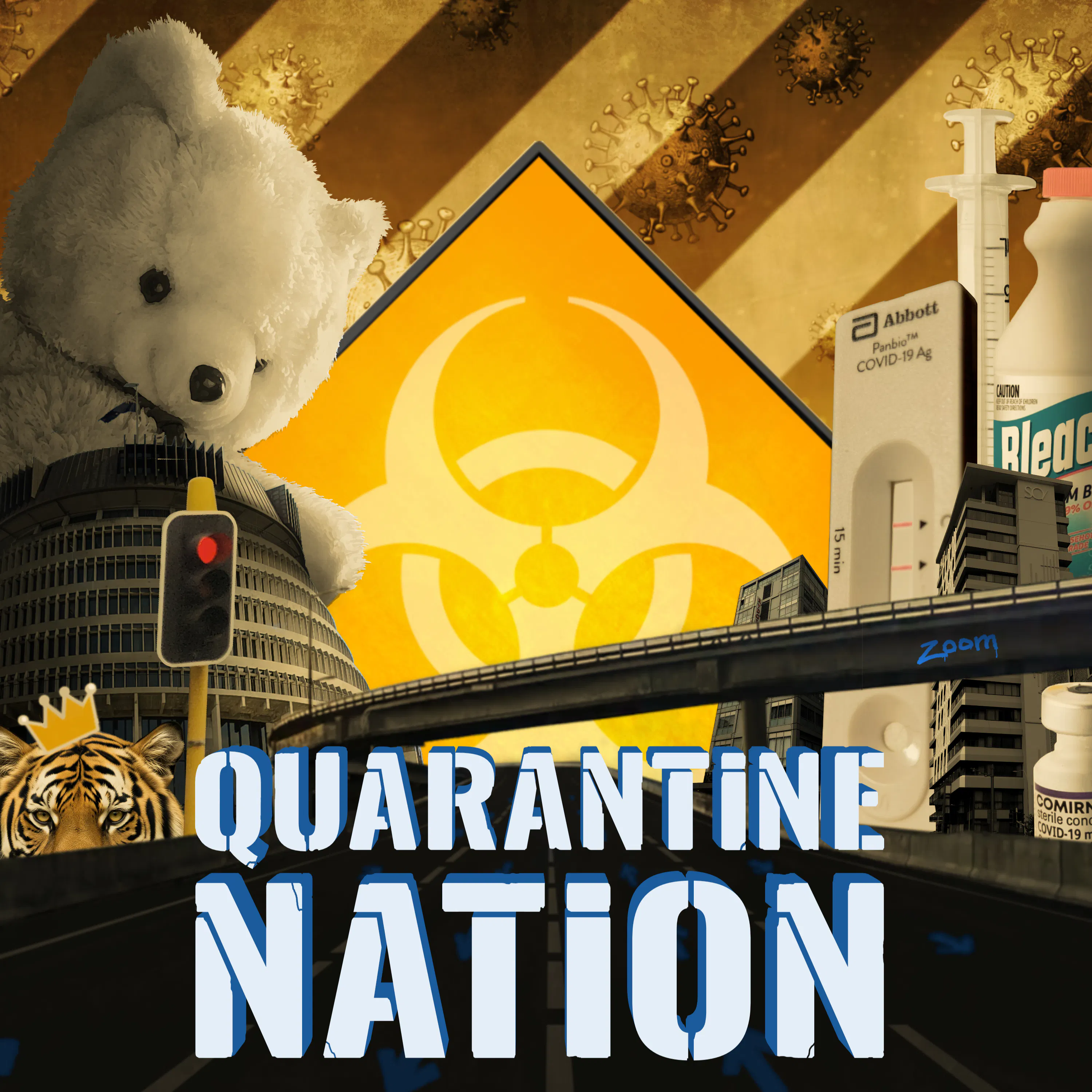
The Commune
Introducing: QUARANTINE NATION Ep2
00:46:47
A lethal virus. A drastic lockdown. A nation turned upside down. Try the new series from the makers of The Commune.
Loading summary
Transcript238 lines
- [00:00]
Adam Dudding
Hi, Adam here. If you liked the Commune, there's a new eight part series we've been making that's Eugene and me for stuff over the past year which you might be interested in. It's called Quarantine Nation and rather than giving everything away, we're just playing the first two episodes in this feed to give you a taste. So you've possibly already heard episode one. And this is episode two of Quarantine Nation, made with the support of nzhonair.
- [00:30]
Eugene Bingham
Just a heads up, in this episode there's a song with a swear word in it.
- [00:43]
Adam Dudding
I'm gonna take a punt and say that whatever your life goals, they're not quite as unusual and specific as Rebecca Roland's.
- [00:51]
Rebecca Rowland
I've got this massive lifetime bucket list where I want to traverse the length of one country in every region of the world with a different form of human power. This means that Rebecca has kayaked the length of Dominica.
- [01:06]
Adam Dudding
She rode the length of Uruguay on
- [01:08]
Rebecca Rowland
a longboard skateboard when we talked to
- [01:11]
Adam Dudding
her on a zoom call from North Carolina. She's recently given birth to her first child and her grand project continues.
- [01:18]
Rebecca Rowland
I think I'm going to run the length of Singapore with a stroller.
- [01:23]
Adam Dudding
But back in late 2019 and early 2020, when it came time to traverse Aotearoa, New Zealand, Rebecca's chosen form of human power was more straightforward.
- [01:36]
Rebecca Rowland
So I started walking the length of New Zealand.
- [01:39]
Adam Dudding
In October, Rebecca, along with her then boyfriend Diarmid, was following the famous Te Aroa trail from Cape Reenga in the north to Bluff in the south. A mere 4,3000 km. By March 2020, the pair had made great progress. They were just a few hundred k's shy of the southern tip of Te Waipounam, the South Island. The thing is, for much of the south island, Te Aroa is in pretty remote country.
- [02:08]
Rebecca Rowland
It was 10 day stretches where you didn't see or talk to people. You didn't have reception.
- [02:13]
Adam Dudding
In fact, Rebecca didn't even have her phone.
- [02:15]
Rebecca Rowland
Her boyfriend had one, but we really didn't use it. We only used it for pictures.
- [02:19]
Adam Dudding
All of which is to say that as news of COVID spread around the world, Rebecca was getting information about it only in dribs and drabs.
- [02:27]
Rebecca Rowland
Every 10 days when I was coming out of the woods, I would hear a little bit more information about what Covid was and then I would go back into the woods. But we didn't really quite understand the seriousness of it because we were so disconnected from society. I mean, that was kind of that's the purpose of walking Te Aurora. It's, it's a moment to just be completely away from societies, not to be on your phone, not to be checking updates.
- [02:49]
Adam Dudding
But some information still got through. They were somewhere deep in Southland's Takitimu Forest.
- [02:55]
Rebecca Rowland
We had shown up to one of the huts and there was someone walking that had said that the whole entire country was going to be shutting down. The walker was like, you have to get out of the woods. You have to go find somewhere to stay. And we were very far from anything. We had about 175km to go.
- [03:16]
Adam Dudding
This alarming intel came to them at about six in the evening, just a couple of hours before sunset.
- [03:23]
Rebecca Rowland
And so we made 10 peanut butter and jelly sandwiches so we could walk through the night. And we ended up walking through a creek in the dark. And we had one headlamp. We walked up and over a mountain, we walked through someone's farmland, and we ended up walking 86km that day to get to an open road.
- [03:45]
Adam Dudding
But even then, they weren't ready for the reality that awaited them. They phoned for taxi, but no one answered. And the locals they did see were acting oddly, holding up smartphones and shaking their heads.
- [03:59]
Rebecca Rowland
We did think it was quite strange that people were videotaping us. And I just thought, oh, maybe they don't really get lots of travelers over here. Like, you don't know what to think. Because we were like, we have all of our packs.
- [04:10]
Adam Dudding
But then it clicked. Lockdown wasn't just on the way. Lockdown was here. It was the morning of March 26, 2020, and the government had just enacted the most dramatic curtailing of New Zealand's rights in the country's history. And for now, just about everybody was doing what they were told.
- [04:34]
Jack Buchanan
The year is 2020 and a deadly pandemic is raging all across the globe. We inside, we are terrified we are baking sourdough We've been living on zoom in our living room since the lockdown was declared Societies are bended Our commitments are suspended it's all unprecedented and nobody's prepared for a quarantine nation COVID 19 has made it to our shores It's a quarantine nation Stay home from work and lock the doors in the quarantine nation Going a level for everywhere in the quarantine Nation we're stuck in one location On a mandatory vacation in our quarantine Nation oh, yeah.
- [05:30]
Adam Dudding
From staff and Te Purongo Productions, this is Quarantine Nation.
- [05:35]
Eugene Bingham
I'm Adam Dudding and I'm Eugene Bingham. And this is episode two, lockdown.
- [05:42]
Adam Dudding
Don't worry, things worked out okay for Rebecca, Roland and Dermott. After they'd stumbled out of the forest and into some sort of post apocalyptic wasteland, the cops showed up. And after some confusion over the rules,
- [05:54]
Rebecca Rowland
they were like, you can't get in our car.
- [05:56]
Adam Dudding
Which baffled Rebecca.
- [05:57]
Rebecca Rowland
I was like, we've literally been in the woods. Like, we're more likely to get Covid from you.
- [06:02]
Adam Dudding
The police were actually really nice and gave them a ride.
- [06:04]
Rebecca Rowland
So they gave us masks, gave them
- [06:06]
Adam Dudding
a meal and got them to the airport, which logically enough was swarming with trampers and travellers and hunters rushing home to comply with the lockdown rules.
- [06:16]
Rebecca Rowland
There were a lot of people in very similar situations.
- [06:19]
Adam Dudding
Lots of walkers, because, yeah, with Rebecca only catching up with the news every 10 days or so, she had missed a lot of action.
- [06:27]
Jacinda Ardern
From 11:59pm tonight, by the end of
- [06:31]
Eugene Bingham
episode one, we'd got to March 19, 2020. That's the day that Sindha Ardern announced the border was shutting. And from there, things moved really fast. The same day as New Zealand's border closure, a package is announced for keeping aviation businesses afloat. Pretty important at a time when international travel was obviously about to fall off a cliff. Also, as the Director General of Health, Ashley Bloomfield says at a press conference,
- [06:58]
Ashley Bloomfield
we have a ban on large gatherings, including any gatherings more than 100 indoors.
- [07:05]
Eugene Bingham
The day after that, Michael Baker, the epidemiologist we met in episode one, is in one of his new regular meetings with senior health officials at the first
- [07:14]
Michael Baker
Face to Face Technical Advisory Group. On that Friday the 20th, we saw the draft alert level system and it had been adapted from a system in Singapore. And it was very good. I mean, as a way of framing the levels of risk and how you communicate them. But the thing that struck me, and this was, as presented by the Ministry of Health, was, are we going to work up the alert levels as the pandemic gets worse? And I remember getting very concerned about that and saying, no, it's the wrong order. We have to start at the top because you basically have to clobber the virus and stamp it out. So I just wanted us to all agree we needed a big shift. And at that stage, I wasn't getting that message coming back from the government or the officials that we'd made that shift. But over the course of that weekend, I know that the government shifted, that we shifted in the space of it was really ours, from the conventional model to an elimination model.
- [08:19]
Eugene Bingham
And one day after that, Saturday, March 21. The rest of the country learns direct from the PM Jacinda Ardern about the system that's been adapted from Singapore.
- [08:29]
Jacinda Ardern
Today I'm announcing an Alert system for COVID 19. That alert system can apply to the
- [08:37]
Eugene Bingham
whole unless you were living under a rock or indeed completing the Takitimu forest bit of Te Aroa without a cell phone.
- [08:44]
Jacinda Ardern
There are four levels.
- [08:45]
Eugene Bingham
You probably know the details already, but basically it went alert level one.
- [08:49]
Jacinda Ardern
Alert level one is where COVID 19 is here, but contained. Alert level two is where the disease is contained, but the risks are growing because we have more cases, which means that we increase our border measures and we cancel events. Alert Level 3 is where the disease is increasingly difficult to contain.
- [09:10]
Eugene Bingham
So things really start slowing down. Public venues shut down, non essential businesses close, and the big Kahuna, the absolute showstopper. Level four.
- [09:20]
Jacinda Ardern
This is where we have sustained transmission. This is where we eliminate.
- [09:24]
Eugene Bingham
That's when the country basically shuts down.
- [09:27]
Jacinda Ardern
We keep essential services going, but we ask everyone to stay at home until COVID 19 is back under control. It's important to note, and just to
- [09:36]
Eugene Bingham
kick things off, Ardern announces that as of this very moment, we're already using this fancy new level system.
- [09:43]
Jacinda Ardern
And today I am confirming that New Zealand is currently at alert level two.
- [09:53]
Adam Dudding
Alert Level 2. As we now know, the country wouldn't be staying at level two for very long at all. But it was just enough time for our composer friend Jack Buchanan to reach for his guitar.
- [10:07]
Jack Buchanan
Well, times they are a little strange and we don't know what to do. Coronavirus has broken out. Now New Zealand's got it too. The world's come to a standstill and some folks are going mad. But there's a couple things we all can do to stop this getting really fucking bad. So at that point, they had announced the level system and how that would work theoretically. So I was starting to feel like, oh, maybe we're gonna need to know this information. It's a bit dense and confusing and maybe a silly song would be nice. So I just spent a night or two writing this song and then singing it into a camera and posting it on Facebook initially. And then people shared it around. It had what I thought were many, many views and I was pretty, pretty happy with myself. The virus cannot win if you maintain a healthy grin and stay inside.
- [11:08]
Adam Dudding
So, musically at least, we were totally ready for the update from Jacinda Ardern two days later, March 23rd.
- [11:16]
Jacinda Ardern
We currently have 102 cases, but so did Italy once. Now the virus has overwhelmed their health system and hundreds of people are dying every day.
- [11:27]
Eugene Bingham
The problem is that two of New Zealand's 102 cases caught the virus locally and contact traces can't map a direct connection back to a known imported case. In other words, the virus is on the loose.
- [11:40]
Jacinda Ardern
On that basis, we now consider there is transmission within our communities.
- [11:45]
Eugene Bingham
Ardern and her health officials and her science advisor have been reading the medical papers, looking at the curves on the models generated by the likes of Sean Hendy, Michael Baker and Baker's colleague Nick Wilson.
- [11:56]
Jacinda Ardern
And if community transmission takes off in New Zealand, the number of cases will double every five days. If that happens unchecked, our health system will be inundated and tens of thousands of New Zealanders will die. Right now, we have a window of opportunity to break the chain of community transmission to contain the virus.
- [12:22]
Eugene Bingham
The government wasn't looking to flatten the curve anymore. They were going to have a crack at elimination instead, basically ridding the country of the virus. So that's that. Level four is about to begin.
- [12:34]
Jacinda Ardern
Our plan is simple. We can stop the spread by staying at home and reducing contact.
- [12:42]
Eugene Bingham
It'll take 48 hours for the government to get its ducks in a row standing up. A national contact tracing workforce clarifying what's an essential service and what's not, tightening the rules about isolation for people who arrive here with the disease, declaring a state of national emergency, giving effect to an epidemic notice, closing all the schools. And those 48 hours will also give some people a brief window to figure out which particular, particular dwelling they intend to hunker down in for a few weeks, or however long it's going to be.
- [13:16]
Karl Horsley
Then
- [13:20]
Eugene Bingham
at 6:30pm on the Wednesday, our collective nerves are shattered as we all receive a very noisy message.
- [13:28]
Ashley Bloomfield
I can remember being in Pack n Save.
- [13:30]
Eugene Bingham
This is Waikato local body politician Marcus Gower, who we'll meet properly in episode four.
- [13:36]
Adam Dudding
And then suddenly you hear this
- [13:39]
Suzy Wiles
all
- [13:39]
Ashley Bloomfield
through the supermarket, everyone's phones just going off and everyone looking down and reading them and going, wow, okay, so now it's real.
- [13:48]
Eugene Bingham
The screens on everyone's phones are telling them that come 11:59pm tonight, wherever you are at that moment, that's where you'll be living. And basically not leaving until further notice, which could be a few weeks. Our TVs and radios are in on it too.
- [14:06]
Adam Dudding
New Zealand is moving to alert level
- [14:08]
Michael Baker
four at 11:59pm tonight.
- [14:14]
Adam Dudding
And then, just like the Prime Minister and the scary text and the weird voice on the TV and Jack's Song and every Single communication channel in the country had been informing us. Four days. 11:59pm March 25, Cinemas. Six years on, it's still quite hard to wrap your head around how profound this moment was. The life of every single person in the country changed all at once. In any life, there are sliding doors moments. The missed bus that means you meet your greatest love. The moments in attention that sparks a tragedy. The road taken. The road not taken. Insert your favourite movie cliche here, but one of the curious things about the pandemic was that all around the planet, and certainly in this country, entire populations would experience a sliding door moment at roughly the same time. For better or worse, in a flash, long planned overseas adventures were scuppered. Educational and career paths were suddenly shut down or delayed or sent off on a different track. Weddings were put on pause. Hasty new living arrangements were cobbled together.
- [15:30]
Eugene Bingham
One of the paradoxical things about that very first lockdown, though, is that alongside the existential terror, the economic chaos, the disrupted education and the families pulled apart, there were, especially in the earlier weeks, some strangely pleasant side effects to shutting down a country. We did 30 or so interviews for this podcast and almost everyone said, look, my heart goes out to the people who had real struggles, but me personally, my lockdown. For me, being a fit and healthy person, I quite enjoyed the lockdown in Auckland. The city was quiet, there was less air pollution.
- [16:09]
Karl Horsley
The thing where everyone went and sat in deck chairs at the end of their driveways with a beer or a glass of wine in their hand.
- [16:15]
Suzy Wiles
We became ornithologists, we had binoculars and we would look at birds outside. My kids were young enough that they actually wanted to hang out with us.
- [16:24]
Karl Horsley
Still, I'm an introvert, so the idea of being home when I'm not working, just reading a book and hanging out was quite nice.
- [16:29]
Suzy Wiles
We had seven of us in the
- [16:31]
Eugene Bingham
house and we were locked up with
- [16:33]
Suzy Wiles
a genuine card carrying foodie. I gave her the keys to the kitchen and we ate like kings.
- [16:39]
Adam Dudding
I loved the deserted streets, Sandringham Road being empty, Dominion Road being empty. Kids being able to ride their bikes without fear of getting run over. One thing we did do was like
- [16:48]
Karl Horsley
a murder mystery over zoom. So one person was told, they're the
- [16:52]
Adam Dudding
murderer and we all created Personas for ourselves.
- [16:55]
Ashley Bloomfield
I do remember the profound sense of connection with my whnau and community and just sitting there and hearing nothing but the piwaka waka and the other birds that we don't usually hear.
- [17:08]
Jacinda Ardern
I tell you what, I only remember
- [17:11]
Suzy Wiles
our Moana looking like that. So blue and so full of life. When I was a little kid, seeing that life again back in Tangaroa and listening to the birds, watching them diving on schools of Kahawai was really, really awesome to see. I wish we had a lockdown every year for a month.
- [17:32]
Adam Dudding
There were just so many specific ways, large and small, in which day to day life changed. Up in the far north, activist Hone Harura suddenly found himself standing at the side of State Highway 1 asking drivers where they were going.
- [17:45]
Karl Horsley
The first day of the first lockdown
- [17:47]
Adam Dudding
is when we stood it up. We'll hear more about these so called IWI checkpoints in episode five.
- [17:53]
Eugene Bingham
We also asked some of our friends if they had any curious moments from early lockdown they wanted to share. And this is what our former colleague,
- [18:00]
Edward Gay
my name's Edward Gay, who back then
- [18:02]
Eugene Bingham
was working at stuff like us, has to say about what happened when offices shut down and he needed to start working from home.
- [18:11]
Edward Gay
I set myself up in our 1950s asbestos garage, which had a tendency, when there's a lot of rain, a couple of centimeters of water on the floor. So I set up my old carpenter's horse with an old bit of Formica kitchen bench I actually found under the house. And I was set up there with my laptop, a little reading lamp and a chair in amongst the tools and furniture that I sometimes see on the side of the road. So yeah, I was in amongst that mess. And it was then, Eugene, that I learned that I had a little furry friend and I named him Monty. I would be doing interviews on the phone under lockdown conditions and I'd look up and Monty was sort of looking at me and he had sort of scuttled across and I'd try not to squeal while I was on the phone, you know, usually writing about quite serious crime and justice stories.
- [19:12]
Eugene Bingham
To be clear, Monty was a mouse. What happened to Monty?
- [19:15]
Edward Gay
Well, you would have noted I used the past tense when referring to Monty. I did set up traps for Monty. Peanut butter. And one day I think in March, in that first week of lockdown, Monty came through the wall. He sort of nosed around the trap and then backed off a bit and I thought, oh, that's a lot of self control, Monty. Well done, mate. But then he came back and I'm pretty sure I was on the phone at the time. There was a loud crack and Monty, well, Monty was another statistic of COVID
- [19:55]
Eugene Bingham
RIP Monty RIP Monty and Monty II
- [19:59]
Edward Gay
Monte 30
- [20:03]
Eugene Bingham
for Otago University virologist Gemma Geegan, the first day of lockdown is a double milestone. A key date, as she and others use genomics to track the movement of COVID through the community. But also, my child decided to take
- [20:17]
Suzy Wiles
her first steps on the first day of lockdown.
- [20:20]
Eugene Bingham
Wow.
- [20:21]
Jack Buchanan
And I was like, no.
- [20:24]
Eugene Bingham
Gemma is working from home, but nominates herself as designated shopper for the household. Just for the variety. Also, like millions of people across the world, she does a bit of baking.
- [20:35]
Suzy Wiles
Like, everyone you know made lots of sourdough.
- [20:37]
Jack Buchanan
And you made sourdough. Oh, yeah.
- [20:40]
Eugene Bingham
You're the first person we've cooked who made sourdough.
- [20:43]
Suzy Wiles
Where is everyone?
- [20:44]
Adam Dudding
Where are these sourdough bakers?
- [20:46]
Suzy Wiles
Made sourdough. Sourdoughs are hard to come by, though.
- [20:49]
Eugene Bingham
Well, did you stock par flour?
- [20:52]
Suzy Wiles
No. Don't tell anyone.
- [20:56]
Adam Dudding
Well, so really, really, really early in
- [21:00]
Suzy Wiles
the pandemic, before any interventions happened here,
- [21:04]
Jack Buchanan
I was kind of sneakily buying toilet
- [21:06]
Suzy Wiles
paper because I knew what was happening, so it wasn't in short supply then, though.
- [21:12]
Jack Buchanan
And then I.
- [21:13]
Eugene Bingham
Okay.
- [21:13]
Suzy Wiles
And then I was following the rules afterwards.
- [21:15]
Jack Buchanan
You do what you need to do
- [21:17]
Ashley Bloomfield
to assuage your own guilt.
- [21:18]
Eugene Bingham
That's fine for me. And Adam, interrogating Gemma about loo paper and bread flour was kind of nostalgic because right from the start of our daily bedroom podcast, Coronavirus NZ, back in
- [21:30]
Adam Dudding
early 2020, that's the Coronavirus NZ podcast for free.
- [21:34]
Eugene Bingham
We are slightly obsessed with the various fads and behaviours that are sweeping the nation and the world, including the run on bread flour caused by rampant home baking. I was at the supermarket yesterday, looked at the shelves, went to the flour aisle, still no flour.
- [21:50]
Adam Dudding
Our colleague Steve Kilgallen even comes on the show. So we've Got Stuff national correspondent Steve Kilgallan here to explain the psycholog and philosophical underpinnings of panic buying and hoarding. Marco Griggs, who's a philosophy lecturer at
- [22:04]
Eugene Bingham
Massey, was saying that basically, if everybody went and bought 50 toilet rolls, the end result would not be good because the bloke down the road's got nothing to wipe his bottom with. We're tracking the trends concerning teddy bears. People putting teddy bears in their windows so that kids who are out with their parents for a walk can go on a teddy bear hunt and spot teddy bears in windows. So, yeah, we have one. We're also tracking the things people are watching during their marathon Netflix sessions. Our Stuff colleague Nicky park comes on to talk us through a new global hit.
- [22:36]
Suzy Wiles
I wanted to give you some thoughts on this show that every single person is talking about all over the Internet, called Tiger King on Netflix. Have you heard of this doppo. So, yeah, as I said, I've only watched the first episode. So it's about this tiger King guy. He owns an exotic animal farm in Florida. But there's hints of sort of murder and bloodshed and that kind of thing.
- [22:57]
Adam Dudding
There is, of course, even quirkier stuff going on. So, Robert, why is it that we've seen the worldwide rise of these bizarre theories about 5G and COVID 19?
- [23:08]
Jack Buchanan
In one word, anxiety.
- [23:10]
Adam Dudding
We get an expert on conspiracy theories on the show to explain why the Internet is abuzz with nutty theories about 5G cell towers giving people Covid.
- [23:19]
Ashley Bloomfield
Same with people believing in alien abductions and Bigfoot. If I just go to websites on
- [23:25]
Jack Buchanan
Bigfoot and alien abductions, it looks very much like it's real.
- [23:29]
Adam Dudding
It's striking, though, listening back to the questions we were asking at this early stage of the pandemic, how the COVID 19 conspiracies still felt like a laughable curiosity. I don't think we had any idea of just how serious a problem misinformation would eventually become.
- [23:48]
Eugene Bingham
Tiger king, sourdough, teddy bears, loo paper, nutty conspiracies. They're fun to talk about, but of course, they are mostly distractions from some really quite serious matters. You know, an economy that has been all but shut down, the sudden withdrawal of many of the civil liberties that we take for granted, and of course, a lethal virus on the loose. Andrew McDowell, a composer and sound designer living in Auckland, is just one of the many Kiwis who takes an animal. Instant financial hit.
- [24:15]
Adam Dudding
It was around about $15,000 of work that I lost within a few hours
- [24:20]
Karl Horsley
of level 4 lockdown.
- [24:23]
Eugene Bingham
This is a contract with a gaming company in Canada to compose the music and do the sound design for a murder mystery game for iPhones.
- [24:30]
Adam Dudding
The budgets were set, the job was
- [24:32]
Jacinda Ardern
started, and today I'm announcing an alert system.
- [24:37]
Adam Dudding
Jacinda gave her announcement and then probably five hours later, I got an email from them saying, we're just a little bit concerned with everything that's both going on in the world, but also in your neck of the woods down in New Zealand. We feel it would be too risky to be trying to work across the great divides. So they pulled the pin immediately and got a local composer in Vancouver to do the entire job. A few days into lockdown, the big international publisher Bauer Media shuts down all its New Zealand magazines and lays off all its staff. This feels a bit close to home for me and Eugene. And given the small world of New Zealand journalism, we know personally A lot of these people who are suddenly out of their jobs. Sure, the company and commercial journalism in general has been struggling even before COVID came along, but lockdown seems to have tipped things over the edge.
- [25:29]
Eugene Bingham
Yet even for industries that had actually been in great shape, with closed borders and everyone stuck at home, vast chunks of the economy are simply forbidden to do business. Tourism is munted, obviously. Hospitality too, though hotel owners do at least have a new source of revenue because the government is booking out entire buildings to make space for all the Kiwis returning from overseas who are being required to spend time in managed isolation and quarantine. Miq. And sure, vast handouts of government funds are softening the impact of somewhat.
- [26:03]
Jacinda Ardern
I know there is real and genuine struggle in New Zealand right now. That is why the $5 billion paid out for wage subsidies within a couple of weeks has been so important to cushion the blow.
- [26:13]
Eugene Bingham
But nonetheless, it's all very, very alarming.
- [26:18]
Adam Dudding
It's also very alarming suddenly losing the right to do extremely ordinary things like meet other people, go for a swim, get a haircut, attend a wedding, get a massage, visit, get your batch, visit your neighbour, go to the gym, play tennis, sip a latte in a fashionable inner city cafe, attend a funeral, visit a dying relative, go to school, go to work, go to the gym. It was bizarre. Yeah.
- [26:39]
Eugene Bingham
And the lines between allowed and not allowed could get quite contentious. Jobs and businesses and products were deemed essential or inessential, which meant journalists could go into their offices, but librarians couldn't. Supermarkets could keep trading, but butchers couldn't. You were allowed to buy paracetamol, but not books.
- [26:59]
Jacinda Ardern
You will be able to access medical services.
- [27:02]
Adam Dudding
Also, as we'll see later, this sudden withdrawal of so many of our liberties was actually seriously dodgy, constitutionally speaking.
- [27:09]
Jacinda Ardern
Now, I'm asking you to do everything
- [27:12]
Adam Dudding
you the government is asking nicely. Kinda. We will not hesitate if anyone doesn't follow the rules. Well, the police suddenly have powers they've never dreamed of, thanks to the Health act and the Civil Defence Emergency Act.
- [27:24]
Ashley Bloomfield
You'll have noted today that we've issued a clear warning to those intending to travel out of town that they should change their plans immediately.
- [27:30]
Adam Dudding
Police aren't usually in the business of arresting people for fancying a change of scenery.
- [27:35]
Ashley Bloomfield
Right.
- [27:36]
Adam Dudding
But this is the new police chief, Andrew Costa, with an update from early lockdown.
- [27:40]
Ashley Bloomfield
We've recorded a total of 367 breaches of the Civil Defence, Emergency Management or health act notices, 45 prosecution, 309 warnings and 13 youth referrals.
- [27:54]
Adam Dudding
Plus, a lot of us are keen to help the cops out with these new powers. In other words, we're dobbing each other in like crazy.
- [28:00]
Ashley Bloomfield
We're continuing to receive a huge number of reports of potential breaches, which tells us that members of the public clearly want others to comply.
- [28:09]
Eugene Bingham
With most people stuck at home, most crime stats fall off a cliff.
- [28:13]
Jack Buchanan
So Normally there'd be 40 to 45 burglaries or cars broken into driveways in Christchurch overnight, and overnight Sunday, there were only three.
- [28:26]
Eugene Bingham
That's our staff colleague Blair Ensore on our daily podcast bringing us up to speed on Canterbury's lockdown crims. But there was another type of crime that police worried would actually increase.
- [28:38]
Jack Buchanan
International modelling would suggest we could see as much as a 50% increase in family harm. And over the weekend here in Canterbury, there was quite a big increase.
- [28:49]
Eugene Bingham
Blair also took a moment to acknowledge that lockdown might be challenging for recreational drug users.
- [28:54]
Jack Buchanan
It's not just going to be as easy as popping down the road to your local tinny house anymore. We have spoken to some sources who suggest that car parks could be the new tinny house, particularly supermarket car parks where large numbers of people gather and likewise drug dealers do a lot of drop offs around the place, but after dark now, I think police officers will be pulling a lot of those vehicles over. So the suggestion is that many will take to their bikes during the day to blend in with people who are
- [29:21]
Adam Dudding
out exercising during lockdown. There's one other show, something even more gripping than Tiger King, which has been closely followed by absolutely everyone.
- [29:31]
Ashley Bloomfield
My name is Dr. Ashley Bloomfield, I'm the Director General of Health and with me also, I have beside me here Dr. Carolyn Mcilnay, who is, is the Director of Public Health. And many of you, you know that
- [29:42]
Adam Dudding
voice, you probably didn't need to hear him say his name, but he's introducing himself there because that clip was actually from really early on, back in January, when Ashley Bloomfield first started giving briefings and press conferences to keep the media and public up to speed on New Zealand's health response. As the pandemic gathers pace, though, those briefings settle into a daily rhythm of afternoon updates. And by the time lockdown arrives, the 1pm press conference has become utterly essential viewing for the entire nation. It's the place where we learn the shape of our lives for the coming 24 hours and beyond. It's where we hear the latest thinking from the Prime Minister and her Cabinet.
- [30:21]
Jacinda Ardern
The government's focus this week remains doing all we can to stop the spread of the virus so we can move.
- [30:27]
Adam Dudding
That's the place to hear the latest case numbers.
- [30:29]
Ashley Bloomfield
So today I can report there is an increase of 89 COVID 19 cases on yesterday.
- [30:34]
Adam Dudding
And it's the place to hear about the various Covid clusters.
- [30:37]
Ashley Bloomfield
We now have 12 significant clusters around the country.
- [30:40]
Jacinda Ardern
Our three largest clusters.
- [30:42]
Ashley Bloomfield
Very close eye on our 13 current clusters.
- [30:46]
Adam Dudding
You might even remember the names of a few of these clusters.
- [30:48]
Ashley Bloomfield
The wedding in Bluff has 58.
- [30:50]
Jacinda Ardern
And Marist College at 84.
- [30:52]
Ashley Bloomfield
The event in Matamata has 56. From Rosewood Rest Home, Hereford Cattle Conference
- [30:57]
Eugene Bingham
where Australian the Marist Cluster. The Bluff Wedding Cluster, the Rosewood, the Hereford Conference, the Ruby Princess. These seemingly random words became talismanic. We desperately want to know their status because those clusters are tangible evidence of the transmission chains of the COVID virus. And actually, I think we could do with another quick explainer from Suzy Wiles about transmission chains and, well, about the actual point of making everyone stay home like this, the point of a lockdown.
- [31:30]
Suzy Wiles
So transmission chain really is just the transmission of an infection from one person to the next, one animal to the next. It's really just the WHO infected who. And stopping those transmission chains is how you stop an infection. When something is transmitted from human to human or animal to animal in the
- [31:50]
Eugene Bingham
point of a lockdown is to break those chains.
- [31:52]
Suzy Wiles
The basic thing was if we could limit the number of people that people had contact with, then we could stamp out transmission chains. Then transmission was only going to really happen within a household. And so it would then essentially fizzle out. The virus would run out of people to infect. And so every transmission chain we could extinguish was hundreds of people, thousands of people who weren't going to get infected. Right? And so that was just to try and limit our movements and our interactions for a long enough period to extinguish whatever transmission chains were happening.
- [32:25]
Adam Dudding
Now, just like any long running daytime TV show, the 1pm press conference has its leading man or leading lady. And though Jacinda Ardern gets a lot of screen time, I'd say even she would concede the real star is Ashley Bloomfield, the unflappable DG of age. The calm, bespectacled, gentle sounding chapter who is seemingly the keeper of all knowledge. And naturally the star has his fans. There are adoring tweets, people make Ashley T shirts, Ashley tea towels. There's an Ashley song.
- [32:58]
Jack Buchanan
I'm stuck in isolation but it's not so bad cause every day at one I get to see my man he's got blonde hair he's got that face. He knows just what to say. The way he speaks makes me feel like it's gonna be okay. Dr. Ashley.
- [33:20]
Adam Dudding
Someone gets an Ashley Bloomfield tattoo. It is all, as Bloomfield admits now, bonkers. You became a celebrity, a meme, a crush, a cultural touchstone. You know, it was nuts, but kind of cool.
- [33:35]
Ashley Bloomfield
Well, it was nuts and it was a product of the time and the place. And fortunately, I have good friends and family who made sure I stayed very grounded in that regard.
- [33:46]
Adam Dudding
How big is your collection of Ashley T shirts, tea towels and framed photographs of that guy with the tattoo?
- [33:53]
Ashley Bloomfield
It's a woman with the tattoo.
- [33:54]
Eugene Bingham
A woman, is it?
- [33:55]
Ashley Bloomfield
Yes, yes. And she's got it on her calf? Yes. I think she wakes up probably on every Saturday morning, thinks, what was I thinking? You know, too many glasses of wine, obviously. Look, I've got several T shirts. They're unused. My sister, who's quite a character, bought them for the whole family. And surprisingly or not surprisingly, no one wanted to wear them. I've got about half a dozen pictures that people have painted of me. They're sitting in a pile somewhere, but every now and then someone will pull out a tea towel or a hand towel with my face on it, which is, I guess, sort of a reminder of a time that we all lived through.
- [34:49]
Eugene Bingham
New Zealand in early lockdown is weird, it's scary, it's unsettling, but it's also exciting. And there's an incredible sense of national unity in the face of a threat. And as we've heard, sometimes it feels inappropriately enjoyable, but out of the corner of your eye, you never quite forget that this is all happening because of a deadly threat. On lockdown day, no one has yet died of COVID in New Zealand, but that will change in just days. And we know from the 1pm Press conferences that the number of cases is going to keep rising for a while yet. Also, we've been following the international news. On our lockdown day, the global death toll is around 20,000. One week later, that number is 47,000. A week after that, it's 90,000. That's what exponential growth looks like. When a virus spreads through a community that's never encountered it before, the numbers double and redouble and double again. Italy is in a terrible state. If the epicenter of the coronavirus outbreak
- [35:58]
Ashley Bloomfield
in Europe is in Lombardy province in northern Italy, then the absolute centre of
- [36:03]
Eugene Bingham
this epidemic is here in the town of Bergamo.
- [36:07]
Edward Gay
More people have died here than anywhere else.
- [36:09]
Eugene Bingham
Iran is also suffering.
- [36:11]
Adam Dudding
An Iranian politician has died after contracting the coronavirus.
- [36:15]
Eugene Bingham
And in the US things are strange.
- [36:18]
Adam Dudding
What do you say? The Americans were scared, though, I guess
- [36:20]
Eugene Bingham
nearly 200 dead, 14,000 who are sick, millions who are scared right now.
- [36:25]
Adam Dudding
What do you say to Americans who
- [36:27]
Jack Buchanan
are watching you right now, who are scared?
- [36:29]
Adam Dudding
I say that you're a terrible reporter. That's what I say. I think it's a very nasty question.
- [36:34]
Eugene Bingham
The strategy has been in Sweden, where senior health official Anders Tegnal has rejected an enforced lockdown and is instead advising people to reduce their social interactions. A wave seems to be taking hold on the day New Zealand locks down. Deaths in Sweden are below 100. A week later, it's 330 dead. Another week later, it's 870.
- [36:59]
Adam Dudding
From this evening, I must give the British people a very simple instruction. You must stay at home.
- [37:05]
Eugene Bingham
Britain has declared a lockdown almost the same day as New Zealand. But the virus arrived there weeks earlier than here. So it has already spread widely and cases are starting to arrive in the hospitals, including St Thomas in London, where the Kiwi nurse Jenny McGee is working again. Since her recent return from New Zealand.
- [37:25]
Suzy Wiles
The first few patients had come in in drips and drabs and had been okay, but the hospital was in overdrive, trying to prepare for the oncoming storm.
- [37:35]
Eugene Bingham
There had been that extended period where Boris Johnson had been playing things down.
- [37:39]
Adam Dudding
I was at a hospital the other night where there were actually a few coronavirus patients and I shook hands with everybody, you'll be pleased to know, and I continued to shake hands.
- [37:48]
Suzy Wiles
But the medical community's very well connected and, you know, there's Italian consultants that work in our icu and they knew exactly what was going on in Italy and they knew exactly. They knew this was coming. And we just had to organise and organise and organise as much as we could to get the resources and the people and the ventilators and. And everything that you need to look after ICU patients.
- [38:08]
Adam Dudding
Meanwhile, in New Zealand hospitals, a rather different kind of waiting is going on.
- [38:13]
Karl Horsley
Kia ora. My name's Karl Horsley. I'm an intensive care specialist out at Middlemore Hospital, trained in emergency medicine and then intensive care.
- [38:21]
Adam Dudding
Dr. Karl Horsley and his colleagues at Auckland's Middlemore Hospital have had a very hectic December 2019.
- [38:27]
Jacinda Ardern
The eruption happened.
- [38:29]
Adam Dudding
Many of the survivors from the eruption of Whakare, White island, ended up at Middlemoor and had been in intensive care with severe burns.
- [38:36]
Karl Horsley
The end of December for us was we were still really dealing with Whakati and we kind of had heard that there was a new virus around.
- [38:43]
Adam Dudding
But at first there hadn't been huge concern.
- [38:45]
Karl Horsley
There are always viruses, there's always outbreaks and things, but the sense that this was different really didn't become crystallized until it started to hit some of the Western intensive care units, and particularly in Lombardy and Italy. And I think once we started to see services that had a lot more capacity than us, that were just completely overwhelmed, then that was when we realised that this was something quite different and that we were. No one was ready for it.
- [39:11]
Adam Dudding
This was one of the big factors that would feed into the eventual decision in late March to go into a hard lockdown in New Zealand. Health experts were sounding the alarm that if we got a COVID wave like Italy's, we would be even less ready than they were, because New Zealand had a scandalously low level of ventilator capacity in its hospitals. And ventilators are really important.
- [39:34]
Karl Horsley
Covid pneumonitis is essentially a viral pneumonitis that causes an inflammation of the lungs and that affects your ability to breathe, your ability to take on oxygen, get rid of carbon dioxide, it makes your worker breathing go up. And for people who get to a certain point where they are not able to be helped with just oxygen and other more simple things, sometimes they have to come to intensive care and we have to almost take over their breathing. And that means putting them off to sleep, putting a breathing tube down, keeping them asleep, and having a breathing machine that essentially does the work of breathing for them.
- [40:04]
Adam Dudding
A relatively small fraction of people who get Covid will need a ventilator to survive. But if the virus rips through the entire population, that small fraction still adds up to a huge number. A number way, way bigger than hospitals can treat all at once. The system overloads and people who might have survived die. That's what's been happening overseas in these early months.
- [40:28]
Karl Horsley
And then the numbers are starting to go up and we realised we were probably following the same path as Italy, New York, uk. We knew we had about two weeks, thought we would likely follow the same course as other places overseas. So there was quite a big rush to really think about how could we increase the capacity of the ICU to deal with things, but also how could we keep our staff safe? One of the things is that with a pandemic, not only do you have more people in the population getting unwell at the same time, but also your staff don't have the immunity. And so your staff capacity, the ability to meet that need, goes down as well. So you have to think about how do we get more staff on how do we protect our staff so we don't lose them.
- [41:14]
Adam Dudding
The stories Carl and others are hearing from their colleagues overseas are chilling.
- [41:19]
Karl Horsley
We're hearing from these big units overseas which have got, you know, much more capacity, much more room. They're saying, you will be swamped, it will be awful, you will lose staff.
- [41:28]
Adam Dudding
Middlemore at that time has 10 ICU beds.
- [41:32]
Karl Horsley
Some of the numbers coming through meant that no matter what we did, we would be overwhelmed, you know, needing 200 ICU beds when we have 10. We just had to acknowledge there were some scenarios that we couldn't cope with and we had to prepare for the ones that we could. The numbers are kind of, you know, that's a cerebral thing. I think for most of us though, it was going home and thinking about, you know, will I get through this? Will I bring this home to my family and take out my family, thinking about, you know, what will we be like in a year from now? Will we all be here, me and my mum at a cafe and sort of knowing what was coming and thinking like, will I see her again? And that sounds really dramatic, but this is what we've been hearing from overseas.
- [42:13]
Adam Dudding
So frankly, Carl and others are really hoping that this looming catastrophe can be averted in New Zealand. At least.
- [42:21]
Karl Horsley
We can see the numbers tracking. We know what that looks like and that sort of waiting for will there be a decision or not?
- [42:29]
Adam Dudding
A decision and then lockdown.
- [42:34]
Karl Horsley
We were delighted when that, that first lockdown was announced. We were prepared to do it. We would be as prepared as we could be, but, you know, it was going to be awful. Now when we go to conferences, we go to these intensive care conferences and it feels like this sort of survivor guilt because we didn't go through what other places did in the world. They are all completely scarred by it and they have lost a lot of staff. And when we go there, we go like, well, actually we were okay.
- [43:06]
Adam Dudding
But back then, with lockdown only just beginning, it's far from clear to Karl and his colleagues whether this catastrophe has actually been averted or not. Like everyone else, he'll be checking in to the 1pm press conference every day, listening to the numbers and keeping his fingers crossed.
- [43:28]
Eugene Bingham
As for Rebecca Rowland, the tramper who'd stumbled out of the southland forest after 10 days off the grid to discover that New Zealand had kind of shut down. She has her own sort of sliding doors moment just like the rest of us.
- [43:41]
Rebecca Rowland
So my intention of coming to New Zealand was only to stay for six months and then I was supposed to leave. And then with COVID it just didn't make sense for me to go back to the US because Covid was just a mess in the us, so it just made sense to stay put. Six months quickly turned into two years that I stayed in New Zealand.
- [44:01]
Eugene Bingham
We've heard from lots of people in this episode who actually loved aspects of that very first Aotearoa lockdown, but Rebecca was not one of them.
- [44:10]
Rebecca Rowland
It was like night and day to go into lockdown for me because you have to imagine I'm walking every single day for 12 to 13 hours. At that stage, I'd been walking for four, four straight consecutive months. I was in the best shape of my life. And then you do the complete opposite where you're sitting inside. Like, I didn't have a job at the time. I didn't really feel like I had a purpose. And I was in the beginning running 10k runs and trying to stay active. But then over time I was just so bored and everything slowed down and then I just got used to just sitting around and I got comfortable with it.
- [44:46]
Adam Dudding
Rebecca's outdoor adventures in New Zealand aren't quite over, but for now they'll have to wait. Lockdown's only just beginning. We have no clear idea of how long it's going to drag on, but it's safe to predict that it's going to be a rocky ride. There was a real disconnect between what we were hearing about the testing capacity and the actual reality on the ground. So we were sailing very close to the wind.
- [45:10]
Suzy Wiles
I really smart consultant said, what will happen is patient numbers will double every three days. And it just seemed like the most bonkers thing to say. But no, he was completely and utterly accurate.
- [45:23]
Jacinda Ardern
It did shock me when I heard he was in intensive care.
- [45:25]
Rebecca Rowland
It really did.
- [45:26]
Adam Dudding
The first thing I did was buy an electric piano.
- [45:32]
Eugene Bingham
Hey. That was episode two of Quarantine Nation. Like we said, there are eight episodes, so if you want to hear them all, just search for Quarantine Nation on your favourite podcast app and hit subscribe.
- [45:45]
Adam Dudding
That was episode two of Quarantine Nation, an eight part series produced for Stuff by Te Purongo Productions. For more about Quarantine Nation, as well as links to future articles and extended videos of some of our key interviews, go to www.stuff.co.nz qn. The series was researched, written, hosted and produced by Adam Dunning and Eugene Bingham of the Te Puronga Productions, with additional research by Connor Scott. Thanks to staff for unlocking the coronavirus NZ archives and also to the BBC, Al Jazeera and Sky News uk. Theme tuned by Jack Buchanan. Additional music from Audio Network and shout out to Maxwell aps, creator of the marvellous Ashley Bloomfield song. Editing by Toby Longbottom, mixing by Andrew McDowell of Diducate, graphics by Phil Johnson and photography by Abigail Dougherty, Chris Skelton and David Unwin. Social media and video editing by via Digital at Staff thanks to Executive Producer Chris Reed, Content producer Dave Hull and Senior Legal Counsel Charlotte Curry. Quarantine Nation Made with the support of NZ on.