
Podcast
The CoSN Podcast
Hosted by COSN - The Podcast · EN
The CoSN Podcast, produced and distributed by edCircuit, provides current and aspiring K-12 edtech leaders with timely insights and strategies to succeed in the ever-evolving world of school system technology. Hear from Certified Education Technology Leaders (CETL), visionary district changemakers, and instructional experts, who will discuss essential topics such as digital equity, innovation, IT leadership, cybersecurity, and more.
13episodes
Episodes
Newest firstAll episodes
Fostering a Culture of Belonging for All: Lessons from the 2026 CoSN Network Meetup
2w ago00:13:36Tap to summarizeIn this episode of the Consortium for School Networking Podcast, we explore key insights from the 2026 CoSN Network Meetup and the growing importance of fostering a true culture of belonging across K–12 education.The conversation examines how district leaders are moving beyond simple inclusion to create environments where students, staff, and community members feel valued, heard, and connected. From inclusive technology and student voice to staff wellness, mentorship, multilingual communication, and community partnerships, this discussion highlights what belonging looks like in practice and why it remains essential to effective leadership.Listeners will come away with a clearer understanding of how belonging shapes school culture, strengthens trust, and supports more inclusive, student-centered decision-making across the district.Article Mentioned in This EpisodeFostering a Culture of Belonging for All: Insights from the 2026 CoSN Network MeetupLearn MoreTo explore more CoSN resources, professional learning opportunities, and leadership conversations in K–12 education technology, visit CoSN.Produced in partnership with edCircuit. CoSN is vendor-neutral and does not endorse products or services. Any mention of a specific solution is for contextual purposes. This episode was generated in part using AI tools. All content was reviewed and approved by CoSN and the edCircuit editorial team before publication.
Transcribe →
Perspectives on AI in K–12: Implications of New Global Research (Part 2)
3w ago00:12:47Tap to summarizeIn Part 2 of this special two-part CoSN Podcast series, we move beyond the research presentations and into the engaging moderated discussion led by Keith Krueger, CEO of CoSN. Rebecca Winthrop of the Brookings Institution and Andreas Schleicher of the OECD compare their findings, discuss where their research aligns, and explore what K–12 leaders should prioritize as artificial intelligence becomes increasingly integrated into teaching and learning.From AI governance and educator preparation to student learning and responsible implementation, this episode offers practical insights for superintendents, CTOs, curriculum leaders, principals, and district leadership teams navigating the rapidly evolving world of artificial intelligence.In this episode, you'll hear about:Where the Brookings Institution and OECD research findings alignWhy AI should strengthen—not replace—great teachingLessons education can learn from the rise of social mediaThe importance of AI literacy for educators, students, and familiesAI governance and policy considerations for school districtsWhy leadership and instructional purpose should guide every AI decisionThe difference between commercial AI and AI designed for educationPractical advice for district leaders preparing for the future of AIFeatured SpeakersKeith KruegerCEO, CoSNRebecca WinthropSenior Fellow and Director, Center for Universal EducationBrookings InstitutionAndreas SchleicherDirector for Education and SkillsOECDFeatured ResourcesA New Direction for Students in an AI World: Prosper, Prepare, Protect (Brookings Institution)OECD Digital Education Outlook 2026: Exploring Effective Uses of Generative AI in Education (OECD)CoSN Webinar: Perspectives on AI in K–12: Implications of New Global ResearchWhy This Conversation MattersArtificial intelligence continues to reshape education, but successful implementation depends on more than technology. Throughout this discussion, Rebecca Winthrop and Andreas Schleicher emphasize that leadership, educator expertise, thoughtful governance, and a continued focus on student learning will determine how AI ultimately impacts K–12 education.Whether your district is just beginning its AI journey or refining existing strategies, this conversation provides valuable perspectives grounded in global research and practical educational leadership.Learn MoreWatch the complete Perspectives on AI in K–12: Implications of New Global Research webinar and explore additional AI resources, professional learning opportunities, and upcoming events by visiting www.cosn.org.Produced in partnership with edCircuit. CoSN is vendor-neutral and does not endorse products or services. Any mention of a specific solution is for contextual purposes. This episode was generated in part using AI tools. All content was reviewed and approved by CoSN and the edCircuit editorial team before publication.
Transcribe →
Perspectives on AI in K–12: Implications of New Global Research (Part 1)
4w ago00:17:03Tap to summarizeArtificial intelligence is rapidly reshaping K–12 education, but what does the latest global research actually tell us?In Part 1 of this special two-part CoSN Podcast, we explore the key findings from the CoSN webinar Perspectives on AI in K–12: Implications of New Global Research. CoSN CEO Keith Krueger is joined by two of the world's leading education researchers: Rebecca Winthrop of the Brookings Institution and Andreas Schleicher of the OECD to discuss how AI is transforming teaching, learning, and educational leadership.During this episode, we examine the major themes from their presentations, including the opportunities artificial intelligence creates for K–12 education, the challenges schools must address, and why thoughtful leadership, not technology alone, will determine AI's impact on students.In this episode, you'll hear about:Why AI has become one of the most important leadership conversations in K–12 educationRebecca Winthrop's research on AI's impact on students, learning, and the future of educationThe difference between "narrow AI" and "wide AI" and why the distinction mattersOpportunities for AI to improve access, personalization, and instructional supportWhy AI is more than "the next calculator" and what that means for student learningAndreas Schleicher's global perspective on AI in education and why he describes AI as "an amplifier"Lessons education systems around the world are learning as they begin implementing AIWhy teachers, relationships, and instructional leadership remain central in an AI-enabled futureFeatured SpeakersKeith KruegerCEO, CoSNRebecca WinthropSenior Fellow and Director, Center for Universal EducationBrookings InstitutionAndreas SchleicherDirector for Education and SkillsOECDFeatured ResourcesA New Direction for Students in an AI World: Prosper, Prepare, Protect (Brookings Institution)OECD Digital Education Outlook 2026: Exploring Effective Uses of Generative AI in Education (OECD)CoSN Webinar: Perspectives on AI in K–12: Implications of New Global ResearchComing NextDon't miss Part 2, where we dive into Keith Krueger's moderated discussion with Rebecca Winthrop and Andreas Schleicher. The conversation explores where their research aligns, what school leaders should prioritize over the next several years, AI governance, educator preparation, and practical guidance for districts developing AI strategies.Produced in partnership with edCircuit. CoSN is vendor-neutral and does not endorse products or services. Any mention of a specific solution is for contextual purposes. This episode was generated in part using AI tools. All content was reviewed and approved by CoSN and the edCircuit editorial team before publication.
Transcribe →
Unlocking the Value of EdTech Investments
Jun 2300:16:27Tap to summarizeHow do K-12 technology leaders communicate the value of their work in an era of increasing expectations, tighter budgets, and rapidly evolving technologies?In this episode of the Consortium for School Networking Podcast, we explore key insights from the recent CoSN webinar, Unlocking the Value of EdTech Investments, led by Frankie J. Jackson, CETL®, RTSBA. Joining Frankie for the discussion were Michael Flood, founder and CEO of Alpine Frog; Maria Stavropoulos, CETL®, Director of Technology at Northbrook School District 28; and William Brackett, Director of Technology at Oak Park Elementary District 97.Drawing from decades of experience in district leadership, the panel examined one of the most important challenges facing EdTech leaders today: how to effectively tell the story behind technology investments.In this episode, we discuss:Why EdTech value doesn't speak for itself—and why leaders must tell the storyThe increasing expectations and financial pressures facing today's K-12 technology leadersMoving from traditional technology thinking to leadership thinkingUnderstanding Total Cost of Ownership (TCO), Return on Investment (ROI), and Value of Investment (VOI)Why some of the most important outcomes are difficult to quantifyReal-world examples involving bus Wi-Fi, Advanced Placement access, cybersecurity, and network reliabilityMeasuring what matters and defining success before making investmentsAligning technology initiatives with district strategic plansCommunicating differently with boards, finance teams, educators, and parentsThe growing importance of storytelling as a leadership skillWhy collaboration and professional learning remain essential for technology leadersThroughout the conversation, we reflect on how technology leaders are increasingly being called upon to serve not only as technical experts, but also as strategists, communicators, and advocates for student success.Because technology investments are about more than devices and infrastructure.They're about opportunity.They're about impact.And ultimately, they're about creating lasting value for students, educators, and communities.ResourcesWatch the original webinar, Unlocking the Value of Edtech InvestmentsLearn more about CoSN Professional Learning:https://www.cosn.org/professional-learning/Explore upcoming CoSN events:https://www.cosn.org/events/Produced in partnership with edCircuit. CoSN is vendor-neutral and does not endorse products or services. Any mention of a specific solution is for contextual purposes. This episode was generated in part using AI tools. All content was reviewed and approved by CoSN and the edCircuit editorial team before publication.
Transcribe →
CoSN2026 Keynote Series: Building What's Next: Supporting Youth in a Digital World
Jun 1600:44:24Summary readyIn this special episode, recorded live at CoSN2026, Dr. Candice Odgers, Associate Dean and Chancellor's Professor at the University of California, Irvine, shares insights from more than 25 years of research on adolescent mental health and digital technology.Drawing on decades of longitudinal research following thousands of young people, Dr. Odgers explores what the evidence actually tells us about smartphones, social media, and youth well-being. She examines the growing gap between headlines and scientific findings, discusses the risks of fear-driven technology policies, and explains why supporting young people requires addressing broader factors that shape their lives.Throughout the keynote, Dr. Odgers challenges common assumptions surrounding screen time and social media while advocating for evidence-based approaches that help students thrive in an increasingly digital world.In This EpisodeWhat more than 25 years of research reveal about adolescents and digital technologyThe gap between headlines and scientific evidence surrounding social media and youth well-beingWhy fear-driven approaches can lead to poor technology decisionsLessons from longitudinal studies following thousands of young peopleThe importance of addressing the underlying causes of youth mental health challengesWhy banning technology may not produce the outcomes adults expectLessons from international efforts to restrict social media accessHow schools and communities can better support students in healthy digital environmentsAbout the SpeakerDr. Candice Odgers is Associate Dean and Chancellor's Professor at the University of California, Irvine. For more than 25 years, her research has focused on adolescent mental health, inequality, and the role technology plays in the lives of young people. Through large-scale longitudinal studies, her work provides some of the most comprehensive evidence available on how digital technology intersects with youth development and well-being.ResourcesWatch the original CoSN2026 keynote on YouTube:https://www.youtube.com/watch?v=X2I8ZpVi2WYLearn more about CoSN:https://www.cosn.orgLearn more about Dr. Candice Odgers and her work:CoSN is vendor-neutral and does not endorse products or services. Any mention of a specific solution is for contextual purposes. Produced in partnership with edCircuit.
Summary
Screen Time in Schools: Policy, Research, and Reality (Part 2)
Jun 900:16:06Tap to summarizeIn Part 2 of this special CoSN podcast series, the conversation moves beyond policy and research into the realities of implementation. Building on the foundation established in Part 1, education leaders, practitioners, and policy experts explore what happens when screen time legislation and technology policies reach classrooms, schools, and communities.Drawing from CoSN's webinar, Screen Time in Schools: A Policy Briefing for State Leaders, this episode examines the challenges of balancing student well-being with meaningful learning opportunities while ensuring students remain prepared for a digital world.Listeners will hear perspectives from state education leaders, classroom practitioners, accessibility experts, and digital citizenship advocates as they discuss teacher voice, student agency, accessibility, implementation challenges, and the unintended consequences that can emerge when broad policies fail to account for the diverse ways technology supports teaching and learning.The discussion highlights why thoughtful technology policies must consider local context, instructional purpose, accessibility needs, and the realities educators face every day in classrooms.Participants Featured in Part 2• Stacy Hawthorne, Chair, CoSN• Sydnee Dickson, Former Utah State Superintendent• Alyssa Moore, Delaware Department of Education• Michelle Soriano, Professional Learning and Implementation Specialist, CAST• Cooper Sved, Elementary Educator, Education Policy Analyst, and 2025 CoSN Blaschke Fellow• Julia Fallon, Executive Director, SETDAKey Talking Points• Moving from policy discussions to real-world implementation• Why balanced technology policies begin with clearly defining the problem being solved• The importance of teacher voice and educator involvement in policy decisions• Accessibility considerations for students with IEPs and 504 Plans• Universal Design for Learning (UDL) and creating flexible learning environments• Digital citizenship as a critical component of student preparation and workforce readiness• Student agency and helping learners make informed technology choices• Distinguishing instructional technology from consumer technology and social media platforms• The unintended consequences of broad technology restrictions and device bans• Building trust through transparency, communication, and local flexibilityKey Takeaways• Student well-being and meaningful learning are not competing priorities—they are interconnected.• Technology policies should focus on intentional use rather than elimination.• Accessibility tools are essential learning supports for many students and must be considered in policy decisions.• Digital citizenship education is critical to preparing students for an increasingly connected world.• Teachers must be included in conversations about technology implementation and classroom practice.• Effective policy recognizes that not all technology use serves the same purpose or produces the same outcomes.• Schools must balance safety, engagement, accessibility, and future readiness when developing technology policies.Referenced Resources• CoSN's webinar, Screen Time in Schools: A Policy Briefing for State Leaders,• CoSN Screen Time Resource Center• Digital Promise: The Digital Learning Gap• SETDA: State EdTech Trends 2026• Whiteboard Advisors: Youth Tech Policy TrackProduced in partnership with edCircuit. CoSN is vendor-neutral and does not endorse products or services. Any mention of a specific solution is for contextual purposes. This episode was generated in part using AI tools. All content was reviewed and approved by CoSN and the edCircuit editorial team before publication.
Transcribe →
Screen Time in Schools: Policy, Research, and Reality (Part 1)
Jun 200:14:48Tap to summarizeAcross the country, state leaders are considering legislation that could significantly change how technology is used in K–12 schools. From cell phone restrictions to broader screen time limits, policymakers are grappling with questions about student well-being, academic outcomes, digital access, and workforce readiness.In Part 1 of this two-part CoSN podcast series, we explore the policy landscape and research driving the national conversation around screen time in schools. Drawing from CoSN's webinar, Screen Time in Schools: A Policy Briefing for State Leaders, this episode examines emerging state legislation, the growing debate around instructional technology, and what current research tells us about technology's role in teaching and learning.Listeners will hear insights from education leaders and researchers as they discuss why not all screen time is the same, how instructional technology differs from social media and entertainment platforms, and why thoughtful policy decisions require a deeper understanding of how technology is actually being used in classrooms.Topics discussed include the rapid growth of state-level screen time legislation, the distinction between cell phone bans and instructional technology policies, active versus passive technology use, the importance of implementation, and examples of how technology can support learning when used intentionally and effectively.Participants Featured in Part 1:• Keith R. Krueger, CEO, CoSN• Ivo Popov, Senior Vice President, Whiteboard Advisors• Beth Holland, Managing Director, Research & Policy, FullScale• Jeremy Roschelle, Co-Executive Director, Learning Sciences Research, Digital PromiseKey Talking Points:• The growing movement among states to regulate student screen use• Why cell phone restrictions and instructional technology policies are fundamentally different conversations• Not all screen time is the same; context, purpose, and design matter• The distinction between educational technology, social media, and entertainment platforms• Active versus passive technology use in learning environments• Why correlation does not equal causation in screen time research• Examples of instructional technology improving student outcomes through feedback and targeted support• The importance of balancing student well-being with meaningful learning opportunitiesReferenced Resources:• CoSN Screen Time Resource Center• Digital Promise: The Digital Learning Gap• SETDA: State EdTech Trends 2026• Whiteboard Advisors: Youth Tech Policy TrackComing Up in Part 2:The conversation moves from policy and research into real-world implementation. Hear from state leaders, classroom educators, accessibility experts, and digital citizenship advocates as they discuss how screen time policies impact students, teachers, schools, and communities. Topics include accessibility, digital citizenship, teacher voice, student agency, unintended consequences, and what balanced technology policies look like in practice.Call to Action:Watch the full webinar recording.Share this episode with policymakers, district leaders, and education stakeholders.Explore CoSN's Screen Time Resource Center and policy briefing materials to support informed, balanced decision-making around technology use in schools.Produced in partnership with edCircuit. CoSN is vendor-neutral and does not endorse products or services. Any mention of a specific solution is for contextual purposes. This episode was generated in part using AI tools. All content was reviewed and approved by CoSN and the edCircuit editorial team before publication.
Transcribe →
CETL® Basics and the Future of K-12 EdTech Leadership
May 2600:11:57Tap to summarizeWhat does it mean to lead technology in today’s K–12 schools? In this episode, we explore the growing importance of the CETL® (Certified Education Technology Leader) credential and why it has become one of the most respected certifications in education technology leadership.Drawing from insights shared by Yenny Caceres and Robin Gunter during the recent CETL® Basics webinar, this conversation examines how the role of the district technology leader has evolved far beyond infrastructure and device management into strategic leadership around artificial intelligence, cybersecurity, digital learning, data privacy, and district transformation.We discuss how the CETL framework helps education leaders bridge instructional vision with technical operations while building the leadership capacity needed to guide modern school systems through increasingly complex challenges.The episode also highlights the importance of lifelong learning, professional credibility, mentorship, and community in a field that continues to evolve at a rapid pace.Whether you are an aspiring CTO, current district technology leader, or educator looking to grow your understanding of K–12 EdTech leadership, this episode offers valuable insight into the leadership skills shaping the future of education technology.Key TakeawaysThe role of K–12 technology leaders has evolved from operational support to strategic leadershipCETL® is designed specifically for education-focused technology leadershipModern district leaders must balance instructional goals with technical strategyArtificial intelligence, cybersecurity, and data privacy are reshaping district leadership responsibilitiesProfessional credibility and continuous learning are becoming increasingly important in K–12 technology leadershipThe CETL community provides mentorship, networking, and collaboration opportunitiesEducation technology leadership now impacts nearly every aspect of school operations and student learningLifelong learning and recertification help leaders stay current in a rapidly changing fieldResources & LinksLearn more about the CETL® Certification Program:CoSN CETL CertificationCETL® Certification FAQs:CETL Certification FAQsApply or Recertify for CETL®:Apply or Recertify for CETL®Watch the CETL® Basics Webinar:CETL® Basics WebinarLearn more about CoSN:CoSN Official WebsiteWhy This Episode MattersTechnology leadership in K–12 education is more complex than ever before. District leaders are being asked to navigate AI implementation, cybersecurity risks, digital governance, instructional transformation, and long-term strategic planning — often simultaneously.This episode highlights why credentials like the CETL® are becoming increasingly valuable for leaders seeking to strengthen their expertise, expand their professional networks, and help shape the future of teaching and learning in a rapidly evolving digital landscape.Produced in partnership with edCircuit. CoSN is vendor-neutral and does not endorse products or services. Any mention of a specific solution is for contextual purposes. This episode was generated in part using AI tools. All content was reviewed and approved by CoSN and the edCircuit editorial team before publication.
Transcribe →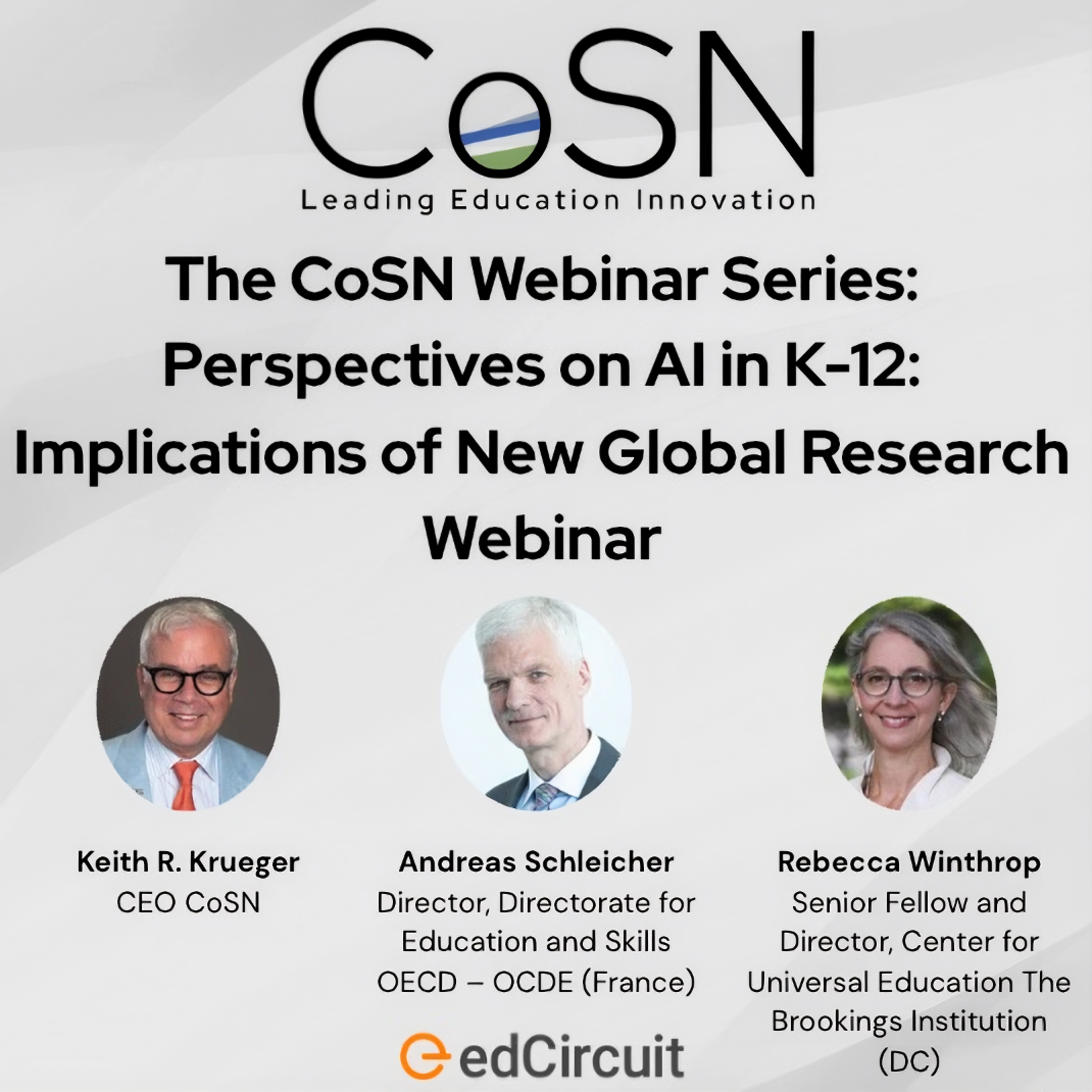
The CoSN Webinar Series: Perspectives on AI in K-12: Implications of New Global Research Webinar
May 1901:00:08Tap to summarizeTwo Global Voices on the Future of AI in K–12 EducationTwo of the world’s most influential education policy leaders come together for a timely, unscripted conversation on what AI means for schools—now and next.Rebecca Winthrop (Brookings Institution) and Andreas Schleicher (OECD), lead authors of newly released, high-profile global reports on AI in K–12 education, go beyond the headlines to unpack what their research really means for district leaders.The Research Behind the ConversationThis dialogue draws from two major global reports:A New Direction for Students in an AI World: Prosper, Prepare, Protect(Brookings Institution)OECD Digital Education Outlook 2026: Exploring Effective Uses of Generative AI in Education(OECD)Key Questions They’ll ExploreWhere do their findings align?Where do they diverge?And most importantly: What should education leaders do next?What You’ll Gain From This ConversationParticipants will hear candid insights on:The biggest opportunities and risks AI presents for K-12 systemsWhat global data tells us about readiness, equity, and impactHow policy and practice must evolve in responsePractical guidance for superintendents, CTOs, and state leaders navigating AI adoptionWhy This Session MattersThis is a rare opportunity to hear two global thought leaders engage directly—with each other and with CoSN members—about the decisions shaping the future of learning in an AI-driven world.FacilitatorKeith KruegerCoSN CEOFeatured SpeakersRebecca WinthropSenior Fellow and Director, Center for Universal EducationThe Bookings Institution (DC)Andreas SchleicherDirector, Directorate for Education and SkillsOECD – OCDE (France)AssetsA New Direction for Students in an AI World: Prosper, Prepare, Protect(Brookings Institution)OECD Digital Education Outlook 2026: Exploring Effective Uses of Generative AI in Education(OECD)Perspectives on AI in K 12: Implications of New Global Research WebinarCoSN is vendor-neutral and does not endorse products or services. Any mention of a specific solution is for contextual purposes. For a complete listing of all CoSN's webinars, please visit: https://www.cosn.org/Produced in partnership with edCircuit.
Transcribe →
The CoSN Webinar Series: Unlocking the Value of Investment
May 1200:55:56Tap to summarizeEdTech value doesn’t speak for itself. Leaders do.K–12 districts are investing millions in education technology—but too often, the story behind those investments gets lost. Data lives in spreadsheets. Impact is felt in classrooms. And leaders are left trying to connect the dots for boards, families, and communities.This webinar is designed for the leaders who have to tell that story clearly, confidently, and credibly.Join a team of experienced K–12 EdTech leaders as they unpack how to translate complex metrics—ROI, TCO, and Value of Investment—into a narrative that decision-makers understand and trust. You’ll learn how to connect technology investments to instructional impact, equity, efficiency, and student outcomes, and how to communicate that value in ways that resonate beyond the IT department.This session goes beyond calculations. It’s about:Framing technology as a strategic investment, not a line itemAligning data with district goals, instructional priorities, and community valuesMaking the case for future investments with clarity and confidenceEnsuring everyone—from boards to parents—understands why this technology mattersIf you’ve ever struggled to explain the value of the technology you support—or to secure buy-in for what’s needed next—this conversation is for you.Because the right story can turn technology spending into shared understanding and sustained support.Note: The Webinar is free for members and available a low cost for non-members to attend live. And the recording will be posted on our YouTube channel for free for everyone: https://www.youtube.com/@CoSNwebPresenters:Frankie J. Jackson, CETL®, RTSBAFormer K-12 CTO (TX)CoSN Subject Matter ExpertMichael Flood, Founder & CEO, Alpine FrogCoSN Committee MemberMaria Stavropoulos, CETL®Director of Technology at Northbrook School District 28 (IL)William Brackett, MCITP, CNE, Network+, A+Director of Technology at Oak Park Elementary District 97 (IL)All registered attendees will receive a recording of the webinar.More Information K-12 Education Technology (EdTech) investments are exponential, especially with the additional funding that has been provided through the pandemic. With millions of dollars being spent on EdTech solutions and services, the need to show Value of Investment and Value of Instruction has never been greater. Join a team of EdTech leaders that will take a deep dive into updating methods in how to capture and calculate VOI (investment and instruction), show Return on Investment (ROI), and measure Total Cost of Ownership (TCO).Meets on Thursdays. May 7, 14 & 21 from 2:00-3:00 ETEducator: Members $149 Non-Members $249; Corporate: Members: $299 Non-Members $499Bulk pricing for the same organization registration-1 to 4 %10 discount, 5 to 10 15% discount, 11 to 15+ discount.This course covers areas of the Essential Skills of a K-12 CTO which guides the study and test for the CETL® Certification.All attendees are eligible to earn 5 CEA hours toward CETL® recertification. A certificate of completion will be awarded to participants who attend all three days.Assets Unlocking the Value of Edtech InvestmentsUnlocking Value of Investment (VOI) and Total Cost of Ownership (TCO) for EdTech Leaders Facilitated Online WorkshopEssential Skills of a K-12 CTOCoSN is vendor-neutral and does not endorse products or services. Any mention of a specific solution is for contextual purposes. For a complete listing of all CoSN's webinars, please visit: https://www.cosn.org/Produced in partnership with edCircuit.
Transcribe →