← The Curbsiders Internal Medicine Podcast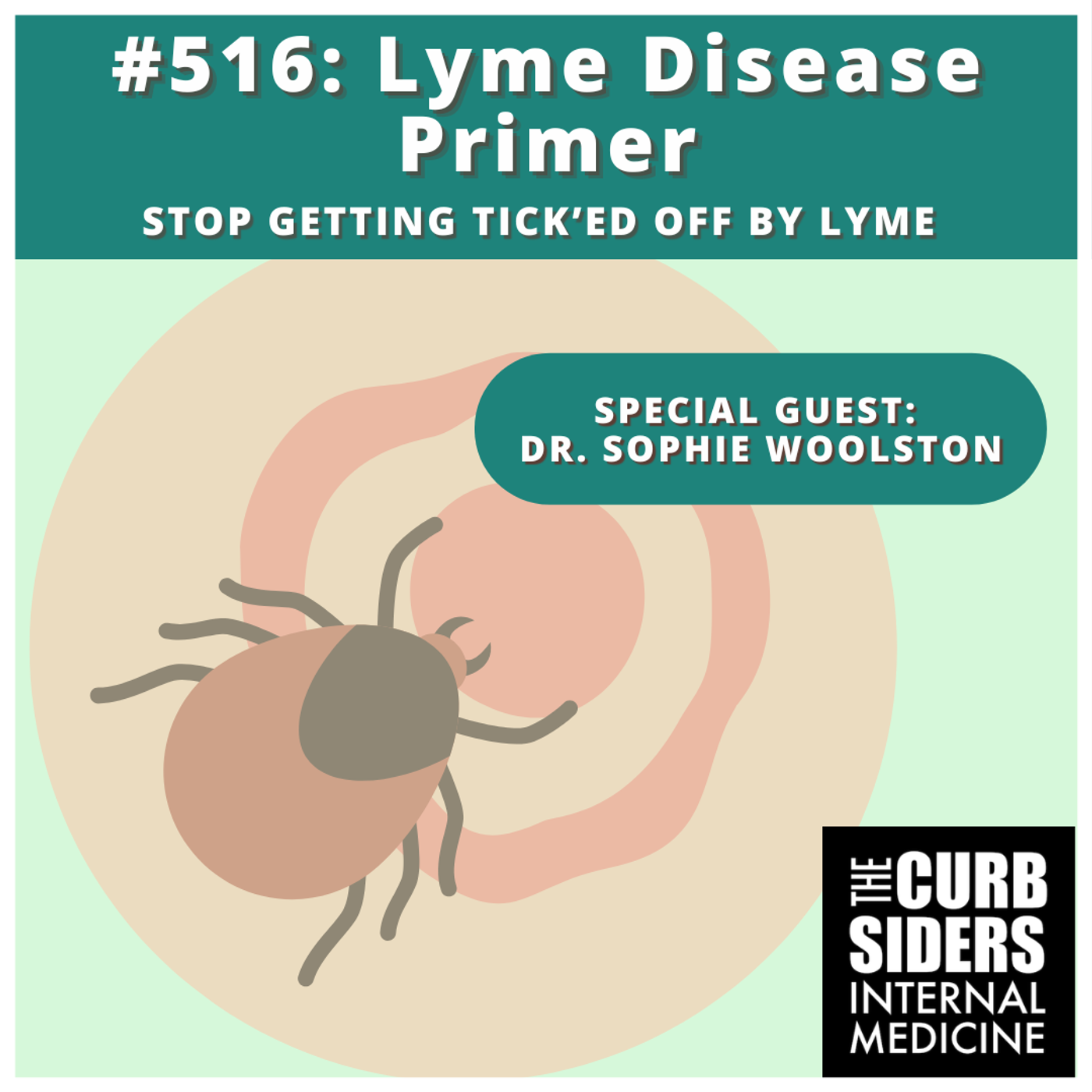
The Curbsiders Internal Medicine Podcast
#516 Lyme Disease Primer featuring Dr. Sophie Woolston
01:18:30
Loading summary
Transcript205 lines
- [00:00]
Dr. Matthew Frank Watto
Hey, before we get to the show, I wanted to remind you to check out our patreon@patreon.com curbsiders. If you haven't signed up yet, sign up now to get ad free episodes, twice monthly, bonus episodes, and a whole bunch of other cool stuff@patreon.com curbsiders. You know, Paul, my landlord. My landlord told me that he needs
- [00:24]
Dr. Paul Nelson Williams
to come talk to me about how high my heating bill is.
- [00:28]
Paul Nelson Williams
Okay.
- [00:30]
Dr. Matthew Frank Watto
So I told him my door is always open.
- [00:34]
Paul Nelson Williams
I like that one.
- [00:35]
Dr. Paul Nelson Williams
It's a good joke for the winter, you know?
- [00:36]
Paul Nelson Williams
Sure.
- [00:37]
Dr. Paul Nelson Williams
We're in the thick of it.
- [00:38]
Dr. Beth Garbs Gasperlin
I was. Wait, is there something about tics?
- [00:42]
Dr. Matthew Frank Watto
I didn't even look for one.
- [00:43]
Dr. Paul Nelson Williams
Beth.
- [00:44]
Dr. Matthew Frank Watto
I'm not.
- [00:44]
Dr. Paul Nelson Williams
You know, it's for the best. Yeah.
- [00:51]
Narrator/Disclaimer Voice
The Curbsiders podcast is for entertainment, education and information purposes only. And the topics discussed should not be used solely diagnosed, treat, cure or prevent any diseases or conditions. Furthermore, the views and statements expressed on this podcast, solely those of those and should not be interpreted to reflect official policy or position of any entity aside from possibly cash, like more hospital and affiliate outreach programs, if indeed there are any. In fact, there are none. Pretty much. We aren't responsible if you screw up. You should always do your own homework and let us know when we're wrong.
- [01:16]
Dr. Matthew Frank Watto
Welcome back to the curbsiders. I'm Dr. Matthew Frank Watto, here with
- [01:19]
Dr. Paul Nelson Williams
my great friend and America's primary care
- [01:21]
Dr. Matthew Frank Watto
physician, Dr. Paul Nelson Williams. Hey, Paul.
- [01:25]
Paul Nelson Williams
Hey, Matt. How are you?
- [01:26]
Dr. Paul Nelson Williams
I'm doing well. Paul.
- [01:27]
Dr. Matthew Frank Watto
Lyme. This is an episode.
- [01:29]
Dr. Paul Nelson Williams
I feel like we're long overdue for another Lyme disease episode. We had a great guest, Dr. Sophie Woolston, and we'll tell you about her in a second.
- [01:38]
Dr. Matthew Frank Watto
But, Paul, why are we here?
- [01:40]
Dr. Paul Nelson Williams
What do we do? What are we doing?
- [01:41]
Dr. Matthew Frank Watto
Paul? We're approaching 10 years now.
- [01:44]
Dr. Paul Nelson Williams
What are we doing?
- [01:44]
Paul Nelson Williams
Are we approaching. I thought 10 years is never going
- [01:46]
Dr. Paul Nelson Williams
to be at 10 years now.
- [01:47]
Paul Nelson Williams
Yeah, yeah, now 10 years is behind us. We're getting old is what we're doing, Matt. But in the meantime, we are the internal medicine podcast. We use expert interviews to bring you clinical pearls and practice knowledge. And as you mentioned, we have a great episode with Dr. Sophie Olston telling us all about evaluating and managing Lyme disease before we even get there. Nat, I'm going to mention that we also have frequent co host, super producer, infectious disease training extraordinaire, Beth Garbs Gasperlin, which I'm still working on. Garbs, how are you doing?
- [02:16]
Dr. Beth Garbs Gasperlin
Well,
- [02:19]
Dr. Matthew Frank Watto
at least she didn't drop the garbs, though.
- [02:20]
Dr. Paul Nelson Williams
Paul I would be lost without that.
- [02:24]
Paul Nelson Williams
But there's a nice consonants with the garbs. Gaspelin so I actually. So, yeah, not that you need my approval, but it's nice. It's just, it's an adjustment after all these years.
- [02:33]
Dr. Beth Garbs Gasperlin
I'll let you know. We strongly considered changing both of our names to Gaspar Telly, but we opted not to do that. Although sometimes we think that we should have done that. It would have been kind of fun,
- [02:47]
Paul Nelson Williams
just infuriate all family members. Well, we are delighted to have you here with us. Why don't you tell us about who we talked to and maybe a little bit more about what we talked about.
- [02:55]
Dr. Beth Garbs Gasperlin
We had a very good discussion. This is a topic that is near and dear to my heart as an ID Fellow and as a New England resident. Unfortunately, a lot of personal experience with it. And we had one of my favorite doctors, one of my mentors, Dr. Sophie Woolston, on and just got into a great discussion about kind of presentations of Lyme when folks are coming in after they've had Lyme treatment, navigating those challenging discussions. And to tell you a little bit more about Dr. Woolston, she is an attending infectious disease specialist at Maine Health. She is the director of their cardiovascular Infectious Disease Service. She's also an associate professor of clinical medicine at Tufts School of Medicine. Her clinical interests are in infections in the immunocompromised or critically ill state. She enjoys teaching trainees, providing mentorship and practicing medicine in a multidisciplinary team. And without further ado, our discussion, a
- [03:54]
Dr. Paul Nelson Williams
reminder that this and most episodes will
- [03:56]
Dr. Matthew Frank Watto
be available for CME credit for all
- [03:58]
Dr. Paul Nelson Williams
health professionals through VCUhealthcurbsiders.vcuhealth.org
- [04:05]
Dr. Matthew Frank Watto
Sophie We've been talking for a while now, really excited
- [04:08]
Dr. Paul Nelson Williams
to get into this topic.
- [04:09]
Dr. Matthew Frank Watto
But before we do, the audience always
- [04:12]
Dr. Paul Nelson Williams
wants to know, like, what is a hobby or interest that you have outside of medicine right now other than letting your twins cook for you?
- [04:21]
Dr. Sophie Woolston
Not to reinforce stereotypes, but I love harnessing microorganisms for good. We do a lot of fermentation in my house. Kefir Kombucha. We're probably getting into other stuff this summer, but we love all that stuff.
- [04:38]
Dr. Paul Nelson Williams
Paul we'll get to Lyme another night. We're going to just dig in on this fermentation
- [04:44]
Dr. Matthew Frank Watto
masterclass. We got some free master classes because
- [04:47]
Dr. Paul Nelson Williams
they sponsored a few episodes and they're great. And I watched the one on fermentation. They were talking about all those things like kombucha and everything. Sourdough bread is the closest that I've gotten to making my own fermented food. So what's the easiest to make? What should I try next?
- [05:07]
Dr. Sophie Woolston
Kefir is really. So I actually would say with all these things, they're remarkably easy. Right. They're as old as humans are and they've been sort of passed on through generations. And so by definition, they're pretty simple. Kefir use scald milk and put in a starter and then put it in jars and wait.
- [05:27]
Dr. Paul Nelson Williams
Okay, I could do that. And I'm not gonna like, give myself some like, awful diarrheal illness by doing that?
- [05:34]
Dr. Sophie Woolston
Like, no, I'll just.
- [05:37]
Paul Nelson Williams
Intolerant, probably.
- [05:39]
Dr. Sophie Woolston
Although actually it actually is more tolerable than just milk. Interestingly enough, kombucha is also really fun to watch it ferment, so I can't recommend that one enough as well.
- [05:54]
Dr. Paul Nelson Williams
I think it's.
- [05:55]
Dr. Matthew Frank Watto
What's it called, Paul the Scooby or something like that.
- [06:00]
Dr. Paul Nelson Williams
Did you try to make it before?
- [06:01]
Paul Nelson Williams
Yes. Yeah, I can't remember what that all stands for. I'm ashamed. But no. I think this was a Patreon episode where Matt wasn't kidding. We're going to go down the rabbit hole.
- [06:11]
Dr. Paul Nelson Williams
But.
- [06:11]
Paul Nelson Williams
But there was a brief point in time where I was making my own ginger beer with an actual ginger bug and sort of allowing that to ferment and then actually sort of making homemade carbonated soda, which was actually very satisfying too. Same concern. I'm always worried I'm going to poison myself, but I'm still here to tell the tale. It tasted pretty good.
- [06:26]
Dr. Sophie Woolston
I respect that.
- [06:28]
Dr. Paul Nelson Williams
Well, I'm impressed. All our guests have such cool hobbies, Paul. I mean, I got to try to make some kefir and see how it goes. And then if I die and the podcast, or at least Beth will start hosting in my place along Paul, then it'll be fine.
- [06:45]
Dr. Matthew Frank Watto
It'll be seamless.
- [06:46]
Paul Nelson Williams
Paul be doing memorial episodes. That'll be great. Well, before we go too deep into Matt's potential demise, I guess one more follow up question I always do like to ask about. Is there any advice or feedback that you've either gotten or that you'd like to give to your learners that you
- [07:03]
Dr. Sophie Woolston
find especially meaningful, I usually love to advise mostly learners who they rotate on our infectious disease service. Coming from a variety of different interests, and I know it's cliche and perhaps really basic, but I really advise them to lean into what they're most passionate about and I ask them to kind of think about the future, whatever subspecialty they're in, and think about what kind of minutiae they're going to be focusing on. For me, I love, love, love working with microtechs and sort of wondering about interpretations of M I C debating on different antimicrobials based on side effect profiles. And I can't imagine sort of choosing different statins, for example. And I know there are people who live for that and I'm glad they do. But I think it's really lean into to sort of thinking about the minutiae of something you're passionate about because I think it'll help you work hard and really work for patients for something you believe in.
- [08:04]
Paul Nelson Williams
You're talking to two men who have done, I think, no less than 27 episodes on hypertension for their podcast. So you're preaching to the choir here.
- [08:13]
Dr. Paul Nelson Williams
All right, we should get to the topic. We have a lot to go through. Beth, can you read our first case from Cashlack?
- [08:20]
Dr. Beth Garbs Gasperlin
I sure can. Okay, this is a patient from Cashlak north. Might be somewhere in the great Northeast somewhere. Patient is a 32 year old woman. She has no major past medical history and she presents in your primary care clinic for about three days of worsening malaise. She's reporting a fever at home to 101 and some body aches. She takes no medications. She did recently return from a hiking and camping trip with her partner near Bar Harbor, Maine. It's mid July currently. She reports having no known tick bites, but she did sleep outside in a tent and generally wore shorts while hiking. Didn't use any DEET or insect repellents. Her vitals are normal, but she's tired and well appearing. She has a rash noted on the back of her left shin. So a lot of alarm bells going off in this case of course, but I'd love to kind of hear your broad definition of what is Lyme disease.
- [09:18]
Dr. Sophie Woolston
I'll first start. I love a good fever vignette. I guess it's not quite an fuo, but I'll resist the questions about dysuria and Covid exposures and dental abscess and so on and so forth. So Lyme disease. So Lyme disease is a tick borne vector infectious disease caused by a spirochete called Borrelia burgdorfi and sort of parenthetically there are other borrelias that cause Lyme like conditions otherwise otherwise in North America and Europe as well. And Lyme disease essentially is a syndrome which has a variety of symptoms and can make People sick and we can treat it.
- [10:05]
Dr. Beth Garbs Gasperlin
So geographically, where are we most worried about Lyme? I know you were mentioning that there's some other, you know, tick borne pathogens, but where is Lyme's hot spots?
- [10:17]
Dr. Sophie Woolston
Well, I think it's a really interesting question because I think that's really changed over time. The cdc, if you look back in like their historical Data section, have three excellent maps for Lyme. One is like 1995, one is 2010 and one is 2023. And really the answer to your question is there were some initial hotspots. It was first sort of discovered in lyme, Connecticut in 1977. So we think about the southern Northeast or New England region, the country being a hotspot, as well as possibly in Minnesota and Wisconsin. And, and essentially the map over time has just expanded from those areas, both north into New England as well as south into the Mid Atlantic region. And it's slowly been marching its way over to New York State and closer and closer to the, to the Mississippi river and then essentially the Great Lakes region has slowly expanded south as well into Illinois. And what's interesting about the maps is they've both sort of expanded in regions as well as we think probably expanded in incidence as well in terms of sort of numbers of people who are being diagnosed with Lyme.
- [11:36]
Dr. Beth Garbs Gasperlin
And is there a seasonality to it? Because I know I mentioned the timing of year when this person's coming to you.
- [11:44]
Dr. Sophie Woolston
Yeah. So when we. Essentially, to answer that question, you need to think about when ticks are around. And so we need to have essentially a time of year where it's above freezing. And generally we need to allow for ticks to mature enough that they're able to need to take their first blood meal. And so typically we think about possibly mid to late spring as well as summer. And now we're also starting to talk about fall and even late fall. We here in Maine experienced a fairly late hard frost this past year and people were experiencing tick borne related diseases even as late as November here.
- [12:29]
Dr. Beth Garbs Gasperlin
Yeah, I'll just have the terrifying aside that we're recording this episode in the middle of winter and we had a patient this week on our ID service who, and he's somebody who lives in New England. So I do think he knows what the ticks look like. He said he was quote, unquote, covered with ticks recently and it just terrified me because I just did not associate this time of year with ticks. But maybe I need to start thinking about it more.
- [12:52]
Paul Nelson Williams
Well, I guess so. Let me ask the Question a bit a different way. So if someone comes in and says, I was covered in ticks, now I have a fever and some rashes, I feel like I could probably crack that case wide open. But the patients may not present even as sort of like, apparently this patient had read some board exams or what have you and kind of gave us a lot of great information. But how do you take a history if you suspect Lyme? Is that easy? What are the historical details that are most important to you in infectious disease doctors to kind of help move you forward?
- [13:15]
Dr. Sophie Woolston
So I want to know if the patient themselves have been outside, if their pets have been outside, or if they've had any exposure. I'll even say to close habitants who have been outside, sort of anything that would allow ticks to crawl onto them. And that's really interesting to share that experience of having patients having tick exposure this sort of late in the year or early in the year, depending on how we're seeing it. And that certainly probably needs to have me rephrase is my response to that, which is I think when temperatures are above freezing, ticks can be alive. And it certainly needs to be something that we're worried about.
- [14:01]
Dr. Paul Nelson Williams
Yeah, it just, I mean, my take home has been, I mean, I've lived in the northeast and I've just sort of assumed that if someone has a febrile illness, a tick borne illness is always kind of on my differential. And anytime there's like rashes or joint pains, things like that, I'm just sort of thinking, could Lyme be at play just because of where I live, or could there be Lyme plus something else at play? So it just sounds like we just have to have a high degree of suspicion and not just completely rule it out just because of the time of year, because the climate can be weird and it can be above freezing at different times of year. I don't know any modifications to that.
- [14:47]
Dr. Sophie Woolston
I really like that. So people coming in with fevers, joint pains, rashes, and then the other just thing that I'd add to that is this is often something that I think about when patients have fevers without other specific localizing symptoms. So for me, if you come in with a fever and dysuria, I'm much more focused on cystitis, for example, or fever and pain around your PICC line. I'm worried about that localizing area. But if it's as you suggest, a much more generalized syndrome, this certainly needs to stay in my differential. Great.
- [15:22]
Dr. Paul Nelson Williams
I think that's, I think that's great.
- [15:29]
Dr. Matthew Frank Watto
This episode is brought to you by Continuing Education Co. Hey curbsiders. Have you ever chosen a CME conference because of the destination, only to be disappointed by the education once you got there? That's where Continuing Education company really stands out. They host conferences in places clinicians genuinely
- [15:46]
Dr. Paul Nelson Williams
want to visit, like Hawaii, Alaska, the
- [15:49]
Dr. Matthew Frank Watto
Florida Keys, Kiawah Island, Nashville and New Orleans. But they pair those destinations with education that actually delivers. Their meetings are structured as half day morning sessions so you get focused, practical learning without feeling overwhelmed. And because your afternoons are free, you have time to enjoy the destination and reflect on what you learned, which makes it far more likely to stick. That balance is why so many clinicians attend for the location the first time and then keep coming back for the education. And if traveling isn't in the cards right now. Continuing Education company also offers a wide range of online CME options, including live webcasts, on demand courses and recordings from recent conferences. It's the same expert faculty and evidence based content just available whenever and wherever it fits your schedule. And for Curbsider's listeners, there's a special offer. Use promo code CURB30 for 30% off all online courses and webcasts. That's promo code CURB 30 for 30% off all online courses and webcasts. See for yourself why Continuing Education Company is considered a leading source for medical education education. Visit cmemeeting.org curbsiders to learn more. That's cmemeeting.org curBSiders. This episode is brought to you by Mint Mobile. Are you one of those people that
- [17:13]
Dr. Paul Nelson Williams
actually likes your money?
- [17:14]
Dr. Matthew Frank Watto
Well, unfortunately traditional big wireless, they like your money too. So if you're tired of spending hundreds on crazy high wireless bills, bogus fees and free perks that cost you more in the long run then a premium wireless plan from mint mobile for 15 bucks a month might be right for you. You know you want to save money, so stop overpaying for wireless just because that's how it's always been. Mint exists purely to fix that. They're here to rescue you with premium wireless plans starting at 15 bucks a month. They all come with high speed data, unlimited talk and text delivered on the nation's largest 5G network. And you can bring your own phone and number and activate with ESIM in minutes and start saving immediately. No long term contracts, no hassle. Ditch the overpriced wireless and get three months of premium wireless service from Mint Mobile for 15 bucks a month. Look, I'm in the market for a new wireless plan and Mint Mobile has got to be a place you're looking. You got to take this seriously because you got to save money and you got to get that money out of big wireless hands. If you like your money, Mint Mobile is for you. Shop plans@mintmobile.com curb that's mintmobile.com curb Upfront payment of $45 for three months. Five gigabyte plan required, equivalent to 15 per month. New customer offer for first three months only. Then full price plan options available, taxes and fees extra. See Mint Mobile for details.
- [18:39]
Dr. Paul Nelson Williams
So let's talk about the stages of Lyme, because this is always. I know there's a bunch of stages. They always kind of get jumbled up in my head. Do you have an easy way that you explain that to learners?
- [18:53]
Dr. Sophie Woolston
Yeah. Well, let's talk about our patient that we're discussing. From my perspective, I wonder if she has early localized Lyme. And that's sort of the first stage that we think about, and this is sort of the hallmark sign of early localized Lyme is our EM rash. Right? And so this is an erythema migrans skin lesion. Often it's described as a rash as well. And people often think about this as a target lesion. And the best way to try to visualize or imagine what this looks like is an area of central necrosis around where the tick bit you. Around that is an area of clearing followed by an external circle of erythema. So an EM rash is pathognomonic for early localized Lyme. If you see it, you've made the diagnosis. I've got to say, I really do struggle with this. When it's classic, I'm happy, I'm good. I actually don't need anything else to make a diagnosis. I think the problem with this is that they rarely are classic in appearance. And part of this is sometimes they're extremely large and you may miss the external area of erythema. Sometimes they're in places where people have a hard time seeing under a strap behind a knee. Sometimes people's skin pigmentation either makes them very vibrant or very dull, and sometimes we just miss them altogether. And so it is great when we see it, but I just really want to emphasize that if we don't see it, you still can have early localized Lyme in addition to an EM rash. Often patients will have systemic symptoms like our patient has. They can have fevers and myalgias and arthralgias and malaise as well. And so that's early localized Lyme, and generally we think that that occurs days to weeks after a tick bite. And when we do miss that, maybe we. Maybe patients attribute symptoms to other causes or have a mild enough syndrome that we do not notice that they're having those symptoms. Patients can experience symptoms of early disseminated Lyme, and this can happen weeks to months after getting bitten by a tick. And this can include things that often patients and family members and friends at parties often get pretty concerned about when we start talking about them. And from my perspective, the one that I personally sort of see the most often is probably Lyme carditis. And so this includes AV nodal block cardiomyopathy, or more rarely, myopericarditis. Sometimes patients can also experience neurologic symptoms. And this can occur in about 15% of patients with early disseminated Lyme. And this can come in sort of frustratingly a variety of flavors. So this can be cranial neuropathies, peripheral neuropathies, more rarely can be meningitis, and probably extremely rare, can be encephalitis as well. Patients can also experience migratory arthralgias rarely, and I've actually not personally seen this, but can also experience multiple EM lesions or rashes at this time, and rarely can experience hepatitis or renal problems related to early disseminated Lyme. And then finally, late Lyme disease is typically considered to be a Lyme arthritis. And we most of the time see this as a mono or oligoarticular arthritis, where the most classic thing that I see is that patients are not complaining about severe pain of their joint. They're complaining that generally one joint is. Generally the knee is swollen and red and achy, but it rarely is significantly painful. There have been other late neurologic manifestations of Lyme, but these typically are not seen in the modern era where we have a recognized treatment for Lyme.
- [23:38]
Dr. Paul Nelson Williams
Yeah, it's just. It's so much. Paul, what are you going to say?
- [23:42]
Paul Nelson Williams
I was just going to ask, do we have a sense of how often patients with early localized disease then progress to the disseminated and sort of later stage? If we just ignored this person and sent them on their way and said, just rub some dirt on it and walk it off, I guess, how likely are they to then progress through the later stages of Lyme disease? Do we have a sense of how often it progresses to the late disseminated?
- [24:03]
Dr. Sophie Woolston
So I would say that probably occurs in about 15 to 25% of patients.
- [24:09]
Dr. Paul Nelson Williams
So in other words, if we didn't treat, if we didn't recognize it, the body can fight it off. And not everyone's going to develop late Lyme disease.
- [24:21]
Dr. Sophie Woolston
The answer is yes, but I'll also just articulate the answer is probably also unknown about exactly how many patients can fight it off or, for example, be asymptomatic. But there certainly are patients who experience both.
- [24:36]
Dr. Paul Nelson Williams
Yeah, I mean, it just seems so common. And it's such, you know, the early symptoms are just so nonspecific that it's easy for someone to just miss the rash and then think they had, like, a viral illness or something. And then it's just, maybe they pop up with more symptoms later, maybe they don't. And I think, I guess that's why it's impossible to know.
- [25:07]
Dr. Sophie Woolston
That is correct. I often do go down this rabbit hole of really worrying about how many patients present with sort of vague symptoms and how many patients am I missing for early Lyme disease and may progress. And I do have to relieve some of that anxiety, sort of contemplating how few people do present to our emergency room with AV nodal blockade or cranial nerve neuropathies related to Lyme disease. That's fortunately as common as Lyme disease is becoming. Later manifestations are not as common as I would fear.
- [25:46]
Dr. Paul Nelson Williams
Yeah. Well, let's talk a little bit about the testing that might help. Right. So if someone, you told us if someone has that obvious rash with, like, the central necrosis and then some clearing and then the surrounding erythema that, you know, then we're going to say, okay, this is Lyme we can treat, but if they have a rash that's maybe a little bit less typical or we didn't get to see the rash and the exposure's not that clear, what about testing in that early time and then just testing in general? Can you talk about the characteristics of it, like sensitivity, specificity, that sort of thing?
- [26:23]
Dr. Sophie Woolston
Yeah, absolutely. And this is actually, from my perspective, Lyme disease is complicated because it can manifest so many different syndromes, but it's also really complicated because we don't have excellent testing. And the testing can be problematic in that there can be false negative and false positive testing, and different test results mean different things in different stages of Lyme disease. So it can be really complicated. So in a patient with early Lyme, one of the issues with getting testing and why I'd recommend that one doesn't necessarily get serologic testing is that it is possible to have a negative IGM at that point, to have a falsely negative test. And so it can often not be helpful. And so typically, again, if you see a rash that you're convinced is Lyme disease. From my perspective, you've got a diagnosis, go ahead and treat. If you have a. And I'd say that's in the minority of time. If you have a syndrome and a rash, that you're wondering if it could be Lyme disease, my typical practice is to actually go ahead and treat. I do not find it helpful at that point in time for early Lyme disease, even if I'm not certain to order serologic testing. And I would add that the other problem, and I'll probably repeat this aspect as we start talking a little bit more about testing, is that the testing for Lyme can often is antibody testing. So it's often showing an exposure present or past to Lyme, and so it can pick up prior exposures. And one of the problems we have, particularly with the IgM aspect of the antibody testing, is for many patients, it can actually stay positive for years after an initial exposure to Lyme.
- [28:34]
Dr. Paul Nelson Williams
Oh, that's curious. So the igm. Not the igm, which is the one we usually think of as being acute, can stay positive for years after Lyme. Does the igg also stay positive for years? That's the one that I would expect to just be positive maybe forever.
- [28:49]
Dr. Sophie Woolston
And I'm not being coy. It can, but both also don't. Yes, it often does stay positive, but then some patients can also revert back to zero as well, and that's very difficult to predict. And who'. Whose. Whose patients would sort of. Their slate would be cleared, so to speak.
- [29:07]
Dr. Paul Nelson Williams
Yeah. So this is kind of like one of those things where we're detecting, we're detecting a prior exposure, but we can't. We're not detecting like live organism. That's. So we don't. We don't know for sure. And we just have to kind of, based on the history and the whole picture, we're trying to put the. Combine this antibody testing with the clinical picture to say if we think they're still infected, if they need treatment.
- [29:32]
Dr. Sophie Woolston
Correct.
- [29:33]
Dr. Paul Nelson Williams
Paul, this is the kind of stuff you love, right? Where it's not black. There's not a clear answer.
- [29:39]
Paul Nelson Williams
There's no good answers. Yeah, no. And I guess I may have raised this in the episode or on the show before, but my senior thesis in college, 17,000 years ago was I actually hung out in butcher shops during deer season, and when people brought deer carcasses, I scraped off deer ticks and I ran PCR to look for co infections. And I was stunned at how often I saw. I think I looked for Bartonella babesia and anaplasma, if I remember, in addition to, in addition to Lyme and it was just, I mean it was there all the time. I don't remember the exact numbers, but I guess this is all my long winded way of asking is there a role for looking for co infections or when would you think about doing that? Because it seems like better safe than sorry, but also seems like it can get you into trouble and may not actually give you information that you actually need.
- [30:21]
Dr. Sophie Woolston
One follow up question, where was this research that you were doing?
- [30:25]
Paul Nelson Williams
Oh, this is at York College of Pennsylvania. My, my undefeated in football since 18.
- [30:30]
Dr. Sophie Woolston
Something fascinating. What a great project. So from my perspective, it's a great question and you're essentially asking what is the role for assessing for CO infection? The Iaxodes scapularis tick carries not just Lyme disease, it also carries anaplasmosis, it carries babesiosis, it carries Powassan virus and other encephalitis as well. And so I typically consider tick panel testing, which is sort of a vague term that often health systems will use in the context when I'm not thinking about someone with a pathognomonic Lyme condition. So if I'm seeing someone with a bullseye rash or target lesion, I'm thinking about Lyme disease. If I'm wondering about monoarticular arthritis, something about Lyme disease, if a patient is coming in with a fever or broader or vaguer symptoms, I do usually want to cast a wider net and at that point I would absolutely reach for a tick panel or a panel that can test for both. Lyme disease. Anaplasmosis and Babesia are usually the 3 on panels I'm most familiar with. And curiously, just for what it's worth, since we're talking about Lyme testing and how frustrating it can be, we have a PCR for anaplasmosis and we have a PCR for babesiosis. We just don't have that type of testing for Lyme, which I think is really interesting. And typically. So Lyme testing typically has been a two stage testing modality where we start with an EIA and confirm with a western blot. And essentially what you get reported is a series of bands, essentially. And it's usually a number of bands that would sort of report. They test for number of bands for IGM and igg and typically what is considered to be a positive IGM is two out of three of those bands need to be positive and for an IGG it's greater than 5 of 10. And I think one of the sort of. One of the sort of nice cheap tricks I've had as an infectious disease doc is often just taking a look at some testing results that other physicians will sort of send to me and ask me how to interpret. And it's often just helpful to have that trick in my back pocket. It is helpful to be able to say as a way to rule out false positive tests. No, there are not enough positive bands for this to be considered at all. A positive test.
- [33:13]
Dr. Paul Nelson Williams
Yes. And so you mentioned the eia. That's the enzyme immunoassay. So that's like step one, it's like, are we detecting any Lyme antibodies? And then step two is like, okay, now let's dig into the, you know, the specifics. Is there at least 2 of 3 IGM? Is there at least 5 of 10 IGG? And if those criteria met then we were convinced that they have. We have a case of Lyme. It's not a false positive anyway.
- [33:40]
Dr. Sophie Woolston
We are convinced that it's a positive test. Correct.
- [33:42]
Dr. Paul Nelson Williams
A positive test. Right. So not necessarily a case. Right. If they're. Yeah. If the clinical syndrome didn't fit, then it. Then it still would not be useful.
- [33:52]
Dr. Sophie Woolston
And I think that I'm going back to. There are seem to be many situations in where Lyme testing is run as a large battery of tests. As you say, for syndrome, that doesn't quite make sense. And sometimes positive testing can reflect prior exposure. And often the question does come up, particularly if someone's critically ill or has a vague syndrome. Even if you're not certain, do you treat? Even if you're not sure how to interpret the test.
- [34:24]
Dr. Matthew Frank Watto
Well, Paul, this is part of your fatigue panel, right?
- [34:27]
Paul Nelson Williams
100%. Yeah. Vitamin B12 level and Lyme serologies. And that'll pretty much do it for me.
- [34:33]
Dr. Sophie Woolston
I mean, I think it's actually part of me. I actually think that's, that's not a bad idea though. Yeah. And as long as you're interpreting it with, with caution.
- [34:42]
Paul Nelson Williams
Nope, nope. Diagnostic.
- [34:45]
Dr. Paul Nelson Williams
It's a running joke that, that Paul. Paul is very judicious with his testing. So. But it's a running joke that he just, he just shotguns like every test possible. Like everyone gets an A and a. Everyone gets a Lyme. He's just creating problems for himself all over the place with, with that. So maybe we should get.
- [35:06]
Dr. Matthew Frank Watto
Beth, do we have results for our
- [35:08]
Dr. Paul Nelson Williams
patient that we've been talking about? I think we have a lot of good background now to understand how we might interpret them. So do we have results here?
- [35:15]
Dr. Beth Garbs Gasperlin
Lyme serologies were collected, they were negative, but now we know how to interpret that. In the setting of her clinical picture, let's say she had a very pathognomonic EM rash. She's had previous testing in the past that was negative as well. Sometimes that can be helpful. If someone's had negative in the past and positive, that's new. And then she did get co testing because they were worried of her exposure history with the level of Babesia and anaplasmosis near Bar harbor, that was negative as well. So now we're at the point where we have a diagnosis we've made despite the testing not really being particularly useful. So how do we treat Lyme and for how long?
- [35:54]
Dr. Sophie Woolston
Fortunately, we have good old doxycycline, which is a wonderfully cheap and well tolerated drug. And so for early Lyme disease, disease we typically treat for 10 days.
- [36:07]
Dr. Beth Garbs Gasperlin
And what do you do if someone has an allergy to doxy, God forbid, one of our favorite antibiotics or some other contraindication like pregnancy or some other, you know, she's going to be sunbathing and she can't stop herself from doing that. What would we do?
- [36:23]
Dr. Sophie Woolston
So I want to say actually doxycycline allergy is remarkably rare and I'm so happy about that. I actually think your last example is pretty well in pregnancy, but sort of concern for sun exposure is probably the most common concern I've had. I typically that case would reach for amoxicillin. Cefuroxime is also an alternative. There are certain situations, particularly like Lyme arthritis, where cefuroxime is less well studied. And so that is a drug that I've least frequently reached for. It's typically amoxicillin.
- [37:00]
Dr. Beth Garbs Gasperlin
And for this patient, she's a hiker and she's going to be outside again. What's your kind of spiel for tick safety that you tell people to kind of how they're going to avoid this in the future
- [37:14]
Dr. Sophie Woolston
in terms of prevention of tick bites? Yes, here is my spiel. So the best advice that I can have is having a protective layer against your skin. Skin is my number one. And so in your vignette you mentioned that she's wearing shorts. From my perspective, you've got to wear pants and tuck them into your socks, which doesn't matter what it looks like.
- [37:42]
Paul Nelson Williams
It's my day to day wear.
- [37:45]
Dr. Sophie Woolston
I strongly recommend in general when you're out hiking, also to wear a hat, which is obviously sun protection, but is covering your head from any Sort of brush that you may be sort of exposed to on your head as well as collared shirts and ideally long sleeve shirts as well. Again just protecting your having a barrier against your skin. It's really interesting. DEET is certainly deet insect repellent is certainly my number one go to and sort of looking into the data. There's a little bit of a variety of how well that works again against ticks. And I think the rub really is it really depends on how well you apply it. And so what I take from that is I apply a thick layer of DEET whenever possible and I don't love breathing it in or getting close to my eyes. So I like to apply it to the outside of my clothing typically. And then there are other chemicals including permethrin that you can actually wash your clothing in. And I, I certainly do that. I have children who love being outside in the summer and we have sort of a set of clothes that they wear when they go outside and we wash their clothes about every six weeks and that as well. And I think that's actually really good for socks and under, pardon me, socks as well. So I think so skin protection and then insect repellent. And then this doesn't quite relate to the sort of hiking part, but just in terms of sort of home maintenance. It's actually really important to maintain and remove any brush or any invasives from around your property. Sort of low lying stuff where your body can rub against branches or brush. And then there cannot be said enough about tick checking and then showering or bathing after outdoor exposure. Both. It's just sort of having good contact with, with taking a look at your own skin or your loved one's skin as well.
- [39:53]
Dr. Paul Nelson Williams
Yeah, I heard ticks like they crawl around for a while before they decide where they're gonna try to bite you and start feeding. So I guess the shower, removing the clothing and stuff like that after you and doing the checks like you can find them before something bad happens. The one thing just before we leave the treatment area because of Paul's experiments, we know there's a lot of co infections but we're, you know, babesiosis is not treated with doxy. Is that all of a concern? I mean I don't, I usually if someone has a case of Lyme like this patient here, I just treat for Lyme and I don't, usually don't test for the other ones. But should we be testing for everything if someone has Lyme?
- [40:44]
Dr. Sophie Woolston
I think it depends on the case. If someone has a vague fever Without a localizing rash, I would consider doing a tick panel. And I would say my concern increases the sicker they are, the higher their fevers and the greater their syndrome. Okay. In particular, I think my concern is that babesiosis, which is our form of malaria here in North America, can make people really ill. And so it is one that I don't want to miss. And so, again, my concern goes up the sicker. The presentation of the patient.
- [41:29]
Dr. Paul Nelson Williams
Yeah. Okay.
- [41:36]
Dr. Matthew Frank Watto
This episode is brought to you by figs. And here at Curbsiders, we're always talking about the latest medical breakthroughs. But if I'm being honest, there was one big thing that we weren't seeing any major advancements in, and that was medical scrubs. The ones I used to wear were stiff, itchy, boxy, and they definitely did not fit right and did not look good. Then about five years ago, I started to notice all these people in the hospital were looking great, and I got my hands on a set of figs. And I remember thinking, wait, how can scrubs actually look this good, even on me? Because let's say I'm not exactly blessed in the looks department. Figs are made for all of us in healthcare.
- [42:13]
Dr. Paul Nelson Williams
They're lightweight, breathable, antimicrobial, and they have
- [42:17]
Dr. Matthew Frank Watto
pockets for your stethoscope, your pager, parking tickets, whatever you got in there. Probably snacks. If you're like me, you got snacks. I own five pairs of FIG scrubs. I don't wear anything else. If I'm in scrubs, I'm in figure figs. We've teamed up with figs and now curbsider's listeners can get 15% off. Just go to wherefigs.com and use the code figsrx. That's wherefigs.com and use THE CODE FIGSRX for 15% off. Hey, listener, you're a devoted clinician. Your patients, they get your best. But if you're finishing charts and admin work, work during nights and weekends, it's time to meet Fried. Fried is more than an AI scribe. It's an AI assistant that writes your notes, automates coding, creates referral letters, patient instructions, answers medical questions, analyzes patient history for smarter visit prep, and pushes everything into your EHR with just one click. Freed can be used across all specialties for in office as well as virtual visits, and works in over 90 plus languages. While it only takes minutes to learn and requires zero IT setup, Freed's White Glove US based success team is available within minutes for every customer, no matter the size of the practice. Join 26,000 clinicians who get to focus on patience, not paperwork. Use code FREED50 for 50 off your first month at FREED AI.
- [43:48]
Dr. Paul Nelson Williams
That's FREED AI.
- [43:50]
Dr. Matthew Frank Watto
And use the code FREED50 for 50
- [43:53]
Dr. Paul Nelson Williams
off YOUR first month. Month. Paul, are you happy with this so far? You have any. You look pensive.
- [44:04]
Paul Nelson Williams
We're doing great. But I guess before we move on and talk about sicker patients, can I just do some quick hits here? So I guess a couple questions I had. Is it worth litigating what the tick looks like? So I feel like having patients describe and is it worth sort of arguing, was it a dog tick or a deer tick? Is that. Or if a patient brings a tick in, how useful that. I guess I'd like to get up more sort of tick specifics because I feel like this comes up in my practice on a day to day basis. But let me start with the first question.
- [44:31]
Dr. Beth Garbs Gasperlin
Nurses that have been giving me ticks in little vials, I mean, so many. I've gotten so many. And a lot of times I'm just like, I don't know what to do with this. This tick was found. It's also a little disturbing how many ticks are found on people's bodies in hospitals. But that's an aside.
- [44:47]
Dr. Sophie Woolston
My response is that. That they're guilty. Essentially, you're guilty. I want to believe that it is a Lyme transmitting tick, and I love being shown all these little critters, but it is not necessary. I don't need to be convinced, I think is my response.
- [45:08]
Dr. Paul Nelson Williams
So how are we going to remove these? I mean, if they're crawling on the patient, that's easy, but if they've already attached, what's the best way to remove them? I think Beth joked about an open flame. Is that the right way to go?
- [45:23]
Dr. Sophie Woolston
Absolutely not. I'm worried we're going to create a second issue. Need to send you to a burn clinic, for example, so let's avoid that. So the most important thing, of course, with tick removal is that you focus on trying to remove the mouth part of their body. That is what. What is essentially the infectious agent. And so the best way to do that is try to get a good grip of the tick with something like tweezers, as close to the mouth part as possible. Ideally, you don't want to smush the mouth part if you're. If you're able to. And what I have found to be the most helpful is to give several strong tugs and relax and then tug again a couple of times. And I have been incredibly surprised about how strong their grip is on human skin. And I am a fan, if necessary, of taking a little tiny bit of the person with me, if necessary.
- [46:30]
Paul Nelson Williams
There's a nice annals in the clinic review, I think from 20, so it's a little bit older now on Lyme disease. And they describe tick removal in great detail and they talk about applying steady pressure because the mouthparts will eventually fatigue. And that phrase is going to rattle around my brain for the next 17 years. Like I just. The idea of tics getting tired of holding on because you're applying gentle traction, all that is just very upsetting to me. And there's no point to that story other than it's a great article and that description I found deeply upsetting.
- [46:56]
Dr. Paul Nelson Williams
I was going to bring up the same thing, Paul. I was going to bring up the same thing about. I remember that phrase, the mouth parts getting fatigued. That is.
- [47:03]
Paul Nelson Williams
Thank you.
- [47:05]
Dr. Sophie Woolston
I actually think that's great encouragement because the, the, the person is often a screaming child or someone, a loved one that you're, you're trying to help. And it's often very upsetting as you're applying gentle but consistent pressure to a parasite.
- [47:19]
Dr. Beth Garbs Gasperlin
So the other thing that has come up for me personally, unfortunately, is when I, I've encountered ticks after you pull them off, they're also very, very hard to dispose of. They are like made of iron. I don't know what they're made of. They're like, they bounce back. I've tried killing them with things and they, and they continue to survive. So I feel like that's also something.
- [47:36]
Dr. Matthew Frank Watto
Put them in a piece of tape
- [47:37]
Dr. Paul Nelson Williams
and just, you know, tape it together or flush them down the toilet, I guess, I don't know.
- [47:42]
Dr. Beth Garbs Gasperlin
So I had to flush them, but they cannot, they have to be like very crushed with a very sharp instrument, which I also found a little bit disturbing. They seem like they're designed to just survive the apocalypse and they're very strong.
- [47:55]
Paul Nelson Williams
This is the last I'll mention it, but for my thesis I had to freeze them with liquid nitrogen so I could grind them up for the pcr. So if you have access to liquid nitrogen, that's also an option.
- [48:06]
Dr. Sophie Woolston
We're a fan of grinding them with rocks.
- [48:09]
Dr. Paul Nelson Williams
Oh, that's, that's good.
- [48:10]
Dr. Sophie Woolston
But they are remarkably hard and I, I think it's, it's humorous, but it's also just, it's fascinating how hardy they are and somewhat alarming.
- [48:21]
Dr. Paul Nelson Williams
Yeah, I'm sure the 10 year olds love grinding ticks with some rocks. That sounds like, you know, I mean, who wouldn't love that?
- [48:27]
Dr. Sophie Woolston
That a good main activity.
- [48:29]
Dr. Paul Nelson Williams
Yeah.
- [48:30]
Dr. Matthew Frank Watto
And then for patients, when I treat
- [48:32]
Dr. Paul Nelson Williams
patients and I would love corrections if this is wrong, I tell them you had the rash, we treated you, this treatment's very effective. You should do just fine after this and not go on to develop more and more symptoms from this. But how do you counsel people when you're treating them that first time for this? We thought this case we gave you was an early, early Lyme case.
- [48:59]
Dr. Sophie Woolston
That is absolutely my counsel and I sort of further, I think that sort of the other things that I add is I am joyful that we have a treatment for which there's no evidence of resistance as well that is safe and effective. And I'd certainly like to get into this. I know that there can be a concern about post treatment symptoms of Lyme disease and I typically refrain from bringing that up during this conversation. It is a very small minority of patients who experience that. But I also want to establish how effective doxycycline really is in curing Lyme disease.
- [49:46]
Dr. Beth Garbs Gasperlin
Another question I get from folks, you know, if they like my, my patients are always like why can my dog be vaccinated for this? But I can't like where, why is there no Lyme vaccine? Is this something that they're working on? I know vaccines are not the most popular in a lot of parts of our country, but I do feel like Lyme vaccine would be something people are very interested in. And there was a Lyme vaccine. Correct. But it's no longer available.
- [50:13]
Dr. Sophie Woolston
I am really interested in this topic. I find it really interesting and I'm really excited to report that we are finally making progress on hopefully having an effective Lyme vaccine somewhere in the not too distant future. I'd say probably still several years, but we're getting there. And you're right, we previously did have a Lyme vaccine that was eventually taken off the market because of a public perception about an association with the vaccine and autoimmune conditions. And there was enough concern about this association that the uptake of the vaccine was poor enough that it was taken taken off the market. The new vaccine that's currently in phase three trial trials is similar to the old vaccine but not at all the same and is a broader range vaccine that appears to be very safe. And one of the things to highlight about the prior vaccine is that this public concern of side effect was absolutely never scientifically valid. There was no actual concern about autoimmune conditions associated with it. And the new vaccine that is coming out is one in which people in highly endemic areas are actually really excited about. And some of the questions that we don't yet have the answer to is how often do you need to get the vaccine? At present I think it's being described as I think a three shot series, possibly with boosters over time. Does it work as well in children and in adults? How does it work in people who previously had Lyme disease? And how does it work with other seasonal vaccines as well? And so some of these questions we don't yet have answers to. But my expectation is that this will be on the market, so to speak, in several years. And I'm really excited about this, this. And one more time I'm really excited because it seems to be a safe and effective way to prevent Lyme disease, which seems so common.
- [52:34]
Dr. Paul Nelson Williams
Yeah, it's hard to believe you can get Lyme more than once. And the vaccine is like the one that they're developing I think is like something, it's a surface, some sort of surface protein or something they're targeting against. So it just seems like if you got Lyme naturally that you should be immune to it. But. So I don't understand how that works,
- [52:57]
Dr. Sophie Woolston
but I'm just thinking about a couple points in there. So it's targeting a surface protein that I believe is created in the mid gut of the tick and is upregulated when the tick actually starts feeding on a host. Which I just thought was really interesting. And you raise a really sort of other interesting question which I would sort of think about of is, can we personally get some immunity from one tick, one from one Lyme infection? And the answer is there are enough different subtypes of Lyme that you can get some immunity only to that subtype. And it appears that it is not more than a couple of years. So the answer is yes, sort of.
- [53:44]
Dr. Paul Nelson Williams
Yeah. So it's kind of like a cold. Like there's just too many, like, you know, you can get a million different types of colds and so we don't have a cold vaccine. Okay, I'll accept that answer.
- [53:58]
Dr. Beth Garbs Gasperlin
All right, so let's say this patient didn't have, you know, a classic rash and she's coming to you saying she went hiking, she pulled a tick off, she has no symptoms yet. This happened, you know, the last day. She's sending you a Mychart message. How do you handle that situation for post exposure prophylaxis?
- [54:18]
Dr. Sophie Woolston
Well, guidelines say that if a patient has been exposed to a tick, and typically we mean noted that a tick has been engorged on their body and that they it's within 72 hours after that's occurred. Post exposure prophylaxis with doxycycline 200 milligrams once is indicated. In general, most patients can't quite be that specific. And so I in general am more liberal in every one of those parameters than what I mentioned. My sense is that the data of how well that works diminishes the longer it's been since your tick exposure. But my sort of being liberal with doxycycline is again on the, the rather favorable side effect profile, particularly of a one time dose of doxycycline. And so I do err on the side of offering post exposure prophylaxis fairly liberally as a way to present prevent disseminated disease.
- [55:28]
Dr. Paul Nelson Williams
I can deal with that. And you know, I have some patients that have been like, you know, listen, I have a mountain house and you know, from time to time I'm pulling ticks off me and I will tell them, you know, I'll be like, listen this, you're gonna get a terrible sunburn if you take this too much. And like, you know, just tell me if you, if you're using it, if you're, if you're having exposures. But you know, I'll give you some just so that you're not having to like try to go to an urgent care in the middle of nowhere to do this. So it seems like it's safe enough to do that. I see you nodding, but is that something you do up in, you're up in Maine, right? So you probably have people going really to the middle of nowhere where I'm
- [56:06]
Dr. Sophie Woolston
up in Maine and I'll disclose I have doxycycline in my freezer for that personal indication. And I do think it's appropriate as primary care doctors for people, patients who have a good deal of outdoor exposure to arm them with post exposure prophylaxis. And as you say, emphasizing probably the biggest issue with doxycycline being photosensitivity. And, and I am always surprised we're really not messing around when we're talking about risk of sunburns. Patients can get what almost appears to be actual burns from doxycycline and sun exposures. And so I always remind them in particular to cover their tips of their ears, the bald spot on their head, the tops of their feet as well.
- [56:55]
Dr. Beth Garbs Gasperlin
It's something to be super careful for for patients who are housing insecure. It's not something that I've needed To be like, reminded of. And, and it's something I forget about. You know, if someone is living outside, you cannot just give them doxy. Sometimes you have to, or you have to be very clear about the safety issues. Cause those are the folks who will get these blistering, absolutely devastating sunburns.
- [57:15]
Dr. Paul Nelson Williams
Sophie, we were, we, we're gonna, we're gonna get to a third or. Well, we had three cases, but the, the second case was more like hospital, hospital medicine, like sicker patients. So I do wanna, I don't wanna just completely skip over the fact that early disseminated Lyme can need treatment for like carditis neuritis. And then we'll ask you to comment on late Lyme as well. But for the early disseminated, like if somebody, let's say our patient was sick enough that she was in the hospital for that, what is that looking like? And kind of, what's the general treatment course?
- [57:48]
Dr. Sophie Woolston
Yeah, and the most classic patient that I would imagine would be someone who presents with a first degree or second degree or third degree AV block. And, and typically for patients in whom we suspect have disseminated Lyme, in this instance, I would likely start them on intravenous ceftriaxone. And once we make the diagnosis and patients improve, they all typically get transitioned back to oral doxycycline as an outpatient to complete a course.
- [58:21]
Dr. Paul Nelson Williams
And it's like a couple weeks or up to a month or so of treatment.
- [58:24]
Dr. Sophie Woolston
Usually that's correct. Depending on the severity as well as the actual syndrome. It's typically between 21 and 28 days.
- [58:33]
Dr. Paul Nelson Williams
Okay, and what about for late Lyme, which we said was typically like a mono or oligoarthritis, and curiously, with pain that is not like super front and center or it's not super severe.
- [58:48]
Dr. Sophie Woolston
And I often, as an infectious disease doctor, am trying to distinguish septic arthritis from, in this case, late Lyme, for example. And that is often one of the distinguishing features is just how much pain people are experiencing. So this often can get diagnosed with both serologic tests, but also synovial fluid testing as well. And typically we're using a synovial PCR to make this diagnosis. And, and often we are using oral doxycycline to treat Lyme arthritis, and we're often using typically slightly longer courses. And the way I like to try to think about that is it just takes a little bit longer for drug to get into joints essentially. And so typically patients are getting treated for usually four weeks of time with doxycycline.
- [59:50]
Dr. Paul Nelson Williams
So we can do the PCR test on synovial fluid, but we don't have like a blood test for Lyme pcr. I guess that's just a different.
- [59:59]
Dr. Sophie Woolston
Correct. And unfortunately I don't have a good, I don't have a witty response to explain why. Not yet. But I think that's, I think that's too. We gotta, we gotta wait for that.
- [60:11]
Paul Nelson Williams
I did want to ask just before we move with the testing, you know, especially in areas where there's or it's endemic or you might have someone who has known past exposures to Lyme and past treatments even. How useful is the serologic testing? Again, if the IgM is potentially positive for eternity or the Ig might be negative, if it's not, even if it's positive, that might reflect the past exposure. How are you interpreting the serologic test for these sort of later stages of Lyme?
- [60:36]
Dr. Sophie Woolston
I like to have the past tests in front of me and look at what bands were positive and use current tests and ideally be able to see, oh, there are different bands that are positive and ideally there are many more bands that are positive. That to me is enough of a diagnosis of a new exposure, new infection. And so I do find that helpful in that situation. But again, it can be challenging.
- [61:03]
Dr. Paul Nelson Williams
Yeah, okay. That reminds me of trying to match up like antibiotic sensitivities and for different like E. Coli bacteria and stuff like that when I was on my infection infectious diseases rotations back in the day.
- [61:16]
Dr. Sophie Woolston
It also reminds me of charting RPR titers as well. I don't know if you guys did that as well.
- [61:22]
Dr. Beth Garbs Gasperlin
I wish we had some sort of corollary for Lyme activity in the body. And I guess that kind of actually segues really nicely into our next topic, which is going to be someone who maybe is worried about chronic Lyme or what is called chronic Lyme, but we have some different names for it, like post treatment Lyme disease syndrome is actually, I think the, the more accepted terminology. So this patient's a 51 year old woman. She's coming to your clinic with really severe fatigue. She is absolutely exhausted, bone tired every day from waking up in the morning until going to sleep. She's endorsing diffuse joint pain, but she's not having any effusions or erythema. She does have these sensations of hotness, heat kind of coming on, but no elevated temperature. Generally she's running around 98 or 99 degrees. She's not having localizing symptoms like dyspnea, chest pain or pre syncope but she has generalized exercise intolerance. The exam and vitals are unrevealing. She's living in an endemic area for tick borne exposures, let's say Vermont. It's currently the middle of the winter. She reports a friend had similar symptoms and was diagnosed by a naturopath with chronic Lyme. So this is something we see a ton of in primary care and in infectious disease. And I'd love to hear your approach to this clinical presentation in terms of counseling and testing and next steps.
- [62:52]
Dr. Sophie Woolston
Yeah, absolutely. And this is certainly a hot topic. And data seems to suggest that about 5 to maybe 10% of patients who have been infected with Lyme may have some persistent symptoms and some of them are more severe than others. And over time this has, as you said, had a variety of different names, but most commonly we've sort of accepted this as a post treatment Lyme syndrome. And if you think about it, this type of post infectious syndrome is not just specific to Lyme. We certainly recognize this. For example, with COVID 19 and people who are recovering from bloodstream infections and other serious infections absolutely experience post infectious symptoms. And so firstly, this is absolutely real and I think it's really important that we understand that our patients are experiencing real symptoms and certainly can be attributed to their infection with Lyme and sort of coming in, approaching this patient with that attitude that their symptoms are real and it can be associated with Lyme infection. And I'm just using that word based on the vignette, which I'll get back to in a second, is really important that patients know that they are believed and understood. The vignette that you bring up is great because it's so common and often I need to start thinking about where I'm going to go. Even with tests, you suggest that it's a time of year that, despite what we talked about earlier, should be unlikely to be associated with active acute Lyme disease. And often patients will bring up testing and ask me for testing in this situation. And we go through the pros and cons where I describe to them the risk of that testing can create false positives or demonstrate evidence of prior infection and not active infection. And that's particularly true because none of her symptoms that you describe are pathognomonic for an active syndrome. The symptoms presented to me in this patient also can be symptoms of many other chronic or acute conditions that we see in primary care and infectious disease diseases, for example, other autoimmune conditions, other infections and other metabolic syndromes or chronic illnesses. Part of what I try to discuss with patients who bring up a concern of chronic Lyme, in their words, is that this is a syndrome that does not have a recognized diagnostic criteria. It also doesn't have a recognized. Set of treatment as well. And so part of understanding and working up patients symptoms is to try to see if there are other explanations for their symptoms that are easily treatable. And so that's usually the first approach to really important conversations that I'll have with patients about this. And part of the conversation which I think we'll get into is also trying to address what evidence they have, what testing they have, and what types of treatments they've read about or been offered as well. Again, because part of my job, as mentioned, there are no known treatments for these types of symptoms. Part of my job is trying to defend my patient against treatments that do not work and actually may be harmful to them.
- [67:09]
Dr. Paul Nelson Williams
Yeah, and we should mention that I think like people, there's the sense in some people that the Lyme is still there, that they're still infected. And for some people with post treatment Lyme, I think there's like five or so trials, they actually tried giving these long courses of antibiotics and it didn't seem to work to give extra antibiotics to people with post treatment Lyme disease syndrome. So do you think that's pretty well put to rest, Sophie, as far as like that there's an ongoing infection or that extra antibiotics don't seem to work for this?
- [67:47]
Dr. Sophie Woolston
I think that it's very well put to rest that there is no clear ongoing active infection. And also it's very clear that, that more or prolonged courses of antibiotics do not help patients real symptoms. And I actually have a little PowerPoint slide that I often print out for patients that have studies that you mentioned. And what I like to demonstrate to patients and have them look them up themselves is the large number of patients that have been used in these trials as well as the different types of antibiotics. So different lengths, different courses of oral versus IV or a mixture of both also for different conditions. So neurologic conditions, more sort of more systemic conditions or symptoms. And what I really want to emphasize is that, and I'd say regrettably, right, we want to help patients, we want to help them their symptoms and find solutions. But regrettably more antibiotics does not seem to change the outcomes. And what is often the most typical finding in these studies is actually just a higher risk of adverse events in patients in the arms of patients who were taking prolonged courses of antibiotics. And some of the just personally in my own Practice some of the side effects that I've seen patients experience from prolonged courses of antibiotics for concern for persistent Lyme, I'll say would be a PICC line associated bloodstream infection and C. Diff. And I know there's certainly been other cases of vertebral osteomyelitis from bacteremia from PICC lines for example. And so, so besides, unfortunately there's no data to suggest they help. They often can harm and also be costly and time consuming. And so I usually am very direct and firm and caring in trying to prevent patients from pursuing that route because there is no evidence that that works.
- [70:10]
Dr. Paul Nelson Williams
Yeah, we talked before we went on air that there' sthereand this person seeing a Lyme specialist. And I know a lot of the time they're prescribing various supplements, sometimes they're giving them antibiotics which could be oral or sometimes people are getting PICC lines outside of a hospital and getting these things. But I've also heard about ozone and hyperbaric oxygen being used, used with the theory that some of these can be like antioxidant, have antioxidant properties, anti inflammatory properties. And the anti inflammatory idea makes some sense to me. Like this is like they had this major inflammatory event, this major infection and just kind of trying to put in place some anti inflammatory measures. Makes sense. But how do you talk to people about this that.
- [71:07]
Dr. Sophie Woolston
Well, I am, as much as I love really esoteric antimicrobial therapy, I also am a physician who is really interested in holistic approach and I am really interested in non pharmacologic methods of addressing patients symptoms and typically when I'm at ask questions about techniques and approaches that haven't been validated. Right. Because you mentioned ozone therapy or hyperbaric oxygen therapy. I don't know of any rigorous trials that have looked at the efficacy in their use of treatment for patient symptoms after Lyme disease. And so I often frankly ask patients how much they cost and what, what the likely side effects of each of these treatment modalities are. And certainly for both of which you mentioned there are real potential side effects and real financial costs and time associated with both. And my general bias is, as you say, is to focus on approaches that are typically sustainable things that patients can do on their own to reduce inflammation. And so I like to focus on things that almost seem mundane, but on diet and sleep habits and exercise, which often is a conversation that they can't do exercise. So just talking about movement as well as things like meditation and yoga and acupuncture. And massage and the conversations that I have, I really emphasize this is not that I'm offering them a consolation prize or there's sort of nothing else to offer. From my perspective, these are the least harmful and potentially most beneficial ways to try to reduce inflammation in a syndrome that I think most likely is from too much inflammation in a patient's body after an infection.
- [73:17]
Dr. Paul Nelson Williams
Yeah. And if there are patients listening to this, I just think. I think a good rule is, like, if somebody makes a test and they're telling you you need to get that test done and they're benefiting from you getting that test done, or if they sell supplements and they're telling you that they need the supplements, then, you know, they. They have an inherent conflict of interest, even if they believe that they're telling you the right thing to do. So, I mean, like, I don't sell supplements to my patients, but I might talk to them about supplements and I talk to them about tests because there are a bunch of other lab. We mentioned the labs out there. I know there's a bunch of labs that are not CLIA approved, that are, meaning their tests have not really been studied the way that other tests are that you would get if you go to any of your big universities or any of your major lab providers. And. And therefore it's hard to know how to interpret those tests.
- [74:13]
Dr. Sophie Woolston
Agreed. And as someone who is an expert in this, I'm often in that situation exactly where I'm being presented with tests that I often don't understand because I'm not sure that the tools they're using make sense to me, nor is it clear, as you're saying, that they've been rigorously validated. And often those conversations with patients can be challenging, but important to make sure they understand why something that they've actually maybe spent a lot of money on and based a lot of time and effort addressing may not be something that is accurate.
- [75:00]
Dr. Paul Nelson Williams
It. Yeah. Well, Paul, anything else that you want to ask? I mean, are we ready for take home points? What do you think?
- [75:09]
Paul Nelson Williams
No, I think. Ready for take home points. Yeah. Just to echo the points that have already been made. I think patients seek help elsewhere when they don't feel like someone is partnering with them or listening to them. So this is. I think it's telling someone, well, chronic climb's not a thing is maybe the least helpful possibly thing that you could do for somebody who's coming in with a concern for chronic climb. So. So I think having the conversation, validating the symptoms, looking for the reasons, and partnering with patients is a way to keep them safe, which is what we've all been saying this entire time. But I appreciate your outlining of those
- [75:38]
Dr. Sophie Woolston
points and I actually think it's a lot easier post Covid that we quite literally have a different framework to also reference as well, that this has now become a larger thing that patients accept in general, but also physicians and so sort of both sides have a greater understanding of post infectious inflammatory syndromes as well.
- [76:01]
Dr. Matthew Frank Watto
Sophie, how about a couple take home
- [76:03]
Dr. Paul Nelson Williams
points that you want people to remember from this episode and then we'll let you go. And thank you so much for all your time and teaching.
- [76:12]
Dr. Sophie Woolston
Yeah, so Lyme disease is an infectious disease that's transmitted by ticks. It seems pretty common. It can cause a variety of symptoms and occasionally can make you fairly sick. The good news is there are easy to take treatments that are extremely safe and effective, but the best way to approach Lyme disease is to prevent so remember those pants tucked into your socks,
- [76:46]
Dr. Paul Nelson Williams
but just go right to the outro from that. That's great.
- [76:57]
Paul Nelson Williams
This has been another episode of the Curbsiders bringing you a little knowledge food for your brain hole.
- [77:02]
Dr. Beth Garbs Gasperlin
Yummy.
- [77:04]
Paul Nelson Williams
Glad you're here Garbs. Still hungry for more? Join our Patreon. You should you I don't know if you pay any attention to what's going on when you're not around, but it's. It's not great. Still hungry for more gen our patreon get all our episodes ad free plus twice monthly bonus episodes@patreon.com curbsiders. You can find our show notes@thecurbsiders.com and sign up for our email list to get our weekly show notes in your inbox. This includes our Curbsiders Digest, which recaps the latest price changing articles, guidelines and news in internal medicine.
- [77:27]
Dr. Paul Nelson Williams
And we're committed to high value practice,
- [77:29]
Dr. Matthew Frank Watto
changing knowledge and we want your feedback.
- [77:31]
Dr. Paul Nelson Williams
So email us@scurbsiders gmail.com reminder that this and most episodes are available for CME credit for all health professionals through VCU health@curbsiders.vcuhealth.org Special thanks to our writer and producers for this episode, Dr. Beth Garbs, Garbutelli and Zoya Serani.
- [77:50]
Dr. Matthew Frank Watto
And to our whole Curbsiders team.
- [77:52]
Dr. Paul Nelson Williams
Our technical production is done by Podpaste. Elizabeth Proto does our social media Gen Waddle runs our Patreon.
- [77:58]
Dr. Matthew Frank Watto
Chris the Chumanchu moderates our Discord. Stuart Brigham composed our theme music and
- [78:02]
Dr. Paul Nelson Williams
with all that until next time, I've been Dr. Matt Matthew Frank Waddo.
- [78:05]
Dr. Beth Garbs Gasperlin
I've been Beth Garbs Gasperlin and as
- [78:08]
Paul Nelson Williams
always, remain Dr. Paul Nelson Williams.
- [78:10]
Dr. Paul Nelson Williams
Thank you and goodbye.
- [78:31]
Chase Sapphire Reserve Advertiser
This is the table, the one with the view. This is how you reserve exclusive tables with Chase Sapphire Reserve. This is your name on the list. This is the chef sending you something he didn't put on the menu. This is 3 times points on dining with Chase Sapphire reserve and a $300 dining credit that covered the citrus pavlova and drinks. And the thing you didn't think you liked until you tasted it, Chase Sapphire Reserve now even more rewarding.
- [78:55]
Paul Nelson Williams
Learn more@chase.com Sapphire Reserve cards issued by JP Morgan, Chase bank and a member
- [78:59]
Narrator/Disclaimer Voice
FDIC, subject to credit approval.