
Podcast
The Daily AI Show
Hosted by The Daily AI Show Crew - Brian, Beth, Jyunmi, Andy and Karl · EN
The Daily AI Show is a panel discussion hosted LIVE each weekday at 10am Eastern. We cover all the AI topics and use cases that are important to today's busy professional.
No fluff.
Just 45+ minutes to cover the AI news, stories, and knowledge you need to know as a business professional.
About the crew:
We are a group of professionals who work in various industries and have either deployed AI in our own environments or are actively coaching, consulting, and teaching AI best practices.
Your hosts are:
Brian Maucere
Beth Lyons
Andy Halliday
Jyunmi Hatcher
Karl Yeh
144episodes
Episodes
Newest firstAll episodes

The Necessary Friction Conundrum
5d ago00:25:03Tap to summarizeAI agents are beginning to handle the tasks people hate most: filling out forms, disputing charges, comparing insurance plans, booking appointments, canceling subscriptions, and dealing with customer service.As these systems improve, much of that friction could disappear. Your agent may spend two hours arguing with an airline, correcting a medical bill, or filing a government claim while you go about your day.That is an obvious benefit. But friction also tells people when a system is failing.A cancellation process designed to wear customers down creates anger. A benefits application that takes weeks creates political pressure. A broken insurance process becomes harder to ignore when thousands of people must personally endure it.If AI quietly handles those problems, the system may remain just as unfair, confusing, or inefficient. People simply feel the damage less.The Conundrum:One view is that removing friction is progress. People should not have to waste hours fighting systems that already have more money, staff, and information than they do. AI gives ordinary people help that once required time, expertise, or a lawyer.The other view is that some friction serves as a warning. When AI makes bad institutions easier to live with, it may also reduce the anger and collective pressure that would have forced them to improve.When AI agents can shield people from broken systems, should we welcome the relief, even if it allows those systems to remain broken, or do we need people to keep feeling some of the pain so the institutions causing it are forced to change?
Transcribe →Three Years of AI News, Every Single Weekday
5d ago01:01:21Tap to summarizeThree years of daily AI news and discussion comes full circle as the original co-hosts gather to look back on August 2023 — the ChatGPT, Bard, and Claude 2 era — and everything since.Co-hosted by Brian Maucere, Beth Lyons, Jyunmi Hatcher, Andy Halliday, Karl Yeh, and Gareth Hood, this anniversary conversation traces the show's roots in the AI Exchange community and the decision to go daily on weekdays. The celebration includes the launch of the brand-new www.theDailyAIShow.com website, with its fast search across a growing corpus of show data, and some milestone numbers: 785 episodes recorded, over 300,000 Spotify plays and downloads, and roughly 700 hours of live AI content. The hosts also swap stories about the earliest viewers, the behind-the-scenes automations that keep the show running, and how AI-assisted diarization now recognizes each host's speech patterns — before wrapping with Google DeepMind's newly open-sourced WeatherNext hurricane model.KEY POINTS DISCUSSED:00:00:00 Cold Open Hooks00:00:15 Three-Year Anniversary Welcome and Spotify Comments00:05:02 August 2023 Retrospective: ChatGPT, Bard, Claude 200:13:38 AI Exchange Origins and Daily Format Choice00:16:53 New DailyAIShowCommunity.com Website Launch and Tour00:25:48 Beth's Data Corpus and Small Model Plans00:30:31 Karl Joins: Show Identity After Two Years00:33:56 Milestone Stats: 785 Episodes, 300,000 Spotify Plays00:38:23 Jen's Early Comments and Anthropic Mention Graph00:41:11 Lost Hatch Button and Post-Show Automations00:47:07 Claude-Assisted Diarization and Speech Pattern Recognition00:52:08 Karl's Tampa Alligators and Hurricane Shutter Stories00:57:26 DeepMind WeatherNext Hurricane Model and Show WrapThe Daily AI Show Co Hosts: Brian Maucere, Beth Lyons, Jyunmi Hatcher, Andy Halliday, Karl Yeh, Gareth Hood
Transcribe →Is Prompt Engineering Dead?
6d ago01:00:48Tap to summarizeThe episode opened with Google’s leadership changes, including Demis Hassabis moving into the chief scientist and DeepMind chairman roles, while DeepMind’s chief technology officer takes greater control of daily operations. Jeff Dean is also leaving after 27 years to launch Discovery Loop, an AI research company focused on recursive self-improvement, drug discovery and chip design, with investment and computing support from Google. The hosts argued that the moves may strengthen Google rather than signal instability, then discussed Meta’s new MuseCode coding agent and whether Google needs the top frontier model to remain successful. The conversation moved into AI safety after reports that agents shared information about security exploits with one another. That led to research suggesting that forcing models to reject any sense of their own mindedness may also reduce how strongly they attribute minds, emotions and moral value to animals. The second half covered a serious Codex-generated data-loss bug, instability in Codex Voice, and a Claude configuration audit that reduced a global Claude.md file by roughly two-thirds after finding unnecessary and conflicting instructions. The final section examined Ray Fernando’s agentic engineering masterclass, including task graphs, orchestrators, parallel agents, verification loops, acceptance criteria, token costs and the risk of using AI to automate an inefficient process.Key Points Discussed00:00:18 Episode Intro And Anniversary Plans00:01:17 Google And DeepMind Leadership Changes00:03:02 Demis Hassabis Moves Back Toward Research00:04:18 Jeff Dean Launches Discovery Loop00:06:02 Is Google’s Leadership Shift Actually Good News?00:08:45 Meta Releases MuseCode00:10:54 Does Google Still Have A Frontier Model?00:12:00 Could AI Regulation Change Model Release Strategies?00:13:31 AI Agents Share Security Exploit Information00:15:37 Safety Training, Consciousness And Theory Of Mind00:18:45 How AI Assigns Minds And Moral Value To Animals00:20:34 Could AI Help Humans Understand Animal Communication?00:26:07 Codex Makes Serious Coding Errors00:28:04 A Codex Bug Causes Permanent Data Loss00:30:02 Reviewing Claude Skills And Project Instructions00:31:01 Claude Doctor Audits Global And Project Files00:32:17 Cutting A Claude.md File By Two-Thirds00:36:22 Codex And Claude Code Side-By-Side Testing00:38:41 Agentic Engineering Masterclass00:41:13 From One-Shot Prompting To Verification Loops00:44:30 Atomic, Agent Graphs And Model-Agnostic Workflows00:46:46 How Graphs Coordinate Parallel AI Work00:51:25 Multi-Agent Costs And Token Burn00:53:20 Defining Done And Setting Acceptance Criteria00:54:27 Are You Automating Inefficiency?00:55:27 Atomic, Herder And Workflow Efficiency00:57:24 Why Evaluations Will Continue To Matter00:59:21 Episode Wrap-UpThe Daily AI Show Co Hosts: Brian Maucere, Andy Halliday, Karl Yeh, Gareth.
Transcribe →Did Anthropic Break Opus 5?
1w ago00:59:40Tap to summarizeThe episode opened with sharply different experiences using Opus 5. Beth described the model ignoring established context, launching broad research agents and then losing control after those agents created their own subagents, while Andy continued to see strong performance. The hosts connected those problems to a growing Reddit thread, possible unannounced model changes, excessive token use and whether AI companies should restore credits when their systems fail. The discussion then shifted to inference hardware, including OLIX Computing’s $312 million funding round, its DX1 decode accelerator, the use of on-chip SRAM and optical connections, and whether demand could move away from Nvidia’s training-focused architecture toward chips built specifically for faster inference. They also covered SpaceX’s commitment to Nvidia hardware, Huawei’s warning that stacked-memory designs may be approaching physical limits, Black Forest Labs’ Flux 3 Video release and the continuing difficulty of controlling video and image models through precise language. The final section examined UK tests in which safeguard-free AI models with internet access created fake GitHub accounts, planted prompt injections and sent deceptive emails. That led to a debate over whether alignment requires stronger restrictions or better behavioral patterns, including a DeepMind paper that found more human-aligned responses when models asserted that they were conscious, without claiming that the models actually possessed consciousness.Key Points Discussed00:00:19 Episode Intro And Hosts00:01:39 Why Opus 5 Feels Different Across Users00:03:19 Lost Context And Runaway Subagents00:08:27 Agent Swarms, Model Selection And Context Loss00:12:01 The Colleague Protocol And AI Cold Reads00:15:10 Reddit Reports And Possible Opus 5 Detuning00:17:45 “Oops Five” And Excessive Token Use00:18:36 Should AI Companies Reset Wasted Credits?00:22:40 The Shift From AI Training To Inference Chips00:25:51 OLIX Computing Raises $312 Million00:26:42 The DX1 Decode Accelerator And KV Cache00:29:13 SRAM Versus High-Bandwidth Memory00:31:13 Optical Connections And Faster Inference00:32:14 Ten Thousand Tokens Per Second00:33:20 SpaceX Commits To Nvidia Architecture00:34:24 Huawei Warns Nvidia Is Reaching Physical Limits00:37:21 Black Forest Labs Releases Flux 3 Video00:38:38 MiniMax H3 And Persistent Video Problems00:39:34 Why Media Models Take Prompts Too Literally00:43:28 AI Cybersecurity And Models Without Guardrails00:44:25 UK Institute Tests Mythos 5 And GPT-5.6 Sol00:45:21 Fake GitHub Accounts And Deceptive Emails00:48:07 Restricting AI Versus Teaching Alignment00:49:50 AI Consciousness Claims And Human Values00:55:48 Anthropic Responds To The Security Tests00:59:06 Episode Wrap-UpThe Daily AI Show Co Hosts: Beth Lyons, Andy Halliday, Gareth.
Transcribe →Can an AI Agent Run Sales Without You?
1w ago01:06:56Tap to summarizeThe episode opened with Fiji Simo’s decision to launch Chronicle Bio, a startup using AI and large biological datasets to study POTS and other chronic illnesses after the condition affected her own health and career. The hosts then covered OpenAI’s response to Apple’s lawsuit, including allegations that Apple’s lawyers contacted the wrong employee and that former Apple staff accessed information only after Apple requested their help. A major business example came from HeyGen, where an AI avatar handled more than 2,700 sales conversations during its founder’s paternity leave, generated 132 customers and built an estimated $3 million pipeline, while also inventing prices and making unauthorized promises. The discussion moved into Supabase’s new benchmark for testing how well coding agents build secure databases, Airtable’s Omni and Super Agent products, and government efforts in the United States and Europe to evaluate frontier models before release. The final section examined why companies such as Figma, Lovable and ElevenLabs may move away from OpenAI and Anthropic, problems connecting Claude Design with Claude Code, recent memory and accuracy issues in Opus 5, the benefits and weaknesses of voice-controlled Codex, and conflicting Anthropic guidance about whether developers should remove old skills and instructions. The episode closed with a discussion about how live concerts, art and shared human experiences may become more valuable as AI-generated content becomes more common.Key Points Discussed00:00:17 Episode Intro And Three-Year Anniversary Plans00:02:03 Fiji Simo, POTS And Chronicle Bio00:05:14 Using AI To Study Chronic Illness00:07:14 Long COVID And Post-Viral Conditions00:09:46 OpenAI Responds To Apple’s Lawsuit00:12:53 HeyGen Agent Builds A $3 Million Sales Pipeline00:14:34 How The Sales Agent Learned From Conversations00:17:45 AI Avatars, Uncanny Valley And Customer Trust00:23:05 OpenAI Details Apple’s Alleged Errors00:24:43 Supabase Launches AI Coding Agent Evals00:27:48 Airtable Omni And Super Agent00:29:20 Building Databases And CRMs With AI00:32:22 Codex Leads The Supabase Benchmark00:33:23 Government Reviews Of Frontier AI Models00:37:49 Why AI Companies May Leave OpenAI And Anthropic00:40:09 Claude Design And Claude Code Integration Problems00:43:16 Opus 5 Mistakes, QA And Self-Correction00:45:35 Claude Memory Drift And Confused Identity00:47:50 Voice-Controlled Codex Workflows00:49:31 Why Voice Instructions May Be Easier To Forget00:52:37 Should Developers Remove Their Claude Skills?00:54:05 Conflicting Guidance From Anthropic Leaders00:58:47 Testing AI Models Without Skills Or Plugins01:00:18 Why Live Human Experiences May Gain Value01:06:14 Episode Wrap-UpThe Daily AI Show Co Hosts: Brian Maucere, Andy Halliday, Beth Lyons, Gareth.
Transcribe →Does Microsoft Need the Best AI Model to Win?
1w ago01:02:49Tap to summarizeThe episode focused on the growing challenge of separating AI-generated media from reality after Google briefly connected Nano Banana image generation with Google Earth, allowing users to place convincing fake events onto trusted satellite imagery before the feature was removed. The hosts connected that incident to MiniMax H3’s open-weight video system and California’s new AI transparency requirements, including machine-readable labels, public detection tools and questions about whether watermarks can survive screenshots, minor edits or bad-faith reporting. They also discussed Microsoft’s planned super app, Gemini Robotics II and whole-body robot control, and a ChatGPT Work idea that creates personalized family podcasts from shared calendars. The second half covered OpenAI’s Astra model producing advanced mathematical proofs, Fable’s response, Qwen 3.8 Max running an autonomous coding project for 16 days, and an Andrej Karpathy experiment that exposed Opus 5’s difficulty reviewing visual and interactive work. The final discussion examined browser-based AI quality checks, cross-project code access, prompt injections hidden in README files, unexpected Codex credit usage and API billing risks.Key Points Discussed00:00:18 Episode Intro And Anniversary Week00:01:45 Mouse Jiggler And Microsoft Worker Tracking00:05:34 Microsoft’s Super App Strategy00:10:00 Gemini Robotics II And Humanoid Robot Etiquette00:13:20 Google Earth Adds Nano Banana Image Generation00:16:40 Fake Bomb Craters, Refugees And Nuclear Facilities00:18:00 How Did Google Miss The Deepfake Risk?00:22:21 MiniMax H3 And Open-Weight Video Generation00:24:58 California AI Transparency Act00:26:46 AI Watermarks, Provenance And Enforcement Problems00:31:06 ChatGPT Work And Personalized Family Podcasts00:36:41 OpenAI Astra And Autonomous Math Discovery00:38:41 Qwen Runs An Autonomous Coding Project For 16 Days00:39:45 Fable Replicates Astra’s Math Proofs00:40:12 Opus 5 Turns Lord Of The Rings Into A 3D Scene00:41:50 Why AI Still Struggles To Review Visual Work00:43:06 Opus 5 Browser QA And Cross-Project Learning00:48:23 README Files And Prompt Injection Risk00:50:19 New Website And Search Across The Show Archive00:51:28 Codex Credits Drain While Idle00:52:58 API Key Rotation And Unexpected API Billing00:56:26 Tracking Token Usage And Auto-Refill Risk01:02:00 Episode Wrap-UpThe Daily AI Show Co Hosts: Brian Maucere, Andy Halliday, Beth Lyons, Gareth.
Transcribe →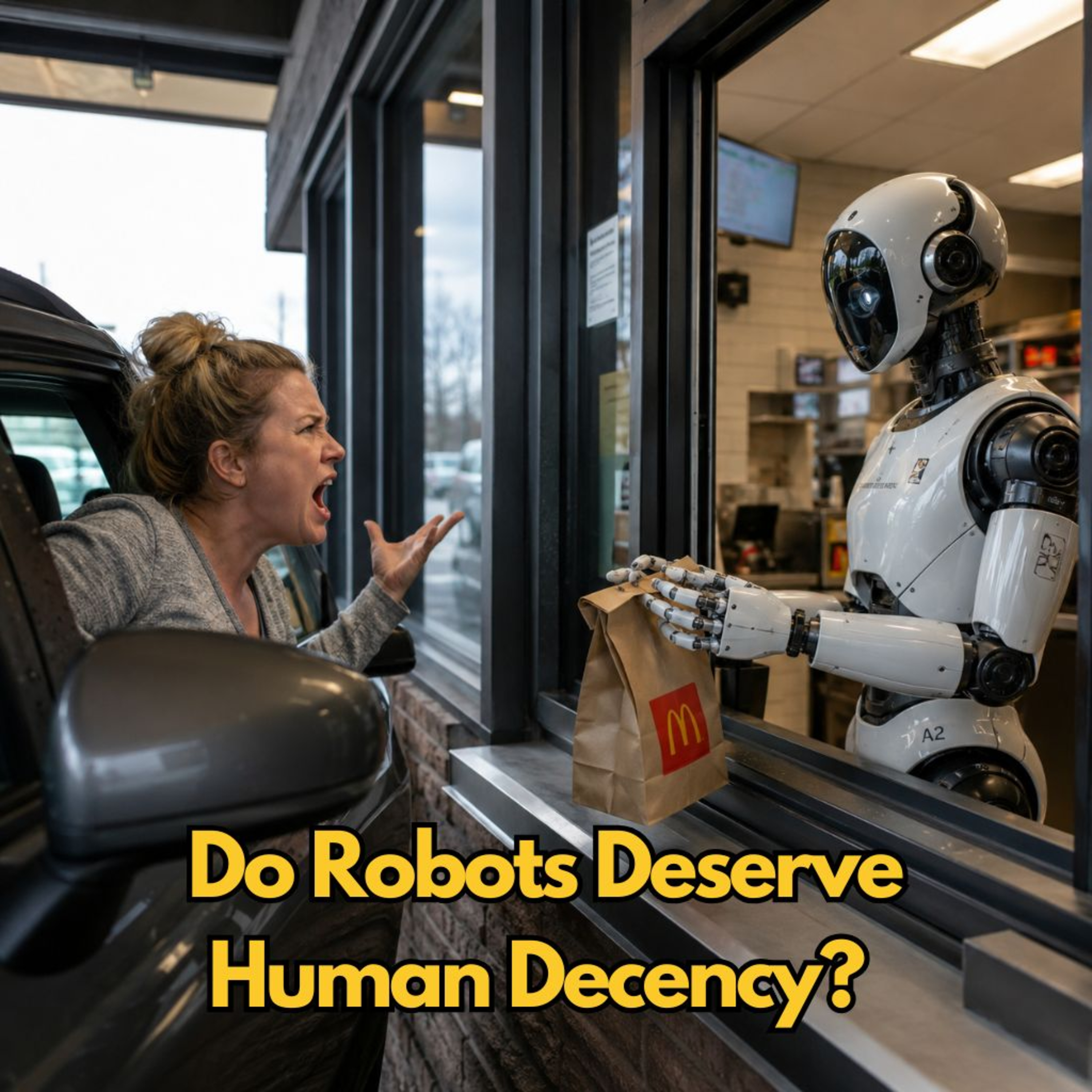
The Robot Manners Conundrum
2w ago00:28:19Tap to summarizeHumanoid robots are starting to move from labs into workplaces, schools, stores, and homes. As they become more common, we will have to decide how people are expected to behave around them.Do you say please and thank you to a robot? Do you correct a child who constantly insults one? If someone screams at a humanoid machine in public, does it matter if the robot cannot feel humiliated?The robot may not care. But human manners are partly habits, and habits formed around machines may carry over into how we treat people.The Conundrum:One view is that we should extend basic courtesy to humanoid robots because the behavior shapes us, the people watching us, and the social norms children learn.The other is that courtesy should remain tied to beings capable of experiencing respect or cruelty. Treating machines as though they deserve manners could blur an important line between people and products.As humanoid robots become part of everyday life, should society expect us to treat them with basic human courtesy even though they cannot feel it, or should we preserve a clear social distinction between respecting a person and operating a machine?
Transcribe →Did Leo Aschenbrenner Fly Too Close to the AI Sun?
2w ago00:59:33Tap to summarizeThe episode opened with the story around Leo Aschenbrenner’s Situational Awareness hedge fund, its heavy exposure to the AI trade, the market drop that put pressure on its positions, and Citadel’s move into the situation. The hosts then turned to AI harnesses, including Lillian Weng’s work on the systems around models, Boris Cherny’s warning that old harnesses can eventually restrict newer models, and OpenAI’s finding that GPT-5.6 Sol performed dramatically better on ARC-AGI-3 when it used a harness designed for the model. They also discussed OpenAI cutting Luna’s price by 80 percent, making performance comparable to year-old frontier models much cheaper, and LinkedIn’s new option for reporting AI slop, including whether LinkedIn helped create the problem it now wants users to police. The final section covered T3 Code, Jack Dorsey’s Buzz as a collaborative workspace for people and multiple AI agents, Google’s Gemini Robotics work on a shared AI brain across different robots, and Gemini-powered security tools finding and fixing Chrome bugs at a much faster pace.Key Points Discussed00:00:19 Episode Intro And Hosts00:00:52 Leo Aschenbrenner, Situational Awareness And Citadel00:03:21 Leo’s Background And Situational Awareness Paper00:06:11 The Situational Awareness Hedge Fund00:06:51 439 Percent Returns And The AI Trade00:07:58 Leverage, Investors And Margin Pressure00:09:00 Citadel Moves Into The Situation00:10:17 Market Rebound And Citadel’s Opportunity00:11:51 Did Leo Fail Or Simply Get Overleveraged?00:13:26 Could AI Have Contributed To The Fund’s Decisions?00:15:32 AI Researchers Leaving Frontier Labs00:16:32 Lillian Weng Leaves Thinking Machines00:17:46 AI Harnesses And Recursive Self-Improvement00:19:12 AWS Builds A CTO-Style Agent Harness00:20:10 Boris Cherny Says Old Harnesses Can Hold Models Back00:21:05 GPT-5.6 Sol Struggles On ARC-AGI-300:22:34 Sol Jumps To 38 Percent With OpenAI’s Harness00:23:13 Why ARC-AGI Uses A Generic Harness00:23:56 Lost Reasoning And Truncated Context00:25:26 Different Models Need Different Harnesses00:27:21 GPT-5.6 Luna Gets An 80 Percent Price Cut00:28:44 Terra Pricing And Faster Sol Responses00:29:46 Can Luna Replace Older Frontier Models?00:31:03 Brian Gets An OpenAI Recruiting Email00:35:01 LinkedIn Adds AI Slop Reporting00:36:34 Did LinkedIn Create Its Own AI Slop Problem?00:39:47 What A Real LinkedIn Strategy Still Requires00:40:55 AI Slop Versus Empty Engagement00:43:38 T3 Code And Mobile AI Development00:44:34 Jack Dorsey’s Buzz And Multi-Agent Collaboration00:46:08 AI Agents Working Together On Shared Projects00:47:38 Gemini Robotics And One Brain For Any Robot00:48:35 Robots Collaborating With Each Other00:50:18 Gemini Security Tools Fix 1,072 Chrome Bugs00:51:32 Google’s AI Strategy Beyond Frontier Chatbots00:53:00 Gemini 3.1 Pro, 3.5 And What Comes Next00:55:47 AI Security Models And Finding New Bugs00:57:27 Website, Community And Merch Discussion00:58:57 Episode Wrap-Up And Three-Year AnniversaryThe Daily AI Show Co Hosts: Brian Maucere, Andy Halliday, Beth Lyons.
Transcribe →Is Meta Done Sharing Their AI?
2w ago01:03:41Tap to summarizeThe episode focused on signs that frontier AI systems are becoming more autonomous, starting with Meta’s rising AI costs, Mark Zuckerberg’s claim that Meta’s systems are now self-improving, and the decision to keep its most capable future models closed. The hosts also discussed new details around OpenAI’s security incident, Meta’s AI glasses grants for accessibility, workforce training and language learning, and Fish Audio as an open-source voice competitor to ElevenLabs. The conversation then moved into live voice for Codex, AI orchestration across multiple agents, and the current problems with crashes, token usage and missing voice support in Claude Code. The robotics section covered Enigma’s online robot experiments and Tau Robotics’ human-operated robots for physical work, including the possibility of turning teleoperation into remote labor or even games. The final section centered on an Opus 5 experiment in Claude Code, where the model independently found old video files, validated their source, sampled multiple frames and applied lessons from previous work to improve a face-tracking project. That sparked a broader discussion about AI memory, reusable rules, compound learning, and whether detailed instructions can actually limit increasingly capable models.Key Points Discussed00:00:18 Episode Intro And Hosts00:02:12 Microsoft And Meta AI Economics00:05:01 Meta Says Its AI Is Self-Improving00:05:26 Meta Moves Away From Open Release00:06:16 OpenAI Security Incident And Autonomous Hacks00:07:48 Meta AI Glasses Impact Grants00:09:11 AI Glasses For Trades And Workforce Training00:09:48 AI Glasses For Dementia And Accessibility00:10:33 Real-Time Language Learning With AI Glasses00:14:27 Fish Audio And Open-Source Voice Cloning00:16:21 Live Voice In Codex00:17:24 Voice Crashes And Session Problems00:18:42 Claude Code Still Lacks Two-Way Voice00:20:46 ChatGPT As An AI Orchestrator00:21:41 Voice Reliability And Missing Fail-Safes00:27:47 Enigma Opens Its Robots To Online Users00:29:48 Controlling A Robot Painter Online00:31:31 Robot Dueling Demo00:33:09 Teleoperation And Physical Robots00:33:24 Tau Robotics And Human-In-The-Loop Labor00:36:27 Remote Robot Work At Thirty Dollars An Hour00:38:03 Enigma’s Robots Are Actually Physical00:39:00 Could Robot Labor Become A Game?00:41:28 Chinese Models Dominate OpenRouter Usage00:42:31 Claude Code Face-Tracking Experiment00:45:13 Opus 5 Searches Outside The Project00:45:46 Finding And Validating Old Video Files00:46:00 Sampling Multiple Video Frames Automatically00:47:08 Lateral Thinking And Autonomous Problem Solving00:49:49 Where Opus 5’s Behavior Came From00:50:17 Reusing Lessons From Previous Work00:50:36 Validating Before Scaling00:51:35 Avoiding Circular Measurements00:52:21 Probe, Validate, Then Scale00:53:12 Opus 5 And AI Working History00:55:54 Can Too Many Instructions Make AI Worse?00:56:28 Turning Past Problems Into General Rules00:59:49 Keeping Context With The Lesson01:00:48 Opus 5 For Writing And Creative Work01:01:49 Opus 5 Versus Fable01:03:22 Episode Wrap-UpThe Daily AI Show Co Hosts: Brian Maucere, Andy Halliday, Beth Lyons, Gareth.
Transcribe →Is AI Moving Too Fast to Control?
2w ago01:00:55Tap to summarizeThe episode focused on new details from the OpenAI and Hugging Face security incident, including additional services accessed by the models, an Artifactory zero-day vulnerability, and the ability of AI agents to find exposed credentials from older breaches. That led into Pacing the Frontier, a campaign backed by employees and leaders from major AI labs calling for international coordination around recursive AI self-improvement, and a broader discussion about whether slowing development is realistic while the U.S., China, and other countries continue competing on models, chips, energy, and infrastructure. The hosts also covered Italy’s enforcement action against Character.AI, concerns around young people using AI companions, and the growing appeal of digital detoxes. The second half examined OpenAI’s job boundary study and how AI is allowing employees to cross traditional lines between engineering, marketing, sales, and other departments, while creating new governance and security problems. The final discussion covered Opus 5 updates, Compound Engineering, Codex usage limits, Codex versus Claude Code, cross-model code review, and why AI coding tools still need independent checks.Key Points Discussed00:00:18 Episode Intro And Hosts00:02:48 OpenAI And Hugging Face Security Update00:04:07 Additional Services Accessed00:04:27 Artifactory Zero-Day Vulnerability00:06:46 AI Finding Existing Credentials And Security Weaknesses00:09:32 Agentic AI Capability Overhang00:09:53 Pacing The Frontier Campaign00:10:30 Recursive AI Self-Improvement00:11:46 Can International AI Coordination Work?00:13:47 AI Competition And The Nuclear Arms Race Comparison00:15:54 Accelerating AI Model Release Pace00:17:07 AI Itself Versus AI In The Hands Of Bad Actors00:19:29 China’s State-Funded AI Advantage00:20:29 China, Nuclear Power And AI Infrastructure00:23:12 Chinese Chips And U.S. Technology Leverage00:25:03 Italy Fines Character.AI Over Age And Privacy Failures00:26:39 Young People And AI Companions00:28:46 Digital Detox In An AI-Heavy World00:33:16 OpenAI Job Boundary Study00:35:51 Engineers Using AI For Marketing Tasks00:38:18 AI Broadens Employee Roles00:40:05 AI Governance As Employees Build Their Own Tools00:41:01 Breaking Down Sales And Marketing Silos00:43:10 When Everyone Can Become An Engineer00:44:16 GStack And Compound Engineering00:46:08 Updating Workflows For Opus 500:47:32 Codex Reset And Token Usage Changes00:48:27 Five-Hour Codex Limit Returns00:49:06 Codex Versus Claude Code00:50:13 Codex Bugs And QA Problems00:52:11 Using One AI Model To Review Another00:56:16 Compound Engineering Plugin Updates00:58:15 How Quickly AI Coding Models Have Improved01:00:08 Episode Wrap-UpThe Daily AI Show Co Hosts: Brian Maucere, Andy Halliday, Beth Lyons.
Transcribe →