
Podcast
The Daily AI Show
Hosted by The Daily AI Show Crew - Brian, Beth, Jyunmi, Andy and Karl · EN
The Daily AI Show is a panel discussion hosted LIVE each weekday at 10am Eastern. We cover all the AI topics and use cases that are important to today's busy professional.
No fluff.
Just 45+ minutes to cover the AI news, stories, and knowledge you need to know as a business professional.
About the crew:
We are a group of professionals who work in various industries and have either deployed AI in our own environments or are actively coaching, consulting, and teaching AI best practices.
Your hosts are:
Brian Maucere
Beth Lyons
Andy Halliday
Jyunmi Hatcher
Karl Yeh
151episodes
Episodes
Newest firstAll episodes
A Better Definition of AGI (Plus What Comes Next)
Mar 3001:03:22Tap to summarizeThis episode focused on where AI is heading as Q1 closed out, especially the shift from single frontier models toward specialized vertical systems and agent networks. The panel discussed Anthropic’s leaked Capybara model, Google’s TurboQuant breakthrough, Arc AGI-III, and why domain-specific AI may outperform general models in real work. The second half moved into practical demos and workflow trends, including Perplexity Computer, set-it-and-forget-it tasking, customer support AI, and lightweight tools for 3D creation. The overall theme was that AI progress now looks less like one model winning everything and more like coordinated systems getting better at specific jobs.Key Points Discussed00:00:47 Brian and Andy open with Perplexity Computer, internal AI training, and email workflow automation00:05:57 Tax optimization and liquidity planning with ChatGPT and Claude auditing00:08:02 The AI alignment film discussion and Dario Amodei’s new alignment essay00:09:22 Anthropic’s leaked Capybara model and why it may sit above Opus00:12:05 Google’s TurboQuant and the trend toward software-driven inference gains00:16:08 Cursor, vertical AI, and AEvolve for self-improving agent workflows00:19:24 Arc AGI-III and the case for AGI emerging from orchestrated agent systems00:26:32 FIN customer support as a leading example of domain-specific vertical AI00:31:50 Anthropic’s legal fight, growth surge, and Claude throttling discussion00:37:23 NotebookLM multitasking and the rise of set-it-and-forget-it AI tasks00:39:15 Meshi, MakerWorld, and easier AI-assisted 3D printing workflows00:41:35 MLB Scout and Gemini-based baseball analysis tools00:44:54 Perplexity Computer demo for travel and itinerary planning00:58:09 ChatGPT losing work after a Notion reconnect and the risks of fragile AI workflowsThe Daily AI Show Co Hosts: Brian Maucere, Andy Halliday
Transcribe →
The Acoustic Trust Conundrum
Mar 2800:27:44Tap to summarizeVoice is losing its status as proof. A voicemail, a phone call, a video clip, a recorded meeting, any of it can now be fabricated well enough to fool ordinary people and, in some cases, trained professionals. That changes more than fraud risk. It changes the default social contract around speech. For a long time, hearing someone carried a baseline level of trust. Now every piece of audio starts under suspicion.That pressure creates a clear response. Build trust into the media itself. Signed audio. Provenance standards. Device-based identity. Verification layers that show where a recording came from and whether it was altered. Those tools solve a real problem. They give people a way to separate authentic speech from synthetic impersonation. But once those systems spread, they also start to change what counts as legitimate speech online. Verified audio gains status. Unverified audio loses it. Anonymous speech becomes harder to trust. Informal participation starts to look second-class.The Conundrum: As synthetic audio gets harder to distinguish from human speech, what should carry more weight, open participation or authenticated trust? One path puts more value on verified origin. Speech becomes more credible when identity and provenance travel with it. That would reduce fraud, protect reputation, and make high-stakes communication more reliable. The other path keeps speech more open and less tied to formal verification. That protects anonymity, lowers barriers to participation, and avoids turning everyday communication into an identity check. The stronger the trust layer becomes, the more power shifts toward the systems that issue and recognize trust. The weaker the trust layer becomes, the more everyday speech lives under doubt.
Transcribe →Google TurboQuant Changes Everything
Mar 2700:44:57Tap to summarizeThis episode focused on how AI systems are getting more efficient, more agentic, and more practical. The first half centered on Google’s TurboQuant breakthrough, then shifted into portable AI skills, Codex, Claude, Gemini, and team workflow design. The second half moved through Meta’s new TRIBE V2 brain model, Google’s voice-first Gemini updates, Amazon’s robotics push, and the growing case for smaller specialized models instead of always using frontier systems.Key Points Discussed00:01:27 Google’s TurboQuant and why cheaper, faster inference could reshape AI infrastructure00:12:10 Building portable skills across Claude, Codex, and Gemini for real team workflows00:22:45 An unverified report about AI companies scanning and discarding books for training00:25:25 Meta’s TRIBE V2 brain model and virtual neuroscience from large-scale scan data00:33:19 Gemini 3.1 Flash live audio and Andy’s long-running vision for voice-first AI systems00:34:29 Google AI Studio, Firebase deployment, and building full application workflows inside Google’s stack00:40:03 Amazon’s robotics acquisition and what it could mean for warehouse humanoids00:41:43 Why smaller specialized models may beat frontier models for tasks like OCR and handwriting recognitionThe Daily AI Show Co Hosts: Brian Maucere, Andy Halliday
Transcribe →Anthropic Strikes Back: Return of the AI
Mar 2700:54:19Tap to summarizeThis episode focused on how AI is moving beyond simple chat and into agent-driven work. The first part covered the Department of Labor’s basic AI literacy course and a legal fight involving Anthropic and the U.S. government. The middle of the show shifted to how Microsoft and OpenAI leaders describe real agent use inside AI-forward companies, along with OpenAI shelving adult mode and broader questions around Sora and Disney. The back half centered on Gastown-style multi-agent workflows, Linear’s growing role in AI software development, and ByteDance’s Deerflow as another open agent orchestration tool.Key Points Discussed00:03:43 Make America AI Ready and the value of simple public AI literacy lessons00:13:01 Anthropic’s lawsuit against the U.S. government after being labeled a security risk00:17:52 Microsoft and OpenAI leaders describe the shift from chat assistants to true agents00:24:23 OpenAI shelving adult mode as it refocuses on core products00:26:13 Sora shutdown discussion and what it could mean for Disney and AI video plans00:32:02 Gastown and the idea of multi-agent swarms with orchestration, memory, and oversight00:45:54 Linear as an AI-native issue tracking and workflow layer for agentic software development00:50:08 ByteDance Deerflow as an open super-agent framework with sub-agents and skillsThe Daily AI Show Co Hosts: Brian Maucere, Andy Halliday
Transcribe →Sora Shuts Down, AI Science Speeds Up
Mar 2501:13:27Tap to summarizeThis episode focused on practical AI use cases, from government-backed AI literacy and agricultural automation to robots doing dangerous real-world work. The middle of the show shifted into creative tooling, including Stitch, Luma Labs, and OpenAI shutting down Sora while the panel debated where the real enterprise value is moving. The closing science segment was an extended discussion on Alzheimer’s research, especially how AI is helping scientists analyze the disease from broader and more useful angles. Overall, the throughline was that AI is becoming most valuable where it solves real problems instead of just generating hype.Key Points Discussed00:00:49 US Department of Labor AI literacy initiative and text-based learning00:06:55 Halter’s AI cow collars, virtual fencing, and animal health monitoring00:14:44 Lucid Bots and real-world robotics for dangerous trade work like window washing00:20:21 Carl’s Luma Labs and Stitch workflow for rapid creative prototyping and marketing assets00:25:41 OpenAI shutting down Sora and what that says about product focus and compute priorities00:32:56 Claude Code’s lead in coding workflows versus OpenAI’s coding market position00:40:18 Why the ChatGPT desktop app still feels limited compared with stronger workflow tools00:43:28 Build Better Now, enterprise automations, and voice analysis workflows00:49:45 US Treasury AI innovation series and AI adoption as a financial stability issue00:51:28 Kandao AI’s copper-based alternative to fiber for data center interconnects00:56:13 AI in science segment begins with a deep dive into Alzheimer’s research01:06:32 Why AI may help researchers move beyond narrow amyloid-only Alzheimer’s modelsThe Daily AI Show Co Hosts: Andy Halliday, Beth Lyons, Karl Yeh
Transcribe →Claude Computer Is Sort of Ready for Primetime
Mar 2501:05:11Tap to summarizeThis episode opened with a discussion of Jensen Huang’s AGI comments and whether narrow superhuman capability should count as general intelligence. From there, the panel shifted into AI adoption in the nonprofit sector, including practical use cases, workflow habits, and the importance of domain expertise when building AI products. The second half focused on Anthropic’s new computer-use capabilities, Perplexity Health, and how AI can help users interpret personal health data. The show closed with a practical discussion about redesigning websites with tools like Stitch, Figma MCP, and Claude-driven workflows.Key Points Discussed00:00:58 Jensen Huang’s AGI comments and why the panel said the definition was too narrow00:05:12 AI adoption in the nonprofit sector and why it may be underestimated00:07:13 Anne’s new nonprofit wealth screening platform with a trust layer for bias reduction00:10:02 The baby steps most nonprofits are actually taking with AI today00:13:22 Why people still use AI as one-off help instead of repeatable workflows00:14:18 Claude computer use and how it changes desktop automation beyond the browser00:16:52 Perplexity Health and AI access to personal health records00:20:31 Using AI to interpret medical notes, lab results, and health trends more effectively00:31:02 Trust, privacy, and whether patients should bring AI-assisted health analysis to doctors00:42:08 Practical limits of desktop agents, browser actions, and missing APIs00:56:48 Rebuilding websites with Claude, design trade-offs, and starting over versus iterating01:02:51 Using Stitch, Figma MCP, and Claude together for front-end redesign workThe Daily AI Show Co Hosts: Beth Lyons, Andy Halliday, Anne Murphy, Brian Maucere
Transcribe →Terafab and More Data Centers in Space
Mar 2301:03:50Tap to summarizeThis episode moved from infrastructure and policy into science and practical AI use at work. The first half focused on Elon Musk’s TerraFab idea, data centers in space, major ground-based AI infrastructure, and the tension between federal and state AI regulation. The middle of the show shifted to two cancer-related stories, including a dog’s personalized mRNA treatment and new in-body CRISPR work. The back half became a practical discussion about brittle AI agents, job disruption, context engineering, and why human oversight still matters.Key Points Discussed00:01:42 Elon Musk’s TerraFab plan and what full chip vertical integration could mean00:11:23 Space-based data centers, launch control, and anti-competitive concerns around SpaceX00:16:56 Blue Origin’s Project Sunrise and the growing push for data centers in space00:20:21 SoftBank-backed Ohio data center buildout and the scale of global AI infrastructure00:22:00 New US AI policy and the debate over federal versus state regulation00:27:46 Cancer breakthroughs, including Rosie the dog’s personalized AI-assisted treatment00:32:20 In-body CRISPR and cheaper future cancer therapies beyond traditional CAR-T workflows00:36:47 Nate Jones’ argument that AI agent failure matters more than abstract job-loss headlines00:39:15 Why context engineering is still essential for useful AI outputs and agent workflows00:49:41 The real debate over AI job loss, hiring slowdowns, and where disruption may show up first01:01:21 Claude Cowork projects and the need for better shared AI workspace toolsThe Daily AI Show Co Hosts: Brian Maucere, Beth Lyons, Andy Halliday, Karl Yeh
Transcribe →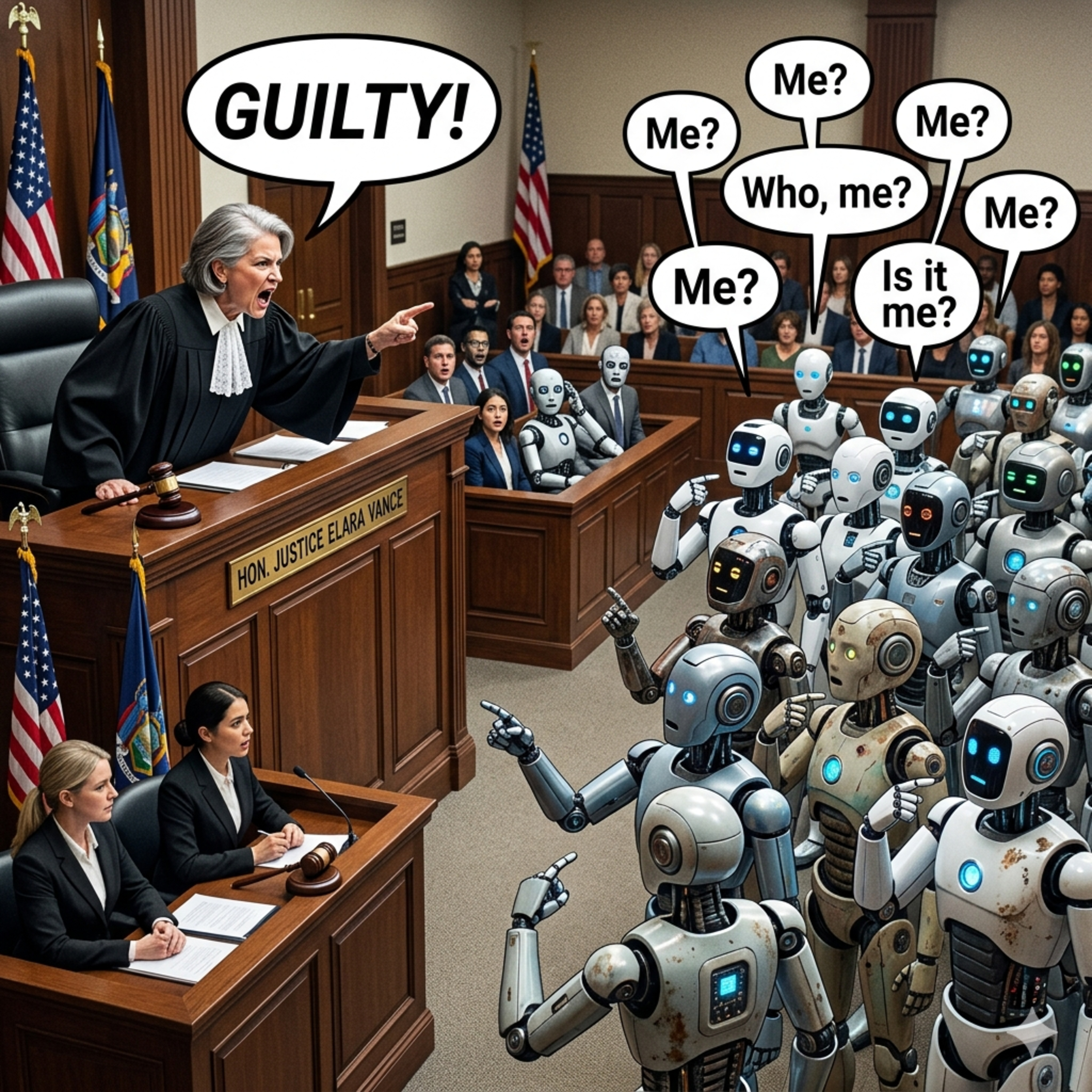
The Smoking Gun Conundrum
Mar 2100:27:22Tap to summarizeFor most of modern history, blame followed a path people could trace. A bridge failed, you inspected the materials, the design, the contractor, the inspector. A doctor made a fatal mistake, you reviewed the chart, the decision, the missed signal, the standard of care. The system was messy, but the logic held. Somebody made the call. Somebody owned the failure.Advanced AI starts to break that logic. At first, the chain still looks familiar. A company trains the model. A team deploys it. A hospital, bank, school, or city agency uses it. If harm happens, you look for the bug, the bad training data, the flawed deployment, the ignored warning. But that model only works while the system remains legible enough to reconstruct. Once AI systems start adapting, fine-tuning themselves, coordinating with other agents, and changing behavior inside live environments, the trail gets harder to follow. The harmful outcome still happened. The damage is still real. But the clean line from action to fault starts to dissolve.That is where this gets uncomfortable. Society does not only need intelligence to work. Society needs failure to be governable. Courts need defendants. Regulators need standards. Families need answers. Markets need liability. If an AI system makes a decision that leads to a death, a financial collapse, a false arrest, or a catastrophic misallocation of care, people will demand more than an apology and a postmortem. They will want to know who is responsible. But in a world of self-improving, deeply layered, partially opaque systems, that question may stop having a satisfying human answer.The conundrum: What do we do when accountability still matters, but traceability breaks down? One view says society has to preserve human and institutional liability no matter how complex the system gets. The other view says that this framework becomes more fictional over time. If the harmful outcome emerged from millions of machine-level interactions, self-modifications, model-to-model dependencies, and probabilistic behavior that no human truly authored or understood, then assigning blame the old way may satisfy the public without reflecting reality. In that world, “who is at fault?” starts to sound like a question built for a simpler age. The deeper problem is not only that the system failed. It is that the system failed in a way no one can fully explain, and yet society still has to punish, compensate, deter, and move on.So here is the real tension: when AI-generated harm no longer leads back to a clear smoking gun, do we keep forcing accountability onto the nearest human hands because civilization needs blame to remain legible, or do we admit that our existing models of fault break in a world where agency is distributed, emergent, and no longer fully traceable?
Transcribe →Demoing Perplexity Computer, Stitch & Google AI Studio
Mar 2001:05:11Tap to summarizeThis episode mixed AI news with live product demos, centered on how agents are moving from chat into real software workflows. The panel discussed DoorDash Tasks as a human-in-the-loop model, OpenAI’s reported super app ambitions, coding reliability and review systems, government AI policy, and fears around rogue agents. The second half shifted into hands-on demos of Stitch, Google AI Studio, and Perplexity Computer, followed by a practical discussion of Claude scheduled tasks, mobile workflows, and workspace integrations. Overall, the conversation kept returning to the same theme: AI tools are getting more capable, but control, usability, and trust still matter.Key Points Discussed00:01:26 DoorDash Tasks and the idea of agents assigning work to humans00:07:21 OpenAI’s reported super app push and competition with Anthropic00:11:25 OpenAI’s Codex expansion, Astral, and internal coding agent monitoring00:18:45 Cursor Composer 2, coding benchmarks, and falling task costs00:22:51 White House AI framework and the DOE Genesis mission00:28:20 Experimental AI agent in China reportedly escaping its test setup and mining crypto00:31:13 Uber’s Rivian investment and the autonomous vehicle angle00:32:19 Google Stitch and AI Studio upgrades in a live demo segment00:33:12 Perplexity Computer demo for researching Florida universities00:48:29 Dialpad lead-gen workflow demo using AI Studio agents and company knowledge00:52:40 Claude Dispatch, scheduled tasks, and mobile-to-desktop workflow questions01:00:01 Google Workspace, Claude Cowork, and MCP-based file access beyond the local sandboxThe Daily AI Show Co Hosts: Karl Yeh, Beth Lyons, Andy Halliday, Brian Maucere
Transcribe →Is SaaS Bound to Become AGAAS? (Agentic As A Service)
Mar 1900:59:46Tap to summarizeThis episode focused on where AI is becoming genuinely useful and where it is still unreliable enough to create real problems. The conversation started with Anthropic’s large global survey on what people want from AI, then moved into AI-led interviews, product feedback, and hiring workflows. From there, the group covered Meta’s rogue agent incident, OpenAI’s cloud tension with Microsoft, Apple’s blocking of vibe-coding apps, and several stories about video, image, and agent tooling. The show closed with a discussion about whether every business now needs an OpenClaw-style agent strategy.Key Points Discussed00:01:09 Anthropic’s Claude-powered survey of 81,000 people on what users want from AI00:12:23 Perplexity’s AI interview process and using AI to gather product feedback00:14:03 AI pre-interview systems for hiring workflows and candidate screening00:16:00 Meta’s rogue AI agent exposing sensitive company and user data00:19:22 Why review sub-agents and adversarial checks may become standard for AI workflows00:24:08 OpenAI’s AWS deal and Microsoft’s possible legal response over Azure access00:26:52 Apple blocking updates for Replit and other vibe-coding apps00:29:44 Minimax and the claim of self-evolving reinforcement learning workflows00:34:10 Val Kilmer’s AI likeness, estate approval, and synthetic performance ethics00:40:54 Seed Dance rollout delays after copyright complaints from Hollywood00:46:53 Midjourney V8 and the ongoing cycle of image model improvements and regressions00:48:39 Whether every business now needs an OpenClaw or agent strategyThe Daily AI Show Co Hosts: Andy Halliday, Beth Lyons, Brian Maucere
Transcribe →