← The Daily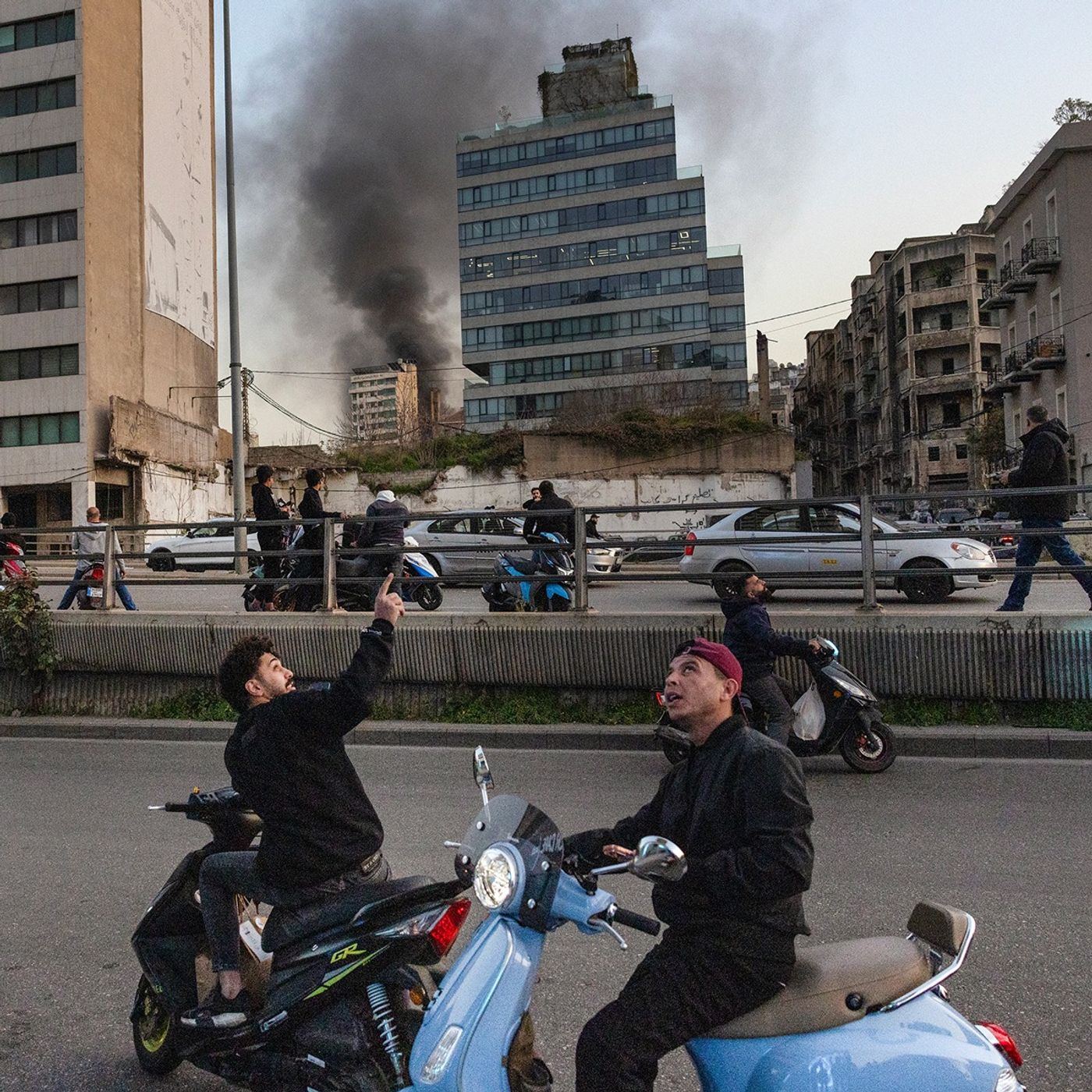
The Daily
A War Within the War: Israel’s Bombardment of Lebanon
00:25:58
With the world’s attention on the U.S.-Israeli war with Iran, a second front in the conflict has opened in Lebanon. Israel has pummeled an area in the southern outskirts of Beirut where Hezbollah holds sway, as well as southern Lebanon, with airstrikes, displacing almost one million people. Israel has also expanded its assault into other parts of Beirut, the capital. Christina Goldbaum, The New York Times’s bureau chief in Beirut, explains how the crisis in Lebanon connects to the broader war, what Israel hopes to achieve and what people in Lebanon fear might come next.
Loading summary
Transcript57 lines
- [00:00]
Podcast Sponsor/Announcer
This podcast is supported by nrdc, the Natural Resources Defense Council. The Trump administration just carried out the largest environmental rollback in American history. They eliminated the endangerment, finding a core scientific and legal foundation for tackling climate pollution. This is illegal and NRDC is suing to stop them. For a short time. Listeners of the Daily will have their gift matched to support their legal challenge. Go to nrdc.org daily from the new
- [00:31]
Rachel Abrams
York Times, I'm Rachel Abrams and this is the Daily Breaking news. Israel saying it is now expanding operations in Lebanon with the world's attention on the US Israeli war with Iran. Over the last two weeks, a second front has opened in Lebanon, the target of those strikes, a Hezbollah stronghold. The IDF says it's hitting sites linked to the group, which is backed and fund by Iran. Israel has pummeled southern Lebanon and southern Beirut with airstrikes, displacing almost a million people. And it's expanded its assault into other parts of the capital.
- [01:10]
Christina Goldbaum
I carried the children quickly and we left towards the airport road. People were like ants, like Judgment Day. It was like Judgment day.
- [01:19]
Rachel Abrams
One man, his wife and four young children have fled a few miles north to safer ground. Like many families, they'll spend the night on the streets watching the strikes at a distance. Today, Beirut bureau chief Christina Goldbaum explains how the crisis in Lebanon connects to the broader war, what Israel hopes to achieve and what the Lebanese people fear may come Next. It's Monday, March16. Christina, since the war with Iran began, I think it's been clear that there has been sort of this second front emerging in Lebanon. It started when Hezbollah, the Iranian backed militia group that's based in Lebanon, lobbed missiles at Israel. Israel lobbed missiles back. The two sides have traded fire for days now and that is not in and of itself an unfamiliar scenario. Right. But things have really escalated. And you are based in Beirut. You are the Beirut bureau chief for the New York Times. And so I'd like for you to paint a picture for our audience of what the last few days have looked like on the ground.
- [02:33]
Christina Goldbaum
So what we've seen over the last two weeks is what feels like the beginnings of another major war in the country. Nowadays when you're walking through Beirut, there is this acrid smell in the air from all of the airstrikes in and around the city. And you have the sound of Israeli drones overhead head, this loud buzzing that's been a near constant over the last two weeks. In certain parts of the city, life feels very normal, kind of untouched by the war, buildings intact. But in Other parts of the city, walking around, you can see this mass displacement that has happened. You see people putting up kind of makeshift tents out of tarps and out of gray blankets that people have set up in parking lots on the seaside corniche, on sidewalks and in parks and living there because there isn't room in the schools that the government has turned into shelter. In the Dahya, in these southern suburbs, where Hezbollah holds a lot of sway, a lot of buildings there have been just completely cratered in this bombardment by Israel. And in the last couple of days, it felt like it escalated even more when Israel started targeting buildings and cars within central Beirut itself and also issuing evacuation orders for buildings in central Beirut. You have guys who are shooting weapons up in the air to warn people to get out, and massive crowds of people trying to get out of those buildings, get out of street, get out of the way before these strikes hit. So there's very much now a sense even in Beirut, that this conflict is escalating, that fewer and fewer places in the city that once felt safe are still safe. And also just the scale of this is already huge. I mean, over a million people have been displaced so far. That's in a country of 5.8 million people total. And you have more than 800 people who've been killed in Israeli strikes so far. So now there is just this kind of tenseness here where people are really coming to terms with the fact that the country is, yet again, in less than two years, being dragged into another major war.
- [04:37]
Rachel Abrams
Cristina, can you give us a sense of why this feels different than previous campaigns that Israel has waged in Lebanon, even As recently as 2024?
- [04:47]
Christina Goldbaum
I think what makes this different is the fears now that there is going to be a major Israeli ground invasion, which is something that the country has not seen since the 1980s. There has been this massive buildup of troops on the Israel side of the border. And the rhetoric that we're hearing from Israeli officials is increasingly suggesting that they also view this war as something different. The Israeli defense Minister compared the southern suburbs of Beirut to Khan Younis, saying that that's what it will soon look like. That's the city in Gaza that was completely destroyed. And he also said recently that if the Lebanese government cannot prevent Hezbollah from firing on Israel, then Israel will take it upon itself to do so in Lebanese territory. And so that's obviously an escalation of rhetoric that has people here very on edge and feeling like this is going to be something bigger than what we saw the last time around.
- [05:43]
Rachel Abrams
I believe the defense minister, I think I saw comments from him saying that he wanted to basically flatten large swaths of southern Beirut. He was naming individual cities.
- [05:51]
Christina Goldbaum
Yes, he said that about Dahya, this cluster of neighborhoods in the southern edge of the city. The other thing we've seen that makes this feel like it's going to be much bigger is that for the first time, we didn't see this in 2024, but for the first time, Israel has issue sweeping evacuation orders for all of the southern suburbs of Beirut, as well as a huge swath of territory in southern Lebanon that extends as far as 25 miles from the border. That's something that we did not see in the war in 2024.
- [06:20]
Rachel Abrams
Obviously, there's a war going on with Iran right now. What is the relationship between this war in Lebanon and that wider conflict?
- [06:28]
Christina Goldbaum
So after the war in Iran began, Hezbollah then fired on Israel in retaliation, it said, for the kill of Ayatollah Ali Khamenei there. Israel then struck back and started firing on Lebanon in the south, in the east, and in the southern parts of Beirut. And what everyone understood was that Israel was kind of taking this attack by Hezbollah as an opportunity to do what they have wanted to do for so long, which is for once and for all, take out Hezbollah. And so what we're seeing right now is essentially kind of a war within a war. The second front that is actually a much bigger war for Lebanon and feels much more consequent for this country.
- [07:09]
Rachel Abrams
So just to be clear, Hezbollah started this conflict in solidarity with Iran and it has spiraled from there.
- [07:15]
Christina Goldbaum
That's right. And it's important to note that this kind of took a lot of people here by surprise. Very few people thought that Hezbollah would get involved in this conflict.
- [07:24]
Rachel Abrams
Obviously, Israel has been at odds and in conflict with Lebanon and Hezbollah for many, many years. Can you just give us a brief history of that back and forth?
- [07:35]
Christina Goldbaum
Sure. So this dates back to the 1980s. And to set the scene a little bit, you know, at that time, Lebanon is in the midst of this civil war. You have Palestinian groups in southern Lebanon that are launching attacks on Israel. And then in 1982, Israel launches this large scale invasion of southern Lebanon, getting as far as the capital, Beirut, and then occupying the south for, I mean, nearly 20 years. And it was within that context in the 1980s that Hezbollah came to be. It emerged as this Shiite militant and political movement that was dedicated to what it described as resisting Israeli presence in Lebanon. And it had the backing of the vanguard of Shia Islam in the Region, Iran. And so throughout that period of Israeli occupation in the south, Hezbollah militants were fighting with Israeli forces. And eventually when Israel withdrew from Southern Leb in 2000, it was seen as this major victory for Hezbollah. And with that, it started to expand its political influence while also keeping its armed wing. So for years after that, you know, tension was still very high along the border between the two. There were periodic clashes, but then in 2023, we saw this much larger escalation between the two. So in October 2023, Hezbollah launched rockets at Israeli positions in solidarity with Hamas, another Iran backed group which had just
- [09:12]
Rachel Abrams
attacked Israel in the October 7 attacks.
- [09:14]
Christina Goldbaum
Of course, that's right. And that escalated into a major conflict. I mean, Israel bombarded much of the south and eastern Lebanon as well as Beirut. It exploded thousands of pagers carried by Hezbollah members, and it killed Hassan Nasrallah, the longtime leader of Hezbollah, in what was a major blow to the group.
- [09:34]
Rachel Abrams
I think for the last year, a lot of people have had the impression that because of all of those events, the killing of Nasrallah, the pager incident, the attacks by Israel, that Hezbollah had been severely weakened. Right. So if Hezbollah has been severely weakened, why would Israel need to go after them so hard right now if presumably they pose less of a threat?
- [09:55]
Christina Goldbaum
I think what we're seeing right now is Israel really seizing on this moment where a lot of eyes are on the war in Iran. The country's feeling emboldened by its partnership with the United States, feeling its own military strength, and it senses this kind of weakness. And it's too, you know, fiercest adversaries because Hezbollah was always the strongest among Iran's proxies. We also know from, you know, reporting out of our Jerusalem bureau that this Israeli offensive in Lebanon has been months in the making. And Israel was essentially just waiting for the opportunity for Hezbollah to fire on Israel to attack in order to carry out these long laid plans. And I think it's important to note that while the kind of going narrative over the last year was that Hezbollah has been battered, what we're seeing now is proof that they're still able to mount a fight even if they are severely weakened. We're seeing that they've been able to manufacture and locally assemble arms within Lebanon to replenish its we stockpile. And even after, you know, their senior military ranks were wiped out during the war, what we've also seen now is how members of Iran's Islamic Revolutionary Guard Corps, the irgc, appeared to come into the country to replenish those ranks and take even greater control of Hezbollah's military arms. And we've seen proof of that over the past two weeks already. At least two Israeli soldiers have been killed and more than a dozen injured. So there is this sense now that even though over the last, Hezbollah has not appeared to be very militarily strong, while it hasn't responded to the near daily airstrikes by Israel that have happened despite the ceasefire, that in fact it was using the past year to in part rebuild and prepare for this major conflict that it too expected would happen with Israel.
- [11:47]
Rachel Abrams
Given all of that, if Israel's goal is to finally take out Hezbollah's ability to operate and just maybe completely wipe them out once and for all, and is that actually possible in this moment?
- [11:59]
Christina Goldbaum
So this has been a long time project of Israel for decades now, and so far Israel has not been able to disarm or eliminate the group. But I think what we're seeing is Israeli officials seeing a moment to seize on when they could finally take out this group that has for decades posed a threat to Israel. But all of the challenges that have existed over the last several decades when it comes to Israel's aim of disarming Hezbollah are still there. So this is still a very complicated endeavor.
- [12:40]
Rachel Abrams
We'll be right back.
- [12:50]
Podcast Sponsor/Announcer
This podcast is supported by Edison Electric Institute. Behind every moment, there's a team working to make it happen. Deepening connections, strengthening the energy grid, and preparing for tomorrow. We are America's electric companies and our commitment is simple. Provide energy as affordably as possible, build a stronger tomorrow, and deliver for the people who depend on us, America's electric companies, the energy of every day.
- [13:19]
Christina Goldbaum
Ever feel like you're too busy worrying about making money to actually save money? What you need is a friend. A big financial friend. Experian, your BFF could help you save over 300 bucks. Here's how. On the Experian app, you can see your monthly subscriptions. Then any you don't want, Experian can cancel them for you. Get started with the Experian app and
- [13:38]
Experian/Midi Health Advertiser
find out how much you could save.
- [13:39]
Christina Goldbaum
Results will vary. Not all subscriptions eligible. Savings not guaranteed $306 a year average savings with one cancellations paid. Membership with connected payment required. See experian.com for details.
- [13:48]
Experian/Midi Health Advertiser
Experian this podcast is supported by Midi Health. Are you in midlife? Feeling dismissed and unheard by the healthcare system? You're not alone. For too long, women's midlife health issues have been trivialized and ignored. It's time for a change. It's time for Midi MIDI is the only women's telehealth brand covered by major insurance companies. Making expert care accessible and affordable. MIDI's clinicians provide one on one consultations where they truly listen to your unique needs needs offering data driven solutions tailored for you. At MITI, you'll feel seen, heard and prioritized. Visit joinmitty.com to book your insurance covered virtual visit. That's joinmitty.com Mitti the Care Women deserve
- [14:27]
Rachel Abrams
so Christina, you explained that Israel would face all of these challenges in its quest to take out Hezbollah. But this time the circumstances are different enough that at least Israeli officials seem to think that they might have more of a chance. Can you just explain why they think that?
- [14:44]
Christina Goldbaum
So I think first off, you have to keep in mind that yes, Hezbollah is an Iran backed militant group, but it's also a very strong political and social movement that is embedded in Lebanese society here, especially among the Shia community, which is about a third of the country. And for decades it has essentially had the Lebanese government in a chokehold where no political decisions could be made without its support. So it most powerful political party in the country, it holds seats in Lebanon's parliament and it also runs this vast network of social services that its supporters benefit from, like schools and hospitals. And it employs tens of thousands of people within that network. So it does hold this immense sway in Lebanese society. A lot of people have described it as being like a state within a state.
- [15:35]
Rachel Abrams
I visited Beirut a few years ago and one thing that really stood out to me was all of the Hezbollah flags, hezboll shirts, Hezbollah merchandise that you could purchase, particularly in the south of Lebanon where Hezbollah obviously has a huge presence. And it really hit home this idea that Hezbollah, in a way that perhaps Americans or people outside of the country can't fully appreciate it, is this political party. It is fully embedded in the population. I had a friend say to me that if his mother's car broke down, he hoped it would be in a Hezbollah neighborhood because those are the folks that are more likely to help.
- [16:10]
Christina Goldbaum
That's right. But now we're also beginning to see that loyal base of support tested like it hasn't been before and more tired than it's been before. A lot of people who have been displaced, the vast majority are people who are in areas that are more sympathetic to Hezbollah. So it means that a lot of Hezbollah supporters are the ones that have been shouldering the burdens of these wars over the last two years. The one thing that they keep telling me is how exhausted they are, how after the last war in 2023, 2024, and then this one. They're tired of evacuating from their homes. They're tired of living in shelters. They're tired of their towns and villages, especially in the south, being flattened by airstrikes. They're tired of rebuilding homes only to now worry that they're going to get demolished again. So I think we're starting to see this very new feeling right now. For ages, there's been this kind of fervent ideological zeal within Hezbollah's support base to resist Israel at any cost. And Hezbollah still does command a lot of support and can turn out massive crowds, especially in Beirut. But right now, we're starting to see that commitment give way to this kind of wariness of war and also to just some people that are questioning why Hezbollah chose to become involved in this war, why they chose to fire on Israel only after the killing of a foreign leader, Ayatollah Khamenei, and not over the last year when Lebanese have been killed in Israeli airstrikes.
- [17:51]
Rachel Abrams
It sounds like what people are telling you is that increasingly they are maybe for the first time questioning Hezbollah, questioning their support for Hezbollah. And that feels quite new.
- [18:02]
Christina Goldbaum
Yes, that's right. In one of the shelters that we went to. Can you tell us her name and age? I actually ran into a nurse who I had met during the last war, in 2024 in a hospital in the southern city of Nabatiya from Nabatiyeh. And when did you leave Nabatiya? And at that time, she was dealing with this influx of people who were injured in Israeli strikes. And now with this war, she's been displaced from Nabatiyeh to Beirut. And my colleagues and I sat with her and her family, and we were talking about this very question. What are the costs of these wars? Are these wars worth it? And they were debating among themselves whether Hezbollah remains their main defender, because keep in mind, you know, as Israeli forces have moved into the south, the Lebanese army is pretty much nowhere to be found. On the other hand, they're also wondering if actually, because Hezbollah has now dragged the country into war twice in two years, whether that is still the case, whether they are still able to defend the Shia community, and whether the cost the Shia community is bearing is worth it.
- [19:15]
Rachel Abrams
If the Lebanese government is so dysfunctional, what is their capacity to help their own people? And what is their relationship to Hezbollah? What do they want from Hezbollah in this moment?
- [19:27]
Christina Goldbaum
So this has been the main topic of political conversation in Lebanon over the last year, because in that Time, the country has kind of reached this political tipping point. After the ceasefire in 2024, there was this kind of sea change here where the Lebanese government agreed for the first time ever, to begin a process of disarming Hezbollah. Now, of course, over the past year, we've seen the many, many challenges that come with trying to do so. The Lebanese military is weak. You know, its soldiers are underpaid. It is not terribly well equipped. So in many ways, it is outmatched by Hezbollah. And at the same time, there is this fear that if the government moves too quickly and too decisively, it could lead to a clash between Lebanese soldiers and Hezbollah fighters. And that here is a recipe for.
- [20:19]
Rachel Abrams
I wonder what the point of all of this is then, with Israel saying that it's going to take out Hezbollah. Like, is that kind of the equivalent. This is a super imperfect comparison, but the equivalent of the US Saying it's going to take out the Taliban, just in terms of one country saying it's going to take out this heavily armed, embedded group in another country. That doesn't, for many reasons, seem realistic. Like, I just sort of wonder if this is Israel kind of doing what it's always done with Hezbollah, which is basically periodically crippling them, but not actually totally destroying them.
- [20:48]
Christina Goldbaum
I mean, that's the rhetoric we've heard, right? Is this idea that Israel wants to completely eliminate the threat from Hezbollah. But I think what a lot of people here see is this major buildup of Israeli military forces along the border, on the Israeli side of the border, and that has made people here in Lebanon extremely concerned about the possibility of a massive Israeli ground invasion of southern Lebanon and possible occupation of a large swath of southern Lebanon, essentially creating a new, much larger buffer zone with Israel. Now, that, of course, has brought up a lot of concerns within Lebanon of mass displacement, because we've already seen more than a million people displaced from their homes from this conflict. And also this possibility that Israel would reoccupy southern Lebanon just feels like this repeat of history here. And it's coming at a time when these memories of the civil war, of the last occupation are still seared into people's minds here.
- [21:46]
Rachel Abrams
And I can imagine for Israel, though, the creation of that buffer zone in southern Lebanon, buffer zone, maybe, AKA occupied territory, would be a win politically for Netanyahu. Right. Like, even if he doesn't oust Hezbollah completely, he may still end up with a swath of land in southern Lebanon that achieves at least some of his political goals.
- [22:07]
Christina Goldbaum
Yeah, you could imagine that as part of this calculation, how should we think
- [22:11]
Rachel Abrams
about the United States role here? Obviously, they're heavily involved in the conflict with Iran, but what, what is their stance on Israel's action in Lebanon?
- [22:21]
Christina Goldbaum
So typically, the US has tried to temper Israel's efforts to take out Hezbollah because of these fears of it spiraling into a larger war and destabilizing the region. It's the same reason why we haven't seen Israel involved in a war with Iran like this before. But we're seeing that that's beginning to change now. The US has essentially allowed Israel to carry out this bombardment of Lebanon, and it' been putting an immense amount of pressure on the Lebanese government to act more decisively to disarm Hezbollah, to declare the group a terrorist group and take a much tougher stance against Hezbollah, despite the concerns from Lebanese officials that doing so could be very destabilizing for the country.
- [23:07]
Rachel Abrams
So basically, whereas the United States has been a check on Israel's actions in Lebanon in the past, at least to some degree, that check seems to have disappeared or dissipated.
- [23:18]
Christina Goldbaum
Yeah, at least so far, that's what we've seen. I think we're still waiting to see as this war escalates, whether the US Decides to step in and try to rein Israel back in.
- [23:28]
Rachel Abrams
So Christina, just stepping back, should we think about this war in Lebanon as part of the larger war with Iran? How are you thinking about how they're connected?
- [23:37]
Christina Goldbaum
So sure. I mean, on the one hand, the two are clearly connected, right. Hezbollah is an Iran backed militant group. It fired on Israel in response to the killing of an Iranian leader. And in a lot of ways, what we're seeing now is the kind of epitome of Iran's axis of resistance. Right. Hezbollah firing on Israel, coordinating their rocket attacks on Israel with Iran trying to create a second front in this war. And more and more, some of these missiles and rockets are beginning to get through and hit Israeli territory.
- [24:06]
Rachel Abrams
Christina, what do you see as the possible outcomes in this conflict in Lebanon, both in the short term and also in the long term?
- [24:15]
Christina Goldbaum
So Hezbollah is trying to inflict as much pain and as many casualties as they can on Israeli forces in order to change the political cost for Israel to continue to engage in this war? We've already seen that Hezbollah has killed two Israeli soldiers and injured more than a dozen others. But at the same time, there is this growing sense here that this war will last much longer than the Iranian war. People are afraid that when the war in Iran ends, Israel is going to turn its attention to Lebanon and focus its military capabilities here. And also even just in the last couple of days, there are these new fears as people see similarities in the messaging from Israeli officials in Gaza and in Lebanon. The Israeli military has issued these sweeping evacuation orders for much of southern Lebanon, which is similar to what we saw in Gaza the other day. Israeli warplanes were dropping leaflets over central Beirut calling on people to disarm Hezbollah and talking about a, quote, new reality in Lebanon. And Israeli officials have said they believe Hezbollah is using ambulances and civilian trucks to move weaponry and started to hint that those two would no longer be off limits. So these eerie similarities are starting to create a new fear in Lebanon that Israel's aims in this war are much more permanent than in previous ones.
- [25:42]
Rachel Abrams
It sounds like the Lebanese, not without some reasons, are concerned about another protracted deadly conflict.
- [25:47]
Christina Goldbaum
Yeah. So this is creating the prospect of more clashes with Hezbollah, more displaced people and more civilian casualties for years and years to come.
- [26:02]
Rachel Abrams
Christina Goldbaum, thank you so much.
- [26:04]
Christina Goldbaum
Thanks for having me.
- [26:12]
Rachel Abrams
We'll be right back.
- [26:17]
AG Sulzberger
This is AG Sulzberger. I'm the publisher of the New York Times. I oversee our news operations and our business. But I'm also a former reporter who has watched with a lot of alarm as our profession has shrunk and shrunk in recent years. Normally in these ads we talk about the importance of subscribing to the Times. I'm here today with a different message. I'm encouraging you to support any news organization that's dedicated to original reporting. If that's your local newspaper, terrific. Local newspapers in particular need your support. If that's another national newspaper, that's great too. And if it's the New York Times, we'll use that money to send reporters out to find the facts and context that you'll never get from AI that's it. Not asking you to click on any link. Just subscribe to a real news organization with real journalists doing firsthand fact based reporting. And if you already do, thank you.
- [27:21]
Rachel Abrams
Here's what else you need to know. Today, Iran's Foreign Minister, Abbas Arakchee said that the country was not ready to hold talks with the United States.
- [27:30]
Christina Goldbaum
We never asked for a ceasefire and we have never asked even for negotiation.
- [27:36]
Rachel Abrams
Iraqi's comments directly contradict an interview President Trump gave just one day earlier, during which he said that Iran, quote, wants to make a deal. And the US Embassy in Baghdad has urged Americans to leave Iraq immediately after it was attacked for the second time since the war with Iran started. The warning said militias aligned with Iran had carried out numerous attacks on targets associated with the United States, including diplomatic facilities, American companies, and hotels frequented by foreigners. The alert comes after Americans all over the region have complained that the Trump administration was not providing enough assistance to citizens stranded in evacuation zones. Today's episode was produced by Jessica Chung, Mary Wilson, Rachelle Bonga and Olivia Natt. It was edited by MJ Davis Lynn with help from Paige Cowett, and contains music by Dan Powell, Alicia Ba? Itub and Rowan Demisto. Our theme music is by Wonderly. This episode was engineered by Alyssa Moxley. That's it for the Daily I'm Rachel Abrams. See you tomorrow.
- [29:04]
Christina Goldbaum
Momento. Se no frecido porriquea encuentren subas interior ordenando suropa interior.